EP2604127A2 - Pflanzliches Ersatzprodukt für Joghurt - Google Patents
Pflanzliches Ersatzprodukt für Joghurt Download PDFInfo
- Publication number
- EP2604127A2 EP2604127A2 EP12364006.2A EP12364006A EP2604127A2 EP 2604127 A2 EP2604127 A2 EP 2604127A2 EP 12364006 A EP12364006 A EP 12364006A EP 2604127 A2 EP2604127 A2 EP 2604127A2
- Authority
- EP
- European Patent Office
- Prior art keywords
- substitute
- water
- product
- yoghurt
- temperature
- Prior art date
- Legal status (The legal status is an assumption and is not a legal conclusion. Google has not performed a legal analysis and makes no representation as to the accuracy of the status listed.)
- Withdrawn
Links
Images




Classifications
-
- A—HUMAN NECESSITIES
- A23—FOODS OR FOODSTUFFS; TREATMENT THEREOF, NOT COVERED BY OTHER CLASSES
- A23C—DAIRY PRODUCTS, e.g. MILK, BUTTER OR CHEESE; MILK OR CHEESE SUBSTITUTES; PREPARATION THEREOF
- A23C11/00—Milk substitutes, e.g. coffee whitener compositions
- A23C11/02—Milk substitutes, e.g. coffee whitener compositions containing at least one non-milk component as source of fats or proteins
- A23C11/10—Milk substitutes, e.g. coffee whitener compositions containing at least one non-milk component as source of fats or proteins containing or not lactose but no other milk components as source of fats, carbohydrates or proteins
- A23C11/103—Milk substitutes, e.g. coffee whitener compositions containing at least one non-milk component as source of fats or proteins containing or not lactose but no other milk components as source of fats, carbohydrates or proteins containing only proteins from pulses, oilseeds or nuts, e.g. nut milk
- A23C11/106—Addition of, or treatment with, microorganisms
-
- A—HUMAN NECESSITIES
- A23—FOODS OR FOODSTUFFS; TREATMENT THEREOF, NOT COVERED BY OTHER CLASSES
- A23G—COCOA; COCOA PRODUCTS, e.g. CHOCOLATE; SUBSTITUTES FOR COCOA OR COCOA PRODUCTS; CONFECTIONERY; CHEWING GUM; ICE-CREAM; PREPARATION THEREOF
- A23G9/00—Frozen sweets, e.g. ice confectionery, ice-cream; Mixtures therefor
- A23G9/32—Frozen sweets, e.g. ice confectionery, ice-cream; Mixtures therefor characterised by the composition containing organic or inorganic compounds
- A23G9/36—Frozen sweets, e.g. ice confectionery, ice-cream; Mixtures therefor characterised by the composition containing organic or inorganic compounds containing microorganisms or enzymes; containing paramedical or dietetical agents, e.g. vitamins
- A23G9/363—Frozen sweets, e.g. ice confectionery, ice-cream; Mixtures therefor characterised by the composition containing organic or inorganic compounds containing microorganisms or enzymes; containing paramedical or dietetical agents, e.g. vitamins containing microorganisms, enzymes
-
- A—HUMAN NECESSITIES
- A23—FOODS OR FOODSTUFFS; TREATMENT THEREOF, NOT COVERED BY OTHER CLASSES
- A23L—FOODS, FOODSTUFFS OR NON-ALCOHOLIC BEVERAGES, NOT OTHERWISE PROVIDED FOR; PREPARATION OR TREATMENT THEREOF
- A23L11/00—Pulses, i.e. fruits of leguminous plants, for production of food; Products from legumes; Preparation or treatment thereof
- A23L11/60—Drinks from legumes, e.g. lupine drinks
- A23L11/65—Soy drinks
-
- A—HUMAN NECESSITIES
- A23—FOODS OR FOODSTUFFS; TREATMENT THEREOF, NOT COVERED BY OTHER CLASSES
- A23L—FOODS, FOODSTUFFS OR NON-ALCOHOLIC BEVERAGES, NOT OTHERWISE PROVIDED FOR; PREPARATION OR TREATMENT THEREOF
- A23L7/00—Cereal-derived products; Malt products; Preparation or treatment thereof
- A23L7/10—Cereal-derived products
- A23L7/104—Fermentation of farinaceous cereal or cereal material; Addition of enzymes or microorganisms
-
- A—HUMAN NECESSITIES
- A23—FOODS OR FOODSTUFFS; TREATMENT THEREOF, NOT COVERED BY OTHER CLASSES
- A23L—FOODS, FOODSTUFFS OR NON-ALCOHOLIC BEVERAGES, NOT OTHERWISE PROVIDED FOR; PREPARATION OR TREATMENT THEREOF
- A23L11/00—Pulses, i.e. fruits of leguminous plants, for production of food; Products from legumes; Preparation or treatment thereof
- A23L11/05—Mashed or comminuted pulses or legumes; Products made therefrom
- A23L11/07—Soya beans, e.g. oil-extracted soya bean flakes
-
- A—HUMAN NECESSITIES
- A23—FOODS OR FOODSTUFFS; TREATMENT THEREOF, NOT COVERED BY OTHER CLASSES
- A23V—INDEXING SCHEME RELATING TO FOODS, FOODSTUFFS OR NON-ALCOHOLIC BEVERAGES AND LACTIC OR PROPIONIC ACID BACTERIA USED IN FOODSTUFFS OR FOOD PREPARATION
- A23V2002/00—Food compositions, function of food ingredients or processes for food or foodstuffs
Definitions
- the present invention relates to a seed-based product, excluding soybean seed and water, fermented by lactic acid bacteria and whose appearance, taste and final texture are very close to that of a stirred yogurt, making it a substitute for dairy yogurt, all natural.
- Its composition contains no exogenous additives to the sheath used, especially no texturizer, which eliminates cross contamination of allergens.
- the product may contain a proportion of native elements of the raw seed, that is to say undenatured molecules.
- the present invention also relates to the process which leads to this product as well as the derivatives of this product such as beverages, sauces , ice cream or ice cream wholly or partially derived from this yoghurt substitute. More specifically, the present invention covers any use of the seed-based yogurt substitute as a food ingredient.
- the present invention also relates to a machine for the manufacture of vegetable substitute yoghurt according to the method described and specially designed to avoid the cross contamination by allergens.
- Fermentation of plant fibers by lactic acid bacteria is exploited for the production of a commercial product based on oat fiber (Avenly) protected until 2011 by the patent WO 9117672 .
- the main claim of this patent is the fermentative transformation of the oat fibers to make them more edible, and thus is not superimposed on the present invention.
- soy yogurt a plant specialty soy is obtained by fermentation of soy juice using Lactobacillus acidophilus and bacteria of the genus Bifidobacterium.
- This product more commonly known as "soy yogurt” (albeit an inadequate name) is consumed in Europe as a substitute for dairy yogurt: consumers with allergies are looking for food sources to avoid contact with allergens,
- the present invention excluding soybean, seed otherwise rich in compounds close to the sex hormones and therefore disrupting the human hormone cycle, the soy product does not constitute an anteriority.
- Yosa (Finland) is presented as a "yoghurt" of oats.
- this product claiming as a substitute for yoghurt, nevertheless contains thickeners (xanthan, pectin, agar) to stabilize its texture, which is not the case for dairy yogurt, nor for the plant-based specialty of soya juice.
- thickeners xanthan, pectin, agar
- the patent EP0853889 also describes the manufacture of a starch-based dairy product substitute. Again, the cited invention necessarily provides an emulsifier of exogenous origin at the source of starch. It is also mentioned in this patent that the addition of ingredients of animal origin such as milk improves the taste and texture of the fermented product.
- exogenous compounds to the claimed species in the product composition greatly increases the risk of cross-contamination, making production of allergen-free food products more complex and expensive.
- the aim of the invention is to solve simultaneously these three questions: (i) the texturing of the vegetal substitute of yoghurt without having to add exogenous texturants. It is particularly important for allergic persons to provide themselves with foods that limit cross-contamination, and therefore the simplest possible in terms of ingredients. (ii) reducing the proportion of cereals or cooked seeds in the diet and improving their digestion and (iii) the possibility of making a true substitute for yoghurt, lactose-free, only by fermentation of seeds other that soybean, which we know today contains compounds close to sex hormones.
- the cream obtained contains a residual proportion of elements native seeds of raw seeds ranging from 5 to 80%, which makes the final product both more digestible, because of the decrease in hyperleucocytosis, and also more interesting nutritionally because richer in vitamins.
- the pH of the "cream” is between 6 and 8, more commonly 7.
- the controlled hydrolysis of the starch present in the "cream” is optionally carried out: in order to render the "cream” obtained previously, which can be fermented by the lactic acid bacteria, a partial hydrolysis of 10 to 20% of the starch by the amylase action of the malt of the same plant species as that used in the formulation (if one makes a substitute of yoghurt with the help of rice, one uses rice malt).
- This step is, however, made optional when amylolytic lactic acid bacteria are employed -see fifth step, which is the most favorable case, for the sake of simplicity of the process.
- amylase action either amylases of the malt of the same plant species or amylolytic lactic acid bacteria has a favorable effect on the texture, making it very smooth in the mouth.
- the taste is also improved by hydrolysis, becoming very sweet, slightly sweet.
- the lactic acid bacteria are inoculated: the "cream" previously obtained is cooled to a temperature of between 20 ° C. and 45 ° C., more favorably 37 ° C.
- the seeding is then carried out from a mother suspension of concentration 10 ⁇ to 10 ⁇ bacteria / ml to obtain a seeding rate of 10 ⁇ to 10 ⁇ bacteria / ml and more favorably 10 ⁇ bacteria / ml.
- the seeding rate of the "cream" is 10 ⁇ to 10 ⁇ bacteria / ml and more favorably 10 ⁇ bacteria / ml.
- a fifth step called fermentation the population of lactic acid bacteria previously selected to ensure efficient growth on the "cream" medium (amylolytic, and or metabolizing maltose) as well as for the production of exopolysaccharides, used in pure strain or in mixture , is incubated at a temperature between 20 ° C and 45 ° C for at least 1 hour and less than 24 hours, more favorably 3 hours. This population increases sufficiently for lactic acid production to lower the pH to a lower 4.5 in less than 12 hours. The population of lactic acid bacteria in the yogurt substitute thus produced is then 10 ⁇ to 10 10 living cells per milliliter.
- the mixture of strains can be advantageously selected so as to combine an amylolytic strain and a strain that uses maltose and produces exopolysaccharide texturants.
- the use of enzyme-producing strains, for example of amylases has the effect of guaranteeing an enzymatic activity in the finished product, which improves its digestibility. Indeed, it is shown that foods rich in enzymes are better digested than foods without enzymatic activity.
- It can also be built on a small scale, from 0.5 to 5 liters, preferably 2 liters, for use in a domestic kitchen.
- At the other end of the scale from 100 liters to 10,000 liters, preferably 1000 liters, it can also allow the manufacture of yogurt in industrial use.
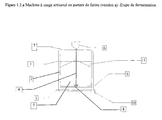
- the craft machine As regards the craft machine, it consists of two tanks, one external ( figure 1.1.a legend1), the other internal ( figure 1.1.a legend 2): the first, the outer tank, is equipped with an immersion heater ( figure 1.1.a legend 3) and thus serves as a water bath to the second, the inner tank.
- the internal tank is stepped in the outer tank. It is equipped with a vertical mixer / agitator ( figure 1.1.a legends 4 and 5) driven by a motor ( figure 1.1.a legend 6), fixed on the lid ( figure 1.1.a legend 7) placed above the inner tank.
- This motor can be equipped with a reducer and a variable speed drive.
- the axis 4 is maintained in its lower part by a receptacle fixed at the bottom of the inner tank ( figure 1.1.a legend 8).
- the internal tank is also equipped at the bottom of the tank with a thread closed by a bolt (( figure .1.1 .a legend 9).
- the outer tank is also equipped with a valve to introduce water or drain it. figure 1.1.a legend 10).
- Gelatinization step During the first part of the process, the flour-water mixture ( figure 1.1.a -legend 11) located in the inner tank is brought to the gelatinization temperature, this with stirring preferentially first fast, then slow, in order to obtain a cream smooth and unctuous.
- the cooling can be done under the effect of the circulation of cold water or without particular action, Fermentation stage: when the cooling is sufficient, the bacteria are added in the "cream" always located in the inner tank.
- a possible feature of the outer tank is that it can be easily drained of its water (1.2.a legend 10). This is very useful for the second stage, the fermentation: In fact, it serves as a reflection wall rays emanating from the inner tank, which ensures the maintenance of the temperature required for fermentation without any additional energy input. In this case, the machine is very low in energy consumption.
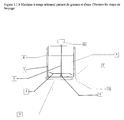
- Step of storage and distribution In the case of craft machinery, the inner vessel ( figure 1.3.a legend 1) containing the vegetable substitute of yogurt ( figure 1.3.a legend 2) is extracted from the outer tank and its lid, the motor and the mixer / agitator are replaced by a hermetic clip-on cover for shipment ( figure 1.3.a legend 3) and the tank is then made available in the shop.
- a pump ( figure 1.3.a legend 4) is then fixed on the thread present at the bottom of said tank to allow the distribution of pots that customers bring or buy. This method of distribution promotes the reuse of packaging.
- a suction valve ( figure 1.3.a legend 5)) makes it possible to break the vacuum during pumping. The preservation of the product can be done in this tank at room temperature.
- modified atmosphere ( figure 1.3.a legend 6) obtained either by the partial pressurization of carbon dioxide by means of a bombone or by the use of an ATCO oxygen absorber (STANDA company) or by any other means that is useful for this purpose. end.
- Other inhibitory gases for aerobic microorganisms are conceivable, such as inert gases for example.
- Another technique is to use a culture of microorganisms ( figure 1.3.a legend 7) producers of gas inhibiting aerobic species (such as for example yeasts, leuconostoc) and which, placed in the space between the surface of the product and the lid of the bottle, so saturates with carbon dioxide atmosphere in contact with the surface of the product and guarantees its protection against any aerobic species, such as eg molds (eg genus penicillium), yeasts (eg genus rhodoturella), sporulated bacteria (for example, the species bacillus cereus) .
- a filter with a diameter of less than 1 micrometer is placed between the ambient atmosphere and the valve ( figure 1.3.a legend 8).
- the tank is equipped with a handle ( figure 1.3.a legend 9). It is understood that this mode of storage and distribution can further minimize the risk of contamination of the product by exogenous molecules.
- FIG 1.1 b legend 1 Grinding seeds in water ( figure 1.1 b legend 1) is done in the inner tank previously described in version (a) of the machine (see figure 1.1.a ).
- the internal tank ( figure 1.1 b legend 2) is then equipped with an axis ( figure 1.1 b legend 3) equipped with a crusher ( figure 1.1 b legend 4) maintained at the bottom of the tank by a receptacle ( figure 1.1 b legend 5), and driven by a motor running more than 1000 rpm ( figure 1.1 b legend 6).
- the inner tank is also equipped at the bottom of the tank with a thread closed by a bolt ( figure .1.1 .b legend 7).
- the whole internal tank is enchased in the outer tank ( figure 1.1.b legend 8) equipped with an immersion heater ( figure .1.1 .b legend 9) and a valve allowing the entry or withdrawal of water ( figure .1.1 .b legend 10).
- the so-called "internal" tank which then serves as a storage and dispensing vessel may also be cooled by any means suitable for this purpose. goal.
- This version consists of two tanks, one external ( figure 2.1.a legend1), the other internal ( figure 2.1.a legend 2): the first, the outer tank, is equipped with an immersion heater ( figure 2.1.a legend 3) and thus serves as a water bath to the second, the inner tank.
- the internal tank is stepped in the outer tank. It is equipped with a vertical mixer / agitator ( figure 2.1.a legends 4 and 5) driven by a motor ( figure 2.1.a legend 6), fixed on the lid ( figure 2.1.a legend 7) placed above the inner tank.
- This motor can be equipped with a reducer and a variable speed drive.
- the axis 4 is maintained in its lower part by a receptacle fixed at the bottom of the inner tank ( figure 2.1.a legend 8).
- the internal tank is also equipped at the bottom of the tank with a valve ( figure .2.1.a legend 9).
- the outer tank is also equipped with a valve to introduce water or drain it. figure 2.1.a legend 10).
- Gelatinization step During the first part of the process, the flour-water mixture ( figure 2.1.a -legend 11) located in the inner tank is brought to the gelatinization temperature, this with stirring preferentially first fast, then slow, to obtain a cream smooth and unctuous.
- the cooling can be done under the effect of the circulation of cold water or without particular action,
- Fermentation stage when the cooling is sufficient, the bacteria are added in the "cream" always located in the inner tank.
- a possible feature of the outer tank is that it can be easily drained of its water (2.2.a legend 10). This is very useful for the second stage, the fermentation: In fact, it serves as a reflection wall rays emanating from the inner tank, which ensures the maintenance of the temperature required for fermentation without any additional energy input. In this case, the machine is very low in energy consumption.
- Potting step a pump, ( figure 2.3.a ) makes it possible to extract the yogurt from the internal tank and to distribute it in the pots.
- This pump may advantageously be a piston pump.
- the product is for example passed on a negative scraped surface exchanger, expanded and then extruded, or in any other type of machine for making ice cream.
- a domestic ice cream maker or an ice turbine can also be used in addition to the main module (gelatinization / fermentation step) described above.
- the machines can be equipped with programmers that make grinding, cooking and mixing operations automatic during fermentation.
- the machines are usable by persons having no precise knowledge of the process or the fermentation
- the yogurt plant substitute can be stored under refrigerated conditions, typically 4 ° C. It can also be carried out at room temperature, thanks to (i) the acidic pH that characterizes the product and (ii) the protection of the surface the product in contact with the air.
- the protection of the surface of the product in contact with the air is carried out either (i) by the controlled atmosphere techniques obtained thanks to an oxygen absorber or the injection of an inert or protective gas, technical adapted to the cylinders either (ii) as regards the glass jars by sterilizing the surface of the product and the ambient air contained in the jar by sterilizing the outer surface of the lid, the jar being held in the inverted position during this operation.
- the pot of yoghurt thus obtained can be kept at least 8 days at room temperature, and this up to one year, more favorably two months.
- Example 1 We start with toasted buckwheat flour. 25 grams of buckwheat and 75 grams of water are mixed. The suspension thus produced is mounted at an average temperature of 67 ° C. for 30 minutes and stabilized at 37 ° C. It is seeded at a seeding level of 10 ⁇ bacteria / mL. The selected species are Lactobacillus acidophilus, amylolytic strain and Lactobacillus delbriecki subsp lactis strain producing exopolysaccharides in a 50/50 mixture. After 8 hours at 37 ° C, the pH went from a value of 6.5 to a value of 4.2.
- Example 2 White rice is used, for example basmati as a seed for making the yoghurt substitute. 25 grams of rice and 75 grams of water are mixed. The rice is soaked for 2 hours at room temperature. The mixture is then blendered at a speed of 3500 rpm for 5 minutes. The suspension thus produced is mounted at an average temperature of 63 ° C. for 30 minutes and stabilized at 37 ° C. For fermentation, a strain of Lactobacillus acidophilus amylolytic seeded at a level of 10 ⁇ bacteria / mL is used. Incubation at a temperature of 37 ° C allows acidification of the "cream" at pH 4 in less than 3 hours. The resulting product has the taste, color and consistency of a naturally stirred yoghurt. It is therefore a substitute for yoghurt fully rice seed base, free of any gelling agent of exogenous origin to this species.
- the method and the product of the invention are particularly suitable for people suffering from allergy to milk and gluten, seeking the simplest possible products, thus ensuring the absence of cross contamination of allergens.
- the ingredients on the label of the product referred to in Example 1 are: water, buckwheat flour, lactic ferments.
- Example 3 Starting from rice seeds, and using the version (b) of the machine for artisan use and incorporating the elements of the recipe described in Example 1, 30 liters of yogurt are made in a bottle, without the ingredients being used. have not been transferred.
- EXAMPLE 4 By taking up the product manufactured in Example 1 and using a machine for traditional use, using a homemade ice cream machine, a vegetable yoghurt ice cream without fat and lactose is produced.
Landscapes
- Life Sciences & Earth Sciences (AREA)
- Chemical & Material Sciences (AREA)
- Engineering & Computer Science (AREA)
- Polymers & Plastics (AREA)
- Food Science & Technology (AREA)
- Nutrition Science (AREA)
- Health & Medical Sciences (AREA)
- Microbiology (AREA)
- Oil, Petroleum & Natural Gas (AREA)
- Agronomy & Crop Science (AREA)
- Botany (AREA)
- Inorganic Chemistry (AREA)
- Biotechnology (AREA)
- Dairy Products (AREA)
Applications Claiming Priority (1)
| Application Number | Priority Date | Filing Date | Title |
|---|---|---|---|
| FR1103836A FR2983682A1 (fr) | 2011-12-13 | 2011-12-13 | Produit vegetal de substitution du yaourt |
Publications (2)
| Publication Number | Publication Date |
|---|---|
| EP2604127A2 true EP2604127A2 (de) | 2013-06-19 |
| EP2604127A3 EP2604127A3 (de) | 2014-05-07 |
Family
ID=47458805
Family Applications (1)
| Application Number | Title | Priority Date | Filing Date |
|---|---|---|---|
| EP12364006.2A Withdrawn EP2604127A3 (de) | 2011-12-13 | 2012-12-12 | Pflanzliches Ersatzprodukt für Joghurt |
Country Status (2)
| Country | Link |
|---|---|
| EP (1) | EP2604127A3 (de) |
| FR (1) | FR2983682A1 (de) |
Cited By (6)
| Publication number | Priority date | Publication date | Assignee | Title |
|---|---|---|---|---|
| WO2017126959A1 (en) * | 2016-01-18 | 2017-07-27 | Innoso B.V. | Food composition with fermented starch |
| WO2019122499A1 (en) | 2017-12-22 | 2019-06-27 | Valio Ltd | Plant-based product and process |
| CN110621167A (zh) * | 2017-05-10 | 2019-12-27 | 桂格燕麦公司 | 发酵的水解的植物来源的材料 |
| FR3086509A1 (fr) * | 2018-10-01 | 2020-04-03 | In'management | Kit de fermentation de laits vegetaux |
| EP3981257A1 (de) | 2020-10-09 | 2022-04-13 | Fraunhofer-Gesellschaft zur Förderung der angewandten Forschung e.V. | Verfahren zur herstellung einer für lebensmittelprodukte nutzbaren emulsion aus linsensamen sowie damit erhaltene emulsion |
| DE102021103835A1 (de) | 2020-10-09 | 2022-04-14 | Fraunhofer-Gesellschaft zur Förderung der angewandten Forschung eingetragener Verein | Verfahren zur Herstellung einer für Lebensmittelprodukte nutzbaren Emulsion aus Linsensamen sowie damit erhaltene Emulsion |
Citations (4)
| Publication number | Priority date | Publication date | Assignee | Title |
|---|---|---|---|---|
| WO1991017672A1 (en) | 1990-05-18 | 1991-11-28 | Hannu Salovaara | Food product containing dietary fiber and method of making said product |
| EP0853889A2 (de) | 1997-01-15 | 1998-07-22 | Milk Fresh Dairy and Food Products CC | Stärkehaltiges, milchproduktähnliches Nahrungsmittel |
| WO2005011403A1 (fr) | 2003-07-02 | 2005-02-10 | Compagnie Gervais Danone | Procede de preparation d’un milieu fermente a base de fibres vegetales et son utilisation pour la fabrication de produits alimentaires riches en fibres |
| WO2007011685A2 (en) | 2005-07-15 | 2007-01-25 | Creative Research Management | Whole grain non-dairy milk production, products and use |
Family Cites Families (9)
| Publication number | Priority date | Publication date | Assignee | Title |
|---|---|---|---|---|
| SE502941C2 (sv) * | 1993-09-15 | 1996-02-26 | Lennart Lindahl | Homogen och stabil cerealiesuspension och förfarande för dess framställning |
| DE69633720T2 (de) * | 1996-08-02 | 2006-02-09 | Puratos N.V. | Verfahren zur Herstellung von erweichten Samenkörnern für Lebensmittel und Verpackung der gebrauchsfertigen Körner |
| IT1317398B1 (it) * | 2000-03-22 | 2003-06-16 | Paseluma Elettrica S R L | Yogurt di origine vegetale. |
| FR2815830A1 (fr) * | 2000-10-27 | 2002-05-03 | Ulice | Produits liquides fermentes riches en cereales, procede d'elaboration et utilisation comme boissons |
| SE0004107D0 (sv) * | 2000-11-10 | 2000-11-10 | Ceba Ab | Fermented product based on an oat suspension |
| ES2242541B1 (es) * | 2004-04-30 | 2006-12-16 | Consejo Superior De Investigaciones Cientificas | Producto fermentado sin lactosa a partir de batido de frutos secos no legumbres y/o horchata. |
| CN201491673U (zh) * | 2009-05-12 | 2010-06-02 | 李行 | 一种豆浆机 |
| CN101862125B (zh) * | 2010-07-02 | 2012-05-23 | 林修鹏 | 家庭用豆浆机 |
| CN201790580U (zh) * | 2010-09-10 | 2011-04-13 | 佛山市金星徽电器有限公司 | 一种带有内循环导流器的豆浆机 |
-
2011
- 2011-12-13 FR FR1103836A patent/FR2983682A1/fr not_active Withdrawn
-
2012
- 2012-12-12 EP EP12364006.2A patent/EP2604127A3/de not_active Withdrawn
Patent Citations (4)
| Publication number | Priority date | Publication date | Assignee | Title |
|---|---|---|---|---|
| WO1991017672A1 (en) | 1990-05-18 | 1991-11-28 | Hannu Salovaara | Food product containing dietary fiber and method of making said product |
| EP0853889A2 (de) | 1997-01-15 | 1998-07-22 | Milk Fresh Dairy and Food Products CC | Stärkehaltiges, milchproduktähnliches Nahrungsmittel |
| WO2005011403A1 (fr) | 2003-07-02 | 2005-02-10 | Compagnie Gervais Danone | Procede de preparation d’un milieu fermente a base de fibres vegetales et son utilisation pour la fabrication de produits alimentaires riches en fibres |
| WO2007011685A2 (en) | 2005-07-15 | 2007-01-25 | Creative Research Management | Whole grain non-dairy milk production, products and use |
Cited By (10)
| Publication number | Priority date | Publication date | Assignee | Title |
|---|---|---|---|---|
| WO2017126959A1 (en) * | 2016-01-18 | 2017-07-27 | Innoso B.V. | Food composition with fermented starch |
| CN110621167A (zh) * | 2017-05-10 | 2019-12-27 | 桂格燕麦公司 | 发酵的水解的植物来源的材料 |
| EP3621460A4 (de) * | 2017-05-10 | 2021-01-13 | The Quaker Oats Company | Fermentiertes hydrolysiertes material pflanzlichen ursprungs |
| WO2019122499A1 (en) | 2017-12-22 | 2019-06-27 | Valio Ltd | Plant-based product and process |
| CN111491522A (zh) * | 2017-12-22 | 2020-08-04 | 维利奥有限公司 | 植物基产品和方法 |
| AU2018392099B2 (en) * | 2017-12-22 | 2024-12-19 | Oddlygood Ltd | Plant-based product and process |
| FR3086509A1 (fr) * | 2018-10-01 | 2020-04-03 | In'management | Kit de fermentation de laits vegetaux |
| WO2020070045A1 (fr) * | 2018-10-01 | 2020-04-09 | In'management | Kit de fermentation de laits végétaux |
| EP3981257A1 (de) | 2020-10-09 | 2022-04-13 | Fraunhofer-Gesellschaft zur Förderung der angewandten Forschung e.V. | Verfahren zur herstellung einer für lebensmittelprodukte nutzbaren emulsion aus linsensamen sowie damit erhaltene emulsion |
| DE102021103835A1 (de) | 2020-10-09 | 2022-04-14 | Fraunhofer-Gesellschaft zur Förderung der angewandten Forschung eingetragener Verein | Verfahren zur Herstellung einer für Lebensmittelprodukte nutzbaren Emulsion aus Linsensamen sowie damit erhaltene Emulsion |
Also Published As
| Publication number | Publication date |
|---|---|
| EP2604127A3 (de) | 2014-05-07 |
| FR2983682A1 (fr) | 2013-06-14 |
Similar Documents
| Publication | Publication Date | Title |
|---|---|---|
| CN105054054B (zh) | 一种高sod活性的果蔬酵素液及果蔬酵素粉的制备方法 | |
| Achi et al. | Cereal-based fermented foods of Africa as functional foods | |
| US4808419A (en) | Automated method for a semi-solid fermentation used in the production of ancient quality rice vinegar and/or rice wine | |
| EP0031050B1 (de) | Verfahren zur Herstellung eines pulverförmigen, leicht mit Wasser mischbaren, stärkehaltigen Nahrungsmittels | |
| AU2018248695B2 (en) | Process for converting invertebrates into feedstock | |
| EP3375293A1 (de) | Lebensmittel auf pflanzenmilchbasis | |
| FR2983682A1 (fr) | Produit vegetal de substitution du yaourt | |
| KV | Applications of microbes in food industry | |
| KR101469452B1 (ko) | 고감미 현미흑초 및 그 제조방법과 이를 이용한 음료 및 식품 | |
| CN104975051A (zh) | 一种富集桑叶中gaba的方法 | |
| JP2007529200A (ja) | 高可溶性食物繊維発酵食品 | |
| CN107114689A (zh) | 一种预混进料制备低盐红油豆瓣的罐式发酵工艺 | |
| RU2409659C2 (ru) | Способ получения жидкого коджи | |
| JP2828210B2 (ja) | 古来の品質をもった米酢及び/又は米ワインの生産に用いる半固体発酵の自動化方法 | |
| CN107794160B (zh) | 一种谷物蛋白液及其制备方法 | |
| EP0686352B1 (de) | Verfahren zur Herstellung eines stärkehaltigen Nahrungsmittels | |
| Okara et al. | Developing an efficient method for ogi production: Towards educating the rural women | |
| EP1643856B1 (de) | Verfahren zur herstellung eines fermentierten produkts auf pflanzenballaststoffbasis und seine verwendung für die herstellung von nahrungsmittelprodukten mit erhöhtem ballaststoffgehalt | |
| KR20140045790A (ko) | 마-홍국을 이용한 막걸리 제조방법 및 그에 의한 마-홍국 막걸리 | |
| Pswarayi et al. | Sourdough and cereal beverages | |
| CN113966821A (zh) | 一种酸汤的生产方法及其酸汤发酵装置 | |
| Abdul-Abbas et al. | Effects of mixed strains of rhizopus oryzae and lactobacillus on corn meal fermentation | |
| EP1001033A2 (de) | Verfahren zur Verwertung von Stärke in milchsäurehaltige Produkten, und so erhaltene Produkte | |
| Schwan et al. | Brazilian indigenous fermented food | |
| FR2815830A1 (fr) | Produits liquides fermentes riches en cereales, procede d'elaboration et utilisation comme boissons |
Legal Events
| Date | Code | Title | Description |
|---|---|---|---|
| PUAI | Public reference made under article 153(3) epc to a published international application that has entered the european phase |
Free format text: ORIGINAL CODE: 0009012 |
|
| AK | Designated contracting states |
Kind code of ref document: A2 Designated state(s): AL AT BE BG CH CY CZ DE DK EE ES FI FR GB GR HR HU IE IS IT LI LT LU LV MC MK MT NL NO PL PT RO RS SE SI SK SM TR |
|
| AX | Request for extension of the european patent |
Extension state: BA ME |
|
| RIC1 | Information provided on ipc code assigned before grant |
Ipc: A23L 1/211 20060101ALI20131125BHEP Ipc: A23L 1/105 20060101AFI20131125BHEP Ipc: A23L 1/187 20060101ALI20131125BHEP Ipc: A23L 1/10 20060101ALI20131125BHEP Ipc: A23L 1/19 20060101ALI20131125BHEP Ipc: A23C 11/10 20060101ALI20131125BHEP Ipc: A23L 1/30 20060101ALI20131125BHEP |
|
| PUAL | Search report despatched |
Free format text: ORIGINAL CODE: 0009013 |
|
| AK | Designated contracting states |
Kind code of ref document: A3 Designated state(s): AL AT BE BG CH CY CZ DE DK EE ES FI FR GB GR HR HU IE IS IT LI LT LU LV MC MK MT NL NO PL PT RO RS SE SI SK SM TR |
|
| AX | Request for extension of the european patent |
Extension state: BA ME |
|
| RIC1 | Information provided on ipc code assigned before grant |
Ipc: A23C 11/10 20060101ALI20140403BHEP Ipc: A23L 1/105 20060101AFI20140403BHEP Ipc: A23L 1/10 20060101ALI20140403BHEP Ipc: A23L 1/19 20060101ALI20140403BHEP Ipc: A47J 31/00 20060101ALI20140403BHEP Ipc: A23L 1/187 20060101ALI20140403BHEP Ipc: A23L 1/211 20060101ALI20140403BHEP Ipc: A23L 1/30 20060101ALI20140403BHEP |
|
| STAA | Information on the status of an ep patent application or granted ep patent |
Free format text: STATUS: THE APPLICATION IS DEEMED TO BE WITHDRAWN |
|
| 18D | Application deemed to be withdrawn |
Effective date: 20141108 |