EP2604827A2 - Gasturbine mit einem Startergenerator - Google Patents
Gasturbine mit einem Startergenerator Download PDFInfo
- Publication number
- EP2604827A2 EP2604827A2 EP12196169.2A EP12196169A EP2604827A2 EP 2604827 A2 EP2604827 A2 EP 2604827A2 EP 12196169 A EP12196169 A EP 12196169A EP 2604827 A2 EP2604827 A2 EP 2604827A2
- Authority
- EP
- European Patent Office
- Prior art keywords
- starter
- generator
- gas turbine
- engine
- turbine engine
- Prior art date
- Legal status (The legal status is an assumption and is not a legal conclusion. Google has not performed a legal analysis and makes no representation as to the accuracy of the status listed.)
- Withdrawn
Links
- 230000001052 transient effect Effects 0.000 title description 3
- 238000000034 method Methods 0.000 claims abstract description 23
- 230000008859 change Effects 0.000 claims description 6
- 230000007423 decrease Effects 0.000 description 7
- 239000000446 fuel Substances 0.000 description 6
- 238000002485 combustion reaction Methods 0.000 description 4
- 230000006870 function Effects 0.000 description 4
- 230000009467 reduction Effects 0.000 description 4
- 230000009471 action Effects 0.000 description 3
- 230000001133 acceleration Effects 0.000 description 2
- 230000000454 anti-cipatory effect Effects 0.000 description 2
- 230000003247 decreasing effect Effects 0.000 description 1
- 230000008569 process Effects 0.000 description 1
- 238000004513 sizing Methods 0.000 description 1
- 230000001360 synchronised effect Effects 0.000 description 1
- 230000002123 temporal effect Effects 0.000 description 1
Images
Classifications
-
- F—MECHANICAL ENGINEERING; LIGHTING; HEATING; WEAPONS; BLASTING
- F02—COMBUSTION ENGINES; HOT-GAS OR COMBUSTION-PRODUCT ENGINE PLANTS
- F02C—GAS-TURBINE PLANTS; AIR INTAKES FOR JET-PROPULSION PLANTS; CONTROLLING FUEL SUPPLY IN AIR-BREATHING JET-PROPULSION PLANTS
- F02C7/00—Features, components parts, details or accessories, not provided for in, or of interest apart form groups F02C1/00 - F02C6/00; Air intakes for jet-propulsion plants
- F02C7/26—Starting; Ignition
- F02C7/268—Starting drives for the rotor, acting directly on the rotor of the gas turbine to be started
-
- F—MECHANICAL ENGINEERING; LIGHTING; HEATING; WEAPONS; BLASTING
- F02—COMBUSTION ENGINES; HOT-GAS OR COMBUSTION-PRODUCT ENGINE PLANTS
- F02C—GAS-TURBINE PLANTS; AIR INTAKES FOR JET-PROPULSION PLANTS; CONTROLLING FUEL SUPPLY IN AIR-BREATHING JET-PROPULSION PLANTS
- F02C7/00—Features, components parts, details or accessories, not provided for in, or of interest apart form groups F02C1/00 - F02C6/00; Air intakes for jet-propulsion plants
- F02C7/32—Arrangement, mounting, or driving, of auxiliaries
Definitions
- the present invention generally relates to gas turbine engines, and more particularly relates to a system and method for providing assistance to a gas turbine engine during transients, using the gas turbine engine starter-generator.
- a gas turbine engine may be used to supply power to various types of vehicles and systems.
- gas turbine engines may be used to supply propulsion power for various types of vehicles, including various types of helicopters and various types of aircraft.
- a gas turbine engine may be used as an auxiliary power unit (APU) to provide electrical power or air to an aircraft.
- Many gas turbine engines include at least three major sections, a compressor section, a combustor section, and a turbine section.
- the compressor section receives a flow of intake air and raises the pressure of this air to a relatively high level.
- the compressed air from the compressor section then enters the combustor section, where fuel nozzles inject a steady stream of fuel.
- the injected fuel is ignited by a burner, which significantly increases the energy of the compressed air.
- the high-energy compressed air from the combustor section then flows into and through the turbine section, causing rotationally mounted turbine blades to rotate and generate energy.
- the air exiting the turbine section is then exhausted from the engine.
- the turbine section may include a plurality of turbines. The energy generated in each of the turbines may be used to power other portions of the engine as well as leftover energy providing thrust.
- the speed of the gas turbine propulsion engine may undesirably decrease.
- Such undesirable decreases can be on the order of 10-20 percent, and can cause a concomitant and undesirable decrease in aircraft speed and/or altitude.
- Some engine control systems may not respond fast enough to prevent or alleviate such engine speed reduction.
- sizing the engines to provide sufficient margin for potential speed reductions may be undesirable.
- a method of supplying mechanical power to an operating gas turbine engine includes supplying mechanical power from the operating gas turbine engine to a starter-generator, to thereby generate electrical power using starter-generator.
- One or more operational parameters of the operating gas turbine engine are sensed. Based on the one or more sensed operational parameters, electrical power is selectively supplied to the starter-generator to thereby generate and supply mechanical output power to the operating gas turbine engine.
- a method of supplying mechanical power to an operating gas turbine engine that is controlled, at least in part, by positioning an engine throttle includes supplying mechanical power from the operating gas turbine engine to a starter-generator, to thereby generate electrical power using starter-generator;. sensing a position of the engine throttle. Based at least on the sensed position of the engine throttle, electrical power is selectively supplied to the starter-generator to thereby generate and supply mechanical output power to the operating gas turbine engine.
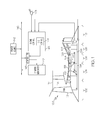
- FIG. 1 depicts a simplified schematic representation of an exemplary turbofan gas turbine engine control system.
- gas turbine engine could be used to drive one or more rotors of a helicopter, the gas turbine engine may be implemented as an APU, or the gas turbine engine may be used to supply power to any one of numerous other types of waterborne, airborne, or terrestrial vehicles.
- FIG. 1 a simplified representation of an exemplary multi-spool turbofan gas turbine jet engine 100 is depicted in FIG. 1 , and includes an intake section 102, a compressor section 104, a combustion section 106, a turbine section 108, and an exhaust section 110.
- the intake section 102 includes a fan 112, which is mounted in a fan case 114.
- the fan 112 draws air into the intake section 102 and accelerates it.
- a fraction of the accelerated air exhausted from the fan 112 is directed through a bypass section 116 (shown only partially in FIG. 1 ) disposed between the fan case 114 and an engine case 118, and provides a forward thrust.
- the remaining fraction of air exhausted from the fan 112 is directed into the compressor section 104.
- the compressor section 104 includes two compressors, a low pressure compressor 120, and a high pressure compressor 122.
- the low pressure compressor 120 raises the pressure of the air directed into it from the fan 112, and directs the compressed air into the high pressure compressor 122.
- the high pressure compressor 122 compresses the air still further, and directs the high pressure air into the combustion section 106.
- the combustion section 106 which includes a combustor 124, a plurality of non-illustrated fuel injectors, and one or more non-illustrated igniters, the high pressure air is mixed with fuel and combusted. The combusted air is then directed into the turbine section 108.
- the turbine section 108 includes two turbines, a high pressure turbine 126 and a low pressure turbine 128, disposed in axial flow series in the engine case 118.
- the combusted air from the combustion section 106 expands through each turbine 126 and 128, causing each to rotate.
- the air is then exhausted through a propulsion nozzle disposed in the exhaust section 110, providing addition forward thrust.
- each drives equipment in the engine 100 via concentrically disposed shafts or spools.
- the low pressure turbine 128 drives the fan 112 and the low pressure compressor 120 via a low pressure spool 136
- the high pressure turbine 126 drives the high pressure compressor 122 via a high pressure spool 134.
- a starter-generator 140 is coupled to the engine 100.
- the starter-generator 140 is coupled to the high pressure spool 134 via appropriate gearing. It will be appreciated, however, that the starter-generator 140 could instead (or additionally) be coupled to the low pressure spool 132.
- the starter-generator 140 is configured to operate in one of two modes - a motor mode or a generate mode. In the motor mode, the starter-generator receives electrical power from an electrical power source 142, via a power bus 145 and a suitable power controller 143, and converts the supplied electrical power to mechanical output power.
- the starter-generator 140 may be used to rotate the engine 100 during start-up. In the generate mode, the starter-generator receives mechanical power from the engine 100, converts the mechanical power to electrical power, and supplies the electrical power to, for example, the power bus 145.
- the starter-generator 140 may be implemented using any one of numerous types of starter-generators. In the depicted embodiment, however, it is implemented using brushless, wound field synchronous generator, alternating current machine.
- the operational mode and control of the starter-generator 140 may be controlled by a starter-generator control 144.
- the starter-generator control 144 may be implemented as a separate, individual device or integrated into another device. In the embodiment depicted in FIG. 1 , the starter-generator control 144 is integrated into an engine control 146, an embodiment of which will now be described.
- the engine control 146 controls the overall operation of the engine 100.
- the engine control 146 is used to control the output power of the engine 100 by, for example, controlling fuel flow rate to the engine 100.
- the engine control 146 receives a throttle position signal from an engine throttle 148, and signals from a plurality of sensors 152 that are disposed at various locations on and within the engine 100.
- the sensors 152 are used to sense various operational parameters associated with the engine 100 such as, for example, various temperatures, speeds, and air flow, and supply signals representative of the sensed parameters to the engine control 146.
- the engine control 146 processes the signals received from the engine throttle 148 and the sensors 152 and, among other things, supplies various commands to the engine 100 to control its operation.
- the engine control 146 may be any one of numerous types of engine controllers such as, for example, a FADEC (Full Authority Digital Engine Controller). As will now be described, the engine control 146 also controls the operational mode of the starter-generator 140 during operation of the engine 100.
- FADEC Full Authority Digital Engine Controller
- the engine control 146 is additionally configured to selectively command the starter-generator control 144 to switch the operational mode of the starter-generator 140. That is, to selectively switch the starter-generator 140 from operating in the generate mode to operating in the motor mode.
- the starter-generator 140 instead of receiving mechanical power from the engine 100, and converting the mechanical power to electrical power, the starter-generator 140 will receive electrical power, and convert the electrical power to mechanical output power and supply the mechanical output power to the engine 100.
- the engine control 146 will, more specifically, be configured to determine when the engine 100 is not delivering the commanded thrust or power.
- the engine control 146 is additionally configured, upon making this determination, to supply a command to the starter-generator control 144 to switch the operational mode of the starter-generator 140. Because, as was noted above, the starter-generator 140 is coupled to the high pressure spool 134 (and/or other appropriate spool), the mechanical output power supplied from the starter-generator 140 to the engine 100 is sufficient to reduce the decrease, or at least substantially reduce the decrease, of the engine 100 speed, thrust, or power. When the mechanical power from the starter-generator 140 is no longer needed, the engine control 146 will supply a command to the starter-generator control 144 to switch the operational mode of the starter-generator 140 back to the generate mode.
- the engine control 146 may be configured to determine when the engine 100 is not delivering the commanded thrust or power using any one of numerous techniques. For example, the engine control 146 may be configured to make this determination based on one or more of the sensed operational parameters of the engine 100, such as engine speed. With this implementation, if the sensed rotational speed is less than a predetermined value, or is decreasing at too great of a rate, then the starter-generator control 144 is commanded to switch the operational mode of the starter-generator 140 to the motor mode.
- the engine control 146 may be configured to implement anticipatory logic.
- the engine control 146 may be configured to sense the position, or rate of change of position, of the engine throttle 148 and, based on the sensed position (or rate of change of position) and one or more of the sensed operational parameters, anticipatorily determine if the engine 100 will experience a speed/thrust droop. If the anticipatory logic determines that the engine 100 will experience a speed/thrust droop, the engine control 146 will then command the starter-generator control 144 to switch the operational mode of the starter-generator 140.
- the engine 100 may not experience a droop or decrease in speed during some transients. In these implementations, however, the engine control 146 may still command the starter-generator control 144 to selectively switch the operational mode of the starter-generator 140. For example, during a transient maneuver the engine control 146 may command the starter-generator control 144 to switch the operational mode of the starter-generator 140 from the generate mode to the motor mode in order to improve the acceleration time of the engine 100.
- the gas turbine engine control system and method described herein prevents, or at least alleviates, reductions in gas turbine engine speed during various load changes, and/or improves acceleration times of the gas turbine engine during various load changes.
- Skilled artisans may implement the described functionality in varying ways for each particular application, but such implementation decisions should not be interpreted as causing a departure from the scope of the present invention.
- an embodiment of a system or a component may employ various integrated circuit components, e.g., memory elements, digital signal processing elements, logic elements, look-up tables, or the like, which may carry out a variety of functions under the control of one or more microprocessors or other control devices.
- integrated circuit components e.g., memory elements, digital signal processing elements, logic elements, look-up tables, or the like, which may carry out a variety of functions under the control of one or more microprocessors or other control devices.
- DSP digital signal processor
- ASIC application specific integrated circuit
- FPGA field programmable gate array
- a general-purpose processor may be a microprocessor, but in the alternative, the processor may be any conventional processor, controller, microcontroller, or state machine.
- a processor may also be implemented as a combination of computing devices, e.g., a combination of a DSP and a microprocessor, a plurality of microprocessors, one or more microprocessors in conjunction with a DSP core, or any other such configuration.
- a software module may reside in RAM memory, flash memory, ROM memory, EPROM memory, EEPROM memory, registers, hard disk, a removable disk, a CD-ROM, or any other form of storage medium known in the art.
- An exemplary storage medium is coupled to the processor such the processor can read information from, and write information to, the storage medium.
- the storage medium may be integral to the processor.
- the processor and the storage medium may reside in an ASIC.
Landscapes
- Engineering & Computer Science (AREA)
- Chemical & Material Sciences (AREA)
- Combustion & Propulsion (AREA)
- Mechanical Engineering (AREA)
- General Engineering & Computer Science (AREA)
- Control Of Turbines (AREA)
- Control Of Eletrric Generators (AREA)
Applications Claiming Priority (1)
| Application Number | Priority Date | Filing Date | Title |
|---|---|---|---|
| US13/324,789 US20130147192A1 (en) | 2011-12-13 | 2011-12-13 | Gas turbine engine transient assist using a starter-generator |
Publications (1)
| Publication Number | Publication Date |
|---|---|
| EP2604827A2 true EP2604827A2 (de) | 2013-06-19 |
Family
ID=47602869
Family Applications (1)
| Application Number | Title | Priority Date | Filing Date |
|---|---|---|---|
| EP12196169.2A Withdrawn EP2604827A2 (de) | 2011-12-13 | 2012-12-07 | Gasturbine mit einem Startergenerator |
Country Status (2)
| Country | Link |
|---|---|
| US (1) | US20130147192A1 (de) |
| EP (1) | EP2604827A2 (de) |
Cited By (1)
| Publication number | Priority date | Publication date | Assignee | Title |
|---|---|---|---|---|
| WO2016020618A1 (fr) * | 2014-08-08 | 2016-02-11 | Snecma | Hybridation des compresseurs d'un turboréacteur |
Families Citing this family (14)
| Publication number | Priority date | Publication date | Assignee | Title |
|---|---|---|---|---|
| US10830085B2 (en) * | 2013-06-06 | 2020-11-10 | Ge Aviation Systems Llc | Jet engine assembly and method for generating electricity |
| EP2887536B1 (de) | 2013-12-23 | 2019-02-27 | Rolls-Royce Corporation | Steuersystem für einen doppelt redundanten Motor/Generator und Motor |
| US20170234234A1 (en) * | 2016-02-12 | 2017-08-17 | Hamilton Sundstrand Corporation | Gas turbine engine motoring system for bowed rotor engine starts |
| EP3246526B1 (de) * | 2016-05-18 | 2021-03-24 | Rolls-Royce Corporation | Steuerung eines niedrigdruckwellengenerators für einen gasturbinenmotor |
| US10934935B2 (en) | 2017-01-30 | 2021-03-02 | Ge Aviation Systems Llc | Engine core assistance |
| US11970062B2 (en) * | 2017-04-05 | 2024-04-30 | Ge Aviation Systems Llc | Systems and methods of power allocation for hybrid electric architecture |
| US11008111B2 (en) * | 2017-06-26 | 2021-05-18 | General Electric Company | Propulsion system for an aircraft |
| US20190002117A1 (en) * | 2017-06-30 | 2019-01-03 | General Electric Company | Propulsion system for an aircraft |
| US11097849B2 (en) | 2018-09-10 | 2021-08-24 | General Electric Company | Aircraft having an aft engine |
| US20200400036A1 (en) * | 2019-06-24 | 2020-12-24 | Pratt & Whitney Canada Corp. | Gas turbine engine system |
| US11428171B2 (en) | 2019-12-06 | 2022-08-30 | General Electric Company | Electric machine assistance for multi-spool turbomachine operation and control |
| US11845388B2 (en) | 2021-05-20 | 2023-12-19 | General Electric Company | AC electrical power system for a vehicle |
| US12480449B2 (en) | 2022-08-22 | 2025-11-25 | General Electric Company | Propulsion system including an electric machine for starting a gas turbine engine |
| US11933232B1 (en) * | 2023-02-21 | 2024-03-19 | General Electric Company | Hybrid-electric gas turbine engine and method of operating |
Family Cites Families (6)
| Publication number | Priority date | Publication date | Assignee | Title |
|---|---|---|---|---|
| US4743777A (en) * | 1986-03-07 | 1988-05-10 | Westinghouse Electric Corp. | Starter generator system with two stator exciter windings |
| FR2914697B1 (fr) * | 2007-04-06 | 2012-11-30 | Turbomeca | Dispositif d'assistance aux phases transitoires d'acceleration et de deceleration |
| US7810337B2 (en) * | 2007-10-04 | 2010-10-12 | Hamilton Sundtrand Corporation | Method to re-engage start of dynamoelectric machine |
| US20120000204A1 (en) * | 2010-07-02 | 2012-01-05 | Icr Turbine Engine Corporation | Multi-spool intercooled recuperated gas turbine |
| US8955334B2 (en) * | 2010-07-22 | 2015-02-17 | General Electric Company | Systems and methods for controlling the startup of a gas turbine |
| US9745897B2 (en) * | 2011-01-13 | 2017-08-29 | Hamilton Sundstrand Corporation | Anti-windmilling starter generator |
-
2011
- 2011-12-13 US US13/324,789 patent/US20130147192A1/en not_active Abandoned
-
2012
- 2012-12-07 EP EP12196169.2A patent/EP2604827A2/de not_active Withdrawn
Non-Patent Citations (1)
| Title |
|---|
| None |
Cited By (4)
| Publication number | Priority date | Publication date | Assignee | Title |
|---|---|---|---|---|
| WO2016020618A1 (fr) * | 2014-08-08 | 2016-02-11 | Snecma | Hybridation des compresseurs d'un turboréacteur |
| FR3024755A1 (fr) * | 2014-08-08 | 2016-02-12 | Snecma | Hybridation des compresseurs d'un turboreacteur |
| RU2708492C2 (ru) * | 2014-08-08 | 2019-12-09 | Сафран Эркрафт Энджинз | Гибридизация компрессоров турбореактивного двигателя |
| US11767794B2 (en) | 2014-08-08 | 2023-09-26 | Safran Aircraft Engines | Hybridisation of the compressors of a turbojet |
Also Published As
| Publication number | Publication date |
|---|---|
| US20130147192A1 (en) | 2013-06-13 |
Similar Documents
| Publication | Publication Date | Title |
|---|---|---|
| EP2604827A2 (de) | Gasturbine mit einem Startergenerator | |
| EP2733312B1 (de) | Gasturbinenoptimierung durch elektrische Energieübertragung | |
| CN112922731B (zh) | 多线轴涡轮机操作和控制的电机辅助 | |
| US11427340B2 (en) | Propulsion system for an aircraft | |
| CN109204843B (zh) | 用于飞行器的推进系统 | |
| US9567906B2 (en) | Systems and methods for controlling aircraft main engine speeds by adjusting compressed air flow from an APU | |
| US10738706B2 (en) | Propulsion system for an aircraft | |
| US10968765B2 (en) | Power system with a coordinated power draw | |
| US9266618B2 (en) | Gas turbine engine turbine blade tip active clearance control system and method | |
| US10184348B2 (en) | System and method for turbine blade clearance control | |
| US20130174570A1 (en) | Engine systems with enhanced start control schedules | |
| US12170500B2 (en) | Active stability control of compression systems utilizing electric machines | |
| CN115636092B (zh) | 在怠速操作期间的涡轮发动机的电机动力辅助 | |
| US12253030B2 (en) | In-flight engine re-start | |
| US12320295B2 (en) | Gas turbine engine system with generator | |
| US12140089B2 (en) | Gas turbine engine system with generator | |
| EP4310309A1 (de) | Hybrid-elektrisches antriebssystem mit einem koppler zum umschalten zwischen betriebsmodi | |
| US12618335B2 (en) | In-flight hybrid electric engine shutdown | |
| EP3960997A1 (de) | Abschaltung und wiederanlassen eines hybrid-elektrischen triebwerks während des flugs |
Legal Events
| Date | Code | Title | Description |
|---|---|---|---|
| PUAI | Public reference made under article 153(3) epc to a published international application that has entered the european phase |
Free format text: ORIGINAL CODE: 0009012 |
|
| 17P | Request for examination filed |
Effective date: 20121207 |
|
| AK | Designated contracting states |
Kind code of ref document: A2 Designated state(s): AL AT BE BG CH CY CZ DE DK EE ES FI FR GB GR HR HU IE IS IT LI LT LU LV MC MK MT NL NO PL PT RO RS SE SI SK SM TR |
|
| AX | Request for extension of the european patent |
Extension state: BA ME |
|
| STAA | Information on the status of an ep patent application or granted ep patent |
Free format text: STATUS: THE APPLICATION HAS BEEN WITHDRAWN |
|
| 18W | Application withdrawn |
Effective date: 20140213 |