EP2606718B1 - Käseblöcke mit konvexen Seiten - Google Patents
Käseblöcke mit konvexen Seiten Download PDFInfo
- Publication number
- EP2606718B1 EP2606718B1 EP12198201.1A EP12198201A EP2606718B1 EP 2606718 B1 EP2606718 B1 EP 2606718B1 EP 12198201 A EP12198201 A EP 12198201A EP 2606718 B1 EP2606718 B1 EP 2606718B1
- Authority
- EP
- European Patent Office
- Prior art keywords
- curd
- block
- cheese
- sides
- edges
- Prior art date
- Legal status (The legal status is an assumption and is not a legal conclusion. Google has not performed a legal analysis and makes no representation as to the accuracy of the status listed.)
- Active
Links
Images


Classifications
-
- A—HUMAN NECESSITIES
- A01—AGRICULTURE; FORESTRY; ANIMAL HUSBANDRY; HUNTING; TRAPPING; FISHING
- A01J—MANUFACTURE OF DAIRY PRODUCTS
- A01J25/00—Cheese-making
- A01J25/12—Forming the cheese
-
- A—HUMAN NECESSITIES
- A01—AGRICULTURE; FORESTRY; ANIMAL HUSBANDRY; HUNTING; TRAPPING; FISHING
- A01J—MANUFACTURE OF DAIRY PRODUCTS
- A01J27/00—After-treatment of cheese; Coating of cheese
-
- A—HUMAN NECESSITIES
- A23—FOODS OR FOODSTUFFS; TREATMENT THEREOF, NOT COVERED BY OTHER CLASSES
- A23C—DAIRY PRODUCTS, e.g. MILK, BUTTER OR CHEESE; MILK OR CHEESE SUBSTITUTES; PREPARATION THEREOF
- A23C2250/00—Particular aspects related to cheese
- A23C2250/10—Cheese characterised by a specific form
Definitions
- the present invention relates to a method for preparing blocks of hard or semi-hard cheese having at least one convex side, to hard or semi-hard cheese blocks obtainable with this method and to cheese slices and pieces cut therefrom.
- rectangularly shaped cheese blocks are brought on the market. From these rectangularly shaped blocks the cheese seller can easily cut flat pieces of cheese without any cutting losses.
- the corners and edges of the rectangularly shaped cheese comprise significantly more salt than the rest of the cheese. After all, during brining salt can enter the cheese at these places from two or three sides, making these places in the cheese more salt and dry than for instance in the middle of the cheese.
- Another disadvantage is that consumers do not appreciate rectangular pieces of cheese. They feel that the cheeses have not been made by craftsmanship but in large factories. Hence, consumers favor flat pieces of cheese with a rounded side.
- the American patent application US 2008/0034978 relates to the reshaping of ripened cheese.
- a cheese reshaper is provided that reshapes a generally rectangular portion of cheese into a generally circular or ovular portion of cheese while substantially eliminating residual edge trimmings. Again, the cutting back of the edges of a non-ripened cheese (i.e. curd block) is not disclosed or suggested.
- a first aspect of the present invention relates to a method for preparing blocks of hard or semi-hard cheese having at least one convex side, said method comprising:
- a further advantage of the present invention lies in the fact that due to the removal of the edges of the curd block, formation of relatively sharp edges with extremely high salt content and with an extremely dry rind after ripening are avoided. Hence, cheeses with novel properties, i.e. better rind and lower salt content, are obtained.
- cheese is prepared by forming a milk gel from milk with rennet (or any other coagulant suitable for inducing coagulation in milk), cutting the milk gel into a mixture of curd and whey and at least partially draining the whey such that the curd is obtained.
- rennet or any other coagulant suitable for inducing coagulation in milk
- Hard or semi-hard cheeses generally have a moisture on a fat free basis (MFFB%) of 49-56% for hard cheese and 54-69% for semi-hard cheese ( Codex Standard for cheese, 283-1978; 7.1 )
- curd is brought into a rectangularly shaped mold and the curd in the mold is pressed in order to obtain the desired shape and water content.
- the term "rectangular” includes any three dimensional shape comprising a cross-section which is substantially rectangular, particularly preferred substantially rectangular shapes according to the present invention are a cube or cuboid, such as a beam.
- curd blocks Due to the pressing of the curd in the mold, rectangularly shaped curd blocks, also called fresh cheese blocks are obtained.
- These curd blocks have a rectangular shape, more specifically they have the form of a cube or cuboid, such as a beam.
- the curd blocks are not necessarily perfect cubes or cuboids, however they will have the general form of a cube or cuboid.
- they have a substantially flat bottom side, a substantially flat top side and perpendicular to these sides four upright sides, such that substantially rectangular shape or even a cube or cuboid, such as a beam is formed.
- shape the curd blocks such that they have the general shape of a cuboid, preferably the shape of a beam.
- curd block encompasses blocks of curd before and during ripening.
- the blocks obtained after ripening of the curd blocks are in accordance with the present invention referred to as "cheese blocks”.
- convex means within the context of the present invention substantially convex.
- flat means within the context of the present invention substantially flat.
- upright means within the context of the present invention substantially upright.
- the length of the curd blocks or cheese blocks is 20 - 140 cm, preferably 50 - 100 cm.
- the width of the curd blocks or cheese blocks is 20-120 cm, preferably 50-100 cm and the height of the curd blocks or cheese blocks is 5 - 20 cm, preferably at least 10 cm. It is particularly preferred to prepare curd blocks or cheese blocks having the general shape of a cuboid, such as beam, wherein the length is 45-55 cm, the width is 25 to 35 cm and the height is 10-12 cm.
- the curd blocks or cheese blocks have the dimensions of a so called Eurobloc (i.e. length of about 50 cm, a width of about 30 cm and a height of about 11 cm).
- the curd block After formation of the curd block it is brought in a brining bath.
- the general conditions for such brining baths are commonly known in the state of the art.
- the curd blocks are brined for 1-5 days.
- the salt-concentration (NaCl) is usually between 14-21 wt% and the temperature of the brine is most often 10-15°C.
- the curd is preferably separated from the mold before it is subjected to brining, although it may be possible to brine the curd in the mold.
- the cutting back can be done before or after brining, preferably after brining, more preferably directly after brining, i.e.before step v) of the present method.
- the edge of at least one of the upright sides with one of the other sides of the curd block is removed.
- This cutting back can be done along the entire edge of the curd block, such that the entire edge is removed.
- such an edge usually takes up a lot of salt during brining, making it less appreciated by consumers. By cutting back the edge this is avoided. More importantly, cutting back the edges also takes away some of the firmness of the curd block, causing the spreading out of one of the sides from which the edge was cut, such that this side becomes substantially convex.
- the cutting back can be done in different ways, for example by cutting the curd blocks with a knife or wire, e.g. a heated wire. It is also possible to remove the edges by means of scrapping, shaving, trimming, laser cutting or melting. In order to minimize the cutting losses a part of the side, preferably an upright side, from which the edge has been cut back is unaffected by the cutting back. Also when two or more edges are cut from a side, a part of that side, preferably an upright side, remains unaffected by the cutting back. Generally, only 10-50% of the surface area of such a side, or sides (preferably upright side(s)) is affected by the cutting back.
- the pieces cut from the curd block is preferably between 0,5-5 wt% of the total weight of the block.
- the curd blocks are often allowed to air-dry and ripen separately on (wooden) shelves and develop a rind over time. It is also possible to allow the curd blocks to ripen in a foil. This way the formation of a rind is substantially avoid.
- the ripening is usually carried out by keeping the curd blocks in a ripening chamber with a controlled atmosphere. Furthermore, to allow the blocks to obtain a satisfactory shape, the ripening blocks are reqularly turned. During ripening gravity causes the curd blocks to deform further due to spreading out, or "flow", of the curd mass. Since at least one of the edges has been removed completely from the curd blocks, the spreading out will occur more and quicker than by normal (uncut) blocks.
- the curd blocks are ripened for at least 4 weeks, preferably at least 8 weeks. Preferably 4 to 100 weeks, more preferably 8 to 40 weeks, most preferably 10-25 weeks. After ripening the curd blocks have become cheese blocks.
- two, preferably three, most preferably four parallel extending edges of the upright sides of the curd block are completely cut back.
- the firmness of the block is reduced, causing it to spread out and form one or two convex upright sides.
- one of the edges of one of the upright sides with the bottom side or the top side such that the cross section of the block, which cross section extends perpendicular to the edge cut, comprises five sides. It is more preferred that two parallel extending edges of one or two upright sides with the top side and/or bottom side are cut back such that the cross section of the block, which cross section extends perpendicular to the edges cut, comprises six sides. It is highly preferred that the four parallel extending edges of two upright sides with the top side and the bottom side are cut back such that the cross section of the block, which cross section extends perpendicular to the edges cut, comprises eight sides. With these curd block very good spreading out is obtained, causing the upright sides from which the edges have been cut to become convex.
- edges are preferably cut at a depth of 0,5 to 10 centimeters from the edge to be cut. This depth refers to the largest direct distance between the edge cut and the plane through which the cut was made in the curd block.
- the curd block can be coated with a plastic layer. It is also possible to coat the block with a plastic layer before cutting back, however this is not preferred.
- the plastic layer prevents the curd block from drying out and avoids contamination of the curd with micro-organisms or foreign objects.
- the (partially) ripened curd block can be fed to an automatic packaging apparatus.
- curd block it is also possible to subject the curd block to so called foil ripening. This way, the formation of a rind is substantially avoided.
- curd block is before or during ripening provided with a substantially water impermeable coating or foil.
- cuboid curd blocks are formed, wherein the longest upright sides are rendered convex by cutting back one or more of their edges as explained above, it is particularly preferred to cut the block in longitudinal direction in two parts, preferably two substantially equal parts. This is preferably done at the last stage of ripening or after ripening. This way two blocks are obtained, each comprising at least one convex side, three substantially flat upright sides and a substantially flat bottom side and top side.
- Such blocks are particularly suitable for cutting cheese pieces or slices. Such pieces or slices are cut in transversal direction.
- the cheese pieces have a thickness from 1 to 15 centimeter, preferably 5 to 10 centimeter.
- the cheese slices have a thickness of 0,1 to 5 centimeter, preferably 0,1 to 1 centimeter.
- cuboid shape such as a beam
- cube shaped cheese blocks may comprise one or more convex sides, preferably two convex sides.
- a second aspect of the present invention relates to hard or semi-hard rectangular shaped cheese blocks obtainable by the method as described above.
- Such cheese blocks are not yet known in the art.
- the quality of the cheese has improved significantly.
- due to the removal of the edges of the curd block formation of relatively sharp edges with extremely high salt content and with an extremely dry rind after ripening are avoided.
- the cheese blocks obtainable by the above mentioned method also have excellent quality properties, such as an excellent taste and texture.
- a third aspect of the present invention relates to cheese pieces or slices obtainable by the method described above.
- curd was brought by means of a drain-fill machine (e.g. a Casomatic of Tetra Pak) in rectangularly shaped molds with an internal length of 50 cm and width of 30 cm. After bringing the curd in the mold a cover was placed on the mold and the curd was pressed for about 80 minutes into a beam-shaped curd block comprising a flat top side, a flat bottom side and perpendicular to these sides, four upright sides.
- the block of about 16 kg had a height of about 50 cm, a width of about 30 cm and a height of about 12 cm.
- the curd block was brined for 3 days in a brining bath comprising 18 wt% salt.
- Figure 1 shows a rectangularly shaped curd block 1, having cuboid shape, namely a beam, which beam comprises two short upright sides 2, 3 and two long upright sides 4, 5.
- the curd block further comprises a substantially flat bottom side 6 and a substantially flat top side (7).
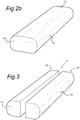
- Figure 2A shows a curd block 8 similar to the curd block of Figure 1 , wherein the four edges 9, 10, 11 and 12 of the longest upright sides 13, 14 with the top side 15 and bottom side 16 have been cut back from the block 8. After cutting back the edges 9, 10, 11 and 12 the curd block is ripened for a period of at least 4 weeks. During this ripening period the longest upright sides 13 and 14 start to spread out, making these upright sides 13, 14 substantially convex as is shown in figure 2B .
- Figure 3 shows a cheese block 17 according to the present invention, which cheese block 17 has been formed from a curd block from which the edges were cut and which curd block has ripened for 6 weeks on a wooden shelf. Every week during ripening the curd block was turned. Due to the fact that the longest edges of the curd block were cut back, two symmetrical longitudinal extending convex sides 18, 19 have been formed. This cheese block has been cut in two substantially equal parts 20, 21, by cutting the cheese block 17 in longitudinal direction.
- FIG 4 shows one of the parts 21 of the cheese block 17 of Figure 3 .
- This part 21 of the cheese block 17 is cut into cheese pieces 22 and 23.
- the pieces 22 and 23 are subsequently packaged in packaging material.
- the piecces 22, 23 obtained comprise one convex side 25, 26, which is highly appreciated by consumers.
- Figure 5 shows also one of the parts 20 of the cheese block 17 of Figure 3 .
- This part 20 of the cheese block 17 is cut into thin slices 28, 29 and 30 of about 0,5 centimeter thick. These slices 28, 29 and 30 comprise one convex side 31, 32 and 33, which is highly preferred by consumers.
Landscapes
- Life Sciences & Earth Sciences (AREA)
- Animal Husbandry (AREA)
- Environmental Sciences (AREA)
- Dairy Products (AREA)
Claims (19)
- Verfahren zum Herstellen von Blöcken aus festem oder halbfestem Käse, die wenigstens eine konvexe Seite haben,
wobei das Verfahren umfasst:a) Bereitstellen von Quark und Einfüllen des Quarks in eine rechteckige Form;b) Pressen des in der Form enthaltenen Quarks in einer Press-Station, so dass ein rechteckig geformter Quark-Block (1) entsteht, der eine flache Unterseite (6), eine flache Oberseite (7) und senkrecht zu diesen Seiten vier aufrechtstehende Seiten (2, 3, 4, 5) umfasst, und wobei der Quark-Block (1) die folgenden Abmessungen umfasst:Länge: 20-140 cm;Breite: 20-120 cm;Höhe: 5-20 cm;c) Einbringen des gepressten Quark-Blocks in ein Salzlake-Bad;d) Entnehmen des Quark-Blocks aus dem Salzlake-Bad; unde) Reifen des Quark-Blocks (1, 8) über einen gewünschten Zeitraum, so dass ein Block aus festem oder halbfestem Käse entsteht; undwobei wenigstens eine der Seiten (13, 14, 15, 16) des Blocks (8) konvex geformt wird, indem wenigstens eine der Kanten (9, 10, 11, 12) dieser Seite abgeschnitten wird, wobei das Abschneiden vor oder beim Reifen stattfindet. - Verfahren nach Anspruch 1, wobei das Abschneiden zwischen dem Entnehmen des Quark-Blocks aus dem Salzlake-Bad (Schritt d) und dem Reifen (Schritt e) stattfindet.
- Verfahren nach Anspruch 1 oder 2, wobei eine, zwei, drei oder vier der aufrechtstehenden Seiten konvex geformt werden, indem die Kante dieser aufrechtstehenden Seite an der Unterseite (16) und/oder der Oberseite (15) abgeschnitten wird.
- Verfahren nach Anspruch 3, wobei zwei parallel verlaufende aufrechtstehende Seiten konvex geformt werden, indem die Kanten dieser aufrechtstehenden Seiten an der Unterseite und/oder der Oberseite abgeschnitten werden.
- Verfahren nach einem der vorangehenden Ansprüche, wobei die zwei längsten aufrechtstehenden Seiten (13, 14) konvex geformt werden.
- Verfahren nach einem der vorangehenden Ansprüche, wobei die Seiten des Quark-Blocks (8), die konvex geformt werden, symmetrisch sind.
- Verfahren nach einem der vorangehenden Ansprüche, wobei die Kanten so abgeschnitten werden, dass ein Teil der Seite, von der die Kante abgeschnitten worden ist, von dem Abschneiden nicht betroffen ist.
- Verfahren nach einem der vorangehenden Ansprüche, wobei 10-50 % der Oberfläche der wenigstens einen Seite des Quark-Blocks von dem Abschneiden betroffen ist.
- Verfahren nach einem der vorangehenden Ansprüche, wobei zwei, vorzugsweise drei und am besten vier der parallel verlaufenden Kanten der aufrechtstehenden Seiten abgeschnitten werden.
- Verfahren nach einem der vorangehenden Ansprüche, wobei eine der Kanten an einer der aufrechtstehenden Seiten und der Unterseite oder der Oberseite des Quark-Blocks (8) so abgeschnitten wird, dass der Querschnitt des Quark-Blocks fünf Seiten umfasst.
- Verfahren nach einem der vorangehenden Ansprüche, wobei zwei parallel verlaufende Kanten des Quark-Blocks so abgeschnitten werden, dass der Querschnitt des Quark-Blocks (8) sechs Seiten umfasst.
- Verfahren nach einem der vorangehenden Ansprüche, wobei die Kanten einer aufrechtstehenden Seite des Quark-Blocks an der Unterseite und der Oberseite so abgeschnitten werden, dass der Querschnitt des Quark-Blocks sechs Seiten umfasst.
- Verfahren nach einem der vorangehenden Ansprüche, wobei vier parallel verlaufende Kanten der aufrechtstehenden Seiten des Blocks so abgeschnitten werden, dass der Querschnitt des Quark-Blocks acht Seiten umfasst.
- Verfahren nach einem der vorangehenden Ansprüche, wobei die Quark-Blöcke über einen Zeitraum von mehr als 4 Wochen, vorzugsweise mehr als 8 Wochen, vorzugsweise 4 bis 100 Wochen, noch besser 8 bis 40 Wochen und am besten 10 bis 25 Wochen, reifen.
- Verfahren nach einem der vorangehenden Ansprüche, wobei der Quark-Block beim Reifen oder der nach dem Reifen des Quark-Blocks entstandene Käse-Block längs in zwei Teile, vorzugsweise in zwei gleiche Teile, geschnitten wird.
- Verfahren nach einem der vorangehenden Ansprüche, wobei nach dem Reifen der mit dem Verfahren nach einem der Ansprüche 1-15 erzeugte Käse-Block in Scheiben geschnitten wird, um eine Vielzahl von Käsescheiben oder -stücken mit einer konvexen Seite herzustellen.
- Verfahren nach einem der vorangehenden Ansprüche, wobei nach dem Abschneiden wenigstens einer der Kanten der Quark-Block mit einer Kunststoffschicht überzogen wird.
- Feste oder halbfeste, rechteckig geformte Käse-Blöcke, die mit einem Verfahren hergestellt werden, das umfasst:a) Bereitstellen von Quark und Einfüllen des Quarks in eine rechteckige Form;b) Pressen des in der Form enthaltenen Quarks in einer Press-Station, so dass ein rechteckig geformter Quark-Block entsteht, der eine flache Unterseite, eine flache Oberseite und senkrecht zu diesen Seiten vier aufrechtstehende Seiten umfasst, und wobei der Quark-Block die folgenden Abmessungen umfasst:Länge: 20-140 cm;Breite: 20-120 cm;Höhe: 5-20 cm;c) Einbringen des gepressten Quark-Blocks in ein Salzlake-Bad;d) Entnehmen des Quark-Blocks aus dem Salzlake-Bad; unde) Reifen des Quark-Blocks über einen gewünschten Zeitraum, so dass ein Block aus festem oder halbfestem Käse entsteht;wobei wenigstens eine der Seiten des Blocks konvex geformt wird, indem wenigstens eine der Kanten dieser Seite abgeschnitten wird, das Abschneiden vor oder beim Reifen stattfindet und nach dem Abschneiden wenigstens einer der Kanten der Quark-Block mit einer Kunststoffschicht überzogen wird.
- Käsescheiben oder -stücke, die mit einem Verfahren hergestellt werden, das umfasst:a) Bereitstellen von Quark und Einfüllen des Quarks in eine rechteckige Form;b) Pressen des in der Form enthaltenen Quarks in einer Press-Station, so dass ein rechteckig geformter Quark-Block entsteht, der eine flache Unterseite, eine flache Oberseite und senkrecht zu diesen Seiten vier aufrechtstehende Seiten umfasst, und wobei der Quark-Block die folgenden Abmessungen umfasst:Länge: 20-140 cm;Breite: 20-120 cm;Höhe: 5-20 cm;c) Einbringen des gepressten Quark-Blocks in ein Salzlake-Bad;d) Entnehmen des Quark-Blocks aus dem Salzlake-Bad; unde) Reifen des Quark-Blocks über einen gewünschten Zeitraum, so dass ein Block aus festem oder halbfestem Käse ausgebildet wird;f) Schneiden des Käse-Blocks, um eine Vielzahl von Käsescheiben oder -stücken herzustellenwobei wenigstens eine der Seiten des Blocks konvex geformt wird, indem wenigstens eine der Kanten dieser Seite abgeschnitten wird, das Abschneiden vor oder beim Reifen stattfindet und nach dem Abschneiden wenigstens einer der Kanten der Quark-Block mit einer Kunststoffschicht überzogen wird und die mit dem Schneiden des Käse-Blocks in Scheiben hergestellte Vielzahl von Käsescheiben oder -stücken eine konvexe Seite haben.
Priority Applications (1)
| Application Number | Priority Date | Filing Date | Title |
|---|---|---|---|
| EP12198201.1A EP2606718B1 (de) | 2011-12-23 | 2012-12-19 | Käseblöcke mit konvexen Seiten |
Applications Claiming Priority (2)
| Application Number | Priority Date | Filing Date | Title |
|---|---|---|---|
| EP11195546 | 2011-12-23 | ||
| EP12198201.1A EP2606718B1 (de) | 2011-12-23 | 2012-12-19 | Käseblöcke mit konvexen Seiten |
Publications (2)
| Publication Number | Publication Date |
|---|---|
| EP2606718A1 EP2606718A1 (de) | 2013-06-26 |
| EP2606718B1 true EP2606718B1 (de) | 2018-08-22 |
Family
ID=47358035
Family Applications (1)
| Application Number | Title | Priority Date | Filing Date |
|---|---|---|---|
| EP12198201.1A Active EP2606718B1 (de) | 2011-12-23 | 2012-12-19 | Käseblöcke mit konvexen Seiten |
Country Status (4)
| Country | Link |
|---|---|
| EP (1) | EP2606718B1 (de) |
| DK (1) | DK2606718T3 (de) |
| ES (1) | ES2698442T3 (de) |
| HU (1) | HUE040770T2 (de) |
Family Cites Families (6)
| Publication number | Priority date | Publication date | Assignee | Title |
|---|---|---|---|---|
| US3700373A (en) | 1970-06-01 | 1972-10-24 | Cache Valley Dairy Ass | Cheese mold apparatus |
| NL9201812A (nl) | 1992-10-19 | 1994-05-16 | Friesland Frico Domo Coop | Kaas in platte blokvorm. |
| NL1006488C2 (nl) * | 1997-07-04 | 1999-01-05 | Baars Leerdam Productie B V | Werkwijze voor het maken van blokvormige kazen van een type dat tijdens de rijpingsfase een aanzienlijke en snelle gasontwikkeling door propionzuurvergisting vertoont, in het bijzonder kazen van het Maasdammer-type. |
| US20080034978A1 (en) | 2006-08-11 | 2008-02-14 | Kraft Foods Holdings, Inc. | Apparatus and Methods for Reshaping Cheese |
| EP1932431A3 (de) | 2006-12-14 | 2008-07-23 | Campina Nederland Holding B.V. | Verfahren und Vorrichtung zur Entfernung der Kunststoffschicht von einem Käse |
| NL2004737C2 (en) * | 2010-05-18 | 2011-11-22 | Friesland Brands Bv | Ripened semi-hard or hard cheese, and it's preparation. |
-
2012
- 2012-12-19 ES ES12198201T patent/ES2698442T3/es active Active
- 2012-12-19 HU HUE12198201A patent/HUE040770T2/hu unknown
- 2012-12-19 EP EP12198201.1A patent/EP2606718B1/de active Active
- 2012-12-19 DK DK12198201.1T patent/DK2606718T3/en active
Non-Patent Citations (1)
| Title |
|---|
| None * |
Also Published As
| Publication number | Publication date |
|---|---|
| HUE040770T2 (hu) | 2019-03-28 |
| EP2606718A1 (de) | 2013-06-26 |
| ES2698442T3 (es) | 2019-02-04 |
| DK2606718T3 (en) | 2018-12-17 |
Similar Documents
| Publication | Publication Date | Title |
|---|---|---|
| CN105392369B (zh) | 一口大小的熏制干酪及其制造方法 | |
| US5520934A (en) | Process for manufacture of large blocks of pasta filata cheese | |
| AU766053B2 (en) | Method for making novel cheese products by processing an initial material | |
| EP0880901B1 (de) | Verfahren zur Herstellung von Käseprodukten durch Behandlung von Käseausgangsmasse | |
| EP2606718B1 (de) | Käseblöcke mit konvexen Seiten | |
| WO2018022686A1 (en) | Methods and systems of making cheese forms | |
| EP0039257A1 (de) | Rollkäse und Verfahren zu seiner Herstellung | |
| US20110151054A1 (en) | Reduced Sodium Natural Cheese And Method Of Manufacturing | |
| JP2023165923A (ja) | カマンベールチーズ | |
| US12329119B2 (en) | Cheese ripening | |
| JP2001211826A (ja) | プロセスチーズ及びその製造方法 | |
| JP2004097066A (ja) | 乾燥チーズの製造方法 | |
| EP0052409A1 (de) | Halbharter oder Hartkäse mit einer zentralen Öffnung, Herstellungsverfahren sowie Vorrichtung und Käseform zur Durchführung des Verfahrens | |
| WO2024236112A1 (en) | Process for the preparation of comminuted mozzarella cheese | |
| JP2004350541A (ja) | スモークナチュラルチーズ | |
| EP2387878B1 (de) | Gereifter halbharter oder harter käse und dessen herstellung | |
| CA2119313C (en) | Form of processed cheese product | |
| US6482458B2 (en) | Method for preparing a cheese having a closed rind and a virtually blind structure | |
| US20150250132A1 (en) | Method for Forming Shapes Containing Multiple Natural Cheeses | |
| EP0402264B1 (de) | Verfahren zur Herstellung von Milchprodukten | |
| EP2015641A1 (de) | Verfahren zur herstellung von käse | |
| WO2025021641A1 (en) | Process for the preparation of high moisture mozzarella cheese | |
| JPH04304843A (ja) | スライスチーズ、その製造方法及びそれに用いる成形ノズル | |
| WO2023242245A1 (en) | Improved cheese ripening | |
| HK1215659B (zh) | 一口大小的薰制干酪及其制造方法 |
Legal Events
| Date | Code | Title | Description |
|---|---|---|---|
| AK | Designated contracting states |
Kind code of ref document: A1 Designated state(s): AL AT BE BG CH CY CZ DE DK EE ES FI FR GB GR HR HU IE IS IT LI LT LU LV MC MK MT NL NO PL PT RO RS SE SI SK SM TR |
|
| AX | Request for extension of the european patent |
Extension state: BA ME |
|
| PUAI | Public reference made under article 153(3) epc to a published international application that has entered the european phase |
Free format text: ORIGINAL CODE: 0009012 |
|
| 17P | Request for examination filed |
Effective date: 20131223 |
|
| RBV | Designated contracting states (corrected) |
Designated state(s): AL AT BE BG CH CY CZ DE DK EE ES FI FR GB GR HR HU IE IS IT LI LT LU LV MC MK MT NL NO PL PT RO RS SE SI SK SM TR |
|
| RAP1 | Party data changed (applicant data changed or rights of an application transferred) |
Owner name: FRIESLANDCAMPINA NEDERLAND B.V. |
|
| 17Q | First examination report despatched |
Effective date: 20160527 |
|
| GRAP | Despatch of communication of intention to grant a patent |
Free format text: ORIGINAL CODE: EPIDOSNIGR1 |
|
| INTG | Intention to grant announced |
Effective date: 20171122 |
|
| GRAJ | Information related to disapproval of communication of intention to grant by the applicant or resumption of examination proceedings by the epo deleted |
Free format text: ORIGINAL CODE: EPIDOSDIGR1 |
|
| GRAP | Despatch of communication of intention to grant a patent |
Free format text: ORIGINAL CODE: EPIDOSNIGR1 |
|
| INTC | Intention to grant announced (deleted) | ||
| INTG | Intention to grant announced |
Effective date: 20180420 |
|
| GRAS | Grant fee paid |
Free format text: ORIGINAL CODE: EPIDOSNIGR3 |
|
| GRAA | (expected) grant |
Free format text: ORIGINAL CODE: 0009210 |
|
| AK | Designated contracting states |
Kind code of ref document: B1 Designated state(s): AL AT BE BG CH CY CZ DE DK EE ES FI FR GB GR HR HU IE IS IT LI LT LU LV MC MK MT NL NO PL PT RO RS SE SI SK SM TR |
|
| REG | Reference to a national code |
Ref country code: GB Ref legal event code: FG4D |
|
| REG | Reference to a national code |
Ref country code: CH Ref legal event code: EP |
|
| REG | Reference to a national code |
Ref country code: AT Ref legal event code: REF Ref document number: 1031367 Country of ref document: AT Kind code of ref document: T Effective date: 20180915 |
|
| REG | Reference to a national code |
Ref country code: IE Ref legal event code: FG4D |
|
| REG | Reference to a national code |
Ref country code: DE Ref legal event code: R096 Ref document number: 602012050035 Country of ref document: DE |
|
| REG | Reference to a national code |
Ref country code: RO Ref legal event code: EPE |
|
| REG | Reference to a national code |
Ref country code: NL Ref legal event code: FP |
|
| REG | Reference to a national code |
Ref country code: DK Ref legal event code: T3 Effective date: 20181210 |
|
| REG | Reference to a national code |
Ref country code: LT Ref legal event code: MG4D |
|
| PG25 | Lapsed in a contracting state [announced via postgrant information from national office to epo] |
Ref country code: RS Free format text: LAPSE BECAUSE OF FAILURE TO SUBMIT A TRANSLATION OF THE DESCRIPTION OR TO PAY THE FEE WITHIN THE PRESCRIBED TIME-LIMIT Effective date: 20180822 Ref country code: NO Free format text: LAPSE BECAUSE OF FAILURE TO SUBMIT A TRANSLATION OF THE DESCRIPTION OR TO PAY THE FEE WITHIN THE PRESCRIBED TIME-LIMIT Effective date: 20181122 Ref country code: BG Free format text: LAPSE BECAUSE OF FAILURE TO SUBMIT A TRANSLATION OF THE DESCRIPTION OR TO PAY THE FEE WITHIN THE PRESCRIBED TIME-LIMIT Effective date: 20181122 Ref country code: SE Free format text: LAPSE BECAUSE OF FAILURE TO SUBMIT A TRANSLATION OF THE DESCRIPTION OR TO PAY THE FEE WITHIN THE PRESCRIBED TIME-LIMIT Effective date: 20180822 Ref country code: IS Free format text: LAPSE BECAUSE OF FAILURE TO SUBMIT A TRANSLATION OF THE DESCRIPTION OR TO PAY THE FEE WITHIN THE PRESCRIBED TIME-LIMIT Effective date: 20181222 Ref country code: LT Free format text: LAPSE BECAUSE OF FAILURE TO SUBMIT A TRANSLATION OF THE DESCRIPTION OR TO PAY THE FEE WITHIN THE PRESCRIBED TIME-LIMIT Effective date: 20180822 |
|
| REG | Reference to a national code |
Ref country code: ES Ref legal event code: FG2A Ref document number: 2698442 Country of ref document: ES Kind code of ref document: T3 Effective date: 20190204 |
|
| REG | Reference to a national code |
Ref country code: AT Ref legal event code: MK05 Ref document number: 1031367 Country of ref document: AT Kind code of ref document: T Effective date: 20180822 |
|
| PG25 | Lapsed in a contracting state [announced via postgrant information from national office to epo] |
Ref country code: HR Free format text: LAPSE BECAUSE OF FAILURE TO SUBMIT A TRANSLATION OF THE DESCRIPTION OR TO PAY THE FEE WITHIN THE PRESCRIBED TIME-LIMIT Effective date: 20180822 Ref country code: AL Free format text: LAPSE BECAUSE OF FAILURE TO SUBMIT A TRANSLATION OF THE DESCRIPTION OR TO PAY THE FEE WITHIN THE PRESCRIBED TIME-LIMIT Effective date: 20180822 Ref country code: LV Free format text: LAPSE BECAUSE OF FAILURE TO SUBMIT A TRANSLATION OF THE DESCRIPTION OR TO PAY THE FEE WITHIN THE PRESCRIBED TIME-LIMIT Effective date: 20180822 |
|
| REG | Reference to a national code |
Ref country code: HU Ref legal event code: AG4A Ref document number: E040770 Country of ref document: HU |
|
| REG | Reference to a national code |
Ref country code: GR Ref legal event code: EP Ref document number: 20180403451 Country of ref document: GR Effective date: 20190320 |
|
| PG25 | Lapsed in a contracting state [announced via postgrant information from national office to epo] |
Ref country code: CZ Free format text: LAPSE BECAUSE OF FAILURE TO SUBMIT A TRANSLATION OF THE DESCRIPTION OR TO PAY THE FEE WITHIN THE PRESCRIBED TIME-LIMIT Effective date: 20180822 Ref country code: PL Free format text: LAPSE BECAUSE OF FAILURE TO SUBMIT A TRANSLATION OF THE DESCRIPTION OR TO PAY THE FEE WITHIN THE PRESCRIBED TIME-LIMIT Effective date: 20180822 Ref country code: EE Free format text: LAPSE BECAUSE OF FAILURE TO SUBMIT A TRANSLATION OF THE DESCRIPTION OR TO PAY THE FEE WITHIN THE PRESCRIBED TIME-LIMIT Effective date: 20180822 Ref country code: AT Free format text: LAPSE BECAUSE OF FAILURE TO SUBMIT A TRANSLATION OF THE DESCRIPTION OR TO PAY THE FEE WITHIN THE PRESCRIBED TIME-LIMIT Effective date: 20180822 |
|
| REG | Reference to a national code |
Ref country code: DE Ref legal event code: R097 Ref document number: 602012050035 Country of ref document: DE |
|
| PG25 | Lapsed in a contracting state [announced via postgrant information from national office to epo] |
Ref country code: SM Free format text: LAPSE BECAUSE OF FAILURE TO SUBMIT A TRANSLATION OF THE DESCRIPTION OR TO PAY THE FEE WITHIN THE PRESCRIBED TIME-LIMIT Effective date: 20180822 Ref country code: SK Free format text: LAPSE BECAUSE OF FAILURE TO SUBMIT A TRANSLATION OF THE DESCRIPTION OR TO PAY THE FEE WITHIN THE PRESCRIBED TIME-LIMIT Effective date: 20180822 |
|
| PLBE | No opposition filed within time limit |
Free format text: ORIGINAL CODE: 0009261 |
|
| STAA | Information on the status of an ep patent application or granted ep patent |
Free format text: STATUS: NO OPPOSITION FILED WITHIN TIME LIMIT |
|
| 26N | No opposition filed |
Effective date: 20190523 |
|
| REG | Reference to a national code |
Ref country code: CH Ref legal event code: PL |
|
| PG25 | Lapsed in a contracting state [announced via postgrant information from national office to epo] |
Ref country code: SI Free format text: LAPSE BECAUSE OF FAILURE TO SUBMIT A TRANSLATION OF THE DESCRIPTION OR TO PAY THE FEE WITHIN THE PRESCRIBED TIME-LIMIT Effective date: 20180822 Ref country code: LU Free format text: LAPSE BECAUSE OF NON-PAYMENT OF DUE FEES Effective date: 20181219 Ref country code: MC Free format text: LAPSE BECAUSE OF FAILURE TO SUBMIT A TRANSLATION OF THE DESCRIPTION OR TO PAY THE FEE WITHIN THE PRESCRIBED TIME-LIMIT Effective date: 20180822 |
|
| REG | Reference to a national code |
Ref country code: IE Ref legal event code: MM4A |
|
| PG25 | Lapsed in a contracting state [announced via postgrant information from national office to epo] |
Ref country code: IE Free format text: LAPSE BECAUSE OF NON-PAYMENT OF DUE FEES Effective date: 20181219 |
|
| PG25 | Lapsed in a contracting state [announced via postgrant information from national office to epo] |
Ref country code: LI Free format text: LAPSE BECAUSE OF NON-PAYMENT OF DUE FEES Effective date: 20181231 Ref country code: CH Free format text: LAPSE BECAUSE OF NON-PAYMENT OF DUE FEES Effective date: 20181231 |
|
| PG25 | Lapsed in a contracting state [announced via postgrant information from national office to epo] |
Ref country code: MT Free format text: LAPSE BECAUSE OF NON-PAYMENT OF DUE FEES Effective date: 20181219 |
|
| PGFP | Annual fee paid to national office [announced via postgrant information from national office to epo] |
Ref country code: RO Payment date: 20191126 Year of fee payment: 8 Ref country code: FI Payment date: 20191220 Year of fee payment: 8 Ref country code: HU Payment date: 20191220 Year of fee payment: 8 |
|
| PGFP | Annual fee paid to national office [announced via postgrant information from national office to epo] |
Ref country code: FR Payment date: 20191220 Year of fee payment: 8 Ref country code: GR Payment date: 20191220 Year of fee payment: 8 Ref country code: IT Payment date: 20191230 Year of fee payment: 8 Ref country code: DK Payment date: 20191227 Year of fee payment: 8 |
|
| PG25 | Lapsed in a contracting state [announced via postgrant information from national office to epo] |
Ref country code: TR Free format text: LAPSE BECAUSE OF FAILURE TO SUBMIT A TRANSLATION OF THE DESCRIPTION OR TO PAY THE FEE WITHIN THE PRESCRIBED TIME-LIMIT Effective date: 20180822 |
|
| PGFP | Annual fee paid to national office [announced via postgrant information from national office to epo] |
Ref country code: ES Payment date: 20200121 Year of fee payment: 8 Ref country code: GB Payment date: 20191220 Year of fee payment: 8 |
|
| PG25 | Lapsed in a contracting state [announced via postgrant information from national office to epo] |
Ref country code: PT Free format text: LAPSE BECAUSE OF FAILURE TO SUBMIT A TRANSLATION OF THE DESCRIPTION OR TO PAY THE FEE WITHIN THE PRESCRIBED TIME-LIMIT Effective date: 20180822 |
|
| PG25 | Lapsed in a contracting state [announced via postgrant information from national office to epo] |
Ref country code: CY Free format text: LAPSE BECAUSE OF FAILURE TO SUBMIT A TRANSLATION OF THE DESCRIPTION OR TO PAY THE FEE WITHIN THE PRESCRIBED TIME-LIMIT Effective date: 20180822 Ref country code: MK Free format text: LAPSE BECAUSE OF NON-PAYMENT OF DUE FEES Effective date: 20180822 |
|
| REG | Reference to a national code |
Ref country code: FI Ref legal event code: MAE |
|
| REG | Reference to a national code |
Ref country code: DK Ref legal event code: EBP Effective date: 20201231 |
|
| PG25 | Lapsed in a contracting state [announced via postgrant information from national office to epo] |
Ref country code: RO Free format text: LAPSE BECAUSE OF NON-PAYMENT OF DUE FEES Effective date: 20201219 Ref country code: FI Free format text: LAPSE BECAUSE OF NON-PAYMENT OF DUE FEES Effective date: 20201219 |
|
| GBPC | Gb: european patent ceased through non-payment of renewal fee |
Effective date: 20201219 |
|
| PG25 | Lapsed in a contracting state [announced via postgrant information from national office to epo] |
Ref country code: IT Free format text: LAPSE BECAUSE OF NON-PAYMENT OF DUE FEES Effective date: 20201219 Ref country code: HU Free format text: LAPSE BECAUSE OF NON-PAYMENT OF DUE FEES Effective date: 20201220 Ref country code: FR Free format text: LAPSE BECAUSE OF NON-PAYMENT OF DUE FEES Effective date: 20201231 |
|
| PG25 | Lapsed in a contracting state [announced via postgrant information from national office to epo] |
Ref country code: GR Free format text: LAPSE BECAUSE OF NON-PAYMENT OF DUE FEES Effective date: 20210707 Ref country code: GB Free format text: LAPSE BECAUSE OF NON-PAYMENT OF DUE FEES Effective date: 20201219 |
|
| PG25 | Lapsed in a contracting state [announced via postgrant information from national office to epo] |
Ref country code: DK Free format text: LAPSE BECAUSE OF NON-PAYMENT OF DUE FEES Effective date: 20201231 |
|
| REG | Reference to a national code |
Ref country code: ES Ref legal event code: FD2A Effective date: 20220412 |
|
| PG25 | Lapsed in a contracting state [announced via postgrant information from national office to epo] |
Ref country code: ES Free format text: LAPSE BECAUSE OF NON-PAYMENT OF DUE FEES Effective date: 20201220 |
|
| PGFP | Annual fee paid to national office [announced via postgrant information from national office to epo] |
Ref country code: DE Payment date: 20251211 Year of fee payment: 14 |
|
| PGFP | Annual fee paid to national office [announced via postgrant information from national office to epo] |
Ref country code: NL Payment date: 20251219 Year of fee payment: 14 |
|
| PGFP | Annual fee paid to national office [announced via postgrant information from national office to epo] |
Ref country code: BE Payment date: 20251219 Year of fee payment: 14 |