EP2606802A2 - Wascheimer, insbesondere Fliesen-Wascheimer - Google Patents
Wascheimer, insbesondere Fliesen-Wascheimer Download PDFInfo
- Publication number
- EP2606802A2 EP2606802A2 EP12199308.3A EP12199308A EP2606802A2 EP 2606802 A2 EP2606802 A2 EP 2606802A2 EP 12199308 A EP12199308 A EP 12199308A EP 2606802 A2 EP2606802 A2 EP 2606802A2
- Authority
- EP
- European Patent Office
- Prior art keywords
- washing bucket
- surface element
- bucket
- roller
- elements
- Prior art date
- Legal status (The legal status is an assumption and is not a legal conclusion. Google has not performed a legal analysis and makes no representation as to the accuracy of the status listed.)
- Granted
Links
- 238000005406 washing Methods 0.000 claims description 45
- 239000004568 cement Substances 0.000 description 4
- 239000010802 sludge Substances 0.000 description 4
- XLYOFNOQVPJJNP-UHFFFAOYSA-N water Substances O XLYOFNOQVPJJNP-UHFFFAOYSA-N 0.000 description 4
- 238000000034 method Methods 0.000 description 2
- 239000002689 soil Substances 0.000 description 2
- 230000001419 dependent effect Effects 0.000 description 1
- 230000005484 gravity Effects 0.000 description 1
- 239000011440 grout Substances 0.000 description 1
- 238000007654 immersion Methods 0.000 description 1
- 239000007788 liquid Substances 0.000 description 1
- 238000004519 manufacturing process Methods 0.000 description 1
Images


Classifications
-
- A—HUMAN NECESSITIES
- A47—FURNITURE; DOMESTIC ARTICLES OR APPLIANCES; COFFEE MILLS; SPICE MILLS; SUCTION CLEANERS IN GENERAL
- A47L—DOMESTIC WASHING OR CLEANING; SUCTION CLEANERS IN GENERAL
- A47L13/00—Implements for cleaning floors, carpets, furniture, walls, or wall coverings
- A47L13/10—Scrubbing; Scouring; Cleaning; Polishing
- A47L13/50—Auxiliary implements
- A47L13/58—Wringers for scouring pads, mops, or the like, combined with buckets
-
- B—PERFORMING OPERATIONS; TRANSPORTING
- B08—CLEANING
- B08B—CLEANING IN GENERAL; PREVENTION OF FOULING IN GENERAL
- B08B1/00—Cleaning by methods involving the use of tools
- B08B1/30—Cleaning by methods involving the use of tools by movement of cleaning members over a surface
- B08B1/32—Cleaning by methods involving the use of tools by movement of cleaning members over a surface using rotary cleaning members
- B08B1/34—Cleaning by methods involving the use of tools by movement of cleaning members over a surface using rotary cleaning members rotating about an axis parallel to the surface
-
- B—PERFORMING OPERATIONS; TRANSPORTING
- B08—CLEANING
- B08B—CLEANING IN GENERAL; PREVENTION OF FOULING IN GENERAL
- B08B1/00—Cleaning by methods involving the use of tools
- B08B1/50—Cleaning by methods involving the use of tools involving cleaning of the cleaning members
- B08B1/54—Cleaning by methods involving the use of tools involving cleaning of the cleaning members using mechanical tools
-
- E—FIXED CONSTRUCTIONS
- E04—BUILDING
- E04F—FINISHING WORK ON BUILDINGS, e.g. STAIRS, FLOORS
- E04F21/00—Implements for finishing work on buildings
- E04F21/165—Implements for finishing work on buildings for finishing joints, e.g. implements for raking or filling joints, jointers
- E04F21/1652—Implements for finishing work on buildings for finishing joints, e.g. implements for raking or filling joints, jointers for smoothing and shaping joint compound to a desired contour
Definitions
- the invention relates to a washing bucket, in particular a tile washing bucket.
- tile washing buckets used by tilers.
- the tiler After inserting the joints, the tiler washes the tile covering off with a sponge board to remove any remaining cement.
- the sponge surface is inevitably heavily contaminated by the inclusion of the cement residues.
- the sponge board In order to remove the residual water from the sponge board, the sponge board is then expressed via rotatably mounted wash rollers.
- the invention has for its object to offer a particularly advantageous, variable use wash bucket. In particular, this should be easy to maneuver.
- the inventive washing bucket made of plastic which is designed in particular as a tile washing bucket, is substantially cuboid and has a bottom, which has a first, short base side and a second, long base side, and four side elements. On the outside of the floor four roller elements are attached.
- the outer side of the bottom at its outer edge on a circumferential ridge and the roller elements are each rotatably storable with a first end in a receptacle in the circumferential ridge and rotatably supported with a second end face in an abutment mounted on the outside of the floor.
- the washing bucket according to the invention has at least three roller holders for at least one washing roller spanning the washing bucket. Due to this large number of roll holders variable storage of the wash roller is possible as needed.
- the inside of the floor is not horizontal over its entire area.
- the inside of the bottom consists of at least one horizontally extending surface element and at least one non-horizontal surface element.
- the inside of the bottom thus runs at least partially obliquely (and thus non-parallel) with respect to a horizontal plane, e.g. a table level (table top) or a floor level on which the washing bucket is placed.
- a particularly cost-effective production is possible by the use of individual, if necessary standardized, surface elements.
- these surface elements may be arranged such that the horizontally extending surface element forms the deepest region of the washing bucket. The settling in the region of the non-horizontal surface element sludge slides down on this non-horizontal surface element and collects on the horizontally extending surface element.
- the non-horizontal (ie oblique) running floor causes the floor sludge settling at the bottom automatically by the action of gravity in certain defined areas of the soil (eg at the lowest point) collects and remains there, without this by manual inclination of the washing bucket, as must be done with conventional buckets with horizontal bottom. As a result, the joint sludge can be removed faster if necessary.
- the horizontally extending surface element is arranged in that region of the inside of the bottom, which seen in the vertical direction below the Roller mounts is located. This will collect the dirt in this area.
- the horizontally extending surface element is arranged centrally in the direction of the short base side.
- the joint sludge is collected in the middle of the soil.
- the focus of the Wascheimers is thus seen in the direction of the short base side also in the middle.
- the washing bucket has four spout openings. As a result, a simple pouring the Wascheimers in different directions is possible.
- the spout openings are in each case in areas of the meeting of two side elements. Through this corner position pouring can be done very easily and specifically.
- the washing bucket has a handle for a handle which spans the washing bucket.
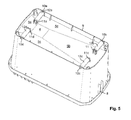
- Fig. 1 shows a perspective view of the Wasimimers 1 obliquely-above.
- the substantially cuboid washing bucket 1 has a bottom 2 and four side elements 3a, 3b, 3c, 3d. In each case, the two side elements 3a and 3c and 3b and 3d are arranged substantially parallel to each other.
- the bottom 2 has a substantially rectangular basic shape with a short base and a long base and consists of several surface elements.
- the surface element 4 is arranged horizontally and the surface elements 5a, 5b, 5c, 5d are not horizontal.
- roller holders 6a, 6b, 6c for receiving a washing roller (not shown) spanning the washing bucket 1, four spout openings 7a, 7b, 7c, 7d and a hanger 8 for a handle (not shown) spanning the washing bucket 1.
- horizontal and vertical refer to a positioning of the washing bucket 1 in a working position, i. with substantially horizontal bottom 2, horizontally extending side elements 3a, 3b, 3c, 3d and upwardly pointing bucket opening, so that the washing bucket 1 in this position can fulfill its function (storage means for liquids).
- Fig. 2 shows a perspective view of the laundry bucket 1 from Fig. 1 from diagonally below.
- the bottom 2 of the Wascheimers 1 consists of a total of five surface elements, wherein the surface element 4 is horizontal and the surface elements 5a, 5b, 5c, 5d are not horizontal.
- the handle bearing 8 is attached to the upper edge of the side member 3b.
- the spout openings 7a, 7b, 7c, 7d are located in each case in areas of the meeting of two side elements.
- a circumferential web 9 is arranged at the outer edge of the bottom 2 . Roller elements (in Fig.
- a second roller element between the receptacle 10b and the abutment 11b, a second roller element, between the receptacle 10c and the abutment 11c, a third roller element and between the receptacle 10d and the abutment 11 d a fourth roller element are rotatably mounted.
- Fig. 3 shows a plan view of the washing bucket 1 from Fig. 1 , Shown are the three roller holders 6a, 6b, 6c and the four spout openings 7a, 7b, 7c, 7d. Further shows Fig. 3 seen from the horizontal surface element 4 and the non-horizontal surface elements 5a, 5b, 5c, 5d inner side of the bottom 2. Seen in the direction of the long base and seen in the direction of the short base closes before and after the horizontal surface element 4 each one not horizontally extending surface element 5a, 5b, 5c, 5d.
- Fig. 4 shows a sectional view of the laundry bucket 1 from Fig. 1 in the in Fig. 3 illustrated direction AA.
- the horizontally extending surface element 4 is in that region of the inside of the bottom of the second arranged, which is seen in the vertical direction below the roll holders 6a, 6b, 6c.
- the horizontally extending surface element 4 is thus not arranged centrally in the direction of the long base side.
- the surface element 4 Seen in the direction of the short base side, the surface element 4 is arranged centrally in the bottom 2 and forms the deepest region of the laundry bucket 1. In the direction of the long base side, a non-horizontal surface element 5a and 5b adjoins before and after the horizontal surface element 4.
- Fig. 5 shows a perspective view of the laundry bucket 1 from Fig. 1 obliquely-down with roller elements 12a, 12b, 12c, 12d mounted on the outside of the floor 2.
- the bottom 2 of the washing bucket 1 consists of a total of five surface elements, wherein the surface element 4 is horizontal and the surface elements 5a, 5b, 5c, 5d are not horizontal.
- a circumferential web 9 is arranged at the outer edge of the bottom 2 .
- the roller elements 12a, 12b, 12c, 12d, which serve to move the washing bucket 1, are each rotatably mounted with a first end face in a receptacle 10a, 10b, 10c, 10d in the circumferential web 9.
- roller elements 12a, 12b, 12c, 12d are rotatably mounted in one of the abutments 11a, 11b, 11c, 11d mounted on the outside of the bottom 2.
- a first roller element 12a is rotatably mounted between the receptacle 10a and the abutment 11a.
- a second roller element 12b between the receptacle 10c and the abutment 11c, a third roller element 12c and between the receptacle 10d and the abutment 11d a fourth roller element 12d rotatably mounted.
Landscapes
- Engineering & Computer Science (AREA)
- Architecture (AREA)
- Civil Engineering (AREA)
- Structural Engineering (AREA)
- Accessory Of Washing/Drying Machine, Commercial Washing/Drying Machine, Other Washing/Drying Machine (AREA)
- Devices For Warming Or Keeping Food Or Tableware Hot (AREA)
- Detail Structures Of Washing Machines And Dryers (AREA)
- Cleaning By Liquid Or Steam (AREA)
Abstract
Description
- Die Erfindung betrifft einen Wascheimer, insbesondere einen Fliesen-Wascheimer.
- Derartige Fliesen-Wascheimer von Fliesenlegern verwendet.
- Nach dem Einfugen der Fugen wäscht der Fliesenleger zum Entfernen von Zementresten den Fliesenbelag mit einem Schwammbrett ab. Dadurch wird der Schwammbelag durch die Aufnahme der Zementreste zwangsläufig stark verschmutzt. Um diesen Zementschleier wieder aus dem Schwammbelag zu entfernen taucht man das Schwammbrett in einen Fliesen-Wascheimer mit Wasser und drückt das Schwammbrett erst auf einem Ausdrückgitter aus. Um das Restwasser aus dem Schwammbrett zu entfernen, wird dann das Schwammbrett über drehbar gelagerte Waschrollen ausgedrückt.
- Dadurch wird das im Schwamm befindliche Wasser aus dem Schwamm herausgedrückt und der darin enthaltene Zement bzw. die darin enthaltene Fugenmasse sammelt sich im Wasser des Fliesen-Wascheimers und setzen sich am Boden des Wascheimers ab.
- Der Erfindung liegt die Aufgabe zugrunde, einen besonders vorteilhaften, variabel einsetzbaren Wascheimer anzubieten. Insbesondere soll dieser leicht zu manövrieren sein.
- Diese Aufgabe wird durch die Merkmale des Schutzanspruchs 1 gelöst. Vorteilhafte Ausführungsformen sind in den Unteransprüchen 2 - 11 beschrieben.
- Der erfindungsgemäße Wascheimer aus Kunststoff, der insbesondere als Fliesen-Wascheimer ausgebildet ist, ist im wesentlichen quaderförmig ausgebildet und besitzt einem Boden, der eine erste, kurze Grundseite und eine zweite, lange Grundseite aufweist, sowie vier Seitenelementen. An der Außenseite des Bodens sind vier Rollenelemente anbringbar.
- Durch die im wesentlichen quaderförmige Gestalt des Wascheimers ist ein einfaches und schnelles Eintauchen des Schwammbrettes möglich. Durch das Vorsehen von Anbringmöglichkeiten für vier Rollenelementen ist ein besonders leichtgängiges und fugenschonendes Verfahren und Manövrieren des Wascheimers möglich.
- In einer vorteilhaften Ausführungsform weist die Außenseite des Bodens an dessen Außenkante einen umlaufenden Steg auf und die Rollenelemente sind jeweils mit einer ersten Stirnseite in einer Aufnahme im umlaufenden Steg drehbar lagerbar und mit einer zweiten Stirnseite in einem an der Außenseite des Bodens angebrachten Widerlager drehbar lagerbar. Auf diese Weise ist eine besonders stabile Lagerung der Rollenelemente möglich. Zugleich ermöglicht eine derartige Positionierung der Rollenelemente eine hohe Standfestigkeit des Wascheimers.
- In einer weiteren vorteilhaften Ausführungsform weist der neuerungsgemäße Wascheimer mindestens drei Rollenhalterungen für mindestens eine den Wascheimer überspannende Waschrolle auf. Durch diese große Anzahl von Rollenhalterungen ist eine variable Lagerung der Waschrolle je nach Bedarf möglich.
- In einer weiteren vorteilhaften Ausführungsform verläuft die Innenseite des Bodens nicht über ihren gesamten Bereich horizontal. Die Innenseite des Bodens besteht vielmehr aus mindestens einem horizontal verlaufenden Flächenelement und mindestens einem nicht horizontal verlaufenden Flächenelement. Die Innenseite des Bodens verläuft somit zumindest teilweise schräg (und damit nicht-parallel) gegenüber einer horizontalen Ebene, z.B. einer Tischebene (Tischplatte) oder einer Bodenebene, auf welcher der Wascheimer abgestellt ist. Durch die Verwendung einzelner, bei Bedarf standardisierter, Flächenelemente ist darüber hinaus eine besonders kostengünstige Fertigung möglich.
- Dabei ist es möglich, dass nur ein horizontal und ein nicht horizontal verlaufendes Flächenelement vorhanden ist. Insbesondere können diese Flächenelemente derart angeordnet sein, dass das horizontal verlaufende Flächenelement den tiefsten Bereich des Wascheimers bildet. Der sich im Bereich des nicht horizontal verlaufenden Flächenelements absetzende Schlamm, gleitet an diesem nicht horizontal verlaufenden Flächenelement herab und sammelt sich auf dem horizontal verlaufenden Flächenelement.
- Der nicht horizontal (also schräg) verlaufende Boden führt dazu, dass der sich am Boden absetzende Fugenschlamm automatisch durch die Wirkung der Schwerkraft in bestimmten, definierten Bereichen des Bodens (z.B. am tiefsten Punkt) sammelt und auch dort verbleibt, ohne dass dies durch manuelle Schrägstellung des Wascheimers herbeigeführt werden muss, wie dies bei konventionellen Eimern mit horizontalem Boden herbeigeführt werden muss. Dadurch kann der Fugenschlamm bei Bedarf schneller entfernt werden.
- In einer weiteren vorteilhaften Ausführungsform ist das horizontal verlaufende Flächenelement in denjenigen Bereich der Innenseite des Bodens angeordnet, der sich in vertikaler Richtung gesehen unterhalb der Rollenhalterungen befindet. Dadurch wird der Schmutz in diesem Bereich gesammelt.
- In besonders vorteilhafter Weise ist das horizontal verlaufende Flächenelement in Richtung der kurzen Grundseite gesehen mittig angeordnet. Dadurch wird der Fugenschlamm mittig im Boden gesammelt. Der Schwerpunkt des Wascheimers befindet sich somit in Richtung der kurzen Grundseite gesehen ebenfalls mittig.
- Nach einer weiteren vorteilhaften Ausführungsform weist der Wascheimer vier Ausgussöffnungen auf. Dadurch ist ein einfaches Ausgießen des Wascheimers in verschiedene Richtungen möglich.
- In einer weiteren vorteilhaften Ausführungsform befinden sich die Ausgussöffnungen jeweils in Bereichen des Aufeinandertreffens zweier Seitenelemente. Durch diese Ecklage kann das Ausgießen besonders einfach und gezielt erfolgen.
- Nach einer weiteren vorteilhaften Ausführungsform weist der Wascheimer eine Henkellagerung für einen den Wascheimer überspannenden Henkel auf.
- Die Erfindung ist anhand eines Ausführungsbeispiels in den Zeichnungsfiguren weiter erläutert. Es zeigen:
- Fig. 1
- eine perspektivische Ansicht des Wascheimers von schräg-oben;
- Fig. 2
- eine perspektivische Ansicht des Wascheimers aus
Fig. 1 von schräg-unten; - Fig. 3
- eine Draufsicht auf den Wascheimer aus
Fig. 1 ; - Fig. 4
- eine Schnittansicht des Wascheimers entlang der Ebene A-A in
Fig. 3 ; - Fig. 5
- eine perspektivische Ansicht des Wascheimers aus
Fig. 1 von schräg-unten mit an der Außenseite des Bodens angebrachten Rollenelementen. -
Fig. 1 zeigt eine perspektivische Ansicht des Wascheimers 1 von schräg-oben. Der im wesentlichen quaderförmige Wascheimer 1 weist einen Boden 2 und vier Seitenelemente 3a, 3b, 3c, 3d auf. Dabei sind jeweils die beiden Seitenelemente 3a und 3c sowie 3b und 3d im wesentlichen parallel zueinander angeordnet. Der Boden 2 besitzt dabei eine im wesentlichen rechteckige Grundform mit einer kurzen Grundseite und einer langen Grundseite und besteht aus mehreren Flächenelementen. Das Flächenelement 4 ist horizontal angeordnet und die Flächenelemente 5a, 5b, 5c, 5d verlaufen nicht horizontal. Weiterhin sind drei Rollenhalterungen 6a, 6b, 6c zur Aufnahme einer den Wascheimer 1 überspannende Waschrolle (nicht dargestellt), vier Ausgussöffnungen 7a, 7b, 7c, 7d sowie eine Henkellagerung 8 für einen den Wascheimer 1 überspannenden Henkel (nicht dargestellt) vorhanden. - Die Begriffe "horizontal" und "vertikal" beziehen sich auf eine Positionierung des Wascheimers 1 in einer Arbeitsstellung, d.h. mit im wesentlichen waagerecht ausgerichtetem Boden 2, horizontal verlaufenden Seitenelementen 3a, 3b, 3c, 3d und nach oben zeigender Eimeröffnung, sodass der Wascheimer 1 in dieser Position seine Funktion (Aufbewahrungsmittel für Flüssigkeiten) erfüllen kann.
-
Fig. 2 zeigt eine perspektivische Ansicht des Wascheimers 1 ausFig. 1 von schräg-unten. Der Boden 2 des Wascheimers 1 besteht aus insgesamt fünf Flächenelementen, wobei das Flächenelement 4 horizontal und die Flächenelemente 5a, 5b, 5c, 5d nicht horizontal verlaufen. Die Henkellagerung 8 ist am oberen Rand des Seitenelements 3b angebracht. Die Ausgussöffnungen 7a, 7b, 7c, 7d befinden sich jeweils in Bereichen des Aufeinandertreffens zweier Seitenelemente. An der Außenkante des Bodens 2 ist ein umlaufender Steg 9 angeordnet. Rollenelemente (inFig. 2 nicht dargestellt), die zum Verfahren des Wascheimers 1 dienen, sind jeweils mit einer ersten Stirnseite in eine Aufnahme 10a, 10b, 10c, 10d im umlaufenden Steg 9 drehbar lagerbar. Mit einer zweiten Stirnseite können die Rollenelemente in einem der an der Außenseite des Bodens 2 angebrachten Widerlager 11a, 11 b, 11 c, 11 d drehbar gelagert werden. Mit anderen Worten kann zwischen der Aufnahme 10a und dem Widerlager 11a ein erstes Rollenelement drehbar gelagert werden. In analoger Weise kann zwischen der Aufnahme 10b und dem Widerlager 11 b ein zweites Rollenelement, zwischen der Aufnahme 10c und dem Widerlager 11 c ein drittes Rollenelement und zwischen der Aufnahme 10d und dem Widerlager 11 d ein viertes Rollenelement drehbar gelagert werden. -
Fig. 3 zeigt eine Draufsicht auf den Wascheimer 1 ausFig. 1 . Dargestellt sind die drei Rollenhalterungen 6a, 6b, 6c und die vier Ausgussöffnungen 7a, 7b, 7c, 7d. Ferner zeigtFig. 3 die aus dem horizontal verlaufenden Flächenelement 4 und den nicht horizontal verlaufenden Flächenelementen 5a, 5b, 5c, 5d bestehende Innenseite des Bodens 2. In Richtung der langen Grundseite gesehen und in Richtung der kurzen Grundseite gesehen schließt sich vor und nach dem horizontalen Flächenelement 4 jeweils ein nicht horizontal verlaufendes Flächenelement 5a, 5b, 5c, 5d an. -
Fig. 4 zeigt eine Schnittansicht des Wascheimers 1 ausFig. 1 in der inFig. 3 dargestellten Richtung A-A. Das horizontal verlaufende Flächenelement 4 ist in denjenigen Bereich der Innenseite des Bodens 2 angeordnet, der sich in vertikaler Richtung gesehen unterhalb der Rollenhalterungen 6a, 6b, 6c befindet. - Das horizontal verlaufende Flächenelement 4 ist somit in Richtung der langen Grundseite gesehen nicht mittig angeordnet.
- Das Flächenelement 4 ist in Richtung der kurzen Grundseite gesehen mittig im Boden 2 angeordnet und bildet den tiefsten Bereich des Wascheimers 1. In Richtung der langen Grundseite gesehen schließt sich vor und nach dem horizontalen Flächenelement 4 jeweils ein nicht horizontal verlaufendes Flächenelement 5a und 5b an.
-
Fig. 5 zeigt eine perspektivische Ansicht des Wascheimers 1 ausFig. 1 von schräg-unten mit an der Außenseite des Bodens 2 angebrachten Rollenelementen 12a, 12b, 12c, 12d. Der Boden 2 des Wascheimers 1 besteht aus insgesamt fünf Flächenelementen, wobei das Flächenelement 4 horizontal und die Flächenelemente 5a, 5b, 5c, 5d nicht horizontal verlaufen. An der Außenkante des Bodens 2 ist ein umlaufender Steg 9 angeordnet. Die Rollenelemente 12a, 12b, 12c, 12d, die zum Verfahren des Wascheimers 1 dienen, sind jeweils mit einer ersten Stirnseite in eine Aufnahme 10a, 10b, 10c, 10d im umlaufenden Steg 9 drehbar gelagert. Mit einer zweiten Stirnseite sind die Rollenelemente 12a, 12b, 12c, 12d in einem der an der Außenseite des Bodens 2 angebrachten Widerlager 11a, 11 b, 11 c, 11 d drehbar gelagert. Mit anderen Worten ist zwischen der Aufnahme 10a und dem Widerlager 11a ein erstes Rollenelement 12a drehbar gelagert. In analoger Weise ist zwischen der Aufnahme 10b und dem Widerlager 11b ein zweites Rollenelement 12b, zwischen der Aufnahme 10c und dem Widerlager 11 c ein drittes Rollenelement 12c und zwischen der Aufnahme 10d und dem Widerlager 11 d ein viertes Rollenelement 12d drehbar gelagert. -
- 1
- Wascheimer
- 2
- Boden
- 3
- Seitenelement
- 4
- horizontal verlaufendes Flächenelement
- 5
- nicht horizontal verlaufendes Flächenelement
- 6
- Rollenhalterung
- 7
- Ausgussöffnung
- 8
- Henkellagerung
- 9
- Steg
- 10
- Aufnahme
- 11
- Widerlager
- 12
- Rollenelement
Claims (11)
- Wascheimer (1), insbesondere Fliesen-Wascheimer, aus Kunststoff, welcher im wesentlichen quaderförmig ausgebildet ist, mit einem Boden (2), der eine erste, kurze Grundseite und eine zweite, lange Grundseite aufweist, und mit vier Seitenelementen (3a, 3b, 3c, 3d), wobei an der Außenseite des Bodens (2) vier Rollenelemente anbringbar sind.
- Wascheimer (1) nach Anspruch 1, wobei die Außenseite des Bodens (2) an dessen Außenkante einen umlaufenden Steg (9) aufweist und die Rollenelemente jeweils mit einer ersten Stirnseite in einer Aufnahme (10a, 10b, 10c, 10d) im umlaufenden Steg (9) drehbar lagerbar sind und mit einer zweiten Stirnseite in einem an der Außenseite des Bodens (2) angebrachten Widerlager (11a, 11 b, 11 c, 11 d) drehbar lagerbar sind.
- Wascheimer (1) nach einem der vorhergehenden Ansprüche, wobei der Wascheimer (1) mindestens drei Rollenhalterungen (6a, 6b, 6c) für mindestens eine den Wascheimer (1) überspannende Waschrolle aufweist.
- Wascheimer (1) nach einem der vorhergehenden Ansprüche, wobei die Innenseite des Bodens (2) aus mindestens einem horizontal verlaufenden Flächenelement (4) und mindestens einem nicht horizontal verlaufenden Flächenelement (5a, 5b, 5c, 5d) besteht.
- Wascheimer (1) nach Anspruch 4, wobei das horizontal verlaufende Flächenelement (4) in denjenigen Bereich der Innenseite des Bodens (2) angeordnet ist, der sich in vertikaler Richtung gesehen unterhalb der Rollenhalterungen (6a, 6b, 6c) befindet.
- Wascheimer nach einem der Ansprüche 4 oder 5, wobei das horizontal verlaufende Flächenelement (4) in Richtung der kurzen Grundseite gesehen mittig angeordnet ist.
- Wascheimer nach einem der Ansprüche 4 bis 6, wobei das horizontal verlaufende Flächenelement (4) den tiefsten Bereich des Wascheimers (1) bildet.
- Wascheimer nach einem der Ansprüche 4 bis 7, wobei sich in Richtung der langen Grundseite gesehen und/oder in Richtung der kurzen Grundseite gesehen vor und nach dem horizontalen Flächenelement (4) jeweils mindestens ein nicht horizontal verlaufendes Flächenelement (5a, 5b, 5c, 5d) anschließt.
- Wascheimer (1) nach einem der vorhergehenden Ansprüche, wobei der Wascheimer (1) vier Ausgussöffnungen (7a, 7b, 7c, 7d) aufweist.
- Wascheimer (1) nach Anspruch 9, wobei sich die Ausgussöffnungen (7a, 7b, 7c, 7d) jeweils in Bereichen des Aufeinandertreffens zweier Seitenelemente (3a, 3b, 3c, 3d) befinden.
- Wascheimer (1) nach einem der vorhergehenden Ansprüche, wobei der Wascheimer (1) eine Henkellagerung (8) für einen den Wascheimer (1) überspannenden Henkel aufweist.
Applications Claiming Priority (1)
| Application Number | Priority Date | Filing Date | Title |
|---|---|---|---|
| DE202011052462U DE202011052462U1 (de) | 2011-12-23 | 2011-12-23 | Wascheimer, insbesondere Fliesen-Wascheimer |
Publications (3)
| Publication Number | Publication Date |
|---|---|
| EP2606802A2 true EP2606802A2 (de) | 2013-06-26 |
| EP2606802A3 EP2606802A3 (de) | 2015-02-25 |
| EP2606802B1 EP2606802B1 (de) | 2016-10-12 |
Family
ID=45769316
Family Applications (1)
| Application Number | Title | Priority Date | Filing Date |
|---|---|---|---|
| EP12199308.3A Not-in-force EP2606802B1 (de) | 2011-12-23 | 2012-12-21 | Wascheimer, insbesondere Fliesen-Wascheimer |
Country Status (3)
| Country | Link |
|---|---|
| EP (1) | EP2606802B1 (de) |
| DE (1) | DE202011052462U1 (de) |
| ES (1) | ES2608314T3 (de) |
Families Citing this family (3)
| Publication number | Priority date | Publication date | Assignee | Title |
|---|---|---|---|---|
| DE102020121122B4 (de) | 2020-08-11 | 2023-02-09 | Kronen-Hansa-Werk Gmbh & Co. Kg | Waschrollenaufnahme für einen Wascheimer |
| DE102021112956B3 (de) | 2021-02-12 | 2022-06-09 | Kronen-Hansa-Werk Gmbh & Co. Kg | Eimer |
| DE102022122736B3 (de) | 2022-09-07 | 2023-11-23 | Kronen-Hansa-Werk Gmbh & Co. Kg | Wascheimer |
Family Cites Families (4)
| Publication number | Priority date | Publication date | Assignee | Title |
|---|---|---|---|---|
| DE3502307A1 (de) * | 1985-01-21 | 1986-07-24 | Friedrich 8500 Nürnberg Kaul | Vorrichtung zum reinigen des waschbretts fuer fliesenleger, stukkateure und aehnliche berufe |
| US6279195B1 (en) * | 1999-07-08 | 2001-08-28 | Blyth S. Biggs | Ergonomic mop bucket method and apparatus |
| US7350260B2 (en) * | 2005-01-14 | 2008-04-01 | Joseph Papa | Mop wringer and handle stabilizer |
| DE202007000040U1 (de) * | 2007-10-08 | 2007-12-27 | Kaul, Christian | Wascheimer, insbesondere Fliesen-Wascheimer |
-
2011
- 2011-12-23 DE DE202011052462U patent/DE202011052462U1/de not_active Expired - Lifetime
-
2012
- 2012-12-21 EP EP12199308.3A patent/EP2606802B1/de not_active Not-in-force
- 2012-12-21 ES ES12199308.3T patent/ES2608314T3/es active Active
Non-Patent Citations (1)
| Title |
|---|
| None |
Also Published As
| Publication number | Publication date |
|---|---|
| ES2608314T3 (es) | 2017-04-07 |
| EP2606802B1 (de) | 2016-10-12 |
| EP2606802A3 (de) | 2015-02-25 |
| DE202011052462U1 (de) | 2012-02-01 |
Similar Documents
| Publication | Publication Date | Title |
|---|---|---|
| DE102009043686A1 (de) | Wischeimer | |
| DE102016118256B3 (de) | Reinigungssystem zur Fußbodenreinigung | |
| EP2606802A2 (de) | Wascheimer, insbesondere Fliesen-Wascheimer | |
| EP2808458A1 (de) | Wasserablaufvorrichtung für eine Dusche und Duschbodenelement | |
| DE29924050U1 (de) | Bewässerungs- und/oder Drainagekasten | |
| EP1210902A1 (de) | Auspresssieb für Feuchtwischmops | |
| DE102021112956B3 (de) | Eimer | |
| DE102016110432A1 (de) | Behälter | |
| EP4177411A1 (de) | Profilelement | |
| DE2900774A1 (de) | Saugfilterbandvorrichtung | |
| DE19624942C2 (de) | Behälter für Flüssigkeiten, insbesondere für Waschflüssigkeiten | |
| DE202007000040U1 (de) | Wascheimer, insbesondere Fliesen-Wascheimer | |
| WO1999018837A1 (de) | Behälter für flüssigkeiten, insb. für waschflüssigkeiten | |
| DE102022122736B3 (de) | Wascheimer | |
| AT515272A1 (de) | Werkzeugspeichersystem für Biegewerkzeuge | |
| DE8809476U1 (de) | Vorrichtung zum Absetzen von Verunreinigungen von in einem Behälter enthaltener Reinigungsflüssigkeit | |
| EP2735348A1 (de) | Abscheider mit Trägerkonstruktion | |
| DE102016108537A1 (de) | Wischmopp-Flüssigkeitsabstreifvorrichtung zum Abstreifen von Flüssigkeit von einem Wischmopp und Anordnung aufweisend wenigstens einen Reinigungsbehälter und eine darauf aufgesetzte Wischmopp-Flüssigkeitsabstreifvorrichtung | |
| DE2941660A1 (de) | Sinkkasten fuer bodenablaufrinnen | |
| DE202024102898U1 (de) | Schmutzfangsystem an einer Rolltreppe | |
| DE102023001660A1 (de) | Boden-Wischmopp-Abstreifvorrichtung | |
| DE102023122332A1 (de) | Waschbrett und Vorrichtung zum Reinigen eines Waschbretts | |
| DE20101733U1 (de) | Schuhputzvorrichtung | |
| EP2650435A2 (de) | Stein und Verlegeeinheit mit mehreren Steinen | |
| DE202009012633U1 (de) | Deckwerkstein |
Legal Events
| Date | Code | Title | Description |
|---|---|---|---|
| AK | Designated contracting states |
Kind code of ref document: A2 Designated state(s): AL AT BE BG CH CY CZ DE DK EE ES FI FR GB GR HR HU IE IS IT LI LT LU LV MC MK MT NL NO PL PT RO RS SE SI SK SM TR |
|
| AX | Request for extension of the european patent |
Extension state: BA ME |
|
| PUAI | Public reference made under article 153(3) epc to a published international application that has entered the european phase |
Free format text: ORIGINAL CODE: 0009012 |
|
| RIC1 | Information provided on ipc code assigned before grant |
Ipc: B08B 1/04 20060101ALI20140926BHEP Ipc: E04F 21/06 20060101ALI20140926BHEP Ipc: A47L 13/58 20060101ALI20140926BHEP Ipc: A47L 13/60 20060101AFI20140926BHEP Ipc: B08B 1/02 20060101ALI20140926BHEP |
|
| PUAL | Search report despatched |
Free format text: ORIGINAL CODE: 0009013 |
|
| AK | Designated contracting states |
Kind code of ref document: A3 Designated state(s): AL AT BE BG CH CY CZ DE DK EE ES FI FR GB GR HR HU IE IS IT LI LT LU LV MC MK MT NL NO PL PT RO RS SE SI SK SM TR |
|
| AX | Request for extension of the european patent |
Extension state: BA ME |
|
| RIC1 | Information provided on ipc code assigned before grant |
Ipc: A47L 13/60 20060101AFI20150121BHEP Ipc: B08B 1/04 20060101ALI20150121BHEP Ipc: A47L 13/58 20060101ALI20150121BHEP Ipc: B08B 1/02 20060101ALI20150121BHEP Ipc: E04F 21/06 20060101ALI20150121BHEP |
|
| RAP1 | Party data changed (applicant data changed or rights of an application transferred) |
Owner name: KWM ENTWICKLUNGS-, VETRIEBS- UND SERVICE GMBH |
|
| 17P | Request for examination filed |
Effective date: 20150824 |
|
| RBV | Designated contracting states (corrected) |
Designated state(s): AL AT BE BG CH CY CZ DE DK EE ES FI FR GB GR HR HU IE IS IT LI LT LU LV MC MK MT NL NO PL PT RO RS SE SI SK SM TR |
|
| GRAP | Despatch of communication of intention to grant a patent |
Free format text: ORIGINAL CODE: EPIDOSNIGR1 |
|
| INTG | Intention to grant announced |
Effective date: 20160630 |
|
| GRAS | Grant fee paid |
Free format text: ORIGINAL CODE: EPIDOSNIGR3 |
|
| GRAA | (expected) grant |
Free format text: ORIGINAL CODE: 0009210 |
|
| AK | Designated contracting states |
Kind code of ref document: B1 Designated state(s): AL AT BE BG CH CY CZ DE DK EE ES FI FR GB GR HR HU IE IS IT LI LT LU LV MC MK MT NL NO PL PT RO RS SE SI SK SM TR |
|
| REG | Reference to a national code |
Ref country code: GB Ref legal event code: FG4D Free format text: NOT ENGLISH |
|
| REG | Reference to a national code |
Ref country code: CH Ref legal event code: EP |
|
| REG | Reference to a national code |
Ref country code: AT Ref legal event code: REF Ref document number: 835687 Country of ref document: AT Kind code of ref document: T Effective date: 20161015 |
|
| REG | Reference to a national code |
Ref country code: IE Ref legal event code: FG4D Free format text: LANGUAGE OF EP DOCUMENT: GERMAN |
|
| REG | Reference to a national code |
Ref country code: DE Ref legal event code: R096 Ref document number: 502012008484 Country of ref document: DE |
|
| REG | Reference to a national code |
Ref country code: FR Ref legal event code: PLFP Year of fee payment: 5 |
|
| REG | Reference to a national code |
Ref country code: NL Ref legal event code: FP |
|
| REG | Reference to a national code |
Ref country code: LT Ref legal event code: MG4D |
|
| PG25 | Lapsed in a contracting state [announced via postgrant information from national office to epo] |
Ref country code: LV Free format text: LAPSE BECAUSE OF FAILURE TO SUBMIT A TRANSLATION OF THE DESCRIPTION OR TO PAY THE FEE WITHIN THE PRESCRIBED TIME-LIMIT Effective date: 20161012 |
|
| REG | Reference to a national code |
Ref country code: ES Ref legal event code: FG2A Ref document number: 2608314 Country of ref document: ES Kind code of ref document: T3 Effective date: 20170407 |
|
| PG25 | Lapsed in a contracting state [announced via postgrant information from national office to epo] |
Ref country code: GR Free format text: LAPSE BECAUSE OF FAILURE TO SUBMIT A TRANSLATION OF THE DESCRIPTION OR TO PAY THE FEE WITHIN THE PRESCRIBED TIME-LIMIT Effective date: 20170113 Ref country code: NO Free format text: LAPSE BECAUSE OF FAILURE TO SUBMIT A TRANSLATION OF THE DESCRIPTION OR TO PAY THE FEE WITHIN THE PRESCRIBED TIME-LIMIT Effective date: 20170112 Ref country code: LT Free format text: LAPSE BECAUSE OF FAILURE TO SUBMIT A TRANSLATION OF THE DESCRIPTION OR TO PAY THE FEE WITHIN THE PRESCRIBED TIME-LIMIT Effective date: 20161012 Ref country code: SE Free format text: LAPSE BECAUSE OF FAILURE TO SUBMIT A TRANSLATION OF THE DESCRIPTION OR TO PAY THE FEE WITHIN THE PRESCRIBED TIME-LIMIT Effective date: 20161012 |
|
| PG25 | Lapsed in a contracting state [announced via postgrant information from national office to epo] |
Ref country code: PL Free format text: LAPSE BECAUSE OF FAILURE TO SUBMIT A TRANSLATION OF THE DESCRIPTION OR TO PAY THE FEE WITHIN THE PRESCRIBED TIME-LIMIT Effective date: 20161012 Ref country code: HR Free format text: LAPSE BECAUSE OF FAILURE TO SUBMIT A TRANSLATION OF THE DESCRIPTION OR TO PAY THE FEE WITHIN THE PRESCRIBED TIME-LIMIT Effective date: 20161012 Ref country code: IS Free format text: LAPSE BECAUSE OF FAILURE TO SUBMIT A TRANSLATION OF THE DESCRIPTION OR TO PAY THE FEE WITHIN THE PRESCRIBED TIME-LIMIT Effective date: 20170212 Ref country code: BE Free format text: LAPSE BECAUSE OF NON-PAYMENT OF DUE FEES Effective date: 20161231 Ref country code: RS Free format text: LAPSE BECAUSE OF FAILURE TO SUBMIT A TRANSLATION OF THE DESCRIPTION OR TO PAY THE FEE WITHIN THE PRESCRIBED TIME-LIMIT Effective date: 20161012 Ref country code: FI Free format text: LAPSE BECAUSE OF FAILURE TO SUBMIT A TRANSLATION OF THE DESCRIPTION OR TO PAY THE FEE WITHIN THE PRESCRIBED TIME-LIMIT Effective date: 20161012 Ref country code: PT Free format text: LAPSE BECAUSE OF FAILURE TO SUBMIT A TRANSLATION OF THE DESCRIPTION OR TO PAY THE FEE WITHIN THE PRESCRIBED TIME-LIMIT Effective date: 20170213 |
|
| REG | Reference to a national code |
Ref country code: DE Ref legal event code: R097 Ref document number: 502012008484 Country of ref document: DE |
|
| PG25 | Lapsed in a contracting state [announced via postgrant information from national office to epo] |
Ref country code: SK Free format text: LAPSE BECAUSE OF FAILURE TO SUBMIT A TRANSLATION OF THE DESCRIPTION OR TO PAY THE FEE WITHIN THE PRESCRIBED TIME-LIMIT Effective date: 20161012 Ref country code: DK Free format text: LAPSE BECAUSE OF FAILURE TO SUBMIT A TRANSLATION OF THE DESCRIPTION OR TO PAY THE FEE WITHIN THE PRESCRIBED TIME-LIMIT Effective date: 20161012 Ref country code: CZ Free format text: LAPSE BECAUSE OF FAILURE TO SUBMIT A TRANSLATION OF THE DESCRIPTION OR TO PAY THE FEE WITHIN THE PRESCRIBED TIME-LIMIT Effective date: 20161012 Ref country code: EE Free format text: LAPSE BECAUSE OF FAILURE TO SUBMIT A TRANSLATION OF THE DESCRIPTION OR TO PAY THE FEE WITHIN THE PRESCRIBED TIME-LIMIT Effective date: 20161012 Ref country code: RO Free format text: LAPSE BECAUSE OF FAILURE TO SUBMIT A TRANSLATION OF THE DESCRIPTION OR TO PAY THE FEE WITHIN THE PRESCRIBED TIME-LIMIT Effective date: 20161012 |
|
| REG | Reference to a national code |
Ref country code: CH Ref legal event code: PL |
|
| PLBE | No opposition filed within time limit |
Free format text: ORIGINAL CODE: 0009261 |
|
| STAA | Information on the status of an ep patent application or granted ep patent |
Free format text: STATUS: NO OPPOSITION FILED WITHIN TIME LIMIT |
|
| PG25 | Lapsed in a contracting state [announced via postgrant information from national office to epo] |
Ref country code: SM Free format text: LAPSE BECAUSE OF FAILURE TO SUBMIT A TRANSLATION OF THE DESCRIPTION OR TO PAY THE FEE WITHIN THE PRESCRIBED TIME-LIMIT Effective date: 20161012 Ref country code: BG Free format text: LAPSE BECAUSE OF FAILURE TO SUBMIT A TRANSLATION OF THE DESCRIPTION OR TO PAY THE FEE WITHIN THE PRESCRIBED TIME-LIMIT Effective date: 20170112 |
|
| 26N | No opposition filed |
Effective date: 20170713 |
|
| PG25 | Lapsed in a contracting state [announced via postgrant information from national office to epo] |
Ref country code: MC Free format text: LAPSE BECAUSE OF FAILURE TO SUBMIT A TRANSLATION OF THE DESCRIPTION OR TO PAY THE FEE WITHIN THE PRESCRIBED TIME-LIMIT Effective date: 20161012 |
|
| REG | Reference to a national code |
Ref country code: IE Ref legal event code: MM4A |
|
| PG25 | Lapsed in a contracting state [announced via postgrant information from national office to epo] |
Ref country code: LU Free format text: LAPSE BECAUSE OF NON-PAYMENT OF DUE FEES Effective date: 20161221 Ref country code: CH Free format text: LAPSE BECAUSE OF NON-PAYMENT OF DUE FEES Effective date: 20161231 Ref country code: LI Free format text: LAPSE BECAUSE OF NON-PAYMENT OF DUE FEES Effective date: 20161231 |
|
| PG25 | Lapsed in a contracting state [announced via postgrant information from national office to epo] |
Ref country code: SI Free format text: LAPSE BECAUSE OF FAILURE TO SUBMIT A TRANSLATION OF THE DESCRIPTION OR TO PAY THE FEE WITHIN THE PRESCRIBED TIME-LIMIT Effective date: 20161012 Ref country code: IE Free format text: LAPSE BECAUSE OF NON-PAYMENT OF DUE FEES Effective date: 20161221 |
|
| REG | Reference to a national code |
Ref country code: FR Ref legal event code: PLFP Year of fee payment: 6 |
|
| REG | Reference to a national code |
Ref country code: BE Ref legal event code: MM Effective date: 20161231 |
|
| PG25 | Lapsed in a contracting state [announced via postgrant information from national office to epo] |
Ref country code: HU Free format text: LAPSE BECAUSE OF FAILURE TO SUBMIT A TRANSLATION OF THE DESCRIPTION OR TO PAY THE FEE WITHIN THE PRESCRIBED TIME-LIMIT; INVALID AB INITIO Effective date: 20121221 Ref country code: CY Free format text: LAPSE BECAUSE OF FAILURE TO SUBMIT A TRANSLATION OF THE DESCRIPTION OR TO PAY THE FEE WITHIN THE PRESCRIBED TIME-LIMIT Effective date: 20161012 |
|
| PG25 | Lapsed in a contracting state [announced via postgrant information from national office to epo] |
Ref country code: MK Free format text: LAPSE BECAUSE OF FAILURE TO SUBMIT A TRANSLATION OF THE DESCRIPTION OR TO PAY THE FEE WITHIN THE PRESCRIBED TIME-LIMIT Effective date: 20161012 Ref country code: TR Free format text: LAPSE BECAUSE OF FAILURE TO SUBMIT A TRANSLATION OF THE DESCRIPTION OR TO PAY THE FEE WITHIN THE PRESCRIBED TIME-LIMIT Effective date: 20161012 |
|
| PG25 | Lapsed in a contracting state [announced via postgrant information from national office to epo] |
Ref country code: MT Free format text: LAPSE BECAUSE OF FAILURE TO SUBMIT A TRANSLATION OF THE DESCRIPTION OR TO PAY THE FEE WITHIN THE PRESCRIBED TIME-LIMIT Effective date: 20161012 |
|
| PGFP | Annual fee paid to national office [announced via postgrant information from national office to epo] |
Ref country code: NL Payment date: 20191217 Year of fee payment: 8 |
|
| PGFP | Annual fee paid to national office [announced via postgrant information from national office to epo] |
Ref country code: FR Payment date: 20191219 Year of fee payment: 8 |
|
| PGFP | Annual fee paid to national office [announced via postgrant information from national office to epo] |
Ref country code: GB Payment date: 20191220 Year of fee payment: 8 Ref country code: ES Payment date: 20200122 Year of fee payment: 8 |
|
| PG25 | Lapsed in a contracting state [announced via postgrant information from national office to epo] |
Ref country code: AL Free format text: LAPSE BECAUSE OF FAILURE TO SUBMIT A TRANSLATION OF THE DESCRIPTION OR TO PAY THE FEE WITHIN THE PRESCRIBED TIME-LIMIT Effective date: 20161012 |
|
| REG | Reference to a national code |
Ref country code: NL Ref legal event code: MM Effective date: 20210101 |
|
| GBPC | Gb: european patent ceased through non-payment of renewal fee |
Effective date: 20201221 |
|
| PG25 | Lapsed in a contracting state [announced via postgrant information from national office to epo] |
Ref country code: NL Free format text: LAPSE BECAUSE OF NON-PAYMENT OF DUE FEES Effective date: 20210101 |
|
| PG25 | Lapsed in a contracting state [announced via postgrant information from national office to epo] |
Ref country code: FR Free format text: LAPSE BECAUSE OF NON-PAYMENT OF DUE FEES Effective date: 20201231 |
|
| PG25 | Lapsed in a contracting state [announced via postgrant information from national office to epo] |
Ref country code: GB Free format text: LAPSE BECAUSE OF NON-PAYMENT OF DUE FEES Effective date: 20201221 |
|
| PGFP | Annual fee paid to national office [announced via postgrant information from national office to epo] |
Ref country code: AT Payment date: 20211216 Year of fee payment: 10 |
|
| REG | Reference to a national code |
Ref country code: ES Ref legal event code: FD2A Effective date: 20220412 |
|
| PGFP | Annual fee paid to national office [announced via postgrant information from national office to epo] |
Ref country code: DE Payment date: 20211220 Year of fee payment: 10 |
|
| PGFP | Annual fee paid to national office [announced via postgrant information from national office to epo] |
Ref country code: IT Payment date: 20211230 Year of fee payment: 10 |
|
| PG25 | Lapsed in a contracting state [announced via postgrant information from national office to epo] |
Ref country code: ES Free format text: LAPSE BECAUSE OF NON-PAYMENT OF DUE FEES Effective date: 20201222 |
|
| REG | Reference to a national code |
Ref country code: DE Ref legal event code: R119 Ref document number: 502012008484 Country of ref document: DE |
|
| REG | Reference to a national code |
Ref country code: AT Ref legal event code: MM01 Ref document number: 835687 Country of ref document: AT Kind code of ref document: T Effective date: 20221221 |
|
| PG25 | Lapsed in a contracting state [announced via postgrant information from national office to epo] |
Ref country code: DE Free format text: LAPSE BECAUSE OF NON-PAYMENT OF DUE FEES Effective date: 20230701 Ref country code: AT Free format text: LAPSE BECAUSE OF NON-PAYMENT OF DUE FEES Effective date: 20221221 |
|
| PG25 | Lapsed in a contracting state [announced via postgrant information from national office to epo] |
Ref country code: IT Free format text: LAPSE BECAUSE OF NON-PAYMENT OF DUE FEES Effective date: 20221221 |