EP2607103B1 - Gummizusammensetzung und reifen mit funktionalisiertem polybutadien und funktionalisierten styren-/butadienelastomeren - Google Patents
Gummizusammensetzung und reifen mit funktionalisiertem polybutadien und funktionalisierten styren-/butadienelastomeren Download PDFInfo
- Publication number
- EP2607103B1 EP2607103B1 EP12198492.6A EP12198492A EP2607103B1 EP 2607103 B1 EP2607103 B1 EP 2607103B1 EP 12198492 A EP12198492 A EP 12198492A EP 2607103 B1 EP2607103 B1 EP 2607103B1
- Authority
- EP
- European Patent Office
- Prior art keywords
- rubber
- functionalized
- styrene
- butadiene
- rubber composition
- Prior art date
- Legal status (The legal status is an assumption and is not a legal conclusion. Google has not performed a legal analysis and makes no representation as to the accuracy of the status listed.)
- Not-in-force
Links
Classifications
-
- C—CHEMISTRY; METALLURGY
- C08—ORGANIC MACROMOLECULAR COMPOUNDS; THEIR PREPARATION OR CHEMICAL WORKING-UP; COMPOSITIONS BASED THEREON
- C08L—COMPOSITIONS OF MACROMOLECULAR COMPOUNDS
- C08L9/00—Compositions of homopolymers or copolymers of conjugated diene hydrocarbons
-
- B—PERFORMING OPERATIONS; TRANSPORTING
- B60—VEHICLES IN GENERAL
- B60C—VEHICLE TYRES; TYRE INFLATION; TYRE CHANGING; CONNECTING VALVES TO INFLATABLE ELASTIC BODIES IN GENERAL; DEVICES OR ARRANGEMENTS RELATED TO TYRES
- B60C1/00—Tyres characterised by the chemical composition or the physical arrangement or mixture of the composition
- B60C1/0016—Compositions of the tread
-
- C—CHEMISTRY; METALLURGY
- C08—ORGANIC MACROMOLECULAR COMPOUNDS; THEIR PREPARATION OR CHEMICAL WORKING-UP; COMPOSITIONS BASED THEREON
- C08C—TREATMENT OR CHEMICAL MODIFICATION OF RUBBERS
- C08C19/00—Chemical modification of rubber
- C08C19/20—Incorporating sulfur atoms into the molecule
-
- C—CHEMISTRY; METALLURGY
- C08—ORGANIC MACROMOLECULAR COMPOUNDS; THEIR PREPARATION OR CHEMICAL WORKING-UP; COMPOSITIONS BASED THEREON
- C08C—TREATMENT OR CHEMICAL MODIFICATION OF RUBBERS
- C08C19/00—Chemical modification of rubber
- C08C19/22—Incorporating nitrogen atoms into the molecule
-
- C—CHEMISTRY; METALLURGY
- C08—ORGANIC MACROMOLECULAR COMPOUNDS; THEIR PREPARATION OR CHEMICAL WORKING-UP; COMPOSITIONS BASED THEREON
- C08C—TREATMENT OR CHEMICAL MODIFICATION OF RUBBERS
- C08C19/00—Chemical modification of rubber
- C08C19/25—Incorporating silicon atoms into the molecule
-
- C—CHEMISTRY; METALLURGY
- C08—ORGANIC MACROMOLECULAR COMPOUNDS; THEIR PREPARATION OR CHEMICAL WORKING-UP; COMPOSITIONS BASED THEREON
- C08L—COMPOSITIONS OF MACROMOLECULAR COMPOUNDS
- C08L9/00—Compositions of homopolymers or copolymers of conjugated diene hydrocarbons
- C08L9/06—Copolymers with styrene
-
- C—CHEMISTRY; METALLURGY
- C08—ORGANIC MACROMOLECULAR COMPOUNDS; THEIR PREPARATION OR CHEMICAL WORKING-UP; COMPOSITIONS BASED THEREON
- C08L—COMPOSITIONS OF MACROMOLECULAR COMPOUNDS
- C08L2205/00—Polymer mixtures characterised by other features
- C08L2205/02—Polymer mixtures characterised by other features containing two or more polymers of the same C08L -group
-
- C—CHEMISTRY; METALLURGY
- C08—ORGANIC MACROMOLECULAR COMPOUNDS; THEIR PREPARATION OR CHEMICAL WORKING-UP; COMPOSITIONS BASED THEREON
- C08L—COMPOSITIONS OF MACROMOLECULAR COMPOUNDS
- C08L2666/00—Composition of polymers characterized by a further compound in the blend, being organic macromolecular compounds, natural resins, waxes or and bituminous materials, non-macromolecular organic substances, inorganic substances or characterized by their function in the composition
- C08L2666/02—Organic macromolecular compounds, natural resins, waxes or and bituminous materials
- C08L2666/04—Macromolecular compounds according to groups C08L7/00 - C08L49/00, or C08L55/00 - C08L57/00; Derivatives thereof
- C08L2666/08—Homopolymers or copolymers according to C08L7/00 - C08L21/00; Derivatives thereof
Definitions
- the invention relates to a rubber composition comprising a combination of functionalized polybutadiene rubber and functionalized styrene/butadiene rubber, and to a tire comprising such a rubber composition.
- the treads are of a rubber composition which will provide properties which promote good wear resistance, wet traction (wet skid resistance) and acceptable rolling resistance for the tire itself.
- Such desirable rubber composition properties for the various tire components rely, in large part, upon viscoelastic properties of the elastomers, or combination of elastomers.
- elastomers having relatively high rebound property values, representing a relatively low energy loss during operation of the tire have been used to provide tire tread rubber compositions.
- mixtures of various elastomers are normally used for tire tread rubber compositions.
- mixtures of styrene/butadiene elastomers and polybutadiene elastomers have been used for a tire tread rubber compositions, sometimes with an addition of cis 1,4-polyisoprene rubber.
- a tire tread as a silica reinforcement-containing rubber composition containing a combination of functionalized styrene/butadiene rubber together with polybutadiene rubber (non-functionalized).
- Such styrene/butadiene rubber was functionalized with a combination of alkoxysilane and thiol groups to promote enhancement of the silica reinforcement for the rubber composition.
- the silica e.g. precipitated silica
- the functionalized styrene/butadiene rubber by reaction of the precipitated silica's hydroxyl groups with the functionalized styrene/butadiene rubber instead of, or in preference to, the polybutadiene rubber and in such manner preferentially provides reinforcement, or at least greater reinforcement, for the functionalized styrene/butadiene rubber instead of the non-functionalized polybutadiene rubber.
- silica reinforcement of the polybutadiene component of the rubber composition it is desired to evaluate promoting enhancement of silica reinforcement of the polybutadiene component of the rubber composition, and thereby enhanced, or improved, silica reinforcement for the rubber composition itself, by providing the polybutadiene in a form of functionalized polybutadiene to be used in combination with a functionalized styrene/butadiene rubber.
- the functionalized styrene/butadiene with both a moderate bound styrene content (e.g. from 15 to 28 or 34 percent of the styrene/butadiene rubber) to promote compatibility (miscibility) with the functionalized polybutadiene and, also, with an elevated bound styrene content (e.g. from 35 to 45 percent of the styrene/butadiene rubber) to promote incompatibility (immiscibility) with the functionalized polybutadiene.
- a moderate bound styrene content e.g. from 15 to 28 or 34 percent of the styrene/butadiene rubber
- an elevated bound styrene content e.g. from 35 to 45 percent of the styrene/butadiene rubber
- the term “phr” where used means “parts of material per 100 parts by weight rubber.
- rubber and “elastomer” may be use interchangeably, unless otherwise indicated.
- rubber composition and “compounded rubber” and “compound'' may be used interchangeably to refer to rubber, or elastomer(s), which has been blended or mixed with various ingredients and materials, unless otherwise indicated, and such terms are well known to those having skill in such art.
- the term "functionalized” relates to elastomers which contain at least one functional group which is reactive with hydroxyl groups (e.g. silanol groups) contained on silica reinforcement for the rubber composition.
- EP-A- 2 213 477 describes a rubber composition comprising a solution polymerized styrene-butadiene rubber terminally functionalized with an aminosilane compound, and cis-1,4-polybutadiene.
- EP-A- 2 182 028 describes a rubber composition comprising polybutadiene modified along its chain. It also describes a rubber composition comprising such a modified polybutadiene together with solution polymerized SBR which is end-modified with an amino group-containing compound.
- the invention relates to a rubber composition in accordance with claim 1 and to a tire in accordance with claim 15.
- the rubber composition is used in a tire tread or a tire tread cap.
- a pneumatic rubber tire having a component of a rubber composition comprising, based upon parts by weight per 100 parts by weight of rubber (phr):
- the rubber composition contains 40 to 135, alternately from 50 to 90, phr of a reinforcing filler comprising:
- said rubber composition contains a coupling agent for the silica (e.g. when said rubber composition contains said silica) having a moiety (e.g. a siloxy moiety) reactive with hydroxyl groups (e.g. silanol groups) on said silica and another moiety interactive with one of said elastomers (e.g. with carbon-carbon double bonds contained in said elastomers).
- a coupling agent for the silica e.g. when said rubber composition contains said silica
- a moiety e.g. a siloxy moiety
- hydroxyl groups e.g. silanol groups
- a representative example of functionalized monomers represented by structural formula (I) is, for example, pyrrolidine ethyl styrene, (PES).
- a representative example of functionalized monomers represented by structural formula (I) is, for example, vinyl benzyl pyrrolidine.
- a representative example of functionalized monomers represented by structural formula (I) is, for example, vinyl benzyl dimethyl amine.
- the in-chain functionalized polybutadiene may comprise repeat units derived from 1,3-butadiene and at least one of pyrrolidine ethyl styrene, vinyl benzyl dimethyl amine and vinyl benzyl pyrrolidine.
- said polybutadiene copolymer further contains repeat units derived from isoprene where isoprene monomer is copolymerized with said 1,3-butadiene and functionalized monomer(s).
- Said repeat units of isoprene may, for example, constitute from 2 to 25, alternately from 2 to 15, weight percent of said polybutadiene copolymer.
- said functionalized polybutadiene rubber is a copolymer of 1,3-butadiene and functionalized monomer prepared by anionic copolymerization of the 1,3-butadiene and functional monomers in a hydrocarbon solvent in the presence of a polymerization initiator comprised of n-butyllithium to initiate the copolymerization for which may be added a polymerization modifier to promote incorporation (distribution) of the functional monomer units along the polybutadiene chain such as, for example and not limited to, tetramethylethylenediamine (which may sometimes be referred to as TMEDA).
- a polymerization initiator comprised of n-butyllithium to initiate the copolymerization for which may be added a polymerization modifier to promote incorporation (distribution) of the functional monomer units along the polybutadiene chain
- TMEDA tetramethylethylenediamine
- the polybutadiene (prepared by the aforesaid n-butyllithium copolymerization initiator) may comprise a cis 1,4-isomeric content in a range of from 30 to 50 percent, a trans 1,4-isomeric content in a range of from 40 to 60 percent and a vinyl 1,2-content in a range of from 5 to 20 percent with a typical glass transition temperature (Tg) in a range of from -85°C to-95°C.
- Tg glass transition temperature
- Mn number average molecular weight
- Mw/Mn heterogeneity index of weight average to number average
- At least one of said terminal di-functionalized styrene/butadiene elastomer and said in-chain functionalized polybutadiene elastomer is at least partially chain extended with tin tetrachloride or silicon tetrachloride, particularly with tin tetrachloride.
- lithium polybutadiene polybutadiene rubber prepared by the n-butyllithium initiated polymerization
- functionalized polybutadiene rubber prepared by the n-butyllithium initiated copolymerization may be referred to herein as a "lithium polybutadiene copolymer”.
- Such nickel polybutadiene elastomer may have, for example, a number average (Mn) in a range of from 230,000 to 250,000 with a heterogeneity index (Mw/Mn) in a range of from 1.5 to 2.
- Mn number average
- Mw/Mn heterogeneity index
- the functional styrene/butadiene rubber is di-functionalized with a combination of alkoxysilane and primary amino or thiol groups, particularly thiol groups, together at the same terminal end of the styrene/butadiene elastomer as being derived from a singular di-functional polymerization terminating compound containing said combination of alkylsilane and primary amino or thiol groups.
- the di-functional combination of alkoxysilyl group together with the primary amino group or thiol group may thereby be bonded, for example, to one terminal end of the styrene/butadiene rubber to form the terminally di-functionalized styrene/butadiene rubber.
- the terminally di-functionalized styrene/butadiene rubber may be produced, for example, by polymerizing styrene and butadiene in a hydrocarbon solvent by anionic polymerization using an organic alkali metal and/or an organic alkali earth metal as an initiator, adding a terminating agent compound having an alkoxysilyl group and a primary amino group protected with a protective group or a thiol group protected with a protecting group to act as a polymerization terminating agent with a living polymer chain terminal at the time when the polymerization has substantially completed, and then conducting deblocking, for example, by hydrolysis or other appropriate procedure.
- the terminally di-functionalized styrene/butadiene rubber may be produced, for example, in a matter shown in USB- 7,342,070 .
- the terminally di-functionalized styrene-butadiene rubber may be produced, for example, in a manner shown in WO-A-2007/047943 .
- the terminally di-functionalized styrene/butadiene rubber may be comprised of the Formula (V): wherein P is a (co)polymer chain of styrene/butadiene copolymer, R 1 is an alkylene group having 1 to 12 carbon atoms, R 2 and R 3 are each independently selected from an alkyl group having 1 to 20 carbon atoms, an allyl group or an aryl group, where R 2 is preferably an ethyl group, n is a value of 1 or 2, m is a value of from 1 or 2, preferably 2, k is a value of from 1 or 2, x is a value of 0 to 1, with the proviso that n+m+k is an integer of 3 or 4.
- P is a (co)polymer chain of styrene/butadiene copolymer
- R 1 is an alkylene group having 1 to 12 carbon atoms
- R 2 and R 3 are each independently selected from an alky
- the terminating agent compound having a protected primary amino group and an alkoxysilyl group may be any of various compounds containing such groups as are known in the art.
- the compound having a protected primary amino group and an alkoxysilyl group may include, for example, N,N-bis(trimethylsilyl)aminopropylmethyldimethoxysilane, 1-trimethylsilyl-2,2-dimethoxy-1-aza-2-silacyclopentane, N,N-bis(trimethylsilyl)aminopropyltrimethoxysilane, N,N-bis(trimethylsilyl)aminopropyltriethoxysilane, N,N-bis(trimethylsilyl)aminopropylmethyldiethoxysilane, N,N-bis(trimethylsilyl)aminoethyltrimethoxysilane, N,N-bis(trimethylsilyl)-aminoethyltriethoxysilne, N,
- styrene-butadiene rubbers terminally di-functionalized with an alkoxysilane group and a primary amine group may be, for example, HPR 355 from Japan Synthetic Rubber (JSR).
- a silane-sulfide represented by the formula VI: (VI) (R 4 O) x R 4 y Si-R 5 -S-SiR 4
- R 5 is a (C 1 -C 16 ) alkyl.
- each R 4 group is the same or different, and each is independently a C 1 -C 5 alkyl, and R 5 is C 1 -C 5 alkyl.
- the terminal di-functionalized styrene/butadiene rubber is di-functionalized at one terminal end of the styrene/butadiene elastomer with a combination of alkoxysilane and primary amine or thiol groups with a polymerization terminating di-functional compound containing a combination of alkoxysilane and primary amine or thiol groups.
- the styrene-butadiene rubber may be terminal di-functionalized with alkoxysilane and thiol groups from, for example, Styron as an alkoxysilane/thiol functionalized SBR as described in WO-A-2007/047943 .
- a purpose of inclusion of the in-chain functionalized polybutadiene rubber, instead of non-functionalized polybutadiene rubber, with the terminally di-functionalized styrene/butadiene rubber is to promote reaction of silica with both the functionality of the in-chain functionalized polybutadiene and the terminal di-functionalized styrene/butadiene elastomers, instead of only with the terminally di-functionalized styrene/butadiene elastomer, to create a better dispersion of the silica within and throughout the in-chain functionalized polybutadiene elastomer and thereby in the rubber composition itself.
- a further purpose is to promote greater abrasion resistance of the rubber composition by promoting a better and more complete dispersion of the silica particles throughout the in-chain functionalized polybutadiene and terminal di-functionalized styrene/butadiene elastomers of the rubber composition which is predictive of better abrasion resistance for the rubber composition and thereby better resistance to treadwear for a tire with such rubber composition.
- an envisioned significant aspect is to create and evaluate miscible (compatible) and immiscible (incompatible) blends of the functionalized elastomers evaluating use of the terminal di-functionalized styrene/butadiene rubber with high a low bound styrene contents.
- the relatively immiscible rubber composition containing the combination of the terminally di-functionalized styrene/butadiene rubber with the high bound styrene content together with the in-chain functionalized polybutadiene rubber may also beneficially promote higher rebound physical property values for the rubber composition which is predictive of less internal heat generation, and therefore less temperature build-up for the rubber composition when it is being worked and predictive of better (lower) rolling resistance for a tire with a tread of such rubber composition.
- immiscible blends of the elastomers might be created by using the terminally di-functionalized styrene/butadiene with a high bound styrene content, to enhance abrasion resistance for the rubber composition and thereby better resistance to treadwear for a tire having a tread of such rubber composition.
- a purpose of providing the functionalized styrene/butadiene rubber (functionalized SBR) with a significantly lower bound styrene content in a range of, for example, from 15 to 30 or 34 percent of the rubber is to promote its miscibility (compatibility) with the functionalized polybutadiene
- the terminal di-functionalized styrene/butadiene rubber (functionalized SBR) with the low bound styrene content, used in combination with the in-chain functionalized polybutadiene may beneficially promote a reduction in rolling resistance as well as tread wear resistance for a tire with tread of such combination of functionalized elastomers although to an expected lesser degree, or extent, than the aforesaid immiscible blend of terminal di-functional functionalized styrene/butadiene and in-chain functionalized polybutadiene elastomers.
- the elastomers utilized in the rubber composition are exclusive of polymers and copolymers of isobutylene, including halogen modifications thereof.
- reinforcing carbon blacks for elastomers generally, together with their Iodine number values and DBP (dibutyl phthalate) absorption values, may be found in The Vanderbilt Rubber Handbook , (1990), 13th edition, Pages 416 through 419.
- the precipitated silicas are such as, for example, those obtained by the acidification of a soluble silicate (e.g., sodium silicate or a co-precipitation of a silicate and an aluminate).
- a soluble silicate e.g., sodium silicate or a co-precipitation of a silicate and an aluminate
- the BET surface area of the silica may, for example, be in a range of 50 to 300, alternatively 120 to 200, square meters per gram.
- the silica may also have a dibutylphthalate (DBP) absorption value in a range of, for example, 100 to 400, and usually 150 to 300 cc/g.
- DBP dibutylphthalate
- silicas may be considered for use in this invention such as, for example only and without limitation, silicas commercially available from PPG Industries under the Hi-Sil trademark with designations 210 and 243; silicas available from Rhodia, with designations of Zeosil 1165MP and Zeosil 165GR and silicas available from Degussa AG with designations VN2, VN3 and 3770GR, and from Huber as Zeopol 8745.
- silica reinforcement When silica reinforcement is used for a rubber tire tread, the silica is conventionally used with a coupling agent to aid in coupling the precipitated silica to the diene-based elastomers.
- silica surface e.g. hydroxyl groups on the silica
- rubber elastomer e.g. carbon-carbon double bonds in the elastomer
- Such coupling agents may be premixed, or pre-reacted, with the silica particles or added to the rubber mixture during the rubber/silica processing, or mixing, stage. If the coupling agent and silica are added separately to the rubber mix during the rubber/silica mixing, or processing stage, it is considered that the coupling agent then combines in situ with the silica.
- such coupling agents may, for example, be composed of a silane which has a constituent component, or moiety, (the silane portion) capable of reacting with the silica surface and, also, a constituent component, or moiety, capable of reacting with the rubber, particularly a sulfur vulcanizable rubber which contains carbon-to-carbon double bonds, or unsaturation.
- the coupler acts as a connecting bridge between the silica and the rubber and thereby enhances the rubber reinforcement aspect of the silica.
- the silane of the coupling agent apparently forms a bond to the silica surface, possibly through hydrolysis, and the rubber reactive component of the coupling agent combines with carbon-carbon double bonds contained in the rubber itself.
- coupling agents are taught for use in combining silica and rubber such as, for example, silane coupling agents containing a polysulfide component, or structure, such as bis-(3-alkoxysilylalkl) polysulfide which contains an average from 2 to 4 (such as for example a range of from 2 to 2.4 or a range of from 3 to 4) connecting sulfur atoms in its polysulfidic bridge such as, for example, a bis-(3-triethoxysilylpropyl) polysulfide.
- silane coupling agents containing a polysulfide component, or structure, such as bis-(3-alkoxysilylalkl) polysulfide which contains an average from 2 to 4 (such as for example a range of from 2 to 2.4 or a range of from 3 to 4) connecting sulfur atoms in its polysulfidic bridge such as, for example, a bis-(3-triethoxysilylpropyl) polysul
- the rubber compositions of the tread would be compounded with conventional compounding ingredients including the aforesaid reinforcing fillers such as carbon black and precipitated silica, as hereinbefore defined, in combination with a silica coupling agent, as well as antidegradant(s), processing oil as hereinbefore defined, stearic acid or a zinc stearate, zinc oxide, sulfur-contributing material(s) and vulcanization accelerator(s) as hereinbefore defined.
- aforesaid reinforcing fillers such as carbon black and precipitated silica, as hereinbefore defined
- a silica coupling agent as well as antidegradant(s), processing oil as hereinbefore defined, stearic acid or a zinc stearate, zinc oxide, sulfur-contributing material(s) and vulcanization accelerator(s) as hereinbefore defined.
- Antidegradants are typically of the amine or phenolic type. While stearic acid is typically referred to as a rubber compounding ingredient, it may be pointed out that the ingredient itself is usually obtained and used as a mixture of organic acids primarily composed of stearic acid with at least one of oleic acid, linolenic acid and/or palmitic acid normally contained in the stearic acid as typically used. The mixture may contain minor amounts (less than about six weight percent) of myristic acid, arachidic acid and/or arachidonic acid. Such material or mixture is conventionally referred to in the rubber compounding art as stearic acid.
- processing aids may be, for example, waxes such as microcrystalline and paraffinic waxes typically used in a range of 1 to 5 phr and often in a range of 1 to 3 phr; and resins, usually as tackifiers, such as, for example, synthetic hydrocarbon and natural resins typically used in a range of 1 to 5 phr and often in a range of 1 to 3 phr.
- a curative might be classified as a combination of sulfur and sulfur cure accelerator(s) for the rubber compound (usually simply referred to as accelerator) or a sulfur donor/accelerator.
- accelerator sulfur and accelerator(s) curative
- the amount of free sulfur added to the rubber composition, in addition to the sulfur generating bis(3-triethoxysilylpropyl) polysulfide coupling agent, is in a range of 1 to 5 phr and more generally in a range of 2 to 4 phr in order to promote cross-link density of the cured rubber composition; and the accelerator(s), often of the sulfenamide type, may be used, for example, in a range of 0.5 to 5 phr and perhaps in a range of 1 to 2 phr.
- the ingredients including the elastomers but exclusive of sulfur and accelerator curatives, are normally first mixed together in at least one and often in a series of at least two sequential, mixing stage(s), although sometimes one mixing stage might be used, to a temperature in a range of 130°C to 140°C, and such mixing stages are typically referred to as non-productive mixing stages. Thereafter, the sulfur and accelerators, and possibly one or more retarders and one or more antidegradants, are mixed therewith to a temperature of 90°C to 120°C and is typically referred as a productive mix stage.
- the compounded rubber can be fabricated such as, for example, by extrusion through a suitable die to form a tire component such as, for example, a tire tread strip.
- a tire component such as, for example, a tire tread strip.
- the tire tread rubber strip is then typically built onto a sulfur curable tire carcass and the assembly thereof shaped and cured in a suitable mold under conditions of elevated temperature and pressure by methods well-known to those having skill in such art.
- Miscible and immiscible blends of elastomers were prepared comprised of terminal di-functional styrene/butadiene elastomers containing about 23 percent and about 40 percent bound styrene, respectively, with polybutadiene and with in-chain functionalized polybutadiene to evaluate resultant rebound and abrasion resistance physical properties.
- the rubber compositions for rubber Samples A and B can be prepared, for example, by mixing the elastomers(s) without sulfur and sulfur cure accelerators in a first non-productive mixing stage (NP-1) in an internal rubber mixer for 4 minutes to a temperature of 170°C. The rubber mixture can then be mixed in a second non-productive mixing stage (NP-2) in an internal rubber mixer for about 4 minutes to a temperature of 160°C with further addition of ingredients. The rubber mixture can then be mixed in a third non-productive mixing stage (NP-3) in an internal rubber mixer for about 4 minutes to a temperature of 150°C without further addition of ingredients.
- NP-1 non-productive mixing stage
- NP-2 second non-productive mixing stage
- NP-3 third non-productive mixing stage
- the resulting rubber mixture can then be mixed in a productive mixing stage (PR) in an internal rubber mixer with sulfur and sulfur cure accelerator(s) being added for 2 minutes to a temperature of about 110°C.
- PR productive mixing stage
- the rubber composition can be dumped from each mixer and sheeted out and cooled to below 50°C between each of the non-productive mixing steps and prior to the productive mixing step.
- a similar mixing procedure can be used where only one non-productive mixing stage is utilized.
- Lithium polybutadiene copolymer as an in-chain functionalized polybutadiene prepared by n-butyllithium initiated copolymerization of 1,3-butadiene and pyrrolidine ethyl styrene (PES) in the presence of TMEDA with the copolymer containing about 0.5 percent repeat units derived from the pyrrolidine ethyl styrene
- Sulfur cure accelerators as a combination of N-N-dicyclohexyl-2-benzothiazolesulfenamide primary accelerator and (amine-containing) diphenylguanidine secondary accelerator in about a 75/50 ratio.
- Sulfur cure accelerators as a combination of N-N-dicyclohexyl-2-benzothiazolesulfenamide primary accelerator and zinc dibenzyldithiocarbamate secondary accelerator in about a 50/50 ratio.
- Such sulfur cure ingredients are therefore comprised of sulfur, primary sulfur cure accelerator comprised of N-N-dicyclohexyl-2-benzothiazolesulfenamide and secondary sulfur cure accelerator comprised of zinc dibenzyldithiocarbamate exclusive of diphenylguanidine. Therefore, in one embodiment, said rubber composition contains sulfur cure ingredients comprised of sulfur and sulfur cure accelerator(s) exclusive of diphenylguanidine.
- test rubber sample is placed at a slip angle under constant load (Newtons) as it traverses a given distance on a rotating abrasive disk (disk from HB Schleifffen GmbH). Frictional forces, both lateral and circumferential, generated by the abrading sample can be measured together with the load (Newtons) using a custom tri-axial load cell. The surface temperature of the abrading wheel is monitored during testing and reported as an average temperature.
- a Low abrasion severity test may be run, for example, at a load of 20 Newtons at a slip angle of 2 degrees and a disk speed of 20 or 40 kph (kilometers per hour) at a sample travel of 7,500 m.
- a Medium abrasion severity test may be run, for example, at a load of 40 Newtons at a slip angle of 6 degrees and a disk speed of 20 kph and a sample travel of 1,000 m.
- a High abrasion severity test may be run, for example, at a load of 70 Newtons at a slip angle of 12 degrees and a disk speed of 20 kph and a sample travel of 250 m.
- Control rubber Sample A contained non functionalized lithium polybutadiene elastomer.
- Experimental rubber Sample B contained in-chain functionalized lithium polybutadiene copolymer.
- Control rubber Sample C contained non functionalized lithium polybutadiene elastomer.
- Experimental rubber Sample D contained in-chain functionalized lithium polybutadiene copolymer.
- Vehicular tires were prepared of tire size P225/60R16 having treads comprising rubber compositions represented by Samples A, B, C and D of Example I and tested for tire rolling resistance, treadwear and tread traction (stopping distance) with results reported in the following Table 3.
- Tires A and B used treads comprising a miscible blend of elastomers (Samples) A and B, respectively, which were comprised of a miscible blend of the terminal di-functionalized SBR containing about 23 percent bound styrene together with the in-chain functionalized polybutadiene for Experimental Tire B and non-functionalized polybutadiene for Control Tire A.
- Tires C and D used treads comprising immiscible blend of elastomers (Samples) C and D, respectively, which were comprised of an immiscible blend of the terminal di-functionalized SBR containing about 40 percent bound styrene and the in-chain functionalized polybutadiene for Experimental Tire D and the non-functionalized polybutadiene for Control Tire C.
Landscapes
- Chemical & Material Sciences (AREA)
- Health & Medical Sciences (AREA)
- Chemical Kinetics & Catalysis (AREA)
- Medicinal Chemistry (AREA)
- Polymers & Plastics (AREA)
- Organic Chemistry (AREA)
- General Chemical & Material Sciences (AREA)
- Engineering & Computer Science (AREA)
- Mechanical Engineering (AREA)
- Compositions Of Macromolecular Compounds (AREA)
- Addition Polymer Or Copolymer, Post-Treatments, Or Chemical Modifications (AREA)
Claims (15)
- Kautschukzusammensetzung, umfassend, auf Basis von Gewichtsteilen je 100 Gewichtsteile Kautschuk (ThK):(A) 50 bis 80 ThK eines durch Lösungspolymerisation hergestellten Styrol-Butadien-Kautschuks (S-SBR), der an einem Ende des Styrol-Butadien-Kautschuks endständig difunktionalisiert ist mit einer Kombination von sowohl Alkoxysilan als auch entweder Amin- oder Thiol-Gruppen, wobei das S-SBR einen Gehalt an gebundenem Styrol aufweist von:(1) 15 bis 34 Prozent gebundenen Styroleinheiten, oder(2) 35 bis 45 Prozent gebundenen Styroleinheiten, und(B) 5 bis 70 ThK eines in der Kette funktionalisierten Polybutadienelastomers mit einem cis-1,4-Isomergehalt im Bereich von 30 bis 50 Prozent und einem trans-Isomergehalt im Bereich von 40 bis 60 Prozent, das Funktionalisierung in der Kette enthält, umfassend 0,2 bis 1,5 Gewichtsprozent an funktionellen Gruppen, die in der Polybutadienpolymerkette gebunden sind;
wobei das in der Kette funktionalisierte Polybutadienelastomer ein Copolymer aus in-Ketten-Repetiereinheiten umfasst, abgeleitet von:(1) 1,3-Butadienmonomer; und(2) funktionalisiertem Monomer in einer Menge von 0,2 bis 1,5 Gewichtsprozent des 1,3-Butadienmonomers mit einer Strukturformel (I):
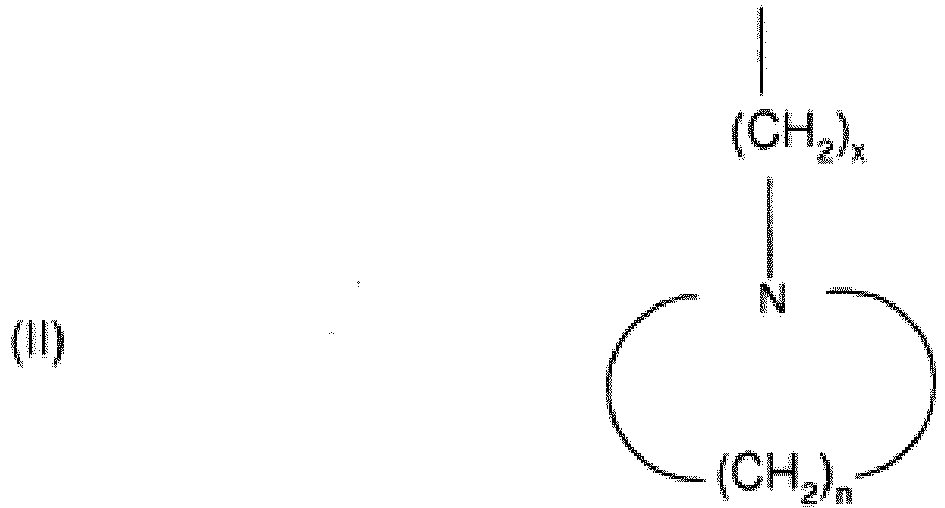

(IV) -(CH2)y-O-(CH2)z-CH2
wobei n, x, y und z ganze Zahlen im Bereich von 1 bis 10 darstellen. - Kautschukzusammensetzung nach Anspruch 1, umfassend 40 bis 135 ThK eines Verstärkungsfüllstoffs, umfassend:(A) Silika, wie etwa amorphes synthetisches ausgefälltes Silika, oder(B) ein Kautschukverstärkungs-Carbon Black, oder(C) eine Kombination des Silikas und des Kautschukverstärkungs-Carbon Blacks, bevorzugt in einem Gewichtsverhältnis im Bereich von 1:1 bis 10:1.
- Kautschukzusammensetzung nach Anspruch 2, umfassend einen Haftvermittler für das Silika mit einem Anteil, der mit Hydroxylgruppen auf dem Silika reaktiv ist, und einem anderen Anteil, der mit mindestens einem der Elastomere in Wechselwirkung tritt.
- Kautschukzusammensetzung nach mindestens einem der vorhergehenden Ansprüche, wobei das durch die Strukturformel (I) dargestellte funktionalisierte Monomer Pyrrolidinetherstyrol, Vinylbenzylpyrrolidin oder Vinylbenzyldimethylamin ist.
- Kautschukzusammensetzung nach mindestens einem der vorhergehenden Ansprüche, wobei das in der Kette funktionalisierte Polybutadien Repetiereinheiten umfasst, die von 1,3-Butadien und mindestens einem von Pyrrolidinethylstyrol, Vinylbenzyldimethylamin und Vinylbenzylpyrrolidin abgeleitet sind.
- Kautschukzusammensetzung nach mindestens einem der vorhergehenden Ansprüche, wobei das in der Kette funktionalisierte Polybutadiencopolymer weiter 2 bis 25 Prozent von Isopren abgeleitete Repetiereinheiten enthält.
- Kautschukzusammensetzung nach mindestens einem der vorhergehenden Ansprüche, wobei der in der Kette funktionalisierte Polybutadienkautschuk ein Copolymer von 1,3-Butadien und funktionalisiertem Monomer ist, hergestellt durch anionische Copolymerisation des 1,3-Butadiens und funktioneller Monomere in einem Kohlenwasserstofflösungsmittel in Gegenwart eines n-Butyllithium umfassenden Polymerisationsinitiators, um die Copolymerisation zu initiieren, wofür ein Tetramethylethylendiamin umfassender Polymerisationsmodifikator zugesetzt wird, um die Eingliederung der funktionellen Monomereinheiten entlang der Polybutadienkette zu fördern.
- Kautschukzusammensetzung nach mindestens einem der vorhergehenden Ansprüche, wobei das endständig difunktionalisierte Styrol-Butadien-Elastomer Styrol-Butadien-Elastomer ist, das endständige Funktionalisierung enthält, umfassend eine Kombination von Alkoxysilan und primären Aminogruppen oder eine Kombination von Alkoxysilan und Thiolgruppen.
- Kautschukzusammensetzung nach mindestens einem der vorhergehenden Ansprüche, wobei das endständig difunktionalisierte Styrol-Butadien-Elastomer mindestens teilweise mit Zinntetrachlorid oder Siliziumtetrachlorid kettenverlängert ist.
- Kautschukzusammensetzung nach mindestens einem der vorhergehenden Ansprüche, wobei das in der Kette funktionalisierte Polybutadienelastomer mindestens teilweise mit Zinntetrachlorid oder Siliziumtetrachlorid kettenverlängert ist.
- Kautschukzusammensetzung nach mindestens einem der vorhergehenden Ansprüche, wobei der endständig difunktionalisierte Styrol-Butadien-Kautschuk die Formel (V) aufweist:

- Kautschukzusammensetzung nach mindestens einem der vorhergehenden Ansprüche, wobei der endständig difunktionalisierte Styrol-Butadien-Kautschuk endständig difunktionalisiert ist mit einer Alkoxysilangruppe und einem Thiol als ein Reaktionsprodukt eines lebenden anionischen Styrol-Butadien-Polymers und eines Silansulfids, dargestellt durch die Formel VI:
(VI) (R4O)xR4 ySi-R5-S-SiR4 3
wobei Si Silizium ist; S Schwefel ist; O Sauerstoff ist; x eine ganze Zahl ist, ausgewählt aus 1, 2 und 3; y eine ganze Zahl ist, ausgewählt aus 0, 1 und 2; x+y=3; R4 dasselbe oder verschieden ist und ein (C1-C16)-Alkyl, bevorzugt ein C1-C5-Alkyl, ist; und R5 Aryl, Alkylaryl oder ein (C1-C16)-Alkyl, bevorzugt ein C1-C5-Alkyl, ist. - Kautschukzusammensetzung nach mindestens einem der vorhergehenden Ansprüche, wobei das endständig difunktionalisierte Styrol-Butadien-Elastomer 18 bis 28 Prozent gebundene Styroleinheiten enthält.
- Kautschukzusammensetzung nach mindestens einem der vorhergehenden Ansprüche, wobei die Kautschukzusammensetzung Schwefelvulkanisationsbestandteile enthält, umfassend Schwefel, einen primären Schwefelvulkanisationsbeschleuniger, umfassend N-N-Dicylohexyl-2-benzothiazolsulfenamid, und einen sekundären Schwefelvulkanisationsbeschleuniger, umfassend Zinkdibenzyldithiocarbamat unter Ausschluss von Diphenylguanidin; oder wobei die Kautschukzusammensetzung Schwefelvulkanisationsbestandteile enthält, umfassend Schwefel und einen oder mehrere Schwefelvulkanisationsbeschleuniger unter Ausschluss von Diphenylguanidin.
- Reifen, der ein Bauteil aufweist, das die Kautschukzusammensetzung gemäß mindestens einem der vorhergehenden Ansprüche umfasst.
Applications Claiming Priority (2)
| Application Number | Priority Date | Filing Date | Title |
|---|---|---|---|
| US201161579138P | 2011-12-22 | 2011-12-22 | |
| US13/664,468 US20130165578A1 (en) | 2011-12-22 | 2012-10-31 | Tire with rubber component containing functionalized polybutadiene and functionalized styrene/butadiene elastomers |
Publications (3)
| Publication Number | Publication Date |
|---|---|
| EP2607103A2 EP2607103A2 (de) | 2013-06-26 |
| EP2607103A3 EP2607103A3 (de) | 2014-01-15 |
| EP2607103B1 true EP2607103B1 (de) | 2016-04-27 |
Family
ID=47458731
Family Applications (1)
| Application Number | Title | Priority Date | Filing Date |
|---|---|---|---|
| EP12198492.6A Not-in-force EP2607103B1 (de) | 2011-12-22 | 2012-12-20 | Gummizusammensetzung und reifen mit funktionalisiertem polybutadien und funktionalisierten styren-/butadienelastomeren |
Country Status (2)
| Country | Link |
|---|---|
| US (1) | US20130165578A1 (de) |
| EP (1) | EP2607103B1 (de) |
Cited By (1)
| Publication number | Priority date | Publication date | Assignee | Title |
|---|---|---|---|---|
| US11884823B2 (en) | 2019-12-16 | 2024-01-30 | The Goodyear Tire & Rubber Company | Pneumatic tire |
Families Citing this family (22)
| Publication number | Priority date | Publication date | Assignee | Title |
|---|---|---|---|---|
| ES2642163T3 (es) * | 2012-09-14 | 2017-11-15 | Trinseo Europe Gmbh | Polímeros modificados por amino silano |
| JP6313850B2 (ja) * | 2013-09-27 | 2018-04-18 | トリンゼオ ヨーロッパ ゲゼルシャフト ミット ベシュレンクテル ハフツング | 低ビニル結合の変性エラストマー性コポリマー |
| US20160060438A1 (en) * | 2014-08-26 | 2016-03-03 | The Goodyear Tire & Rubber Company | Tire with silica-rich rubber tread |
| JP6849596B2 (ja) | 2014-12-30 | 2021-03-24 | 株式会社ブリヂストン | 末端官能性ポリマー及び関連する方法 |
| US10793678B2 (en) * | 2015-01-19 | 2020-10-06 | Agency For Science Technology And Research | Fillers for polymers |
| WO2016139960A1 (ja) * | 2015-03-05 | 2016-09-09 | 株式会社ブリヂストン | ゴム組成物、ジエン系重合体の製造方法及びタイヤ |
| US10053559B2 (en) | 2015-12-16 | 2018-08-21 | The Goodyear Tire & Rubber Company | Tire with tread containing functionalized polybutadiene rubber and reinforcing filler containing precipitated silica |
| CN108779229B (zh) | 2016-03-31 | 2021-08-20 | 横滨橡胶株式会社 | 光固性树脂、混合物、以及光固性树脂组合物 |
| JP2020504205A (ja) | 2016-12-28 | 2020-02-06 | ファイヤーストーン ポリマーズ エルエルシー | 低減された粘着性を有するポリマーを作製する方法、及びこれらのポリマーを組み込んだゴム組成物 |
| JP7206914B2 (ja) * | 2017-07-19 | 2023-01-18 | 住友ゴム工業株式会社 | トレッド用ゴム組成物及び空気入りタイヤ |
| US10654995B2 (en) | 2017-08-30 | 2020-05-19 | The Goodyear Tire & Rubber Company | Pneumatic tire |
| CN109467918B (zh) * | 2017-09-08 | 2021-03-19 | 北京化工大学 | 一种高抗湿滑弹性体纳米复合材料及制备方法 |
| KR102301667B1 (ko) | 2018-02-07 | 2021-09-14 | 주식회사 엘지화학 | 고무 조성물 |
| JP2021523261A (ja) | 2018-05-04 | 2021-09-02 | ブリヂストン アメリカズ タイヤ オペレーションズ、 エルエルシー | タイヤトレッドゴム組成物 |
| WO2019213185A1 (en) | 2018-05-04 | 2019-11-07 | Bridgestone Americas Tire Operations, Llc | Tire tread rubber composition |
| EP3781625A4 (de) | 2018-05-04 | 2022-01-05 | Bridgestone Americas Tire Operations, LLC | Kautschukzusammensetzung für reifenlauffläche |
| JP2021523264A (ja) | 2018-05-04 | 2021-09-02 | ブリヂストン アメリカズ タイヤ オペレーションズ、 エルエルシー | タイヤトレッドゴム組成物 |
| CN110577678B (zh) * | 2018-06-07 | 2022-08-16 | 中国石油化工股份有限公司 | 一种端环氧基聚硫橡胶改性ssbr及其制备方法和在半钢子午线轮胎胎面胶中的应用 |
| JP7445681B2 (ja) | 2019-05-29 | 2024-03-07 | ブリヂストン アメリカズ タイヤ オペレーションズ、 エルエルシー | タイヤトレッドゴム組成物及び関連方法 |
| US12365787B2 (en) | 2019-05-29 | 2025-07-22 | Bridgestone Americas Tire Operations, Llc | Tire tread rubber composition and related methods |
| JP2022534568A (ja) | 2019-05-29 | 2022-08-02 | ブリヂストン アメリカズ タイヤ オペレーションズ、 エルエルシー | タイヤトレッドゴム組成物及びその関連方法 |
| US20230002595A1 (en) * | 2021-06-28 | 2023-01-05 | The Goodyear Tire & Rubber Company | Functionalized elastomer blend for tire tread |
Family Cites Families (9)
| Publication number | Priority date | Publication date | Assignee | Title |
|---|---|---|---|---|
| US4530959A (en) * | 1984-03-08 | 1985-07-23 | The Goodyear Tire & Rubber Company | Pneumatic tire with tread of medium vinyl polybutadiene/rubber blend |
| ITMI20011554A1 (it) | 2001-07-20 | 2003-01-20 | Enichem Spa | Composizione attivante per la (co) polimerizzazione delle alfa-olefine comprendete composti ciclopentadienilici fluorurati |
| ATE427969T1 (de) | 2001-09-27 | 2009-04-15 | Jsr Corp | (co)polymerkautschuk auf basis von konjugiertem diolefin, verfahren zur herstellung von (co)polymerkautschuk, kautschukzusammensetzung, verbundwerkstoff und reifen |
| US6693160B1 (en) * | 2002-08-16 | 2004-02-17 | The Goodyear Tire & Rubber Company | Functionalized monomers for synthesis of rubbery polymers |
| PL1963110T3 (pl) | 2005-10-19 | 2010-01-29 | Trinseo Europe Gmbh | Elastomeryczne polimery modyfikowane silano-sulfidowymi końcami łańcucha |
| CN101724127A (zh) * | 2008-10-16 | 2010-06-09 | 住友橡胶工业株式会社 | 聚合物、橡胶组合物及使用该橡胶组合物的轮胎 |
| CN101724184B (zh) * | 2008-10-29 | 2013-05-01 | 住友橡胶工业株式会社 | 橡胶组合物及轮胎 |
| JP4881362B2 (ja) * | 2008-11-05 | 2012-02-22 | 住友ゴム工業株式会社 | ゴム組成物及びタイヤ |
| US20100190885A1 (en) * | 2009-01-29 | 2010-07-29 | Kuo-Chih Hua | Tire with rubber component containing silica and use of combination of blocked and unblocked alkoxyorganomercaptosilane coupling agents |
-
2012
- 2012-10-31 US US13/664,468 patent/US20130165578A1/en not_active Abandoned
- 2012-12-20 EP EP12198492.6A patent/EP2607103B1/de not_active Not-in-force
Cited By (1)
| Publication number | Priority date | Publication date | Assignee | Title |
|---|---|---|---|---|
| US11884823B2 (en) | 2019-12-16 | 2024-01-30 | The Goodyear Tire & Rubber Company | Pneumatic tire |
Also Published As
| Publication number | Publication date |
|---|---|
| EP2607103A2 (de) | 2013-06-26 |
| EP2607103A3 (de) | 2014-01-15 |
| US20130165578A1 (en) | 2013-06-27 |
Similar Documents
| Publication | Publication Date | Title |
|---|---|---|
| EP2412731B1 (de) | Gummizusammensetzung, Verfahren zur Herstellung einer derartigen Gummizusammensetzung und Reifen mit einer derartigen Gummizusammensetzung | |
| EP2607103A2 (de) | Gummizusammensetzung und Reifen mit funktionalisiertem Polybutadien und funktionalisierten Styren-/Butadienelastomeren | |
| US8592515B2 (en) | Tire with rubber component | |
| JP6450062B2 (ja) | 官能化ポリブタジエン及び官能化スチレン/ブタジエンエラストマーを含有するゴム部品を有するタイヤ | |
| EP3000618B1 (de) | Reifen | |
| EP3135500B1 (de) | Reifen mit reifenlaufflächenzusammensetzung | |
| US10214637B2 (en) | Tire rubber composition and pneumatic tire | |
| US12187894B2 (en) | Rubber composition and pneumatic tire | |
| US12173140B2 (en) | Rubber composition and pneumatic tire | |
| EP2213688B1 (de) | Reifen mit einer Lauffläche mit einer räumlich definierten Elastomerzusammensetzung | |
| US8445580B2 (en) | Tire with tread of polybutadiene rubber | |
| US12410308B2 (en) | Rubber composition and pneumatic tire | |
| EP3181632B1 (de) | Kautschukzusammensetzung und reifen mit lauffläche mit funktionalisiertem polybutadienkautschuk und verstärkendem, fällungskieselsäurehaltigem füllstoff | |
| JP6575236B2 (ja) | ゴム組成物および空気入りタイヤ | |
| JP6575237B2 (ja) | ゴム組成物および空気入りタイヤ | |
| CN113329889A (zh) | 胎面橡胶组合物和充气轮胎 | |
| US20120309891A1 (en) | Tire with tread of polybutadiene rubber | |
| US20130340912A1 (en) | Tire with chafer component | |
| EP2990218B1 (de) | Kautschukzusammensetzung und reifen mit kieselsäurereicher kautschuklauffläche | |
| JP6651787B2 (ja) | タイヤ用ゴム組成物 | |
| EP3882306A1 (de) | Kautschukzusammensetzung und luftreifen | |
| US20240132706A1 (en) | Rubber composition for tires and tire |
Legal Events
| Date | Code | Title | Description |
|---|---|---|---|
| AK | Designated contracting states |
Kind code of ref document: A2 Designated state(s): AL AT BE BG CH CY CZ DE DK EE ES FI FR GB GR HR HU IE IS IT LI LT LU LV MC MK MT NL NO PL PT RO RS SE SI SK SM TR |
|
| AX | Request for extension of the european patent |
Extension state: BA ME |
|
| PUAI | Public reference made under article 153(3) epc to a published international application that has entered the european phase |
Free format text: ORIGINAL CODE: 0009012 |
|
| PUAL | Search report despatched |
Free format text: ORIGINAL CODE: 0009013 |
|
| AK | Designated contracting states |
Kind code of ref document: A3 Designated state(s): AL AT BE BG CH CY CZ DE DK EE ES FI FR GB GR HR HU IE IS IT LI LT LU LV MC MK MT NL NO PL PT RO RS SE SI SK SM TR |
|
| AX | Request for extension of the european patent |
Extension state: BA ME |
|
| RIC1 | Information provided on ipc code assigned before grant |
Ipc: C08L 9/00 20060101ALI20131211BHEP Ipc: C08C 19/25 20060101ALI20131211BHEP Ipc: C08C 19/20 20060101ALI20131211BHEP Ipc: C08L 9/06 20060101ALI20131211BHEP Ipc: C08C 19/22 20060101ALI20131211BHEP Ipc: B60C 1/00 20060101AFI20131211BHEP |
|
| 17P | Request for examination filed |
Effective date: 20140715 |
|
| RBV | Designated contracting states (corrected) |
Designated state(s): AL AT BE BG CH CY CZ DE DK EE ES FI FR GB GR HR HU IE IS IT LI LT LU LV MC MK MT NL NO PL PT RO RS SE SI SK SM TR |
|
| 17Q | First examination report despatched |
Effective date: 20150422 |
|
| GRAP | Despatch of communication of intention to grant a patent |
Free format text: ORIGINAL CODE: EPIDOSNIGR1 |
|
| INTG | Intention to grant announced |
Effective date: 20151106 |
|
| GRAS | Grant fee paid |
Free format text: ORIGINAL CODE: EPIDOSNIGR3 |
|
| GRAA | (expected) grant |
Free format text: ORIGINAL CODE: 0009210 |
|
| AK | Designated contracting states |
Kind code of ref document: B1 Designated state(s): AL AT BE BG CH CY CZ DE DK EE ES FI FR GB GR HR HU IE IS IT LI LT LU LV MC MK MT NL NO PL PT RO RS SE SI SK SM TR |
|
| REG | Reference to a national code |
Ref country code: GB Ref legal event code: FG4D |
|
| REG | Reference to a national code |
Ref country code: CH Ref legal event code: EP |
|
| REG | Reference to a national code |
Ref country code: AT Ref legal event code: REF Ref document number: 794307 Country of ref document: AT Kind code of ref document: T Effective date: 20160515 |
|
| REG | Reference to a national code |
Ref country code: IE Ref legal event code: FG4D |
|
| REG | Reference to a national code |
Ref country code: DE Ref legal event code: R096 Ref document number: 602012017615 Country of ref document: DE |
|
| REG | Reference to a national code |
Ref country code: LT Ref legal event code: MG4D |
|
| REG | Reference to a national code |
Ref country code: NL Ref legal event code: MP Effective date: 20160427 |
|
| REG | Reference to a national code |
Ref country code: AT Ref legal event code: MK05 Ref document number: 794307 Country of ref document: AT Kind code of ref document: T Effective date: 20160427 |
|
| PG25 | Lapsed in a contracting state [announced via postgrant information from national office to epo] |
Ref country code: NL Free format text: LAPSE BECAUSE OF FAILURE TO SUBMIT A TRANSLATION OF THE DESCRIPTION OR TO PAY THE FEE WITHIN THE PRESCRIBED TIME-LIMIT Effective date: 20160427 |
|
| PG25 | Lapsed in a contracting state [announced via postgrant information from national office to epo] |
Ref country code: LT Free format text: LAPSE BECAUSE OF FAILURE TO SUBMIT A TRANSLATION OF THE DESCRIPTION OR TO PAY THE FEE WITHIN THE PRESCRIBED TIME-LIMIT Effective date: 20160427 Ref country code: FI Free format text: LAPSE BECAUSE OF FAILURE TO SUBMIT A TRANSLATION OF THE DESCRIPTION OR TO PAY THE FEE WITHIN THE PRESCRIBED TIME-LIMIT Effective date: 20160427 Ref country code: NO Free format text: LAPSE BECAUSE OF FAILURE TO SUBMIT A TRANSLATION OF THE DESCRIPTION OR TO PAY THE FEE WITHIN THE PRESCRIBED TIME-LIMIT Effective date: 20160727 Ref country code: PL Free format text: LAPSE BECAUSE OF FAILURE TO SUBMIT A TRANSLATION OF THE DESCRIPTION OR TO PAY THE FEE WITHIN THE PRESCRIBED TIME-LIMIT Effective date: 20160427 |
|
| PG25 | Lapsed in a contracting state [announced via postgrant information from national office to epo] |
Ref country code: GR Free format text: LAPSE BECAUSE OF FAILURE TO SUBMIT A TRANSLATION OF THE DESCRIPTION OR TO PAY THE FEE WITHIN THE PRESCRIBED TIME-LIMIT Effective date: 20160728 Ref country code: RS Free format text: LAPSE BECAUSE OF FAILURE TO SUBMIT A TRANSLATION OF THE DESCRIPTION OR TO PAY THE FEE WITHIN THE PRESCRIBED TIME-LIMIT Effective date: 20160427 Ref country code: AT Free format text: LAPSE BECAUSE OF FAILURE TO SUBMIT A TRANSLATION OF THE DESCRIPTION OR TO PAY THE FEE WITHIN THE PRESCRIBED TIME-LIMIT Effective date: 20160427 Ref country code: SE Free format text: LAPSE BECAUSE OF FAILURE TO SUBMIT A TRANSLATION OF THE DESCRIPTION OR TO PAY THE FEE WITHIN THE PRESCRIBED TIME-LIMIT Effective date: 20160427 Ref country code: PT Free format text: LAPSE BECAUSE OF FAILURE TO SUBMIT A TRANSLATION OF THE DESCRIPTION OR TO PAY THE FEE WITHIN THE PRESCRIBED TIME-LIMIT Effective date: 20160829 Ref country code: LV Free format text: LAPSE BECAUSE OF FAILURE TO SUBMIT A TRANSLATION OF THE DESCRIPTION OR TO PAY THE FEE WITHIN THE PRESCRIBED TIME-LIMIT Effective date: 20160427 Ref country code: ES Free format text: LAPSE BECAUSE OF FAILURE TO SUBMIT A TRANSLATION OF THE DESCRIPTION OR TO PAY THE FEE WITHIN THE PRESCRIBED TIME-LIMIT Effective date: 20160427 Ref country code: HR Free format text: LAPSE BECAUSE OF FAILURE TO SUBMIT A TRANSLATION OF THE DESCRIPTION OR TO PAY THE FEE WITHIN THE PRESCRIBED TIME-LIMIT Effective date: 20160427 |
|
| PG25 | Lapsed in a contracting state [announced via postgrant information from national office to epo] |
Ref country code: BE Free format text: LAPSE BECAUSE OF FAILURE TO SUBMIT A TRANSLATION OF THE DESCRIPTION OR TO PAY THE FEE WITHIN THE PRESCRIBED TIME-LIMIT Effective date: 20160427 Ref country code: IT Free format text: LAPSE BECAUSE OF FAILURE TO SUBMIT A TRANSLATION OF THE DESCRIPTION OR TO PAY THE FEE WITHIN THE PRESCRIBED TIME-LIMIT Effective date: 20160427 |
|
| REG | Reference to a national code |
Ref country code: DE Ref legal event code: R097 Ref document number: 602012017615 Country of ref document: DE |
|
| PG25 | Lapsed in a contracting state [announced via postgrant information from national office to epo] |
Ref country code: EE Free format text: LAPSE BECAUSE OF FAILURE TO SUBMIT A TRANSLATION OF THE DESCRIPTION OR TO PAY THE FEE WITHIN THE PRESCRIBED TIME-LIMIT Effective date: 20160427 Ref country code: CZ Free format text: LAPSE BECAUSE OF FAILURE TO SUBMIT A TRANSLATION OF THE DESCRIPTION OR TO PAY THE FEE WITHIN THE PRESCRIBED TIME-LIMIT Effective date: 20160427 Ref country code: DK Free format text: LAPSE BECAUSE OF FAILURE TO SUBMIT A TRANSLATION OF THE DESCRIPTION OR TO PAY THE FEE WITHIN THE PRESCRIBED TIME-LIMIT Effective date: 20160427 Ref country code: SK Free format text: LAPSE BECAUSE OF FAILURE TO SUBMIT A TRANSLATION OF THE DESCRIPTION OR TO PAY THE FEE WITHIN THE PRESCRIBED TIME-LIMIT Effective date: 20160427 Ref country code: RO Free format text: LAPSE BECAUSE OF FAILURE TO SUBMIT A TRANSLATION OF THE DESCRIPTION OR TO PAY THE FEE WITHIN THE PRESCRIBED TIME-LIMIT Effective date: 20160427 |
|
| PG25 | Lapsed in a contracting state [announced via postgrant information from national office to epo] |
Ref country code: SM Free format text: LAPSE BECAUSE OF FAILURE TO SUBMIT A TRANSLATION OF THE DESCRIPTION OR TO PAY THE FEE WITHIN THE PRESCRIBED TIME-LIMIT Effective date: 20160427 |
|
| PLBE | No opposition filed within time limit |
Free format text: ORIGINAL CODE: 0009261 |
|
| STAA | Information on the status of an ep patent application or granted ep patent |
Free format text: STATUS: NO OPPOSITION FILED WITHIN TIME LIMIT |
|
| 26N | No opposition filed |
Effective date: 20170130 |
|
| PG25 | Lapsed in a contracting state [announced via postgrant information from national office to epo] |
Ref country code: SI Free format text: LAPSE BECAUSE OF FAILURE TO SUBMIT A TRANSLATION OF THE DESCRIPTION OR TO PAY THE FEE WITHIN THE PRESCRIBED TIME-LIMIT Effective date: 20160427 |
|
| REG | Reference to a national code |
Ref country code: DE Ref legal event code: R119 Ref document number: 602012017615 Country of ref document: DE |
|
| REG | Reference to a national code |
Ref country code: CH Ref legal event code: PL |
|
| GBPC | Gb: european patent ceased through non-payment of renewal fee |
Effective date: 20161220 |
|
| PG25 | Lapsed in a contracting state [announced via postgrant information from national office to epo] |
Ref country code: MC Free format text: LAPSE BECAUSE OF FAILURE TO SUBMIT A TRANSLATION OF THE DESCRIPTION OR TO PAY THE FEE WITHIN THE PRESCRIBED TIME-LIMIT Effective date: 20160427 |
|
| REG | Reference to a national code |
Ref country code: FR Ref legal event code: ST Effective date: 20170831 |
|
| REG | Reference to a national code |
Ref country code: IE Ref legal event code: MM4A |
|
| PG25 | Lapsed in a contracting state [announced via postgrant information from national office to epo] |
Ref country code: CH Free format text: LAPSE BECAUSE OF NON-PAYMENT OF DUE FEES Effective date: 20161231 Ref country code: FR Free format text: LAPSE BECAUSE OF NON-PAYMENT OF DUE FEES Effective date: 20170102 Ref country code: LU Free format text: LAPSE BECAUSE OF NON-PAYMENT OF DUE FEES Effective date: 20161220 Ref country code: LI Free format text: LAPSE BECAUSE OF NON-PAYMENT OF DUE FEES Effective date: 20161231 |
|
| PG25 | Lapsed in a contracting state [announced via postgrant information from national office to epo] |
Ref country code: GB Free format text: LAPSE BECAUSE OF NON-PAYMENT OF DUE FEES Effective date: 20161220 Ref country code: DE Free format text: LAPSE BECAUSE OF NON-PAYMENT OF DUE FEES Effective date: 20170701 Ref country code: IE Free format text: LAPSE BECAUSE OF NON-PAYMENT OF DUE FEES Effective date: 20161220 |
|
| PG25 | Lapsed in a contracting state [announced via postgrant information from national office to epo] |
Ref country code: CY Free format text: LAPSE BECAUSE OF FAILURE TO SUBMIT A TRANSLATION OF THE DESCRIPTION OR TO PAY THE FEE WITHIN THE PRESCRIBED TIME-LIMIT Effective date: 20160427 Ref country code: HU Free format text: LAPSE BECAUSE OF FAILURE TO SUBMIT A TRANSLATION OF THE DESCRIPTION OR TO PAY THE FEE WITHIN THE PRESCRIBED TIME-LIMIT; INVALID AB INITIO Effective date: 20121220 |
|
| PG25 | Lapsed in a contracting state [announced via postgrant information from national office to epo] |
Ref country code: TR Free format text: LAPSE BECAUSE OF FAILURE TO SUBMIT A TRANSLATION OF THE DESCRIPTION OR TO PAY THE FEE WITHIN THE PRESCRIBED TIME-LIMIT Effective date: 20160427 Ref country code: MK Free format text: LAPSE BECAUSE OF FAILURE TO SUBMIT A TRANSLATION OF THE DESCRIPTION OR TO PAY THE FEE WITHIN THE PRESCRIBED TIME-LIMIT Effective date: 20160427 Ref country code: IS Free format text: LAPSE BECAUSE OF FAILURE TO SUBMIT A TRANSLATION OF THE DESCRIPTION OR TO PAY THE FEE WITHIN THE PRESCRIBED TIME-LIMIT Effective date: 20160427 |
|
| PG25 | Lapsed in a contracting state [announced via postgrant information from national office to epo] |
Ref country code: BG Free format text: LAPSE BECAUSE OF FAILURE TO SUBMIT A TRANSLATION OF THE DESCRIPTION OR TO PAY THE FEE WITHIN THE PRESCRIBED TIME-LIMIT Effective date: 20160427 |
|
| PG25 | Lapsed in a contracting state [announced via postgrant information from national office to epo] |
Ref country code: MT Free format text: LAPSE BECAUSE OF NON-PAYMENT OF DUE FEES Effective date: 20161220 |
|
| PG25 | Lapsed in a contracting state [announced via postgrant information from national office to epo] |
Ref country code: AL Free format text: LAPSE BECAUSE OF FAILURE TO SUBMIT A TRANSLATION OF THE DESCRIPTION OR TO PAY THE FEE WITHIN THE PRESCRIBED TIME-LIMIT Effective date: 20160427 |