EP2608276A1 - Photovoltaikmodul-Rückfolie, Verfahren zu deren Herstellung sowie deren Verwendung bei der Produktion photovoltaischer Module - Google Patents
Photovoltaikmodul-Rückfolie, Verfahren zu deren Herstellung sowie deren Verwendung bei der Produktion photovoltaischer Module Download PDFInfo
- Publication number
- EP2608276A1 EP2608276A1 EP11195475.6A EP11195475A EP2608276A1 EP 2608276 A1 EP2608276 A1 EP 2608276A1 EP 11195475 A EP11195475 A EP 11195475A EP 2608276 A1 EP2608276 A1 EP 2608276A1
- Authority
- EP
- European Patent Office
- Prior art keywords
- polyamide
- photovoltaic module
- weight
- weight percent
- molding composition
- Prior art date
- Legal status (The legal status is an assumption and is not a legal conclusion. Google has not performed a legal analysis and makes no representation as to the accuracy of the status listed.)
- Withdrawn
Links
- 238000004519 manufacturing process Methods 0.000 title claims abstract description 15
- 238000000034 method Methods 0.000 title claims description 6
- 239000004952 Polyamide Substances 0.000 claims abstract description 110
- 229920002647 polyamide Polymers 0.000 claims abstract description 110
- 239000000203 mixture Substances 0.000 claims abstract description 51
- 238000000465 moulding Methods 0.000 claims abstract description 32
- 239000012963 UV stabilizer Substances 0.000 claims abstract description 8
- 239000012760 heat stabilizer Substances 0.000 claims abstract description 8
- 230000009477 glass transition Effects 0.000 claims abstract description 7
- 239000004953 Aliphatic polyamide Substances 0.000 claims abstract description 6
- 239000000654 additive Substances 0.000 claims abstract description 6
- 230000000996 additive effect Effects 0.000 claims abstract description 6
- 229920003231 aliphatic polyamide Polymers 0.000 claims abstract description 6
- 238000010521 absorption reaction Methods 0.000 claims abstract description 5
- 150000001875 compounds Chemical class 0.000 claims abstract description 3
- 239000010410 layer Substances 0.000 claims description 47
- 239000005038 ethylene vinyl acetate Substances 0.000 claims description 22
- GWEVSGVZZGPLCZ-UHFFFAOYSA-N Titan oxide Chemical group O=[Ti]=O GWEVSGVZZGPLCZ-UHFFFAOYSA-N 0.000 claims description 18
- 229920000299 Nylon 12 Polymers 0.000 claims description 17
- 239000011888 foil Substances 0.000 claims description 12
- 239000003381 stabilizer Substances 0.000 claims description 11
- 238000003475 lamination Methods 0.000 claims description 6
- 239000004408 titanium dioxide Substances 0.000 claims description 6
- 150000001412 amines Chemical class 0.000 claims description 4
- YIMHRDBSVCPJOV-UHFFFAOYSA-N n'-(2-ethoxyphenyl)-n-(2-ethylphenyl)oxamide Chemical compound CCOC1=CC=CC=C1NC(=O)C(=O)NC1=CC=CC=C1CC YIMHRDBSVCPJOV-UHFFFAOYSA-N 0.000 claims description 4
- 239000002356 single layer Substances 0.000 claims description 4
- 238000003860 storage Methods 0.000 claims description 4
- 239000012463 white pigment Substances 0.000 claims description 4
- -1 2,2,6,6-tetramethyl-4-piperidinyl Chemical group 0.000 claims description 3
- WBWXVCMXGYSMQA-UHFFFAOYSA-N 3,9-bis[2,4-bis(2-phenylpropan-2-yl)phenoxy]-2,4,8,10-tetraoxa-3,9-diphosphaspiro[5.5]undecane Chemical compound C=1C=C(OP2OCC3(CO2)COP(OC=2C(=CC(=CC=2)C(C)(C)C=2C=CC=CC=2)C(C)(C)C=2C=CC=CC=2)OC3)C(C(C)(C)C=2C=CC=CC=2)=CC=1C(C)(C)C1=CC=CC=C1 WBWXVCMXGYSMQA-UHFFFAOYSA-N 0.000 claims description 3
- OKOBUGCCXMIKDM-UHFFFAOYSA-N Irganox 1098 Chemical compound CC(C)(C)C1=C(O)C(C(C)(C)C)=CC(CCC(=O)NCCCCCCNC(=O)CCC=2C=C(C(O)=C(C=2)C(C)(C)C)C(C)(C)C)=C1 OKOBUGCCXMIKDM-UHFFFAOYSA-N 0.000 claims description 3
- 229920006152 PA1010 Polymers 0.000 claims description 3
- BEIOEBMXPVYLRY-UHFFFAOYSA-N [4-[4-bis(2,4-ditert-butylphenoxy)phosphanylphenyl]phenyl]-bis(2,4-ditert-butylphenoxy)phosphane Chemical compound CC(C)(C)C1=CC(C(C)(C)C)=CC=C1OP(C=1C=CC(=CC=1)C=1C=CC(=CC=1)P(OC=1C(=CC(=CC=1)C(C)(C)C)C(C)(C)C)OC=1C(=CC(=CC=1)C(C)(C)C)C(C)(C)C)OC1=CC=C(C(C)(C)C)C=C1C(C)(C)C BEIOEBMXPVYLRY-UHFFFAOYSA-N 0.000 claims description 3
- 239000006096 absorbing agent Substances 0.000 claims description 3
- 239000002318 adhesion promoter Substances 0.000 claims description 3
- ZJIPHXXDPROMEF-UHFFFAOYSA-N dihydroxyphosphanyl dihydrogen phosphite Chemical class OP(O)OP(O)O ZJIPHXXDPROMEF-UHFFFAOYSA-N 0.000 claims description 3
- QZUPTXGVPYNUIT-UHFFFAOYSA-N isophthalamide Chemical compound NC(=O)C1=CC=CC(C(N)=O)=C1 QZUPTXGVPYNUIT-UHFFFAOYSA-N 0.000 claims description 3
- 239000000314 lubricant Substances 0.000 claims description 3
- 150000002989 phenols Chemical class 0.000 claims description 3
- 230000008569 process Effects 0.000 claims description 3
- 239000004609 Impact Modifier Substances 0.000 claims description 2
- 229920000571 Nylon 11 Polymers 0.000 claims description 2
- 239000012190 activator Substances 0.000 claims description 2
- 239000003086 colorant Substances 0.000 claims description 2
- 238000004132 cross linking Methods 0.000 claims description 2
- 239000000945 filler Substances 0.000 claims description 2
- 239000003063 flame retardant Substances 0.000 claims description 2
- 239000004811 fluoropolymer Substances 0.000 claims description 2
- 229920002313 fluoropolymer Polymers 0.000 claims description 2
- 230000007062 hydrolysis Effects 0.000 claims description 2
- 238000006460 hydrolysis reaction Methods 0.000 claims description 2
- 238000012986 modification Methods 0.000 claims description 2
- 230000004048 modification Effects 0.000 claims description 2
- 229910052615 phyllosilicate Inorganic materials 0.000 claims description 2
- 239000000049 pigment Substances 0.000 claims description 2
- 239000012744 reinforcing agent Substances 0.000 claims description 2
- 239000013589 supplement Substances 0.000 claims description 2
- 239000012778 molding material Substances 0.000 claims 1
- 238000004383 yellowing Methods 0.000 abstract description 10
- 239000011521 glass Substances 0.000 description 20
- 229920001200 poly(ethylene-vinyl acetate) Polymers 0.000 description 20
- DQXBYHZEEUGOBF-UHFFFAOYSA-N but-3-enoic acid;ethene Chemical compound C=C.OC(=O)CC=C DQXBYHZEEUGOBF-UHFFFAOYSA-N 0.000 description 18
- 238000003825 pressing Methods 0.000 description 10
- 239000000463 material Substances 0.000 description 8
- 230000000052 comparative effect Effects 0.000 description 7
- 238000012360 testing method Methods 0.000 description 6
- 230000004888 barrier function Effects 0.000 description 5
- QVGXLLKOCUKJST-UHFFFAOYSA-N atomic oxygen Chemical compound [O] QVGXLLKOCUKJST-UHFFFAOYSA-N 0.000 description 4
- 229910052760 oxygen Inorganic materials 0.000 description 4
- 239000001301 oxygen Substances 0.000 description 4
- 239000004810 polytetrafluoroethylene Substances 0.000 description 4
- 229920001343 polytetrafluoroethylene Polymers 0.000 description 4
- 229920002620 polyvinyl fluoride Polymers 0.000 description 4
- 239000007857 degradation product Substances 0.000 description 3
- 238000002845 discoloration Methods 0.000 description 3
- 150000002978 peroxides Chemical class 0.000 description 3
- 229920006060 Grivory® Polymers 0.000 description 2
- 229920001577 copolymer Polymers 0.000 description 2
- 239000008187 granular material Substances 0.000 description 2
- 238000005469 granulation Methods 0.000 description 2
- 230000003179 granulation Effects 0.000 description 2
- RLSSMJSEOOYNOY-UHFFFAOYSA-N m-cresol Chemical compound CC1=CC=CC(O)=C1 RLSSMJSEOOYNOY-UHFFFAOYSA-N 0.000 description 2
- 238000013508 migration Methods 0.000 description 2
- 230000005012 migration Effects 0.000 description 2
- 239000000047 product Substances 0.000 description 2
- 230000005855 radiation Effects 0.000 description 2
- XMNIXWIUMCBBBL-UHFFFAOYSA-N 2-(2-phenylpropan-2-ylperoxy)propan-2-ylbenzene Chemical compound C=1C=CC=CC=1C(C)(C)OOC(C)(C)C1=CC=CC=C1 XMNIXWIUMCBBBL-UHFFFAOYSA-N 0.000 description 1
- ISWSIDIOOBJBQZ-UHFFFAOYSA-N Phenol Chemical compound OC1=CC=CC=C1 ISWSIDIOOBJBQZ-UHFFFAOYSA-N 0.000 description 1
- XUIMIQQOPSSXEZ-UHFFFAOYSA-N Silicon Chemical compound [Si] XUIMIQQOPSSXEZ-UHFFFAOYSA-N 0.000 description 1
- 229910010413 TiO 2 Inorganic materials 0.000 description 1
- 239000002313 adhesive film Substances 0.000 description 1
- 229920006020 amorphous polyamide Polymers 0.000 description 1
- 230000001174 ascending effect Effects 0.000 description 1
- 230000008901 benefit Effects 0.000 description 1
- 239000002131 composite material Substances 0.000 description 1
- 230000001419 dependent effect Effects 0.000 description 1
- 229910003460 diamond Inorganic materials 0.000 description 1
- 239000010432 diamond Substances 0.000 description 1
- 238000000113 differential scanning calorimetry Methods 0.000 description 1
- 238000001035 drying Methods 0.000 description 1
- 230000004927 fusion Effects 0.000 description 1
- 230000009931 harmful effect Effects 0.000 description 1
- 238000005338 heat storage Methods 0.000 description 1
- 238000010438 heat treatment Methods 0.000 description 1
- 238000010348 incorporation Methods 0.000 description 1
- 238000003780 insertion Methods 0.000 description 1
- 230000037431 insertion Effects 0.000 description 1
- 238000011835 investigation Methods 0.000 description 1
- 230000007774 longterm Effects 0.000 description 1
- 239000011159 matrix material Substances 0.000 description 1
- 239000000155 melt Substances 0.000 description 1
- 238000002844 melting Methods 0.000 description 1
- 230000008018 melting Effects 0.000 description 1
- QIQXTHQIDYTFRH-UHFFFAOYSA-N octadecanoic acid Chemical compound CCCCCCCCCCCCCCCCCC(O)=O QIQXTHQIDYTFRH-UHFFFAOYSA-N 0.000 description 1
- 230000003647 oxidation Effects 0.000 description 1
- 238000007254 oxidation reaction Methods 0.000 description 1
- 230000037361 pathway Effects 0.000 description 1
- 229920003023 plastic Polymers 0.000 description 1
- 239000004033 plastic Substances 0.000 description 1
- 229920000642 polymer Polymers 0.000 description 1
- 238000010248 power generation Methods 0.000 description 1
- 238000002360 preparation method Methods 0.000 description 1
- 238000012545 processing Methods 0.000 description 1
- OANVFVBYPNXRLD-UHFFFAOYSA-M propyromazine bromide Chemical compound [Br-].C12=CC=CC=C2SC2=CC=CC=C2N1C(=O)C(C)[N+]1(C)CCCC1 OANVFVBYPNXRLD-UHFFFAOYSA-M 0.000 description 1
- 239000011241 protective layer Substances 0.000 description 1
- 229910052710 silicon Inorganic materials 0.000 description 1
- 239000010703 silicon Substances 0.000 description 1
- 230000006641 stabilisation Effects 0.000 description 1
- 238000011105 stabilization Methods 0.000 description 1
- 239000000126 substance Substances 0.000 description 1
- 238000009966 trimming Methods 0.000 description 1
- 235000012431 wafers Nutrition 0.000 description 1
- XLYOFNOQVPJJNP-UHFFFAOYSA-N water Chemical compound O XLYOFNOQVPJJNP-UHFFFAOYSA-N 0.000 description 1
Classifications
-
- H—ELECTRICITY
- H10—SEMICONDUCTOR DEVICES; ELECTRIC SOLID-STATE DEVICES NOT OTHERWISE PROVIDED FOR
- H10F—INORGANIC SEMICONDUCTOR DEVICES SENSITIVE TO INFRARED RADIATION, LIGHT, ELECTROMAGNETIC RADIATION OF SHORTER WAVELENGTH OR CORPUSCULAR RADIATION
- H10F19/00—Integrated devices, or assemblies of multiple devices, comprising at least one photovoltaic cell covered by group H10F10/00, e.g. photovoltaic modules
-
- C—CHEMISTRY; METALLURGY
- C08—ORGANIC MACROMOLECULAR COMPOUNDS; THEIR PREPARATION OR CHEMICAL WORKING-UP; COMPOSITIONS BASED THEREON
- C08L—COMPOSITIONS OF MACROMOLECULAR COMPOUNDS
- C08L77/00—Compositions of polyamides obtained by reactions forming a carboxylic amide link in the main chain; Compositions of derivatives of such polymers
- C08L77/02—Polyamides derived from omega-amino carboxylic acids or from lactams thereof
-
- C—CHEMISTRY; METALLURGY
- C08—ORGANIC MACROMOLECULAR COMPOUNDS; THEIR PREPARATION OR CHEMICAL WORKING-UP; COMPOSITIONS BASED THEREON
- C08J—WORKING-UP; GENERAL PROCESSES OF COMPOUNDING; AFTER-TREATMENT NOT COVERED BY SUBCLASSES C08B, C08C, C08F, C08G or C08H
- C08J5/00—Manufacture of articles or shaped materials containing macromolecular substances
- C08J5/18—Manufacture of films or sheets
-
- C—CHEMISTRY; METALLURGY
- C08—ORGANIC MACROMOLECULAR COMPOUNDS; THEIR PREPARATION OR CHEMICAL WORKING-UP; COMPOSITIONS BASED THEREON
- C08L—COMPOSITIONS OF MACROMOLECULAR COMPOUNDS
- C08L77/00—Compositions of polyamides obtained by reactions forming a carboxylic amide link in the main chain; Compositions of derivatives of such polymers
- C08L77/06—Polyamides derived from polyamines and polycarboxylic acids
-
- H—ELECTRICITY
- H10—SEMICONDUCTOR DEVICES; ELECTRIC SOLID-STATE DEVICES NOT OTHERWISE PROVIDED FOR
- H10F—INORGANIC SEMICONDUCTOR DEVICES SENSITIVE TO INFRARED RADIATION, LIGHT, ELECTROMAGNETIC RADIATION OF SHORTER WAVELENGTH OR CORPUSCULAR RADIATION
- H10F19/00—Integrated devices, or assemblies of multiple devices, comprising at least one photovoltaic cell covered by group H10F10/00, e.g. photovoltaic modules
- H10F19/80—Encapsulations or containers for integrated devices, or assemblies of multiple devices, having photovoltaic cells
-
- H—ELECTRICITY
- H10—SEMICONDUCTOR DEVICES; ELECTRIC SOLID-STATE DEVICES NOT OTHERWISE PROVIDED FOR
- H10F—INORGANIC SEMICONDUCTOR DEVICES SENSITIVE TO INFRARED RADIATION, LIGHT, ELECTROMAGNETIC RADIATION OF SHORTER WAVELENGTH OR CORPUSCULAR RADIATION
- H10F19/00—Integrated devices, or assemblies of multiple devices, comprising at least one photovoltaic cell covered by group H10F10/00, e.g. photovoltaic modules
- H10F19/80—Encapsulations or containers for integrated devices, or assemblies of multiple devices, having photovoltaic cells
- H10F19/85—Protective back sheets
-
- H—ELECTRICITY
- H10—SEMICONDUCTOR DEVICES; ELECTRIC SOLID-STATE DEVICES NOT OTHERWISE PROVIDED FOR
- H10F—INORGANIC SEMICONDUCTOR DEVICES SENSITIVE TO INFRARED RADIATION, LIGHT, ELECTROMAGNETIC RADIATION OF SHORTER WAVELENGTH OR CORPUSCULAR RADIATION
- H10F71/00—Manufacture or treatment of devices covered by this subclass
-
- C—CHEMISTRY; METALLURGY
- C08—ORGANIC MACROMOLECULAR COMPOUNDS; THEIR PREPARATION OR CHEMICAL WORKING-UP; COMPOSITIONS BASED THEREON
- C08J—WORKING-UP; GENERAL PROCESSES OF COMPOUNDING; AFTER-TREATMENT NOT COVERED BY SUBCLASSES C08B, C08C, C08F, C08G or C08H
- C08J2377/00—Characterised by the use of polyamides obtained by reactions forming a carboxylic amide link in the main chain; Derivatives of such polymers
- C08J2377/02—Polyamides derived from omega-amino carboxylic acids or from lactams thereof
-
- C—CHEMISTRY; METALLURGY
- C08—ORGANIC MACROMOLECULAR COMPOUNDS; THEIR PREPARATION OR CHEMICAL WORKING-UP; COMPOSITIONS BASED THEREON
- C08J—WORKING-UP; GENERAL PROCESSES OF COMPOUNDING; AFTER-TREATMENT NOT COVERED BY SUBCLASSES C08B, C08C, C08F, C08G or C08H
- C08J2377/00—Characterised by the use of polyamides obtained by reactions forming a carboxylic amide link in the main chain; Derivatives of such polymers
- C08J2377/06—Polyamides derived from polyamines and polycarboxylic acids
-
- C—CHEMISTRY; METALLURGY
- C08—ORGANIC MACROMOLECULAR COMPOUNDS; THEIR PREPARATION OR CHEMICAL WORKING-UP; COMPOSITIONS BASED THEREON
- C08J—WORKING-UP; GENERAL PROCESSES OF COMPOUNDING; AFTER-TREATMENT NOT COVERED BY SUBCLASSES C08B, C08C, C08F, C08G or C08H
- C08J2477/00—Characterised by the use of polyamides obtained by reactions forming a carboxylic amide link in the main chain; Derivatives of such polymers
- C08J2477/02—Polyamides derived from omega-amino carboxylic acids or from lactams thereof
-
- C—CHEMISTRY; METALLURGY
- C08—ORGANIC MACROMOLECULAR COMPOUNDS; THEIR PREPARATION OR CHEMICAL WORKING-UP; COMPOSITIONS BASED THEREON
- C08J—WORKING-UP; GENERAL PROCESSES OF COMPOUNDING; AFTER-TREATMENT NOT COVERED BY SUBCLASSES C08B, C08C, C08F, C08G or C08H
- C08J2477/00—Characterised by the use of polyamides obtained by reactions forming a carboxylic amide link in the main chain; Derivatives of such polymers
- C08J2477/06—Polyamides derived from polyamines and polycarboxylic acids
-
- C—CHEMISTRY; METALLURGY
- C08—ORGANIC MACROMOLECULAR COMPOUNDS; THEIR PREPARATION OR CHEMICAL WORKING-UP; COMPOSITIONS BASED THEREON
- C08K—Use of inorganic or non-macromolecular organic substances as compounding ingredients
- C08K5/00—Use of organic ingredients
- C08K5/0008—Organic ingredients according to more than one of the "one dot" groups of C08K5/01 - C08K5/59
- C08K5/005—Stabilisers against oxidation, heat, light, ozone
-
- C—CHEMISTRY; METALLURGY
- C08—ORGANIC MACROMOLECULAR COMPOUNDS; THEIR PREPARATION OR CHEMICAL WORKING-UP; COMPOSITIONS BASED THEREON
- C08L—COMPOSITIONS OF MACROMOLECULAR COMPOUNDS
- C08L2205/00—Polymer mixtures characterised by other features
- C08L2205/02—Polymer mixtures characterised by other features containing two or more polymers of the same C08L -group
-
- Y—GENERAL TAGGING OF NEW TECHNOLOGICAL DEVELOPMENTS; GENERAL TAGGING OF CROSS-SECTIONAL TECHNOLOGIES SPANNING OVER SEVERAL SECTIONS OF THE IPC; TECHNICAL SUBJECTS COVERED BY FORMER USPC CROSS-REFERENCE ART COLLECTIONS [XRACs] AND DIGESTS
- Y02—TECHNOLOGIES OR APPLICATIONS FOR MITIGATION OR ADAPTATION AGAINST CLIMATE CHANGE
- Y02E—REDUCTION OF GREENHOUSE GAS [GHG] EMISSIONS, RELATED TO ENERGY GENERATION, TRANSMISSION OR DISTRIBUTION
- Y02E10/00—Energy generation through renewable energy sources
- Y02E10/50—Photovoltaic [PV] energy
- Y02E10/52—PV systems with concentrators
Definitions
- a photovoltaic module is usually tabular (relatively thin and large area) constructed as a laminate and typically includes from the front (ie from the light incidence side) to the rear: a transparent disc (eg made of special glass), an adhesion-promoting film (preferably of ethylene vinyl acetate EVA, a copolymer that is elastic and transparent), one or more solar cells (usually silicon wafers), another adhesive film (preferably EVA), and finally the backsheet, which consists of suitable plastics and the backside protective layer represents the module. Between the two elastic EVA layers, the solar cells are embedded.
- the solar cells are hardened after the bonding between the front and back laminate layers encapsulated in EVA. Through the glass and the rear foil, the solar cell is sealed against the entry of moisture.
- the backsheet can be monolayered (monofilm) or multi-layered. A backsheet of such a photovoltaic module is the subject of the present invention.
- EP 2 275 471 B1 A representative prior art document in this field is the patent EP 2 275 471 B1 , In the introduction to this document, the further relevant prior art is also cited in a survey.
- the document EP 2 275 471 B1 deals with a photovoltaic module Mono Wegfolie, the a polyamide (PA) based molding composition.
- PA polyamide
- backings of crosslinked PA12 and PA1010 were used.
- PVF / PET composites are already a widely used state of the art, e.g. the well-known Tedlar® film, which is mostly used as a three-layer backsheet (PVF / PET / PVF).
- Tedlar® film which is mostly used as a three-layer backsheet (PVF / PET / PVF).
- Tedlar® film which is mostly used as a three-layer backsheet (PVF / PET / PVF).
- Tedlar® film which is mostly used as a three-layer backsheet (PVF / PET / PVF).
- EVA ethylene-vinyl acetate copolymer
- a newer backsheet system is based on single or multi-layer polyamide films; in the already mentioned document EP 2 275 471 B1 Monofilms are described.
- the application not yet published at the priority date of the present application EP 11159544.3 of the same applicant describes multilayer films with PA in the outer layers.
- the PA layers of these backs also contain heat stabilizers and UV stabilizers in addition to titanium dioxide to achieve the highest possible degree of reflection, as in EP 2 275 471 B1 is specified. These stabilizers are intended to ensure the longest possible service life of these backsheets and a slight discoloration.
- the yellowing of polyamides at higher temperatures was in the structures according to the EP 11159544.3 suppressed by incorporation of acting as an oxygen barrier inner layer.
- the at least one transparent polyamide (A) is preferably selected from a group consisting of PA MACM 12, PA PACM 12, PA MACM I, PA MACM T and mixtures thereof, and the at least one aliphatic polyamide (B) is preferably selected from a group consisting of PA 11, PA 12, PA 1010, PA 1012 and mixtures thereof.
- the at least one transparent polyamide (A) is amorphous.
- Amorphous polyamides are understood as meaning those polyamides which, in differential scanning calorimetry (DSC) according to ISO 11357, have a heat of fusion of not more than 5 J / g, preferably not more than 3 J / g and especially at a heating rate of 20 K / min preferably at most 1 J / g.
- the polyamide molding composition contains in its composition a mixture of 26 to 68 weight percent of the polyamide (A) and 16 to 50 weight percent of the polyamide (B), more preferably 28 to 65 weight percent of the polyamide (A) and 17 to 40 percent by weight of the polyamide (B) and most preferably from 53 to 63 percent by weight of the polyamide (A) and 18 to 30 weight percent of the polyamide (B), wherein the percentages by weight in each case relate to 100 percent by weight of the polyamide molding composition which also 0.5 to 3 weight percent of component (C) and 10 to 30 weight percent of component (D).
- the polyamide molding composition contains in its composition a mixture of 26 to 68 weight percent PA MACM 12 as polyamide (A) and 16 to 50 weight percent PA 12 as polyamide (B), more preferably from 28 to 65 Weight percent PA MACM 12 as polyamide (A) and 17 to 40 weight percent PA 12 as polyamide (B) and most preferably from 53 to 63 weight percent PA MACM 12 as polyamide (A) and 18 to 30 weight percent PA 12 as polyamide (B) , wherein the percentages by weight in each case relate to 100 percent by weight of the polyamide molding composition, which also contains 0.5 to 3 percent by weight of component (C) and 10 to 30 percent by weight of component (D).
- polyamide molding composition contains no polyamides other than PA MACM 12 and PA 12 is preferred.
- the UV and heat stabilizers (C) are selected from the group consisting of the classes of diphosphites, diphosphonites, oxanilides, sterically hindered amines, sterically hindered phenols and mixtures thereof, and more preferably selected from the group consisting of [4- [4 bis (2,4-di-tert-butylphenoxy) phosphanylphenyl] phenyl] bis (2,4-di-tert-butylphenoxy) phosphine; Bis (2,4-dicumylphenyl) pentaerythritol diphosphite; 2-ethyl-2'-ethoxy-oxalanilide; 1,3-Benzene dicarboxamide, N, N'-bis (2,2,6,6-tetramethyl-4-piperidinyl; N, N'-hexane-1,6-diyl-bis [3- (3,5-di-tert Butyl-4-
- the at least one further additive (D) is preferably selected from a group consisting of white pigments, UV absorbers, hydrolysis stabilizers, crosslinking activators, flame retardants, phyllosilicates, fillers, colorants, reinforcing agents, adhesion promoters, impact modifiers, lubricants, fluoropolymers and mixtures thereof.
- Titanium dioxide in the rutile or anatase modification is preferred as the white pigment.
- the photovoltaic module backsheet preferably contains at least one white pigment in the layer of the polyamide molding composition, and in particular has a reflectance of at least 92%.
- the reflectance was determined in the present invention according to DIN 5033 (Part 7) on a spectrophotometer from Datacolor (device name: Datacolor 650) under the following measuring conditions in front of a white-painted contrast plate, measuring mode: reflection, measuring geometry: D / 8 °, type of light: D 65 10, gloss: included, calibration: UV calibrated, orifice plate: SAV.
- Titanium dioxide is preferably present in an amount of from 15 to 25 percent by weight, more preferably from 18 to 22 percent by weight, and most preferably from 19 to 21 percent by weight in the layer of the polyamide molding composition.
- the photovoltaic module rear foil according to the invention consists of a single layer or of several layers.
- the at least one layer of the backsheet made of a polyamide molding composition in a laminated photovoltaic module directly adjoins an EVA layer.
- the yellow index is 15 minutes lamination at a press temperature of 150 ° C and subsequent storage for 1000 hours at 85 ° C and 85% relative humidity less than 11, preferably less than 9 and more preferably less than 6.
- the Yellow Index was measured according to ASTM D1925, through the glass plate of the PV module.
- this polyamide molding composition is extruded or coextruded.
- a photovoltaic module back sheet according to the invention or a method for the production thereof is preferably used in the production of photovoltaic modules.
- PA MACM 12 has proven to be particularly suitable, which is well compatible with the PA 12 frequently used in the PA backsheets.
- the novel backsheets can be monolayer or multilayer films.
- the at least one layer of the inventive PA molding compound in the laminated PV module is adjacent to the EVA layer.
- the backsheet consists of several layers, in addition to the PA layer or between two PA layers, preferably barrier layers are contained in the backsheet.
- a photovoltaic module multilayer backsheet may comprise a first outer layer, a second outer layer and an inner layer arranged between these outer layers and forming a water vapor barrier and / or oxygen barrier, wherein these layers are made up of polymers.
- Preferred barrier layers are in the application not yet published at the priority date of the present application EP 11159544.3 described.
- Preferred UV and heat stabilizers in the context of the invention are stabilizers selected from the group consisting of the classes of diphosphites, diphosphonites, oxanilides, sterically hindered amines, sterically hindered phenols and / or mixtures thereof.
- Sandostab® P-EPQ [4- [4-bis (2,4-di-tert-butylphenoxy) phosphanylphenyl] phenyl] bis (2,4-di-tert-butylphenoxy) phosphane
- Doverphos® S-9228 bis (2,4-dicumylphenyl) pentaerythritol diphosphite
- Sanduvor® 312 (2-ethyl-2'-ethoxy-oxalanilide
- Nylostab® S-EED (1,3-benzenedicarboxamide, N, N'-bis (2,2,6,6-tetramethyl-4-piperidinyl) and Irganox® 1098 (N, N'-hexane-1,6-diylbis [3- (3,5-di-tert-butyl-4-hydroxyphenyl) propionamide]).
- a standard PV module structure provides for two EVA-X foils, between which the solar cells are encapsulated.
- a simplified structure was adopted in which the EVA-X layer between the glass plate and the solar cell as well as the solar cell itself was omitted, so that the test laminate of a glass plate and an EVA-X Film and a PA backsheet was formed.
- the pressing system is constantly heated to 150 ° C. Before inserting the glass plate and the foils, the EVA-X foil is placed cleanly and evenly on the glass plate. Existing air pockets are removed by stripping to the outer edge.
- the top and bottom of the compact (glass plate - EVA-X film - PA film) to protect against deformation by the pressing tool and a homogeneous exercise of pressure provided with a 1 mm thick PTFE film and placed in the matrices of the pressing plant (with the glass plate down so that it can serve as a rigid base for the other layers during lamination).
- a further 110 ⁇ m thick PTFE film is placed between the PA film and the upper 1 mm thick PTFE film.
- the pressure in the press is now reduced to 200 mbar (abs.) With the aid of a vacuum pump. After 5 minutes, the vacuum pump is switched off, the pressure of 200 mbar is kept in the press.
- the lamination time was 15 minutes, during which This time a press force of 10 kN acted on the compact. After the pressing time, the system was depressurized via a valve, the PTFE films removed and the finished PV module test laminate removed from the press.
- the production differs only by the handling of the films and glass plates (apart from the size of the PV module).
- the conveying to the pressing plant, the trimming and placing of the foil, the removal of air and the insertion into the pressing plant are done by machine.
- the pressing time depends on the type of EVA-X film used.
- the yellow index of the EVA-X layer was then measured in the laminated original state through the 6 mm thick glass plate of the PV module test laminate according to ASTM D1925.
- the laminates were then stored for 1000 hours in a climatic chamber at 85 ° C and 85% relative humidity.
- the yellow index of the EVA layer was again measured through the glass plate after this storage. The measured values are listed in Table 2 below.
- PA MACM 12 has a glass transition temperature of 118 ° C under these storage conditions in accordance with claim 1. When dry, the glass transition temperature is 155 ° C.
- PV module laminates which have a PA MACM12 content of at least 25 percent by weight in the PA layer of a rear film according to the invention have a similar good color stability to a PA12 film of Comparative Example C1 which does not contain any stabilizers contains (which could migrate).
- PA MACM 12 Comparative Example C4, without PA 12
- no suitable backsheet for a PV module laminate could be obtained due to the poorer processability.
- PA MACM 12 has a poorer melting behavior than PA 12 or a blend of PA MACM 12 and PA 12, on the other hand, the feed stream into the extruder is lower.
- a take-off roll temperature 135 ° C. (compared to ⁇ 100 ° C. for the PA MACM 12 and PA 12 blend). At such high take-off temperatures it is easy to bond; the resulting film had very poor surface quality and many waves.
- This polyamide blend largely prevents the migration of stabilizer molecules or their degradation products into the adjacent ethylene vinyl acetate (EVA) laminate layer, where they could otherwise react with unused peroxide to yellow discoloration. Thanks to the measure according to the invention, a perfect PV module is obtained which only yellows very little, even when used in a moist, warm environment. Thus, the reflectance and efficiency of the PV module remain high, and the aesthetic expectations of the consumer are also met.
- EVA ethylene vinyl acetate
Landscapes
- Chemical & Material Sciences (AREA)
- Health & Medical Sciences (AREA)
- Chemical Kinetics & Catalysis (AREA)
- Medicinal Chemistry (AREA)
- Polymers & Plastics (AREA)
- Organic Chemistry (AREA)
- Engineering & Computer Science (AREA)
- Manufacturing & Machinery (AREA)
- Materials Engineering (AREA)
- Photovoltaic Devices (AREA)
- Compositions Of Macromolecular Compounds (AREA)
- Laminated Bodies (AREA)
Abstract
Description
- Die Erfindung betrifft photovoltaische Module, d.h. Solarzellenmodule zur photoelektrischen Stromerzeugung aus Sonnenlicht. Ein Photovoltaikmodul (PV-Modul) ist üblicherweise tafelförmig (relativ dünn und grossflächig) als Laminat aufgebaut und umfasst typischerweise von vorne (d.h. von der Lichteinfallseite her) nach hinten: eine transparente Scheibe (z.B. aus Spezialglas), eine haftvermittelnde Folie (bevorzugt aus Ethylenvinylacetat EVA, einem Copolymer das elastisch und transparent ist), eine oder mehrere Solarzellen (in der Regel Siliziumscheiben), eine weitere Haftvermittlerfolie (bevorzugt EVA), und schliesslich die Rückfolie ("backsheet"), welche aus dafür geeigneten Kunststoffen besteht und die rückseitige Schutzschicht des Moduls darstellt. Zwischen den beiden elastischen EVA-Schichten sind die Solarzellen eingebettet. Bei der in einer Presse durchgeführten thermischen Verklebung der Glasplatte und der Rückfolie über die EVA-Schichten (und der EVA-Schichten untereinander in den Zwischenräumen zwischen oder neben den Solarzellen sowie auch mit den Solarzellen selbst) werden die Solarzellen nach der Verfestigung des Verbundes zwischen den vorderseitigen und rückseitigen Laminatschichten in EVA eingekapselt. Durch das Glas und die Rückfolie wird die Solarzelle gegen den Eintritt von Feuchtigkeit versiegelt. Die Rückfolie kann einschichtig (als Monofolie) oder mehrschichtig ausgebildet sein. Eine Rückfolie eines solchen photovoltaischen Moduls ist Gegenstand der vorliegenden Erfindung.
- Ein repräsentatives Dokument für den Stand der Technik auf diesem Gebiet ist die Patentschrift
EP 2 275 471 B1 . In der Einleitung dieses Dokuments wird auch der weitere einschlägige Stand der Technik in einem Überblick zitiert. Das DokumentEP 2 275 471 B1 befasst sich mit einer Photovoltaikmodul-Monorückfolie, die aus einer auf Polyamid (PA) basierenden Formmasse hergestellt ist. Als Beispiele wurden Rückfolien aus vernetztem PA12 und PA1010 gearbeitet. - Rückfolien auf Basis von PVF/PET-Verbunden sind ein schon länger verbreiteter Stand der Technik, z.B. die bekannte Tedlar®-Folie, die meist als dreischichtige Rückfolie (PVF/PET/PVF) zum Einsatz kommt. Diese Rückfolie wird zusammen mit der Solarzelle und der vorderen Glasplatte mit jeweils dazwischen liegendem Ethylen-Vinylacetat-Copolymer (EVA) verschweisst, d.h. in einem Laminierverfahren heiss verpresst und über das EVA als Haftvermittler der ganze Schichtaufbau verklebt.
- Ein neueres Rückfoliensystem basiert auf ein- oder mehrschichtigen Folien aus Polyamid; im bereits erwähnten Dokument
EP 2 275 471 B1 werden Monofolien beschrieben. Die zum Prioritätszeitpunkt der vorliegenden Anmeldung noch nicht ver-öffentlichte AnmeldungEP 11159544.3 EP 2 275 471 B1 angegeben ist. Durch diese Stabilisatoren soll eine möglichst lange Lebensdauer dieser Rückfolien und eine geringe Verfärbung gewährleistet werden. Die Vergilbung von Polyamiden bei höheren Temperaturen (ab ca. 80 °C) wurde in den Aufbauten gemäss derEP 11159544.3 - Trotz der getroffenen Massnahmen, Polyamide gegen die schädliche Wirkung von Hitze und UV-Strahlung zu stabilisieren und bei höheren Temperaturen den Kontakt mit Luftsauerstoff zu vermeiden hat sich gezeigt, dass nach Hitzelagerung in feuchtem Klima von entsprechenden Testlaminaten mit Rückfolien aus verschiedenen Polyamiden (Glasplatte plus EVA-Folie plus PA-Rückfolie) jeweils durch die Glasplatte hindurch eine unerklärlich starke Vergilbung zu sehen war, welche in Form des Yellow Index quantifiziert wurde.
- Es war die Aufgabe der vorliegenden Erfindung, dieses unerklärte Vergilbungsphänomen weitgehend zu unterbinden und eine auf Basis einer Polyamid-Formmasse hergestellte verbesserte Photovoltaikmodul-Rückfolie zur Verfügung zu stellen, die den erwähnten Nachteil nicht oder nur in deutlich verringertem Ausmass aufweist.
- Diese Aufgabe wird gemäss der vorliegenden Erfindung mit einer Photovoltaikmodul-Rückfolie mit den Merkmalen von Anspruch 1 gelöst. Die erfindungsgemässe Photovoltaikmodul-Rückfolie enthält mindestens eine Schicht die aus einer Polyamid-Formmasse hergestellt ist, dadurch gekennzeichnet dass diese Polyamid-Formmasse zusammengesetzt ist aus:
- 25 bis 70 Gewichtsprozent mindestens eines transparenten Polyamids (A), dessen Glasübergangstemperatur (Tg) auch nach der Aufnahme von Feuchtigkeit bei 85°C und 85 % relativer Feuchtigkeit mehr als 100°C beträgt;
- 15 bis 58 Gewichtsprozent mindestens eines aliphatischen Polyamids (B);
- 0.5 bis 3 Gewichtsprozent an UV- und Hitzestabilisatoren (C); und
- 10 bis 30 Gewichtsprozent mindestens eines weiteren Zusatzstoffes (D); wobei sich die Komponenten (A) bis (D) auf 100 Gewichtsprozent der Polyamid-Formmasse ergänzen.
- Weitere bevorzugte Merkmale und Ausführungsformen der erfindungsgemässen Photovoltaikmodul-Rückfolie ergeben sich aus den abhängigen Ansprüchen. Zudem werden ein Verfahren zu deren Herstellung sowie deren Verwendung bei der Produktion photovoltaischer Module beansprucht.
- Das mindestens eine transparente Polyamid (A) ist bevorzugt ausgewählt aus einer Gruppe, die aus PA MACM 12, PA PACM 12, PA MACM I, PA MACM T und Mischungen daraus besteht, und das mindestens eine aliphatische Polyamid (B) ist bevorzugt ausgewählt aus einer Gruppe, die aus PA 11, PA 12, PA 1010, PA 1012 und Mischungen daraus besteht.
- Bevorzugt ist das mindestens eine transparente Polyamid (A) amorph. Unter amorphen Polyamiden werden solche Polyamide verstanden, die in der Dynamischen Differenz-Kalorimetrie (Differential Scanning Calorimetry, DSC) nach ISO 11357 bei einer Aufheizrate von 20 K/min eine Schmelzwärme von maximal 5 J/g, bevorzugt maximal 3 J/g und besonders bevorzugt maximal 1 J/g aufweisen.
- In einer bevorzugten Ausführungsform enthält die Polyamid-Formmasse in ihrer Zusammensetzung eine Mischung von 26 bis 68 Gewichtsprozent des Polyamids (A) und 16 bis 50 Gewichtsprozent des Polyamids (B), besonders bevorzugt von 28 bis 65 Gewichtsprozent des Polyamids (A) und 17 bis 40 Gewichtsprozent des Polyamids (B) und ganz besonders bevorzugt von 53 bis 63 Gewichtsprozent des Polyamids (A) und 18 bis 30 Gewichtsprozent des Polyamids (B), wobei sich die Gewichtsprozente jeweils auf 100 Gewichtsprozent der Polyamid-Formmasse beziehen, die auch 0.5 bis 3 Gewichtsprozent der Komponente (C) und 10 bis 30 Gewichtsprozent der Komponente (D) enthält.
- In einer besonders bevorzugten Variante der obigen Ausführungsform enthält die Polyamid-Formmasse in ihrer Zusammensetzung eine Mischung von 26 bis 68 Gewichtsprozent PA MACM 12 als Polyamid (A) und 16 bis 50 Gewichtsprozent PA 12 als Polyamid (B), besonders bevorzugt von 28 bis 65 Gewichtsprozent PA MACM 12 als Polyamid (A) und 17 bis 40 Gewichtsprozent PA 12 als Polyamid (B) und ganz besonders bevorzugt von 53 bis 63 Gewichtsprozent PA MACM 12 als Polyamid (A) und 18 bis 30 Gewichtsprozent PA 12 als Polyamid (B), wobei sich die Gewichtsprozente jeweils auf 100 Gewichtsprozent der Polyamid-Formmasse beziehen, die auch 0.5 bis 3 Gewichtsprozent der Komponente (C) und 10 bis 30 Gewichtsprozent der Komponente (D) enthält.
- Bevorzugt ist eine Ausführungsform, bei welcher die Polyamidformmasse keine anderen Polyamide als PA MACM 12 und PA 12 enthält.
- Vorzugsweise sind die UV- und Hitzestabilisatoren (C) ausgewählt aus der Gruppe bestehend aus den Klassen der Diphosphite, Diphosphonite, Oxanilide, sterisch gehinderten Aminen, sterisch gehinderten Phenolen und Mischungen daraus, und besonders bevorzugt ausgewählt aus der Gruppe bestehend aus [4-[4-bis(2,4-ditert-butylphenoxy)phosphanylphenyl] phenyl]-bis(2,4-ditert-butylphenoxy)phosphan; Bis(2,4-dicumylphenyl)pentaerythritol diphosphit; 2-Ethyl-2'-ethoxy-oxalanilid; 1,3-Benzendicarboxamid, N,N'-bis(2,2,6,6-tetramethyl-4-piperidinyl; N,N'-hexan-1,6-diylbis [3-(3, 5-di-tert-butyl-4-hydroxyphenyl)propionamid] und Mischungen daraus. Die entsprechenden Handelsnamen sind nach der Tabelle 1 mit den eingesetzten Materialien angegeben.
- Der mindestens eine weitere Zusatzstoff (D) ist bevorzugt ausgewählt aus einer Gruppe, die aus Weisspigmenten, UV-Absorbern, Hydrolysestabilisatoren, Vernetzungsaktivatoren, Flammschutzmitteln, Schichtsilikaten, Füllstoffen, Farbmitteln, Verstärkungsmitteln, Haftvermittlern, Schlagzähigkeitsmodifikatoren, Gleitmitteln, Fluorpolymeren und Mischungen daraus besteht.
- Als Weisspigment ist Titandioxid in der Rutil- oder Anatas-Modifikation bevorzugt. Die Photovoltaikmodul-Rückfolie enthält in der Schicht aus der Polyamid-Formmasse bevorzugt mindestens ein Weisspigment, und weist insbesondere einen Reflexionsgrad von mindestens 92 % auf. Der Reflexionsgrad wurde bei der vorliegenden Erfindung gemäss der DIN 5033 (Teil 7) auf einem Spektrophotometer der Firma Datacolor (Gerätebezeichnung: Datacolor 650) unter den folgenden Messbedingungen vor einem weisslackierten Kontrastblech bestimmt, Messmodus: Reflexion, Messgeometrie: D/8°, Lichtart: D 65 10, Glanz: eingeschlossen, Kalibrierung: UVkalibriert, Messblende: SAV.
- Titandioxid ist bevorzugt in einem Anteil von 15 bis 25 Gewichtsprozent, besonders bevorzugt von 18 bis 22 Gewichtsprozent und ganz besonders bevorzugt von 19 bis 21 Gewichtsprozent in der Schicht aus der Polyamid-Formmasse enthalten.
- Die erfindungsgemässe Photovoltaikmodul-Rückfolie besteht aus einer einzigen Schicht oder aus mehreren Schichten.
- In einer bevorzugten Ausführungsform grenzt die mindestens eine Schicht der Rückfolie, die aus einer Polyamid-Formmasse hergestellt ist, in einem laminierten Photovoltaikmodul direkt an eine EVA-Schicht.
- Vorzugsweise ist der Yellow Index nach 15-minütigem Laminieren bei einer Pressentemperatur von 150°C und anschliessender Lagerung während 1000 Stunden bei 85°C und 85 % relativer Feuchtigkeit kleiner als 11, bevorzugt kleiner als 9 und besonders bevorzugt kleiner als 6. Der Yellow Index wurde nach ASTM D1925 gemessen, und zwar durch die Glasplatte des PV-Moduls hindurch.
- Bei einem bevorzugten Verfahren zur Herstellung einer Photovoltaikmodul-Rückfolie auf Basis einer erfindungsgemässen Polyamid-Formmasse wird diese Polyamid-Formmasse extrudiert oder coextrudiert.
- Eine erfindungsgemässe Photovoltaikmodul-Rückfolie oder ein Verfahren zu deren Herstellung wird bevorzugt bei der Produktion photovoltaischer Module verwendet.
- In den durch die Erfinder durchgeführten Untersuchungen wurde neben den bereits diskutierten Auslösefaktoren für die Vergilbung (Hitze, UV-Strahlung und Oxidation durch Luftsauerstoff) ein weiterer Vergilbungsweg identifiziert. Es hat sich gezeigt, dass die zur Langzeitstabilisierung der Polyamidschicht eingesetzten Stabilisatoren oder deren Abbauprodukte unter dem Einfluss von Temperatur und Feuchtigkeit in einem PV-Modul in die benachbarte EVA-Schicht migrieren können und dort mit nicht umgesetztem Peroxid reagieren, was zu einer unerwünschten Vergilbung führt. Peroxid ist in vernetzbarem EVA enthalten, damit solches EVA bei der heissen Laminierung chemisch vernetzt. Beispielsweise wird Dicumylperoxid eingesetzt.
- Überraschenderweise wurde gefunden, dass diese Migration von Stabilisatormolekülen bzw. deren Abbauprodukten weitgehend unterbunden werden kann, wenn die PA-Matrix ein transparentes, bevorzugt amorphes PA enthält, dessen Glasübergangstemperatur auch nach Feuchtigkeitsaufnahme (bei 85°C und 85 % relativer Feuchtigkeit) noch oberhalb von 100°C liegt. Als besonders geeignet hat sich dabei PA MACM 12 erwiesen, das mit dem häufig in den PA-Rückfolien eingesetzten PA 12 gut verträglich ist.
- Die erfindungsgemässen Rückfolien können Mono- oder Mehrschichtfolien sein. Bei Mehrschichtfolien ist die mindestens eine Schicht aus der erfindungsgemässen PA-Formmasse im laminierten PV-Modul benachbart zur EVA-Schicht. Sofern die Rückfolie aus mehreren Schichten besteht, sind neben der PA-Schicht oder zwischen zwei PA-Schichten bevorzugt Barriereschichten in der Rückfolie enthalten.
- So kann eine Photovoltaikmodul-Mehrschichtrückfolie eine erste Aussenschicht, eine zweite Aussenschicht und eine zwischen diesen Aussenschichten angeordnete, eine Wasserdampfbarriere und/oder Sauerstoffbarriere bildende Innenschicht umfassen, wobei diese Schichten aus Polymeren aufgebaut sind. Zumindest die der EVA-Schicht benachbarte Aussenschicht, bevorzugt aber beide Aussenschichten der Rückfolie bestehen aus einer erfindungsgemässen Polyamidformmasse, wobei beide Aussenschichten in einer speziell bevorzugten Ausführungsform dieselben Polyamide enthalten. Bevorzugte Barriereschichten sind in der zum Prioritätszeitpunkt der vorliegenden Anmeldung noch nicht veröffentlichten Anmeldung
EP 11159544.3 - Die vorliegende Erfindung wird anhand der nachfolgenden Beispiele, welche die Erfindung illustrieren, nicht aber den Erfindungsumfang einschränken sollen, näher dargestellt.
- Die in Tabelle 1 aufgeführten Materialien wurden in den Beispielen und Vergleichsbeispielen eingesetzt.
Tabelle 1: eingesetzte Materialien Stoff Handelsname Hersteller rel. Viskositäta) H2O-Gehalt [Gew.-%] PA MACM 12 Grilamid TR® 90 EMS-GRIVORY 1.73 0.04 PA 12 Grilamid® L20 EMS-GRIVORY 1.90 0.05 TiO2 Kronos® 2222 Kronos-Titan - - sterisch gehindertes Phenol Irganox® 1098 BASF - - Diphosphonit Sandostab® P-EPQ Clariant - - Diphosphit Doverphos® S-9228 Dover Chemical - - UV-Absorber Sanduvor® VSU Clariant - - sterisch gehindertes Amin Nylostab® S-EED Clariant - - Gleitmittel Mg-Stearat Faci - - a) bestimmt nach ISO 307 (0.5 g Polyamid in 100 ml m-Kresol), Berechnung der relativen Viskosität (RV) nach RV = t/t0 in Anlehnung an Abschnitt 11 der Norm. - Bevorzugte UV- und Hitzestabilisatoren im Sinne der Erfindung sind Stabilisatoren ausgewählt aus der Gruppe bestehend aus den Klassen der Diphosphite, Diphosphonite, Oxanilide, sterisch gehinderten Aminen, sterisch gehinderten Phenolen und/oder Mischungen daraus. Besonders bevorzugte Vertreter aus diesen Klassen sind dabei Sandostab® P-EPQ ([4-[4-bis(2,4-ditert-butylphenoxy)phosphanylphenyl]phenyl]-bis(2,4-ditert-butylphenoxy)phosphan), Doverphos® S-9228 (Bis(2,4-dicumylphenyl)pentaerythritol diphosphit), Sanduvor® 312 (2-Ethyl-2'-ethoxy-oxalanilid), Nylostab® S-EED (1,3-Benzendicarboxamid, N,N'-bis(2,2,6,6-tetramethyl-4-piperidinyl) und Irganox® 1098 (N,N'-hexan-1,6-diylbis[3-(3, 5-di-tert-butyl-4-hydroxyphenyl)propionamid]).
- Für die Herstellung der Photovoltaik-Modul-Testlaminate wurden folgende Produkte verwendet:
- Glasplatte: Optiwhite 6 mm (Diamant) gehärtetes Solarglas, 200 x 240 x 6 mm, geliefert von der Kurth Glas + Spiegel AG (Zuchwil, Schweiz)
- EVA-X-Folie (Folie aus vernetzbarem/vernetztem Ethylenvinylacetat-Copolymer): Vistasolar 486.10, Dicke 480 µm, geliefert von der Solutia Solar GmbH (Dietenheim, Deutschland). (Der Typ Vistasolar 486.10 wird in der PV-Modul-Produktion standardmässig eingesetzt und ist eine schnellvernetzende EVA-X-Folie ("fast cure"). Unter die Typenbezeichung ".10" fallen Folien bei denen beide Folienseiten bei Raumtemperatur nicht klebrig sind.) Die Folie wurde auf die Dimensionen der Glasplatte zurechtgeschnitten.
- Rückfolie (einschichtig) aus Polyamid-Formmassen von EMS (jeweils ausgewählt gemäss Tabelle 2 aus Materialien der Erfindungsbeispiele 1-6 sowie Materialien der Vergleichsbeispiele V1-V3). Foliendicke 300 pm. Die Formmassen wurden auf einem Zweiwellenextruder der Fa. Werner und Pfleiderer Typ ZSK25 hergestellt. Die jeweiligen Polyamid-Granulate wurden zusammen mit den Stabilisatoren in den Einzug und das Titandioxid mit einer Seitenförderung in die Schmelze dosiert. Die Gehäusetemperatur wurde als aufsteigendes Profil bis 270°C eingestellt. Bei einer Schneckendrehzahl von 200 Umdrehungen pro Minute wurden 12 kg Durchsatz pro Minute erreicht. Die Granulierung erfolgte mittels Stranggranulierung. Nach Trocknung bei 80°C für 24h wurden die Flachfolien hergestellt. Die Folienherstellung erfolgte auf einer Flachfolienanlage der Firma Dr. Collin GmbH (Ebersberg, Deutschland), Typ 3300, 3-Zonenschnecke mit 30 mm Durchmesser, L/D-Verhältnis = 25. Chill-Roll Typ 136/350. PA 12: Zylindertemperatur: 245-255°C, Kopftemperatur: 245°C. PA MACM 12 / PA 12: Zylindertemperatur: 265-275°C, Kopftemperatur: 260°C. PA MACM 12: Zylindertemperatur: 270-280°C, Kopftemperatur: 270-280°C. Die Folie wurde auf die Dimensionen der Glasplatte zurechtgeschnitten. Die Folien wurden vor der Weiterverarbeitung visuell auf Ihre Verwendbarkeit für ein PV-Modul beurteilt, geeignete Folien wurden in Tabelle 2 mit (+) und ungeeignete mit (-) bewertet.
- Ein standardmässiger PV-Modul-Aufbau sieht zwei EVA-X-Folien vor, zwischen denen die Solarzellen eingekapselt sind. Sowohl für die erfindungsgemässen Beispiele als auch für die Vergleichsbeispiele wurde ein vereinfachter Aufbau gewählt, bei dem die EVA-X-Schicht zwischen der Glasplatte und der Solarzelle wie auch die Solarzelle selbst weggelassen wurde, so dass das Testlaminat aus einer Glasplatte und einer EVA-X-Folie und einer PA-Rückfolie gebildet wurde.
- Als Laborpressanlage zur Herstellung der PV-Modul-Laminate wurde eine Tischpresse der Firma Fontijne-Grotnes (Vlaardingen, Niederlande), Typ Fontijne TP400, maximale Presskraft 400 kN, Plattengrösse (Werkzeugaufnahme) 320 mm x 320 mm, Pressenhub 200 mm, verwendet. In dieser Tischpresse befindet sich eine Werkzeugaufnahme mit einer Unter- und Oberseite, in welche die jeweiligen Matrizen für das Presswerkzeug eingelegt werden. Die Unterseite der Werkzeugaufnahme ist mit einem Hydraulikkolben verbunden, mit dem eine Presskraft auf das zu verpressende Produkt bzw. Laminat ausgeübt werden kann.
- Die Pressanlage ist konstant auf 150 °C beheizt. Vor dem Einlegen der Glasplatte und der Folien wird die EVA-X-Folie sauber und gleichmässig auf die Glasplatte aufgelegt. Vorhandene Lufteinschlüsse werden durch Abstreifen zum Aussenrand hin entfernt. Nach dem Auflegen der Polyamid-Rückfolie auf die EVA-X-Folie werden die Ober- und Unterseite des Presslings (Glasplatte - EVA-X-Folie - PA-Folie), zum Schutz vor Deformation durch das Presswerkzeug und um eine homogene Ausübung des Drucks zu gewährleisten, mit einer 1 mm dicken PTFE-Folie versehen und in die Matrizen der Pressanlage eingelegt (mit der Glasplatte nach unten, damit diese beim Laminieren als starre Unterlage für die anderen Schichten dienen kann). Zwischen die PA-Folie und die obere 1 mm dicke PTFE-Folie wird eine weitere 110 µm dicke PTFE-Folie gelegt. Der Druck in der Presse wird nun mit Hilfe einer Vakuumpumpe auf 200 mbar (abs.) reduziert. Nach 5 Minuten wird die Vakuumpumpe abgeschaltet, der Druck von 200 mbar wird in der Pressanlage gehalten. Die Laminierzeit betrug 15 Minuten, wobei während dieser Zeit eine Presskraft von 10 kN den Pressling beaufschlagte. Nach der Presszeit wurde das System über ein Ventil entspannt, die PTFE-Folien entfernt und das fertige PV-Modul-Testlaminat aus der Pressanlage entnommen.
- Im Produktionsmassstab unterscheidet sich die Herstellung nur durch die Handhabung der Folien und Glasplatten (abgesehen von der Grösse des PV-Moduls). Das Fördern zur Pressanlage, das Zurechtschneiden und Auflegen der Folie, das Entfernen von Luft und das Einlegen in die Pressanlage erfolgt maschinell. Die Presszeit ist abhängig vom Typ der verwendeten EVA-X-Folie.
- Der Yellow Index der EVA-X-Schicht wurde dann im laminierten Originalzustand durch die 6 mm dicke Glasplatte des PV-Modul-Testlaminats gemäss der Norm ASTM D1925 gemessen. Die Laminate wurden anschliessend während 1000 Stunden im Klimaschrank bei 85°C und 85 % relativer Feuchtigkeit gelagert. Der Yellow Index der EVA-Schicht wurde nach dieser Lagerung nochmals durch die Glasplatte hindurch gemessen. Die gemessenen Werte sind in der nachfolgenden Tabelle 2 eingetragen.
- PA MACM 12 hat unter diesen Lagerungsbedingungen im Einklang mit Anspruch 1 eine Glasübergangstemperatur von 118 °C. Im trockenen Zustand liegt die Glasübergangstemperatur bei 155 °C.
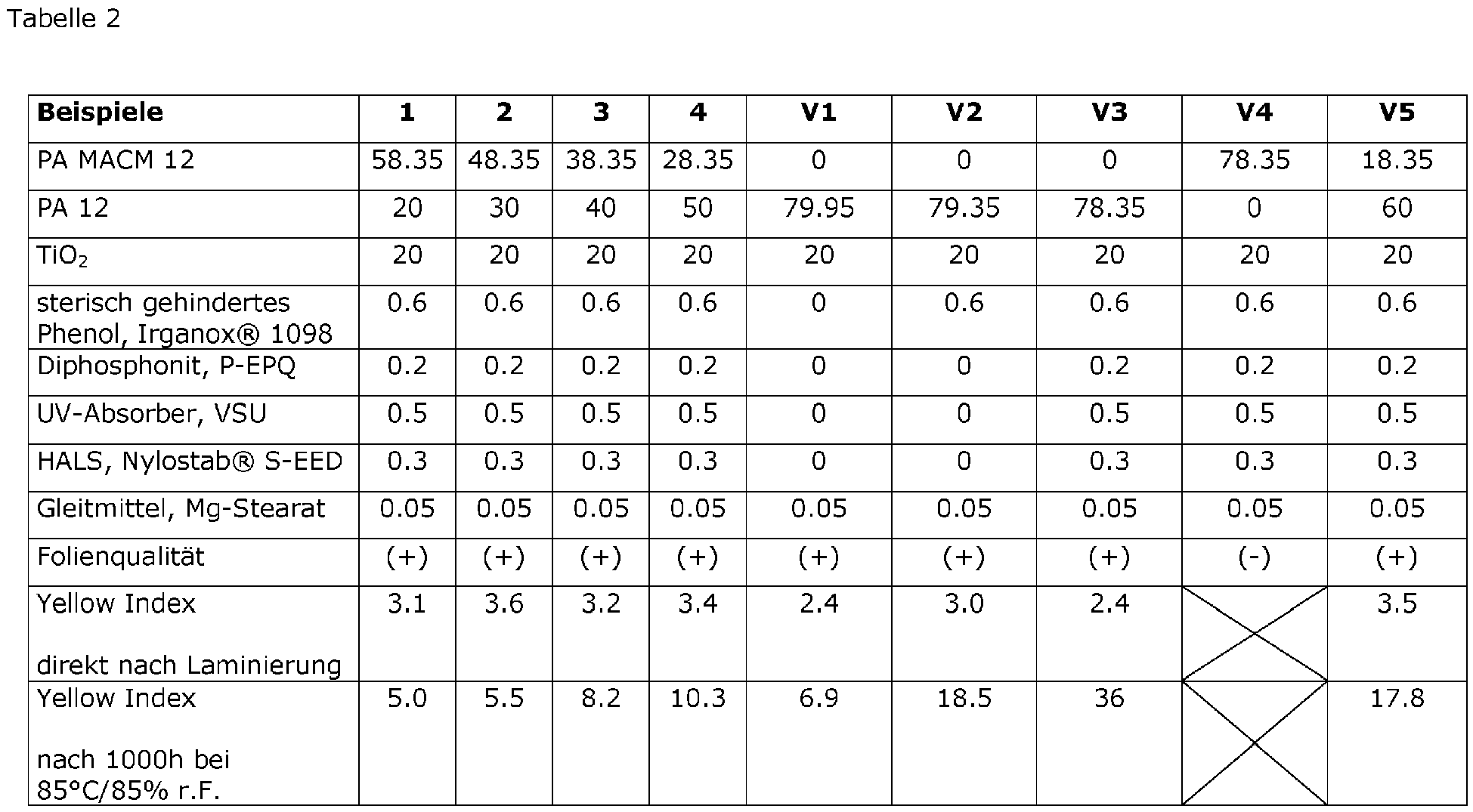
- Aus PA MACM 12 (Vergleichsbeispiel V4, ohne PA 12) konnte auf Grund der schlechteren Verarbeitbarkeit keine geeignete Rückfolie für ein PV-Modul-Laminat erhalten werden. Zum Einen weist PA MACM 12 ein schlechteres Aufschmelzverhalten als PA 12 oder ein Blend aus PA MACM 12 und PA 12 auf, zum Anderen ist der Einzugstrom in den Extruder geringer. Um überhaupt eine Folie extrudieren zu können, musste mit einer Abzugswalzentemperatur von 135°C (im Vergleich zu <100°C für den Blend aus PA MACM 12 und PA12) gearbeitet werden. Bei derart hohen Abzugstemperaturen kommt es leicht zu Verklebungen; die erhaltene Folie wies eine sehr schlechte Qualität der Oberfläche und viele Wellen auf.
- Der Hauptvorteil einer erfindungsgemässen Photovoltaik-Rückfolie zeigt sich vor allem darin, dass im Vergleich zum stark vergilbenden Vergleichsbeispiel V3 (ohne PA MACM 12, mit Stabilisatoren) die Vergilbung der erfindungsgemässen Beispiele (dank PA MACM12-Anteil im erfindungsgemässen Bereich) frappant gering ist.
- Somit konnte das Problem der mit den PA-Stabilisatoren und der EVA-Haftvermittlerschicht zusammenhängenden Vergilbung in PV-Modul-Laminaten auf überraschende Weise durch eine Mischung von Polyamiden in der Formmasse der Polyamidschicht gemäss Anspruch 1 gelöst werden.
- Diese Polyamidmischung verhindert weitgehend das Migrieren von Stabilisatormolekülen oder deren Abbauprodukten in die angrenzende Laminatschicht aus Ethylenvinylacetat (EVA), wo sie sonst mit nicht verbrauchtem Peroxid unter Gelbverfärbung reagieren könnten. Dank der erfindungsgemässen Massnahme erhält man ein einwandfreies PV-Modul, das auch bei Gebrauch in einer feuchtwarmen Umgebung nur sehr wenig vergilbt. Damit bleiben der Reflexionsgrad und der Wirkungsgrad des PV-Moduls hoch, und die ästhetischen Erwartungen des Konsumenten werden darüber hinaus erfüllt.
Claims (15)
- Photovoltaikmodul-Rückfolie, welche mindestens eine Schicht enthält die aus einer Polyamid-Formmasse hergestellt ist, dadurch gekennzeichnet, dass diese Polyamid-Formmasse zusammengesetzt ist aus:- 25 bis 70 Gewichtsprozent mindestens eines transparenten Polyamids (A), dessen Glasübergangstemperatur auch nach der Aufnahme von Feuchtigkeit bei 85°C und 85 % relativer Feuchtigkeit mehr als 100°C beträgt;- 15 bis 58 Gewichtsprozent mindestens eines aliphatischen Polyamids (B);- 0.5 bis 3 Gewichtsprozent an UV- und Hitzestabilisatoren (C); und- 10 bis 30 Gewichtsprozent mindestens eines weiteren Zusatzstoffes (D); wobei sich die Komponenten (A) bis (D) auf 100 Gewichtsprozent der Polyamid-Formmasse ergänzen.
- Photovoltaikmodul-Rückfolie gemäss Anspruch 1, dadurch gekennzeichnet, dass das mindestens eine transparente Polyamid (A) ausgewählt ist aus einer Gruppe, die aus PA MACM 12, PA PACM 12, PA MACM I, PA MACM T und Mischungen daraus besteht, und dass das mindestens eine aliphatische Polyamid (B) ausgewählt ist aus einer Gruppe, die aus PA 11, PA 12, PA 1010, PA 1012 und Mischungen daraus besteht.
- Photovoltaikmodul-Rückfolie gemäss Anspruch 1 oder 2, dadurch gekennzeichnet, dass das mindestens eine transparente Polyamid (A) amorph ist.
- Photovoltaikmodul-Rückfolie gemäss einem der vorhergehenden Ansprüche, dadurch gekennzeichnet, dass die Polyamid-Formmasse in ihrer Zusammensetzung eine Mischung von 26 bis 68 Gewichtsprozent des Polyamids (A) und 16 bis 50 Gewichtsprozent des Polyamids (B), bevorzugt von 28 bis 65 Gewichtsprozent des Polyamids (A) und 17 bis 40 Gewichtsprozent des Polyamids (B) und besonders bevorzugt von 53 bis 63 Gewichtsprozent des Polyamids (A) und 18 bis 30 Gewichtsprozent des Polyamids (B) enthält, wobei sich die Gewichtsprozente jeweils auf 100 Gewichtsprozent der Polyamid-Formmasse beziehen, die auch die Komponenten (C) und (D) enthält.
- Photovoltaikmodul-Rückfolie gemäss einem der vorhergehenden Ansprüche, dadurch gekennzeichnet, dass die Polyamidformmasse keine anderen Polyamide als PA MACM 12 und PA 12 enthält.
- Photovoltaikmodul-Rückfolie gemäss einem der vorhergehenden Ansprüche, dadurch gekennzeichnet, dass die UV- und Hitzestabilisatoren (C) ausgewählt sind aus der Gruppe bestehend aus den Klassen der Diphosphite, Diphosphonite, Oxanilide, sterisch gehinderten Aminen, sterisch gehinderten Phenolen und Mischungen daraus, und bevorzugt ausgewählt sind aus der Gruppe bestehend aus [4-[4-bis(2,4-ditert-butylphenoxy)phosphanylphenyl] phenyl]-bis(2,4-ditert-butylphenoxy)phosphan; Bis(2,4-dicumylphenyl)pentaerythritol diphosphit; 2-Ethyl-2'-ethoxy-oxalanilid; 1,3-Benzendicarboxamid, N,N'-bis(2,2,6,6-tetramethyl-4-piperidinyl; N,N'-hexan-1,6-diylbis [3-(3, 5-di-tert-butyl-4-hydroxyphenyl)propionamid] und Mischungen daraus.
- Photovoltaikmodul-Rückfolie gemäss einem der vorhergehenden Ansprüche, dadurch gekennzeichnet, dass der mindestens eine weitere Zusatzstoff (D) ausgewählt ist aus einer Gruppe, die aus Weisspigmenten, UV-Absorbern, Hydrolysestabilisatoren, Vernetzungsaktivatoren, Flammschutzmitteln, Schichtsilikaten, Füllstoffen, Farbmitteln, Verstärkungsmitteln, Haftvermittlern, Schlagzähigkeitsmodifikatoren, Gleitmitteln, Fluorpolymeren und Mischungen daraus besteht.
- Photovoltaikmodul-Rückfolie gemäss Anspruch 7, dadurch gekennzeichnet, dass sie mindestens ein Weisspigment enthält und einen Reflexionsgrad von mindestens 92 % aufweist.
- Photovoltaikmodul-Rückfolie gemäss Anspruch 7 oder 8, dadurch gekennzeichnet, dass das Weisspigment Titandioxid in der Rutil- oder Anatas-Modifikation ist.
- Photovoltaikmodul-Rückfolie gemäss Anspruch 9, dadurch gekennzeichnet, dass Titandioxid in einem Anteil von 15 bis 25 Gewichtsprozent, bevorzugt von 18 bis 22 Gewichtsprozent und besonders bevorzugt von 19 bis 21 Gewichtsprozent enthalten ist.
- Photovoltaikmodul-Rückfolie gemäss einem der vorhergehenden Ansprüche, dadurch gekennzeichnet, dass die Rückfolie aus einer einzigen Schicht oder aus mehreren Schichten besteht.
- Photovoltaikmodul-Rückfolie gemäss einem der vorhergehenden Ansprüche, dadurch gekennzeichnet, dass die mindestens eine Schicht der Rückfolie, die aus einer Polyamid-Formmasse hergestellt ist, in einem laminierten Photovoltaikmodul direkt an eine Schicht aus Ethylenvinylacetat (EVA) grenzt.
- Photovoltaikmodul mit einer Photovoltaikmodul-Rückfolie gemäss einem der vorhergehenden Ansprüche, dadurch gekennzeichnet, dass es einen Yellow Index aufweist, der nach 15-minütigem Laminieren bei einer Pressentemperatur von 150°C und anschliessender Lagerung des Photovoltaikmoduls während 1000 Stunden bei 85°C und 85 % relativer Feuchtigkeit kleiner als 11, bevorzugt kleiner als 9 und besonders bevorzugt kleiner als 6 ist.
- Verfahren zur Herstellung einer Photovoltaikmodul-Rückfolie, welche mindestens eine Schicht enthält die aus einer Polyamid-Formmasse hergestellt ist, insbesondere gemäss einem der Ansprüche 1 bis 12, dadurch gekennzeichnet, dass die Polyamid-Formmasse zusammengesetzt ist aus:- 25 bis 70 Gewichtsprozent mindestens eines transparenten Polyamids (A), dessen Glasübergangstemperatur auch nach der Aufnahme von Feuchtigkeit bei 85°C und 85 % relativer Feuchtigkeit mehr als 100°C beträgt,- 15 bis 58 Gewichtsprozent mindestens eines aliphatischen Polyamids (B),- 0.5 bis 3 Gewichtsprozent an UV- und Hitzestabilisatoren (C), und- 10 bis 30 Gewichtsprozent mindestens eines weiteren Zusatzstoffes (D), wobei sich die Komponenten (A) bis (D) auf 100 Gewichtsprozent der Polyamid-Formmasse ergänzen, und die Polyamid-Formmasse extrudiert oder coextrudiert wird.
- Verwendung einer Photovoltaikmodul-Rückfolie gemäss einem der Ansprüche 1 bis 12 oder eines Verfahrens zu deren Herstellung gemäss Anspruch 14 bei der Produktion photovoltaischer Module.
Priority Applications (4)
| Application Number | Priority Date | Filing Date | Title |
|---|---|---|---|
| EP11195475.6A EP2608276A1 (de) | 2011-12-23 | 2011-12-23 | Photovoltaikmodul-Rückfolie, Verfahren zu deren Herstellung sowie deren Verwendung bei der Produktion photovoltaischer Module |
| JP2012264460A JP2013138199A (ja) | 2011-12-23 | 2012-12-03 | 光電池モジュール用バックシート、その製造方法、および光電池モジュールの製造におけるその使用 |
| KR1020120141969A KR20130073819A (ko) | 2011-12-23 | 2012-12-07 | 광전지 모듈 백시트, 그것의 제조 방법 및 광전지 모듈의 제조에서의 사용 |
| CN2012105637271A CN103325872A (zh) | 2011-12-23 | 2012-12-21 | 光生伏打模块背板、它的制造方法、以及它在制造光生伏打模块的过程中的用途 |
Applications Claiming Priority (1)
| Application Number | Priority Date | Filing Date | Title |
|---|---|---|---|
| EP11195475.6A EP2608276A1 (de) | 2011-12-23 | 2011-12-23 | Photovoltaikmodul-Rückfolie, Verfahren zu deren Herstellung sowie deren Verwendung bei der Produktion photovoltaischer Module |
Publications (1)
| Publication Number | Publication Date |
|---|---|
| EP2608276A1 true EP2608276A1 (de) | 2013-06-26 |
Family
ID=45444470
Family Applications (1)
| Application Number | Title | Priority Date | Filing Date |
|---|---|---|---|
| EP11195475.6A Withdrawn EP2608276A1 (de) | 2011-12-23 | 2011-12-23 | Photovoltaikmodul-Rückfolie, Verfahren zu deren Herstellung sowie deren Verwendung bei der Produktion photovoltaischer Module |
Country Status (4)
| Country | Link |
|---|---|
| EP (1) | EP2608276A1 (de) |
| JP (1) | JP2013138199A (de) |
| KR (1) | KR20130073819A (de) |
| CN (1) | CN103325872A (de) |
Cited By (2)
| Publication number | Priority date | Publication date | Assignee | Title |
|---|---|---|---|---|
| EP2746344A1 (de) * | 2012-12-21 | 2014-06-25 | Ems-Patent Ag | Verwendung einer Polyamidformmasse zur Herstellung eines schmutzabweisenden Artikels |
| EP2857437B2 (de) † | 2013-10-04 | 2025-01-15 | Evonik Operations GmbH | Polyamidmischung |
Families Citing this family (2)
| Publication number | Priority date | Publication date | Assignee | Title |
|---|---|---|---|---|
| CN103594559B (zh) * | 2013-11-21 | 2016-03-23 | 常州回天新材料有限公司 | 自修复型太阳能电池背膜的制备方法 |
| JP2016084399A (ja) * | 2014-10-24 | 2016-05-19 | 大塚化学株式会社 | 反射板用樹脂組成物及び反射板 |
Citations (3)
| Publication number | Priority date | Publication date | Assignee | Title |
|---|---|---|---|---|
| US6660930B1 (en) * | 2002-06-12 | 2003-12-09 | Rwe Schott Solar, Inc. | Solar cell modules with improved backskin |
| EP2275471A1 (de) * | 2009-06-18 | 2011-01-19 | Ems-Patent Ag | Photovoltaikmodul-Monorückfolie, Verfahren zu deren Herstellung sowie deren Verwendung bei der Produktion photovoltaischer Module |
| US20110259406A1 (en) * | 2010-04-26 | 2011-10-27 | BioSolar Inc. | Photovoltaic module backsheet, materials for use in module backsheet, and processes for making the same |
Family Cites Families (1)
| Publication number | Priority date | Publication date | Assignee | Title |
|---|---|---|---|---|
| EP1942147B1 (de) * | 2006-12-28 | 2009-04-01 | Ems-Chemie Ag | Mit flachen Glasfasern verstärkte Polyamidformmassen sowie daraus hergestellte Spritzgussteile |
-
2011
- 2011-12-23 EP EP11195475.6A patent/EP2608276A1/de not_active Withdrawn
-
2012
- 2012-12-03 JP JP2012264460A patent/JP2013138199A/ja active Pending
- 2012-12-07 KR KR1020120141969A patent/KR20130073819A/ko not_active Withdrawn
- 2012-12-21 CN CN2012105637271A patent/CN103325872A/zh active Pending
Patent Citations (3)
| Publication number | Priority date | Publication date | Assignee | Title |
|---|---|---|---|---|
| US6660930B1 (en) * | 2002-06-12 | 2003-12-09 | Rwe Schott Solar, Inc. | Solar cell modules with improved backskin |
| EP2275471A1 (de) * | 2009-06-18 | 2011-01-19 | Ems-Patent Ag | Photovoltaikmodul-Monorückfolie, Verfahren zu deren Herstellung sowie deren Verwendung bei der Produktion photovoltaischer Module |
| US20110259406A1 (en) * | 2010-04-26 | 2011-10-27 | BioSolar Inc. | Photovoltaic module backsheet, materials for use in module backsheet, and processes for making the same |
Cited By (3)
| Publication number | Priority date | Publication date | Assignee | Title |
|---|---|---|---|---|
| EP2746344A1 (de) * | 2012-12-21 | 2014-06-25 | Ems-Patent Ag | Verwendung einer Polyamidformmasse zur Herstellung eines schmutzabweisenden Artikels |
| US9546272B2 (en) | 2012-12-21 | 2017-01-17 | Ems-Patent Ag | Stain-resistant article and use thereof |
| EP2857437B2 (de) † | 2013-10-04 | 2025-01-15 | Evonik Operations GmbH | Polyamidmischung |
Also Published As
| Publication number | Publication date |
|---|---|
| CN103325872A (zh) | 2013-09-25 |
| KR20130073819A (ko) | 2013-07-03 |
| JP2013138199A (ja) | 2013-07-11 |
Similar Documents
| Publication | Publication Date | Title |
|---|---|---|
| EP2275471B1 (de) | Photovoltaikmodul-Monorückfolie, Verfahren zu deren Herstellung sowie deren Verwendung bei der Produktion photovoltaischer Module | |
| EP2599629B1 (de) | Verwendung einer Mehrschichtfolie für die Herstellung photovoltaischer Module | |
| EP2422976B1 (de) | Photovoltaikmodul-Mehrschichtrückfolie sowie deren Herstellung und Verwendung bei der Produktion photovoltaischer Module | |
| EP2581947B1 (de) | Verwendung einer Mehrschichtfolie mit Polyamid- und Polyesterschichten für die Herstellung photovoltaischer Module | |
| EP3733804B1 (de) | Verkapselungshaftfolie für solarzelle und verfahren zu ihrer herstellung und ihre verwendung | |
| DE112009001580B4 (de) | Ethylen-Copolymer-Zusammensetzung, Folie zum Versiegeln eines Solarzellenelements und ihre Verwendung | |
| DE60035093T2 (de) | Schlagfeste mehrschichtige Schutzfolie | |
| EP2581221B1 (de) | Verwendung einer Mehrschichtfolie mit Polyamid- und Polypropylenschichten für die Herstellung photovoltaischer Module | |
| DE202007019226U1 (de) | Eindringungsresistente Sicherheitsverglasungen und Solarzellenmodule | |
| TWI605940B (zh) | 包含環氧化植物油的聚合物夾層 | |
| DE60011608T2 (de) | Uv-stabilisierte polymerstrukturen | |
| EP2509789B1 (de) | Mehrschichtfolie mit hoher durchstoss- und weiterreissfestigkeit | |
| DE112011101446T5 (de) | Photovoltaikmodul-Rückseitenfolie, Materialien zur Verwendung in Modul-Rückseitenfolie und Verfahren zur Herstellung derselben | |
| DE112012003531B4 (de) | Solarmodul und Verfahren zu seiner Herstellung | |
| EP2608276A1 (de) | Photovoltaikmodul-Rückfolie, Verfahren zu deren Herstellung sowie deren Verwendung bei der Produktion photovoltaischer Module | |
| DE102011009817A1 (de) | Transparente, biaxial gestreckte Polyesterfolie mit hohem Cyclohexandimethanolanteil und einem primären und sekundären Dicarbonsäureanteil sowie ein Verfahren zu ihrer Herstellung und ihre Verwendung | |
| CN105647064A (zh) | 一种耐候pvc塑料墙纸及其制备方法 | |
| DE102014210007A1 (de) | Drei-Schicht-UV-Schutzfolie für dekorative Schichtpressstoffplatten (HPL) | |
| EP2643398A1 (de) | Diisononylterephthalat (dint) als weichmacher für thermoplastische anwendungen | |
| DE69501400T2 (de) | Acrylat mischungen und verbundwerkstoffe die diese benutzen | |
| CN1052493C (zh) | 转光薄膜及其制造方法 | |
| WO2011015579A1 (de) | Evm-granulat als einbettungsmaterial für solarmodule, deren herstellungsverfahren, eine klebefolie sowie ein solarmodul und dessen herstellungsverfahren und herstellungsvorrichtung | |
| EP2581222B1 (de) | Verwendung einer Mehrschichtfolie mit Sauerstoffpermeationssperre für die Herstellung photovoltaischer Module | |
| DE102004000026A1 (de) | Farbige Polymermischungen mit Aminverbindungen als UV-Stabilisator | |
| DE112018004961B4 (de) | MEHRSCHICHTFOLIE MIT HOHER REIßKRAFT |
Legal Events
| Date | Code | Title | Description |
|---|---|---|---|
| 17P | Request for examination filed |
Effective date: 20120611 |
|
| AK | Designated contracting states |
Kind code of ref document: A1 Designated state(s): AL AT BE BG CH CY CZ DE DK EE ES FI FR GB GR HR HU IE IS IT LI LT LU LV MC MK MT NL NO PL PT RO RS SE SI SK SM TR |
|
| AX | Request for extension of the european patent |
Extension state: BA ME |
|
| PUAI | Public reference made under article 153(3) epc to a published international application that has entered the european phase |
Free format text: ORIGINAL CODE: 0009012 |
|
| GRAP | Despatch of communication of intention to grant a patent |
Free format text: ORIGINAL CODE: EPIDOSNIGR1 |
|
| RIC1 | Information provided on ipc code assigned before grant |
Ipc: H01L 31/048 20140101ALI20140203BHEP Ipc: C08L 77/02 20060101ALI20140203BHEP Ipc: C08L 77/06 20060101ALI20140203BHEP Ipc: C08J 5/18 20060101AFI20140203BHEP Ipc: C08K 5/00 20060101ALI20140203BHEP Ipc: B32B 27/34 20060101ALI20140203BHEP Ipc: B32B 27/30 20060101ALI20140203BHEP |
|
| INTG | Intention to grant announced |
Effective date: 20140227 |
|
| STAA | Information on the status of an ep patent application or granted ep patent |
Free format text: STATUS: THE APPLICATION IS DEEMED TO BE WITHDRAWN |
|
| 18D | Application deemed to be withdrawn |
Effective date: 20140701 |