EP2610127A2 - Mode d'économie de carburant afin de modifier la régulation de vitesse pour un véhicule automobile - Google Patents
Mode d'économie de carburant afin de modifier la régulation de vitesse pour un véhicule automobile Download PDFInfo
- Publication number
- EP2610127A2 EP2610127A2 EP12198515.4A EP12198515A EP2610127A2 EP 2610127 A2 EP2610127 A2 EP 2610127A2 EP 12198515 A EP12198515 A EP 12198515A EP 2610127 A2 EP2610127 A2 EP 2610127A2
- Authority
- EP
- European Patent Office
- Prior art keywords
- fuel economy
- vehicle
- cruise control
- control system
- level
- Prior art date
- Legal status (The legal status is an assumption and is not a legal conclusion. Google has not performed a legal analysis and makes no representation as to the accuracy of the status listed.)
- Withdrawn
Links
Images
Classifications
-
- B—PERFORMING OPERATIONS; TRANSPORTING
- B60—VEHICLES IN GENERAL
- B60K—ARRANGEMENT OR MOUNTING OF PROPULSION UNITS OR OF TRANSMISSIONS IN VEHICLES; ARRANGEMENT OR MOUNTING OF PLURAL DIVERSE PRIME-MOVERS IN VEHICLES; AUXILIARY DRIVES FOR VEHICLES; INSTRUMENTATION OR DASHBOARDS FOR VEHICLES; ARRANGEMENTS IN CONNECTION WITH COOLING, AIR INTAKE, GAS EXHAUST OR FUEL SUPPLY OF PROPULSION UNITS IN VEHICLES
- B60K31/00—Vehicle fittings, acting on a single sub-unit only, for automatically controlling vehicle speed, i.e. preventing speed from exceeding an arbitrarily established velocity or maintaining speed at a particular velocity, as selected by the vehicle operator
-
- B—PERFORMING OPERATIONS; TRANSPORTING
- B60—VEHICLES IN GENERAL
- B60K—ARRANGEMENT OR MOUNTING OF PROPULSION UNITS OR OF TRANSMISSIONS IN VEHICLES; ARRANGEMENT OR MOUNTING OF PLURAL DIVERSE PRIME-MOVERS IN VEHICLES; AUXILIARY DRIVES FOR VEHICLES; INSTRUMENTATION OR DASHBOARDS FOR VEHICLES; ARRANGEMENTS IN CONNECTION WITH COOLING, AIR INTAKE, GAS EXHAUST OR FUEL SUPPLY OF PROPULSION UNITS IN VEHICLES
- B60K2310/00—Arrangements, adaptations or methods for cruise controls
- B60K2310/24—Speed setting methods
- B60K2310/242—Speed setting methods setting initial target speed, e.g. initial algorithms
-
- B—PERFORMING OPERATIONS; TRANSPORTING
- B60—VEHICLES IN GENERAL
- B60W—CONJOINT CONTROL OF VEHICLE SUB-UNITS OF DIFFERENT TYPE OR DIFFERENT FUNCTION; CONTROL SYSTEMS SPECIALLY ADAPTED FOR HYBRID VEHICLES; ROAD VEHICLE DRIVE CONTROL SYSTEMS FOR PURPOSES NOT RELATED TO THE CONTROL OF A PARTICULAR SUB-UNIT
- B60W2540/00—Input parameters relating to occupants
- B60W2540/21—Voice
-
- B—PERFORMING OPERATIONS; TRANSPORTING
- B60—VEHICLES IN GENERAL
- B60W—CONJOINT CONTROL OF VEHICLE SUB-UNITS OF DIFFERENT TYPE OR DIFFERENT FUNCTION; CONTROL SYSTEMS SPECIALLY ADAPTED FOR HYBRID VEHICLES; ROAD VEHICLE DRIVE CONTROL SYSTEMS FOR PURPOSES NOT RELATED TO THE CONTROL OF A PARTICULAR SUB-UNIT
- B60W2540/00—Input parameters relating to occupants
- B60W2540/30—Driving style
-
- B—PERFORMING OPERATIONS; TRANSPORTING
- B60—VEHICLES IN GENERAL
- B60W—CONJOINT CONTROL OF VEHICLE SUB-UNITS OF DIFFERENT TYPE OR DIFFERENT FUNCTION; CONTROL SYSTEMS SPECIALLY ADAPTED FOR HYBRID VEHICLES; ROAD VEHICLE DRIVE CONTROL SYSTEMS FOR PURPOSES NOT RELATED TO THE CONTROL OF A PARTICULAR SUB-UNIT
- B60W2552/00—Input parameters relating to infrastructure
- B60W2552/15—Road slope, i.e. the inclination of a road segment in the longitudinal direction
-
- B—PERFORMING OPERATIONS; TRANSPORTING
- B60—VEHICLES IN GENERAL
- B60W—CONJOINT CONTROL OF VEHICLE SUB-UNITS OF DIFFERENT TYPE OR DIFFERENT FUNCTION; CONTROL SYSTEMS SPECIALLY ADAPTED FOR HYBRID VEHICLES; ROAD VEHICLE DRIVE CONTROL SYSTEMS FOR PURPOSES NOT RELATED TO THE CONTROL OF A PARTICULAR SUB-UNIT
- B60W2556/00—Input parameters relating to data
- B60W2556/45—External transmission of data to or from the vehicle
- B60W2556/50—External transmission of data to or from the vehicle of positioning data, e.g. GPS [Global Positioning System] data
-
- B—PERFORMING OPERATIONS; TRANSPORTING
- B60—VEHICLES IN GENERAL
- B60W—CONJOINT CONTROL OF VEHICLE SUB-UNITS OF DIFFERENT TYPE OR DIFFERENT FUNCTION; CONTROL SYSTEMS SPECIALLY ADAPTED FOR HYBRID VEHICLES; ROAD VEHICLE DRIVE CONTROL SYSTEMS FOR PURPOSES NOT RELATED TO THE CONTROL OF A PARTICULAR SUB-UNIT
- B60W2710/00—Output or target parameters relating to a particular sub-units
- B60W2710/06—Combustion engines, Gas turbines
-
- B—PERFORMING OPERATIONS; TRANSPORTING
- B60—VEHICLES IN GENERAL
- B60W—CONJOINT CONTROL OF VEHICLE SUB-UNITS OF DIFFERENT TYPE OR DIFFERENT FUNCTION; CONTROL SYSTEMS SPECIALLY ADAPTED FOR HYBRID VEHICLES; ROAD VEHICLE DRIVE CONTROL SYSTEMS FOR PURPOSES NOT RELATED TO THE CONTROL OF A PARTICULAR SUB-UNIT
- B60W2710/00—Output or target parameters relating to a particular sub-units
- B60W2710/06—Combustion engines, Gas turbines
- B60W2710/0616—Position of fuel or air injector
- B60W2710/0627—Fuel flow rate
-
- B—PERFORMING OPERATIONS; TRANSPORTING
- B60—VEHICLES IN GENERAL
- B60W—CONJOINT CONTROL OF VEHICLE SUB-UNITS OF DIFFERENT TYPE OR DIFFERENT FUNCTION; CONTROL SYSTEMS SPECIALLY ADAPTED FOR HYBRID VEHICLES; ROAD VEHICLE DRIVE CONTROL SYSTEMS FOR PURPOSES NOT RELATED TO THE CONTROL OF A PARTICULAR SUB-UNIT
- B60W2720/00—Output or target parameters relating to overall vehicle dynamics
- B60W2720/10—Longitudinal speed
-
- B—PERFORMING OPERATIONS; TRANSPORTING
- B60—VEHICLES IN GENERAL
- B60Y—INDEXING SCHEME RELATING TO ASPECTS CROSS-CUTTING VEHICLE TECHNOLOGY
- B60Y2300/00—Purposes or special features of road vehicle drive control systems
- B60Y2300/52—Engine fuel consumption
-
- Y—GENERAL TAGGING OF NEW TECHNOLOGICAL DEVELOPMENTS; GENERAL TAGGING OF CROSS-SECTIONAL TECHNOLOGIES SPANNING OVER SEVERAL SECTIONS OF THE IPC; TECHNICAL SUBJECTS COVERED BY FORMER USPC CROSS-REFERENCE ART COLLECTIONS [XRACs] AND DIGESTS
- Y02—TECHNOLOGIES OR APPLICATIONS FOR MITIGATION OR ADAPTATION AGAINST CLIMATE CHANGE
- Y02T—CLIMATE CHANGE MITIGATION TECHNOLOGIES RELATED TO TRANSPORTATION
- Y02T10/00—Road transport of goods or passengers
- Y02T10/10—Internal combustion engine [ICE] based vehicles
- Y02T10/40—Engine management systems
Definitions
- the present disclosure relates to automotive vehicles, and more particularly to fuel economy for automotive vehicles.
- Automotive vehicles utilize cruise control systems to assist vehicle operators in maintaining vehicles at a constant speed when traveling long distances. Operation of the vehicle in cruise control mode may increase fuel economy over long distances. As is known, the vehicle operator can engage and disengaged the cruise control systems as desired. Vehicle speed is typically maintained at a constant speed over differing road terrains. However, as is known, operation of the cruise control system may be terminated by application of the brakes by the vehicle operator.
- ACC systems adjust the speed of the vehicle to accommodate changes in traffic speed when operating in cruise control mode.
- ACC systems maintain a desired distance from a forward vehicle. If the forward vehicle changes speeds or changes lanes the ACC system will return the vehicle to the cruising speed originally set by the vehicle operator.
- the ACC systems may be terminated by application of the vehicle brakes.
- a method of operating a cruise control system for a vehicle comprises selecting a fuel economy mode for the cruise control system and determining a desired fuel economy.
- a fuel economy level of the vehicle is maintained at the desired fuel economy when operating in fuel economy mode.
- a method of operating a vehicle comprises selecting an operating mode for a cruise control system. At least one of a desired fuel economy and an initial cruise control speed for the vehicle are determined. A fuel supply to an engine for the vehicle is adjusted with an engine controller in communication with a fuel supply system to maintain a fuel economy level of the vehicle at the desired fuel economy when operating in a fuel economy mode.
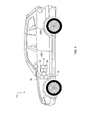
- FIG. 1 is a schematic illustration of a vehicle 10 having a cruise control system 12 having a standard operating mode and a fuel economy mode 14.
- the cruise control system 12 may also be an adaptive cruise control (ACC) system and preferably incorporates other existing vehicle 10 systems and components for simplicity, such as forward looking sensors.
- ACC adaptive cruise control
- FIG. 2 illustrates the vehicle 10 with the cruise control system 12 where the operating mode of the cruise control system is selected by a control device 24.
- the fuel efficiency of the vehicle 10 may be maintained at a desired fuel economy.
- the desired fuel economy may correspond to the fuel economy level for the vehicle 10 at a pre-selected speed when traveling along a flat surface. If the vehicle 10 recognizes a hill is approaching the control device 24 for the cruise control system 12 may switch to a fuel economy mode 14and maintain the vehicle at the desired fuel economy rather than at a desired speed.
- the vehicle 10 may have at least one sensor, such as a longitudinal gravity sensor or may utilize other vehicle systems, such as a navigation system to detect an approaching hill.
- the fuel economy mode 14 would allow the vehicle 10 to slow while ascending the hill and regain speed while descending the hill.
- the overall speed of the vehicle 10 after the hill will be approximately the same speed as before the hill while the fuel economy of the vehicle 10 is maintained above the desired fuel economy level.
- the cruise control system 12 in a standard operating mode the cruise control system 12 maintains the speed of the vehicle 10 at the speed selected by the driver. If the cruise control system 12 is an ACC system the cruise control system 12 will adjust the speed of the vehicle 10 to maintain a predetermined distance from forward objects. In the standard operating mode the cruise control system 12 maintains the vehicle 10 at the selected speed regardless of the terrain and contours of the road and only adjusts the vehicle speed 10 based upon intervening objects as mentioned above.
- the speed of the vehicle 10 is typically maintained within a range of the preselected speed by an engine controller 16. The vehicle 10 speed is maintain even when encountering changes in the slope of the road, such as when ascending or descending a hill.
- the engine controller 16 cooperates with a fuel supply system 18 to adjust the fuel supply as required to maintain the vehicle 10 at the preselected speed.
- the fuel economy mode 14 may be selected by the vehicle operator using the control device 24.
- the speed of the vehicle 10 may be allowed to vary while the cruise control system 12 operates to maintain a desired fuel economy.
- the desired fuel economy may correspond to the fuel economy level for the vehicle 10 at a pre-selected speed when traveling along a flat surface.
- the desired fuel economy of the vehicle 10 can be determined by the fuel economy level that is calculated when the fuel economy mode 14 of the cruise control system 12 is initiated. Thereafter, the vehicle 10 will maintain the desired fuel economy regardless of the changes in the road. Again the engine controller 16 and the fuel supply system 18 cooperate with the cruise control system 12 to operate the vehicle 10 in a manner that maintains the fuel economy as the desired fuel economy level.
- a high fuel economy level is generally desirable. Therefore, maintaining the vehicle 10 at the desired fuel economy may mean allowing the fuel economy of the vehicle 10 to increase, but not allowing the fuel economy to decrease below the desired level.
- the fuel economy level may also be limited from increasing. For example, due to terrain an increase in the fuel economy level may also correspond to an increase in speed of the vehicle 10, e.g. when the vehicle 10 is travelling downhill. In order to maintain the vehicle 10 at safe operating speed the fuel economy level may be maintained at the pre-selected level and not allowed to increase outside of a predetermined range, thus, restricting the speed of the vehicle 10. In this instance, an increase in the fuel economy level would be allowable as long as the vehicle 10 is travelling within safe operating speeds.
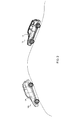
- FIG. 2 An example of the vehicle 10 operating in the fuel economy mode 14 is illustrated in Figure 2 .
- the vehicle 10 is in the fuel economy mode 14 as the vehicle 10 begins to ascend a hill.
- the speed of the vehicle 10 may be allowed to decrease to maintain the desired fuel economy level that was determined when the fuel economy mode 14 was initiated.
- Preferably the fuel economy mode 14 is initiated while traveling a flat surface.
- the fuel economy of the vehicle 10 is not allowed below the desired fuel economy level. As a result, the vehicle 10 will slow in speed while ascending the hill.
- the engine controller 16 cooperates with the fuel system 18 to only provide the amount of fuel necessary for the desired fuel economy. Therefore, the vehicle 10 will slow while ascending the hill and regain speed when descending the hill such that, the overall speed of the vehicle 10 after the hill will be approximately the same speed as before the hill while the fuel economy of the vehicle 10 is maintained above the desired fuel economy level.
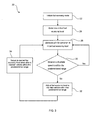
- FIG 3 illustrates a method 20 for operating the vehicle 10 having the cruise control system 12 with the fuel economy mode 14. Also with reference to Figures 1 and 2 , the method 20 for operating the vehicle 10 having the cruise control system 12 with the fuel economy mode 14 is described below.
- the fuel economy mode 14 is initiated by the operator of the vehicle 10, step 22.
- the fuel economy mode 14 may initiated by a control device 24.
- the control device 24 may be a control unit for the cruise control system 12 or may be a separate selector or switch that is part of the controls the vehicle driver uses to operate the cruise control system 12.
- the cruise control system 12 determines a desired fuel economy level, step 26.
- the desired fuel economy level may be an average or instantaneous fuel economy for the vehicle 10 when the fuel economy mode 14 is initiated.
- the average fuel economy level may be an average of the fuel economy determined for a preselected period of the time, i.e. for 60 seconds of vehicle 10 operation prior to the initiation of the fuel economy mode 14.
- the vehicle 10 Upon initiation of the fuel economy mode 14 the vehicle 10 is operated at the desired fuel economy level, step 28.
- the cruise control system 12 monitors the instantaneous fuel economy of the vehicle 10.
- the desired fuel economy level may be adjusted by the vehicle 10 operator through the use of the control device 24. For example, the fuel economy may be increased or decreased in an incremental manner.
- the adjustment of the desired fuel economy level may be similar to adjusting a preselected speed of the vehicle 10 when operating in the standard operating mode of the cruise control system 12
- the fuel economy level may be adjusted under selected conditions. For example, if the cruise control system 12 is an ACC system the vehicle 10 may be operated at another fuel economy level to maintain a desired distance between the vehicle 10 and a forward object. Once the forward object is no longer in the path of the vehicle 10 the cruise control system 12 may return operation to the desired fuel economy level 14.
- the cruise control system 12 may be arranged to operate at a desired fuel economy level, with a predetermined speed range. In this instance, the vehicle 10 will maintain the desired fuel economy level, step 28. However, the cruise control system 12 will also monitor the vehicle 10 speed, step 30. If the vehicle 10 speed drops below a predetermined level the cruise control system 12 may temporarily adjust the fuel economy level to operate the vehicle 10 at a minimum determined speed, step 32. The vehicle 10 will return to operating at the desired fuel economy level once the vehicle 10 is able to maintain the minimum determined speed with the original desired fuel economy, step 34.
- the desired fuel economy when the cruise control system 12 is in fuel economy mode 14 the desired fuel economy may be maintained as long as the vehicle 10 is within a predetermined range of the speed at the time the fuel economy mode 14 was initiated by the driver.
- the fuel economy supplied by the vehicle 10 may be adjusted to maintain the vehicle within the predetermined speed range, until the vehicle 10 speed can be maintained without requiring adjustment from the desired fuel economy.
- the fuel economy mode 14 will continue operation at the desired fuel economy level, i.e. at the fuel economy level that was selected when the fuel economy mode 14 was initiated.
- the cruise control system 12 will maintain the vehicle 10 at the selected fuel economy level as long as the vehicle 10 speed is within a predetermined range of the initial vehicle speed, e.g. within 10 mph of the original speed of 60 mph. If the vehicle 10 departs the predetermined range the fuel economy level of the vehicle 10 will be adjusted to maintain the closest limit of the predetermined range. That is, if the vehicle 10 begins to slow down below 50 mph the fuel economy will be adjusted to maintain the vehicle speed at 50 mph. At such time that the vehicle 10 is able to stay within the predetermined range without the adjusted fuel economy level, the cruise control system 12 will return to maintaining the fuel economy for the vehicle at the initial fuel economy level.
- a predetermined range of the initial vehicle speed e.g. within 10 mph of the original speed of 60 mph.
- the fuel economy level may be limited from increase to maintain the vehicle within safe operating speeds.
- the vehicle speed may be limited by the fuel economy mode 14 of the cruise control system 12 without requiring braking action to slow the vehicle 10.
Landscapes
- Engineering & Computer Science (AREA)
- Chemical & Material Sciences (AREA)
- Combustion & Propulsion (AREA)
- Transportation (AREA)
- Mechanical Engineering (AREA)
- Control Of Driving Devices And Active Controlling Of Vehicle (AREA)
Applications Claiming Priority (1)
| Application Number | Priority Date | Filing Date | Title |
|---|---|---|---|
| US13/331,166 US20130158829A1 (en) | 2011-12-20 | 2011-12-20 | Fuel economy mode to modify cruise control for an automobile |
Publications (1)
| Publication Number | Publication Date |
|---|---|
| EP2610127A2 true EP2610127A2 (fr) | 2013-07-03 |
Family
ID=47681524
Family Applications (1)
| Application Number | Title | Priority Date | Filing Date |
|---|---|---|---|
| EP12198515.4A Withdrawn EP2610127A2 (fr) | 2011-12-20 | 2012-12-20 | Mode d'économie de carburant afin de modifier la régulation de vitesse pour un véhicule automobile |
Country Status (2)
| Country | Link |
|---|---|
| US (1) | US20130158829A1 (fr) |
| EP (1) | EP2610127A2 (fr) |
Cited By (1)
| Publication number | Priority date | Publication date | Assignee | Title |
|---|---|---|---|---|
| US10590879B2 (en) | 2017-12-15 | 2020-03-17 | Ford Global Technologies, Llc | Variable displacement engine diagnostic method |
Families Citing this family (6)
| Publication number | Priority date | Publication date | Assignee | Title |
|---|---|---|---|---|
| US9233690B2 (en) * | 2011-10-05 | 2016-01-12 | Volvo Lastvagnar Ab | Arrangement and method for adapting a cruise control system in a vehicle |
| US9187093B1 (en) * | 2014-08-04 | 2015-11-17 | Cummins, Inc. | Systems and methods of cruise droop control |
| US9393963B2 (en) | 2014-09-19 | 2016-07-19 | Paccar Inc | Predictive cruise control system with advanced operator control and feedback |
| KR102521655B1 (ko) * | 2016-09-01 | 2023-04-13 | 삼성전자주식회사 | 자율 주행 방법 및 장치 |
| US10618516B2 (en) * | 2017-08-24 | 2020-04-14 | Fca Us Llc | Automotive vehicle with cruise control that enhances fuel economy |
| SE547535C2 (en) * | 2024-01-16 | 2025-10-14 | Scania Cv Ab | Method of Controlling Operation of a Vehicle, Computer Program, Computer-Readable Medium, Control Arrangement, and Vehicle |
-
2011
- 2011-12-20 US US13/331,166 patent/US20130158829A1/en not_active Abandoned
-
2012
- 2012-12-20 EP EP12198515.4A patent/EP2610127A2/fr not_active Withdrawn
Non-Patent Citations (1)
| Title |
|---|
| None |
Cited By (1)
| Publication number | Priority date | Publication date | Assignee | Title |
|---|---|---|---|---|
| US10590879B2 (en) | 2017-12-15 | 2020-03-17 | Ford Global Technologies, Llc | Variable displacement engine diagnostic method |
Also Published As
| Publication number | Publication date |
|---|---|
| US20130158829A1 (en) | 2013-06-20 |
Similar Documents
| Publication | Publication Date | Title |
|---|---|---|
| US10913456B2 (en) | Method and system for adaptive cruise control and vehicle | |
| EP2610127A2 (fr) | Mode d'économie de carburant afin de modifier la régulation de vitesse pour un véhicule automobile | |
| JP6577002B2 (ja) | 車両のクルーズコントロールの改善 | |
| US8265850B2 (en) | Method and apparatus for target vehicle following control for adaptive cruise control | |
| EP2885174B1 (fr) | Procédé et système de régulation de vitesse de véhicule à compensation de force extérieure | |
| EP2885178B1 (fr) | Système de commande de vitesse de véhicule | |
| KR101679273B1 (ko) | 속력 제어 방법 및 시스템 | |
| CN106414203B (zh) | 用于车辆中的巡航控制制动的设备和方法 | |
| CN108025750B (zh) | 车辆控制装置 | |
| CN108466618B (zh) | 车辆自适应巡航控制方法及系统 | |
| CN102712320B (zh) | 用于机动车的起动辅助装置 | |
| JP2009061941A (ja) | 車両走行制御装置 | |
| CN108137057B (zh) | 主动底盘的状况识别 | |
| US10507831B2 (en) | Cruise control system for a motor vehicle | |
| EP2678203A1 (fr) | Procédé et système de commande de régulateur de vitesse | |
| CN104284824A (zh) | 用于控制至少一个速度调节器的方法和系统 | |
| WO2019151918A1 (fr) | Procédé et appareil de commande de changement de vitesse d'une boîte de vitesses dans un véhicule à moteur | |
| US20170129467A1 (en) | An arrangement and method for supporting a cruise control brake in a vehicle | |
| JP2014000900A (ja) | 車両制御装置 | |
| US20250058775A1 (en) | Adaptive cruise control system and method | |
| WO2013114625A1 (fr) | Dispositif d'aide à la conduite | |
| JP2024030184A (ja) | 車両用制御装置 | |
| SE1450044A1 (sv) | Förfarande och system för styrning av en parameter relateradtill ett framförande av ett fordon | |
| KR20060014185A (ko) | 차량의 커브길 주행속도 제어방법 | |
| KR20100040507A (ko) | 차량의 주행 조절 방법 |
Legal Events
| Date | Code | Title | Description |
|---|---|---|---|
| PUAI | Public reference made under article 153(3) epc to a published international application that has entered the european phase |
Free format text: ORIGINAL CODE: 0009012 |
|
| AK | Designated contracting states |
Kind code of ref document: A2 Designated state(s): AL AT BE BG CH CY CZ DE DK EE ES FI FR GB GR HR HU IE IS IT LI LT LU LV MC MK MT NL NO PL PT RO RS SE SI SK SM TR |
|
| AX | Request for extension of the european patent |
Extension state: BA ME |
|
| STAA | Information on the status of an ep patent application or granted ep patent |
Free format text: STATUS: THE APPLICATION HAS BEEN PUBLISHED |
|
| STAA | Information on the status of an ep patent application or granted ep patent |
Free format text: STATUS: THE APPLICATION IS DEEMED TO BE WITHDRAWN |
|
| 18D | Application deemed to be withdrawn |
Effective date: 20170701 |