EP2610925A2 - Herstellungsverfahren für eine LED-Vorrichtung - Google Patents
Herstellungsverfahren für eine LED-Vorrichtung Download PDFInfo
- Publication number
- EP2610925A2 EP2610925A2 EP12195631.2A EP12195631A EP2610925A2 EP 2610925 A2 EP2610925 A2 EP 2610925A2 EP 12195631 A EP12195631 A EP 12195631A EP 2610925 A2 EP2610925 A2 EP 2610925A2
- Authority
- EP
- European Patent Office
- Prior art keywords
- light emitting
- emitting diode
- phosphor layer
- group
- layer
- Prior art date
- Legal status (The legal status is an assumption and is not a legal conclusion. Google has not performed a legal analysis and makes no representation as to the accuracy of the status listed.)
- Withdrawn
Links
Images

Classifications
-
- H—ELECTRICITY
- H10—SEMICONDUCTOR DEVICES; ELECTRIC SOLID-STATE DEVICES NOT OTHERWISE PROVIDED FOR
- H10H—INORGANIC LIGHT-EMITTING SEMICONDUCTOR DEVICES HAVING POTENTIAL BARRIERS
- H10H20/00—Individual inorganic light-emitting semiconductor devices having potential barriers, e.g. light-emitting diodes [LED]
- H10H20/80—Constructional details
- H10H20/85—Packages
- H10H20/851—Wavelength conversion means
-
- H—ELECTRICITY
- H10—SEMICONDUCTOR DEVICES; ELECTRIC SOLID-STATE DEVICES NOT OTHERWISE PROVIDED FOR
- H10H—INORGANIC LIGHT-EMITTING SEMICONDUCTOR DEVICES HAVING POTENTIAL BARRIERS
- H10H20/00—Individual inorganic light-emitting semiconductor devices having potential barriers, e.g. light-emitting diodes [LED]
- H10H20/80—Constructional details
- H10H20/85—Packages
-
- B—PERFORMING OPERATIONS; TRANSPORTING
- B29—WORKING OF PLASTICS; WORKING OF SUBSTANCES IN A PLASTIC STATE IN GENERAL
- B29C—SHAPING OR JOINING OF PLASTICS; SHAPING OF MATERIAL IN A PLASTIC STATE, NOT OTHERWISE PROVIDED FOR; AFTER-TREATMENT OF THE SHAPED PRODUCTS, e.g. REPAIRING
- B29C43/00—Compression moulding, i.e. applying external pressure to flow the moulding material; Apparatus therefor
- B29C43/02—Compression moulding, i.e. applying external pressure to flow the moulding material; Apparatus therefor of articles of definite length, i.e. discrete articles
- B29C43/18—Compression moulding, i.e. applying external pressure to flow the moulding material; Apparatus therefor of articles of definite length, i.e. discrete articles incorporating preformed parts or layers, e.g. compression moulding around inserts or for coating articles
-
- C—CHEMISTRY; METALLURGY
- C08—ORGANIC MACROMOLECULAR COMPOUNDS; THEIR PREPARATION OR CHEMICAL WORKING-UP; COMPOSITIONS BASED THEREON
- C08K—Use of inorganic or non-macromolecular organic substances as compounding ingredients
- C08K5/00—Use of organic ingredients
- C08K5/54—Silicon-containing compounds
- C08K5/541—Silicon-containing compounds containing oxygen
- C08K5/5425—Silicon-containing compounds containing oxygen containing at least one C=C bond
-
- C—CHEMISTRY; METALLURGY
- C08—ORGANIC MACROMOLECULAR COMPOUNDS; THEIR PREPARATION OR CHEMICAL WORKING-UP; COMPOSITIONS BASED THEREON
- C08K—Use of inorganic or non-macromolecular organic substances as compounding ingredients
- C08K5/00—Use of organic ingredients
- C08K5/56—Organo-metallic compounds, i.e. organic compounds containing a metal-to-carbon bond
-
- C—CHEMISTRY; METALLURGY
- C08—ORGANIC MACROMOLECULAR COMPOUNDS; THEIR PREPARATION OR CHEMICAL WORKING-UP; COMPOSITIONS BASED THEREON
- C08L—COMPOSITIONS OF MACROMOLECULAR COMPOUNDS
- C08L83/00—Compositions of macromolecular compounds obtained by reactions forming in the main chain of the macromolecule a linkage containing silicon with or without sulfur, nitrogen, oxygen or carbon only; Compositions of derivatives of such polymers
-
- C—CHEMISTRY; METALLURGY
- C08—ORGANIC MACROMOLECULAR COMPOUNDS; THEIR PREPARATION OR CHEMICAL WORKING-UP; COMPOSITIONS BASED THEREON
- C08L—COMPOSITIONS OF MACROMOLECULAR COMPOUNDS
- C08L83/00—Compositions of macromolecular compounds obtained by reactions forming in the main chain of the macromolecule a linkage containing silicon with or without sulfur, nitrogen, oxygen or carbon only; Compositions of derivatives of such polymers
- C08L83/04—Polysiloxanes
-
- H—ELECTRICITY
- H10—SEMICONDUCTOR DEVICES; ELECTRIC SOLID-STATE DEVICES NOT OTHERWISE PROVIDED FOR
- H10H—INORGANIC LIGHT-EMITTING SEMICONDUCTOR DEVICES HAVING POTENTIAL BARRIERS
- H10H20/00—Individual inorganic light-emitting semiconductor devices having potential barriers, e.g. light-emitting diodes [LED]
- H10H20/80—Constructional details
- H10H20/85—Packages
- H10H20/851—Wavelength conversion means
- H10H20/8515—Wavelength conversion means not being in contact with the bodies
-
- H—ELECTRICITY
- H10—SEMICONDUCTOR DEVICES; ELECTRIC SOLID-STATE DEVICES NOT OTHERWISE PROVIDED FOR
- H10H—INORGANIC LIGHT-EMITTING SEMICONDUCTOR DEVICES HAVING POTENTIAL BARRIERS
- H10H20/00—Individual inorganic light-emitting semiconductor devices having potential barriers, e.g. light-emitting diodes [LED]
- H10H20/80—Constructional details
- H10H20/85—Packages
- H10H20/852—Encapsulations
-
- H—ELECTRICITY
- H10—SEMICONDUCTOR DEVICES; ELECTRIC SOLID-STATE DEVICES NOT OTHERWISE PROVIDED FOR
- H10H—INORGANIC LIGHT-EMITTING SEMICONDUCTOR DEVICES HAVING POTENTIAL BARRIERS
- H10H20/00—Individual inorganic light-emitting semiconductor devices having potential barriers, e.g. light-emitting diodes [LED]
- H10H20/80—Constructional details
- H10H20/85—Packages
- H10H20/855—Optical field-shaping means, e.g. lenses
-
- C—CHEMISTRY; METALLURGY
- C08—ORGANIC MACROMOLECULAR COMPOUNDS; THEIR PREPARATION OR CHEMICAL WORKING-UP; COMPOSITIONS BASED THEREON
- C08G—MACROMOLECULAR COMPOUNDS OBTAINED OTHERWISE THAN BY REACTIONS ONLY INVOLVING UNSATURATED CARBON-TO-CARBON BONDS
- C08G77/00—Macromolecular compounds obtained by reactions forming a linkage containing silicon with or without sulfur, nitrogen, oxygen or carbon in the main chain of the macromolecule
- C08G77/04—Polysiloxanes
- C08G77/12—Polysiloxanes containing silicon bound to hydrogen
-
- C—CHEMISTRY; METALLURGY
- C08—ORGANIC MACROMOLECULAR COMPOUNDS; THEIR PREPARATION OR CHEMICAL WORKING-UP; COMPOSITIONS BASED THEREON
- C08G—MACROMOLECULAR COMPOUNDS OBTAINED OTHERWISE THAN BY REACTIONS ONLY INVOLVING UNSATURATED CARBON-TO-CARBON BONDS
- C08G77/00—Macromolecular compounds obtained by reactions forming a linkage containing silicon with or without sulfur, nitrogen, oxygen or carbon in the main chain of the macromolecule
- C08G77/04—Polysiloxanes
- C08G77/14—Polysiloxanes containing silicon bound to oxygen-containing groups
- C08G77/16—Polysiloxanes containing silicon bound to oxygen-containing groups to hydroxy groups
-
- H—ELECTRICITY
- H10—SEMICONDUCTOR DEVICES; ELECTRIC SOLID-STATE DEVICES NOT OTHERWISE PROVIDED FOR
- H10H—INORGANIC LIGHT-EMITTING SEMICONDUCTOR DEVICES HAVING POTENTIAL BARRIERS
- H10H20/00—Individual inorganic light-emitting semiconductor devices having potential barriers, e.g. light-emitting diodes [LED]
- H10H20/01—Manufacture or treatment
- H10H20/036—Manufacture or treatment of packages
- H10H20/0361—Manufacture or treatment of packages of wavelength conversion means
Definitions
- the present invention relates to a method for producing a light emitting diode device using a light emitting diode encapsulating material.
- a white light emitting device which is capable of emitting high-energy light
- a white light emitting device for example, an LED (a light emitting diode) which emits blue light, and a phosphor layer which is capable of converting the blue light into yellow light and covers the LED are provided.
- the white light emitting device emits high-energy white light by color mixing of the blue light emitted from the LED and the yellow light converted from the blue light in the phosphor layer.
- a method for producing a light emitting device for example, a producing method of a light emitting device in which after an LED chip is mounted on a mounting board, the LED chip is covered with a first encapsulating resin; then, a second encapsulating resin made of the same material as that of the first encapsulating resin is injected into the inner side of an optical member in a dome shape; thereafter, the optical member and the mounting board are positioned and the encapsulating resins are cured, so that an encapsulating portion is formed; and subsequently, a color conversion member in a dome shape formed from a phosphor and a light transmissive resin is disposed on the mounting board by a locking claw has been proposed (ref: for example, Japanese Unexamined Patent Publication No. 2007-227677 ).
- a method for producing a light emitting diode device of the present invention includes the steps of preparing a board mounted with a light emitting diode; preparing a hemispherical lens molding die; preparing a light emitting diode encapsulating material which includes a light emitting diode encapsulating layer and a phosphor layer laminated on the light emitting diode encapsulating layer, and in which both of the light emitting diode encapsulating layer and the phosphor layer are prepared from a resin before final curing; and disposing the light emitting diode encapsulating material between the board and the lens molding die so that the phosphor layer is opposed to the lens molding die to be compressively molded, so that the light emitting diode is directly encapsulated by the hemispherical light emitting diode encapsulating layer and the phosphor layer is disposed on the hemispherical surface of the light emitting diode encapsulating layer.
- the light emitting diode is encapsulated by the hemispherical light emitting diode encapsulating layer and at the same time, the phosphor layer can be disposed on the hemispherical surface of the light emitting diode encapsulating layer.
- the light emitting diode device can be produced easily and accurately with a small number of operating steps.
- the phosphor layer is disposed at a substantially equal distance from the central point of the light emitting diode.
- the light distribution characteristics can be improved and the light emitting diode device which is capable of widely emitting light can be produced.
- the resin before final curing is a first-step cured material of a two-step curable resin and/or a thermoplastic material of a resin having both thermoplastic properties and thermosetting properties.
- the light emitting diode encapsulating material is a first-step cured material of a two-step curable resin and/or a thermoplastic material of a resin having both thermoplastic properties and thermosetting properties, so that the handling ability of the light emitting diode encapsulating material is excellent and the final curing of the light emitting diode encapsulating material can be surely achieved.
- the light emitting diode is encapsulated by the hemispherical light emitting diode encapsulating layer prepared from the resin before final curing and at the same time, the phosphor layer can be disposed on the hemispherical surface thereof, so that the light emitting diode device is capable of being produced easily and accurately with a small number of operating steps.
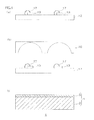
- FIG. 1 shows process drawings for illustrating one embodiment of a method for producing a light emitting diode device of the present invention.
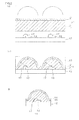
- FIG. 2 shows process drawings for illustrating one embodiment of a method for producing a light emitting diode device of the present invention, subsequent to FIG. 1 .
- FIGS. 1 and 2 In the following, one embodiment of a method for producing a light emitting diode device of the present invention is described with reference to FIGS. 1 and 2 .
- a board 12 mounted with light emitting diodes 13 is prepared.
- the board 12 is formed of, for example, a lead frame prepared by plating copper with silver.
- a wire (not shown) for electrically connecting a terminal (not shown) of the light emitting diode 13 with a terminal (not shown) of a power source for supplying electricity to the light emitting diode 13 is formed.
- An example of the light emitting diode 13 includes a blue light emitting diode (a blue LED) which emits mainly blue light.
- a plurality (in FIGS. 1 and 2 , two pieces are shown) of the light emitting diodes 13 are disposed on the upper surface of the board 12.
- the terminal (not shown) of the light emitting diodes 13 is electrically connected (wire bonded) to the wire which is not shown via wires 17.
- a hemispherical lens molding die 16 is prepared.
- the lens molding die 16 is a molding die prepared by, for example, plating stainless steel with hard chromium.
- the lens molding die 16 includes a plurality (in FIGS. 1 and 2 , two pieces are shown) of dents each of which has a shape corresponding to that of a phosphor cover 14 (described later), that is, hemispherical dents, corresponding to the light emitting diodes 13.
- a light emitting diode encapsulating material 1 is prepared.
- the light emitting diode encapsulating material 1 includes a light emitting diode encapsulating layer 2 and a phosphor layer 3 laminated on the light emitting diode encapsulating layer 2.
- the light emitting diode encapsulating layer 2 is a resin layer which is capable of encapsulating the light emitting diodes 13 and transmitting through light.
- the light emitting diode encapsulating layer 2 is formed from a resin which is a resin capable of transmitting through light and not to be finally cured into a flat plate shape in a generally rectangular shape in plane view.
- Examples of the resin before final curing include a first-step cured material (before curing in the second step) of a two-step curable resin and a thermoplastic material (before thermal curing) of a resin having both thermoplastic properties and thermosetting properties.
- the handling ability of the light emitting diode encapsulating layer 2 is excellent and the final curing of the light emitting diode encapsulating layer 2 can be surely achieved.
- the two-step curable resin is defined as a resin which has a two-step reaction mechanism and in which the resin is brought into a semi-cured state (into a B-stage state) in the first-step reaction and is subjected to a final curing in the second-step reaction.
- the B-stage state is a state between an A-stage state in which a resin is soluble in a solvent and a C-stage state in which a resin is subjected to a final curing. Also, the B-stage state is a state in which the curing and the gelation of the resin are slightly progressed to be swollen but not to be completely dissolved in a solvent and also to be softened but not to be melted by heating.
- Examples of an uncured material (before curing in the first step) of the two-step curable resin include an epoxy resin composition and a silicone resin composition.
- a silicone resin composition is used.
- silicone resin composition includes a condensation reaction and addition reaction type silicone resin composition.
- the condensation reaction and addition reaction type silicone resin composition is a silicone resin composition which can undergo a condensation reaction and an addition reaction (to be specific, a hydrosilylation reaction) by heating.
- the condensation reaction and addition reaction type silicone resin composition is a silicone resin composition which can be brought into a B-stage state (a semi-cured state) by undergoing the condensation reaction by heating and then, be brought into a cured (final cured) state by undergoing the addition reaction (to be specific, for example, the hydrosilylation reaction) by further heating.
- condensation reaction and addition reaction type silicone resin composition examples include a first thermosetting silicone resin composition which contains a polysiloxane containing silanol groups at both ends, an alkenyl group-containing alkoxysilane, and an organohydrogensiloxane; a second thermosetting silicone resin composition which contains a polysiloxane containing silanol groups at both ends, a silicon compound containing an ethylenically unsaturated hydrocarbon group, an epoxy group-containing silicon compound, and an organohydrogensiloxane; a third thermosetting silicone resin composition which contains a first organopolysiloxane having, in one molecule, at least two alkenylsilyl groups, a second organopolysiloxane having, in one molecule, at least two hydrosilyl groups, a hydrosilylation catalyst, and a curing retarder; a fourth thermosetting silicone resin composition which contains a first organopolysiloxane having, in one molecule, both at
- condensation reaction and addition reaction type silicone resin compositions can be used alone or in combination of two or more.
- thermosetting silicone resin composition preferably, a first thermosetting silicone resin composition is used.
- the polysiloxane containing silanol groups at both ends and the alkenyl group-containing alkoxysilane are condensation materials (materials subjected to a condensation reaction) and the alkenyl group-containing alkoxysilane and the organohydrogensiloxane are addition materials (materials subjected to an addition reaction).
- the polysiloxane containing silanol groups at both ends is a silane compound which contains silanol groups (SiOH groups) at both ends of a molecule and to be specific, is represented by the following formula (1).
- R 1 and R 2 are monovalent hydrocarbon groups.
- "n” represents an integer of 2 or more.
- R 1 and R 2 are the same or different from each other.
- R 1 and R 2 are the same.
- An example of the monovalent hydrocarbon group represented by R 1 and R 2 includes a saturated or unsaturated, straight chain, branched chain, or cyclic hydrocarbon group.
- the number of carbon atoms of the hydrocarbon group is, in view of easy preparation or thermal stability, for example, 1 to 20, or preferably 1 to 10.
- examples of the monovalent hydrocarbon group include a saturated aliphatic hydrocarbon group such as methyl, ethyl, propyl, isopropyl, butyl, isobutyl, pentyl, cyclopentyl, hexyl, and cyclohexyl and an aromatic hydrocarbon group such as phenyl and naphthyl.
- a saturated aliphatic hydrocarbon group is used, or more preferably, in view of transparency and light resistance, methyl is used.
- n is preferably, in view of stability and/or handling ability, an integer of 2 to 10000, or more preferably an integer of 2 to 1000.
- examples of the polysiloxane containing silanol groups at both ends include a polydimethylsiloxane containing silanol groups at both ends, a polymethylphenylsiloxane containing silanol groups at both ends, and a polydiphenylsiloxane containing silanol groups at both ends.
- a polydimethylsiloxane containing silanol groups at both ends is used.
- a commercially available product can be used as the polysiloxane containing silanol groups at both ends.
- a polysiloxane containing silanol groups at both ends synthesized in accordance with a known method can be also used.
- polysiloxanes containing silanol groups at both ends can be used alone or in combination of two or more.
- the polysiloxane containing silanol groups at both ends is a mixture of compounds in which "n"s are usually different from each other (that is, the molecular weights are different).
- the number average molecular weight of the polysiloxane containing silanol groups at both ends is, in view of stability and/or handling ability, for example, 100 to 1000000, or preferably 200 to 100000.
- the number average molecular weight is calculated by conversion based on standard polystyrene with a gel permeation chromatography. The number average molecular weight to be described later is also calculated in the same manner as that described above.
- the mixing ratio of the polysiloxane containing silanol groups at both ends with respect to the total amount of the condensation material is, for example, 1 to 99.99 mass %, preferably 50 to 99.9 mass %, or more preferably 80 to 99.5 mass %.
- the alkenyl group-containing alkoxysilane is a silane compound which contains both an alkenyl group and an alkoxy group and to be specific, is an alkenyl group-containing trialkoxysilane represented by the following formula (2).
- R 3 is a straight chain or a cyclic alkenyl group and R 4 is a monovalent hydrocarbon group. R 3 and R 4 are different from each other.
- the number of carbon atoms of the alkenyl group represented by R 3 is, in view of easy preparation or thermal stability, for example, 2 to 20, or preferably 2 to 10.
- examples of the alkenyl group include a straight chain alkenyl group such as a vinyl group, an allyl group, a propenyl group, a butenyl group, a pentenyl group, a hexenyl group, a heptenyl group, and an octenyl group and a cyclic alkenyl group such as a norbornenyl group and a cyclohexenyl group.
- a straight chain alkenyl group is used, or more preferably, in view of reactivity in an addition reaction, a vinyl group is used.
- An example of the monovalent hydrocarbon group represented by R 4 includes the same monovalent hydrocarbon group as that represented by R 1 and R 2 in the above-described formula (1).
- alkenyl group-containing alkoxysilane examples include vinyltrialkoxysilane such as vinyltrimethoxysilane, vinyltriethoxysilane, and vinyltripropoxysilane; allyltrimethoxysilane; propenyltrimethoxysilane; butenyltrimethoxysilane; pentenyltrimethoxysilane; hexenyltrimethoxysilane; heptenyltrimethoxysilane; octenyltrimethoxysilane; norbornenyltrimethoxysilane; and cyclohexenyltrimethoxysilane.
- vinyltrialkoxysilane such as vinyltrimethoxysilane, vinyltriethoxysilane, and vinyltripropoxysilane
- allyltrimethoxysilane propenyltrimethoxysilane
- butenyltrimethoxysilane pentenyltrimethoxys
- vinyltrialkoxysilane is used, or more preferably, vinyltrimethoxysilane is used.
- alkenyl group-containing alkoxysilanes can be used alone or in combination of two or more.
- alkenyl group-containing alkoxysilane A commercially available product can be used as the alkenyl group-containing alkoxysilane.
- An alkenyl group-containing alkoxysilane synthesized in accordance with a known method can be also used.
- the mixing ratio of the alkenyl group-containing trialkoxysilane with respect to the total amount of the condensation material is, for example, 0.01 to 90 mass %, preferably 0.01 to 50 mass %, or more preferably 0.01 to 10 mass %.
- the molar ratio (SiOH/SiOR 4 ) of the silanol group (SiOH group) in the polysiloxane containing silanol groups at both ends to the alkoxysilyl group (SiOR 4 group) in the alkenyl group-containing alkoxysilane is, for example, 20/1 to 0.2/1, preferably 10/1 to 0.5/1, or more preferably substantially 1/1.
- the molar ratio exceeds the above-described range, there may be a case where a product in a B-stage state (a semi-cured product) having an appropriate toughness is not obtained when the silicone resin composition is brought into a B-stage state.
- the molar ratio is below the above-described range, the mixing proportion of the alkenyl group-containing alkoxysilane is excessively large, so that the heat resistance of the resin layer (the light emitting diode encapsulating layer 2) to be obtained may be defective.
- the silanol group (the SiOH group) in the polysiloxane containing silanol groups at both ends and the alkoxysilyl group (the SiOR 4 group) in the alkenyl group-containing alkoxysilane can be subjected to a condensation reaction neither too much nor too little.
- the organohydrogensiloxane is a compound which contains a hydrogen atom directly bonded to a silicon atom in the main chain.
- the organohydrogensiloxane include a hydride compound represented by the following formula (3) and containing a hydrogen atom directly bonded to a silicon atom in the middle (between the both ends) of the main chain or a hydride compound (a polysiloxane containing hydrosilyl groups at both ends) represented by the following formula (4) and containing hydrogen atoms directly bonded to silicon atoms at both ends of the main chain.
- R 6 s are the same or different from each other and represent monovalent hydrocarbon groups.
- "c" represents an integer of 1 or more.
- R 5 in the constituent unit I, R 5 in the constituent unit II, R 5 in the constituent unit III, and R 5 in the constituent unit IV are the same.
- An example of the monovalent hydrocarbon group represented by R 5 includes the same monovalent hydrocarbon group as that represented by the above-described R 1 and R 2 .
- a saturated aliphatic hydrocarbon group is used, more preferably, methyl and ethyl are used, or further preferably, methyl is used.
- the constituent units I and IV are the constituent units of both ends of the structure.
- a in the constituent unit II is the number of repeating units of the constituent unit II and represents, in view of reactivity, preferably an integer of 1 to 1000, or more preferably an integer of 1 to 100.
- "b" in the constituent unit III is the number of repeating units of the constituent unit III and represents, in view of reactivity, preferably an integer of 2 to 10000, or more preferably an integer of 2 to 1000.
- examples of the hydride compound represented by the above-described formula (3) include methylhydrogenpolysiloxane, dimethylpolysiloxane-co-methylhydrogenpolysiloxane, ethylhydrogenpolysiloxane, and methylhydrogenpolysiloxane-co-methylphenylpolysiloxane.
- dimethylpolysiloxane-co-methylhydrogenpolysiloxane is used.
- the hydride compound represented by the above-described formula (3) is a mixture of compounds in which "a” and/or "b" are usually different from each other (that is, the molecular weights are different).
- the number average molecular weight of the hydride compound represented by the above-described formula (3) is, for example, 100 to 1000000.
- R 6 s in the above-described formula (4) are the same. That is, all of the R 6 s bonded to the silicon atoms at both ends and the R 6 s bonded to the silicon atom between both ends are the same.
- An example of the monovalent hydrocarbon group represented by R 6 includes the same monovalent hydrocarbon group as that represented by the above-described R 1 and R 2 Preferably, methyl and ethyl are used.
- "c" represents, in view of reactivity, preferably an integer of 1 to 10000, or more preferably an integer of 1 to 1000.
- examples of the hydride compound represented by the above-described formula (4) include a polydimethylsiloxane containing hydrosilyl groups at both ends, a polymethylphenylsiloxane containing hydrosilyl groups at both ends, and a polydiphenylsiloxane containing hydrosilyl groups at both ends.
- the hydride compound represented by the above-described formula (4) is a mixture of compounds in which "c"s are usually different from each other (that is, the molecular weights are different).
- the number average molecular weight of the hydride compound represented by the above-described formula (4) is, in view of stability and/or handling ability, for example, 100 to 1000000, or preferably 100 to 100000.
- the viscosity of the organohydrogensiloxane at 25°C is, for example, 10 to 100000 mPa ⁇ s, or preferably 15 to 50000 mPa ⁇ s.
- the viscosity is measured with a B-type viscometer.
- organohydrogensiloxane A commercially available product can be used as the organohydrogensiloxane.
- An organohydrogensiloxane synthesized in accordance with a known method can be also used.
- the hydride compound represented by the above-described formula (3) or the hydride compound represented by the above-described formula (4) can be used alone.
- the hydride compound represented by the above-described formula (3) and the hydride compound represented by the above-described formula (4) can be used in combination.
- the organohydrogensiloxane preferably, the hydride compound represented by the above-described formula (3) is used alone.
- the mixing ratio of the organohydrogensiloxane with respect to 100 parts by mass of the alkenyl group-containing alkoxysilane is, though depending on the molar ratio of the alkenyl group (R 3 in the above-described formula (2)) in the alkenyl group-containing alkoxysilane to the hydrosilyl group (the SiH group) in the organohydrogensiloxane, for example, 10 to 10000 parts by mass, or preferably 50 to 1000 parts by mass.
- the molar ratio (R 3 /SiH) of the alkenyl group (R 3 in the above-described formula (2)) in the alkenyl group-containing alkoxysilane to the hydrosilyl group (the SiH group) in the organohydrogensiloxane is, for example, 20/1 to 0.05/1, preferably 20/1 to 0.1/1, more preferably 10/1 to 0.1/1, particularly preferably 5/1 to 0.2/1, or most preferably substantially 1/1.
- the molar ratio exceeds the above-described upper limit (20/1), there may be a case where a semi-cured product having an appropriate toughness is not obtained when the silicone resin composition is brought into a B-stage state.
- the molar ratio is below the above-described lower limit (0.05/1), the mixing proportion of the organohydrogensiloxane is excessively large, so that the heat resistance and the toughness of the resin layer (the light emitting diode encapsulating layer 2) to be obtained may be insufficient.
- the silicone resin composition can be quickly transferred into a B-stage state, compared to the silicone resin composition whose molar ratio is 20/1 to 1/1.
- the catalyst examples include a condensation catalyst (a semi-curing catalyst) and an addition catalyst (a curing catalyst, a hydrosilylation catalyst).
- the condensation catalyst is not particularly limited as long as it is a substance capable of improving the reaction rate of the condensation reaction of the silanol group with the alkoxysilyl group.
- the condensation catalyst include an acid such as hydrochloric acid, acetic acid, formic acid, and sulfuric acid; a base such as potassium hydroxide, sodium hydroxide, potassium carbonate, and tetramethylammonium hydroxide; and a metal catalyst such as aluminum, titanium, zinc, and tin.
- a base is used, or more preferably, tetramethylammonium hydroxide is used.
- the mixing ratio of the condensation catalyst with respect to 100 mol of the polysiloxane containing silanol groups at both ends is, for example, 0.1 to 50 mol, or preferably 0.5 to 5 mol.
- the addition catalyst is not particularly limited as long as it is a substance capable of improving the reaction rate of the addition reaction, that is, the hydrosilylation reaction of the alkenyl group with the SiH.
- the addition catalyst include a metal catalyst such as a platinum catalyst including platinum black, platinum chloride, chloroplatinic acid, a platinum olefin complex, a platinum carbonyl complex, and platinum acetyl acetate; a palladium catalyst; and a rhodium catalyst.
- a platinum catalyst is used, or more preferably, a platinum carbonyl complex is used.
- the mixing ratio of the addition catalyst with respect to 100 parts by mass of the organohydrogensiloxane is, as the number of parts by mass of the metal amount in the addition catalyst, for example, 1.0 ⁇ 10 -4 to 2.0 parts by mass, preferably 1.0 ⁇ 10 -4 to 1.5 parts by mass, or more preferably 1.0 ⁇ 10 -4 to 1.0 parts by mass.
- a catalyst in a solid state can be used as it is.
- a catalyst dissolved or dispersed in a solvent can be used as a solution or a dispersion liquid.
- the solvent examples include water and an alcohol such as methanol, ethanol, 1-propanol, and 2-propanol. Preferably, water is used.
- the above-described materials (the condensation materials and the addition materials) and the catalysts are added simultaneously.
- each of the materials and each of the catalysts can be added, respectively, at different timings.
- a part of the components can be added simultaneously and each of the remaining components can be added, respectively, at different timings.
- the condensation catalyst is added to the condensation materials and next, the addition materials and the addition catalyst are added thereto simultaneously.
- the condensation catalyst is blended into the polysiloxane containing silanol groups at both ends and the alkenyl group-containing alkoxysilane (that is, the condensation materials) at the above-described proportion to be stirred for, for example, 5 minutes to 24 hours.
- the temperature can be also set to be, for example, 0 to 60°C so as to improve the compatibility and the handling ability of the condensation materials.
- a compatibilizing agent for improving the compatibility thereof can be added at an appropriate proportion.
- An example of the compatibilizing agent includes an organic solvent such as an alcohol including methanol, ethanol, 1-propanol, and 2-propanol.
- the organic solvent can serve as the compatibilizing agent.
- the mixing ratio of the compatabilizing agent with respect to 100 parts by mass of the total amount of the polysiloxane containing silanol groups at both ends and the alkenyl group-containing alkoxysilane is, for example, 1 to 20 parts by mass, or preferably 5 to 10 parts by mass.
- the organohydrogensiloxane and the addition catalyst are blended into the obtained mixture of the condensation materials and the condensation catalyst to be stirred for, for example, 1 to 60 minutes.
- the temperature can be also set to be, for example, 0 to 60°C so as to improve the compatibility and the handling ability of the mixture and the organohydrogensiloxane.
- condensation reaction and addition reaction type silicone resin composition can be prepared.
- the two-step curable resin can contain a filler as required.
- the resin By allowing the resin to contain a filler, the curing shrinkage of the resin at the time of curing is reduced, so that an accurate shape and size of a component can be obtained as designed. Furthermore, the heat resistance and the thermal conductivity can be improved.
- filler examples include silicone microparticles, glass, alumina, aluminum hydroxide, silica (fused silica, crystalline silica, ultrafine amorphous silica, hydrophobic ultrafine silica, and the like), talc, clay, and barium sulfate. These fillers can be used alone or in combination of two or more.
- silicone microparticles are used.
- the particle size of the filler is variously selected in accordance with its purpose and use and the maximum particle size thereof is, in view of transparency, for example, 20 ⁇ m or less, or preferably 10 ⁇ m or less.
- the content ratio of the filler with respect to 100 parts by mass of the two-step curable resin is, for example, 1 to 50 parts by mass, or preferably 3 to 30 parts by mass.
- a known additive can be added to the two-step curable resin at an appropriate proportion.
- Examples of the known additive include transmission inhibitors, modifiers, surfactants, dyes, pigments, discoloration inhibitors, and ultraviolet absorbers.
- the above-described uncured material for example, the above-described first thermosetting silicone resin composition or the like
- the first-step curing for example, a condensation reaction
- the heating conditions are the conditions in which the first-step curing (for example, a condensation reaction) is progressed but the second-step curing (for example, an addition reaction (a hydrosilylation reaction)) is not progressed.
- the heating conditions are as follows: a heating temperature of, for example, 40 to 150°C, or preferably 50 to 140°C and a heating duration of, for example, 1 to 60 minutes, or preferably 3 to 30 minutes.
- the light emitting diode encapsulating layer 2 prepared from a first-step cured material (a resin before final curing (for example, a condensation material or the like)) of the two-step curable resin can be obtained.
- thermosetting properties An example of a resin having both thermoplastic properties and thermosetting properties includes a silicone resin having both thermoplastic properties and thermosetting properties.
- the silicone resin composition having both thermoplastic properties and thermosetting properties is obtained by allowing a cage octasilsesquioxane to react with an alkenyl group-containing polysiloxane in the presence of a hydrosilylation catalyst.
- the cage octasilsesquioxane is an octamer of trifunctional silicone monomer and to be specific, has eight groups represented by the following formula (5),
- R 7 represents a monovalent hydrocarbon group
- R 8 represents hydrogen or a monovalent hydrocarbon group.
- the molar ratio of the monovalent hydrocarbon group: hydrogen in R 8 in the cage octasilsesquioxane as a whole is, as an average value, in the range of 6.5:1.5 to 5.5:2.5.
- the cage octasilsesquioxane is represented by the following formula (6).
- R 7 and R 8 are the same as those described above.
- the molar ratio of the monovalent hydrocarbon group: hydrogen in R 8 is the same as that described above.
- an example of the monovalent hydrocarbon group represented by R 7 includes a saturated or unsaturated, straight chain, branched chain, or cyclic hydrocarbon group.
- examples thereof include a saturated straight chain hydrocarbon group (for example, an alkyl group having 1 to 6 carbon atoms such as methyl, ethyl, propyl, butyl, pentyl, and hexyl), a saturated branched chain hydrocarbon group (for example, an alkyl group having 3 to 6 carbon atoms such as isopropyl and isobutyl), a saturated cyclic hydrocarbon group (for example, a cycloalkyl group having 3 to 6 carbon atoms such as cyclohexyl), and an unsaturated cyclic hydrocarbon group (for example, an aryl group having 6 to 8 carbon atoms such as phenyl).
- a saturated straight chain hydrocarbon group for example, an alkyl group having 1 to 6 carbon atoms such as methyl, ethyl, propyl, butyl, pentyl, and hexyl
- a saturated branched chain hydrocarbon group for example, an alkyl group having 3 to
- the number of carbon atoms of the monovalent hydrocarbon group is, for example, 1 to 8, or preferably 1 to 6.
- R 7 s may be the same or different from each other. Preferably, R 7 s are the same.
- a saturated straight chain hydrocarbon group is used, more preferably, an alkyl group having 1 to 6 carbon atoms is used, or particularly preferably, methyl is used.
- an example of the monovalent hydrocarbon group represented by R 8 includes the same monovalent hydrocarbon group as that represented by R 7 described above.
- the molar ratio of the monovalent hydrocarbon group: hydrogen in R 8 in formula (6), in the cage octasilsesquioxane as a whole, is, as an average value, in the range of 6.5:1.5 to 5.5:2.5, or preferably 6.0:2.0 to 5.5:2.5.
- the group represented by the above-described formula (5) forms 1.5 to 2.5 (to be specific, two), or preferably 2 to 2.5 (to be specific, two) of the hydrosilyl groups (-SiH).
- the silicone resin may not show the thermoplastic properties.
- an example of the above-described cage octasilsesquioxane includes a cage octasilsesquioxane having methyl in R 7 and methyl or hydrogen in R 8 in the above-described formulas (5) and (6) and having a molar ratio of methyl: hydrogen in R 8 in the cage octasilsesquioxane as a whole of 5.5:2.5, 6:2, or 6.5:1.5 as an average value.
- the cage octasilsesquioxane represented by the above-described formula (6) is, for example, synthesized in accordance with a known method (for example, in conformity with the description in Japanese Unexamined Patent Publication No. 2007-246880 ).
- tetraalkoxysilane (tetraethoxysilane and the like) is allowed to react with an alcohol such as methanol and/or with water in the presence of a catalyst to synthesize an octa (silsesquioxane) skeleton (a portion in formula (6) excluding the groups of formula (5)) and thereafter, dialkylchlorosilane (dimethylchlorosilane and the like) and trialkylchlorosilane (trimethylchlorosilane and the like) are blended at a mixing proportion corresponding to the above-described molar ratio of the monovalent hydrocarbon group: hydrogen in R 8 .
- an alkoxyl group (ethoxy and the like) bonded to the silicon atom of the octa (silsesquioxane) skeleton is allowed to react with dialkylchlorosilane and trialkylchlorosilane. After the reaction, the product is refined as required. In this way, the cage octasilsesquioxane can be obtained.
- a commercially available product can be also used as the cage octasilsesquioxane.
- the alkenyl group-containing polysiloxane is a polysiloxane containing alkenyl groups.
- the alkenyl group-containing polysiloxane is represented by the following formula (7).
- R 9 represents a monovalent hydrocarbon group and R 10 represents an alkenyl group.
- “d” represents an integer of 1 or more.
- the monovalent hydrocarbon groups represented by R 9 in formula (7) may be the same or different from each other.
- the monovalent hydrocarbon groups represented by R 9 are the same.
- An example of the monovalent hydrocarbon group represented by R 9 includes the same monovalent hydrocarbon group as that represented by R 7 in the above-described formulas (5) and (6).
- methyl is used.
- Examples of the alkenyl group represented by R 10 in formula (7) include a substituted or unsubstituted alkenyl group. Preferably, an unsubstituted alkenyl group is used.
- alkenyl group includes an alkenyl group having 2 to 10 carbon atoms such as vinyl, allyl, propenyl, butenyl, and pentenyl.
- the number of carbon atoms of the alkenyl group is, for example, 2 to 10, or preferably 2 to 5.
- R 10 s may be the same or different from each other. Preferably, R 10 s are the same.
- alkenyl group preferably, in view of reactivity with the hydrosilyl group in the cage octasilsesquioxane, an alkenyl group having 2 to 5 carbon atoms is used, or more preferably, vinyl is used.
- “d” is calculated as the average value in the same manner as “n” in the above-described formula (1) and represents, in view of reactivity and stability, preferably an integer of 1 to 5000, or more preferably an integer of 1 to 1000.
- the number average molecular weight of the alkenyl group-containing polysiloxane represented by the above-described formula (7) is, in view of safety and handling ability, for example, 100 to 10000, or preferably 300 to 5000.
- the alkenyl group-containing polysiloxane represented by the above-described formula (7) is, for example, synthesized in accordance with a known method.
- a commercially available product for example, manufactured by Gelest, Inc.
- Gelest, Inc. can be also used.
- hydrosilylation catalyst examples include a platinum catalyst such as platinum black, platinum chloride, chloroplatinic acid, a platinum olefin complex, a platinum carbonyl complex, and platinum acetyl acetate; a palladium catalyst; and a rhodium catalyst.
- a platinum catalyst such as platinum black, platinum chloride, chloroplatinic acid, a platinum olefin complex, a platinum carbonyl complex, and platinum acetyl acetate
- a palladium catalyst a rhodium catalyst.
- a platinum catalyst is used, or more preferably, a platinum olefin complex is used.
- a platinum-divinylsiloxane complex such as a platinum-1,3-divinyl-1,1,3,3-tetramethyldisiloxane complex is used.
- the hydrosilylation catalyst may be prepared as a solution in a known solvent (such as toluene).
- the mixing ratio of the hydrosilylation catalyst (solid content) with respect to 100 parts by mass of the total amount of the cage octasilsesquioxane and the alkenyl group-containing polysiloxane is, for example, 1.0 ⁇ 10 -10 to 3 parts by mass, or preferably 1.0 ⁇ 10 -8 to 1 parts by mass.
- the cage octasilsesquioxane is allowed to react with the alkenyl group-containing polysiloxane in the presence of the hydrosilylation catalyst so that the number of moles of the hydrosilyl group in the cage octasilsesquioxane is larger (excessive) than that of the alkenyl group in the alkenyl group-containing polysiloxane.
- the molar ratio (the number of moles of the alkenyl group/the number of moles of the hydrosilyl group) of the alkenyl group to the hydrosilyl group is below 1, for example, 0.10 to 0.99, preferably 0.20 to 0.99, or more preferably 0.50 to 0.99.
- the hydrosilyl group is fewer than the alkenyl group. In such a case, the excess of the hydrosilyl group does not remain after the reaction and the thermosetting properties may not be imparted to the silicone resin.
- the solvent examples include an aromatic hydrocarbon such as toluene, an aliphatic hydrocarbon such as hexane, and ester such as ethyl acetate.
- an aromatic hydrocarbon is used, or more preferably, toluene is used.
- the reaction temperature is, for example, 0 to 100°C, or preferably 20 to 80°C and the reaction duration is, for example, 0.5 to 96 hours.
- the degree of the hydrosilylation reaction can be checked by 1 H-NMR measurement based on the intensity of a signal derived from the alkenyl group in the alkenyl group-containing polysiloxane.
- the hydrosilylation reaction is considered to be terminated at the time of disappearance of the signal.
- the cage octasilsesquioxane is allowed to react with the alkenyl group-containing polysiloxane so that the number of moles of the hydrosilyl group is excessive compared with the number of moles of the alkenyl group. Therefore, after the reaction, the excess of the hydrosilyl group remains and the excess of the hydrosilyl group is hydrolyzed with moisture in the air and undergoes a condensation reaction by heating (for example, heating at 100 to 200°C). Then, the excesses of the hydrosilyl group are bonded to each other (three-dimensional cross-linking) and in this way, the thermosetting properties are imparted to the silicone resin.
- the obtained silicone resin is in a solid state.
- the silicone resin in a solid state is obtained because the mobility of the alkenyl group-containing polysiloxane is reduced due to the steric hindrance of the cage octasilsesquioxane.
- a resin having both thermoplastic properties and thermosetting properties can contain a filler and an additive at the above-described proportion as required in the same manner as in the above-described two-step curable resin.
- the resin having both thermoplastic properties and thermosetting properties is disposed in a known release paper or the like and then is plasticized by being heated and retained at the thermoplastic temperature.
- thermoplastic properties is exhibited based on an increase in mobility of the cage octasilsesquioxane and the alkenyl group-containing polysiloxane by heating.
- thermoplastic temperature of the silicone resin having both thermoplastic properties and thermosetting properties is, for example, 40 to 100°C, or preferably 50 to 90°C.
- the thermoplastic temperature is the temperature at which the silicone resin shows the thermoplastic properties, to be specific, is the temperature at which the silicone resin in a solid state is softened by heating to be brought into a completely liquid state, and is substantially the same as the softening temperature.
- the light emitting diode encapsulating layer 2 prepared from a thermoplastic material (a resin before final curing) of the resin having both thermoplastic properties and thermosetting properties can be obtained.
- the thickness of the light emitting diode encapsulating layer 2 obtained in this way is, for example, 50 to 1000 ⁇ m, or preferably 300 to 900 ⁇ m.
- the phosphor layer 3 is formed from a resin before final curing which is capable of emitting fluorescent light and allowing light to transmit therethrough into a flat plate shape in a generally rectangular shape in plane view.
- the phosphor layer 3 is provided so as to emit fluorescent light by absorbing light generated from the light emitting diodes 13.
- examples of the resin before final curing include a first-step cured material of the above-described two-step curable resin and a thermoplastic material (before thermal curing) of the above-described resin having both thermoplastic properties and thermosetting properties.
- the phosphor layer 3 contains a phosphor.
- An example of the phosphor includes a yellow phosphor which is capable of converting blue light into yellow light.
- An example of the phosphor includes a phosphor obtained by doping a metal atom such as cerium (Ce) or europium (Eu) into a composite metal oxide, a metal sulfide, or the like.
- examples of the phosphor include a garnet type phosphor having a garnet type crystal structure such as Y 3 Al 5 O 12 :Ce (YAG (yttrium aluminum garnet):Ce), (Y, Gd) 3 Al 5 O 12 :Ce, Tb 3 Al 3 O 12 :Ce, Ca 3 Sc 2 Si 3 O 12 :Ce, and Lu 2 CaMg 2 (Si, Ge) 3 O 12 :Ce; a silicate phosphor such as (Sr, Ba) 2 SiO 4 :Eu, Ca 3 SiO 4 Cl 2 :Eu, Sr 3 SiO 5 :Eu, Li 2 SrSiO 4 :Eu, and Ca 3 SiO 2 :Eu; an aluminate phosphor such as CaAl 12 O 19 :Mn and SrAl 2 O 4 :Eu; a sulfide phosphor such as ZnS:Cu,Al, CaS:Eu, CaGa 2 S
- the phosphor is in the form of a particle.
- the shape thereof is not particularly limited and examples of the shape thereof include a generally sphere shape, a generally flat plate shape, and a generally needle shape.
- the average particle size (the average of the maximum length) of the phosphor is, for example, 0.1 to 30 ⁇ m, or preferably 0.2 to 20 ⁇ m.
- the average particle size of the phosphor particle is measured with a particle size distribution analyzer.
- the phosphors can be used alone or in combination.
- the fluorescent light can be efficiently emitted from the phosphor layer 3.
- the light emitting diode device 11 a blue light emitting diode or the like is used as the light emitting diode 13.
- the light emitting diode device 11 can serve as, for example, the light emitting diode device 11 which generates white light (a white light emitting diode) by color mixing of light generated from the light emitting diode 13 with light generated from the phosphor.
- the content ratio of the phosphor with respect to 100 parts by mass of the resin before final curing is, for example, 1 to 50 parts by mass, or preferably 3 to 35 parts by mass.
- the above-described phosphor is blended with the resin before final curing to be stirred and mixed.
- the stirring duration is, for example, 0.5 to 2 hours.
- the phosphor layer 3 can contain the above-described filler as required in the same manner as in the above-described light emitting diode encapsulating layer 2.
- silica is used as the filler.
- the particle size of the filler is variously selected in accordance with its purpose and use.
- the maximum particle size of the filler is, in view of transparency, for example, 50 nm or less, or preferably 20 nm or less.
- an example of the filler includes nano-silica (silica in the form of nano-microparticles).
- the content ratio of the filler with respect to 100 parts by mass of the resin before final curing is, for example, 1 to 50 parts by mass, or preferably 3 to 30 parts by mass.
- the phosphor layer 3 can be obtained as a resin before final curing in the same manner as in the light emitting diode encapsulating layer 2.
- the thickness of the phosphor layer 3 is, for example, 40 to 500 ⁇ m, or preferably 50 to 200 ⁇ m.
- the thickness of the phosphor layer 3 with respect to that of the light emitting diode encapsulating layer 2 is, for example, 10 to 40 %.
- the light emitting diode encapsulating material 1 can be obtained by attaching the light emitting diode encapsulating layer 2 to the phosphor layer 3.
- the light emitting diode encapsulating layer 2 and the phosphor layer 3 which are prepared from a resin before final curing are attached to each other and then, are heated at, for example, 100 to 150°C, or preferably 110 to 140°C for, for example, 0.5 to 5 minutes, or preferably 1 to 3 minutes, so that the light emitting diode encapsulating material 1 can be obtained while the state before final curing of the light emitting diode encapsulating layer 2 and the phosphor layer 3 is maintained.
- both of the light emitting diode encapsulating layer 2 and the phosphor layer 3 are a first-step cured material (in a B-stage state) of a two-step curable resin
- the light emitting diode encapsulating layer 2 and the phosphor layer 3 are attached to each other and then, are heated at, for example, 100 to 150°C, or preferably 110 to 140°C for, for example, 0.5 to 5 minutes, or preferably 1 to 3 minutes, so that the light emitting diode encapsulating material 1 can be obtained while the state before curing in the second step of the light emitting diode encapsulating layer 2 and the phosphor layer 3 is maintained.
- both of the light emitting diode encapsulating layer 2 and the phosphor layer 3 are a thermoplastic material (before thermal curing) of a resin having both thermoplastic properties and thermosetting properties
- the light emitting diode encapsulating layer 2 and the phosphor layer 3 are attached to each other and then, are heated at, for example, 100 to 150°C, or preferably 110 to 140°C for, for example, 0.5 to 5 minutes, or preferably 1 to 3 minutes, so that the light emitting diode encapsulating material 1 can be obtained while the state before thermal curing of the light emitting diode encapsulating layer 2 and the phosphor layer 3 is maintained.
- the thickness of the light emitting diode encapsulating material 1 is, for example, 90 to 1500 ⁇ m, or preferably 350 to 1000 ⁇ m.
- the light emitting diodes 13 are encapsulated by the hemispherical light emitting diode encapsulating layer 2; at the same time, the light emitting diode encapsulating material 1 can be formed into a hemispherical shape; and furthermore, the phosphor layer 3 can be disposed on the hemispherical surface of the light emitting diode encapsulating layer 2, so that the light emitting diode device 11 (described later) is capable of being produced easily and accurately with a small number of operating steps.
- the above-described light emitting diode encapsulating material 1 is disposed between the board 12 and the lens molding die 16 so that the phosphor layer 3 is opposed to the lens molding die 16, and as shown in FIG. 2 (e) , compression molding is performed so that the light emitting diode encapsulating material 1 is sandwiched between the board 12 and the lens molding die 16.
- the light emitting diode encapsulating material 1 is disposed on the lens molding die 16 (at the side where dents are formed) and thereafter, the board 12 provided with the light emitting diodes 13 is disposed thereon so that the light emitting diodes 13 are opposed to the light emitting diode encapsulating material 1 to be compressively molded.
- a compression pressure is, for example, 0.1 to 5 MPa, or preferably 0.5 to 3 MPa and a compression duration is, for example, 1 to 15 minutes, or preferably 2 to 10 minutes.
- the light emitting diode encapsulating material 1 is formed so as to follow the lens molding die 16 while being extended by, for example, 20 to 30 ⁇ m.
- the light emitting diodes 13 are directly encapsulated by the hemispherical light emitting diode encapsulating layer 2 and the phosphor layer 3 is disposed on the hemispherical surface of the light emitting diode encapsulating layer 2.
- the light emitting diode encapsulating material 1 is subjected to a heating process, so that the resin before final curing can be subjected to the final curing.
- the heating process usually includes a first step in which a curing is performed to such a degree that the light emitting diode encapsulating layer 2 and the phosphor layer 3 in the light emitting diode encapsulating material 1 are capable of being released, and a second step in which a final curing is performed after being released from the lens molding die 16.
- the heating conditions in the heating process are the conditions in which the light emitting diode encapsulating layer 2 and the phosphor layer 3 prepared from a resin before final curing are subjected to the final curing.
- the heating conditions are as follows: in the first step, for example, a temperature of 120 to 180°C and a duration of 2 to 20 minutes, and in the second step, for example, a temperature of 100 to 180°C and a duration of 30 minutes to 5 hours.
- the heating conditions are the conditions in which a curing in the second step (for example, an addition reaction (a hydrosilylation reaction)) is progressed and to be specific, are the conditions as follows: in the first step, for example, a temperature of 120 to 180°C and a duration of 2 to 20 minutes, and in the second step, for example, a temperature of 100 to 180°C and a duration of 30 minutes to 5 hours.
- the heating conditions are the conditions in which a thermal curing reaction is progressed and to be specific, are the conditions as follows: in the first step, for example, a temperature of 120 to 180°C and a duration of 2 to 20 minutes, and in the second step, for example, a temperature of 100 to 180°C and a duration of 30 minutes to 5 hours.
- the light emitting diode encapsulating material 1 can be cured in a state where the light emitting diode encapsulating layer 2 encapsulates the light emitting diodes 13 and in a shape where the light emitting diode encapsulating material 1 corresponds to the lens molding die 16.
- a light emitting diode encapsulating layer 15 (the light emitting diode encapsulating layer 2 after curing) and the phosphor cover 14 (the phosphor layer 3 after curing) can be formed at the same time.
- the light emitting diode encapsulating material 1, the lens molding die 16, and the light emitting diodes 13 are positioned so that the phosphor layer 3 in the light emitting diode encapsulating material 1 is disposed at a substantially equal distance from the central point of each of the light emitting diodes 13.
- the optical path length from the optical source to the phosphor layer 3 becomes uniform (ref: arrows in FIG. 2 (e) ).
- the phosphor layer 3 is at a substantially equal distance from the central point of each of the light emitting diodes 13.
- the light distribution characteristics can be improved and the light emitting diode device which is capable of widely emitting light can be produced.
- the light emitting diodes 13 are cut into single pieces so that each of the light emitting diodes 13 is individualized. In this way, the light emitting diode device 11 can be obtained.
- the light emitting diodes 13 can be encapsulated by the hemispherical light emitting diode encapsulating layer 2 prepared from the resin before final curing and at the same time, the phosphor layer 3 can be disposed on the hemispherical surface thereof. Therefore, after encapsulating the light emitting diodes 13, a lens or the phosphor cover 14 are not required to be separately disposed, so that the light emitting diode device 11 is capable of being produced easily and accurately with a small number of operating steps.
- silicone microparticles polymethylsilsesquioxane microparticles, trade name: Tospearl 2000B, manufactured by Momentive Performance Materials Inc., an average particle size of 6.0 ⁇ m
- silicone resin composition obtained in ⁇ Preparation of Silicone Resin Composition>.
- the obtained mixture was applied to a release paper and then, was dried at 135°C for 12 minutes, so that a light emitting diode encapsulating layer in a semi-cured state (in a B-stage state) having a thickness of 900 ⁇ m was obtained.
- the obtained mixture was applied to a release paper and then, was dried at 135°C for 3 minutes, so that a phosphor layer prepared from a silicone resin composition in a semi-cured state (in a B-stage state) having a thickness of 100 ⁇ m was obtained.
- the light emitting diode encapsulating layer and the phosphor layer obtained by the description above were attached to each other to be heated at 120°C for 3 minutes, so that a light emitting diode encapsulating material having a thickness of 1000 ⁇ m was obtained.
- the light emitting diode encapsulating layer and the phosphor layer maintained a semi-cured state (a B-stage state):
- FIG. 1 (b) a lens molding die in which 100 pieces of hemispherical dents were formed was prepared (ref: FIG. 1 (b) ), and the light emitting diode encapsulating material (ref: FIG. 1 (c) ) obtained by the description above was disposed between the lens molding die and the board so that the phosphor layer was opposed to the lens molding die (ref: FIG. 2 (d) ).
- the light emitting diode encapsulating material was sandwiched between the board and the lens molding die to be compressively molded at 1.6 MPa and heated at 160°C for 10 minutes (ref: FIG. 2 (e) ). Thereafter, the obtained product was demolded and was heated at 150°C for 3 hours to be completely cured. Then, the resulting product was cut into single pieces, so that 100 pieces of the light emitting diode devices were produced (ref: FIG. 2 (f) ).
- the light emitting diodes were encapsulated by the hemispherical light emitting diode encapsulating layer and at the same time, lenses were molded and the phosphor layer could be integrally molded on the hemispherical surfaces thereof.
- the light emitting diode device was capable of being produced easily and accurately with a small number of operating steps.
- the sectional photographic view of the obtained light emitting diode device is shown in FIG. 3 .
- a light emitting diode encapsulating layer was obtained in the same manner as in Example 1, except that a solution of a silicone elastomer (a dimethylsiloxane skeleton derivative, trade name: LR7556, manufactured by WACKER ASAHIKASEI SILICONE CO., LTD.) was used instead of the silicone resin composition obtained in ⁇ Preparation of Silicone Resin Composition>, and the drying conditions were changed to be 150°C for 10 minutes.
- a silicone elastomer a dimethylsiloxane skeleton derivative, trade name: LR7556, manufactured by WACKER ASAHIKASEI SILICONE CO., LTD.
- a phosphor layer was obtained in the same manner as in Example 1, except that a solution of a silicone elastomer (a dimethylsiloxane skeleton derivative, trade name: LR7556, manufactured by WACKER ASAHIKASEI SILICONE CO., LTD.) was used instead of the silicone resin composition obtained in ⁇ Preparation of Silicone Resin Composition>, and the drying conditions were changed to be 150°C for 10 minutes.
- a silicone elastomer a dimethylsiloxane skeleton derivative, trade name: LR7556, manufactured by WACKER ASAHIKASEI SILICONE CO., LTD.
- a light emitting diode encapsulating material was obtained in the same manner as in Example 1.
- a light emitting diode device was obtained in the same manner as in Example 1.
Landscapes
- Chemical & Material Sciences (AREA)
- Health & Medical Sciences (AREA)
- Chemical Kinetics & Catalysis (AREA)
- Medicinal Chemistry (AREA)
- Polymers & Plastics (AREA)
- Organic Chemistry (AREA)
- Engineering & Computer Science (AREA)
- Mechanical Engineering (AREA)
- Led Device Packages (AREA)
- Compositions Of Macromolecular Compounds (AREA)
- Casting Or Compression Moulding Of Plastics Or The Like (AREA)
Applications Claiming Priority (1)
| Application Number | Priority Date | Filing Date | Title |
|---|---|---|---|
| JP2011284488A JP2013135084A (ja) | 2011-12-26 | 2011-12-26 | 発光ダイオード装置の製造方法 |
Publications (2)
| Publication Number | Publication Date |
|---|---|
| EP2610925A2 true EP2610925A2 (de) | 2013-07-03 |
| EP2610925A3 EP2610925A3 (de) | 2014-12-31 |
Family
ID=47678471
Family Applications (1)
| Application Number | Title | Priority Date | Filing Date |
|---|---|---|---|
| EP12195631.2A Withdrawn EP2610925A3 (de) | 2011-12-26 | 2012-12-05 | Herstellungsverfahren für eine LED-Vorrichtung |
Country Status (6)
| Country | Link |
|---|---|
| US (1) | US8828753B2 (de) |
| EP (1) | EP2610925A3 (de) |
| JP (1) | JP2013135084A (de) |
| KR (1) | KR20130074755A (de) |
| CN (1) | CN103178195A (de) |
| TW (1) | TW201327932A (de) |
Cited By (1)
| Publication number | Priority date | Publication date | Assignee | Title |
|---|---|---|---|---|
| EP3425023A1 (de) * | 2017-05-02 | 2019-01-09 | Samsung Electronics Co., Ltd. | Weisslichtemittierende vorrichtungen |
Families Citing this family (23)
| Publication number | Priority date | Publication date | Assignee | Title |
|---|---|---|---|---|
| JP5767062B2 (ja) * | 2010-09-30 | 2015-08-19 | 日東電工株式会社 | 発光ダイオード封止材、および、発光ダイオード装置の製造方法 |
| DE102011078572B4 (de) * | 2011-07-04 | 2016-06-02 | Osram Gmbh | Beleuchtungsvorrichtung |
| US20130279194A1 (en) * | 2012-04-22 | 2013-10-24 | Liteideas, Llc | Light emitting systems and related methods |
| WO2014171268A1 (ja) * | 2013-04-15 | 2014-10-23 | シャープ株式会社 | オープンリール |
| KR20140124110A (ko) * | 2013-04-16 | 2014-10-24 | 주식회사 포스코엘이디 | 광 반도체 조명장치 |
| WO2015056525A1 (ja) * | 2013-10-18 | 2015-04-23 | シャープ株式会社 | 発光装置 |
| US10204887B2 (en) | 2013-12-18 | 2019-02-12 | Lumileds Llc | Reflective solder mask layer for LED phosphor package |
| KR102323289B1 (ko) * | 2014-01-07 | 2021-11-08 | 루미리즈 홀딩 비.브이. | 인광체 변환기를 갖는 비접착식 발광 디바이스 |
| JP2015133369A (ja) * | 2014-01-10 | 2015-07-23 | アピックヤマダ株式会社 | 光デバイス及び光デバイスの製造方法 |
| JP6215769B2 (ja) * | 2014-05-09 | 2017-10-18 | 信越化学工業株式会社 | ウェハーレベル光半導体デバイス用部材の製造方法、及び光半導体デバイスの製造方法 |
| JP2015216192A (ja) * | 2014-05-09 | 2015-12-03 | 信越化学工業株式会社 | ウェハーレベル光半導体デバイス用部材の製造方法、光半導体デバイスの製造方法、及び光半導体デバイス |
| JP2015216206A (ja) * | 2014-05-09 | 2015-12-03 | 信越化学工業株式会社 | ウェハーレベル光半導体デバイス用部材の製造方法、光半導体デバイスの製造方法、及び光半導体デバイス |
| EP3146263B1 (de) * | 2014-05-21 | 2019-09-25 | Lumileds Holding B.V. | Verfahren zur befestigung einer linse mit einem led-modul mit hoher ausrichtungsgenauigkeit |
| JP2016063228A (ja) * | 2014-09-12 | 2016-04-25 | 日東電工株式会社 | 封止層被覆光半導体素子の製造方法および光半導体装置の製造方法 |
| CN105990496B (zh) * | 2015-03-04 | 2018-11-16 | 光宝光电(常州)有限公司 | Led封装结构及其制造方法 |
| KR101802592B1 (ko) * | 2015-09-02 | 2017-12-29 | 삼성에스디아이 주식회사 | 유기발광소자 봉지용 조성물 및 이로부터 제조된 유기발광소자 표시장치 |
| JP2017181798A (ja) * | 2016-03-30 | 2017-10-05 | アーゼッド・エレクトロニック・マテリアルズ(ルクセンブルグ)ソシエテ・ア・レスポンサビリテ・リミテ | 低温硬化可能なネガ型感光性組成物 |
| US10883045B2 (en) * | 2016-05-02 | 2021-01-05 | Current Lighting Solutions, Llc | Phosphor materials including fluidization materials for light sources |
| CN106098903A (zh) * | 2016-08-03 | 2016-11-09 | 深圳市兆驰节能照明股份有限公司 | 多面出光csp光源及其制造方法 |
| CN106252474A (zh) * | 2016-09-01 | 2016-12-21 | 佛山市国星半导体技术有限公司 | 一种倒装白光led芯片及其制造方法 |
| KR102051484B1 (ko) * | 2019-02-22 | 2019-12-04 | (주)라이타이저 | 발광다이오드 패키지 및 그 제조방법 |
| US12289937B2 (en) * | 2019-02-25 | 2025-04-29 | Osram Opto Semiconductors Gmbh | Controlled wetting in the manufacture of electronic components |
| WO2025242660A1 (en) * | 2024-05-23 | 2025-11-27 | Ams-Osram International Gmbh | Converter element laminate, method for fixing a converter element on a radiation emitting semiconductor chip, and radiation emitting device |
Citations (2)
| Publication number | Priority date | Publication date | Assignee | Title |
|---|---|---|---|---|
| JP2007227677A (ja) | 2006-02-23 | 2007-09-06 | Matsushita Electric Works Ltd | 発光装置の製造方法 |
| JP2007246880A (ja) | 2006-02-20 | 2007-09-27 | Matsushita Electric Works Ltd | 半導体光装置及び透明光学部材 |
Family Cites Families (12)
| Publication number | Priority date | Publication date | Assignee | Title |
|---|---|---|---|---|
| US6922024B2 (en) * | 2002-11-25 | 2005-07-26 | Matsushita Electric Industrial Co., Ltd. | LED lamp |
| JP5109226B2 (ja) * | 2005-01-20 | 2012-12-26 | 豊田合成株式会社 | 発光装置 |
| JP5666775B2 (ja) * | 2006-07-21 | 2015-02-12 | 株式会社カネカ | ポリシロキサン系組成物およびそれから得られる成形体、オプトデバイス部材 |
| KR100755612B1 (ko) * | 2006-09-21 | 2007-09-06 | 삼성전기주식회사 | Led 패키지 제조방법 및 백색 광원 모듈 제조방법 |
| DE102007049799A1 (de) * | 2007-09-28 | 2009-04-02 | Osram Opto Semiconductors Gmbh | Optoelektronisches Bauelement |
| JP5190993B2 (ja) * | 2008-11-20 | 2013-04-24 | 日東電工株式会社 | 光半導体封止用シート |
| JP5107886B2 (ja) * | 2008-12-24 | 2012-12-26 | 日東電工株式会社 | 光半導体装置の製造方法 |
| US20100181582A1 (en) * | 2009-01-22 | 2010-07-22 | Intematix Corporation | Light emitting devices with phosphor wavelength conversion and methods of manufacture thereof |
| US8168998B2 (en) * | 2009-06-09 | 2012-05-01 | Koninklijke Philips Electronics N.V. | LED with remote phosphor layer and reflective submount |
| US20110031516A1 (en) * | 2009-08-07 | 2011-02-10 | Koninklijke Philips Electronics N.V. | Led with silicone layer and laminated remote phosphor layer |
| JP5744386B2 (ja) * | 2009-10-07 | 2015-07-08 | 日東電工株式会社 | 光半導体封止材 |
| JP5738541B2 (ja) * | 2010-04-21 | 2015-06-24 | 日東電工株式会社 | 光半導体装置 |
-
2011
- 2011-12-26 JP JP2011284488A patent/JP2013135084A/ja active Pending
-
2012
- 2012-12-05 EP EP12195631.2A patent/EP2610925A3/de not_active Withdrawn
- 2012-12-11 US US13/711,159 patent/US8828753B2/en not_active Expired - Fee Related
- 2012-12-20 TW TW101148842A patent/TW201327932A/zh unknown
- 2012-12-24 KR KR1020120151658A patent/KR20130074755A/ko not_active Withdrawn
- 2012-12-26 CN CN2012105768742A patent/CN103178195A/zh active Pending
Patent Citations (2)
| Publication number | Priority date | Publication date | Assignee | Title |
|---|---|---|---|---|
| JP2007246880A (ja) | 2006-02-20 | 2007-09-27 | Matsushita Electric Works Ltd | 半導体光装置及び透明光学部材 |
| JP2007227677A (ja) | 2006-02-23 | 2007-09-06 | Matsushita Electric Works Ltd | 発光装置の製造方法 |
Cited By (2)
| Publication number | Priority date | Publication date | Assignee | Title |
|---|---|---|---|---|
| EP3425023A1 (de) * | 2017-05-02 | 2019-01-09 | Samsung Electronics Co., Ltd. | Weisslichtemittierende vorrichtungen |
| US10312419B2 (en) | 2017-05-02 | 2019-06-04 | Samsung Electronics Co., Ltd. | White light emitting devices |
Also Published As
| Publication number | Publication date |
|---|---|
| KR20130074755A (ko) | 2013-07-04 |
| CN103178195A (zh) | 2013-06-26 |
| JP2013135084A (ja) | 2013-07-08 |
| US20130164869A1 (en) | 2013-06-27 |
| EP2610925A3 (de) | 2014-12-31 |
| TW201327932A (zh) | 2013-07-01 |
| US8828753B2 (en) | 2014-09-09 |
Similar Documents
| Publication | Publication Date | Title |
|---|---|---|
| US8828753B2 (en) | Producing method of light emitting diode device | |
| US20120083056A1 (en) | Light emitting diode sealing member and method for producing light emitting diode device | |
| US8937329B2 (en) | Encapsulating sheet, light emitting diode device, and producing method thereof | |
| US8956007B2 (en) | Encapsulating sheet, producing method thereof, light emitting diode device, and producing method thereof | |
| US9246063B2 (en) | Phosphor encapsulating sheet, light emitting diode device, and producing method thereof | |
| EP2958961B1 (de) | Härtbare silikonzusammensetzung, gehärtetes produkt daraus und optisches halbleiterbauelement | |
| US8519422B2 (en) | Encapsulating sheet and optical semiconductor element device | |
| US8933158B2 (en) | Thermosetting silicone resin composition for reflector of LED, reflector for LED using the same and optical semiconductor apparatus | |
| JP5775375B2 (ja) | 発光ダイオード装置の製造方法 | |
| US9349927B2 (en) | Encapsulating sheet and optical semiconductor element device | |
| EP2509122A2 (de) | Verkapselungsblatt, lichtemittierende Diodenvorrichtung und Verfahren zu ihrer Herstellung | |
| US9153755B2 (en) | Silicone resin sheet, cured sheet, and light emitting diode device and producing method thereof | |
| EP2750209A2 (de) | Verkapselungsfolie | |
| EP2554600A2 (de) | Silikonharzzusammensetzung, Verkapselungsmaterial und lichtemittierende Diodenvorrichtung | |
| EP2750210A2 (de) | Verkapselungsfolie |
Legal Events
| Date | Code | Title | Description |
|---|---|---|---|
| PUAI | Public reference made under article 153(3) epc to a published international application that has entered the european phase |
Free format text: ORIGINAL CODE: 0009012 |
|
| AK | Designated contracting states |
Kind code of ref document: A2 Designated state(s): AL AT BE BG CH CY CZ DE DK EE ES FI FR GB GR HR HU IE IS IT LI LT LU LV MC MK MT NL NO PL PT RO RS SE SI SK SM TR |
|
| AX | Request for extension of the european patent |
Extension state: BA ME |
|
| PUAL | Search report despatched |
Free format text: ORIGINAL CODE: 0009013 |
|
| AK | Designated contracting states |
Kind code of ref document: A3 Designated state(s): AL AT BE BG CH CY CZ DE DK EE ES FI FR GB GR HR HU IE IS IT LI LT LU LV MC MK MT NL NO PL PT RO RS SE SI SK SM TR |
|
| AX | Request for extension of the european patent |
Extension state: BA ME |
|
| RIC1 | Information provided on ipc code assigned before grant |
Ipc: H01L 33/52 20100101ALI20141126BHEP Ipc: C09J 183/10 20060101ALN20141126BHEP Ipc: C09D 183/10 20060101ALN20141126BHEP Ipc: H01L 33/00 20100101AFI20141126BHEP Ipc: H01L 33/50 20100101ALN20141126BHEP Ipc: B29C 43/18 20060101ALN20141126BHEP |
|
| STAA | Information on the status of an ep patent application or granted ep patent |
Free format text: STATUS: THE APPLICATION IS DEEMED TO BE WITHDRAWN |
|
| 18D | Application deemed to be withdrawn |
Effective date: 20150701 |