EP2611183A2 - Procédé de visualisation de sorties d'affichage virtuel - Google Patents
Procédé de visualisation de sorties d'affichage virtuel Download PDFInfo
- Publication number
- EP2611183A2 EP2611183A2 EP20120198744 EP12198744A EP2611183A2 EP 2611183 A2 EP2611183 A2 EP 2611183A2 EP 20120198744 EP20120198744 EP 20120198744 EP 12198744 A EP12198744 A EP 12198744A EP 2611183 A2 EP2611183 A2 EP 2611183A2
- Authority
- EP
- European Patent Office
- Prior art keywords
- display
- light output
- simulated light
- model
- viewing environment
- Prior art date
- Legal status (The legal status is an assumption and is not a legal conclusion. Google has not performed a legal analysis and makes no representation as to the accuracy of the status listed.)
- Ceased
Links
Images


Classifications
-
- H—ELECTRICITY
- H04—ELECTRIC COMMUNICATION TECHNIQUE
- H04N—PICTORIAL COMMUNICATION, e.g. TELEVISION
- H04N17/00—Diagnosis, testing or measuring for television systems or their details
- H04N17/02—Diagnosis, testing or measuring for television systems or their details for colour television signals
-
- H—ELECTRICITY
- H04—ELECTRIC COMMUNICATION TECHNIQUE
- H04N—PICTORIAL COMMUNICATION, e.g. TELEVISION
- H04N17/00—Diagnosis, testing or measuring for television systems or their details
- H04N17/04—Diagnosis, testing or measuring for television systems or their details for receivers
-
- H—ELECTRICITY
- H04—ELECTRIC COMMUNICATION TECHNIQUE
- H04N—PICTORIAL COMMUNICATION, e.g. TELEVISION
- H04N9/00—Details of colour television systems
- H04N9/64—Circuits for processing colour signals
- H04N9/67—Circuits for processing colour signals for matrixing
-
- H—ELECTRICITY
- H04—ELECTRIC COMMUNICATION TECHNIQUE
- H04N—PICTORIAL COMMUNICATION, e.g. TELEVISION
- H04N9/00—Details of colour television systems
- H04N9/64—Circuits for processing colour signals
- H04N9/68—Circuits for processing colour signals for controlling the amplitude of colour signals, e.g. automatic chroma control circuits
-
- H—ELECTRICITY
- H04—ELECTRIC COMMUNICATION TECHNIQUE
- H04N—PICTORIAL COMMUNICATION, e.g. TELEVISION
- H04N9/00—Details of colour television systems
- H04N9/64—Circuits for processing colour signals
- H04N9/74—Circuits for processing colour signals for obtaining special effects
Definitions
- This disclosure is directed toward to video systems, and, more particularly, to a system and method that accurately displays images on a target device.
- the video is rendered on the display that is used in conjunction with the quality analyzer.
- display manufacturers have an unmet need to be able to automatically evaluate virtual designs, before a product is built. However, without being able to directly see the differences among display design options, much useful information is hidden from the display engineers.
- white point calibration is often intentionally set to a non-default value.
- a computer monitor typically set at 9500° default color temperature may instead have its white point set to 6500° to match a television default color temperature.
- This white point calibration allows a display with one set of primaries to come close to looking like a display with another set of primaries.
- such conversion is not included in the color conversion formulae mentioned above, and does so by shifting colors in a way that many colors in the gamut are lost.
- Embodiments of the invention address this and other limitations of the prior art.
- a system using reverse modeling of a target display type converts simulated light output into a signal that, when rendered on the target display, produces a perceptual response equivalent or nearly equivalent to that of the original simulated light. Further, methods are provided that can adapt to a given available display so that when rendered on the available display, the perceived image closely represents the perceived image of the simulated light or a virtual image.
- Particular embodiments of the invention are directed to methods for viewing a simulated light output generated for a selected display type on a second display.
- the method includes first generating the simulated light output based on qualities of the first display type. Next the simulated light output is compensated for viewing environment of the second display in real-time. After the compensation is complete, the simulated light output that has been compensated is output for the second display.
- Fig. 1 is a functional block diagram of a system for generating a compensated video output according to embodiments of the invention.
- Fig. 2 is a series of equations for calculating weights for white balance calculation used in embodiments of the invention.
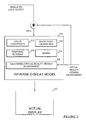
- Fig. 3 is a functional block diagram of a system for viewing virtual display outputs according to embodiments of the invention.
- Fig. 1 is a functional block diagram of a system 10 for generating a compensated video output according to embodiments of the invention.
- An image source such as a video, virtual-reality images, or other images is provided to a display model that includes modeling information specific for selected types of displays.
- a display model selector 70 may select, for instance, an LCD display model 30, CRT display model 40, DMD (Digital Micromirror Device) display model 50, or other display model 60. Also, the display model selector 70 may bypass the display model selection completely by choosing the bypass mode 20.
- Display models 30-60 include various data, such as color data, white balance, gamma information, etc., about a particular type of display. Display models may include translations from one particular color space to another, with particular parameters specific to the particular display model type.
- digital video streams and files commonly use YCbCr tristimulus representation as per ITU-R BT.601 for standard definition video and ITU-R BT.709 for high definition video, or in some cases RGB.
- direct XYZ representation is already directly supported as per the DCI (Digital Cinema Initiatives) "Digital Cinema System Specification,” commonly referred to as the "DCI Specification.”
- a standard such as according to 601, 709, SMPTE-C, EBU or whatever best represents the appropriate display to be simulated
- each display model technology has a unique initialization function for such things as creating look-up tables, setting filter parameters (for LCD), etc. It is within these functions that the following color model initialization takes place.
- Initialization of the color model includes the initialization of white point calibration weights ⁇ wr,wg,wb ⁇ along with any required look-up tables.
- Converting color data from YCbCr to XYZ may be performed directly using general computation circuitry or equivalent functions. For instance, first, a conversion of YCbCr to ER,EG,EB, according to standards, would use 9 multiplys and 6 adds. Applying a gamma factor to the result then uses 3 exponentials. Applying weights to create a white point may take a further 3 multiplys. Finally, a conversion of RGB light to XYZ (RGB Vector * matrix) takes another 9 multiplys and 5 adds, for a total of 18 8 multiplies, 12 adds, and 3 exponentials.
- LUT Look Up Table
- Embodiments of the invention may use any method for color conversion, of course, and the choice of which method to use is typically an implementation choice.
- a direct YCbCr to XYZ conversion may be performed by the use of a LUT, the size of which depending on bit depth. For example, for 8 bit video depth, the number of memory locations for the LUT would be on the order of 6.7 x 10 7 bits, which is a practical implementation given present day storage costs. 10 bit video depth and 12 bit video depth would require LUT sizes on the order of 4.3 x 10 9 bits, and 2.7 x 10 11 bits, which is currently not practical for typical implementations.
- the color conversion is made from YCbCr to RGB (light), because temporal processing for LCDs, as described below, occurs in RGB light space.
- the size of a LUT for LCD processing is the same as for CRTs and DMDs at the same bit depths.
- YCbCr is converted to ER,EG,EB according to the corresponding colorimetry standard (601, 709, etc.)
- the value of normalized (to unity) ER, EG, and EB values are converted to normalized (to unity) RGB light values using gamma, contrast and brightness controls, effectively reusing a luminance model already existing in quality analyzers by applying it to each primary color channel.
- the subsequent RGB to XYZ light conversion takes into account the actual luminance levels of each.
- White is represented as equal "electrical signal" amplitudes of R,G and B.
- white point calibration is usually performed.
- white point calibration weights R,G and/or B light output such that the amplitudes are altered in order to achieve the white point.
- limits here normalized to 1 of max and min R, G and B, find the relative ratios of RGB such that the given white point is achieved. Calculation of the weights ⁇ wr,wg,wb ⁇ may be performed as illustrated in Fig. 2 .
- RGB and White CIE 1931 xyY coordinates given either by:
- the XYZ output of the display model should be equal to XwTarget, YwTarget and ZwTarget respectively.
- Y values for R,G,B and W depend on the 1) choice of gamma, 2) maximum luminance value and 3) the light R,G,B to Y conversion.
- the first two parameters are already included in the already existing luminance only display models in quality analyzers.
- the third set of 3 weights for R,G and B respectively will generally be calculated from the coordinates of the primaries and white point along with the first two parameters.
- the RGB to Y conversion is also defined within many standards (i.e. ITU.B-709 HD) via the matrix to convert RGB to XYZ. Including explicit values from each standard, such as ITU.B-709 HD, SMPTE-C, EBU, NTSC, and SMPTE-240M would be redundant, since direct calculation gives the same results for Y, as described below.
- the most general display model of LCD technology includes temporal filtering to represent the "zero order hold" aspect of constant or high duty cycle backlighting, or reflected light during the time between frame transitions.
- a temporal filter is applied to the simulated light output for the luminance only model (applied to Y).
- this filter is instead applied to RGB (light primaries) outputs prior to conversion to XYZ.
- Advanced LCD configuration includes the use of modulated backlight.
- Modem LCD displays include backlight modulation to mitigate the motion blur problem associated with even theoretical 0 response time technology.
- the temporal filtering would be modified accordingly:
- parameters such as the duty cycle and phase of the backlight on-off and off-on transitions are received as display specifications.
- the temporal filter is updated accordingly, with the simulated results tracking the real results of greatly mitigated motion blur.
- the temporal filter may be eliminated since the integration in the human eye (accounted for in the human vision model) will sufficiently attenuate remaining high frequency information.
- a calculation of initialization of matrix M_RGBlight2XYZ is initialized during the display initialization as follows:
- an optional view model or virtual reality viewing environment 80 may add a factor to the output of the selected display model type to more accurately reflect the viewing environment of the display. For example, information about the ambient light, reflected light, or other simulated light may be added linearly to the XYZ representation of the display, using a CIE XYZ representation of the added light information. This view model information is used to modify the predicted picture/video quality rating.
- any virtual environment aspect may also be similarly included in the view model, also by using the CIE XYZ representation of such added information.
- Such information may include relatively basic information, for example, information about the display bezel of the display device, or may be as complex as a detailed virtual reality rendering.
- Fig. 3 is a functional block diagram of a system for viewing simulated or virtual display outputs according to embodiments of the invention, providing additional detail about the reverse display model 90 of Fig. 1 .
- a reverse display model 310 of Fig. 3 may be an example embodiment of the reverse display model 90 of Fig. 1 .
- the reverse display model 310 includes facilities for color conversion 312, white point calibration 314, gamma 316, temporal filtering 318, and a view model 320.
- the components of the reverse display model 310 of Fig. 3 are similar or identical to their counterpart components in the (forward) display models described above.
- the various factors included within components or sections of the reverse display model 310 may be pre-stored within the display model.
- the particular factors specific to the actual display 340 may be selected, for example as a menu choice on the system.
- the actual display 340 may identify itself to the system, and a look-up performed to select the appropriate factors for the reverse display model 310.
- the reverse display model 310 in contrast to the standard display models 30-60 of Figure 1 , operates in "reverse.”
- conversion to standard video representation (which can include XYZ representation) for the actual display 340 is performed.
- standard video representation which can include XYZ representation
- the inverse of XYZ to RGB light using the primaries of the actual display to be used
- inverse gamma function may be performed from respectively inverting the matrices and functions described above.
- a simulated light output is generated, for instance, from video, imaging, or virtual reality, it is optionally passed through a display model for a particular selected display type.
- the simulated output is then passed to a reverse display model for an actual display, the reverse display model including a compensator for adapting the simulated output to the actual display, so the image viewed on the actual display is as close as possible to the perceived image represented by the virtual or simulated light.
- the compensations may include display primary (color) compensation and equivalent gamma compensation, white point calibration, temporal characteristics, and viewing environment of the actual display.
- the viewing environment may include color and brightness of surroundings and ambient light, and may also include a generated virtual reality viewing environment that includes other images.
- the compensations change in real time as the simulated light output, actual display viewing environment, and virtual reality environment changes.
- the actual display 340 used for viewing has sufficient if not superior color gamut, maximum luminance, response time, contrast (black level), and other specifications to accurately render the input image.
- the viewing conditions will also allow for accurate perception of the rendered image.
- the ambient light will be sufficiently low as to not raise the effective black level or move the perceived white point (chromatic shift) beyond target accuracy.
- components of the invention may be implemented in hardware, software, or a combination of the two, and may comprise a general purpose microprocessor, a digital signal processor (DSP), an application specific integrated circuit (ASIC), a field-programmable gate array (FPGA), or the like.
- DSP digital signal processor
- ASIC application specific integrated circuit
- FPGA field-programmable gate array
Landscapes
- Engineering & Computer Science (AREA)
- Multimedia (AREA)
- Signal Processing (AREA)
- Health & Medical Sciences (AREA)
- Biomedical Technology (AREA)
- General Health & Medical Sciences (AREA)
- Processing Of Color Television Signals (AREA)
- Controls And Circuits For Display Device (AREA)
Applications Claiming Priority (1)
| Application Number | Priority Date | Filing Date | Title |
|---|---|---|---|
| US13/340,517 US9013502B2 (en) | 2011-12-29 | 2011-12-29 | Method of viewing virtual display outputs |
Publications (2)
| Publication Number | Publication Date |
|---|---|
| EP2611183A2 true EP2611183A2 (fr) | 2013-07-03 |
| EP2611183A3 EP2611183A3 (fr) | 2014-02-19 |
Family
ID=47720241
Family Applications (1)
| Application Number | Title | Priority Date | Filing Date |
|---|---|---|---|
| EP20120198744 Ceased EP2611183A3 (fr) | 2011-12-29 | 2012-12-20 | Procédé de visualisation de sorties d'affichage virtuel |
Country Status (4)
| Country | Link |
|---|---|
| US (1) | US9013502B2 (fr) |
| EP (1) | EP2611183A3 (fr) |
| JP (1) | JP6351202B2 (fr) |
| CN (1) | CN103383830B (fr) |
Families Citing this family (8)
| Publication number | Priority date | Publication date | Assignee | Title |
|---|---|---|---|---|
| WO2014017388A1 (fr) * | 2012-07-25 | 2014-01-30 | シャープ株式会社 | Dispositif d'affichage et procédé d'affichage |
| CN104240674B (zh) * | 2013-06-14 | 2016-10-05 | 联想(北京)有限公司 | 一种调节显示单元的方法及一种电子设备 |
| WO2014069349A1 (fr) * | 2012-11-02 | 2014-05-08 | シャープ株式会社 | Dispositif d'affichage et procédé d'affichage |
| JP2015108796A (ja) * | 2013-10-22 | 2015-06-11 | キヤノン株式会社 | 画像表示システム、画像表示システムの制御方法、画像表示装置、画像表示装置の制御方法 |
| JP2015121954A (ja) * | 2013-12-24 | 2015-07-02 | 株式会社デンソー | 輝度値算出装置及び車線検出システム |
| KR102061233B1 (ko) | 2014-01-20 | 2020-01-02 | 삼성디스플레이 주식회사 | 표시 장치 및 집적 회로 칩 |
| US10345768B2 (en) * | 2014-09-29 | 2019-07-09 | Microsoft Technology Licensing, Llc | Environmental control via wearable computing system |
| US10121419B2 (en) * | 2015-11-13 | 2018-11-06 | Google Llc | Head mounted display device with rapid gamma correction between display panels |
Citations (3)
| Publication number | Priority date | Publication date | Assignee | Title |
|---|---|---|---|---|
| EP0700218A2 (fr) * | 1994-08-04 | 1996-03-06 | Lg Electronics Inc. | Système et procédé de compensation d'image pour applications vidéo |
| EP1189457A2 (fr) * | 2000-09-13 | 2002-03-20 | Seiko Epson Corporation | Méthode de génération de courbe de correction, méthode de traitement d'image, unité d'affichage d'image et moyen de mémorisation |
| EP1914980A1 (fr) * | 2006-10-17 | 2008-04-23 | Samsung Electronics Co., Ltd. | Appareil et procédé pour améliorer la visibilité d'une image |
Family Cites Families (13)
| Publication number | Priority date | Publication date | Assignee | Title |
|---|---|---|---|---|
| JPH1132228A (ja) * | 1997-02-21 | 1999-02-02 | Sony Corp | 送信装置、送信方法、受信装置、受信方法、画像処理システム、画像処理方法、画像データ処理装置、画像データ処理方法、並びに提供媒体 |
| JP3658141B2 (ja) * | 1997-05-21 | 2005-06-08 | キヤノン株式会社 | 画像処理装置及び画像処理方法 |
| US6847374B2 (en) * | 2000-07-31 | 2005-01-25 | Seiko Epson Corporation | Environment-compliant image display system and program |
| DE60110399T2 (de) * | 2000-08-28 | 2006-01-19 | Seiko Epson Corp. | Sich an die umgebung anpassendes anzeigesystem, bildverarbeitungsverfahren und bildspeichermedium |
| JP3876650B2 (ja) * | 2001-06-06 | 2007-02-07 | 日本電気株式会社 | 色補正パラメータ算出装置、画像色補正装置及びそれに用いる色補正パラメータ算出方法並びにそのプログラム |
| US7487118B2 (en) | 2005-05-06 | 2009-02-03 | Crutchfield Corporation | System and method of image display simulation |
| US7593017B2 (en) | 2006-08-15 | 2009-09-22 | 3M Innovative Properties Company | Display simulator |
| JP2008085980A (ja) * | 2006-08-31 | 2008-04-10 | Sony Corp | 色変換装置、エミュレーション方法、三次元ルックアップテーブルの生成方法、画像処理装置 |
| TWI394121B (zh) * | 2006-12-18 | 2013-04-21 | Sony Corp | An image processing apparatus, an image processing method, and a recording medium |
| JP2008178075A (ja) | 2006-12-18 | 2008-07-31 | Sony Corp | 表示制御装置、表示制御方法、及びプログラム |
| WO2011028626A2 (fr) * | 2009-09-01 | 2011-03-10 | Entertainment Experience Llc | Procédé permettant de produire une image couleur et dispositif d'imagerie mettant en oeuvre ledit procédé |
| US20110273451A1 (en) * | 2010-05-10 | 2011-11-10 | Salemann Leo J | Computer simulation of visual images using 2d spherical images extracted from 3d data |
| US9153200B2 (en) * | 2011-05-13 | 2015-10-06 | Samsung Display Co., Ltd. | Method for selecting backlight color values |
-
2011
- 2011-12-29 US US13/340,517 patent/US9013502B2/en active Active
-
2012
- 2012-12-20 EP EP20120198744 patent/EP2611183A3/fr not_active Ceased
- 2012-12-28 CN CN201210597131.3A patent/CN103383830B/zh not_active Expired - Fee Related
- 2012-12-28 JP JP2012288303A patent/JP6351202B2/ja not_active Expired - Fee Related
Patent Citations (3)
| Publication number | Priority date | Publication date | Assignee | Title |
|---|---|---|---|---|
| EP0700218A2 (fr) * | 1994-08-04 | 1996-03-06 | Lg Electronics Inc. | Système et procédé de compensation d'image pour applications vidéo |
| EP1189457A2 (fr) * | 2000-09-13 | 2002-03-20 | Seiko Epson Corporation | Méthode de génération de courbe de correction, méthode de traitement d'image, unité d'affichage d'image et moyen de mémorisation |
| EP1914980A1 (fr) * | 2006-10-17 | 2008-04-23 | Samsung Electronics Co., Ltd. | Appareil et procédé pour améliorer la visibilité d'une image |
Also Published As
| Publication number | Publication date |
|---|---|
| US9013502B2 (en) | 2015-04-21 |
| JP2013141239A (ja) | 2013-07-18 |
| EP2611183A3 (fr) | 2014-02-19 |
| JP6351202B2 (ja) | 2018-07-04 |
| US20130169826A1 (en) | 2013-07-04 |
| CN103383830A (zh) | 2013-11-06 |
| CN103383830B (zh) | 2017-04-12 |
Similar Documents
| Publication | Publication Date | Title |
|---|---|---|
| US9013502B2 (en) | Method of viewing virtual display outputs | |
| JP3719411B2 (ja) | 画像表示システム、プロジェクタ、プログラム、情報記憶媒体および画像処理方法 | |
| KR100710302B1 (ko) | 디스플레이 장치의 색보정 장치 및 방법 | |
| CN102063888B (zh) | 色彩管理方法及装置 | |
| US8098932B2 (en) | Color correction method and apparatus of display apparatus | |
| US20110305391A1 (en) | Image Processing and Displaying Methods for Devices that Implement Color Appearance Models | |
| US8411936B2 (en) | Apparatus and method for color reproduction | |
| CN101171848A (zh) | 色彩变换亮度校正方法和设备 | |
| EP2200268B1 (fr) | Procédé d'étalonnage d'un dispositif cible de reproduction couleur | |
| US20110148907A1 (en) | Method and system for image display with uniformity compensation | |
| CN101188096A (zh) | 一种液晶显示器的色域映射算法和颜色管理系统 | |
| US9111477B2 (en) | Language-based color calibration of displays | |
| CA2661650C (fr) | Moniteur video assurant des fonctions d'affichage de courbes de signaux parametriques, et methodes connexes | |
| US20080095430A1 (en) | Maintenance of Color Maximum Values in a Color Saturation Controlled Color Image | |
| US20060071937A1 (en) | Color characterization of projectors | |
| JP2005196156A (ja) | カラー画像表示装置、色変換装置、色彩シミュレーション装置及びそれらの方法 | |
| Nezamabadi et al. | Effect of image size on the color appearance of image reproductions using colorimetrically calibrated LCD and DLP displays | |
| Kim | Optically adjustable display color gamut in time-sequential displays using LED/Laser light sources | |
| Cho et al. | Inverse characterization method of alternate gain-offset-gamma model for accurate color reproduction in display device | |
| KR100827128B1 (ko) | 휴대 영상 장치의 영상 구현 방법 | |
| JP2006033881A (ja) | 画像表示装置、画像処理方法およびプログラム | |
| US12056913B2 (en) | System for luminance qualified chromaticity | |
| Park et al. | Color Reproduction Using “Black-Point Adaptation” | |
| Koch et al. | Spatial Color Confidence for Physically based Rendering Settings on LC Displays. | |
| Becker | 50‐3: Electro‐Optical Transfer Characteristic, the Undervalued Display Feature |
Legal Events
| Date | Code | Title | Description |
|---|---|---|---|
| PUAI | Public reference made under article 153(3) epc to a published international application that has entered the european phase |
Free format text: ORIGINAL CODE: 0009012 |
|
| AK | Designated contracting states |
Kind code of ref document: A2 Designated state(s): AL AT BE BG CH CY CZ DE DK EE ES FI FR GB GR HR HU IE IS IT LI LT LU LV MC MK MT NL NO PL PT RO RS SE SI SK SM TR |
|
| AX | Request for extension of the european patent |
Extension state: BA ME |
|
| PUAL | Search report despatched |
Free format text: ORIGINAL CODE: 0009013 |
|
| AK | Designated contracting states |
Kind code of ref document: A3 Designated state(s): AL AT BE BG CH CY CZ DE DK EE ES FI FR GB GR HR HU IE IS IT LI LT LU LV MC MK MT NL NO PL PT RO RS SE SI SK SM TR |
|
| AX | Request for extension of the european patent |
Extension state: BA ME |
|
| RIC1 | Information provided on ipc code assigned before grant |
Ipc: H04N 9/68 20060101ALI20140114BHEP Ipc: H04N 13/04 20060101AFI20140114BHEP Ipc: H04N 17/04 20060101ALI20140114BHEP Ipc: H04N 9/74 20060101ALI20140114BHEP Ipc: H04N 1/60 20060101ALI20140114BHEP Ipc: H04N 9/67 20060101ALI20140114BHEP |
|
| 17P | Request for examination filed |
Effective date: 20140818 |
|
| RAP1 | Party data changed (applicant data changed or rights of an application transferred) |
Owner name: TEKTRONIX, INC. |
|
| RBV | Designated contracting states (corrected) |
Designated state(s): AL AT BE BG CH CY CZ DE DK EE ES FI FR GB GR HR HU IE IS IT LI LT LU LV MC MK MT NL NO PL PT RO RS SE SI SK SM TR |
|
| 17Q | First examination report despatched |
Effective date: 20150702 |
|
| STAA | Information on the status of an ep patent application or granted ep patent |
Free format text: STATUS: THE APPLICATION HAS BEEN REFUSED |
|
| 18R | Application refused |
Effective date: 20170328 |