EP2615064A2 - Mesoporösen Silica Mikropartikeln - Google Patents
Mesoporösen Silica Mikropartikeln Download PDFInfo
- Publication number
- EP2615064A2 EP2615064A2 EP13154419.9A EP13154419A EP2615064A2 EP 2615064 A2 EP2615064 A2 EP 2615064A2 EP 13154419 A EP13154419 A EP 13154419A EP 2615064 A2 EP2615064 A2 EP 2615064A2
- Authority
- EP
- European Patent Office
- Prior art keywords
- mesoporous silica
- particles
- silica
- silica microparticle
- microparticle
- Prior art date
- Legal status (The legal status is an assumption and is not a legal conclusion. Google has not performed a legal analysis and makes no representation as to the accuracy of the status listed.)
- Withdrawn
Links
- VYPSYNLAJGMNEJ-UHFFFAOYSA-N Silicium dioxide Chemical compound O=[Si]=O VYPSYNLAJGMNEJ-UHFFFAOYSA-N 0.000 title claims abstract description 370
- 239000000377 silicon dioxide Substances 0.000 title claims abstract description 168
- 239000011859 microparticle Substances 0.000 title claims abstract description 71
- 239000002245 particle Substances 0.000 claims abstract description 178
- 238000000034 method Methods 0.000 claims abstract description 132
- 239000011148 porous material Substances 0.000 claims abstract description 91
- LFQSCWFLJHTTHZ-UHFFFAOYSA-N Ethanol Chemical compound CCO LFQSCWFLJHTTHZ-UHFFFAOYSA-N 0.000 claims abstract description 44
- 239000002243 precursor Substances 0.000 claims abstract description 42
- XLYOFNOQVPJJNP-UHFFFAOYSA-N water Substances O XLYOFNOQVPJJNP-UHFFFAOYSA-N 0.000 claims abstract description 39
- 239000003795 chemical substances by application Substances 0.000 claims abstract description 31
- 238000004090 dissolution Methods 0.000 claims abstract description 19
- 230000007062 hydrolysis Effects 0.000 claims abstract description 7
- 238000006460 hydrolysis reaction Methods 0.000 claims abstract description 7
- QGZKDVFQNNGYKY-UHFFFAOYSA-O Ammonium Chemical compound [NH4+] QGZKDVFQNNGYKY-UHFFFAOYSA-O 0.000 claims abstract description 6
- 239000012046 mixed solvent Substances 0.000 claims abstract description 6
- 238000006482 condensation reaction Methods 0.000 claims abstract description 5
- 238000005530 etching Methods 0.000 claims description 40
- 239000000839 emulsion Substances 0.000 claims description 14
- 150000002894 organic compounds Chemical class 0.000 claims description 7
- 230000005526 G1 to G0 transition Effects 0.000 claims description 6
- 238000004587 chromatography analysis Methods 0.000 claims description 5
- 238000012856 packing Methods 0.000 claims description 2
- OKKJLVBELUTLKV-UHFFFAOYSA-N Methanol Chemical compound OC OKKJLVBELUTLKV-UHFFFAOYSA-N 0.000 description 86
- HEMHJVSKTPXQMS-UHFFFAOYSA-M Sodium hydroxide Chemical compound [OH-].[Na+] HEMHJVSKTPXQMS-UHFFFAOYSA-M 0.000 description 63
- QGZKDVFQNNGYKY-UHFFFAOYSA-N Ammonia Chemical compound N QGZKDVFQNNGYKY-UHFFFAOYSA-N 0.000 description 45
- BOTDANWDWHJENH-UHFFFAOYSA-N Tetraethyl orthosilicate Chemical compound CCO[Si](OCC)(OCC)OCC BOTDANWDWHJENH-UHFFFAOYSA-N 0.000 description 32
- LZZYPRNAOMGNLH-UHFFFAOYSA-M Cetrimonium bromide Chemical compound [Br-].CCCCCCCCCCCCCCCC[N+](C)(C)C LZZYPRNAOMGNLH-UHFFFAOYSA-M 0.000 description 29
- VHUUQVKOLVNVRT-UHFFFAOYSA-N Ammonium hydroxide Chemical compound [NH4+].[OH-] VHUUQVKOLVNVRT-UHFFFAOYSA-N 0.000 description 28
- 230000008569 process Effects 0.000 description 25
- 239000004094 surface-active agent Substances 0.000 description 24
- 239000003054 catalyst Substances 0.000 description 22
- 235000011114 ammonium hydroxide Nutrition 0.000 description 21
- 239000000908 ammonium hydroxide Substances 0.000 description 20
- 238000003756 stirring Methods 0.000 description 19
- IJGRMHOSHXDMSA-UHFFFAOYSA-N Atomic nitrogen Chemical compound N#N IJGRMHOSHXDMSA-UHFFFAOYSA-N 0.000 description 18
- 229910021529 ammonia Inorganic materials 0.000 description 18
- 238000006243 chemical reaction Methods 0.000 description 18
- 239000000203 mixture Substances 0.000 description 15
- 150000001412 amines Chemical class 0.000 description 14
- 239000000463 material Substances 0.000 description 13
- BDERNNFJNOPAEC-UHFFFAOYSA-N propan-1-ol Chemical compound CCCO BDERNNFJNOPAEC-UHFFFAOYSA-N 0.000 description 13
- KFZMGEQAYNKOFK-UHFFFAOYSA-N Isopropanol Chemical compound CC(C)O KFZMGEQAYNKOFK-UHFFFAOYSA-N 0.000 description 12
- 238000009826 distribution Methods 0.000 description 12
- 238000013019 agitation Methods 0.000 description 11
- 238000002360 preparation method Methods 0.000 description 11
- 238000001179 sorption measurement Methods 0.000 description 11
- WMFOQBRAJBCJND-UHFFFAOYSA-M Lithium hydroxide Chemical compound [Li+].[OH-] WMFOQBRAJBCJND-UHFFFAOYSA-M 0.000 description 10
- 239000002904 solvent Substances 0.000 description 10
- 238000001195 ultra high performance liquid chromatography Methods 0.000 description 10
- ZMANZCXQSJIPKH-UHFFFAOYSA-N Triethylamine Chemical compound CCN(CC)CC ZMANZCXQSJIPKH-UHFFFAOYSA-N 0.000 description 9
- 239000002738 chelating agent Substances 0.000 description 9
- 239000008139 complexing agent Substances 0.000 description 9
- 230000000694 effects Effects 0.000 description 9
- 229910052757 nitrogen Inorganic materials 0.000 description 9
- 229910000069 nitrogen hydride Inorganic materials 0.000 description 9
- 238000003786 synthesis reaction Methods 0.000 description 9
- LRHPLDYGYMQRHN-UHFFFAOYSA-N N-Butanol Chemical compound CCCCO LRHPLDYGYMQRHN-UHFFFAOYSA-N 0.000 description 8
- 230000015572 biosynthetic process Effects 0.000 description 8
- 150000001875 compounds Chemical class 0.000 description 8
- 238000003795 desorption Methods 0.000 description 8
- GETQZCLCWQTVFV-UHFFFAOYSA-N trimethylamine Chemical compound CN(C)C GETQZCLCWQTVFV-UHFFFAOYSA-N 0.000 description 8
- 150000004820 halides Chemical class 0.000 description 7
- 238000005259 measurement Methods 0.000 description 7
- 102100021792 Gamma-sarcoglycan Human genes 0.000 description 6
- 101000616435 Homo sapiens Gamma-sarcoglycan Proteins 0.000 description 6
- 125000003668 acetyloxy group Chemical group [H]C([H])([H])C(=O)O[*] 0.000 description 6
- 125000003545 alkoxy group Chemical group 0.000 description 6
- YCIMNLLNPGFGHC-UHFFFAOYSA-N catechol Chemical compound OC1=CC=CC=C1O YCIMNLLNPGFGHC-UHFFFAOYSA-N 0.000 description 6
- 239000002019 doping agent Substances 0.000 description 6
- 238000010335 hydrothermal treatment Methods 0.000 description 6
- 238000000926 separation method Methods 0.000 description 6
- UQMOLLPKNHFRAC-UHFFFAOYSA-N tetrabutyl silicate Chemical compound CCCCO[Si](OCCCC)(OCCCC)OCCCC UQMOLLPKNHFRAC-UHFFFAOYSA-N 0.000 description 6
- LFQCEHFDDXELDD-UHFFFAOYSA-N tetramethyl orthosilicate Chemical compound CO[Si](OC)(OC)OC LFQCEHFDDXELDD-UHFFFAOYSA-N 0.000 description 6
- ZQZCOBSUOFHDEE-UHFFFAOYSA-N tetrapropyl silicate Chemical compound CCCO[Si](OCCC)(OCCC)OCCC ZQZCOBSUOFHDEE-UHFFFAOYSA-N 0.000 description 6
- 230000002776 aggregation Effects 0.000 description 5
- 238000001354 calcination Methods 0.000 description 5
- 239000003093 cationic surfactant Substances 0.000 description 5
- 238000004128 high performance liquid chromatography Methods 0.000 description 5
- 239000006194 liquid suspension Substances 0.000 description 5
- 238000004626 scanning electron microscopy Methods 0.000 description 5
- KBPLFHHGFOOTCA-UHFFFAOYSA-N 1-Octanol Chemical compound CCCCCCCCO KBPLFHHGFOOTCA-UHFFFAOYSA-N 0.000 description 4
- 238000004220 aggregation Methods 0.000 description 4
- JLDSOYXADOWAKB-UHFFFAOYSA-N aluminium nitrate Chemical compound [Al+3].[O-][N+]([O-])=O.[O-][N+]([O-])=O.[O-][N+]([O-])=O JLDSOYXADOWAKB-UHFFFAOYSA-N 0.000 description 4
- 230000008859 change Effects 0.000 description 4
- MWKFXSUHUHTGQN-UHFFFAOYSA-N decan-1-ol Chemical compound CCCCCCCCCCO MWKFXSUHUHTGQN-UHFFFAOYSA-N 0.000 description 4
- LQZZUXJYWNFBMV-UHFFFAOYSA-N dodecan-1-ol Chemical compound CCCCCCCCCCCCO LQZZUXJYWNFBMV-UHFFFAOYSA-N 0.000 description 4
- 125000002496 methyl group Chemical group [H]C([H])([H])* 0.000 description 4
- BFXIKLCIZHOAAZ-UHFFFAOYSA-N methyltrimethoxysilane Chemical compound CO[Si](C)(OC)OC BFXIKLCIZHOAAZ-UHFFFAOYSA-N 0.000 description 4
- YWWNNLPSZSEZNZ-UHFFFAOYSA-N n,n-dimethyldecan-1-amine Chemical compound CCCCCCCCCCN(C)C YWWNNLPSZSEZNZ-UHFFFAOYSA-N 0.000 description 4
- 239000000843 powder Substances 0.000 description 4
- 239000000047 product Substances 0.000 description 4
- 238000005086 pumping Methods 0.000 description 4
- 238000001878 scanning electron micrograph Methods 0.000 description 4
- YMWUJEATGCHHMB-UHFFFAOYSA-N Dichloromethane Chemical compound ClCCl YMWUJEATGCHHMB-UHFFFAOYSA-N 0.000 description 3
- 238000004458 analytical method Methods 0.000 description 3
- 230000008901 benefit Effects 0.000 description 3
- 125000000484 butyl group Chemical group [H]C([*])([H])C([H])([H])C([H])([H])C([H])([H])[H] 0.000 description 3
- JJQZDUKDJDQPMQ-UHFFFAOYSA-N dimethoxy(dimethyl)silane Chemical compound CO[Si](C)(C)OC JJQZDUKDJDQPMQ-UHFFFAOYSA-N 0.000 description 3
- 125000001495 ethyl group Chemical group [H]C([H])([H])C([H])([H])* 0.000 description 3
- SBRXLTRZCJVAPH-UHFFFAOYSA-N ethyl(trimethoxy)silane Chemical compound CC[Si](OC)(OC)OC SBRXLTRZCJVAPH-UHFFFAOYSA-N 0.000 description 3
- 239000013335 mesoporous material Substances 0.000 description 3
- XTAZYLNFDRKIHJ-UHFFFAOYSA-N n,n-dioctyloctan-1-amine Chemical compound CCCCCCCCN(CCCCCCCC)CCCCCCCC XTAZYLNFDRKIHJ-UHFFFAOYSA-N 0.000 description 3
- VLKZOEOYAKHREP-UHFFFAOYSA-N n-Hexane Chemical compound CCCCCC VLKZOEOYAKHREP-UHFFFAOYSA-N 0.000 description 3
- 230000007935 neutral effect Effects 0.000 description 3
- MSRJTTSHWYDFIU-UHFFFAOYSA-N octyltriethoxysilane Chemical compound CCCCCCCC[Si](OCC)(OCC)OCC MSRJTTSHWYDFIU-UHFFFAOYSA-N 0.000 description 3
- 125000001436 propyl group Chemical group [H]C([*])([H])C([H])([H])C([H])([H])[H] 0.000 description 3
- 239000000376 reactant Substances 0.000 description 3
- FDNAPBUWERUEDA-UHFFFAOYSA-N silicon tetrachloride Chemical compound Cl[Si](Cl)(Cl)Cl FDNAPBUWERUEDA-UHFFFAOYSA-N 0.000 description 3
- 241000894007 species Species 0.000 description 3
- 239000012798 spherical particle Substances 0.000 description 3
- 239000000126 substance Substances 0.000 description 3
- 230000008961 swelling Effects 0.000 description 3
- 238000011282 treatment Methods 0.000 description 3
- YZVRVDPMGYFCGL-UHFFFAOYSA-N triacetyloxysilyl acetate Chemical compound CC(=O)O[Si](OC(C)=O)(OC(C)=O)OC(C)=O YZVRVDPMGYFCGL-UHFFFAOYSA-N 0.000 description 3
- SWZDQOUHBYYPJD-UHFFFAOYSA-N tridodecylamine Chemical compound CCCCCCCCCCCCN(CCCCCCCCCCCC)CCCCCCCCCCCC SWZDQOUHBYYPJD-UHFFFAOYSA-N 0.000 description 3
- CPUDPFPXCZDNGI-UHFFFAOYSA-N triethoxy(methyl)silane Chemical compound CCO[Si](C)(OCC)OCC CPUDPFPXCZDNGI-UHFFFAOYSA-N 0.000 description 3
- UWSYCPWEBZRZNJ-UHFFFAOYSA-N trimethoxy(2,4,4-trimethylpentyl)silane Chemical compound CO[Si](OC)(OC)CC(C)CC(C)(C)C UWSYCPWEBZRZNJ-UHFFFAOYSA-N 0.000 description 3
- XYJRNCYWTVGEEG-UHFFFAOYSA-N trimethoxy(2-methylpropyl)silane Chemical compound CO[Si](OC)(OC)CC(C)C XYJRNCYWTVGEEG-UHFFFAOYSA-N 0.000 description 3
- ZNOCGWVLWPVKAO-UHFFFAOYSA-N trimethoxy(phenyl)silane Chemical compound CO[Si](OC)(OC)C1=CC=CC=C1 ZNOCGWVLWPVKAO-UHFFFAOYSA-N 0.000 description 3
- HQYALQRYBUJWDH-UHFFFAOYSA-N trimethoxy(propyl)silane Chemical compound CCC[Si](OC)(OC)OC HQYALQRYBUJWDH-UHFFFAOYSA-N 0.000 description 3
- ZOXJGFHDIHLPTG-UHFFFAOYSA-N Boron Chemical compound [B] ZOXJGFHDIHLPTG-UHFFFAOYSA-N 0.000 description 2
- OKTJSMMVPCPJKN-UHFFFAOYSA-N Carbon Chemical compound [C] OKTJSMMVPCPJKN-UHFFFAOYSA-N 0.000 description 2
- HEDRZPFGACZZDS-UHFFFAOYSA-N Chloroform Chemical compound ClC(Cl)Cl HEDRZPFGACZZDS-UHFFFAOYSA-N 0.000 description 2
- DGAQECJNVWCQMB-PUAWFVPOSA-M Ilexoside XXIX Chemical compound C[C@@H]1CC[C@@]2(CC[C@@]3(C(=CC[C@H]4[C@]3(CC[C@@H]5[C@@]4(CC[C@@H](C5(C)C)OS(=O)(=O)[O-])C)C)[C@@H]2[C@]1(C)O)C)C(=O)O[C@H]6[C@@H]([C@H]([C@@H]([C@H](O6)CO)O)O)O.[Na+] DGAQECJNVWCQMB-PUAWFVPOSA-M 0.000 description 2
- CBENFWSGALASAD-UHFFFAOYSA-N Ozone Chemical compound [O-][O+]=O CBENFWSGALASAD-UHFFFAOYSA-N 0.000 description 2
- 229920003171 Poly (ethylene oxide) Polymers 0.000 description 2
- KWYUFKZDYYNOTN-UHFFFAOYSA-M Potassium hydroxide Chemical compound [OH-].[K+] KWYUFKZDYYNOTN-UHFFFAOYSA-M 0.000 description 2
- 238000003917 TEM image Methods 0.000 description 2
- 230000001476 alcoholic effect Effects 0.000 description 2
- 150000004703 alkoxides Chemical class 0.000 description 2
- 125000000217 alkyl group Chemical group 0.000 description 2
- -1 alkyl silicates Chemical class 0.000 description 2
- 239000004411 aluminium Substances 0.000 description 2
- 229910052782 aluminium Inorganic materials 0.000 description 2
- XAGFODPZIPBFFR-UHFFFAOYSA-N aluminium Chemical compound [Al] XAGFODPZIPBFFR-UHFFFAOYSA-N 0.000 description 2
- SMZOGRDCAXLAAR-UHFFFAOYSA-N aluminium isopropoxide Chemical compound [Al+3].CC(C)[O-].CC(C)[O-].CC(C)[O-] SMZOGRDCAXLAAR-UHFFFAOYSA-N 0.000 description 2
- 229940127236 atypical antipsychotics Drugs 0.000 description 2
- 229910052796 boron Inorganic materials 0.000 description 2
- AXCZMVOFGPJBDE-UHFFFAOYSA-L calcium dihydroxide Chemical compound [OH-].[OH-].[Ca+2] AXCZMVOFGPJBDE-UHFFFAOYSA-L 0.000 description 2
- 239000000920 calcium hydroxide Substances 0.000 description 2
- 229910001861 calcium hydroxide Inorganic materials 0.000 description 2
- 229910052799 carbon Inorganic materials 0.000 description 2
- 238000006555 catalytic reaction Methods 0.000 description 2
- 238000013375 chromatographic separation Methods 0.000 description 2
- 229910052681 coesite Inorganic materials 0.000 description 2
- 238000009833 condensation Methods 0.000 description 2
- 230000005494 condensation Effects 0.000 description 2
- 239000006184 cosolvent Substances 0.000 description 2
- 229910052906 cristobalite Inorganic materials 0.000 description 2
- 230000003247 decreasing effect Effects 0.000 description 2
- 238000010586 diagram Methods 0.000 description 2
- 238000001914 filtration Methods 0.000 description 2
- XLYOFNOQVPJJNP-UHFFFAOYSA-M hydroxide Chemical compound [OH-] XLYOFNOQVPJJNP-UHFFFAOYSA-M 0.000 description 2
- 239000007788 liquid Substances 0.000 description 2
- 239000012702 metal oxide precursor Substances 0.000 description 2
- 238000000874 microwave-assisted extraction Methods 0.000 description 2
- 238000012986 modification Methods 0.000 description 2
- 230000004048 modification Effects 0.000 description 2
- 238000002429 nitrogen sorption measurement Methods 0.000 description 2
- 229920001451 polypropylene glycol Polymers 0.000 description 2
- 235000012239 silicon dioxide Nutrition 0.000 description 2
- 229910052708 sodium Inorganic materials 0.000 description 2
- 239000011734 sodium Substances 0.000 description 2
- 239000007787 solid Substances 0.000 description 2
- 229910052682 stishovite Inorganic materials 0.000 description 2
- 230000002194 synthesizing effect Effects 0.000 description 2
- 238000004627 transmission electron microscopy Methods 0.000 description 2
- 229910052905 tridymite Inorganic materials 0.000 description 2
- ALVYUZIFSCKIFP-UHFFFAOYSA-N triethoxy(2-methylpropyl)silane Chemical compound CCO[Si](CC(C)C)(OCC)OCC ALVYUZIFSCKIFP-UHFFFAOYSA-N 0.000 description 2
- IZRJPHXTEXTLHY-UHFFFAOYSA-N triethoxy(2-triethoxysilylethyl)silane Chemical group CCO[Si](OCC)(OCC)CC[Si](OCC)(OCC)OCC IZRJPHXTEXTLHY-UHFFFAOYSA-N 0.000 description 2
- LALRXNPLTWZJIJ-UHFFFAOYSA-N triethylborane Chemical compound CCB(CC)CC LALRXNPLTWZJIJ-UHFFFAOYSA-N 0.000 description 2
- 238000003828 vacuum filtration Methods 0.000 description 2
- RNAMYOYQYRYFQY-UHFFFAOYSA-N 2-(4,4-difluoropiperidin-1-yl)-6-methoxy-n-(1-propan-2-ylpiperidin-4-yl)-7-(3-pyrrolidin-1-ylpropoxy)quinazolin-4-amine Chemical compound N1=C(N2CCC(F)(F)CC2)N=C2C=C(OCCCN3CCCC3)C(OC)=CC2=C1NC1CCN(C(C)C)CC1 RNAMYOYQYRYFQY-UHFFFAOYSA-N 0.000 description 1
- 229910001369 Brass Inorganic materials 0.000 description 1
- RYGMFSIKBFXOCR-UHFFFAOYSA-N Copper Chemical compound [Cu] RYGMFSIKBFXOCR-UHFFFAOYSA-N 0.000 description 1
- KRHYYFGTRYWZRS-UHFFFAOYSA-N Fluorane Chemical compound F KRHYYFGTRYWZRS-UHFFFAOYSA-N 0.000 description 1
- 238000001016 Ostwald ripening Methods 0.000 description 1
- ZLMJMSJWJFRBEC-UHFFFAOYSA-N Potassium Chemical compound [K] ZLMJMSJWJFRBEC-UHFFFAOYSA-N 0.000 description 1
- 239000002250 absorbent Substances 0.000 description 1
- 230000002745 absorbent Effects 0.000 description 1
- 238000010521 absorption reaction Methods 0.000 description 1
- 238000005054 agglomeration Methods 0.000 description 1
- 230000004075 alteration Effects 0.000 description 1
- 239000003945 anionic surfactant Substances 0.000 description 1
- 238000013459 approach Methods 0.000 description 1
- 230000000712 assembly Effects 0.000 description 1
- 238000000429 assembly Methods 0.000 description 1
- TUCIXUDAQRPDCG-UHFFFAOYSA-N benzene-1,2-diol Chemical compound OC1=CC=CC=C1O.OC1=CC=CC=C1O TUCIXUDAQRPDCG-UHFFFAOYSA-N 0.000 description 1
- 230000002902 bimodal effect Effects 0.000 description 1
- 239000010951 brass Substances 0.000 description 1
- KIZFHUJKFSNWKO-UHFFFAOYSA-M calcium monohydroxide Chemical compound [Ca]O KIZFHUJKFSNWKO-UHFFFAOYSA-M 0.000 description 1
- 150000007942 carboxylates Chemical class 0.000 description 1
- 239000003153 chemical reaction reagent Substances 0.000 description 1
- GZGREZWGCWVAEE-UHFFFAOYSA-N chloro-dimethyl-octadecylsilane Chemical compound CCCCCCCCCCCCCCCCCC[Si](C)(C)Cl GZGREZWGCWVAEE-UHFFFAOYSA-N 0.000 description 1
- 238000010276 construction Methods 0.000 description 1
- 239000010949 copper Substances 0.000 description 1
- 229910052802 copper Inorganic materials 0.000 description 1
- 239000011258 core-shell material Substances 0.000 description 1
- 230000007547 defect Effects 0.000 description 1
- 230000001419 dependent effect Effects 0.000 description 1
- 238000011161 development Methods 0.000 description 1
- 238000009792 diffusion process Methods 0.000 description 1
- 150000002009 diols Chemical class 0.000 description 1
- FBELJLCOAHMRJK-UHFFFAOYSA-L disodium;2,2-bis(2-ethylhexyl)-3-sulfobutanedioate Chemical compound [Na+].[Na+].CCCCC(CC)CC(C([O-])=O)(C(C([O-])=O)S(O)(=O)=O)CC(CC)CCCC FBELJLCOAHMRJK-UHFFFAOYSA-L 0.000 description 1
- 230000008030 elimination Effects 0.000 description 1
- 238000003379 elimination reaction Methods 0.000 description 1
- 238000010828 elution Methods 0.000 description 1
- 238000005516 engineering process Methods 0.000 description 1
- 150000002170 ethers Chemical class 0.000 description 1
- 230000007717 exclusion Effects 0.000 description 1
- 238000000605 extraction Methods 0.000 description 1
- 238000011049 filling Methods 0.000 description 1
- 239000012467 final product Substances 0.000 description 1
- 239000005350 fused silica glass Substances 0.000 description 1
- 238000007429 general method Methods 0.000 description 1
- 238000010438 heat treatment Methods 0.000 description 1
- 230000003301 hydrolyzing effect Effects 0.000 description 1
- 238000001027 hydrothermal synthesis Methods 0.000 description 1
- 150000004679 hydroxides Chemical class 0.000 description 1
- 125000002887 hydroxy group Chemical group [H]O* 0.000 description 1
- 230000003993 interaction Effects 0.000 description 1
- 230000007774 longterm Effects 0.000 description 1
- 238000004519 manufacturing process Methods 0.000 description 1
- 229910052751 metal Inorganic materials 0.000 description 1
- 239000002184 metal Substances 0.000 description 1
- 229910021645 metal ion Inorganic materials 0.000 description 1
- 239000000693 micelle Substances 0.000 description 1
- 238000002156 mixing Methods 0.000 description 1
- 238000009828 non-uniform distribution Methods 0.000 description 1
- 229920002113 octoxynol Polymers 0.000 description 1
- 230000005693 optoelectronics Effects 0.000 description 1
- 239000011368 organic material Substances 0.000 description 1
- 239000001301 oxygen Substances 0.000 description 1
- 229910052760 oxygen Inorganic materials 0.000 description 1
- 229920001748 polybutylene Polymers 0.000 description 1
- 229910052700 potassium Inorganic materials 0.000 description 1
- 239000011591 potassium Substances 0.000 description 1
- 239000002244 precipitate Substances 0.000 description 1
- 108090000765 processed proteins & peptides Proteins 0.000 description 1
- 238000012545 processing Methods 0.000 description 1
- 230000035484 reaction time Effects 0.000 description 1
- 238000011896 sensitive detection Methods 0.000 description 1
- 238000007873 sieving Methods 0.000 description 1
- 150000004756 silanes Chemical class 0.000 description 1
- RMAQACBXLXPBSY-UHFFFAOYSA-N silicic acid Chemical compound O[Si](O)(O)O RMAQACBXLXPBSY-UHFFFAOYSA-N 0.000 description 1
- 229910052710 silicon Inorganic materials 0.000 description 1
- 239000010703 silicon Substances 0.000 description 1
- 239000002002 slurry Substances 0.000 description 1
- 238000003980 solgel method Methods 0.000 description 1
- 238000007669 thermal treatment Methods 0.000 description 1
- 238000012546 transfer Methods 0.000 description 1
- 230000007704 transition Effects 0.000 description 1
- 229920000428 triblock copolymer Polymers 0.000 description 1
- 239000012905 visible particle Substances 0.000 description 1
- 238000007704 wet chemistry method Methods 0.000 description 1
Images




Classifications
-
- C—CHEMISTRY; METALLURGY
- C01—INORGANIC CHEMISTRY
- C01B—NON-METALLIC ELEMENTS; COMPOUNDS THEREOF; METALLOIDS OR COMPOUNDS THEREOF NOT COVERED BY SUBCLASS C01C
- C01B37/00—Compounds having molecular sieve properties but not having base-exchange properties
- C01B37/02—Crystalline silica-polymorphs, e.g. silicalites dealuminated aluminosilicate zeolites
-
- C—CHEMISTRY; METALLURGY
- C01—INORGANIC CHEMISTRY
- C01B—NON-METALLIC ELEMENTS; COMPOUNDS THEREOF; METALLOIDS OR COMPOUNDS THEREOF NOT COVERED BY SUBCLASS C01C
- C01B33/00—Silicon; Compounds thereof
- C01B33/113—Silicon oxides; Hydrates thereof
- C01B33/12—Silica; Hydrates thereof, e.g. lepidoic silicic acid
-
- Y—GENERAL TAGGING OF NEW TECHNOLOGICAL DEVELOPMENTS; GENERAL TAGGING OF CROSS-SECTIONAL TECHNOLOGIES SPANNING OVER SEVERAL SECTIONS OF THE IPC; TECHNICAL SUBJECTS COVERED BY FORMER USPC CROSS-REFERENCE ART COLLECTIONS [XRACs] AND DIGESTS
- Y10—TECHNICAL SUBJECTS COVERED BY FORMER USPC
- Y10T—TECHNICAL SUBJECTS COVERED BY FORMER US CLASSIFICATION
- Y10T428/00—Stock material or miscellaneous articles
- Y10T428/29—Coated or structually defined flake, particle, cell, strand, strand portion, rod, filament, macroscopic fiber or mass thereof
- Y10T428/2982—Particulate matter [e.g., sphere, flake, etc.]
Definitions
- the invention relates to a method for the synthesis of porous silica particles with micrometer diameters.
- High-performance liquid chromatography is currently the most commonly applied technique for separating and analysing multi-component mixtures.
- the chromatographic industry is on the verge of radical change.
- UHPLC ultra high-performance liquid chromatography
- the shorter run times achieved by UHPLC, compared to HPLC, are possible by faster elution of the sample through a silica stationery phase composed of particles with diameters below 2 ⁇ m, typically between 1.1-1.9 ⁇ m
- porous silica particles in the 1-2 ⁇ m size range suitable for UHPLC has proven to be a challenge as it is difficult to form high yields of porous particles with mean diameters below 2 ⁇ m that have a narrow size distribution.
- size-monodisperse enough for UHPLC it is necessary to separate out the desired particles which is a very time consuming process.
- the particles have to be mechanically strong to withstand the high mobile-phase shear imposed by ultra-high pressures.
- Porous ethyl-bridged hybrid particles have recently been developed by Waters Corporation 4 . These particles have an average pore diameter of 14.5 nm, making them suitable for peptide separations. The surface area of these particles however remains below 200 m 2 g -1 , which is low for UHPLC requirements. The stability of these materials is also questionable at the high pressures that are involved in UHPLC and they are not seen as suitable long term replacement for porous silica particles.
- EP 0 844 949 describes a process for the production of porous spherical microparticles consisting of pure SiO 2 having a mean particle diameter of d 50 of 0.05 to 10 ⁇ m, a standard deviation of the particle diameter of at most 15% and a pore width of 2 - 20 nm comprising the steps of hydrolysing and polymerising mixtures comprising tetraalkoxysilanes and trialkoxysilanes, isolating the particles thus formed and heating the isolated particles to a temperature between 600 and 1300°C to form pores.
- radicals for example C 2 -C 25 albyl, C 6 -C 14 - aryl, C 7 -C 25 -alkylaryl or C 1 -C 25 - arylalkyl, are used to burn holes in the spherical silica particles.
- Such a method may result in a non-uniform distribution of pores and pores of greatly varying size depending on the amount of and location of radicals in the pre-formed spherical particles.
- Grun et al., 18 discloses a process for producing designed mesoporous silica absorbants comprising the steps of synthesising mesoporous silica particles with an average diameter of 0.1-2.3 ⁇ m and an average pore diameter of 2.5-3.5nm by the hydrolysis and condensation oftetra-n-alkaysilanes and an n-alkylamine in the presence of an ammonia catalyst and calcining the formed particles to remove any remaining n-alkylamine template. The resultant particles are then exposed to hydrothermal treatment to enlarge the average pore diameter to about 6.7nm.
- a larger pore diameter is required to avoid size exclusion effects. For example pore sizes in the region of>10nm are required for UHPLC.
- a wet chemistry method for synthesizing mesoporous silica microparticles comprising the steps of:-
- the mesoporous particles may have an average diameter of up to about 5 ⁇ m such as between about 0.1 ⁇ m to about 3 ⁇ m
- the step of further increasing the pore size using controlled dissolution may be repeated at least once.
- the porous particles may be hydrothermally treated in an organic compound-water emulsion.
- the organic compound to water ratio may be between 1 v/v% and 10 v/v%.
- the organic compound may be an amine such as a neutral amine.
- the amine may be selected from one or more of the group comprising: N,N-Dimethyldecylamine, Trioctylamine, trimethylamine, tridodecylamine and triethylamine.
- the amine may be N,N-Dimethyldecylamine.
- the organic compound may be an alcohol.
- the alcohol may be selected from one or more of the group comprising: heaxanol, octanol, decanol and dodecanol.
- the porous particles may be hydrothermally treated at a temperature of between about 70 °C and about 150 °C. For example, about 110 °C.
- the controlled dissolution step may comprise an etching process.
- the etching process may utilise a base catalyst.
- the base catalyst may be one or more selected from of the group comprising: ammonium hydroxide (NH 4 OH), sodium hydroxide (NaOH), potassium hydroxide (KOH), lithium hydroxide (LiOH), and calcium hydroxide (CaOH).
- the base catalyst may be present in a concentration of between about 0.01 M and about 1 M.
- the base catalyst may be present in a concentration of about 0.05 M.
- the particles may be etched for up to about 12 hours or for between 1 day and 5 days. For example 3 days.
- the particles may be etched at a temperature of about 50°C.
- the etching process may comprise a silica chelating or complexing agent.
- the silica chelating or complexing agent may be present in a concentration of about 0.5M.
- the silica chelating or complexing agent may be catechol.
- the particles may be treated with heat to remove residual structure directing agent.
- the particles may be heated at a temperature between about 400°C and about 800 °C to remove residual structure directing agent.
- the particles may be treated by microwave irradiation to remove residual structure directing agent.
- the particles may be treated in air. Alternatively, the particles may be treated in an air-ozone mixture. The particles may be treated for between about 1 hour and about 24 hours. For example, the particles may be treated for at least 8 hours
- the particles may be treated in the presence of an alcohol.
- the particles may be treated by microwave irradiation.
- the structure directing agent may be a surfactant for example a cationic surfactant.
- the surfactant may have the structure: (CH 3 ) 3 N + C x H y wherein:
- the surfactant may be cetyltrimethylammonium bromide (CTAB).
- the alcohol of the mixed solvent system may be one or more selected from the group comprising: ethanol, methanol, 1-propanol, 2-propanol and 1-butanol.
- the silica precursor may be one or more selected from of the group comprising: tetraethoxysilane (TEOS), tetramethoxysilane (TMOS), tetrapropoxysilane (TPOS). tetrabutoxysilane (TBOS), tetra-acetoxysilane and tetrachlorosilane or an organic derivative thereof.
- TEOS tetraethoxysilane
- TMOS tetramethoxysilane
- TPOS tetrapropoxysilane
- TBOS tetrabutoxysilane
- TBOS tetra-acetoxysilane and tetrachlorosilane or an organic derivative thereof.
- the organic derivative may have the formula: R n SiX( 4-n ) wherein:
- the silica precursor may be a hybrid silica precursor, such as one or more selected from the group comprising dimethyldimethoxysilane, methyltriethoxysilane, methyltrimethoxysilane, ethyltrimethoxysilane, n-propyltrimethoxysilane, isobutyltrithoxysilane, isobutyltrimethoxysilane, phenyltrimethoxysilane, n-octyltriethoxysilane, and iso-octyltrimethoxysilane.
- a hybrid silica precursor such as one or more selected from the group comprising dimethyldimethoxysilane, methyltriethoxysilane, methyltrimethoxysilane, ethyltrimethoxysilane, n-propyltrimethoxysilane, isobutyltrithoxysilane, isobutyltrimethoxysilane
- the hybrid silica precursor may be a bridged hybrid silica precursor having the general formula: R n X( 3-n) Si-R' -Si-R n X (3-n)
- the ammonia catalyst may be ammonium hydroxide.
- the pre sol solution may contain from 0.001 moles to 0.08 moles of silica precursor.
- the pre sol solution may contain from 0.001 moles to 0.006 moles of structure directing agent.
- the pre sol solution may contain from 8 moles to 14 moles of alcohol.
- the pre sol solution may contain from 2 moles to 10 moles of water.
- the pre sol solution may contain from 0.05 moles to 1.5 moles of ammonia catalyst.
- the pre sol solution may contain the mole ratio of silica precursor : structure directing agent : alcohol: water : ammonia catalyst of about 0.0359 : 0.0032 : 12.36 : 6.153 : 0.505
- the pre sol solution may contain the mole ratio of silica precursor : structure directing agent : alcohol: water : ammonia catalyst of about 0.0359 : 0.0032 : 12.36 : 0.0159 : 6.153
- the pre-sol solution may be heated to a temperature of between about -5 °C and about 80 °C.
- pre-sol solution may be heated to a temperature of between about -5 °C and about 80 °C for up to 2 hours.
- the pre-sol solution may be agitated.
- the method may further comprise the step of adding a dopant compound to the pre-sol solution.
- the dopant compound may comprise aluminium or boron.
- the dopant compound may be selected from one or more of the group comprising aluminium nitrate, aluminium isopropoxide and triethyl borane.
- the steps of the method may be carried out in sequence.
- the invention also provides for mesoporous silica microparticles produced by the method of the invention.
- the invention may further provide a chromatography stationary phase comprising mesoporous silica produced by the method of the invention.
- the invention may also provide discrete mesoporous silica microparticles with an average particle diameter of about 0.1 ⁇ m to about 3 ⁇ m and an average pore diameter of at least about 7.1 nm.
- the invention further provides for discrete mesoporous silica microparticles with an average particle diameter of about 0.1 ⁇ m to about 3 ⁇ m and an average pore diameter between about 7.1nm to about 20.1nm.
- the discrete mesoporous silica microparticles may have an average pore volume between about 0.3 cm 3 g -1 and about 1 cm 3 g -1 .
- the discrete mesoporous silica microparticles may have a surface area between about 100 m 2 g -1 and about 1000 m 2 g -1 .
- the pores of the discrete mesoporous silica microparticles may be ordered in a random direction.
- the discrete mesoporous silica microparticles may be in the form of spheres.
- the invention may further provide discrete mesoporous silica microparticles with an average particle diameter of about 3 ⁇ m to about 50 ⁇ m and an average pore diameter of at least about 7.1nm.
- the invention may also provide discrete mesoporous silica microparticles with an average particle diameter of about 3 ⁇ m to about 50 ⁇ m and an average pore diameter of between about 7.1nm to about 20.1 nm.
- the discrete mesoporous silica microparticles may have an average pore volume between about 0.3 cm 3 g -1 and about 1 cm 3 g -1 .
- the discrete mesoporous silica microparticles may have a surface area between about 100 m 2 g -1 and about 1000 m 2 g -1 .
- the pores of the discrete may be mesoporous silica microparticles may be ordered in random direction.
- the discrete mesoporous silica microparticles may be in the form of spheres.
- the invention may also provide discrete mesoporous silica hybrid microparticles with an average particle diameter of about 0.1 ⁇ m to about 50 ⁇ m and an average pore diameter of at least about 7.1nm.
- the invention may further provide discrete mesoporous silica hybrid microparticles with an average particle diameter of about 0.1 ⁇ m to about 50 ⁇ m and an average pore diameter of between about 7.1nm to about 20.1nm.
- the discrete mesoporous silica hybrid microparticles may have an average pore volume between about 0.3 cm 3 g -1 and about 1 cm 3 g -1 .
- the discrete mesoporous silica hybrid microparticles may have a surface area between about 100 m 2 g -1 and about 1000 m 2 g -1 .
- the pores of the discrete mesoporous silica hybrid microparticles may be ordered in a random direction.
- the discrete mesoporous silica hybrid microparticles may be in the form of spheres.
- a porous particle comprises a sphere, rod, disc or rope and is taken to include a particle in which the pores that are arranged within the particle are in a random or ordered arrangement.
- macroscopic is taken to include sizes of the order of 100 nm and greater.
- An organic template is taken to include a defined structural arrangement originating from the assembly of surfactant molecules in a solvent as defined by the solvent-surfactant interactions.
- the organic template can also be described as a structural directing agent (SDA).
- Typical surfactants used as mesoporous SDAs are cationic surfactants, typically cetyltrimethylammonium bromide (CTAB).
- CTL cetyltrimethylammonium bromide
- a silica precursor is a chemical compound that can be reacted with other chemical compounds to produce a silica material. This silica will form around the organic template structure to form an inorganic silica skeleton which will survive treatments to remove the organic SDA component.
- An example of a silica precursor is a metal alkoxide such as tetraethoxysilane (TEOS).
- TEOS tetraethoxysilane
- TEOS tetraethoxysilane
- the product of the condensation reaction is a poorly chemically, structurally and stoichiometrically defined solid or gel containing silica oxide, silica hydroxide and metal-organic bonds.
- a dilute gel which flows easily on pouring is termed a sol.
- a pre-sol is a mixture of chemicals which under certain conditions will react to form a sol of mesoporous silica particles.
- Calcination is described as a thermal treatment under air.
- mixtures of air and ozone may be used as this ensures complete removal of organic materials.
- the pore size and structure of the porous spheres can be predetermined.
- the method of the invention produces a high yield of mesoporous particles.
- 2.51 of sol may yield about 20 g of mesoporous particles.
- the method provides mesoporous particles with a narrow size distribution. Such materials have large surface areas and are very effective for use in chromatographic, absorbent and separation applications.
- Porous silica particles with an average size of up to about 50 ⁇ m or up to about 5 ⁇ m or with an average size in the range of about 0.1 to about 3 ⁇ m offer a number of advantages over current commercially available porous silica spheres which include:
- the mesoporous materials of the invention may also be relevant to the catalysis industry as support materials and to the general materials market, including, highly specific chemical sensors and opto-electronic devices.
- Mesopore dimensions may be tuned utilizing a water-amine emulsion hydrothermal technique and subsequent base etching techniques such as sodium hydroxide or ammonium hydroxide base etching.
- Spherical particles are produced in a similar manner to those reported by Shimura et al. 12 .
- micelles formed from cationic surfactants, such as CTAB are mixed with a silica precursor, such as tetraethoxysilane (TEOS), under basic conditions (termed a pre-sol solution) and processed to form mesoporous materials.
- TEOS tetraethoxysilane
- stirring speed and temperature relatively size-monodisperse spherical particles with tunable macroscopic diameters up to about 50 ⁇ m such as up to about 5 ⁇ m or between about 0.1 and about 3 ⁇ m can be formed.
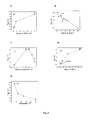
- the resultant particle size can be controlled by controlling the experimental conditions of the process such as the volume of silica precursor or volume of catalyst or volume of solvent or the reaction temperature of the process. For example by controlling the amount of ammonia in the pre-sol solution, the resultant particle size can be determined. We have found that 0.0159 moles of ammonia results in particles with an average diameter of about 2.45 ⁇ m whereas 0.3971 moles of ammonia produces particles with an average diameter of about 0.49 ⁇ m Figs.
- FIG. 4A to E show the effect of increasing the volume of silica precursor (TEOS in the example of Fig. 4A ): the effect of increasing the volume of catalyst (Ammonia in the example of Fig. 4B ); the effect of increasing the volume of solvent (methanol in the example of Fig. 4C ); the effect of increasing the mass of poreogen (CTAB in the example of Fig. 4D ) and the effect of increasing temperature ( Fig. 4E ) on the resultant particle size.
- TEOS silica precursor
- Ammonia in the example of Fig. 4B
- methanol methanol
- CTAB mass of poreogen
- Fig. 4E the effect of increasing temperature
- temperatures of about -100°C or less will produce particles with an average size of about 10 ⁇ m or more, for example up to about 50 ⁇ m
- Resultant particle size may also by controlled by altering two or more experimental parameters.
- a seeded growth method particles obtained from the process described herein (Step 2 of Fig. 1 ) are immersed in a fresh sol preparation (Step 1 of Fig. 1 ) such that a new layer of silica is grown on the existing particles thereby increasing the average size of the particles.
- the average size of particles may be further increased by performing additional seeded growth steps.
- particles Once particles have been grown to the desired size they can be processed as described in steps 3 to 6 of Fig. 1 .
- the preparation of particles using the seeded growth method may result in particles having a core-shell structure.
- Post synthesis treatment of the silica powder via an amine-water emulsion under hydrothermal conditions results in the controlled swelling of the mesopores to between about 2 and about 4 nm.
- the invention provides a method for synthesising swelled mesoporous silica materials with tunable mesoporous diameters. Further post synthesis treatment using a base etch (controlled dissolution) solution further increases the pore size of the silica powders to between about 4nm to about 50nm.
- the surfactants used may be, but are not limited to, any one or more of cationic surfactants, e.g. cetyltrimethylammonium bromide (CTAB), diblock (A-B) or triblock copolymers (A-B-A or A-B-C), with polyethylene oxide (PEO), polypropylene oxide (PPO) or polybutylene oxide (PBO) segments, polyalkyl ethers, e.g C x H 2x+1 -(CH 2 -CH 2 O) z H (C x EO y ) such as Brij surfactants, anionic surfactants, such as sodium bis (2- ethylhexyl)sulfosuccinate (AOT) and Triton-X.
- CAB cetyltrimethylammonium bromide
- A-B diblock
- A-B-A or A-B-C triblock copolymers
- PEO polyethylene oxide
- PPO polypropylene oxide
- PBO
- the alcohol-type solvent used may be, but is not limited to, any one or more of methanol, ethanol, propanol or butanol.
- a suitable silica precursor may be, but is not limited to, any one or more of tetraethoxysilane (TEOS), tetramethoxysilane (TMOS), tetrapropoxysilane (TPOS), and tetrabutoxysilane (TBOS), tetra-acetoxysilane, tetrachlorosilane or organic derivative thereof represented by the formula R n SiX( 4-n ) where R is an organic radical and X is a hydrolysable group such as halide, acetoxy, alkoxy, teramethysilane, tetraethysilane, and n is an integer between 1 and 4.
- Hybrid silica precursors may also be used in the process of the invention to produce porous hybrid silica microparticles.
- hybrid silica particles we mean silica particles that contain a percentage of organic component within the structure such as silica particles with organic functionality. The organic functionality may be within the silica particle (internal) and/or linked to the surface of the silica particle (external).
- a suitable hybrid silica precursor may be, but is not limited to, any one or more of, dimethyldimethoxysilane, methyltriethoxysilane, methyltrimethoxysilane, ethyltrimethoxysilane, n-propyltrimethoxysilane, isobutyltriethoxysilane, isobutyltrimethoxysilane, phenyltrimethoxysilane, n-octyltriethoxysilane, and iso-octyltrimethoxysilane.
- Bridged hybrid precursors may also be used in the process of the invention to produce porous hybrid silica microparticles.
- a suitable bridged silica may be, but is not limited to R n X (3-n) Si-R'-SiR n X (3-n) wherein:
- bridged hybrid silica precursor 1,2-Bis (triethoxysilyl)ethane
- a suitable amine porogenic swelling agent may be, but is not limited to, any one or more of N,N-Dimethyldecylarnine, Trioctylamine, trimethylamine, tridodecylamine and triethylamine.
- the silica source used to prepare the sol may be, but is not limited to, an alkoxide, carboxylate or halide of silicon.
- a suitable base etch solution may be, but is not limited to, hydroxides of sodium, potassium and ammonium.
- a suitable silica chelating agent/complexing agent may be but is not limited to, organic diols such as catechol (1,2 benzenediol).
- Control of the pre-sol conditions pre-determine the macroscopic particle size of the particles. Decreased concentration of the base hydrolysis agent yields larger particles, whilst increased temperature yields smaller particles.
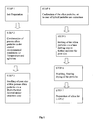
- Mesoporous silica particles are prepared in several stages, as represented schematically in Fig. 1 and described below:
- the TEOS may be replaced with a suitable hybrid silica precursor.
- the silica precursors may comprise a mixture of a bridged hybrid silica precursor and a non-hybrid silica precursor for example TEOS.
- the non-hybrid silica precursor may be present at a concentration of between about 5 to about 25% v/v of the pre-sol solution.
- Step 2 The silica precipitate is separated by filtration (vacuum filtration through a Whatman 110mm diameter filter paper) and dried at room temperature to produce an as synthesised silica powder of porous silica particles.
- Step 3 An emulsion of DMDA in H 2 O (3.3 %v/v) is prepared by vigorously stirring known amounts of DMDA in water for 1 hour. As synthesised silica powder (2.5 % w/w) from step 2 is added to the emulsion and stirred for a further hour. The solution is then transferred to a closed hydrothermal container and treated at about 110 °C for 1 week under autogenous pressure. A colour charge from white to brown is observed.
- Step 4 The porous silica particles are removed from the hydrothermal process of step 3, washed, filtered, air dried for up to 4 days and calcined at temperatures between about 200 and about 550 °C for periods of a few minutes to several days in air or air/ozone mixtures.
- the particles are exposed to microwave irradiation between about 40 and about 1000 watt in the presence of a solvent which in most cases is an alcohol to extract the SDA.
- microwave irradiation may be used to extract the SDA.
- Oxide particles are formed which consist of open pores, i.e. no organic surfactant is present.
- Step 5 The hydrothermally treated and calcined particles (1 % w/w) are base etched.
- the calcined particles may be added to a 0.05 M sodium hydroxide base etch solution and agitated for about 3 days.
- the calcined particles may be base etched using an ammonium hydroxide base etch solution for example a base etch solution comprising about 14.8M ammonium hydroxide and agitated for about 8 hours.
- the base etch step may be performed at a temperature of about 50°C.
- a silica chelating agent or complexing agent can be included in the base etching solution which may reduce the likelihood of Ostwald ripening of the etched particles.
- Catechol may be added to the base etch solution at a concentration of about 10 v/v%.
- Catecol may be included in the base etching solution when the base etching catalyst is a hydroxide of sodium or ammonium.
- the rate of the base etching step can be controlled by controlling one or more of the reaction parameters such as time, temperature, concentration of base etching catalyst, concentration of silica chelating agent or complexing agent, and the agitation conditions.
- Step 6 The etched particles are separated by filtration (vacuum filtration through a Whatman 110mm diameter filter paper) and dried at 200 °C.
- Step 7 The porous particles can be packed into traditional chromatography columns, with typical dimensions such as diameter 1.0 cm and length 30 cm, using traditional 'wet filling' techniques, i.e. the mesoporous silica is wetted with a solvent to produce a slurry which is delivered into the column.
- a liquid sample of the mixture to be chromatographed is dissolved in a solvent, typically dichloromethane, and placed on top of the column.
- the starting column solvent hexane in the first two cases
- a hand pump can then be used to generate the required pressure to force the solvent through the column to separate the mixture's components.
- TEOS Tetraethoxysilane
- CTAB cetyltrimethylammonium bromide
- Methanol MeOH was used as the co-solvent.
- a known mass of the as-synthesised material was then added to a pre-prepared agitated water-DMDA (3.3 %v/v) emulsion system. After subsequent agitation for 1 hour the contents were transferred to a hydrothermal cell and placed in a 110 °C oven for 6 days. Calcination of the surfactant template was performed at 550 °C for 8 hr. The calcined product was then placed in a 0.05 M NaOH (1 %w/w) solution and agitated at 200 rpm for 3 days, filtered and dried at 200 °C.
- the Silica particles were 'etched' for a second time (under the same conditions: 0.05 M NaOH (1 %w/w) solution and agitated at 200 rpm for 3 days) to further increase pore size, filtered and dried at 200 °C.
- Table 1 illustrates the molar composition and physiochemical properties of a variety of silica particles synthesised.
- TEOS Tetraethoxysilane
- CTAB cetyltrimethylammonium bromide
- Methanol MeOH was used as the co-solvent.
- a known mass of the as-synthesised material was then added to a pre-prepared agitated water-DMDA (3.3 %v/v) emulsion system. After subsequent agitation for 1 hour the contents were transferred to a hydrothermal cell and placed in a 110 °C oven for 6 days. Calcination of the surfactant template was performed at 550 °C for 8 hr.
- the calcined product was then placed in a sodium hydroxide solution under the conditions listed in Table 2 below and agitated at 200rpm and 50°C for the time indicated in Table 2 below. Following sodium hydroxide etching, the particles were filtered and dried at 200°C.
- Example 2 Using the method of Example 2 but varying the concentration of ammonia resulted in particles with an increased average diameter.
- a known mass of the as-synthesised material was then added to a pre-prepared agitated water-DMDA (3.3 %v/v) emulsion system. After subsequent agitation for 1 hour the contents were transferred to a hydrothermal cell and placed in a 110 °C oven for 6 days. Calcination of the surfactant template was performed at 550 °C for 8 hr. Silica particles with an average diameter of 2.45 ⁇ m were obtained. The calcined product was then placed in a 0.05 M NaOH (1 %w/w) solution and agitated at 200 rpm for 3 days, filtered and dried at 200 °C to increase the pore size to about 7.1nm to 8.1nm.
- the Silica particles were 'etched' for a second time (under the same conditions: 0.05 M NaOH (1 %w/w) solution and agitated at 200 rpm for 3 days) to further increase pore size to about 12.1nm to 20.6nm, filtered and dried at 200 °C.
- Example 4 Using the method of Example 4 but replacing the sodium hydroxide base etching steps with a single ammonium hydroxide base etching step under the conditions for NH3002 to NH3007 listed in Table 2 above at 50°C with agitation at 200rpm, the pore size of the particles was increased to about 11.6nm (NH3002), about 15.7nm (NH3004), about 25.0nm (NH3005), about 12.4nm (NH3006) and about 24.0nm (NH3007). Following base etching, particles were filtered and dried at 200 °C.
- a known mass of the as-synthesised material was then added to a pre-prepared agitated water-DMDA (3.3 %v/v) emulsion system. After subsequent agitation for 1 hour the contents were transferred to a hydrothermal cell and placed in a 110 °C oven for 6 days. Removal of the surfactant template was performed using microwave extraction extraction in ethanol. The hybrid silica particles were then 'etched' using ammonium hydroxide under the conditions outlined in Examples 3 and 5 above.
- a known mass of the as-synthesised material was then added to a pre-prepared agitated water-DMDA (3.3 %v/v) emulsion system. After subsequent agitation for 1 hour the contents were transferred to a hydrothermal cell and placed in a 110 °C oven for 6 days. Removal of the surfactant template was performed using microwave extraction in ethanol. The bridged silica particles were then 'etched' using ammonium hydroxide under the conditions outlined in Examples 3, 5, and 6 above.
- the surface areas of the calcined mesoporous silica spheres were measured using nitrogen Brunauer Emmett Teller (BET) isotherms on a Micromeritics Gemini 2375 volumetric analyzer. Each sample was degassed for 12 hr at 200 °C prior to a BET measurement. The average pore size distribution of the calcined silicas was calculated on the Barrett Joyner Halanda (BJH) model from a 30-point BET surface area plot. Mesoporous silicas examined exhibited a Type-IV adsorption isotherm typical of mesoporous solids. Average pore diameters were calculated from the adsorption branch of the isotherm.
- BET Brunauer Emmett Teller
- a JEOL 2010 (0.5 nm resolution) electron microscope operating with a 100 kV accelerating voltage was used for transmission electron microscopy (TEM). Samples were dispersed in chloroform/ethanol, and a drop of the mixture was placed on a carbon-coated copper TEM grid. Scanning electron microscopy (SEM) measurements (0.05 ⁇ m resolution) were conducted on a JEOL 5510 SEM on samples placed on carbon tape and then adhered to a brass stub. Particle size distributions were measured on a Multisizer 3 Coulter Counter which is based on the electrical sensing zone (ESZ) technique.
- SEM scanning electron microscopy
- FIG. 1 is a flow diagram of the process according to the invention, illustrating a general method of forming ordered mesoporous silica particles.
- a silica pre-sol solution is made. This may be agitated in a beaker under atmospheric conditions.
- the particles are then hydrolysed in an amine water emulsion as shown in block 3.
- the particles are then calcined to create SDA-free particles (Block 4). Finally, these particles are base etched, filtered and dried.
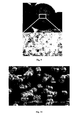
- Figure 2 shows an SEM analysis of silica microspheres synthesized from the above method.
- the average particle size measured was 1.4 ⁇ m
- the SEM image confirms that the surface of the sphere is smooth and free from major defects.
- the particle size of the modified SFB method may be controlled by altering the reactant type, stoichiometry and experimental conditions. It is useful to compare the processing and particle size control of the modified SFB method with the original SFB method.
- Stöber et al. 9 systematically varied reaction parameters so that silica particle diameters could be tailored from 0.05 ⁇ m to 2 ⁇ m in diameter.
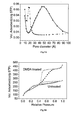
- Fig. 3 shows particle size distribution profiles for silica synthesised using the above method. Modification of the agitation speed leads to varying particle sizes. (Open Triangles 400rpm, closed squares 300rpm and open circles 200rpm)
- Fig. 4A to E show the effect of altering experimental conditions on the resultant particle size.
- FIG. 5(b) show nitrogen adsorption (closed squares) and desorption isotherms (open circles) isotherms of hydrothermally treated (labelled DMDA treated) and untreated particles (labelled Untreated). There is a clear transition from a Type 1 microporous ( ⁇ 2 nm) to a Type 4 mesoporous (2-50 nm) adsorption isotherm according to IUPAC classification 17 .
- Figure 5(a) depicts the pore size distribution profiles of a untreated (closed squares) and hydrothermally treated (closed circles) silica sample.
- the pore diameter may be further increased by a base etch in sodium hydroxide or ammonium hydroxide solution.
- Figure 6(b) shows a nitrogen adsorption (closed squares) and desorption (open circles) isotherms of sodium hydroxide etched spheres.
- the average pore diameter is 8.5 nm taken from the Pore size distribution profile shown in Figure 6(a) .
- Table 1 indicates that there is a four fold increase in the pore size after base etching (controlled dissolution).
- Figure 7(b) shows a nitrogen adsorption ( ⁇ ) and desorption ( ⁇ ) isotherms of silica spheres that have been etched once with sodium hydroxide (line A) and have been double etched with sodium hydroxide (line B).
- the average pore diameter can be seen from the Pore size distribution profile shown in Figure 7(a) for spheres that have been etched once (line A) and have been double etched (line B).
- Fig. 8(a) shows nitrogen adsorption ( ⁇ )and desorption ( ⁇ ) isotherms of silica spheres that have been etched with an ammonium hydroxide etching solution under various conditions (see Table 2 above for the base etching conditions).
- the average pore diameter can be seen from the pore size distribution profile in Fig. 8(b) for spheres that have been etched with an ammonium hydroxide base etching solution under various conditions (see Table 2 above for the base etching conditions).
- Figure 9 is a TEM image of the random pore structure within the spheres after base etching in 0.05 M NaOH (3 days). Pore sizes of up to 50 nm can be created after suitable base etch conditions i.e. repeated base etching procedures. Typically pore sizes in the region of about 2 to 25nm or about 2 to 15nm are achieved.
- Figure 10 is a scanning electron micrograph image of porous silica spheres prepared from a moles ratio of TEOS : CTAB : MeOH : NH 3 : H 2 O of 0.0359 : 0.003 : 12.36 : 0.5 : 6.15 under a reaction temperature of -17°C.
- the spheres have an average diameter of about 4.7 ⁇ m.
Landscapes
- Chemical & Material Sciences (AREA)
- Organic Chemistry (AREA)
- Inorganic Chemistry (AREA)
- Life Sciences & Earth Sciences (AREA)
- General Life Sciences & Earth Sciences (AREA)
- Geology (AREA)
- Silicates, Zeolites, And Molecular Sieves (AREA)
- Solid-Sorbent Or Filter-Aiding Compositions (AREA)
- Silicon Compounds (AREA)
Applications Claiming Priority (2)
| Application Number | Priority Date | Filing Date | Title |
|---|---|---|---|
| IE20070511 | 2007-07-13 | ||
| EP08776584.8A EP2181069B1 (de) | 2007-07-13 | 2008-07-14 | Verfahren zur synthese von porösen siliciumdioxid-mikropartikeln |
Related Parent Applications (3)
| Application Number | Title | Priority Date | Filing Date |
|---|---|---|---|
| EP08776584.8A Division EP2181069B1 (de) | 2007-07-13 | 2008-07-14 | Verfahren zur synthese von porösen siliciumdioxid-mikropartikeln |
| EP08776584.8A Division-Into EP2181069B1 (de) | 2007-07-13 | 2008-07-14 | Verfahren zur synthese von porösen siliciumdioxid-mikropartikeln |
| EP08776584.8 Division | 2008-07-14 |
Publications (3)
| Publication Number | Publication Date |
|---|---|
| EP2615064A2 true EP2615064A2 (de) | 2013-07-17 |
| EP2615064A8 EP2615064A8 (de) | 2013-08-28 |
| EP2615064A3 EP2615064A3 (de) | 2015-08-12 |
Family
ID=40130536
Family Applications (2)
| Application Number | Title | Priority Date | Filing Date |
|---|---|---|---|
| EP13154419.9A Withdrawn EP2615064A3 (de) | 2007-07-13 | 2008-07-14 | Mesoporösen Silica Mikropartikeln |
| EP08776584.8A Active EP2181069B1 (de) | 2007-07-13 | 2008-07-14 | Verfahren zur synthese von porösen siliciumdioxid-mikropartikeln |
Family Applications After (1)
| Application Number | Title | Priority Date | Filing Date |
|---|---|---|---|
| EP08776584.8A Active EP2181069B1 (de) | 2007-07-13 | 2008-07-14 | Verfahren zur synthese von porösen siliciumdioxid-mikropartikeln |
Country Status (5)
| Country | Link |
|---|---|
| US (2) | US20100272996A1 (de) |
| EP (2) | EP2615064A3 (de) |
| JP (3) | JP5358570B2 (de) |
| IE (1) | IE20080577A1 (de) |
| WO (1) | WO2009010945A2 (de) |
Cited By (1)
| Publication number | Priority date | Publication date | Assignee | Title |
|---|---|---|---|---|
| CN109529797A (zh) * | 2018-11-12 | 2019-03-29 | 北京航空航天大学 | 一种微米颗粒介孔二氧化硅及其制备与应用 |
Families Citing this family (50)
| Publication number | Priority date | Publication date | Assignee | Title |
|---|---|---|---|---|
| JP5511194B2 (ja) * | 2009-01-29 | 2014-06-04 | 国立大学法人広島大学 | メソポーラスシリカナノ粒子の製造方法 |
| JP5332821B2 (ja) * | 2009-03-31 | 2013-11-06 | 株式会社豊田中央研究所 | メソ細孔配向材料 |
| US8197782B2 (en) * | 2010-02-08 | 2012-06-12 | Momentive Performance Materials | Method for making high purity metal oxide particles and materials made thereof |
| WO2012012311A2 (en) * | 2010-07-23 | 2012-01-26 | The Regents Of The University Of California | Compositions and methods for synthesis of organic-silica hybrid materials |
| US20130112605A1 (en) | 2010-07-26 | 2013-05-09 | Waters Technologies Corporation | Superficially porous materials comprising a substantially nonporous core having narrow particle size distribution; process for the preparation thereof; and use thereof for chromatographic separations |
| US9109063B2 (en) | 2010-10-29 | 2015-08-18 | Lg Chem, Ltd. | Acrylamide-based mesoporous polymer and preparation method thereof |
| WO2012060102A1 (ja) | 2010-11-05 | 2012-05-10 | パナソニック株式会社 | シリカ多孔体およびこれを用いた光マイクロフォン |
| JP2012097883A (ja) * | 2010-11-05 | 2012-05-24 | Asahi Kasei Chemicals Corp | 断熱材 |
| WO2012085896A2 (en) * | 2010-12-24 | 2012-06-28 | I2Ic Corporation | Color insensitive scattering pigment |
| JP5583574B2 (ja) * | 2010-12-28 | 2014-09-03 | 花王株式会社 | 非球状シリカ微粒子の製造方法 |
| WO2012112553A1 (en) | 2011-02-14 | 2012-08-23 | Dionex Corporation | Nanometer size chemical modified materials and uses |
| CN102153094B (zh) * | 2011-03-21 | 2013-03-20 | 厦门大学 | 一种有序介孔二氧化硅空心球的制备方法 |
| US20120283337A1 (en) * | 2011-05-05 | 2012-11-08 | Mary Christine Brick | Inorganic porous particles with stabilized micropores |
| CN102659124A (zh) * | 2012-04-12 | 2012-09-12 | 南昌大学 | 一种溶胶-微乳-水热体系制备纳米硅微粉的方法 |
| WO2013153210A1 (en) | 2012-04-13 | 2013-10-17 | Nanoscape Ag | Sustained-release formulation |
| JP5974683B2 (ja) * | 2012-07-02 | 2016-08-23 | 堺化学工業株式会社 | 粒子内部に空隙を有する粒子及びその製造方法 |
| JP6079023B2 (ja) * | 2012-07-19 | 2017-02-15 | Dic株式会社 | 活性エネルギー線硬化性組成物及びフィルムの製造方法 |
| EP2812091B1 (de) | 2012-09-17 | 2021-03-10 | W.R. Grace & CO. - CONN. | Chromatographiemedien und -vorrichtungen |
| CN103086389B (zh) * | 2013-02-27 | 2015-01-21 | 北京农学院 | 硅基介孔材料及其制备方法 |
| WO2014201033A1 (en) * | 2013-06-11 | 2014-12-18 | Waters Technologies Corporation | Chromatographic columns and separation devices comprising a superficially porous material; and use thereof for supercritical fluid chromatography and other chromatography |
| CN103435054B (zh) * | 2013-06-26 | 2016-01-13 | 临安市绿源精细化学品有限公司 | 一步法获得超亲水二氧化硅溶胶的制备方法 |
| CN103432983B (zh) * | 2013-08-08 | 2015-04-15 | 西安热工研究院有限公司 | 一种电力用油再生处理微孔极性诱导吸附剂及其制备方法 |
| CN103833040B (zh) * | 2014-01-29 | 2016-03-23 | 中国科学院上海硅酸盐研究所 | 空心介孔氧化硅球和空心介孔有机硅球的制备方法 |
| US20150224473A1 (en) * | 2014-02-07 | 2015-08-13 | Thermo Electron Manufacturing Limited | Chromatographic material and methods for the synthesis thereof |
| US9764292B2 (en) | 2014-02-28 | 2017-09-19 | Pall Corporation | Porous polymeric membrane with high void volume |
| US9309126B2 (en) | 2014-02-28 | 2016-04-12 | Pall Corporation | Rapidly dissolvable nanoparticles |
| US9302228B2 (en) | 2014-02-28 | 2016-04-05 | Pall Corporation | Charged porous polymeric membrane with high void volume |
| US9737860B2 (en) | 2014-02-28 | 2017-08-22 | Pall Corporation | Hollow fiber membrane having hexagonal voids |
| US9446355B2 (en) | 2014-02-28 | 2016-09-20 | Pall Corporation | Porous polymeric membrane with high void volume |
| US9776142B2 (en) | 2014-02-28 | 2017-10-03 | Pall Corporation | Porous polymeric membrane with high void volume |
| US9561473B2 (en) | 2014-02-28 | 2017-02-07 | Pall Corporation | Charged hollow fiber membrane having hexagonal voids |
| US9610548B2 (en) | 2014-02-28 | 2017-04-04 | Pall Corporation | Composite porous polymeric membrane with high void volume |
| PL3137209T3 (pl) | 2014-05-02 | 2023-01-02 | W.R. Grace & Co. - Conn. | Funkcjonalizowany materiał nośnikowy i sposoby wytwarzania oraz stosowania funkcjonalizowanego materiału nośnikowego |
| KR102566292B1 (ko) | 2015-06-05 | 2023-08-10 | 더블유.알. 그레이스 앤드 캄파니-콘. | 흡착성 바이오프로세싱 정화제와 이의 제조 및 사용 방법 |
| WO2017141821A1 (ja) * | 2016-02-19 | 2017-08-24 | 国立大学法人東北大学 | コアシェル型多孔質シリカ粒子の製造方法 |
| US20190015815A1 (en) | 2016-03-06 | 2019-01-17 | Waters Technologies Corporation | Superficially porous materials comprising a coated core having narrow particle size distribution; process for the preparation thereof; and use thereof for chromatographic separations |
| US10434496B2 (en) | 2016-03-29 | 2019-10-08 | Agilent Technologies, Inc. | Superficially porous particles with dual pore structure and methods for making the same |
| CN108568291B (zh) * | 2018-04-13 | 2020-08-14 | 山东省分析测试中心 | 一种苯基桥键型纤维状多孔硅材料、其制备方法及应用 |
| US10781289B2 (en) * | 2018-11-30 | 2020-09-22 | National Cheng Kung University | Aerogel particles and method of making the same |
| KR102334608B1 (ko) * | 2019-11-29 | 2021-12-02 | 한남대학교 산학협력단 | 화학-기계적 연마용 실리카 나노입자의 제조방법 |
| US11806693B2 (en) | 2020-06-16 | 2023-11-07 | Sigma-Aldrich Co. Llc | HPLC carbon with narrow particle size distribution |
| JP7678270B2 (ja) * | 2020-06-26 | 2025-05-16 | 日亜化学工業株式会社 | 成形体、発光装置及び成形体の製造方法 |
| ES2912936B2 (es) * | 2020-11-27 | 2022-10-05 | Univ Valencia | Procedimiento de obtencion de materiales mesoporosos bimodales basados en oxidos de silicio mediante el uso de radiacion microondas |
| CN112919481B (zh) * | 2021-01-29 | 2022-10-28 | 吉林大学 | 一种正电性的二氧化硅粒子的制备方法 |
| FR3122585A1 (fr) | 2021-05-04 | 2022-11-11 | Universite Claude Bernard Lyon 1 | Solide mésoporeux pour réguler l’humidité dans les espaces clos |
| CN117303936B (zh) * | 2023-09-15 | 2025-08-15 | 武汉理工大学 | 一种微波复合介质基板及其制备方法 |
| WO2025133002A1 (de) | 2023-12-20 | 2025-06-26 | Merz + Benteli Ag | Mikroporöse sio2-partikel |
| PL447589A1 (pl) * | 2024-01-24 | 2025-07-28 | Politechnika Śląska | Sposób zmiany wielkości makroporów zwłaszcza w materiałach otrzymywanych metodami separacji fazowej i techniką zol-żel |
| PL447587A1 (pl) * | 2024-01-24 | 2025-07-28 | Politechnika Śląska | Sposób wytwarzania wielokanałowego mikroreaktora chemicznego o hierarchicznej strukturze porowatej typu rdzeń-powłoka |
| CN119430203B (zh) * | 2024-11-08 | 2025-06-10 | 宁波卿甬新材料科技有限公司 | 一种双介孔二氧化硅纳米球的制备方法 |
Citations (3)
| Publication number | Priority date | Publication date | Assignee | Title |
|---|---|---|---|---|
| US3634558A (en) | 1968-10-29 | 1972-01-11 | Atomic Energy Commission | Method of producing monodisperse silica spheres having a dispersed radioactive tracer |
| EP0844949A1 (de) | 1995-08-31 | 1998-06-03 | TRW Airbag Systems GmbH & Co. KG | Vorrichtung zum befüllen einer rückhaltevorrichtung |
| US20060118490A1 (en) * | 2004-12-02 | 2006-06-08 | The University Of Vermont And State Agricultural College | Mesoporous inorganic oxide spheres and method of making same |
Family Cites Families (18)
| Publication number | Priority date | Publication date | Assignee | Title |
|---|---|---|---|---|
| US2699376A (en) * | 1950-08-01 | 1955-01-11 | Gulf Research Development Co | Process for increasing the a verage pore size of a calcined silica gel |
| JP2621153B2 (ja) * | 1987-01-05 | 1997-06-18 | 株式会社島津製作所 | 球状多孔体の製造法 |
| US5256386A (en) * | 1987-06-29 | 1993-10-26 | Eka Nobel Ab | Method for preparation of silica particles |
| JPH01230421A (ja) * | 1988-03-11 | 1989-09-13 | Nippon Shokubai Kagaku Kogyo Co Ltd | 多孔質球状シリカ微粒子 |
| JP2668958B2 (ja) * | 1988-07-11 | 1997-10-27 | 三菱化学株式会社 | 球状シリカ多孔体の製造方法 |
| US5057296A (en) * | 1990-12-10 | 1991-10-15 | Mobil Oil Corp. | Method for synthesizing mesoporous crystalline material |
| JPH04231320A (ja) * | 1990-08-30 | 1992-08-20 | Akzo Nv | アルキルシリケートの酸/塩基加水分解によるシリカ粒子 |
| JPH0543217A (ja) * | 1991-08-01 | 1993-02-23 | Tokuyama Soda Co Ltd | シリカ粒子の製造方法 |
| AU2001266332A1 (en) * | 2000-06-26 | 2002-01-08 | Asahi Kasei Kabushiki Kaisha | Porous, fine inorganic particles |
| US6528167B2 (en) * | 2001-01-31 | 2003-03-04 | Waters Investments Limited | Porous hybrid particles with organic groups removed from the surface |
| JP3801592B2 (ja) * | 2001-09-05 | 2006-07-26 | 旭化成ケミカルズ株式会社 | レーザー彫刻可能な印刷原版用感光性樹脂組成物 |
| US20040091411A1 (en) * | 2002-11-08 | 2004-05-13 | Bijan Modrek-Najafabadi | High surface area, high porosity silica packing with narrow particle and pore diameter distribution and methods of making same |
| JP4314077B2 (ja) * | 2003-06-30 | 2009-08-12 | 三菱化学株式会社 | シリカ及びその製造方法 |
| JP4296307B2 (ja) * | 2003-09-16 | 2009-07-15 | 株式会社豊田中央研究所 | 球状シリカ系メソ多孔体の製造方法 |
| JP2005213122A (ja) * | 2004-01-30 | 2005-08-11 | Sumitomo Osaka Cement Co Ltd | 多孔質微粒子の製造方法 |
| JP2007533583A (ja) * | 2004-04-13 | 2007-11-22 | ユニバーシティ・カレッジ・コークーナショナル・ユニバーシティ・オブ・アイルランド,コーク | メソポーラス材料の調製方法 |
| JP2006069864A (ja) * | 2004-09-03 | 2006-03-16 | National Institute Of Advanced Industrial & Technology | ナノポーラス体及びその製造方法 |
| CA2604869A1 (en) * | 2005-04-05 | 2006-10-12 | University College Cork - National University Of Ireland, Cork | Mesoporous particles |
-
2008
- 2008-07-14 JP JP2010516645A patent/JP5358570B2/ja active Active
- 2008-07-14 US US12/668,859 patent/US20100272996A1/en not_active Abandoned
- 2008-07-14 IE IE20080577A patent/IE20080577A1/en not_active IP Right Cessation
- 2008-07-14 EP EP13154419.9A patent/EP2615064A3/de not_active Withdrawn
- 2008-07-14 WO PCT/IE2008/000074 patent/WO2009010945A2/en not_active Ceased
- 2008-07-14 EP EP08776584.8A patent/EP2181069B1/de active Active
-
2013
- 2013-03-18 JP JP2013055676A patent/JP2013155107A/ja active Pending
- 2013-08-14 JP JP2013168506A patent/JP5980744B2/ja active Active
-
2020
- 2020-04-28 US US16/860,970 patent/US11772978B2/en active Active
Patent Citations (3)
| Publication number | Priority date | Publication date | Assignee | Title |
|---|---|---|---|---|
| US3634558A (en) | 1968-10-29 | 1972-01-11 | Atomic Energy Commission | Method of producing monodisperse silica spheres having a dispersed radioactive tracer |
| EP0844949A1 (de) | 1995-08-31 | 1998-06-03 | TRW Airbag Systems GmbH & Co. KG | Vorrichtung zum befüllen einer rückhaltevorrichtung |
| US20060118490A1 (en) * | 2004-12-02 | 2006-06-08 | The University Of Vermont And State Agricultural College | Mesoporous inorganic oxide spheres and method of making same |
Non-Patent Citations (17)
| Title |
|---|
| BARTON, T. J.; BULL, I,. M.; KLEMPERER, W. G.; LOY, D. A.; MCENANEY, B.; MISONO, M.; MONSON, P. A.; PEZ, G.; SCHERER, G. W.; VARTU, CHEM. MATER, vol. 11, 1999, pages 2633 |
| BECK, J. S., U.S PATENT THE SWELLING OF MESOPOROUS SILCIA USING 135TMB, 1991 |
| BECK, J. S.; VARTULLI, J. C.; ROTH, W. J.; LEONOWICZ, M. E.; KRESGE, C. T.; SCHMITT, K. D.; CHU, C. T.; OLSON, D. H.; SHEPPARD, E., J. AM. CHEM. SOC., vol. 114, 1992, pages 10834 |
| BOGUSH, G. H.; ZUKOSKI, C. F. J., COLLOID INTERFACE SCI, vol. 104, 1988, pages 94 |
| GRUN, M.; BÜCHEL, G.; KUMAR, D.; SCHUMACHER, K.; BIDLINGMAIER, B.; UNGER, K.K., STUDIES IN SURFACE SCIENCE AND CATALYSIS, vol. 128, 2000, pages 155 - 165 |
| GRUN, M.; LAUER, I.; UNGER, K. K., ADV. MATER, vol. 9, 1997, pages 254 |
| HALASZ, I.; ENDELE, R.; ASSHAUER, J., J CHROMATOGR, vol. 12, 1975, pages 12 |
| KRUK, M.; JARONIEC, M.; SAYARI, A., MICRO. MESO. MAT., vol. 35, 2000, pages 545 |
| MACNAIR, J. E.; LEWIS, K. C.; JORGENSON, J. W., ANAL. CHEM, vol. 69, 1997, pages 983 |
| MACNAIR, J. E.; PATEL, K. D.; JORGENSON, 1. W., ANAL. CHEM., 1999 |
| MARTIN, T.; GALARNEAU, A.; DI RENZO, F.; BRUNEL, D.; FAJULA, F., CHEM. MATER., vol. 16, 2004, pages 1725 |
| SAYARI, A., ANGEW. CHEM. INT. ED., vol. 39, 2000, pages 2920 |
| SELVAM, P.; BHATIA, S. K.; ;, IND. ENG. CHEM. RES., vol. 40, 2001, pages 3237 |
| SHIMURA, S.; OGAWA, M., BULL. CHEM. SOC. JPN., vol. 78, 2005, pages 1154 |
| STOBER, W.; FINK, A.; BOHN, E., J. COLLOID INTERFACE SCI., vol. 26, 1968, pages 62 |
| UNGER, K. K.; KUMAR, D.; GRUN, M.; BUCHEL, G.; LUDTKE, S.; ADAM, T.; SCHMACHER, K.; RENKER, S., J. CHROMATOGR. A, vol. 892, 2000, pages 47 |
| YANO, K.; FUKUSHIMA, Y., J. MATER. CHEM., vol. 13, 2003, pages 2577 |
Cited By (1)
| Publication number | Priority date | Publication date | Assignee | Title |
|---|---|---|---|---|
| CN109529797A (zh) * | 2018-11-12 | 2019-03-29 | 北京航空航天大学 | 一种微米颗粒介孔二氧化硅及其制备与应用 |
Also Published As
| Publication number | Publication date |
|---|---|
| EP2615064A8 (de) | 2013-08-28 |
| JP5980744B2 (ja) | 2016-08-31 |
| US20200255297A1 (en) | 2020-08-13 |
| EP2181069A2 (de) | 2010-05-05 |
| EP2615064A3 (de) | 2015-08-12 |
| US11772978B2 (en) | 2023-10-03 |
| WO2009010945A2 (en) | 2009-01-22 |
| JP2013227226A (ja) | 2013-11-07 |
| IE20080577A1 (en) | 2009-07-08 |
| WO2009010945A3 (en) | 2010-03-25 |
| EP2181069B1 (de) | 2020-04-29 |
| JP2013155107A (ja) | 2013-08-15 |
| JP5358570B2 (ja) | 2013-12-04 |
| US20100272996A1 (en) | 2010-10-28 |
| JP2010533124A (ja) | 2010-10-21 |
Similar Documents
| Publication | Publication Date | Title |
|---|---|---|
| US11772978B2 (en) | Method for synthesising microparticles | |
| JP5856162B2 (ja) | 粒度分布の狭い実質的に非多孔質のハイブリッドコアを含む表面多孔質材料 | |
| Kachbouri et al. | Tuning particle morphology of mesoporous silica nanoparticles for adsorption of dyes from aqueous solution | |
| Chen et al. | Synthesis of monodispersed mesoporous silica spheres (MMSSs) with controlled particle size using gemini surfactant | |
| Misran et al. | Nonsurfactant route of fatty alcohols decomposition for templating of mesoporous silica | |
| US20090029146A1 (en) | Mesoporous Particles | |
| Chen et al. | The complete control for the nanosize of spherical MCM-41 | |
| WO2012110995A1 (en) | Silica core-shell microparticles | |
| Liu et al. | Synthesis of hollow mesoporous silica spheres with radially aligned mesochannels and tunable textural properties | |
| US9284456B2 (en) | Superficially porous metal oxide particles, methods for making them, and separation devices using them | |
| JP5118328B2 (ja) | 中空シリカ粒子 | |
| Essien et al. | Sol-gel-derived porous silica: Economic synthesis and characterization. | |
| Hanrahan et al. | Synthesis and swelling of large pore diameter mesoporous silica spheres | |
| Mizutani et al. | Pore-expansion of monodisperse mesoporous silica spheres by a novel surfactant exchange method | |
| Pérez-Quintanilla et al. | Synthesis and characterization of novel mesoporous silicas of the MSU-X family for environmental applications | |
| Liu et al. | Preparation of spherical large-particle MCM-41 with a broad particle-size distribution by a modified pseudomorphic transformation | |
| Niu et al. | Chelating template-induced encapsulation of NiO cluster in mesoporous silica via anionic surfactant-templated route | |
| Qu et al. | The formation mechanism of ag/SBA-15 nanocomposites prepared via in-situ pH-adjusting method | |
| Shiba et al. | Preparation of Monodispersed Spherical Titania–Octadecylamine Particles Containing Silane-Coupling Reagents | |
| JP2008145190A (ja) | マイクロカプセル、液体クロマトグラフ用充填剤及びそれを用いた液体クロマトグラフ用カラム | |
| Zukal et al. | Preparation of MCM-41 silica using the cationic surfactant blend | |
| KR101782731B1 (ko) | 메조포러스 실리카 제조용 계면활성제, 이를 이용한 메조포러스 실리카의 제조방법, 구조체의 제조 방법 및 상기 방법으로 제조된 구조체 | |
| JP5057021B2 (ja) | 球状シリカ系メソ多孔体及びその製造方法、並びにそれを用いた塩基性色素吸着材 | |
| Sayari et al. | Polyfunctionalized silica adsorbents obtained by using dodecylamine as template | |
| Martines et al. | Effect of fat chain length of sorbitan surfactant on the porosity of mesoporous silica |
Legal Events
| Date | Code | Title | Description |
|---|---|---|---|
| PUAI | Public reference made under article 153(3) epc to a published international application that has entered the european phase |
Free format text: ORIGINAL CODE: 0009012 |
|
| AC | Divisional application: reference to earlier application |
Ref document number: 2181069 Country of ref document: EP Kind code of ref document: P |
|
| AK | Designated contracting states |
Kind code of ref document: A2 Designated state(s): AT BE BG CH CY CZ DE DK EE ES FI FR GB GR HR HU IE IS IT LI LT LU LV MC MT NL NO PL PT RO SE SI SK TR |
|
| RIN1 | Information on inventor provided before grant (corrected) |
Inventor name: HOLMES, JUSTIN Inventor name: KEANE, DONAL Inventor name: MORRIS, MICHAEL Inventor name: COPLEY, MARK Inventor name: HANRAHAN, JOHN |
|
| PUAL | Search report despatched |
Free format text: ORIGINAL CODE: 0009013 |
|
| AK | Designated contracting states |
Kind code of ref document: A3 Designated state(s): AT BE BG CH CY CZ DE DK EE ES FI FR GB GR HR HU IE IS IT LI LT LU LV MC MT NL NO PL PT RO SE SI SK TR |
|
| RIC1 | Information provided on ipc code assigned before grant |
Ipc: C01B 37/02 20060101ALI20150706BHEP Ipc: C01B 33/12 20060101AFI20150706BHEP |
|
| 17P | Request for examination filed |
Effective date: 20160212 |
|
| RBV | Designated contracting states (corrected) |
Designated state(s): AT BE BG CH CY CZ DE DK EE ES FI FR GB GR HR HU IE IS IT LI LT LU LV MC MT NL NO PL PT RO SE SI SK TR |
|
| 17Q | First examination report despatched |
Effective date: 20170209 |
|
| STAA | Information on the status of an ep patent application or granted ep patent |
Free format text: STATUS: THE APPLICATION HAS BEEN WITHDRAWN |
|
| 18W | Application withdrawn |
Effective date: 20191018 |