EP2615546A1 - Verfahren und system sowie planer für parallele simulationsprozessoren - Google Patents
Verfahren und system sowie planer für parallele simulationsprozessoren Download PDFInfo
- Publication number
- EP2615546A1 EP2615546A1 EP12828153.2A EP12828153A EP2615546A1 EP 2615546 A1 EP2615546 A1 EP 2615546A1 EP 12828153 A EP12828153 A EP 12828153A EP 2615546 A1 EP2615546 A1 EP 2615546A1
- Authority
- EP
- European Patent Office
- Prior art keywords
- simulated
- processor
- thread
- slave
- scheduler
- Prior art date
- Legal status (The legal status is an assumption and is not a legal conclusion. Google has not performed a legal analysis and makes no representation as to the accuracy of the status listed.)
- Withdrawn
Links
Images


Classifications
-
- G—PHYSICS
- G06—COMPUTING OR CALCULATING; COUNTING
- G06F—ELECTRIC DIGITAL DATA PROCESSING
- G06F30/00—Computer-aided design [CAD]
- G06F30/30—Circuit design
- G06F30/32—Circuit design at the digital level
- G06F30/33—Design verification, e.g. functional simulation or model checking
-
- G—PHYSICS
- G06—COMPUTING OR CALCULATING; COUNTING
- G06F—ELECTRIC DIGITAL DATA PROCESSING
- G06F11/00—Error detection; Error correction; Monitoring
- G06F11/22—Detection or location of defective computer hardware by testing during standby operation or during idle time, e.g. start-up testing
- G06F11/26—Functional testing
- G06F11/261—Functional testing by simulating additional hardware, e.g. fault simulation
Definitions
- Embodiments of the present invention relate to a simulation technology, and in particular, to a method, system, and scheduler for simulating multiple processors in parallel.
- An SIMICS simulator is a system simulator with high performance, which may simulate a single-processor system and a multi-processor system.
- the SIMICS simulator performs scheduling by adopting a single processor scheduling manner, that is, scheduling one processor each time to execute a corresponding instruction in order to simulate multiple processors in series.
- Embodiments of the present invention provide a method, system, and scheduler for simulating multiple processors in parallel, in order to increase simulation efficiency.
- a method for simulating multiple processors in parallel including:
- a scheduler including:
- a system for simulating multiple processors in parallel including a processor that is simulated by a master thread and a processor that is simulated by a slave thread and further including the foregoing scheduler.
- the scheduler creates one or more slave threads using a master thread, and determines a processor that is simulated by the master thread and a processor that is simulated by a slave thread, so that the scheduler is capable of using the master thread and the one or more slave threads to invoke, through the first execute interface, the determined processor that is simulated by the master thread and the determined processor that is simulated by the slave thread to execute a corresponding instruction, where the first execute interface is registered with the scheduler by the determined processor that is simulated by the master thread and the determined processor that is simulated by the slave thread.
- the master thread and the one or more slave threads are able to be used to schedule a processor that is simulated by the master thread and a processor that is simulated by a slave thread each time, multiple processors are able to be simulated in parallel. This avoids a problem in the prior art that multiple processors cannot be simulated in parallel because only one processor is scheduled each time, thereby increasing the simulation efficiency; meanwhile, processor resources of a host where the scheduler is located are able to be fully utilized, thereby improving resource utilization.
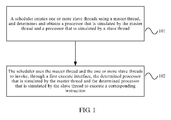
- FIG. 1 is a schematic flowchart of a method for simulating multiple processors in parallel according to an embodiment of the present invention
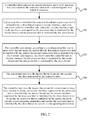
- FIG. 2 is a schematic flowchart of a method for simulating multiple processors in parallel according to another embodiment of the present invention
- FIG. 3 is a schematic diagram of system architecture which the embodiment corresponding to FIG. 2 is applicable to;
- FIG. 4 is a schematic structural diagram of a scheduler according to another embodiment of the present invention.
- FIG. 5 is a schematic structural diagram of a scheduler according to another embodiment of the present invention.
- FIG. 6 is a schematic structural diagram of a system for simulating multiple processors in parallel according to another embodiment of the present invention.
- FIG. 1 is a schematic flowchart of a method for simulating multiple processors in parallel according to an embodiment of the present invention. As shown in FIG. 1 , the method for simulating multiple processors in parallel in this embodiment may include the following steps:
- a scheduler creates one or more slave threads using a master thread, and determines and obtains a processor that is simulated by the master thread and a processor that is simulated by a slave thread.
- the scheduler may create, according to a configuration file, one or more slave threads using the master thread, and determine a processor that is simulated by the master thread and a processor that is simulated by a slave thread.
- the configuration file may include but is not limited to the number of created slave threads and a mapping relationship between a thread (the master thread or a slave thread) and the processor that is simulated by the thread.
- the scheduler uses the master thread and the one or more slave threads to invoke, through a first execute interface (execute interface), the determined processor that is simulated by the master thread and the determined processor that is simulated by the slave thread so as to execute a corresponding instruction.
- a first execute interface execute interface
- the first execute interface is registered with the scheduler by the determined processor that is simulated by the master thread and the determined processor that is simulated by the slave thread.
- each thread may correspond to one processor that is simulated by the thread, or may correspond to multiple processors that are simulated by the thread, which is not limited in this embodiment. If each thread corresponds to multiple processors that are simulated by the thread, in step 102, each time when scheduling, through the master thread and a slave thread, the processor that is simulated by the master thread and the processor that is simulated by the slave thread to execute the corresponding instruction, the scheduler may first schedule one processor that is simulated by each thread in parallel, and then schedule, in series in each thread, other processors that are simulated by the thread.
- the instruction may include but is not limited to at least one of the following instructions: an instruction for accessing memory, which is used for indicating an instruction for accessing a same type of memory or different types of memory; and an instruction for accessing a peripheral, which is used for indicating an instruction for accessing a same peripheral or different peripherals.
- the instruction may also be an atomic instruction.
- the scheduler may specifically use a mutex lock operation to invoke the determined processor that is simulated by the master thread and the determined processor that is simulated by the slave thread to execute the corresponding instruction.
- the scheduler may further use the master thread and the one or more slave threads to assign, through a first cycle interface (cycle interface), a cycle parameter to the determined processor that is simulated by the master thread and the determined processor that is simulated by the slave thread, in order to control synchronous invoking between the determined processor that is simulated by the master thread and the determined processor that is simulated by the slave thread, thereby ensuring consistent scheduling of the determined processor that is simulated by the master thread and the determined processor that is simulated by the slave thread between threads, where the first cycle interface is registered with the scheduler by the determined processor that is simulated by the master thread and the determined processor that is simulated by the slave thread.
- a first cycle interface cycle interface
- the executor scheduler in steps 101 and 102 may be a scheduling unit in a SIMICS simulator.
- the executor scheduler in steps 101 and 102 may be an independently arranged controller unit. Further, the scheduler may register a corresponding second execute interface with the scheduling unit in the SIMICS simulator, so that the scheduling unit triggers, through the second execute interface, the scheduler to create one or more slave threads using the master thread.
- the scheduler may further register a corresponding second cycle interface with the scheduling unit in the SIMICS simulator, so that the scheduling unit uses the master thread to assign a cycle parameter to the scheduler through the second cycle interface, and thereby the scheduler uses the master thread and the one or more slave threads to assign, through the first cycle interface, the cycle parameter to the determined processor that is simulated by the master thread and the determined processor that is simulated by the slave thread, in order to control synchronous invoking between the determined processor that is simulated by the master thread and the determined processor that is simulated by the slave thread, where the first cycle interface is registered with the scheduler by the determined processor that is simulated by the master thread and the determined processor that is simulated by the slave thread.
- the scheduler creates one or more slave threads using the master thread, and determines a processor that is simulated by the master thread and a processor that is simulated by a slave thread, so that the scheduler is capable of using the master thread and the one or more slave threads to invoke, through the first execute interface, the determined processor that is simulated by the master thread and the determined processor that is simulated by the slave thread to execute the corresponding instruction, where the first execute interface is registered with the scheduler by the determined processor that is simulated by the master thread and the determined processor that is simulated by the slave thread.
- the master thread and one or more slave threads are able to be used to schedule a processor that is simulated by the master thread and a processor that is simulated by a slave thread each time, multiple processors are able to be simulated in parallel. This avoids a problem in the prior art that multiple processors cannot be simulated in parallel because only one processor is scheduled each time, thereby increasing simulation efficiency; meanwhile, processor resources of a host where the scheduler is located are able to be fully utilized, thereby improving resource utilization.
- FIG. 2 is a schematic flowchart of a method for simulating multiple processors in parallel according to another embodiment of the present invention, and system architecture which this embodiment is applicable to may be shown in FIG. 3 .
- the method for simulating multiple processors in parallel in this embodiment may include the following steps:
- a controller unit registers an execute interface and a cycle interface that correspond to the controller unit with a scheduling unit in a SIMICS simulator.
- a processor that is simulated by a master thread and a processor that is simulated by a slave thread register execute interfaces and cycle interfaces with the controller unit, where the execute interfaces and cycle interfaces correspond to the processor that is simulated by the master thread and the processor that is simulated by the slave thread.
- the controller unit creates, according to a configuration file, one or more slave threads using the master thread, determines a processor that is simulated by the master thread and a processor that is simulated by a slave thread, and requests, on a host where the controller unit is located, memory for the processor that is simulated by the master thread and the processor that is simulated by the slave thread.
- the master thread corresponds to a processor 0 and a processor 6, where the processor 0 and the processor 6 are simulated by the master thread;
- the controller unit may request, on the host where the controller unit is located, a same type of memory for the processor that is simulated by the master thread and the processor that is simulated by the slave thread, in order to simulate multiple processors to access the same type of memory, or may also request, on the host where the controller unit is located, different types of memory for the processor that is simulated by the master thread and the processor that is simulated by the slave thread, in order to simulate multiple processors to access different types of memory.
- the scheduling unit uses the master thread to invoke the execute interface registered by the controller unit.
- the controller unit uses the master thread and the created one or more slave threads to invoke an execute interface registered by the processor that is simulated by the master thread and an execute interface registered by the processor that is simulated by the slave thread so as to invoke the processor that is simulated by the master thread to execute a corresponding instruction and invoke the processor that is simulated by the slave thread to execute a corresponding instruction.
- the controller unit uses the master thread to invoke an execute interface registered by the processor 0 that is simulated by the master thread and then invoke an execute interface registered by the processor 6 that is simulated by the master thread; the controller unit uses the slave thread 1 to invoke an execute interface registered by the processor 1 that is simulated by the slave thread 1 and then invoke an execute interface registered by the processor 3 that is simulated by the slave thread 1; the controller unit uses the slave thread 2 to invoke an execute interface registered by the processor 2 that is simulated by the slave thread 2 and then invoke an execute interface registered by the processor 4 that is simulated by the slave thread 2; and the controller unit uses the slave thread 3 to invoke an execute interface registered by the processor 5 that is simulated by the slave thread 3 and then invoke an execute interface registered by the processor 7 that is simulated by the slave thread 3.
- the scheduling unit may further use the master thread to invoke the cycle interface registered by the controller unit to assign a cycle parameter to the controller unit, so that the controller unit further uses the master thread and the created one or more slave threads to invoke a cycle interface registered by a processor simulated by a thread so as to assign a target value of time advance to the processor simulated by the thread, in order to control synchronous invoking between the processor that is simulated by the master thread and the processor that is simulated by the slave thread.
- the cycle parameter may be a processor-switch-time parameter (for example, a cpu-switch-time parameter), which is used for indicating the specified number of instructions to be executed.
- the processor that is simulated by the slave thread notifies the controller unit on the master thread and enters a sleep state; after receiving notifications of processors that are simulated by all slave threads, the controller unit on the master thread exits the execute interface and waits for re-executing step 204.
- the controller unit after being invoked by the scheduling unit in the SIMICS simulator, creates one or more slave threads using the master thread, and determines a processor that is simulated by the master thread and a processor that is simulated by a slave thread, so that the controller unit is capable of using the master thread and the one or more slave threads to invoke, through a first execute interface, the determined processor that is simulated by the master thread and the determined processor that is simulated by the slave thread to execute a corresponding instruction, where the first execute interface is registered with the controller unit by the processor that is simulated by the master thread and the processor that is simulated by the slave thread.
- the master thread and one or more slave threads are able to be used to schedule a processor that is simulated by the master thread and a processor that is simulated by a slave thread each time, multiple processors are able to be simulated in parallel. This avoids a problem in the prior art that multiple processors cannot be simulated in parallel because only one processor is scheduled each time, thereby increasing simulation efficiency; meanwhile, processor resources of a host where the scheduler is located are able to be fully utilized, thereby improving resource utilization.
- FIG. 4 is a schematic structural diagram of a scheduler according to another embodiment of the present invention.
- the scheduler in this embodiment may include a creating unit 41 and an invoking unit 42.
- the creating unit 41 is configured to create one or more slave threads using a master thread, and determine and obtain a processor that is simulated by the master thread and a processor that is simulated by a slave thread;
- the invoking unit 42 is configured to use the master thread and the one or more slave threads that are created by the creating unit 41 to invoke, through a first execute interface, the processor that is simulated by the master thread and determined by the creating unit 41 and the processor that is simulated by the slave thread and determined by the creating unit 41 to execute a corresponding instruction, where the first execute interface is registered with the scheduler by the processor that is simulated by the master thread and determined by the creating unit 41 and the processor that is simulated by the slave thread and determined by the creating unit 41.
- the function of the scheduler in the embodiment corresponding to FIG. 1 may be implemented by the scheduler provided by this embodiment.
- the corresponding instruction that the invoking unit 42 in this embodiment invokes the processor that is simulated by the master thread and determined by the creating unit 41 and the processor that is simulated by the slave thread and determined by the creating unit 41 to execute includes but is not limited to at least one of the following instructions: an instruction for accessing memory, which is used for indicating an instruction for accessing a same type of memory or different types of memory; and an instruction for accessing a peripheral, which is used for indicating an instruction for accessing a same peripheral or different peripherals.
- the corresponding instruction that the invoking unit 42 in this embodiment invokes the processor that is simulated by the master thread and determined by the creating unit 41 and the processor that is simulated by the slave thread and determined by the creating unit 41 to execute may also be an atomic instruction.
- the invoking unit 42 may specifically use a mutex lock operation to invoke the processor that is simulated by the master thread and determined by the creating unit and the processor that is simulated by the slave thread and determined by the creating unit to execute the corresponding instruction.
- the invoking unit 42 may further use the master thread and the one or more slave threads to assign, through a first cycle interface (cycle interface), a cycle parameter to the processor that is simulated by the master thread and determined by the creating unit 41 and the processor that is simulated by the slave thread and determined by the creating unit 41, in order to control synchronous invoking between the processor that is simulated by the master thread and determined by the creating unit 41 and the processor that is simulated by the slave thread and determined by the creating unit 41, thereby guaranteeing consistent scheduling of the processor that is simulated by the master thread and the processor that is simulated by the slave thread between threads, where the first cycle interface is registered with the scheduler by the processor that is simulated by the master thread and determined by the creating unit 41 and the processor that is simulated by the slave thread and determined by the creating unit 41.
- a first cycle interface cycle interface
- the scheduler provided in this embodiment may be a scheduling unit in a SIMICS simulator.
- the scheduler provided in this embodiment may be an independently arranged controller unit. Further, as shown in FIG. 5 , the scheduler provided in this embodiment may also include a registering unit 51, configured to register a corresponding second execute interface with the scheduling unit in the SIMICS simulator, so that the scheduling unit triggers, through the second execute interface, the scheduler to create one or more slave threads using the master thread.
- a registering unit 51 configured to register a corresponding second execute interface with the scheduling unit in the SIMICS simulator, so that the scheduling unit triggers, through the second execute interface, the scheduler to create one or more slave threads using the master thread.
- the registering unit 51 may further register a corresponding second cycle interface with the scheduling unit in the SIMICS simulator, so that the scheduling unit uses the master thread to assign a cycle parameter to the scheduler through the second cycle interface, and thereby the invoking unit uses the master thread and the one or more slave threads to assign, through the first cycle interface, the cycle parameter to the processor that is simulated by the master thread and determined by the creating unit 41 and the processor that is simulated by the slave thread and determined by the creating unit 41, in order to control synchronous invoking between the processor that is simulated by the master thread and determined by the creating unit 41 and the processor that is simulated by the slave thread and determined by the creating unit 41, where the first cycle interface is registered with the scheduler by the processor that is simulated by the master thread and determined by the creating unit 41 and the processor that is simulated by the slave thread and determined by the creating unit 41.
- the creating unit creates one or more slave threads using the master thread, and determines a processor that is simulated by the mater thread and a processor that is simulated by a slave thread, so that the invoking unit is capable of using the master thread and the one or more slave threads to invoke, through the first execute interface, the processor that is simulated by the master thread and determined by the creating unit 41 and the processor that is simulated by the slave thread and determined by the creating unit 41 to execute the corresponding instruction, where the first execute interface is registered with the scheduler by the processor that is simulated by the master thread and determined by the creating unit 41 and the processor that is simulated by the slave thread and determined by the creating unit 41.
- the master thread and one or more slave threads are able to be used to schedule a processor that is simulated by the master thread and a processor that is simulated by a slave thread each time, multiple processors are able to be simulated in parallel. This avoids a problem in the prior art that multiple processors cannot be simulated in parallel because only one processor is scheduled each time, thereby increasing simulation efficiency; meanwhile, processor resources of a host where the scheduler is located are able to be fully utilized, thereby improving resource utilization.
- FIG. 6 is a schematic structural diagram of a system for simulating multiple processors in parallel according to another embodiment of the present invention.
- the system for simulating multiple processors in parallel in this embodiment may include a processor 61 to be simulated and a scheduler 62.
- the scheduler may be the scheduler provided by either of the embodiments corresponding to FIG. 4 and FIG. 5 . Details are disclosed in the corresponding embodiments and not provided herein.
- the scheduler creates one or more slave threads using a master thread, and determines a processor that is simulated by the master thread and a processor that is simulated by a slave thread, so that the scheduler is capable of using the master thread and the one or more slave threads to invoke, through a first execute interface, the processor that is simulated by the master thread and determined by the scheduler and the processor that is simulated by the slave thread and determined by the scheduler to execute a corresponding instruction, where the first execute interface is registered with the scheduler by the processor that is simulated by the master thread and determined by the scheduler and the processor that is simulated by the slave thread and determined by the scheduler.
- the master thread and one or more slave threads are able to be used to schedule a processor that is simulated by the master thread and a processor that is simulated by a slave thread each time, multiple processors are able to be simulated in parallel. This avoids a problem in the prior art that multiple processors cannot be simulated in parallel because only one processor is scheduled each time, thereby increasing simulation efficiency; meanwhile, processor resources of a host where the scheduler is located are able to be fully utilized, thereby improving resource utilization.
- the disclosed system, apparatuses, and method may be implemented in other ways.
- the foregoing apparatus embodiments are only for illustration.
- the division of the units is based only on logical functionality.
- another division manner may be available, for example, multiple units or components may be combined or integrated into another system, or some features may be ignored or not be executed.
- the displayed or discussed mutual couplings or direct couplings or communication connections may be implemented through some interfaces.
- the indirect couplings or communication connections between the apparatuses or units may be implemented in electrical, mechanical or another manner.
- the units that are described as separate components may or may not be physically separate.
- the components that are displayed as the units may or may not be physical units, that is, the components may be located at one place or distributed on multiple network elements. Some or all of the units may be selected according to an actual requirement to achieve the objectives of the solutions of the embodiments.
- each functional unit in the embodiments of the present invention may be integrated into a processing unit, or may exist independently and physically, or two or more units are integrated into one unit.
- the integrated unit may be implemented in the form of hardware or a software functional unit in addition to hardware.
- the integrated unit implemented in the form of a software functional unit may be stored in a computer readable storage medium.
- the software functional unit is stored in a storage medium, and incorporates several instructions to instruct a computer device (such as a personal computer, a server, or a network device) to execute a part of the steps in the method described in each of the embodiments of the present invention.
- the preceding storage medium may include any medium that is capable of storing program codes, such as a USB disk, a removable hard disk, a read-only memory (Read-Only Memory, ROM), a random access memory (Random Access Memory, RAM), a magnetic disk, or a CD-ROM.
Landscapes
- Engineering & Computer Science (AREA)
- Computer Hardware Design (AREA)
- Theoretical Computer Science (AREA)
- General Engineering & Computer Science (AREA)
- Physics & Mathematics (AREA)
- General Physics & Mathematics (AREA)
- Quality & Reliability (AREA)
- Evolutionary Computation (AREA)
- Geometry (AREA)
- Debugging And Monitoring (AREA)
- Management, Administration, Business Operations System, And Electronic Commerce (AREA)
- Multi Processors (AREA)
Applications Claiming Priority (2)
| Application Number | Priority Date | Filing Date | Title |
|---|---|---|---|
| CN201110252377.2A CN102279766B (zh) | 2011-08-30 | 2011-08-30 | 并行模拟多个处理器的方法及系统、调度器 |
| PCT/CN2012/080608 WO2013029513A1 (zh) | 2011-08-30 | 2012-08-27 | 并行模拟多个处理器的方法及系统、调度器 |
Publications (2)
| Publication Number | Publication Date |
|---|---|
| EP2615546A1 true EP2615546A1 (de) | 2013-07-17 |
| EP2615546A4 EP2615546A4 (de) | 2013-12-11 |
Family
ID=45105230
Family Applications (1)
| Application Number | Title | Priority Date | Filing Date |
|---|---|---|---|
| EP12828153.2A Withdrawn EP2615546A4 (de) | 2011-08-30 | 2012-08-27 | Verfahren und system sowie planer für parallele simulationsprozessoren |
Country Status (4)
| Country | Link |
|---|---|
| US (1) | US20130231912A1 (de) |
| EP (1) | EP2615546A4 (de) |
| CN (1) | CN102279766B (de) |
| WO (1) | WO2013029513A1 (de) |
Families Citing this family (12)
| Publication number | Priority date | Publication date | Assignee | Title |
|---|---|---|---|---|
| US9928260B2 (en) | 2008-02-11 | 2018-03-27 | Nuix Pty Ltd | Systems and methods for scalable delocalized information governance |
| US9785700B2 (en) | 2008-02-11 | 2017-10-10 | Nuix Pty Ltd | Systems and methods for load-balancing by secondary processors in parallelized indexing |
| US8359365B2 (en) | 2008-02-11 | 2013-01-22 | Nuix Pty Ltd | Systems and methods for load-balancing by secondary processors in parallel document indexing |
| CN102279766B (zh) * | 2011-08-30 | 2014-05-07 | 华为技术有限公司 | 并行模拟多个处理器的方法及系统、调度器 |
| CN102331961B (zh) * | 2011-09-13 | 2014-02-19 | 华为技术有限公司 | 并行模拟多个处理器的方法及系统、调度器 |
| CN103164267A (zh) * | 2013-03-29 | 2013-06-19 | 汉柏科技有限公司 | 无锁消息队列实现方法 |
| US10826930B2 (en) | 2014-07-22 | 2020-11-03 | Nuix Pty Ltd | Systems and methods for parallelized custom data-processing and search |
| US11200249B2 (en) | 2015-04-16 | 2021-12-14 | Nuix Limited | Systems and methods for data indexing with user-side scripting |
| KR102543212B1 (ko) * | 2015-10-26 | 2023-06-14 | (주)한화 | 로봇 제어 시스템 및 방법 |
| WO2018112855A1 (zh) * | 2016-12-22 | 2018-06-28 | 深圳前海达闼云端智能科技有限公司 | 一种虚拟化方法、装置、及电子设备、计算机程序产品 |
| WO2019195969A1 (zh) * | 2018-04-08 | 2019-10-17 | 华为技术有限公司 | 数据同步处理的方法和装置 |
| CN110888865A (zh) * | 2019-12-04 | 2020-03-17 | 北京明略软件系统有限公司 | 一种基于单向链表的数据处理方法及装置 |
Family Cites Families (6)
| Publication number | Priority date | Publication date | Assignee | Title |
|---|---|---|---|---|
| US6134515A (en) * | 1997-06-13 | 2000-10-17 | Telefonaktiebolaget Lm Ericsson | Controlling a first type telecommunications switch upon translating instructions for a second type telecommunications switch |
| JP4717492B2 (ja) * | 2005-04-12 | 2011-07-06 | 富士通株式会社 | マルチコアモデルシミュレータ |
| CN101873338A (zh) * | 2009-04-27 | 2010-10-27 | 华为技术有限公司 | 并行模拟的事件同步方法以及模拟器 |
| CN101777007B (zh) * | 2010-01-28 | 2013-04-10 | 中国科学技术大学苏州研究院 | 片上多核处理器的并行功能仿真系统及其方法 |
| CN102279766B (zh) * | 2011-08-30 | 2014-05-07 | 华为技术有限公司 | 并行模拟多个处理器的方法及系统、调度器 |
| CN102331961B (zh) * | 2011-09-13 | 2014-02-19 | 华为技术有限公司 | 并行模拟多个处理器的方法及系统、调度器 |
-
2011
- 2011-08-30 CN CN201110252377.2A patent/CN102279766B/zh not_active Expired - Fee Related
-
2012
- 2012-08-13 US US13/584,332 patent/US20130231912A1/en not_active Abandoned
- 2012-08-27 EP EP12828153.2A patent/EP2615546A4/de not_active Withdrawn
- 2012-08-27 WO PCT/CN2012/080608 patent/WO2013029513A1/zh not_active Ceased
Also Published As
| Publication number | Publication date |
|---|---|
| US20130231912A1 (en) | 2013-09-05 |
| WO2013029513A1 (zh) | 2013-03-07 |
| CN102279766B (zh) | 2014-05-07 |
| CN102279766A (zh) | 2011-12-14 |
| EP2615546A4 (de) | 2013-12-11 |
Similar Documents
| Publication | Publication Date | Title |
|---|---|---|
| EP2615546A1 (de) | Verfahren und system sowie planer für parallele simulationsprozessoren | |
| EP2672388B1 (de) | Paralleles multiprozessor-simulationsverfahren sowie system und planer dafür | |
| US8468524B2 (en) | Inter-virtual machine time profiling of I/O transactions | |
| KR101332840B1 (ko) | 병렬 컴퓨팅 프레임워크 기반의 클러스터 시스템, 호스트 노드, 계산 노드 및 어플리케이션 실행 방법 | |
| US20150205633A1 (en) | Task management in single-threaded environments | |
| US10055248B1 (en) | Virtual processor scheduling via memory monitoring | |
| RU2012127580A (ru) | Подход многоэтапного планирования на уровне исходных кодов для разработки и тестирования программного обеспечения для многопроцессорных сред | |
| CN105550040B (zh) | 基于kvm平台的虚拟机cpu资源预留算法 | |
| US9817771B2 (en) | Guarded memory access in a multi-thread safe system level modeling simulation | |
| CN105389261B (zh) | 异步测试的方法及装置 | |
| CN106250217A (zh) | 一种多虚拟处理器间的同步调度方法及其调度系统 | |
| Galante et al. | Constructing elastic scientific applications using elasticity primitives | |
| CN110704195B (zh) | 一种cpu调整方法、服务器及计算机可读存储介质 | |
| Neves et al. | Scheduling mapreduce jobs in HPC clusters | |
| CN104714843B (zh) | 多内核操作系统实例支持多处理器的方法及装置 | |
| CN119781942A (zh) | 事件处理方法、装置、电子设备及计算机可读存储介质 | |
| US9563588B1 (en) | OS bypass inter-processor interrupt delivery mechanism | |
| CN106155782B (zh) | 虚拟机迁移方法及装置 | |
| CN103019844B (zh) | 一种支持多线程调用mpi函数的方法和装置 | |
| EP3678043A1 (de) | Hybride leistung von verfahren der elektronischen designautomatisierung (eda) mit verzögerter erfassung von entfernten ressourcen | |
| CN114691311B (zh) | 一种执行异步任务的方法、设备和计算机程序产品 | |
| CN103019843B (zh) | Mpi函数调用方法和装置 | |
| US10776139B2 (en) | Simulation apparatus, simulation method, and computer readable medium | |
| Quaglia et al. | Timing aspects in QEMU/SystemC synchronization | |
| Jünger et al. | X-on-X: Distributed Parallel Virtual Platforms for Heterogeneous Systems |
Legal Events
| Date | Code | Title | Description |
|---|---|---|---|
| PUAI | Public reference made under article 153(3) epc to a published international application that has entered the european phase |
Free format text: ORIGINAL CODE: 0009012 |
|
| 17P | Request for examination filed |
Effective date: 20130409 |
|
| AK | Designated contracting states |
Kind code of ref document: A1 Designated state(s): AL AT BE BG CH CY CZ DE DK EE ES FI FR GB GR HR HU IE IS IT LI LT LU LV MC MK MT NL NO PL PT RO RS SE SI SK SM TR |
|
| RIC1 | Information provided on ipc code assigned before grant |
Ipc: G06F 11/26 20060101ALI20131010BHEP Ipc: G06F 9/455 20060101AFI20131010BHEP |
|
| RIC1 | Information provided on ipc code assigned before grant |
Ipc: G06F 11/26 20060101ALI20131031BHEP Ipc: G06F 9/455 20060101AFI20131031BHEP |
|
| A4 | Supplementary search report drawn up and despatched |
Effective date: 20131113 |
|
| DAX | Request for extension of the european patent (deleted) | ||
| 17Q | First examination report despatched |
Effective date: 20170620 |
|
| STAA | Information on the status of an ep patent application or granted ep patent |
Free format text: STATUS: THE APPLICATION IS DEEMED TO BE WITHDRAWN |
|
| 18D | Application deemed to be withdrawn |
Effective date: 20171031 |