EP2617846A2 - Composant d'alliage à base de nickel-fer et procédé de formation d'un composant d'alliage à base de nickel-fer - Google Patents
Composant d'alliage à base de nickel-fer et procédé de formation d'un composant d'alliage à base de nickel-fer Download PDFInfo
- Publication number
- EP2617846A2 EP2617846A2 EP20120191913 EP12191913A EP2617846A2 EP 2617846 A2 EP2617846 A2 EP 2617846A2 EP 20120191913 EP20120191913 EP 20120191913 EP 12191913 A EP12191913 A EP 12191913A EP 2617846 A2 EP2617846 A2 EP 2617846A2
- Authority
- EP
- European Patent Office
- Prior art keywords
- iron
- base alloy
- nickel
- alloy component
- ingot
- Prior art date
- Legal status (The legal status is an assumption and is not a legal conclusion. Google has not performed a legal analysis and makes no representation as to the accuracy of the status listed.)
- Withdrawn
Links
Images


Classifications
-
- C—CHEMISTRY; METALLURGY
- C21—METALLURGY OF IRON
- C21D—MODIFYING THE PHYSICAL STRUCTURE OF FERROUS METALS; GENERAL DEVICES FOR HEAT TREATMENT OF FERROUS OR NON-FERROUS METALS OR ALLOYS; MAKING METAL MALLEABLE, e.g. BY DECARBURISATION OR TEMPERING
- C21D1/00—General methods or devices for heat treatment, e.g. annealing, hardening, quenching or tempering
-
- C—CHEMISTRY; METALLURGY
- C22—METALLURGY; FERROUS OR NON-FERROUS ALLOYS; TREATMENT OF ALLOYS OR NON-FERROUS METALS
- C22C—ALLOYS
- C22C19/00—Alloys based on nickel or cobalt
- C22C19/03—Alloys based on nickel or cobalt based on nickel
- C22C19/05—Alloys based on nickel or cobalt based on nickel with chromium
- C22C19/051—Alloys based on nickel or cobalt based on nickel with chromium and Mo or W
- C22C19/056—Alloys based on nickel or cobalt based on nickel with chromium and Mo or W with the maximum Cr content being at least 10% but less than 20%
-
- C—CHEMISTRY; METALLURGY
- C22—METALLURGY; FERROUS OR NON-FERROUS ALLOYS; TREATMENT OF ALLOYS OR NON-FERROUS METALS
- C22F—CHANGING THE PHYSICAL STRUCTURE OF NON-FERROUS METALS AND NON-FERROUS ALLOYS
- C22F1/00—Changing the physical structure of non-ferrous metals or alloys by heat treatment or by hot or cold working
- C22F1/10—Changing the physical structure of non-ferrous metals or alloys by heat treatment or by hot or cold working of nickel or cobalt or alloys based thereon
-
- F—MECHANICAL ENGINEERING; LIGHTING; HEATING; WEAPONS; BLASTING
- F05—INDEXING SCHEMES RELATING TO ENGINES OR PUMPS IN VARIOUS SUBCLASSES OF CLASSES F01-F04
- F05D—INDEXING SCHEME FOR ASPECTS RELATING TO NON-POSITIVE-DISPLACEMENT MACHINES OR ENGINES, GAS-TURBINES OR JET-PROPULSION PLANTS
- F05D2240/00—Components
- F05D2240/10—Stators
- F05D2240/12—Fluid guiding means, e.g. vanes
-
- F—MECHANICAL ENGINEERING; LIGHTING; HEATING; WEAPONS; BLASTING
- F05—INDEXING SCHEMES RELATING TO ENGINES OR PUMPS IN VARIOUS SUBCLASSES OF CLASSES F01-F04
- F05D—INDEXING SCHEME FOR ASPECTS RELATING TO NON-POSITIVE-DISPLACEMENT MACHINES OR ENGINES, GAS-TURBINES OR JET-PROPULSION PLANTS
- F05D2300/00—Materials; Properties thereof
- F05D2300/10—Metals, alloys or intermetallic compounds
- F05D2300/11—Iron
- F05D2300/111—Cast iron
Definitions
- the present invention is directed to alloys, articles including alloys, and processes of forming alloys. More specifically, the present invention is directed to a nickel-iron-base alloy and a process of forming a nickel-iron-base alloy.
- the operating temperature within a gas turbine engine is both thermally and chemically hostile.
- Significant advances in high temperature capabilities have been achieved through the development of iron, nickel and cobalt-based superalloys and the use of environmental coatings capable of protecting superalloys from oxidation, hot corrosion, etc., but coating systems continue to be developed to improve the performance of the materials.
- Stator components are hot gas path components for gas turbines. It is desirable for the stator components to have oxidation resistance, thermal-mechanical fatigue capability and high temperature creep strength. Traditionally, the stator components are made of Ni-based or Co-based cast superalloys. These superalloys suffer from the drawback that they can have very high costs.
- advanced stainless steels for example Alumina-Forming Austenitic (AFA) alloys, developed by Oak Ridge National Laboratory
- AFA Alumina-Forming Austenitic
- these advanced stainless steels have undesirably low creep strength for nozzles.
- the creep strength of these advanced stainless steels only reaches about one half of design requirement for gas turbine nozzles.
- Nita-iron-base superalloys including A286, INCOLOY ® 901, INCOLOY ® 903 and INCONEL ® 706, have been regarded as suffering from several drawbacks.
- INCOLOY and INCONEL are federally registered trademarks of alloy produced by Inco Alloys International, Inc., Huntington, West Virginia.
- INCOLOY ® 901 has been regarded as lacking gamma prime phases (resulting in low creep strength), containing significant amounts of eta, sigma, and laves phases (resulting in low ductility and/or poor long-term mechanical properties), and having a wide solidification range and poor castability.
- the composition of INCOLOY ® 901 is well-known and includes a composition of 40.0-45.0% Ni, up to 0.35% Al, 2.35-3.10% Ti, 11.0-14.0% Cr, 5.0-7.0% Mo, up to about 1.0% Co, up to 1.0% Mn, up to 0.03% S, up to 0.10% C, up to 0.60% Si, up to 0.03% P, up to 0.50% Cu, from 0.01 to 0.02% B, balance Fe.
- the composition of INCONEL ® 706 is well-known and includes a composition of 39.0-44.0% Ni, 14.5-17.5% Cr, up to 0.40% Al, 1.5-2.0% Ti, 2.5-3.3 % Nb+Ta, up to about 1.0% Co, up to 0.35% Mn, up to 0.015% S, up to 0.06% C, up to 0.35% Si, up to 0.020% P, up to 0.30% Cu, from up to 0.006% B, balance Fe.
- Nickel-iron-base alloy components and processes of forming nickel-iron-base alloy components that do not suffer from the above drawbacks are desirable in the art.
- a cast nickel-iron-base alloy component having by weight:
- the nickel-iron-base alloy component has a creep rupture life greater about 1000 hours at about 25 ksi to about 30 ksi at about 1400 °F.
- Another exemplary embodiment of the present disclosure includes a process of forming a cast nickel-iron-base alloy component.
- the process includes casting an alloy having by weight:
- the cast ingot is homogenized at a temperature from about 2000 °F to about 2200 °F to form a homogenized ingot.
- the homogenized ingot is heat treated at a temperature from about 1700 °F to about 1850 °F to form a heat-treated ingot.
- the heat-treated ingot is then aged at a first aging temperature from about 1200 °F to about 1500 °F and then aged at a second aging temperature from about 1000 °F to about 1200 °F to form an aged ingot.
- the aged ingot has a creep rupture life greater than about 1000 hours at about 25 ksi to about 30 ksi at about 1400 °F.
- a cast nickel-iron-base alloy component having a plurality of predetermined properties and a process of forming a nickel-iron-base alloy component having a plurality of predetermined properties.
- Embodiments of the present disclosure involve a nickel-iron-base alloy formed from one or more low-cost alloys previously regarded as unsuitable for hot gas path components such as engine turbine stators.
- An embodiment of the present disclosure includes a high-temperature component, such as a turbine nozzle or shroud, having a desirable creep strength through casting and heat treatment according to the present disclosure.
- a high-temperature component such as a turbine nozzle or shroud
- the nickel-iron-base alloy components, according to the present disclosure, having desirable long-term mechanical properties, are suitable for use in power generation systems.
- Power generation systems include, but are not limited to, gas turbines, steam turbines, and other turbine assemblies.
- power generation systems including the turbomachinery therein (e.g., turbines, compressors, and pumps) and other machinery may include components that are exposed to extreme environments and heavy wear conditions.
- certain power generation system components such as blades, casings, rotor wheels, shafts, nozzles, and so forth, may operate in high heat and high revolution environments. As a result of the extreme environmental operating conditions, cracks, gouges, cavities, or gaps may develop on the surface of the components.
- Embodiments of the present disclosure include nickel-iron-base alloys having the following broad, preferred and nominal compositions: TABLE 1 wt% Broad Range Preferred Range Nominal Chromium 12.0-16.5 12.0-14.0 12.5 Aluminum 1.0-2.0 1.35-1.65 1.5 Titanium 2.0-3.0 2.25-2.75 2.5 Tungsten 2.0-3.0 2.0-2.7 2.5 Molybdenum 3.0-5.0 3.2-4.0 3.5 Niobium ⁇ 0.1 ⁇ 0.1 ⁇ 0.1 Manganese ⁇ 0.2 ⁇ 0.2 ⁇ 0.2 Silicon ⁇ 0.1 ⁇ 0.1 ⁇ 0.1 Carbon 0.05-0.10 0.07-0.09 0.08 Boron 0.003-0.010 0.005-0.008 0.006 Iron 35-37 35-37 36 Nickel Balance Balance Balance Balance Balance Balance Balance Balance
- the nickel-iron-base alloy has a creep rupture life of greater than about 1000 hours, or greater than about 1400 hours, or greater than about 1800 hours at about 1400 °F and at about 25 ksi to about 30 ksi of loading. In one embodiment, the nickel-iron-base alloy is resistant to oxidation for 48,000 hours or more. In one embodiment, hold time low cycle fatigue of the nickel-iron-base alloy at 1400 °F is substantially the same or exceeds typical cobalt-base or nickel-base alloys for gas turbine nozzle castings, such as FSX414 alloy or GTD-222 alloy, respectively. For example, the nickel-iron-base alloy hold time (2 minutes) low cycle fatigue life at 1400 °F and 5% total strain may reach 2000 cycles or more.
- the component according to the present disclosure can be formed using a casting method, such as, but not limited to, investment casting.
- Investment casting or lost wax casting can prepare articles or components having intricate shapes while maintaining accuracy of features.
- investment casting comprises the following steps: forming a wax form of the part to be cast; building a shell around the wax form; de-waxing to leave a shell; filling the shell with molten metal; and removing the shell around the cast part.
- One important characteristic of casting alloy is the solidification range. It is the temperature range between the liquidus and solidus, which is often used to evaluate the castability of an alloy. The greater the solidification range is, the easier the shrinkage formation is.
- the nickel-iron-base alloy has a solidification range less than about 110 °F. This solidification range provides good castability of the alloy.
- Other steps and processing may also be utilized to provide the cast ingot or component.
- subsequent machining or other processes may be utilized to form the ingot or component into its final form.
- the ingot or component is subjected to heat treatment.
- the heat treatment includes homogenization, heat treatment and aging at temperatures and conditions that provide fine precipitates allowing the alloy to have strength and creep rupture resistance greater than known nickel-iron-base alloys, such as INCOLOY ® 903 and INCONEL ® 706.
- the homogenizing includes homogenizing the cast ingot at a temperature from about 2000 °F to about 2200 °F or 2050 °F to about 2150 °F or about 2100 °F to form a homogenized ingot where the precipitates are put into solution and essentially only MC precipitates remain.
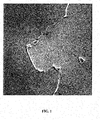
- the heat treating includes heat treating the homogenized ingot to a temperature from about 1700 °F to about 1850 °F for 2 hours or 1750 °F to about 1800 °F for 2 hours or about 1775 °F for 2 hours to form fine discrete carbides and an eta-phase microstructure along the grain boundaries (see, for example, FIG. 1 ). After the heat treatment, an aging process is provided.
- a multi-step aging is utilized, including aging the heat treated ingot at a first aging temperature from about 1200 °F to about 1500 °F for 8 hours or about 1300 °F to about 1400 °F for 8 hours or about 1350 °F for 8 hours and then at a second aging temperature from about 1000 °F to about 1200 °F for 8 hours or 1050 °F to about 1150 °F for 8 hours or about 1100 °F for 8 hours to form an aged ingot having fine precipitates in matrix of the alloy (see, for example, FIG. 2 ).
- a 3 rd step of age may be applied.
- the component is a power generation system component.
- the component may be a turbine stator component including, but not limited to, a nozzle, a shroud, other suitable portions, or combinations thereof.
- Alloys 1-3 are alloys according to the present disclosure.
- Comparative Alloy 4 is an INCONEL ® 706 alloy and Comparative Alloy 6 is an INCOLOY ® 901 alloy.
- All of the alloys shown in Table 2 are investment cast alloys according to the indicated composition. In addition, the alloys in Table 2 were heat treated by homogenization, heat treatment and double aging.
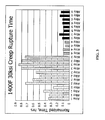
- FIG. 3 shows the creep rupture time for Alloys 1-6.
- FIG. 4 shows the tensile properties, including the % elongation, tensile strength and 0.2% yield strength of Alloys 1-6.
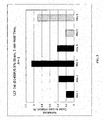
- FIG. 5 shows low cycle fatigue (LCF) values at 1400 °F with 0.5% strain and 2 min hold for Alloys 1-6.
- Alloys 1-3 according to the present disclosure showed about 5-10 times improvement in 1400 °F creep over the Alloy 6, INCOLOY ® 901 alloy and the Alloy 4, INCONEL ® 706 alloy baseline.
- LCF capability at the given condition (1400 °F, 0.5% total strain, 2 minutes hold time) reached 2000 cycles, which is substantially the same as that of a nickel-base alloy, GTD-222.
- Alloys 1-3 according to the present disclosure, showed excellent castability, and heat treatment feasibility, which is evidenced by microstructure and mechanical properties.
Landscapes
- Chemical & Material Sciences (AREA)
- Engineering & Computer Science (AREA)
- Materials Engineering (AREA)
- Mechanical Engineering (AREA)
- Metallurgy (AREA)
- Organic Chemistry (AREA)
- Physics & Mathematics (AREA)
- Thermal Sciences (AREA)
- Crystallography & Structural Chemistry (AREA)
- Turbine Rotor Nozzle Sealing (AREA)
- Refinement Of Pig-Iron, Manufacture Of Cast Iron, And Steel Manufacture Other Than In Revolving Furnaces (AREA)
Applications Claiming Priority (1)
| Application Number | Priority Date | Filing Date | Title |
|---|---|---|---|
| US13/299,823 US20130126056A1 (en) | 2011-11-18 | 2011-11-18 | Cast nickel-iron-base alloy component and process of forming a cast nickel-iron-base alloy component |
Publications (2)
| Publication Number | Publication Date |
|---|---|
| EP2617846A2 true EP2617846A2 (fr) | 2013-07-24 |
| EP2617846A3 EP2617846A3 (fr) | 2014-02-12 |
Family
ID=47216106
Family Applications (1)
| Application Number | Title | Priority Date | Filing Date |
|---|---|---|---|
| EP20120191913 Withdrawn EP2617846A3 (fr) | 2011-11-18 | 2012-11-09 | Composant d'alliage à base de nickel-fer et procédé de formation d'un composant d'alliage à base de nickel-fer |
Country Status (3)
| Country | Link |
|---|---|
| US (1) | US20130126056A1 (fr) |
| EP (1) | EP2617846A3 (fr) |
| JP (1) | JP2013108176A (fr) |
Families Citing this family (3)
| Publication number | Priority date | Publication date | Assignee | Title |
|---|---|---|---|---|
| US9206704B2 (en) | 2013-07-11 | 2015-12-08 | General Electric Company | Cast CrMoV steel alloys and the method of formation and use in turbines thereof |
| US11866809B2 (en) | 2021-01-29 | 2024-01-09 | Ut-Battelle, Llc | Creep and corrosion-resistant cast alumina-forming alloys for high temperature service in industrial and petrochemical applications |
| US11479836B2 (en) | 2021-01-29 | 2022-10-25 | Ut-Battelle, Llc | Low-cost, high-strength, cast creep-resistant alumina-forming alloys for heat-exchangers, supercritical CO2 systems and industrial applications |
Family Cites Families (4)
| Publication number | Priority date | Publication date | Assignee | Title |
|---|---|---|---|---|
| US7118636B2 (en) * | 2003-04-14 | 2006-10-10 | General Electric Company | Precipitation-strengthened nickel-iron-chromium alloy |
| FR2910912B1 (fr) * | 2006-12-29 | 2009-02-13 | Areva Np Sas | Procede de traitement thermique de desensibilisation a la fissuration assistee par l'environnement d'un alliage a base nickel, et piece realisee en cet alliage ainsi traitee |
| US8313593B2 (en) * | 2009-09-15 | 2012-11-20 | General Electric Company | Method of heat treating a Ni-based superalloy article and article made thereby |
| US20120051963A1 (en) * | 2010-08-30 | 2012-03-01 | General Electric Company | Nickel-iron-base alloy and process of forming a nickel-iron-base alloy |
-
2011
- 2011-11-18 US US13/299,823 patent/US20130126056A1/en not_active Abandoned
-
2012
- 2012-11-09 EP EP20120191913 patent/EP2617846A3/fr not_active Withdrawn
- 2012-11-16 JP JP2012251728A patent/JP2013108176A/ja active Pending
Non-Patent Citations (1)
| Title |
|---|
| None |
Also Published As
| Publication number | Publication date |
|---|---|
| EP2617846A3 (fr) | 2014-02-12 |
| US20130126056A1 (en) | 2013-05-23 |
| JP2013108176A (ja) | 2013-06-06 |
Similar Documents
| Publication | Publication Date | Title |
|---|---|---|
| US11566313B2 (en) | Method for manufacturing Ni-based alloy member | |
| Kushan et al. | ALLVAC 718 Plus™ superalloy for aircraft engine applications | |
| CN102816965B (zh) | 钴-镍基合金和由此制造物品的方法 | |
| JP2021172852A (ja) | Ni基合金補修部材および該補修部材の製造方法 | |
| CN111051548A (zh) | 可沉淀硬化的钴-镍基高温合金和由其制造的制品 | |
| CN101294251A (zh) | 燃气轮机叶片及其制造方法 | |
| JP4409409B2 (ja) | Ni−Fe基超合金とその製造法及びガスタービン | |
| CN110520545B (zh) | 镍基合金如合金282的热处理方法、所述合金及其组件 | |
| EP2065479A2 (fr) | Alliage eutectique de nickel ternaire | |
| JP5597598B2 (ja) | Ni基超合金と、それを用いたガスタービンのタービン動・静翼 | |
| EP2290115B1 (fr) | Procédé de fabrication de pales de turbine | |
| EP2913416B1 (fr) | Article et procédé de formation d'un article | |
| EP2617846A2 (fr) | Composant d'alliage à base de nickel-fer et procédé de formation d'un composant d'alliage à base de nickel-fer | |
| CA2878711A1 (fr) | Superalliage a base de nickel, traitement associe et composants formes a partir de celui-ci | |
| JP2007191791A (ja) | ニッケル基超合金組成物 | |
| JP2023155166A (ja) | 組成物、物品並びにその形成方法 | |
| JP5791998B2 (ja) | ニッケル−鉄基合金及びニッケル−鉄基合金を形成する方法 | |
| JP2706328B2 (ja) | Ni基超耐熱合金用耐食・耐酸化コーティング時の熱処理方法 | |
| TWI918844B (zh) | 鎳基超合金 | |
| JP2014005528A (ja) | Ni基耐熱合金およびタービン用部品 | |
| RU208686U1 (ru) | Блок из трех полых направляющих лопаток турбины для газотурбинных двигателей и энергетических установок | |
| WO2013167513A1 (fr) | Procédé de fabrication d'éléments en superalliages monocristallins (sx) ou solidifiés de manière directionnelle (ds) | |
| JP2020037899A (ja) | ガスタービン静翼の補修方法および高強度化ガスタービン静翼の製造方法 | |
| KR102197355B1 (ko) | 니켈기 단결정 초내열합금 | |
| Wahl et al. | An overview of advanced Ni-base superalloys for small turbines and missile Engine applications |
Legal Events
| Date | Code | Title | Description |
|---|---|---|---|
| PUAI | Public reference made under article 153(3) epc to a published international application that has entered the european phase |
Free format text: ORIGINAL CODE: 0009012 |
|
| AK | Designated contracting states |
Kind code of ref document: A2 Designated state(s): AL AT BE BG CH CY CZ DE DK EE ES FI FR GB GR HR HU IE IS IT LI LT LU LV MC MK MT NL NO PL PT RO RS SE SI SK SM TR |
|
| AX | Request for extension of the european patent |
Extension state: BA ME |
|
| PUAL | Search report despatched |
Free format text: ORIGINAL CODE: 0009013 |
|
| AK | Designated contracting states |
Kind code of ref document: A3 Designated state(s): AL AT BE BG CH CY CZ DE DK EE ES FI FR GB GR HR HU IE IS IT LI LT LU LV MC MK MT NL NO PL PT RO RS SE SI SK SM TR |
|
| AX | Request for extension of the european patent |
Extension state: BA ME |
|
| RIC1 | Information provided on ipc code assigned before grant |
Ipc: C22F 1/10 20060101ALI20140108BHEP Ipc: F01D 9/02 20060101ALI20140108BHEP Ipc: C22C 19/05 20060101AFI20140108BHEP Ipc: F01D 5/00 20060101ALI20140108BHEP |
|
| 17P | Request for examination filed |
Effective date: 20140812 |
|
| RBV | Designated contracting states (corrected) |
Designated state(s): AL AT BE BG CH CY CZ DE DK EE ES FI FR GB GR HR HU IE IS IT LI LT LU LV MC MK MT NL NO PL PT RO RS SE SI SK SM TR |
|
| GRAP | Despatch of communication of intention to grant a patent |
Free format text: ORIGINAL CODE: EPIDOSNIGR1 |
|
| INTG | Intention to grant announced |
Effective date: 20150409 |
|
| STAA | Information on the status of an ep patent application or granted ep patent |
Free format text: STATUS: THE APPLICATION IS DEEMED TO BE WITHDRAWN |
|
| 18D | Application deemed to be withdrawn |
Effective date: 20150820 |