EP2617848A1 - Acier à paliers - Google Patents
Acier à paliers Download PDFInfo
- Publication number
- EP2617848A1 EP2617848A1 EP11824893.9A EP11824893A EP2617848A1 EP 2617848 A1 EP2617848 A1 EP 2617848A1 EP 11824893 A EP11824893 A EP 11824893A EP 2617848 A1 EP2617848 A1 EP 2617848A1
- Authority
- EP
- European Patent Office
- Prior art keywords
- cementite
- excluding
- less
- present
- rolling fatigue
- Prior art date
- Legal status (The legal status is an assumption and is not a legal conclusion. Google has not performed a legal analysis and makes no representation as to the accuracy of the status listed.)
- Withdrawn
Links
Images

Classifications
-
- C—CHEMISTRY; METALLURGY
- C22—METALLURGY; FERROUS OR NON-FERROUS ALLOYS; TREATMENT OF ALLOYS OR NON-FERROUS METALS
- C22C—ALLOYS
- C22C38/00—Ferrous alloys, e.g. steel alloys
- C22C38/60—Ferrous alloys, e.g. steel alloys containing lead, selenium, tellurium, or antimony, or more than 0.04% by weight of sulfur
-
- C—CHEMISTRY; METALLURGY
- C22—METALLURGY; FERROUS OR NON-FERROUS ALLOYS; TREATMENT OF ALLOYS OR NON-FERROUS METALS
- C22C—ALLOYS
- C22C38/00—Ferrous alloys, e.g. steel alloys
- C22C38/18—Ferrous alloys, e.g. steel alloys containing chromium
- C22C38/28—Ferrous alloys, e.g. steel alloys containing chromium with titanium or zirconium
-
- C—CHEMISTRY; METALLURGY
- C21—METALLURGY OF IRON
- C21D—MODIFYING THE PHYSICAL STRUCTURE OF FERROUS METALS; GENERAL DEVICES FOR HEAT TREATMENT OF FERROUS OR NON-FERROUS METALS OR ALLOYS; MAKING METAL MALLEABLE, e.g. BY DECARBURISATION OR TEMPERING
- C21D1/00—General methods or devices for heat treatment, e.g. annealing, hardening, quenching or tempering
- C21D1/26—Methods of annealing
- C21D1/32—Soft annealing, e.g. spheroidising
-
- C—CHEMISTRY; METALLURGY
- C21—METALLURGY OF IRON
- C21D—MODIFYING THE PHYSICAL STRUCTURE OF FERROUS METALS; GENERAL DEVICES FOR HEAT TREATMENT OF FERROUS OR NON-FERROUS METALS OR ALLOYS; MAKING METAL MALLEABLE, e.g. BY DECARBURISATION OR TEMPERING
- C21D9/00—Heat treatment, e.g. annealing, hardening, quenching or tempering, adapted for particular articles; Furnaces therefor
- C21D9/40—Heat treatment, e.g. annealing, hardening, quenching or tempering, adapted for particular articles; Furnaces therefor for rings; for bearing races
-
- C—CHEMISTRY; METALLURGY
- C22—METALLURGY; FERROUS OR NON-FERROUS ALLOYS; TREATMENT OF ALLOYS OR NON-FERROUS METALS
- C22C—ALLOYS
- C22C38/00—Ferrous alloys, e.g. steel alloys
- C22C38/001—Ferrous alloys, e.g. steel alloys containing N
-
- C—CHEMISTRY; METALLURGY
- C22—METALLURGY; FERROUS OR NON-FERROUS ALLOYS; TREATMENT OF ALLOYS OR NON-FERROUS METALS
- C22C—ALLOYS
- C22C38/00—Ferrous alloys, e.g. steel alloys
- C22C38/002—Ferrous alloys, e.g. steel alloys containing In, Mg, or other elements not provided for in one single group C22C38/001 - C22C38/60
-
- C—CHEMISTRY; METALLURGY
- C22—METALLURGY; FERROUS OR NON-FERROUS ALLOYS; TREATMENT OF ALLOYS OR NON-FERROUS METALS
- C22C—ALLOYS
- C22C38/00—Ferrous alloys, e.g. steel alloys
- C22C38/02—Ferrous alloys, e.g. steel alloys containing silicon
-
- C—CHEMISTRY; METALLURGY
- C22—METALLURGY; FERROUS OR NON-FERROUS ALLOYS; TREATMENT OF ALLOYS OR NON-FERROUS METALS
- C22C—ALLOYS
- C22C38/00—Ferrous alloys, e.g. steel alloys
- C22C38/04—Ferrous alloys, e.g. steel alloys containing manganese
-
- C—CHEMISTRY; METALLURGY
- C22—METALLURGY; FERROUS OR NON-FERROUS ALLOYS; TREATMENT OF ALLOYS OR NON-FERROUS METALS
- C22C—ALLOYS
- C22C38/00—Ferrous alloys, e.g. steel alloys
- C22C38/06—Ferrous alloys, e.g. steel alloys containing aluminium
-
- C—CHEMISTRY; METALLURGY
- C22—METALLURGY; FERROUS OR NON-FERROUS ALLOYS; TREATMENT OF ALLOYS OR NON-FERROUS METALS
- C22C—ALLOYS
- C22C38/00—Ferrous alloys, e.g. steel alloys
- C22C38/14—Ferrous alloys, e.g. steel alloys containing titanium or zirconium
-
- C—CHEMISTRY; METALLURGY
- C22—METALLURGY; FERROUS OR NON-FERROUS ALLOYS; TREATMENT OF ALLOYS OR NON-FERROUS METALS
- C22C—ALLOYS
- C22C38/00—Ferrous alloys, e.g. steel alloys
- C22C38/18—Ferrous alloys, e.g. steel alloys containing chromium
- C22C38/20—Ferrous alloys, e.g. steel alloys containing chromium with copper
-
- C—CHEMISTRY; METALLURGY
- C22—METALLURGY; FERROUS OR NON-FERROUS ALLOYS; TREATMENT OF ALLOYS OR NON-FERROUS METALS
- C22C—ALLOYS
- C22C38/00—Ferrous alloys, e.g. steel alloys
- C22C38/18—Ferrous alloys, e.g. steel alloys containing chromium
- C22C38/24—Ferrous alloys, e.g. steel alloys containing chromium with vanadium
-
- C—CHEMISTRY; METALLURGY
- C22—METALLURGY; FERROUS OR NON-FERROUS ALLOYS; TREATMENT OF ALLOYS OR NON-FERROUS METALS
- C22C—ALLOYS
- C22C38/00—Ferrous alloys, e.g. steel alloys
- C22C38/18—Ferrous alloys, e.g. steel alloys containing chromium
- C22C38/26—Ferrous alloys, e.g. steel alloys containing chromium with niobium or tantalum
-
- C—CHEMISTRY; METALLURGY
- C22—METALLURGY; FERROUS OR NON-FERROUS ALLOYS; TREATMENT OF ALLOYS OR NON-FERROUS METALS
- C22C—ALLOYS
- C22C38/00—Ferrous alloys, e.g. steel alloys
- C22C38/18—Ferrous alloys, e.g. steel alloys containing chromium
- C22C38/40—Ferrous alloys, e.g. steel alloys containing chromium with nickel
- C22C38/44—Ferrous alloys, e.g. steel alloys containing chromium with nickel with molybdenum or tungsten
-
- C—CHEMISTRY; METALLURGY
- C22—METALLURGY; FERROUS OR NON-FERROUS ALLOYS; TREATMENT OF ALLOYS OR NON-FERROUS METALS
- C22C—ALLOYS
- C22C38/00—Ferrous alloys, e.g. steel alloys
- C22C38/18—Ferrous alloys, e.g. steel alloys containing chromium
- C22C38/40—Ferrous alloys, e.g. steel alloys containing chromium with nickel
- C22C38/50—Ferrous alloys, e.g. steel alloys containing chromium with nickel with titanium or zirconium
-
- F—MECHANICAL ENGINEERING; LIGHTING; HEATING; WEAPONS; BLASTING
- F16—ENGINEERING ELEMENTS AND UNITS; GENERAL MEASURES FOR PRODUCING AND MAINTAINING EFFECTIVE FUNCTIONING OF MACHINES OR INSTALLATIONS; THERMAL INSULATION IN GENERAL
- F16C—SHAFTS; FLEXIBLE SHAFTS; ELEMENTS OR CRANKSHAFT MECHANISMS; ROTARY BODIES OTHER THAN GEARING ELEMENTS; BEARINGS
- F16C33/00—Parts of bearings; Special methods for making bearings or parts thereof
- F16C33/30—Parts of ball or roller bearings
- F16C33/58—Raceways; Race rings
- F16C33/62—Selection of substances
-
- C—CHEMISTRY; METALLURGY
- C21—METALLURGY OF IRON
- C21D—MODIFYING THE PHYSICAL STRUCTURE OF FERROUS METALS; GENERAL DEVICES FOR HEAT TREATMENT OF FERROUS OR NON-FERROUS METALS OR ALLOYS; MAKING METAL MALLEABLE, e.g. BY DECARBURISATION OR TEMPERING
- C21D2211/00—Microstructure comprising significant phases
- C21D2211/003—Cementite
-
- C—CHEMISTRY; METALLURGY
- C21—METALLURGY OF IRON
- C21D—MODIFYING THE PHYSICAL STRUCTURE OF FERROUS METALS; GENERAL DEVICES FOR HEAT TREATMENT OF FERROUS OR NON-FERROUS METALS OR ALLOYS; MAKING METAL MALLEABLE, e.g. BY DECARBURISATION OR TEMPERING
- C21D2211/00—Microstructure comprising significant phases
- C21D2211/009—Pearlite
Definitions
- the present invention relates to a bearing steel applied to bearing parts and machine structural parts used for automobiles, various industrial machines, and the like.
- the present invention particularly relates to a bearing steel that exhibits excellent cold workability in the production of bearing parts or machine structural parts by cold working and also exhibits excellent abrasion resistance and rolling fatigue characteristics in parts after working.
- a bearing part or a machine structural part is processed into the final shape through the processing of a wire rod or a steel bar, such as scission, forging, or cutting.
- a rolled material is so hard as it is that cold working is difficult. Therefore, the material is usually subjected to spheroidizing annealing prior to the cold working for the purpose of improving cold workability.
- the ensuring of excellent cold workability is important also in terms of improving productivity and saving energy, thereby reducing cost and CO 2 emission.
- parts such as bearings and crank shafts are important parts that support rotating portions or sliding portions of machines. Because of the considerably high contact pressure and also of the varying external force, they are often used in severe environments. Therefore, steel materials, which are their raw materials, are required to have excellent durability.
- a high-carbon chromium bearing steel such as SUJ2 specified in JIS G 4805 (1999)
- SUJ2 specified in JIS G 4805 (1999)
- a steel material has high contents of carbon (0.95 to 1.1% by mass) and Cr (1.3 to 1. 6% by mass), and coarse eutectic carbides, which adversely affect rolling fatigue characteristics, etc., are tend to be produced (e.g., precipitates of not less than 10 ⁇ m).
- Patent Document 1 proposes a technique in which the contents of C (less than 0.6 to 0.95% by mass) and Cr (less than 1.3% by mass) are reduced, and also a specified content of B (0.0002 to 0.01% by mass) is included, thereby achieving the omission of the homogenization heat treatment and the shortening of the spheroidizing annealing time, so that the production cost is saved, and also excellent rolling fatigue characteristics and abrasion resistance are both ensured.
- this technique does not consider cold forgeability and may have a problem of cracking during cold forging, etc.
- Patent Document 2 proposes a technique in which the content of C (0.70 to 0.95% by mass) is reduced to shorten the diffusion annealing time, while a specified content of Sb (less than 0.0010% by mass) is included to improve rolling fatigue characteristics.
- this technique does not consider cold forgeability either and may have a problem of cracking during cold forging, etc.
- Patent Document 3 discloses a patent in which after the spheroidizing annealing treatment, the average particle size of ferrite and the average particle size of cementite after cold drawing are specified to improve cold workability.
- the C and Cr contents are high, and eutectic carbides may be produced, diffusion annealing is indispensable. Further, because 20 to 40% cold drawing is performed after spheroidizing annealing, the yield of the steel material decreases, resulting in increased production cost.
- An object of the present invention is to establish a bearing steel capable of exhibiting excellent cold workability in cold working that follows spheroidizing annealing and also capable of ensuring excellent abrasion resistance and rolling fatigue characteristics as a bearing member or the like. Further, another object of the present invention is to provide a steel material that allows for the production of a bearing steel having such excellent properties even when diffusion annealing is omitted.
- the gist of the bearing steel of the present invention that has achieved the object mentioned above is as follows.
- the bearing steel contains C: 0.9 to 1.10% (% by mass, the same applies hereinafter), Si: 0.05 to 0.49%, Mn: 0.1 to 1.0%, P: not more than 0.05% (excluding 0%), S: not more than 0.05% (excluding 0%), Cr: 0.03 to 0.40%, Al: not more than 0.05% (excluding 0%), N: 0.002 to 0.025%, Ti: not more than 0.0030% (excluding 0%), and O: not more than 0.0025% (excluding 0%), with the remainder being iron and unavoidable impurities.
- the average aspect ratio of cementite is not more than 2.00, the average circle-equivalent diameter of cementite is 0.35 to 0.6 ⁇ m, and the number density of cementite having a circle-equivalent diameter of not less than 0.13 ⁇ m is not less than 0.45/ ⁇ m 2 .
- the bearing steel further contains, as an additional element, at least one member selected from the group consisting of Cu: not more than 0.25% (excluding 0%), Ni: not more than 0.25% (excluding 0%), and Mo: not more than 0.25% (excluding 0%).
- the bearing steel further contains, as an additional element, Nb: not more than 0.5% (excluding 0%) and/or V: not more than 0.5% (excluding 0%).
- the chemical component composition is appropriately adjusted, and also cementite having a proper size (aspect ratio, equivalent circle diameter) is appropriately dispersed in the steel material (number density).
- a bearing steel capable of ensuring excellent cold workability and also excellent abrasion resistance and rolling fatigue characteristics hereinafter rolling fatigue characteristics and abrasion resistance may be collectively referred to as "durability"
- durability rolling fatigue characteristics and abrasion resistance
- the bearing steel of the present invention which has a reduced Cr content, does not require long-time diffusion annealing that has been indispensable for conventional SUJ2, and also a spheroidizing annealing treatment can be performed within a short period of time. Therefore, the present invention is also useful for improving productivity and saving energy, thereby reducing cost and CO 2 emission.
- the present inventors have conducted examination from various angles to aim for the realization of a bearing steel that exhibits excellent cold workability and durability. As a result, it has been found that in order to achieve excellent cold workability and improve durability in a steel material, it is effective to appropriately control the chemical component composition of the steel material and also control cementite, especially to satisfy the following requirements (A) and (B) :
- the present inventors have conducted extensive research to improve the cold workability, abrasion resistance, and rolling fatigue characteristics of a steel material. As a result, they have found that a steel material excellent in terms of the above properties can be achieved when the chemical component composition in the steel material is controlled, and also the production conditions are controlled such that, after spheroidizing annealing, the average aspect ratio of cementite is not more than 2.00, the average circle-equivalent diameter of cementite is 0.35 to 0.6 ⁇ m, and the number density of cementite having a circle-equivalent diameter of not less than 0.13 ⁇ m is not less than 0.45/ ⁇ m 2 .
- the present invention has thus been accomplished.
- the Cr content is reduced, whereby the production of coarse eutectoid carbides is suppressed.
- a decrease in the Cr content makes it difficult to obtain a steel that satisfies the above specified cementite.
- production conditions have been studied. As a result, it has been found that even in the case where the Cr content is reduced, when the production conditions are strictly controlled, the above specified cementite can be satisfied.
- the long-time diffusion annealing which has been indispensable for conventional steel (SUJ2), is omitted, and also the spheroidizing annealing treatment time is shortened, the bearing steel of the present invention having the above excellent properties can be produced.
- the average aspect ratio of cementite is not more than 2.00.
- the average aspect ratio is preferably not more than 1.90, and more preferably not more than 1.70.
- the aspect ratio above is a ratio between the major axis and minor axis of cementite based on the measurement method given in the Examples below.
- the average aspect ratio in the present invention is an average of 12 fields.
- the average size of cementite also affects cold workability and rolling fatigue characteristics, and thus it is necessary that the average circle-equivalent diameter is 0. 35 to 0.6 ⁇ m.
- the average circle-equivalent diameter of cementite is less than 0.35 ⁇ m, deformation resistance increases due to dispersion hardening, whereby cold workability deteriorate.
- cementite disappears during the quenching and tempering treatment, and desired durability is not obtained.
- the average circle-equivalent diameter is preferably not less than 0.40 ⁇ m, and more preferably not less than 0.45 ⁇ m.
- the average circle-equivalent diameter of cementite is more than 0.6 ⁇ m, this enlarges the fragile site surrounding cementite after quenching and tempering, whereby cracking is likely to occur and progress, resulting in the deterioration of rolling fatigue characteristics.
- the average circle-equivalent diameter is preferably not more than 0.55 ⁇ m, and more preferably not more than 0.5 ⁇ m.
- the circle-equivalent diameter means, focusing on the size of cementite, the diameter of a circle assumed to have an equal area. As will be described later in the Examples, the circle-equivalent diameter is that of cementite observed on the observation plane under a scanning electron microscope (SEM), and the average circle-equivalent diameter in the present invention is an average of 12 fields.
- SEM scanning electron microscope
- the number density of cementite having a circle-equivalent diameter of not less than 0.13 ⁇ m identified by the observation of cementite is less than 0.45/ ⁇ m 2 , the abrasion-resistance-improving effect of the dispersion of hard cementite is not effectively exhibited. Therefore, the number density of cementite having a circle-equivalent diameter of not less than 0.13 ⁇ m is preferably not less than 0.48/ ⁇ m 2 , and more preferably not less than 0 . 51/ ⁇ m 2 . No particular upper limit is placed on the number density. However, when the number density is too high, deformation resistance may increase due to dispersion hardening, resulting in the deterioration of cold workability.
- the number density of cementite is preferably not more than 1.0/ ⁇ m 2 , and more preferably not more than 0.75/ ⁇ m 2 . As will be described later in the Examples, the number density of the present invention is a value obtained by observation in 12 fields.
- Coarse precipitates means, for example, those having a major axis of not less than 10 ⁇ m.
- the appropriate adjustment of the chemical component composition (C, Si, Mn, P, S, Cr, Al, N, Ti, O, etc.), including the reduction of the Cr content, is necessary.
- the reasons for the range limitation on these components are as follows.
- the C is an element that is indispensable for increasing quenching hardness, maintaining strength at room temperature and high temperatures, and dispersing cementite to impart abrasion resistance and rolling fatigue characteristics, and also for improving cold workability.
- the C content has to be not less than 0.9%, preferably not less than 0.95%, and more preferably not less than 0.97%.
- the C content should be not more than 1.10%, preferably not more than 1.07%, and more preferably not more than 1.03%.
- the Si is an element useful to improve matrix solid-solution strengthening and hardenability.
- the Si content has to be not less than 0.05%, preferably not less than 0.1%, and more preferably not less than 0.2%.
- the Si content should be not more than 0.49%, preferably not more than 0.35%, and more preferably not more than 0.30%.
- Mn is an element useful to improve matrix solid-solution strengthening and hardenability.
- the Mn content has to be not less than 0.1%, preferably not less than 0.15%, and more preferably not less than 0.2%.
- the Mn content should be not more than 1.0%, preferably not more than 0.85%, and more preferably not more than 0.8%.
- P is an element that is unavoidably present as an impurity. P segregates at the grain boundary and deteriorates cold workability, and thus is preferably minimized. However, extreme reduction causes an increase in steel production cost. For this reason, the P content has been specified to be not more than 0.05%. The content is reduced to preferably not more than 0.04%, and more preferably not more than 0.03%.
- S is an element that is unavoidably present as an impurity. S precipitates at the grain boundary as FeS and deteriorates cold workability, and also precipitates as MnS and deteriorates rolling fatigue characteristics. Therefore, S is preferably minimized, but extreme reduction causes an increase in steel production cost. For this reason, the S content has been specified to be not more than 0.05%. The content is reduced to preferably not more than 0.04%, and more preferably not more than 0.03%.
- Cr is an element that is bonded to C and forms a carbide to improve abrasion resistance and cold workability. In order to obtain such effects, it is necessary that the Cr content is not less than 0.03%.
- the content is preferably not less than 0.1%, and more preferably not less than 0.2%.
- Cr is an element that is prone to segregation, when the Cr content is too high, coarse carbides are produced, resulting in the deterioration of rolling fatigue characteristics. Therefore, the Cr content is specified to be not more than 0.40%.
- the content is preferably not more than 0.35%, and more preferably not more than 0.3%.
- Al is effective as a deoxidizing element.
- Al is an element that reduces the amount of oxygen in the steel to enhance rolling fatigue characteristics, and is also bonded to N and forms AlN to improve rolling fatigue characteristics.
- the Al content is not less than 0.015%.
- the Al content is not more than 0.05%, preferably not more than 0.04%, and more preferably not more than 0.03%.
- N is an element that is bonded to Al and allows the fine dispersion of an Al-based nitrogen compound to exhibit its improving effect on rolling fatigue characteristics.
- the N content is not less than 0.002%, preferably not less than 0.004%, and more preferably not less than 0.005%.
- the N content is not more than 0.025%, preferably not more than 0.020%, and more preferably not more than 0.010%.
- Ti is a harmful element that is bonded to N in the steel and produces TiN, thereby not only adversely affecting rolling fatigue characteristics but also impairing cold workability and hot workability. Therefore, Ti is preferably minimized, but extreme reduction causes an increase in steel production cost. For this reason, the Ti content has to be not more than 0.0030%. Incidentally, the upper limit on the Ti content is preferably not more than 0.0015%, and more preferably not more than 0.0010%.
- O greatly affects the form of impurities in the steel and forms inclusions such as Al 2 O 3 and SiO 2 that adversely affect rolling fatigue characteristics. Therefore, O is preferably minimized, but extreme reduction causes an increase in steel production cost. For this reason, the O content has to be not more than 0.0025%.
- the upper limit on the O content is preferably not more than 0.002%, and more preferably not more than 0.0015%.
- the contained elements specified in the present invention are as above, and the remainder is iron and unavoidable impurities.
- the unavoidable impurities the incorporation of elements introduced depending on the conditions including raw materials, materials, production facilities, and the like is acceptable. Incidentally, it is also possible to positively introduce the following elements within the specified ranges to enhance rolling fatigue characteristics.
- Cu, Ni, and Mo are each an element that functions as an element that improves the hardenability of the parent phase and enhances hardness to contribute to the improvement of rolling fatigue characteristics. Any one or more of them may be contained. These effects are effectively exhibited when the contents are each preferably not less than 0.03%, and more preferably not less than 0.05%. However, in each case, a content of more than 0.25% leads to the deterioration of processability. The content is preferably not more than 0.23%, and more preferably not more than 0.20%.
- Nb and V are each an element that is bonded to N and forms a nitrogen compound to thereby size crystal grains. They are effective in improving rolling fatigue characteristics and can be used alone or in combination. These effects are effectively exhibited when the contents are each preferably not less than 0.001%, and more preferably not less than 0.003%. However, in each case, a content of more than 0.5% leads to the formation of fine crystal grains, whereby an incomplete quenching phase is likely to be formed.
- the contents are each preferably not more than 0.3%, and more preferably not more than 0.1%.
- the Cr content is specified to be within the range mentioned above.
- the production conditions especially the conditions of spheroidizing annealing performed after rolling
- a steel material obtained by hot rolling is heated to the soaking temperature (A1 + 10°C to A1 + 40°C) at an average temperature rise rate of 40 to 100°C/hr, and then retained at the soaking temperature for 4 to 8 hours.
- the soaking temperature is reduced to (A1 - 60°C) at a primary cooling rate (average cooling rate) within a range of 5 to 15°C/hr and further allowed to drop to room temperature (25°C) as secondary cooling.
- a primary cooling rate average cooling rate
- room temperature 25°C
- the average temperature rise rate is preferably not less than 50°C/hr, and more preferably not less than 60°C/hr, and is also preferably not more than 90°C/hr, and more preferably not more than 80°C/hr.
- the soaking temperature is less than A1 + 10°C, pearlite cannot be divided, and the aspect ratio of cementite exceeds the above specified value.
- the soaking temperature is more than A1 + 40°C, cementite in pearlite is excessively dissolved, causing the precipitation of regenerated pearlite. As a result, the aspect ratio exceeds the above specified value.
- cementite In cooling at a primary cooling rate of less than 5°C/hr, cementite is coarsened, and the desired size is not obtained. In addition, when it is more than 15°C/hr, cementite is provided with a small diameter, and the above predetermined size is not obtained.
- primary cooling is performed within a range from the soaking temperature to (A1 - 60°C). This is the temperature set to reliably obtain the above specified cementite. Therefore, as long as the above specified cementite is obtained, the primary cooling finishing temperature may be higher (e.g., A1 - 50°C, etc.). In addition, when cooling is performed at the above primary cooling rate after the temperature reached A1 - 60°C, productivity deteriorates.
- the secondary cooling rate is not particularly limited. However, in terms of improving productivity, it is preferable that the temperature is allowed to drop (allowed to cool in the air).
- the steel material of the present invention is subjected to spheroidizing annealing as above, then processed into a predetermined part shape, quenched and tempered, and thereby formed into a bearing part, etc.
- the shapes of steel materials include any of linear and cylindrical shapes that can be applied to such production, and the size can also be suitably determined according to the final product.
- the structure of the bearing steel of the present invention after spheroidizing annealing is specified. It has been confirmed by an experiment that when a bearing steel satisfies the above specified structure after spheroidizing annealing, in the case where it is processed into a predetermined part shape, subsequently quenched, and tempered into a bearing part, such a bearing part exhibits excellent abrasion resistance and rolling fatigue characteristics when used (see the Examples below).
- Steel materials of the chemical component composition shown in Table 1 below were each heated to 1100 to 1300°C in a heating furnace, then bloomed at 900 to 1200°C, and subsequently hot rolled at a temperature range of 800 to 1100°C (including forging that simulates rolling) to give a round bar material having a diameter of 65 mm.
- the obtained round bar material was subjected to spheroidizing annealing under the spheroidizing heat treatment conditions shown in Table 2 (temperature rise rate, soaking temperature, soaking time, and primary cooling rate to A1 - 60°C) to give a test material. At this time, the temperature was allowed to drop from A1 - 60°C to room temperature (25°C) in the air (secondary cooling).
- test material No. 1 was soaked in a soaking furnace at 1230°C for 17 hours (diffusion annealing) and then hot rolled (No. 1 was used as the standard steel for comparison).
- test material was cut perpendicularly to the longitudinal direction (rolling direction).
- D is the diameter
- the test material was further cut horizontally in the longitudinal direction.
- the horizontal section was mirror-polished and corroded with 5% picral to cause the phanerosis of the metal structure.
- the horizontal section was observed and photographed in arbitrary 12 positions on the D/4 position line (2688 ⁇ m 2 per field) under a scanning electron microscope (magnification: ⁇ 2000). From the contrast of the image, white parts were determined as cementite particles and marked.
- the number of cementite particles having a circle-equivalent diameter of not less than 0.13 ⁇ m present per unit area was determined ("number density").
- a columnar test piece having a diameter of 14 mm and a height of 21 mm was cut from the center of the test material and used as a test piece for the evaluation of cold workability.
- the test piece was cold worked using a press testing machine at a working rate (compressibility) of 60%. Subsequently, the side of the test piece was observed under an optical microscope (magnification: x20) to determine the presence of cracks.
- deformation resistance (MPa) in the case where the test piece was cold worked at a working rate (compressibility) of 40% was measured, and deformation resistance reduction was calculated by comparison with the deformation resistance of the test piece of the steel No. 1 and evaluated.
- the working rate is represented by [ ⁇ (1 - L/L 0 ) ⁇ ⁇ 100 (%)] (L is the length of a test piece before working, and L 0 is the length of a test piece after working).
- a thrust test piece (shape: disc-like, size: ⁇ 60 mm ⁇ 2 mm in thickness) was prepared from a test material. Using a thrust-type rolling fatigue testing machine ("FJ-5T" manufactured by Fuji Testing Machine Corporation), each test piece was subjected to a rolling fatigue test repeated 16 times under the conditions of rate: 1800 rpm, surface pressure: 5.3 GPa, the number of stoppages: 2 ⁇ 10 8 .
- the fatigue life L 10 (the number of stress repetition until fatigue failure at a cumulative failure probability of 10%, which is obtained by plotting on Weibull probability paper) was thereby evaluated.
- the fatigue life L 10 (L10 life) of the test piece No. 1 was taken as 1.0.
- the rolling fatigue characteristics were rated as excellent.
- the above thrust test piece was repeatedly rotated under the following conditions of rate: 1800 rpm, surface pressure: 5.3 Gpa, the number of stoppages: 1 ⁇ 10 8 .
- the resulting abrasion depth was defined as the amount of abrasion.
- the amount of abrasion of the test piece No. 1 was taken as 1. When a test piece had an abrasion amount of not more than 1.00, the abrasion resistance was rated as excellent.
- Si, Mn, P, S, Al, Ti, and O are outside the ranges specified in the present invention, and thus the number density of cementite is insufficient. As a result, cold workability and rolling fatigue characteristics are poor.
- the Si, Mn, N, P, and S contents are outside the ranges specified in the present invention. As a result, rolling fatigue characteristics are poor.
- Fig. 2 shows the relationship of the average circle-equivalent diameter of cementite, deformation resistance reduction (cold workability), and L10 life ratio (rolling fatigue characteristics) (plotting only examples in which the chemical component composition specified in the present invention is satisfied, and the average aspect ratio is not more than 2.00). It is shown that appropriate control on the size of cementite is effective in improving cold workability and rolling fatigue characteristics.
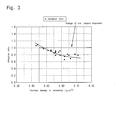
- Fig. 3 shows the relationship between the number density of cementite and abrasion ratio (abrasion resistance) (plotting only examples in which the chemical component composition specified in the present invention is satisfied, and the aspect ratio is not more than 2.00). It is shown that appropriate control on the number density of cementite is effective in improving abrasion resistance.
Landscapes
- Chemical & Material Sciences (AREA)
- Engineering & Computer Science (AREA)
- Mechanical Engineering (AREA)
- Materials Engineering (AREA)
- Metallurgy (AREA)
- Organic Chemistry (AREA)
- Physics & Mathematics (AREA)
- Thermal Sciences (AREA)
- Crystallography & Structural Chemistry (AREA)
- General Engineering & Computer Science (AREA)
- Heat Treatment Of Steel (AREA)
- Heat Treatment Of Sheet Steel (AREA)
Applications Claiming Priority (2)
| Application Number | Priority Date | Filing Date | Title |
|---|---|---|---|
| JP2010207163A JP5425736B2 (ja) | 2010-09-15 | 2010-09-15 | 冷間加工性、耐摩耗性、及び転動疲労特性に優れた軸受用鋼 |
| PCT/JP2011/066847 WO2012035884A1 (fr) | 2010-09-15 | 2011-07-25 | Acier à paliers |
Publications (2)
| Publication Number | Publication Date |
|---|---|
| EP2617848A1 true EP2617848A1 (fr) | 2013-07-24 |
| EP2617848A4 EP2617848A4 (fr) | 2015-07-01 |
Family
ID=45831359
Family Applications (1)
| Application Number | Title | Priority Date | Filing Date |
|---|---|---|---|
| EP11824893.9A Withdrawn EP2617848A4 (fr) | 2010-09-15 | 2011-07-25 | Acier à paliers |
Country Status (8)
| Country | Link |
|---|---|
| US (1) | US9598752B2 (fr) |
| EP (1) | EP2617848A4 (fr) |
| JP (1) | JP5425736B2 (fr) |
| KR (1) | KR101408548B1 (fr) |
| CN (1) | CN103097565B (fr) |
| BR (1) | BR112013005533A2 (fr) |
| TW (1) | TWI448567B (fr) |
| WO (1) | WO2012035884A1 (fr) |
Cited By (2)
| Publication number | Priority date | Publication date | Assignee | Title |
|---|---|---|---|---|
| CN106086678A (zh) * | 2016-08-02 | 2016-11-09 | 东北特钢集团北满特殊钢有限责任公司 | 高寿命轴承钢材料及其加工方法 |
| CN106636883A (zh) * | 2016-09-23 | 2017-05-10 | 龙南日升昌新材料研发有限公司 | 高寿命轴承钢及其制造方法 |
Families Citing this family (27)
| Publication number | Priority date | Publication date | Assignee | Title |
|---|---|---|---|---|
| JP5820326B2 (ja) * | 2012-03-30 | 2015-11-24 | 株式会社神戸製鋼所 | 転動疲労特性に優れた軸受用鋼材およびその製造方法 |
| JP5820325B2 (ja) * | 2012-03-30 | 2015-11-24 | 株式会社神戸製鋼所 | 冷間加工性に優れた軸受用鋼材およびその製造方法 |
| JP5990428B2 (ja) * | 2012-08-21 | 2016-09-14 | 株式会社神戸製鋼所 | 転動疲労特性に優れた軸受用鋼材およびその製造方法 |
| TWI494179B (zh) * | 2012-09-28 | 2015-08-01 | Twdt Prec Co Ltd | Mandrel manufacturing method |
| JP6059570B2 (ja) * | 2013-03-15 | 2017-01-11 | 株式会社神戸製鋼所 | 冷間加工性に優れた鋼材の製造方法 |
| JP6059568B2 (ja) * | 2013-03-15 | 2017-01-11 | 株式会社神戸製鋼所 | 冷間鍛造用鋼の製造方法 |
| CN103160742B (zh) * | 2013-03-28 | 2016-03-30 | 宝山钢铁股份有限公司 | 一种耐磨钢板及其制造方法 |
| JP6328435B2 (ja) * | 2014-01-31 | 2018-05-23 | 株式会社神戸製鋼所 | 冷間鍛造用高炭素低Cr鋼材の球状化熱処理方法 |
| CN105899705B (zh) * | 2014-03-20 | 2017-12-08 | 新日铁住金株式会社 | 良加工性钢线材及其制造方法 |
| JP2015183265A (ja) * | 2014-03-25 | 2015-10-22 | 株式会社神戸製鋼所 | 冷間加工性または被削性に優れた鋼材の製造方法 |
| JP6177753B2 (ja) * | 2014-11-17 | 2017-08-09 | 株式会社神戸製鋼所 | 穴広げ性と転動疲労寿命に優れた高炭素鋼板およびその製造方法 |
| DE102015220299A1 (de) | 2014-11-21 | 2016-05-25 | Hyundai Motor Company | Lagerstahl mit verbesserter Dauerhaltbarkeit und Verfahren zur Herstellung desselbigen |
| CN106756630A (zh) * | 2015-11-24 | 2017-05-31 | 徐文萍 | 一种布氏硬度增强的轴承 |
| CN106756629A (zh) * | 2015-11-24 | 2017-05-31 | 徐文萍 | 一种布氏硬度增强的轴承的制造方法 |
| CN106756633A (zh) * | 2015-11-25 | 2017-05-31 | 徐文萍 | 一种洛氏硬度增强的轴承 |
| CN106756631A (zh) * | 2015-11-25 | 2017-05-31 | 徐文萍 | 一种洛氏硬度增强的轴承的制造方法 |
| CN106756632A (zh) * | 2015-11-25 | 2017-05-31 | 徐文萍 | 一种洛氏硬度增强的轴承钢 |
| CN106801191A (zh) * | 2015-11-25 | 2017-06-06 | 徐文萍 | 一种洛氏硬度增强的轴承钢的制备方法 |
| CN106801203A (zh) * | 2015-11-26 | 2017-06-06 | 徐文萍 | 一种布氏硬度增强的轴承钢的制备方法 |
| CN106801192A (zh) * | 2015-11-26 | 2017-06-06 | 徐文萍 | 一种布氏硬度增强的轴承钢 |
| CN106801205A (zh) * | 2015-11-26 | 2017-06-06 | 徐文萍 | 一种抗拉强度增强的轴承钢 |
| CN106801204A (zh) * | 2015-11-26 | 2017-06-06 | 徐文萍 | 一种抗拉强度增强的轴承 |
| JP2018165408A (ja) * | 2018-06-22 | 2018-10-25 | 株式会社神戸製鋼所 | 冷間加工性または被削性に優れた鋼材の製造方法 |
| JP7681942B2 (ja) | 2019-10-01 | 2025-05-23 | Ntn株式会社 | 軸受部品 |
| KR102421642B1 (ko) * | 2019-12-20 | 2022-07-18 | 주식회사 포스코 | 베어링용 선재 및 이의 제조방법 |
| WO2022065200A1 (fr) * | 2020-09-24 | 2022-03-31 | Ntn株式会社 | Composant de palier et palier à roulement |
| CN119351868B (zh) * | 2024-09-27 | 2025-12-26 | 江阴兴澄特种钢铁有限公司 | 一种耐腐蚀矿用研磨钢球及其生产方法 |
Family Cites Families (27)
| Publication number | Priority date | Publication date | Assignee | Title |
|---|---|---|---|---|
| JPS63135615A (ja) * | 1986-11-27 | 1988-06-08 | Daido Steel Co Ltd | 転動寿命のすぐれた軸受鋼 |
| JP3565960B2 (ja) * | 1995-11-01 | 2004-09-15 | 山陽特殊製鋼株式会社 | 軸受用鋼、軸受および転がり軸受 |
| JPH09302444A (ja) * | 1996-05-14 | 1997-11-25 | Kawasaki Steel Corp | 軸受用鋼 |
| JPH10122243A (ja) * | 1996-10-22 | 1998-05-12 | Nippon Seiko Kk | 転がり軸受 |
| JP3308836B2 (ja) | 1996-12-06 | 2002-07-29 | 川崎製鉄株式会社 | 軸受用鋼 |
| JP3713975B2 (ja) * | 1998-09-17 | 2005-11-09 | 住友金属工業株式会社 | 軸受用鋼 |
| JP4343357B2 (ja) * | 1998-11-11 | 2009-10-14 | Ntn株式会社 | 高温用転がり軸受部品 |
| JP3572993B2 (ja) * | 1999-04-22 | 2004-10-06 | 住友金属工業株式会社 | 鋼線材、鋼線及びその製造方法 |
| JP2000319748A (ja) * | 1999-05-06 | 2000-11-21 | Sanyo Special Steel Co Ltd | 耐遅れ破壊特性に優れた高強度長寿命高周波焼入用鋼及びその製造方法 |
| JP3528676B2 (ja) * | 1999-05-07 | 2004-05-17 | 住友金属工業株式会社 | 鋼線材、鋼線及びその製造方法 |
| JP3405277B2 (ja) * | 1999-08-03 | 2003-05-12 | 住友金属工業株式会社 | 被削性に優れた軸受要素部品用の鋼線材、棒鋼及び鋼管 |
| JP3463651B2 (ja) * | 2000-04-18 | 2003-11-05 | 住友金属工業株式会社 | 軸受用鋼材 |
| JP3971569B2 (ja) * | 2000-12-20 | 2007-09-05 | 新日本製鐵株式会社 | 高強度ばね用熱間圧延線材 |
| JP4003450B2 (ja) * | 2001-12-13 | 2007-11-07 | 住友金属工業株式会社 | 鋼線材、鋼線及びその製造方法 |
| JP3922026B2 (ja) * | 2002-01-07 | 2007-05-30 | 住友金属工業株式会社 | 鋼線材および鋼線 |
| JP3997867B2 (ja) * | 2002-09-04 | 2007-10-24 | 住友金属工業株式会社 | 鋼線材とその製造法及び当該鋼線材を用いる鋼線の製造法 |
| BRPI0406697B1 (pt) * | 2003-01-30 | 2016-06-14 | Nippon Steel & Sumitomo Metal Corp | tubos de aço para peças de elementos de mancais e métodos para produção bem como para usinagem dos mesmos |
| JP4016894B2 (ja) * | 2003-06-12 | 2007-12-05 | 住友金属工業株式会社 | 鋼線材及び鋼線の製造方法 |
| JP4319001B2 (ja) | 2003-10-10 | 2009-08-26 | Ntn株式会社 | 転がり軸受 |
| CN100480411C (zh) | 2004-11-30 | 2009-04-22 | 新日本制铁株式会社 | 高强度弹簧用钢及钢线 |
| US10131973B2 (en) * | 2004-11-30 | 2018-11-20 | Nippon Steel & Sumitomo Metal Corporation | High strength spring steel and steel wire |
| JP4559959B2 (ja) | 2004-11-30 | 2010-10-13 | 新日本製鐵株式会社 | 高強度ばね用鋼 |
| JP4555768B2 (ja) | 2004-11-30 | 2010-10-06 | 新日本製鐵株式会社 | 高強度ばね用鋼線 |
| JP4646866B2 (ja) * | 2006-01-24 | 2011-03-09 | 株式会社神戸製鋼所 | 伸線性に優れた軸受鋼線材およびその製造方法 |
| JP2008088478A (ja) * | 2006-09-29 | 2008-04-17 | Jfe Steel Kk | 疲労特性に優れた軸受用鋼部品 |
| CN101565801A (zh) | 2008-04-22 | 2009-10-28 | 宝山钢铁股份有限公司 | 一种高碳铬轴承钢及其制造方法 |
| JP5400590B2 (ja) | 2009-11-30 | 2014-01-29 | 株式会社神戸製鋼所 | 転動疲労寿命の安定性に優れた鋼材 |
-
2010
- 2010-09-15 JP JP2010207163A patent/JP5425736B2/ja not_active Expired - Fee Related
-
2011
- 2011-07-25 WO PCT/JP2011/066847 patent/WO2012035884A1/fr not_active Ceased
- 2011-07-25 US US13/820,865 patent/US9598752B2/en not_active Expired - Fee Related
- 2011-07-25 CN CN201180044233.6A patent/CN103097565B/zh not_active Expired - Fee Related
- 2011-07-25 BR BR112013005533A patent/BR112013005533A2/pt not_active Application Discontinuation
- 2011-07-25 KR KR1020137006289A patent/KR101408548B1/ko not_active Expired - Fee Related
- 2011-07-25 EP EP11824893.9A patent/EP2617848A4/fr not_active Withdrawn
- 2011-08-10 TW TW100128527A patent/TWI448567B/zh not_active IP Right Cessation
Cited By (3)
| Publication number | Priority date | Publication date | Assignee | Title |
|---|---|---|---|---|
| CN106086678A (zh) * | 2016-08-02 | 2016-11-09 | 东北特钢集团北满特殊钢有限责任公司 | 高寿命轴承钢材料及其加工方法 |
| CN106086678B (zh) * | 2016-08-02 | 2018-03-20 | 建龙北满特殊钢有限责任公司 | 高寿命轴承钢材料及其加工方法 |
| CN106636883A (zh) * | 2016-09-23 | 2017-05-10 | 龙南日升昌新材料研发有限公司 | 高寿命轴承钢及其制造方法 |
Also Published As
| Publication number | Publication date |
|---|---|
| JP5425736B2 (ja) | 2014-02-26 |
| CN103097565A (zh) | 2013-05-08 |
| BR112013005533A2 (pt) | 2016-05-03 |
| EP2617848A4 (fr) | 2015-07-01 |
| KR101408548B1 (ko) | 2014-06-17 |
| KR20130037227A (ko) | 2013-04-15 |
| TWI448567B (zh) | 2014-08-11 |
| CN103097565B (zh) | 2016-11-23 |
| TW201211279A (en) | 2012-03-16 |
| US20130183191A1 (en) | 2013-07-18 |
| WO2012035884A1 (fr) | 2012-03-22 |
| US9598752B2 (en) | 2017-03-21 |
| JP2012062515A (ja) | 2012-03-29 |
Similar Documents
| Publication | Publication Date | Title |
|---|---|---|
| US9598752B2 (en) | Bearing steel | |
| EP3093361B1 (fr) | Pièce de palier, acier pour pièce de palier, et son procédé de production | |
| KR101520208B1 (ko) | 기소강 및 그의 제조 방법, 및 기소강을 이용한 기계 구조 부품 | |
| TWI485267B (zh) | 轉動疲勞特性優異之軸承用鋼材及其製造方法 | |
| EP1873409B1 (fr) | Pièce roulante/coulissante et son procédé de fabrication | |
| JP5400591B2 (ja) | 冷間加工性に優れた軸受用鋼 | |
| CN103562423B (zh) | 滚动疲劳特性优异的钢材 | |
| KR101396898B1 (ko) | 전동 피로 수명 특성이 우수한 베어링강, 베어링용 잉곳재 그리고 그들의 제조 방법 | |
| JP5400590B2 (ja) | 転動疲労寿命の安定性に優れた鋼材 | |
| EP2508638A1 (fr) | Lingot pour roulement, et procédé de production d'acier à roulements | |
| JP4632931B2 (ja) | 冷間加工性に優れる高周波焼入れ用鋼及びその製造方法 | |
| JP5406687B2 (ja) | 転動疲労寿命に優れた鋼材 | |
| JP5976581B2 (ja) | 転動疲労特性に優れた軸受用鋼材、および軸受部品 | |
| JP6801782B2 (ja) | 鋼及び部品 | |
| KR101527337B1 (ko) | 냉간 가공성이 우수한 베어링용 강재 및 그의 제조 방법 | |
| JP7782477B2 (ja) | 軸受用鋼 | |
| JP2006299313A (ja) | 転がり支持装置 | |
| WO2012160677A1 (fr) | Acier pour palier doté d'excellentes propriétés de déformation à froid |
Legal Events
| Date | Code | Title | Description |
|---|---|---|---|
| PUAI | Public reference made under article 153(3) epc to a published international application that has entered the european phase |
Free format text: ORIGINAL CODE: 0009012 |
|
| 17P | Request for examination filed |
Effective date: 20130314 |
|
| AK | Designated contracting states |
Kind code of ref document: A1 Designated state(s): AL AT BE BG CH CY CZ DE DK EE ES FI FR GB GR HR HU IE IS IT LI LT LU LV MC MK MT NL NO PL PT RO RS SE SI SK SM TR |
|
| DAX | Request for extension of the european patent (deleted) | ||
| RA4 | Supplementary search report drawn up and despatched (corrected) |
Effective date: 20150603 |
|
| RIC1 | Information provided on ipc code assigned before grant |
Ipc: C21D 1/32 20060101ALI20150528BHEP Ipc: C22C 38/04 20060101ALI20150528BHEP Ipc: C22C 38/24 20060101ALI20150528BHEP Ipc: C21D 9/40 20060101ALI20150528BHEP Ipc: C21D 6/00 20060101ALI20150528BHEP Ipc: C22C 38/06 20060101ALI20150528BHEP Ipc: C22C 38/00 20060101AFI20150528BHEP Ipc: C22C 38/44 20060101ALI20150528BHEP Ipc: C22C 38/26 20060101ALI20150528BHEP Ipc: C22C 38/02 20060101ALI20150528BHEP Ipc: C22C 38/28 20060101ALI20150528BHEP Ipc: C22C 38/50 20060101ALI20150528BHEP Ipc: C22C 38/20 20060101ALI20150528BHEP Ipc: F16C 33/62 20060101ALI20150528BHEP |
|
| GRAP | Despatch of communication of intention to grant a patent |
Free format text: ORIGINAL CODE: EPIDOSNIGR1 |
|
| RIC1 | Information provided on ipc code assigned before grant |
Ipc: C22C 38/00 20060101AFI20180430BHEP Ipc: C22C 38/02 20060101ALI20180430BHEP Ipc: C22C 38/04 20060101ALI20180430BHEP Ipc: C21D 6/00 20060101ALI20180430BHEP Ipc: C22C 38/06 20060101ALI20180430BHEP Ipc: C22C 38/26 20060101ALI20180430BHEP Ipc: F16C 33/62 20060101ALI20180430BHEP Ipc: C22C 38/44 20060101ALI20180430BHEP Ipc: C22C 38/50 20060101ALI20180430BHEP Ipc: C22C 38/20 20060101ALI20180430BHEP Ipc: C21D 9/40 20060101ALI20180430BHEP Ipc: C22C 38/24 20060101ALI20180430BHEP Ipc: C22C 38/28 20060101ALI20180430BHEP Ipc: C21D 1/32 20060101ALI20180430BHEP |
|
| INTG | Intention to grant announced |
Effective date: 20180523 |
|
| STAA | Information on the status of an ep patent application or granted ep patent |
Free format text: STATUS: THE APPLICATION IS DEEMED TO BE WITHDRAWN |
|
| 18D | Application deemed to be withdrawn |
Effective date: 20181003 |