EP2620135A1 - Système de déplacement d'un appareil pour le redressement, l'assistance au déplacement et la rééducation, en particulier pour la rééducation de personnes handicapées moteur, ainsi que le renforcement musculaire - Google Patents
Système de déplacement d'un appareil pour le redressement, l'assistance au déplacement et la rééducation, en particulier pour la rééducation de personnes handicapées moteur, ainsi que le renforcement musculaire Download PDFInfo
- Publication number
- EP2620135A1 EP2620135A1 EP12460001.6A EP12460001A EP2620135A1 EP 2620135 A1 EP2620135 A1 EP 2620135A1 EP 12460001 A EP12460001 A EP 12460001A EP 2620135 A1 EP2620135 A1 EP 2620135A1
- Authority
- EP
- European Patent Office
- Prior art keywords
- movement
- hydraulic
- simultaneous
- position sensors
- actuators
- Prior art date
- Legal status (The legal status is an assumption and is not a legal conclusion. Google has not performed a legal analysis and makes no representation as to the accuracy of the status listed.)
- Withdrawn
Links
Images


Classifications
-
- A—HUMAN NECESSITIES
- A61—MEDICAL OR VETERINARY SCIENCE; HYGIENE
- A61H—PHYSICAL THERAPY APPARATUS, e.g. DEVICES FOR LOCATING OR STIMULATING REFLEX POINTS IN THE BODY; ARTIFICIAL RESPIRATION; MASSAGE; BATHING DEVICES FOR SPECIAL THERAPEUTIC OR HYGIENIC PURPOSES OR SPECIFIC PARTS OF THE BODY
- A61H3/00—Appliances for aiding patients or disabled persons to walk about
-
- A—HUMAN NECESSITIES
- A61—MEDICAL OR VETERINARY SCIENCE; HYGIENE
- A61H—PHYSICAL THERAPY APPARATUS, e.g. DEVICES FOR LOCATING OR STIMULATING REFLEX POINTS IN THE BODY; ARTIFICIAL RESPIRATION; MASSAGE; BATHING DEVICES FOR SPECIAL THERAPEUTIC OR HYGIENIC PURPOSES OR SPECIFIC PARTS OF THE BODY
- A61H1/00—Apparatus for passive exercising; Vibrating apparatus; Chiropractic devices, e.g. body impacting devices, external devices for briefly extending or aligning unbroken bones
- A61H1/02—Stretching or bending or torsioning apparatus for exercising
- A61H1/0237—Stretching or bending or torsioning apparatus for exercising for the lower limbs
-
- A—HUMAN NECESSITIES
- A61—MEDICAL OR VETERINARY SCIENCE; HYGIENE
- A61H—PHYSICAL THERAPY APPARATUS, e.g. DEVICES FOR LOCATING OR STIMULATING REFLEX POINTS IN THE BODY; ARTIFICIAL RESPIRATION; MASSAGE; BATHING DEVICES FOR SPECIAL THERAPEUTIC OR HYGIENIC PURPOSES OR SPECIFIC PARTS OF THE BODY
- A61H1/00—Apparatus for passive exercising; Vibrating apparatus; Chiropractic devices, e.g. body impacting devices, external devices for briefly extending or aligning unbroken bones
- A61H1/02—Stretching or bending or torsioning apparatus for exercising
- A61H1/0274—Stretching or bending or torsioning apparatus for exercising for the upper limbs
-
- B—PERFORMING OPERATIONS; TRANSPORTING
- B25—HAND TOOLS; PORTABLE POWER-DRIVEN TOOLS; MANIPULATORS
- B25J—MANIPULATORS; CHAMBERS PROVIDED WITH MANIPULATION DEVICES
- B25J9/00—Program-controlled manipulators
- B25J9/0006—Exoskeletons, i.e. resembling a human figure
-
- F—MECHANICAL ENGINEERING; LIGHTING; HEATING; WEAPONS; BLASTING
- F15—FLUID-PRESSURE ACTUATORS; HYDRAULICS OR PNEUMATICS IN GENERAL
- F15B—SYSTEMS ACTING BY MEANS OF FLUIDS IN GENERAL; FLUID-PRESSURE ACTUATORS, e.g. SERVOMOTORS; DETAILS OF FLUID-PRESSURE SYSTEMS, NOT OTHERWISE PROVIDED FOR
- F15B7/00—Systems in which the movement produced is definitely related to the output of a volumetric pump; Telemotors
-
- F—MECHANICAL ENGINEERING; LIGHTING; HEATING; WEAPONS; BLASTING
- F15—FLUID-PRESSURE ACTUATORS; HYDRAULICS OR PNEUMATICS IN GENERAL
- F15B—SYSTEMS ACTING BY MEANS OF FLUIDS IN GENERAL; FLUID-PRESSURE ACTUATORS, e.g. SERVOMOTORS; DETAILS OF FLUID-PRESSURE SYSTEMS, NOT OTHERWISE PROVIDED FOR
- F15B7/00—Systems in which the movement produced is definitely related to the output of a volumetric pump; Telemotors
- F15B7/005—With rotary or crank input
- F15B7/006—Rotary pump input
-
- A—HUMAN NECESSITIES
- A61—MEDICAL OR VETERINARY SCIENCE; HYGIENE
- A61H—PHYSICAL THERAPY APPARATUS, e.g. DEVICES FOR LOCATING OR STIMULATING REFLEX POINTS IN THE BODY; ARTIFICIAL RESPIRATION; MASSAGE; BATHING DEVICES FOR SPECIAL THERAPEUTIC OR HYGIENIC PURPOSES OR SPECIFIC PARTS OF THE BODY
- A61H2201/00—Characteristics of apparatus not provided for in the preceding codes
- A61H2201/12—Driving means
- A61H2201/1207—Driving means with electric or magnetic drive
-
- A—HUMAN NECESSITIES
- A61—MEDICAL OR VETERINARY SCIENCE; HYGIENE
- A61H—PHYSICAL THERAPY APPARATUS, e.g. DEVICES FOR LOCATING OR STIMULATING REFLEX POINTS IN THE BODY; ARTIFICIAL RESPIRATION; MASSAGE; BATHING DEVICES FOR SPECIAL THERAPEUTIC OR HYGIENIC PURPOSES OR SPECIFIC PARTS OF THE BODY
- A61H2201/00—Characteristics of apparatus not provided for in the preceding codes
- A61H2201/12—Driving means
- A61H2201/1238—Driving means with hydraulic or pneumatic drive
- A61H2201/1246—Driving means with hydraulic or pneumatic drive by piston-cylinder systems
-
- A—HUMAN NECESSITIES
- A61—MEDICAL OR VETERINARY SCIENCE; HYGIENE
- A61H—PHYSICAL THERAPY APPARATUS, e.g. DEVICES FOR LOCATING OR STIMULATING REFLEX POINTS IN THE BODY; ARTIFICIAL RESPIRATION; MASSAGE; BATHING DEVICES FOR SPECIAL THERAPEUTIC OR HYGIENIC PURPOSES OR SPECIFIC PARTS OF THE BODY
- A61H2201/00—Characteristics of apparatus not provided for in the preceding codes
- A61H2201/12—Driving means
- A61H2201/1253—Driving means driven by a human being, e.g. hand driven
- A61H2201/1261—Driving means driven by a human being, e.g. hand driven combined with active exercising of the patient
- A61H2201/1269—Passive exercise driven by movement of healthy limbs
- A61H2201/1276—Passive exercise driven by movement of healthy limbs by the other leg or arm
-
- A—HUMAN NECESSITIES
- A61—MEDICAL OR VETERINARY SCIENCE; HYGIENE
- A61H—PHYSICAL THERAPY APPARATUS, e.g. DEVICES FOR LOCATING OR STIMULATING REFLEX POINTS IN THE BODY; ARTIFICIAL RESPIRATION; MASSAGE; BATHING DEVICES FOR SPECIAL THERAPEUTIC OR HYGIENIC PURPOSES OR SPECIFIC PARTS OF THE BODY
- A61H2201/00—Characteristics of apparatus not provided for in the preceding codes
- A61H2201/14—Special force transmission means, i.e. between the driving means and the interface with the user
- A61H2201/1409—Hydraulic or pneumatic means
-
- A—HUMAN NECESSITIES
- A61—MEDICAL OR VETERINARY SCIENCE; HYGIENE
- A61H—PHYSICAL THERAPY APPARATUS, e.g. DEVICES FOR LOCATING OR STIMULATING REFLEX POINTS IN THE BODY; ARTIFICIAL RESPIRATION; MASSAGE; BATHING DEVICES FOR SPECIAL THERAPEUTIC OR HYGIENIC PURPOSES OR SPECIFIC PARTS OF THE BODY
- A61H2201/00—Characteristics of apparatus not provided for in the preceding codes
- A61H2201/16—Physical interface with patient
- A61H2201/1602—Physical interface with patient kind of interface, e.g. head rest, knee support or lumbar support
- A61H2201/165—Wearable interfaces
-
- A—HUMAN NECESSITIES
- A61—MEDICAL OR VETERINARY SCIENCE; HYGIENE
- A61H—PHYSICAL THERAPY APPARATUS, e.g. DEVICES FOR LOCATING OR STIMULATING REFLEX POINTS IN THE BODY; ARTIFICIAL RESPIRATION; MASSAGE; BATHING DEVICES FOR SPECIAL THERAPEUTIC OR HYGIENIC PURPOSES OR SPECIFIC PARTS OF THE BODY
- A61H2201/00—Characteristics of apparatus not provided for in the preceding codes
- A61H2201/16—Physical interface with patient
- A61H2201/1657—Movement of interface, i.e. force application means
- A61H2201/1676—Pivoting
-
- A—HUMAN NECESSITIES
- A61—MEDICAL OR VETERINARY SCIENCE; HYGIENE
- A61H—PHYSICAL THERAPY APPARATUS, e.g. DEVICES FOR LOCATING OR STIMULATING REFLEX POINTS IN THE BODY; ARTIFICIAL RESPIRATION; MASSAGE; BATHING DEVICES FOR SPECIAL THERAPEUTIC OR HYGIENIC PURPOSES OR SPECIFIC PARTS OF THE BODY
- A61H2201/00—Characteristics of apparatus not provided for in the preceding codes
- A61H2201/50—Control means thereof
- A61H2201/5058—Sensors or detectors
- A61H2201/5064—Position sensors
Definitions
- the present invention relates to a movement system of the device for assisting straight walking and gait rehabilitation of the severely handicapped, in particular those suffering from a partial paralysis of one (mono-paresis) or both (paraparesis) limbs.
- the movement system of the device is applicable u. a. in the erection of a patient, postural control, improvement of walking ability and gait rehabilitation of people with varying degrees of paralysis of the lower extremities, as well as assisting locomotion and endurance even in physically fit people and for reinforcement, in particular over-exertion by the muscles applied force.
- auxiliary device for walking and relaxing for patients with walking disabilities, according to patent no. 195173 (PL), characterized in that it consists of vertical elements of a frame with a vest and foot platforms, the vertical elements being constructed of two pairs of segments, each pair of hinges being connected to foot platforms both with each other and in the lower part.
- PL auxiliary device for walking and relaxing for patients with walking disabilities
- the user In order to be able to walk with the device, the user must stand on the foot platforms, hold on to special grips and tilt from one side to the other and, by using the upper extremities, lift the foot plates alternately move ahead. This type of locomotion impedes the natural mobility of the upper extremities during the individual gait phases.
- the device of the present invention eliminates this inconvenience. Furthermore, the device of the present invention provides a possibility of movement of all joints of the lower extremities. In addition, the movement of the upper limbs in different gait phases is very similar to a physiological movement.
- the moving system of the invention is composed of three main blocks: two symmetrical lower blocks, one middle block and two symmetrical upper blocks, each operatively connected to each other. Both the individual blocks and the components of the blocks are connected to each other by means of joints.
- Each of the two lower blocks consists of a horizontal part (foot platform), two vertical parts, on which there are additional clamps for attaching the lower leg (lower vertical part) and the upper leg (upper vertical part), a connecting part which connects the vertical part with connecting the middle block, a one-sided locking system that challenges the two vertical parts to straightness in certain gait phases and exerts a force between the connecting part and the lower vertical part, two end locks to restrict the freedom of movement of knee and hip joints.
- Additional servo motors in the lower block or other electric, hydraulic or similar functioning actuators equipped with corresponding position sensors serve to apply a torque between the lower vertical and the lower horizontal part or the upper vertical part and the connecting part.
- the center block consists of a part for fixing the hull, to which by means of joints the connecting parts of the lower and upper blocks are connected, and servomotors or other electric, hydraulic or similar functioning actuators, equipped with corresponding position sensors, which on both sides of the Exercise a torque between the connecting part and the part to attach the hull serve.
- Each of the two upper blocks consists of two elongated parts, on which there are additional clamps for attaching the lower arm (lower elongate member) and the arm (upper elongated member), a connecting member and servo motors or other electric, hydraulic or similar functioning actuators, equipped with corresponding position sensors which serve to apply a torque between the lower and upper elongated parts and between the upper elongated part and the connecting part.
- All the actuators in each block are coupled together so that the torque in the elbow joint is translated to the torque in the upper ankle and the torque in the shoulder joint is transferred to the torque in the hip joint.
- the energy sources built into the device such as e.g. Battery, compressed air accumulator or a hydraulic battery with a pump (depending on the version) together with the o.g. Actuators a torque amplifier, which leads to the power amplification in the individual joints.
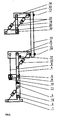
- FIG. 1 Side view
- Fig.2 Rear view
- An alternative variant of the device with electrical or mechanical drives and position sensors requires the hoses.
- hydraulic pressure sensors and electric pumps with pull-and-push bars, electromechanical tension and pressure sensors and servomotors.
- FIG.1 and Fig.2 illustrate individual parts of an exemplary apparatus of the present invention.
- the foot lies freely on the horizontal part - foot platform (1).
- the outline of the foot platform is approximately the size of the user's foot.
- the transverse axis of rotation (2) of the upper ankle joint is at the same time the axis of rotation (2) of the articulated connection between the foot platform (1) and the lower vertical part (3).
- Both the lower (3) and the upper vertical part (4) are equipped with additional clamps for attaching the lower leg (lower vertical part) and the thigh (upper vertical part) so that the lower extremity is covered and a fully synchronized movement of the combined parts is possible.
- the additional clamps for embracing the thighs and lower legs are each on the side of the vertical parts attached.
- the frontal rotation axis (5) of the knee joint coincides with the pivot axis (5) of the hinge connection between the lower vertical part (3) and the upper vertical part (4).
- the frontal rotational axis (6) of the hip joint coincides with the rotational axis (6) of the hinge connection between the upper vertical part (4) and the connecting part (7) of the lower block.
- the mobile one-sided lock consists of a unilaterally rotatably mounted tie rod (8), a pivot bracket (9) which is fixed to the front of the lower vertical part (3), and a latch (10).
- the lower vertical part (3) and the connecting part (7) of the lower block are additionally equipped with end locks (11). Bilateral hydraulic cylinders supplemented (optionally) by the force augmentation system (12) exert torque in upper leaflet (2) and hip joints (6), respectively in the sagittal plane.
- the hull fixing part (13) is connected by joints to both the connecting parts (7) of the lower block and the connecting parts (14) of the upper block.
- the double-acting hydraulic cylinder (15) and the double-acting hydraulic cylinder with the power augmentation system (optional) (16) are coupled to each other, for example, a left-handed rotational movement of the connecting part (14) about the pivot axis (17) in the upper block to a left-handed rotational movement of Connecting part (7) about the pivot axis (18) in the lower block on the same side leads.
- Upper elongate members (19) are connected at one end to lower elongate members (20) and at the other end to the upper block connecting members (14), each by means of hinges.
- Double-acting hydraulic cylinders (21) react to the torques both in the elbow joint (22) and in the sagittal plane in the shoulder joint (23) and transmit the resulting force to the double-acting hydraulic cylinder (12) of the jump and hip joints of the opposite limb.
- Illustration Figure 3 illustrates components of an example power boosting system. It consists of two double-acting hydraulic cylinders, a four-chamber hydraulic cylinder (24) (a double-acting hydraulic cylinder with power boost), from which the energy is removed, and a two-chamber hydraulic cylinder (25), which also serves as an energy source and a control function for the four-chamber hydraulic cylinder (24). has.
- the chambers (26) and (27) of the two-chamber hydraulic cylinder (25) are connected to the chambers (28) and (29) of the four-chamber cylinder (24) by means of high-pressure lines (30) and (31), resulting in a closed hydraulic circuit.
- the remaining two chambers (32) and (33) of the four-chamber hydraulic cylinder (24) are connected to a one-way hydraulic pump (34), and the hydraulic pump (34) is respectively controlled by positive pressure in the high-pressure lines (30) and (31). Commissioning and performance of the hydraulic pump (34) and the resulting force acting on the piston rod (35), caused by the alternating pressure in the chambers (28) and (29).
- the operating principle of the device of the present invention relates to the - as in the figures Fig.1 . Fig. 2 and Figure 3
- the device with the motion system of the present invention is attached to upper and lower extremities as well as to the trunk by means of additional clips. Sitting in the unit requires stretching the arms forward and flexing the lower extremities in the hip and knee joints. An erection of the user is carried out by simultaneously bringing the two arms to the body so that they are placed almost parallel to the trunk.
- the exemplary apparatus of the present invention is constructed so that from the starting position (sitting position), the extension of the right arm for extension in the hip joint of the left lower extremity, wherein the system of mobile one-sided knee joint locking forces a proportional extension in the knee joint.
- a pressure threshold in the chambers of the control hydraulic cylinder, in the high-pressure lines and in the pressure sensors is briefly exceeded, from this moment and for the duration The excess is a precise power boosting system in operation.
- An extension in the elbow joint on the right half of the body leads to dorsiflexion of the left foot, and flexion (flexion) in the elbow (as well as on the right half of the body) is associated with plantar flexion of the left foot.
- a similar functional coupling applies to the movement of the upper left and right lower limbs.
- a body movement in the hip joints in the frontal plane is forced and controlled by a movement around the sagittal axis in the shoulder joint.
- Adduction (insertion) in the right shoulder joint leads to adduction in the right hip joint (in the frontal plane), resulting in a slight inclination of the whole body to the right and a resulting elevation of the left lower extremity.
- the shoulder joint and hip joint on the left half of the body are functionally interconnected.
- the power boosting system for supporting the Extremity movement in the frontal plane works according to the same principle, as it takes place during its movement in the sagittal plane. Slight locomotion will result from alternating adduction and flexion of the arms, with the use of the elbow joints serving to maintain balance as well as assist movement in individual gait phases.
- a change in the direction of movement is carried out by a simultaneous flexion in the shoulder joint on one side of the body and an extension in the opposite shoulder joint by the device user.
- the advantages of the movement system of the device include among others: erection of the body; a controlled by the healthy limb movement operation of the motion-impaired limbs; Possibility of adapting both the time of switching on the force-augmentation system and a movement-supporting force to an individual paralysis degree; high performance and energy efficiency and, in some cases, independence from energy sources; a precise control of the foot movement in the upper ankle joint; a stable posture even without the use of crutches; efficient body control, especially when getting up; Movement support during the shift of the center of gravity to the other extremity (thanks to an active foot movement); Prevention of tripping by controlling the dorsiflexion of the foot, selective locking of the knee joint; Reduction of the force required for the movement by the precise power boost system; relatively simple movement enforcement and extension of the lower extremity; an enabled sitting position, without having to put the device with the movement system; stable center of gravity of the body above the area marked by feet when walking and sitting; controllable foot position even when sitting; a
Landscapes
- Health & Medical Sciences (AREA)
- Engineering & Computer Science (AREA)
- General Health & Medical Sciences (AREA)
- Rehabilitation Therapy (AREA)
- Veterinary Medicine (AREA)
- Public Health (AREA)
- Epidemiology (AREA)
- Pain & Pain Management (AREA)
- Physical Education & Sports Medicine (AREA)
- Mechanical Engineering (AREA)
- Life Sciences & Earth Sciences (AREA)
- Animal Behavior & Ethology (AREA)
- Physics & Mathematics (AREA)
- Fluid Mechanics (AREA)
- General Engineering & Computer Science (AREA)
- Robotics (AREA)
- Rehabilitation Tools (AREA)
Priority Applications (1)
| Application Number | Priority Date | Filing Date | Title |
|---|---|---|---|
| EP12460001.6A EP2620135A1 (fr) | 2012-01-24 | 2012-01-24 | Système de déplacement d'un appareil pour le redressement, l'assistance au déplacement et la rééducation, en particulier pour la rééducation de personnes handicapées moteur, ainsi que le renforcement musculaire |
Applications Claiming Priority (1)
| Application Number | Priority Date | Filing Date | Title |
|---|---|---|---|
| EP12460001.6A EP2620135A1 (fr) | 2012-01-24 | 2012-01-24 | Système de déplacement d'un appareil pour le redressement, l'assistance au déplacement et la rééducation, en particulier pour la rééducation de personnes handicapées moteur, ainsi que le renforcement musculaire |
Publications (1)
| Publication Number | Publication Date |
|---|---|
| EP2620135A1 true EP2620135A1 (fr) | 2013-07-31 |
Family
ID=45656882
Family Applications (1)
| Application Number | Title | Priority Date | Filing Date |
|---|---|---|---|
| EP12460001.6A Withdrawn EP2620135A1 (fr) | 2012-01-24 | 2012-01-24 | Système de déplacement d'un appareil pour le redressement, l'assistance au déplacement et la rééducation, en particulier pour la rééducation de personnes handicapées moteur, ainsi que le renforcement musculaire |
Country Status (1)
| Country | Link |
|---|---|
| EP (1) | EP2620135A1 (fr) |
Cited By (6)
| Publication number | Priority date | Publication date | Assignee | Title |
|---|---|---|---|---|
| CN104116613A (zh) * | 2014-07-17 | 2014-10-29 | 蒋文庆 | 一种智能上肢辅助运动装置 |
| CN106112989B (zh) * | 2016-08-18 | 2018-10-16 | 黄河科技学院 | 人体穿戴式减压助力机械外骨骼装置 |
| CN110074949A (zh) * | 2019-06-11 | 2019-08-02 | 唐山市拓又达科技有限公司 | 一种下肢外骨骼机器人及应用方法 |
| CN110974615A (zh) * | 2019-12-07 | 2020-04-10 | 中国科学院宁波工业技术研究院慈溪生物医学工程研究所 | 一种产生镜像运动的方法以及镜像运动装置 |
| CN111820904A (zh) * | 2020-08-05 | 2020-10-27 | 南昌大学第二附属医院 | 一种糖尿病心肌病患者运动监控提醒装置 |
| US20220331947A1 (en) * | 2021-04-20 | 2022-10-20 | Ottop Co., Ltd | Wearable exoskeleton with auxiliary back frame support |
Citations (5)
| Publication number | Priority date | Publication date | Assignee | Title |
|---|---|---|---|---|
| US5282460A (en) * | 1992-01-06 | 1994-02-01 | Joyce Ann Boldt | Three axis mechanical joint for a power assist device |
| DE19702972A1 (de) * | 1997-01-28 | 1998-07-30 | Pfaender Holger | Mechanischer Kraftverstärker |
| PL176092B1 (pl) | 1995-03-10 | 1999-04-30 | Politechnika Warszawska | Urządzenie wspomagające chód osób niepełnosprawnych |
| US7066896B1 (en) * | 2002-11-12 | 2006-06-27 | Kiselik Daniel R | Interactive apparatus and method for developing ability in the neuromuscular system |
| PL195173B1 (pl) | 2000-05-30 | 2007-08-31 | Ortopedyczna Medort Sa Fa | Układ ruchu, utrzymywania równowagi oraz realizacji odpoczynku urządzenia, umożliwiającego chodzenie osobom z niedowładem kończyn dolnych |
-
2012
- 2012-01-24 EP EP12460001.6A patent/EP2620135A1/fr not_active Withdrawn
Patent Citations (5)
| Publication number | Priority date | Publication date | Assignee | Title |
|---|---|---|---|---|
| US5282460A (en) * | 1992-01-06 | 1994-02-01 | Joyce Ann Boldt | Three axis mechanical joint for a power assist device |
| PL176092B1 (pl) | 1995-03-10 | 1999-04-30 | Politechnika Warszawska | Urządzenie wspomagające chód osób niepełnosprawnych |
| DE19702972A1 (de) * | 1997-01-28 | 1998-07-30 | Pfaender Holger | Mechanischer Kraftverstärker |
| PL195173B1 (pl) | 2000-05-30 | 2007-08-31 | Ortopedyczna Medort Sa Fa | Układ ruchu, utrzymywania równowagi oraz realizacji odpoczynku urządzenia, umożliwiającego chodzenie osobom z niedowładem kończyn dolnych |
| US7066896B1 (en) * | 2002-11-12 | 2006-06-27 | Kiselik Daniel R | Interactive apparatus and method for developing ability in the neuromuscular system |
Cited By (9)
| Publication number | Priority date | Publication date | Assignee | Title |
|---|---|---|---|---|
| CN104116613A (zh) * | 2014-07-17 | 2014-10-29 | 蒋文庆 | 一种智能上肢辅助运动装置 |
| CN104116613B (zh) * | 2014-07-17 | 2016-05-25 | 蒋文庆 | 一种智能上肢辅助运动装置 |
| CN106112989B (zh) * | 2016-08-18 | 2018-10-16 | 黄河科技学院 | 人体穿戴式减压助力机械外骨骼装置 |
| CN110074949A (zh) * | 2019-06-11 | 2019-08-02 | 唐山市拓又达科技有限公司 | 一种下肢外骨骼机器人及应用方法 |
| CN110974615A (zh) * | 2019-12-07 | 2020-04-10 | 中国科学院宁波工业技术研究院慈溪生物医学工程研究所 | 一种产生镜像运动的方法以及镜像运动装置 |
| CN110974615B (zh) * | 2019-12-07 | 2022-03-04 | 中国科学院宁波工业技术研究院慈溪生物医学工程研究所 | 一种产生镜像运动的方法以及镜像运动装置 |
| CN111820904A (zh) * | 2020-08-05 | 2020-10-27 | 南昌大学第二附属医院 | 一种糖尿病心肌病患者运动监控提醒装置 |
| CN111820904B (zh) * | 2020-08-05 | 2023-07-04 | 南昌大学第二附属医院 | 一种糖尿病心肌病患者运动监控提醒装置 |
| US20220331947A1 (en) * | 2021-04-20 | 2022-10-20 | Ottop Co., Ltd | Wearable exoskeleton with auxiliary back frame support |
Similar Documents
| Publication | Publication Date | Title |
|---|---|---|
| Chen et al. | Mechanical design and evaluation of a compact portable knee–ankle–foot robot for gait rehabilitation | |
| CN105686930B (zh) | 一种连杆关节一体化液压驱动外骨骼 | |
| US10722416B2 (en) | Multi-posture lower limb rehabilitation robot | |
| CN105662780B (zh) | 一种下肢助力矫形器 | |
| CN104552276B (zh) | 气动肌肉驱动的外骨骼助力机构 | |
| CN106361543B (zh) | 一种减重式步态康复训练机器人 | |
| CN103622796B (zh) | 一种穿戴式下肢康复训练装置 | |
| EP2620135A1 (fr) | Système de déplacement d'un appareil pour le redressement, l'assistance au déplacement et la rééducation, en particulier pour la rééducation de personnes handicapées moteur, ainsi que le renforcement musculaire | |
| CN107811805A (zh) | 穿戴式下肢外骨骼康复机器人 | |
| US20140358053A1 (en) | Power assisted orthosis with hip-knee synergy | |
| CN101181177A (zh) | 肩关节康复训练装置 | |
| Koceska et al. | Robot devices for gait rehabilitation | |
| CA2771972A1 (fr) | Orthese genou-cheville-pied | |
| US11191694B2 (en) | Exoskeleton system | |
| WO2007088044A8 (fr) | Appareil orthopedique pour faire marcher et rehabiliter des personnes accidentees | |
| CN107595550B (zh) | 基于气动肌肉全身外骨骼康复系统 | |
| Durfee et al. | Design and simulation of a pneumatic, stored-energy, hybrid orthosis for gait restoration | |
| Strausser et al. | Prototype medical exoskeleton for paraplegic mobility: first experimental results | |
| Ekkelenkamp et al. | LOPES: a lower extremity powered exoskeleton | |
| CN108030645A (zh) | 一种可穿戴式下肢移动外骨骼机器人 | |
| CN201189266Y (zh) | 肩关节康复训练装置 | |
| CN205612707U (zh) | 一种连杆关节一体化液压驱动外骨骼 | |
| CN205234884U (zh) | 外骨骼式康复辅助装置 | |
| CN109846675A (zh) | 一种可拼接组合的下肢步行训练器的机械结构及其康复助行机构 | |
| EP1596778B1 (fr) | Orthese active |
Legal Events
| Date | Code | Title | Description |
|---|---|---|---|
| PUAI | Public reference made under article 153(3) epc to a published international application that has entered the european phase |
Free format text: ORIGINAL CODE: 0009012 |
|
| AK | Designated contracting states |
Kind code of ref document: A1 Designated state(s): AL AT BE BG CH CY CZ DE DK EE ES FI FR GB GR HR HU IE IS IT LI LT LU LV MC MK MT NL NO PL PT RO RS SE SI SK SM TR |
|
| AX | Request for extension of the european patent |
Extension state: BA ME |
|
| STAA | Information on the status of an ep patent application or granted ep patent |
Free format text: STATUS: THE APPLICATION IS DEEMED TO BE WITHDRAWN |
|
| 18D | Application deemed to be withdrawn |
Effective date: 20140201 |