EP2620414A2 - Ionenaustauscher - Google Patents
Ionenaustauscher Download PDFInfo
- Publication number
- EP2620414A2 EP2620414A2 EP13250011.7A EP13250011A EP2620414A2 EP 2620414 A2 EP2620414 A2 EP 2620414A2 EP 13250011 A EP13250011 A EP 13250011A EP 2620414 A2 EP2620414 A2 EP 2620414A2
- Authority
- EP
- European Patent Office
- Prior art keywords
- ion exchange
- exchange unit
- assembly according
- water
- unit
- Prior art date
- Legal status (The legal status is an assumption and is not a legal conclusion. Google has not performed a legal analysis and makes no representation as to the accuracy of the status listed.)
- Withdrawn
Links
- 238000005342 ion exchange Methods 0.000 claims abstract description 70
- XLYOFNOQVPJJNP-UHFFFAOYSA-N water Substances O XLYOFNOQVPJJNP-UHFFFAOYSA-N 0.000 claims abstract description 51
- 238000010438 heat treatment Methods 0.000 claims abstract description 9
- 230000000007 visual effect Effects 0.000 claims abstract description 9
- 239000011347 resin Substances 0.000 claims description 25
- 229920005989 resin Polymers 0.000 claims description 25
- 239000002609 medium Substances 0.000 claims description 18
- 239000012500 ion exchange media Substances 0.000 claims description 4
- 239000012530 fluid Substances 0.000 claims description 3
- 125000002091 cationic group Chemical group 0.000 description 4
- 229910052500 inorganic mineral Inorganic materials 0.000 description 4
- 150000002500 ions Chemical class 0.000 description 4
- 239000011707 mineral Substances 0.000 description 4
- 239000000126 substance Substances 0.000 description 4
- 125000000129 anionic group Chemical group 0.000 description 3
- 230000000694 effects Effects 0.000 description 3
- NWUYHJFMYQTDRP-UHFFFAOYSA-N 1,2-bis(ethenyl)benzene;1-ethenyl-2-ethylbenzene;styrene Chemical compound C=CC1=CC=CC=C1.CCC1=CC=CC=C1C=C.C=CC1=CC=CC=C1C=C NWUYHJFMYQTDRP-UHFFFAOYSA-N 0.000 description 2
- OYPRJOBELJOOCE-UHFFFAOYSA-N Calcium Chemical compound [Ca] OYPRJOBELJOOCE-UHFFFAOYSA-N 0.000 description 2
- 239000011575 calcium Substances 0.000 description 2
- 230000000295 complement effect Effects 0.000 description 2
- 150000001875 compounds Chemical class 0.000 description 2
- 239000000470 constituent Substances 0.000 description 2
- 238000005562 fading Methods 0.000 description 2
- 125000000524 functional group Chemical group 0.000 description 2
- 239000011521 glass Substances 0.000 description 2
- 239000008233 hard water Substances 0.000 description 2
- 239000003456 ion exchange resin Substances 0.000 description 2
- 229920003303 ion-exchange polymer Polymers 0.000 description 2
- 239000000463 material Substances 0.000 description 2
- BVKZGUZCCUSVTD-UHFFFAOYSA-M Bicarbonate Chemical class OC([O-])=O BVKZGUZCCUSVTD-UHFFFAOYSA-M 0.000 description 1
- FYYHWMGAXLPEAU-UHFFFAOYSA-N Magnesium Chemical compound [Mg] FYYHWMGAXLPEAU-UHFFFAOYSA-N 0.000 description 1
- JLVVSXFLKOJNIY-UHFFFAOYSA-N Magnesium ion Chemical compound [Mg+2] JLVVSXFLKOJNIY-UHFFFAOYSA-N 0.000 description 1
- 239000004793 Polystyrene Substances 0.000 description 1
- 230000002378 acidificating effect Effects 0.000 description 1
- 238000013459 approach Methods 0.000 description 1
- 239000011324 bead Substances 0.000 description 1
- 235000012206 bottled water Nutrition 0.000 description 1
- 229910052791 calcium Inorganic materials 0.000 description 1
- 229910001424 calcium ion Inorganic materials 0.000 description 1
- 150000004649 carbonic acid derivatives Chemical class 0.000 description 1
- 150000001768 cations Chemical class 0.000 description 1
- 239000013000 chemical inhibitor Substances 0.000 description 1
- 238000000576 coating method Methods 0.000 description 1
- 239000003086 colorant Substances 0.000 description 1
- HNPSIPDUKPIQMN-UHFFFAOYSA-N dioxosilane;oxo(oxoalumanyloxy)alumane Chemical class O=[Si]=O.O=[Al]O[Al]=O HNPSIPDUKPIQMN-UHFFFAOYSA-N 0.000 description 1
- 238000006073 displacement reaction Methods 0.000 description 1
- 239000003651 drinking water Substances 0.000 description 1
- 230000003993 interaction Effects 0.000 description 1
- 239000011777 magnesium Substances 0.000 description 1
- 229910052749 magnesium Inorganic materials 0.000 description 1
- 229910001425 magnesium ion Inorganic materials 0.000 description 1
- 238000000034 method Methods 0.000 description 1
- 229920000620 organic polymer Polymers 0.000 description 1
- 229920002223 polystyrene Polymers 0.000 description 1
- 239000011148 porous material Substances 0.000 description 1
- 239000002244 precipitate Substances 0.000 description 1
- 230000001172 regenerating effect Effects 0.000 description 1
- 239000000758 substrate Substances 0.000 description 1
- 239000012780 transparent material Substances 0.000 description 1
- 239000003643 water by type Substances 0.000 description 1
Images


Classifications
-
- B—PERFORMING OPERATIONS; TRANSPORTING
- B01—PHYSICAL OR CHEMICAL PROCESSES OR APPARATUS IN GENERAL
- B01J—CHEMICAL OR PHYSICAL PROCESSES, e.g. CATALYSIS OR COLLOID CHEMISTRY; THEIR RELEVANT APPARATUS
- B01J47/00—Ion-exchange processes in general; Apparatus therefor
- B01J47/14—Controlling or regulating
-
- B—PERFORMING OPERATIONS; TRANSPORTING
- B01—PHYSICAL OR CHEMICAL PROCESSES OR APPARATUS IN GENERAL
- B01J—CHEMICAL OR PHYSICAL PROCESSES, e.g. CATALYSIS OR COLLOID CHEMISTRY; THEIR RELEVANT APPARATUS
- B01J39/00—Cation exchange; Use of material as cation exchangers; Treatment of material for improving the cation exchange properties
- B01J39/04—Processes using organic exchangers
- B01J39/07—Processes using organic exchangers in the weakly acidic form
-
- B—PERFORMING OPERATIONS; TRANSPORTING
- B01—PHYSICAL OR CHEMICAL PROCESSES OR APPARATUS IN GENERAL
- B01J—CHEMICAL OR PHYSICAL PROCESSES, e.g. CATALYSIS OR COLLOID CHEMISTRY; THEIR RELEVANT APPARATUS
- B01J39/00—Cation exchange; Use of material as cation exchangers; Treatment of material for improving the cation exchange properties
- B01J39/08—Use of material as cation exchangers; Treatment of material for improving the cation exchange properties
- B01J39/14—Base exchange silicates, e.g. zeolites
-
- B—PERFORMING OPERATIONS; TRANSPORTING
- B01—PHYSICAL OR CHEMICAL PROCESSES OR APPARATUS IN GENERAL
- B01J—CHEMICAL OR PHYSICAL PROCESSES, e.g. CATALYSIS OR COLLOID CHEMISTRY; THEIR RELEVANT APPARATUS
- B01J47/00—Ion-exchange processes in general; Apparatus therefor
- B01J47/02—Column or bed processes
- B01J47/026—Column or bed processes using columns or beds of different ion exchange materials in series
-
- B—PERFORMING OPERATIONS; TRANSPORTING
- B01—PHYSICAL OR CHEMICAL PROCESSES OR APPARATUS IN GENERAL
- B01J—CHEMICAL OR PHYSICAL PROCESSES, e.g. CATALYSIS OR COLLOID CHEMISTRY; THEIR RELEVANT APPARATUS
- B01J47/00—Ion-exchange processes in general; Apparatus therefor
- B01J47/02—Column or bed processes
- B01J47/04—Mixed-bed processes
-
- C—CHEMISTRY; METALLURGY
- C02—TREATMENT OF WATER, WASTE WATER, SEWAGE, OR SLUDGE
- C02F—TREATMENT OF WATER, WASTE WATER, SEWAGE, OR SLUDGE
- C02F1/00—Treatment of water, waste water, or sewage
- C02F1/42—Treatment of water, waste water, or sewage by ion-exchange
-
- G—PHYSICS
- G01—MEASURING; TESTING
- G01N—INVESTIGATING OR ANALYSING MATERIALS BY DETERMINING THEIR CHEMICAL OR PHYSICAL PROPERTIES
- G01N31/00—Investigating or analysing non-biological materials by the use of the chemical methods specified in the subgroup; Apparatus specially adapted for such methods
- G01N31/22—Investigating or analysing non-biological materials by the use of the chemical methods specified in the subgroup; Apparatus specially adapted for such methods using chemical indicators
-
- C—CHEMISTRY; METALLURGY
- C02—TREATMENT OF WATER, WASTE WATER, SEWAGE, OR SLUDGE
- C02F—TREATMENT OF WATER, WASTE WATER, SEWAGE, OR SLUDGE
- C02F2201/00—Apparatus for treatment of water, waste water or sewage
- C02F2201/002—Construction details of the apparatus
- C02F2201/006—Cartridges
-
- C—CHEMISTRY; METALLURGY
- C02—TREATMENT OF WATER, WASTE WATER, SEWAGE, OR SLUDGE
- C02F—TREATMENT OF WATER, WASTE WATER, SEWAGE, OR SLUDGE
- C02F2209/00—Controlling or monitoring parameters in water treatment
- C02F2209/44—Time
- C02F2209/445—Filter life
-
- C—CHEMISTRY; METALLURGY
- C02—TREATMENT OF WATER, WASTE WATER, SEWAGE, OR SLUDGE
- C02F—TREATMENT OF WATER, WASTE WATER, SEWAGE, OR SLUDGE
- C02F2303/00—Specific treatment goals
- C02F2303/22—Eliminating or preventing deposits, scale removal, scale prevention
-
- C—CHEMISTRY; METALLURGY
- C02—TREATMENT OF WATER, WASTE WATER, SEWAGE, OR SLUDGE
- C02F—TREATMENT OF WATER, WASTE WATER, SEWAGE, OR SLUDGE
- C02F2305/00—Use of specific compounds during water treatment
- C02F2305/14—Additives which dissolves or releases substances when predefined environmental conditions are reached, e.g. pH or temperature
Definitions
- the invention relates to a novel arrangement of an ion exchange unit containing an ion exchange medium wherein the unit is provided with an indicator means which will provide a visual warning when the ion exchange unit needs changing or regenerating.
- water is used as a heat transfer medium whose source is potable water supplied by municipal authorities.
- the natural chemical constituents found in water often include dissolved minerals whose concentration can vary over a large range of values depending on the source, geographical location or season whilst still meeting the basic obligation for potability.
- the chemical constituents of these dissolved minerals which characterise waters 'hardness' are predominantly the carbonates and bicarbonates of calcium and magnesium. These remain soluble in cold water but when hard water is heated, the nature of these compounds is such that they precipitate from the water to form an insoluble mineral deposit, generally termed 'scale' or 'limescale' and this happens most readily on the hottest surfaces. Water having a high mineral content has a high scaling potential.
- ion exchange media are natural or synthetic zeolites or more preferably in the form of resin (1-2 mm diameter) beads fabricated from an organic polymer substrate, e.g. crosslinked polystyrene and containing strongly or weakly acidic functional groups or strongly or weakly basic functional groups. These materials have highly developed pore structures on their surfaces which are sites that easily trap, exchange and release ions.
- Ion exchange media are characterised by their ion exchange capacity which is the measure of their ability to undergo displacement of ions incorporated into their structure by charged ions present in the surrounding solution and may be expressed as the total number of chemical equivalents available for exchange per unit weight or unit volume of medium or resin. The capacity may be expressed in terms of milli-equivalents per dry gram of resin or in terms of milli-equivalents per milli-litre of wet resin.
- a disadvantage of these known methods is that it is difficult to know exactly when a softening or demineralising unit is coming to the end of its life. If it is changed too soon then that leads to increased cost, whereas if it is not changed soon enough the improperly treated hard water can cause the problems already discussed.
- the aim of the invention is to provide a primary ion exchange unit in combination with a secondary ion exchange unit wherein the secondary ion exchange unit acts as an indicator that the primary ion exchange unit is exhausted by displaying a visual warning.
- the arrangement is particularly applicable to treat the water which is being supplied to a closed system e.g. where water is the circulating fluid of a heating system serviced by a central heat source.
- an assembly suitable for treating water comprises a primary ion exchange unit and a secondary ion exchange unit arranged in combination so that in use water to be treated will pass through the primary ion exchange unit before it passes through the secondary ion exchange unit and wherein the secondary ion exchange unit includes a means to give a visual warning that the primary ion exchange unit is not treating the water efficiently.
- the primary unit and secondary units are connected directly or indirectly (more preferably directly) together so that water flows through the primary unit and then through the secondary unit i.e. the secondary unit is downstream of the primary unit.
- the secondary unit i.e. the secondary unit is downstream of the primary unit.
- the primary unit is operating efficiently, the water entering the secondary unit has been softened or demineralised and the ion exchange medium therein is largely unaffected. It is only when the primary unit is exhausted and ceases to be effective that hard, untreated water enters the secondary unit and the ion exchange medium therein begins to exchange ions.
- the secondary unit contains only a comparatively very small amount of ion exchange medium so that this becomes quickly exhausted.
- the total exchange capacity of the mass of resin in the secondary unit is very much less than the total exchange capacity of the mass of resin in the primary unit so that very soon after the primary unit becomes exhausted the secondary unit does so too.
- the mass or total exchange capacity of resin in the primary unit need bear no fixed mass or total exchange capacity ratio relationship with the mass or total exchange capacity of resin in the secondary unit, but is preferably at least 50 times greater. Further, it is desirable that in any circumstances, after exhaustion of the primary resin, the mass or total exchange capacity of the of the resin in the secondary ion exchange unit is such that it becomes exhausted after treating a small volume of the water needing to be softened or demineralised, preferably less than 20 litres and most preferably less than 5 litres.
- the secondary unit As the secondary unit becomes exhausted, it provides a visual warning of this fact.
- the visual warning is achieved by using an ion exchange medium in the secondary unit which changes colour as it becomes exhausted.
- this colour change can be viewed through a window provided in the wall of the secondary unit e.g. a glass or other transparent material.
- Colour-changing ion exchange materials are those having chemical indicator compounds on the anionic or cationic (or both) components of the respective exchange resins, and this moiety effects a colour change on exhaustion.
- the colours will depend upon the dye used.
- the nature of the colour indicating resin (anionic, cationic or mixed) in the secondary unit must be chosen with consideration to the nature of the type of resin in the primary unit. Such colour indicating resins are available commercially (e.g. from Purolite, Dow and other manufacturers and their distributors).
- the units will be ordered in-line sequentially so that the water flow flows first through the primary unit and then directly into and through the secondary unit.
- the ratio of total exchange capacity of the volume of the ion exchange medium in the primary unit to that of the total exchange capacity of the volume of ion exchange medium in the secondary unit is preferably greater than 20:1, more preferably greater than 500:1.
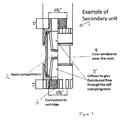
- a primary ion exchange unit (not shown) is connected inline by means of complementary screw threaded portions ( one of which is shown as 3) with a secondary ion exchange unit 1 containing a mixed bed ion exchange resin initially coloured blue held in a resin compartment 2.
- the resin held in resin compartment 2 can be viewed through a clear window 4.
- the secondary unit 1 is fitted with a diffuser 5 to improve water flow through the resin.
- the end of the secondary unit 1 away from the connection 3 to the primary unit is provided with a screw threaded portion complementary to other pipework in the central heating system, thus allowing easy assembly and removal of the secondary/primary ion exchange unit assembly.
- the assembly of primary and secondary ion exchange units is connected into the pipework of a water supply to a central heating system.
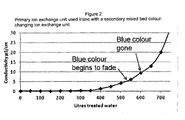
- the initial conductivity of the water supply was 185 ⁇ S/cm (microSiemens/cm)
- the vertical scale indicates the conductivity in ⁇ S/cm (microSiemens/cm) of the water supply after it has passed through the primary unit and then through the secondary unit before passing into the central heating system.
- the horizontal scale indicates the litres of water which have passed through the primary unit and then through the secondary unit.
- the maximum acceptable level of conductivity of the effluent water (treated water) is 5 ⁇ S/cm (ASTM D1193-91); once that level is reached then the primary unit is deemed exhausted. As can be seen, the primary unit efficiently treats the first 550 litres of water but thereafter the efficiency of the primary unit falls due to the resin becoming less efficient.
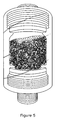
- FIGS 3 , 4 and 5 show the colour of the resin at 0, 550 and 600 litres respectively.
- the resin is blue (shown as black in Figure 3 )
- the blue colour of the resin in the secondary unit begins to fade as can be seen in Figure 4 through a glass window (see Figure 1 ) and after 600 litres of water the blue colour has disappeared (see Figure 5 shown as faded to grey/white).
- This initial fading at 550 litres is a visible warning that the ion exchange resin in the primary unit must be changed or regenerated and that the secondary unit must be discarded.
Landscapes
- Chemical & Material Sciences (AREA)
- Organic Chemistry (AREA)
- Chemical Kinetics & Catalysis (AREA)
- Life Sciences & Earth Sciences (AREA)
- Hydrology & Water Resources (AREA)
- Water Supply & Treatment (AREA)
- Health & Medical Sciences (AREA)
- Environmental & Geological Engineering (AREA)
- Engineering & Computer Science (AREA)
- Analytical Chemistry (AREA)
- General Health & Medical Sciences (AREA)
- General Physics & Mathematics (AREA)
- Immunology (AREA)
- Pathology (AREA)
- Biochemistry (AREA)
- Physics & Mathematics (AREA)
- Molecular Biology (AREA)
- Biophysics (AREA)
- Treatment Of Water By Ion Exchange (AREA)
Applications Claiming Priority (1)
| Application Number | Priority Date | Filing Date | Title |
|---|---|---|---|
| GBGB1201523.6A GB201201523D0 (en) | 2012-01-30 | 2012-01-30 | Ion exchange |
Publications (2)
| Publication Number | Publication Date |
|---|---|
| EP2620414A2 true EP2620414A2 (de) | 2013-07-31 |
| EP2620414A3 EP2620414A3 (de) | 2015-04-22 |
Family
ID=45876290
Family Applications (1)
| Application Number | Title | Priority Date | Filing Date |
|---|---|---|---|
| EP20130250011 Withdrawn EP2620414A3 (de) | 2012-01-30 | 2013-01-24 | Ionenaustauscher |
Country Status (2)
| Country | Link |
|---|---|
| EP (1) | EP2620414A3 (de) |
| GB (2) | GB201201523D0 (de) |
Citations (1)
| Publication number | Priority date | Publication date | Assignee | Title |
|---|---|---|---|---|
| EP2077422A2 (de) * | 2008-01-07 | 2009-07-08 | Perma-Trade Wassertechnik GMBH | Wasserbehandlungseinrichtung für eine Heizanlage |
Family Cites Families (7)
| Publication number | Priority date | Publication date | Assignee | Title |
|---|---|---|---|---|
| US2935194A (en) * | 1955-06-01 | 1960-05-03 | Tomkin Abraham Emil | Purity indicator for ion-exchange material |
| GB980335A (en) * | 1961-12-19 | 1965-01-13 | John Frederick Zwicky | Improvements relating to ion-exchange apparatus |
| JPS5712881A (en) * | 1980-06-27 | 1982-01-22 | Mitsubishi Chem Ind Ltd | Water disposal |
| JPS5721979A (en) * | 1980-07-11 | 1982-02-04 | Mitsubishi Chem Ind Ltd | Water treating method |
| DE68927320T2 (de) * | 1988-12-30 | 1997-02-20 | Purotech Ltd | Wasserreinigungssystem |
| SU1807004A1 (ru) * | 1989-05-17 | 1993-04-07 | Ilya S Elinson | Портативный фильтр для очистки воды |
| DE3918561C2 (de) * | 1989-06-07 | 1997-09-11 | Brita Wasserfilter | Vorrichtung zur Wasserbehandlung |
-
2012
- 2012-01-30 GB GBGB1201523.6A patent/GB201201523D0/en not_active Ceased
-
2013
- 2013-01-24 GB GB1301257.0A patent/GB2499313B/en active Active
- 2013-01-24 EP EP20130250011 patent/EP2620414A3/de not_active Withdrawn
Patent Citations (1)
| Publication number | Priority date | Publication date | Assignee | Title |
|---|---|---|---|---|
| EP2077422A2 (de) * | 2008-01-07 | 2009-07-08 | Perma-Trade Wassertechnik GMBH | Wasserbehandlungseinrichtung für eine Heizanlage |
Also Published As
| Publication number | Publication date |
|---|---|
| GB201301257D0 (en) | 2013-03-06 |
| GB2499313B (en) | 2017-11-22 |
| EP2620414A3 (de) | 2015-04-22 |
| GB2499313A (en) | 2013-08-14 |
| GB201201523D0 (en) | 2012-03-14 |
Similar Documents
| Publication | Publication Date | Title |
|---|---|---|
| CN104203832B (zh) | 使用阳离子交换树脂进行预处理来提高电化学去离子装置的性能 | |
| JP5836392B2 (ja) | バイポーラ膜を用いた水処理 | |
| Čuda et al. | Reverse osmosis in water treatment for boilers | |
| RU2009125052A (ru) | Способ и устройство для обогащения воды ионами магния | |
| BRPI0806375A2 (pt) | método para purificar água, método para tratar água contendo sìlica dissolvida e sistema de tratamento de água | |
| EA201071159A1 (ru) | Низкоэнергетическая система и способ обессоливания морской воды | |
| Trus et al. | Development of resource-saving technologies in the use of sedimentation inhibitors for reverse osmosis installations | |
| Wang et al. | Cooling tower and boiler water treatment | |
| Chang et al. | Foulant identification and fouling control with iron oxide adsorption in electrodialysis for the desalination of secondary effluent | |
| EP2620414A2 (de) | Ionenaustauscher | |
| Al-Deffeeri | Heat transfer measurement as a criterion for performance evaluation of scale inhibition in MSF plants in Kuwait | |
| JP2008006369A (ja) | スケール防止方法 | |
| IL293311B1 (en) | Cartridge for treating drinking water, and method for enriching drinking water with silicon | |
| CN104973718B (zh) | 一种绿色高效锅炉给水处理系统 | |
| CA2728014A1 (en) | A system and method for controlling multiple sized water softening tanks | |
| EP2989058A1 (de) | Mittel gegen übermässige polyacrylat-ablagerung und verfahren zur herstellung davon | |
| Kinsela et al. | The impacts of low-cost treatment options upon scale formation potential in remote communities reliant on hard groundwaters. A case study: Northern Territory, Australia | |
| US9731983B2 (en) | Ion exchange methods for treating water hardness | |
| BRPI0416580B1 (pt) | método de tratar de água e prover água potável. | |
| Chang et al. | Scaling mitigation and salt reduction of vacuum membrane distillation using sacrificial zeolites | |
| Zadghaffari et al. | Water softening using caustic soda: privileges and restrictions | |
| CN204454691U (zh) | 一种天然气净化厂锅炉供热系统废水的处理系统 | |
| KR20130135464A (ko) | 선박의 연수화 장치 및 연수화 방법 | |
| CN204848524U (zh) | 一种绿色高效锅炉给水处理系统 | |
| Brenner et al. | Technical and mineral level effects of water treatment |
Legal Events
| Date | Code | Title | Description |
|---|---|---|---|
| PUAI | Public reference made under article 153(3) epc to a published international application that has entered the european phase |
Free format text: ORIGINAL CODE: 0009012 |
|
| AK | Designated contracting states |
Kind code of ref document: A2 Designated state(s): AL AT BE BG CH CY CZ DE DK EE ES FI FR GB GR HR HU IE IS IT LI LT LU LV MC MK MT NL NO PL PT RO RS SE SI SK SM TR |
|
| AX | Request for extension of the european patent |
Extension state: BA ME |
|
| PUAL | Search report despatched |
Free format text: ORIGINAL CODE: 0009013 |
|
| AK | Designated contracting states |
Kind code of ref document: A3 Designated state(s): AL AT BE BG CH CY CZ DE DK EE ES FI FR GB GR HR HU IE IS IT LI LT LU LV MC MK MT NL NO PL PT RO RS SE SI SK SM TR |
|
| AX | Request for extension of the european patent |
Extension state: BA ME |
|
| RIC1 | Information provided on ipc code assigned before grant |
Ipc: C02F 1/42 20060101AFI20150316BHEP Ipc: B01J 47/02 20060101ALI20150316BHEP |
|
| RAP1 | Party data changed (applicant data changed or rights of an application transferred) |
Owner name: SENTINEL PERFORMANCE SOLUTIONS LTD |
|
| 17P | Request for examination filed |
Effective date: 20151028 |
|
| RBV | Designated contracting states (corrected) |
Designated state(s): AL AT BE BG CH CY CZ DE DK EE ES FI FR GB GR HR HU IE IS IT LI LT LU LV MC MK MT NL NO PL PT RO RS SE SI SK SM TR |
|
| 17Q | First examination report despatched |
Effective date: 20160317 |
|
| STAA | Information on the status of an ep patent application or granted ep patent |
Free format text: STATUS: THE APPLICATION HAS BEEN WITHDRAWN |
|
| 18W | Application withdrawn |
Effective date: 20170505 |