EP2620621A2 - Gasturbinenmotorsystem und Verfahren zur Regelung der Temperatur einer Leitung in einem Gasturbinenmotorsystem - Google Patents
Gasturbinenmotorsystem und Verfahren zur Regelung der Temperatur einer Leitung in einem Gasturbinenmotorsystem Download PDFInfo
- Publication number
- EP2620621A2 EP2620621A2 EP13152389.6A EP13152389A EP2620621A2 EP 2620621 A2 EP2620621 A2 EP 2620621A2 EP 13152389 A EP13152389 A EP 13152389A EP 2620621 A2 EP2620621 A2 EP 2620621A2
- Authority
- EP
- European Patent Office
- Prior art keywords
- fuel
- conduit
- flow
- gaseous fuel
- reformer
- Prior art date
- Legal status (The legal status is an assumption and is not a legal conclusion. Google has not performed a legal analysis and makes no representation as to the accuracy of the status listed.)
- Withdrawn
Links
- 238000000034 method Methods 0.000 title claims description 11
- 239000000446 fuel Substances 0.000 claims abstract description 219
- 239000007800 oxidant agent Substances 0.000 claims abstract description 29
- 230000001590 oxidative effect Effects 0.000 claims abstract description 28
- 238000006243 chemical reaction Methods 0.000 claims abstract description 16
- 238000002485 combustion reaction Methods 0.000 claims abstract description 16
- 239000012530 fluid Substances 0.000 claims abstract description 13
- 238000004891 communication Methods 0.000 claims abstract description 12
- QVGXLLKOCUKJST-UHFFFAOYSA-N atomic oxygen Chemical compound [O] QVGXLLKOCUKJST-UHFFFAOYSA-N 0.000 claims description 11
- 239000001301 oxygen Substances 0.000 claims description 11
- 229910052760 oxygen Inorganic materials 0.000 claims description 11
- 239000003570 air Substances 0.000 claims description 9
- 239000007789 gas Substances 0.000 description 30
- 230000003197 catalytic effect Effects 0.000 description 15
- 239000000203 mixture Substances 0.000 description 12
- VNWKTOKETHGBQD-UHFFFAOYSA-N methane Chemical compound C VNWKTOKETHGBQD-UHFFFAOYSA-N 0.000 description 9
- 230000001276 controlling effect Effects 0.000 description 7
- 239000000654 additive Substances 0.000 description 6
- 230000000996 additive effect Effects 0.000 description 6
- 230000003750 conditioning effect Effects 0.000 description 6
- 239000001257 hydrogen Substances 0.000 description 4
- 229910052739 hydrogen Inorganic materials 0.000 description 4
- UFHFLCQGNIYNRP-UHFFFAOYSA-N Hydrogen Chemical compound [H][H] UFHFLCQGNIYNRP-UHFFFAOYSA-N 0.000 description 3
- 238000010586 diagram Methods 0.000 description 3
- UGFAIRIUMAVXCW-UHFFFAOYSA-N Carbon monoxide Chemical compound [O+]#[C-] UGFAIRIUMAVXCW-UHFFFAOYSA-N 0.000 description 2
- 229910002091 carbon monoxide Inorganic materials 0.000 description 2
- 238000007254 oxidation reaction Methods 0.000 description 2
- 239000000126 substance Substances 0.000 description 2
- MYMOFIZGZYHOMD-UHFFFAOYSA-N Dioxygen Chemical compound O=O MYMOFIZGZYHOMD-UHFFFAOYSA-N 0.000 description 1
- 230000004075 alteration Effects 0.000 description 1
- 239000012080 ambient air Substances 0.000 description 1
- 238000000429 assembly Methods 0.000 description 1
- 230000000712 assembly Effects 0.000 description 1
- 238000009530 blood pressure measurement Methods 0.000 description 1
- 238000009529 body temperature measurement Methods 0.000 description 1
- 239000000567 combustion gas Substances 0.000 description 1
- 238000001816 cooling Methods 0.000 description 1
- 239000002737 fuel gas Substances 0.000 description 1
- 239000007792 gaseous phase Substances 0.000 description 1
- XLYOFNOQVPJJNP-ZSJDYOACSA-N heavy water Substances [2H]O[2H] XLYOFNOQVPJJNP-ZSJDYOACSA-N 0.000 description 1
- 150000002431 hydrogen Chemical class 0.000 description 1
- 239000007788 liquid Substances 0.000 description 1
- 239000000463 material Substances 0.000 description 1
- 239000003345 natural gas Substances 0.000 description 1
- 230000003647 oxidation Effects 0.000 description 1
- 230000000704 physical effect Effects 0.000 description 1
- 239000000376 reactant Substances 0.000 description 1
- 230000009257 reactivity Effects 0.000 description 1
- 238000011084 recovery Methods 0.000 description 1
- 238000002407 reforming Methods 0.000 description 1
- 230000001105 regulatory effect Effects 0.000 description 1
- 238000006467 substitution reaction Methods 0.000 description 1
- 230000003685 thermal hair damage Effects 0.000 description 1
- 230000008646 thermal stress Effects 0.000 description 1
- XLYOFNOQVPJJNP-UHFFFAOYSA-N water Substances O XLYOFNOQVPJJNP-UHFFFAOYSA-N 0.000 description 1
Images

Classifications
-
- F—MECHANICAL ENGINEERING; LIGHTING; HEATING; WEAPONS; BLASTING
- F02—COMBUSTION ENGINES; HOT-GAS OR COMBUSTION-PRODUCT ENGINE PLANTS
- F02C—GAS-TURBINE PLANTS; AIR INTAKES FOR JET-PROPULSION PLANTS; CONTROLLING FUEL SUPPLY IN AIR-BREATHING JET-PROPULSION PLANTS
- F02C7/00—Features, components parts, details or accessories, not provided for in, or of interest apart form groups F02C1/00 - F02C6/00; Air intakes for jet-propulsion plants
- F02C7/22—Fuel supply systems
- F02C7/232—Fuel valves; Draining valves or systems
-
- F—MECHANICAL ENGINEERING; LIGHTING; HEATING; WEAPONS; BLASTING
- F02—COMBUSTION ENGINES; HOT-GAS OR COMBUSTION-PRODUCT ENGINE PLANTS
- F02C—GAS-TURBINE PLANTS; AIR INTAKES FOR JET-PROPULSION PLANTS; CONTROLLING FUEL SUPPLY IN AIR-BREATHING JET-PROPULSION PLANTS
- F02C3/00—Gas-turbine plants characterised by the use of combustion products as the working fluid
- F02C3/20—Gas-turbine plants characterised by the use of combustion products as the working fluid using a special fuel, oxidant, or dilution fluid to generate the combustion products
- F02C3/22—Gas-turbine plants characterised by the use of combustion products as the working fluid using a special fuel, oxidant, or dilution fluid to generate the combustion products the fuel or oxidant being gaseous at standard temperature and pressure
-
- F—MECHANICAL ENGINEERING; LIGHTING; HEATING; WEAPONS; BLASTING
- F02—COMBUSTION ENGINES; HOT-GAS OR COMBUSTION-PRODUCT ENGINE PLANTS
- F02C—GAS-TURBINE PLANTS; AIR INTAKES FOR JET-PROPULSION PLANTS; CONTROLLING FUEL SUPPLY IN AIR-BREATHING JET-PROPULSION PLANTS
- F02C3/00—Gas-turbine plants characterised by the use of combustion products as the working fluid
- F02C3/20—Gas-turbine plants characterised by the use of combustion products as the working fluid using a special fuel, oxidant, or dilution fluid to generate the combustion products
- F02C3/30—Adding water, steam or other fluids for influencing combustion, e.g. to obtain cleaner exhaust gases
-
- F—MECHANICAL ENGINEERING; LIGHTING; HEATING; WEAPONS; BLASTING
- F02—COMBUSTION ENGINES; HOT-GAS OR COMBUSTION-PRODUCT ENGINE PLANTS
- F02C—GAS-TURBINE PLANTS; AIR INTAKES FOR JET-PROPULSION PLANTS; CONTROLLING FUEL SUPPLY IN AIR-BREATHING JET-PROPULSION PLANTS
- F02C9/00—Controlling gas-turbine plants; Controlling fuel supply in air- breathing jet-propulsion plants
- F02C9/26—Control of fuel supply
-
- F—MECHANICAL ENGINEERING; LIGHTING; HEATING; WEAPONS; BLASTING
- F05—INDEXING SCHEMES RELATING TO ENGINES OR PUMPS IN VARIOUS SUBCLASSES OF CLASSES F01-F04
- F05D—INDEXING SCHEME FOR ASPECTS RELATING TO NON-POSITIVE-DISPLACEMENT MACHINES OR ENGINES, GAS-TURBINES OR JET-PROPULSION PLANTS
- F05D2270/00—Control
- F05D2270/01—Purpose of the control system
- F05D2270/08—Purpose of the control system to produce clean exhaust gases
- F05D2270/082—Purpose of the control system to produce clean exhaust gases with as little NOx as possible
-
- Y—GENERAL TAGGING OF NEW TECHNOLOGICAL DEVELOPMENTS; GENERAL TAGGING OF CROSS-SECTIONAL TECHNOLOGIES SPANNING OVER SEVERAL SECTIONS OF THE IPC; TECHNICAL SUBJECTS COVERED BY FORMER USPC CROSS-REFERENCE ART COLLECTIONS [XRACs] AND DIGESTS
- Y02—TECHNOLOGIES OR APPLICATIONS FOR MITIGATION OR ADAPTATION AGAINST CLIMATE CHANGE
- Y02E—REDUCTION OF GREENHOUSE GAS [GHG] EMISSIONS, RELATED TO ENERGY GENERATION, TRANSMISSION OR DISTRIBUTION
- Y02E20/00—Combustion technologies with mitigation potential
- Y02E20/16—Combined cycle power plant [CCPP], or combined cycle gas turbine [CCGT]
Definitions
- the subject matter disclosed herein relates to gas turbine engine combustion systems, and more particularly, to methods and apparatus for controlling temperatures of apparatus receiving an oxidant and fuel for reaction
- Gas turbine engines include apparatus for reaction of oxidants and fuel, such as gas turbine combustors configured to achieve low NOx emissions levels by employing a lean premixed fuel combustion process wherein the fuel and air that is required to bum the fuel are mixed prior to combustion.
- This type of combustor may be referred to as a Dry Low NOx (DLN) combustor.
- DLN Dry Low NOx
- Higher efficiencies in gas turbines with DLN combustors are generally achieved by increasing overall gas temperature in the combustion chambers. In particular, the combustion chambers can experience elevated temperatures that cause thermal stress on the combustor components.
- an engine system includes one or more fuel circuits configured to provide gaseous fuel from a fuel source for combustion.
- the system further comprises a conduit in fluid communication with the one or more fuel circuits, wherein the conduit is configured to receive a first gaseous fuel flow and an oxidant flow for a reaction within the conduit, wherein a temperature of the conduit is controlled by a second gaseous fuel flow along an outer wall of the conduit.
- a method for controlling a temperature of a conduit in an engine system includes providing gaseous fuel from a fuel supply via a fuel circuit, receiving a first gaseous fuel flow from the fuel circuit in a conduit and receiving an oxidant flow to react with the first gaseous fuel flow within the conduit. The method also includes flowing a second gaseous fuel flow along an outer wall of the conduit to control a temperature of the conduit.
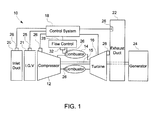
- FIG. 1 is a schematic diagram of a gas turbine engine system 10 including a compressor 12, a combustor 14, and a turbine 16 coupled by a drive shaft 15 to the compressor 12.
- the system 10 can have a single combustor or a plurality of combustors (two shown in the figure).
- the combustors are DLN combustors.
- the combustors are lean premixed combustors.
- the gas turbine engine system 10 is managed by a combination of operator commands and a control system 18.
- An inlet duct system 20 channels ambient air to the compressor inlet guide vanes 21 which, by modulation with actuator 25, regulate the amount of air to compressor 12.
- An exhaust system 22 channels combustion gases from the outlet of turbine 16 through, for example, sound absorbing, heat recovery and possibly emissions control devices.
- Turbine 16 may drive a generator 24 that produces electrical power or any other type of mechanical output.
- sensors 26 may monitor ambient temperature, pressure and humidity surrounding gas turbine engine system 10, compressor discharge pressure and temperature, turbine exhaust gas temperature and emissions, and other pressure and temperature measurements within the gas turbine engine.
- Sensors 26 may also comprise flow sensors, speed sensors, flame detector sensors, valve position sensors, guide vane angle sensors, dynamic pressure sensors, and other sensors that sense various parameters relative to the operation of gas turbine engine system 10.
- “parameters” refer to physical properties whose values can be used to define the operating conditions of gas turbine engine system 10, such as temperatures, pressures, fluid flows at defined locations, and the like.
- sensors 26 there may be one or more sensors to monitor, measure or infer fuel properties sufficiently to determine the fuel composition prior to and/or after a fuel reformer 32 described below.
- the sensors may sense one or more of the following: fractional (fuel) composition, hydrogen content, carbon monoxide content, a parameter representative of the fuel MWI, fuel temperature, fuel and oxidant flow rates, products temperature, and the like.
- a flow controller 28 responds to commands from the control system 18 to continuously regulate the fuel flowing from a fuel supply to the combustor(s) 14, and the fuel splits (independently controlled fuel supply to fuel circuits) to multiple fuel nozzle injectors (i.e., fuel circuits) located within each of the combustor(s) 14.
- the flow controller 28 also responds to control system 18 commands controlling flows of steam, oxidant, primary and secondary fuel into the fuel reformer 32.
- the control system 18 may be a computer system having a processor(s) that executes programs to control the operation of the gas turbine using the sensor inputs described above and instructions from additional operators.
- the programs executed by the control system 18 may include scheduling algorithms for regulating primary fuel flow, oxidant, steam flow, secondary fuel flow and fuel splits to combustor(s) 14.
- the depicted fuel reformer 32 may be any suitable combustor, oxidant-fuel reaction apparatus or fuel conditioning apparatus in a gas turbine system.
- the exemplary fuel reformer 32 is a non-catalytic fuel reformer but may be a catalytic fuel reformer in other embodiments.
- the fuel reformer 32 may also be included in gas turbine of a combined-cycle power plant, wherein the fuel reformer 32 is utilized to control the temperature and composition of a fuel supply to the turbine.
- the fuel reformer 32 is in fluid communication with the fuel flow of one or more fuel circuits (not shown) in the fuel flow controller 28.
- the fuel reformer 32 is fed a mixture of oxidant and fuel, wherein the fuel and oxidant is premixed and then burned in the fuel reformer.
- the oxidant can be supplied to the fuel reformer by the compressor 12 or it may be provided by a separate oxidant supply.
- the fuel reformer 32 can be used to partially reform any gas and/or liquid fuel typically used in gas turbine engine combustion systems, such as natural gas (methane) and other like gaseous-phase fuels.
- the fuel reformer 32 is configured to partially oxidize a small percentage of the fuel to form hydrogen, carbon monoxide, and other combustion products.
- the gas turbine system 10 can comprise a single fuel reformer 32 or a plurality of fuel reformers in fluid communication with one or more of the fuel circuits.
- FIG. 2 illustrates an exemplary embodiment of a fuel conditioning apparatus, such as a non-catalytic fuel reformer 100, in fluid communication with a fuel circuit 102.
- the non-catalytic fuel reformer 100 is disposed within the fuel conduit 104 such that a portion of the fuel flowing through the fuel conduit 104 is diverted to pass through the non-catalytic fuel reformer 100.
- a portion of the fuel can be diverted into the non-catalytic fuel reformer 100 through the operation of a valve system.
- a valve 106 is disposed in an inlet 108 of a reformer conduit 110 (also referred to as "conduit" or "fuel conditioning conduit").
- the valve 106 When open, the valve 106 is configured to controllably divert a portion of the fuel, such as first fuel flow 117, from the fuel conduit 104 to a chamber formed by the reformer conduit 110.
- the valve 106 may include one or more suitable valve assemblies, such as throttle valves or by-pass valves.
- the non-catalytic fuel reformer 100 can be substantially isolated from the fuel circuit 102. Additional valves (not shown) may be placed in an outlet of the reformer conduit 110.
- the valve 106, as well as the non-catalytic fuel reformer 100 can be in operative communication with a turbine engine control system to provide on-demand conditioning of a specific portion of the turbine fuel.
- the conditioning of the turbine fuel may include controlling a temperature and/or a chemical composition of the turbine fuel.
- An oxidant inlet 114 is in fluid communication with the non-catalytic fuel reformer 100 and is configured to provide an oxidant flow, such as oxygen flow 150, for premixing with the fuel before combustion in the fuel reformer.
- the oxidant inlet 114 can be in fluid communication with the compressor of the gas turbine or it can be in fluid communication with a separate oxidant supply. Again, the oxidant inlet 114 can supply oxygen, air, oxygen-enriched air, or combinations thereof to the non-catalytic fuel reformer 100.
- a primary fuel flow 116 flows within the fuel conduit and a portion of the primary fuel flow 116, shown as the first fuel flow 117, flows into through an open valve 106 into the inlet 108.
- the primary fuel flow 116 is a flow of gaseous turbine fuel, wherein the primary fuel flow is cool or cold as compared to fuel temperatures after turbine warm-up.
- the remaining portion of the primary fuel flow 116 is directed outside the inlet 108 wherein a second fuel flow 118 is formed from a portion of the primary fuel flow 116.
- the second fuel flow 118 travels in an annular passage between an outer conduit 120 and the reformer conduit 110.
- the oxygen flow 150 mixes with first fuel flow 117 inside the reformer conduit 110 chamber, combustion occurs in a combustion region 121, thereby producing partially oxidized or reformed fuel 166.
- An additive fuel flow 122 and a steam flow 124 are then directed into the partially oxidized fuel downstream of the combustion region 121 in the reformer conduit 110 chamber.
- the additive fuel flow 122 is directed through passages 123 in the reformer conduit 110. Passages 123 may be fixed holes in the reformer conduit 110, or may include valves providing additional flow control.
- the steam flow 124 may be supplied by a suitable steam supply 125, such as a water line that is heated by portions of the turbine, or from the steam created in the boiler section of a combined-cycle power plant.
- the additive fuel flow 122 is supplied by portions of the second fuel flow 118 or a separate fuel supply dedicated to the non-catalytic fuel reformer 100.
- the first fuel flow 117 and additive fuel flow 122 are composed of portions of the primary fuel flow 116.
- the additive fuel flow 122 and a remainder fuel flow 162 are portions of second fuel flow 118, wherein the remainder fuel flow 162 is mixed with a reacted fuel flow 128 downstream of the reformer conduit 110.
- the non-catalytic fuel reformer 100 is positioned within or substantially concentric within the fuel circuit 102.
- the outer conduit 120 is a substantially cylindrical conduit with the reformer conduit 110 positioned within an annular cavity of the outer conduit 120, wherein a flow annulus 168 between the outer conduit 120 and reformer conduit 110 receives the second fuel flow 118.
- the arrangement directs the second fuel flow 118 along an outer wall of the reformer conduit 110 to convectively cool the reformer conduit 110. Accordingly, the reformer conduit 110 is able to withstand heat released by a reaction, such as the partial oxidation reaction, in a reaction region 126 in the reformer conduit 110 chamber.
- Controlling a temperature of portions of the reformer conduit 110 using the second fuel flow 118 enables higher temperatures within the fuel reformer 100 while preventing thermal damage of the material of the reformer conduit 110, such as by oxidation or thermal fatigue. Higher temperatures within the fuel reformer 100 provide flexibility in the type of fuels used in the gas turbine. In addition, the higher temperatures in the fuel reformer 100 can also improve efficiencies and power output.
- the flow velocity and convective heat transfer of the second fuel flow 118 is controlled by one or more valves or orifices in passages 160, or by the area of the annular passage between outer conduit 120 and the reformer conduit 110. Accordingly, the control of flow velocity and convective heat transfer of second fuel flow 118 enhances temperature control of the reformer conduit 110.
- any gaseous flow along an outer surface of a conduit wall may be used to provide convective cooling for components, such as the reformer conduit 110, wherein an oxidant and fuel react within the conduit. It should be understood that the depicted arrangement may be used with any engine or system where fuel reforming occurs. In an embodiment, the fuel reformer 100 and fuel circuit 102 may be used for conditioning fuel for a reciprocating engine.
- the additive fuel flow 122 and steam flow 124 are added and mixed with the oxidized fuel to cause a water-gas shift in a water-gas shift reaction region 126 inside the reformer, thereby producing additional hydrogen and CO in a reformate.
- the reacted fuel flow 128 from the reformer conduit 110 has a high temperature, relative to remainder flow 162, wherein the reacted fuel flow 128 and remainder flow 162 form a mixed fuel stream 140 directed to the combustor 14 ( FIG. 1 ).
- the mixed fuel stream 140 comprised of flows 128 and 162, has an increased reactivity which allows the combustion flame to stabilize at a lower adiabatic temperature than an equivalent flame from fuel flow without enhanced amounts of hydrogen.
- conduits 110 and 120 may be any suitable shape and size, wherein the conduits are configured to receive and direct fluid flow in a selected direction.
- the conduits 110 and 120 may have substantially the same or different geometries.
- Exemplary conduit 110 is a substantially cylindrical conduit with a chamber or cavity inside the conduit wall for an oxidant-fuel reaction.
- Other embodiments of conduits 110 and 120 may have a hexagon, octagon or other multi-sided cross-sectional shapes.
- the non-catalytic fuel reformer 100 is positioned in the fuel circuit 102 used to supply a gas turbine engine of a combined-cycle gas turbine (CCGT) power plant.
- CCGT combined-cycle gas turbine
- the fuel supplied to the gas turbine is not heated to a temperature within an operational range for the CCGT combustor in some cases, especially after plant startup (before the turbine system is warmed up).
- the depicted arrangement of the non-catalytic fuel reformer 100 may be placed in the fuel supply circuit for the gas turbine, wherein the arrangement is used heat the fuel flow during startup period for the CCGT system.
- the second fuel flow 118 is heated by the air and fuel combusting in the reaction region 126 of reformer conduit 110, thus producing a heated mixed fuel flow 140 for operation of the gas turbine engine.
- an embodiment of the fuel reformer 100 results in the temperature controlled fuel flow 140 which enables the CCGT system to operate efficiently during the start-up period when the system is cool.
- the fuel reformer may also control the composition of the fuel flow 140, due to the reaction(s) within the fuel reformer 100. Specifically, when a portion of the fuel flow, such as fuel flow 117, is mixed with an oxidant, such as oxygen flow 150, and burned, the chemical composition of the resulting flow (i.e.
- reformed fuel flow 166 is a different composition as compared to the reactants.
Landscapes
- Engineering & Computer Science (AREA)
- Chemical & Material Sciences (AREA)
- Combustion & Propulsion (AREA)
- Mechanical Engineering (AREA)
- General Engineering & Computer Science (AREA)
- Hydrogen, Water And Hydrids (AREA)
Applications Claiming Priority (1)
| Application Number | Priority Date | Filing Date | Title |
|---|---|---|---|
| US13/359,068 US20130192249A1 (en) | 2012-01-26 | 2012-01-26 | Gas Turbine Engine System and Method for Controlling a Temperature of a Conduit in a Gas Turbine Engine System |
Publications (2)
| Publication Number | Publication Date |
|---|---|
| EP2620621A2 true EP2620621A2 (de) | 2013-07-31 |
| EP2620621A3 EP2620621A3 (de) | 2018-04-04 |
Family
ID=47631301
Family Applications (1)
| Application Number | Title | Priority Date | Filing Date |
|---|---|---|---|
| EP13152389.6A Withdrawn EP2620621A3 (de) | 2012-01-26 | 2013-01-23 | Gasturbinenmotorsystem und Verfahren zur Regelung der Temperatur einer Leitung in einem Gasturbinenmotorsystem |
Country Status (5)
| Country | Link |
|---|---|
| US (1) | US20130192249A1 (de) |
| EP (1) | EP2620621A3 (de) |
| JP (1) | JP2013155732A (de) |
| CN (1) | CN103225546B (de) |
| RU (1) | RU2013103437A (de) |
Families Citing this family (7)
| Publication number | Priority date | Publication date | Assignee | Title |
|---|---|---|---|---|
| US10094566B2 (en) * | 2015-02-04 | 2018-10-09 | General Electric Company | Systems and methods for high volumetric oxidant flow in gas turbine engine with exhaust gas recirculation |
| US20170058784A1 (en) * | 2015-08-27 | 2017-03-02 | General Electric Company | System and method for maintaining emissions compliance while operating a gas turbine at turndown condition |
| US9739199B2 (en) * | 2015-10-30 | 2017-08-22 | General Electric Company | Intercooled gas turbine optimization |
| US11112118B2 (en) * | 2016-06-27 | 2021-09-07 | General Electric Company | Gas turbine lower heating value methods and systems |
| RU2750070C1 (ru) * | 2018-04-26 | 2021-06-21 | Юоп Ллк | Способ и устройство для конвекционного нагревателя сырья |
| CN112901353B (zh) * | 2021-02-01 | 2022-04-12 | 中国科学院力学研究所 | 一种碳氢燃料主动冷却超燃冲压发动机起动系统及方法 |
| US12169069B2 (en) * | 2021-12-20 | 2024-12-17 | General Electric Company | System for producing diluent for a gas turbine engine |
Family Cites Families (13)
| Publication number | Priority date | Publication date | Assignee | Title |
|---|---|---|---|---|
| JP3196549B2 (ja) * | 1995-01-09 | 2001-08-06 | 株式会社日立製作所 | 燃料改質装置を備えた発電システム |
| JP3063622B2 (ja) * | 1996-05-28 | 2000-07-12 | 株式会社日立製作所 | ごみ発電システム及びごみ処理システム |
| JP3775718B2 (ja) * | 2000-08-18 | 2006-05-17 | 財団法人電力中央研究所 | 発電プラントおよびその運転方法 |
| US20060191268A1 (en) * | 2005-02-25 | 2006-08-31 | General Electric Company | Method and apparatus for cooling gas turbine fuel nozzles |
| US7513115B2 (en) * | 2005-05-23 | 2009-04-07 | Power Systems Mfg., Llc | Flashback suppression system for a gas turbine combustor |
| US7690203B2 (en) * | 2006-03-17 | 2010-04-06 | Siemens Energy, Inc. | Removable diffusion stage for gas turbine engine fuel nozzle assemblages |
| US20100175386A1 (en) * | 2009-01-09 | 2010-07-15 | General Electric Company | Premixed partial oxidation syngas generation and gas turbine system |
| US8161750B2 (en) * | 2009-01-16 | 2012-04-24 | General Electric Company | Fuel nozzle for a turbomachine |
| US20110167782A1 (en) * | 2010-01-13 | 2011-07-14 | Scott Arthur Tetzlaff | Systems and apparatus for a fuel control assembly for use in a gas turbine engine |
| US8252251B2 (en) * | 2010-03-30 | 2012-08-28 | General Electric Company | Fluid cooled reformer and method for cooling a reformer |
| US20110265485A1 (en) * | 2010-04-30 | 2011-11-03 | General Electric Company | Fluid cooled injection nozzle assembly for a gas turbomachine |
| US20110296844A1 (en) * | 2010-06-02 | 2011-12-08 | General Electric Company | Gas turbine combustion system with rich premixed fuel reforming and methods of use thereof |
| US8931283B2 (en) * | 2011-01-21 | 2015-01-13 | General Electric Company | Reformed multi-fuel premixed low emission combustor and related method |
-
2012
- 2012-01-26 US US13/359,068 patent/US20130192249A1/en not_active Abandoned
-
2013
- 2013-01-22 JP JP2013008858A patent/JP2013155732A/ja active Pending
- 2013-01-23 EP EP13152389.6A patent/EP2620621A3/de not_active Withdrawn
- 2013-01-25 RU RU2013103437/06A patent/RU2013103437A/ru not_active Application Discontinuation
- 2013-01-25 CN CN201310028725.7A patent/CN103225546B/zh not_active Expired - Fee Related
Non-Patent Citations (1)
| Title |
|---|
| None |
Also Published As
| Publication number | Publication date |
|---|---|
| CN103225546A (zh) | 2013-07-31 |
| EP2620621A3 (de) | 2018-04-04 |
| CN103225546B (zh) | 2016-12-28 |
| JP2013155732A (ja) | 2013-08-15 |
| US20130192249A1 (en) | 2013-08-01 |
| RU2013103437A (ru) | 2014-07-27 |
Similar Documents
| Publication | Publication Date | Title |
|---|---|---|
| EP2573359A2 (de) | Gasturbinenantriebssystem und Verfahren zum Bereitstellen eines Kraftstoffes, der an einen oder mehrerer Brennkammern in einem Gasturbinenantriebssystem geliefert wird | |
| US7980082B2 (en) | Wobbe control and enhanced operability through in-line fuel reforming | |
| EP2620621A2 (de) | Gasturbinenmotorsystem und Verfahren zur Regelung der Temperatur einer Leitung in einem Gasturbinenmotorsystem | |
| EP2392797A2 (de) | Gasturbinenbrennkammersystem mit Reformierung von fettem Vormischbrennstoff und Verwendungsverfahren dafür | |
| JP6662638B2 (ja) | ガスタービン負荷制御システム | |
| EP2309189B1 (de) | Brennkammer mit niedrigen NOx-Emissionen für wasserstoffhaltigen Brennstoff und Betriebsverfahren dafür | |
| AU2009303735B2 (en) | Methods and systems for controlling the products of combustion | |
| US9739488B2 (en) | Gas turbine combustor with two kinds of gas fuel supply systems | |
| US20100300110A1 (en) | Gas Turbine Combustion System With In-Line Fuel Reforming And Methods Of Use Thereof | |
| JP6220586B2 (ja) | ガスタービン設備 | |
| EP3141726A1 (de) | Brennkammer und verfahren zur brennstoffzufuhr und zum umrüsten einer brennstoffdüse für eine verbesserte feuchtluftturbine | |
| EP2738371A2 (de) | System und Verfahren zum Betreiben einer Gasturbine in Teillastmodus | |
| JP5063538B2 (ja) | ガスタービンの燃料供給方法 | |
| CN101963354A (zh) | 燃气涡轮机预混合系统 | |
| JP6384916B2 (ja) | ガスタービン設備 | |
| US20160237893A1 (en) | System and Method for Producing Hydrogen Rich Fuel | |
| IT202200001079A1 (it) | Sistema di turbina a gas con combustione a fiamma diffusiva e miscelazione di carburante per ridurre emissioni indesiderate |
Legal Events
| Date | Code | Title | Description |
|---|---|---|---|
| PUAI | Public reference made under article 153(3) epc to a published international application that has entered the european phase |
Free format text: ORIGINAL CODE: 0009012 |
|
| AK | Designated contracting states |
Kind code of ref document: A2 Designated state(s): AL AT BE BG CH CY CZ DE DK EE ES FI FR GB GR HR HU IE IS IT LI LT LU LV MC MK MT NL NO PL PT RO RS SE SI SK SM TR |
|
| AX | Request for extension of the european patent |
Extension state: BA ME |
|
| PUAL | Search report despatched |
Free format text: ORIGINAL CODE: 0009013 |
|
| AK | Designated contracting states |
Kind code of ref document: A3 Designated state(s): AL AT BE BG CH CY CZ DE DK EE ES FI FR GB GR HR HU IE IS IT LI LT LU LV MC MK MT NL NO PL PT RO RS SE SI SK SM TR |
|
| AX | Request for extension of the european patent |
Extension state: BA ME |
|
| RIC1 | Information provided on ipc code assigned before grant |
Ipc: F02C 3/22 20060101ALI20180227BHEP Ipc: F02C 7/232 20060101AFI20180227BHEP Ipc: F02C 9/26 20060101ALI20180227BHEP Ipc: F02C 3/30 20060101ALI20180227BHEP |
|
| STAA | Information on the status of an ep patent application or granted ep patent |
Free format text: STATUS: THE APPLICATION IS DEEMED TO BE WITHDRAWN |
|
| 18D | Application deemed to be withdrawn |
Effective date: 20180801 |