EP2621138A2 - Verfahren und vorrichtung zur frequenzversatzkorrektur - Google Patents
Verfahren und vorrichtung zur frequenzversatzkorrektur Download PDFInfo
- Publication number
- EP2621138A2 EP2621138A2 EP12759967.8A EP12759967A EP2621138A2 EP 2621138 A2 EP2621138 A2 EP 2621138A2 EP 12759967 A EP12759967 A EP 12759967A EP 2621138 A2 EP2621138 A2 EP 2621138A2
- Authority
- EP
- European Patent Office
- Prior art keywords
- frequency offset
- estimated
- channels
- offset values
- estimated frequency
- Prior art date
- Legal status (The legal status is an assumption and is not a legal conclusion. Google has not performed a legal analysis and makes no representation as to the accuracy of the status listed.)
- Withdrawn
Links
Images


Classifications
-
- H—ELECTRICITY
- H04—ELECTRIC COMMUNICATION TECHNIQUE
- H04B—TRANSMISSION
- H04B7/00—Radio transmission systems, i.e. using radiation field
- H04B7/02—Diversity systems; Multi-antenna system, i.e. transmission or reception using multiple antennas
- H04B7/04—Diversity systems; Multi-antenna system, i.e. transmission or reception using multiple antennas using two or more spaced independent antennas
- H04B7/0413—MIMO systems
-
- H—ELECTRICITY
- H04—ELECTRIC COMMUNICATION TECHNIQUE
- H04L—TRANSMISSION OF DIGITAL INFORMATION, e.g. TELEGRAPHIC COMMUNICATION
- H04L25/00—Baseband systems
- H04L25/02—Details ; arrangements for supplying electrical power along data transmission lines
- H04L25/03—Shaping networks in transmitter or receiver, e.g. adaptive shaping networks
- H04L25/03891—Spatial equalizers
-
- H—ELECTRICITY
- H04—ELECTRIC COMMUNICATION TECHNIQUE
- H04L—TRANSMISSION OF DIGITAL INFORMATION, e.g. TELEGRAPHIC COMMUNICATION
- H04L27/00—Modulated-carrier systems
- H04L27/0014—Carrier regulation
- H04L2027/0024—Carrier regulation at the receiver end
- H04L2027/0026—Correction of carrier offset
- H04L2027/003—Correction of carrier offset at baseband only
-
- H—ELECTRICITY
- H04—ELECTRIC COMMUNICATION TECHNIQUE
- H04L—TRANSMISSION OF DIGITAL INFORMATION, e.g. TELEGRAPHIC COMMUNICATION
- H04L27/00—Modulated-carrier systems
- H04L27/0014—Carrier regulation
- H04L2027/0024—Carrier regulation at the receiver end
- H04L2027/0026—Correction of carrier offset
- H04L2027/0038—Correction of carrier offset using an equaliser
- H04L2027/0042—Correction of carrier offset using an equaliser the equaliser providing the offset correction per se
Definitions
- the present invention relates to the field of communications technologies, and in particular to a method and an apparatus for correcting a frequency offset, where the method and the apparatus for correcting a frequency offset are applied to a distributed MIMO (Multiple Input Multiple Output, multiple input multiple output) system.
- MIMO Multiple Input Multiple Output, multiple input multiple output
- the MIMO technology is an effective means for improving spectral efficiency of a communication system by using a multi-antenna technology, and has a very high application value in wireless communications and microwave communications.
- different antenna pairs form multiple different sub-channels, and according to a different transmission feature of a signal on a different sub-channel, a receiving end may decode and identify data on a different transmitting antenna by using a corresponding algorithm, so that an effect that multiple channels of information are transmitted simultaneously on the same frequency band is achieved and spectral efficiency is doubled.
- each antenna is connected to an independent ODU (OutDoor Unit, outdoor unit), and each ODU includes an LO (Local Oscillator, local oscillator). Due to a difference of an LO device in each ODU, multiple channels of baseband signals received by one antenna at a receiving end have different CFOs (Carrier Frequency Offset, carrier frequency offset, referred to as frequency offset), so that it is difficult for a decoding system at the receiving end to converge to a stable decoding state and decoding performance is significantly deteriorated.
- CFOs Carrier Frequency Offset, carrier frequency offset, referred to as frequency offset
- a known sequence with a special structure is inserted in transmission data of a baseband signal, for example, a CAZAC (Const Amplitude Zero Auto Corelation, constant amplitude zero auto correlation) sequence, and the sequence is sent on different antennas simultaneously.
- a CFO parameter of the distributed MIMO system may be obtained through calculation, and correction of a signal is implemented according to the CFO parameter, so as to improve the decoding performance.
- the known sequence is inserted in the transmission data of the baseband signal, effective transmission of the data is affected; and furthermore, a process of calculating the CFO parameter of the distributed MIMO system according to the known sequence is intermittent and does not have a dynamic tracing feature.
- embodiments of the present invention provide a method and an apparatus for correcting a frequency offset.
- the technical solutions are as follows:
- a method for correcting a frequency offset in a distributed multiple input multiple output MIMO system includes:
- an apparatus for correcting a frequency offset in a distributed multiple input multiple output MIMO system includes:
- n first estimated frequency offset values that is, estimated frequency offset values of a receiving end, are acquired according to n center tap coefficients that correspond to n channels of first corrected signals and n first output phases that correspond to the n channels of first corrected signals; and a second estimated frequency offset value of a sending end is acquired according to a second output phase that corresponds to a superposed signal.
- an estimated frequency offset does not need to be calculated by using a method that a known sequence is inserted in transmission data of a baseband signal, but an estimated frequency offset of each of the receiving end and the sending end may be acquired according to the transmission data of the baseband signal, that is, a first corrected signal, and then frequency offset correction is performed, according to the estimated frequency offset of the receiving end and the estimated frequency offset of the sending end, on n channels of second signals currently received, thereby ensuring effective transmission of data.
- a frequency offset is estimated according to the transmission data of the baseband signal, and a transmission process of the transmission data is successive, therefore the method described in the embodiments has a dynamic tracing feature; a process of calculating the estimated frequency offset of the receiving end and the estimated frequency offset of the sending end does not involve high-dimensional matrix calculation, thereby reducing operation complexity; and in the embodiments, frequency offsets of the two ends: the receiving end and the sending end, may be compensated at the receiving end, and compared with the prior art in which a frequency offset of a sending end is compensated at the sending end in a feedback manner, complexity of a compensation system is reduced.
- FIG. 1 is a flow chart of an embodiment of a method for correcting a frequency offset in a distributed MIMO system according to Embodiment 1 of the present invention
- FIG. 2 is a flow chart of an embodiment of a method for correcting a frequency offset in a distributed MIMO system according to Embodiment 2 of the present invention
- FIG. 3 is a schematic diagram of a calculation procedure of first estimated frequency offset values according to Embodiment 2 of the present invention.
- FIG. 4 is a schematic diagram of a combination of the first estimated frequency offset values according to Embodiment 2 of the present invention.
- FIG. 5 is a flow chart of an embodiment of a method for correcting a frequency offset in a distributed MIMO system according to Embodiment 3 of the present invention
- FIG. 6 is a first schematic structural diagram of an embodiment of an apparatus for correcting a frequency offset in a distributed MIMO system according to Embodiment 5 of the present invention.
- FIG. 7 is a second schematic structural diagram of the embodiment of the apparatus for correcting a frequency offset in the distributed MIMO system according to Embodiment 5 of the present invention.
- FIG. 8 is a schematic diagram of signal processing in a microwave MIMO system according to Embodiment 5 of the present invention.
- 2*2MIMO is taken as an example in the following to describe an effect imposed by a CFO on data decoding by comparing two kinds of transmission systems: a transmission system in which a CFO does not exist and a transmission system in which a CFO exists.
- Formula (3) shows the transmission system in which a CFO exists, which is shown as follows:
- R c represents a vector of a received signal when a CFO exists
- ⁇ sn represents a CFO on an n th channel of transmitting ODU
- ⁇ m represents a CFO on an n th channel of receiving ODU
- H represents a transmission channel matrix
- S represents a vector of a transmitted signal
- N represents a noise vector
- H w represents a transmission channel matrix when a CFO exists
- the matrix H w ' is a quantity that is irrelevant to time t, while because a CFO exists, the matrix H w ' is a quantity that changes fast with time t.
- the matrix H w ' is a quantity that is irrelevant to time t, while because a CFO exists, the matrix H w ' is a quantity that changes fast with time t.
- FIG. 1 is a flow chart of an embodiment of a method for correcting a frequency offset in a distributed MIMO system according to Embodiment 1 of the present invention.
- the method for correcting a frequency offset in the distributed MIMO system includes:
- S 101 Receive n channels of first signals, where n is a positive integer.
- S102 Perform frequency offset correction processing on the n channels of first signals to obtain n channels of first corrected signals.
- S103 Acquire n center tap coefficients of a space time equalizer that corresponds to the n channels of first corrected signals, n first output phases of a phase-locked loop phase detector that corresponds to the n channels of first corrected signals, and a second output phase of a phase-locked loop phase detector that corresponds to a superposed signal, where the superposed signal is a signal that is obtained after the n channels of first corrected signals are superposed one by one.
- S104 Acquire n first estimated frequency offset values according to the n center tap coefficients and the n first output phases.
- S105 Acquire a second estimated frequency offset value according to the second output phase.
- S106 Receive n channels of second signals, and perform frequency offset correction on the n channels of second signals according to the n first estimated frequency offset values and the second estimated frequency offset value.
- n first estimated frequency offset values that is, estimated frequency offset values of a receiving end, are acquired according to n center tap coefficients that correspond to n channels of first corrected signals and n first output phases that correspond to the n channels of first corrected signals; and a second estimated frequency offset value of a sending end is acquired according to a second output phase that corresponds to a superposed signal.
- an estimated frequency offset does not need to be calculated by using a method that a known sequence is inserted in transmission data of a baseband signal, but an estimated frequency offset of each of the receiving end and the sending end may be acquired according to the transmission data of the baseband signal, that is, a first corrected signal, and then frequency offset correction is performed, according to the estimated frequency offset of the receiving end and the estimated frequency offset of the sending end, on n channels of second signals currently received, thereby ensuring effective transmission of data.
- a frequency offset is estimated according to the transmission data of the baseband signal and a transmission process of the transmission data is successive, therefore the method described in this embodiment has a dynamic tracing feature; a process of calculating the estimated frequency offset of the receiving end and the estimated frequency offset of the sending end does not involve high-dimensional matrix calculation, thereby reducing operation complexity; and in this embodiment, frequency offsets of the two ends: the receiving end and the sending end, may be compensated at the receiving end, and compared with the prior art in which a frequency offset of a sending end is compensated at the sending end in a feedback manner, complexity of a compensation system is reduced.
- FIG. 2 is a flow chart of an embodiment of a method for correcting a frequency offset in a distributed MIMO system according to Embodiment 2 of the present invention.
- the method for correcting a frequency offset in the distributed MIMO system includes:
- S201 Receive n channels of first baseband signals sent by a sending end, perform digital processing on the n channels of first baseband signals, receive n channels of first signals that are obtained after the digital processing is performed, and perform frequency offset correction on the n channels of first signals according to an estimated frequency offset to obtain n channels of first corrected signals.
- a baseband processing system for example, an IDU (InDoor Unit, indoor unit), receives and processes the first baseband signal, and performs analog to digital conversion and filter processing on the first baseband signal to generate a first signal, where the first signal is a digital signal.
- IDU InDoor Unit, indoor unit
- receives and processes the first baseband signal and performs analog to digital conversion and filter processing on the first baseband signal to generate a first signal, where the first signal is a digital signal.
- One first baseband signal is received on each of n receiving branches of the baseband processing system at the receiving end, each receiving branch processes the first baseband signal according to the foregoing procedure to generate n channels of first signals, where the first signals include a CFO of the receiving end and a CFO of the sending end.
- the receiving end When the receiving end receives the first baseband signal for the first time, where the first baseband signal is sent by the sending end, the estimated frequency offset is 0. Therefore, the n channels of first corrected signals obtained by performing frequency offset estimation on the n channels of first signals according to the estimated frequency offset are still the n channels of first signals, where the first corrected signals also include a CFO of the receiving end and a CFO of the sending end.
- S202 Acquire n center tap coefficients of a space time equalizer that corresponds to the n channels of first corrected signals, n first output phases of a phase-locked loop phase detector that corresponds to the n channels of first corrected signals, and a second output phase of a phase-locked loop phase detector that corresponds to a superposed signal, where the superposed signal is a signal that is obtained after the n channels of first corrected signals are superposed one by one.
- the baseband processing system at the receiving end performs MIMO signal decoding processing on the n channels of first corrected signals, and specifically, may perform, on the n channels of first corrected signals, space time equalization processing and phase locking processing sequentially through an STE (Space Time Equalizer, space time equalizer) and a phase-locked loop phase detector, respectively, to implement decoding and obtain n channels of first decoded corrected signals, and then perform combination and decision processing on the n channels of first decoded corrected signals to obtain a single channel of decoded signal.
- Outputs of the space time equalizer and the phase-locked loop phase detector also change as a transmission signal on a channel is different, and n is a positive integer.
- n center tap coefficients of the STE on a signal channel that corresponds to the n channels of first corrected signals, n first output phases of the phase-locked loop phase detector on the signal channel that corresponds to the n channels of first corrected signals, and a second output phase of a phase-locked loop phase detector that corresponds to a superposed signal that is obtained after the n channels of first corrected signals are superposed one by one, are acquired respectively.
- a frequency offset continues to change a gradient direction for a decision error, so that a statistical offset is formed. Because an adaptive STE traces the gradient direction of the error, a center tap coefficient of the STE may indicate a direction of the frequency offset, where a center tap coefficient of an STE on a branch channel reflects CFO information of different ODUs at a receiving end.
- an output phase of the phase-locked loop phase detector can indicate the frequency offset, where an output phase of a phase-locked loop phase detector on a branch channel, that is a first output phase, reflects CFO information of different ODUs at the receiving end; and an output phase of a phase-locked loop phase detector on a superposed channel, that is a second output phase, reflects CFO information of an ODU at a sending end, where the ODU corresponds to a decoded signal.
- S203 Acquire n first estimated frequency offset values of ODUs on n receiving branches according to the n center tap coefficients and the n first output phases, and acquire a second estimated frequency offset value of the sending end according to the second output phase.
- a CFO is estimated through information of the STE and the phase-locked loop, that is, the CFO is estimated through the center tap coefficient of the STE and the output phase of the phase-locked loop phase detector, so as to implement blind frequency offset estimation, so that an estimated frequency offset of the sending end and an estimated frequency offset of the receiving end may be obtained without depending on calculation of a known sequence.
- FIG. 3 is a schematic diagram of a calculation procedure of first estimated frequency offset values according to Embodiment 2 of the present invention.
- a calculation process of the first estimated frequency offset values includes:
- S203a Acquire n first estimated sub frequency offsets of the ODUs on the n receiving branches according to the n center tap coefficients.
- instantaneous phase information of each of the n center tap coefficients is extracted to obtain n pieces of instantaneous phase information; a differential operation is performed on each of the n pieces of instantaneous phase information to obtain n pieces of first frequency information; amplitude limiting processing is performed on each of the n pieces of first frequency information to obtain n pieces of first amplitude-limited frequency information; and low-pass filtering processing is performed on each of the n pieces of first amplitude-limited frequency information to obtain n first estimated sub frequency offsets of the ODUs on the n receiving branches.
- S203b Acquire n second estimated sub frequency offsets of the ODUs on the n receiving branches according to the n first output phases.
- a differential operation is perform on each of the n first output phases to obtain n pieces of second frequency information; and low-pass filtering processing is performed on each of the n pieces of second frequency information to obtain n second estimated sub frequency offsets of the ODUs on the n receiving branches.
- S203c Perform gain control and superposition and combination processing on the n first estimated sub frequency offsets and their respective corresponding n second estimated sub frequency offsets of the ODUs on the n receiving branches to obtain n first estimated frequency offset values of the ODUs on the n receiving branches.
- gain control that is, weighting control
- gain control is performed on each first estimated sub frequency offset and each second estimated sub frequency offset according to credibility of estimated data, and then superposition and combination are performed on each first gain-controlled estimated sub frequency offset and its corresponding second gain-controlled estimated sub frequency offset to obtain n first estimated frequency offset values of the ODUs on the n receiving branches.
- FIG. 4 is a schematic diagram of a combination of the first estimated frequency offset values according to Embodiment 2 of the present invention.
- f wn represents a first estimated sub frequency offset of an ODU on an n th receiving branch
- f pn represents a second estimated sub frequency offset of the ODU on the n th receiving branch
- f n represents a first estimated frequency offset value of the ODU on the n th receiving branch.
- the center tap coefficient and the first output phase of the STE both reflect CFO information of different ODUs at the receiving end.
- the first estimated sub frequency offset and the second estimated sub frequency offset are combined by gain control etc, so that robustness of estimation tracing may be further improved, where the first estimated sub frequency offset is obtained according to the center tap coefficient of the STE, and the second estimated sub frequency offset is obtained according to the first output phase.
- a procedure of acquiring a second estimated frequency offset value of the sending end according to the second output phase is similar to that in step S203b. Specifically, a differential operation is performed on the second output phase to obtain third frequency information; and low-pass filtering processing is performed on the third frequency information to obtain a second estimated frequency offset value of the sending end.
- the baseband processing system needs to determine whether a decoding operation in MIMO signal decoding processing is a linear operation, where the decoding operation satisfies linearity generally.
- frequency offset compensation of the ODU at the sending end may be performed before decoding processing and be completed by being combined with frequency offset compensation of the ODU at the receiving end, that is, the n first estimated frequency offset values of the ODUs on the n receiving branches are combined with the second estimated frequency offset value of the sending end to compensate frequency offsets of the receiving end and the sending end together.
- n third estimated frequency offset values are acquired according to the n first estimated frequency offset values of the ODUs on the n receiving branches and the second estimated frequency offset value of the sending end, where the n third estimated frequency offset values correspond to the n channels of first signals.
- Gain control processing is performed on the second estimated frequency offset value according to credibility of estimated data, and the second estimated frequency offset value that has undergone the gain control processing is combined with the n first estimated frequency offset values of the ODUs on the n receiving branches, that is, the second estimated frequency offset value is added to each first estimated frequency offset value, to obtain n third estimated frequency offset values that correspond to the n channels of first signals.
- S205 Receive n channels of second signals that have undergone digital processing, and perform frequency offset correction on the n channels of second signals according to the n third estimated frequency offset values.
- the first corrected signal is a first signal that has undergone frequency offset correction processing.
- frequency offset compensation is performed on a second signal currently received.
- n third estimated frequency offset values After the n third estimated frequency offset values are obtained, preprocessing is performed on the n third estimated frequency offset values; and it is determined whether each of n third preprocessed estimated frequency offset values converges, if yes, frequency offset correction is performed on each of the n channels of second signals according to the n third preprocessed estimated frequency offset values to obtain a signal without a frequency offset, and if no, frequency offset correction is performed on each of the n channels of second signals according to the n third preprocessed estimated frequency offset values to obtain the n channels of first corrected signals, and then step S202 to S204 are performed again until a signal without a frequency offset is obtained.
- the performing preprocessing on each of the n third estimated frequency offset values includes:
- the determining whether each of the n third preprocessed estimated frequency offset values converges includes:
- each of the n fourth estimated frequency offset values is smaller than or equal to a preset threshold, where if each of the n fourth estimated frequency offset values is smaller than or equal to the preset threshold, it indicates that the n third estimated frequency offset values that have undergone a current iteration converge; and if each of the n fourth estimated frequency offset values is greater than the preset threshold, it indicates that the n third estimated frequency offset values that have undergone the current iteration do not converge.
- a difference between a third estimated frequency offset value that has undergone the current iteration and a fifth estimated frequency offset value that has undergone a last iteration is smaller than or equal to a preset threshold generally.
- the difference is a fourth estimated frequency offset value, and preferably, the preset threshold is 0.
- each of the n corresponding locally-stored fifth estimated frequency offset values may also be updated according to the n third estimated frequency offset values that have undergone the current iteration.
- each local register saves only an estimated frequency offset value that has undergone the current iteration, that is, an original fifth estimated frequency offset value in a local register is replaced with a third estimated frequency offset value that has undergone the current iteration, where the third estimated frequency offset value that has undergone the current iteration is used as a new fifth estimated frequency offset value, to which this embodiment is not limited.
- each local register may also save N fifth estimated frequency offset values according to an iteration sequence, where an N th estimated frequency offset value is a third estimated frequency offset value that has undergone the current iteration, and N is a positive integer that is greater than 1.
- a fifth estimated frequency offset value in an iteration operation that is performed on the n fourth estimated frequency offset values and their respective n corresponding locally-stored fifth estimated frequency offset values is a third estimated frequency offset value that has undergone an (n-1) th iteration; and in this case, updating of a register is not limited here, an estimated frequency offset value that has undergone the current iteration may be directly saved in the register, and the estimated frequency offset value that has undergone the current iteration may also be saved and a first estimated frequency offset value in the local register is deleted, which is not described here again.
- the performing frequency offset correction on each of the n channels of second signals according to the n third estimated frequency offset values that have undergone the current iteration includes:
- ⁇ 1 represents estimation of a first channel of transmitted signal s1, that is, an estimated vector of the first channel of transmitted signal s1
- h 11 ⁇ and h 21 ⁇ represent two elements of H' respectively, and correspond to inverse mappings of a first channel of received signal and a second channel
- a sending end has n frequency offsets
- a receiving end also has n frequency offsets
- data of each receiving antenna is a mixture of data of n transmitting antennas.
- each receiving structure decodes data of n receiving antennas to output data of one transmitting antenna.
- only a channel of transmitted data that is to be decoded by one receiving structure is concerned, and therefore, only one output phase of a transmitting end and one frequency offset of the transmitting end are output.
- n first estimated frequency offset values that is, estimated frequency offset values of a receiving end, are acquired according to n center tap coefficients that correspond to n channels of first corrected signals and n first output phases that correspond to the n channels of first corrected signals; and a second estimated frequency offset value of a sending end is acquired according to a second output phase that corresponds to a superposed signal.
- an estimated frequency offset does not need to be calculated by using a method that a known sequence is inserted in transmission data of a baseband signal, but an estimated frequency offset of each of the receiving end and the sending end may be acquired according to the transmission data of the baseband signal, that is, a first corrected signal, and then frequency offset correction is performed, according to the estimated frequency offset of the receiving end and the estimated frequency offset of the sending end, on n channels of second signals currently received, thereby ensuring effective transmission of data.
- a frequency offset is estimated according to the transmission data of the baseband signal and a transmission process of the transmission data is successive, therefore the method described in this embodiment has a dynamic tracing feature; a process of calculating the estimated frequency offset of the receiving end and the estimated frequency offset of the sending end does not involve high-dimensional matrix calculation, thereby reducing operation complexity; in this embodiment, frequency offsets of the two ends: the receiving end and the sending end, may be compensated at the receiving end, and compared with the prior art in which a frequency offset of a sending end is compensated at the sending end in a feedback manner, complexity of a compensation system is reduced and system construction and configuration are simplified; and the frequency offset is estimated and corrected by using a signal processing technology, so that a restriction on and a selection cost of a hardware device are reduced.
- FIG. 5 is a flow chart of an embodiment of a method for correcting a frequency offset in a distributed MIMO system according to Embodiment 3 of the present invention.
- the method for correcting a frequency offset in the distributed MIMO system includes:
- S301 Receive n channels of first baseband signals sent by a sending end, perform digital processing on the n channels of first baseband signals, receive n channels of first signals that are obtained after the digital processing is performed, and perform frequency offset correction on the n channels of first signals according to an estimated frequency offset to obtain n channels of first corrected signals.
- Step S301 in this embodiment is similar to step S201 in Embodiment 2, and is not described here again. For details, reference may be made to the relevant description in Embodiment 2.
- S302 Acquire n center tap coefficients of a space time equalizer that corresponds to the n channels of first corrected signals, n first output phases of a phase-locked loop phase detector that corresponds to the n channels of first corrected signals, and a second output phase of a phase-locked loop phase detector that corresponds to a superposed signal, where the superposed signal is a signal that is obtained after the n channels of first corrected signals are superposed one by one.
- Step S302 in this embodiment is similar to step S202 in Embodiment 2, and is not described here again. For details, reference may be made to the relevant description in Embodiment 2.
- S303 Acquire n first estimated frequency offset values of ODUs on n receiving branches according to the n center tap coefficients and the n first output phases, and acquire a second estimated frequency offset value of the sending end according to the second output phase.
- Step S303 in this embodiment is similar to step S203 in Embodiment 2, and is not described here again. For details, reference may be made to the relevant description in Embodiment 2.
- S304 Receive n channels of second signals that have undergone digital processing, and when a decoding operation is not a linear operation, perform frequency offset correction on the n channels of second signals according to the n first estimated frequency offset values and the second estimated frequency offset value.
- the first corrected signal is a first signal that has undergone frequency offset correction processing.
- frequency offset compensation is performed on a second signal currently received.
- a baseband processing system needs to determine whether a decoding operation in MIMO signal decoding processing is a linear operation.
- frequency offset compensation at the receiving end needs to be performed according to the n first estimated frequency offset values before decoding processing to obtain n channels of first corrected signals; then MIMO signal decoding processing is performed on the n channels of first corrected signals to obtain n channels of first decoded corrected signals; and then frequency offset compensation at the sending end is performed according to the second estimated frequency offset value before combination and decision processing is performed on the n channels of first corrected signals, to obtain n channels of second corrected signals.
- preprocessing is performed on each of the n first estimated frequency offset values of the ODUs on the n receiving branches; and it is determined whether each of n first preprocessed estimated frequency offset values converges, and if yes, frequency offset correction is performed on each of the n channels of second signals according to the n first preprocessed estimated frequency offset values to obtain a first corrected signal; and frequency offset correction is performed on a first decoding-processed corrected signal according to the second estimated frequency offset value of the sending end to obtain a signal without a frequency offset, that is, the second corrected signal.
- n first preprocessed estimated frequency offset values do not converge, frequency offset correction is performed, according to the n first preprocessed estimated frequency offset values, on each of the n channels of second signals currently received, to obtain the n channels of first corrected signals; and then steps S302-S304 are performed again until a signal without a frequency offset is obtained.
- MIMO signal decoding processing is performed on the n channels of first corrected signals to obtain n channels of first decoded corrected signals; and frequency offset compensation at the sending end is performed according to the second estimated frequency offset value before decision processing is performed on the n channels of first decoded corrected signals, to obtain n channels of second corrected signals.
- the obtained second corrected signals still have a frequency offset, and therefore, the foregoing procedure in this embodiment still needs to be repeated until a signal without a frequency offset is obtained.
- the performing preprocessing on each of the n first estimated frequency offset values of the ODUs on the n receiving branches includes: performing weighting processing on the n first estimated frequency offset values of the ODUs on the n receiving branches once; and performing iteration processing on the first estimated frequency offset value that has undergone the weighting processing, to obtain a first preprocessed estimated frequency offset value, that is, the first estimated frequency offset value that has undergone a current iteration.
- a first preprocessed estimated frequency offset value that is, the first estimated frequency offset value that has undergone a current iteration.
- stepping compensation is performed according to estimated CFO data, and bandwidth of a "estimation-correction" loop is adjusted through an iteration and step control, so that parameters of an equalizer and a phase-locked loop are gradually stable when MIMO signal processing is performed on gradually-compensated CFO data.
- bandwidth of a "estimation-correction" loop is adjusted through an iteration and step control, so that parameters of an equalizer and a phase-locked loop are gradually stable when MIMO signal processing is performed on gradually-compensated CFO data.
- a change of extracted phase information gradually becomes slight, and fmally, an output of frequency offset estimation is driven to converge to a correct CFO compensation value, so that a system enters a stable working state.
- an objective of CFO compensation is to remove time-varying parameters ⁇ rn t and ⁇ sn t in a composite matrix H w .
- a frequency offset H wr of a receiving end in a received signal is compensated according to a first estimated frequency offset value of the receiving end, as shown in formula (6):
- R cmp e - j ⁇ ⁇ r ⁇ 1 ⁇ t 0 0 e - j ⁇ ⁇ r ⁇ 2 ⁇ t ⁇
- R c H w ⁇ r ⁇ H wr ⁇ H ⁇ H wt ⁇ S + N ⁇
- R cmp represents a vector of a received signal after a frequency offset of a receiving end is compensated
- ⁇ ' rn represents an estimated CFO of an n th channel of receiving ODU
- R c represents a vector of a received signal when a CFO exists
- H w'r represents a parameter matrix for estimating the frequency offset of the receiving end
- H wr represents a parameter matrix of a frequency offset introduced at the receiving end due to an LO difference
- H represents a transmission channel matrix
- R cmp H ⁇ H wt ⁇ S + N ⁇
- R cmp the vector of the received signal after the frequency offset of the receiving end is compensated
- H a transmission channel matrix
- H wt the parameter matrix of the frequency offset introduced at the sending end due to the LO difference
- S the vector of the transmitted signal
- N represents a noise vector after the CFO of the receiving end is compensated.
- a decoding model is an inverse mapping of a transmission system.
- the decoded signal ⁇ cfo is compensated by using an estimated frequency offset of the sending end, that is, a second estimated frequency offset value of the sending end to obtain a final decoded signal, as shown in formula (9):
- S ⁇ e - j ⁇ ⁇ s ⁇ 1 ⁇ t 0 0 e - j ⁇ ⁇ s ⁇ 2 ⁇ t ⁇ S
- ⁇ represents estimation of S, that is, the estimated vector of the transmitted signal
- ⁇ cfo represents the decoded signal that is obtained by using the sent signal (H wt ⁇ S) that is impaired by the frequency offset as the decoding target
- ⁇ s'n represents an estimated CFO of the n th channel of transmitting ODU
- H w,t represents a parameter matrix for estimating the frequency offset of the sending end, H
- a decoded signal that is obtained through decoding is a sent signal.
- An error may occur during decoding when existence of an undesirable factor such as noise in the system is considered. Therefore, the decoded signal is actually estimation and approximation of the sent signal, that is, ⁇ .
- a final convergence state of the decoding system is H' , as shown in formula (8), which is not affected by a time-varying component, thereby implementing compensation at the receiving end for all frequency offsets of the receiving end and the sending end, where the frequency offsets of the receiving end and the sending end are distributed CFOs.
- n first estimated frequency offset values that is, estimated frequency offset values of a receiving end, are acquired according to n center tap coefficients that correspond to n channels of first corrected signals and n first output phases that correspond to the n channels of first corrected signals; and a second estimated frequency offset value of a sending end is acquired according to a second output phase that corresponds to a superposed signal.
- an estimated frequency offset does not need to be calculated by using a method that a known sequence is inserted in transmission data of a baseband signal, but an estimated frequency offset of each of the receiving end and the sending end may be acquired according to the transmission data of the baseband signal, that is, a first corrected signal, and then frequency offset correction is performed, according to the estimated frequency offset of the receiving end and the estimated frequency offset of the sending end, on n channels of second signals currently received, thereby ensuring effective transmission of data.
- a frequency offset is estimated according to the transmission data of the baseband signal and a transmission process of the transmission data is successive, therefore the method described in this embodiment has a dynamic tracing feature; a process of calculating the estimated frequency offset of the receiving end and the estimated frequency offset of the sending end does not involve high-dimensional matrix calculation, thereby reducing operation complexity; in this embodiment, frequency offsets of the two ends: the receiving end and the sending end, may be compensated at the receiving end, and compared with the prior art in which a frequency offset of a sending end is compensated at the sending end in a feedback manner, complexity of a compensation system is reduced and system construction and configuration are simplified; and the frequency offset is estimated and corrected by using a signal processing technology, so that a restriction and selection cost of a hardware device are reduced.
- This embodiment provides a computer program product, where the computer program product includes computer program codes.
- the computer unit performs actions described in Embodiment 1, Embodiment 2, or Embodiment 3.
- FIG. 6 is a first schematic structural diagram of an embodiment of an apparatus for correcting a frequency offset in a distributed MIMO system according to Embodiment 5 of the present invention.
- the apparatus for correcting a frequency offset in the distributed MIMO system includes:
- the first estimation acquiring unit 604 includes: a first acquiring sub-unit 6041, a second acquiring sub-unit 6042, and a processing sub-unit 6043.
- FIG. 7 is a second schematic structural diagram of the embodiment of the apparatus for correcting a frequency offset in the distributed MIMO system according to Embodiment 5 of the present invention.
- the first acquiring sub-unit 6041 is configured to acquire n first estimated sub frequency offsets according to the n center tap coefficients.
- the second acquiring sub-unit 6042 is configured to acquire n second estimated sub frequency offsets according to the n first output phases.
- the processing sub-unit 6043 is configured to perform gain control and superposition and combination processing on the n first estimated sub frequency offsets and their corresponding n second estimated sub frequency offsets to obtain n first estimated frequency offset values.
- the first acquiring sub-unit 6041 includes:
- the second acquiring sub-unit 6042 includes:
- the second estimation acquiring unit 605 includes:
- the receiving and correcting unit 606 includes:
- the first judging and correcting sub-unit includes:
- the apparatus further includes:
- the correcting unit 606 includes:
- the apparatus for correcting a frequency offset in the distributed MIMO system may further include: a storage, configured to store at least one kind of the following information: values such as the n first estimated frequency offset values, the second estimated frequency offset value, the n first estimated sub frequency offsets, the n second estimated sub frequency offsets, the n fourth estimated frequency offset values, and the fifth estimated frequency offset value, which are not limited here and are not described here again.
- the apparatus for correcting a frequency offset in the distributed MIMO system is located in a baseband processing system, and the baseband processing system further includes n space time equalizers and (n+1) phase-locked loop phase detectors.
- Microwave MIMO is taken as an example for description in the following.
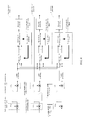
- FIG. 8 is a schematic diagram of signal processing in a microwave MIMO system according to Embodiment 5 of the present invention.
- the microwave MIMO system is a distributed MIMO system.
- n channels of baseband signals are transmitted to n channels of ODUs at a receiving end through the n channels of ODUs at the receiving end, the n channels of ODUs at the receiving end transmits the n channels of baseband signals to n channels of baseband processing systems after receiving the n channels of baseband signals, and the n channels of baseband processing systems process the n channels of baseband signals. Because each ODU at the sending end and each ODU at the receiving end adopt an independent LO, the n channels of baseband signals received by the n channels of baseband processing systems have frequency offsets of the sending end and the receiving end.
- a baseband processing system performs digital front-end processing such as analog-to-digital conversion and filtering on a received baseband signal, and an apparatus for correcting a frequency offset processes a digital signal that is obtained after digital processing.
- the apparatus for correcting a frequency offset may perform frequency offset estimation according to a center tap coefficient and an output phase that are acquired from a space time equalizer and a phase-locked loop phase detector, respectively; then perform frequency offset correction processing on the received digital signal according to an estimated value of a frequency offset to output a corrected signal to a subsequent space time equalizer and phase-locked loop phase detector for MIMO signal decoding processing to output a decoded signal; and then perform back-end processing such as combination and decision on the decoded signal to obtain a single channel of decoded signal finally.
- an apparatus for correcting a frequency offset acquires n first estimated frequency offset values, that is, estimated frequency offset values of a receiving end, according to n center tap coefficients that correspond to n channels of first corrected signals and n first output phases that correspond to the n channels of first corrected signals; and acquires a second estimated frequency offset value of a sending end according to a second output phase that corresponds to a superposed signal.
- an estimated frequency offset does not need to be calculated by using a method that a known sequence is inserted in transmission data of a baseband signal, but an estimated frequency offset of each of the receiving end and the sending end may be acquired according to the transmission data of the baseband signal, that is, a first corrected signal, and then frequency offset correction is performed, according to the estimated frequency offset of the receiving end and the estimated frequency offset of the sending end, on n channels of second signals currently received, thereby ensuring effective transmission of data.
- a frequency offset is estimated according to the transmission data of the baseband signal and a transmission process of the transmission data is successive, therefore the method described in this embodiment has a dynamic tracing feature; a process of calculating the estimated frequency offset of the receiving end and the estimated frequency offset of the sending end does not involve high-dimensional matrix calculation, thereby reducing operation complexity; in this embodiment, frequency offsets of the two ends: the receiving end and the sending end, may be compensated at the receiving end, and compared with the prior art in which a frequency offset of a sending end is compensated at the sending end in a feedback manner, complexity of a compensation system is reduced and system construction and configuration are simplified; and the frequency offset is estimated and corrected by using a signal processing technology, so that a restriction and a selection cost of a hardware device are reduced.
- each embodiment in the present specification is described in a progressive manner, with each embodiment emphasizing its differences from other embodiments, and for the same or similar parts, reference may be made among the embodiments.
- the apparatus embodiment is basically the same as the method embodiment, and is therefore described briefly. For the relevant parts in the apparatus embodiment, reference may be made to the corresponding description in the method embodiment.
- the program may be stored in a computer readable storage medium.
- the storage medium may be a read-only memory, a magnetic disk, or an optical disk.
Landscapes
- Engineering & Computer Science (AREA)
- Computer Networks & Wireless Communication (AREA)
- Signal Processing (AREA)
- Power Engineering (AREA)
- Radio Transmission System (AREA)
- Cable Transmission Systems, Equalization Of Radio And Reduction Of Echo (AREA)
Applications Claiming Priority (1)
| Application Number | Priority Date | Filing Date | Title |
|---|---|---|---|
| PCT/CN2012/075936 WO2012126429A2 (zh) | 2012-05-23 | 2012-05-23 | 一种频偏校正方法及装置 |
Publications (2)
| Publication Number | Publication Date |
|---|---|
| EP2621138A2 true EP2621138A2 (de) | 2013-07-31 |
| EP2621138A4 EP2621138A4 (de) | 2014-01-08 |
Family
ID=46879805
Family Applications (1)
| Application Number | Title | Priority Date | Filing Date |
|---|---|---|---|
| EP12759967.8A Withdrawn EP2621138A4 (de) | 2012-05-23 | 2012-05-23 | Verfahren und vorrichtung zur frequenzversatzkorrektur |
Country Status (4)
| Country | Link |
|---|---|
| US (1) | US8761238B2 (de) |
| EP (1) | EP2621138A4 (de) |
| CN (1) | CN102783107B (de) |
| WO (1) | WO2012126429A2 (de) |
Families Citing this family (10)
| Publication number | Priority date | Publication date | Assignee | Title |
|---|---|---|---|---|
| CN103095614B (zh) * | 2013-01-24 | 2015-06-24 | 电子科技大学 | 一种突发相干光纤通信中的联合均衡和频偏估计装置 |
| CN104639479B (zh) * | 2015-02-03 | 2019-02-26 | 大唐移动通信设备有限公司 | 一种频偏校准方法及设备 |
| CN106411806A (zh) * | 2016-08-30 | 2017-02-15 | 华为技术有限公司 | Fb脉冲序列搜索方法及装置 |
| CN106549720A (zh) * | 2016-10-13 | 2017-03-29 | 广东欧珀移动通信有限公司 | 一种改善移动终端射频频偏的方法和移动终端 |
| CN106603452B (zh) * | 2017-02-23 | 2019-12-10 | 武汉米风通信技术有限公司 | 基于多通道通信接收系统的定时采样与频偏校正方法 |
| CN113141196B (zh) * | 2020-01-20 | 2022-12-27 | 华为技术有限公司 | 一种信道补偿方法及通信装置 |
| CN111381075B (zh) * | 2020-04-16 | 2020-12-11 | 华中科技大学 | 一种利用预拟合锁相频差值获取频率偏移量的方法及装置 |
| CN114389926B (zh) * | 2020-10-22 | 2024-09-17 | 南京中兴软件有限责任公司 | 系数设置方法、信号处理方法、装置、设备及存储介质 |
| CN118713968A (zh) * | 2023-03-27 | 2024-09-27 | 华为技术有限公司 | 通信方法、装置、设备、系统及可读存储介质 |
| CN117155498B (zh) * | 2023-10-30 | 2024-03-22 | 武汉能钠智能装备技术股份有限公司 | 一种针对分布式接收机的信道联合参数处理方法及装置 |
Family Cites Families (10)
| Publication number | Priority date | Publication date | Assignee | Title |
|---|---|---|---|---|
| DE60142082D1 (de) * | 2001-06-22 | 2010-06-17 | Thomson Licensing | Verfahren und system zur kompensation einer trägerfrequenzversetzung in einem ofdm-empfänger |
| US7545891B1 (en) * | 2004-03-09 | 2009-06-09 | Ralink Technology, Inc. | Carrier recovery architectures for multi input multi output orthogonal frequency division multiplexing receivers |
| CN1317830C (zh) * | 2005-04-15 | 2007-05-23 | 展讯通信(上海)有限公司 | 自动频偏校正方法及使用该方法的装置和接收机 |
| US7738357B2 (en) * | 2005-06-17 | 2010-06-15 | Broadcom Corporation | Apparatus and method for carrier frequency offset estimation and correction in a wireless communication system |
| US7177374B2 (en) * | 2005-06-17 | 2007-02-13 | Broadcom Corporation | Apparatus and method for sampling frequency offset estimation and correction in a wireless communication system |
| US7856068B1 (en) * | 2005-06-28 | 2010-12-21 | Ralink Technology Corporation | Nested preamble for multi input multi output orthogonal frequency division multiplexing |
| US20080101497A1 (en) * | 2006-10-30 | 2008-05-01 | Broadcom Corporation, A California Corporation | MIMO phase noise estimation and correction |
| US7813442B2 (en) * | 2006-10-30 | 2010-10-12 | Broadcom Corporation | MIMO channel estimation in presence of carrier frequency offset |
| US7646823B2 (en) * | 2006-10-30 | 2010-01-12 | Broadcom Corporation | MIMO channel estimation in presence of sampling frequency offset |
| CN1964341B (zh) * | 2006-11-14 | 2011-04-27 | 北京邮电大学 | 多入多出-正交频分复用系统的接收端的频偏估计方法 |
-
2012
- 2012-05-23 EP EP12759967.8A patent/EP2621138A4/de not_active Withdrawn
- 2012-05-23 CN CN201280000641.6A patent/CN102783107B/zh not_active Expired - Fee Related
- 2012-05-23 WO PCT/CN2012/075936 patent/WO2012126429A2/zh not_active Ceased
-
2013
- 2013-05-16 US US13/896,020 patent/US8761238B2/en active Active
Also Published As
| Publication number | Publication date |
|---|---|
| EP2621138A4 (de) | 2014-01-08 |
| US20130315293A1 (en) | 2013-11-28 |
| CN102783107B (zh) | 2015-01-21 |
| CN102783107A (zh) | 2012-11-14 |
| WO2012126429A3 (zh) | 2013-05-02 |
| US8761238B2 (en) | 2014-06-24 |
| WO2012126429A2 (zh) | 2012-09-27 |
Similar Documents
| Publication | Publication Date | Title |
|---|---|---|
| EP2621138A2 (de) | Verfahren und vorrichtung zur frequenzversatzkorrektur | |
| EP2860931B1 (de) | Iterative Nachverfolgung und Verringerung von Phasenrauschen in drahtlosen Kommunikationssystemen | |
| US9401826B2 (en) | Signal processing unit employing a blind channel estimation algorithm and method of operating a receiver apparatus | |
| US8031762B2 (en) | Stream weight estimation and compensation in SIMO/MIMO OFDM receivers | |
| US20190215206A1 (en) | Ofdm system synchronization tracking method and apparatus | |
| JP5981658B2 (ja) | 通信デバイス、ベースバンドユニット、および通信方法 | |
| KR101828790B1 (ko) | 주파수 편이 변조 신호의 수신 방법 및 장치 | |
| US9154212B2 (en) | Radio transmission apparatus, radio reception apparatus, and data transmission method | |
| US8681896B1 (en) | Transmitter I/Q and carrier leak calibration | |
| US10440720B2 (en) | Co-channel interference cancellation method and apparatus | |
| JP3691709B2 (ja) | ダイバーシチ受信回路 | |
| US9001877B2 (en) | Signal processing for diversity combining radio receiver | |
| US20170180182A1 (en) | Joint noncoherent demodulation and carrier frequency offset correction based on non-linear filtering | |
| CN113572714A (zh) | 信号补偿方法、装置、设备及存储介质、芯片、模组设备 | |
| US8982982B2 (en) | Joint carrier recovery for MIMO systems | |
| US10177855B2 (en) | Amplitude adjustment circuit, digital coherent receiver, and amplitude adjustment method | |
| EP2651085A1 (de) | Verfahren und Vorrichtung zur iterativen Erfassung von Datenströmen | |
| WO2017005300A1 (en) | Phase noise suppression for large antenna array communication systems | |
| KR20130095216A (ko) | 블라인드 채널 추정 알고리즘을 사용하는 신호 처리 유닛 및 수신기 장치의 동작 방법 | |
| CN105282087A (zh) | 一种高阶调制数据符号相位补偿的方法、装置和电路 | |
| US20080240296A1 (en) | Iterative sequential carrier acquisition | |
| US9059765B2 (en) | Reception device and reception method | |
| EP2869522B1 (de) | Drahtloser kommunikationsempfänger mit i/q-ungleichgewichtsschätzung und korrekturverfahren | |
| Sagong et al. | A novel blind interference cancellation receiver for LTE uplink SC-FDMA systems | |
| JP6016608B2 (ja) | 受信装置および復号方法 |
Legal Events
| Date | Code | Title | Description |
|---|---|---|---|
| PUAI | Public reference made under article 153(3) epc to a published international application that has entered the european phase |
Free format text: ORIGINAL CODE: 0009012 |
|
| 17P | Request for examination filed |
Effective date: 20130422 |
|
| AK | Designated contracting states |
Kind code of ref document: A2 Designated state(s): AL AT BE BG CH CY CZ DE DK EE ES FI FR GB GR HR HU IE IS IT LI LT LU LV MC MK MT NL NO PL PT RO RS SE SI SK SM TR |
|
| A4 | Supplementary search report drawn up and despatched |
Effective date: 20131205 |
|
| RIC1 | Information provided on ipc code assigned before grant |
Ipc: H04L 27/00 20060101ALI20131129BHEP Ipc: H04L 7/02 20060101ALI20131129BHEP Ipc: H04L 27/26 20060101AFI20131129BHEP Ipc: H04L 25/03 20060101ALI20131129BHEP Ipc: H04L 7/00 20060101ALI20131129BHEP |
|
| 17Q | First examination report despatched |
Effective date: 20140509 |
|
| STAA | Information on the status of an ep patent application or granted ep patent |
Free format text: STATUS: THE APPLICATION IS DEEMED TO BE WITHDRAWN |
|
| 18D | Application deemed to be withdrawn |
Effective date: 20140920 |