EP2626960A2 - Matériau laser actif comprenant des nanoparticules, appareil laser comprenant ledit matériau laser actif et procédé de fabrication de nanoparticules - Google Patents
Matériau laser actif comprenant des nanoparticules, appareil laser comprenant ledit matériau laser actif et procédé de fabrication de nanoparticules Download PDFInfo
- Publication number
- EP2626960A2 EP2626960A2 EP13154561.8A EP13154561A EP2626960A2 EP 2626960 A2 EP2626960 A2 EP 2626960A2 EP 13154561 A EP13154561 A EP 13154561A EP 2626960 A2 EP2626960 A2 EP 2626960A2
- Authority
- EP
- European Patent Office
- Prior art keywords
- laser medium
- active laser
- vacuum state
- nanoparticles
- reaction chamber
- Prior art date
- Legal status (The legal status is an assumption and is not a legal conclusion. Google has not performed a legal analysis and makes no representation as to the accuracy of the status listed.)
- Withdrawn
Links
Images


Classifications
-
- H—ELECTRICITY
- H01—ELECTRIC ELEMENTS
- H01S—DEVICES USING THE PROCESS OF LIGHT AMPLIFICATION BY STIMULATED EMISSION OF RADIATION [LASER] TO AMPLIFY OR GENERATE LIGHT; DEVICES USING STIMULATED EMISSION OF ELECTROMAGNETIC RADIATION IN WAVE RANGES OTHER THAN OPTICAL
- H01S3/00—Lasers, i.e. devices using stimulated emission of electromagnetic radiation in the infrared, visible or ultraviolet wave range
- H01S3/05—Construction or shape of optical resonators; Accommodation of active medium therein; Shape of active medium
- H01S3/06—Construction or shape of active medium
- H01S3/07—Construction or shape of active medium consisting of a plurality of parts, e.g. segments
-
- H—ELECTRICITY
- H01—ELECTRIC ELEMENTS
- H01S—DEVICES USING THE PROCESS OF LIGHT AMPLIFICATION BY STIMULATED EMISSION OF RADIATION [LASER] TO AMPLIFY OR GENERATE LIGHT; DEVICES USING STIMULATED EMISSION OF ELECTROMAGNETIC RADIATION IN WAVE RANGES OTHER THAN OPTICAL
- H01S3/00—Lasers, i.e. devices using stimulated emission of electromagnetic radiation in the infrared, visible or ultraviolet wave range
- H01S3/14—Lasers, i.e. devices using stimulated emission of electromagnetic radiation in the infrared, visible or ultraviolet wave range characterised by the material used as the active medium
- H01S3/16—Solid materials
- H01S3/168—Solid materials using an organic dye dispersed in a solid matrix
-
- H—ELECTRICITY
- H01—ELECTRIC ELEMENTS
- H01S—DEVICES USING THE PROCESS OF LIGHT AMPLIFICATION BY STIMULATED EMISSION OF RADIATION [LASER] TO AMPLIFY OR GENERATE LIGHT; DEVICES USING STIMULATED EMISSION OF ELECTROMAGNETIC RADIATION IN WAVE RANGES OTHER THAN OPTICAL
- H01S3/00—Lasers, i.e. devices using stimulated emission of electromagnetic radiation in the infrared, visible or ultraviolet wave range
- H01S3/09—Processes or apparatus for excitation, e.g. pumping
- H01S3/091—Processes or apparatus for excitation, e.g. pumping using optical pumping
- H01S3/094—Processes or apparatus for excitation, e.g. pumping using optical pumping by coherent light
- H01S3/09403—Cross-pumping, e.g. Förster process involving intermediate medium for excitation transfer
-
- H—ELECTRICITY
- H01—ELECTRIC ELEMENTS
- H01S—DEVICES USING THE PROCESS OF LIGHT AMPLIFICATION BY STIMULATED EMISSION OF RADIATION [LASER] TO AMPLIFY OR GENERATE LIGHT; DEVICES USING STIMULATED EMISSION OF ELECTROMAGNETIC RADIATION IN WAVE RANGES OTHER THAN OPTICAL
- H01S3/00—Lasers, i.e. devices using stimulated emission of electromagnetic radiation in the infrared, visible or ultraviolet wave range
- H01S3/14—Lasers, i.e. devices using stimulated emission of electromagnetic radiation in the infrared, visible or ultraviolet wave range characterised by the material used as the active medium
- H01S3/16—Solid materials
- H01S3/169—Nanoparticles, e.g. doped nanoparticles acting as a gain material
-
- B—PERFORMING OPERATIONS; TRANSPORTING
- B82—NANOTECHNOLOGY
- B82Y—SPECIFIC USES OR APPLICATIONS OF NANOSTRUCTURES; MEASUREMENT OR ANALYSIS OF NANOSTRUCTURES; MANUFACTURE OR TREATMENT OF NANOSTRUCTURES
- B82Y20/00—Nanooptics, e.g. quantum optics or photonic crystals
-
- Y—GENERAL TAGGING OF NEW TECHNOLOGICAL DEVELOPMENTS; GENERAL TAGGING OF CROSS-SECTIONAL TECHNOLOGIES SPANNING OVER SEVERAL SECTIONS OF THE IPC; TECHNICAL SUBJECTS COVERED BY FORMER USPC CROSS-REFERENCE ART COLLECTIONS [XRACs] AND DIGESTS
- Y10—TECHNICAL SUBJECTS COVERED BY FORMER USPC
- Y10S—TECHNICAL SUBJECTS COVERED BY FORMER USPC CROSS-REFERENCE ART COLLECTIONS [XRACs] AND DIGESTS
- Y10S977/00—Nanotechnology
- Y10S977/70—Nanostructure
- Y10S977/773—Nanoparticle, i.e. structure having three dimensions of 100 nm or less
Definitions
- the present disclosure relates to active laser mediums including nanoparticles, laser apparatuses including the active laser mediums, and methods of manufacturing nanoparticles.
- Metal nanoparticles have found applications in many fields of modern research and technologies: fluorescent spectroscopy, therapy and visualization of tumors, creation of sensors of various types, low-threshold lasers, panels of increased luminosity and metamaterials (hyperlenses, invisible coating devices, etc.).
- Metal nanoparticles have gained such widespread use due to their strong and specific interaction with an electromagnetic wave and the presence of surface plasmon resonance - frequency bands, in which an absorption limit is considerably increased because of coincidence of a frequency of an incident light with a frequency of oscillations of surface plasmons (collective oscillations of electrons of conduction in a particle concerning the ionic skeleton).
- SPASER Surface Plasmon Amplification by Stimulated Emission of Radiation
- MNP is surrounded by a luminophor which represents, for example, molecules of organic dye.
- One of the methods of implementation of a SPASER is surrounding MNP by a silica shell with the organic dye which has a spectrum of a luminescence which overlaps with a band of surface plasmon resonance and providing a layer of silica between the MNP and silica shell in order to avoid quenching a luminophor (see Noginov M. A. et al., "Demonstration of a spaser-based nanolaser", Nature, Vol. 460, P. 1110-1113, 2009 ).
- an MNP shell containing a luminophor can be executed, for example, from polyallylamine hydrochloride (PAH) or sulfonated polystyrene (PSS) (see Schneider G., Decher G., "Distance-dependent fluorescence quenching on gold nanoparticles ensheathed with layer-by-layer assembled polyelectrolytes," Nano Lett., Vol. 6. No 3., P. 530-536, 2006 ), or polyaniline (PANI) which possesses an electrical conductivity (see Xing S. at al., "Highly controlled core/shell structures: tunable conductive polymer shells on gold nanoparticles and nanochains", J. Mater. Chem., Vol.
- thermosensitivity Li D., He Q., Li J., "Smart core/shell nanocomposites: Intelligent polymers modified gold nanoparticles", Adv. Colloid Interface Sci., Vol. 149, P. 28-38, 2009 ).
- PNIPA polyisopropylacrylamide
- a method of obtaining opal-similar structures with gold nanoparticles, in which sedimentation is performed in two stages, is known.
- the first stage includes obtaining gold nanoparticles by laser ablation, the transfer of the gold nanoparticles being made in ethanolic solution, by using an impact of laser radiation with a wave length of 1060 nanometers on the gold target, located in ethanolic solution.
- the gold nanoparticles transfer in ethanolic solution under the influence of a laser impulse.
- the multiple infiltration of gold nanoparticles in an opal matrix is performed, for which purpose the sample with the superimposed silica microspheres is drowned in the solution, obtained at the first stage, and dried using air. This procedure is iterated up to 100 times (see V. S. Gorelik, L I. Zlobina, V. A. Karavanskii, O. A. Troitskii, R I. Chanieva, Inorganic Materials 46 (2010), P. 862-865 ).
- a method of sedimentation of gold nanoparticles on a surface of silica microspheres includes the following steps.
- a glass substrate with the superimposed microspheres is placed at an angle of 65° in 2-3 ml of the solution containing 0.01% HAuCl4, 0.01% of tannic acid, 0.04%, citrate of sodium and 0.26 mm of a solution of potassium carbonate.
- the solution will completely evaporate and will be infiltrated in a matrix of silica microspheres under the influence of capillary forces.
- gold nanoparticles of sizes from 3.5 to 6.5 nanometers are obtained from a solution (see A.Z. Khokhar, F. Rahman, N.P. Johnson, Journal of Physics and Chemistry of Solids 72 (2011), P. 185-189 ).
- This known method possesses essential drawbacks, such as the impossibility of control of sizes of nanoparticles, the presence of SAW, and also the aggregation of nanoparticles after removal of a solvent.
- a substrate is placed in the reactor at atmospheric pressure, heated up to 200-400°C, and then steam including precursors is submitted from two independent sources, thus varying the temperatures of the steam from 52°C to 150°C for trimethylindium and to 350 °C for phosphine.
- the number of cycles of sedimentation is from 2 to 10 for each reactant, and the duration of cycles is from 25 minutes up to 1 hour.
- InP nanoparticles having a size of 50 nanometers are obtained.
- Drawbacks of this method include the complexity and duration of the method.
- aspects of the exemplary embodiments may overcome the above disadvantages associated with the related art techniques. It is understood, however, that aspects of the exemplary embodiments are not required to overcome the above disadvantages associated with the related art techniques.
- active laser mediums including nanoparticles.
- laser apparatuses including the active laser mediums.
- an active laser medium including: a metal nanoparticle; and a shell surrounding the metal nanoparticle, the shell including a luminophor, wherein a luminescence spectrum of the luminophor overlaps with a peak of surface plasmon resonance of the metal nanoparticle.
- the active laser medium may have a form of a colloid or a form of a solid-state film.
- the luminophor may include a plurality of quantum dots having the luminescence spectrum that overlaps with the peak of the surface plasmon resonance of the metal nanoparticle.
- the luminophor may include an organic dye having the luminescence spectrum that overlaps with the peak of the surface plasmon resonance of the metal nanoparticle.
- the organic dye may be fluorescein.
- the shell may include a silica material.
- the shell may include a polymer material.
- the metal nanoparticle may be a gold nanoparticle.
- a laser apparatus including: an active laser medium including a metal nanoparticle; and a shell surrounding the metal nanoparticle, the shell including a luminophor, wherein a luminescence spectrum of the luminophor overlaps with a peak of surface plasmon resonance of the metal nanoparticle; a pumping light source for radiating a pumping light to the active laser medium; and a resonator for induction-amplifying light excited in the active laser medium by the pumping light.
- the resonator may include a pair of confocal mirrors that face each other across the active laser medium and are positioned such that the active laser medium is between the confocal mirrors.
- the active laser medium may be disposed on a focal plane of the pair of confocal mirrors.
- a focusing lens for focusing the pumping light radiated from the pumping light source on the active laser medium may be disposed between the pumping light source and the active laser medium.
- a method of manufacturing nanoparticles including: disposing a substrate, on which silica microspheres are added, into a reaction chamber in a first vacuum state; heating the substrate and supplying a precursor steam onto the substrate; delivering air into the reaction chamber and forming a second vacuum state by increasing an atmospheric pressure of the reaction chamber; maintaining the second vacuum state for a predetermined time period; and performing a pumping operation to allow the atmospheric pressure of the reaction chamber to reach the first vacuum state.
- the precursor steam may include a volatile organometallic complex.
- the precursor steam may include gold.
- the precursor steam may include dipivaloylmethanate dimethylgold.
- the supplying of the precursor steam, the forming of the second vacuum state by increasing the atmospheric pressure of the reaction chamber, the maintaining of the second vacuum state, and the performing of the pumping operation to allow the atmospheric pressure of the reaction chamber to reach the first vacuum state may be repeated for a number of repetitions until a nanoparticle with a predetermined size is formed.
- the nanoparticles each may have a diameter of 5 nm to 20 nm as the predetermined size.
- the number of repetitions may be from 30 to 100.
- the atmospheric pressure of the first vacuum state may be 10 -4 torr (1.33 x 10 -7 bar).
- the substrate In the supplying of the precursor steam, the substrate may be heated to a temperature of 192° C to 230° C.
- a temperature of the precursor steam may be from 45° C to 56° C.
- a time period during which the precursor steam is supplied may be 1.5 seconds or greater.
- the atmospheric pressure of the second vacuum state may be 10 -2 torr (1.33 x 10 -5 bar).
- a time period during which the second vacuum state is maintained may be two seconds or greater.
- an active laser medium including: a metal nanoparticle; and a shell surrounding the metal nanoparticle, the shell including a luminophor having a predetermined luminescence spectrum, wherein the shell includes one of a silica shell or a polymer shell.
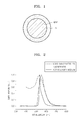
- FIG. 1 schematically illustrates a core-shell structure including a metal nanoparticle and a shell, which constitutes an active laser medium according to an exemplary embodiment.
- the core-shell structure that is included in the active laser medium includes a metal nanoparticle (hereinafter, also referred to as MNP) and a shell S surrounding the MNP.
- the shell S includes a luminophor having a luminescence spectrum that overlaps with the peak of surface plasmon resonance of the MNP.
- the MNP causes the surface plasmon resonance due to a strong and specific interaction with an electromagnetic wave, and has a very high limit absorbance with respect to incident light within a frequency band of the surface plasmon resonance.
- the MNP may be formed of a metal material having high electric conductivity, for example, gold.
- the shell S includes a luminophor, and in addition, may include silica or a polymer.
- a plural number of quantum dots with a luminescence spectrum that overlaps with the peak of the surface plasmon resonance of the MNP may be used as the luminophor.
- Each quantum dot may include any one of an Si-based nanocrystal, a II-V group-based compound semiconductor nanocrystal, a III-V group-based compound semiconductor nanocrystal, a IV-VI group-based compound semiconductor nanocrystal, or a mixture thereof.
- the energy level of a quantum dot is changed according to the material and size of the quantum dot, and thus, the material and size of the quantum dot may be determined so that a luminescence spectrum thereof overlaps with the peak of an extinction spectrum of the MNP.
- an organic dye with a luminescence spectrum that overlaps with the peak of the surface plasmon resonance of the MNP may be used as the luminophor L.
- fluorescein may be used as the organic dye.
- FIG. 2 is a graph illustrating a spectrum of stimulated radiation of the active laser medium, a spectrum of extinction of gold nanoparticles constituting the active laser medium, and a spectrum of luminescence of a luminophor.
- gold nanoparticles are used as MNPs, and fluorescein is used as the luminophor.
- the spectrum of luminescence of the luminophor overlaps with the spectrum of extinction of the gold nanoparticles, and the stimulated radiation of the active laser medium is between the spectrum of luminescence of the luminophor and the spectrum of extinction of the gold nanoparticles, which is consistent with theoretical representations (see Stockman M.I., "The spaser as a nanoscale quantum generator and ultrafast amplifier", J. Opt., Vol. 12., P. 1-13, 2010 ).
- FIG. 3 shows a scheme of an experimental facility 50 for observing the spectrum of luminescence of a laser apparatus 20 according to an exemplary embodiment.
- the experimental facility 50 for observing the spectrum of luminescence includes the laser apparatus 20 including an active laser medium 23, a cuvette Q in which a sample of the active laser medium 23 is disposed, a spectrometer 37, a glass plate 36 for diverging a portion of the light emitted from the laser apparatus 20 towards the spectrometer 37, and a focusing lens 32 for focusing the diverged portion of light on the spectrometer 37.
- the laser apparatus 20 includes the active laser medium 23, a pumping light source 21 for radiating light (e.g., a pumping light) to the active laser medium 23, and a resonator for induction-amplifying the light excited in the active laser medium 23 by the pumping light.
- a pumping light source 21 for radiating light (e.g., a pumping light) to the active laser medium 23, and a resonator for induction-amplifying the light excited in the active laser medium 23 by the pumping light.
- the active laser medium 23 has a structure in which a shell including a luminophor having a predetermined luminescence spectrum surrounds an MNP.
- the resonator may be formed of a pair of confocal mirrors 24 and 25 that face each other across the active laser medium 23, the active laser medium 23 being disposed therebetween, and the active laser medium 23 may be disposed on a focal plane of the pair of confocal mirrors.
- the focusing lens 22 for focusing the light radiated from the pumping light source 21 on the active laser medium 23 may be disposed between the pumping light source 21 and the active laser medium 23.
- FIG. 4 is a graph illustrating a luminescence spectrum of the laser apparatus 20 according to the present exemplary embodiment and a luminescence spectrum of a laser apparatus according to a comparison example.
- the graph of FIG. 4 shows a spectrum in which light intensity has been normalized for the case of the present exemplary embodiment at a pump power 40 megawatt/cm 2 and for the case of the comparison example at a pump power 200 megawatt/cm 2 .
- a very efficient laser radiation performance may be obtained by using NMPs, each surrounded with a shell including a luminophor, as an active laser medium.
- FIG. 5 is a flowchart schematically illustrating a method of manufacturing nanoparticles, according to an exemplary embodiment.
- the method shown in FIG. 5 includes disposing a substrate, in which silica microspheres are added, into a reaction chamber in a first vacuum state (operation S1), heating the substrate and supplying steam (e.g., a precursor steam) onto the substrate (operation S2), delivering air into the reaction chamber and forming a second vacuum state by increasing the atmospheric pressure of the reaction chamber (operation S3), maintaining the second vacuum state (operation S4), and performing a pumping operation to allow the atmospheric pressure of the reaction chamber to reach the first vacuum state (operation S5).
- steam e.g., a precursor steam
- Operations S2 through S5 may be repeated until nanoparticles having desired sizes are formed.
- nanoparticles each having a diameter of 5 nm to 20 nm may be formed, and the number of repetitions may be from 30 to 100. It is understood, however, that the nanoparticles may have diameters greater or less than 5 nm to 20 nm, and the number of repetitions may be greater or less than 30 to 100.
- a volatile organometallic complex may be used as a precursor to be included in the precursor steam for formation of nanoparticles.
- the precursor may include gold, and for example, dipivaloylmethanate dimethylgold may be used as the precursor.
- the atmospheric pressure of the first vacuum state may be about 10 -4 torr (1.33 x 10 -7 bar).
- a vacuum may be formed in the reaction chamber until the atmospheric pressure of the first vacuum state reaches 10 -4 torr.
- the substrate may be heated to a temperature of 192°C to 230°C, and the temperature of the precursor steam may be from 45°C to 56°C.
- a time period during which the precursor steam is supplied may be 1.5 seconds or greater.
- an air delivery process may be performed until the atmospheric pressure of the reaction chamber reaches about 10 -2 torr (1.33 x 10 -5 bar).
- the maintaining of the second vacuum state (operation S4) is continued for a predetermined time period.
- the maintaining of the second vacuum state may be for several seconds, for example, about two seconds or greater.
- operation S5 a pumping operation is performed to allow the atmospheric pressure of the reaction chamber to reach the first vacuum state that is an initial state.
- the method according to the present exemplary embodiment is different from commonly known conventional methods in that the sedimentation of gold nanoparticles is performed in one stage.
- the method according to the present exemplary embodiment may provide nanoparticles having sizes which are controlled and which do not aggregate with each other after performing the method.
- the method may be executed by automation equipment that includes a reaction chamber, a vacuum system, and a gas delivery system which may be controlled by using a computer.
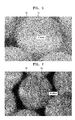
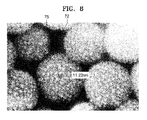
- FIGS. 6 through 8 show microphotographs of various sized-nanoparticles precipitated on silica microspheres, produced according to the above described method of manufacturing nanoparticles according to an exemplary embodiment.
- FIG. 6 shows a microphotograph in which gold nanoparticles 75 with a size of about 5 nm to about 10 nm have been formed on silica microspheres 72.
- Process conditions for forming the gold nanoparticles 75 shown in FIG. 6 are as follows.
- a substrate having a thickness of 2 mm and a size of 10x10 mm 2 in which silica microspheres having an average diameter of 210 nm are added, is disposed in a reaction chamber having an atmospheric pressure of 10 -4 torr (1.33 x 10 -7 bar) and is heated to a temperature of 192°C.
- Dipivaloylmethanate dimethylgold steam with a temperature of 45°C is supplied into the reaction chamber, and the supplied steam is maintained for 1.5 seconds.
- an air delivery operation is performed until the atmospheric pressure of the reaction chamber reaches 10 -2 torr (1.33 x 10 -5 bar). This state is maintained for 2 seconds, and then the reaction chamber returns to an initial vacuum state by a pumping operation.
- the number of cycles according to this example is 50.
- FIG. 7 shows a microphotograph in which gold nanoparticles 75 with a size of about 10 nm to about 20 nm have been formed on silica microspheres 72.
- Process conditions for forming the gold nanoparticles 75 shown in FIG. 7 are as follows.
- a substrate having a thickness of 2 mm and a size of 10x10 mm 2 in which silica microspheres having an average diameter of 210 nm are added, is disposed in a reaction chamber having an atmospheric pressure of 10 -4 torr (1.33 x 10 -7 bar) and is heated to a temperature of 200°C.
- Dipivaloylmethanate dimethylgold steam with a temperature of 56°C is supplied into the reaction chamber, and the supplied steam is maintained for 2 seconds.
- an air delivery operation is performed until the atmospheric pressure of the reaction chamber reaches 10 -2 torr (1.33 x 10 -5 bar). This state is maintained for 2 seconds, and then the reaction chamber returns to an initial vacuum state by a pumping operation.
- the number of cycles in this example is 100.
- FIG. 8 shows a microphotograph in which gold nanoparticles 75 with a size of about 8 nm to about 15 nm have been formed on silica microspheres 72.
- Process conditions for forming the gold nanoparticles 75 shown in FIG. 8 are as follows.
- a substrate having a thickness of 2 mm and a size of 10x10 mm 2 in which silica microspheres having an average diameter of 210 nm are added, is disposed in a reaction chamber having an atmospheric pressure of 10 -4 torr (1.33 x 10 -7 bar) and is heated to a temperature of 230°C.
- Dipivaloylmethanate dimethylgold steam with a temperature of 55°C is supplied into the reaction chamber, and this state is maintained for 2.5 seconds.
- an air delivery operation is performed until the atmospheric pressure of the reaction chamber reaches 10 -2 torr (1.33 x 10 -5 bar). This state is maintained for 3 seconds, and then the reaction chamber returns to an initial vacuum state by a pumping operation.
- the number of cycles in this example is 30.
- the detailed experimental conditions are examples only, and any of the described conditions, including, for example, temperature for heating the substrate, temperature of the steam, duration of reaction mixture, number of cycles, etc., may be varied to form a nanoparticle of a desired size.
- the active laser medium according to exemplary embodiments described above includes nanoparticles each surrounded with a silica shell including a luminophor. As described above, the active laser medium according to exemplary embodiments achieves a significantly lower threshold of generation of laser radiation in the active laser medium than a threshold of generation of laser radiation in an active laser medium including nanoparticles without silica shells.
- the active laser medium according to exemplary embodiments described above may be applied to a high-efficiency laser apparatus.
- the above described method of manufacturing nanoparticles according to exemplary embodiments includes an operation of precipitating nanoparticles on silica microspheres, and thus, the manufacturing method according to exemplary embodiments is simple, the processing time thereof is short, and the sizes of the nanoparticles may be controlled in a very accurate fashion.
Landscapes
- Physics & Mathematics (AREA)
- Electromagnetism (AREA)
- Engineering & Computer Science (AREA)
- Plasma & Fusion (AREA)
- Optics & Photonics (AREA)
- Chemical & Material Sciences (AREA)
- Dispersion Chemistry (AREA)
- Nanotechnology (AREA)
- Manufacture Of Metal Powder And Suspensions Thereof (AREA)
- Lasers (AREA)
Applications Claiming Priority (3)
| Application Number | Priority Date | Filing Date | Title |
|---|---|---|---|
| RU2012104712/28A RU2489230C1 (ru) | 2012-02-10 | 2012-02-10 | Способ осаждения наночастиц золота на микросферы кремнезема |
| RU2012104713/28A RU2520946C2 (ru) | 2012-02-10 | 2012-02-10 | Активная среда лазера |
| KR1020120104211A KR20130092361A (ko) | 2012-02-10 | 2012-09-19 | 나노 입자를 구비한 액티브 레이저 매체, 이를 포함하는 레이저 장치 및 나노 입자 제조방법 |
Publications (2)
| Publication Number | Publication Date |
|---|---|
| EP2626960A2 true EP2626960A2 (fr) | 2013-08-14 |
| EP2626960A3 EP2626960A3 (fr) | 2016-01-27 |
Family
ID=47666040
Family Applications (1)
| Application Number | Title | Priority Date | Filing Date |
|---|---|---|---|
| EP13154561.8A Withdrawn EP2626960A3 (fr) | 2012-02-10 | 2013-02-08 | Matériau laser actif comprenant des nanoparticules, appareil laser comprenant ledit matériau laser actif et procédé de fabrication de nanoparticules |
Country Status (2)
| Country | Link |
|---|---|
| US (1) | US20130250988A1 (fr) |
| EP (1) | EP2626960A3 (fr) |
Cited By (1)
| Publication number | Priority date | Publication date | Assignee | Title |
|---|---|---|---|---|
| GB2592614A (en) * | 2020-03-03 | 2021-09-08 | Sumitomo Chemical Co | Light-emitting particles |
Families Citing this family (1)
| Publication number | Priority date | Publication date | Assignee | Title |
|---|---|---|---|---|
| CN109066284A (zh) * | 2018-08-21 | 2018-12-21 | 西安工业大学 | 一种用于实现可调谐双波段受激辐射的纳米激光器 |
Citations (1)
| Publication number | Priority date | Publication date | Assignee | Title |
|---|---|---|---|---|
| US7569188B2 (en) | 2003-01-03 | 2009-08-04 | Ramot At Tel-Aviv University Ltd | Surface plasmon amplification by stimulated emission of radiation (SPASER) |
Family Cites Families (11)
| Publication number | Priority date | Publication date | Assignee | Title |
|---|---|---|---|---|
| EP1264375A2 (fr) * | 2000-03-14 | 2002-12-11 | Massachusetts Institute Of Technology | Amplificateurs optiques et lasers |
| US7817697B1 (en) * | 2003-07-28 | 2010-10-19 | The United States Of America As Represented By The Secretary Of The Navy | Laser diode pumped solid-state dye laser and method for operating same |
| JP4421319B2 (ja) * | 2004-02-13 | 2010-02-24 | 独立行政法人科学技術振興機構 | レーザ装置及びレーザ発振方法 |
| US20060039425A1 (en) * | 2004-08-10 | 2006-02-23 | Betin Alexander A | Solid-state suspension laser |
| US20070034831A1 (en) * | 2005-08-09 | 2007-02-15 | Attieh Al-Ghamdi | Synthesis of solid state dye laser by y-irradiation polymerization method |
| US20070189351A1 (en) * | 2006-02-15 | 2007-08-16 | Northrop Grumman Corporation | Liquid laser with colloidal suspension of lasant nanoparticles |
| US8050303B2 (en) * | 2006-04-12 | 2011-11-01 | Raytheon Company | Laser based on quantum dot activated media with forster resonant energy transfer excitation |
| FR2942571B1 (fr) * | 2009-02-20 | 2011-02-25 | Draka Comteq France | Fibre optique amplificatrice comprenant des nanostructures |
| US20120305802A1 (en) * | 2009-08-11 | 2012-12-06 | Erik Herz | Nanoparticles and Methods of Generating Coherent Emission Therefrom |
| US8259772B2 (en) * | 2011-02-04 | 2012-09-04 | Fondazione Istituto Italiano Di Technologia | Fabrication of lasing microcavities consisting of highly luminescent colloidal nanocrystals |
| FR2973593B1 (fr) * | 2011-03-29 | 2013-04-19 | Commissariat Energie Atomique | Laser plasmonique et son procede de fabrication. |
-
2013
- 2013-02-08 EP EP13154561.8A patent/EP2626960A3/fr not_active Withdrawn
- 2013-02-11 US US13/764,041 patent/US20130250988A1/en not_active Abandoned
Patent Citations (1)
| Publication number | Priority date | Publication date | Assignee | Title |
|---|---|---|---|---|
| US7569188B2 (en) | 2003-01-03 | 2009-08-04 | Ramot At Tel-Aviv University Ltd | Surface plasmon amplification by stimulated emission of radiation (SPASER) |
Non-Patent Citations (11)
| Title |
|---|
| A.Z. KHOKHAR; F. RAHMAN; N.P. JOHNSON, JOURNAL OF PHYSICS AND CHEMISTRY OF SOLIDS, vol. 72, 2011, pages 185 - 189 |
| DICE G. D.; MUJUMDAR S.; ELEZZABI A. Y.: "Plasmonically enhanced diffusive and subdiffusive metal nanoparticle-dye random laser", APPL. PHYS. LETT., vol. 86, 2005, pages 131105, XP012064790, DOI: doi:10.1063/1.1894590 |
| H.M. YATES; M.E. PEMBLE; H. MIGUEZ; A. BLANCO; C. LOPEZ; F. MESEGUER; L. VAZQUEZ., J. CRYS. GROWTH, vol. 193, 1998, pages 9 - 15 |
| LI D.; HE Q.; LI J.: "Smart core/shell nanocomposites: Intelligent polymers modified gold nanoparticles", ADV. COLLOID INTERFACE SCI., vol. 149, 2009, pages 28 - 38, XP026098087, DOI: doi:10.1016/j.cis.2008.12.007 |
| MERTENS H.; KOENDERINK A.F.; POLMAN A: "Plasmon-enhanced luminescence near noble-metal nanospheres: Comparison of exact theory and an improved Gersten and Nitzan model", PHYS. REV. B., vol. 76, 2007, pages 115 - 123 |
| NOGINOV M. A. ET AL.: "Demonstration of a spaser-based nanolaser", NATURE, vol. 460, 2009, pages 1110 - 1113 |
| SCHNEIDER G.; DECHER G.: "Distance-dependent fluorescence quenching on gold nanoparticles ensheathed with layer-by-layer assembled polyelectrolytes", NANO LETT., vol. 6, no. 3, 2006, pages 530 - 536 |
| STOCKMAN M.I.: "The spaser as a nanoscale quantum generator and ultrafast amplifier", J. OPT., vol. 12, 2010, pages 1 - 13 |
| V. S. GORELIK; L . ZLOBINA; V. A. KARAVANSKII; O. A. TROITSKII; R . CHANIEVA, INORGANIC MATERIALS, vol. 46, 2010, pages 862 - 865 |
| XING S.: "Highly controlled core/shell structures: tunable conductive polymer shells on gold nanoparticles and nanochains", J. MATER. CHEM., vol. 19, 2009, pages 3286 - 3291 |
| ZAKOVRYASHIN N.S.; PERMINOV S.V.; KUCH'YANOV A.S.; SAFONOV V.P.: "Modern Problems of Laser Physics", 22 August 2004, article "Pulsed lasing in dye molecules - silver nanoagreggates - microcavity composites at nano- and picoseconds excitation", pages: 404 - 407 |
Cited By (3)
| Publication number | Priority date | Publication date | Assignee | Title |
|---|---|---|---|---|
| GB2592614A (en) * | 2020-03-03 | 2021-09-08 | Sumitomo Chemical Co | Light-emitting particles |
| WO2021176208A1 (fr) | 2020-03-03 | 2021-09-10 | Cambridge Display Technology Limited | Particules électroluminescentes |
| GB2592614B (en) * | 2020-03-03 | 2024-07-17 | Sumitomo Chemical Co | Light-emitting particles |
Also Published As
| Publication number | Publication date |
|---|---|
| EP2626960A3 (fr) | 2016-01-27 |
| US20130250988A1 (en) | 2013-09-26 |
Similar Documents
| Publication | Publication Date | Title |
|---|---|---|
| Guan et al. | Engineering directionality in quantum dot shell lasing using plasmonic lattices | |
| Yuan et al. | Ultrastable and low‐threshold random lasing from narrow‐bandwidth‐emission triangular carbon quantum dots | |
| Miller et al. | Ensemble brightening and enhanced quantum yield in size-purified silicon nanocrystals | |
| Li et al. | Output coupling of perovskite lasers from embedded nanoscale plasmonic waveguides | |
| CN103247935B (zh) | 光学各向异性可饱和吸收器件、制备方法及基于该器件的脉冲激光器 | |
| Zhou et al. | Broad-band lead halide perovskite quantum dot single-mode lasers | |
| KR101502390B1 (ko) | 그래핀의 제조 방법, 이를 포함하는 펄스레이저 공진기의 제조방법 및 이를 이용한 펄스레이저의 제조 방법 | |
| Liu et al. | Lead chalcogenide quantum dot‐doped glasses for photonic devices | |
| Wang et al. | Plasmon enhancement for Vernier coupled single-mode lasing from ZnO/Pt hybrid microcavities | |
| Ni et al. | Random lasing carbon dot fibers for multilevel anti-counterfeiting | |
| Tang et al. | Electronic coupling of highly ordered perovskite nanocrystals in supercrystals | |
| Ali et al. | SiO2 Capped-ZnO nanorods for enhanced random laser emission | |
| Zhao et al. | Low-threshold stimulated emission in perovskite quantum dots: single-exciton optical gain induced by surface plasmon polaritons at room temperature | |
| CN108767648A (zh) | 可饱和吸收体器件及其制备方法、锁模光纤激光器 | |
| CN109103739A (zh) | 一种蓝光随机激光器 | |
| US20130250988A1 (en) | Active laser medium including nanoparticles, laser apparatus including the active laser medium, and method of manufacturing nanoparticles | |
| Zeng et al. | Control of whispering gallery modes and PT-symmetry breaking in colloidal quantum dot microdisk lasers with engineered notches | |
| CN110429469B (zh) | 一种回音壁模式有机微盘谐振腔的制备方法 | |
| Fu et al. | Tunable plasmon modes in single silver nanowire optical antennas characterized by far-field microscope polarization spectroscopy | |
| CN206076726U (zh) | 基于氧化锌纳米棒的随机激光器 | |
| Kong et al. | Use of distributed Bragg reflectors to enhance Fabry–Pérot lasing in vertically aligned ZnO nanowires | |
| CN107759941B (zh) | 一种掺杂有银立方体-二氧化硅核壳材料的准波导结构染料/聚合物薄膜的制备方法 | |
| CN106159669A (zh) | 基于氧化锌纳米棒的随机激光器及其激光增益介质制作方法 | |
| Soriano‐Díaz et al. | Photon Recycling Triggered Amplified Spontaneous Emission in MAPbBr3‐Ni (AcO) 2 Nanocomposite Waveguides | |
| Haider et al. | Structural, morphological and random laser action for dye-Zno nanoparticles in polymer films |
Legal Events
| Date | Code | Title | Description |
|---|---|---|---|
| PUAI | Public reference made under article 153(3) epc to a published international application that has entered the european phase |
Free format text: ORIGINAL CODE: 0009012 |
|
| AK | Designated contracting states |
Kind code of ref document: A2 Designated state(s): AL AT BE BG CH CY CZ DE DK EE ES FI FR GB GR HR HU IE IS IT LI LT LU LV MC MK MT NL NO PL PT RO RS SE SI SK SM TR |
|
| AX | Request for extension of the european patent |
Extension state: BA ME |
|
| RIC1 | Information provided on ipc code assigned before grant |
Ipc: H01S 3/16 20060101AFI20150714BHEP Ipc: H01S 3/094 20060101ALI20150714BHEP Ipc: B82Y 20/00 20110101ALI20150714BHEP |
|
| PUAL | Search report despatched |
Free format text: ORIGINAL CODE: 0009013 |
|
| AK | Designated contracting states |
Kind code of ref document: A3 Designated state(s): AL AT BE BG CH CY CZ DE DK EE ES FI FR GB GR HR HU IE IS IT LI LT LU LV MC MK MT NL NO PL PT RO RS SE SI SK SM TR |
|
| AX | Request for extension of the european patent |
Extension state: BA ME |
|
| RIC1 | Information provided on ipc code assigned before grant |
Ipc: B82Y 20/00 20110101ALI20151218BHEP Ipc: H01S 3/094 20060101ALI20151218BHEP Ipc: H01S 3/16 20060101AFI20151218BHEP |
|
| STAA | Information on the status of an ep patent application or granted ep patent |
Free format text: STATUS: THE APPLICATION IS DEEMED TO BE WITHDRAWN |
|
| 18D | Application deemed to be withdrawn |
Effective date: 20160728 |