EP2627986B1 - Analyse basée sur une analyse composante principale (pca) de spectres à émission discontinue dans une cytométrie de flux multichromatique - Google Patents
Analyse basée sur une analyse composante principale (pca) de spectres à émission discontinue dans une cytométrie de flux multichromatique Download PDFInfo
- Publication number
- EP2627986B1 EP2627986B1 EP11779341.4A EP11779341A EP2627986B1 EP 2627986 B1 EP2627986 B1 EP 2627986B1 EP 11779341 A EP11779341 A EP 11779341A EP 2627986 B1 EP2627986 B1 EP 2627986B1
- Authority
- EP
- European Patent Office
- Prior art keywords
- particles
- light
- data
- analysis
- biological particles
- Prior art date
- Legal status (The legal status is an assumption and is not a legal conclusion. Google has not performed a legal analysis and makes no representation as to the accuracy of the status listed.)
- Active
Links
Images



Classifications
-
- G—PHYSICS
- G01—MEASURING; TESTING
- G01N—INVESTIGATING OR ANALYSING MATERIALS BY DETERMINING THEIR CHEMICAL OR PHYSICAL PROPERTIES
- G01N21/00—Investigating or analysing materials by the use of optical means, i.e. using sub-millimetre waves, infrared, visible or ultraviolet light
- G01N21/62—Systems in which the material investigated is excited whereby it emits light or causes a change in wavelength of the incident light
- G01N21/63—Systems in which the material investigated is excited whereby it emits light or causes a change in wavelength of the incident light optically excited
- G01N21/64—Fluorescence; Phosphorescence
- G01N21/6486—Measuring fluorescence of biological material, e.g. DNA, RNA, cells
-
- G—PHYSICS
- G01—MEASURING; TESTING
- G01N—INVESTIGATING OR ANALYSING MATERIALS BY DETERMINING THEIR CHEMICAL OR PHYSICAL PROPERTIES
- G01N15/00—Investigating characteristics of particles; Investigating permeability, pore-volume or surface-area of porous materials
- G01N15/10—Investigating individual particles
- G01N15/14—Optical investigation techniques, e.g. flow cytometry
- G01N15/1429—Signal processing
-
- G—PHYSICS
- G01—MEASURING; TESTING
- G01N—INVESTIGATING OR ANALYSING MATERIALS BY DETERMINING THEIR CHEMICAL OR PHYSICAL PROPERTIES
- G01N15/00—Investigating characteristics of particles; Investigating permeability, pore-volume or surface-area of porous materials
- G01N15/10—Investigating individual particles
- G01N15/14—Optical investigation techniques, e.g. flow cytometry
- G01N15/1468—Optical investigation techniques, e.g. flow cytometry with spatial resolution of the texture or inner structure of the particle
- G01N15/147—Optical investigation techniques, e.g. flow cytometry with spatial resolution of the texture or inner structure of the particle the analysis being performed on a sample stream
-
- G—PHYSICS
- G01—MEASURING; TESTING
- G01N—INVESTIGATING OR ANALYSING MATERIALS BY DETERMINING THEIR CHEMICAL OR PHYSICAL PROPERTIES
- G01N15/00—Investigating characteristics of particles; Investigating permeability, pore-volume or surface-area of porous materials
- G01N15/10—Investigating individual particles
- G01N15/14—Optical investigation techniques, e.g. flow cytometry
- G01N15/1456—Optical investigation techniques, e.g. flow cytometry without spatial resolution of the texture or inner structure of the particle, e.g. processing of pulse signals
- G01N15/1459—Optical investigation techniques, e.g. flow cytometry without spatial resolution of the texture or inner structure of the particle, e.g. processing of pulse signals the analysis being performed on a sample stream
-
- G—PHYSICS
- G01—MEASURING; TESTING
- G01N—INVESTIGATING OR ANALYSING MATERIALS BY DETERMINING THEIR CHEMICAL OR PHYSICAL PROPERTIES
- G01N15/00—Investigating characteristics of particles; Investigating permeability, pore-volume or surface-area of porous materials
- G01N15/01—Investigating characteristics of particles; Investigating permeability, pore-volume or surface-area of porous materials specially adapted for biological cells, e.g. blood cells
- G01N2015/012—Red blood cells
-
- G—PHYSICS
- G01—MEASURING; TESTING
- G01N—INVESTIGATING OR ANALYSING MATERIALS BY DETERMINING THEIR CHEMICAL OR PHYSICAL PROPERTIES
- G01N15/00—Investigating characteristics of particles; Investigating permeability, pore-volume or surface-area of porous materials
- G01N15/01—Investigating characteristics of particles; Investigating permeability, pore-volume or surface-area of porous materials specially adapted for biological cells, e.g. blood cells
- G01N2015/016—White blood cells
-
- G—PHYSICS
- G01—MEASURING; TESTING
- G01N—INVESTIGATING OR ANALYSING MATERIALS BY DETERMINING THEIR CHEMICAL OR PHYSICAL PROPERTIES
- G01N15/00—Investigating characteristics of particles; Investigating permeability, pore-volume or surface-area of porous materials
- G01N15/01—Investigating characteristics of particles; Investigating permeability, pore-volume or surface-area of porous materials specially adapted for biological cells, e.g. blood cells
- G01N2015/018—Platelets
-
- G—PHYSICS
- G01—MEASURING; TESTING
- G01N—INVESTIGATING OR ANALYSING MATERIALS BY DETERMINING THEIR CHEMICAL OR PHYSICAL PROPERTIES
- G01N15/00—Investigating characteristics of particles; Investigating permeability, pore-volume or surface-area of porous materials
- G01N15/10—Investigating individual particles
- G01N2015/1006—Investigating individual particles for cytology
-
- G—PHYSICS
- G01—MEASURING; TESTING
- G01N—INVESTIGATING OR ANALYSING MATERIALS BY DETERMINING THEIR CHEMICAL OR PHYSICAL PROPERTIES
- G01N15/00—Investigating characteristics of particles; Investigating permeability, pore-volume or surface-area of porous materials
- G01N15/10—Investigating individual particles
- G01N15/14—Optical investigation techniques, e.g. flow cytometry
- G01N2015/1488—Methods for deciding
-
- G—PHYSICS
- G01—MEASURING; TESTING
- G01N—INVESTIGATING OR ANALYSING MATERIALS BY DETERMINING THEIR CHEMICAL OR PHYSICAL PROPERTIES
- G01N15/00—Investigating characteristics of particles; Investigating permeability, pore-volume or surface-area of porous materials
- G01N15/10—Investigating individual particles
- G01N15/14—Optical investigation techniques, e.g. flow cytometry
- G01N2015/1497—Particle shape
-
- G—PHYSICS
- G01—MEASURING; TESTING
- G01N—INVESTIGATING OR ANALYSING MATERIALS BY DETERMINING THEIR CHEMICAL OR PHYSICAL PROPERTIES
- G01N21/00—Investigating or analysing materials by the use of optical means, i.e. using sub-millimetre waves, infrared, visible or ultraviolet light
- G01N21/62—Systems in which the material investigated is excited whereby it emits light or causes a change in wavelength of the incident light
- G01N21/63—Systems in which the material investigated is excited whereby it emits light or causes a change in wavelength of the incident light optically excited
- G01N21/64—Fluorescence; Phosphorescence
- G01N2021/6417—Spectrofluorimetric devices
- G01N2021/6421—Measuring at two or more wavelengths
-
- G—PHYSICS
- G01—MEASURING; TESTING
- G01N—INVESTIGATING OR ANALYSING MATERIALS BY DETERMINING THEIR CHEMICAL OR PHYSICAL PROPERTIES
- G01N21/00—Investigating or analysing materials by the use of optical means, i.e. using sub-millimetre waves, infrared, visible or ultraviolet light
- G01N21/62—Systems in which the material investigated is excited whereby it emits light or causes a change in wavelength of the incident light
- G01N21/63—Systems in which the material investigated is excited whereby it emits light or causes a change in wavelength of the incident light optically excited
- G01N21/64—Fluorescence; Phosphorescence
- G01N2021/6417—Spectrofluorimetric devices
- G01N2021/6423—Spectral mapping, video display
-
- G—PHYSICS
- G01—MEASURING; TESTING
- G01N—INVESTIGATING OR ANALYSING MATERIALS BY DETERMINING THEIR CHEMICAL OR PHYSICAL PROPERTIES
- G01N2201/00—Features of devices classified in G01N21/00
- G01N2201/12—Circuits of general importance; Signal processing
- G01N2201/129—Using chemometrical methods
- G01N2201/1293—Using chemometrical methods resolving multicomponent spectra
Definitions
- the invention relates to a flow cytometer for acquiring discontinuous emission spectra data according to claim 1, whereby the data is analyzed by principal component analysis.
- the invention also relates to a method for detecting biological particles of interest from a sample according to claim 3.
- Cytometers are known in the art that are equipped with up to 7 lasers, which will allow the detection of up to 49 parameters. Independent of these impressive hardware developments, the detection is still based on fluorochromes and is therefore restricted by the need of optical bandpass filters collecting only a small, but characteristic part of a particular emission spectrum. As a consequence, limitations arise in the sensitivity and resolution of partially overlapping fluorescence signals. Moreover, analysis of those high-dimensional datasets, especially in a non-hypothesis driven manner, will be a challenge of future software developments.
- Flow cytometry describes a technique where a beam of light (usually laser light) of a single wavelength is directed onto a hydrodynamically-focused stream of fluid.
- Flow cytometers are frequently used for the analysis of particles such as biological cells or beads in a number of different applications. Such systems allow for determination of both particle morphology and evaluation of particle features by detection of optical labels. The ability to distinguish multiple particles sizes and colors allows multiplex application providing higher capacity of this technology to obtain information from analyzed targets.
- the term "particle” as used herein means any discrete target that may be optically analyzed, enumerated or sorted by a flow cytometer.
- the particles of the present invention include cells, cell fragments and beads.
- liquid containing target particles are fed from a container into a flow cell.
- the flow cells separate particles into a stream of individual particles that flow past a detection location.
- the particles may flow as individual droplets, but to reduce optical noise from refraction it is often preferred to have the particle stream flow through a cuvette where particles in the flow stream are analyzed.
- a beam of focused illumination light (often a laser beam) illuminates the passing particles. Light scattered by the passing particles is detected by forward and side scatter detectors allowing determination of particle morphology.
- the particle generally a cell or bead
- the particle may be labelled with one or more dyes having a characteristic excitation and fluorescent emission wavelength.
- the dye may be conjugated to a binding agent (e.g. a monoclonal antibody) allowing targeting of specific antigen associated with the bead or cell.
- Light beam splitters separate the collected light into component wavelengths. These beams are directed through a bandpass filter to a light detector (e.g. photomultiplier tube). A specific wavelength associated with each dye is individually detected by at least one detector. The combination of scattered and fluorescent light is picked up by the detectors, and, by analysing fluctuations in brightness at each detector (one for each fluorescent emission peak), it is then possible to derive various types of information about the physical and chemical structure of each individual particle.
- FSC Forward scatter
- SSC cell volume and side scatter
- inner complexity of the particle i.e., shape of the nucleus, the amount and type of cytoplasmic granules or the membrane roughness.
- the data generated by flow-cytometers can be plotted in a single dimension, to produce a histogram, or in two-dimensional dot plots or even in three dimensions.
- the regions on these plots can be sequentially separated, based on fluorescence intensity, by creating a series of subset extractions, termed "gates."
- Specific gating protocols exist for diagnostic and clinical purposes especially in relation to hematology.
- the plots are often made on logarithmic scales. Because different fluorescent dyes' emission spectra overlap, signals at the detectors have to be compensated electronically as well as computationally.
- Data accumulated using the flow cytometer can be analyzed using software, e.g., WinMDI (deprecated), Flowjo, or CellQuest Pro. Once the data is collected, there is no need to stay connected to the flow cytometer. For this reason, analysis is most often done on a separate computer. This is especially necessary in core facilities where usage of these machines is in high demand.
- US 2005/275839 A1 discloses a spectral detection system for detection, analysis and classification of micro-particles.
- US 2010/155577 A1 relates to obtaining sensing results that indicate time-varying waveforms in response to objects that have relative motion.
- US 6 592 822 B1 discloses a substantially simultaneous and multiplexed, multi-analyte diagnostic system and/or method for performing assays using a flow analyzer.
- US 2003/215892 A1 discloses multiparameter flow cytometry measurements of cellular samples in combination with a reference bead suspension. Dakota A. Watson ET AL: "A flow cytometer for the measurement of Raman spectra",Cytometry Part A, vol. 73A, no.
- ROBINSON J P "MULTISPECTRAL CYTOMETRY: THE NEXT GENERATION",BIOPHOTONICS INTERNATIONAL, LAURIN PUBL., PITTSFIELD, MA, US, vol. 11, no. 10, 1 October 2004 (2004-10-01), pages 36-40, ISSN: 1081-8693 discloses a flow cytometer according to the preamble of claim 1. It also discloses a method for detecting biological particles of interest from a sample comprising: a. moving particles from a sample of unknown biological particles in a fluid flow stream; b. providing an incident beam of illumination directed at the biological particles in said flow stream; c. detecting fluorescent light emitted from the biological particles as the biological particles pass through said beam of illumination to generate data on the fluorescence emission spectrum from the biological particles.
- US 2006/197033 A1 relates to methods and devices for performing automated blood cell analysis by integrating "impedance,” “light scattering,” and “fluorescence” analysis and flow cytometric techniques.
- US 2009/307248 A1 relates to a method and apparatus for representing multidimensional data.
- US 2006/237665 A1 relates to classifying particles and, in particular, to utilizing time-based fluorescence techniques to characterize the biological nature of aerosol particles.
- an object of the invention is to provide a system for acquiring discontinuous emission spectra data, whereby the data is analyzed by principal component analysis.
- PCA The principal component analysis can also be termed PCA.
- PCA is a model of multivariate statistics, which describes a form of statistics encompassing the simultaneous observation and analysis of more than one statistical variable.
- the discontinuous emission spectrum is achieved by optical bandpass filters.
- the optical bandpass filters divide the emission spectrum into two to ten separate wavelength bands, i.e., 2, 3, 4, 5, 6, 7, 8, 9 or 10 bands.
- system as described herein is characterised in that fluorochromes are used to identify particles, whereby the fluorochromes are excited by a laser or LED.
- the invention concerns a flow cytometer, which preferably allows the acquiring of data without the need of gating.
- the flow cytometer is preferably a standard cytometer which can be used as a multispectral cytometer due to the system.
- the invention also provides a method for detecting biological particles of interest from a sample according to claim 3, the method comprising:
- the sample is preferably a fluid comprising a biological particle.
- the particles to be detected are preferably cells, comprising eukaryotic or prokaryotic cells.
- LOC lab-on-a-chip
- said detecting step includes detecting a plurality of different light signals.
- the said detecting step includes detecting light scattered in at least two different directions and detecting fluorescence emitted by particles at a minimum of two different wavelengths. It is also preferred that the light detected is divided in at least two to ten different wavelength bands.
- the method as described herein is characterised in that said detecting step includes detecting scattered light in a multiplexing serial manner.
- the method as described herein is characterised in that the light is detected by Photomultiplier, Multi-Channel-Photomultiplier, CCD-Camera or Photodiodes.
- the principal component analysis algorithm is implemented in a standard flow cytometry software.
- the analysis of data is simplified by implementing the principal component analysis algorithm in a software, which is commonly used to analyze the data generated by flow cytometry. It can also be preferred that a probability binning algorithm is also implemented either in the software or the system.
- the principal component analysis can be used for analyzing a discontinuous emission spectrum.
- the spectrum can for example be generated by a fluorochrome or a fuorophore, which is attached to an antibody or bead and analyzed by a flow cytometry apparatus.
- the principal component analysis can be used for normalization and population classification.
- the invention describes an adaption of a multi-spectral imaging approach to flow cytometry to have potential new opportunities for the combination of fluorochromes, which cannot be separated by a conventional filter setup.
- This technology captures images at distinct (for example 3 to 7) wavelengths intervals, which can be used for spectral decomposition of full colour images by the method of principal component analysis (PCA) (ref. 1).
- PCA principal component analysis
- the present invention represents a significant and unexpected improvement over those systems and methods used in the prior art. It was until now unknown that discontinuous emission spectra data could be collected and analysed in the context of flow cytometry, whereby the data is analyzed by a multivariate statistic model or equivalent model, such as principal component analysis.
- One surprising advantage of the system of the present invention is that a standard cytometer can be used for the data collection and PCA according to the present invention just by changing the optical filters, thereby providing a multispectral cytometer. No further expensive modifications as described in the literature are required (ref. 4, 5), therefore providing a cost-effective and practical method for improving the data acquisition and quality of data acquired on existing flow cytometry devices.
- the present system and method enables the analysis and representation of multiplex data in a more efficient and effective manner, for example whereby the frequency of monocyte and lymphocyte subsets within PBMCs are classified through PCA analysis, the invention provides a comparable statistical distribution to the known standard method, but enables representation of subsets in one dot plot without compensation.
- the compensation of overlapping fluorescence portions is unnecessary, because the assignment of the biological parameter (antibody) to the physical parameter (fluorochromes) is enabled via the principle component analysis. No masking or removal of spectral ranges is carried out, but instead an almost gapless detection of the emission spectra is achieved.
- the representation of the measurement data can be reduced to a single dot plot independent of the number of measured parameters. With the reduced data achieved through the principle component analysis and the defined principle components, all biological parameters can be described in two dimensions. The result of this is a strongly reduced time cost for the user and additionally the visual requirements of the user and the software are reduced to the minimum.
- the representation of the measurement data is free from subjective influences and is therefore objective - ultimately avoiding distortion of the data collection and analysis by biological hypothesis or individual tendencies of the user.
- Sequential gating can be omitted in the present invention because only a single dot plot is required for visualisation.
- the manual positioning of the gates is omitted and subjective data distortion is thereby significantly reduced.
- This enables the analysis of measurement data in a high throughput method with a pre-defined gating strategy.
- the effort required for the analysis of a patient sample is minimal, for example analysis of 10 measurement parameters for the determination of an immune status can be carried out within a few hours, which was previously only able to be carried out over a number of days.
- Flow cytometers with multiple lasers are (with regard to the hardware components) severely susceptible to faults or breakdowns and generally run in an unstable manner.
- With assistance of the multispectral analysis it is possible to use only one laser to excite the fluorochromes and also to use fluorochromes with strongly overlapping spectra. From this increased device stability is achieved, due to reduced components and a reduced number of necessary measurement series.
- the stability of the system and flow cytometer is an essential factor for clinical applications, for experiments with patient samples, for tests running over long periods of time (such as high throughput analyses or screens) or for multi-centric studies.
- the present invention enables flow cytometry analysis with stably integrated structural optical elements and a reduced number of lasers. While commercially available flow cytometers presently exhibit a side length of 1.60 m and a weight of approx. 200 kg, and comprise at least 3 lasers and the corresponding structural optical elements, the present invention provides the possibility for cytometers to be reduced in size by half (or more) and to exhibit improved functionality and flexibility in their application.
- the present invention enables, in addition to the optical filter settings, flow cytometers with permanently installed device settings. Through this feature untrained users can obtain objective and meaningful data. High-cost maintenance contracts with producer companies are also subsequently reduced, providing a significant cost reduction over presently known systems.
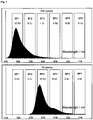
- Fig. 1 Shows the emission spectra of FITC, PE and PE+FITC, which are mapped by a combination of 6 different band pass filters (BP). Single fluorophores and combinations were defined by a unique fingerprint. IU (integrated unit) quantifies the area under the curve which defines the specific energy of the fluorophores per BP.
- Fig. 2 Overview of data processing
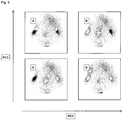
- Fig. 3 Shows an overlay of FMO-controls (light grey) and complete stained cells (black): (A) FMO CD3, (B) FMO CD8, (C) FMO CD4, (D) FMO CD14. All plots are calculated by PCA.
- Fig. 4 Shows the result of the standard analysis and the PCA analysis of the present invention. On top standard analysis is depicted and sequential gating of CD4/CD8 populations are shown. Figure below: Only one dotplot required to classify all subsets by PCA.
- the invention describes a flow cytometer, in which discontinuous emission spectra is acquired and analyzed by principal component analysis (PCA).
- PCA principal component analysis
- the invention enables new possibilities in combining fluorochromes with similar emission spectra for the first time.
- additional tools such as the Probability Binning algorithm (ref. 6) are preferably implemented, which finally will help to exploit new dimensions in multiparametric flow cytometry. Further studies in progress show that it is possible to detect up to 10 fluorochromes with 6 PMT's excited by one laser.
- the detection principle was applied to a conventional flow cytometer by using optical bandpass filters (BP) to divide the emission spectrum between 505 and 795 nm into six separate wavelength bands.
- BP optical bandpass filters
- This instrumental alignment and the application of PCA were used to detect the spectral fingerprints of each fluorochromes combination.
- the detection principle is shown in figure 1 .
- a blue laser for the excitation of 4 fluorochromes was used, which were conjugated to lineage specific antibodies to identify main leukocyte populations in peripheral blood samples.
- Table 1 Filter configurations of the cytometer LSRII. All filters were installed in the octagon which is connected to the 488nm laser PCA setup Standard setup PMT Beam-splitter Bandpass Beam-splitter Bandpass A 750LP 775/40 735LP 780/60 B 700LP 725/50 690LP 720/30 E 650LP 675/40 650LP 670/40 D 600LP 625/40 550LP 575/26 E 550LP 575/40 505LP 520/30 F 525/40 488/10
- Table 1 illustrates the frequency of monocyte and lymphocyte subsets within PBMCs classified through PCA and standard analysis. Both setups show comparable statistical distributions. Data compression by PCA allows representation of subsets in one dot plot without compensation. Table 2: Comparison of the frequency of PBMC subsets determined throughPCA and standard analysis. Subset PCA analysis Standard analysis CD3+ CD4+ 24.3% 23.7% CD3+ CD8+ 31.1% 29.5% CD3- 8.7% 12.0% CD14+ 16.5% 17.6%
Landscapes
- Chemical & Material Sciences (AREA)
- Health & Medical Sciences (AREA)
- Life Sciences & Earth Sciences (AREA)
- Biochemistry (AREA)
- General Physics & Mathematics (AREA)
- Pathology (AREA)
- Immunology (AREA)
- Analytical Chemistry (AREA)
- Physics & Mathematics (AREA)
- General Health & Medical Sciences (AREA)
- Dispersion Chemistry (AREA)
- Engineering & Computer Science (AREA)
- Signal Processing (AREA)
- Biomedical Technology (AREA)
- Molecular Biology (AREA)
- Nuclear Medicine, Radiotherapy & Molecular Imaging (AREA)
- Investigating, Analyzing Materials By Fluorescence Or Luminescence (AREA)
Claims (7)
- Cytomètre de flux pour acquérir des données de spectres à émission discontinue à partir de particules, comprenant,une source de lumière pour fournir un faisceau d'éclairage, un moyen pour concentrer ledit faisceau d'éclairage sur un emplacement de détection,une cellule de flux conçue pour recevoir des particules, en laissant passer lesdites particules individuellement pour atteindre l'emplacement de détection, où le faisceau d'éclairage concentré de la source de lumière éclaire les particules,des détecteurs de lumière permettant de détecter la lumière fluorescente émise par lesdites particules à l'emplacement de détection etun processeur de données conçu pour traiter des données acquises par les détecteurs de lumièrecaractérisé en ce que des filtres optiques passe-bande situés entre la cellule de flux et les détecteurs de lumière divisent le spectre d'émission fluorescente en deux à dix bandes de longueur d'onde séparées presque sans intervalle avec des intervalles de 10 nm ou moins qui sont détectés par les détecteurs de lumière et en ce que le processeur de données est conçu pour analyser les données acquises par les détecteurs de lumière sur les deux à dix bandes de longueur d'onde séparées au moyen d'une analyse composante principale.
- Cytomètre de flux selon la revendication 1, le cytomètre de flux comprenant un laser ou une DEL pour l'excitation de fluorochromes attachés aux particules.
- Procédé de détection de particules biologiques d'intérêt à partir d'un échantillon comprenant :a. le déplacement de particules à partir d'un échantillon de particules biologiques inconnues dans un écoulement de fluide ou dans un laboratoire sur puce ;b. la fourniture d'un faisceau d'éclairage incident dirigé sur les particules biologiques dans ledit écoulement ;c. la détection de la lumière diffusée et de la lumière fluorescente émises par les particules biologiques simultanément lorsque les particules biologiques traversent ledit faisceau d'éclairage pour générer des données sur la lumière diffusée et le spectre d'émission de fluorescence à partir des particules biologiques ;dans lequel la lumière fluorescente émise est divisée par des filtres optiques passe-bande en deux à dix bandes de longueurs d'onde distinctes presque sans intervalle avec des intervalles de 10 nm ou moins et les données sur le spectre d'émission de fluorescence détecté sont analysées au moyen d'une analyse composante principale.
- Procédé selon au moins l'une des revendications précédentes, dans lequel les particules biologiques à détecter sont des cellules.
- Procédé selon au moins l'une des revendications précédentes, dans lequel un algorithme de regroupement des probabilités est mis en œuvre.
- Procédé selon au moins l'une des revendications précédentes, dans lequel ladite étape de détection comporte la détection de la lumière diffusée par multiplexage en série.
- Procédé selon au moins l'une des revendications précédentes, dans lequel la lumière diffusée et la lumière fluorescente émises par les particules biologiques sont détectées par un photomultiplicateur, un photomultiplicateur multicanaux, une caméra CCD ou des photodiodes.
Priority Applications (1)
| Application Number | Priority Date | Filing Date | Title |
|---|---|---|---|
| EP11779341.4A EP2627986B1 (fr) | 2010-10-12 | 2011-10-12 | Analyse basée sur une analyse composante principale (pca) de spectres à émission discontinue dans une cytométrie de flux multichromatique |
Applications Claiming Priority (4)
| Application Number | Priority Date | Filing Date | Title |
|---|---|---|---|
| US39243910P | 2010-10-12 | 2010-10-12 | |
| EP10013552 | 2010-10-12 | ||
| EP11779341.4A EP2627986B1 (fr) | 2010-10-12 | 2011-10-12 | Analyse basée sur une analyse composante principale (pca) de spectres à émission discontinue dans une cytométrie de flux multichromatique |
| PCT/EP2011/005220 WO2012048906A1 (fr) | 2010-10-12 | 2011-10-12 | Analyse basée sur une analyse composante principale (pca) de spectres à émission discontinue dans une cytométrie de flux multichromatique |
Publications (2)
| Publication Number | Publication Date |
|---|---|
| EP2627986A1 EP2627986A1 (fr) | 2013-08-21 |
| EP2627986B1 true EP2627986B1 (fr) | 2021-11-17 |
Family
ID=44910164
Family Applications (1)
| Application Number | Title | Priority Date | Filing Date |
|---|---|---|---|
| EP11779341.4A Active EP2627986B1 (fr) | 2010-10-12 | 2011-10-12 | Analyse basée sur une analyse composante principale (pca) de spectres à émission discontinue dans une cytométrie de flux multichromatique |
Country Status (4)
| Country | Link |
|---|---|
| US (1) | US9958393B2 (fr) |
| EP (1) | EP2627986B1 (fr) |
| ES (1) | ES2906435T3 (fr) |
| WO (1) | WO2012048906A1 (fr) |
Families Citing this family (14)
| Publication number | Priority date | Publication date | Assignee | Title |
|---|---|---|---|---|
| CN103698279B (zh) * | 2013-11-19 | 2016-03-30 | 江苏师范大学 | 一种测量单个纳米粒子光谱的方法 |
| NL1040872C2 (en) | 2013-12-18 | 2015-06-22 | Stichting Katholieke Univ | Method of analysing data from, computer program, computer readable medium and data analysis system. |
| US9739783B1 (en) | 2016-03-15 | 2017-08-22 | Anixa Diagnostics Corporation | Convolutional neural networks for cancer diagnosis |
| US10360499B2 (en) | 2017-02-28 | 2019-07-23 | Anixa Diagnostics Corporation | Methods for using artificial neural network analysis on flow cytometry data for cancer diagnosis |
| US11164082B2 (en) | 2017-02-28 | 2021-11-02 | Anixa Diagnostics Corporation | Methods for using artificial neural network analysis on flow cytometry data for cancer diagnosis |
| US9934364B1 (en) * | 2017-02-28 | 2018-04-03 | Anixa Diagnostics Corporation | Methods for using artificial neural network analysis on flow cytometry data for cancer diagnosis |
| WO2019173233A1 (fr) * | 2018-03-05 | 2019-09-12 | Anixa Diagnostics Corporation | Procédés d'utilisation d'analyse de réseaux neuronaux artificiels sur des données de cytométrie en flux pour le diagnostic du cancer |
| EP3927665B1 (fr) * | 2019-02-18 | 2023-11-15 | Kemira Oyj | Procédé de surveillance et optionnellement de contrôle de l'élimination de microplastiques dans des eaux contenant des microplastiques |
| JP7516870B2 (ja) * | 2019-08-23 | 2024-07-17 | ソニーグループ株式会社 | 情報処理装置、情報処理方法、プログラム及び情報処理システム |
| JP2021081342A (ja) * | 2019-11-20 | 2021-05-27 | ソニーグループ株式会社 | 情報処理システムおよび情報処理装置 |
| CN112858208A (zh) * | 2019-11-27 | 2021-05-28 | 国能生物发电集团有限公司 | 基于红外光谱主成分和神经网络的生物质钾含量测量与建模方法 |
| CN112858205A (zh) * | 2019-11-27 | 2021-05-28 | 国能生物发电集团有限公司 | 基于红外光谱主成分和神经网络的生物质氢含量测量与建模方法 |
| CN112858209A (zh) * | 2019-11-27 | 2021-05-28 | 国能生物发电集团有限公司 | 基于红外光谱主成分和神经网络的生物质氮含量测量与建模方法 |
| JP7476247B2 (ja) * | 2022-02-16 | 2024-04-30 | 日本電子株式会社 | 相分析装置、試料分析装置、および分析方法 |
Citations (6)
| Publication number | Priority date | Publication date | Assignee | Title |
|---|---|---|---|---|
| US5656499A (en) * | 1994-08-01 | 1997-08-12 | Abbott Laboratories | Method for performing automated hematology and cytometry analysis |
| US20030215892A1 (en) * | 2002-05-14 | 2003-11-20 | Alberto Orfao De Matos Correia E Valle | Multidimensional leukocyte differential analysis |
| US20040207731A1 (en) * | 2003-01-16 | 2004-10-21 | Greg Bearman | High throughput reconfigurable data analysis system |
| US20060197033A1 (en) * | 2005-02-08 | 2006-09-07 | Northrop Grumman Corporation | Systems and methods for use in detecting harmful aerosol particles |
| US20060237665A1 (en) * | 2003-03-10 | 2006-10-26 | Barney William S | Bioaerosol discrimination |
| US20090307248A1 (en) * | 2006-03-31 | 2009-12-10 | Cira Discovery Sciences, Inc. | Method and Apparatus for Representing Multidimensional Data |
Family Cites Families (15)
| Publication number | Priority date | Publication date | Assignee | Title |
|---|---|---|---|---|
| US4727020A (en) * | 1985-02-25 | 1988-02-23 | Becton, Dickinson And Company | Method for analysis of subpopulations of blood cells |
| US5102625A (en) * | 1990-02-16 | 1992-04-07 | Boc Health Care, Inc. | Apparatus for monitoring a chemical concentration |
| WO1998052016A1 (fr) * | 1997-05-09 | 1998-11-19 | Morphometrix Technologies Inc. | Systeme d'imagerie multispectrale et methode de cytologie |
| US6592822B1 (en) | 1998-05-14 | 2003-07-15 | Luminex Corporation | Multi-analyte diagnostic system and computer implemented process for same |
| US6246479B1 (en) * | 1998-06-08 | 2001-06-12 | Lj Laboratories, L.L.C. | Integrated spectrometer assembly and methods |
| US6091843A (en) | 1998-09-03 | 2000-07-18 | Greenvision Systems Ltd. | Method of calibration and real-time analysis of particulates |
| US6942773B1 (en) * | 2001-01-26 | 2005-09-13 | The Regents Of The University Of California | Particle sizer and DNA sequencer |
| US7280207B2 (en) * | 2001-07-25 | 2007-10-09 | Applera Corporation | Time-delay integration in a flow cytometry system |
| US20030112432A1 (en) * | 2001-09-05 | 2003-06-19 | Genicon Sciences Corporation | Apparatus for reading signals generated from resonance light scattered particle labels |
| US6880414B2 (en) * | 2002-08-08 | 2005-04-19 | Becton Dickinson And Company | Sort block and liquid collection device for sorting flow cytometer |
| AU2003900857A0 (en) * | 2003-02-26 | 2003-03-13 | Commonwealth Scientific And Industrial Research Organisation | Method and apparatus for characterising multiphase fluid mixtures |
| EP1616286A1 (fr) * | 2003-04-02 | 2006-01-18 | Amersham Biosciences UK Limited | Procede et logiciel associe pour la classification de cellules en sous-populations |
| US7280204B2 (en) * | 2004-04-08 | 2007-10-09 | Purdue Research Foundation | Multi-spectral detector and analysis system |
| US7804064B2 (en) * | 2004-10-01 | 2010-09-28 | The George Washington University | In-situ droplet monitoring for self-tuning spectrometers |
| US8153949B2 (en) | 2008-12-18 | 2012-04-10 | Palo Alto Research Center Incorporated | Obtaining sensing results indicating time variation |
-
2011
- 2011-10-12 EP EP11779341.4A patent/EP2627986B1/fr active Active
- 2011-10-12 US US13/878,902 patent/US9958393B2/en active Active
- 2011-10-12 WO PCT/EP2011/005220 patent/WO2012048906A1/fr not_active Ceased
- 2011-10-12 ES ES11779341T patent/ES2906435T3/es active Active
Patent Citations (6)
| Publication number | Priority date | Publication date | Assignee | Title |
|---|---|---|---|---|
| US5656499A (en) * | 1994-08-01 | 1997-08-12 | Abbott Laboratories | Method for performing automated hematology and cytometry analysis |
| US20030215892A1 (en) * | 2002-05-14 | 2003-11-20 | Alberto Orfao De Matos Correia E Valle | Multidimensional leukocyte differential analysis |
| US20040207731A1 (en) * | 2003-01-16 | 2004-10-21 | Greg Bearman | High throughput reconfigurable data analysis system |
| US20060237665A1 (en) * | 2003-03-10 | 2006-10-26 | Barney William S | Bioaerosol discrimination |
| US20060197033A1 (en) * | 2005-02-08 | 2006-09-07 | Northrop Grumman Corporation | Systems and methods for use in detecting harmful aerosol particles |
| US20090307248A1 (en) * | 2006-03-31 | 2009-12-10 | Cira Discovery Sciences, Inc. | Method and Apparatus for Representing Multidimensional Data |
Non-Patent Citations (3)
| Title |
|---|
| DAKOTA A. WATSON ET AL: "A flow cytometer for the measurement of Raman spectra", CYTOMETRY PART A, vol. 73A, no. 2, 1 February 2008 (2008-02-01), pages 119 - 128, XP055002675, ISSN: 1552-4922, DOI: 10.1002/cyto.a.20520 * |
| MARIO ROEDERER ET AL: "Probability binning comparison: a metric for quantitating multivariate distribution differences", CYTOMETRY, vol. 45, no. 1, 24 August 2001 (2001-08-24), US, pages 47 - 55, XP055492552, ISSN: 0196-4763, DOI: 10.1002/1097-0320(20010901)45:1<47::AID-CYTO1143>3.0.CO;2-A * |
| ROBINSON J P: "MULTISPECTRAL CYTOMETRY: THE NEXT GENERATION", BIOPHOTONICS INTERNATIONAL, LAURIN PUBL., PITTSFIELD, MA, US, vol. 11, no. 10, 1 October 2004 (2004-10-01), pages 36 - 40, XP009051989, ISSN: 1081-8693 * |
Also Published As
| Publication number | Publication date |
|---|---|
| EP2627986A1 (fr) | 2013-08-21 |
| ES2906435T3 (es) | 2022-04-18 |
| US9958393B2 (en) | 2018-05-01 |
| US20130266959A1 (en) | 2013-10-10 |
| WO2012048906A1 (fr) | 2012-04-19 |
Similar Documents
| Publication | Publication Date | Title |
|---|---|---|
| EP2627986B1 (fr) | Analyse basée sur une analyse composante principale (pca) de spectres à émission discontinue dans une cytométrie de flux multichromatique | |
| US8103080B2 (en) | Method for imaging and differential analysis of cells | |
| US7925069B2 (en) | Blood and cell analysis using an imaging flow cytometer | |
| US8406498B2 (en) | Blood and cell analysis using an imaging flow cytometer | |
| US8779387B2 (en) | Method and system for detecting fluorochromes in a flow cytometer | |
| CN107003239A (zh) | 自触发流式细胞计数仪 | |
| Grégori et al. | Hyperspectral cytometry | |
| US10670512B1 (en) | Apparatus to perform intrinsic hyper-spectral flow cytometry | |
| US8953866B2 (en) | Method for imaging and differential analysis of cells | |
| EP2660598A1 (fr) | Procédé d'imagerie et d'analyse différentielle de cellules | |
| GA et al. | WO2012/048906A1|| | |
| JP2016197121A (ja) | 表示方法及び微小粒子分析装置 | |
| Saxena et al. | Polychromatic Flow Cytometry | |
| JP6489167B2 (ja) | データ表示方法及び微小粒子分析装置 | |
| Grégori et al. | Hyperspectral Cytometry at the Single-Cell Level Using | |
| JP2019132846A (ja) | 微小粒子分析装置及び微小粒子分析方法 | |
| HK1095633A (en) | Method for imaging and differential analysis of cells | |
| HK1095633B (en) | Method for imaging and differential analysis of cells |
Legal Events
| Date | Code | Title | Description |
|---|---|---|---|
| PUAI | Public reference made under article 153(3) epc to a published international application that has entered the european phase |
Free format text: ORIGINAL CODE: 0009012 |
|
| 17P | Request for examination filed |
Effective date: 20130417 |
|
| AK | Designated contracting states |
Kind code of ref document: A1 Designated state(s): AL AT BE BG CH CY CZ DE DK EE ES FI FR GB GR HR HU IE IS IT LI LT LU LV MC MK MT NL NO PL PT RO RS SE SI SK SM TR |
|
| DAX | Request for extension of the european patent (deleted) | ||
| STAA | Information on the status of an ep patent application or granted ep patent |
Free format text: STATUS: EXAMINATION IS IN PROGRESS |
|
| 17Q | First examination report despatched |
Effective date: 20161221 |
|
| GRAP | Despatch of communication of intention to grant a patent |
Free format text: ORIGINAL CODE: EPIDOSNIGR1 |
|
| STAA | Information on the status of an ep patent application or granted ep patent |
Free format text: STATUS: GRANT OF PATENT IS INTENDED |
|
| RIC1 | Information provided on ipc code assigned before grant |
Ipc: G01N 15/14 20060101AFI20210112BHEP Ipc: G01N 15/00 20060101ALI20210112BHEP Ipc: G01N 21/64 20060101ALI20210112BHEP Ipc: G01N 15/10 20060101ALI20210112BHEP |
|
| INTG | Intention to grant announced |
Effective date: 20210126 |
|
| GRAJ | Information related to disapproval of communication of intention to grant by the applicant or resumption of examination proceedings by the epo deleted |
Free format text: ORIGINAL CODE: EPIDOSDIGR1 |
|
| STAA | Information on the status of an ep patent application or granted ep patent |
Free format text: STATUS: EXAMINATION IS IN PROGRESS |
|
| GRAS | Grant fee paid |
Free format text: ORIGINAL CODE: EPIDOSNIGR3 |
|
| STAA | Information on the status of an ep patent application or granted ep patent |
Free format text: STATUS: GRANT OF PATENT IS INTENDED |
|
| GRAP | Despatch of communication of intention to grant a patent |
Free format text: ORIGINAL CODE: EPIDOSNIGR1 |
|
| INTC | Intention to grant announced (deleted) | ||
| INTG | Intention to grant announced |
Effective date: 20210701 |
|
| GRAA | (expected) grant |
Free format text: ORIGINAL CODE: 0009210 |
|
| STAA | Information on the status of an ep patent application or granted ep patent |
Free format text: STATUS: THE PATENT HAS BEEN GRANTED |
|
| AK | Designated contracting states |
Kind code of ref document: B1 Designated state(s): AL AT BE BG CH CY CZ DE DK EE ES FI FR GB GR HR HU IE IS IT LI LT LU LV MC MK MT NL NO PL PT RO RS SE SI SK SM TR |
|
| REG | Reference to a national code |
Ref country code: GB Ref legal event code: FG4D |
|
| REG | Reference to a national code |
Ref country code: IE Ref legal event code: FG4D |
|
| REG | Reference to a national code |
Ref country code: DE Ref legal event code: R096 Ref document number: 602011072120 Country of ref document: DE |
|
| REG | Reference to a national code |
Ref country code: AT Ref legal event code: REF Ref document number: 1448437 Country of ref document: AT Kind code of ref document: T Effective date: 20211215 |
|
| REG | Reference to a national code |
Ref country code: NL Ref legal event code: FP |
|
| REG | Reference to a national code |
Ref country code: LT Ref legal event code: MG9D |
|
| REG | Reference to a national code |
Ref country code: AT Ref legal event code: MK05 Ref document number: 1448437 Country of ref document: AT Kind code of ref document: T Effective date: 20211117 |
|
| REG | Reference to a national code |
Ref country code: ES Ref legal event code: FG2A Ref document number: 2906435 Country of ref document: ES Kind code of ref document: T3 Effective date: 20220418 |
|
| PG25 | Lapsed in a contracting state [announced via postgrant information from national office to epo] |
Ref country code: RS Free format text: LAPSE BECAUSE OF FAILURE TO SUBMIT A TRANSLATION OF THE DESCRIPTION OR TO PAY THE FEE WITHIN THE PRESCRIBED TIME-LIMIT Effective date: 20211117 Ref country code: LT Free format text: LAPSE BECAUSE OF FAILURE TO SUBMIT A TRANSLATION OF THE DESCRIPTION OR TO PAY THE FEE WITHIN THE PRESCRIBED TIME-LIMIT Effective date: 20211117 Ref country code: FI Free format text: LAPSE BECAUSE OF FAILURE TO SUBMIT A TRANSLATION OF THE DESCRIPTION OR TO PAY THE FEE WITHIN THE PRESCRIBED TIME-LIMIT Effective date: 20211117 Ref country code: BG Free format text: LAPSE BECAUSE OF FAILURE TO SUBMIT A TRANSLATION OF THE DESCRIPTION OR TO PAY THE FEE WITHIN THE PRESCRIBED TIME-LIMIT Effective date: 20220217 Ref country code: AT Free format text: LAPSE BECAUSE OF FAILURE TO SUBMIT A TRANSLATION OF THE DESCRIPTION OR TO PAY THE FEE WITHIN THE PRESCRIBED TIME-LIMIT Effective date: 20211117 |
|
| PG25 | Lapsed in a contracting state [announced via postgrant information from national office to epo] |
Ref country code: IS Free format text: LAPSE BECAUSE OF FAILURE TO SUBMIT A TRANSLATION OF THE DESCRIPTION OR TO PAY THE FEE WITHIN THE PRESCRIBED TIME-LIMIT Effective date: 20220317 Ref country code: SE Free format text: LAPSE BECAUSE OF FAILURE TO SUBMIT A TRANSLATION OF THE DESCRIPTION OR TO PAY THE FEE WITHIN THE PRESCRIBED TIME-LIMIT Effective date: 20211117 Ref country code: PT Free format text: LAPSE BECAUSE OF FAILURE TO SUBMIT A TRANSLATION OF THE DESCRIPTION OR TO PAY THE FEE WITHIN THE PRESCRIBED TIME-LIMIT Effective date: 20220317 Ref country code: PL Free format text: LAPSE BECAUSE OF FAILURE TO SUBMIT A TRANSLATION OF THE DESCRIPTION OR TO PAY THE FEE WITHIN THE PRESCRIBED TIME-LIMIT Effective date: 20211117 Ref country code: NO Free format text: LAPSE BECAUSE OF FAILURE TO SUBMIT A TRANSLATION OF THE DESCRIPTION OR TO PAY THE FEE WITHIN THE PRESCRIBED TIME-LIMIT Effective date: 20220217 Ref country code: LV Free format text: LAPSE BECAUSE OF FAILURE TO SUBMIT A TRANSLATION OF THE DESCRIPTION OR TO PAY THE FEE WITHIN THE PRESCRIBED TIME-LIMIT Effective date: 20211117 Ref country code: HR Free format text: LAPSE BECAUSE OF FAILURE TO SUBMIT A TRANSLATION OF THE DESCRIPTION OR TO PAY THE FEE WITHIN THE PRESCRIBED TIME-LIMIT Effective date: 20211117 Ref country code: GR Free format text: LAPSE BECAUSE OF FAILURE TO SUBMIT A TRANSLATION OF THE DESCRIPTION OR TO PAY THE FEE WITHIN THE PRESCRIBED TIME-LIMIT Effective date: 20220218 |
|
| PG25 | Lapsed in a contracting state [announced via postgrant information from national office to epo] |
Ref country code: SM Free format text: LAPSE BECAUSE OF FAILURE TO SUBMIT A TRANSLATION OF THE DESCRIPTION OR TO PAY THE FEE WITHIN THE PRESCRIBED TIME-LIMIT Effective date: 20211117 Ref country code: SK Free format text: LAPSE BECAUSE OF FAILURE TO SUBMIT A TRANSLATION OF THE DESCRIPTION OR TO PAY THE FEE WITHIN THE PRESCRIBED TIME-LIMIT Effective date: 20211117 Ref country code: RO Free format text: LAPSE BECAUSE OF FAILURE TO SUBMIT A TRANSLATION OF THE DESCRIPTION OR TO PAY THE FEE WITHIN THE PRESCRIBED TIME-LIMIT Effective date: 20211117 Ref country code: EE Free format text: LAPSE BECAUSE OF FAILURE TO SUBMIT A TRANSLATION OF THE DESCRIPTION OR TO PAY THE FEE WITHIN THE PRESCRIBED TIME-LIMIT Effective date: 20211117 Ref country code: DK Free format text: LAPSE BECAUSE OF FAILURE TO SUBMIT A TRANSLATION OF THE DESCRIPTION OR TO PAY THE FEE WITHIN THE PRESCRIBED TIME-LIMIT Effective date: 20211117 Ref country code: CZ Free format text: LAPSE BECAUSE OF FAILURE TO SUBMIT A TRANSLATION OF THE DESCRIPTION OR TO PAY THE FEE WITHIN THE PRESCRIBED TIME-LIMIT Effective date: 20211117 |
|
| REG | Reference to a national code |
Ref country code: DE Ref legal event code: R097 Ref document number: 602011072120 Country of ref document: DE |
|
| PLBE | No opposition filed within time limit |
Free format text: ORIGINAL CODE: 0009261 |
|
| STAA | Information on the status of an ep patent application or granted ep patent |
Free format text: STATUS: NO OPPOSITION FILED WITHIN TIME LIMIT |
|
| 26N | No opposition filed |
Effective date: 20220818 |
|
| PG25 | Lapsed in a contracting state [announced via postgrant information from national office to epo] |
Ref country code: AL Free format text: LAPSE BECAUSE OF FAILURE TO SUBMIT A TRANSLATION OF THE DESCRIPTION OR TO PAY THE FEE WITHIN THE PRESCRIBED TIME-LIMIT Effective date: 20211117 |
|
| PG25 | Lapsed in a contracting state [announced via postgrant information from national office to epo] |
Ref country code: SI Free format text: LAPSE BECAUSE OF FAILURE TO SUBMIT A TRANSLATION OF THE DESCRIPTION OR TO PAY THE FEE WITHIN THE PRESCRIBED TIME-LIMIT Effective date: 20211117 |
|
| PG25 | Lapsed in a contracting state [announced via postgrant information from national office to epo] |
Ref country code: MC Free format text: LAPSE BECAUSE OF FAILURE TO SUBMIT A TRANSLATION OF THE DESCRIPTION OR TO PAY THE FEE WITHIN THE PRESCRIBED TIME-LIMIT Effective date: 20211117 |
|
| REG | Reference to a national code |
Ref country code: BE Ref legal event code: MM Effective date: 20221031 |
|
| PG25 | Lapsed in a contracting state [announced via postgrant information from national office to epo] |
Ref country code: LU Free format text: LAPSE BECAUSE OF NON-PAYMENT OF DUE FEES Effective date: 20221012 |
|
| PG25 | Lapsed in a contracting state [announced via postgrant information from national office to epo] |
Ref country code: BE Free format text: LAPSE BECAUSE OF NON-PAYMENT OF DUE FEES Effective date: 20221031 |
|
| PG25 | Lapsed in a contracting state [announced via postgrant information from national office to epo] |
Ref country code: IE Free format text: LAPSE BECAUSE OF NON-PAYMENT OF DUE FEES Effective date: 20221012 |
|
| PG25 | Lapsed in a contracting state [announced via postgrant information from national office to epo] |
Ref country code: HU Free format text: LAPSE BECAUSE OF FAILURE TO SUBMIT A TRANSLATION OF THE DESCRIPTION OR TO PAY THE FEE WITHIN THE PRESCRIBED TIME-LIMIT; INVALID AB INITIO Effective date: 20111012 |
|
| PG25 | Lapsed in a contracting state [announced via postgrant information from national office to epo] |
Ref country code: CY Free format text: LAPSE BECAUSE OF FAILURE TO SUBMIT A TRANSLATION OF THE DESCRIPTION OR TO PAY THE FEE WITHIN THE PRESCRIBED TIME-LIMIT Effective date: 20211117 |
|
| PG25 | Lapsed in a contracting state [announced via postgrant information from national office to epo] |
Ref country code: MK Free format text: LAPSE BECAUSE OF FAILURE TO SUBMIT A TRANSLATION OF THE DESCRIPTION OR TO PAY THE FEE WITHIN THE PRESCRIBED TIME-LIMIT Effective date: 20211117 |
|
| PG25 | Lapsed in a contracting state [announced via postgrant information from national office to epo] |
Ref country code: TR Free format text: LAPSE BECAUSE OF FAILURE TO SUBMIT A TRANSLATION OF THE DESCRIPTION OR TO PAY THE FEE WITHIN THE PRESCRIBED TIME-LIMIT Effective date: 20211117 |
|
| P01 | Opt-out of the competence of the unified patent court (upc) registered |
Free format text: CASE NUMBER: APP_36073/2024 Effective date: 20240617 |
|
| PG25 | Lapsed in a contracting state [announced via postgrant information from national office to epo] |
Ref country code: MT Free format text: LAPSE BECAUSE OF FAILURE TO SUBMIT A TRANSLATION OF THE DESCRIPTION OR TO PAY THE FEE WITHIN THE PRESCRIBED TIME-LIMIT Effective date: 20211117 |
|
| REG | Reference to a national code |
Ref country code: CH Ref legal event code: U11 Free format text: ST27 STATUS EVENT CODE: U-0-0-U10-U11 (AS PROVIDED BY THE NATIONAL OFFICE) Effective date: 20251101 |
|
| PGFP | Annual fee paid to national office [announced via postgrant information from national office to epo] |
Ref country code: NL Payment date: 20251023 Year of fee payment: 15 |
|
| PGFP | Annual fee paid to national office [announced via postgrant information from national office to epo] |
Ref country code: DE Payment date: 20250919 Year of fee payment: 15 |
|
| PGFP | Annual fee paid to national office [announced via postgrant information from national office to epo] |
Ref country code: GB Payment date: 20251024 Year of fee payment: 15 |
|
| PGFP | Annual fee paid to national office [announced via postgrant information from national office to epo] |
Ref country code: IT Payment date: 20251031 Year of fee payment: 15 |
|
| PGFP | Annual fee paid to national office [announced via postgrant information from national office to epo] |
Ref country code: FR Payment date: 20251029 Year of fee payment: 15 |
|
| PGFP | Annual fee paid to national office [announced via postgrant information from national office to epo] |
Ref country code: CH Payment date: 20251101 Year of fee payment: 15 |
|
| PGFP | Annual fee paid to national office [announced via postgrant information from national office to epo] |
Ref country code: ES Payment date: 20251114 Year of fee payment: 15 |