EP2628552B1 - Apparatus for sorting and controlled conveying - Google Patents
Apparatus for sorting and controlled conveying Download PDFInfo
- Publication number
- EP2628552B1 EP2628552B1 EP20120008395 EP12008395A EP2628552B1 EP 2628552 B1 EP2628552 B1 EP 2628552B1 EP 20120008395 EP20120008395 EP 20120008395 EP 12008395 A EP12008395 A EP 12008395A EP 2628552 B1 EP2628552 B1 EP 2628552B1
- Authority
- EP
- European Patent Office
- Prior art keywords
- sorting
- objects
- transport
- aforementioned
- objects according
- Prior art date
- Legal status (The legal status is an assumption and is not a legal conclusion. Google has not performed a legal analysis and makes no representation as to the accuracy of the status listed.)
- Active
Links
Images


Classifications
-
- B—PERFORMING OPERATIONS; TRANSPORTING
- B03—SEPARATION OF SOLID MATERIALS USING LIQUIDS OR USING PNEUMATIC TABLES OR JIGS; MAGNETIC OR ELECTROSTATIC SEPARATION OF SOLID MATERIALS FROM SOLID MATERIALS OR FLUIDS; SEPARATION BY HIGH-VOLTAGE ELECTRIC FIELDS
- B03B—SEPARATING SOLID MATERIALS USING LIQUIDS OR USING PNEUMATIC TABLES OR JIGS
- B03B9/00—General arrangement of separating plant, e.g. flow sheets
- B03B9/06—General arrangement of separating plant, e.g. flow sheets specially adapted for refuse
-
- B—PERFORMING OPERATIONS; TRANSPORTING
- B07—SEPARATING SOLIDS FROM SOLIDS; SORTING
- B07C—POSTAL SORTING; SORTING INDIVIDUAL ARTICLES, OR BULK MATERIAL FIT TO BE SORTED PIECE-MEAL, e.g. BY PICKING
- B07C7/00—Sorting by hand only e.g. of mail
- B07C7/04—Apparatus or accessories for hand picking
Definitions
- the invention relates to a device for sorting and controlled conveyance of material groups to sort objects for recycling and waste disposal.
- sorting devices which can sometimes sort fully automatically waste products according to certain properties, in particular their constituents and recyclables. In order to be able to achieve particularly high levels of purity during sorting, it may be necessary to sort by hand. Especially with high throughput rates, the sorting for recyclables is sometimes very difficult.
- sorting aids from the household and hobby sector, for example, according to the US 5,117,982 A which allow individual beds of fractions but can not meet the required throughput rates, for example in a sorting plant.
- the object of the invention is to provide a device for sorting and controlled conveyors, with which a faster and more accurate sorting can be achieved.
- a device for sorting and controlled conveyance of by value groups to sorting objects a Sortiertribüne and at least one transport device, wherein the transport device has at least one partition, with which the transport path can be divided into at least two channels and at least one loading as a mechanical obstacle in transporting the objects from the transport path to a downstream fall distance.
- the objects are to be sorted according to material groups. On the one hand, this means, for example, that it is sorted according to whether the corresponding objects made of PET (polyethylene terephthalate) consist of PEHD (hard polyethylene) or of other plastics. It can also or additionally be sorted by color, for example, whether transparent, light PET bottles or dark colored PET bottles, white, green, etc. are present.
- PET polyethylene terephthalate
- PEHD hard polyethylene
- Each of these recyclable groups can be assigned to a channel.
- the presorting or actual sorting is automated.
- a wide variety of optical methods, X-ray methods or mechanical methods can be used.
- Corresponding sorting components are, for example, ballistic separators, sieve drums; However, as described, more specific determination methods such as optical methods or X-ray analyzes are basically used.
- these are in particular sorting systems for light packaging for example the sorting of plastic waste and lightweight packaging, films, bottles, smaller containers, etc., which are recyclable.
- Households collect such packaging waste mostly in the yellow bag or the so-called "RaWEG bag” or any containers that are connected to the dual system.
- a ballistic separator a mechanical pre-sorting into light and rolling heavy parts takes place first.
- an optical sorting can separate PET bottles and PET hollow bodies. Separation methods such as the sink-float separation can also be used. in which objects can be separated according to their specific weight. Such separation processes achieve purities of well over 90 percent.
- the sorted or pre-sorted objects are transported, for example, with conveyor belts.
- the re-sorting only makes a small contribution to the sorting on a percentage basis due to the already achieved high purity grades, this is sometimes very difficult, especially at high throughput rates.
- the sorting is particularly difficult, since the same amount of objects to be sorted is not always generated for the individual material groups. For example, a large amount of waste to be sorted may contain PET bottles, but only a small proportion of PEHD parts. Especially if objects are presorted into the wrong resource group simultaneously in several channels, the simultaneous resorting or re-sorting of these objects is correspondingly more difficult.
- At least one loading is arranged as a mechanical obstacle when conveying the objects from the transport path to the drop route between the transport path on which the presorted objects are brought in the direction of sorting turrets from which an operator takes over the re-sorting.
- the drawer can be advantageously used so that at the point where the operator takes over the re-sorting by hand, the objects are accumulated, so that the operator gains time to carry out a subsequent sorting conscientious.
- the transport device may in principle comprise a plurality of individual transport devices, such as a plurality of conveyor belts; but it may also be a single transport device, for example, a single conveyor belt, which is divisible by partitions in several sub-areas, so-called channels. Each channel can accordingly be assigned a resource group.
- the drawer can in principle be arranged so that it only serves as a Obstacle and not as a complete blockade, which means that the objects can initially accumulate, but from a certain amount forwarded.
- the device for sorting and controlled conveyance according to the invention can be used for all conceivable sorting operations, for example also for metal sorting.
- the drawer is adjusted with respect to its angle to the transport path of the transport device so that it has a different mechanical resistance in conveyed objects during transport opposes.
- the tray can also be designed as a chute, which allows a different speed depending on the angle of inclination.
- a passage opening may be present, so that the objects can finally reach the drop route via the passage opening.
- the passage opening is then bounded to one side by the tray, to another side by a boundary wall. The operator thereby has more time to perform the re-sorting operation, while if too many objects accumulate in this area of the tray, the objects can still pass through the opening to the drop zone, thus avoiding clogging.
- the drawer which adjoins the transport path via the transport device, is inclined upward, that is to say on the side on which the objects are conveyed, the drawer closes an angle of less than 180 ° with the conveyor belt (180 degrees).
- the loading itself forms a mechanical obstacle for the transported objects by their angle of attack, since they have to overcome this mechanical obstacle (against gravity) on further transport.
- the tray is designed as a chute, that is, it is inclined with respect to the transport path that on the side on which the objects are transported, the loading with the conveyor belt at an angle greater than 180 ° or includes on the side facing away from it, usually below the conveyor belt, an angle smaller 180 ° includes.
- the mechanical resistance is then formed on the one hand by the frictional resistance itself, which has the tray opposite the transported objects, on the other hand by the size of the opening, which is bounded on one side by the tray and forms the passage to the drop distance.
- this opening is barely larger than the average size of an object, then damming will easily occur, especially as objects tend to become wedged easily in the opening. Consequently, if the drawer is designed as a chute, the mechanical obstacle is mainly composed of the friction that the chute has with respect to the objects, the inclination angle of the chute and the size of the passage opening, which determines how quickly a jam can occur ,
- the question of whether a jam comes about, also influenced by how many objects at once reach the passage opening. If the passage opening, for example, slightly larger than the transported objects, then no jam will arise when objects pass successively to the passage opening without z. B. to stand diagonally and to wedge.
- the conveyed objects are usually present on the conveyor belt as accumulation and as a batch.
- individual objects that are separate from such clusters can usually be detected easily and quickly. The subsequent sorting can thus be substantially facilitated.
- the tray is rotatably mounted and adjustable in terms of their angle to the transport path and / or the boundary wall of the drop distance.
- the mechanical Widerstrand or the mechanical obstacle can be adjusted when moving the objects.
- the mechanical obstacle can also be set so small that the transported objects are transported practically without noticeable resistance on. If the drawer is designed, for example, as a chute, the chute can in principle also be set almost vertically downwards, so that the objects reach the drop path practically directly.
- the passage opening can be increased or decreased by tilting the tray.
- the larger the passage opening the easier the objects can be fall through. If the load z. B. tilted away down (slide), is an enlargement of the passage regularly associated with a steeper course of the slide.
- the chute can also be adjusted so that the friction causes the objects to be braked practically completely on the chute after the transport device.
- the chute itself does not include a machine conveyor such as a conveyor belt. Depending on the friction or mechanical resistance, in principle, the conveyed objects, which reach the drawer after the transport device, can be braked so that they remain lying on the drawer.
- This adjustment which allows a rotatable storage of the load, offers, among other things, the advantage that it can be set individually by the operator, so adapted to how much by sorting waste to be sorted to the device.
- the operator who is to sort the refuse, stands on a sorting platform, which is designed to allow access to the channels.
- the Sortiertribüne is thus arranged so that the operator is advantageously in the operating range of the drawer.
- Sortiertribüne may be any space or any device for receiving an operator in the context of the invention, which allows this access to the drawer or the shop for sorting.
- the sorting turret may include an operating device for adjusting the angle and / or moving the tray. The operator can thus regulate the mechanical resistance directly from their working position on the sorting platform.
- the garbage mountain to be sorted comprises an irregular or uneven distribution according to individual recycling groups.
- the presorted objects which already have individual channels and are thus assigned to individual groups of recyclables, in the direction of the Sortiertribüne. It is usually completely left to chance, how many objects in a particular channel at a certain time arrive at the Sortiertribüne. Consequently, it is particularly advantageous to provide not only one tray for adjusting the mechanical obstacle, but several.
- This measure can take into account how many objects are currently arriving in a particular channel. As already described, a situation is conceivable in which a relatively large number of objects arrive at the sorting platform on one channel, while other channels are largely empty. Due to the adjustability of the load is then allowed that exactly the channels that just lead few objects, are initially dammed up, in which the mechanical resistance is increased by adjusting the load. In this time, the operator can then, where arrive in a short time many objects to be sorted, perform the re-sorting, without fear that in other channels that lead little objects, they simply go unseen on the case route and thus no longer resorted can be.
- the fall distance is also advantageously divided by at least one shut-off device in partial fall distances, which are each associated with a loading and / or a channel.
- Such a further transport device which the Downstream case, for example, can be designed as well as the transport device, which leads to Sortiertribüne. It is conceivable, for example, a training as a conveyor belt.
- a conveyor belt is characterized in particular by the fact that a wide variety of objects of different weights and sizes can be transported largely independently of these properties.
- the transport device is designed such that the channels are essentially arranged next to one another in each case.
- this measure represents a relief and a particularly clear situation for the operator who is to sort the pre-sorted waste again.
- the sorting and conveying device is to a certain extent designed as a "front sorting station", that is to say the objects to be sorted run directly towards the operator or sorting platform so that during regular operation the operator looks directly at the incoming and subsequently sorted objects. The operator can thus also immediately estimate where or in which area, if appropriate, a drawer should be changed in terms of its mechanical resistance and react immediately to it, in which it makes this setting.
- the operator may also have enough time to make this adjustment, if they have appropriate insight on the conveyor belt or the transport path. The operator can thus gain at least a few seconds to make the adjustment. It is also conceivable, in principle, that such a setting of the tray takes place automatically, in which an optical monitoring device checks how many objects are currently lying on a corresponding strip or whether it is an accumulation of objects to be sorted. In addition, such a device still allows one Another advantage: the channels can in particular be arranged in parallel. Accordingly, it is possible to provide only a single conveyor belt for the transport path and this only separated by barriers into individual channels.
- the pre-sorted objects can thus be transported away at the same speed, since it is only a single conveyor belt. At the same time, of course, costs can also be saved, since only a single conveyor belt is necessary.
- items can sometimes also be placed under the objects which can not be assigned to any group of recyclables to which the sorting process currently in existence shuts off.
- the objects can not be assigned to another channel during the re-sorting process. They must therefore be sorted out. Therefore, in a development of the invention directly adjacent to the tribune at least one receptacle for receiving objects that are assigned to any of the recycling groups, arranged. The operator can then sort out, for example by hand, the corresponding objects.
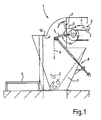
- FIG. 1 shows a schematic side view of a sorting device 1 with a conveyor belt 2 in which objects 3 are conveyed in the conveying direction 4.
- the objects 3 have already been subjected to presorting.
- a loading 5 is provided (in total, several stores are available for all channels, cf. FIG. 2 ).
- the tray 5 can be tilted downwards, wherein the angle ⁇ between the conveying path of the conveyor belt 2 and the tray 5 on the side facing away from the objects is less than 180 ° (180 degrees). From the drawer, the objects can fall over a drop section 6 into a container 7.
- the drawer 5 can be actuated via an actuating lever 8, that is, with this, the tilting of the drawer can be adjusted or the drawer can be completely folded down.
- a Sortiertribüne 9 is arranged, which can be an operator to perform the re-sorting in the area of the tray 5.
- the tray 5 is rotatably mounted about a pivot point A and further has a guide F in the present case is designed as a backdrop, so that the guide lever can be performed on a circular arc section.
- FIG. 2 shows the same sorter from above. Shown is also the conveyor belt 2 in the plan view can be seen that the conveyor belt is separated via the partitions 10 into individual channels 11a, 11b, 11c and 11d.
- Channel 11a can for example be assigned to the recyclables group of dark PET bottles and PET hollow bodies, the channel 11b to transparent PET bottles or hollow bodies, the channel 11c to plastic bodies made of PEHD (hard polyethylene) and the channel 11d to other plastic parts.
- PEHD hard polyethylene
- the store 5a - 5d are slightly folded down in the present case, that is called in the drawing of FIG. 2 viewed from the top view in the direction of the drawing plane. Shown after the store 5a - 5d, the passage openings 12a - 12d.
- Channel 11a currently has a relatively large collection of objects 3a, channel 11b only a very small collection of objects 3b, while again channels 11c and 11d currently have no objects.
- the setting is the loading 5c and 5d temporarily without meaning.
- the tray 5b can be turned upward to form a slightly inclined chute and the passage opening 12b is small. The few objects 3b can therefore accumulate. The operator concentrates on channel 11a during this time, since there the object volume 3a is substantially higher than in the remaining channels 11b-11d.
- FIG. 3 shows a schematic oblique view of the sorting device of the FIGS. 1 and 2 with an operator 14 on the Sortiertribüne 9.
- the sorting device 1 with the conveyor belt 2, the partitions 10 for the separation of the individual channels 11 (or a total of 11a to 11d).
- the operator 14 stands on a sorting platform 9 and sorts the individual objects within the individual channels 11a to 11d in order to obtain a particularly high degree of purity of the sorting waste. From the drawer 5, the sorted objects fall into the containers 7, whereby these can be assigned to the individual channels depending on the recycling groups.
- Side of the operator 14 and the Sortiertribüne 9 are the waste containers 13a and 13b can be disposed of in the contaminants.
- the Sortiertribüne 9 is, as can be seen here, arranged so that the conveyor belt 2 with its conveying direction 4 conveys the objects directly in the direction of the operator. Since this conveyor line ends almost immediately in front of the operator 14, a sorting with the aid of the store 5a-5d is easily possible.
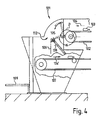
- FIG. 4 shows a similar sorting device 101 with a conveyor belt 102 for sorting objects 103, which are moved on the conveyor belt in the direction of the arrow 104.
- the objects 103 reach one of the stores 105 and fall over a drop section 106 onto another conveyor belt 107, this conveyor belt moves in the opposite direction 104 '(opposite in comparison to the conveying direction 104).
- the drawer 105 may also be connected via an actuating lever 108, which in FIG. 4 indicated only schematically is folded or positioned.
- the sorting turret 109 is also provided.
- the objects can in turn reach the drop distance via a passage opening 112.
- the tray 105 can in turn be stored similarly, wherein the angle ⁇ on the side still facing away from the objects side is less than 180 °, the tray 105 is thus designed as a slide.
- a transport device 107 is provided, with which the re-sorted items can be transported on and then further processed, shredded or sorted again.
- a combination of a device according to the FIGS. 1 and 4 so that the conveyor belt 107 does not extend over the entire width of the individual channels, for example, but only some of the channels finally land on the conveyor belt 107, while others in turn open directly into a container (see container 7).
- the device for sorting and controlled conveyance of objects to be sorted according to material groups can also be referred to as a so-called "front sorting station".
Landscapes
- Sorting Of Articles (AREA)
Description
Die Erfindung betrifft eine Vorrichtung zum Sortieren und kontrollierten Befördern von nach Wertstoffgruppen zu sortierenden Objekten für die Wertstofftrennung und Abfallentsorgung.The invention relates to a device for sorting and controlled conveyance of material groups to sort objects for recycling and waste disposal.
Aus dem Stand der Technik, beispielsweise aus der
Aufgabe der Erfindung ist es, eine Vorrichtung zum Sortieren und kontrollierten Befördern bereitzustellen, mit welcher eine schnellere und genauere Nachsortierung erzielt werden kann.The object of the invention is to provide a device for sorting and controlled conveyors, with which a faster and more accurate sorting can be achieved.
Die Aufgabe wird, ausgehend von einer Vorrichtung der eingangs genannten Art, durch die Merkmale des Anspruchs 1 gelöst.The object is achieved, starting from a device of the type mentioned, by the features of
Durch die in den abhängigen Ansprüchen genannten Maßnahmen sind vorteilhafte Ausführungen und Weiterbildungen der Erfindung möglich.The measures mentioned in the dependent claims advantageous embodiments and modifications of the invention are possible.
Dementsprechend umfasst eine Vorrichtung zum Sortieren und kontrollierten Befördern von nach Wertstoffgruppen zu sortierenden Objekten eine Sortiertribüne und wenigstens eine Transportvorrichtung, wobei die Transportvorrichtung mindestens eine Trennwand aufweist, mit welcher der Transportweg in wenigstens zwei Kanäle aufteilbar ist sowie wenigstens eine Lade als mechanisches Hindernis beim Befördern der Objekte vom Transportweg zu einer nachgeordneten Fallstrecke.Accordingly, a device for sorting and controlled conveyance of by value groups to sorting objects a Sortiertribüne and at least one transport device, wherein the transport device has at least one partition, with which the transport path can be divided into at least two channels and at least one loading as a mechanical obstacle in transporting the objects from the transport path to a downstream fall distance.
Die Objekte sind nach Wertstoffgruppen zu sortieren. Das heißt zum einen, dass beispielsweise danach sortiert wird, ob die entsprechenden Objekte aus PET (Polyethylenterephthalat) aus PEHD (Hart-Polyethylen) oder aus anderen Kunststoffen bestehen. Es kann darüber hinaus oder zusätzlich auch nach Farben sortiert werden, beispielsweise ob durchsichtige, helle PET-Flaschen oder dunkelfarbige PET-Flaschen, weiße, grüne usw. vorhanden sind.The objects are to be sorted according to material groups. On the one hand, this means, for example, that it is sorted according to whether the corresponding objects made of PET (polyethylene terephthalate) consist of PEHD (hard polyethylene) or of other plastics. It can also or additionally be sorted by color, for example, whether transparent, light PET bottles or dark colored PET bottles, white, green, etc. are present.
Jede dieser Wertstoffgruppen kann einem Kanal zugeordnet werden. Die Vorsortierung oder eigentliche Sortierung erfolgt automatisiert. Zu diesem Zweck können verschiedenste optische Methoden, Röntgenmethoden oder mechanische Methoden eingesetzt werden. Entsprechende Sortierkomponenten sind beispielsweise Ballistik-Separatoren, Siebtrommeln; es aber auch, wie beschrieben, speziellere Bestimmungsmethoden wie optische Methoden oder Röntgenanalysen grundsätzlich zum Einsatz kommen.Each of these recyclable groups can be assigned to a channel. The presorting or actual sorting is automated. For this purpose, a wide variety of optical methods, X-ray methods or mechanical methods can be used. Corresponding sorting components are, for example, ballistic separators, sieve drums; However, as described, more specific determination methods such as optical methods or X-ray analyzes are basically used.
Im vorliegenden Fall handelt es sich insbesondere um Sortieranlagen für Leichtverpackungen, beispielsweise die Sortierung von Kunststoffmüll und Leichtverpackungen, Folien, Flaschen, kleineren Behältern usw., welche recycelbar sind. Haushalte sammeln derartigen Verpackungsmüll meistens im Gelben Sack oder dem so genannten "RaWEG-Sack" oder etwaigen Behältern, welche an das Duale System angeschlossen sind. Mit Hilfe beispielsweise eines Ballistikseparators erfolgt zunächst eine maschinelle Vorsortierung in flächig-leichte und rollend-schwere Anteile. Anschließend kann eine optische Sortierung PET-Flaschen und PET-Hohlkörper trennen. Eingesetzt werden können auch Trennungsmethoden wie die Schwimm-Sink-Trennung, bei der Objekte nach ihrem spezifischen Gewicht separiert werden können. Durch derartige Trennungsverfahren werden Reinheitsgrade von weit über 90 Prozent erreicht.In the present case, these are in particular sorting systems for light packaging, for example the sorting of plastic waste and lightweight packaging, films, bottles, smaller containers, etc., which are recyclable. Households collect such packaging waste mostly in the yellow bag or the so-called "RaWEG bag" or any containers that are connected to the dual system. With the help of, for example, a ballistic separator, a mechanical pre-sorting into light and rolling heavy parts takes place first. Subsequently, an optical sorting can separate PET bottles and PET hollow bodies. Separation methods such as the sink-float separation can also be used. in which objects can be separated according to their specific weight. Such separation processes achieve purities of well over 90 percent.
Vielfach erfolgt eine Nachsortierung von Hand durch Personen, um typischerweise Reinheitsgrade von 98 Prozent und mehr zu erreichen.In many cases, a manual sorting by persons takes place in order to achieve purity levels of 98 percent and more.
Die sortierten bzw. vorsortierten Objekte werden dabei beispielsweise mit Förderbändern transportiert. Obgleich die Nachsortierung aufgrund der bereits erzielten hohen Reinheitsgrade prozentual lediglich einen geringen Beitrag zur Sortierung ausmacht, ist diese gerade bei hohen Durchsatzraten mitunter sehr schwierig.The sorted or pre-sorted objects are transported, for example, with conveyor belts. Although the re-sorting only makes a small contribution to the sorting on a percentage basis due to the already achieved high purity grades, this is sometimes very difficult, especially at high throughput rates.
Die entsprechende Person ist gezwungen, sich auf verschiedene Kanäle zu konzentrieren, was dazu führt, dass der Durchsatz entweder verringert werden muss, indem die Fördergeschwindigkeit der vorsortierten Objekte verringert wird oder es muss in Kauf genommen werden, dass zu Lasten eines geringeren Reinheitsgrades vermehrt Sortierfehler auftreten können.The corresponding person is forced to concentrate on different channels, with the result that the throughput must either be reduced by reducing the conveying speed of the presorted objects or it has to be accepted that increased sorting errors occur at the expense of a lower degree of purity can.
Besonders schwierig ist die Sortierung, da für die einzelnen Wertstoffgruppen grundsätzlich nicht jeweils die gleiche Menge an zu sortierenden Objekten anfällt. Eine zu sortierende Abfallmenge kann beispielsweise größtenteils PET-Flaschen enthalten, aber nur einen geringen Anteil von PEHD-Teilen aufweisen. Gerade dann, wenn gleichzeitig in mehreren Kanälen Objekte in die falsche Wertstoffgruppe vorsortiert sind, ist die gleichzeitige Umsortierung bzw. Nachsortierung dieser Objekte entsprechend schwieriger.The sorting is particularly difficult, since the same amount of objects to be sorted is not always generated for the individual material groups. For example, a large amount of waste to be sorted may contain PET bottles, but only a small proportion of PEHD parts. Especially if objects are presorted into the wrong resource group simultaneously in several channels, the simultaneous resorting or re-sorting of these objects is correspondingly more difficult.
Um hohe Reinheitsgrade dennoch zu ermöglichen, könnte prinzipiell der Bestand an Sortierpersonal erhöht werden, was jedoch zu wesentlich höheren Kosten führt und daher unerwünscht ist. Grundsätzlich ist es auch denkbar, die Geschwindigkeit des Förderbandes zu reduzieren, was aber gleichzeitig dazu führt, dass der Durchsatz vermindert wird, zumal regelmäßig die gesamte Sortieranlage in ihrer Geschwindigkeit gedrosselt werden muss, damit ein regulärer Betrieb und eine reguläre Funktionsweise auch weiterhin gewährleistet ist.In order to enable high levels of purity nevertheless, the stock of sorting personnel could in principle be increased, which, however, leads to significantly higher costs and is therefore undesirable. In principle, it is also conceivable to reduce the speed of the conveyor belt, but at the same time leads to a reduction in throughput, especially since the entire sorting system regularly has to be throttled in its speed, so that a regular operation and a regular functioning continue to be guaranteed.
Zu diesem Zweck ist zwischen dem Transportweg, auf dem die vorsortierten Objekte in Richtung Sortiertribüne gebracht werden, von der aus eine Bedienperson die Nachsortierung übernimmt, wenigstens eine Lade als mechanisches Hindernis beim Befördern der Objekte vom Transportweg zur Fallstrecke angeordnet. Die Lade kann in vorteilhafter Weise dazu verwendet werden, dass an der Stelle, an der die Bedienperson die Nachsortierung von Hand übernimmt, die Objekte angestaut werden, sodass die Bedienperson Zeit gewinnt, eine Nachsortierung gewissenhaft durchzuführen.For this purpose, at least one loading is arranged as a mechanical obstacle when conveying the objects from the transport path to the drop route between the transport path on which the presorted objects are brought in the direction of sorting turrets from which an operator takes over the re-sorting. The drawer can be advantageously used so that at the point where the operator takes over the re-sorting by hand, the objects are accumulated, so that the operator gains time to carry out a subsequent sorting conscientious.
Besonders vorteilhaft ist bei der erfindungsgemäßen Vorrichtung, dass die Geschwindigkeit, mit der die Transportvorrichtung, welche zur Sortiertribüne führt, nicht verändert, insbesondere nicht verlangsamt werden muss. Zudem kann Bedienpersonal eingespart werden, da, wie bereits dargestellt, durch die vorliegende Vorrichtung eine erhebliche Erleichterung bei der Nachsortierung sowie Zeitvorteile bietet. Die Transportvorrichtung kann grundsätzlich mehrere Einzeltransportvorrichtungen umfassen, wie beispielsweise mehrere Förderbänder; es kann sich aber auch um eine einzige Transportvorrichtung handeln, beispielsweise ein einziges Förderband, das durch Trennwände in mehrere Teilbereiche, sogenannte Kanäle aufteilbar ist. Jedem Kanal kann dementsprechend eine Wertstoffgruppe zugeordnet werden.In the device according to the invention, it is particularly advantageous that the speed with which the transport device leading to the sorting platform does not change, in particular does not have to be slowed down. In addition, operating personnel can be saved, since, as already shown, by the present device provides a considerable relief in the after-sorting and time advantages. The transport device may in principle comprise a plurality of individual transport devices, such as a plurality of conveyor belts; but it may also be a single transport device, for example, a single conveyor belt, which is divisible by partitions in several sub-areas, so-called channels. Each channel can accordingly be assigned a resource group.
Wird lediglich eine einzige Transportvorrichtung verwendet, die durch mindestens eine Trennwand in Einzelkanäle aufgeteilt wird, so hat dies grundsätzlich den Vorteil, dass die Abfuhr des vorsortierten Mülls nach einer Vorsortierung gleichmäßig erfolgt und nicht die Abfuhr einer bestimmten vorsortierten Wertstoffgruppe schneller erfolgt als die andere, was wiederum zum Aufstauen des Abfalls führen könnte. Die Lade kann grundsätzlich so angeordnet sein, dass sie lediglich als Hindernis und nicht als vollständige Blockade dient, das heißt, dass die Objekte sich zunächst aufstauen können, ab einer gewissen Menge jedoch weiterbefördert werden.If only a single transport device is used, which is divided by at least one partition into individual channels, this has the fundamental advantage that the removal of the presorted waste after a presorting is uniform and not the removal of a certain presorted recyclable group is faster than the other, what in turn could lead to damming up the refuse. The drawer can in principle be arranged so that it only serves as a Obstacle and not as a complete blockade, which means that the objects can initially accumulate, but from a certain amount forwarded.
Hinter dem Transportweg der Transportvorrichtung ist sogleich die Lade nachgeschaltet, daran anschließend wiederum eine Fallstrecke.Behind the transport path of the transport device is immediately downstream of the charging, then in turn a drop route.
Sobald beispielsweise eine gewisse Anzahl von Objekten aufgestaut ist, können diese die Lade überwinden und zur Fallstrecke gelangen. Insbesondere wird dadurch ermöglicht, eine präzisere Nachsortierung zu bewerkstelligen.For example, as soon as a certain number of objects are dammed up, they can overcome the artery and reach the drop route. In particular, this makes it possible to accomplish a more precise subsequent sorting.
Gerade dann, wenn in einem Kanal eine große Menge an Objekten auf einmal in Richtung Sortiertribüne befördert wird, während in einem anderen Kanal nur sehr wenige Objekte vorhanden sind, ist es beispielsweise denkbar, in diesem Kanal, der nur wenige Objekte umfasst, für eine gewisse Zeit mit Hilfe der Lade die Objekte aufstauen zu lassen, da in vergleichsweise kurzer Zeit in dem anderen Kanal, der mehr Objekte anliefert, eine Sortierung erfolgen muss. Wird in diesem Kanal, der viele Objekte umfasst, nämlich nicht rechtzeitig nachsortiert, so gelangen einige dieser Objekte in kurzer Zeit auf die Fallstrecke und können nicht mehr nachsortiert werden, da sie von der Bedienperson nicht mehr ohne weiteres erreichbar sind. Dadurch, dass gewissermaßen einer der Kanäle, in dem eine Sortierung gegenwärtig nicht besonders dringend erscheint, kurzzeitig "vernachlässigt" wird, kann die dringendere Sortierung in einem Kanal gewissermaßen "vorgezogen" werden.Just when a large number of objects in a channel is transported in the direction of Sortiertribunee, while in a different channel only very few objects are present, it is conceivable, for example, in this channel, which includes only a few objects for a certain Time with the help of the ark to accumulate the objects, because in a relatively short time in the other channel that delivers more objects, a sorting must be done. If, in this channel, which includes many objects, namely not sorted in time, so get some of these objects in a short time on the case route and can not be resorted, since they are no longer easily accessible by the operator. The fact that, as it were, one of the channels in which a sort currently does not appear to be particularly urgent is "neglected" for a short time, the more urgent sorting in a channel can, as it were, be "preferred".
Grundsätzlich kann die Vorrichtung zum Sortieren und kontrollierten Befördern gemäß der Erfindung für alle denkbaren Sortiervorgänge eingesetzt werden, beispielsweise auch für die Metallsortierung.In principle, the device for sorting and controlled conveyance according to the invention can be used for all conceivable sorting operations, for example also for metal sorting.
Besonders vorteilhaft ist es, wenn die Lade bezüglich ihres Winkels zum Transportweg der Transportvorrichtung so eingestellt ist, dass sie einen unterschiedlichen mechanischen Widerstand in beförderten Objekten beim Transport entgegensetzt. Insbesondere kann die Lade auch als Rutsche ausgebildet sein, die je nach Neigungswinkel eine unterschiedlich schnelle Beförderung erlaubt.It is particularly advantageous if the drawer is adjusted with respect to its angle to the transport path of the transport device so that it has a different mechanical resistance in conveyed objects during transport opposes. In particular, the tray can also be designed as a chute, which allows a different speed depending on the angle of inclination.
Hinter der Lade kann eine Durchlassöffnung vorhanden sein, sodass die Objekte über die Durchlassöffnung schließlich zur Fallstrecke gelangen können. Die Durchlassöffnung ist dann zu einer Seite durch die Lade begrenzt, zu einer anderen Seite durch eine Begrenzungswand. Die Bedienperson besitzt dadurch mehr Zeit, um den Nachsortiervorgang durchführen zu können, während dann, wenn sich zu viele Objekte in diesem Bereich der Lade anstauen, die Objekte dennoch durch die Öffnung zur Fallstrecke gelangen können, sodass eine Verstopfung vermieden wird.Behind the drawer, a passage opening may be present, so that the objects can finally reach the drop route via the passage opening. The passage opening is then bounded to one side by the tray, to another side by a boundary wall. The operator thereby has more time to perform the re-sorting operation, while if too many objects accumulate in this area of the tray, the objects can still pass through the opening to the drop zone, thus avoiding clogging.
Denkbar sind unter anderem zwei mögliche Ausführungsformen:Conceivable, inter alia, two possible embodiments:
Zum einen eine Ausführungsform, bei der die Lade, die sich an den Transportweg über die Transportvorrichtung anschließt, nach oben geneigt ist, dass heißt auf der Seite, auf welcher die Objekte befördert werden, schließt die Lade mit dem Transportband einen Winkel kleiner als 180° (180 Grad) ein. In diesem Fall bildet die Lade selbst durch ihren Anstellwinkel ein mechanisches Hindernis für die beförderten Objekte, da sie beim Weitertransport dieses mechanische Hindernis (entgegen der Schwerkraft) überwinden müssen.On the one hand, an embodiment in which the drawer, which adjoins the transport path via the transport device, is inclined upward, that is to say on the side on which the objects are conveyed, the drawer closes an angle of less than 180 ° with the conveyor belt (180 degrees). In this case, the loading itself forms a mechanical obstacle for the transported objects by their angle of attack, since they have to overcome this mechanical obstacle (against gravity) on further transport.
Vorzugsweise ist die Lade jedoch als Rutsche ausgebildet, das heißt, sie ist so in Bezug auf den Transportweg geneigt, dass auf der Seite, auf welcher die Objekte befördert werden, die Lade mit dem Transportband ein Winkel größer als 180° einschließt bzw. auf der davon abgewandten Seite, in der Regel unterhalb des Transportbandes, einen Winkel kleiner 180° einschließt. Der mechanische Widerstand wird dann zum einen durch den Reibungswiderstand selbst gebildet, den die Lade gegenüber den beförderten Objekten aufweist, zum anderen durch die Größe der Öffnung, welche einseitig durch die Lade begrenzt ist und den Durchgang zur Fallstrecke bildet.Preferably, however, the tray is designed as a chute, that is, it is inclined with respect to the transport path that on the side on which the objects are transported, the loading with the conveyor belt at an angle greater than 180 ° or includes on the side facing away from it, usually below the conveyor belt, an angle smaller 180 ° includes. The mechanical resistance is then formed on the one hand by the frictional resistance itself, which has the tray opposite the transported objects, on the other hand by the size of the opening, which is bounded on one side by the tray and forms the passage to the drop distance.
Ist diese Öffnung beispielsweise kaum größer als die Durchschnittsgröße eines Objekts, so kommt es leicht zu einem Aufstauen, zumal sich dann Objekte in der Regel leicht in der Öffnung verkeilen können. Ist die Lade folglich als Rutsche ausgebildet, setzt sich das mechanische Hindernis hauptsächlich zusammen aus der Reibung, welche die Rutsche gegenüber den Objekten aufweist, aus dem Neigungswinkel der Rutsche sowie aus der Größe der Durchlassöffnung, durch die bestimmt wird, wie schnell ein Stau entstehen kann.If, for example, this opening is barely larger than the average size of an object, then damming will easily occur, especially as objects tend to become wedged easily in the opening. Consequently, if the drawer is designed as a chute, the mechanical obstacle is mainly composed of the friction that the chute has with respect to the objects, the inclination angle of the chute and the size of the passage opening, which determines how quickly a jam can occur ,
Grundsätzlich wird die Frage, ob ein Stau zustande kommt, auch dadurch beeinflusst, wie viele Objekte auf einmal zur Durchlassöffnung gelangen. Ist die Durchlassöffnung beispielsweise etwas größer als die beförderten Objekte, so wird auch dann kein Stau entstehen, wenn Objekte nacheinander zur Durchlassöffnung gelangen, ohne z. B. schräg zu stehen und sich zu verkeilen. Die beförderten Objekte liegen auf dem Transportband jedoch in der Regel als Aufhäufung und als Gemenge vor. Zudem können einzelne Objekte, die gesondert von derartigen Anhäufungen liegen, in der Regel einfach und schnell erkannt werden. Das Nachsortieren kann dadurch folglich wesentlich erleichtert werden.Basically, the question of whether a jam comes about, also influenced by how many objects at once reach the passage opening. If the passage opening, for example, slightly larger than the transported objects, then no jam will arise when objects pass successively to the passage opening without z. B. to stand diagonally and to wedge. However, the conveyed objects are usually present on the conveyor belt as accumulation and as a batch. In addition, individual objects that are separate from such clusters can usually be detected easily and quickly. The subsequent sorting can thus be substantially facilitated.
Bei einer besonders bevorzugten Weiterbildung der Erfindung ist die Lade drehbar gelagert und hinsichtlich ihres Winkels zum Transportweg und/oder zur Begrenzungswand der Fallstrecke einstellbar. Durch diese Maßnahme kann der mechanische Widerstrand bzw. das mechanische Hindernis beim befördern der Objekte eingestellt werden. Gegebenfalls kann das mechanische Hindernis auch so klein eingestellt werden, dass die beförderten Objekte praktisch ohne merklichen Widerstand weiter transportiert werden. Ist die Lade beispielsweise als Rutsche ausgebildet, so kann die Rutsche grundsätzlich auch fast senkrecht nach unten eingestellt werden, sodass die Objekte praktisch unmittelbar zur Fallstrecke gelangen.In a particularly preferred embodiment of the invention, the tray is rotatably mounted and adjustable in terms of their angle to the transport path and / or the boundary wall of the drop distance. By this measure, the mechanical Widerstrand or the mechanical obstacle can be adjusted when moving the objects. Optionally, the mechanical obstacle can also be set so small that the transported objects are transported practically without noticeable resistance on. If the drawer is designed, for example, as a chute, the chute can in principle also be set almost vertically downwards, so that the objects reach the drop path practically directly.
Des Weiteren kann die Durchlassöffnung durch Verkippung der Lade vergrößert oder verkleinert werden. Je größer die Durchlassöffnung ist, desto leichter können die Objekte hindurch fallen. Wird die Lade z. B. nach unten weg verkippt (Rutsche),geht eine Vergrößerung der Durchlassöffnung regelmäßig einher mit einem steileren Verlauf der Rutsche. Die Rutsche kann allerdings auch so eingestellt werden, dass die Reibung dazu führt, dass die Objekte nach der Transportvorrichtung praktisch vollständig auf der Rutsche abgebremst werden. Zudem umfasst die Rutsche selbst keine maschinelle Beförderungseinrichtung wie etwa ein Förderband. Je nach Reibung bzw. mechanischem Widerstand können also prinzipiell die beförderten Objekte, die nach der Transportvorrichtung auf die Lade gelangen, so abgebremst werden, dass sie auf der Lade liegen bleiben.Furthermore, the passage opening can be increased or decreased by tilting the tray. The larger the passage opening, the easier the objects can be fall through. If the load z. B. tilted away down (slide), is an enlargement of the passage regularly associated with a steeper course of the slide. However, the chute can also be adjusted so that the friction causes the objects to be braked practically completely on the chute after the transport device. Moreover, the chute itself does not include a machine conveyor such as a conveyor belt. Depending on the friction or mechanical resistance, in principle, the conveyed objects, which reach the drawer after the transport device, can be braked so that they remain lying on the drawer.
Diese Einstellmöglichkeit, die eine drehbare Lagerung der Lade ermöglicht, bietet unter anderem auch den Vorteil, dass sie individuell vom Bediener eingestellt werden kann, also angepasst daran, wie viel nach zu sortierender Müll zur Vorrichtung gelangt.This adjustment, which allows a rotatable storage of the load, offers, among other things, the advantage that it can be set individually by the operator, so adapted to how much by sorting waste to be sorted to the device.
Die Bedienperson, die den Müll nachsortieren soll, steht bei einer Ausführungsform der Erfindung auf einer Sortiertribüne, welche dazu ausgebildet ist, den Zugriff auf die Kanäle zu ermöglichen. Die Sortiertribüne ist also so angeordnet, dass die Bedienperson in vorteilhafter Weise in Bedienreichweite der Lade steht. Als Sortiertribüne kann im Sinne der Erfindung jeglicher Platz bzw. jegliche Vorrichtung zur Aufnahme einer Bedienperson sein, die diesen Zugriff auf die Lade bzw. die Laden zum Sortieren ermöglicht.In one embodiment of the invention, the operator, who is to sort the refuse, stands on a sorting platform, which is designed to allow access to the channels. The Sortiertribüne is thus arranged so that the operator is advantageously in the operating range of the drawer. As Sortiertribüne may be any space or any device for receiving an operator in the context of the invention, which allows this access to the drawer or the shop for sorting.
Ferner kann die Sortiertribüne eine Bedienvorrichtung zum Einstellen des Winkels und/oder zum Bewegen der Lade umfassen. Die Bedienperson kann also den mechanischen Widerstand unmittelbar von ihrer Arbeitsposition auf der Sortiertribüne aus regeln.Further, the sorting turret may include an operating device for adjusting the angle and / or moving the tray. The operator can thus regulate the mechanical resistance directly from their working position on the sorting platform.
Im Allgemeinen umfasst der zu sortierende Müllberg eine unregelmäßige bzw. ungleichmäßige Verteilung nach einzelnen Wertstoffgruppen. Nach der Vorsortierung gelangen die vorsortierten Objekte, welche bereits einzelnen Kanälen und somit einzelnen Wertstoffgruppen zugeordnet sind, in Richtung der Sortiertribüne. Dabei ist es meistens völlig dem Zufall überlassen, wie viele Objekte in einem bestimmten Kanal zu einem bestimmten Zeitpunkt an der Sortiertribüne ankommen. Folglich ist es besonders vorteilhaft, nicht nur eine Lade zum Einstellen des mechanischen Hindernisses vorzusehen, sondern mehrere.In general, the garbage mountain to be sorted comprises an irregular or uneven distribution according to individual recycling groups. After presorting, the presorted objects, which already have individual channels and are thus assigned to individual groups of recyclables, in the direction of the Sortiertribüne. It is usually completely left to chance, how many objects in a particular channel at a certain time arrive at the Sortiertribüne. Consequently, it is particularly advantageous to provide not only one tray for adjusting the mechanical obstacle, but several.
Besonders bevorzugt ist es, jedem einzelnen Kanal eine einzelne Lade zuzuordnen. Durch diese Maßnahme kann Rechnung getragen werden, wie viele Objekte gerade in einem bestimmten Kanal ankommen. Wie bereits beschrieben, ist eine Situation denkbar, in der an einem Kanal relativ viele Objekte an der Sortiertribüne ankommen, während andere Kanäle weitgehend leer sind. Durch die Einstellbarkeit der Lade wird dann ermöglicht, dass genau die Kanäle, die gerade wenig Objekte führen, zunächst einmal aufgestaut werden, in dem der mechanische Widerstand durch Verstellung der Lade vergrößert wird. In dieser Zeit kann die Bedienperson dann dort, wo in einer kurzen Zeit viele zu sortierende Objekte ankommen, die Nachsortierung durchführen, ohne zu befürchten, dass in anderen Kanälen, die wenig Objekte führen, diese einfach ungesehen auf die Fallstrecke gelangen und somit nicht mehr nachsortiert werden können.It is particularly preferable to assign a single load to each individual channel. This measure can take into account how many objects are currently arriving in a particular channel. As already described, a situation is conceivable in which a relatively large number of objects arrive at the sorting platform on one channel, while other channels are largely empty. Due to the adjustability of the load is then allowed that exactly the channels that just lead few objects, are initially dammed up, in which the mechanical resistance is increased by adjusting the load. In this time, the operator can then, where arrive in a short time many objects to be sorted, perform the re-sorting, without fear that in other channels that lead little objects, they simply go unseen on the case route and thus no longer resorted can be.
Entsprechend vorteilhaft kann mittels dieser Ausführungsform der Erfindung auch davon profitiert werden, dass eine ungleichmäßige Müllverteilung über die Transportstrecke hinweg vorliegt. Ist insgesamt in allen Kanälen die Zahl der beförderten Objekte ohnehin gering, kann es ausreichend sein, alle Laden auf einen geringen mechanischen Widerstand einzustellen, da die Bedienperson dann vergleichsweise bequem nachsortieren kann. Kommen etwa gleich viele Objekte über die einzelnen Kanäle jeweils an der Sortiertribüne an, so kann der mechanische Widerstand durch Verstellen der Lade vergrößert werden, sodass die Bedienperson insgesamt pro Kanal mehr Zeit zum Sortieren hat. Wenn die Zahl der Objekte pro Kanal jedoch in etwa gleich ist, welche pro Zeiteinheit an der Sortiertribüne ankomment, so empfiehlt es sich in der Regel, die Laden auch in ähnlicher Weise einzustellen, sodass der mechanische Widerstand für jeden Kanal etwa gleich ist.Correspondingly advantageous can also be benefited by this embodiment of the invention that there is an uneven waste distribution over the transport path away. If, in all channels, the number of transported objects is low anyway, it may be sufficient to set all the stores to a low mechanical resistance, since the operator can then relatively easily resort to sorting. If about the same number of objects arrive at the sorting platform via the individual channels, then the mechanical resistance can be increased by adjusting the loading, so that the operator has more time per channel for sorting. However, if the number of objects per channel is about the same, which per unit of time at the Sortiertribüne commented, so it is usually advisable Adjust the load in a similar way so that the mechanical resistance is about the same for each channel.
Damit die Vorsortierung, die durch die Nachsortierung noch einmal hinsichtlich ihres Reinheitsgrades verbessert wird, erhalten bleibt, ist vorteilhafterweise die Fallstrecke ebenfalls durch wenigstens eine Absperrungsvorrichtung in Teilfallstrecken eingeteilt, die jeweils einer Lade und/oder einem Kanal zugeordnet sind.Thus, the pre-sorting, which is improved by the re-sorting once again in terms of their purity, is maintained, the fall distance is also advantageously divided by at least one shut-off device in partial fall distances, which are each associated with a loading and / or a channel.
Fallen die Objekte nach der Nachsortierung über die Fallstrecke in einen Behälter, so ist es denkbar, entweder für jeden Kanal bzw. jede Wertstoffgruppe einen eigenen Behälter vorzusehen oder einen Behälter nachzuschalten, der in Teilbehälter aufgeteilt ist, sodass die fertig sortierten Objekte nach Wertstoffgruppen / Kanälen geordnet in die einzelnen Teilbehälter separat fallen können.If the objects fall after the sorting over the drop distance into a container, it is conceivable either to provide a separate container for each channel or each recyclable group or to postpone a container which is divided into sub-containers, so that the finished sorted objects according to material groups / channels ordered in the individual sub-containers can fall separately.
Denkbar ist grundsätzlich auch, dass sich anstelle eines Behälters eine weitere Transportvorrichtung hinter der Fallstrecke befindet. Denkbar ist zudem, dass einige Objekte unmittelbar nach der Fallstrecke in einen Behälter fallen, während andere weiter transportiert werden müssen. Dies kann beispielsweise dann wünschenswert sein, wenn verschiedene Arten von Sortierungen etappenweise durchgeführt werden. Beispielsweise ist es denkbar, zunächst Objekte nach Größe zu sortieren und anschließend eine Sortierung nach stofflichen Eigenschaften bzw. nach materieller Zusammensetzung durchzuführen. Denkbar ist außerdem, z. B. in einem ersten Schritt Objekte nach ihrer spezifischen Dichte zu sortieren und beispielsweise anschließend nach Farben. Bei den Objekten, die dann z. B. aufgrund ihrer spezifischen Dichte nicht mehr nachsortiert werden müssen, da die Zuordnung zu der entsprechenden Wertstoffgruppe ausreicht, können dann nach durchlaufender Fallstrecke in einem Behälter gesammelt werden, während die anderen, noch eingehender zu sortierenden Objekte abtransportiert werden, z. B. zur nächsten Sortiervorrichtung.It is also conceivable in principle that instead of a container, a further transport device is behind the drop route. It is also conceivable that some objects fall into a container immediately after the fall distance, while others must be transported further. This may be desirable, for example, when various types of sorts are performed in stages. For example, it is conceivable first to sort objects by size and then to perform a sorting according to material properties or according to material composition. It is also conceivable, for. B. in a first step to sort objects according to their specific density and, for example, then by color. For the objects, then z. B. no longer need to be sorted due to their specific density, since the assignment to the appropriate resource group is sufficient, then can be collected by traversing fall distance in a container, while the other, to be sorted out in more detail to be sorted objects, z. B. to the next sorter.
Eine derartige weitere Transportvorrichtung, welche der Fallstrecke nachgeordnet ist, kann beispielsweise genauso ausgebildet sein, wie die Transportvorrichtung, welche zur Sortiertribüne führt. Denkbar ist beispielsweise eine Ausbildung als Förderband. Ein Förderband zeichnet sich insbesondere dadurch aus, dass verschiedenste Objekte unterschiedlichen Gewichts und unterschiedlicher Größe weitgehend unabhängig von diesen Eigenschaften transportiert werden können.Such a further transport device, which the Downstream case, for example, can be designed as well as the transport device, which leads to Sortiertribüne. It is conceivable, for example, a training as a conveyor belt. A conveyor belt is characterized in particular by the fact that a wide variety of objects of different weights and sizes can be transported largely independently of these properties.
Zudem ist bei einer Weiterbildung der Erfindung die Transportvorrichtung so ausgebildet, dass die Kanäle im Wesentlichen jeweils nebeneinander angeordnet sind. Durch diese Ausbildung können mehrere vorteilhafte Eigenschaften genutzt werden. Zum einen stellt diese Maßnahme eine Erleichterung und eine besonders übersichtliche Situation für die Bedienperson dar, die den vorsortierten Müll noch einmal nachsortieren soll. Bei dieser Ausführungsform ist die Vorrichtung zum Sortieren und Befördern gewissermaßen als "Frontsortierplatz" ausgebildet, dass heißt die zu sortierenden Objekte laufen unmittelbar auf die Bedienperson bzw. die Sortiertribüne zu, sodass bei regelmäßigem Betrieb die Bedienperson unmittelbar auf die ankommenden und nachzusortierenden Objekte blickt. Die Bedienperson kann also auch sofort abschätzen, wo bzw. in welchem Bereich gegebenenfalls eine Lade hinsichtlich ihres mechanischen Widerstandes verändert werden soll und unmittelbar darauf hin reagieren, in dem sie diese Einstellung vornimmt.In addition, in a development of the invention, the transport device is designed such that the channels are essentially arranged next to one another in each case. Through this training, several advantageous properties can be used. On the one hand, this measure represents a relief and a particularly clear situation for the operator who is to sort the pre-sorted waste again. In this embodiment, the sorting and conveying device is to a certain extent designed as a "front sorting station", that is to say the objects to be sorted run directly towards the operator or sorting platform so that during regular operation the operator looks directly at the incoming and subsequently sorted objects. The operator can thus also immediately estimate where or in which area, if appropriate, a drawer should be changed in terms of its mechanical resistance and react immediately to it, in which it makes this setting.
Je nach Ausbildung des Förderbandes kann die Bedienperson auch genügend Zeit haben, um diese Einstellung vorzunehmen, wenn sie entsprechenden Einblick auf das Förderband bzw. den Transportweg hat. Der Bediener kann somit zumindest einige Sekunden Zeit gewinnen, um die Einstellung vorzunehmen. Denkbar ist grundsätzlich auch, dass eine derartige Einstellung der Lade automatisch erfolgt, in dem mittels einer optischen Überwachungsvorrichtung geprüft wird, wie viele Objekte gerade auf einem entsprechenden Band liegen bzw. ob es sich um eine Anhäufung von zu sortierenden Objekten handelt. Zudem ermöglicht eine derartige Vorrichtung noch einen weiteren Vorteil: Die Kanäle können insbesondere parallel angeordnet werden. Dementsprechend ist es möglich, lediglich ein einzelnes Förderband für den Transportweg vorzusehen und dieses lediglich durch Absperrungen in einzelne Kanäle aufzutrennen.Depending on the design of the conveyor belt, the operator may also have enough time to make this adjustment, if they have appropriate insight on the conveyor belt or the transport path. The operator can thus gain at least a few seconds to make the adjustment. It is also conceivable, in principle, that such a setting of the tray takes place automatically, in which an optical monitoring device checks how many objects are currently lying on a corresponding strip or whether it is an accumulation of objects to be sorted. In addition, such a device still allows one Another advantage: the channels can in particular be arranged in parallel. Accordingly, it is possible to provide only a single conveyor belt for the transport path and this only separated by barriers into individual channels.
Nach der Vorsortiereinrichtung können somit die vorsortierten Gegenstände mit der gleichen Geschwindigkeit abtransportiert werden, da es sich nur um ein einziges Transportband handelt. Gleichzeitig können freilich auch Kosten eingespart werden, da nur ein einziges Transportband notwendig ist.After the pre-sorting device, the pre-sorted objects can thus be transported away at the same speed, since it is only a single conveyor belt. At the same time, of course, costs can also be saved, since only a single conveyor belt is necessary.
Bei derartigen Sortierprozessen gelangen mitunter auch Gegenstände unter die Objekte, die keiner Wertstoffgruppe zugeordnet werde können, auf die der gerade vorliegende Sortierprozess abstellt. Beispielsweise kann es sein, dass Glasflaschen oder Metallteile nach der Vorsortierung nicht vollständig aussortiert sind. Diese Objekte können auch während der Nachsortierung nicht einem anderen Kanal zugeordnet werden. Sie müssen daher aussortiert werden. Daher ist bei einer Weiterbildung der Erfindung unmittelbar an die Tribüne angrenzend wenigstens ein Aufnahmebehälter zur Aufnahme von Objekten, die keiner der Wertstoffgruppen zuordenbar sind, angeordnet. Die Bedienperson kann dann beispielsweise von Hand die entsprechenden Objekte aussortieren.In the case of sorting processes of this kind, items can sometimes also be placed under the objects which can not be assigned to any group of recyclables to which the sorting process currently in existence shuts off. For example, it may be that glass bottles or metal parts are not completely sorted out after pre-sorting. These objects can not be assigned to another channel during the re-sorting process. They must therefore be sorted out. Therefore, in a development of the invention directly adjacent to the tribune at least one receptacle for receiving objects that are assigned to any of the recycling groups, arranged. The operator can then sort out, for example by hand, the corresponding objects.
Denkbar ist auch, dass derartige Störstoffe, welche keiner der Wertstoffgruppen zuordenbar sind, auf die abzustellen ist, durch seitlich angeordnete Abwurftrichter in die Behälter gelangen können. Vorteilhaft ist daran, dass die entsprechende Bedienperson, welche das Nachsortieren übernimmt, die Objekte nicht hochheben muss, sondern lediglich über den Abwurftrichter in die entsprechenden seitlichen Behälter befördern kann.It is also conceivable that such contaminants, which are attributable to any of the recyclable groups, is to turn off, can pass through laterally disposed discharge funnel into the container. It is advantageous that the appropriate operator who takes over the sorting does not have to lift the objects, but can only transport via the discharge hopper in the corresponding side container.
Ausführungsbeispiele der Erfindung sind in den Zeichnungen dargestellt und werden nachstehend unter Angabe weiterer Einzelheiten und Vorteile näher erläutert.Embodiments of the invention are in the drawings and are explained in more detail below with further details and advantages.
Im Einzelnen zeigen:
- Figur 1:
- eine schematische Seitenansicht einer Sortiervorrichtung mit Behälter gemäß der Erfindung,
- Figur 2:
- eine schematische Draufsicht der Sortiervorrichtung aus
Fig. 1 gemäß der Erfindung, - Figur 3:
- eine schematische Schrägansicht der Sortiervorrichtung nach
den Figuren 1 und2 gemäß der Erfindung, sowie - Figur 4:
- eine schematische Seitenansicht einer Sortiervorrichtung mit zweitem Förderband gemäß der Erfindung.
- FIG. 1:
- a schematic side view of a sorting device with container according to the invention,
- FIG. 2:
- a schematic plan view of the sorting device
Fig. 1 according to the invention, - FIG. 3:
- a schematic perspective view of the sorting device according to the
FIGS. 1 and2 according to the invention, as well - FIG. 4:
- a schematic side view of a sorting device with a second conveyor belt according to the invention.
Im Übrigen ist die Lade 5 um einen Drehpunkt A drehbar gelagert und besitzt des Weiteren eine Führung F die im vorliegenden Fall als Kulisse ausgebildet ist, sodass der Führungshebel auf einem Kreisbogenabschnitt geführt werden kann.Moreover, the
Zur Sortiertribüne 9 hin ist im unmittelbaren Anschluss an die Lade eine Öffnung 12 erkennbar. Dieses ist die Durchlassöffnung, die schließlich zur Fallstrecke 6 hinführt. Seitlich der Sortiertribüne 9 befinden sich Abfallbehälter 13a und 13b denkbar ist beispielsweise, dass einer der Abfallbehälter für Glasabfälle, der andere für Metallteile gedacht ist. Denkbar ist auch, dass bei einer Ausführungsform der Erfindung seitlich der beiden äußeren Laden zu den jeweiligen Abfallbehältern 13a und 13b hin eine Art Abwurftrichter führt, sodass Störstoffe über diese Abfuhrtrichter bequem in die Abfallbehälter geleitet werden kann.For Sortiertribüne 9 towards an
Kanal 11a führt gerade eine relativ große Objektansammlung 3a, Kanal 11b nur eine sehr kleine Objektansammlung 3b, während wiederum die Kanäle 11c und 11d zurzeit keine Objekte aufweisen. In diesem Fall ist die Einstellung der Laden 5c und 5d vorübergehend ohne Bedeutung. Die Lade 5b allerdings kann nach oben gedreht werden, sodass sie eine schwach geneigte Rutsche bildet und die Durchlassöffnung 12b klein ist. Die wenigen Objekte 3b können sich daher anstauen. Die Bedienperson konzentriert sich in dieser Zeit auf Kanal 11a, da dort das Objektaufkommen 3a wesentlich höher ist als in den übrigen Kanälen 11b -11d.
Bei den Ausführungsformen gemäß
Da die Objekte 3, 103 über das Förderband 2, 102 unmittelbar auf eine Bedienperson auf der Sortiertribüne 9, 109 zulaufen, kann die Vorrichtung zum Sortieren und kontrollierten Befördern von nach Wertstoffgruppen zu sortierenden Objekten auch als so genannter "Frontsortierplatz" bezeichnet werden.Since the
- 11
- FrontsortierplatzFront sorting station
- 22
- Förderbandconveyor belt
- 33
- Abfallobjektwaste object
- 3a3a
- große Objektansammlunglarge object collection
- 3b3b
- kleine Objektansammlungsmall object collection
- 44
- Förderrichtungconveying direction
- 55
- Ladedrawer
- 5a5a
- Ladedrawer
- 5b5b
- Ladedrawer
- 5c5c
- Ladedrawer
- 5d5d
- Ladedrawer
- 66
- Pfeilstreckearrow route
- 77
- Behältercontainer
- 88th
- Betätigungshebelactuating lever
- 99
- Sortiertribünesorting Tribune
- 1010
- Trennwandpartition wall
- 1111
- Kanalchannel
- 11a11a
- Kanalchannel
- 11b11b
- Kanalchannel
- 11c11c
- Kanalchannel
- 11d11d
- Kanalchannel
- 1212
- DurchlassöffnungPort
- 12a12a
- DurchlassöffnungPort
- 12b12b
- DurchlassöffnungPort
- 12c12c
- DurchlassöffnungPort
- 12d12d
- DurchlassöffnungPort
- 13a13a
- StörstoffbehälterStörstoffbehälter
- 13b13b
- StörstoffbehälterStörstoffbehälter
- 1414
- Bedienpersonoperator
- 101101
- FrontsortierplatzFront sorting station
- 102102
- Förderbandconveyor belt
- 103103
- Objektobject
- 104104
- Förderrichtungconveying direction
- 104'104 '
- FöderrichtungFöderrichtung
- 105105
- Ladedrawer
- 106106
- Pfeilstreckearrow route
- 107107
- zweites Transportbandsecond conveyor belt
- 108108
- Bedienhebeloperating lever
- 109109
- Sortiertribünesorting Tribune
- 112112
- DurchlassöffnungPort
- AA
- Drehpunktpivot point
- FF
- Kulissenführunglink guide
- αα
- Winkel unterhalb der FörderstreckeAngle below the conveyor line
- ββ
- Winkel oberhalb der FörderstreckeAngle above the conveyor line
Claims (15)
- A device (1, 101) for sorting and controlled transport of objects (3, 103) to be sorted according to recyclable material groups for the separation of recyclable materials and waste disposal, which comprises a sorting stand (9, 109) for sorting the objects and at least one transport device (2, 102) for transport of the objects on a transport path to the sorting stand, wherein the transport device has at least one partition wall (10, 110), with which the transport path can be divided into at least two channels (11; 11a, 11b, 11c, 11d) and wherein a recyclable material group can be assigned to each channel, wherein a drop section (6, 106) is arranged downstream of the transport path and at least one loading tray (5, 105; 5a, 5b, 5c, 5d) is arranged between the transport path and drop section as a mechanical obstacle to the transport of the object from the transport path to the drop section.
- A device for sorting and controlled transport of objects according to claim 1, characterized in that the drop section is limited by a limiting wall at least on one side and the loading tray is arranged so that a passage opening (12, 112) to the drop section can be formed.
- A device for sorting and controlled transport of objects according to one of the aforementioned claims, characterized in that the loading tray is configured as a slide, which on the upper side, on which the objects can be transported, includes an angle (β) of more than 180 degrees with the transport path.
- A device for sorting and controlled transport of objects according to one of the aforementioned claims, characterized in that the loading tray is pivoted and can be adjusted with regard to its angle (α, β) to the transport path and/or to the limiting wall of the drop section.
- A device for sorting and controlled transport of objects according to one of the aforementioned claims, characterized in that the loading tray is designed to be movable, in particular, as a folding device, in order to transport objects accumulated in the area of the loading tray by swiveling the folding device.
- A device for sorting and controlled transport of objects according to one of the aforementioned claims, characterized in that sorting stand is designed to facilitate access to the channels.
- A device for sorting and controlled transport of objects according to one of the aforementioned claims, characterized in that sorting stand comprises a control device for adjusting the angle and/or for moving the loading tray.
- A device for sorting and controlled transport of objects according to one of the aforementioned claims, characterized in that drop section is divided by at least one cut-off device into sub-drop sections, which are assigned in each case to a loading tray and/or to a channel.
- A device for sorting and controlled transport of objects according to one of the aforementioned claims, characterized in that at least one container (7) is arranged downstream of the drop section and the container is mounted so that the objects can drop into the respective assigned container.
- A device for sorting and controlled transport of objects according to one of the aforementioned claims, characterized in that an additional transport device (107) is downstream of the drop section.
- A device for sorting and controlled transport of objects according to one of the aforementioned claims, characterized in that the transport device (2, 102) and/or the additional transport device (107) is/are designed as a conveyor belt.
- A device for sorting and controlled transport of objects according to one of the aforementioned claims, characterized in that the channels are each arranged next side by side and/or that precisely one loading tray is assigned to each channel.
- A device for sorting and controlled transport of objects according to one of the aforementioned claims, characterized in that at least one receiving container (13a, 13b) is arranged immediately adjacent to the stand for receiving impurities and/or objects, which cannot be assigned to any of the recyclable material groups.
- A device for sorting and controlled transport of objects according to one of the aforementioned claims, characterized in that each of the containers is assigned precisely to one channel or at least one of the containers comprises a sub-container, each of which is assigned precisely to one channel.
- A device for sorting and controlled transport of objects according to one of the aforementioned claims, characterized in that a discharge funnel for transporting impurities and objects, which cannot be assigned to any of the recyclable material groups, is present from the loading tray into one of the receiving containers (13a, 13b).
Applications Claiming Priority (1)
| Application Number | Priority Date | Filing Date | Title |
|---|---|---|---|
| DE201220001478 DE202012001478U1 (en) | 2012-02-15 | 2012-02-15 | Device for sorting and controlled conveyance |
Publications (2)
| Publication Number | Publication Date |
|---|---|
| EP2628552A1 EP2628552A1 (en) | 2013-08-21 |
| EP2628552B1 true EP2628552B1 (en) | 2015-02-25 |
Family
ID=46579918
Family Applications (1)
| Application Number | Title | Priority Date | Filing Date |
|---|---|---|---|
| EP20120008395 Active EP2628552B1 (en) | 2012-02-15 | 2012-12-18 | Apparatus for sorting and controlled conveying |
Country Status (2)
| Country | Link |
|---|---|
| EP (1) | EP2628552B1 (en) |
| DE (1) | DE202012001478U1 (en) |
Families Citing this family (1)
| Publication number | Priority date | Publication date | Assignee | Title |
|---|---|---|---|---|
| CN110125051A (en) * | 2019-04-21 | 2019-08-16 | 湖北协利纺织有限公司 | Screening plant is used in a kind of recycling of waste cotton |
Family Cites Families (3)
| Publication number | Priority date | Publication date | Assignee | Title |
|---|---|---|---|---|
| US5117982A (en) * | 1990-10-09 | 1992-06-02 | Shotthafer Daniel S | Small part sorting tray |
| GB2269774B (en) * | 1992-07-28 | 1995-11-22 | Firbank & Sons Limited C | Can processing plant |
| FR2800304A1 (en) * | 1999-10-28 | 2001-05-04 | Arbor Sa | Domestic rubbish selective sorting conveyor allows sorters to select items without having to lean over the conveyor belt |
-
2012
- 2012-02-15 DE DE201220001478 patent/DE202012001478U1/en not_active Expired - Lifetime
- 2012-12-18 EP EP20120008395 patent/EP2628552B1/en active Active
Also Published As
| Publication number | Publication date |
|---|---|
| EP2628552A1 (en) | 2013-08-21 |
| DE202012001478U1 (en) | 2012-06-26 |
Similar Documents
| Publication | Publication Date | Title |
|---|---|---|
| EP3254893B1 (en) | Delivery vehicle and method for delivering mail items to different locations along a delivery route | |
| EP2958838B1 (en) | Device and method for transporting objects | |
| DE69308025T2 (en) | DEVICE AND METHOD FOR SEPARATING RECYCLABLE MATERIAL | |
| EP2791017B1 (en) | Apparatus and method for emptying load carriers, loaded with piece goods | |
| EP1868923B1 (en) | Conveying device comprising at least one slide for piece goods, and method for stacking piece goods in a container | |
| EP2861403B1 (en) | Singulation apparatus for preforms, comprising a device for eliminating mispositioned preforms | |
| EP1970868A1 (en) | Device and method for automatically storing freight | |
| EP2509901A1 (en) | Sorting device | |
| DE2114481A1 (en) | Device for dispensing measured quantities of particulate goods | |
| EP3208001B1 (en) | Air classifier with triple separation | |
| EP4021831A1 (en) | Method and system for sorting positionally unstable items to be sorted | |
| EP4049949A1 (en) | Device and method for loading a container with sorted items | |
| DE69700944T2 (en) | Slide for sorting device | |
| DE7435092U (en) | DEVICE FOR SORTING GRINDING BODIES USED IN GRINDERS | |
| EP2859802B1 (en) | Apparatus and method for sorting and conveying smoking articles | |
| EP0123825B1 (en) | Sorting plant for extracting valuable products from household refuse, industrial refuse, bulky refuse, dry refuse, and/or difficult and dangerous matter | |
| EP2805780B1 (en) | Stone separator with air separator | |
| DE19545240A1 (en) | Sorting machine achieving more precise recognition and separation of e.g. mixed plastics fractions | |
| DE102014011401B3 (en) | "Blowing device for the selective blowing out of conveyed goods from a conveyed material stream" | |
| EP2628552A1 (en) | Apparatus for sorting and controlled conveying | |
| DE2837037C2 (en) | Rotary drum airflow sorting device for separating solid mixtures such as garbage and the like | |
| DE9417627U1 (en) | Garbage sorting | |
| DE10123304A1 (en) | Line for automatic sorting of waste includes station with compressed air jets for ballistic separation of film from heavier particles | |
| DE102010042333A1 (en) | Device for aligning objects | |
| DE19732442A1 (en) | Classification of higher-value yellow sack waste into recyclable materials in fully automatic plant |
Legal Events
| Date | Code | Title | Description |
|---|---|---|---|
| PUAI | Public reference made under article 153(3) epc to a published international application that has entered the european phase |
Free format text: ORIGINAL CODE: 0009012 |
|
| AK | Designated contracting states |
Kind code of ref document: A1 Designated state(s): AL AT BE BG CH CY CZ DE DK EE ES FI FR GB GR HR HU IE IS IT LI LT LU LV MC MK MT NL NO PL PT RO RS SE SI SK SM TR |
|
| AX | Request for extension of the european patent |
Extension state: BA ME |
|
| 17P | Request for examination filed |
Effective date: 20131202 |
|
| RBV | Designated contracting states (corrected) |
Designated state(s): AL AT BE BG CH CY CZ DE DK EE ES FI FR GB GR HR HU IE IS IT LI LT LU LV MC MK MT NL NO PL PT RO RS SE SI SK SM TR |
|
| GRAP | Despatch of communication of intention to grant a patent |
Free format text: ORIGINAL CODE: EPIDOSNIGR1 |
|
| INTG | Intention to grant announced |
Effective date: 20141113 |
|
| GRAS | Grant fee paid |
Free format text: ORIGINAL CODE: EPIDOSNIGR3 |
|
| GRAA | (expected) grant |
Free format text: ORIGINAL CODE: 0009210 |
|
| AK | Designated contracting states |
Kind code of ref document: B1 Designated state(s): AL AT BE BG CH CY CZ DE DK EE ES FI FR GB GR HR HU IE IS IT LI LT LU LV MC MK MT NL NO PL PT RO RS SE SI SK SM TR |
|
| REG | Reference to a national code |
Ref country code: GB Ref legal event code: FG4D Free format text: NOT ENGLISH |
|
| REG | Reference to a national code |
Ref country code: CH Ref legal event code: EP |
|
| REG | Reference to a national code |
Ref country code: IE Ref legal event code: FG4D Free format text: LANGUAGE OF EP DOCUMENT: GERMAN |
|
| REG | Reference to a national code |
Ref country code: DE Ref legal event code: R096 Ref document number: 502012002311 Country of ref document: DE Effective date: 20150409 |
|
| REG | Reference to a national code |
Ref country code: AT Ref legal event code: REF Ref document number: 711474 Country of ref document: AT Kind code of ref document: T Effective date: 20150415 |
|
| REG | Reference to a national code |
Ref country code: NL Ref legal event code: VDEP Effective date: 20150225 |
|
| REG | Reference to a national code |
Ref country code: LT Ref legal event code: MG4D |
|
| PG25 | Lapsed in a contracting state [announced via postgrant information from national office to epo] |
Ref country code: HR Free format text: LAPSE BECAUSE OF FAILURE TO SUBMIT A TRANSLATION OF THE DESCRIPTION OR TO PAY THE FEE WITHIN THE PRESCRIBED TIME-LIMIT Effective date: 20150225 Ref country code: NO Free format text: LAPSE BECAUSE OF FAILURE TO SUBMIT A TRANSLATION OF THE DESCRIPTION OR TO PAY THE FEE WITHIN THE PRESCRIBED TIME-LIMIT Effective date: 20150525 Ref country code: SE Free format text: LAPSE BECAUSE OF FAILURE TO SUBMIT A TRANSLATION OF THE DESCRIPTION OR TO PAY THE FEE WITHIN THE PRESCRIBED TIME-LIMIT Effective date: 20150225 Ref country code: ES Free format text: LAPSE BECAUSE OF FAILURE TO SUBMIT A TRANSLATION OF THE DESCRIPTION OR TO PAY THE FEE WITHIN THE PRESCRIBED TIME-LIMIT Effective date: 20150225 Ref country code: FI Free format text: LAPSE BECAUSE OF FAILURE TO SUBMIT A TRANSLATION OF THE DESCRIPTION OR TO PAY THE FEE WITHIN THE PRESCRIBED TIME-LIMIT Effective date: 20150225 Ref country code: LT Free format text: LAPSE BECAUSE OF FAILURE TO SUBMIT A TRANSLATION OF THE DESCRIPTION OR TO PAY THE FEE WITHIN THE PRESCRIBED TIME-LIMIT Effective date: 20150225 |
|
| PG25 | Lapsed in a contracting state [announced via postgrant information from national office to epo] |
Ref country code: LV Free format text: LAPSE BECAUSE OF FAILURE TO SUBMIT A TRANSLATION OF THE DESCRIPTION OR TO PAY THE FEE WITHIN THE PRESCRIBED TIME-LIMIT Effective date: 20150225 Ref country code: GR Free format text: LAPSE BECAUSE OF FAILURE TO SUBMIT A TRANSLATION OF THE DESCRIPTION OR TO PAY THE FEE WITHIN THE PRESCRIBED TIME-LIMIT Effective date: 20150526 Ref country code: RS Free format text: LAPSE BECAUSE OF FAILURE TO SUBMIT A TRANSLATION OF THE DESCRIPTION OR TO PAY THE FEE WITHIN THE PRESCRIBED TIME-LIMIT Effective date: 20150225 Ref country code: IS Free format text: LAPSE BECAUSE OF FAILURE TO SUBMIT A TRANSLATION OF THE DESCRIPTION OR TO PAY THE FEE WITHIN THE PRESCRIBED TIME-LIMIT Effective date: 20150625 |
|
| PG25 | Lapsed in a contracting state [announced via postgrant information from national office to epo] |
Ref country code: NL Free format text: LAPSE BECAUSE OF FAILURE TO SUBMIT A TRANSLATION OF THE DESCRIPTION OR TO PAY THE FEE WITHIN THE PRESCRIBED TIME-LIMIT Effective date: 20150225 |
|
| PG25 | Lapsed in a contracting state [announced via postgrant information from national office to epo] |
Ref country code: DK Free format text: LAPSE BECAUSE OF FAILURE TO SUBMIT A TRANSLATION OF THE DESCRIPTION OR TO PAY THE FEE WITHIN THE PRESCRIBED TIME-LIMIT Effective date: 20150225 Ref country code: RO Free format text: LAPSE BECAUSE OF FAILURE TO SUBMIT A TRANSLATION OF THE DESCRIPTION OR TO PAY THE FEE WITHIN THE PRESCRIBED TIME-LIMIT Effective date: 20150225 Ref country code: CZ Free format text: LAPSE BECAUSE OF FAILURE TO SUBMIT A TRANSLATION OF THE DESCRIPTION OR TO PAY THE FEE WITHIN THE PRESCRIBED TIME-LIMIT Effective date: 20150225 Ref country code: EE Free format text: LAPSE BECAUSE OF FAILURE TO SUBMIT A TRANSLATION OF THE DESCRIPTION OR TO PAY THE FEE WITHIN THE PRESCRIBED TIME-LIMIT Effective date: 20150225 Ref country code: SK Free format text: LAPSE BECAUSE OF FAILURE TO SUBMIT A TRANSLATION OF THE DESCRIPTION OR TO PAY THE FEE WITHIN THE PRESCRIBED TIME-LIMIT Effective date: 20150225 |
|
| REG | Reference to a national code |
Ref country code: DE Ref legal event code: R097 Ref document number: 502012002311 Country of ref document: DE |
|
| PG25 | Lapsed in a contracting state [announced via postgrant information from national office to epo] |
Ref country code: PL Free format text: LAPSE BECAUSE OF FAILURE TO SUBMIT A TRANSLATION OF THE DESCRIPTION OR TO PAY THE FEE WITHIN THE PRESCRIBED TIME-LIMIT Effective date: 20150225 |
|
| REG | Reference to a national code |
Ref country code: FR Ref legal event code: PLFP Year of fee payment: 4 |
|
| PG25 | Lapsed in a contracting state [announced via postgrant information from national office to epo] |
Ref country code: IT Free format text: LAPSE BECAUSE OF FAILURE TO SUBMIT A TRANSLATION OF THE DESCRIPTION OR TO PAY THE FEE WITHIN THE PRESCRIBED TIME-LIMIT Effective date: 20150225 |
|
| PLBE | No opposition filed within time limit |
Free format text: ORIGINAL CODE: 0009261 |
|
| STAA | Information on the status of an ep patent application or granted ep patent |
Free format text: STATUS: NO OPPOSITION FILED WITHIN TIME LIMIT |
|
| 26N | No opposition filed |
Effective date: 20151126 |
|
| PG25 | Lapsed in a contracting state [announced via postgrant information from national office to epo] |
Ref country code: SI Free format text: LAPSE BECAUSE OF FAILURE TO SUBMIT A TRANSLATION OF THE DESCRIPTION OR TO PAY THE FEE WITHIN THE PRESCRIBED TIME-LIMIT Effective date: 20150225 |
|
| PG25 | Lapsed in a contracting state [announced via postgrant information from national office to epo] |
Ref country code: BE Free format text: LAPSE BECAUSE OF NON-PAYMENT OF DUE FEES Effective date: 20151231 |
|
| PG25 | Lapsed in a contracting state [announced via postgrant information from national office to epo] |
Ref country code: MC Free format text: LAPSE BECAUSE OF FAILURE TO SUBMIT A TRANSLATION OF THE DESCRIPTION OR TO PAY THE FEE WITHIN THE PRESCRIBED TIME-LIMIT Effective date: 20150225 Ref country code: LU Free format text: LAPSE BECAUSE OF FAILURE TO SUBMIT A TRANSLATION OF THE DESCRIPTION OR TO PAY THE FEE WITHIN THE PRESCRIBED TIME-LIMIT Effective date: 20151218 |
|
| REG | Reference to a national code |
Ref country code: CH Ref legal event code: PL |
|
| REG | Reference to a national code |
Ref country code: IE Ref legal event code: MM4A |
|
| PG25 | Lapsed in a contracting state [announced via postgrant information from national office to epo] |
Ref country code: LI Free format text: LAPSE BECAUSE OF NON-PAYMENT OF DUE FEES Effective date: 20151231 Ref country code: IE Free format text: LAPSE BECAUSE OF NON-PAYMENT OF DUE FEES Effective date: 20151218 Ref country code: CH Free format text: LAPSE BECAUSE OF NON-PAYMENT OF DUE FEES Effective date: 20151231 |
|
| REG | Reference to a national code |
Ref country code: FR Ref legal event code: PLFP Year of fee payment: 5 |
|
| PG25 | Lapsed in a contracting state [announced via postgrant information from national office to epo] |
Ref country code: BG Free format text: LAPSE BECAUSE OF FAILURE TO SUBMIT A TRANSLATION OF THE DESCRIPTION OR TO PAY THE FEE WITHIN THE PRESCRIBED TIME-LIMIT Effective date: 20150225 Ref country code: SM Free format text: LAPSE BECAUSE OF FAILURE TO SUBMIT A TRANSLATION OF THE DESCRIPTION OR TO PAY THE FEE WITHIN THE PRESCRIBED TIME-LIMIT Effective date: 20150225 Ref country code: HU Free format text: LAPSE BECAUSE OF FAILURE TO SUBMIT A TRANSLATION OF THE DESCRIPTION OR TO PAY THE FEE WITHIN THE PRESCRIBED TIME-LIMIT; INVALID AB INITIO Effective date: 20121218 |
|
| PG25 | Lapsed in a contracting state [announced via postgrant information from national office to epo] |
Ref country code: CY Free format text: LAPSE BECAUSE OF FAILURE TO SUBMIT A TRANSLATION OF THE DESCRIPTION OR TO PAY THE FEE WITHIN THE PRESCRIBED TIME-LIMIT Effective date: 20150225 |
|
| GBPC | Gb: european patent ceased through non-payment of renewal fee |
Effective date: 20161218 |
|
| PG25 | Lapsed in a contracting state [announced via postgrant information from national office to epo] |
Ref country code: MT Free format text: LAPSE BECAUSE OF FAILURE TO SUBMIT A TRANSLATION OF THE DESCRIPTION OR TO PAY THE FEE WITHIN THE PRESCRIBED TIME-LIMIT Effective date: 20150225 |
|
| PG25 | Lapsed in a contracting state [announced via postgrant information from national office to epo] |
Ref country code: GB Free format text: LAPSE BECAUSE OF NON-PAYMENT OF DUE FEES Effective date: 20161218 |
|
| REG | Reference to a national code |
Ref country code: FR Ref legal event code: PLFP Year of fee payment: 6 |
|
| PG25 | Lapsed in a contracting state [announced via postgrant information from national office to epo] |
Ref country code: TR Free format text: LAPSE BECAUSE OF FAILURE TO SUBMIT A TRANSLATION OF THE DESCRIPTION OR TO PAY THE FEE WITHIN THE PRESCRIBED TIME-LIMIT Effective date: 20150225 Ref country code: MK Free format text: LAPSE BECAUSE OF FAILURE TO SUBMIT A TRANSLATION OF THE DESCRIPTION OR TO PAY THE FEE WITHIN THE PRESCRIBED TIME-LIMIT Effective date: 20150225 Ref country code: PT Free format text: LAPSE BECAUSE OF FAILURE TO SUBMIT A TRANSLATION OF THE DESCRIPTION OR TO PAY THE FEE WITHIN THE PRESCRIBED TIME-LIMIT Effective date: 20150225 |
|
| PG25 | Lapsed in a contracting state [announced via postgrant information from national office to epo] |
Ref country code: AL Free format text: LAPSE BECAUSE OF FAILURE TO SUBMIT A TRANSLATION OF THE DESCRIPTION OR TO PAY THE FEE WITHIN THE PRESCRIBED TIME-LIMIT Effective date: 20150225 |
|
| REG | Reference to a national code |
Ref country code: AT Ref legal event code: MM01 Ref document number: 711474 Country of ref document: AT Kind code of ref document: T Effective date: 20171218 |
|
| PG25 | Lapsed in a contracting state [announced via postgrant information from national office to epo] |
Ref country code: AT Free format text: LAPSE BECAUSE OF NON-PAYMENT OF DUE FEES Effective date: 20171218 |
|
| REG | Reference to a national code |
Ref country code: DE Ref legal event code: R082 Ref document number: 502012002311 Country of ref document: DE Representative=s name: RAVENSPAT PATENTANWAELTE PARTNERSCHAFT MBB, DE |
|
| PGFP | Annual fee paid to national office [announced via postgrant information from national office to epo] |
Ref country code: FR Payment date: 20251218 Year of fee payment: 14 |
|
| PGFP | Annual fee paid to national office [announced via postgrant information from national office to epo] |
Ref country code: DE Payment date: 20251222 Year of fee payment: 14 |