EP2629451A1 - Procédé et agencement dans un système de télécommunication - Google Patents
Procédé et agencement dans un système de télécommunication Download PDFInfo
- Publication number
- EP2629451A1 EP2629451A1 EP13163049.3A EP13163049A EP2629451A1 EP 2629451 A1 EP2629451 A1 EP 2629451A1 EP 13163049 A EP13163049 A EP 13163049A EP 2629451 A1 EP2629451 A1 EP 2629451A1
- Authority
- EP
- European Patent Office
- Prior art keywords
- nas
- mme
- seq
- enb
- enodeb
- Prior art date
- Legal status (The legal status is an assumption and is not a legal conclusion. Google has not performed a legal analysis and makes no representation as to the accuracy of the status listed.)
- Granted
Links
Images



Classifications
-
- H—ELECTRICITY
- H04—ELECTRIC COMMUNICATION TECHNIQUE
- H04L—TRANSMISSION OF DIGITAL INFORMATION, e.g. TELEGRAPHIC COMMUNICATION
- H04L9/00—Cryptographic mechanisms or cryptographic arrangements for secret or secure communications; Network security protocols
- H04L9/08—Key distribution or management, e.g. generation, sharing or updating, of cryptographic keys or passwords
- H04L9/0816—Key establishment, i.e. cryptographic processes or cryptographic protocols whereby a shared secret becomes available to two or more parties, for subsequent use
- H04L9/0819—Key transport or distribution, i.e. key establishment techniques where one party creates or otherwise obtains a secret value, and securely transfers it to the other(s)
- H04L9/083—Key transport or distribution, i.e. key establishment techniques where one party creates or otherwise obtains a secret value, and securely transfers it to the other(s) involving central third party, e.g. key distribution center [KDC] or trusted third party [TTP]
-
- H—ELECTRICITY
- H04—ELECTRIC COMMUNICATION TECHNIQUE
- H04L—TRANSMISSION OF DIGITAL INFORMATION, e.g. TELEGRAPHIC COMMUNICATION
- H04L63/00—Network architectures or network communication protocols for network security
- H04L63/06—Network architectures or network communication protocols for network security for supporting key management in a packet data network
- H04L63/062—Network architectures or network communication protocols for network security for supporting key management in a packet data network for key distribution, e.g. centrally by trusted party
-
- H—ELECTRICITY
- H04—ELECTRIC COMMUNICATION TECHNIQUE
- H04L—TRANSMISSION OF DIGITAL INFORMATION, e.g. TELEGRAPHIC COMMUNICATION
- H04L9/00—Cryptographic mechanisms or cryptographic arrangements for secret or secure communications; Network security protocols
- H04L9/08—Key distribution or management, e.g. generation, sharing or updating, of cryptographic keys or passwords
- H04L9/0816—Key establishment, i.e. cryptographic processes or cryptographic protocols whereby a shared secret becomes available to two or more parties, for subsequent use
-
- H—ELECTRICITY
- H04—ELECTRIC COMMUNICATION TECHNIQUE
- H04L—TRANSMISSION OF DIGITAL INFORMATION, e.g. TELEGRAPHIC COMMUNICATION
- H04L9/00—Cryptographic mechanisms or cryptographic arrangements for secret or secure communications; Network security protocols
- H04L9/08—Key distribution or management, e.g. generation, sharing or updating, of cryptographic keys or passwords
- H04L9/0861—Generation of secret information including derivation or calculation of cryptographic keys or passwords
- H04L9/0869—Generation of secret information including derivation or calculation of cryptographic keys or passwords involving random numbers or seeds
-
- H—ELECTRICITY
- H04—ELECTRIC COMMUNICATION TECHNIQUE
- H04W—WIRELESS COMMUNICATION NETWORKS
- H04W12/00—Security arrangements; Authentication; Protecting privacy or anonymity
- H04W12/04—Key management, e.g. using generic bootstrapping architecture [GBA]
- H04W12/041—Key generation or derivation
-
- H—ELECTRICITY
- H04—ELECTRIC COMMUNICATION TECHNIQUE
- H04W—WIRELESS COMMUNICATION NETWORKS
- H04W12/00—Security arrangements; Authentication; Protecting privacy or anonymity
- H04W12/04—Key management, e.g. using generic bootstrapping architecture [GBA]
- H04W12/047—Key management, e.g. using generic bootstrapping architecture [GBA] without using a trusted network node as an anchor
- H04W12/0471—Key exchange
-
- H—ELECTRICITY
- H04—ELECTRIC COMMUNICATION TECHNIQUE
- H04W—WIRELESS COMMUNICATION NETWORKS
- H04W8/00—Network data management
- H04W8/18—Processing of user or subscriber data, e.g. subscribed services, user preferences or user profiles; Transfer of user or subscriber data
- H04W8/20—Transfer of user or subscriber data
-
- H—ELECTRICITY
- H04—ELECTRIC COMMUNICATION TECHNIQUE
- H04L—TRANSMISSION OF DIGITAL INFORMATION, e.g. TELEGRAPHIC COMMUNICATION
- H04L2209/00—Additional information or applications relating to cryptographic mechanisms or cryptographic arrangements for secret or secure communication H04L9/00
- H04L2209/24—Key scheduling, i.e. generating round keys or sub-keys for block encryption
-
- H—ELECTRICITY
- H04—ELECTRIC COMMUNICATION TECHNIQUE
- H04L—TRANSMISSION OF DIGITAL INFORMATION, e.g. TELEGRAPHIC COMMUNICATION
- H04L2209/00—Additional information or applications relating to cryptographic mechanisms or cryptographic arrangements for secret or secure communication H04L9/00
- H04L2209/80—Wireless
-
- H—ELECTRICITY
- H04—ELECTRIC COMMUNICATION TECHNIQUE
- H04L—TRANSMISSION OF DIGITAL INFORMATION, e.g. TELEGRAPHIC COMMUNICATION
- H04L2463/00—Additional details relating to network architectures or network communication protocols for network security covered by H04L63/00
- H04L2463/061—Additional details relating to network architectures or network communication protocols for network security covered by H04L63/00 applying further key derivation, e.g. deriving traffic keys from a pair-wise master key
-
- H—ELECTRICITY
- H04—ELECTRIC COMMUNICATION TECHNIQUE
- H04W—WIRELESS COMMUNICATION NETWORKS
- H04W92/00—Interfaces specially adapted for wireless communication networks
- H04W92/04—Interfaces between hierarchically different network devices
- H04W92/10—Interfaces between hierarchically different network devices between terminal device and access point, i.e. wireless air interface
Definitions
- the present invention relates to methods and arrangements in a telecommunication system, and in particular to a security solution in the EPS (Evolved Packet System), i.e. the E-UTRAN (the Evolved UMTS Terrestrial Radio Access Network) and the EPC (Evolved Packet Core network), for UE-triggered service requests. More specifically, the present invention relates a method and an arrangement in an MME (Mobility Management Entity) and in a UE (User Equipment) for an EPS (Evolved Packet System) of establishing a security key for protecting RRC/UP traffic.
- MME Mobility Management Entity
- UE User Equipment
- EPS Evolved Packet System
- the subscriber authentication is performed between a UE and an MME (Mobility Management Entity), and the MME manages e.g. the mobility, the UE-identities and the security parameters.
- the basis for defining the security procedure in the EPS is a security key, K_ASME, which is shared between the MME and the UE, and established at the authentication of the UE.
- a functional entity of the EPS-architecture called the ASME (Access Security Management Entity) may e.g. be co-located with the MME, and the ASME receives and stores the security key K_ASME derived from the CK/IK-keys confined in the home network.
- the ASME derives an NAS security context used to protect the NAS signalling, i.e. the Non Access Stratum signalling between the MME of the Evolved Packet Core (EPC) network and a UE.
- the NAS security context contains parameters for the encryption and integrity protection of the NAS signalling, such as K_NAS_enc, K_NAS_int, as well as uplink and downlink sequence numbers, NAS_U_SEQ and NAS_D_SEQ, and the sequence numbers are used to prevent replay of old messages, as well as for input to the encryption and integrity protection procedures.
- the ASME provides the MME with the NAS security context, and one NAS security context is kept in the MME, and a corresponding NAS security context is kept in the UE, and the replay protection, integrity protection and encryption are based on that the sequence numbers of the NAS security contexts of the MME and UE are not reused.
- the security context for the protection of the UP/RRC traffic between a UE and the serving eNodeB is also based on said security key, K_ASME.
- the procedure to establish the UP/RRC security context involves deriving a key called K_eNB, from which the encryption key K_eNB_UP_enc is derived for protecting the UP (User Plane), i.e. the end user data transferred over EPC and E-UTRAN, as well as the encryption key, K_eNB_RRC_enc, and the integrity protection key, K_eNB_RRC_int, for protecting the RRC (Radio Resource Control).
- Figure 1 illustrates a conventional exemplary signalling flow for a UE-initiated IDLE to ACTIVE state transition in an EPS-architecture.
- An IDLE UE is only known to the EPC (Evolved Packet Core) of the EPS, and no UP/RRC security context exists between the eNodeB and the UE.
- An UE in the ACTIVE state is known both in the EPC and in the EUTRAN, and a UP/RRC security context has been established for protection of the UP/RRC-traffic between the UE and its serving eNobeB.
- EPC Evolved Packet Core
- Figure 1 illustrates a UE 11, an eNodeB 12, an MME 13, a serving GW (Gateway) 14, a PDN Gateway 15, and the HSS (Home Subscriber Server) 16.
- the Serving Gateway 14 is the node of the EPC that terminates the interface towards EUTRAN
- the PDN Gateway is the node of the EPC that terminates the interface towards a PDN (Packet Data Network). If a UE accesses multiple PDNs, there may be multiple PDN Gateways for that UE.
- the NAS Service Request is transparently forwarded from the UE to the MME, and the NAS Service Request is integrity protected based on NAS_U_SEQ.
- the UE is authenticated by the MME and the K_ASME is established, using subscriber data stored in the HSS (Home Subscriber Server), and the MME sends the Initial Context Setup Request to the eNodeB, in S4.
- the eNodeB establishes the radio bearer with the UE and forwards uplink data, and returns an Initial Context Setup Complete-message to the MME in signal S7.
- the MME sends an update bearer request to the Serving GW, and the serving GW responds in signal S9.
- the derivation of the K_eNB by the UE and MME for the RRC/UP security context is based e.g. on a NAS SERVICE ACCEPT message or other expliciz information sent from the MME to the UE.
- the MME will normally not send any NAS SERVICE ACCEPT upon receiving a NAS SERVICE REQUEST from a UE in an EPS. Therefore, it will not be possible to derive the K_eNB from the information in a NAS SERVICE ACCEPT message.
- the K_eNB is derived by the MME from the K_ASME and the NAS_D_SEQ used by the MME in the NAS SERVICE ACCEPT message, and the UE derives the same K_eNB by retrieving the sequence number, NAS_D_SEQ, from the NAS SERVICE ACCEPT message and performing the same K_eNB derivation as the MME.
- the MME transfers the K_eNB to the eNodeB when it sets up the S1-connenction to the eNodeB.
- NAS_D_SEQ a drawback with this known solution is that if no explicit NAS SERVICE ACCEPT message is defined from the MME to the UE, as in the exemplary conventional EPS signalling flow in figure 1 , it is not possible for the UE to derive the same K_eNB as the MME. Even though it is technically possible for the UE to estimate a current NAS downlink sequence number, NAS_D_SEQ, this estimation could be erroneous, since the MME may have sent NAS messages that were lost and never received by the UE. In such a case, the MME would have updated its NAS_D_SEQ, without the UE being aware of the updating, leading to an erroneous NAS_D_SEQ in the UE.
- the derivation of the K_eNB is based on a separate sequence number maintained specifically for the derivation of the K_eNB, and this sequence number is explicitly synchronized during the NAS Service Request procedure either by the UE sending it to the MME, or by the MME sending it to the UE.
- a drawback with this solution is the extra complexity of the separate sequence number, since it has to be maintained both in the UE and in the MME in order to prevent replay attacks.
- the object of the present invention is to address the problem outlined above, and this object and others are achieved by the method and arrangement according to the independent claims, and by the embodiments according to the dependent claims
- the basic idea of the present invention is that the K_eNB is derived from the K_ASME and from the NAS_U_SEQ of the NAS SERVICE REQUEST message from the UE to the MME, thereby triggering the establishment of a UP/RRC security context in the eNodeB.
- the invention provides a method in a Mobility Management Entity, MME, of an Evolved Packet System, EPS, of establishing a security key, K_eNB, for protecting RRC/UP traffic between a User Equipment, UE, and an eNodeB serving the UE.
- the method comprises the steps of receiving an NAS Service Request from the UE, the request indicating a NAS uplink sequence number, NAS_U_SEQ; Deriving the security key, K_eNB, from at least said received NAS_U_SEQ and from a stored Access Security Management Entity-key, K_ASME, shared with said UE; and forwarding said derived K_eNB to the eNodeB serving said UE.
- the invention provides a Mobility Management Entity, MME, for an Evolved Packet System, EPS.
- MME Mobility Management Entity
- EPS Evolved Packet System
- the MME is arranged to establish a security key, K_eNB, for protection of RRC/UP-traffic between a UE and an eNodeB serving the UE.
- the MME comprises means for receiving an NAS Service Request from the UE, the request indicating a NAS uplink sequence number, NAS_U_SEQ; Means for deriving a K_eNB from at least said received NAS_U_SEQ and from a stored Access Security Management Entity-key, K_ASME, shared with said UE, as well as means for sending said derived K_eNB to the eNodeB serving said UE.
- the first and the second aspect further provides methods, as well as corresponding means, according to which the MME may derive the K_eNB from the NAS_U_SEQ and the K_ASME using a Pseudo-Random Function, PRF.
- the MME may further reconstruct the full NAS uplink sequence number NAS_U_SEQ from received low order bits and integrity check the NAS Service Request received from the UE. Additionally, the MME may return an indication of the received NAS_U_SEQ to the UE, and the NAS_U_SEQ may be included in the set-up message forwarding the K_eNB to the eNodeB. Thereby, the UE does not have to remember the NAS_U_SEQ sent to the MME.
- the invention provides a method in a User Equipment, UE, of an Evolved Packet System, EPS, of establishing a security key, K_eNB, for protecting RRC/UP traffic exchanged with a serving eNodeB.
- the method comprises the steps of sending an NAS Service Request to a Mobility Management Entity, MME, the request indicating a NAS uplink sequence number, NAS_U_SEQ; and deriving the K_eNB from at least said NAS_U_SEQ and from a stored Access Security Management Entity-key, K_ASME, shared with said MME.
- the invention provides a User Equipment, UE, adapted for an Evolved Packet System, EPS.
- the UE is arranged to establish a security key, K_eNB, for protecting RRC/UP-traffic exchanged with a serving eNodeB.
- the UE comprises means for sending a NAS Service Request to an MME, the request indicating a NAS uplink sequence number, NAS_U_SEQ, as well as means for deriving a K_eNB from at least said NAS_U_SEQ, and from a stored Access Security Management Entity-key, K_ASME, shared with said MME.
- the third and the fourth aspect further provides methods, as well as corresponding means, according to which the UE may derive the K_eNB from the NAS_U_SEQ and the K_ASME using a Pseudo-Random Function, PRF, and integrity protect the NAS Service Request sent to the MME. Additionally, the UE may store the NAS_U_SEQ of the NAS Service Request sent to the MME, or, alternatively, receive an indication of the NAS_U_SEQ of the NAS Service Request sent to the MME, back from the MME via the eNodeB. This alternative embodiment has the advantage that the UE does not have to remember the NAS_U_SEQ sent to the MME. The UE may further derive the K_eNB from the NAS_U_SEQ and the K_ASME after the reception of a security configuration message from the eNodeB.
- PRF Pseudo-Random Function
- the described functions may be implemented using software functioning in conjunction with a programmed microprocessor or a general purpose computer, and/or using an application-specific integrated circuit.
- the invention may also be embodied in a computer program product, as well as in a system comprising a computer processor and a memory, wherein the memory is encoded with one or more programs that may perform the described functions.
- K_eNB is derived from the Access Security Management Entity-key, K_ASME, and from the uplink sequence counter, NAS_U_SEQ, of the NAS SERVICE REQUEST message sent from the UE to the MME, thereby triggering the establishment of the UP/RRC security context in the eNodeB.
- a NAS security context exists and comprises e.g. the above described K_NAS_enc, K_NAS_int, NAS_U_SEQ and NAS_D_SEQ, and the NAS messages are integrity- and possibly confidentiality protected.
- the NAS security context thus also contains the security capabilities of the UE, in particular the encryption and integrity algorithms.
- the protection of the NAS messages is based on the NAS security keys, K_NAS_enc, K_NAS_int, and the uplink and downlink sequence counters, NAS_U_SEQ or NAS_D_SEQ, for the direction of the message.
- the full sequence counter is normally not transmitted with the NAS message, only some of the low order bits, and the full sequence number will be reconstructed at the receiving end from a local estimate of the high order bits and the received low order bits.
- a NAS SERVICE REQUEST comprising an uplink sequence counter, NAS_U_SEQ
- NAS_U_SEQ an uplink sequence counter
- the MME checks the integrity of the message and accepts it if it is not a replay, and this guarantees that the NAS_U_SEQ is fresh and has not been used before.
- the MME derives the K_eNB based at least on the received uplink sequence counter NAS_U_SEQ and on the K_ASME, using a conventional key derivation function, and this is not included in the conventional signalling diagram illustrated en figure 1 . Consequently, the sequence counter may only be reset at the authentication.
- the MME will send the derived K_eNB down to the eNodeB in, or piggybacked to, the message of the signal S4, the Initial Context Setup Request (S1-AP).
- the eNodeB sends a Radio Bearer Establishment and a security configuration message (Security Mode Command) to the UE.
- These messages may be sent as two separate messages or combined in one message, as in figure 1 , and the reception of these messages by the UE will implicitly be a confirmation of the UEs NAS SERVICE REQUEST, in signal S1.
- the Security Mode Command will determine e.g. when the protection should start and which algorithm to use.
- the UE derives the K_eNB based at least on the NAS_U_SEQ and the K_ASME, using a conventional key derivation function, upon reception of the message in signal S5, if not performed before. Thereafter, the eNodeB and the UE will establish the UP/RRC security contexts, and this is not illustrated in the conventional signalling diagram in figure 1 .
- the UE stores the uplink sequence counter, NAS_U_SEQ, included in the initial NAS SERVICE REQUEST in signal S1, and uses the stored NAS_U_SEQ for the derivation of the K_eNB.
- the MME includes the uplink sequence counter, NAS_U_SEQ, or only low order bits indicating the NAS_U_SEQ, in the S1-AP set-up message, in signal S4, sent to the eNodeB, in which case this information is also forwarded to the UE from the eNodeB during the RRC/UP context establishment.
- the UE will be able to retrieve the indication of the NAS_U_SEQ from the eNodeB for the derivation of the K_eNB, and does not have to keep the NAS_U_SEQ of the NAS NAS SERVICE REQUEST-message sent to the MME in the signals S1 and S2.
- Figure 2 illustrates the first embodiment of this invention, in which the UE keeps the NAS_U_SEQ of the initial NAS SERVICE REQUEST-message, in the signal S21, for the derivation of K_eNB in the signal S24.
- the MME will receive the NAS_U_SEQ from the UE in the signal S21, or only low order bits indicating the NAS_U_SEQ, and derive the K_eNB based on the NAS_U_SEQ and the K_ASME in S22.
- the MME forwards the derived K_eNB to the eNodeB in the signal S23.
- the eNodeB and the UE will establish the UP/RRC security context using the K_eNB, the UP/RRC security contexts comprising the encryption key, K_eNB_UP_enc for protecting the UP-traffic, as well as the encryption key and the integrity protection key, K_eNB_RRC_enc and K_eNB_RRC_int, respectively, for protecting the RRC-traffic, thereby enabling a secure UP/RRC traffic, in signal S25.
- K_eNB PRF(K_ASME, NAS_U_SEQ, ).
- the K_eNB-deriving function may have additional conventional input values, such as e.g. the eNodeB-identity.
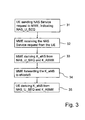
- FIG. 3 is a flow diagram illustrating the method according to this invention, and in step 31, the UE 11 sends the initial NAS SERVICE REQUEST-message to the MME 13, the message indicating the NAS uplink sequence counter, NAS_U_SEQ, normally only by sending the low order bits of the counter.
- the MME receives the NAS SERVICE REQUEST-message from the UE, obtaining the NAS_U_SEQ, and reconstructing the full sequence from the received low order bits.
- the MME derives the security key, K_eNB, from at least the received NAS_U_SEQ and the K_ASME from the ASME (Access Security Mobility Entity), using a suitable key derivation function, e.g. a Pseudo-Random Function.
- the MME forwards the derived K_eNB to the eNodeB 12, in step 34, to be used by the eNodeB to establish the complete UP/RRC security context shared with the UE.
- said UE will derive the same K_eNB from at least the stored K_ASME and from the NAS_U_SEQ of the initial NAS SERVICE REQUEST-message transmitted from the UE to the MME in step 31, and establish the UP/RRC security context from the derived K_eNB.
- the UE stores the NAS_U_SEQ transmitted to the MME in the initial NAS NAS SERVICE REQUEST-message, and uses the stored sequence number to derive the K_eNB.
- Figure 4 is a signalling diagram illustrating a second embodiment of this invention, in which the UE does not have to store the NAS_U_SEQ. Instead, the MME will return an indication of the received NAS_U_SEQ back to the UE, via the eNodeB.
- the UE 11 transmits an initial NAS SERVICE REQUEST to the MME 13, indicating an uplink sequence number, NAS_U_SEQ, and MME will receive the NAS_U_SEQ and derive the K_eNB based on at least the NAS_U_SEQ and the K_ASME, in S42.
- the MME will include an indication of said received NAS_U_SEQ in signal S43 transmitted to the eNodeB 12 together with the derived K_eNB, and the eNodeB will forward the NAS_U_SEQ to the UE, in signal S44. Thereafter, the UE will derive the K_eNB from at least the K_ASME and from the NAS_U_SEQ returned by the MME, in signal S45. From the derived security key, K_eNB, the eNodeB and the UE will establish the UP/RRC security context, thereby enabling secure UP/RRC traffic, in signal S46.
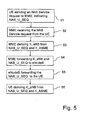
- FIG. 5 is a flow diagram illustrating the above-described method according to a second embodiment of this invention, in which an indication of the NAS_U_SEQ is returned to the UE by the MME.
- the UE 11 sends the initial NAS SERVICE REQUEST-message to the MME 13, the message indicating the NAS uplink sequence counter, NAS_U_SEQ, normally the low order bits.
- the MME receives the NAS SERVICE REQUEST-message from the UE, thereby obtaining the NAS_U_SEQ, and, if necessary, reconstructing the full NAS_U_SEQ from the received low order bits.
- the MME derives the security key, K_eNB, from at least the received NAS_U_SEQ and the K_ASME, using a suitable key derivation function.
- the MME includes an indication of the NAS uplink sequence counter, NAS_U_SEQ, in the message forwarding the derived K_eNB to the eNodeB 12, in step 54, and the eNodeB uses the received security key, K_eNB, for establishing a UP/RRC security context.
- the received NAS_U_SEQ is forwarded to the UE 11 by the eNodeB, in step 55, and in step 56, the UE derives the security key, K_eNB, from at least the K_ASME and from said received NAS_U_SEQ, in order to establish the UP/RRC security context shared with the eNodeB.
- a suitable conventional key derivation function e.g. a Pseudo-Random Function
- K_eNB PRF(K_ASME, NAS_U_SEQ, ,
- the key derivation function will have additional conventional input values, e.g. the eNodeB-identity.
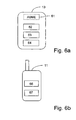
- FIG. 6a illustrates an MME 13 (Mobility Management Entity) for an EPS, according to this invention, further arranged to establish a security key, K_eNB, for a security context for the protection of UP/RRC traffic between a UE and a serving eNodeB.
- the MME is provided with conventional communication means, not illustrated in the figure, for communicating with the nodes in the EPS, e.g. with the eNodeBs via an S1-MME interface.
- an ASME (Access Security Management Entity) 61 is illustrated by hatched lines, since this functional entity of an EPS may be co-located with the MME.
- the means of the MME 13 illustrated in figure 6a for establishing the security key, K_eNB comprises reception means 62 for receiving an NAS SERVICE REQUEST-message including an NAS_U-SEQ from a UE (via its serving eNodeB; key derivation means 63 for deriving a security key, K_eNB based on at least the received NAS_U-SEQ and a stored K_ASME, using a conventional key derivation function; and sending means 64 for sending the derived K_eNB to the eNodeB serving the UE.
- Figure 6b illustrates a UE 11 (User Entity) according to this invention, the UE adapted for an EPS, and further arranged to establish a security key, K_eNB, for a security context for the protection of UP/RRC traffic exchanged with its serving eNodeB.
- the UE is provided with conventional communication means, not illustrated in the figure, for communicating with the nodes in the EPS via an LTE-Uu interface to its serving eNodeB.
- the means of the UE 11 illustrated in the figure 6b for establishing the security key, K_eNB comprises sending means 66 for sending an NAS SERVICE REQUEST-message to the MME, via the serving eNodeB, the request indicating an uplink sequence number, NAS_U-SEQ, and the means for establishing a security key, K_eNB, comprises key derivation means 67 for deriving a security key, K_eNB based on at least the NAS_U-SEQ and a stored K_ASME, using a conventional key derivation function.
Landscapes
- Engineering & Computer Science (AREA)
- Computer Networks & Wireless Communication (AREA)
- Signal Processing (AREA)
- Computer Security & Cryptography (AREA)
- Computer Hardware Design (AREA)
- Computing Systems (AREA)
- General Engineering & Computer Science (AREA)
- Databases & Information Systems (AREA)
- Mobile Radio Communication Systems (AREA)
- Telephonic Communication Services (AREA)
Priority Applications (4)
| Application Number | Priority Date | Filing Date | Title |
|---|---|---|---|
| PL13163049T PL2629451T3 (pl) | 2007-09-17 | 2008-05-20 | Sposób i układ w systemie telekomunikacyjnym |
| PL19183523T PL3598690T3 (pl) | 2007-09-17 | 2008-05-20 | Sposób i układ w systemie telekomunikacyjnym |
| DK19183523.0T DK3598690T3 (da) | 2007-09-17 | 2008-05-20 | Fremgangsmåde og indretning i et telekommunikationssystem |
| EP19183523.0A EP3598690B1 (fr) | 2007-09-17 | 2008-05-20 | Procédé et agencement dans un système de télécommunication |
Applications Claiming Priority (4)
| Application Number | Priority Date | Filing Date | Title |
|---|---|---|---|
| US97295507P | 2007-09-17 | 2007-09-17 | |
| EP11178378A EP2403180A1 (fr) | 2007-09-17 | 2008-05-20 | Procédé et arrangement dans un système de télécommunication |
| EP08767152A EP2191608B1 (fr) | 2007-09-17 | 2008-05-20 | Procédé et arrangement dans un système de télécommunication |
| PCT/SE2008/050591 WO2009038522A1 (fr) | 2007-09-17 | 2008-05-20 | Procédé et arrangement dans un système de télécommunication |
Related Parent Applications (4)
| Application Number | Title | Priority Date | Filing Date |
|---|---|---|---|
| EP08767152A Division EP2191608B1 (fr) | 2007-09-17 | 2008-05-20 | Procédé et arrangement dans un système de télécommunication |
| EP08767152.5 Division | 2008-05-20 | ||
| EP11178378A Division EP2403180A1 (fr) | 2007-09-17 | 2008-05-20 | Procédé et arrangement dans un système de télécommunication |
| EP11178378.3 Division | 2011-08-23 |
Related Child Applications (1)
| Application Number | Title | Priority Date | Filing Date |
|---|---|---|---|
| EP19183523.0A Division EP3598690B1 (fr) | 2007-09-17 | 2008-05-20 | Procédé et agencement dans un système de télécommunication |
Publications (2)
| Publication Number | Publication Date |
|---|---|
| EP2629451A1 true EP2629451A1 (fr) | 2013-08-21 |
| EP2629451B1 EP2629451B1 (fr) | 2019-07-10 |
Family
ID=40468151
Family Applications (4)
| Application Number | Title | Priority Date | Filing Date |
|---|---|---|---|
| EP11178378A Withdrawn EP2403180A1 (fr) | 2007-09-17 | 2008-05-20 | Procédé et arrangement dans un système de télécommunication |
| EP13163049.3A Active EP2629451B1 (fr) | 2007-09-17 | 2008-05-20 | Procédé et agencement dans un système de télécommunication |
| EP08767152A Active EP2191608B1 (fr) | 2007-09-17 | 2008-05-20 | Procédé et arrangement dans un système de télécommunication |
| EP19183523.0A Active EP3598690B1 (fr) | 2007-09-17 | 2008-05-20 | Procédé et agencement dans un système de télécommunication |
Family Applications Before (1)
| Application Number | Title | Priority Date | Filing Date |
|---|---|---|---|
| EP11178378A Withdrawn EP2403180A1 (fr) | 2007-09-17 | 2008-05-20 | Procédé et arrangement dans un système de télécommunication |
Family Applications After (2)
| Application Number | Title | Priority Date | Filing Date |
|---|---|---|---|
| EP08767152A Active EP2191608B1 (fr) | 2007-09-17 | 2008-05-20 | Procédé et arrangement dans un système de télécommunication |
| EP19183523.0A Active EP3598690B1 (fr) | 2007-09-17 | 2008-05-20 | Procédé et agencement dans un système de télécommunication |
Country Status (17)
| Country | Link |
|---|---|
| US (7) | US8660270B2 (fr) |
| EP (4) | EP2403180A1 (fr) |
| JP (2) | JP2010539786A (fr) |
| CN (2) | CN101803271B (fr) |
| AR (1) | AR068031A1 (fr) |
| AT (1) | ATE523980T1 (fr) |
| AU (1) | AU2008301284B2 (fr) |
| CA (1) | CA2699846C (fr) |
| CO (1) | CO6251350A2 (fr) |
| DE (1) | DE202008018538U1 (fr) |
| DK (3) | DK2191608T3 (fr) |
| ES (3) | ES2368875T3 (fr) |
| HU (1) | HUE058067T2 (fr) |
| PL (3) | PL2191608T3 (fr) |
| PT (3) | PT2629451T (fr) |
| RU (1) | RU2466503C9 (fr) |
| WO (1) | WO2009038522A1 (fr) |
Families Citing this family (28)
| Publication number | Priority date | Publication date | Assignee | Title |
|---|---|---|---|---|
| EP2403180A1 (fr) | 2007-09-17 | 2012-01-04 | Telefonaktiebolaget L M Ericsson AB (Publ) | Procédé et arrangement dans un système de télécommunication |
| CN101400059B (zh) * | 2007-09-28 | 2010-12-08 | 华为技术有限公司 | 一种active状态下的密钥更新方法和设备 |
| CN101925059B (zh) * | 2009-06-12 | 2014-06-11 | 中兴通讯股份有限公司 | 一种切换的过程中密钥的生成方法及系统 |
| CN102045677A (zh) * | 2009-10-15 | 2011-05-04 | 中兴通讯股份有限公司 | 紧急业务实现方法、MSC/VLR、MME和eNodeB |
| CN102045803B (zh) * | 2009-10-17 | 2013-06-12 | 中兴通讯股份有限公司 | 演进的分组域系统网络电路交换回落的实现系统及方法 |
| US9385862B2 (en) * | 2010-06-16 | 2016-07-05 | Qualcomm Incorporated | Method and apparatus for binding subscriber authentication and device authentication in communication systems |
| US8839373B2 (en) | 2010-06-18 | 2014-09-16 | Qualcomm Incorporated | Method and apparatus for relay node management and authorization |
| US9215220B2 (en) | 2010-06-21 | 2015-12-15 | Nokia Solutions And Networks Oy | Remote verification of attributes in a communication network |
| US20130242932A1 (en) * | 2010-11-24 | 2013-09-19 | Nokia Siemens Networks Oy | Secondary Spectrum Use |
| EP2737731B1 (fr) | 2011-07-29 | 2016-05-18 | SCA IPLA Holdings Inc. | Terminal de communications mobile et procédé associé |
| CN107509199B (zh) * | 2012-05-10 | 2020-10-20 | 三星电子株式会社 | 在无线蜂窝网络中通过用户设备进行数据消息传输的方法 |
| US9306743B2 (en) * | 2012-08-30 | 2016-04-05 | Texas Instruments Incorporated | One-way key fob and vehicle pairing verification, retention, and revocation |
| US20140068098A1 (en) * | 2012-09-04 | 2014-03-06 | Qualcomm Incorporated | Reducing network latency resulting from non-access stratum (nas) authentication for high performance content applications |
| US8873757B2 (en) * | 2012-10-19 | 2014-10-28 | Qualcom Incorporated | Methods and apparatus for providing network-assisted key agreement for D2D communications |
| US9119062B2 (en) * | 2012-10-19 | 2015-08-25 | Qualcomm Incorporated | Methods and apparatus for providing additional security for communication of sensitive information |
| GB2509937A (en) * | 2013-01-17 | 2014-07-23 | Nec Corp | Providing security information to a mobile device in which user plane data and control plane signalling are communicated via different base stations |
| RS58012B1 (sr) | 2013-02-07 | 2019-02-28 | Dyno Nobel Inc | Sistemi za isporuku eksploziva i s tim povezani postupci |
| KR20190047143A (ko) * | 2013-07-31 | 2019-05-07 | 닛본 덴끼 가부시끼가이샤 | Mtc 그룹 키 관리를 위한 디바이스들 및 방법 |
| JP6337965B2 (ja) | 2013-12-24 | 2018-06-06 | 日本電気株式会社 | Sceのための装置、システム、及び方法 |
| US10142840B2 (en) * | 2015-01-29 | 2018-11-27 | Motorola Mobility Llc | Method and apparatus for operating a user client wireless communication device on a wireless wide area network |
| US10021559B2 (en) * | 2015-08-04 | 2018-07-10 | Qualcomm Incorporated | Supporting multiple concurrent service contexts with a single connectivity context |
| MY201177A (en) * | 2015-09-22 | 2024-02-08 | Huawei Tech Co Ltd | Access method, device and system for user equipment (ue) |
| US11234126B2 (en) | 2015-11-17 | 2022-01-25 | Qualcomm Incorporated | Methods and apparatus for wireless communication using a security model to support multiple connectivity and service contexts |
| US10298549B2 (en) | 2015-12-23 | 2019-05-21 | Qualcomm Incorporated | Stateless access stratum security for cellular internet of things |
| CN108605225B (zh) * | 2016-02-06 | 2021-02-12 | 华为技术有限公司 | 一种安全处理方法及相关设备 |
| PL3682667T3 (pl) | 2017-09-15 | 2024-05-13 | Telefonaktiebolaget Lm Ericsson (Publ) | Kontekst bezpieczeństwa w systemie komunikacji bezprzewodowej |
| JP7028964B2 (ja) | 2017-10-02 | 2022-03-02 | テレフオンアクチーボラゲット エルエム エリクソン(パブル) | ネットワークステアリング情報のセキュア化 |
| US20230370840A1 (en) * | 2020-09-30 | 2023-11-16 | Samsung Electronics Co., Ltd. | Method, ue, and network entity for handling synchronization of security key in wireless network |
Family Cites Families (36)
| Publication number | Priority date | Publication date | Assignee | Title |
|---|---|---|---|---|
| US5799087A (en) | 1994-04-28 | 1998-08-25 | Citibank, N.A. | Electronic-monetary system |
| SE506619C2 (sv) | 1995-09-27 | 1998-01-19 | Ericsson Telefon Ab L M | Metod för kryptering av information |
| WO2000062507A1 (fr) | 1999-04-09 | 2000-10-19 | General Instrument Corporation | Gestion des cles entre un adaptateur de telephonie par cable et un signaleur associe |
| GB9922847D0 (en) * | 1999-09-27 | 1999-11-24 | Simoco Int Ltd | Radio communications |
| US6782274B1 (en) * | 1999-10-21 | 2004-08-24 | Hyundai Electronics Industries Co., Ltd. | Method for transmitting radio resource control message in asynchronous mobile communication system |
| GB0004178D0 (en) | 2000-02-22 | 2000-04-12 | Nokia Networks Oy | Integrity check in a communication system |
| AU2002248158A1 (en) * | 2000-11-02 | 2002-08-12 | Pirus Networks | Tcp/udp acceleration |
| FI111423B (fi) * | 2000-11-28 | 2003-07-15 | Nokia Corp | Järjestelmä kanavanvaihdon jälkeen tapahtuvan tietoliikenteen salauksen varmistamiseksi |
| US7152238B1 (en) * | 2000-12-29 | 2006-12-19 | Cisco Technology, Inc. | Enabling mobility for point to point protocol (PPP) users using a node that does not support mobility |
| EP1678972B1 (fr) * | 2003-10-01 | 2009-08-26 | Actix Limited | Systemes de suivi d'appels |
| EP1878285B1 (fr) * | 2005-04-26 | 2011-08-10 | Vodafone Group PLC | Établissement rapide d'un plan d'utilisateur dans un réseau de télécommunication |
| US8228917B2 (en) * | 2005-04-26 | 2012-07-24 | Qualcomm Incorporated | Method and apparatus for ciphering and re-ordering packets in a wireless communication system |
| US8842693B2 (en) | 2005-05-31 | 2014-09-23 | Qualcomm Incorporated | Rank step-down for MIMO SCW design employing HARQ |
| DE202005021930U1 (de) * | 2005-08-01 | 2011-08-08 | Corning Cable Systems Llc | Faseroptische Auskoppelkabel und vorverbundene Baugruppen mit Toning-Teilen |
| US9420612B2 (en) * | 2005-08-19 | 2016-08-16 | Core Wireless Licensing S.A.R.L. | Apparatus, method and computer program product providing simultaneous radio resource and service requests |
| CN1921682B (zh) * | 2005-08-26 | 2010-04-21 | 华为技术有限公司 | 增强通用鉴权框架中的密钥协商方法 |
| RU2406236C2 (ru) * | 2005-12-22 | 2010-12-10 | Интердиджитал Текнолоджи Корпорейшн | Способ и устройство для выполнения защиты данных и автоматического запроса повторной передачи в системе беспроводной связи |
| EP1806943A2 (fr) * | 2006-01-04 | 2007-07-11 | Innovative Sonic Limited | Interface d'utilisateur pour contrôler de nombreux paramètres et procédé de contrôle de nombreux paramètres |
| GB0600401D0 (en) * | 2006-01-10 | 2006-02-15 | Vodafone Plc | Telecommunications networks |
| EP1997269A4 (fr) * | 2006-03-22 | 2014-01-08 | Lg Electronics Inc | Cryptographie asymétrique pour systèmes sans fil |
| WO2007108651A1 (fr) * | 2006-03-22 | 2007-09-27 | Lg Electronics Inc. | Considérations de sécurité pour l'évolution à long terme (lte) de l'umts |
| KR101514845B1 (ko) * | 2006-03-31 | 2015-04-23 | 삼성전자주식회사 | 액세스 시스템 간의 핸드오버 시의 인증 절차를 최적화하기위한 시스템 및 방법 |
| GB0606692D0 (en) * | 2006-04-03 | 2006-05-10 | Vodafone Plc | Telecommunications networks |
| MX2008016258A (es) * | 2006-06-19 | 2009-02-03 | Interdigital Tech Corp | Metodo y aparato para proteccion de seguridad de la identidad de un usuario original en un mensaje de señalizacion inicial. |
| US8570956B2 (en) | 2006-06-21 | 2013-10-29 | Lg Electronics Inc. | Method of communicating data in a wireless mobile communications system using message separation and mobile terminal for use with the same |
| WO2008001187A2 (fr) | 2006-06-26 | 2008-01-03 | Nokia Corporation | Appareil, procédé et produit-programme informatique obtenant une gestion améliorée des numéros de séquence dans des réseaux |
| US20080039086A1 (en) * | 2006-07-14 | 2008-02-14 | Gallagher Michael D | Generic Access to the Iu Interface |
| US7852817B2 (en) * | 2006-07-14 | 2010-12-14 | Kineto Wireless, Inc. | Generic access to the Iu interface |
| US7912004B2 (en) * | 2006-07-14 | 2011-03-22 | Kineto Wireless, Inc. | Generic access to the Iu interface |
| US8948395B2 (en) | 2006-08-24 | 2015-02-03 | Qualcomm Incorporated | Systems and methods for key management for wireless communications systems |
| CN101523765B (zh) | 2006-09-28 | 2013-06-12 | 三星电子株式会社 | 异构无线网络中提供用户设备发起和协助反向切换的系统及方法 |
| GB0619499D0 (en) * | 2006-10-03 | 2006-11-08 | Lucent Technologies Inc | Encrypted data in a wireless telecommunications system |
| JP2008104040A (ja) | 2006-10-20 | 2008-05-01 | Fujitsu Ltd | 共通鍵生成装置および共通鍵生成方法 |
| EP1973265A1 (fr) | 2007-03-21 | 2008-09-24 | Nokia Siemens Networks Gmbh & Co. Kg | Mise à jour de clé dans un système SAE/LTE |
| US8699711B2 (en) | 2007-07-18 | 2014-04-15 | Interdigital Technology Corporation | Method and apparatus to implement security in a long term evolution wireless device |
| EP2403180A1 (fr) | 2007-09-17 | 2012-01-04 | Telefonaktiebolaget L M Ericsson AB (Publ) | Procédé et arrangement dans un système de télécommunication |
-
2008
- 2008-05-20 EP EP11178378A patent/EP2403180A1/fr not_active Withdrawn
- 2008-05-20 PL PL08767152T patent/PL2191608T3/pl unknown
- 2008-05-20 WO PCT/SE2008/050591 patent/WO2009038522A1/fr not_active Ceased
- 2008-05-20 DK DK08767152.5T patent/DK2191608T3/da active
- 2008-05-20 PT PT13163049T patent/PT2629451T/pt unknown
- 2008-05-20 DE DE202008018538.6U patent/DE202008018538U1/de not_active Expired - Lifetime
- 2008-05-20 PT PT191835230T patent/PT3598690T/pt unknown
- 2008-05-20 CN CN2008801073820A patent/CN101803271B/zh active Active
- 2008-05-20 DK DK19183523.0T patent/DK3598690T3/da active
- 2008-05-20 US US12/677,675 patent/US8660270B2/en active Active
- 2008-05-20 ES ES08767152T patent/ES2368875T3/es active Active
- 2008-05-20 DK DK13163049.3T patent/DK2629451T3/da active
- 2008-05-20 EP EP13163049.3A patent/EP2629451B1/fr active Active
- 2008-05-20 ES ES19183523T patent/ES2906127T3/es active Active
- 2008-05-20 EP EP08767152A patent/EP2191608B1/fr active Active
- 2008-05-20 EP EP19183523.0A patent/EP3598690B1/fr active Active
- 2008-05-20 PL PL13163049T patent/PL2629451T3/pl unknown
- 2008-05-20 CA CA2699846A patent/CA2699846C/fr active Active
- 2008-05-20 JP JP2010524820A patent/JP2010539786A/ja active Pending
- 2008-05-20 AT AT08767152T patent/ATE523980T1/de active
- 2008-05-20 AU AU2008301284A patent/AU2008301284B2/en active Active
- 2008-05-20 CN CN201210401080.2A patent/CN102916808B/zh active Active
- 2008-05-20 HU HUE19183523A patent/HUE058067T2/hu unknown
- 2008-05-20 PL PL19183523T patent/PL3598690T3/pl unknown
- 2008-05-20 ES ES13163049T patent/ES2750051T3/es active Active
- 2008-05-20 RU RU2010115362A patent/RU2466503C9/ru active
- 2008-05-20 PT PT08767152T patent/PT2191608E/pt unknown
- 2008-08-25 AR ARP080103692A patent/AR068031A1/es active IP Right Grant
-
2010
- 2010-02-05 CO CO10012466A patent/CO6251350A2/es active IP Right Grant
-
2012
- 2012-08-23 JP JP2012183895A patent/JP5425281B2/ja active Active
-
2014
- 2014-01-09 US US14/151,077 patent/US8938076B2/en active Active
- 2014-12-12 US US14/568,329 patent/US9615249B2/en active Active
-
2017
- 2017-02-27 US US15/443,229 patent/US10057055B2/en active Active
-
2018
- 2018-07-24 US US16/043,596 patent/US10455417B2/en active Active
-
2019
- 2019-09-10 US US16/565,796 patent/US11075749B2/en active Active
-
2021
- 2021-07-02 US US17/366,098 patent/US11917055B2/en active Active
Non-Patent Citations (2)
| Title |
|---|
| 3GPP: "3rd Generation Partnership Project;Technical Specification Group Services and System Aspects;3GPP System Architecture Evolution:Security Architecture;Release 8", 3GPP DRAFT; DRAFT S3-070624 V1 UPDATE OF 479_33ABC V000 SAE-LTE-SEC RM, 3RD GENERATION PARTNERSHIP PROJECT (3GPP), MOBILE COMPETENCE CENTRE ; 650, ROUTE DES LUCIOLES ; F-06921 SOPHIA-ANTIPOLIS CEDEX ; FRANCE, vol. SA WG3, no. Montreal; 20070712, 12 July 2007 (2007-07-12), XP050279972 * |
| 3GPP: "3RD GENERATION PARTNERSHIP PROJECTS; TECHNICAL SPECIFICATION GROUP SERVICES AND SYSTEM ASPECTS; RATIONALE AND TRACK OF SECURITY DECISIONS IN LONG TERM EVOLVED (LTE) RAN/3GPP SYSTEM ARCHITECTURE EVOLUTION (SAE) (RELEASE 8)", INTERNET CITATION, 20 February 2007 (2007-02-20), XP002445696, Retrieved from the Internet <URL:http://www.3gpp1.net/ftp/spces/archive/33%5Fseries/33.821/> [retrieved on 20070806] * |
Also Published As
Similar Documents
| Publication | Publication Date | Title |
|---|---|---|
| US11917055B2 (en) | Method and arrangement in a telecommunication system | |
| CN108966220B (zh) | 一种密钥推演的方法及网络设备 | |
| JP4820429B2 (ja) | 新しい鍵を生成する方法および装置 | |
| US10299119B2 (en) | Method and system for providing security from a radio access network | |
| PT2222207E (pt) | Sistema de cama | |
| CN110035431A (zh) | 信息处理方法及装置、网络实体及存储介质 | |
| CN105103577B (zh) | 一种加密数据的装置和方法 | |
| CN112055984A (zh) | 从非接入层透明容器失败恢复5g非接入层 | |
| AU2013213718A1 (en) | Method and Arrangement in a Telecommunication System |
Legal Events
| Date | Code | Title | Description |
|---|---|---|---|
| PUAI | Public reference made under article 153(3) epc to a published international application that has entered the european phase |
Free format text: ORIGINAL CODE: 0009012 |
|
| 17P | Request for examination filed |
Effective date: 20130410 |
|
| AC | Divisional application: reference to earlier application |
Ref document number: 2191608 Country of ref document: EP Kind code of ref document: P Ref document number: 2403180 Country of ref document: EP Kind code of ref document: P |
|
| AK | Designated contracting states |
Kind code of ref document: A1 Designated state(s): AT BE BG CH CY CZ DE DK EE ES FI FR GB GR HR HU IE IS IT LI LT LU LV MC MT NL NO PL PT RO SE SI SK TR |
|
| GRAP | Despatch of communication of intention to grant a patent |
Free format text: ORIGINAL CODE: EPIDOSNIGR1 |
|
| STAA | Information on the status of an ep patent application or granted ep patent |
Free format text: STATUS: GRANT OF PATENT IS INTENDED |
|
| INTG | Intention to grant announced |
Effective date: 20190108 |
|
| GRAS | Grant fee paid |
Free format text: ORIGINAL CODE: EPIDOSNIGR3 |
|
| GRAA | (expected) grant |
Free format text: ORIGINAL CODE: 0009210 |
|
| STAA | Information on the status of an ep patent application or granted ep patent |
Free format text: STATUS: THE PATENT HAS BEEN GRANTED |
|
| AC | Divisional application: reference to earlier application |
Ref document number: 2403180 Country of ref document: EP Kind code of ref document: P Ref document number: 2191608 Country of ref document: EP Kind code of ref document: P |
|
| AK | Designated contracting states |
Kind code of ref document: B1 Designated state(s): AT BE BG CH CY CZ DE DK EE ES FI FR GB GR HR HU IE IS IT LI LT LU LV MC MT NL NO PL PT RO SE SI SK TR |
|
| REG | Reference to a national code |
Ref country code: GB Ref legal event code: FG4D |
|
| REG | Reference to a national code |
Ref country code: CH Ref legal event code: EP Ref country code: AT Ref legal event code: REF Ref document number: 1154665 Country of ref document: AT Kind code of ref document: T Effective date: 20190715 |
|
| REG | Reference to a national code |
Ref country code: PT Ref legal event code: SC4A Ref document number: 2629451 Country of ref document: PT Date of ref document: 20190801 Kind code of ref document: T Free format text: AVAILABILITY OF NATIONAL TRANSLATION Effective date: 20190726 |
|
| REG | Reference to a national code |
Ref country code: IE Ref legal event code: FG4D |
|
| REG | Reference to a national code |
Ref country code: DE Ref legal event code: R096 Ref document number: 602008060673 Country of ref document: DE |
|
| REG | Reference to a national code |
Ref country code: DK Ref legal event code: T3 Effective date: 20190816 |
|
| REG | Reference to a national code |
Ref country code: NL Ref legal event code: FP |
|
| REG | Reference to a national code |
Ref country code: LT Ref legal event code: MG4D |
|
| REG | Reference to a national code |
Ref country code: AT Ref legal event code: MK05 Ref document number: 1154665 Country of ref document: AT Kind code of ref document: T Effective date: 20190710 |
|
| PG25 | Lapsed in a contracting state [announced via postgrant information from national office to epo] |
Ref country code: LT Free format text: LAPSE BECAUSE OF FAILURE TO SUBMIT A TRANSLATION OF THE DESCRIPTION OR TO PAY THE FEE WITHIN THE PRESCRIBED TIME-LIMIT Effective date: 20190710 Ref country code: FI Free format text: LAPSE BECAUSE OF FAILURE TO SUBMIT A TRANSLATION OF THE DESCRIPTION OR TO PAY THE FEE WITHIN THE PRESCRIBED TIME-LIMIT Effective date: 20190710 Ref country code: SE Free format text: LAPSE BECAUSE OF FAILURE TO SUBMIT A TRANSLATION OF THE DESCRIPTION OR TO PAY THE FEE WITHIN THE PRESCRIBED TIME-LIMIT Effective date: 20190710 Ref country code: HR Free format text: LAPSE BECAUSE OF FAILURE TO SUBMIT A TRANSLATION OF THE DESCRIPTION OR TO PAY THE FEE WITHIN THE PRESCRIBED TIME-LIMIT Effective date: 20190710 Ref country code: AT Free format text: LAPSE BECAUSE OF FAILURE TO SUBMIT A TRANSLATION OF THE DESCRIPTION OR TO PAY THE FEE WITHIN THE PRESCRIBED TIME-LIMIT Effective date: 20190710 Ref country code: BG Free format text: LAPSE BECAUSE OF FAILURE TO SUBMIT A TRANSLATION OF THE DESCRIPTION OR TO PAY THE FEE WITHIN THE PRESCRIBED TIME-LIMIT Effective date: 20191010 Ref country code: NO Free format text: LAPSE BECAUSE OF FAILURE TO SUBMIT A TRANSLATION OF THE DESCRIPTION OR TO PAY THE FEE WITHIN THE PRESCRIBED TIME-LIMIT Effective date: 20191010 |
|
| PG25 | Lapsed in a contracting state [announced via postgrant information from national office to epo] |
Ref country code: LV Free format text: LAPSE BECAUSE OF FAILURE TO SUBMIT A TRANSLATION OF THE DESCRIPTION OR TO PAY THE FEE WITHIN THE PRESCRIBED TIME-LIMIT Effective date: 20190710 Ref country code: IS Free format text: LAPSE BECAUSE OF FAILURE TO SUBMIT A TRANSLATION OF THE DESCRIPTION OR TO PAY THE FEE WITHIN THE PRESCRIBED TIME-LIMIT Effective date: 20191110 Ref country code: GR Free format text: LAPSE BECAUSE OF FAILURE TO SUBMIT A TRANSLATION OF THE DESCRIPTION OR TO PAY THE FEE WITHIN THE PRESCRIBED TIME-LIMIT Effective date: 20191011 |
|
| REG | Reference to a national code |
Ref country code: ES Ref legal event code: FG2A Ref document number: 2750051 Country of ref document: ES Kind code of ref document: T3 Effective date: 20200324 |
|
| PG25 | Lapsed in a contracting state [announced via postgrant information from national office to epo] |
Ref country code: EE Free format text: LAPSE BECAUSE OF FAILURE TO SUBMIT A TRANSLATION OF THE DESCRIPTION OR TO PAY THE FEE WITHIN THE PRESCRIBED TIME-LIMIT Effective date: 20190710 Ref country code: RO Free format text: LAPSE BECAUSE OF FAILURE TO SUBMIT A TRANSLATION OF THE DESCRIPTION OR TO PAY THE FEE WITHIN THE PRESCRIBED TIME-LIMIT Effective date: 20190710 |
|
| PG25 | Lapsed in a contracting state [announced via postgrant information from national office to epo] |
Ref country code: SK Free format text: LAPSE BECAUSE OF FAILURE TO SUBMIT A TRANSLATION OF THE DESCRIPTION OR TO PAY THE FEE WITHIN THE PRESCRIBED TIME-LIMIT Effective date: 20190710 Ref country code: IS Free format text: LAPSE BECAUSE OF FAILURE TO SUBMIT A TRANSLATION OF THE DESCRIPTION OR TO PAY THE FEE WITHIN THE PRESCRIBED TIME-LIMIT Effective date: 20200224 |
|
| REG | Reference to a national code |
Ref country code: DE Ref legal event code: R097 Ref document number: 602008060673 Country of ref document: DE |
|
| PLBE | No opposition filed within time limit |
Free format text: ORIGINAL CODE: 0009261 |
|
| STAA | Information on the status of an ep patent application or granted ep patent |
Free format text: STATUS: NO OPPOSITION FILED WITHIN TIME LIMIT |
|
| PG2D | Information on lapse in contracting state deleted |
Ref country code: IS |
|
| 26N | No opposition filed |
Effective date: 20200603 |
|
| PG25 | Lapsed in a contracting state [announced via postgrant information from national office to epo] |
Ref country code: SI Free format text: LAPSE BECAUSE OF FAILURE TO SUBMIT A TRANSLATION OF THE DESCRIPTION OR TO PAY THE FEE WITHIN THE PRESCRIBED TIME-LIMIT Effective date: 20190710 |
|
| PG25 | Lapsed in a contracting state [announced via postgrant information from national office to epo] |
Ref country code: MC Free format text: LAPSE BECAUSE OF FAILURE TO SUBMIT A TRANSLATION OF THE DESCRIPTION OR TO PAY THE FEE WITHIN THE PRESCRIBED TIME-LIMIT Effective date: 20190710 Ref country code: CH Free format text: LAPSE BECAUSE OF NON-PAYMENT OF DUE FEES Effective date: 20200531 Ref country code: LI Free format text: LAPSE BECAUSE OF NON-PAYMENT OF DUE FEES Effective date: 20200531 |
|
| PG25 | Lapsed in a contracting state [announced via postgrant information from national office to epo] |
Ref country code: LU Free format text: LAPSE BECAUSE OF NON-PAYMENT OF DUE FEES Effective date: 20200520 |
|
| PG25 | Lapsed in a contracting state [announced via postgrant information from national office to epo] |
Ref country code: MT Free format text: LAPSE BECAUSE OF FAILURE TO SUBMIT A TRANSLATION OF THE DESCRIPTION OR TO PAY THE FEE WITHIN THE PRESCRIBED TIME-LIMIT Effective date: 20190710 Ref country code: CY Free format text: LAPSE BECAUSE OF FAILURE TO SUBMIT A TRANSLATION OF THE DESCRIPTION OR TO PAY THE FEE WITHIN THE PRESCRIBED TIME-LIMIT Effective date: 20190710 |
|
| P01 | Opt-out of the competence of the unified patent court (upc) registered |
Effective date: 20230527 |
|
| PGFP | Annual fee paid to national office [announced via postgrant information from national office to epo] |
Ref country code: NL Payment date: 20250526 Year of fee payment: 18 |
|
| PGFP | Annual fee paid to national office [announced via postgrant information from national office to epo] |
Ref country code: PL Payment date: 20250508 Year of fee payment: 18 Ref country code: DE Payment date: 20250529 Year of fee payment: 18 |
|
| PGFP | Annual fee paid to national office [announced via postgrant information from national office to epo] |
Ref country code: GB Payment date: 20250527 Year of fee payment: 18 Ref country code: ES Payment date: 20250602 Year of fee payment: 18 Ref country code: DK Payment date: 20250526 Year of fee payment: 18 |
|
| PGFP | Annual fee paid to national office [announced via postgrant information from national office to epo] |
Ref country code: BE Payment date: 20250527 Year of fee payment: 18 Ref country code: IT Payment date: 20250521 Year of fee payment: 18 |
|
| PGFP | Annual fee paid to national office [announced via postgrant information from national office to epo] |
Ref country code: PT Payment date: 20250505 Year of fee payment: 18 |
|
| PGFP | Annual fee paid to national office [announced via postgrant information from national office to epo] |
Ref country code: FR Payment date: 20250526 Year of fee payment: 18 |
|
| PGFP | Annual fee paid to national office [announced via postgrant information from national office to epo] |
Ref country code: TR Payment date: 20250515 Year of fee payment: 18 |
|
| PGFP | Annual fee paid to national office [announced via postgrant information from national office to epo] |
Ref country code: CZ Payment date: 20250507 Year of fee payment: 18 |
|
| PGFP | Annual fee paid to national office [announced via postgrant information from national office to epo] |
Ref country code: IE Payment date: 20250527 Year of fee payment: 18 |