EP2631241A2 - Procédé pour la formation d'une protéine et utilisations de celle-ci - Google Patents
Procédé pour la formation d'une protéine et utilisations de celle-ci Download PDFInfo
- Publication number
- EP2631241A2 EP2631241A2 EP13168432.6A EP13168432A EP2631241A2 EP 2631241 A2 EP2631241 A2 EP 2631241A2 EP 13168432 A EP13168432 A EP 13168432A EP 2631241 A2 EP2631241 A2 EP 2631241A2
- Authority
- EP
- European Patent Office
- Prior art keywords
- protein
- rubisco
- residues
- amino acid
- candidate
- Prior art date
- Legal status (The legal status is an assumption and is not a legal conclusion. Google has not performed a legal analysis and makes no representation as to the accuracy of the status listed.)
- Granted
Links
- 108090000623 proteins and genes Proteins 0.000 title claims abstract description 320
- 102000004169 proteins and genes Human genes 0.000 title claims abstract description 303
- 238000000034 method Methods 0.000 title claims abstract description 241
- 230000008569 process Effects 0.000 title description 18
- 125000000539 amino acid group Chemical group 0.000 claims abstract description 261
- 238000012216 screening Methods 0.000 claims abstract description 32
- 238000000126 in silico method Methods 0.000 claims abstract description 12
- 238000000338 in vitro Methods 0.000 claims abstract description 12
- 108010003581 Ribulose-bisphosphate carboxylase Proteins 0.000 claims description 352
- 238000006243 chemical reaction Methods 0.000 claims description 79
- 102220012914 rs397516364 Human genes 0.000 claims description 59
- 239000000758 substrate Substances 0.000 claims description 39
- 230000000243 photosynthetic effect Effects 0.000 claims description 38
- 108091033319 polynucleotide Proteins 0.000 claims description 35
- 239000002157 polynucleotide Substances 0.000 claims description 35
- 102000040430 polynucleotide Human genes 0.000 claims description 35
- 102200115585 rs539699299 Human genes 0.000 claims description 29
- 102220023118 rs387907555 Human genes 0.000 claims description 26
- 108090000765 processed proteins & peptides Proteins 0.000 claims description 25
- 230000001965 increasing effect Effects 0.000 claims description 24
- 102000004196 processed proteins & peptides Human genes 0.000 claims description 24
- 229920001184 polypeptide Polymers 0.000 claims description 21
- 101710097247 Ribulose bisphosphate carboxylase large chain Proteins 0.000 claims description 16
- 101710104360 Ribulose bisphosphate carboxylase large chain, chromosomal Proteins 0.000 claims description 16
- 238000006467 substitution reaction Methods 0.000 claims description 14
- 230000001186 cumulative effect Effects 0.000 claims description 13
- 238000006555 catalytic reaction Methods 0.000 claims description 12
- 102220517195 Protein-arginine deiminase type-1_T68V_mutation Human genes 0.000 claims description 10
- 102200001453 rs587777797 Human genes 0.000 claims description 10
- 102200036772 rs10281879 Human genes 0.000 claims description 7
- 102200041758 rs11557064 Human genes 0.000 claims description 6
- 102220165663 rs147486240 Human genes 0.000 claims description 6
- 102220475447 Vacuolar protein sorting-associated protein 33A_K21A_mutation Human genes 0.000 claims description 3
- 125000002924 primary amino group Chemical group [H]N([H])* 0.000 claims description 3
- 102000008300 Mutant Proteins Human genes 0.000 abstract description 41
- 108010021466 Mutant Proteins Proteins 0.000 abstract description 41
- 230000003993 interaction Effects 0.000 description 101
- 230000035772 mutation Effects 0.000 description 73
- 241000894007 species Species 0.000 description 68
- 102000004190 Enzymes Human genes 0.000 description 66
- 108090000790 Enzymes Proteins 0.000 description 66
- 229940088598 enzyme Drugs 0.000 description 66
- 241000196324 Embryophyta Species 0.000 description 55
- 108091035707 Consensus sequence Proteins 0.000 description 54
- 241000192700 Cyanobacteria Species 0.000 description 52
- 241000206572 Rhodophyta Species 0.000 description 52
- 244000061176 Nicotiana tabacum Species 0.000 description 47
- 235000002637 Nicotiana tabacum Nutrition 0.000 description 47
- 241000218922 Magnoliophyta Species 0.000 description 42
- 210000004027 cell Anatomy 0.000 description 42
- 239000012634 fragment Substances 0.000 description 40
- 230000006872 improvement Effects 0.000 description 39
- 230000000694 effects Effects 0.000 description 35
- 238000007792 addition Methods 0.000 description 34
- 235000009337 Spinacia oleracea Nutrition 0.000 description 32
- 241000192560 Synechococcus sp. Species 0.000 description 32
- 230000002209 hydrophobic effect Effects 0.000 description 31
- 241000219315 Spinacia Species 0.000 description 30
- 230000008859 change Effects 0.000 description 30
- 241000588724 Escherichia coli Species 0.000 description 28
- 239000000543 intermediate Substances 0.000 description 28
- 125000004429 atom Chemical group 0.000 description 26
- 238000004364 calculation method Methods 0.000 description 26
- 230000003197 catalytic effect Effects 0.000 description 26
- 239000000243 solution Substances 0.000 description 26
- 230000000875 corresponding effect Effects 0.000 description 24
- 230000006870 function Effects 0.000 description 24
- 239000013598 vector Substances 0.000 description 24
- 210000004899 c-terminal region Anatomy 0.000 description 22
- 230000036961 partial effect Effects 0.000 description 22
- 238000012360 testing method Methods 0.000 description 21
- 238000006473 carboxylation reaction Methods 0.000 description 20
- 210000002706 plastid Anatomy 0.000 description 20
- 241000282326 Felis catus Species 0.000 description 19
- 229910052799 carbon Inorganic materials 0.000 description 19
- 230000021523 carboxylation Effects 0.000 description 19
- XLYOFNOQVPJJNP-UHFFFAOYSA-N water Substances O XLYOFNOQVPJJNP-UHFFFAOYSA-N 0.000 description 19
- 241000192707 Synechococcus Species 0.000 description 18
- 230000007246 mechanism Effects 0.000 description 18
- 238000000329 molecular dynamics simulation Methods 0.000 description 18
- 101150074945 rbcL gene Proteins 0.000 description 18
- 101100301006 Allochromatium vinosum (strain ATCC 17899 / DSM 180 / NBRC 103801 / NCIMB 10441 / D) cbbL2 gene Proteins 0.000 description 17
- 229940024606 amino acid Drugs 0.000 description 17
- 101150004101 cbbL gene Proteins 0.000 description 17
- 150000001413 amino acids Chemical class 0.000 description 16
- ITHCSGCUQDMYAI-ZMIZWQJLSA-N 2-carboxy-D-arabinitol 1,5-bisphosphate Chemical compound OP(=O)(O)OC[C@@H](O)[C@@H](O)[C@](O)(COP(O)(O)=O)C(O)=O ITHCSGCUQDMYAI-ZMIZWQJLSA-N 0.000 description 15
- OKTJSMMVPCPJKN-UHFFFAOYSA-N Carbon Chemical compound [C] OKTJSMMVPCPJKN-UHFFFAOYSA-N 0.000 description 15
- CURLTUGMZLYLDI-UHFFFAOYSA-N Carbon dioxide Chemical compound O=C=O CURLTUGMZLYLDI-UHFFFAOYSA-N 0.000 description 15
- YAHZABJORDUQGO-NQXXGFSBSA-N D-ribulose 1,5-bisphosphate Chemical compound OP(=O)(O)OC[C@@H](O)[C@@H](O)C(=O)COP(O)(O)=O YAHZABJORDUQGO-NQXXGFSBSA-N 0.000 description 15
- 241001646655 Galdieria partita Species 0.000 description 15
- 239000000047 product Substances 0.000 description 15
- 239000013078 crystal Substances 0.000 description 13
- 241000156300 Griffithsia monilis Species 0.000 description 12
- 238000004458 analytical method Methods 0.000 description 12
- 238000005259 measurement Methods 0.000 description 12
- 125000003275 alpha amino acid group Chemical group 0.000 description 11
- 229910002092 carbon dioxide Inorganic materials 0.000 description 11
- 150000007523 nucleic acids Chemical group 0.000 description 11
- 239000013612 plasmid Substances 0.000 description 11
- 230000009466 transformation Effects 0.000 description 11
- 241001464837 Viridiplantae Species 0.000 description 10
- 230000015572 biosynthetic process Effects 0.000 description 10
- 150000007942 carboxylates Chemical group 0.000 description 10
- 229910052739 hydrogen Inorganic materials 0.000 description 10
- 108091028043 Nucleic acid sequence Proteins 0.000 description 9
- 101150067314 aadA gene Proteins 0.000 description 9
- 238000003556 assay Methods 0.000 description 9
- 210000003763 chloroplast Anatomy 0.000 description 9
- 230000000295 complement effect Effects 0.000 description 9
- 230000012010 growth Effects 0.000 description 9
- 238000000746 purification Methods 0.000 description 9
- IJGRMHOSHXDMSA-UHFFFAOYSA-N Atomic nitrogen Chemical compound N#N IJGRMHOSHXDMSA-UHFFFAOYSA-N 0.000 description 8
- TWRXJAOTZQYOKJ-UHFFFAOYSA-L Magnesium chloride Chemical compound [Mg+2].[Cl-].[Cl-] TWRXJAOTZQYOKJ-UHFFFAOYSA-L 0.000 description 8
- 238000012901 QM/MM calculation Methods 0.000 description 8
- 108020001507 fusion proteins Proteins 0.000 description 8
- 102000037865 fusion proteins Human genes 0.000 description 8
- 230000000869 mutational effect Effects 0.000 description 8
- 229910052757 nitrogen Inorganic materials 0.000 description 8
- 239000000126 substance Substances 0.000 description 8
- 108091026890 Coding region Proteins 0.000 description 7
- 241000425347 Phyla <beetle> Species 0.000 description 7
- 102000044159 Ubiquitin Human genes 0.000 description 7
- 108090000848 Ubiquitin Proteins 0.000 description 7
- 239000001569 carbon dioxide Substances 0.000 description 7
- 239000007806 chemical reaction intermediate Substances 0.000 description 7
- 238000004519 manufacturing process Methods 0.000 description 7
- 230000001404 mediated effect Effects 0.000 description 7
- 230000029553 photosynthesis Effects 0.000 description 7
- 238000010672 photosynthesis Methods 0.000 description 7
- 102000004217 thyroid hormone receptors Human genes 0.000 description 7
- 230000001131 transforming effect Effects 0.000 description 7
- 101710138460 Leaf protein Proteins 0.000 description 6
- 241000190984 Rhodospirillum rubrum Species 0.000 description 6
- 230000006978 adaptation Effects 0.000 description 6
- 230000015556 catabolic process Effects 0.000 description 6
- 239000010410 layer Substances 0.000 description 6
- 239000003446 ligand Substances 0.000 description 6
- 229910052749 magnesium Inorganic materials 0.000 description 6
- 239000011777 magnesium Substances 0.000 description 6
- 125000003729 nucleotide group Chemical group 0.000 description 6
- 210000003463 organelle Anatomy 0.000 description 6
- 230000037361 pathway Effects 0.000 description 6
- 238000013081 phylogenetic analysis Methods 0.000 description 6
- 238000004088 simulation Methods 0.000 description 6
- HEMHJVSKTPXQMS-UHFFFAOYSA-M sodium hydroxide Inorganic materials [OH-].[Na+] HEMHJVSKTPXQMS-UHFFFAOYSA-M 0.000 description 6
- 230000009261 transgenic effect Effects 0.000 description 6
- 238000003775 Density Functional Theory Methods 0.000 description 5
- 108010006519 Molecular Chaperones Proteins 0.000 description 5
- 241000192589 Synechococcus elongatus PCC 7942 Species 0.000 description 5
- 239000002253 acid Substances 0.000 description 5
- 210000000349 chromosome Anatomy 0.000 description 5
- 238000012217 deletion Methods 0.000 description 5
- 230000037430 deletion Effects 0.000 description 5
- 238000011161 development Methods 0.000 description 5
- 230000018109 developmental process Effects 0.000 description 5
- 230000036571 hydration Effects 0.000 description 5
- 238000006703 hydration reaction Methods 0.000 description 5
- 239000001257 hydrogen Substances 0.000 description 5
- 238000013101 initial test Methods 0.000 description 5
- 230000000670 limiting effect Effects 0.000 description 5
- 239000002773 nucleotide Substances 0.000 description 5
- 238000006213 oxygenation reaction Methods 0.000 description 5
- 108010080971 phosphoribulokinase Proteins 0.000 description 5
- 229910052700 potassium Inorganic materials 0.000 description 5
- 108020003175 receptors Proteins 0.000 description 5
- 102000005962 receptors Human genes 0.000 description 5
- 238000002864 sequence alignment Methods 0.000 description 5
- 230000007704 transition Effects 0.000 description 5
- 241000195628 Chlorophyta Species 0.000 description 4
- 102000004127 Cytokines Human genes 0.000 description 4
- 108090000695 Cytokines Proteins 0.000 description 4
- 241001517276 Glaucocystophyceae Species 0.000 description 4
- FYYHWMGAXLPEAU-UHFFFAOYSA-N Magnesium Chemical compound [Mg] FYYHWMGAXLPEAU-UHFFFAOYSA-N 0.000 description 4
- 102000035195 Peptidases Human genes 0.000 description 4
- 108091005804 Peptidases Proteins 0.000 description 4
- 239000004365 Protease Substances 0.000 description 4
- UIIMBOGNXHQVGW-UHFFFAOYSA-M Sodium bicarbonate Chemical compound [Na+].OC([O-])=O UIIMBOGNXHQVGW-UHFFFAOYSA-M 0.000 description 4
- 230000004913 activation Effects 0.000 description 4
- QVGXLLKOCUKJST-UHFFFAOYSA-N atomic oxygen Chemical compound [O] QVGXLLKOCUKJST-UHFFFAOYSA-N 0.000 description 4
- 229930002875 chlorophyll Natural products 0.000 description 4
- 235000019804 chlorophyll Nutrition 0.000 description 4
- ATNHDLDRLWWWCB-AENOIHSZSA-M chlorophyll a Chemical compound C1([C@@H](C(=O)OC)C(=O)C2=C3C)=C2N2C3=CC(C(CC)=C3C)=[N+]4C3=CC3=C(C=C)C(C)=C5N3[Mg-2]42[N+]2=C1[C@@H](CCC(=O)OC\C=C(/C)CCC[C@H](C)CCC[C@H](C)CCCC(C)C)[C@H](C)C2=C5 ATNHDLDRLWWWCB-AENOIHSZSA-M 0.000 description 4
- 238000004587 chromatography analysis Methods 0.000 description 4
- 230000003138 coordinated effect Effects 0.000 description 4
- 239000012792 core layer Substances 0.000 description 4
- 244000038559 crop plants Species 0.000 description 4
- 239000000539 dimer Substances 0.000 description 4
- 230000002255 enzymatic effect Effects 0.000 description 4
- 239000007789 gas Substances 0.000 description 4
- 239000003102 growth factor Substances 0.000 description 4
- 230000001771 impaired effect Effects 0.000 description 4
- 238000001727 in vivo Methods 0.000 description 4
- 230000003834 intracellular effect Effects 0.000 description 4
- 229910001629 magnesium chloride Inorganic materials 0.000 description 4
- 239000003550 marker Substances 0.000 description 4
- 239000000463 material Substances 0.000 description 4
- 125000002496 methyl group Chemical group [H]C([H])([H])* 0.000 description 4
- 238000002703 mutagenesis Methods 0.000 description 4
- 239000002858 neurotransmitter agent Substances 0.000 description 4
- 102000039446 nucleic acids Human genes 0.000 description 4
- 108020004707 nucleic acids Proteins 0.000 description 4
- 229910052760 oxygen Inorganic materials 0.000 description 4
- 239000001301 oxygen Substances 0.000 description 4
- 230000009467 reduction Effects 0.000 description 4
- 229920006395 saturated elastomer Polymers 0.000 description 4
- 239000013605 shuttle vector Substances 0.000 description 4
- 230000003335 steric effect Effects 0.000 description 4
- 231100000331 toxic Toxicity 0.000 description 4
- 230000002588 toxic effect Effects 0.000 description 4
- 239000002028 Biomass Substances 0.000 description 3
- 241000195940 Bryophyta Species 0.000 description 3
- 244000068988 Glycine max Species 0.000 description 3
- 235000010469 Glycine max Nutrition 0.000 description 3
- 244000281247 Ribes rubrum Species 0.000 description 3
- 240000000111 Saccharum officinarum Species 0.000 description 3
- 235000007201 Saccharum officinarum Nutrition 0.000 description 3
- 241000135402 Synechococcus elongatus PCC 6301 Species 0.000 description 3
- 102100033598 Triosephosphate isomerase Human genes 0.000 description 3
- 238000001042 affinity chromatography Methods 0.000 description 3
- 125000001931 aliphatic group Chemical group 0.000 description 3
- 238000013459 approach Methods 0.000 description 3
- 239000002551 biofuel Substances 0.000 description 3
- 230000004071 biological effect Effects 0.000 description 3
- 239000006227 byproduct Substances 0.000 description 3
- 239000003054 catalyst Substances 0.000 description 3
- 238000010367 cloning Methods 0.000 description 3
- 239000004148 curcumin Substances 0.000 description 3
- 238000005516 engineering process Methods 0.000 description 3
- 238000005837 enolization reaction Methods 0.000 description 3
- 230000007613 environmental effect Effects 0.000 description 3
- 210000003527 eukaryotic cell Anatomy 0.000 description 3
- 238000001597 immobilized metal affinity chromatography Methods 0.000 description 3
- 238000003780 insertion Methods 0.000 description 3
- 230000037431 insertion Effects 0.000 description 3
- 230000010354 integration Effects 0.000 description 3
- 229930027917 kanamycin Natural products 0.000 description 3
- 229960000318 kanamycin Drugs 0.000 description 3
- SBUJHOSQTJFQJX-NOAMYHISSA-N kanamycin Chemical compound O[C@@H]1[C@@H](O)[C@H](O)[C@@H](CN)O[C@@H]1O[C@H]1[C@H](O)[C@@H](O[C@@H]2[C@@H]([C@@H](N)[C@H](O)[C@@H](CO)O2)O)[C@H](N)C[C@@H]1N SBUJHOSQTJFQJX-NOAMYHISSA-N 0.000 description 3
- 229930182823 kanamycin A Natural products 0.000 description 3
- 229910052751 metal Inorganic materials 0.000 description 3
- 239000002184 metal Substances 0.000 description 3
- 230000007935 neutral effect Effects 0.000 description 3
- 229920002401 polyacrylamide Polymers 0.000 description 3
- 229920000642 polymer Polymers 0.000 description 3
- 210000001236 prokaryotic cell Anatomy 0.000 description 3
- 230000002829 reductive effect Effects 0.000 description 3
- 230000002441 reversible effect Effects 0.000 description 3
- 102220256970 rs1553348786 Human genes 0.000 description 3
- 239000000523 sample Substances 0.000 description 3
- 238000010187 selection method Methods 0.000 description 3
- 125000001424 substituent group Chemical group 0.000 description 3
- 238000012546 transfer Methods 0.000 description 3
- 230000007306 turnover Effects 0.000 description 3
- 230000000007 visual effect Effects 0.000 description 3
- OSJPPGNTCRNQQC-UHFFFAOYSA-N 3-phosphoglyceric acid Chemical compound OC(=O)C(O)COP(O)(O)=O OSJPPGNTCRNQQC-UHFFFAOYSA-N 0.000 description 2
- 102000003846 Carbonic anhydrases Human genes 0.000 description 2
- 108090000209 Carbonic anhydrases Proteins 0.000 description 2
- 241000218631 Coniferophyta Species 0.000 description 2
- 241000195493 Cryptophyta Species 0.000 description 2
- 244000304337 Cuminum cyminum Species 0.000 description 2
- 241001464430 Cyanobacterium Species 0.000 description 2
- 102100021238 Dynamin-2 Human genes 0.000 description 2
- 241000206602 Eukaryota Species 0.000 description 2
- 108010025076 Holoenzymes Proteins 0.000 description 2
- 101000817607 Homo sapiens Dynamin-2 Proteins 0.000 description 2
- AGPKZVBTJJNPAG-WHFBIAKZSA-N L-isoleucine Chemical compound CC[C@H](C)[C@H](N)C(O)=O AGPKZVBTJJNPAG-WHFBIAKZSA-N 0.000 description 2
- ROHFNLRQFUQHCH-YFKPBYRVSA-N L-leucine Chemical compound CC(C)C[C@H](N)C(O)=O ROHFNLRQFUQHCH-YFKPBYRVSA-N 0.000 description 2
- KZSNJWFQEVHDMF-BYPYZUCNSA-N L-valine Chemical compound CC(C)[C@H](N)C(O)=O KZSNJWFQEVHDMF-BYPYZUCNSA-N 0.000 description 2
- ROHFNLRQFUQHCH-UHFFFAOYSA-N Leucine Natural products CC(C)CC(N)C(O)=O ROHFNLRQFUQHCH-UHFFFAOYSA-N 0.000 description 2
- 102000005431 Molecular Chaperones Human genes 0.000 description 2
- 102000007474 Multiprotein Complexes Human genes 0.000 description 2
- 108010085220 Multiprotein Complexes Proteins 0.000 description 2
- 238000005481 NMR spectroscopy Methods 0.000 description 2
- 241001144488 Nicotiana occidentalis Species 0.000 description 2
- 240000007594 Oryza sativa Species 0.000 description 2
- 235000007164 Oryza sativa Nutrition 0.000 description 2
- 102000004020 Oxygenases Human genes 0.000 description 2
- 108090000417 Oxygenases Proteins 0.000 description 2
- 101150041925 RBCS gene Proteins 0.000 description 2
- 230000010799 Receptor Interactions Effects 0.000 description 2
- 108020004511 Recombinant DNA Proteins 0.000 description 2
- 108010008281 Recombinant Fusion Proteins Proteins 0.000 description 2
- 244000300264 Spinacia oleracea Species 0.000 description 2
- 229920002472 Starch Polymers 0.000 description 2
- KZSNJWFQEVHDMF-UHFFFAOYSA-N Valine Natural products CC(C)C(N)C(O)=O KZSNJWFQEVHDMF-UHFFFAOYSA-N 0.000 description 2
- 230000009056 active transport Effects 0.000 description 2
- 238000007259 addition reaction Methods 0.000 description 2
- 239000012131 assay buffer Substances 0.000 description 2
- 230000001580 bacterial effect Effects 0.000 description 2
- 230000008901 benefit Effects 0.000 description 2
- 239000000872 buffer Substances 0.000 description 2
- 230000021235 carbamoylation Effects 0.000 description 2
- 125000000837 carbohydrate group Chemical group 0.000 description 2
- 150000001720 carbohydrates Chemical class 0.000 description 2
- 235000014633 carbohydrates Nutrition 0.000 description 2
- 150000001721 carbon Chemical group 0.000 description 2
- 230000001413 cellular effect Effects 0.000 description 2
- 238000012512 characterization method Methods 0.000 description 2
- 238000007385 chemical modification Methods 0.000 description 2
- 230000002759 chromosomal effect Effects 0.000 description 2
- 230000001447 compensatory effect Effects 0.000 description 2
- 150000001875 compounds Chemical class 0.000 description 2
- 230000002153 concerted effect Effects 0.000 description 2
- 108091036078 conserved sequence Proteins 0.000 description 2
- 239000000470 constituent Substances 0.000 description 2
- 230000002596 correlated effect Effects 0.000 description 2
- 230000008878 coupling Effects 0.000 description 2
- 238000010168 coupling process Methods 0.000 description 2
- 238000005859 coupling reaction Methods 0.000 description 2
- 230000007423 decrease Effects 0.000 description 2
- 230000006735 deficit Effects 0.000 description 2
- 238000006731 degradation reaction Methods 0.000 description 2
- 230000001419 dependent effect Effects 0.000 description 2
- 238000001962 electrophoresis Methods 0.000 description 2
- 230000001747 exhibiting effect Effects 0.000 description 2
- 238000002474 experimental method Methods 0.000 description 2
- 238000011049 filling Methods 0.000 description 2
- 230000005714 functional activity Effects 0.000 description 2
- 239000000499 gel Substances 0.000 description 2
- 238000007429 general method Methods 0.000 description 2
- 230000002068 genetic effect Effects 0.000 description 2
- 239000011521 glass Substances 0.000 description 2
- 239000000710 homodimer Substances 0.000 description 2
- 239000005556 hormone Substances 0.000 description 2
- 229940088597 hormone Drugs 0.000 description 2
- 238000012405 in silico analysis Methods 0.000 description 2
- 230000001939 inductive effect Effects 0.000 description 2
- 238000011835 investigation Methods 0.000 description 2
- 229960000310 isoleucine Drugs 0.000 description 2
- AGPKZVBTJJNPAG-UHFFFAOYSA-N isoleucine Natural products CCC(C)C(N)C(O)=O AGPKZVBTJJNPAG-UHFFFAOYSA-N 0.000 description 2
- 238000003367 kinetic assay Methods 0.000 description 2
- 150000002632 lipids Chemical class 0.000 description 2
- 238000013507 mapping Methods 0.000 description 2
- 239000012528 membrane Substances 0.000 description 2
- 230000004060 metabolic process Effects 0.000 description 2
- BDAGIHXWWSANSR-UHFFFAOYSA-N methanoic acid Natural products OC=O BDAGIHXWWSANSR-UHFFFAOYSA-N 0.000 description 2
- 230000000813 microbial effect Effects 0.000 description 2
- 230000003278 mimic effect Effects 0.000 description 2
- 231100000350 mutagenesis Toxicity 0.000 description 2
- 230000009057 passive transport Effects 0.000 description 2
- 125000002467 phosphate group Chemical group [H]OP(=O)(O[H])O[*] 0.000 description 2
- 238000002264 polyacrylamide gel electrophoresis Methods 0.000 description 2
- 239000011148 porous material Substances 0.000 description 2
- 230000005588 protonation Effects 0.000 description 2
- 230000006798 recombination Effects 0.000 description 2
- 238000005215 recombination Methods 0.000 description 2
- 230000007115 recruitment Effects 0.000 description 2
- 235000009566 rice Nutrition 0.000 description 2
- 102200082887 rs33950093 Human genes 0.000 description 2
- 102200082890 rs33972047 Human genes 0.000 description 2
- 238000009394 selective breeding Methods 0.000 description 2
- 239000006152 selective media Substances 0.000 description 2
- 230000014639 sexual reproduction Effects 0.000 description 2
- 230000037432 silent mutation Effects 0.000 description 2
- 238000002741 site-directed mutagenesis Methods 0.000 description 2
- 229910000030 sodium bicarbonate Inorganic materials 0.000 description 2
- UNFWWIHTNXNPBV-WXKVUWSESA-N spectinomycin Chemical compound O([C@@H]1[C@@H](NC)[C@@H](O)[C@H]([C@@H]([C@H]1O1)O)NC)[C@]2(O)[C@H]1O[C@H](C)CC2=O UNFWWIHTNXNPBV-WXKVUWSESA-N 0.000 description 2
- 229960000268 spectinomycin Drugs 0.000 description 2
- 238000004611 spectroscopical analysis Methods 0.000 description 2
- 230000000087 stabilizing effect Effects 0.000 description 2
- 235000019698 starch Nutrition 0.000 description 2
- 239000008107 starch Substances 0.000 description 2
- UCSJYZPVAKXKNQ-HZYVHMACSA-N streptomycin Chemical compound CN[C@H]1[C@H](O)[C@@H](O)[C@H](CO)O[C@H]1O[C@@H]1[C@](C=O)(O)[C@H](C)O[C@H]1O[C@@H]1[C@@H](NC(N)=N)[C@H](O)[C@@H](NC(N)=N)[C@H](O)[C@H]1O UCSJYZPVAKXKNQ-HZYVHMACSA-N 0.000 description 2
- 238000003786 synthesis reaction Methods 0.000 description 2
- 238000013518 transcription Methods 0.000 description 2
- 230000035897 transcription Effects 0.000 description 2
- 230000032258 transport Effects 0.000 description 2
- 239000004474 valine Substances 0.000 description 2
- 230000017260 vegetative to reproductive phase transition of meristem Effects 0.000 description 2
- OSJPPGNTCRNQQC-UWTATZPHSA-N 3-phospho-D-glyceric acid Chemical compound OC(=O)[C@H](O)COP(O)(O)=O OSJPPGNTCRNQQC-UWTATZPHSA-N 0.000 description 1
- OSWFIVFLDKOXQC-UHFFFAOYSA-N 4-(3-methoxyphenyl)aniline Chemical compound COC1=CC=CC(C=2C=CC(N)=CC=2)=C1 OSWFIVFLDKOXQC-UHFFFAOYSA-N 0.000 description 1
- 102000013142 Amylases Human genes 0.000 description 1
- 108010065511 Amylases Proteins 0.000 description 1
- 241000736282 Anthocerotophyta Species 0.000 description 1
- 108020004998 Chloroplast DNA Proteins 0.000 description 1
- 108020004705 Codon Proteins 0.000 description 1
- 241000084008 Cyanidiales Species 0.000 description 1
- 102220541230 Cystatin-D_H86R_mutation Human genes 0.000 description 1
- 238000004057 DFT-B3LYP calculation Methods 0.000 description 1
- 108020004414 DNA Proteins 0.000 description 1
- 102000004163 DNA-directed RNA polymerases Human genes 0.000 description 1
- 108090000626 DNA-directed RNA polymerases Proteins 0.000 description 1
- 101150049492 DVR gene Proteins 0.000 description 1
- KCXVZYZYPLLWCC-UHFFFAOYSA-N EDTA Chemical compound OC(=O)CN(CC(O)=O)CCN(CC(O)=O)CC(O)=O KCXVZYZYPLLWCC-UHFFFAOYSA-N 0.000 description 1
- 241000758993 Equisetidae Species 0.000 description 1
- LFQSCWFLJHTTHZ-UHFFFAOYSA-N Ethanol Chemical compound CCO LFQSCWFLJHTTHZ-UHFFFAOYSA-N 0.000 description 1
- 241000233866 Fungi Species 0.000 description 1
- 241000592348 Gnetophyta Species 0.000 description 1
- 102220592003 Hemoglobin subunit beta_K18Q_mutation Human genes 0.000 description 1
- 241000238631 Hexapoda Species 0.000 description 1
- CKLJMWTZIZZHCS-REOHCLBHSA-N L-aspartic acid Chemical compound OC(=O)[C@@H](N)CC(O)=O CKLJMWTZIZZHCS-REOHCLBHSA-N 0.000 description 1
- 101800001509 Large capsid protein Proteins 0.000 description 1
- 125000000729 N-terminal amino-acid group Chemical group 0.000 description 1
- 241000244206 Nematoda Species 0.000 description 1
- 102220475056 POTE ankyrin domain family member C_H86D_mutation Human genes 0.000 description 1
- 239000002202 Polyethylene glycol Substances 0.000 description 1
- 241000985694 Polypodiopsida Species 0.000 description 1
- 229940124158 Protease/peptidase inhibitor Drugs 0.000 description 1
- 241000192142 Proteobacteria Species 0.000 description 1
- 102220472767 Ras-related protein Rab-10_T23N_mutation Human genes 0.000 description 1
- 101001112071 Rhodospirillum rubrum Ribulose bisphosphate carboxylase Proteins 0.000 description 1
- 108091028664 Ribonucleotide Proteins 0.000 description 1
- 240000004808 Saccharomyces cerevisiae Species 0.000 description 1
- 229930006000 Sucrose Natural products 0.000 description 1
- CZMRCDWAGMRECN-UGDNZRGBSA-N Sucrose Chemical compound O[C@H]1[C@H](O)[C@@H](CO)O[C@@]1(CO)O[C@@H]1[C@H](O)[C@@H](O)[C@H](O)[C@@H](CO)O1 CZMRCDWAGMRECN-UGDNZRGBSA-N 0.000 description 1
- 239000012505 Superdex™ Substances 0.000 description 1
- GSEJCLTVZPLZKY-UHFFFAOYSA-N Triethanolamine Chemical compound OCCN(CCO)CCO GSEJCLTVZPLZKY-UHFFFAOYSA-N 0.000 description 1
- 102000005924 Triose-Phosphate Isomerase Human genes 0.000 description 1
- 108700015934 Triose-phosphate isomerases Proteins 0.000 description 1
- 241000209140 Triticum Species 0.000 description 1
- 235000021307 Triticum Nutrition 0.000 description 1
- 240000007026 Tylosema esculentum Species 0.000 description 1
- 235000010416 Tylosema esculentum Nutrition 0.000 description 1
- 230000004075 alteration Effects 0.000 description 1
- 235000019418 amylase Nutrition 0.000 description 1
- 229940025131 amylases Drugs 0.000 description 1
- 238000004873 anchoring Methods 0.000 description 1
- 239000003242 anti bacterial agent Substances 0.000 description 1
- 230000003466 anti-cipated effect Effects 0.000 description 1
- 125000003118 aryl group Chemical group 0.000 description 1
- 229940009098 aspartate Drugs 0.000 description 1
- 230000009286 beneficial effect Effects 0.000 description 1
- 230000000975 bioactive effect Effects 0.000 description 1
- 230000003115 biocidal effect Effects 0.000 description 1
- 238000003766 bioinformatics method Methods 0.000 description 1
- 230000033228 biological regulation Effects 0.000 description 1
- 238000010504 bond cleavage reaction Methods 0.000 description 1
- 238000006664 bond formation reaction Methods 0.000 description 1
- 102220426442 c.160G>A Human genes 0.000 description 1
- 102220358083 c.264A>C Human genes 0.000 description 1
- 125000004432 carbon atom Chemical group C* 0.000 description 1
- 125000002915 carbonyl group Chemical group [*:2]C([*:1])=O 0.000 description 1
- 125000003178 carboxy group Chemical group [H]OC(*)=O 0.000 description 1
- 238000001311 chemical methods and process Methods 0.000 description 1
- 239000007795 chemical reaction product Substances 0.000 description 1
- 239000013626 chemical specie Substances 0.000 description 1
- 230000002860 competitive effect Effects 0.000 description 1
- 230000006957 competitive inhibition Effects 0.000 description 1
- 238000000205 computational method Methods 0.000 description 1
- 238000005094 computer simulation Methods 0.000 description 1
- 238000010276 construction Methods 0.000 description 1
- 230000002939 deleterious effect Effects 0.000 description 1
- 239000005547 deoxyribonucleotide Substances 0.000 description 1
- 125000002637 deoxyribonucleotide group Chemical group 0.000 description 1
- 238000013461 design Methods 0.000 description 1
- 239000003599 detergent Substances 0.000 description 1
- 230000004069 differentiation Effects 0.000 description 1
- 238000006073 displacement reaction Methods 0.000 description 1
- 238000009826 distribution Methods 0.000 description 1
- 230000009881 electrostatic interaction Effects 0.000 description 1
- 238000005421 electrostatic potential Methods 0.000 description 1
- 230000008030 elimination Effects 0.000 description 1
- 238000003379 elimination reaction Methods 0.000 description 1
- 230000009088 enzymatic function Effects 0.000 description 1
- 230000007247 enzymatic mechanism Effects 0.000 description 1
- 230000010429 evolutionary process Effects 0.000 description 1
- 239000013613 expression plasmid Substances 0.000 description 1
- 238000000605 extraction Methods 0.000 description 1
- 239000011536 extraction buffer Substances 0.000 description 1
- 239000012847 fine chemical Substances 0.000 description 1
- 235000019253 formic acid Nutrition 0.000 description 1
- 238000011990 functional testing Methods 0.000 description 1
- 230000004927 fusion Effects 0.000 description 1
- 238000002523 gelfiltration Methods 0.000 description 1
- 238000012224 gene deletion Methods 0.000 description 1
- 230000023266 generation of precursor metabolites and energy Effects 0.000 description 1
- WHUUTDBJXJRKMK-VKHMYHEASA-L glutamate group Chemical group N[C@@H](CCC(=O)[O-])C(=O)[O-] WHUUTDBJXJRKMK-VKHMYHEASA-L 0.000 description 1
- 108020004445 glyceraldehyde-3-phosphate dehydrogenase Proteins 0.000 description 1
- 230000034659 glycolysis Effects 0.000 description 1
- HNDVDQJCIGZPNO-UHFFFAOYSA-N histidine Natural products OC(=O)C(N)CC1=CN=CN1 HNDVDQJCIGZPNO-UHFFFAOYSA-N 0.000 description 1
- 238000002744 homologous recombination Methods 0.000 description 1
- 230000006801 homologous recombination Effects 0.000 description 1
- 125000004435 hydrogen atom Chemical group [H]* 0.000 description 1
- 230000002779 inactivation Effects 0.000 description 1
- 238000010348 incorporation Methods 0.000 description 1
- 230000005764 inhibitory process Effects 0.000 description 1
- 238000013383 initial experiment Methods 0.000 description 1
- 229910052500 inorganic mineral Inorganic materials 0.000 description 1
- 238000007689 inspection Methods 0.000 description 1
- 230000009878 intermolecular interaction Effects 0.000 description 1
- 238000002955 isolation Methods 0.000 description 1
- BPHPUYQFMNQIOC-NXRLNHOXSA-N isopropyl beta-D-thiogalactopyranoside Chemical compound CC(C)S[C@@H]1O[C@H](CO)[C@H](O)[C@H](O)[C@H]1O BPHPUYQFMNQIOC-NXRLNHOXSA-N 0.000 description 1
- MGIUUAHJVPPFEV-ABXDCCGRSA-N magainin ii Chemical compound C([C@H](NC(=O)[C@H](CCCCN)NC(=O)CNC(=O)[C@@H](NC(=O)CN)[C@@H](C)CC)C(=O)N[C@@H](CC(C)C)C(=O)N[C@@H](CC=1NC=NC=1)C(=O)N[C@@H](CO)C(=O)N[C@@H](C)C(=O)N[C@@H](CCCCN)C(=O)N[C@@H](CCCCN)C(=O)N[C@@H](CC=1C=CC=CC=1)C(=O)NCC(=O)N[C@@H](CCCCN)C(=O)N[C@@H](C)C(=O)N[C@@H](CC=1C=CC=CC=1)C(=O)N[C@@H](C(C)C)C(=O)NCC(=O)N[C@@H](CCC(O)=O)C(=O)N[C@@H]([C@@H](C)CC)C(=O)N[C@@H](CCSC)C(=O)N[C@@H](CC(N)=O)C(=O)N[C@@H](CO)C(O)=O)C1=CC=CC=C1 MGIUUAHJVPPFEV-ABXDCCGRSA-N 0.000 description 1
- UEGPKNKPLBYCNK-UHFFFAOYSA-L magnesium acetate Chemical compound [Mg+2].CC([O-])=O.CC([O-])=O UEGPKNKPLBYCNK-UHFFFAOYSA-L 0.000 description 1
- 210000004962 mammalian cell Anatomy 0.000 description 1
- 230000002503 metabolic effect Effects 0.000 description 1
- 239000002207 metabolite Substances 0.000 description 1
- VUZPPFZMUPKLLV-UHFFFAOYSA-N methane;hydrate Chemical compound C.O VUZPPFZMUPKLLV-UHFFFAOYSA-N 0.000 description 1
- 239000011707 mineral Substances 0.000 description 1
- 238000002156 mixing Methods 0.000 description 1
- 239000000203 mixture Substances 0.000 description 1
- 230000004048 modification Effects 0.000 description 1
- 238000012986 modification Methods 0.000 description 1
- 238000010369 molecular cloning Methods 0.000 description 1
- 238000000324 molecular mechanic Methods 0.000 description 1
- 238000000302 molecular modelling Methods 0.000 description 1
- 238000004776 molecular orbital Methods 0.000 description 1
- 238000012900 molecular simulation Methods 0.000 description 1
- 239000006870 ms-medium Substances 0.000 description 1
- 239000006225 natural substrate Substances 0.000 description 1
- 230000003472 neutralizing effect Effects 0.000 description 1
- 238000005457 optimization Methods 0.000 description 1
- 230000003647 oxidation Effects 0.000 description 1
- 238000007254 oxidation reaction Methods 0.000 description 1
- 238000006670 oxygenase reaction Methods 0.000 description 1
- 239000000137 peptide hydrolase inhibitor Substances 0.000 description 1
- 239000000575 pesticide Substances 0.000 description 1
- 229910052698 phosphorus Inorganic materials 0.000 description 1
- 239000013600 plasmid vector Substances 0.000 description 1
- 229920001223 polyethylene glycol Polymers 0.000 description 1
- 235000013809 polyvinylpolypyrrolidone Nutrition 0.000 description 1
- 229920000523 polyvinylpolypyrrolidone Polymers 0.000 description 1
- 238000005182 potential energy surface Methods 0.000 description 1
- 238000002360 preparation method Methods 0.000 description 1
- 230000000644 propagated effect Effects 0.000 description 1
- 230000004952 protein activity Effects 0.000 description 1
- 238000000159 protein binding assay Methods 0.000 description 1
- 108020001580 protein domains Proteins 0.000 description 1
- 238000011002 quantification Methods 0.000 description 1
- 230000002285 radioactive effect Effects 0.000 description 1
- 230000035484 reaction time Effects 0.000 description 1
- 230000001105 regulatory effect Effects 0.000 description 1
- 230000010076 replication Effects 0.000 description 1
- 230000004044 response Effects 0.000 description 1
- 230000000717 retained effect Effects 0.000 description 1
- 239000002336 ribonucleotide Substances 0.000 description 1
- 125000002652 ribonucleotide group Chemical group 0.000 description 1
- 102220323419 rs1002894711 Human genes 0.000 description 1
- 102220206803 rs1057524406 Human genes 0.000 description 1
- 102220005446 rs34743106 Human genes 0.000 description 1
- 102220150308 rs886062031 Human genes 0.000 description 1
- 150000003839 salts Chemical class 0.000 description 1
- 238000005070 sampling Methods 0.000 description 1
- 238000003345 scintillation counting Methods 0.000 description 1
- 230000007017 scission Effects 0.000 description 1
- 230000003248 secreting effect Effects 0.000 description 1
- 230000035945 sensitivity Effects 0.000 description 1
- 238000000926 separation method Methods 0.000 description 1
- 230000009919 sequestration Effects 0.000 description 1
- 238000007086 side reaction Methods 0.000 description 1
- 239000002689 soil Substances 0.000 description 1
- 238000000638 solvent extraction Methods 0.000 description 1
- 230000006641 stabilisation Effects 0.000 description 1
- 238000011105 stabilization Methods 0.000 description 1
- 238000010186 staining Methods 0.000 description 1
- 230000000707 stereoselective effect Effects 0.000 description 1
- 229960005322 streptomycin Drugs 0.000 description 1
- 239000005720 sucrose Substances 0.000 description 1
- 229910052717 sulfur Inorganic materials 0.000 description 1
- 210000001519 tissue Anatomy 0.000 description 1
- 238000011426 transformation method Methods 0.000 description 1
- 238000011179 visual inspection Methods 0.000 description 1
- 239000002699 waste material Substances 0.000 description 1
Images














Classifications
-
- C—CHEMISTRY; METALLURGY
- C12—BIOCHEMISTRY; BEER; SPIRITS; WINE; VINEGAR; MICROBIOLOGY; ENZYMOLOGY; MUTATION OR GENETIC ENGINEERING
- C12N—MICROORGANISMS OR ENZYMES; COMPOSITIONS THEREOF; PROPAGATING, PRESERVING, OR MAINTAINING MICROORGANISMS; MUTATION OR GENETIC ENGINEERING; CULTURE MEDIA
- C12N9/00—Enzymes; Proenzymes; Compositions thereof; Processes for preparing, activating, inhibiting, separating or purifying enzymes
- C12N9/88—Lyases (4.)
-
- C—CHEMISTRY; METALLURGY
- C07—ORGANIC CHEMISTRY
- C07K—PEPTIDES
- C07K1/00—General methods for the preparation of peptides, i.e. processes for the organic chemical preparation of peptides or proteins of any length
-
- C—CHEMISTRY; METALLURGY
- C07—ORGANIC CHEMISTRY
- C07K—PEPTIDES
- C07K1/00—General methods for the preparation of peptides, i.e. processes for the organic chemical preparation of peptides or proteins of any length
- C07K1/13—Labelling of peptides
-
- C—CHEMISTRY; METALLURGY
- C07—ORGANIC CHEMISTRY
- C07K—PEPTIDES
- C07K1/00—General methods for the preparation of peptides, i.e. processes for the organic chemical preparation of peptides or proteins of any length
- C07K1/14—Extraction; Separation; Purification
- C07K1/16—Extraction; Separation; Purification by chromatography
-
- C—CHEMISTRY; METALLURGY
- C07—ORGANIC CHEMISTRY
- C07K—PEPTIDES
- C07K1/00—General methods for the preparation of peptides, i.e. processes for the organic chemical preparation of peptides or proteins of any length
- C07K1/14—Extraction; Separation; Purification
- C07K1/16—Extraction; Separation; Purification by chromatography
- C07K1/18—Ion-exchange chromatography
-
- C—CHEMISTRY; METALLURGY
- C07—ORGANIC CHEMISTRY
- C07K—PEPTIDES
- C07K1/00—General methods for the preparation of peptides, i.e. processes for the organic chemical preparation of peptides or proteins of any length
- C07K1/14—Extraction; Separation; Purification
- C07K1/36—Extraction; Separation; Purification by a combination of two or more processes of different types
-
- C—CHEMISTRY; METALLURGY
- C07—ORGANIC CHEMISTRY
- C07K—PEPTIDES
- C07K14/00—Peptides having more than 20 amino acids; Gastrins; Somatostatins; Melanotropins; Derivatives thereof
- C07K14/415—Peptides having more than 20 amino acids; Gastrins; Somatostatins; Melanotropins; Derivatives thereof from plants
-
- C—CHEMISTRY; METALLURGY
- C12—BIOCHEMISTRY; BEER; SPIRITS; WINE; VINEGAR; MICROBIOLOGY; ENZYMOLOGY; MUTATION OR GENETIC ENGINEERING
- C12N—MICROORGANISMS OR ENZYMES; COMPOSITIONS THEREOF; PROPAGATING, PRESERVING, OR MAINTAINING MICROORGANISMS; MUTATION OR GENETIC ENGINEERING; CULTURE MEDIA
- C12N15/00—Mutation or genetic engineering; DNA or RNA concerning genetic engineering, vectors, e.g. plasmids, or their isolation, preparation or purification; Use of hosts therefor
- C12N15/09—Recombinant DNA-technology
- C12N15/10—Processes for the isolation, preparation or purification of DNA or RNA
- C12N15/1034—Isolating an individual clone by screening libraries
- C12N15/1089—Design, preparation, screening or analysis of libraries using computer algorithms
-
- C—CHEMISTRY; METALLURGY
- C12—BIOCHEMISTRY; BEER; SPIRITS; WINE; VINEGAR; MICROBIOLOGY; ENZYMOLOGY; MUTATION OR GENETIC ENGINEERING
- C12Y—ENZYMES
- C12Y401/00—Carbon-carbon lyases (4.1)
- C12Y401/01—Carboxy-lyases (4.1.1)
- C12Y401/01039—Ribulose-bisphosphate carboxylase (4.1.1.39)
-
- C—CHEMISTRY; METALLURGY
- C07—ORGANIC CHEMISTRY
- C07K—PEPTIDES
- C07K2299/00—Coordinates from 3D structures of peptides, e.g. proteins or enzymes
Definitions
- the present invention relates to a process for the generation of proteins with improved properties, in particular Rubisco proteins, and uses thereof.
- Ribulose-1,5-bisphosphate (RuBP) carboxylase/oxygenase is more commonly known by the abbreviation Rubisco.
- Rubisco is an enzyme participating in carbon fixation in the Calvin Cycle whereby atmospheric carbon dioxide is fixed and made available to biological systems in the form of energy-rich molecules.
- Rubisco comprises large subunit (LSU) chains and small subunit (SSU) chains.
- the substrate binding sites are located in the large chains.
- the large chains form dimers in which amino acids from each large chain contribute to the binding sites.
- a total of four large chain dimers and eight small chains assemble into a larger complex of about 540,000 Da.
- Rubisco catalyzes the first step in photosynthetic CO 2 assimilation (carbon reduction), as well as the competitive fixation of O 2 which produces the waste product that is recycled in photorespiratory carbon oxidation.
- the importance of Rubisco is underlined by the fact that it is the major catalyst in the key chemical reaction by which inorganic carbon enters biological systems.
- Rubisco is a very abundant protein. Parry et al. (2003) suggest that Rubisco accounts for 30-50% of total soluble protein in chloroplasts.
- Rubisco may be attributable to the fact that it is a very slow acting enzyme, which only fixes a few CO 2 molecules per second, in contrast to the thousands of chemical reactions per second characterizing many enzymes.
- the enzyme is inefficient as a catalyst for the carboxylation of RuBP and is subject to competitive inhibition by O 2 , to inactivation by loss of carbamylation, and to dead-end inhibition by RuBP binding prior to activation of the enzyme by carbamylation by CO 2 .
- This nonoptimal behavior makes Rubisco rate limiting for photosynthesis. Consequently, under most conditions and when light is not otherwise limiting photosynthesis, Rubisco its the primary rate-limiting enzyme of the Calvin Cycle.
- the present inventors have hypothesised that extant Rubiscos have sampled only a fraction of the theoretically available mutational space to improve their efficiency and that different spaces may have been sampled by different groups of Rubiscos. Hence, they propose the coupling of these partial evolutionary "solutions" by grafting features from more than one phylogenetic group, or from more than one environmentally adapted species, onto a host Rubisco in order to gain the benefits of wider evolutionary mutational sampling than has been possible naturally. They propose that this process will identify Rubiscos with improved efficiency or other functional properties.
- a method of generating a protein with an improved functional property comprising:
- the identification of at least one Target amino acid Residue in a first protein of step (a) may reduce the amount of sequence space to be examined for the identification of Candidate amino acid Residues from the Variant amino acid Residues identified in step (b).
- step (d) comprises forming or producing at least one Candidate Mutant protein by using the at least one Candidate amino acid Residue from the second protein to substitute a corresponding residue in a homologous protein and/or in homologous proteins other than or in addition to the first protein.
- step (d) comprises forming or producing at least one Candidate Mutant protein in which at least two Candidate amino acid Residues from the second protein substitute corresponding residues in the first protein and/or in a homologous protein other than the first protein.
- the at least one Target amino acid Residue is contained in a first protein or in a set of proteins containing the first protein.
- the at least one Target amino acid Residue is at least 2, at least 3, at least 4, at least 5, at least 10, at least 12, at least 15, at least 20, at least 30, or at least 50 Target amino acid Residues.
- the protein is an enzyme and the improved functional property is selected from any one or more of improved kinetic efficiency of the enzyme, an altered specificity of the enzyme for one or more substrates, an altered specificity for one or more products of the enzyme and an altered effective temperature range for enzyme catalysis.
- the improved functional property may be improved catalytic efficiency or improved specificity for carbon dioxide.
- the Target amino acid Residues of the Rubisco protein are in the N-terminal domain of the Rubisco Large subunit.
- the N-terminal domain Target amino acid Residues may be involved in the gas-addition step of carboxylase catalysis mediated by a Rubisco enzyme.
- the N-terminal domain Target amino acid Residues involved in the gas-addition step are selected from the group consisting of ASN123, GLU60 and Tyr20.
- the protein is an enzyme
- the second protein is selected on the basis of kinetic and functional features adapted for particular growth environments, such as hot- or cold-adaptation, or drought resistance. These features may be identified, for example, from environmental diversity data for the second protein.
- step (c) comprises selecting at least one Alternative Candidate amino acid Residue, instead of at least one Candidate amino acid Residue, from the Variant amino acid Residues identified in (b). In particular embodiments, step (c) comprises selecting at least 2 Alternative Candidate amino acid Residues.
- step (c) comprises selecting at least one Alternative Candidate amino acid Residue and at least one Divergent Candidate amino acid Residue instead of at least two Candidate amino acid Residues, from the Variant amino acid Residues identified in (b).
- step (a) of identifying at least one Target amino acid Residue comprises the step of active-site fragment QM calculations and/or hybrid QM/QM and/or QM/MM calculations based on empirical data of the structure of the protein.
- the empirical data is X-ray crystal structure or solution NMR structure.
- the empirical data may further comprise any one or more of mutational data, kinetic data, isotope discrimination, calorimetric, and spectroscopic data (Fersht, 1998; Frey and Hegeman, .2007).
- the QM/MM calculations are complemented by molecular dynamics (MD) simulations with a QM/MM potential (Gready et al., 2006).
- the step of selecting at least one Candidate amino acid Residue from the at least one Variant amino acid Residue comprises assessing the proximity of the at least one Target amino acid Residue identified in (a) to Variant amino acid Residues identified in (b) and/or relative position to secondary structural units.
- the step (c) of selecting at least one Candidate amino acid Residue may comprise identifying changes between said first protein and said second protein with respect to electrostatic and/or hydrophobic interactions of the one or more Variant amino acid Residue identified in (b) with the at least one Target amino acid Residue identified in (a) and/or a secondary structural unit which contains the at least one Target Residue identified in step (a).
- Said selection procedure also comprises identification of compensatory mutations necessary to remove steric hindrance effects created by introducing a Candidate amino acid Residue into the first protein.
- the method also includes the further step performed after step (c) and prior to step (d) of grouping Candidate amino acid Residues predicted as having a cumulative effect on said at least one Target amino acid Residue.
- said cumulative effect may be effected via one or more of electrostatic and/or hydrophobic and/or steric effects, for example by coordinated or compensating effects on positioning of secondary structural units and loops, which modify such effects.
- the method also includes the further step performed immediately after step (d) of ranking said Candidate Mutant proteins having said improved functional property.
- the process of ranking said Candidate Mutant proteins may comprise assessing their likelihood of having said improved functional property. This procedure comprises assessing the relative potential contributions of Candidate amino acid Residues and/or Alternative Candidate amino acid Residues and/or Divergent Candidate amino acid Residues in said Candidate Mutant proteins to said improved functional property.
- the Sub-regions may provide a basis for identifying additional Candidate Residues, Alternative Candidate Residues, Co-variant residues and/or Divergent Candidate Residues predicted to interact with Candidate Residues, Alternative Candidate Residues and/or Divergent Candidate Residues identified by steps (a) to (e).
- the rounds of screening may be used to generate a set of preferred mutational sites, and a preferred set of combinations thereof.
- the method comprises the further step of performing directed evolution on said protein having said improved functional property and screening products thereof.
- step (a) and step (b) may be performed simultaneously.
- step (b) may be performed before step (a).
- the identification of at least one Target amino acid Residue in a first protein of step (a) reduces the amount of sequence space to be examined for the identification of Candidate amino acid Residues from the Variant amino acid Residues identified in step (b).
- the residues of the second Rubisco protein used for comparison with the first Rubisco protein comprise all residues directly co-ordinated to the active site of a Rubisco protein, all residues interacting with the reactive centre of the substrate or intermediate reaction species of a Rubisco protein, and other residues within a proximate distance from the active site of a Rubisco protein or a subset of such residues.
- the proximate distance may be between 3 and 28 ⁇ from any atom of substrate or intermediate reaction species.
- the proximate distance is between 6 and 20 ⁇ from any atom of substrate or intermediate reaction species. More typically, the proximate distance is between 9 and 15 ⁇ from any atom of substrate or intermediate reaction species.
- step (c) comprises selecting at least one Divergent Candidate amino acid Residue, instead of at least one Candidate amino acid Residue, from the Variant amino acid Residues identified in (b). In particular embodiments, step (c) comprises selecting at least 2 Divergent Candidate amino acid Residues.
- step (c) comprises selecting at least one Alternative Candidate amino acid Residue, instead of at least one Candidate amino acid Residue, from the Variant amino acid Residues identified in (b). In particular embodiments, step (c) comprises selecting at least 2 Alternative Candidate amino acid Residues.
- step (c) comprises selecting at least one Alternative Candidate amino acid Residue and at least one Divergent Candidate amino acid Residue instead of at least two Candidate amino acid Residues, from the Variant amino acid Residues identified in (b).
- step (d) of purifying said protein is performed using chromatography such as metal affinity chromatography.
- the host is E . coli.
- the large subunit comprises one or more mutations.
- a protein produced by the method of the first or second aspects of the invention.
- a Rubisco protein produced by the method of the first or second aspects of the invention.
- a Rubisco large subunit polypeptide comprising one amino acid residue substitution or a combination of amino acid residue substitutions selected from the group consisting of (Y25W, D51I), (Y25W, D51V), (T23G, K81R), (G54A, C84A, I87V), (G54S, C84A, I87V), (T23G, Y25W, DS1I, K81R), (Y25W, D51I, G54A, C84A, I87V), (Y25W, D51I, G54S, C84A, I87V), (Y25W, D51V, G54A, C84A, I87V), (V121I, M297G; V300T), (L36I, I116L, F140L), (L36I, I116L, V121I, F140L, M297G, V300T), (K18I, T23G), (K21A, L22K, (
- the Rubisco large subunit is present in a Rubisco protein.
- the Rubisco is provided in the form of a fusion protein or a fragment which retains the biological activity of the Rubisco.
- the vector comprises a constitutive or selectable expression promoter. In one embodiment, the vector comprises a selectable marker.
- a host cell transformed with a nucleic acid sequence or the vector according to the above aspects.
- a photosynthetic organism transformed with a nucleic acid sequence or a vector of one of the above aspects.
- the photosynthetic organism is a cyanobacterium.
- the photosynthetic organism is a Synechococcus, such as Synechococcus sp. PCC7942 or Synechococcus sp. PCC6301.
- the photosynthetic organism is a flowering plant.
- the flowering plant may be a wild type or transgenic tobacco ( Nicotiana tabacum ).
- the transgenic tobacco may be a tobacco in which native tobacco rbc L has been replaced by rbc M from Rhodospirillum rubrum.
- the organelle is a plastid.
- the organelle may be chosen from the group of plastids of photosynthetic eukaryotes comprising chloroplast (chlorophyll-containing plastid), etioplast (chloroplast not exposed to light), chromoplast (non-chlorophyll-containing plastid), or leucoplast (non-pigmented plastids for storing starch (amyloplast), lipid (elaioplast) or protein (proteinoplast)).
- chloroplast chloroplast
- etioplast chloroplast not exposed to light
- chromoplast non-chlorophyll-containing plastid
- leucoplast non-pigmented plastids for storing starch (amyloplast), lipid (elaioplast) or protein (proteinoplast)
- a method of increasing photosynthetic efficiency of an organism comprising introducing a nucleic acid sequence which encodes a Rubisco protein according any one of the above aspects into said organism and expressing the Rubisco protein.
- a method of increasing crop yield comprising introducing a nucleic acid sequence encoding a Rubisco protein of one of the above aspects into said crop plant.
- a method of increasing drought resistance in a plant comprising introducing a nucleic acid sequence encoding a Rubisco protein according to one of the above aspects into said plant.
- a method of increasing biomass in one or more plants or other photosynthetic organism(s) comprising introducing a nucleic acid sequence encoding a Rubisco protein according to one of the above aspects into said plant(s) or organism(s).
- a fourteenth aspect of the invention there is provided a method of producing a biofuel comprising material from a plant or plants or other photosynthetic organism(s), wherein said method comprises introducing a nucleic acid sequence encoding a Rubisco protein according to one of the above aspects into said plant(s) or organism(s).
- the introduction of proteins may comprise the step of transformation, sexual reproduction, or a combination thereof.
- rbc L S - rbc SS (or rbc L - S) polynucleotide encoding a Rubisco large subunit and Rubisco small subunit of Synechococcus sp.
- rbc M polynucleotide encoding the Form II Rubisco from Rhodospirillum rubrum rbc S polynucleotide encoding a Rubisco small subunit rbc SS polynucleotide encoding a Rubisco small subunit of Synechococcus sp.
- a plant cell also includes a plurality of plant cells.
- a polynucleotide “comprising” a sequence encoding a protein may consist exclusively of that sequence or may include one or more additional sequences.
- host cell is meant a cell which contains an introduced nucleic acid construct and supports the replication and/or expression of the construct.
- Host cells may be prokaryotic cells such as E . coli, or eukaryotic cells such as algae, fungi, yeast, insect, amphibian, nematode, plant or mammalian cells.
- the host cells may be plant cells, such as monocotyledonous plant cells or dicotyledonous plant cells.
- An example of a host cell is an E. coli host cell.
- green plant as used herein is intended to encompass organisms including, but not necessarily limited to, unicellular or multicellular organisms from the Divisions Pteridophyta (ferns), Bryophyta (mosses), Charophyta and Chlorophyta (aquatic green algae), Magnoliophyta (flowering plants or angiosperms), and Pinophyta (conifers).
- homologous proteins are proteins which share an evolutionary origin. Homologous proteins may share the same essential function (orthologous proteins) or may exhibit significantly different, evolutionarily diverged, functions (paralogous proteins).
- nucleic acid means a polynucleotide and includes single or double-stranded polymer of deoxyribonucleotide or ribonucleotide bases. Nucleic acids may also include fragments and modified nucleotides.
- operably linked includes reference to a functional linkage of at least two sequences.
- Operably linked includes linkage between a promoter and a second sequence, wherein the promoter sequence initiates and mediates transcription of the DNA sequence corresponding to the second sequence.
- the rbc L - S is an example of an operably linked sequence.
- photosynthesis refers to the process in green plants and certain other organisms by which carbohydrates are synthesized from carbon dioxide and water using light as an energy source. Most forms of photosynthesis release oxygen as a byproduct.
- phylogenetic branch refers to a group of lineage-connected organisms.
- phylogenetics constitutes a means of classifying groups of organisms according to degree of evolutionary relatedness.
- a phylogenetic branch may contain organisms of different taxonomic divisions, class, order, family, genus or species.
- “Phylogenetic grafting” refers to the process of introducing at least one amino acid residue of a donor protein from an organism of one phylogenetic branch into a recipient protein from an organism of a different phylogenetic branch for the purpose of improving the functional properties of the recipient protein. Phylogenetic grafting may be carried out by substituting at least one amino acid residue into a given position in the sequence of a recipient protein, the at least one amino acid residue being at the same position in the second donor protein selected on the basis of the phylogenetic analysis.
- plant includes plants and plant parts including but not limited to plant cells, plant tissue such as leaves, stems, roots, flowers, and seeds.
- promoter includes reference to a region of DNA that is involved in recognition and binding of an RNA polymerase and other proteins to initiate transcription.
- protein refers to any polymer of amino acids linked through peptide bonds or modified peptide bonds, whether produced naturally or synthetically.
- the protein of the invention may comprise non-peptidic components, such as carbohydrate groups. Carbohydrates and other non-peptidic substituents may be added to a protein by the cell in which the protein is produced, and vary with the type of cell. Proteins are defined herein, in terms of their amino acid backbone structures; substituents such as carbohydrate groups are generally not specified, but may be present nonetheless.
- the "function" of a protein refers to the normal role for the protein in the cell, or a role for which a protein may be engineered to carry out.
- the protein is an enzyme.
- the function may be the catalysis of at least one chemical reaction.
- the function may be structural (e.g. serving as a cytoskeletal protein).
- the function may involve the active or passive transport of a substance within the cell or between the cell interior and exterior, or between different compartments within the cell, or between different regions of the organism, for example where the protein is involved in a channel or a membrane pore, or the protein is involved in trafficking of materials to specific cellular compartments or the protein acts as a chaperone or a transporter.
- the function may be involved with ligand/receptor interactions, for example where the protein is a growth factor, a cytokine, a neurotransmitter or an intracellular or extracellular ligand, or the protein is a receptor for the growth factor, cytokine, neurotransmitter or the intracellular or extracellular ligand.
- a "functional property" of a protein is a property which contributes to the function of the protein.
- the functional property may be the specificity of the enzyme for a particular substrate, the kinetic efficiency of the enzyme, its effective temperature range for catalysis, or its specificity for catalysing its normal reaction and minimizing side-reactions to unwanted and/or potentially toxic byproducts.
- residue in the context of a polypeptide refers to an amino-acid unit in the linear polypeptide chain. It is what remains of each amino acid, i.e -NH-CHR-C-, after water is removed in the formation of the polypeptide from a-amino-acids, i.e. NH 2 -CHR-COOH.
- a Target Residue may be identified by computational and/or molecular simulation methods, as these methods are able to consider positions of water molecules, protons, ionisation states and hydrogen bonds associated with the Target Residues in the enzyme active site, or receptor site, which are not unambiguously definable by experiment.
- the mutation of the Target Residues would in general lead to a disruption or reduction of function.
- the Target Residues are not directly altered by substitution with another amino acid, but rather the properties of the Target Residues such as their position and charge are "tuned" by the manipulation of one or more residues which interact with the Target Residues.
- Variant amino acid Residue or “Variant Residue” (VR) refer to a specific amino acid residue of a second protein or a specific amino acid residue identified in a consensus sequence of a plurality of second proteins which is identified as being different from the corresponding amino acid residue found in a first protein which is homologous to the second protein.
- Variant Residues may be identified, for example, using an alignment of the amino acid sequences of the first and second proteins.
- the sequences of the first and/or second proteins may be consensus sequences.
- the sequences may be derived from organisms of the same or of a different phylogenetic branch.
- a Variant amino acid Residue may be a residue which is present in a first protein but absent in a second protein, or which is absent in a first protein but present in a second protein.
- the Candidate Residue may be present in the consensus sequence from red algae but different in the corresponding residue position in the consensus sequences from flowering plants and cyanobacteria, and at a position where the amino acid is the same in flowering plants and cyanobacteria.
- the Candidate amino acid Residue may be chosen from the residue present in red algae.
- DCR Divergent Candidate amino acid Residue
- DCR Divergent Candidate Residue
- the Divergent Candidate Residue is selected on the basis of difference of amino acid residues at a given position in the consensus sequence of the protein among at least three phylogenetic branches.
- a Divergent Candidate Residue is one which is suspected of being able to influence one or more Rubisco Target amino acid Residues sterically and/or electrostatically, and which may be present in the consensus sequence from red algae but different in the corresponding residue from the consensus sequence of flowering plants and the consensus sequence of cyanobacteria, and also different at the corresponding residue from the consensus sequence of flowering plants and the consensus sequence of cyanobacteria.
- the Divergent Candidate Residue may be selected from the sequence or consensus sequence from the protein of any one of the phylogenetic branches which were compared.
- ACR Alterative Candidate amino acid Residue
- ACR Alterative Candidate residue
- an Alternative Candidate Residue provides a residue which is expressed at the given position in at least one species of the second protein but which is not expressed in the majority of sequences from the same phylogenetic branch.
- an ACR may be selected, for example, from the sequence of Griffithsia monolis Rubisco which exhibits a significantly higher catalytic rate than a Rubisco from a typical red algal species.
- Co-Variant amino acid Residue or “Co-Variant Residue” (CvR) refer to a residue which is identified in the sequence of a second protein from a particular species, as being in the vicinity of an Alternative Candidate Residue and showing complementary variation to the Alternative Candidate Residue. This variation of the Co-Variant Residue, which is not present in the consensus sequence for the second protein, may be suspected to reflect complementary changes in the structural and/or electrostatic properties of the Alternative Candidate Residue and Co-Variant Residue. Identification of Co-Variant Residues provides a means to identify auxiliary residue positions which may be mutated in the first protein to better accommodate changes made from transferring Alternative Candidate Residues.
- SsVR Species-specific Variant amino acid Residue
- SsVRs may be used to map sequence-structure-function relationships. These correlations may be used to predict which variable residues might be contributing most to the improvement in the desired property for the protein. This SsVR information may be used in conjunction with the general method to identify CRs. Predictions of a Candidate Mutant protein containing groups of residues may include SsVRs in addition to the CRs, ACRs, DCRs or CvRs which more directly affect Target Residues.
- Candidate Mutant protein or “Candidate Mutant” (CM) refers to a mutant protein in which at least one or groups of two or more CRs and/or ACRs and/or DCRs, with optional additional CvRs or SsVRs, are combined into a single protein.
- Regions The purpose of defining Regions is to facilitate the application of the phylogenetic grafting method by loosely identifying the subsets of CRs, DCRs, ACRs, CvRs and SsVRs which may be grouped to form Candidate Mutants.
- a region labelled Region 1 which comprises most of the large subunit N-terminal domain and several small segments of structure from the C-terminal domain of the adjacent large subunit, may be identified as being able to influence the Target Residues Asnl23, Glu60 and Tyr20, which specifically interact, directly or indirectly, with the nascent carboxylate group of the reactive species during the gas-addition step.
- Defining Sub-regions may facilitate the application of the phylogenetic grafting method by loosely identifying the subsets of the Region's CRs, DCRs, ACRs, CvRs and SsVRs which may be preferentially grouped to form Candidate Mutants.
- the protein is Rubisco
- component regions of Region 1, labelled 1A, 1B and 1C may be identified, which are predicted to preferentially influence the properties of Target Residues Tyr20, Asn123 and Glu60, respectively.
- sequence space broadly refers to the set of all possible sequences of residues for a polymer of specific length.
- sequence space for a protein or polypeptide of 100 amino acid residues in length is the set of all sequences consisting of all possible variations of the 100 amino acids. If single mutations are considered only, then the sequence space for a protein or polypeptide of 100 amino acid residues in length is 100 times 19 (for the 20 amino acid residue set). A reduction in the sequence space of a protein or polypeptide of given length will, therefore, reduce the number of possible sequences of amino acid residues in a set of protein or polypeptide mutants.
- the independent identification of Target amino acid Residues and Variant amino acid Residues produces two different reduced sets of sequence space to be examined.
- the subsequent intersection of these sets effected when the Target amino acid Residues are used to identify Candidate amino acid Residues from Variant Residues further reduces the sequence space for consideration. Accordingly, the number of residues of the protein and their combinations which need to be considered for mutation are thereby greatly reduced.
- directed evolution refers to methods aimed at modifying the function and/or structure of target protein/s.
- directed evolution is a process by which proteins are "adapted” to act in different or existing natural or artificial chemical or biological environments and/or to elicit new functions and/or increase or decrease a given activity, and/or to modulate a given feature.
- Flowchart 1 provides a flowchart of the Rubisco re-engineering strategy, highlighting the roles of computational chemistry and bioinformatics in providing the mechanistic, sequence, structural and phylogenetic information which is integrated by the phylogenetic grafting procedure to produce the in silico predictions of Candidate Mutant proteins.
- This integration provides a means by which the Target Residues may be used to select out Candidate Residues from Variant Residues, thereby greatly reducing the number of residues of the protein, and their combinations, which need to be considered for mutation towards improvement of the functional property.
- Candidate Residues as shown in the middle column, may optionally comprise ACRs and/or DCRs.
- Flowchart 2 provides a flowchart detailing the prediction strategy for the phylogenetic grafting method, showing the integration of the computational chemistry with the bioinformatics analysis to produce the ranked list of Candidate Mutant proteins.
- This procedure involves steps of selecting Variant Residues against Target Residues to produce Candidate Residues (which optionally may comprise ACRs and/or DCRs), grouping and combining groups of Candidate Residues (and/or Divergent Candidate Residues or Alternative Candidate Residues), and ranking the groups and combined groups to produce a ranked list of Candidate Mutant proteins for optional computational pre-screening and experimental screening.
- Flowchart 3 provides a flowchart which details an optional extension of the method for phylogenetic grafting, in which a list of Candidate Residues is assessed and assembled into Candidate Mutants, and then further Candidate Residues, Alternative Candidate Residues, Divergent Candidate Residues, Co-variant Residues and Species-specific Variant Residues may be recruited and grouped, based on their influence on Target Residues, and formed into new refined Candidate Mutants.
- the present invention provides a method of generating a protein with an improved functional property.
- the invention comprises a procedure to narrow the sequence space for conventional mutational test by defining mutants with one or, preferably, multiple mutations using mechanistic (computational) and bioinformatic and database (phylogenetic-specific/environment-specific sequence changes, kinetic data, 3-D structure and modelling) information, in the first instance.
- This procedure seeks to maximize the use of all available information, particularly partial evolutionary adaptations encoded in Rubisco sequences, so that the protein improvement process for the required functional property starts at a functional level closer to the required level of functional efficiency.
- Sequence ID numbers correspond to those in the computer-readable sequence listing.
- Steps (i) and (ii) hereafter relating to the identification of Target amino acid Residues were performed using the GAUSSIAN program package, for ab initio QM and ONIOM calculations (Frisch et al., 2004), but there are several other proprietary or free-to-use programs available which might be used alternatively.
- Step (iii) uses the generally available AMBER program (Case et al., 2006) to perform protein MD simulations; this capability is also available in many other programs.
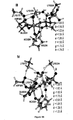
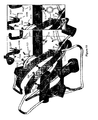
- the active-site fragment model, FM20 as shown in Figure 2 was large enough to contain all the residues and water molecules immediately interacting with the reaction centre and the co-ordinated Mg atom in the active site, and to allow definition of their roles in the different reaction steps, including the key gas (CO 2 or O 2 ) addition steps.
- the structures of the reaction species and the reaction energy pathway for the carboxylation and subsequent reaction steps are shown in Figures 3 and 4 , respectively.
- the calculations (QM/QM and QM/MM) were performed at several stages using the ONIOM module in GAUSSIAN 03.
- the ONIOM QM/QM calculations used a model of a high-level ab initio QM core layer of 93 atoms.
- the QM core layer comprises the magnesium atom (Mg 2+ ), enediolate of RuBP (to compute the structure and energies of subsequent reaction species the corresponding RuBP-derived chemical species were used), GLU60, ASN123, LYS175, LYS177, carbamylated LYS201, ASP203, GLU204, HIS294 and LYS334.
- the core layer is surrounded by a further 711 atoms in the outer layer computed at the PM3 (semi-empirical QM) level, which comprises amino acid residues up to ⁇ 12 ⁇ from the magnesium atom.
- PM3 semi-empirical QM
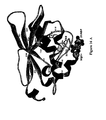
- the starting co-ordinates were taken from the X-ray structure of the spinach Rubisco-2CABP complex (pdb 8ruc). This model is illustrated in Figure 18 .
- the role of these calculations is to compare the effects of grafted residues in the vicinity of the active site with those of the wild type on the energetics and structures of the reaction-pathway species, mainly focussed on the gas-addition step.
- a complete statistical ensemble (conformational average) of enzyme states over the complete course of a reaction step may be generated from semi-empirical QM/MM MD simulations for a grid of points defined by the reaction co-ordinates (a free energy hypersurface).
- a more accurate free-energy surface may then generated at ab initio QM level by ONIOM QM/MM calculations using multiple configurations, for example up to 120, sampled from the points on the semi-empirical QM/MM reaction hypersurface (Gready et al., 2006; Cummins et al., 2007).
- These enzymic free energy surfaces provide reaction and activation free energies that may be compared directly with experimental data, such as experimentally measured kinetic constants, and also may be used to calculate differences in the reaction and activation free energies between wild type and mutants.
- the inventors were able to deduce a mechanism for the entire sequence of reactions in the carboxylase catalysis, and to define precise roles for the active-site residues, singly and in concert. From the QM fragment calculations, a pair of key amino acid residues were identified, one acting as a base and the other acting as an acid, for each reaction step. In particular, the pair HIS294 and LYS334 were identified for the gas-addition step.
- HIS294 acts as a base to remove a proton completely from the 03 atom; this transfers a partial negative charge to the C2 carbon and enables it to form a covalent bond with the carbon atom of CO 2 , and also transfers the negative charge to the nascent carboxylate group.
- LYS334 which is positively charged, helps in stabilizing this negative charge developing on the nascent carboxylate group.
- HIS294 and LYS334 are, thus, identified as "Target Residues", broadly defined to be residues predicted to have a significant effect on the reaction mechanism and energetics.
- HIS294 and LYS334 are in the C-terminal domain, are spatially separated, and affect different parts of the enediolate substrate or ⁇ -keto intermediate. Hence, the amino acids which may affect their properties have been classified into different regions; Region 2 for His294 and Region 3 for Lys334, as shown in Figure 19 .
- residue ASN123 was not included in the FM20 active-site fragment model for the QM calculations, examination of crystal structures and the preliminary QM/QM calculations suggested that it also is involved in stabilizing the charge on the nascent carboxylate group added at C2. Furthermore, examination of crystal structures showed residues E60 and Y20 are positioned to directly alter the charge on LYS334 (i.e. the charge/orientation of LYS334 can be altered by manipulating E60 and Y20), and the C2-carboxylate group of the intermediate, 2C3KABP. Thus, E60, Y20 and N123 were also identified as Target Residues.
- the method described herein also comprises the comparison of at least one second protein with at least the first protein.
- the second protein may originate from the same or a different phylogenetic branch as the first protein.
- the process of comparison entails the identification of at least one Variant amino acid Residue between the first protein and the second protein.
- a plurality of Variant Residues of the second protein act as a pool of different specific amino acid residue identities which may be "grafted" onto the first protein in an attempt to improve the functional property of the first protein mediated by the Target Residues.
- Rubisco phylogenetic branch-specific changes in the Rubisco amino acid sequence, such as changes in Rubiscos from phylogenetic groups of different evolutionary lineages or in Rubiscos which express environment-specific changes, represent possible partial optimizations of the Rubiscos' catalytic efficiency.
- a branch-specific physiological role may include folding and assembly of the protein, including interactions with the small subunit, or protein stability.
- First-shell residues i.e. those residues directly coordinating to the reaction centre (Glu60, Asnl23, Lys175, LYS177, KCX201, Asp203, Glu204, His294 and Lys334) are totally conserved among Rubiscos. This conservation is illustrated in Figure 5 , which shows an alignment of Rubisco LSU sequences from photosynthetic organisms belonging to thirteen different phyla covering red algae, cyanobacteria, glaucophyta and plants (10 phyla). Where more than one Rubisco sequence was available in a phylum, a 50% consensus sequence was used to represent that phylum.
- Red algae show the greatest specificity for CO 2 as identified by the CO 2 /O 2 ratio of ⁇ 160 compared with ⁇ 80 for green plants and ⁇ 40 for cyanobacteria.
- the sequence variation among flowering plants, red algae and cyanobacteria is more clearly illustrated in the alignment in Figure 6 which comprises only the 50% consensus sequences of Rubisco LSUs from red algae ( rhodophyta ; 9 species), cyanobacteria (11 species) and flowering plants ( magnoliophyta ; 134 species), already shown in Figure 5 .
- Figure 6 shows that there are 134 residues that are the same in flowering plants and cyanobacteria but different in red algae, i.e. the Variant Residues.
- the database accession numbers for each of the sequences used in the alignments in Figures 5 and 6 are given in Table 1, together with the SEQ ID NOS for the computer-readable sequence listings.
- Variant Residues may not contribute to the improved property of the Rubisco and consequently may not be part of the evolutionary solution for, in this example, increased CO 2 specificity, but rather are silent mutations or mutations relevant to other enzyme properties, such as the folding and assembly of the protein, or its stability, in the cell.
- the mechanistic insights obtained from the QM calculations were employed to select Candidate Residues from the plurality of Variant Residues.
- the selection process was based on assessing the spatial proximity of the Variant Residues to the Target Residues and estimating and ranking their ability to influence the electrostatics and orientation of the Target Residues.
- Selection may utilise visual screening of crystallographic structures using a molecular modelling and visualization program package such as Accelrys Discovery Studio v2.0 (Accelrys Software Inc., San Diego, CA, 2007), although other similar modelling packages could be used.
- Standard chemical concepts for intermolecular interactions such as charge-charge electrostatic pairing, typical van der Waals and hydrogen-bonding distances, and space-filling models for amino acid sidechains may be used in an initial scan of residues for selection.
- the procedure may also be systematized, for example, by mapping all the atom-to-atom electrostatic and hydrophobic interactions of each of the Variant Residues with all other amino acid residues that are within 3-5 ⁇ in distance and excluding those interactions which are equivalent in the sequences of the first and second protein.
- Variant Residues After screening the Variant Residues for differences in interaction patterns between the sequences of the first and second protein, only those Variant Residues which had the potential to affect an identified Target Residue through changed interaction patterns were retained.
- the potential of a Variant Residue to affect a Target Residue was recognized by the interaction of a Variant Residue with the Target Residue or with amino acid residues adjacent to Target Residues or with amino acid residues in the secondary structural unit harbouring the Target Residue.
- the above-described scheme for the selection of a Candidate Residue relies on a selection criterion that the Candidate Residue is present in a consensus sequence of a second protein exhibiting an improved or desirable property, while being different from the corresponding residue in a plurality of consensus sequences of first proteins not exhibiting the improved or desirable property, and where the consensus sequences of the first proteins share the same residue.
- the Candidate Residue will be a residue which is present in the red algae consensus sequence, and which is different from the residue common to both the consensus sequences of flowering plants and cyanobacteria.
- the residue is termed an Alternative Candidate Residue (ACR).
- ACR represents an alternative to the consensus residue at a Candidate Residue position.
- an ACR must still satisfy the selection criteria related to influencing a relevant Target Residue.
- a purpose for introducing ACRs may be to provide residues for grafting which are suspected to be associated with a greater improvement of the desirable property than the majority residue of the consensus sequence of the second protein.
- the Alternative Candidate Residue will be a residue which is expressed by at least one of the red algae which contribute to the red algae consensus sequence but which is not the majority residue which is contained in the consensus sequence, and which is different to the residue common to both the consensus sequences of green plants and cyanobacteria
- the red algal species Griffithsia monolis has a higher catalytic rate compared with other red algal species while maintaining the high specificity typical of red algae (Whitney et al., 2001), and hence the Griffithsia monolis sequence may be used as a source of ACRs.
- the variation of the Rubisco N-terminal domain sequence between G is the red algal species which contribute to the red algae consensus sequence but which is not the majority residue which is contained in the consensus sequence, and which is different to the residue common to both the consensus sequences of green plants and cyanobacteria
- the red algal species Griffithsia monolis has a higher catalytic rate compared with other red algal species while maintaining the high specificity typical
- a Co-variant Residue may be identified in the sequence of a second protein from a particular species, as being in the vicinity of an Alternative Candidate Residue (ACR) and showing complementary variation to the ACR.
- This variation at the position of the CvR, which is not present in the consensus sequence for the second protein, may be suspected to reflect complementary changes in the structural and/or electrostatic properties of the ACR and CvR. These complementary changes may constitute a partial evolutionary solution.
- Identification of CvRs provides a means to identify auxiliary residue positions which may be mutated in the first protein to better accommodate changes made from transplanting ACRs.
- Yet another partial evolutionary solution may also be expressed in residues found in the pool of Variant Residues where residues from at least three phylogenetic branches are examined and the selected residue is predicted to influence at least one Target Residue and is found in the consensus sequence of the second protein from one branch while being different from the residues present in the consensus sequences of at least two other branches, and where the consensus sequences of the first proteins are also different at the same position.
- a residue is termed a Divergent Candidate Residue (DCR).
- DCR Divergent Candidate Residue
- a DCR must still satisfy the selection criteria related to influencing a relevant Target Residue.
- a purpose for introducing a DCR may be to provide residues for grafting which are suspected of being associated with the improved or desirable property, but which may also be expected to produce a greater variation of the expressed properties when substituted into different first (host) proteins from the at least two phylogenetic branches than would be expected if the substitution was with a Candidate Residue.
- the Divergent Candidate Residue may be a residue which is expressed in the red algae consensus sequence, but which is different from the residue expressed in the consensus sequences of flowering plants and in the consensus sequence of cyanobacteria, while at the same time residues of the flowering plant and cyanobacteria consensus sequences also differ at this position.
- Six Divergent Candidate Residues identified as able to influence the Target Residues in Region 1 are identified by grey shading in the alignment in Figure 7 , and are shown graphically in Figure 13 .
- Table 2 shows the variation in residue between flowering plants and cyanobacteria at these six positions. Table 2.
- a given CR, ACR or DCR may contribute to changes in more than one contiguous interaction region affecting a Target Residue.
- These grouped CRs, ACRs, DCRs or combinations thereof may contribute to a proposed Candidate Mutant enzyme where each grouped CRs, ACRs, DCRs or combination thereof is "grafted" onto the host, replacing the corresponding residues in the sequence of the first (host) protein.
- Candidate Mutants groups of one or more CRs and/or ACRs and/or DCRs
- the Candidate Mutants can be further combined to form a single combined Candidate Mutant.
- Extended phylogenetic grafting predictions may be used to exploit the capacity of the phylogenetic grafting procedure to "learn from experience” through interpretation of the results (successes and failures) from cycles of application of the core method of prediction and testing of Candidate Mutants for proteins of interest described above. While the core method described above focusses on recognizing Candidate Residues, Alternative Candidate Residues and Divergent Candidate Residues and grouping them into Candidate Mutants based on networks of interactions of these residues, the initial results for Rubisco detailed in Example 3 showed that a proportion of these Candidate Mutants were ineffective or even slightly deleterious to the Rubisco function, although not greatly.
- the extended phylogenetic grafting strategy allowed this accumulated knowledge, both successes and failures, to be re-interpreted and built into a method further customized for the particular protein application, and that may continue to be refined as additional results are obtained.
- the interaction between the extended phylogenetic grafting technology and the core method described above is shown in Flowcharts 1 to 3.
- Region 1 mutants of Rubisco re-interpretation of the initial results for Region 1 mutants of Rubisco within this framework allowed identification of spatially contiguous volumes of protein structure, called Sub-regions, containing a subset of the Region's CRs (including initially identified ACRs and DCRs), and, which could be predicted to preferentially influence the properties of a particular Target Residue or Target Residues linked to the Region. Identification of these subsets of the Region's CRs, ACRs and DCRs provides a means by which they may be preferentially grouped to form Candidate Mutants.
- identification of Sub-regions with imprecise and overlapping boundaries provides a basis for identifying additional CRs, ACRs, CvRs and DCRs which are predicted to interact with the core subsets of CRs, ACRs and DCRs and which may be recruited to the core subsets to provide additional residues for grouping into Candidate Mutants.
- Sub-regions as hotspots of natural sequence variation provides the means to identify and exploit other types of sequence diversity data, such as Species-specific Variant Residues (SsVRs) which vary among closely related species, and which may represent partial evolutionary solutions, such as for adaptation to particular environments such as hot/dry or cold/wet.
- SsVRs Species-specific Variant Residues
- Figure 14 illustrates the natural sequence variation among two red algal species and five flowering plant species.
- the development of the extended phylogenetic grafting method provides a means to improve the functional properties of "lead” mutants.
- the development of the concept of Sub-regions as evolutionary hotspots and as a framework for building a database of protein sequence mapped to experimental data from test of predictions also positions the phylogenetic grafting technology to better exploit sequence-diversity data.
- the aforementioned database may be interrogated against sequence-diversity data to identify residues which may be recruited as species-specific variant residues (SsVRs) for possible inclusion in Candidate Mutants.
- SsVRs species-specific variant residues
- sequence data and, in some cases, kinetic data are available for photosynthetic organisms growing under varied or atypical environments, including for related C3 plant species such as those found in the Balearic Islands with different tolerances to drought and temperature (Galmés et al., 2005), the drought-adapted southern African Marama bean (Parry et al., 2007), and extremophilic Cyanidiales red algae (Ciniglia et al., 2004).
- the aforementioned database may be used to identify natural species with improved functional properties that may be used as germplasm in selective breeding.
- Proteins with at least one Candidate Residue and/or Alternative Residue and/or Divergent Candidate Residue, and optionally including other substitutions of CvRs and/or SsVRs, from the second protein may be modelled in silico, or may be engineered in vitro and/or in vivo, for example by site directed mutagenesis of a polynucleotide encoding the protein and then expressed in an expression system.
- Candidate Mutant proteins comprising the combination of Target Residues with one or more Candidate Residues and/or Alternative Candidate Residues and/or Divergent Candidate Residues, and optionally including other substitutions of Co-variant Residues (CvRs) and/or Species-specific Variant Residues (SsVRs) are thereafter screened to identify those Candidate Mutant proteins having said improved functional property.
- CvRs Co-variant Residues
- SsVRs Species-specific Variant Residues
- the process of screening the Candidate Mutant proteins may use any one or more of several techniques and may comprise catalytic assessment, biochemical assessment, and physiological assessment.
- the proteins of the invention may be modified by directed evolution. Accordingly, the function of a protein produced by the methods of the invention may be improved or otherwise modified.
- directed evolution may involve mutagenizing one or more parental molecular templates and identifying any desirable molecules among the progeny molecules. Progeny molecules may then be screened for the desired property, by assessing, for example, the activity of the molecule, the stability of the molecule, and/or frequency of mutation in the molecule. Progeny molecules with desirable properties may then be selected and further rounds of mutagenesis and screening performed.
- Methods by which directed evolution may be performed are well known in the art. Exemplary methods include, among others, rational directed evolution methods described in U.S. application Serial No. 10/022,249 ; and U.S. Published Application No.
- mutant proteins produced by the methods of the invention may be used as a "starting point" for directed evolution.
- a Rubisco protein Candidate Mutant proteins found to have improved enzymatic activity may be selected and further optimised by directed evolution. This optimisation may facilitate, for example, the relief of steric conflicts by recruitment of SvRs and other naturally occurring variant residues which may be identified as complementary to mutations in the Candidate Mutant proteins.
- Candidate Mutant proteins with improved enzymatic activity may thus serve as a novel starting point for directed evolution as they have different potential for exploring sequence space compared with wild type Rubisco protein.
- Systems suitable for directed evolution of Rubisco include, but are not limited to those which employ E. coli strain MMI as recently been reported (Mueller-Cajar et al., 2007).
- the proteins generated in accordance with the invention include functional equivalents, variants, active fragments and fusion proteins.
- functional equivalents of the active fragments and fusion proteins include functional equivalents of the active fragments and fusion proteins; active fragments of the functional equivalents and fusion proteins; and fusion proteins comprising a functional equivalent or active fragment.
- fragment refers to a nucleic acid or polypeptide sequence that encodes a constituent or is a constituent of full-length protein.
- the fragment possesses qualitative biological activity in common with the full-length protein.
- a biologically active fragment of use in accordance with the present invention may typically possess at least about 50% of the activity of the corresponding full-length protein, more typically at least about 60% of such activity, more typically at least about 70% of such activity, more typically at least about 80% of such activity, more typically at least about 90% of such activity, and more typically at least about 95% of such activity.
- sequence identity is calculated on the basis of amino acid identity (sometimes referred to as "hard homology”). Sequence identity is calculated after aligning the sequences.
- the inventors have used the ClustalW (Thompson et al., 1994) program provided within the BioEdit Sequence Alignment Editor (Hall, 1999) to align the sequences. There are several free-to-use and proprietary software packages available that perform sequence alignments and yield effectively the same results.
- the identification of Variant Residues may also be performed by collecting Rubisco sequences, using, for example, BLAST searches from one or more phylogenetic groups that differ in the kinetic property selected for improvement, and aligning them against said first sequence, using, for example, CLUSTALW.
- the functional equivalents, active fragments and fusion proteins of the invention retain the ability of the protein (SEQ ID NO: 23 for Synechococcus sp. PCC7942 and SEQ ID NO: 72 for tobacco) to act as a Rubisco enzyme with improved efficiency.
- the protein SEQ ID NO: 23 for Synechococcus sp. PCC7942 and SEQ ID NO: 72 for tobacco
- Functionally-equivalent proteins according to the invention are, therefore, intended to include mutants (such as mutants containing amino acid substitutions, insertions or deletions).
- mutants may include proteins in which one or more of the amino acid residues are substituted with a conservative or non-conservative amino acid residue and such substituted amino acid residue(s) may or may not be one encoded by the genetic code.
- proteins in which several, i.e. 30 and 50, between 20 and 30, between 15 and 20, between 10 and 15, between 5 and 10, 1 and 5, 1 and 3, 1 and 2 or just 1 amino acids are substituted, deleted or added in any combination.
- "Mutant" proteins also include proteins in which one or more of the amino acid residues include a substituent group.
- fragments may be "free-standing", i.e. not part of or fused to other amino acids or proteins, or they may be comprised within a larger protein of which they form a part or region.
- the fragment of the invention in one embodiment forms a single continuous region. Additionally, several fragments may be comprised within a single larger protein.
- a fusion protein comprising a protein of the invention fused to a peptide or other protein, such as a label, which may be, for instance, bioactive, radioactive, enzymatic or fluorescent, or an antibody.
- polyethylene glycol a compound to increase the half-life of the protein (for example, polyethylene glycol).
- the protein generated in accordance with the invention is an enzyme.
- the function may be the catalysis of at least one chemical reaction.
- the function may be structural (e.g. serving as a cytoskeletal protein).
- the function may involve the active or passive transport of a substance within the cell or between the cell interior and exterior, or between different compartments within the cell, or between different regions of the organism, for example where the protein is involved in a channel or a membrane pore, or the protein is involved in trafficking of materials to specific cellular compartments or the protein acts as a chaperone or a transporter.
- the function may be involved with ligand/receptor interactions, for example where the protein is a growth factor, a cytokine, a neurotransmitter or an intracellular or extracellular ligand, or the protein is a receptor for the growth factor, cytokine, neurotransmitter or the intracellular or extracellular ligand.
- the enzyme may be involved in catabolism or metabolism.
- the enzyme may be involved in the synthesis of at least one product.
- the enzyme may be involved in the breakdown of at least one substrate.
- the enzyme may be involved in the chemical modification of at least one substrate, for example the addition or deletion of one or more phosphate groups from a molecule.
- the enzymes may suitable for use in, for example, degradation of pesticides, and detergent residues, for mineral extraction, or for "bulk” or fine chemical processes, such as amylases.
- the enzymes may also be suitable for use in medical applications, and in particular may be used for minimizing changes to biological and physicochemical stability.
- the enzymes may have specifically engineered properties, for example, the ability to perform optimally in a desired temperature range, a narrower, wider or altered substrate specificity, or the ability to prevent the production and/or release of toxic or potentially toxic byproducts.
- the enzyme may be re-designed such that it is an efficient catalyst for a minor reaction of the wildtype enzyme using either its natural substrate or an alternative substrate to produce a different product.
- the first step of the purification method involves fusing into a first vector the coding sequence for a H 6 tagged ubiquitin (Ub) sequence (H 6 Ub) to the 5' end of an rbcSS gene.
- a host is then co-transformed with the first vector and second vector coding for the the native (or mutated) large subunit and small subunit of the Rubisco protein, and expression of the Rubisco protein and vectors is then induced, producing all three Rubisco subunit peptides (i.e. LSU, SSU and H 6 UbSSU).
- Some are assembled into functional Rubisco hexadecamers made up of 8xLSU octameric cores and different ratios of SSU (at most 8) and H 6 UbSSU.
- the Rubisco protein is purified based on the expression of the H 6 tag fused to the Rubisco small subunit. This purification may be performed, for example, using chromatography techniques such as metal affinity chromatography.
- the Ub fragments may then removed from the Rubisco using, for example, a Ub-specific protease.
- This fragment complex model comprises fragments of most of the active-site amino acid residues that have either been established or mooted to have a key role in the series of reactions that are catalyzed at the Rubisco active site. It contains all residues directly co-ordinated to Mg 2+ or interacting with the reactive centre of the substrate.
- This fragment complex model was built from the coordinates of the crystal structure with PDB code 8ruc (crystal structure of the complex of activated Rubisco with Mg 2+ and 2-carboxyarabinitol 1, 5-bisphosphate (2CABP)).
- the fragment complex model of Rubisco with 2-carboxy-3-ketorarabinitol 1,5-bisphosphate (2C3KABP), a structural analogue of 2CABP and the actual reaction intermediate produced during the Rubisco carboxylase activity was built from the crystallographic coordinates.
- the 77-atom fragment model named FM20, comprises molecular-fragment species to represent the LYS175, LYS177, ASP203, GLU204, KCX201 (carbamylated LYS201), HIS294, and LYS334 amino acid residues and the 4-carbon fragment of the enediolate form of the substrate RuBP, plus the water and carbon dioxide molecules.
- Figure 1 shows a schematic of the proposed carboxylase reaction mechanism based on the QM calculations.
- the curved arrows indicate the flow of electrons, signifying the bond-formation and bond-breaking events, which lead to the successive reaction species.
- the schematic defines the participation of amino acid residues in each reaction step, and the gas-addition step (carboxylation), in particular.
- the residues predicted to have a role in the gas-addition step comprise the set of Target Residues defined previously.
- Figures 3 and 4 provide geometries and relative energies, respectively, of the carboxylase reaction species.
- H 2 O[Mg] is not displaced from Mg-coordination by CO 2 during carboxylation.
- the water molecule in fact assists in binding CO 2 to the active site and contributes to the stability of the carboxylated product and the corresponding TS.
- the same water molecule acts as the water of hydration in the later step. Previously this role of hydration had been assigned to a water molecule found in the vicinity of the coordination sphere.
- the inventors have made the further surprising discovery that the 02 atom remains unprotonated in the enediolate intermediate, despite expectations from general chemical principles that it would need to be deprotonated in order to direct carboxylation exclusively to C2, rather than to C3.
- ESP-derived atomic charges also show that 03 is more negative than 02.
- this unexpected result is explained by the observation of strong hydrogen bonds between LYS175 and protonated KCX201 with 02, which effectively prevent 02 from directing carboxylation to C3.
- LYS334 is H-bonded to the P1-phosphate group in the enzyme, its interaction with the substrate CO 2 would be disrupted if C3 carboxylation were to take place, leaving no scope for stabilization of the corresponding TS and intermediate.
- KCX201 has a direct role only in the initial enolization reaction and it remains in a protonated state after enolization.
- KCX201 and LYS 175 have a role in hindering C3-carboxylation by partially neutralizing the negative charge on 02.
- HIS294 has a significant role in the multi-step catalysis of Rubisco. It shuttles the proton between N ⁇ and 03, modulating the C3-O3 bond length appropriately.
- GLU204 activates the Mg-coordinated water molecule for hydration by abstracting its proton. Thus, both carboxylation and hydration take place on the same face of the enediolate intermediate.
- the H3 proton is eventually transferred to 02 only after the formation of the aci -acid intermediate (VII).
- the charge on the aci -acid intermediate is stabilized by LYS175 and LYS334.
- LYS175 ensures stereospecific protonation of the C2-carbon to yield the final products.
- LYS334 shares its proton with LYS175.
- HIS294 acts as a base by abstracting the proton from 03
- LYS334 is the acid donating a proton to stabilize the carboxylate group formed by addition of CO 2 .
- Residues TYR20 GLU60, ASN123 were also identified as being crucial for appropriate orientation of gas molecules relative to the substrate prior to addition, and for the stability of the gas-adduct and the corresponding transition state structures. These five residues comprise an initial group of Target Residues for further examination.
- Rubisco LSU sequences from available phyla of photosynthetic organisms were collected for phylogenetic analysis from publicly available databases at NCBI ( www.ncbi.nlm.nih.gov/ ) and JGI ( http://img.jgi.doe.gov/cgi-bin/pub/main.cgi ) by performing protein BLAST searches (Altschul et al. , 1997) using the spinach Rubisco LSU sequence as the query sequence.
- LSU sequences are so distinctive, and the conservation relatively high compared with most protein-homologue classes over such wide evolutionary distances, they are easy to identify and other free-to-use or proprietary search software would work equally well.
- Figure 5 shows how diverse the Rubisco LSU sequences from distant phylogenies can be.
- Variant Residues As there is a general agreement that single-residue changes will not result in substantial improvement in Rubisco specificity (otherwise evolution would have been able to explore sequence space reasonably easily to optimize specificity in given organisms), the number of multiple mutations, for example of 2-10 residues, which would need to be tested to explore even the reduced sequence space of these 134 residues to identify the specificity-determining residues is impossibly large. In making use of this list of Variant Residues, variations that are not relevant to the enzyme property of interest are filtered (i.e. specificity).
- the selection procedure was applied to identify such Candidate Residues, Alternative Candidate Residues and Divergent Candidate Residues. Selection was carried out by visual analysis and comparison of differences in inter-residue interactions with Accelrys Discovery Studio v1.5.1 (Accelrys Software Inc., San Diego, CA, 2005), using the crystal structures of Rubiscos from spinach (PDB code: 8ruc) and Galdieria partita (PDB code: 1BWV). The crystal structure of spinach Rubisco was used instead of Rubisco from Synechococcus sp. PCC6301 (PDB code: 1RB1) because the resolution of the available structures is superior for the spinach Rubisco structure. However, the inventors accounted for residue changes between LSUs of spinach and Synechococcus sp. PCC6301 Rubiscos when analyzing the inter-residue interactions, and used the Synechococcus structure also for reference.
- Accelrys Discovery Studio v1.5.1 Accelrys Discovery
- Target Residues Three of the five Target Residues, TYR20, GLU60 and ASN123 are in the N-terminal domain of the Rubisco LSU, while HIS294 and LYS334 are in the C-terminal domain that forms the TIM-barrel structure ( Figure 8 ).
- the Target Residues were classified as belonging to three different Regions.
- Residues TYR20, GLU60 and ASN123 collectively interact with the carboxylate group of the intermediate formed after CO 2 addition ( Figures 8 , 9 and 15 ).
- LYS334 is in the vicinity of HIS294 and Region 1 residues, it is in 'loop 6' of the LSU ( Figure 8 ) and in the open form of the LSU it is separated from the other Target Residues; hence, the region containing LYS334 is classified as Region 3.
- the initial analysis and Candidate Mutant design is illustrated by consideration of the Variant Residues in Region 1.
- the N-terminal domain of the LSU of Rubisco is a compact domain ( Figures 9 and 15 )
- protein-structural considerations suggest that amino acid residue variations in most of the domain can influence the Target Residues TYR20, GLU60 and ASN123.
- the selection procedure was started by mapping all the electrostatic and hydrophobic interactions between each of the Variant Residues and all other residues in the LSU in both the crystal structures. Variant Residues that have equivalent interactions in both the crystal structures were ignored.
- Target Residue GLU60 is at the C-terminal end of helix ⁇ B and the Variant Residue ILE51, at the N-terminal end of this helix, interacts with another Variant Residue TRP25 in the Galdieria partita LSU (see Figure 14 and Table 2), but this interaction is absent in the spinach and Synechococcus sp. PCC6301 LSUs.
- Such grouped Candidate Residues represent mutations for replacement of residues (grafting) from the sequence of Galdieria partita onto the Synechococcus sp. PCC6301 sequence, with the view to transferring features of higher specificity into Synechococcus sp. PCC6301 Rubisco.
- the groups of Candidate Residues can be further combined into groups that can act further in coordinating and amplifying the perturbative effect on a given Target Residue or Target Residues.
- Such extended grouping is useful if two different groups of Candidate Residues affect the same secondary structural unit.
- both of the Candidate-Residue groups ⁇ 25, 51 ⁇ and ⁇ 54, 84, 87 ⁇ affect helix ⁇ B, which harbours GLU60, through two different interactions.
- one of the predicted mutants comprised these combined groups (Shown as Mutant #7a in Table 3).
- Candidate Mutants were further assessed to check for new unfavourable steric interactions introduced by grafting residues from Galdieria partita into Synechococcus sp. PCC6301. Such undesirable steric interactions may be rectified by adding spatially complementing mutations to the Candidate Mutant, or could be investigated by MD simulations to assess whether structural relaxation to relieve such bad contacts is energetically accessible.
- the final step in the Candidate-Mutant prediction procedure is to rank the potential grafted mutants to develop a ranked list for use in prioritising experimental testing or detailed computational in silico pre-screening.
- the ranking reflects the expected degree to which the combined mutations in the individual Candidate Mutants is expected to change the functional property, in this example in the direction towards improvement of specificity by influencing the chemistry, and relative chemistry, of the gas-addition steps for CO 2 and O 2 .
- Ranking depends on a number of parameters such as the Target Residue affected by the Candidate-Residue group, the strength of the changed interactions of the Candidate-Residue group within the Target-Residue Region, and the number of such interactions for each Candidate-Residue group.
- Table 3 shows that two Divergent Candidate Residues (36, 116 and 140; see Table 2) were selected in this initial analysis for the reasons summarized for the relevant Candidate Mutants (#9 and #10). Two of these DCRs (36 and 140) also show differences between G. partita and G. monolis (see Table 2); for Candidate Mutants #9 and #10, the Gm variant of 36 and the Gp variant of 140 were judged to be the most promising for transplant into Synechococcus. Table 3. Predicted and Ranked Candidate Mutants from Analysis of Region 1 in the N-terminal Domain of the Rubisco LSU surrounding Target Residues TYR20, GLU60 and ASN123.
- the swapped methyl group is spatially close to Y20 and adjacent to E60.
- 3 - P49D/ D51I 10 Alters the interaction in the short loop connecting ⁇ B and ⁇ B. 4 9, 10 T23G/K81R 4 Interaction between ⁇ A and ⁇ C is broken. Affects the positioning of Y20.
- 5a 10 G54A Gp / C84A/ I87V 5 Introduces a strong hydrophobic interaction between ⁇ B and ⁇ C.
- 5b 10 G54S Gm / C84A/ I87V 5 Introduces a strong hydrophobic interaction between ⁇ B and ⁇ C.
- Mutant #1a adds a hydrophobic interaction between ⁇ A and ⁇ B, while Mutant #4 breaks the interaction of ⁇ A with ⁇ C. These two sets of mutations together may have a large effect on Y20.
- 6b 9 T23G/ Y25W/ D51V Gm / K81R 1
- Mutant #1b adds a hydrophobic interaction between ⁇ A and ⁇ B, while Mutant #4 breaks the interaction of ⁇ A with ⁇ C. These two sets of mutations together may have a large effect on Y20.
- the extended phylogenetic grafting method provides a means to utilise effectively knowledge of the "map" of function to mutations, developed from experience gained from cycles of application of the core method of prediction and testing of Candidate Mutants.
- Use of the extended method is illustrated in this example with reference to the initial results for predicted Region 1 Candidate Mutants (Example 3) given in Table 5 and discussed in more detail in Example 7.
- the extended method was first used to interpret the core-method results. This resulted in identification of a new model for grouping of already identified CRs, ACRs and DCRs (see CMs in Table 3), which was based on Sub-regions as mutatable hotspots rather than focussed on networks of interactions as in the core method.
- the three Sub-regions (1A, 1B and 1C) exhibited the property of being predicted to preferentially influence the properties of one of the three Target Residues linked to Region 1: Sub-region 1A to TYR20, 1B to ASN123 and 1C to GLU60. This "anchoring" of the three TRs to the Sub-regions of Region 1 is shown graphically in Figures 15 .
- the Sub-regions are shown graphically in an alternative orientation in Figure 17 .
- the Sub-regions are confined entirely to the N-terminal domain, except for fragments of the C-terminal domain of the adjacent LSU which form part of Sub-region 1B.
- residue 19 forms a salt bridge with residue 21 (K or R) in cyanobacteria and plants, which is absent in red algae where residue 19 is P. It is expected that the mutation D19P will influence the reach of TR TYR20 into the active site, and that in combination with the Mutant #4 mutations, this would produce an increased impact on TR TYR20.
- the second example below relates to the identification of a major new mutational area (subregion 1B) which in turn led to the initial prediction of Mutant #20-1B (V116L/L117T/V121I/I138M/F140L).
- This mutant has Mutant #8 (V121I/M297G/V300T), identified by the core method (Table 3), as a component.
- initial testing of Mutant #8 showed improvement in specificity (5.6%) which providing a basis for further characterisation.
- examination of residue variations near residue 121 led to the discovery of a network of interactions between helix C and ⁇ -sheet E.
- This network may be seen more clearly in Figure 16B . Changes in this interaction network can affect the orientation of TR N123. The interactions involve residues 116, 117, 120, 121, 124, 133, 135, 138 and 140. Of these, residue 121 is a CR and residues 120, 124, 133 and 135 are conserved in all major groups of organisms (see Figure 5 ). Residues 116, 117, 138 and 140 are DCRs, i.e. differ among the three major organism groups, red algae, cyanobacteria and flowering plants (Table 2). It was observed that changes in the CR and DCRs interacting in this spatial region (i.e.
- PCC7942 rb cLS gene with the QuickChange multi-mutagenesis kit (Stratagene) using appropriate primers.
- mutants with single (#22-1A, #23-1A, #25, #26-1B) or double (#24) mutations which are components of predicted mutants (#4, #8, #21-1A,B), were engineered as controls.
- the genomic sequence for the rbc L- rbc S sequence (operon) of 'wildtype' Synechococcus sp. PCC7942 is shown in SEQ ID No. 22. This sequence is the same as for Synechococcus sp. PCC6301.
- the rbcLS coding sequence reads ATG CCC (coding Met then Pro) but in all the cloned rb cLS sequences it is ATG GCC (coding Met then Ala). This nucleotide substitution was introduced to code for a unique restriction site ( Nco I) used for cloning of the gene.
- This system involved the construction of a unique (pACYC-based) plasmid vector that incorporates fusing in frame the coding sequence for a H 6 -tagged ubiquitin (Ub) sequence (H 6 Ub) to the 5' end of rbcSS.
- the wild-type rbc LS in plasmid pTrcSynLS (that contains the PCC7942 rbc L -rbc S operon; Emlyn-Jones et al. , 2006) was replaced with the mutated rb cLS ( rbc LS*) and then co-transformed into E.
- Rubisco proteins purified using the method described in Example 6 were used to measure the Michaelis constants for CO 2 ( K c ) and substrate saturated carboxylation rates ( V c max ) using 14 CO 2 -fixation assays at 25°C, pH 8 according to the method described in Andrews (1988), the entire contents of which is incorporated herein by reference.
- the purified enzyme was pre-incubated at 25°C for 30 min in buffer containing 20 mM MgCl 2 and 25 mM NaHCO 3 , and K c measurements were performed in nitrogen sparged septum capped scintillation vials.
- the reactions were initiated by adding 10 ⁇ L of purified enzyme to 0.5 mL of N 2 -equilibrated assay buffer (100 mM EPPS-NaOH, 20 mM MgCl 2 , 0.8 mM ribulose-P 2 , 0.1 mg/ml carbonic anhydrase) containing varying concentrations of NaH 14 CO 3 .
- the Michaelis constants were determined by fitting the data to the Michaelis-Menten equation. Quantification of Rubisco content in the assays was measured using the [2- 14 C] carboxyarabinitol-P 2 ( 14 2CABP) binding assay described by Ruuska et al. (1998) and Whitney and Andrews (2001). The substrate saturated carboxylation turnover rate ( k c cat ) was calculated by dividing the extrapolated maximal carboxylase activity ( V c max ) by the concentration of Rubisco active sites in the assay. The purified Rubisco preparations were also used to measure the CO 2 /O 2 specificity (S c/o ) at pH 8.3 as described in Kane et al. (1994).
- n.m. n.m. #7d (Y25W, D51V Gm , G54A Gp , C84A, I87V) 41,42 (0.9%) n.m. n.m. n.m. #8 (V 121I, M297G, V300T) 43,44 (5.6%) n.m. n.m. n.m. #9 (L361, I116L, F140L) 45,46 (3.6%) n.m. n.m. n.m.m.
- #18-1A (T23G, K81R, P104E) 55,56 (-0.5%) n.m. n.m. n.m. #19-1A (T23G, D19P, K81R) 57,58 (-2.0%) n.m. n.m. n.m. #21-1A,B (T23G, K81R, V121I, M297G, V300T) 59,60 (-0.9%) n.m. n.m. n.m. #22-1A (T23G) 61,62 (5.0%) n.m. n.m. n.m. #23-1A (K81R) 63,64 (7.0%) n.m. n.m. n.m.
- mutants and two single (control) mutants for which specificity measurements were made all showed specificity comparable with wild type, i.e. none was significantly impaired, while five mutants and the two controls showed improvements of 5% or better.
- four of these include the mutations T23G and/or K81R.
- mutants with ACR variants #1a and #1b for position 51, #5a and #5b for position 54, and #7a, #7b and #7d for positions 51 and 54
- mutants with ACR variants #1a and #1b for position 51, #5a and #5b for position 54, and #7a, #7b and #7d for positions 51 and 54
- mutants with ACR variants #1a and #1b for position 51, #5a and #5b for position 54, and #7a, #7b and #7d for positions 51 and 54
- mutants with ACR variants #1a and #1b for position 51, #5a and #5b for position 54, and #7a, #7b and #7d
- the phylogenetic grafted mutants represent one "directed" strategy for exploring regions of sequence space not sampled naturally. However any increase in the activity of these mutants may be impaired due to some areas of "poor sequence fits", as they may not be optimized for the host Rubisco structure.
- the extended phylogenetic grafting method provides a rational in silico strategy which may be used for optimising "lead” mutants, including relieving steric conflicts by recruitment of SvRs and other naturally occurring variant residues which may be identified as complementary to mutations in the "leads", an alternative option to minimize the effects of these conflicts may be to use an experimental directed evolution method to optimize them, i.e. to use these partially optimized Rubiscos as starting points.
- These mutants also provide in themselves a novel starting point for directed evolution as they have different potential for exploring sequence space compared with wild type.
- Rubisco from Synechococcus PCC7942 can assemble correctly in E. coli and has been chosen for a mutant screening procedure.
- Candidate Mutant predictions (which may include groups of correlated mutations, and independent mutations in different structural regions surrounding the Target Residues) can be screened initially in E. coli to confirm they are active and to obtain in vitro kinetic constants for comparison against each other and wild type. Mutants with up to 10-12 mutations can be produced routinely using the current technology.
- selected single mutants can be made to test the general hypothesis underlying the phylogenetic grafting method that single mutants are likely to be poorly active/inactive, and that at least two correlated mutations are necessary to produce an acceptably active enzyme.
- Example 7 The in vitro functional tests in Example 7 identified several Synechococcus mutants with improved Rubisco activity, and which also, necessarily, were, thus, correctly folded and assembled when expressed from the E. coli expression system and purified as described in Example 6.
- Synechococcus has been used as the most convenient initial host for experimental test of mutant predictions to identify "lead” candidates.
- the Rubisco genes ( rbc LS and rbc SS) are coded by a single operon on the chromosome (of which there are typically 5 chromosome copies per cell) and, analogous to E. coli , this cyanobacterial strain is naturally competent and can be genetically transformed either by targeted modifications to its chromosome (e.g. gene deletion, gene substitution) by homologous recombination or by stable retainment of plasmid shuttle vectors within its cells.
- Synechococcus PCC7942 mutant strains have been developed (see Emlyn-Jones et al. , 2006 and Price et al. , 1993 for examples).
- a Synechococcus PCC7942 mutant strain in which the chromosomal rbc LS -rbc SS operon is deleted i.e. a 7942 ⁇ rbc LS strain
- Synechococcus sp. PCC7942 cannot grow heterotrophically (i.e.
- 7942 ⁇ rbc LS strains can be generated by: (1) introducing a second Rubisco gene (e.g. rbc M coding for the structurally different Form II Rubisco homodimer (L 2 ) from the bacterium Rhodospirillum rubrum or the native L 8 S 8 PCC7942 Rubisco) on a plasmid shuttle vector into Synechococcus sp. PCC7942 then (2) homologously recombining in an antibiotic resistance gene km R to replace the rbc LS- rbc SS operon in each chromosome copy (i.e. so the mutation can be fully segregated).
- a second Rubisco gene e.g. rbc M coding for the structurally different Form II Rubisco homodimer (L 2 ) from the bacterium Rhodospirillum rubrum or the native L 8 S 8 PCC7942 Rubisco
- Synechococcus PCC7942 cells transformed with rbc M expressed on a shuttle vector can be subsequently transformed with another plasmid to homologously replace the chromosomal rbc LS -rbc SS coding region with a km R gene.
- the PCC7942 ⁇ rbc LS cells may be used to homologously re-introduce the mutated rbc LS* and rbc SS genes and the cells cured of the shuttle vector.
- the phenotype of the transformed cells may then be comprehensively characterised biochemically, for example, assessing whether the mutated Rubisco LSU subunits are readily folded and assembled properly, and physiologically, for example, assessing whether there are differences in photosynthetic capacity, inorganic carbon partitioning or growth rate.
- a strategy for re-engineering Rubisco which is applicable to higher plant Rubiscos is by plastome transformation using mutated rbc L* genes.
- the plastome of tobacco is readily transformable (Andrews and Whitney, 2003) and was used as a model to conduct proof-of-principle tests for the transformation of other plants.
- the ⁇ aadA tobacco- rubrum lines permit re-use of the aad A marker gene for subsequently transforming its plastome, such as re-transforming back in mutated tobacco rbc L* variants to replace rbc M.
- the transformation efficiency of replacing rbc M in the ⁇ aadA tobacco- rubrum with variant rbc L* genes is 3 to 10-fold higher than transforming wild-type tobacco, and is immune to unwanted recombination events that may occur when transforming rbc L* genes into wild-type tobacco plastomes.
- the method allowed the production of transformants containing only rbc L*-transformed plastome copies (i.e.
- R. rubrum Rubisco is a small homodimer of LSUs (L 2 , ⁇ 100 kDa), rbc L*-transformed lines producing the larger form I L 8 S 8 Rubiscos ( ⁇ 520 kDa) may be identified by separating the soluble leaf protein by non-denaturing polyacrylamide gel electrophoresis as described in Whitney and Sharwood (2007) and homoplasmicity measured by the absence of L 2 Rubisco.
- Mutations for Mutants #4, #22-1A and #23-1A were made to the wild-type tobacco (Nicotiana tabacum) plastome rbc L coding sequence using the QuickChange multi-mutagenesis kit (Stratagene) using appropriate primers, and introduced into the tobacco plastome transforming plasmid pLEV1 where selection of transformants is facilitated by the incorporation of a promoter-less aad A gene downstream of rbc L (Whitney et al. , 1999).
- the sample was centrifuged (36,000 g, 5 min, 4°C) and the soluble protein incubated (activated) with NaHCO 3 and MgCl 2 (15 mM each) for 15 min and used to measure Rubisco content in duplicate aliquots incubated with 40 ⁇ M of 14 2-CABP and the amount of Rubisco-bound- 14 2-CABP recovered by gel filtration (Ruuska et al. , 1998), or used to measure K c and K c air at 25°C, pH 8.0 using 14 CO 2 fixation assays (Andrews 1988; Whitney and Sharwood, 2007). To confirm the samples used were homoplasmic (i.e.
- the kinetic assays were initiated by adding activated soluble protein extract into septum capped scintillation vials containing either N 2 (for K c ) or CO 2 -free air (for K c air ) equilibrated assay buffer (100mM Bicine-NaOH, 15 mM MgCl 2 , 0.6 mM ribulose-P 2 , 0.1 mg ⁇ ml -1 carbonic anhydrase) containing 0 to 90 ⁇ M 14 CO 2 .
- Ribulose-P 2 was synthesized according to (Kane et al. , 1998).
- Homoplasmic transplastomic lines and wild-type tobacco controls may be grown to maturity in soil in controlled environment growth chambers or glass houses and standard physiological tests then undertaken. These tests are done only for the most promising mutant Rubiscos showing improvements in the specificity and/or kinetics over wild type and include determination of photosynthetic capacity, growth rate and leaf biochemistry, including level of Rubisco expression, metabolite, carbon and nitrogen levels using established methodologies (Whitney et al. , 1999; Whitney and Andrews, 2001; Whitney et al. , 2001)
Landscapes
- Chemical & Material Sciences (AREA)
- Organic Chemistry (AREA)
- Life Sciences & Earth Sciences (AREA)
- Health & Medical Sciences (AREA)
- Genetics & Genomics (AREA)
- Biochemistry (AREA)
- General Health & Medical Sciences (AREA)
- Molecular Biology (AREA)
- Engineering & Computer Science (AREA)
- Medicinal Chemistry (AREA)
- Biophysics (AREA)
- Analytical Chemistry (AREA)
- Proteomics, Peptides & Aminoacids (AREA)
- Bioinformatics & Cheminformatics (AREA)
- Wood Science & Technology (AREA)
- Zoology (AREA)
- General Engineering & Computer Science (AREA)
- Biomedical Technology (AREA)
- Biotechnology (AREA)
- Microbiology (AREA)
- Physics & Mathematics (AREA)
- Gastroenterology & Hepatology (AREA)
- Bioinformatics & Computational Biology (AREA)
- Crystallography & Structural Chemistry (AREA)
- Botany (AREA)
- Plant Pathology (AREA)
- Peptides Or Proteins (AREA)
- Investigating Or Analysing Biological Materials (AREA)
- Enzymes And Modification Thereof (AREA)
- Micro-Organisms Or Cultivation Processes Thereof (AREA)
- Preparation Of Compounds By Using Micro-Organisms (AREA)
Priority Applications (1)
| Application Number | Priority Date | Filing Date | Title |
|---|---|---|---|
| PL13168432T PL2631241T3 (pl) | 2006-10-10 | 2007-10-10 | Sposób generowania białka i jego zastosowanie |
Applications Claiming Priority (3)
| Application Number | Priority Date | Filing Date | Title |
|---|---|---|---|
| AU2006905622A AU2006905622A0 (en) | 2006-10-10 | Process for generation of protein and uses thereof | |
| EP07815347.5A EP2079755B1 (fr) | 2006-10-10 | 2007-10-10 | Procédé pour la formation d'une protéine et utilisations de celle-ci |
| PCT/AU2007/001542 WO2008043147A1 (fr) | 2006-10-10 | 2007-10-10 | Procédé pour la formation d'une protéine et utilisations de celle-ci |
Related Parent Applications (3)
| Application Number | Title | Priority Date | Filing Date |
|---|---|---|---|
| EP07815347.5A Division-Into EP2079755B1 (fr) | 2006-10-10 | 2007-10-10 | Procédé pour la formation d'une protéine et utilisations de celle-ci |
| EP07815347.5A Division EP2079755B1 (fr) | 2006-10-10 | 2007-10-10 | Procédé pour la formation d'une protéine et utilisations de celle-ci |
| EP07815347.5 Division | 2007-10-10 |
Publications (3)
| Publication Number | Publication Date |
|---|---|
| EP2631241A2 true EP2631241A2 (fr) | 2013-08-28 |
| EP2631241A3 EP2631241A3 (fr) | 2014-04-09 |
| EP2631241B1 EP2631241B1 (fr) | 2018-09-12 |
Family
ID=39282352
Family Applications (2)
| Application Number | Title | Priority Date | Filing Date |
|---|---|---|---|
| EP13168432.6A Not-in-force EP2631241B1 (fr) | 2006-10-10 | 2007-10-10 | Procédé pour la formation d'une protéine et utilisations de celle-ci |
| EP07815347.5A Not-in-force EP2079755B1 (fr) | 2006-10-10 | 2007-10-10 | Procédé pour la formation d'une protéine et utilisations de celle-ci |
Family Applications After (1)
| Application Number | Title | Priority Date | Filing Date |
|---|---|---|---|
| EP07815347.5A Not-in-force EP2079755B1 (fr) | 2006-10-10 | 2007-10-10 | Procédé pour la formation d'une protéine et utilisations de celle-ci |
Country Status (11)
| Country | Link |
|---|---|
| US (2) | US9598688B2 (fr) |
| EP (2) | EP2631241B1 (fr) |
| CN (1) | CN101553499B (fr) |
| AR (1) | AR063239A1 (fr) |
| AU (1) | AU2007306926B2 (fr) |
| BR (2) | BRPI0717758B1 (fr) |
| CA (1) | CA2665766C (fr) |
| DK (1) | DK2631241T3 (fr) |
| ES (1) | ES2640747T3 (fr) |
| PL (1) | PL2631241T3 (fr) |
| WO (1) | WO2008043147A1 (fr) |
Families Citing this family (17)
| Publication number | Priority date | Publication date | Assignee | Title |
|---|---|---|---|---|
| JP2011500569A (ja) | 2007-10-12 | 2011-01-06 | マサチューセッツ インスティテュート オブ テクノロジー | ワクチンナノテクノロジー |
| JP4812900B1 (ja) * | 2010-03-24 | 2011-11-09 | パナソニック株式会社 | 相互作用力変化予測装置および相互作用力変化予測方法 |
| JP5790006B2 (ja) * | 2010-05-25 | 2015-10-07 | ソニー株式会社 | 情報処理装置、情報処理方法及びプログラム |
| CA2863213A1 (fr) * | 2012-02-14 | 2013-08-22 | Sapphire Energy, Inc. | Genes de rendement de biomasse |
| CN103882014A (zh) * | 2012-12-21 | 2014-06-25 | 中国科学院青岛生物能源与过程研究所 | 用于固定二氧化碳的构建体、菌株及其制备方法 |
| HUE060246T2 (hu) * | 2013-02-22 | 2023-02-28 | Dsm Ip Assets Bv | Rekombináns mikroorganizmus, fokozott termékhozamú eljárásban történõ alkalmazásra |
| CN105602982B (zh) * | 2016-02-03 | 2019-10-18 | 昆明藻能生物科技有限公司 | 一种高生长速率的隐甲藻突变株的构建方法 |
| WO2017173005A1 (fr) * | 2016-03-30 | 2017-10-05 | Sapphire Energy, Inc. | Protéines de grandes sous-unités de rubisco modifiées |
| US10239928B2 (en) * | 2016-05-20 | 2019-03-26 | Postech Academy-Industry Foundation | Method of highly expressing target protein from plant using RbcS fusion protein and method of preparing composition for oral administration of medical protein using target protein expression plant body |
| CN109312296B (zh) * | 2016-06-14 | 2023-05-05 | 帝斯曼知识产权资产管理有限公司 | 重组酵母细胞 |
| KR20240033101A (ko) * | 2019-05-02 | 2024-03-12 | 더 보드 오브 리젠츠 오브 더 유니버시티 오브 텍사스 시스템 | 합성 단백질 안정성을 증가시키기 위한 시스템 및 방법 |
| EP4063482A4 (fr) * | 2019-11-21 | 2022-12-21 | Panasonic Intellectual Property Management Co., Ltd. | Cyanobacterie modifiee, procede de production de cyanobacterie modifiee et procede de production de proteine |
| EP4326086A4 (fr) * | 2021-04-23 | 2025-03-26 | Plantible Foods, Inc. | Compositions d'isolat de protéine de ribulose-1,5-bisphosphate carboxylase-oxygénase (rubisco) pour produits de substitution à l'oeuf d'origine végétale et produits de substitution au lait d'origine végétale |
| WO2023039419A2 (fr) | 2021-09-08 | 2023-03-16 | Plantible Foods Inc. | Systèmes et procédés de mesure de la densité d'un tapis d'une biomasse aquatique |
| CN120712611A (zh) * | 2022-12-21 | 2025-09-26 | 新加坡科技研究局 | 基于机器学习的酶进化 |
| CN116486903B (zh) * | 2023-04-17 | 2023-12-29 | 深圳新锐基因科技有限公司 | 基于同源蛋白序列进化方向结合自由能变提高蛋白稳定性的方法及装置 |
| CN119864074B (zh) * | 2024-12-26 | 2025-09-23 | 中南大学 | 蛋白质结构预测的量子计算方法及系统 |
Citations (2)
| Publication number | Priority date | Publication date | Assignee | Title |
|---|---|---|---|---|
| US2224901A (en) | 1937-07-20 | 1940-12-17 | Radio Kelth Orpheum Corp | Camera dolly |
| US20040132977A1 (en) | 2002-09-09 | 2004-07-08 | Rene Gantier | Rational evolution of cytokines for higher stability, the cytokines and encoding nucleic acid molecules |
Family Cites Families (7)
| Publication number | Priority date | Publication date | Assignee | Title |
|---|---|---|---|---|
| BR9915191A (pt) * | 1998-11-10 | 2001-12-11 | Maxygen Inc | Métodos para obter um polinucleotìdeo isolado epara produzir uma célula recombinante,protoplasto de célula vegetal, coleção deprotoplastos de célula vegetal, vegetal,polinucleotìdeo, biblioteca, um ou mais membros debiblioteca e célula recombinante alvo |
| AU1720300A (en) * | 1998-11-10 | 2000-05-29 | Maxygen, Inc. | Modified phosphoenolpyruvate carboxylase for improvement and optimization of plant phenotypes |
| US20030073135A1 (en) * | 2001-10-12 | 2003-04-17 | Maxygen, Inc. | Methods for improving a photosynthetic carbon fixation enzyme |
| WO2003091420A2 (fr) * | 2002-04-26 | 2003-11-06 | Codexis, Inc. | Polypeptides de ribulose 1,5-bisphosphate carboxylase/oxygenase et polynucleotides associes |
| US20060075522A1 (en) * | 2004-07-31 | 2006-04-06 | Jaclyn Cleveland | Genes and uses for plant improvement |
| US7314975B2 (en) * | 2005-08-24 | 2008-01-01 | Pioneer Hi-Bred International, Inc. | Rubisco Activase with increased thermostability and methods of use thereof |
| US8129512B2 (en) * | 2007-04-12 | 2012-03-06 | Pioneer Hi-Bred International, Inc. | Methods of identifying and creating rubisco large subunit variants with improved rubisco activity, compositions and methods of use thereof |
-
2007
- 2007-10-10 AU AU2007306926A patent/AU2007306926B2/en not_active Ceased
- 2007-10-10 AR ARP070104488A patent/AR063239A1/es not_active Application Discontinuation
- 2007-10-10 CN CN2007800456116A patent/CN101553499B/zh not_active Expired - Fee Related
- 2007-10-10 PL PL13168432T patent/PL2631241T3/pl unknown
- 2007-10-10 CA CA2665766A patent/CA2665766C/fr not_active Expired - Fee Related
- 2007-10-10 WO PCT/AU2007/001542 patent/WO2008043147A1/fr not_active Ceased
- 2007-10-10 EP EP13168432.6A patent/EP2631241B1/fr not_active Not-in-force
- 2007-10-10 BR BRPI0717758-5A patent/BRPI0717758B1/pt not_active IP Right Cessation
- 2007-10-10 ES ES07815347.5T patent/ES2640747T3/es active Active
- 2007-10-10 EP EP07815347.5A patent/EP2079755B1/fr not_active Not-in-force
- 2007-10-10 BR BR122019026330-2A patent/BR122019026330B1/pt not_active IP Right Cessation
- 2007-10-10 DK DK13168432.6T patent/DK2631241T3/en active
-
2009
- 2009-04-10 US US12/422,190 patent/US9598688B2/en not_active Expired - Fee Related
-
2017
- 2017-02-03 US US15/424,513 patent/US10041058B2/en active Active
Patent Citations (2)
| Publication number | Priority date | Publication date | Assignee | Title |
|---|---|---|---|---|
| US2224901A (en) | 1937-07-20 | 1940-12-17 | Radio Kelth Orpheum Corp | Camera dolly |
| US20040132977A1 (en) | 2002-09-09 | 2004-07-08 | Rene Gantier | Rational evolution of cytokines for higher stability, the cytokines and encoding nucleic acid molecules |
Non-Patent Citations (38)
Also Published As
| Publication number | Publication date |
|---|---|
| AR063239A1 (es) | 2009-01-14 |
| US10041058B2 (en) | 2018-08-07 |
| DK2631241T3 (en) | 2018-12-17 |
| AU2007306926B2 (en) | 2013-05-09 |
| WO2008043147A1 (fr) | 2008-04-17 |
| CA2665766A1 (fr) | 2008-04-17 |
| ES2640747T3 (es) | 2017-11-06 |
| US20170152499A1 (en) | 2017-06-01 |
| EP2079755B1 (fr) | 2017-08-30 |
| CN101553499A (zh) | 2009-10-07 |
| EP2079755A4 (fr) | 2010-10-20 |
| AU2007306926A1 (en) | 2008-04-17 |
| US20090203532A1 (en) | 2009-08-13 |
| EP2631241B1 (fr) | 2018-09-12 |
| BRPI0717758A2 (pt) | 2013-11-12 |
| CN101553499B (zh) | 2013-10-16 |
| EP2079755A1 (fr) | 2009-07-22 |
| EP2631241A3 (fr) | 2014-04-09 |
| CA2665766C (fr) | 2016-11-22 |
| BR122019026330B1 (pt) | 2020-12-01 |
| BRPI0717758B1 (pt) | 2020-11-17 |
| PL2631241T3 (pl) | 2019-02-28 |
| US9598688B2 (en) | 2017-03-21 |
Similar Documents
| Publication | Publication Date | Title |
|---|---|---|
| EP2079755B1 (fr) | Procédé pour la formation d'une protéine et utilisations de celle-ci | |
| Mao et al. | The small subunit of Rubisco and its potential as an engineering target | |
| Genkov et al. | Functional hybrid rubisco enzymes with plant small subunits and algal large subunits: Engineered rbcS cDNA for expression in chlamydomonas*♦ | |
| Mueller-Cajar et al. | Evolving improved Synechococcus Rubisco functional expression in Escherichia coli | |
| Mestres-Ortega et al. | The Arabidopsis thaliana genome encodes at least four thioredoxins m and a new prokaryotic-like thioredoxin | |
| Barnes et al. | Identification and Characterization of a Novel RNA Binding Protein That Associates with the 5 ‘-Untranslated Region of the Chloroplast psbA mRNA | |
| Oikawa et al. | Two types of differentially photo-regulated nuclear genes that encode σ factors for chloroplast RNA polymerase in the red alga Cyanidium caldarium strain RK-1 | |
| Carter et al. | Structure, circadian regulation and bioinformatic analysis of the unique sigma factor gene in Chlamydomonas reinhardtii | |
| Ali et al. | Recent advances and biotechnological applications of RNA metabolism in plant chloroplasts and mitochondria | |
| US20110023179A1 (en) | Plastid transit peptides derived from lower photosynthetic eukaryotes and methods | |
| Miglani et al. | Pentatricopeptide repeat proteins: I. Involvement in RNA editing in plants | |
| Shikanai et al. | A point mutation in the gene encoding the Rubisco large subunit interferes with holoenzyme assembly | |
| Basaran | Plant Molecular Farming for the Bulk Production of Industrial Enzymes | |
| EP1316612A1 (fr) | Isozymes de synthase de composant lacrymogene et gene les codant | |
| Trinugroho et al. | Genome data mining approach to identify potential protein in crop plants | |
| Chen et al. | Functional redundancy and divergence of β-carbonic anhydrases in Physcomitrella patens | |
| US20250027069A1 (en) | Engineered rubisco enzyme complexes | |
| Kusaka et al. | Characterization of two rice genes for nuclear-encoded chloroplast ribosomal protein L12 and phylogenetic analysis of the acquisition of transit peptides and gene duplication | |
| Wu et al. | Pentatricopeptide repeat proteins in crops: Advances in functional mechanisms and breeding applications | |
| Gray | Genetic manipulation of the chloroplast genome | |
| Oh et al. | work is properly cited. | |
| Man | Dynamic evolution in the Leucine-Rich Repeat Receptor-Like Kinase (LRR-RLK) family of receptors | |
| Tyagi et al. | The chloroplast genome: genetic potential and its expression | |
| US20030148368A1 (en) | Complementary peptide ligands generated from plant genomes | |
| Bae et al. | Cloning and characterization of plastid ribosomal protein S16 gene from potato (Solanum tuberosum L. cv Désirée) |
Legal Events
| Date | Code | Title | Description |
|---|---|---|---|
| PUAI | Public reference made under article 153(3) epc to a published international application that has entered the european phase |
Free format text: ORIGINAL CODE: 0009012 |
|
| AC | Divisional application: reference to earlier application |
Ref document number: 2079755 Country of ref document: EP Kind code of ref document: P |
|
| AK | Designated contracting states |
Kind code of ref document: A2 Designated state(s): AT BE BG CH CY CZ DE DK EE ES FI FR GB GR HU IE IS IT LI LT LU LV MC MT NL PL PT RO SE SI SK TR |
|
| RIC1 | Information provided on ipc code assigned before grant |
Ipc: C12N 15/64 20060101ALI20130902BHEP Ipc: C12N 15/29 20060101ALI20130902BHEP Ipc: C12N 9/88 20060101ALN20130902BHEP Ipc: C07K 1/00 20060101AFI20130902BHEP Ipc: C07H 21/04 20060101ALI20130902BHEP Ipc: C07K 14/415 20060101ALI20130902BHEP |
|
| PUAL | Search report despatched |
Free format text: ORIGINAL CODE: 0009013 |
|
| RIC1 | Information provided on ipc code assigned before grant |
Ipc: C07K 14/415 20060101ALI20140226BHEP Ipc: C12N 9/88 20060101ALN20140226BHEP Ipc: C12N 15/29 20060101ALI20140226BHEP Ipc: C12N 15/64 20060101ALI20140226BHEP Ipc: C07K 1/00 20060101AFI20140226BHEP Ipc: C07H 21/04 20060101ALI20140226BHEP |
|
| AK | Designated contracting states |
Kind code of ref document: A3 Designated state(s): AT BE BG CH CY CZ DE DK EE ES FI FR GB GR HU IE IS IT LI LT LU LV MC MT NL PL PT RO SE SI SK TR |
|
| 17P | Request for examination filed |
Effective date: 20141009 |
|
| RBV | Designated contracting states (corrected) |
Designated state(s): AT BE BG CH CY CZ DE DK EE ES FI FR GB GR HU IE IS IT LI LT LU LV MC MT NL PL PT RO SE SI SK TR |
|
| 17Q | First examination report despatched |
Effective date: 20150414 |
|
| STAA | Information on the status of an ep patent application or granted ep patent |
Free format text: STATUS: EXAMINATION IS IN PROGRESS |
|
| RIC1 | Information provided on ipc code assigned before grant |
Ipc: C07K 1/00 20060101AFI20180201BHEP Ipc: C12N 15/29 20060101ALI20180201BHEP Ipc: C07K 14/415 20060101ALI20180201BHEP Ipc: C12N 15/64 20060101ALI20180201BHEP Ipc: C12N 9/88 20060101ALN20180201BHEP Ipc: C07H 21/04 20060101ALI20180201BHEP |
|
| GRAP | Despatch of communication of intention to grant a patent |
Free format text: ORIGINAL CODE: EPIDOSNIGR1 |
|
| STAA | Information on the status of an ep patent application or granted ep patent |
Free format text: STATUS: GRANT OF PATENT IS INTENDED |
|
| RIC1 | Information provided on ipc code assigned before grant |
Ipc: C07K 14/415 20060101ALI20180228BHEP Ipc: C12N 9/88 20060101ALN20180228BHEP Ipc: C07H 21/04 20060101ALI20180228BHEP Ipc: C07K 1/00 20060101AFI20180228BHEP Ipc: C12N 15/64 20060101ALI20180228BHEP Ipc: C12N 15/29 20060101ALI20180228BHEP |
|
| INTG | Intention to grant announced |
Effective date: 20180321 |
|
| GRAS | Grant fee paid |
Free format text: ORIGINAL CODE: EPIDOSNIGR3 |
|
| GRAA | (expected) grant |
Free format text: ORIGINAL CODE: 0009210 |
|
| STAA | Information on the status of an ep patent application or granted ep patent |
Free format text: STATUS: THE PATENT HAS BEEN GRANTED |
|
| AC | Divisional application: reference to earlier application |
Ref document number: 2079755 Country of ref document: EP Kind code of ref document: P |
|
| AK | Designated contracting states |
Kind code of ref document: B1 Designated state(s): AT BE BG CH CY CZ DE DK EE ES FI FR GB GR HU IE IS IT LI LT LU LV MC MT NL PL PT RO SE SI SK TR |
|
| REG | Reference to a national code |
Ref country code: GB Ref legal event code: FG4D |
|
| REG | Reference to a national code |
Ref country code: CH Ref legal event code: EP |
|
| REG | Reference to a national code |
Ref country code: IE Ref legal event code: FG4D |
|
| REG | Reference to a national code |
Ref country code: DE Ref legal event code: R096 Ref document number: 602007056156 Country of ref document: DE |
|
| REG | Reference to a national code |
Ref country code: AT Ref legal event code: REF Ref document number: 1040454 Country of ref document: AT Kind code of ref document: T Effective date: 20181015 |
|
| REG | Reference to a national code |
Ref country code: DK Ref legal event code: T3 Effective date: 20181210 |
|
| REG | Reference to a national code |
Ref country code: NL Ref legal event code: MP Effective date: 20180912 |
|
| REG | Reference to a national code |
Ref country code: LT Ref legal event code: MG4D |
|
| PG25 | Lapsed in a contracting state [announced via postgrant information from national office to epo] |
Ref country code: SE Free format text: LAPSE BECAUSE OF FAILURE TO SUBMIT A TRANSLATION OF THE DESCRIPTION OR TO PAY THE FEE WITHIN THE PRESCRIBED TIME-LIMIT Effective date: 20180912 Ref country code: BG Free format text: LAPSE BECAUSE OF FAILURE TO SUBMIT A TRANSLATION OF THE DESCRIPTION OR TO PAY THE FEE WITHIN THE PRESCRIBED TIME-LIMIT Effective date: 20181212 Ref country code: GR Free format text: LAPSE BECAUSE OF FAILURE TO SUBMIT A TRANSLATION OF THE DESCRIPTION OR TO PAY THE FEE WITHIN THE PRESCRIBED TIME-LIMIT Effective date: 20181213 Ref country code: FI Free format text: LAPSE BECAUSE OF FAILURE TO SUBMIT A TRANSLATION OF THE DESCRIPTION OR TO PAY THE FEE WITHIN THE PRESCRIBED TIME-LIMIT Effective date: 20180912 Ref country code: LT Free format text: LAPSE BECAUSE OF FAILURE TO SUBMIT A TRANSLATION OF THE DESCRIPTION OR TO PAY THE FEE WITHIN THE PRESCRIBED TIME-LIMIT Effective date: 20180912 |
|
| PG25 | Lapsed in a contracting state [announced via postgrant information from national office to epo] |
Ref country code: LV Free format text: LAPSE BECAUSE OF FAILURE TO SUBMIT A TRANSLATION OF THE DESCRIPTION OR TO PAY THE FEE WITHIN THE PRESCRIBED TIME-LIMIT Effective date: 20180912 |
|
| REG | Reference to a national code |
Ref country code: AT Ref legal event code: MK05 Ref document number: 1040454 Country of ref document: AT Kind code of ref document: T Effective date: 20180912 |
|
| PG25 | Lapsed in a contracting state [announced via postgrant information from national office to epo] |
Ref country code: AT Free format text: LAPSE BECAUSE OF FAILURE TO SUBMIT A TRANSLATION OF THE DESCRIPTION OR TO PAY THE FEE WITHIN THE PRESCRIBED TIME-LIMIT Effective date: 20180912 Ref country code: RO Free format text: LAPSE BECAUSE OF FAILURE TO SUBMIT A TRANSLATION OF THE DESCRIPTION OR TO PAY THE FEE WITHIN THE PRESCRIBED TIME-LIMIT Effective date: 20180912 Ref country code: IT Free format text: LAPSE BECAUSE OF FAILURE TO SUBMIT A TRANSLATION OF THE DESCRIPTION OR TO PAY THE FEE WITHIN THE PRESCRIBED TIME-LIMIT Effective date: 20180912 Ref country code: NL Free format text: LAPSE BECAUSE OF FAILURE TO SUBMIT A TRANSLATION OF THE DESCRIPTION OR TO PAY THE FEE WITHIN THE PRESCRIBED TIME-LIMIT Effective date: 20180912 Ref country code: EE Free format text: LAPSE BECAUSE OF FAILURE TO SUBMIT A TRANSLATION OF THE DESCRIPTION OR TO PAY THE FEE WITHIN THE PRESCRIBED TIME-LIMIT Effective date: 20180912 Ref country code: IS Free format text: LAPSE BECAUSE OF FAILURE TO SUBMIT A TRANSLATION OF THE DESCRIPTION OR TO PAY THE FEE WITHIN THE PRESCRIBED TIME-LIMIT Effective date: 20190112 Ref country code: ES Free format text: LAPSE BECAUSE OF FAILURE TO SUBMIT A TRANSLATION OF THE DESCRIPTION OR TO PAY THE FEE WITHIN THE PRESCRIBED TIME-LIMIT Effective date: 20180912 |
|
| PG25 | Lapsed in a contracting state [announced via postgrant information from national office to epo] |
Ref country code: PT Free format text: LAPSE BECAUSE OF FAILURE TO SUBMIT A TRANSLATION OF THE DESCRIPTION OR TO PAY THE FEE WITHIN THE PRESCRIBED TIME-LIMIT Effective date: 20190112 |
|
| REG | Reference to a national code |
Ref country code: CH Ref legal event code: PL |
|
| REG | Reference to a national code |
Ref country code: DE Ref legal event code: R097 Ref document number: 602007056156 Country of ref document: DE |
|
| REG | Reference to a national code |
Ref country code: BE Ref legal event code: MM Effective date: 20181031 |
|
| PG25 | Lapsed in a contracting state [announced via postgrant information from national office to epo] |
Ref country code: LU Free format text: LAPSE BECAUSE OF NON-PAYMENT OF DUE FEES Effective date: 20181010 |
|
| PLBE | No opposition filed within time limit |
Free format text: ORIGINAL CODE: 0009261 |
|
| STAA | Information on the status of an ep patent application or granted ep patent |
Free format text: STATUS: NO OPPOSITION FILED WITHIN TIME LIMIT |
|
| REG | Reference to a national code |
Ref country code: IE Ref legal event code: MM4A |
|
| PG25 | Lapsed in a contracting state [announced via postgrant information from national office to epo] |
Ref country code: MC Free format text: LAPSE BECAUSE OF FAILURE TO SUBMIT A TRANSLATION OF THE DESCRIPTION OR TO PAY THE FEE WITHIN THE PRESCRIBED TIME-LIMIT Effective date: 20180912 |
|
| 26N | No opposition filed |
Effective date: 20190613 |
|
| PG25 | Lapsed in a contracting state [announced via postgrant information from national office to epo] |
Ref country code: CH Free format text: LAPSE BECAUSE OF NON-PAYMENT OF DUE FEES Effective date: 20181031 Ref country code: LI Free format text: LAPSE BECAUSE OF NON-PAYMENT OF DUE FEES Effective date: 20181031 Ref country code: BE Free format text: LAPSE BECAUSE OF NON-PAYMENT OF DUE FEES Effective date: 20181031 |
|
| PG25 | Lapsed in a contracting state [announced via postgrant information from national office to epo] |
Ref country code: IE Free format text: LAPSE BECAUSE OF NON-PAYMENT OF DUE FEES Effective date: 20181010 |
|
| PG25 | Lapsed in a contracting state [announced via postgrant information from national office to epo] |
Ref country code: MT Free format text: LAPSE BECAUSE OF NON-PAYMENT OF DUE FEES Effective date: 20181010 |
|
| PG25 | Lapsed in a contracting state [announced via postgrant information from national office to epo] |
Ref country code: TR Free format text: LAPSE BECAUSE OF FAILURE TO SUBMIT A TRANSLATION OF THE DESCRIPTION OR TO PAY THE FEE WITHIN THE PRESCRIBED TIME-LIMIT Effective date: 20180912 |
|
| PG25 | Lapsed in a contracting state [announced via postgrant information from national office to epo] |
Ref country code: CY Free format text: LAPSE BECAUSE OF FAILURE TO SUBMIT A TRANSLATION OF THE DESCRIPTION OR TO PAY THE FEE WITHIN THE PRESCRIBED TIME-LIMIT Effective date: 20180912 Ref country code: HU Free format text: LAPSE BECAUSE OF FAILURE TO SUBMIT A TRANSLATION OF THE DESCRIPTION OR TO PAY THE FEE WITHIN THE PRESCRIBED TIME-LIMIT; INVALID AB INITIO Effective date: 20071010 |
|
| PG25 | Lapsed in a contracting state [announced via postgrant information from national office to epo] |
Ref country code: SI Free format text: LAPSE BECAUSE OF FAILURE TO SUBMIT A TRANSLATION OF THE DESCRIPTION OR TO PAY THE FEE WITHIN THE PRESCRIBED TIME-LIMIT Effective date: 20180912 |
|
| PGFP | Annual fee paid to national office [announced via postgrant information from national office to epo] |
Ref country code: FR Payment date: 20210930 Year of fee payment: 15 Ref country code: CZ Payment date: 20210915 Year of fee payment: 15 |
|
| PGFP | Annual fee paid to national office [announced via postgrant information from national office to epo] |
Ref country code: GB Payment date: 20210915 Year of fee payment: 15 Ref country code: PL Payment date: 20210917 Year of fee payment: 15 Ref country code: SK Payment date: 20210914 Year of fee payment: 15 |
|
| PGFP | Annual fee paid to national office [announced via postgrant information from national office to epo] |
Ref country code: DE Payment date: 20210914 Year of fee payment: 15 Ref country code: DK Payment date: 20211012 Year of fee payment: 15 |
|
| PG25 | Lapsed in a contracting state [announced via postgrant information from national office to epo] |
Ref country code: CZ Free format text: LAPSE BECAUSE OF NON-PAYMENT OF DUE FEES Effective date: 20221010 |
|
| REG | Reference to a national code |
Ref country code: DE Ref legal event code: R119 Ref document number: 602007056156 Country of ref document: DE |
|
| REG | Reference to a national code |
Ref country code: DK Ref legal event code: EBP Effective date: 20221031 |
|
| REG | Reference to a national code |
Ref country code: SK Ref legal event code: MM4A Ref document number: E 29465 Country of ref document: SK Effective date: 20221010 |
|
| GBPC | Gb: european patent ceased through non-payment of renewal fee |
Effective date: 20221010 |
|
| PG25 | Lapsed in a contracting state [announced via postgrant information from national office to epo] |
Ref country code: FR Free format text: LAPSE BECAUSE OF NON-PAYMENT OF DUE FEES Effective date: 20221031 Ref country code: DE Free format text: LAPSE BECAUSE OF NON-PAYMENT OF DUE FEES Effective date: 20230503 |
|
| PG25 | Lapsed in a contracting state [announced via postgrant information from national office to epo] |
Ref country code: SK Free format text: LAPSE BECAUSE OF NON-PAYMENT OF DUE FEES Effective date: 20221010 |
|
| PG25 | Lapsed in a contracting state [announced via postgrant information from national office to epo] |
Ref country code: GB Free format text: LAPSE BECAUSE OF NON-PAYMENT OF DUE FEES Effective date: 20221010 Ref country code: DK Free format text: LAPSE BECAUSE OF NON-PAYMENT OF DUE FEES Effective date: 20221031 |
|
| PG25 | Lapsed in a contracting state [announced via postgrant information from national office to epo] |
Ref country code: PL Free format text: LAPSE BECAUSE OF NON-PAYMENT OF DUE FEES Effective date: 20221010 |