EP2631765A1 - Appareil électronique et son procédé de fonctionnement et produit de programme informatique - Google Patents
Appareil électronique et son procédé de fonctionnement et produit de programme informatique Download PDFInfo
- Publication number
- EP2631765A1 EP2631765A1 EP20130000909 EP13000909A EP2631765A1 EP 2631765 A1 EP2631765 A1 EP 2631765A1 EP 20130000909 EP20130000909 EP 20130000909 EP 13000909 A EP13000909 A EP 13000909A EP 2631765 A1 EP2631765 A1 EP 2631765A1
- Authority
- EP
- European Patent Office
- Prior art keywords
- items
- list
- touch screen
- screen display
- gaps
- Prior art date
- Legal status (The legal status is an assumption and is not a legal conclusion. Google has not performed a legal analysis and makes no representation as to the accuracy of the status listed.)
- Ceased
Links
Images









Classifications
-
- G—PHYSICS
- G06—COMPUTING OR CALCULATING; COUNTING
- G06F—ELECTRIC DIGITAL DATA PROCESSING
- G06F3/00—Input arrangements for transferring data to be processed into a form capable of being handled by the computer; Output arrangements for transferring data from processing unit to output unit, e.g. interface arrangements
- G06F3/01—Input arrangements or combined input and output arrangements for interaction between user and computer
- G06F3/048—Interaction techniques based on graphical user interfaces [GUI]
- G06F3/0484—Interaction techniques based on graphical user interfaces [GUI] for the control of specific functions or operations, e.g. selecting or manipulating an object, an image or a displayed text element, setting a parameter value or selecting a range
- G06F3/0485—Scrolling or panning
-
- G—PHYSICS
- G06—COMPUTING OR CALCULATING; COUNTING
- G06F—ELECTRIC DIGITAL DATA PROCESSING
- G06F3/00—Input arrangements for transferring data to be processed into a form capable of being handled by the computer; Output arrangements for transferring data from processing unit to output unit, e.g. interface arrangements
- G06F3/01—Input arrangements or combined input and output arrangements for interaction between user and computer
- G06F3/048—Interaction techniques based on graphical user interfaces [GUI]
- G06F3/0481—Interaction techniques based on graphical user interfaces [GUI] based on specific properties of the displayed interaction object or a metaphor-based environment, e.g. interaction with desktop elements like windows or icons, or assisted by a cursor's changing behaviour or appearance
- G06F3/0482—Interaction with lists of selectable items, e.g. menus
-
- G—PHYSICS
- G06—COMPUTING OR CALCULATING; COUNTING
- G06F—ELECTRIC DIGITAL DATA PROCESSING
- G06F3/00—Input arrangements for transferring data to be processed into a form capable of being handled by the computer; Output arrangements for transferring data from processing unit to output unit, e.g. interface arrangements
- G06F3/01—Input arrangements or combined input and output arrangements for interaction between user and computer
- G06F3/048—Interaction techniques based on graphical user interfaces [GUI]
- G06F3/0487—Interaction techniques based on graphical user interfaces [GUI] using specific features provided by the input device, e.g. functions controlled by the rotation of a mouse with dual sensing arrangements, or of the nature of the input device, e.g. tap gestures based on pressure sensed by a digitiser
- G06F3/0488—Interaction techniques based on graphical user interfaces [GUI] using specific features provided by the input device, e.g. functions controlled by the rotation of a mouse with dual sensing arrangements, or of the nature of the input device, e.g. tap gestures based on pressure sensed by a digitiser using a touch-screen or digitiser, e.g. input of commands through traced gestures
Definitions
- More and more electronic apparatuses are disposed with a touch screen, such that users can operate the electronic apparatus via the touch screen. For example, users may perform operations by touching the touch screens with fingers.
- the present disclosure provides an electronic apparatus and operation method thereof and a computer program product to move one or more items of a list.
- the present application provides a method includes the following steps executed at a computing device with a touch screen display. Display a list of scrollable items on the touch screen display. Detect a movement of an object on or near the touch screen display. In response to an edge of the list being reached, move one or more items in a first direction to display one or more gaps, wherein each gap is between adjacent items and no gap is formed outside of the edge of the list. Move one or more items in a second direction until the one or more gaps are no longer displayed.
- the present application provides an apparatus, including a touch screen display, one or more processors, a memory and one or more programs.
- the one or more programs are stored in the memory and configured to be installed and executed by the one or more processors, and the one or more programs includes a plurality of instructions to execute following steps.
- the present application further provides an apparatus, including a touch screen display, one or more processors, a memory and one or more programs.
- the one or more programs are stored in the memory and configured to be installed and executed by the one or more processors, and the one or more programs includes a plurality of instructions to execute following steps.
- move one or more items in the first direction to display one or more gaps, wherein each gap is between adjacent items and no gap is formed outside of the edge of the list.
- the present application provides a computer program product having stored therein instructions, which when executed by a device with a touch screen display, making the device execute the aforementioned steps and functionalities.
- the items are moved according to the movement of the object and gaps are displayed between items. Next, return the moved items to original places and no gap would be displayed. Hence, when the list is being moved, one or more items are simultaneously moved instead of moving the whole list at once.
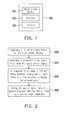
- FIG. 1 is a block diagram of an electronic apparatus according to some examples of the disclosure.
- FIG. 2 is a flowchart of a method of scrolling a list according to some examples of the disclosure.
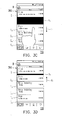
- FIGs. 3A-3E are schematic diagrams illustrating moving items according to some examples of the present disclosure.
- FIGs. 4A-4D are schematic diagrams illustrating moving items according to some examples of the present disclosure.
- FIGs. 5A-5D are schematic diagrams illustrating moving items according to some examples of the present disclosure.
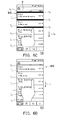
- FIGs. 6A-6F are schematic diagrams of moving items according to some example of the present disclosure.
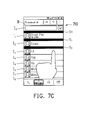
- FIGs. 7A-7C are schematic diagrams of list with a search bar according to some examples of the present disclosure.
- FIGa. 8A-8B are schematic diagrams of list with a digital image according to some examples of the present disclosure.
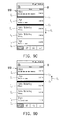
- FIGs. 9A-9E are schematic diagrams illustrating moving items according to some examples of the present disclosure.
- FIGs. 10A-10E are schematic diagrams illustrating moving items according to some examples of the present disclosure.
- FIG. 1 is a block diagram of an electronic apparatus according to some examples of the disclosure.
- the electronic apparatus 100 includes a touch screen display 110, a processor 120 and a memory 130.
- the electronic apparatus 100 can be, for example, a cell phone, a smartphone, a personal computer, a laptop, a tablet, a navigation device, or a video game machine, which is not limited thereto.
- the touch screen display 110 can be, for example, a capacitive screen, a resistance screen or a wave screen.
- the electronic apparatus 100 receives users' operation through the touch screen display 110 to execute the corresponding functions.
- the processor 120 can be, for example, a central processing unit (CPU), a microprocessor, etc., which is configured for executing the hardware, firmware and the data of software.
- CPU central processing unit
- microprocessor etc.
- the memory 130 can be, for example, a non-volatile memory (NVM), a dynamic random access memory (DRAM) or a static random access memory (SRAM), etc.
- NVM non-volatile memory
- DRAM dynamic random access memory
- SRAM static random access memory
- programs stored in the memory 130 would be executed by the processor 120 after the programs being installed.
- the programs include a plurality of instructions, and the processor 120 may perform a plurality of steps via the instructions.
- the electronic apparatus 100 only includes one processor 120.
- the electronic apparatus 100 includes a plurality of processors to execute the programs being installed, though the disclosure is not limited therein.
- FIG. 2 is a flowchart of a method of scrolling a list according to some examples of the disclosure.
- the method provides a visual feedback to a user that an edge of the list has been reached. While the method described below includes a number of operations that appear to occur in a specific order, it should be apparent that the method can include more or fewer operations, which can be executed serially or in parallel (e.g., using parallel processors or multi-threading environment).
- a list of scrollable items is displayed on a touch screen display of a device.
- the list of scrollable items is a list of emails, a list of instant message conversations, a list of phone numbers, a list of contact information, a list of call history, a list of missed calls, a list of labels, a list of email folders, a list of email addresses, a list of physical addresses, a list of ringtones, a list of album names, a list of bookmarks, or a list of files (e.g., document files, music files, or video files), though the disclosure is not limited therein.
- the device that displays the list of scrollable items can be a portable multifunction device, such as a mobile phone, though the disclosure is not limited therein.
- step S210 a movement of an object is detected on or near the touch screen display.
- the object is, for example, a finger or a stylus.
- step S215 in response to an edge of the list being reached, one or more items are moved in a first direction to display one or more gaps.
- each gap is between adjacent items, and no gap is formed outside of the edge of the list.
- the first direction can be a vertical direction, a horizontal direction or a diagonal direction.
- the first direction can be along an x, y, or z-axis in a list implemented by 3D motion.
- the list has a first item and a last item and the edge of the list is either the first item or the last item.
- the edge of the list is, for example, the edge of the first item or the last item in the list, and the edge does not adjoin other item.
- the first item is a title bar, a search bar, or a digital image.
- the gaps are visually distinct from the items, and therefore a visual effect that pulls away the adjacent items can be generated by the gaps.
- the visual distinctions between the gaps and the items can be implemented by using different colors, which can be black, gray, white or a solid color.
- not all adjacent items have a gap in between.
- the method shown in FIG. 2 further comprises a step of detecting the object at an initial location corresponding to an initial item.
- step S215 the one or more items are moved in the first direction to display one or more gap only between the adjacent items located between the first item and the initial item.
- each of the items or part of the items is respectively moved in the first direction, such that gaps between the adjacent items are generated. For example, at least one item would move in the first direction, such that a gap is generated between the item moving in the first direction and the previous adjacent item. Or, all of the items (except the first item near the edge of the list) move in the first direction, such that a gap is generated between each of the items and its previous adjacent item. Or, only part of the items moves in the first direction, such that a gap is generated between the items moving in the first direction and its previous adjacent item.
- the number of the items moving in the first direction is not limited herein.
- step S220 the one or more items are moved in a second direction until the one or more gaps are no longer displayed. That is, the items are moved in the second direction, so as to make the gaps between adjacent items disappear and return the items to the status of closely disposed.
- the second direction is opposite to the first direction. For example, if the first direction is an upward direction, the second direction is a downward direction. In some examples, no additional gap other than the one or more gaps is displayed while moving the one or more items in the second direction.
- step S220 one or more additional gaps between the adjacent items located between the initial item and a last item of the list are displayed while moving the one or more items in the second direction, and the one or more items are moved in the second direction until the one or more gaps and the one or more additional gaps are no longer displayed.
- the one or more items are moved one by one in the second direction.
- step S215 in response to an edge of the list being reached while the object is still detected on or near the touch screen display, the one or more items are moved in the first direction to display the one or more gaps.
- step S220 in response to detecting that the object is no longer on or near the touch screen display, the one or more items are moved in the second direction until the one or more gaps are no longer displayed.
- the movements of the one or more items in the first and second direction are imitation of a spring motion.
- FIGs. 3A-3E are schematic diagrams illustrating moving items according to some examples of the present disclosure.
- the processor 120 detects an initial item corresponding to the initial location where the finger (object) locates among the items, so as to respectively display one or more gaps between adjacent items located between the first item and the initial item.
- the processor 120 detects an initial item corresponding to the initial location where the finger (object) locates among the items, so as to respectively display one or more gaps between adjacent items located between the first item and the initial item.
- no additional gaps would be displayed between adjacent items located between the initial item and the last item (i.e., the other edge).
- a list 310 is displayed on the touch screen display 110.
- the list 310 includes scrollable items I 1 -I 6 , where the item I 1 is the first item in the list 310.
- the list 310 is a mail list, which includes a plurality of items (e.g., a plurality of mails).
- an edge B of the list 310 e.g., the upper edge of the first item I 1 ) has been reached before the user touches the touch screen display 110.
- the user initiates a touch from the item I 2 on or near the touch screen display 110 with a finger, and the processor 120 detects an object (i.e.,. the finger) at an initial location P1 on or near the touch screen display 110, which corresponds to the initial item I 2 .
- the initial item can be the items I 1 , I 3 -I 6 , or any other items displayed in the touch screen display 110.
- FIGs. 3B and 3C show the movement of the items I 2 -I 6 in response to a movement of the finger.
- the processor 120 detects the movement of the object (e.g., the finger) of dragging down from the initial location P1. Because the edge B of the list 310 has been reached before the user touches the touch screen display 110, the processor 120 moves the items I 2 -I 6 in a first direction d 1 to display a gap g 1 between the adjacent items I 1 and I 2 , which are located between the first item I 1 and the initial item I 2 . Since the first item I 1 does not move, no gap is formed outside of the edge B of the list 310.
- the first direction d 1 is a downward direction.
- the items I 2- -I 6 continue to move in the first direction d 1 in response to the dragging down movement of the object on or near the touch screen display 110.
- the height of the gaps g 1 increases as the items I 2 -I 6 continues to move in the first direction d 1 .
- the first item I 1 still does not move and no gap is formed outside of the edge B of the list 310.
- FIG. 3D-3E show the movement of the items I 2 -I 6 in response to detecting that the object is no longer on or near the touch screen display 110.
- the items I 2 -I 6 move back in a second direction d 2 ( FIG. 3D ) until the gap g 1 is no longer displayed ( FIG. 3E ).
- the second direction d 2 is an upward direction opposite to the first direction d 1 (i.e., the downward direction).
- FIGs. 4A-4D are schematic diagrams illustrating movement of the items according to some examples of the present disclosure.
- an edge B of the list 310 e.g., the upper edge of the first item I 1
- the user initiates a touch from an item I 3 on or near the touch screen display 110 with a finger, and the processor 120 detects an object (i.e.,. the finger) at an initial location P2 on or near the touch screen display 110 corresponding to the initial item I 3 .
- an object i.e.,. the finger
- FIG. 4B shows the movement of the items I 2 -I 6 in response to detecting a movement of the finger.
- the processor 120 detects the dragging down movement of the object (e.g., the finger) from the initial location P2. Because the edge B of the list 310 has been reached before the user touches the touch screen display 110, the processor 120 moves the items I 2 -I 6 in a first direction d 1 to display a gap g 1 between the adjacent items I 1 and I 2 and a gap g 2 between the adjacent items I 2 and I 3 .
- the adjacent items I 1 -I 2 and I 2 -I 3 are located between the first item I 1 and the initial item I 3 .
- the first direction d 1 is a downward direction.
- the gap g 2 is formed earlier than the gap g 1 (not shown), and the heights of the gaps g 1 and gaps g 2 are different (e.g., the height of the gap g 1 is smaller than the height of the gap g 2 ).
- the gaps g 1 and gaps g 2 are formed at the same time, and the heights of the gaps g 1 and gaps g 2 are the same all the time. In this example, no additional gap would be displayed between adjacent items located between the initial item I 3 and the last item (not shown). That is, the items I 3 -I 6 and other subsequent items remain closely disposed.
- FIG. 4C-4D show the movement of the items I 2 -I 6 in response to the detection of the finger leaving the touch screen display 110.
- the items I 2 -I 6 move back in a second direction d 2 ( FIG. 4C ) until the gaps g 1 and g 2 are no longer displayed ( FIG. 4D ).
- the second direction d 2 is an upward direction opposite to the first direction d 1 (i.e., the downward direction).
- the heights of the gaps g 1 and gaps g 2 are different (e.g., the height of the gap g 1 is smaller than the height of the gap g 2 ), and the gap g 1 disappears earlier than the gap g 2 (not shown).
- the heights of the gaps g 1 and gaps g 2 are the same all the time, and the gaps g 1 and gaps g 2 disappear at the same time, though the disclosure is not limited therein.
- the initial item I 3 can be regarded as a reference to separate the items into a first part and a second part of items, and the second part can be viewed as a whole part. That is, the first part of items includes the items I 1 -I 2 located between the first item I 1 and the initial item I 3 , and the second part of the items includes the items I 3 -I 6 located between the initial item I 3 and the last item and the subsequent items of the items I 3 -I 6 .
- the items I 1 -I 2 of the first part of items and the second part of items (which can be viewed as a whole part) in the first direction d 1 are pulled away individually to generate the gaps g 1 and g 2 between adjacent items.
- the pulled away items I 1 -I 2 and the second part of the items are moved individually in the second direction d 2 , such that the pulled away items can be connected with the previous items.
- FIGs. 5A-5D are schematic diagrams illustrating movement of the items according to some examples of the present disclosure.
- the description of FIGs. 5A-5B is the same as the description of FIGs. 4A-4B and is thus omitted for brevity.
- the processor 120 When the finger leaves the touch screen display 110, the processor 120 would move the items I 2 -I 3 in a second direction d 2 ( FIG. 5C ) until the gaps g 1 -g 2 are no longer displayed ( FIG. 5D ).
- the second direction d 2 is an upward direction.
- the items located between the initial item I 3 and the last item i.e., the items I 3 -I 6 and their subsequent items
- are moved in the second direction d 2 such that gaps (such as the gaps g 3 -g 5 ) can be respectively displayed between the adjacent items located between the initial item I 3 and the last item ( FIG. 5C ).
- the items I 3 -I 6 and their subsequent items are continuously moved in the second direction d 2 until the gaps between the items located between the initial item I 3 and the last item are no longer displayed( FIG. 5D ).
- additional gaps would be displayed between the adjacent items located between the initial item I 3 and the last item. That is, the displayed items I 3 -I 6 can spring back in the second direction d 2 like a spring motion.
- the first item of the list may be title bar ( FIGs. 6A-6C and FIGs. 6D-6F ), a search bar ( FIGs. 7A-7C ) or a digital image ( FIGs. 8A-8B ).
- FIGs. 6A-6C and FIGs. 6D-6F are schematic diagrams illustrating moving items according to some examples of the present disclosure. Referring to FIGs. 6A-6C , the first item I 0 of the list 610 is the title bar. In FIG. 6A , the edge of the list 610 does not reach before the user touches the touch screen display 110. In response to detecting a movement of an object (e.g., a finger), the whole list 610 would be moved to display the edge B of the list 610, as shown in FIG. 6B .
- an object e.g., a finger
- FIGs. 6C in response to the edge B of the list 610 being reached while the finger (object) is still detected on or near the touch screen display 110, e.g. the finger generates a movement of sliding downward, the gaps g 0 -g 2 are respectively displayed between adjacent items which are located between the first item I 0 and the initial item I 3 but no gap is formed outside of the edge B of the list 610.
- the processor 120 would move the items I 1 -I 6 in the second direction which is opposite to the first direction d 1 until the gaps g 0 -g 2 are no longer displayed, and the movement of the items can be understood via FIGs. 4C-4D .
- the first item I 0 of the list 610 is still the title bar.
- the operations of FIGs. 6D-6E are similar to FIGs. 6A and 6B .
- the list 610 in response to the edge B of the list 610 being reached while the finger (object) is still detected on or near the touch screen display 110, the list 610 may moved down continuously, then the item I 6 is not displayed and the items I 0 -I 5 are still displayed. And each of the gaps g 0 -g 4 is displayed between the adjacent items I 0 -I 5 .
- the items After the gaps are generated, the items would move in the second direction, i.e., moving upward, until the gaps disappear (no longer displayed) and return to the pattern illustrated in FIG. 6B . And the movement of the items can be understood via FIGs. 5C-5D .
- FIGs. 7A-7C are schematic diagrams of list with a search bar according to some examples of the present disclosure.
- the list 710 includes items I 0 -I 9 and the first item I 0 of the list 710 is the search bar.
- the list 710 is not reached the edge.
- the search bar (item I 0 ) is displayed.
- FIG. 7C in response to the edge B of the list 710 being reached while the finger generates a movement of sliding downward, the gaps g 0 -g 2 are respectively displayed.
- the items I 1 -I 6 would move upward, and the movement of the items I 0 -I 9 can be understood via FIGs. 4C-4D or FIGs. 5C-5D .
- FIGs. 8A-8B are schematic diagrams of a list with a digital image according to some examples of the present disclosure.
- the list 810 includes items I 0 -I 5 and the first item I 0 is the digital image.
- an edge of the list 810 being reached.
- FIG. 8B in response to detecting a movement of an object (e.g., a finger), i.e. when the user's finger drags down on the touch screen display 110, the gaps g 0 -g 1 are respectively displayed.
- the items I 1 -I 5 would move upward, and the movement of the items I 0 -I 5 can be understood via FIGs. 4C-4D or FIGs. 5C-5D .
- any one of the lists 610, 710 and 810 is moved to the edge of the other side (i.e., the lower edge of the last item of the list), and the object is detected moving upward (the first direction), the item would move upward and generate gaps between adjacent items. Next, the items would be moved downward (the second direction) until the gaps disappear.
- the movement of the items in the first direction and the second direction may be both spring motions.
- the movement of either the first direction or the second direction can be spring motions, or none of the movement of the first direction or the second direction is the spring motion.
- FIGs. 9A-9E are schematic diagrams illustrating moving items according to some examples of the present disclosure.
- a list 910 is displayed on the touch screen display 110.
- the list 910 includes scrollable items I 1 -I 9 , where the item I 1 is the first item in the list 910.
- the list 910 is a mail list, which includes a plurality of items (e.g., a plurality of mails).
- an edge B of the list 910 (e.g., the upper edge of the first item I 1 ) has not been reached before the user touches the touch screen display 110.
- the edge B of the list 910 has been reached before the user touches the touch screen display 110.
- the processor 120 detects the flicking down movement of the object (e.g., the finger) at an initial location corresponding to an initial item I 3 on or near the touch screen display 110, and the list 910 is moved in a first direction d 1 accordingly.
- the first direction d 1 is a downward direction.
- the processor 120 continues to move the items I 2 -I 6 in the first direction d 1 to display a gap g 1 between the adjacent items I 1 and I 2 and a gap g 2 between the adjacent items I 2 hand I 3 ( FIG. 9C ).
- the adjacent items I 1 -I 2 and I 2 -I 3 are located between the first item I 1 and the initial item I 3 . Since the first item I 1 does not move, no gap is formed outside of the edge B of the list 910.
- the processor 120 moves the items I 1 -I 6 back in a second direction d 2 ( FIG. 9D ) until the gaps g 1 and g 2 are no longer displayed ( FIG. 9E ).
- the second direction d 2 is an upward direction opposite to the first direction d 1 (i.e., the downward direction).
- the processors 120 could continue to move the items I 2 -I 6 in the first direction d 1 to display gaps between every adjacent items I 1 -I 6 , which could be understood via FIG. 6F .
- the processor 120 in response to detecting that the object is no longer on or near the touch screen display 110, the processor 120 would update the list. Besides, in response to detecting that the object is no longer on or near the touch screen display, the processor 120 may further display an updating hint in a gap among the one or more gaps. For example, the updating hint is displayed in the gap between the first item and the second item.
- FIGs. 10A-10E are schematic diagrams illustrating moving items according to some examples of the present disclosure.
- a list 1010 includes items A0-A3, and an edge B of the list 1010 has been reached before the user touches the touch screen display 110.
- the processor 120 moves the items A1-A3 in a first direction to display a gap 1003.
- the first direction is a downward direction.
- an option "Top stories" is displayed in the gap 1003.
- FIG. 10C when the object (ex.
- the processor 120 continues to move the items A1-A3 in the first direction to have the size of the gap 1003 increase, and a updating hint H is displayed in the gap 1003. Meanwhile, the content "RELEASE TO UPDATING" of the updating hint H may be displayed. In this example, the updating hint H is displayed in the first gap. In some examples, the updating hint H may be displayed in any gap other than the first gap.
- the processor 120 detects that the object is no longer on or near the touch screen display 110, in FIG. 10D , the processor 120 would update the list 1010. The content of the updating hint H may be changed from "RELEASE TO UPDATING" to "UPDATING".
- the processor 120 moves the items A1-A3 in a second direction to have the size of the gap 1003 decrease.
- the second direction is an upward direction.
- the processor 120 continues to move the items A1-A3 in the second direction until the gap 1010 is no longer displayed and the content of the list 1010 would be changed due to the updating.
- the items A1-A3 are changed to items A4-A6, and the arrangement manner is different.
- the application provides a computer program product, which records a computer program to be loaded into an electronic apparatus to execute the aforementioned various steps of the method.
- the computer program is basically composed of a plurality of program instructions (for example, an organization chart establishing program instruction, a table approving program instruction, a setting program instruction, and a deployment program instruction, etc.), and these program instructions are loaded into the electronic apparatus and executed by the same to accomplish various steps of the method and various functions of the electronic apparatus described above.
- the items are moved according to the movement of the object. Meanwhile, by displaying gaps between the items, visual effects of sequential movements of the items can be generated with the movement of the object. In addition, after the object stops moving, the moved items are returned to original places. Hence, when the list is being moved, one or more items are simultaneously moved to provide a visual feedback instead of moving the whole list at once.
Landscapes
- Engineering & Computer Science (AREA)
- General Engineering & Computer Science (AREA)
- Theoretical Computer Science (AREA)
- Human Computer Interaction (AREA)
- Physics & Mathematics (AREA)
- General Physics & Mathematics (AREA)
- User Interface Of Digital Computer (AREA)
Applications Claiming Priority (1)
| Application Number | Priority Date | Filing Date | Title |
|---|---|---|---|
| US201261602621P | 2012-02-24 | 2012-02-24 |
Publications (1)
| Publication Number | Publication Date |
|---|---|
| EP2631765A1 true EP2631765A1 (fr) | 2013-08-28 |
Family
ID=47789946
Family Applications (1)
| Application Number | Title | Priority Date | Filing Date |
|---|---|---|---|
| EP20130000909 Ceased EP2631765A1 (fr) | 2012-02-24 | 2013-02-22 | Appareil électronique et son procédé de fonctionnement et produit de programme informatique |
Country Status (4)
| Country | Link |
|---|---|
| US (1) | US9851885B2 (fr) |
| EP (1) | EP2631765A1 (fr) |
| CN (1) | CN103294391A (fr) |
| TW (1) | TWI476674B (fr) |
Families Citing this family (21)
| Publication number | Priority date | Publication date | Assignee | Title |
|---|---|---|---|---|
| USD745529S1 (en) * | 2013-01-04 | 2015-12-15 | Samsung Electronics Co., Ltd. | Portable electronic device with graphical user interface |
| USD744508S1 (en) * | 2013-01-25 | 2015-12-01 | Htc Corporation | Display screen with a graphical user interface |
| USD742916S1 (en) * | 2013-02-07 | 2015-11-10 | Htc Corporation | Portion of a display screen with a graphical user interface |
| USD745528S1 (en) * | 2013-05-10 | 2015-12-15 | Samsung Electronics Co., Ltd. | Portable electronic device with graphical user interface |
| USD745016S1 (en) * | 2013-05-10 | 2015-12-08 | Samsung Electronics Co., Ltd. | Portable electronic device with graphical user interface |
| CN104156245B (zh) * | 2014-08-06 | 2018-04-10 | 小米科技有限责任公司 | 列表更新方法和装置 |
| CN104182133B (zh) * | 2014-08-29 | 2017-10-13 | 广东欧珀移动通信有限公司 | 列表滑动控制方法及装置 |
| KR102337216B1 (ko) * | 2015-01-05 | 2021-12-08 | 삼성전자주식회사 | 영상 표시 장치 및 영상 표시 방법 |
| USD765118S1 (en) | 2015-04-13 | 2016-08-30 | Apple Inc. | Display screen or portion thereof with graphical user interface |
| USD797133S1 (en) * | 2016-01-07 | 2017-09-12 | Invisalert Solutions, LLC | Display screen with graphical user interface |
| JP6759023B2 (ja) * | 2016-09-09 | 2020-09-23 | キヤノン株式会社 | 表示制御装置、その制御方法、およびプログラム、並びに記憶媒体 |
| AU2017326335B2 (en) | 2016-09-14 | 2022-03-10 | Invisalert Solutions, LLC | Tamper resistant clasp and wristband apparatus and associated patient monitoring system and method of use |
| USD875743S1 (en) | 2018-06-04 | 2020-02-18 | Apple Inc. | Display screen or portion thereof with graphical user interface |
| USD906359S1 (en) | 2018-07-05 | 2020-12-29 | Invisalert Solutions, Inc. | Display screen with graphical user interface |
| USD902947S1 (en) | 2019-03-25 | 2020-11-24 | Apple Inc. | Electronic device with graphical user interface |
| USD926781S1 (en) | 2019-05-28 | 2021-08-03 | Apple Inc. | Display screen or portion thereof with graphical user interface |
| EP4028911A4 (fr) | 2019-09-11 | 2023-10-04 | Invisalert Solutions, Inc. | Système de suivi de monitorage de patient sans fil |
| CN120029514A (zh) * | 2020-08-31 | 2025-05-23 | 华为终端有限公司 | 一种页面滑动的处理方法及相关装置 |
| CN116450967A (zh) * | 2023-04-14 | 2023-07-18 | 武汉联影医疗科技有限公司 | 列表视图展示方法、计算机设备和存储介质 |
| US12315353B1 (en) | 2024-06-04 | 2025-05-27 | Invisalert Solutions, Inc. | Patient safety monitoring method and apparatus |
| US12355745B1 (en) | 2024-10-28 | 2025-07-08 | Invisalert Solutions, Inc. | Secure mobile device management |
Citations (4)
| Publication number | Priority date | Publication date | Assignee | Title |
|---|---|---|---|---|
| US20070146337A1 (en) * | 2005-12-23 | 2007-06-28 | Bas Ording | Continuous scrolling list with acceleration |
| EP2034399A2 (fr) * | 2007-09-04 | 2009-03-11 | LG Electronics Inc. | Procédé de défilement d'un terminal mobile |
| US20110001709A1 (en) * | 2009-07-01 | 2011-01-06 | Shih-Yang Wang | Methods for displaying and moving data and systems using the same |
| US20110010659A1 (en) * | 2009-07-13 | 2011-01-13 | Samsung Electronics Co., Ltd. | Scrolling method of mobile terminal and apparatus for performing the same |
Family Cites Families (14)
| Publication number | Priority date | Publication date | Assignee | Title |
|---|---|---|---|---|
| US7469381B2 (en) * | 2007-01-07 | 2008-12-23 | Apple Inc. | List scrolling and document translation, scaling, and rotation on a touch-screen display |
| US7024491B1 (en) * | 2001-05-23 | 2006-04-04 | Western Digital Ventures, Inc. | Remotely synchronizing a mobile terminal by adapting ordering and filtering synchronization rules based on a user's operation of the mobile terminal |
| US20040155909A1 (en) * | 2003-02-07 | 2004-08-12 | Sun Microsystems, Inc. | Scroll tray mechanism for cellular telephone |
| KR100873679B1 (ko) * | 2007-09-04 | 2008-12-12 | 엘지전자 주식회사 | 휴대단말기의 스크롤링 방법 |
| US20100058240A1 (en) * | 2008-08-26 | 2010-03-04 | Apple Inc. | Dynamic Control of List Navigation Based on List Item Properties |
| US8624925B2 (en) * | 2009-10-16 | 2014-01-07 | Qualcomm Incorporated | Content boundary signaling techniques |
| US8799816B2 (en) * | 2009-12-07 | 2014-08-05 | Motorola Mobility Llc | Display interface and method for displaying multiple items arranged in a sequence |
| US8448084B2 (en) * | 2010-04-08 | 2013-05-21 | Twitter, Inc. | User interface mechanics |
| JP5679169B2 (ja) * | 2010-10-20 | 2015-03-04 | 株式会社ソニー・コンピュータエンタテインメント | メニュー表示装置、メニュー表示制御方法及びプログラム |
| JP2012174247A (ja) * | 2011-02-24 | 2012-09-10 | Kyocera Corp | 携帯電子機器、接触操作制御方法および接触操作制御プログラム |
| US20130063383A1 (en) * | 2011-02-28 | 2013-03-14 | Research In Motion Limited | Electronic device and method of displaying information in response to detecting a gesture |
| US20120278754A1 (en) * | 2011-04-29 | 2012-11-01 | Google Inc. | Elastic Over-Scroll |
| US9035967B2 (en) * | 2011-06-30 | 2015-05-19 | Google Technology Holdings LLC | Method and device for enhancing scrolling and other operations on a display |
| US20140215341A1 (en) * | 2013-01-31 | 2014-07-31 | Lsi Corporation | Transitioning between pages of content on a display of a user device |
-
2013
- 2013-02-22 TW TW102106311A patent/TWI476674B/zh not_active IP Right Cessation
- 2013-02-22 EP EP20130000909 patent/EP2631765A1/fr not_active Ceased
- 2013-02-22 CN CN2013100573598A patent/CN103294391A/zh active Pending
- 2013-02-23 US US13/775,121 patent/US9851885B2/en not_active Expired - Fee Related
Patent Citations (4)
| Publication number | Priority date | Publication date | Assignee | Title |
|---|---|---|---|---|
| US20070146337A1 (en) * | 2005-12-23 | 2007-06-28 | Bas Ording | Continuous scrolling list with acceleration |
| EP2034399A2 (fr) * | 2007-09-04 | 2009-03-11 | LG Electronics Inc. | Procédé de défilement d'un terminal mobile |
| US20110001709A1 (en) * | 2009-07-01 | 2011-01-06 | Shih-Yang Wang | Methods for displaying and moving data and systems using the same |
| US20110010659A1 (en) * | 2009-07-13 | 2011-01-13 | Samsung Electronics Co., Ltd. | Scrolling method of mobile terminal and apparatus for performing the same |
Non-Patent Citations (1)
| Title |
|---|
| COCOANETICS: "How to make a Pull-To-Reload TableView just like Tweetie 2", 4 December 2010 (2010-12-04), XP002699297, Retrieved from the Internet <URL:http://web.archive.org/web/20101204054013/http://www.cocoanetics.com/2009/12/how-to-make-a-pull-to-reload-tableview-just-like-tweetie-2/> [retrieved on 20130621] * |
Also Published As
| Publication number | Publication date |
|---|---|
| TWI476674B (zh) | 2015-03-11 |
| US9851885B2 (en) | 2017-12-26 |
| TW201337713A (zh) | 2013-09-16 |
| CN103294391A (zh) | 2013-09-11 |
| US20130227486A1 (en) | 2013-08-29 |
Similar Documents
| Publication | Publication Date | Title |
|---|---|---|
| US9851885B2 (en) | Electronic apparatus and operating method thereof and computer readable storage medium | |
| JP7606580B2 (ja) | 複数のアプリケーションウィンドウと対話するためのシステム、方法、及びユーザインタフェース | |
| US12164745B2 (en) | Device, method, and graphical user interface for managing folders | |
| JP7028935B2 (ja) | アプリケーションに対応するユーザインタフェースオブジェクトと対話するためのデバイス、方法、及びグラフィカルユーザインタフェース | |
| US10102010B2 (en) | Layer-based user interface | |
| US8966387B2 (en) | Method and apparatus for managing icon in portable terminal | |
| CN103098011B (zh) | 项目显示方法和设备 | |
| US9977523B2 (en) | Apparatus and method for displaying information in a portable terminal device | |
| US20110157027A1 (en) | Method and Apparatus for Performing an Operation on a User Interface Object | |
| EP2708997B1 (fr) | Dispositif d'affichage, procédé pour interface utilisateur et programme | |
| JP6381032B2 (ja) | 電子機器、その制御方法及びプログラム | |
| US20130159900A1 (en) | Method, apparatus and computer program product for graphically enhancing the user interface of a device | |
| US20130002706A1 (en) | Method and apparatus for customizing a display screen of a user interface | |
| US20140310653A1 (en) | Displaying history information for application | |
| WO2012110989A1 (fr) | Procédé, appareil et produit programme d'ordinateur pour l'affichage intégré d'une application et d'un gestionnaire de tâches | |
| JP2011022842A (ja) | 表示装置、表示方法及びプログラム | |
| US12579209B2 (en) | Devices, methods, and graphical user interfaces for interacting with a web-browser | |
| US8749558B2 (en) | Method for displaying displacement of object on display of electronic device | |
| JP2012208244A (ja) | 電子機器及びその表示方法 |
Legal Events
| Date | Code | Title | Description |
|---|---|---|---|
| PUAI | Public reference made under article 153(3) epc to a published international application that has entered the european phase |
Free format text: ORIGINAL CODE: 0009012 |
|
| 17P | Request for examination filed |
Effective date: 20130222 |
|
| AK | Designated contracting states |
Kind code of ref document: A1 Designated state(s): AL AT BE BG CH CY CZ DE DK EE ES FI FR GB GR HR HU IE IS IT LI LT LU LV MC MK MT NL NO PL PT RO RS SE SI SK SM TR |
|
| AX | Request for extension of the european patent |
Extension state: BA ME |
|
| RBV | Designated contracting states (corrected) |
Designated state(s): AL AT BE BG CH CY CZ DE DK EE ES FI FR GB GR HR HU IE IS IT LI LT LU LV MC MK MT NL NO PL PT RO RS SE SI SK SM TR |
|
| RAP1 | Party data changed (applicant data changed or rights of an application transferred) |
Owner name: HTC CORPORATION |
|
| STAA | Information on the status of an ep patent application or granted ep patent |
Free format text: STATUS: THE APPLICATION HAS BEEN REFUSED |
|
| 18R | Application refused |
Effective date: 20150205 |