EP2631872A1 - Merkmalsextraktionsvorrichtung, merkmalsextraktionsverfahren und programm dafür - Google Patents
Merkmalsextraktionsvorrichtung, merkmalsextraktionsverfahren und programm dafür Download PDFInfo
- Publication number
- EP2631872A1 EP2631872A1 EP11834034.8A EP11834034A EP2631872A1 EP 2631872 A1 EP2631872 A1 EP 2631872A1 EP 11834034 A EP11834034 A EP 11834034A EP 2631872 A1 EP2631872 A1 EP 2631872A1
- Authority
- EP
- European Patent Office
- Prior art keywords
- layer
- neurons
- neuron
- value
- gene
- Prior art date
- Legal status (The legal status is an assumption and is not a legal conclusion. Google has not performed a legal analysis and makes no representation as to the accuracy of the status listed.)
- Withdrawn
Links
Images










Classifications
-
- G—PHYSICS
- G06—COMPUTING OR CALCULATING; COUNTING
- G06F—ELECTRIC DIGITAL DATA PROCESSING
- G06F16/00—Information retrieval; Database structures therefor; File system structures therefor
- G06F16/50—Information retrieval; Database structures therefor; File system structures therefor of still image data
- G06F16/58—Retrieval characterised by using metadata, e.g. metadata not derived from the content or metadata generated manually
- G06F16/583—Retrieval characterised by using metadata, e.g. metadata not derived from the content or metadata generated manually using metadata automatically derived from the content
- G06F16/5838—Retrieval characterised by using metadata, e.g. metadata not derived from the content or metadata generated manually using metadata automatically derived from the content using colour
-
- G—PHYSICS
- G06—COMPUTING OR CALCULATING; COUNTING
- G06F—ELECTRIC DIGITAL DATA PROCESSING
- G06F18/00—Pattern recognition
- G06F18/20—Analysing
- G06F18/21—Design or setup of recognition systems or techniques; Extraction of features in feature space; Blind source separation
- G06F18/211—Selection of the most significant subset of features
- G06F18/2111—Selection of the most significant subset of features by using evolutionary computational techniques, e.g. genetic algorithms
-
- G—PHYSICS
- G06—COMPUTING OR CALCULATING; COUNTING
- G06N—COMPUTING ARRANGEMENTS BASED ON SPECIFIC COMPUTATIONAL MODELS
- G06N3/00—Computing arrangements based on biological models
- G06N3/02—Neural networks
- G06N3/06—Physical realisation, i.e. hardware implementation of neural networks, neurons or parts of neurons
- G06N3/063—Physical realisation, i.e. hardware implementation of neural networks, neurons or parts of neurons using electronic means
-
- G—PHYSICS
- G06—COMPUTING OR CALCULATING; COUNTING
- G06V—IMAGE OR VIDEO RECOGNITION OR UNDERSTANDING
- G06V10/00—Arrangements for image or video recognition or understanding
- G06V10/40—Extraction of image or video features
- G06V10/44—Local feature extraction by analysis of parts of the pattern, e.g. by detecting edges, contours, loops, corners, strokes or intersections; Connectivity analysis, e.g. of connected components
- G06V10/443—Local feature extraction by analysis of parts of the pattern, e.g. by detecting edges, contours, loops, corners, strokes or intersections; Connectivity analysis, e.g. of connected components by matching or filtering
- G06V10/449—Biologically inspired filters, e.g. difference of Gaussians [DoG] or Gabor filters
- G06V10/451—Biologically inspired filters, e.g. difference of Gaussians [DoG] or Gabor filters with interaction between the filter responses, e.g. cortical complex cells
- G06V10/454—Integrating the filters into a hierarchical structure, e.g. convolutional neural networks [CNN]
-
- G—PHYSICS
- G06—COMPUTING OR CALCULATING; COUNTING
- G06V—IMAGE OR VIDEO RECOGNITION OR UNDERSTANDING
- G06V10/00—Arrangements for image or video recognition or understanding
- G06V10/70—Arrangements for image or video recognition or understanding using pattern recognition or machine learning
- G06V10/77—Processing image or video features in feature spaces; using data integration or data reduction, e.g. principal component analysis [PCA] or independent component analysis [ICA] or self-organising maps [SOM]; Blind source separation
- G06V10/771—Feature selection, e.g. selecting representative features from a multi-dimensional feature space
Definitions
- the present invention relates to feature extraction devices etc., and particularly to a feature extraction device, a feature extraction method, and a program for the same.
- Neural networks have been known as information processing schemes for allowing computers to model functions (neural flexibility) of neurons (neural cells) present in brains in order to achieve aimed information processing.
- a principal application of such a neural network is pattern recognition.
- a neural network is intended to allow a computer to select, from data of images, data of an image that includes a given person's face or data of an image that does not include the given person's face.
- such a neural network makes it possible to non-linearly connect neurons that compose the network, and thus approximate complicated features using non-linear functions and achieve excellent recognition results.
- learning is essential for achieving a neural network capable of successfully extracting features of target data.
- learning is a work for adjusting parameters in the neural network using learning data with known answers (which are pieces of attribute information desired to be recognized, such as a person's name, good or bad, etc.).
- Such learning for the neural network requires a large amount of learning data prepared in advance.
- the present invention was made with an aim to provide a feature extraction device capable of extracting features of recognition targets without requiring prior learning.
- a feature extraction device includes a neural network, wherein the neural network includes a plurality of neurons which are calculation units, each of the plurality of neurons includes at least one expressed gene which is an attribute value for determining whether or not transmission of a signal from one of the neurons to an other one of the neurons is possible, among the plurality of neurons, each of one or more first neurons which has input data obtained by dividing target data to be subjected to feature extraction outputs a first signal value to a second neuron which has the same expressed gene as the expressed gene included in the first neuron, the first signal value increasing as a value of the input data increases, and the second neuron calculates, as a feature quantity of the target data, a second signal value corresponding to a total sum of the one or more first signal values input to the second neuron.
- the expressed gene determines a signal path for the signal to be transmitted from each of the first neurons to the second neuron.
- the second neuron can output the feature quantity of the target data according to the total value of the inputs obtained from the first neurons.
- the neural network may be a hierarchical neural network including a plurality of layers
- the hierarchical neural network may include, as the plurality of neurons, a plurality of first layer neurons which are calculation units in a first layer and a second layer neuron which is a calculation unit in a second layer
- each of the first layer neurons and the second layer neuron may include at least one expressed gene which is an attribute value for determining whether or not the transmission of the signal from the first layer neuron to the second layer neuron is possible
- each of the plurality of first layer neurons which has the input data obtained by dividing the target data may output the first signal value to the second layer neuron which has the same expressed gene as the expressed gene included in the first layer neuron, the first signal value increasing as the value of the input data increases
- the second layer neuron may calculate, as the feature quantity of the target data, the second signal value corresponding to the total sum of the one or more first signal values input to the second layer neuron.
- the expressed gene determines a signal path for the signal to be transmitted from the first neuron to the second neuron.
- each of the second layer neurons can output the feature quantity of the target data.
- the feature extraction device may further include an expressed gene assignment unit configured, for each of the plurality of first layer neurons and the second layer neuron: (i) to select at least one gene from a gene repertory including a plurality of genes each indicating a predetermined attribute value; and (ii) to assign the at least one selected gene as the expressed gene, wherein each of the plurality of first layer neurons may output the first signal value to the second layer neuron which has the same expressed gene as the expressed gene included in the first layer neuron.
- an expressed gene assignment unit configured, for each of the plurality of first layer neurons and the second layer neuron: (i) to select at least one gene from a gene repertory including a plurality of genes each indicating a predetermined attribute value; and (ii) to assign the at least one selected gene as the expressed gene, wherein each of the plurality of first layer neurons may output the first signal value to the second layer neuron which has the same expressed gene as the expressed gene included in the first layer neuron.
- the expressed gene assignment unit may be configured to randomly select the at least one gene that should be assigned as the expressed gene from the gene repertory.
- the expressed gene assignment unit can randomly assign the expressed gene to each neuron.
- the feature extraction device which exerts stable feature extraction performances for various kinds of target data.
- the feature extraction device can exert stable feature extraction performances since only the expressed genes form the signal paths for the signals.
- the expressed gene assignment unit may be configured to select the at least one gene that should be assigned as the expressed gene from predetermined combinations included in the gene repertory.
- the second layer neuron may output a predetermined value as the second signal value when the total sum of the one or more first signal values input to the second layer neuron is included in a predetermined range, and output, as the second signal value, a value different from the predetermined value when the total sum of the one or more first signal values input to the second layer neuron is not included in the predetermined range.
- the hierarchical neural network may include a plurality of the second layer neurons
- the feature extraction device may further include a comparison unit configured to output an activation instruction to each of second layer neurons, among the plurality of second layer neurons, which has a rank within a predetermined range in descending order of total sums of first signal values, each total sum being of first signal values input to a corresponding one of the plurality of second layer neurons, wherein, among the plurality of second layer neurons, (a) the neuron which has the activation instruction obtained from the comparison unit may output a predetermined value as the second signal value, and (b) a neuron which does not have the activation instruction obtained from the comparison unit may output, as the second signal value, a value different from the predetermined value.
- the comparison unit can evaluate each of the neurons belonging to the second layer according to relative ranks based on the total sums of the input values, and activate each of the neurons that satisfy the predetermined evaluation criterion. In other words, it is possible to select the plan for the feature extraction device to extract features of target data, according to the relative ranks based on the total sums of the input values.
- each of the plurality of neurons may (A) output the first signal value to the other neuron when the number of expressed genes that match between the neuron and the other one of the neurons is larger than or equal to a predetermined threshold value, and (B) add, to the first signal value, a weight that increases as the number of expressed genes that match between the neuron and the other one of the neurons increases, and output the weighted first signal value to the other neuron.
- the hierarchical neural network may further include, as calculation units in a third layer, a plurality of third layer neurons each including at least one expressed gene
- the hierarchical neural network may include a plurality of the second layer neurons, each of the plurality of second layer neurons may output the second signal value to each of third layer neurons, among the plurality of third layer neurons, which has the same expressed gene as the expressed gene included in the second layer neuron when the second signal value corresponding to the total sum of the first signal values is included within the predetermined range
- each of the plurality of third layer neurons may calculate, as a feature quantity of the target data, a third signal value corresponding to a total sum of a corresponding one or more of the plurality of the second signal values input to the third layer neuron.
- the feature extraction device may further include a first comparison unit configured to output an activation instruction to each of second layer neurons, among the plurality of second layer neurons, which has a rank within a predetermined range in descending order of total sums of first signal values, each total sum being of first signal values input to a corresponding one of the plurality of second layer neurons; and a second comparison unit configured to output an activation instruction to each of third layer neurons, among the plurality of third layer neurons, which has a rank within a predetermined range in descending order of total sums of second signal values, each total sum being of second signal values input to a corresponding one of the plurality of third layer neurons, wherein, among the plurality of second layer neurons, (a) the second neuron which has the activation instruction obtained from the first comparison unit may output a predetermined value as the second signal value, and (b) a neuron which does not have the activation instruction obtained from the first comparison unit may output, as the second signal value, a value different from the predetermined value, and wherein, among the plurality of
- the feature extraction device may further include an expressed gene assignment unit configured, for each of the plurality of first layer neurons, the plurality of second layer neurons, and the plurality of third neurons: (i) to select at least one gene from a gene repertory including a plurality of genes each indicating a predetermined attribute value; and (ii) to assign each of the at least one selected gene as the expressed gene; a first comparison unit configured to output an activation instruction to each of second layer neurons, among the plurality of second layer neurons, which has a rank higher than or equal to a predetermined threshold value, the rank being based on a total sum of the first signal values input to the second layer neuron; and a second comparison unit configured to output an activation instruction to each of third layer neurons, among the plurality of third layer neurons, which has a rank higher than or equal to a predetermined threshold value, the rank being based on a total sum of the second signal values input to the third layer neuron, wherein each of the plurality of first layer neurons may obtain a value of the input data obtained
- the feature extraction device may further comprise an expressed gene assignment unit configured, for each of the plurality of first layer neurons, the plurality of second layer neurons, and the plurality of third layer neurons (i) to randomly select at least one gene from a gene repertory including a plurality of genes each indicating a predetermined attribute value, and (ii) to assign each of the at least one selected gene as the expressed gene; a first comparison unit configured to obtain, for each of the plurality of second layer neurons, a rank based on a total sum of the first signal values input to the second layer neuron, and to output an activation instruction to each of one or more second layer neurons, among the plurality of second layer neurons, which has a rank lower than or equal to a rank predetermined as a threshold value; a second comparison unit configured to obtain, for each of the plurality of third layer neurons, a rank based on a total sum of a corresponding one or more of the second signal values input to the third layer neuron, and to output an activation instruction to each of one or more third layer neurons
- the number of the expressed genes is plural, and it is also good to determine the frequency of each of the expressed genes included in each of the second neurons such that the frequency increases with increase in the number of or the magnitudes of the first signal values input to the second neuron, and output, as the feature quantities of the target data, gene codes which are information indicating a distribution of sums of frequencies of the expressed genes, each sum being a sum of frequencies of a corresponding one of the expressed genes included in some of the plurality of second neurons.
- the present invention can be realized not only as such a feature extraction device but also as a feature extraction method having the steps corresponding to the unique units of the feature extraction device and a program for causing a computer to execute the unique steps of the image extraction method.
- a program can naturally be distributed through recording media such as CD-ROMs and/or communication media such as the Internet.
- the present invention can be implemented as a semiconductor integrated circuit (LSI) including a part or all of the functions of the feature extraction device and a feature extraction system including the feature extraction device.
- LSI semiconductor integrated circuit
- the present invention provides a feature extraction device capable of extracting features of recognition targets without requiring any prior learning.
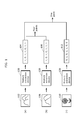
- FIG. 1 is a conceptual diagram showing an example of pattern recognition performed by a feature extraction device 100 according to this embodiment. Here is considered a case where the feature extraction device 100 recognizes which one of an image 106 and an image 110 is more similar to an image 102.
- the feature extraction device 100 obtains, for example, image data, and outputs a motion vector which is a vector having a length of 1 indicating a feature quantity of the image data.
- the feature extraction device 100 receives, as an input, the image data of the image 102, and outputs a feature vector 104 as the feature vector. Likewise, it is assumed that the feature extraction device 100 receives, as an input, the image data of an image 106 similar to the image 102, and outputs a feature vector 108. In addition, it is assumed that the feature extraction device 100 receives, as an input, the image data of an image 110 dissimilar to the image 102, and outputs a feature vector 112.
- a user can find out the degree of similarity between the images by calculating the degree of matching (for example, an internal product) between the feature vectors output by the feature extraction device 100.
- the degree of matching for example, an internal product
- the internal product between the feature vector 104 and the feature vector 108 is 4, and thus the degree of similarity between the image 102 and the image 106 is calculated as 4 points.
- the internal product between the feature vector 104 and the feature vector 112 is 1, and thus the degree of similarity between the image 102 and the image 110 is calculated as 1 point.
- the image most similar to the image 102 is determined to be the image 106.
- FIG. 2 is a block diagram showing a structure of the feature extraction device 100 according to this embodiment.
- the feature extraction device 100 includes a hierarchical neural network. No upper limit is placed on the number of hierarchical layers, whereas at least two layers are required.
- FIG. 2 shows an example of a two-layer neural network.
- each of the hierarchical layers includes a group of neurons which are calculation units for outputting feature quantities indicating features of input data.
- Each of the neurons is initially in a non-activated state, and is switched between an activated state and a non-activated state.
- the feature extraction device 100 includes a plurality of first layer neurons 301 to 303 which are calculation units in the first layer 309, a plurality of second layer neurons 311 to 313 which are calculation units in the second layer 319, and a comparison unit 352.
- Each of the first layer neurons and the second layer neurons is randomly assigned in advance with at least one of genes in a plurality of predetermined genes (hereinafter referred to as a "gene repertory").
- Gene repertory Each of the genes assigned to any one of the neurons is referred to as an expressed gene of the neuron.
- the expressed gene is an attribute value to be used to determine whether or not a signal can be transmitted between adjacent hierarchical layers (for example, from a first layer neuron to a second layer neuron) according to a matching rule to be described later.
- such expressed genes are used as identifiers each represented in the form of a numerical value, a character string, a bitstream, or the like.
- a signal path determined using expressed genes according to a matching rule is hereinafter referred to as a matching network.
- the first neurons 301 to 303 respectively receive input data A to C obtained by dividing the target data from which features should be extracted by the feature extraction device 100.
- the respective first neurons 301 to 303 determine first signal values based on the input data A to C, and output the values to the second layer neurons connected through the matching network.
- Examples of conceivable methods of determining such first signal values include: a method of binarizing input data (outputting 1 as a first signal value in response to an input larger than or equal to a predetermined threshold value and outputting 0 as a first signal value in response to an input smaller than the predetermined threshold value or in the case of no input); a method of applying monotonously increasing scaling functions; and a method of outputting raw input values as first signal values. Another method is possible as a method of determining such first signal values as long as the method is for determining the first signal values such that the values increase as the values of input data increase.
- Each of the second layer neurons 311 to 313 calculates a total sum of the first signal values obtained from a corresponding first layer neuron.
- each of the second layer neurons 311 to 313 outputs the calculated total sum to the comparison unit 352, and obtains a comparison result from the comparison unit 352.
- Each of the second layer neurons 311 to 313 calculates a second signal value based on the comparison result obtained from the comparison unit 352, and outputs the calculated second signal value. This is a feature quantity of the target data.
- a set of all the feature quantities output by all of the second layer neurons is a feature vector.
- a second layer neuron 311 outputs a second signal value as a feature quantity A
- a second layer neuron 312 outputs a second signal value as a feature quantity B
- a second layer neuron 313 outputs a second signal value as a feature quantity C
- data obtained by arranging the feature quantities A, B, and C in this listed order is the feature vector of the target data.
- the total number of first layer neurons and the second layer neurons depends on the amount of target data. For example, such a total number is approximately in a range from three to a hundred thousands.
- the comparison unit 352 compares the total values (total sums) obtained from the second layer neurons 311 to 313, and selects one or some of the second layer neurons for which an activation instruction should be output according to the comparison result.
- the comparison unit 352 gives each of the second layer neurons a rank based on the magnitude of the obtained total value, and outputs "an activation instruction" as a result of the comparison to second layer neurons within the top 10%.
- the expressed gene assignment unit 350 randomly selects at least one gene from the gene repertory for each of the first layer neurons and the second layer neurons, and assigns the selected gene thereto.
- the gene repertory includes different genes, the number of which is, specifically, in an approximate range from two to a hundred. In addition, the number of genes assigned to one neuron is approximately one to ten. As will be described later, these numbers are based on a biological hypothesis that "the line of a local neural circuit which carries out information processing in a brain is realized by several tens of gene repertories".
- a matching rule which is a feature of a neural network included in the feature extraction device 100 according to this embodiment is described in comparison with a conventional neural network.
- FIG. 3 is a diagram illustrating signal transmission processes in a conventional hierarchical neural network. This hierarchical neural network is briefly described here because it is a widely known technique.
- the neural network shown in FIG. 3 is a three-layer hierarchical neural network including five neurons 201 to 205.
- the hierarchical neural network includes a plurality of hierarchical layers each referred to as an input layer, an intermediate layer, or an output layer.
- the neurons are arranged in the layers and every neurons in the same hierarchical layer does not have any signal path therebetween.
- every neurons in a layer and every neurons in an adjacent layer have a signal path therebetween.
- This signal path is for one-way signal transmission from the input layer to the output layer.
- signal transmission is performed in one direction from an upper layer to a lower layer.
- the neurons 201 and 202 are in the input layer (first layer), and the neurons 203 and 204 are in the intermediate layer (second layer), and the neuron 205 is in the output layer (third layer).
- Each of the signal paths connecting the corresponding neurons has a weight, and each of the neurons obtains, as an input signal, a value obtained by multiplying a value output from the upper layer by the weight.
- each neuron has a threshold value and an activation function, inputs a value obtained by subtracting the threshold value from a sum of the input signals to an activation function, and outputs a value obtained from the activation function to the neurons in the next layer.
- the signal path from the neuron 201 to the neuron 203 has a weight W 31
- the signal path from the neuron 202 to the neuron 203 has a weight W 32
- the neuron 203 has a threshold W 30
- the neuron 203 has an activation function f().
- the hierarchical neural network shown in FIG. 3 outputs Y 1 as a feature vector of the inputs X 1 and X 2 which are the target data.
- the weights of the signal paths are modified such that the difference between Y 1 and the output Y 1 (Y 2 - Y 1 ) is reduced assuming that the expected output (correct feature vector) is Y 2 .
- the weights of the signal paths are reduced so that the output Y 1 is smaller.
- the weight of the signal paths are increased so that the output Y 1 is larger.
- new inputs X 3 and X 4 are input to the hierarchical neural network with the modified weights. This cyclical procedure of inputting, outputting, and learning is repeated until the resulting output Y 3 is converged within a range around the expected output Y 4 .
- the conventional hierarchical neural network includes a great number of parameters such as (1) weights of signal paths, (2) threshold values for neurons, (3) the kinds of activation functions, and (4) learning coefficients each multiplied to the difference between a teacher signal and an output in learning. These parameters are determined through “learning” using a great number of teacher signals (sets of inputs X 1 and X 2 and output Y 2 expected from the inputs).
- a matching network included in the feature extraction device 100 according to this embodiment does not always require such learning.
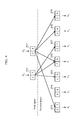
- FIG. 4 is a diagram illustrating signal transmission processes in a matching network in the feature extraction device 100 according to this embodiment.
- this matching network includes a plurality of hierarchical layers as in the conventional hierarchical neural network.
- signal paths are for one way signal transmission from the input layer to the output layer, and the signals are transmitted only in one way direction from a current layer to the next layer.
- the intermediate layer is not shown in FIG. 4 .
- This matching network in the feature extraction device does not add weights to the signal paths.
- the matching network determines signal output destinations based on expressed genes assigned randomly, instead of being based on such weights.
- each of the neurons 251 to 259 shown in FIG. 4 includes two expressed genes.
- the neuron 251 includes expressed genes denoted respectively as numbers 1 and 7
- the neuron 252 includes expressed genes denoted respectively as numbers 3 and 8.
- the expressed genes included in each of the neurons are determined by the expressed gene assignment unit 350 completely randomly.
- This network differs from the conventional hierarchical neural network in the point of forming signal paths between neurons according to the matching rule based on expressed genes.
- the neuron 251 includes the expressed genes with numbers 1 and 7, and thus outputs a signal to each of the neurons in the second layer including at least one of the expressed genes with numbers 1 and 7.
- the neuron 251 outputs a signal to three neurons of neurons 255, 256, and 257.
- the neuron 252 including the expressed genes with numbers 3 and 8 outputs a signal to four neurons of neurons 253, 256, 258, and 259.
- the matching rule used here is the rule of allowing transmission of a signal only between neurons having at least one same expressed gene in the signal transmission from one of the neurons to another one of the neurons.
- the plurality of neurons are not always included in a hierarchical structure. In the above hierarchical neural network, no intra-layer signal path is formed.
- X 1 is input to the neuron 251
- X 2 is input to the neuron 252.
- the neurons 251 and 252 output raw input values.
- the sums of input signals to the neurons in the second layer are respectively as follows: X 2 for the neuron 253, 0 for the neuron 254, X 1 for the neuron 255, X 1 + X 2 for the neuron 256, X 1 for the neuron 257, X 2 for the neuron 258, and X 2 for the neuron 259.
- Each of the neurons in the second layer determines an output value according to the total sum of the input signals.
- Various methods are conceivable as methods of determining such output values.
- neurons having a total sum of input signals within the top 50% output 1, and the other neurons output 0.
- the sums of input signals to the neurons in the second layer are respectively as follows: 1 for the neuron 253, 0 for the neuron 254, 3 for the neuron 255, 4 for the neuron 256, 3 for the neuron 257, 1 for the neuron 258, and 1 for the neuron 259.
- the vector in which these feature quantities are arranged is a feature vector.
- the feature vector for the inputs X 1 and X 2 is determined to be (0, 0, 1, 1, 1, 0, 0) using the matching network.
- the expressed genes are randomly assigned as the attribute values of the neurons, and the signals are transmitted between the neurons having the same expressed gene(s).
- the assignment of the expressed genes is determined when the network is generated. Thus, it is possible to extract the features without execution of learning using teacher signals.
- the neurons form signal paths between other neurons according to the matching rule.
- this does not always mean presence or absence of physical connection relationships.
- the neurons should transmit or receive signals to or from other neurons according to the matching rule assuming that communication is possible between all neurons.
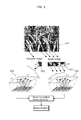
- FIG. 5 is a schematic view of a similar image search process performed by the feature extraction device 100 according to the embodiment.
- matching degrees each indicating the degree of matching between one of feature vectors obtained by inputting a template image 552 to the feature extraction device 100 and each of feature vectors obtained by inputting each of a plurality of target images 554 are calculated as inner products of vectors. Images having a higher score are determined to be images more similar to the template image 552.
- the template image 552 and the target images 554 may be arbitrary images.
- an image of one of blocks obtained by dividing an image (of rice) 550 is used as the template image 552, and images of the other blocks are used as the target images 554.
- FIG. 6 is a block diagram showing a structure of a three-layer matching network included in the feature extraction device 100 according to this embodiment.
- First layer neurons 301 to 303 in the first layer 309 receive inputs of pixel values (for example, integer numbers of 0 to 255) of input data obtained by dividing the template image 552 which is target data on a pixel-by-pixel basis. As will be described later, the first neuron requires data of all the pixels of the template image 552. Each of the first-layer neurons 301 to 303 outputs input pixel values to the second layer according to a matching rule.
- pixel values for example, integer numbers of 0 to 255
- Each of second-layer neurons 311 to 313 in the second layer 319 sums received input values, and outputs the total value to a comparison unit 352.
- each of the second layer neurons 311 to 313 outputs an output value based on the comparison result to the third layer according to a matching rule.
- Each of third layer neurons 321 to 323 in the third layer 329 sums received input values, and outputs the total value to a comparison unit 354.
- each third layer neurons 321 to 323 obtains a comparison result from the comparison unit 354, and outputs a feature quantity based on the comparison result.
- an expressed gene assignment unit 350 Prior to calculation in each of the first layer neurons, the second layer neurons, and the third layer neurons, an expressed gene assignment unit 350 randomly selects, for each of the neurons, at least one gene from a predetermined gene repertory, and assigns the at least one gene thereto as the expressed gene of the neuron.
- the comparison unit 352 obtains, for calculation, the sums of input values to the respective second layer neurons in the second layer 319. Furthermore, according to a predetermined activation criterion, neurons for which an activation instruction is output are determined based on the results of the obtainment.
- a comparison unit 354 obtains the sums of input values to the respective third layer neurons in the third layer 329. Furthermore, according to predetermined activation criteria, neurons for which an activation instruction is output are determined based on the results of the obtainment.
- each of the second layer neurons and the third layer neurons needs to output a logical sum (AND) of the input values from the immediately-previous layer.
- the criterion that "whether or not the current neuron has a sum of input values within the top 10%" is employed as the activation criterion used by each of the comparison unit 352 and the comparison unit 354, and an activation instruction is output to each of the neurons having a sum of input values within the top 10%
- FIG. 7 is a flowchart of processes performed by the feature extraction device 100 according to this embodiment.
- the feature extraction device 100 generates a matching network which is a calculation unit (S202). A method of generating the matching network will be described later.
- the feature extraction device 100 inputs target data to the generated matching network (S204).
- the target data is, for example, the template image 552 and the target images 554.
- each of the neurons in the first layer 309 receives, in an associated manner, inputs of pixel values of input data obtained by dividing the target data on a pixel-by-pixel basis. This will be described later.
- each of the neurons in the first layer 309 outputs the input pixel values as first signal values to the second layer according to the aforementioned matching rule (S206).
- each of the neurons in the second layer 319 calculates the total value of the obtained first signal values, and outputs the total value to the comparison unit 352.
- the comparison unit 352 outputs an activation instruction to each of the neurons selected based on the comparison results among the neurons in the second layer 319 (S209). This comparison process performed by the comparison unit 352 will be described in detail later.
- the neurons with the activation instruction and the other neurons outputs 1 and 0, respectively, as second signal values to corresponding neurons in the third layer (S210).
- the output destinations are determined also according to a matching rule.
- each of the neurons in the third layer 329 calculates the total value of the second signal values obtained from the second layer, and outputs the total value to the comparison unit 354.
- the comparison unit 354 outputs an activation instruction to each of the neurons selected based on the comparison results among the neurons in the third layer 329 (S212).
- the neurons with the activation instruction and the other neurons with a non-activation instruction outputs 1 and 0, respectively, as feature quantities (S214).
- the feature quantities output from the respective neurons in the third layer 329 are arranged, for example, in an order from the left and determined to be a feature vector, which makes it possible to perform following processes such as calculation of the degree of similarity of target data.
- This method of calculating a feature vector from feature quantities is an example.
- Such a feature vector can be calculated by determining the arrangement order of neurons and arranging feature quantities output from the respective neurons in the arrangement order of the neurons.
- Examples of conceivable methods of determining the arrangement order of neurons include a method of assigning identifiers to the respective neurons in the third layer 329 and sorting the identifiers in an ascending order or a descending order.
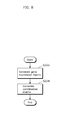
- FIG. 8 is a flowchart showing exemplary processes for generating, in the form of a matrix, a matching network included in the feature extraction device 100 according to this embodiment. More specifically, this flowchart corresponds to Step S202 in FIG. 7 .
- the expressed gene assignment unit 350 generates a gene expression matrix using random numbers (S222).
- the gene expression matrix is a matrix indicating which genes are assigned to each of the neurons in the matching network.
- a gene expression matrix 560 is an exemplary gene expression matrix.
- Each of the rows in the gene expression matrix corresponds to the neuron number which is the identifier of the neuron.
- each of the columns of the gene expression matrix corresponds to the gene number of a gene included in a gene repertory.
- the expressed gene can be represented not only by a number but also in any information form such as a symbol and a bitstream.
- the neuron having the corresponding neuron number is assigned with the gene having the corresponding gene number.
- the cells having gene numbers of 2, 4, and 10 has a value of 1. Accordingly, the neuron having the neuron number 1 is assigned with the three genes having the gene numbers 2, 4, and 10.
- each neuron has three expressed genes.
- target data is image data of 12 ⁇ 12 pixels.
- one pixel is assigned to each of the neurons in the first layer, the number of neurons in the first layer is one hundred and four neurons.
- the second layer includes a thousand neurons, and the third layer includes two hundreds and fifty neurons. The total number of neurons amounts to one thousand and ninety four neurons.
- the gene expression matrices are generated for each of the layers.
- the first layer includes a gene expression matrix of 144 rows and 20 columns
- the second layer includes a gene expression matrix of 1000 rows and 20 columns
- the third layer includes a gene expression matrix of 250 rows and 20 columns.
- the expressed gene assignment unit 350 generates three different random numbers within a range from 1 to 20 as the gene numbers of expressed genes, and set a value "1" to cells each having the same gene number(s) as the generated random number(s).
- the expressed gene assignment unit 350 set a value "0" to the other cells.
- This operation corresponds to a process of selecting the three genes from the gene repertory including the genes having the gene numbers within the range from 1 to 20.
- the expressed gene assignment unit 350 randomly assigns the three genes to each neuron by performing the aforementioned random number generation process for each row.
- connection matrix indicating combination relationships that is, signal paths
- matching rule that is, signal paths
- connection matrix includes two matrices which are a first to second layer connection matrix and a second to third layer connection matrix.
- connection matrix 562 is an exemplary connection matrix.
- Each of the connection matrices shows the neuron numbers of the neurons in the upper layer (for example, in the case of the first to second layer connection matrix, the upper layer is the first layer).
- each of the connection matrices shows the neuron numbers of the neurons in the lower layer (for example, in the case of the first to second layer connection matrix, the lower layer is the second layer).
- the first to second layer connection matrix is the matrix of 1000 rows and 144 columns
- the second to third layer connection matrix is the matrix of 250 rows and 1000 lines.
- connection matrix 562 the cell located at the first row and the second column has a value of 1. This shows that a signal path is formed which is from the neuron with neuron number 8 in the upper layer to the neuron with neuron number 1 in the lower layer.
- the feature extraction device 100 generates such a connection matrix based on the previously generated gene expression matrix.
- connection matrix when a cell in the connection matrix has a value of 1, the corresponding neurons in the upper and lower layers are assigned with at least one same expressed gene.
- the feature extraction device 100 performs the processes using the connection matrices generated in this way.
- FIG. 10 is a flowchart of processes in the first layer in the matching network in the feature extraction device according to this embodiment. More specifically, this flowchart corresponds to Steps S204 and S206 in FIG. 7 .
- the feature extraction device 100 obtains one piece of the target data (S232).
- the target data is a black and white image of 12 ⁇ 12 pixels, and is obtained as a matrix of 12 rows and 12 columns.
- Each of the one hundred and four elements of the matrix corresponds to a pixel value within a range from 0 to 255.
- the feature extraction device 100 transforms the matrix of 12 rows and 12 columns representing the target data into a matrix of 144 rows and 1 column. This is referred to as an image matrix.
- the feature extraction device 100 multiplies the first to second layer connection matrix of 1000 rows and 144 columns generated in Step S224 (S234) and the image matrix. As a result, a matrix of 1000 rows and 1 column is generated. Each of the rows in the matrix shows the total value of the inputs from the first layer neurons to the one thousand neurons in the second layer transmitted according to the matching rule.
- a computer can process signal transmission from the first layer neurons to the second layer neurons according to the matching rule.
- the calculated total values of the inputs to the second layer neurons are output to the comparison unit 352.
- FIG. 11 is a diagram showing an activation criterion for use in a comparison process by the comparison unit 352 according to this embodiment. This comparison processes correspond to the comparison process of Step S208 performed by the comparison unit 352 in FIG. 7 .
- the feature extraction device 100 is capable of selecting an activation criterion to be used by the comparison unit 352, and to thereby executing, for example, one of five logical calculations of AND, OR, NAND, NOR, and XOR.
- the comparison unit 352 sends an activation instruction to each of neurons that satisfy the criterion.
- each of the neurons having a value within the top 10% is shifted into an activated state, and outputs 1.
- Each of the other neurons remains in a non-activated state, and outputs 0.
- lower layer neurons having a greater number of positive inputs from the upper layer neurons is to output 1. This corresponds to an AND operation.
- the comparison unit 352 sends an activation instruction to each of neurons that satisfy the criterion.
- each of the neurons having the total value within the top 70% is shifted to an activated state, and outputs 1.
- Each of the other neurons remains in a non-activated state, and outputs 0.
- each of the lower layer neurons outputs 1 after receiving positive inputs from a smaller number of neurons compared to the number of neurons in the case of the AND operation. This process corresponds to an OR operation.
- the combinations of outputs from the neurons in the upper layer determine the total value of inputs received by the neurons in the lower layer.
- the five logical operations shown in FIG. 11 are defined as will be described later.
- each of the comparison unit 352 and the comparison unit 354 calculates feature quantities of images similar to the input image based on the activation criterion for performing the AND operation.
- Step S210 in FIG. 7 The flow of processes performed by the feature extraction device 100 according to this embodiment has been described above.
- the following signal transmission using a matching rule in Step S210 in FIG. 7 is the same as in Step S206.
- the process of Step S212 performed by the comparison unit 354 is the same as the process of Step S208 performed by the comparison unit 352. Thus, no detailed descriptions are repeated.
- Step S214 the feature extraction device 100 outputs a feature vector composed of two hundreds and fifty numbers of "1" or "0" for each of pieces of the target data.
- the procedure of searching a similar image based on the feature vector obtained in this way is as indicated earlier in FIG. 5 . See FIG. 5 .
- the feature extraction device 100 obtains a feature vector for each of the template image 552 and the target images 554, and then calculates the matching degree (such as an inner product) indicating the degree of matching between the feature vector of the template image 552 and each of the feature vectors of the respective target images 554.
- the resulting inner product value is a score indicating the degree of similarity. It can be determined that an image having a larger inner product value has a higher degree of similarity with the template image 552.
- the feature extraction device 100 includes a hierarchical neural network.
- This hierarchical neural network includes a plurality of first layer neurons (301 to 303) which are calculation units in the first layer and a plurality of second layer neurons (311 to 313) which are calculation units in the second layer.
- Each of the first layer neurons (301 to 303) and the second layer neurons (311 to 313) includes at least one expressed gene which is an attribute value for determining whether or not signal transmission is possible from the plurality of first layer neurons (301 to 303) to the second layer neurons (311 to 313).
- each of the first layer neurons (301 to 303) which has input data obtained by dividing the target data to be subjected to feature extraction outputs a first value to each of corresponding one or more of the second layer neurons (311 to 313) which has the same expressed gene(s) as the expressed gene(s) included in the first layer neuron.
- the first signal value increases as the value of the input data increases.
- each of the second layer neurons (311 to 313) calculates, as a feature quantity of the target data, the second signal value which is a value corresponding to the total sum of the first signal values input to the second layer neuron.
- the feature extraction device 100 may further include an expressed gene assignment unit 350 configured, for each of the first layer neurons (301 to 303) and the second layer neurons (311 to 313): (i) to select at least one gene from a gene repertory including a plurality of genes indicating predetermined attribute values; and (ii) to assign each of the selected at least one gene as the expressed gene.
- each of the first layer neurons (301 to 303) outputs the first signal value to only the second layer neuron(s) having the same expressed gene(s) as the expressed gene(s) included in the first neuron.
- the method of assigning expressed genes to the neurons performed by the expressed gene assignment unit 350 may be a method other than the aforementioned method for random selection.
- the expressed gene assignment unit 350 may randomly select the gene(s) that should be assigned as the expressed gene(s) from the gene repertory or may select the gene(s) that should be assigned as the expressed gene(s) from predetermined combinations included in the gene repertory.
- each of the second layer neurons (311 to 313) may output a predetermined value as the second signal value when the total sum of the first signal values input to the second layer neuron is included in a predetermined range; and output, as the second signal value, a value different from the predetermined value when the total sum of the first signal values input to the second layer neuron is not included in the predetermined range.
- the feature extraction device 100 may further include a comparison unit 352 configured to output an activation instruction to each of neurons, among the plurality of neurons (311 to 313), which has a rank within a predetermined range in descending order of total sums of the first signal values input to the neurons.
- a comparison unit 352 configured to output an activation instruction to each of neurons, among the plurality of neurons (311 to 313), which has a rank within a predetermined range in descending order of total sums of the first signal values input to the neurons.
- the neuron which has the activation instruction obtained from the comparison unit 352 outputs a predetermined value as the second signal value
- the neuron which does not have the activation instruction obtained from the comparison unit 352 outputs, as the second signal value, the value different from the predetermined value.
- the hierarchical neural network may include, as third layer calculation units, a plurality of third layer neurons (321 to 323) each including at least one expressed gene.
- each of the second layer neurons (311 to 313) outputs the second signal value to each of corresponding one or more third layer neurons, among the third layer neurons (321 to 323), which has the same expressed gene(s) as the expressed gene(s) included in the second layer neuron, and each of the third layer neurons (321 to 323) calculates a third signal value which is a value corresponding to a total sum of a plurality of the second signal values input to the third layer neuron.
- the feature extraction device 100 may further include: a first comparison unit 352 which outputs an activation instruction to each of second layer neurons, among the second layer neurons (311 to 313), which has a rank within a predetermined range in descending order of total sums of the first signal values input to the second layer neuron; and a second comparison unit 354 which outputs an activation instruction to each of third layer neurons, among the third layer neurons (321 to 323), which has a rank within a predetermined range in descending order of total sums of the second signal values input to the third layer neuron.
- a first comparison unit 352 which outputs an activation instruction to each of second layer neurons, among the second layer neurons (311 to 313), which has a rank within a predetermined range in descending order of total sums of the first signal values input to the second layer neuron
- a second comparison unit 354 which outputs an activation instruction to each of third layer neurons, among the third layer neurons (321 to 323), which has a rank within a predetermined range in descending order of total
- the neuron which has the activation instruction obtained from the comparison unit 352 outputs the predetermined value as the second signal value
- the neuron which does not have the activation instruction obtained from the comparison unit 352 outputs, as the second signal value, the value different from the predetermined value
- the neuron which has the activation instruction obtained from the comparison unit 354 outputs a predetermined value as the third signal value
- the neuron which does not have the activation instruction obtained from the comparison unit 354 outputs, as the third signal value, a value different from the predetermined value.
- the feature extraction device 100 may further include: an expressed gene assignment unit 350 configured, for each of the first layer neurons (301 to 303), the second layer neurons (311 to 313), and the plurality of third layer neurons (321 to 323): (i) to select at least one gene from a gene repertory including a plurality of genes each indicating a predetermined attribute value; and (ii) to assign each of the selected at least one gene as the expressed gene; a first comparison unit 352 configured (i) to obtain a rank of each of the second layer neurons (311 to 313) based on a total sum of the first signal values input to the second neuron; and (ii) to output an activation instruction to each of second layer neurons, among the second layer neurons, which has a rank higher than or equal to a rank predetermined as a threshold value, a second comparison unit 354 configured: (i) to obtain a rank of each of the third layer neurons (321 to 323) based on a total sum of the second signal values input to the third neuron; and
- each of the first layer neurons (301 to 303) obtains the values of input data obtained by dividing a feature extraction target by the number of first layer neurons (301 to 303), and outputs the values of the input data as the first signal values to the second layer neurons (311 to 313) each including at least one same expressed gene included in the first layer neuron.
- each of the first layer neurons (301 to 303) outputs 1 as the second signal value when the second layer neuron has the activation instruction obtained from the first comparison unit 352, and outputs 0 as the second signal value when the second layer neuron does not have the activation instruction obtained from the first comparison unit 352.
- each of the third layer neurons (321 to 323) outputs 1 as the third signal value when the third layer neuron has the activation instruction obtained from the second comparison unit 354, and outputs 0 as the third signal value when the third layer neuron does not have the activation instruction obtained from the second comparison unit 354.
- the expressed gene assignment unit 350 randomly assigns expressed genes to each of the neurons. Using the values of the expressed genes and the matching rules, combined states between the adjacent layers in the hierarchical neural network are determined (the combined states correspond to the matching network).
- the matching network includes a function of calculating in parallel some of the five logical operations of AND, OR, NAND, NOR, and XOR, based on the activation criteria that the comparison units 352 and 354 use in their comparison processes for signal transmission between the adjacent layers.
- parallel calculation means, for example, each of the second layer neurons receives plural input values respectively from plural first layer neurons and performs a logical operation using the plural input values to obtain its output value, and the respective second layer neurons output their output values in parallel.
- the logical operations are parallel logical operations which are executed in parallel on a plurality of inputs to the matching network. Accordingly, in order to differentiate these operations from conventional logical operations on two input values, an AND operation, an OR operation, a NAND operation, a NOR operation, and an XOR operation here are referred to as a parallel AND operation, a parallel OR operation, a parallel NAND operation, a parallel NOR operation, and a parallel XOR operation, respectively.
- the column of feature quantities output in this way becomes a feature vector including, as extractions, features of the target data.
- FIG. 12 is a schematic view of a dissimilar image search process performed by the feature extraction device 100 according to the variation of the embodiment.
- a template image 552 and the target image 554 are obtained by dividing an image 550 into predetermined blocks as in the embodiment described earlier.
- a feature extraction device 100 in this variation has the same structure as in the embodiment shown in FIG. 6 , and thus no detailed description thereof is repeated.
- the comparison units 352 and 354 perform a parallel AND operation when the target data is the template image 552 in order to obtain a feature vector including, as extractions, features of the target data.
- the comparison units 352 and 354 transmit activation instructions to the neurons within the top 10%.
- the comparison units 352 and 354 perform parallel NOR operations for each of the target images 554 in order to obtain a feature vector including, as extractions, features different from the features of the target images 554. In other words, when the target data is of the target images 554, the comparison units 352 and 354 transmit activation instructions to the neurons within the bottom 10%.
- an inner product is calculated which is between the feature vector of the template image 552 output from the feature extraction device 100 and the feature vector of each of the template images 554.
- the resulting inner product value is a score indicating the degree of dissimilarity. It can be determined that an image having a larger inner product value has a higher degree of dissimilarity with the template image 552.
- the feature extraction device 100 further includes: an expressed gene assignment unit 350 configured, for each of the first layer neurons (301 to 303), the second layer neurons (311 to 313), and the third layer neurons (321 to 323): (i) to select at least one gene from a gene repertory including a plurality of genes each indicating a predetermined attribute value; and (ii) to assign each of the selected at least one gene as the expressed gene; a first comparison unit 352 configured (i) to obtain a rank of each of the second layer neurons (311 to 313) based on a total sum of the first signal values input to the second neuron; and (ii) to output an activation instruction to each of second layer neurons, among the second layer neurons, which has a rank lower than or equal to a rank predetermined as a threshold value, a second comparison unit 354 configured: (i) to obtain a rank of each of the third layer neurons (321 to 323) based on a total sum of the second signal values input to the third neuron; and (ii
- each of the first layer neurons (301 to 303) obtains the values of input data obtained by dividing a feature extraction target by the number of first layer neurons (301 to 303), and outputs the values of the input data as the first signal values to the second layer neurons (311 to 313) each including at least one same expressed gene included in the first layer neuron.
- each of the second layer neurons (311 to 313) outputs 1 as the second signal value when the second layer neuron has the activation instruction obtained from the first comparison unit 352 and to output 0 as the second signal value when the second layer neuron does not have the activation instruction obtained from the first comparison unit 352.
- each of the third layer neurons (321 to 323) outputs 1 as the third signal value when the third layer neuron has the activation instruction obtained from the second comparison unit 354 and to output 0 as the third signal value when the third layer neuron does not have the activation instruction obtained from the second comparison unit 354.
- FIG. 13 is a diagram showing examples of results of similar image searches and dissimilar image searches performed by the feature extraction device 100 according to the embodiment and this variation.
- the search result 570 shown in FIG. 13 is a result of searching a similar image using the feature extraction device 100 according to the embodiment.
- the upper left block among the blocks included in the search result 570 is a template image 552.
- the remaining twenty four blocks are target images having a similarity degree score ranked within the top twenty four searched out from among the target images 554.
- a search result 574 is shown which is a result of searching out an image similar to the template image 552 from among the target mages 554 according to a mean square error method.
- a square value (a mean squared error) of a difference between pixel values is calculated for each of pixels at corresponding positions using a template image 552 and a target image. Subsequently, the total value of mean squared errors of all the pixels is calculated. An image having a smaller total value is determined to be an image more similar to the template image 552, and an image having a larger total value is determined to be an image more dissimilar to the template image 552.
- Comparison between the search result 570 and the search result 574 shows that the search result 570 obtained in the case of using the feature extraction device 100 compares favorably to the search result 574 obtained using a mean square error method.
- the search result 572 shows the result of searching out a dissimilar image using the feature extraction device 100 according to this variation.
- the upper left block is a template image 552.
- the remaining twenty four blocks are target images having a dissimilarity degree score within the top twenty four searched out from among the target images 554.
- the search result 576 shows a result of searching out, using a mean square error method, an image dissimilar to the template image 552 from among the target images 554.
- Comparison between the search result 572 and the search result 576 obtained using the mean square error method shows that the search result 576 in the case of using the mean squared error includes a greater number of images having contrast opposite to the contrast of the template image 552.
- the comparison shows that the search result 572 in the case of using the feature extraction device 100 includes various images different from the template image 552 in addition to such images simply having contrast opposite to the contrast of the template image 552.
- the feature extraction device 100 can properly extract, as feature vectors, not simple "opposite pixel values” but "features not included in the template image 552".
- the search result 572 including various kinds of dissimilar images is closer to search results of "images dissimilar to the template image 552" that people imagine generally.
- This result shows that dissimilar image searches are possible by using feature vectors output from the feature extraction device 100 according to this variation.
- target data from which features can be extracted by the feature extraction device 100 according to the embodiment and this variation is not limited to such image data. Any data composed of discrete numerical values can be input data. Examples of such arbitrary input data includes waveform data, binarized transaction data, and data obtained by sensing etc.
- output from the intermediate layer and the output layer included in the feature extraction device 100 may be values other than binary values of "0" and "1".
- each of the neurons in the second layer which is the intermediate layer and in the third layer which is the output layer may output a total sum of input signal values.
- each of neurons having an activation instruction among the neurons in the second layer which is the intermediate layer and the third layer which is the output layer may output the total sum of the input second signal values.
- each of the neurons in the second layer which is the intermediate layer and in the third layer which is the output layer may output an arbitrary constant A when the total sum of the input signal values is equal to or smaller than a predetermined threshold value and otherwise may output a constant B other than the constant A.
- each of the neurons in the intermediate layer and the output layer may be a calculation unit which outputs a value corresponding to the total sum of the input signal values.
- the first layer may, for example, binarize each of the values of input data into 0 or 1 instead of outputting the raw values of the input data. More specifically, it is also good to determine a threshold value in advance, and to output 1 when the value is larger than or equal to the threshold value and output 0 when the value is smaller than the threshold value.
- each of the neurons in the input layer may be a calculation unit which outputs a first signal value that increases with increase in the value of the input data.
- each of the comparison units 352 and 354 may output a non-activation instruction for bringing neurons which do not satisfy a criterion into a non-activated state.
- each neuron may enter into an activated state in response to an activation instruction, and may return back to a non-activated state in response to a non-activation state.
- the comparison units 352 and 354 may output a non-activation instruction to each of the neurons and initialize the neuron into a non-activated state each time the feature extraction device 100 obtains new target data.
- activated neurons may gradually transit into a non-activated state as time elapses. In this case, it is conceivable that the output values from the neurons are made smaller as the transition into a non-activation state progresses.
- each neuron in a non-activated state does not need to output "0" among the neurons in the intermediate layer and in the output layer according to the embodiment and this variation.
- each neuron in an activated state may output "1" and the others may do nothing among the neurons in the intermediate layer and in the output layer.
- each neuron may select its output by comparing the total value of the inputs with a criterion based on an absolute value (that is, a predetermined threshold value), instead of a relative rank in the layer.
- the neurons in the layer may communicate their total values of input values with each other, and may thereby obtain their relative ranks based on the total values of the input values.
- random numbers for use by the expressed gene assignment unit 350 according to the embodiment and this variation may be random numbers produced using random number generator or the like, or pseudo random numbers produced by calculation processes.
- the number of genes included in a gene repertory is approximately one hundred at most. Accordingly, such random numbers are easily generated, and are used sufficiently even when the random numbers are cyclical.
- the feature extraction device 100 forms signal paths between an upper layer and a lower layer when at least one same expressed gene is included in both the upper layer and in the lower layer in the generation of a connection matrix.
- the activation criteria for use by the comparison units 352 and 354 may be different from each other.
- the comparison unit 352 may execute a parallel AND operation in signal transmission between the first layer and the second layer
- the comparison unit 354 may execute a parallel NOR operation in signal transmission between the second layer and the third layer.
- the activation criteria for use in the respective layers may be different from each other in the case of a four-layer matching network.
- the feature extraction device 100 uses the same gene repertory for all the layers.
- the expressed gene assignment unit 350 may assign expressed genes to the neurons using gene repertories different for the respective layers.
- the feature extraction device 100 may include the comparison units respectively in the second and third layers. This merely shows that it is possible to conceive such comparison units logically corresponding to the respective layers. Accordingly, the feature extraction device 100 may include a single comparison unit as a whole, and the comparison unit may perform comparison processes for all the layers.
- determinations on the similarities of feature vectors may be made based on values other than inner products.
- any processes for extracting the degree of matching between two feature vectors are possible. For example, a mean squared error between two feature vectors is possible.
- the hierarchical neural network included in the feature extraction device 100 is intended for signal transmission between adjacent layers in one direction from an upper layer to a lower layer in the above description.
- the neural network is an exemplary non-limiting one. It is also good to transmit signals form a lower layer to an upper layer, or to transmit signals from a neuron to another neuron in the same layer as necessary.
- the neural network included in the feature extraction device has been described assuming that the neural network is a hierarchical network having a hierarchical structure.
- a neural network which does not have a hierarchical structure is possible.
- a hop-field network for mutual combination is possible. This is because the essence of the present invention lies in transmitting signals between neurons according to a matching rule.
- the feature extraction device may be a feature extraction device including a neural network and including a plurality of neurons which are calculation units, each of the neurons may include at least one expressed genes which is an attribute value for determining whether or not signal transmission from one of the neurons to an other one of the neurons is possible, among the neurons, each of first neurons which has input data obtained by dividing target data subjected to feature extraction may output a first signal value which is larger as the value of the input data is larger to corresponding second neurons each including at least one same expressed gene as the expressed gene included in the first neuron, and each of the second neuron may calculate, as a feature quantity of the target data, a second signal value which is a value corresponding to the total sum of input first signal values input to the second neuron.
- any conventional artificial neural network cannot integrate information processing capabilities even when combining a plurality of networks learned separately.
- the matching networks are networks generated independently, it is possible to combine or connect the matching networks to each other for extension according to matching rules, and to integrate the pieces of information processed by the separate networks.
- a network is possible which includes the following networks generated independently: a second-layer matching network (for executing parallel AND processing) for processing the template image 552; and a second-layer matching network (for executing parallel NOR processing) for processing the target images 554.
- the expressed genes assigned to the neurons may be different between the matching network for performing the parallel AND processing and the matching network for performing the parallel NOR processing.
- the expressed genes (specifically, the numbers of the expressed genes) assigned to the input data obtained by dividing the target data subjected to the feature extraction must be common, and thus the input layer (the first layer) must be common.
- the five parallel logical operations shown in FIG. 11 are examples of operation processes performed by the matching network.
- output may be performed according to another rule such as "Neurons within the top 10% output 2, the neurons other than the neurons within the top 10% among the neurons within the top 50% output 1, the neurons other than the neurons within the top 50% among the neurons within the top 80% output 0, and the remaining neurons output -1.”
- connection matrices as weighted matrices and change the values through learning.
- the matching rule has been conceived based on the fact that approximately sixty kinds of sub-types make up a gene cluster in a cluster Proto-cadherin (cPcdh) which is a cell adhesion molecule group discovered by the Inventors of the present invention, and random combinations of these sub-types express in the neural cells.
- cPcdh cluster Proto-cadherin
- the Inventors establish a hypothesis that information processing in a brain is performed in the form of a simultaneous parallel processing in a plurality of networks which connect the cells in which the same proto-cadherin molecule seed (the expressed gene in the embodiment) express. Based on the hypothesis, the Inventors have made the feature extraction device including a matching network.
- the network When arbitrary two nodes in a network are connected via a small number of intermediate nodes, the network has a short distance between the vertices. In other words, the average distance between the arbitrary nodes is small.
- the network When two nodes connected to a node are also connected to each other, the network has a high clusterness.
- the network includes a triangle network composed of the three nodes.
- the aforementioned matching network has almost the same distance between vertices as in a random network which is a representative network having a short distance between vertices, but has a clusterness much higher than in the random network.
- a matching network which connects an input layer including a small number of neurons and an intermediate layer including a large number of neurons is capable of widely dispersing the values of the input data input in the input layer to the neurons in the intermediate layer.
- a matching network which connects an intermediate layer including a large number of neurons and an output layer including a small number of neurons is capable of generating a feature quantity by integrating, into the output layer, outputs resulting from the input data dispersed to the intermediate layer. Accordingly, it is possible to detect effective combinations.
- the target data provides various kinds of feature quantities by means of fair combinations being extracted in transmission from the intermediate layer to the output layer.
- a conspicuous effect is considered to be obtained when the number of intermediate layers is large. Accordingly, for example, as shown by the results of dissimilar image searches in FIG. 13 , it is considered to be able to output feature vectors of images "which are different in various kinds of viewpoints" from the template image 552.
- the feature extraction device 100 is a feature extraction device intended to generate, on a computer, a matching network having a unique property that is small-worldness, and use the matching network.
- the matching network further has a property of being easy to maintain the characteristics of pieces of information input in each layer even when the number of layers is increased.
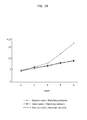
- FIG. 14 is a diagram showing the relationship between the number of layers and maintained information in each of the matching network (MN) and the random network (random).
- the vertical axis shows the conspicuity of response characteristics of each of the neurons. As the value increases, the respective neurons return more different responses due to the characteristics of the images presented in the layer. This shows that each of the neurons has a favorite image.
- the horizontal axis shows the number of hierarchical layers.
- the neurons in the random network lose response characteristics as the number of hierarchical layers is increased. This means that an activity of a neuron does not show characteristics of a presented image.
- the response characteristics of neurons do not decrease so much even when the number of hierarchical layers is increased. Thus, it can be said that information indicating characteristics of images presented in the layer are maintained.
- an advantageous effect provided is that performance decreases less when an output from a lower layer is returned back to an upper layer in information processing.
- a result of processing by a layer needs to be saved for a while and to be used later.
- the matching network it is easy to combine different neuron codes (that are, activated neuron numbers) of neurons between hierarchical layers. This property of the matching network provides the following advantageous effect.
- the matching network enables easy formation of various kinds of logical circuits.
- each of the layers forms a logical element. More specifically, each of the layers is the parallel logical element.
- the matching network includes a high information maintenance capability as shown in FIG. 14 .
- each of the logical elements can have only a simple function, but it is possible to form a complicated logical circuit by combining such logical elements in series or in parallel in several stages. More specifically, it is possible to configure a complicated circuit such as a comparator by combining simple AND and NAND circuits, as in a general digital logical circuit. This is possible on a premise that information is stably transmitted between such elements. This is secured by the information maintenance capability of the matching network shown in FIG. 14 .
- the respective layers in the hierarchical matching network are parallel logical elements, which provide an advantageous effect of being able to form various kinds of logical circuits by combining these parallel logical elements.
- input data A, input data B, and input data C are data output by sensors corresponding to visual sense, auditory sense, and touch sense of the working robot.
- the robot needs to recognize the environments by integrating the data respectively output by the sensors corresponding to the visual sense, auditory sense, and touch sense as in the case of a human being. Accordingly, for example, when a second layer neuron 311 receives inputs from a first layer neuron 301 and a first layer neuron 302, a second layer neuron 312 receives inputs from the first layer neuron 302 and the first layer neuron 303, and a second layer neuron 313 receives inputs from the first layer neuron 303 and the first layer neuron 301, none of the second layer neurons receives the three data items of input data A to C.
- a third layer neuron 321 for example receives inputs from the second layer neuron 311 and the second layer neuron 312, the third layer neuron 321 can perform processing with reference to all of the three input data A to C. In this way, it is possible to increase a probability that a neuron can perform processing based on all the pieces of information output from the sensors by adding the third layer (or the fourth layer etc.). Accordingly, the property of being able to increase combinations between hierarchical layers is essential for a matching network to realize multi-modal information processing.
- FIGs. 15A to 15C show results of extracting features of three different images using the matching network. More specifically, (a) of FIG. 15A shows neuron codes (activated neuron numbers) obtained by inputting an image shown in (b) of FIG. 15A to the matching network. On the other hand, (c) of FIG. 15A is a graph shown as a histogram of the gene codes of genes activated when the image shown in (b) of FIG. 15A is input to the matching network. In other words, the gene codes are pieces of information indicating a frequency distribution of the expressed genes in the form of a vector in which the number of elements is the number of genes in a gene repertory.
- the frequency of an expressed gene is determined for each of a plurality of neurons such that the frequency of the expressed gene included in the neuron (that is, the expressed gene is assigned to the neuron) increases as the number of signal values input from one of the neurons to the current neuron according to the matching rule. This means that an expressed gene included in a neuron having a larger number of input first signal values has a greater influence.
- Each of (a) of FIG. 15B and (a) of FIG. 15C shows neuron codes obtained by inputting images shown in (b) of FIG. 15B and (b) of FIG. 15C in the matching network.
- each of (c) of FIG. 15B and (c) of FIG. 15C is a graph shown as a histogram of the gene codes of genes activated when corresponding ones of the images shown in (b) of FIG. 15B and (b) of FIG. 15C are input to the matching network.
- each of the histograms of gene codes shown as (c) of FIG. 15A, (c) of FIG. 15B, and (c) of FIG. 15C shows the feature quantities of the images shown as a corresponding one of (b) of FIG. 15A, (b) of FIG. 15B, and (b) of FIG. 15C.
- the matching network when the matching network is considered focusing on the gene codes, it is possible to consider that information processing performed by the matching network is processing of outputting the degrees of similarity between a plurality of gene code groups and given pieces of data.
- the matching network provides the advantageous effect of having two kinds of information code formats of neuron codes and gene codes as shown in FIG. 15A to FIG. 15C.
- FIG. 15A to FIG. 15C may be referred to as FIGs. 15A to 15C .
- FIGs. 15A to 15C shows an example of a matching network including a gene repertory made up of 50 genes.
- the gene codes are represented as a vector in which the number of elements is the number of genes in the gene repertory.
- Activities of neurons as shown in (a) of FIG. 15 are directly shown as outputs from the layers, and are equivalent to the gene codes (the total of genes included in the activated neurons) in (c) of FIG. 15 .
- the neuron codes in (a) of FIG. 15 takes a value which is different for each layer or for a matching network to be used even in the case of a same image.
- the neuron numbers of neurons to be activated are different between layers even in the case of the same image.
- the gene codes are unique values for representing the image.
- the matching network has a high integrity because it transmits common gene codes.
- the matching network transmits the unique values of gene codes corresponding to pieces of information (here, an image), utilizing the activities of the neurons.
- each of the layers in the matching network can be considered as a logical element which transforms gene codes.
- NOR element transforms each gene code into a totally dissimilar pattern, and searches for an image having such a gene code.
- the matching network is capable of transforming a mere activity (neuron code) of each neuron into a unique vector (gene code).
- each of the genes represents a unique pattern (prototype) as shown in FIG. 18 to FIG. 20 .
- the gene code is intended to explicitly represent, for each of the images, which prototype or which combination of prototypes is similar to the image, and how much the degree of similarity is.
- the gene codes provide a possibility that the unconventional operation is performed.
- the feature extraction device 100 is a feature extraction device which determines, for each of the second neurons, the frequency of each of the expressed genes included in the second neuron such that the frequency increases with increase in the number or the magnitudes of first signal values input to the second neuron, and outputs, as the features of the target data, gene codes which are information indicating a distribution of sums of frequencies of the expressed genes, each sum being a sum of frequencies of a corresponding one of the expressed genes included in some of the plurality of second neurons.
- the feature extraction device 100 may determine, for each second neuron, the frequencies of the expressed genes included in the second neuron as the number of first signal values input to the second layer. For example, when a given neuron includes three expressed genes represented by 2, 4, and 7, and each of the neurons receives ten signal values from another one of the neurons, the frequencies of the expressed genes denoted as 2, 4, and 7 included in the given neuron are determined to be ten. This value is summed up for each of the second neurons, and the frequency distribution for each gene is generated.
- the feature extraction device 100 determines, for each of the second neurons, whether or not the number or the magnitudes of first signal values input to the second neuron is greater than or equal to a threshold value, and determines the gene codes as the frequencies of the expressed genes included in the second layer neuron having first signal values in number greater than or equal to the threshold value.
- FIG. 16 is a diagram of a matrix of 12 x 12 segments of gene codes included in each of one hundred and four first layers.
- a first segment includes 8, 36, and 43. This shows that the gene codes included in the first neuron among the one hundred and four first layer neurons are 8, 36, and 43.
- FIG. 17A is a diagram in which each of segments including a gene code of "1" in FIG. 16 is assigned with "1", and the other segments are empty.
- the upper left segment corresponds to the first neuron among the first layer neurons
- the lower right segment corresponds to the one hundred and fourth neuron among the first layer neurons.
- FIG. 17B is a diagram in which each of segments including a gene code of "2" in FIG. 16 is assigned with “2", and the other segments are empty.
- FIG. 17C is a diagram in which each of segments including a gene code of "3" in FIG. 16 is assigned with “3”, and the other segments are empty.
- FIG. 18 shows the obtained fifty images arranged in a matrix of 5 images x 10 images.
- the segments (having assigned gene codes) other than the empty segments are painted black.
- FIG. 18 provides images showing a list of patterns of gene codes in the first layer of a given matching network.
- the upper left segment 610a is an image in which a neuron including a gene code "1" is visualized among one hundred and four neurons.
- the lower right segment 610b is an image in which a neuron including the gene code "50" is visualized.
- an image which is shown as an image in the matrix in FIG. 18 and in which a neuron including a particular gene code is visualized is referred to as a prototype image.
- expressed genes are randomly assigned to the neurons, and thus each of the prototype images in which the gene codes are visualized shows a random pattern.
- the matching network performs a process of calculating the degrees of contribution (weights) of the respective prototype images when the input data is represented as combinations of the fifty prototype images as shown in FIG. 18 .
- the feature extraction process performed by the matching network is a process of determining the combinations of the known prototype images in such a manner that the input data can be represented effectively.
- gene codes may be determined differently than randomly.
- the expressed gene assignment unit 350 does not need to always randomly assign expressed genes to the neurons.
- FIG. 19 is images obtained by binarizing arbitrarily selected fifty images. Experiments performed by the Inventors showed that similar image searches can be performed with high precisions even in the case of the matching network which generates prototype images by binarizing other images in the aforementioned manner and assigns expressed genes corresponding to the prototype images to the neurons.
- the functions of the matching network for representing new inputs as combinations of known patterns can be used, for example, in data mining etc. targeting user preference in marketing.
- a specific description is given assuming a scenario for developing a new tea product.
- each of one hundred and four evaluators is asked to drink known fifty kinds of tea and to list five kinds of teas as his or her favorites.
- the evaluators are respectively assigned with numbers 1 to 144, and the fifty kinds of tea are respectively assigned with numbers 1 to 50.
- FIG. 21A is a diagram showing the tea numbers listed by the one hundred and four people as indicating their favorite kinds of tea.
- the leftmost column indicates that Evaluator 1 lists Tea No. 2, No. 5, No. 21, No. 46, and No. 49, as favorites.
- the rightmost column indicates that Evaluator 144 lists Tea No. 6, No. 22, No. 35, No. 41, and No. 44, as favorites.
- each of the same one hundred and four evaluators is asked to drink a new kind of tea which is currently being produced as a new product and to answer whether he or she likes the new kind of tea.
- the numbers of people is counted and a histogram of the numbers is generated.
- FIG. 21B shows the histogram indicating "the tea numbers of known kinds of tea listed as favorites by the people who like the new kind of tea" generated in the aforementioned manner.
- FIG. 21B shows that the new tea is favored by the people who like Tea No. 36, No. 50, etc.
- FIG. 21B also shows that the new tea is not favored by the people who like Tea No. 20, No. 21, etc.
- the matching network determines the similarity based on the degrees of similarity in the histogram as shown in FIG. 21B .
- FIG. 22 shows data of favorites of the one hundred and four evaluators shown in FIG. 21A input to the first layer 630 of the matching network.
- each of the columns showing neurons included in the first layer 630 includes the tea numbers listed as favorites by the evaluator in the column.
- the number of columns of the first layer 630 is one hundred and four when the number of the evaluators is one hundred and four. However, for simplification, only a part of the columns is shown here.
- the first layer 630 and the second layer 632 have connections made based on a matching rule that "a connection is generated between neurons having at least one matching favorite tea number".
- a connection is generated between the layers according to the matching rule, it is possible to extract, for example, the kinds of tea which are favored by a larger number of people using the matching network.
- the type of connections between the neurons shown in FIG. 22 are referred to as a first connection type.
- the first layer 634 and the second layer 636 have connections generated based on a matching rule that "a connection is made only between neurons having three or more matching tea numbers.”
- Each of the connections between the layers made according to the matching rule makes it possible to extract which kinds of tea are commonly favored by the individuals in the connection.
- the type of a connection between the neurons shown in FIG. 23 is referred to as a second connection type.
- the first layer 638 and the second layer 640 have connections made based on a matching rule that "a connection is made between neurons by the number of matching tea numbers".
- the connection between layers made according to the matching rule has an intermediate property between the earlier-mentioned two matching rules. In other words, a connection is made between tea numbers favored by a large number of people, and a greater number of connections (that is, a connection with a larger weight) are made between tea numbers of tea commonly favored by the people.
- the type of connections between the neurons shown in FIG. 24 is referred to as a third connection type.
- connection types it is possible to use different connection types in combination in a single matching network.
- connection type of the connection between the first layer 642 and the second layer 644 is determined to be the first connection type
- connection type of the connection between the first layer 642 and the second layer 646 is determined to be the second connection type
- connection types of a connection between the second layer 644 and the third layer 648 and a connection between the second layer 646 and the third layer 648 are determined to be the third connection type.
- the second layer 644 it is possible to extract the kinds of tea favored by a large number of people among the one hundred and four evaluators.
- the second layer 646 it is possible to extract combinations of kinds of tea commonly favored by a part of people among the one hundred and four evaluators.
- the third layer 648 it is possible to extract mixed (blended) tea made from tea of different kinds commonly favored by people who like a given kind of tea and favored by a large number of people.
- each of the first layer neurons may (A) output a signal to the second layer neuron when the number of matching expressed genes included in both the first layer neuron and the second layer neuron is larger than or equal to a predetermined threshold value, or (B) add a larger weight to a signal as the number of matching expressed genes included in both the first layer neuron and the second layer neuron is larger, and output the weighted signal to the second layer neuron.
- the matching network has characteristics of being less vulnerable to information loss in the case of transmission between layers, and thus is less vulnerable to decrease in feature extraction performances even when some of the connection types are changed and one or more layers are added.
- the matching network is applicable not only as the feature extraction device but also as a device which is capable of sufficiently approximating unknown patterns and detecting combinations of known patterns. Accordingly, the matching network is applicable to data mining for marketing as mentioned earlier.
- the matching network can effectively extract features of both an image similar to a given image and an image dissimilar to the given image. Accordingly, the matching network is applicable to, for example, a scene extraction device which collects similar scenes in a video, a detection device for automatically detecting a suspicious moving object in a video for crime prevention.
- the feature extraction device 100 described in the embodiment can be realized as a computer.
- the feature extraction device 100 includes a computer 34, a keyboard 36 and a mouse 38 for giving instructions to the computer 34, a display 32 for presenting information such as calculation results by the computer 34, a Compact Disc Read Only Memory (CD-ROM) device 40 for reading a program to be executed by the computer 34, and a communication modem (not shown).
- CD-ROM Compact Disc Read Only Memory
- the program that is executed by the feature extraction device 100 is stored in the CD-ROM 42 which is a computer-readable medium, and is read by the CD-ROM device 40. Otherwise, the program is read by the communication modem 52 via a computer network.
- FIG. 27 is a block diagram showing a hardware structure of a computer system which includes the feature extraction device 100.
- the computer 34 includes a Central Processing Unit (CPU) 44, a Read Only Memory (ROM) 46, a Random Access Memory (RAM) 48, a hard disk 50, a communication modem 52, and a bus 54.
- CPU Central Processing Unit
- ROM Read Only Memory
- RAM Random Access Memory
- the CPU 44 executes a program read through the CD-ROM device 40 or the communication modem 52.
- the ROM 46 stores a program and data which are necessary for operations by the computer 34.
- the RAM 48 stores data such as parameters for use in execution of the program.
- the hard disk 50 stores programs, data, etc.
- the communication modem 52 performs communication with other computers via a computer network.
- the bus 54 mutually connects the CPU 44, the ROM 46, the RAM 48, the hard disk 50, the communication modem 52, the display 32, the keyboard 36, the mouse 38, and the CD-ROM device 40.
- a part or all of the structural elements of the feature extraction device 100 may be configured as a single Large Scale Integration (LSI).
- LSI Large Scale Integration
- a system LSI is a super multi-functional LSI manufactured by integrating a plurality of structural units onto a single chip, and is specifically a computer system configured to include a microprocessor, a ROM, a RAM, and so on.
- a computer program is stored in the RAM.
- the system LSI achieves its function through the macroprocessor's operations according to the computer processor.
- a part or all of the structural elements of the feature extraction device 100 may be configures as a detachable IC card or an individual module.
- An IC card or a module is a computer system composed of a microprocessor, a ROM, a RAM, and so on.
- the IC card or module may include the aforementioned super multi-functional LSI.
- the IC card or module achieves its function through the macroprocessor's operations according to the computer processor.
- the IC card or module may be configured to be tamper-resistant.
- the present invention may be realized as the aforementioned method. Furthermore, the present invention may be realized as the computer program for causing a computer to execute the method and as a digital signal including the computer program.
- the present invention may be realized as the computer program or digital signal recorded on a computer-readable recording medium such as a flexible disc, a hard disk, a CD-ROM, an MO, a DVD, a DVD-ROM, a DVD-RAM, a Blu-ray Disc (BD, registered trademark), a USB memory, a memory card such as an SD card.
- a computer-readable recording medium such as a flexible disc, a hard disk, a CD-ROM, an MO, a DVD, a DVD-ROM, a DVD-RAM, a Blu-ray Disc (BD, registered trademark), a USB memory, a memory card such as an SD card.
- the present invention may be realized as the digital signal recorded on these recording media.
- the present invention may also be implemented as the aforementioned computer program or digital signal transmitted via a telecommunication line, a wireless or wired communication line, a network represented by the Internet, a data broadcast, and so on.
- the present invention may also be implemented as a computer system including a microprocessor and a memory, in which the memory stores the computer program and the microprocessor operates according to the computer program.
- the present invention is applicable to feature extraction devices, and particularly to feature extraction devices etc. using artificial neural networks.
Landscapes
- Engineering & Computer Science (AREA)
- Theoretical Computer Science (AREA)
- Physics & Mathematics (AREA)
- General Physics & Mathematics (AREA)
- Health & Medical Sciences (AREA)
- Computer Vision & Pattern Recognition (AREA)
- Artificial Intelligence (AREA)
- Data Mining & Analysis (AREA)
- Evolutionary Computation (AREA)
- General Health & Medical Sciences (AREA)
- Life Sciences & Earth Sciences (AREA)
- Computing Systems (AREA)
- General Engineering & Computer Science (AREA)
- Biomedical Technology (AREA)
- Multimedia (AREA)
- Databases & Information Systems (AREA)
- Library & Information Science (AREA)
- Software Systems (AREA)
- Molecular Biology (AREA)
- Biophysics (AREA)
- Medical Informatics (AREA)
- Physiology (AREA)
- Bioinformatics & Cheminformatics (AREA)
- Bioinformatics & Computational Biology (AREA)
- Evolutionary Biology (AREA)
- Biodiversity & Conservation Biology (AREA)
- Neurology (AREA)
- Mathematical Physics (AREA)
- Computational Linguistics (AREA)
- Image Analysis (AREA)
Applications Claiming Priority (2)
| Application Number | Priority Date | Filing Date | Title |
|---|---|---|---|
| JP2010234064 | 2010-10-18 | ||
| PCT/JP2011/005807 WO2012053188A1 (ja) | 2010-10-18 | 2011-10-18 | 特徴抽出装置、特徴抽出方法、及び、そのプログラム |
Publications (2)
| Publication Number | Publication Date |
|---|---|
| EP2631872A1 true EP2631872A1 (de) | 2013-08-28 |
| EP2631872A4 EP2631872A4 (de) | 2015-10-28 |
Family
ID=45974918
Family Applications (1)
| Application Number | Title | Priority Date | Filing Date |
|---|---|---|---|
| EP11834034.8A Withdrawn EP2631872A4 (de) | 2010-10-18 | 2011-10-18 | Merkmalsextraktionsvorrichtung, merkmalsextraktionsverfahren und programm dafür |
Country Status (4)
| Country | Link |
|---|---|
| US (1) | US20130212053A1 (de) |
| EP (1) | EP2631872A4 (de) |
| JP (1) | JP5656202B2 (de) |
| WO (1) | WO2012053188A1 (de) |
Cited By (1)
| Publication number | Priority date | Publication date | Assignee | Title |
|---|---|---|---|---|
| US11791363B2 (en) | 2016-03-30 | 2023-10-17 | Nikon Corporation | Element, system having the element, and judging apparatus |
Families Citing this family (20)
| Publication number | Priority date | Publication date | Assignee | Title |
|---|---|---|---|---|
| US9015093B1 (en) | 2010-10-26 | 2015-04-21 | Michael Lamport Commons | Intelligent control with hierarchical stacked neural networks |
| US8775341B1 (en) | 2010-10-26 | 2014-07-08 | Michael Lamport Commons | Intelligent control with hierarchical stacked neural networks |
| JP5376024B1 (ja) * | 2012-08-23 | 2013-12-25 | 富士ゼロックス株式会社 | 画像処理装置、プログラム及び画像処理システム |
| JP6345520B2 (ja) * | 2014-07-10 | 2018-06-20 | 国立研究開発法人産業技術総合研究所 | 画像検索装置と画像検索プログラムと画像検索方法 |
| US11423311B2 (en) * | 2015-06-04 | 2022-08-23 | Samsung Electronics Co., Ltd. | Automatic tuning of artificial neural networks |
| JP2017009314A (ja) * | 2015-06-17 | 2017-01-12 | 株式会社Screenホールディングス | 教示データの作成支援方法、作成支援装置、プログラムおよびプログラム記録媒体 |
| US20170249547A1 (en) * | 2016-02-26 | 2017-08-31 | The Board Of Trustees Of The Leland Stanford Junior University | Systems and Methods for Holistic Extraction of Features from Neural Networks |
| US11037330B2 (en) * | 2017-04-08 | 2021-06-15 | Intel Corporation | Low rank matrix compression |
| US11475274B2 (en) * | 2017-04-21 | 2022-10-18 | International Business Machines Corporation | Parameter criticality-aware resilience |
| CN110603577A (zh) * | 2017-05-08 | 2019-12-20 | 长谷川香料株式会社 | 用颜色表现形象的方法和颜色表现图 |
| US11741362B2 (en) * | 2018-05-08 | 2023-08-29 | Microsoft Technology Licensing, Llc | Training neural networks using mixed precision computations |
| CN109000887B (zh) * | 2018-05-25 | 2021-04-23 | 京东方科技集团股份有限公司 | 一种图案检测装置及方法、图案化控制系统及方法 |
| US11501140B2 (en) | 2018-06-19 | 2022-11-15 | International Business Machines Corporation | Runtime reconfigurable neural network processor core |
| CN110378362A (zh) * | 2019-04-22 | 2019-10-25 | 浙江师范大学 | 基于概念稳定特征及其差异化网络的概念学习方法 |
| JP7164267B2 (ja) * | 2020-12-07 | 2022-11-01 | インテル・コーポレーション | ヘテロジニアスコンピューティングのためのシステム、方法及び装置 |
| WO2022226034A1 (en) * | 2021-04-21 | 2022-10-27 | Northwestern University | Hierarchical deep learning neural networks-artificial intelligence: an ai platform for scientific and materials systems innovation |
| CN113140012B (zh) * | 2021-05-14 | 2024-05-31 | 北京字节跳动网络技术有限公司 | 图像处理方法、装置、介质及电子设备 |
| CN113743459B (zh) * | 2021-07-29 | 2024-04-02 | 深圳云天励飞技术股份有限公司 | 目标检测方法、装置、电子设备及存储介质 |
| CN115391516B (zh) * | 2022-10-31 | 2023-04-07 | 成都飞机工业(集团)有限责任公司 | 一种非结构化文档提取方法、装置、设备及介质 |
| CN116416253B (zh) * | 2023-06-12 | 2023-08-29 | 北京科技大学 | 一种基于亮暗通道先验景深估计的神经元提取方法及装置 |
Family Cites Families (14)
| Publication number | Priority date | Publication date | Assignee | Title |
|---|---|---|---|---|
| FR2690772A1 (fr) * | 1992-04-29 | 1993-11-05 | Philips Electronique Lab | Processeur neuronal muni de moyens pour calculer une norme ou une distance. |
| FR2719384B1 (fr) * | 1994-05-02 | 1996-05-24 | Commissariat Energie Atomique | Procédé de trajectographie d'objets et dispositif de mise en Óoeuvre de ce procédé. |
| US6078946A (en) * | 1996-09-10 | 2000-06-20 | First World Communications, Inc. | System and method for management of connection oriented networks |
| JP2001051968A (ja) * | 1999-08-05 | 2001-02-23 | Fuji Xerox Co Ltd | ニューラルネットワーク構築方法及びニューラルネットワーク処理装置 |
| JP4478296B2 (ja) | 2000-06-16 | 2010-06-09 | キヤノン株式会社 | パターン検出装置及び方法、画像入力装置及び方法、ニューラルネットワーク回路 |
| EP2955662B1 (de) * | 2003-07-18 | 2018-04-04 | Canon Kabushiki Kaisha | Bildverarbeitungsvorrichtung, Abbildungsvorrichtung und Bildverarbeitungsverfahren |
| US7426501B2 (en) * | 2003-07-18 | 2008-09-16 | Knowntech, Llc | Nanotechnology neural network methods and systems |
| JP2007520278A (ja) * | 2004-01-26 | 2007-07-26 | コーニンクレッカ フィリップス エレクトロニクス エヌ ヴィ | 例に基づく診断決定支援装置及び方法 |
| JP4730684B2 (ja) * | 2004-03-16 | 2011-07-20 | イマジニアリング株式会社 | ユーザインターフェースが進化するデータベースシステムおよび当該データベースシステムを利用したWebブラウザ |
| US8542928B2 (en) * | 2005-09-26 | 2013-09-24 | Canon Kabushiki Kaisha | Information processing apparatus and control method therefor |
| US7814758B2 (en) * | 2006-04-03 | 2010-10-19 | Computer Process Controls, Inc. | Refrigeration system controller and method |
| US8103602B2 (en) * | 2006-12-29 | 2012-01-24 | Neurosciences Research Foundation, Inc. | Solving the distal reward problem through linkage of STDP and dopamine signaling |
| US8047012B2 (en) * | 2007-05-24 | 2011-11-01 | Computer Process Controls, Inc. | Refrigeration system and method using multiple variable capacity devices |
| US8250010B2 (en) * | 2009-05-21 | 2012-08-21 | International Business Machines Corporation | Electronic learning synapse with spike-timing dependent plasticity using unipolar memory-switching elements |
-
2011
- 2011-10-18 WO PCT/JP2011/005807 patent/WO2012053188A1/ja not_active Ceased
- 2011-10-18 US US13/880,189 patent/US20130212053A1/en not_active Abandoned
- 2011-10-18 EP EP11834034.8A patent/EP2631872A4/de not_active Withdrawn
- 2011-10-18 JP JP2012539596A patent/JP5656202B2/ja not_active Expired - Fee Related
Cited By (3)
| Publication number | Priority date | Publication date | Assignee | Title |
|---|---|---|---|---|
| US11791363B2 (en) | 2016-03-30 | 2023-10-17 | Nikon Corporation | Element, system having the element, and judging apparatus |
| EP3439288B1 (de) * | 2016-03-30 | 2024-04-10 | Nikon Corporation | Merkmalsextraktionselement, merkmalsextraktionssystem und bestimmungsvorrichtung |
| US12396286B2 (en) | 2016-03-30 | 2025-08-19 | Nikon Corporation | Element, system having the element, and judging apparatus |
Also Published As
| Publication number | Publication date |
|---|---|
| EP2631872A4 (de) | 2015-10-28 |
| US20130212053A1 (en) | 2013-08-15 |
| WO2012053188A1 (ja) | 2012-04-26 |
| JPWO2012053188A1 (ja) | 2014-02-24 |
| JP5656202B2 (ja) | 2015-01-21 |
Similar Documents
| Publication | Publication Date | Title |
|---|---|---|
| EP2631872A1 (de) | Merkmalsextraktionsvorrichtung, merkmalsextraktionsverfahren und programm dafür | |
| Rahman et al. | Ensemble classifiers and their applications: A review | |
| Wang et al. | Time series classification from scratch with deep neural networks: A strong baseline | |
| Sizemore et al. | Classification of weighted networks through mesoscale homological features | |
| Lines et al. | Hive-cote: The hierarchical vote collective of transformation-based ensembles for time series classification | |
| Xie et al. | Overlapping community detection in networks: The state-of-the-art and comparative study | |
| Chen et al. | Optimizing subspace SVM ensemble for hyperspectral imagery classification | |
| Kuncheva et al. | Designing classifier fusion systems by genetic algorithms | |
| CN109885756B (zh) | 基于cnn和rnn的序列化推荐方法 | |
| WO2015078018A1 (en) | Method and system for face image recognition | |
| CN117746260B (zh) | 遥感数据智能解析方法及系统 | |
| Baraldi et al. | Comparison of the multilayer perceptron with neuro-fuzzy techniques in the estimation of cover class mixture in remotely sensed data | |
| Augustine et al. | Visual sudoku puzzle classification: A suite of collective neuro-symbolic tasks | |
| Ray et al. | A granular self-organizing map for clustering and gene selection in microarray data | |
| Tang et al. | Object localization based on proposal fusion | |
| Wanda et al. | URLDeep: Continuous Prediction of Malicious URL with Dynamic Deep Learning in Social Networks. | |
| CN119445384A (zh) | 基于聚类和多样经验池的多智能体波段选择方法 | |
| Nejc | Modified Dunn’s cluster validity index based on graph theory | |
| Duarte-Villaseñor et al. | Nested dichotomies based on clustering | |
| Giacinto et al. | Selection of image classifiers | |
| Santana et al. | A comparative analysis of feature selection methods for ensembles with different combination methods | |
| Cippitelli et al. | Human action recognition based on temporal pyramid of key poses using RGB-D sensors | |
| Yen et al. | Image recognition system based on novel measures of image similarity and cluster validity | |
| Xu et al. | Predicting Amazon deforestation with satellite images | |
| Tahir | Integrating artificial neural network and classical methods for unsupervised classification of optical remote sensing data |
Legal Events
| Date | Code | Title | Description |
|---|---|---|---|
| PUAI | Public reference made under article 153(3) epc to a published international application that has entered the european phase |
Free format text: ORIGINAL CODE: 0009012 |
|
| 17P | Request for examination filed |
Effective date: 20130418 |
|
| AK | Designated contracting states |
Kind code of ref document: A1 Designated state(s): AL AT BE BG CH CY CZ DE DK EE ES FI FR GB GR HR HU IE IS IT LI LT LU LV MC MK MT NL NO PL PT RO RS SE SI SK SM TR |
|
| DAX | Request for extension of the european patent (deleted) | ||
| RA4 | Supplementary search report drawn up and despatched (corrected) |
Effective date: 20150930 |
|
| RIC1 | Information provided on ipc code assigned before grant |
Ipc: G06K 9/62 20060101ALI20150923BHEP Ipc: G06T 7/00 20060101AFI20150923BHEP Ipc: G06K 9/46 20060101ALI20150923BHEP Ipc: G06F 17/30 20060101ALI20150923BHEP |
|
| STAA | Information on the status of an ep patent application or granted ep patent |
Free format text: STATUS: THE APPLICATION IS DEEMED TO BE WITHDRAWN |
|
| 18D | Application deemed to be withdrawn |
Effective date: 20160427 |