EP2631890A2 - Verfahren zur Anpassung eines Flugplans während des Fluges - Google Patents
Verfahren zur Anpassung eines Flugplans während des Fluges Download PDFInfo
- Publication number
- EP2631890A2 EP2631890A2 EP13156562.4A EP13156562A EP2631890A2 EP 2631890 A2 EP2631890 A2 EP 2631890A2 EP 13156562 A EP13156562 A EP 13156562A EP 2631890 A2 EP2631890 A2 EP 2631890A2
- Authority
- EP
- European Patent Office
- Prior art keywords
- flight
- data
- aircraft
- trajectory
- cost
- Prior art date
- Legal status (The legal status is an assumption and is not a legal conclusion. Google has not performed a legal analysis and makes no representation as to the accuracy of the status listed.)
- Withdrawn
Links
Images

Classifications
-
- G—PHYSICS
- G08—SIGNALLING
- G08G—TRAFFIC CONTROL SYSTEMS
- G08G5/00—Traffic control systems for aircraft
- G08G5/30—Flight plan management
- G08G5/34—Flight plan management for flight plan modification
-
- G—PHYSICS
- G05—CONTROLLING; REGULATING
- G05D—SYSTEMS FOR CONTROLLING OR REGULATING NON-ELECTRIC VARIABLES
- G05D1/00—Control of position, course, altitude or attitude of land, water, air or space vehicles, e.g. using automatic pilots
- G05D1/0005—Control of position, course, altitude or attitude of land, water, air or space vehicles, e.g. using automatic pilots with arrangements to save energy
-
- G—PHYSICS
- G06—COMPUTING OR CALCULATING; COUNTING
- G06Q—INFORMATION AND COMMUNICATION TECHNOLOGY [ICT] SPECIALLY ADAPTED FOR ADMINISTRATIVE, COMMERCIAL, FINANCIAL, MANAGERIAL OR SUPERVISORY PURPOSES; SYSTEMS OR METHODS SPECIALLY ADAPTED FOR ADMINISTRATIVE, COMMERCIAL, FINANCIAL, MANAGERIAL OR SUPERVISORY PURPOSES, NOT OTHERWISE PROVIDED FOR
- G06Q10/00—Administration; Management
- G06Q10/04—Forecasting or optimisation specially adapted for administrative or management purposes, e.g. linear programming or "cutting stock problem"
- G06Q10/047—Optimisation of routes or paths, e.g. travelling salesman problem
Definitions
- Contemporary aircraft include flight management systems (FMS) to implement a flight plan, which may consider a variety of factors and data that may be uploaded to the FMS from a ground station via a communications system while the aircraft is in flight or input by the pilot.
- the FMS may generate the flight plan by taking into account parameters specific to the aircraft and to the flight conditions such as the payload, the weight of the aircraft, the quantity of fuel onboard, temperature, wind, altitude, etc., and of the time constraints imposed by the air traffic control.
- the flight plan may describe all the waypoints or positions through which the aircraft is to pass, with the altitude and corresponding speed at each waypoint.
- Recently FMS have also been configured to take into account economic criteria; however, these systems only take into account the relative weighting of the cost of fuel to time-related costs such as labor or crew costs when developing a flight plan.
- a method of in-flight adjusting a flight plan of an aircraft to provide a low cost flight includes predicting a trajectory for completion of the flight based on at least current state data of the aircraft along the flight plan, performance data for the aircraft, and flight plan data, computing the cost of completing the flight plan, varying at least one of the current state data, performance data, and flight plan data to define a set of acceptable predicted trajectories and corresponding costs, and selecting a cost trajectory from the set of acceptable predicted trajectories and flying the aircraft along the selected trajectory.
- a method of in-flight adjusting a flight plan of an aircraft to provide a low cost flight includes a) predicting a trajectory for completion of the flight based on at least current state data of the aircraft along the flight plan, performance data for the aircraft, and flight plan data, b) computing the cost of completing the flight plan by flying the aircraft along the predicted trajectory, c) applying a constraint, including at least one of a scheduling constraint and a cost constraint, to the predicted trajectory, d) accepting the predicted trajectory if it satisfies the constraint, e) varying at least one of the current state data, performance data, and flight plan data and repeating steps a-d to define a set of acceptable predicted trajectories and corresponding costs and where the number of repetitions of steps a-d is limited by at least one of time or iterations, f) selecting a lowest cost trajectory from the set of acceptable predicted trajectories and updating the flight plan data according to the selected trajectory, and g) flying the aircraft along the
- a flight path for an aircraft generally includes a climb, a cruise, and a descent.
- Most contemporary aircraft include a FMS for generating a flight path trajectory 10 and flying the aircraft along the flight path trajectory 10.
- the FMS may automatically generate the flight path trajectory 10 for the aircraft based on commands, waypoint data, and additional information such as weather data all of which may be received from an airline operations center, air traffic control, or from the pilot.
- Such information may be manually entered or sent to the aircraft using a communication link.
- the communication link may be any variety of communication mechanisms including but not limited to packet radio and satellite uplink.
- the Aircraft Communications Addressing and Reporting System (ACARS) is a digital datalink system for transmission messages between aircraft and ground stations via radio or satellite. The information may also be input by the pilot.
- ACARS Aircraft Communications Addressing and Reporting System
- Figure 1 is a schematic illustration of a flight path for an aircraft in the form of an aircraft trajectory 10.
- the trajectory begins at a start point 12, such as the departure airport, and ends at an end point 14, such as a destination airport. Traversing between the start point 12 and end point 14 includes a climb phase 16, a cruise phase 18, and a descent phase 20, which are all included in the trajectory 10.
- the climb, cruise and descent phases 16, 18, and 20 are normally input into a FMS or predicted by the FMS according to inputs such as preferred speeds, cruise altitudes, and routing in accordance with the aircraft performance.
- This prediction creates a trajectory that passes through specified data points.
- the term data point may include any type of data point including waypoints, enroute waypoints, and altitudes and is not limited to a specific geographic position.
- the data point may just be an altitude or it may be a specific geographic location, which may be represented by any coordinate system, such as longitude and latitude.
- a data point may be 3-D or 4-D; a four dimensional description of the aircraft trajectory 10 defines where in 3D space the aircraft is at any given point of time.
- Each of the data points may include associated information, such as weather data that may include temperature data and wind data, with or without wind direction.
- a data point corresponding to the altitude A at the top of the climb 22 may be predicted based on a computed or assumed rate of climb; for the cruise phase 18, en route waypoints B may be input; and for the descent phase 20 various altitudes may be input as constraints that the flight trajectory must pass through.
- an aircraft typically remains in the climb phase 16 up to the top of climb 22 and then it follows the enroute waypoints during the cruise phase 18 to the top of the descent 24 where it then starts the descent phase 20.
- the altitudes A in the climb phase 16 and the descent phase 20 are computed or virtual waypoints in the sense that the aircraft is achieving its trajectory 10 to such altitudes during these phases.
- the enroute waypoints B may be selected based upon the location of ground navigation aids (Navaids) along the trajectory 10 of the aircraft.
- Pseudo-waypoints P may also be included in the trajectory 10 and are artificial reference points created for some purpose relevant to a parameter of the trajectory 10 and are not limited to ground navigation aids. They can be defined prior to or after established data points for the trajectory have been set. Pseudo-waypoints can be defined in various ways, such as by latitude and longitude or by a specified distance along the current trajectory, such as an along-track waypoint.
- the flight plan is illustrated as straight lines for each of the phases, when in reality, this will not be the case.
- the cruise phase 18 there may be some changes in altitude especially for transcontinental flights where an aircraft may change its elevation to take advantage of or minimize the impact of prevailing winds, such as the jet stream, to climb to higher altitudes as fuel is burned, or to avoid turbulence.
- a FMS may only allow for one wind level, which prevents onboard calculation of wind-optimal cruise altitude or an optimal step climb point based on winds and weight and results in a constant altitude cruise or cruise altitude changes that do not take full advantage of the wind and temperature.
- Some long-range aircraft may take winds at up to 5 flight levels at each waypoint, allowing a computation of the wind optimal cruise altitude and a single location to optimize a cruise step to a higher cruise level.
- a change in altitude during the cruise phase 18 using a constant thrust setting on the auto-throttle may create a cruise-climb where the cruising trajectory would not be at a fixed altitude, but would vary as ambient wind and temperature conditions change, impacting that actual thrust achieved.
- An embodiment of the invention includes a method of in-flight adjusting of a flight plan of an aircraft to provide a low cost flight.
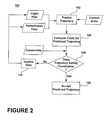
- Figure 2 illustrates a method 100, which may be used for in-flight adjusting of the flight plan of an aircraft according to a predetermined guideline, which in the embodiment is illustrated as providing a low cost flight.
- the method 100 begins at 102 by predicting a trajectory for the completion of the flight of a specified aircraft. Such a prediction may be based on at least the current state data, performance data for the aircraft, and the flight plan data.
- Current state data may include information pertaining to the aircraft along the flight plan and may include a current operational state of the aircraft and/or a current positional state of the aircraft.
- the current state data may include aircraft position data and may include at least one of latitude, longitude, altitude, flight phase, and location on the flight plan.
- the location on the flight plan may include the location relative to a waypoint of the flight plan.
- Current state data of the aircraft along the flight plan may also include time information, fuel information, and speed of the aircraft.
- Performance data for the aircraft may be aircraft specific data related to the flight, such as cost index, airframe engine combination, weight, and unique tail number.
- the weight information may be any of a gross weight, zero fuel weight, and fuel on board weight.
- the unique tail number may be correlated to fuel flow, thrust, drag, and an operating envelope of the aircraft.
- Performance data may also include air speed, altitude, throttle setting, cruise speed, cost index, fuel consumption rate, drag, and operating envelope.
- the performance data may also include meteorological data including current weather conditions. This could be accessed directly from a weather grid source such as the National Oceanic and Atmospheric Association Rapid Update Cycle Gridded Binary. Such meteorological data may contain real-time meteorological data or forecasted meteorological data. Such meteorological data may include data regarding certain weather-related phenomena (e.g., wind speed, wind direction, temperature, among others) and data pertaining to visibility (e.g., foggy, cloudy, etc.), precipitation (rain, hail, snow, freezing rain, etc.) and other meteorological information such as convective weather cells or turbulence.
- weather-related phenomena e.g., wind speed, wind direction, temperature, among others
- data pertaining to visibility e.g., foggy, cloudy, etc.
- precipitation rain, hail, snow, freezing rain, etc.
- other meteorological information such as convective weather cells or turbulence.
- the meteorological data may include 3-D real-time temperature and wind models of the local airspace as well as 4-D forecasted data.
- the weather database may store such real-time or forecasted meteorological data at a specific latitude, longitude, and altitude.
- the flight plan data may specify the route the aircraft should follow such as a company route or a custom route.
- the flight plan data may include at least one of departure airport, arrival airport, time of departure, estimated time of arrival, gate arrival time, enroute waypoints, airways, waypoint wind data, and waypoint temperature data.
- This data may include a navigation database, which may provide supplementary information regarding the flight plan data, such as latitude and longitude or any speed or altitude constraint.
- the navigation database may contain information such as whether the waypoint must be crossed at a specified speed or altitude, whether the waypoints are in en route or terminal airspace, information on how to transition from one waypoint to another, runway length and heading, and information on the airspace structure, such as the boundary of different sectors, or the definition of the terminal airspace shape around an airport.
- the flight plan data may be input in a standardized format, such as a flight plan string in ICAO format.
- the trajectory prediction at 102 may take into consideration a variety of the information listed above. The more information included and the more accurate the information the more accurate the prediction of the trajectory.
- the cost of completing the flight plan by flying the aircraft along the predicted trajectory may be computed.
- Such a computation may include operating costs and schedule costs.
- Operating costs may include such things as the cost of fuel to operate the flight, labor costs, and other time-based operating costs. Additional time-based operating costs may include things such as engine depreciation or other indirect operating costs.
- Schedule related costs may take into account the cost associated with the schedule, which may include things such as the cost of deviating from a defined schedule, whether overtime costs apply beyond a certain time, whether additional ground crew or gate agents will be required before or after a specified time block, or whether compensation for missed passenger connections will be required beyond certain times. It is contemplated that these costs may also be tiered; for example, a missed first class passenger connection to an international flight may be more costly than a domestic economy class missed connection. In this manner, schedule information such as passenger connection times, crew connection times, earliest gate availability time, scheduled arrival time, scheduled departure time, and actual departure time may be considered and various costs may be associated therewith.
- the schedule-related costs may be complex, non-linear, and important in determining the cost of flying the associated trajectory. Examples may include that if a first subset of passengers will miss a connection, the cost is C1. If a larger group of passengers will miss a connection, the cost is C2. If an even larger number of passengers will miss a connection, the cost is C3. If the crew will miss a connection or the next aircraft will be held for the crew, the cost is C4. If the crew will violate maximum hours worked, the cost is C5. If the aircraft will be between 1 and 14 minutes late, the cost is C6. If the aircraft will be more than 14 minutes late, the cost is C7.
- the cost C7 may be significantly higher than the cost C6 because the FAA on-time statistics are with respect to being 15 minutes or more late, thus the corresponding cost may increase at that point.
- the schedule-related costs may also be taken into account via a mechanism such as a penalty factor. For example, the aircraft should not arrive before the earliest gate availability, or should at least be penalized in the cost computation for getting there too early. Alternatively, only constraints may be used to constrain the solution.
- the method 100 may be capable of outputting the cost of the current specified predicted trajectory in dollars or some other normalized unit.
- constraints may be applied to the predicted trajectory.
- constraints may include at least one of a scheduling constraint and a cost constraint.
- Scheduling constraints may include arrival gate availability and flight crew availability. More specifically, the constraints may include whether the arrival gate will not be available for a certain period, whether the legal flying time of the flight crew will be exceeded by the predicted trajectory, allowable flight levels, maximum deviation from current flight level, time that a given airspace will be unavailable, min/max speeds, maximum deviation from current speed, time an airport will be closed (e.g. due to noise curfews), time a runway will be closed (e.g. for snow clearing), fuel weight constraints, etc.
- Cost constraints may include fuel costs and crew costs.
- the predicted trajectory may be accepted at 108. If the predicted trajectory does not satisfy the constraints, then the flight plan and performance data may be updated at 110 and the method may continue at 102 where a trajectory is predicted based on the updated data.
- a number of acceptable predicted trajectories may be determined in this manner. More specifically, a set of acceptable predicted trajectories and corresponding costs may be defined by varying at least one of the current state data, performance data, and flight plan data and repeating the method 100. One of the cost trajectories may then be selected from the set of acceptable predicted trajectories and the flight plan data may be updated according to the selected trajectory and the aircraft may be flown along the selected trajectory accordingly.
- the method of in-flight adjusting is flexible and the method illustrated is merely for illustrative purposes.
- the sequence of steps depicted is for illustrative purposes only, and is not meant to limit the method 100 in any way as it is understood that the steps may proceed in a different logical order or additional or intervening steps may be included without detracting from the invention.
- a ranked set of alternative trajectories with related cost information may be presented to a dispatcher to make the decision regarding what trajectory to select.
- a breakdown of costs may be presented so a dispatcher may understand the implications of choosing one flight modification over another.
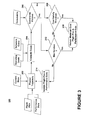
- Figure 3 illustrates a second embodiment of a method of in-flight adjusting of a flight plan of an aircraft to provide a low cost flight according to an embodiment of the invention.
- the second embodiment is similar to the first embodiment and it may be understood that the description of the like parts of the first embodiment applies to the second embodiment, unless otherwise noted.
- the method 200 of in-flight adjusting is merely for illustrative purposes.
- the sequence of steps depicted is for illustrative purposes only, and is not meant to limit the method 200 in any way as it is understood that the steps may proceed in a different logical order or additional or intervening steps may be included without detracting from the invention.
- the trajectory is predicted at 202, the costs for the predicted trajectory are computed at 204, and it is determined if the trajectory satisfies constraints at 206. If the predicted trajectory satisfies these constraints, then the method may move on to 208 where it may be determined if the cost computed at 204 satisfies a cost threshold. If the predicted trajectory does not satisfy the constraints, then the method may move on to determining if the maximum iterations have been reached at 212.
- the cost computed at 204 may be compared to a predetermined cost threshold value.
- the term "satisfies" the threshold is used herein to mean that the cost computed at 204 satisfies the predetermined threshold, such as being equal to or less than the threshold value. It will be understood that such a determination may easily be altered to be satisfied by a positive/negative comparison or a true/false comparison.
- the predetermined cost threshold value may set by airline control or the pilot as the cost acceptable for flying the remainder of the flight or the total cost for flying the flight.
- the predetermined cost threshold value may be a predetermined range of costs and that the predetermined cost threshold may be satisfied when the cost computed at 204 falls within the predetermined cost range. It has been contemplated that there may be multiple predetermined cost threshold values and that during the comparison, it may be determined which of the multiple cost threshold values is satisfied.
- the flight plan and performance data may be returned as an acceptable option at 210. It is contemplated that predicting the trajectory, computing the costs for the predicted trajectory, and determining if the trajectory satisfies constraints may be repeated to find a low cost option. The number of repetitions of steps a-d may be limited by the number of iterations. Thus, if the predicted trajectory does not satisfy the constraints at 206, or the cost computed at 204 does not satisfy the cost threshold at 208, then the method may move on to determining if the maximum iterations have been reached at 212. For example, it is possible that no combination of flight parameters honors all constraints within a desired cost threshold.
- the flight plan and performance data may be returned as an acceptable option at 210. If a specified maximum number of iterations has not been exceeded, the flight plan and performance data may be updated at 214 and the method may continue at 202 where a trajectory is predicted based on the updated data.
- predicting the trajectory may be limited by time instead of iterations.
- the method 200 may have a target response time and if the target response time has not been exceeded then the method 200 may continue to iterate.
- the data may be updated to reflect the movement of the aircraft during the flight. At least one of the current state data and the performance data may be updated for each iteration. It is also contemplated that an optimization function may be used to determine new flight plan and performance data to be used in predicting the trajectory. In this manner, the method 200 may be used to determine a set of predicted trajectories having the lowest cost and the highest cruise altitude or the best altitude and location to change altitudes during a cruise-climb. A user may input which of these should be included in computing the set of acceptable trajectories and the set of acceptable predicted trajectories may be selected to find a combination of these, as specified by the user. It is also contemplated that an output of the method may include the low cost trajectory information as well as the, cost index, cruise altitude, and cruise-climb step altitudes and locations, if such information is applicable.
- the method 200 may be capable of outputting a number of low cost trajectories. More specifically, a set of acceptable predicted trajectories and corresponding costs may be defined by varying at least one of the current state data, performance data, and flight plan data and repeating the method 200. For example, the method 200 may output the five lowest cost alternatives, along with the cost and the savings relative to the currently planned flight. One of the cost trajectories may then be selected from the set of acceptable predicted trajectories and the flight plan data may be updated according to the selected trajectory and the aircraft may be flown along the selected trajectory accordingly. The selected trajectory may correlate to the lowest cost trajectory or may be selected in another manner such as an optimization of the highest cruise altitude or cruise step altitudes and locations. The determining a low cost trajectory and flying the aircraft according to the same may be repeated multiple times during the flight. For example, it may be continuously repeated during the flight such that the aircraft is always being flown in a low cost manner.
- computing such low cost trajectories may be determined on the ground by a suitable computer or processor and provided to the aircraft via a communication system, such as a wireless communication system.
- the determination of such low cost trajectories may be done by a computer, processor, or the FMS onboard the aircraft itself. It is contemplated that the determination of the low cost trajectories may be done on a processor connected to other systems such as a flight planning system, crew and passenger scheduling systems, and weather forecasting system such that much of the inputs may come directly from such sources rather than direct operator input.
- a user may directly interact with the process to specify or modify inputs such that various outputs may be displayed in near real-time or that the trajectories may be optimized according to various inputs.
- An advantageous effect of the above embodiments is that during the flight the trajectory and flight plan of the aircraft may be updated based on cost information as well as other various constraints and inputs to minimize the cost of the flight.
- the above embodiments provide a variety of benefits including the ability to manage the flight of an aircraft to fly along a trajectory having a corresponding low cost based on a variety of constraints. This may allow for overall cost savings in a flight as well as allowing an airline to manage its fleet more effectively.
- the above described embodiments may be used during flight to minimize the cost of disturbances such as weather of air traffic congestion.
Landscapes
- Engineering & Computer Science (AREA)
- Business, Economics & Management (AREA)
- General Physics & Mathematics (AREA)
- Human Resources & Organizations (AREA)
- Physics & Mathematics (AREA)
- Economics (AREA)
- Aviation & Aerospace Engineering (AREA)
- Strategic Management (AREA)
- Marketing (AREA)
- Operations Research (AREA)
- Radar, Positioning & Navigation (AREA)
- Game Theory and Decision Science (AREA)
- Remote Sensing (AREA)
- Entrepreneurship & Innovation (AREA)
- Automation & Control Theory (AREA)
- Development Economics (AREA)
- Quality & Reliability (AREA)
- Tourism & Hospitality (AREA)
- General Business, Economics & Management (AREA)
- Theoretical Computer Science (AREA)
- Traffic Control Systems (AREA)
- Navigation (AREA)
Applications Claiming Priority (1)
| Application Number | Priority Date | Filing Date | Title |
|---|---|---|---|
| US13/405,685 US20130226373A1 (en) | 2012-02-27 | 2012-02-27 | Methods for in-flight adjusting of a flight plan |
Publications (2)
| Publication Number | Publication Date |
|---|---|
| EP2631890A2 true EP2631890A2 (de) | 2013-08-28 |
| EP2631890A3 EP2631890A3 (de) | 2013-12-25 |
Family
ID=47843069
Family Applications (1)
| Application Number | Title | Priority Date | Filing Date |
|---|---|---|---|
| EP13156562.4A Withdrawn EP2631890A3 (de) | 2012-02-27 | 2013-02-25 | Verfahren zur Anpassung eines Flugplans während des Fluges |
Country Status (5)
| Country | Link |
|---|---|
| US (1) | US20130226373A1 (de) |
| EP (1) | EP2631890A3 (de) |
| JP (1) | JP2013177120A (de) |
| CN (1) | CN103295089A (de) |
| CA (1) | CA2806090A1 (de) |
Cited By (9)
| Publication number | Priority date | Publication date | Assignee | Title |
|---|---|---|---|---|
| FR3040801A1 (fr) * | 2015-09-09 | 2017-03-10 | Thales Sa | Optimisation de la trajectoire d'un aeronef |
| EP3154047A1 (de) * | 2015-09-30 | 2017-04-12 | Airbus Group India Private Limited | Flugbahnoptimierung während des flugs |
| CN109118827A (zh) * | 2018-09-28 | 2019-01-01 | 北京理工大学 | 一种基于云平台的无人机飞行管理方法及系统 |
| EP3499484A1 (de) * | 2017-12-12 | 2019-06-19 | Honeywell International Inc. | System und verfahren zum überwachen der konformität eines flugzeugs mit einer 4-dimensionalen referenztrajektorie |
| EP3699833A1 (de) * | 2019-02-25 | 2020-08-26 | The Boeing Company | Systeme und verfahren zur endspezifischen parameterberechnung |
| EP3767239A1 (de) * | 2019-07-16 | 2021-01-20 | Honeywell International Inc. | System und verfahren zur berechnung eines optimalen geschwindigkeitsniveaus unter berücksichtigung atmosphärischer bedingungen |
| DE102018003274B4 (de) | 2018-04-23 | 2022-08-18 | Fraunhofer-Gesellschaft zur Förderung der angewandten Forschung e.V. | Polymer-Blend mit Formgedächtnis- und/oder mit thermoresponsiven Eigenschaften auf der Basis von thermoplastischen Polyurethanen und Polyolefinen, Polymer-Formteil sowie Verfahren zur Programmierung des Polymer-Blends eines solchen Formteils |
| EP4080424A1 (de) * | 2019-04-02 | 2022-10-26 | Honeywell International Inc. | Verfahren und system zum ermöglichen von berechnungen zur schätzung und vorhersage von kosten mit einem kostenindex durch eine betriebskosten-app mit einer betriebskostenintegratorschnittstelle zur anzeige von gate-zu-gate-flugkosten |
| US12122530B2 (en) | 2022-02-04 | 2024-10-22 | Honeywell International Inc. | Energy constraint management methods and systems |
Families Citing this family (56)
| Publication number | Priority date | Publication date | Assignee | Title |
|---|---|---|---|---|
| US8626429B2 (en) * | 2012-02-15 | 2014-01-07 | Hewlett-Packard Development Company, L.P. | Allocation of flight legs to dispatcher positions |
| FR2994010B1 (fr) * | 2012-07-27 | 2018-09-07 | Thales | Dispositif et procede de gestion de strategie de rejointe de points de navigation |
| FR3010541B1 (fr) * | 2013-09-10 | 2015-10-02 | Airbus Operations Sas | Procede et dispositif de gestion automatique d'un changement de trajectoire de vol sur un aeronef, en particulier pour un vol a basse altitude. |
| JP6358791B2 (ja) * | 2013-10-07 | 2018-07-18 | 株式会社 ミックウェア | 飛行体制御システム |
| EP2876586A1 (de) * | 2013-11-26 | 2015-05-27 | Deutsche Lufthansa AG | Verfahren und System zum Entwerfen von Flugzeugen |
| FR3014213B1 (fr) * | 2013-12-04 | 2016-02-05 | Airbus Operations Sas | Procede et dispositif de determination automatique d'un profil de vitesse a paliers de vitesse pour un aeronef. |
| US9947229B2 (en) * | 2013-12-19 | 2018-04-17 | International Business Machines Corporation | Managing flight paths of a soaring aircraft |
| US9201426B1 (en) | 2014-02-19 | 2015-12-01 | Google Inc. | Reverse iteration of planning data for system control |
| KR102294078B1 (ko) * | 2014-04-25 | 2021-08-25 | 소니그룹주식회사 | 정보 처리 장치, 정보 처리 방법, 프로그램 및 촬상 시스템 |
| US9483052B2 (en) * | 2014-06-12 | 2016-11-01 | The Boeing Company | Aircraft departure profile generation compliant with noise abatement limits |
| US9460629B2 (en) * | 2014-07-18 | 2016-10-04 | University Of Malta | Flight trajectory optimization and visualization tool |
| JP6294487B2 (ja) | 2014-09-30 | 2018-03-14 | エスゼット ディージェイアイ テクノロジー カンパニー リミテッドSz Dji Technology Co.,Ltd | 飛行ミッション処理方法、装置及びシステム |
| US10748089B2 (en) * | 2014-12-24 | 2020-08-18 | General Electric Company | Method and system for automatic evaluation of robustness and disruption management for commercial airline flight operations |
| US10546260B2 (en) | 2014-12-24 | 2020-01-28 | General Electric Company | System and method for rule-based analytics of temporal-spatial constraints on noisy data for commercial airlineflight operations |
| US9984580B2 (en) | 2015-01-09 | 2018-05-29 | General Electric Company | Method and system for robust network planning optimization of airline flight operations |
| FR3032271B1 (fr) * | 2015-01-30 | 2017-01-13 | Thales Sa | Procede d'amelioration d'une trajectoire de vol d'un aeronef en fonction de conditions meteorologiques |
| US9928747B2 (en) * | 2015-03-31 | 2018-03-27 | The Boeing Company | System and method for calculating a fuel consumption differential corresponding to an aircraft trajectory revision |
| KR101772556B1 (ko) | 2015-04-02 | 2017-09-12 | 한국항공우주연구원 | 실시간 항적 자료 모니터링을 통한 항공기 궤적 예측 방법 및 시스템 |
| US10068488B2 (en) * | 2015-04-30 | 2018-09-04 | Ge Aviation Systems Llc | Systems and methods of providing a data update to an aircraft |
| US10229372B2 (en) | 2015-05-15 | 2019-03-12 | Taleris Global Llp | Method for rescheduling flights affected by a disruption and an airline operations control system and controller |
| CN119645078A (zh) | 2015-09-15 | 2025-03-18 | 深圳市大疆创新科技有限公司 | 控制可移动物体跟踪目标的系统和方法 |
| EP3368957B1 (de) | 2015-10-30 | 2022-02-09 | SZ DJI Technology Co., Ltd. | Systeme und verfahren für uav-wegplanung und -steuerung |
| FR3044402B1 (fr) * | 2015-11-27 | 2021-04-02 | Thales Sa | Procede de calcul de la representation de la trajectoire d'un aeronef en vol |
| CN105759630B (zh) * | 2016-03-03 | 2018-06-26 | 中国民航大学 | 基于模糊pid控制的飞机4d航迹仿真系统及仿真方法 |
| FR3050177B1 (fr) * | 2016-04-19 | 2021-06-25 | Airbus Operations Sas | Systeme et procede de commande de la poussee des moteurs d'un aeronef |
| US10140873B2 (en) | 2016-08-16 | 2018-11-27 | The Boeing Company | Performance-based track variation for aircraft flight management |
| US10345824B2 (en) * | 2016-09-02 | 2019-07-09 | The Boeing Company | Optimum cruise climb tracking for reduced fuel consumption using vertical and lateral navigation |
| FR3055958B1 (fr) * | 2016-09-13 | 2020-04-24 | Thales | Aide a la decision pour la revision d'un plan de vol |
| US10026325B2 (en) * | 2016-09-16 | 2018-07-17 | The Boeing Company | Graphical user interface for optimization of flight plan schedule, ride quality, and efficiency |
| EP3373272B1 (de) * | 2017-03-09 | 2019-05-15 | The Boeing Company | Verfahren und elektronische vorrichtung zur bereitstellung einer optimalen menge flugzeugbrennstoff |
| US10228692B2 (en) | 2017-03-27 | 2019-03-12 | Gulfstream Aerospace Corporation | Aircraft flight envelope protection and recovery autopilot |
| CN107025805B (zh) * | 2017-04-23 | 2022-09-13 | 温州云航信息科技有限公司 | 基于候补机制的协同决策系统时刻计算方法及对应系统 |
| US10692309B2 (en) * | 2017-07-27 | 2020-06-23 | The Boeing Company | Flight management system having performance table datalink capability |
| FR3069946A1 (fr) * | 2017-08-03 | 2019-02-08 | Airbus Operations (S.A.S.) | Procede d'anticipation du deplacement d'un tourbillon de sillage dans un vol en formation de deux aeronefs |
| US11030906B2 (en) * | 2017-11-16 | 2021-06-08 | The Boeing Company | System for taking into account micro wind conditions in flight plans for aerial vehicles |
| JP6968911B2 (ja) * | 2018-01-23 | 2021-11-17 | 株式会社Nttドコモ | 情報処理装置及び情報処理方法 |
| US11302204B2 (en) * | 2018-04-02 | 2022-04-12 | Ge Aviation Systems Llc | Flight management system and method of updating |
| US10777085B2 (en) * | 2018-04-05 | 2020-09-15 | GE Aviation Sytems LLC | Efficient flight profiles with multiple RTA constraints |
| US10964220B2 (en) * | 2018-09-11 | 2021-03-30 | The Boeing Company | Methods and apparatus for providing continuous flight trajectories for aircraft |
| US11024182B2 (en) * | 2018-12-17 | 2021-06-01 | The Boeing Company | System and method to forecast flight delay based on real-time data |
| JP7228229B2 (ja) * | 2018-12-20 | 2023-02-24 | 国立研究開発法人宇宙航空研究開発機構 | プログラム、情報処理装置及び情報処理方法 |
| US11030664B2 (en) | 2018-12-27 | 2021-06-08 | Honeywell International Inc. | Methods and systems for dynamically determining and adapting to cost impact during a flight |
| US11176832B2 (en) | 2019-04-25 | 2021-11-16 | Honeywell International Inc. | Systems and methods to integrate real-time internet-connected aircraft data for cargo planning |
| GB201909464D0 (en) * | 2019-07-01 | 2019-08-14 | Rolls Royce Plc | Aircraft control method |
| GB2589302A (en) * | 2019-10-21 | 2021-06-02 | Airbus Sas | Flight path modification system and method |
| US11705009B2 (en) * | 2019-12-05 | 2023-07-18 | Rockwell Collins, Inc. | System and method for optimizing mission fulfillment by unmanned aircraft systems (UAS) via dynamic atmospheric modeling |
| US11741841B2 (en) * | 2020-10-29 | 2023-08-29 | Ge Aviation Systems Limited | Method and system for updating a flight plan |
| EP3998594A1 (de) * | 2021-02-19 | 2022-05-18 | Lilium eAircraft GmbH | System und verfahren zur navigation eines flugzeugs |
| CN113721653B (zh) * | 2021-08-09 | 2024-01-19 | 陕西工业职业技术学院 | 一种飞行器航迹实时规划系统 |
| CN114049795A (zh) * | 2021-10-11 | 2022-02-15 | 中国航空无线电电子研究所 | 优化飞机飞行轨迹的方法和设备 |
| CN115880951A (zh) * | 2022-10-28 | 2023-03-31 | 田晓东 | 一种5d计算机飞行计划的实现方法及应用系统 |
| CN116129677B (zh) * | 2022-12-20 | 2025-08-01 | 中航材导航技术(北京)有限公司 | 飞行计划生成方法、装置、计算机设备和存储介质 |
| US12307909B2 (en) | 2022-12-27 | 2025-05-20 | Rockwell Collins, Inc. | Speed schedule tracking |
| US20250236413A1 (en) * | 2024-01-24 | 2025-07-24 | The Boeing Company | Systems and methods for increasing operational efficiency of aircraft |
| CN118587937B (zh) * | 2024-05-16 | 2025-01-10 | 中国南方航空股份有限公司 | 一种考虑高度的航路规划方法、装置及设备 |
| US20260004662A1 (en) * | 2024-06-27 | 2026-01-01 | Honeywell International Inc. | Updating enhanced flight plan variants |
Family Cites Families (26)
| Publication number | Priority date | Publication date | Assignee | Title |
|---|---|---|---|---|
| US4642775A (en) * | 1984-05-25 | 1987-02-10 | Sundstrand Data Control, Inc. | Airborne flight planning and information system |
| US4760530A (en) * | 1986-06-17 | 1988-07-26 | Honeywell Inc. | Flight management system providing minimum total cost |
| US5121325A (en) * | 1990-04-04 | 1992-06-09 | Smiths Industries Aerospace & Defense Systems, Inc. | Required time of arrival (RTA) control system |
| DE19604931A1 (de) * | 1996-02-10 | 1997-08-14 | Nfs Navigations Und Flugfuehru | Verfahren zur Korrektur des Flugablaufs eines Fluggerätes |
| FR2761176B1 (fr) * | 1997-03-18 | 1999-05-14 | Aerospatiale | Procede et dispositif pour determiner un trajet de vol optimal d'un aeronef |
| US6085147A (en) * | 1997-09-26 | 2000-07-04 | University Corporation For Atmospheric Research | System for determination of optimal travel path in a multidimensional space |
| JP3223880B2 (ja) * | 1998-04-10 | 2001-10-29 | 日本電気株式会社 | 飛行経路作成装置および飛行経路作成方法 |
| US6266610B1 (en) * | 1998-12-31 | 2001-07-24 | Honeywell International Inc. | Multi-dimensional route optimizer |
| US6721714B1 (en) * | 1999-04-16 | 2004-04-13 | R. Michael Baiada | Method and system for tactical airline management |
| US6134500A (en) * | 1999-06-03 | 2000-10-17 | United Air Lines, Inc. | System and method for generating optimal flight plans for airline operations control |
| US6173159B1 (en) * | 1999-06-25 | 2001-01-09 | Harris Corporation | Wireless spread spectrum ground link-based aircraft data communication system for updating flight management files |
| US6584400B2 (en) * | 2001-04-09 | 2003-06-24 | Louis J C Beardsworth | Schedule activated management system for optimizing aircraft arrivals at congested airports |
| US6606553B2 (en) * | 2001-10-19 | 2003-08-12 | The Mitre Corporation | Traffic flow management method and system for weather problem resolution |
| US20050071206A1 (en) * | 2003-04-30 | 2005-03-31 | The Boeing Company | System, method and computer program product for schedule recovery |
| US7194353B1 (en) * | 2004-12-03 | 2007-03-20 | Gestalt, Llc | Method and system for route planning of aircraft using rule-based expert system and threat assessment |
| FR2894367B1 (fr) * | 2005-12-07 | 2008-02-29 | Thales Sa | Procede de determination du profil horizontal d'un plan de vol respectant un profil de vol vertical impose |
| KR20080098538A (ko) * | 2006-02-21 | 2008-11-10 | 다이나믹 인텔리전스 인코포레이티드 | 운송 스케줄 작성 시스템 |
| JP2009146004A (ja) * | 2007-12-11 | 2009-07-02 | Hitachi Information & Control Solutions Ltd | 配車計画装置及び配車計画方法 |
| US7725337B2 (en) * | 2007-12-13 | 2010-05-25 | American Airlines, Inc. | Quantifying revenue and profit impact of retiming flights while taking into consideration non-linear ramifications and constraints |
| CN100483477C (zh) * | 2007-12-20 | 2009-04-29 | 四川川大智胜软件股份有限公司 | 基于实时雷达和飞行情报的短期空中交通流量预测方法 |
| US8010242B1 (en) * | 2008-08-06 | 2011-08-30 | On Time Systems, Inc. | Flight planning system and method |
| FR2937453B1 (fr) * | 2008-10-17 | 2010-10-22 | Thales Sa | Dispositif pour le calcul d'un plan de vol d'un aeronef |
| US8538673B2 (en) * | 2008-10-31 | 2013-09-17 | Czech Technical University In Prague | System and method for planning/replanning collision free flight plans in real or accelerated time |
| US8160759B2 (en) * | 2009-01-23 | 2012-04-17 | Flightaware, Llc | System and method for optimized flight planning |
| JP5284901B2 (ja) * | 2009-08-05 | 2013-09-11 | 公益財団法人鉄道総合技術研究所 | 配置決定装置及び配置決定プログラム |
| FR2953302B1 (fr) * | 2009-11-27 | 2012-08-10 | Thales Sa | Procede de planification, de calcul de trajectoire, de predictions et de guidage pour le respect d'une contrainte de temps de passage d'un aeronef |
-
2012
- 2012-02-27 US US13/405,685 patent/US20130226373A1/en not_active Abandoned
-
2013
- 2013-02-14 CA CA2806090A patent/CA2806090A1/en not_active Abandoned
- 2013-02-19 JP JP2013029561A patent/JP2013177120A/ja active Pending
- 2013-02-25 EP EP13156562.4A patent/EP2631890A3/de not_active Withdrawn
- 2013-02-27 CN CN201310061416XA patent/CN103295089A/zh active Pending
Non-Patent Citations (1)
| Title |
|---|
| None |
Cited By (13)
| Publication number | Priority date | Publication date | Assignee | Title |
|---|---|---|---|---|
| WO2017042166A1 (fr) * | 2015-09-09 | 2017-03-16 | Thales | Optimisation de la trajectoire d'un aéronef |
| FR3040801A1 (fr) * | 2015-09-09 | 2017-03-10 | Thales Sa | Optimisation de la trajectoire d'un aeronef |
| EP3154047A1 (de) * | 2015-09-30 | 2017-04-12 | Airbus Group India Private Limited | Flugbahnoptimierung während des flugs |
| EP3499484A1 (de) * | 2017-12-12 | 2019-06-19 | Honeywell International Inc. | System und verfahren zum überwachen der konformität eines flugzeugs mit einer 4-dimensionalen referenztrajektorie |
| US10573186B2 (en) | 2017-12-12 | 2020-02-25 | Honeywell International Inc. | System and method for monitoring conformance of an aircraft to a reference 4-dimensional trajectory |
| DE102018003274B4 (de) | 2018-04-23 | 2022-08-18 | Fraunhofer-Gesellschaft zur Förderung der angewandten Forschung e.V. | Polymer-Blend mit Formgedächtnis- und/oder mit thermoresponsiven Eigenschaften auf der Basis von thermoplastischen Polyurethanen und Polyolefinen, Polymer-Formteil sowie Verfahren zur Programmierung des Polymer-Blends eines solchen Formteils |
| CN109118827A (zh) * | 2018-09-28 | 2019-01-01 | 北京理工大学 | 一种基于云平台的无人机飞行管理方法及系统 |
| US11158197B2 (en) | 2019-02-25 | 2021-10-26 | The Boeing Company | Systems and methods for tail-specific parameter computation |
| EP3699833A1 (de) * | 2019-02-25 | 2020-08-26 | The Boeing Company | Systeme und verfahren zur endspezifischen parameterberechnung |
| US12142152B2 (en) | 2019-02-25 | 2024-11-12 | The Boeing Company | Systems and methods for tail-specific parameter computation |
| EP4080424A1 (de) * | 2019-04-02 | 2022-10-26 | Honeywell International Inc. | Verfahren und system zum ermöglichen von berechnungen zur schätzung und vorhersage von kosten mit einem kostenindex durch eine betriebskosten-app mit einer betriebskostenintegratorschnittstelle zur anzeige von gate-zu-gate-flugkosten |
| EP3767239A1 (de) * | 2019-07-16 | 2021-01-20 | Honeywell International Inc. | System und verfahren zur berechnung eines optimalen geschwindigkeitsniveaus unter berücksichtigung atmosphärischer bedingungen |
| US12122530B2 (en) | 2022-02-04 | 2024-10-22 | Honeywell International Inc. | Energy constraint management methods and systems |
Also Published As
| Publication number | Publication date |
|---|---|
| CA2806090A1 (en) | 2013-08-27 |
| CN103295089A (zh) | 2013-09-11 |
| EP2631890A3 (de) | 2013-12-25 |
| JP2013177120A (ja) | 2013-09-09 |
| US20130226373A1 (en) | 2013-08-29 |
Similar Documents
| Publication | Publication Date | Title |
|---|---|---|
| EP2631890A2 (de) | Verfahren zur Anpassung eines Flugplans während des Fluges | |
| EP2541529B1 (de) | Auswahl von meteorologischen Daten entlang der Flugbahn eines Flugzeuges | |
| US11978348B2 (en) | System and method for optimizing an aircraft trajectory | |
| EP2631732B1 (de) | Verfahren zum Fliegen eines Flugzeugs entlang eines Flugpfads | |
| CA2781863C (en) | Weather data selection relative to an aircraft trajectory | |
| US8868345B2 (en) | Meteorological modeling along an aircraft trajectory | |
| US20250182631A1 (en) | System and method for optimising flight efficiency | |
| CN106249592A (zh) | 用于航空器的优化下降和进场剖面的自动确定方法和系统 | |
| EP4170628A1 (de) | Pilotflugbahnrückkopplungswerkzeug | |
| Ramée et al. | Aircraft flight plan optimization with dynamic weather and airspace constraints | |
| Rosenow et al. | Advanced flight planning and the benefit of in-flight aircraft trajectory optimization. Sustainability 2021, 13, 1383 | |
| Rosenow et al. | Arrival Time Management in Real Weather Conditions |
Legal Events
| Date | Code | Title | Description |
|---|---|---|---|
| PUAI | Public reference made under article 153(3) epc to a published international application that has entered the european phase |
Free format text: ORIGINAL CODE: 0009012 |
|
| AK | Designated contracting states |
Kind code of ref document: A2 Designated state(s): AL AT BE BG CH CY CZ DE DK EE ES FI FR GB GR HR HU IE IS IT LI LT LU LV MC MK MT NL NO PL PT RO RS SE SI SK SM TR |
|
| AX | Request for extension of the european patent |
Extension state: BA ME |
|
| PUAL | Search report despatched |
Free format text: ORIGINAL CODE: 0009013 |
|
| AK | Designated contracting states |
Kind code of ref document: A3 Designated state(s): AL AT BE BG CH CY CZ DE DK EE ES FI FR GB GR HR HU IE IS IT LI LT LU LV MC MK MT NL NO PL PT RO RS SE SI SK SM TR |
|
| AX | Request for extension of the european patent |
Extension state: BA ME |
|
| RIC1 | Information provided on ipc code assigned before grant |
Ipc: G06Q 10/04 20120101ALI20131118BHEP Ipc: G08G 5/00 20060101AFI20131118BHEP |
|
| 17P | Request for examination filed |
Effective date: 20140625 |
|
| RBV | Designated contracting states (corrected) |
Designated state(s): AL AT BE BG CH CY CZ DE DK EE ES FI FR GB GR HR HU IE IS IT LI LT LU LV MC MK MT NL NO PL PT RO RS SE SI SK SM TR |
|
| STAA | Information on the status of an ep patent application or granted ep patent |
Free format text: STATUS: THE APPLICATION IS DEEMED TO BE WITHDRAWN |
|
| 18D | Application deemed to be withdrawn |
Effective date: 20140626 |