EP2632383B1 - System zur unterstützung der anordnung eines standardinstruments in bezug zu einem patientengewebe - Google Patents
System zur unterstützung der anordnung eines standardinstruments in bezug zu einem patientengewebe Download PDFInfo
- Publication number
- EP2632383B1 EP2632383B1 EP11782295.7A EP11782295A EP2632383B1 EP 2632383 B1 EP2632383 B1 EP 2632383B1 EP 11782295 A EP11782295 A EP 11782295A EP 2632383 B1 EP2632383 B1 EP 2632383B1
- Authority
- EP
- European Patent Office
- Prior art keywords
- instrument
- guide
- patient tissue
- stock
- feature
- Prior art date
- Legal status (The legal status is an assumption and is not a legal conclusion. Google has not performed a legal analysis and makes no representation as to the accuracy of the status listed.)
- Active
Links
Images



Classifications
-
- A—HUMAN NECESSITIES
- A61—MEDICAL OR VETERINARY SCIENCE; HYGIENE
- A61B—DIAGNOSIS; SURGERY; IDENTIFICATION
- A61B17/00—Surgical instruments, devices or methods
- A61B17/56—Surgical instruments or methods for treatment of bones or joints; Devices specially adapted therefor
- A61B17/58—Surgical instruments or methods for treatment of bones or joints; Devices specially adapted therefor for osteosynthesis, e.g. bone plates, screws or setting implements
- A61B17/88—Osteosynthesis instruments; Methods or means for implanting or extracting internal or external fixation devices
-
- A—HUMAN NECESSITIES
- A61—MEDICAL OR VETERINARY SCIENCE; HYGIENE
- A61B—DIAGNOSIS; SURGERY; IDENTIFICATION
- A61B34/00—Computer-aided surgery; Manipulators or robots specially adapted for use in surgery
- A61B34/10—Computer-aided planning, simulation or modelling of surgical operations
-
- A—HUMAN NECESSITIES
- A61—MEDICAL OR VETERINARY SCIENCE; HYGIENE
- A61B—DIAGNOSIS; SURGERY; IDENTIFICATION
- A61B17/00—Surgical instruments, devices or methods
- A61B17/16—Instruments for performing osteoclasis; Drills or chisels for bones; Trepans
- A61B17/17—Guides or aligning means for drills, mills, pins or wires
- A61B17/1739—Guides or aligning means for drills, mills, pins or wires specially adapted for particular parts of the body
- A61B17/1778—Guides or aligning means for drills, mills, pins or wires specially adapted for particular parts of the body for the shoulder
-
- A—HUMAN NECESSITIES
- A61—MEDICAL OR VETERINARY SCIENCE; HYGIENE
- A61B—DIAGNOSIS; SURGERY; IDENTIFICATION
- A61B17/00—Surgical instruments, devices or methods
- A61B17/56—Surgical instruments or methods for treatment of bones or joints; Devices specially adapted therefor
- A61B17/58—Surgical instruments or methods for treatment of bones or joints; Devices specially adapted therefor for osteosynthesis, e.g. bone plates, screws or setting implements
- A61B17/88—Osteosynthesis instruments; Methods or means for implanting or extracting internal or external fixation devices
- A61B17/8872—Instruments for putting said fixation devices against or away from the bone
-
- A—HUMAN NECESSITIES
- A61—MEDICAL OR VETERINARY SCIENCE; HYGIENE
- A61B—DIAGNOSIS; SURGERY; IDENTIFICATION
- A61B34/00—Computer-aided surgery; Manipulators or robots specially adapted for use in surgery
- A61B34/10—Computer-aided planning, simulation or modelling of surgical operations
- A61B2034/107—Visualisation of planned trajectories or target regions
-
- A—HUMAN NECESSITIES
- A61—MEDICAL OR VETERINARY SCIENCE; HYGIENE
- A61B—DIAGNOSIS; SURGERY; IDENTIFICATION
- A61B34/00—Computer-aided surgery; Manipulators or robots specially adapted for use in surgery
- A61B34/10—Computer-aided planning, simulation or modelling of surgical operations
- A61B2034/108—Computer aided selection or customisation of medical implants or cutting guides
-
- A—HUMAN NECESSITIES
- A61—MEDICAL OR VETERINARY SCIENCE; HYGIENE
- A61B—DIAGNOSIS; SURGERY; IDENTIFICATION
- A61B90/00—Instruments, implements or accessories specially adapted for surgery or diagnosis and not covered by any of the groups A61B1/00 - A61B50/00, e.g. for luxation treatment or for protecting wound edges
- A61B90/39—Markers, e.g. radio-opaque or breast lesions markers
- A61B2090/3904—Markers, e.g. radio-opaque or breast lesions markers specially adapted for marking specified tissue
- A61B2090/3916—Bone tissue
Definitions
- the present invention relates to a system for use of a surgical guide for assisting with arrangement of a stock instrument with respect to a patient tissue.
- Each shoulder joint includes the upper portion of the humerus, which terminates in an offset bony neck surmounted by a ball-headed portion known as the humeral head.
- the humeral head rotates within a socket, known as the glenoid fossa, in the scapula to complete the shoulder joint.
- Diseases such as rheumatoid- and osteo-arthritis can cause erosion of the cartilage lining of the glenoid fossa so that the ball of the humerus and the scapula rub together, causing pain and further erosion. Bone erosion may cause the bones themselves to attempt to compensate for the erosion which may result in the bone becoming deformed. This misshapen joint may cause pain and may eventually cease to function altogether.
- the shoulder prosthesis will be fonned of two components, namely: a glenoid, or socket, component which lines the glenoid fossa, and a humeral, or stem, component which includes a weight-bearing ball and replaces the humeral head. (Each of these components may be made up of multiple subassemblies.)
- a reverse shoulder prosthesis has a ball as the glenoid component and a socket as the humeral component, but the following description presumes a standard, not reverse, shoulder prosthesis arrangement.
- the remaining cartilage or damaged tissue is removed from the glenoid fossa using a reamer such that the native glenoid fossa will accommodate the outer surface of the glenoid component of the shoulder prosthesis.
- the glenoid component of the prosthesis can then be inserted into the prepared glenoid fossa.
- fixing means such as screws and/or bone cement may be used to hold the glenoid component in the glenoid fossa.
- the glenoid component may be coated on its external surface with a bone growth promoting substance which will encourage bone ingrowth which also helps to hold the glenoid component in place.
- the humeral head also is removed during the surgical procedure, and the humerus shaft hollowed out using reamers and rasps to accept the humeral component of the prosthesis.
- the stem portion of the prosthesis is inserted into the humerus and secured therein to complete the shoulder joint replacement.
- the glenoid portion In order to strive toward desired performance of the combined glenoid and humeral shoulder prosthesis components, the glenoid portion should be properly positioned upon the glenoid fossa (among other considerations). The glenoid portion positioning is particularly important since incorrect positioning of the glenoid component can lead to the prosthetic shoulder joint suffering from dislocations, a decreased range of motion, and possibly eventual loosening and/or failure of one or both components of the joint.
- US2009/0024131 describes a drill guide for an orthopedic knee procedure including a body portion, a first cannulated post and a second cannulated post, the first and second posts having cross-sectional areas of different shapes.
- US 5030219 describes a glenoid component installation tool.
- US 2008/0287954 describes a guidance tool for intraoperative use during bone or joint surgery, the guidance tool placed directly upon the patient's anatomy and used to guide a medical instrument at a predefined trajectory.
- the guidance tool is not used in combination with a stock instrument having an instrument shaft configured to be placed into an aperture in the patient tissue .
- WO 2012/033821 which is a document falling under A54(3) EPC, discloses a positioning apparatus which guides placement of a prosthetic implant component.
- the locating block is not used in combination with a stock instrument configured to be placed into an aperture in the patient tissue.
- the normal glenoid retroversion of a given patient may fall within a range of approximately 20° (5° of anteversion and 15° of retroversion).
- the version of the glenoid is defined as the angle between the plane of the glenoid fossa to the plane of the scapula body.
- glenoid bone loss may result in a much larger range of version angles.
- One goal of shoulder surgery may be to modify the pathologic bone to correct pathologic version to be within the normal range or the normal version of the patient's native anatomy before the bone loss occurred.
- the plane of the scapula may be difficult or impossible to determine by direct visual inspection, resulting in the need for assistive devices or methods to define both the pathologic version present at the time of surgery and the intended correction angle.
- glenoid component there is a preferred orientation for the glenoid component to provide a full range of motion and to minimize the risk of dislocation or other mechanical component failure.
- Some example orientations of the glenoid prosthesis relative to the glenoid face are about 5° of anteversion to about 15° of retroversion; average version is about 1-2° of retroversion. This broadly replicates the natural angle of the glenoid. However, the specific angular orientation of the glenoid portion varies from patient to patient.
- a three-dimensional intraoperative computer imaging surgical navigation system is used to render a model of the patient's bone structure.
- This model is displayed on a computer screen and the user is provided with intraoperative three-dimensional information as to the desired positioning of the instruments and the glenoid component 216 (or any component, depending on the subject patient tissue) of the prosthetic implant.
- surgical navigation arrangements of this type are not wholly satisfactory since they generally use only a low number of measured landmark points to register the patient's anatomy and to specify the angle of the prosthetic implant component (e.g., a glenoid component 216), which may not provide the desired level of accuracy.
- Fig. 1 depicts a portion of the external surface of a (left) scapula 100, which is an example of a possible patient tissue use environment for the described systems, apparatuses, and methods, with particular emphasis on the glenoid fossa 102.
- Directional arrow 104 indicates the superior/inferior and anterior/posterior directions.
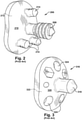
- a glenoid implant 206 shown in Fig. 2 , is the stock prosthetic implant for use with a prosthetic shoulder replacement surgery for the described embodiments of the present invention.
- the glenoid implant 206 includes an implant shaft 208, a lower implant surface 210, an upper implant surface 212 (hidden in this view, as shown via dashed line), and a plurality of fastening pegs 214 extending from the lower implant surface.
- the patient tissue is shown and described herein at least as a scapula and the prosthetic implant component is shown and described herein at least as an glenoid prosthetic shoulder component, but the patient tissue and corresponding prosthetic implant component could be any desired types such as, but not limited to, hip joints, shoulder joints, knee joints, ankle joints, phalangeal joints, metatarsal joints, spinal structures, long bones (e.g., fracture sites), or any other suitable patient tissue use environment for the present invention.
- the prosthetic implant component could be an internal fixation device (e.g., a bone plate), a structure of a replacement/prosthetic joint, or any other suitable artificial device to replace or augment a missing or impaired part of the body.
- lateral is used herein to refer to a direction indicated by directional arrow 104 in Fig. 1 ; the lateral direction in Fig. 1 lies substantially within the plane of the drawing and includes all of the superior, inferior, anterior, and posterior directions.
- longitudinal is used herein to refer to a direction defined perpendicular to the plane created by directional arrow 104, with the longitudinal direction being substantially into and out of the plane of the drawing in Fig. 1 and representing the proximal (toward the medial line of the body) and distal (out from the body) directions, respectively.
- a shaft aperture (not shown) is drilled into the patient tissue (here, the patient's glenoid fossa 102) at a predetermined location and a stock instrument is used to help prepare the patient tissue surface.
- the stock instrument is depicted here as a glenoid instrument 316 according to a first embodiment of the present invention, shown in Fig. 3 .
- Suitable instruments 316 similar to those shown herein are available from DePuy Orthopaedics, Inc., of Warsaw, Indiana.
- the instrument 316 includes an instrument shaft 318, a lower instrument surface 320, an upper instrument surface 322 (hidden in this view, as shown via dashed line), and at least one guide interacting feature 324.
- stock is used herein to indicate that the component indicated is not custom-manufactured or -configured for the patient, but is instead provided as a standard inventory item by a manufacturer.
- a particular stock component may be selected by the user from a product line range of available components, with the user specifying a desired configuration, general or particular size (e.g., small, medium, large or a specific measurement), material, or any other characteristic of the component. Indeed, the stock component could be manufactured only after the user has selected the desired options from the range of choices available.
- the stock component is differentiated from a custom-manufactured or bespoke component in that the stock component is agnostic and indifferent regarding a particular patient anatomy during the design and manufacturing processes for an implant intended for that patient, while the patient anatomy is an input into at least one design and/or manufacturing process for a custom-manufactured component.
- the following description presumes the use of a stock instrument, though one of ordinary skill in the art will be able to provide for the use of the present invention with a custom-manufactured instrument, instead.
- At least one of the guide interacting features 324 may bear a direct positional relationship to some feature of the glenoid implant 206.
- the guide interacting features 324 are located analogously to the fastening pegs 214 of the glenoid implant 206 and may later assist in guiding some aspect of patient tissue modification to ready the glenoid fossa 102 for the glenoid implant 206 in a known manner and as will be discussed in further detail below.
- the instrument 316 may include at least one handling feature 426 to accept a handle (not shown) which the user may manipulate to move the instrument at or near the surgical site--two throughhole handling features and one closed (blind) cavity handling feature are shown in the Figures.
- the instrument 316 may also include one or more securing features 428 for assisting with holding the instrument 316 in a predetermined instrument with the patient tissue, if desired.
- a stock instrument 316 on the patient tissue to help guide surgical tools used to prepare the patient tissue to receive the glenoid implant.
- a central shaft aperture (which will later receive the implant shaft 218) can be machined at a desired location on the glenoid fossa 102, and the instrument shaft 318 can be placed into the shaft aperture to help hold the instrument 316 in place while the instrument is used as a template for the user to drill, ream, cut, scrape, graft, or otherwise modify the patient tissue from a native or pathologic state to accept the glenoid implant 206 as desired according to the preoperative plan and/or an intraoperative decision.
- the shaft aperture can be located on the glenoid fossa 102 by the user with relatively little difficulty, such as with the assistance of a landmark (not shown), such as a guide pin, wire, marking, and/or other location indicator previously placed in a predetermined relationship with the patient tissue.
- the landmark may be any suitable two- or three-dimensional landmark such as, but not limited to, a native or acquired anatomical feature of the patient tissue and/or a separately provided landmark placed with the assistance of a guide as disclosed in co-pending U.S. Patent Application No. to be determined, filed October 27, 2011, titled "System and Method for Association of a Guiding Aid with a Patient Tissue" and claiming priority to U.S. Provisional Patent Application No.
- the landmark could also or instead be placed using a robotic surgical aid, adjustable reusable (e.g., "dial-in") tools, intraoperative imaging, or any other suitable placement aid.
- an original landmark could have been previously placed, then removed for any reason (e.g., to facilitate machining of the glenoid fossa 102 surface).
- a second landmark may then be placed at the same location and with the same location as the original landmark, such as via reusing the cavity in the surface left by the removal of the original landmark. Indeed, the remaining cavity in the surface itself may serve a landmarking function.
- the instrument 316 may still be in an orientation that does not comport with a preoperatively planned positioning.
- the instrument 316 can pivot about an axis provided by the instrument shaft.
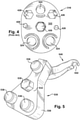
- the user may choose to employ a guide 530, such as that shown in Figs. 5-7 .
- a guide 530 has a lower guide surface 532 configured to contact an upper instrument surface 322 of the instrument 316 when a lower instrument surface 320 of the instrument is in contact with the glenoid fossa 102.
- the lower guide surface 532 is contoured to substantially mate with at least a portion of the upper instrument surface 322, as will be discussed below.
- the term "mate" is used herein to indicate a relationship in which the contours of two structures are at least partially matched or coordinated in at least two dimensions.
- both the lower guide surface 532 and the upper instrument surface 322 could have profiles that are concavely curved, convexly curved, planar/linear, or any combination of those or other profile shapes.
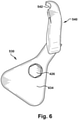
- the guide 530 also includes an upper guide surface 634 spaced longitudinally apart from the lower guide surface 532 by a guide body 536. The upper guide surface 634 is accessible to a user when the lower guide surface 532 is in contact with the upper instrument surface 322.
- the patient's name, identification number, surgeon's name, and/or any other desired identifier may be molded into, printed on, attached to, or otherwise associated with the guide 530 in a legible manner.
- the guide 530 may be made by any suitable method such as, but not limited to, selective laser sintering ("SLS"), fused deposition modeling (“FDM”), stereolithography (“SLA”), laminated object manufacturing (“LOM”), electron beam melting (“EBM”), 3-dimensional printing (“3DP”), contour milling from a suitable material, computer numeric control (“CNC”), other rapid prototyping methods, or any other desired manufacturing process.
- the guide 530 may include at least one instrument guiding feature 538 at a predetermined feature location with respect to the guide body 536. At least one guide interacting feature 324 of the instrument 316 may be configured for engagement with at least one instrument guiding feature 538 of the guide 530. As shown in Fig. 5 , each instrument guiding feature 538 is a protrusion from the lower guide surface 532 and each guide interaction feature 324 is a cavity, and the protrusion enters the cavity to engage the guide 530 and the instrument 316 in the mating contact in the predetermined relative guide/instrument orientation.
- cavity/protrusion status for one or more guide interacting features 324 and/or instrument guiding features 538, or could provide different mechanical structures (i.e., other than a cavity or protrusion) to carry out the described engagement.
- the lower guide surface 532 includes a hexagon-shaped protruding instrument guiding feature 538, which may be configured to engage with a correspondingly located and complementarily shaped handling feature 426 of the instrument 316 to supplement or supplant the engagement of the round instrument guiding features in transferring motive force between the guide 530 and the instrument 316. It is contemplated that engagement between one or more guide interacting features 324 and instrument guiding features 538 will assist the user with concurrently moving one of the guide 530 and the instrument 316 via a motive force exerted on the other of the guide and the instrument.
- the user may directly grasp and move both the guide 530 and the instrument 316 at once--in this situation, the engagement between the guide interacting features 324 and instrument guiding features 538 may simply assist with maintaining the guide and the instrument in the predetermined relative guide/instrument orientation.
- the hexagonal instrument guiding feature 538 is collinear with the handling feature 426, which is collinear with the instrument shaft 318. Because the instrument shaft 318 may interact with a shaft aperture in the patient tissue serving as a landmark, the hexagonal instrument guiding feature 538 could be considered to be an extension or indication of the position of the landmark, as well.
- the hexagonal edges of the centrally located instrument guiding feature 538 may also be helpful in interacting with the hexagonal handling feature 426 of the instrument 316 to "grip" and transmit force (especially rotational force) between the guide 530 and the instrument in a way that the other, substantially cylindrical guiding features shown in Fig. 5 might not be able to accomplish.
- the guide 530 may include a handling feature 426 which can be used with a handling tool (not shown) similarly to, and potentially in combination with, the handling features 426 of the instrument 316.
- a handling tool (not shown) similarly to, and potentially in combination with, the handling features 426 of the instrument 316.
- the available maneuvering space in a surgical field is relatively restricted, and it may be useful for a forceps, hex wrench (perhaps with a frictional fit or other feature to nest into the handling feature 426), Kocher tool, hemostat, or other user-manipulated handling tool (not shown) to selectively interact with the handling feature to hold the guide 520 or instrument 316 steady and/or to move the guide or instrument to a desired position.
- One or more features such as indents, apertures, cavities, lugs, undercuts, or any other suitable structures could be provided to the handling feature 426 or to any other structure of the guide 530 or instrument 316 to facilitate gripping of the guide by any handling tool, in general, and/or by a particular handling tool.
- An orienting feature 540 such as the depicted extension in Figs. 5-7 , is provided to the guide 530. As shown here, for use with the instrument 316 in a glenoid implant 206 surgical procedure, the orienting feature 540 may extend, perhaps substantially, longitudinally and/or laterally from the guide 530, but the direction, amount, and type of extension will depend upon the location and type of body tissue with which the guide 530 is being used.
- the orienting feature 540 is configured to enter a predetermined orienting relationship with a landmark (not shown), such as a guide pin, wire, marking, and/or other location indicator previously placed in a predetermined relationship with the patient tissue, such predetermined orienting relationship occurring when the lower guide surface 532 is in mating contact with at least a portion of the upper instrument surface 322 in a predetermined relative guide/instrument orientation.
- a landmark such as a guide pin, wire, marking, and/or other location indicator previously placed in a predetermined relationship with the patient tissue
- the achievement of the predetermined orienting relationship indicates that the instrument 316 has achieved a predetermined instrument relationship with the patient tissue.
- the predetermined relative guide/instrument orientation is achieved when the guide 530 and instrument 316 are mated in a desired manner, as predetermined via preoperative imaging and/or analysis.
- the landmark for use with the orienting feature 540 similarly to any landmark used to help locate the shaft aperture as described above, may be any suitable two- or three-dimensional landmark and placed in any desired manner. It may be helpful for the landmark for use with the orienting feature 540 to be affixed to the patient tissue at a location spaced from a location of the stock instrument 530.
- the orienting feature 540 includes an orienting indicator 542.
- the orienting indicator 542 is configured to achieve a predetermined signaling relationship (the signaling relationship being directly related to the orienting relationship) with the landmark, as will be described below, while the guide 530 and the instrument 316 are in the predetermined relative guide/instrument orientation.
- the orienting feature 540 is an arm-type structure extending from the guide body 536 and the orienting indicator 542 is a notch in the orienting feature 540 shaped to somewhat closely surround at least a portion of the diameter of a guide pin or other three-dimensional landmark to achieve the predetermined signaling relationship.
- the landmark(s) were previously placed in any suitable manner in predetermined locations at the surgical site. Accordingly, the predetermined signaling relationship between the landmark(s) and the orienting indicator(s) 542 assists the user in placing the guide 530 into a predetermined guide orientation with respect to the patient tissue.
- the guide 530 and the instrument 316 are held in a predetermined relative guide/instrument orientation (e.g., through the use of the guide interacting feature 324 and instrument guiding feature 538, frictional engagement between the upper instrument surface 322 and lower guide surface 532, any other mechanical linkage, or even merely coordinated movement of each by the user), then the instrument is manipulated in concert with the guide. Accordingly, movement of the guide 530 into the predetermined guide orientation--as signaled by coordination of the landmark(s) and the orienting feature 540--will concurrently move the instrument 316 into a predetermined instrument orientation with respect to the patient tissue.
- One of ordinary skill in the art can readily preoperatively plan the placement and type of landmark(s), as well as the structure and type of orienting feature(s) 540 and/or orienting indicator(s) 542 to assist the user in guiding the instrument 316 into the predetermined instrument orientation and/or location with respect to the patient tissue for a particular application of the present invention.
- the orienting indicator 542 is shown in Figs. 5-7 as being a notch, any suitable structure, notch-like or otherwise, could be used as an orienting indicator, wherein only notch-shaped structures form part of the present invention.
- the orienting indicator 542 could be a lug extending from the orienting feature 540, a visual indicator such as a line drawn or etched on the orienting protrusion, or even a mechanical system such as a latch or trip-wire.
- the scapula 100 may be visible to the user, and the visible portion of the scapula may be located at the distal end of a "tunnel" of surrounding soft tissue temporarily retracted by the user-accordingly, available maneuvering space at the surgical site may be severely restricted.
- the patient's shoulder may be actually canted slightly differently during the surgical procedure than planned preoperatively.
- the guide 530 may be preoperatively generated.
- the guide 530 is at least partially custom-manufactured for a particular patient responsive to preoperative imaging of the patient tissue.
- the guide 530 may be wholly custom-made (e.g., using rapid prototyping techniques) or may be modified from a stock guide or guide blank (not shown). It is contemplated that at least a part of the guide 530 is a patient-specific, single-use, bespoke feature suited only for use at the indicated surgical site.
- a stock guide body 536 e.g., the y-shaped portion of the structure in Figs.
- a patient-specific orienting feature 540 e.g., the protruding, asymmetrical arm structure in Figs. 5-6 .
- a patient-specific orienting feature 540 e.g., the protruding, asymmetrical arm structure in Figs. 5-6 .
- One of ordinary skill in the art could create a guide which uses a patient-specific "disposable” structure connected to a stock, generic “reusable” carrier in this manner, with any desired attachment mechanism connecting the two in a sufficiently rigid portion to carry out the interactions discussed herein.
- the guide 530 may be configured responsive to at least one of preoperative imaging of the patient tissue and preoperative selection of the stock prosthetic implant. Because the instruments 316 are stock items, related to specific stock prosthetic implants (e.g., the depicted glenoid implants 206), the guide 530 also may be at least partially a stock item.
- the orientation of the instrument 316 upon the glenoid fossa 102 is predetermined by a user before the guide 530 is provided. This predetermination may occur intraoperatively, as the user is able to directly see the condition of the surgical site. However, it is contemplated that a predetermination of the desired instrument orientation could be accomplished preoperatively, with reference to preoperative imaging of the patient tissue. In this manner, a user can create a patient tissue model for observation, manipulation, rehearsal, or any other pre-operative tasks.
- the term "model” is used herein to indicate a replica or copy of a physical item, at any relative scale and represented in any medium, physical or virtual.
- the patient tissue model may be a total or partial model of a subject patient tissue, and may be created in any suitable manner.
- the patient tissue model may be based upon computer tomography ("CT") data imported into a computer aided drafting ("CAD") system. Additionally or alternatively, the patient tissue model may be based upon digital or analog radiography, magnetic resonance imaging, or any other suitable imaging means.
- CT computer tomography
- CAD computer aided drafting
- the patient tissue model will generally be displayed for the user to review and manipulate preoperatively, such as through the use of a computer or other graphical workstation interface.
- the user can view the patient tissue model and, based upon knowledge of other patient characteristics (such as, but not limited to, height, weight, age, and activity level), then choose a desired stock prosthetic implant. Because three-dimensional image models are available of many stock prosthetic implants, the user may be able to "install" the stock prosthetic implant virtually in the patient tissue model via a preoperative computer simulation. During such a simulation, the user can adjust the position of the stock prosthetic implant with respect to the patient tissue, even to the extent of simulating the dynamic interaction between the two, to refine the selection, placement, and orientation of the stock prosthetic implant for a desired patient outcome. For example, a system similar to that of co-pending U.S. Patent Application No.
- the orientation of the implant, and thus of the instrument 316 can also be planned through the use of the computer simulation, with consideration of the location, amount, and pathology of the patient tissue being taken into account in instrument selection and placement planning.
- the user can experiment with various sizes, placements, and orientations for an instrument that can be used to help achieve the desired patient tissue remodeling.
- the selected instrument 316 may contain at least one patient tissue modification feature (e.g., a reaming window, drill guide aperture, or any other structure which can help a user in placing and/or conducting some patient tissue modification), which indicates a predetermined location for a patient tissue modification procedure when the instrument is in the predetermined instrument orientation with respect to the patient tissue.
- a patient tissue modification feature e.g., a reaming window, drill guide aperture, or any other structure which can help a user in placing and/or conducting some patient tissue modification
- the final desired location of the fastening pegs 214 in the patient tissue, or any other patient tissue modification desired may be used to work backward and determine selection of a suitable instrument 316 and from there to a predetermined instrument orientation on the glenoid fossa 102, both in terms of lateral positioning and rotational orientation.
- the guide 530 can be generated, and landmark(s) for interaction with the orienting feature 540 virtually placed with respect to the virtual instrument and the virtual patient tissue. The user may then have the opportunity to adjust the virtual guide 530 before a physical guide 530 is produced. (Hereafter, in the description of the first embodiment, the guide 530 is presumed to be physical.)
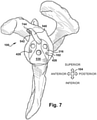
- a scapula 100 is shown in an intraoperative arrangement.
- the instrument 316 has been placed atop the glenoid fossa 102 with the instrument shaft 318 received into a shaft aperture.
- a landmark 744 has been placed at a predetermined landmark location chosen responsive to preoperative imaging of the patient tissue.
- the landmark 744 is spaced from a location of the instrument 316.
- the lower guide surface 532 of the guide 530 has been mated with a portion of the upper instrument surface 322 of the instrument 316 to place the instrument and guide into the predetermined relative guide/instrument orientation.
- the guide 530 and instrument 316 have then been concurrently moved (either both directly or by virtue of the interaction between some structure of the guide and a contacting structure of the instrument) to place the guide in the predetermined guide orientation with respect to the patient tissue, which means, since the guide and instrument are mated, that the instrument has achieved the predetermined instrument orientation with respect to the patient tissue.
- the user knows that the predetermined guide and instrument orientations have been achieved because the mated guide 530 and instrument 316 have been repositioned (here, rotated about the instrument shaft 318 pivotally held in the shaft aperture) to bring the orienting feature 540 into the predetermined orienting relationship with the landmark 744. More specifically in the depicted example of the Figures, since the orienting indicator 542 is a notch, the instrument 316 and mated guide 530 have been repositioned such that the landmark 744 is received into the orienting indicator 542.
- the guide 530 and the instrument 316 could be concurrently placed into contact with at least one landmark (which could include the central landmark) at a location spaced apart from the patient tissue at the surgical site.
- a landmark could be an elongate guide pin (such as that shown in Fig. 7 ), and a notchlike orienting indicator 542 could be placed into the signaling relationship with a protruding end of the guide pin some distance from the patient tissue.
- the stock instrument would be guided into the predetermined instrument orientation concurrently with being brought into contact with the patient tissue as the orienting indicator 542 slides along the length of the guide pin via a rail-like dynamic guiding technique.
- the user may remove the guide 530, and optionally the landmark 744, from the surgical site and continue with the surgical procedure using the positioned instrument as desired once the predetermined instrument orientation has been achieved as shown in Fig. 7 .
- the instrument 316 may be temporarily secured in the predetermined instrument orientation to avoid shifting or movement of the instrument upon the patient tissue.
- guide pins (not shown) could be inserted through the securing features 428 to hold the instrument 316 in place for as long as desired by the user. Whether an additional structure is provided or the user merely holds the instrument 316 in place by hand, however, the desired patient tissue modifications are made, the instrument 316 is removed from the patient tissue, and the surgical procedure proceeds apace. This may include the insertion of one or more surgical tools through at least one guide interacting structure 324 of the instrument 316, since some of the guide interacting structures additionally function as drill guides for preparation of the patient tissue to receive the fastening pegs 214 of the glenoid implant 206 here.
- Figs. 8-12 depict a guide 530' according to an embodiment not forming part of the present invention and related structures.
- the guide 530' of Figs. 8-12 is similar to the guide 530 of Figs. 5-7 and therefore, structures of Figs. 8-12 that are the same as or similar to those described with reference to Figs. 1-7 have the same reference numbers with the addition of a "prime" mark. Description of common elements and operation similar to those in the previously described first embodiment will not be repeated with respect to the second embodiment.
- Figs. 8-9 depict an instrument 316' which can be used to guide reaming or other relatively large-area patient tissue modification (as opposed to the relatively confined fastening peg 214 drilling guided by the first embodiment).
- the instrument 316' includes a relatively large guide interacting feature 324'.
- the instrument 316' of Fig. 8 could be used with the glenoid implant 206 of Fig. 2 or with any other suitable glenoid implant (e.g., a known type of implant having a stepped lower implant surface, for which an area of the glenoid fossa 102' will need to be reamed away).
- the instrument 316' of the second embodiment does not have an instrument shaft 318, but instead has a locating aperture 846 which accepts a three-dimensional landmark (not shown) to position the instrument 316' laterally upon the glenoid fossa 102 as desired.
- the landmark which enters the locating aperture 846 could be a guidewire (not shown), such as that disclosed in co-pending U.S. Patent Application No. 13/178,324, filed July 7, 2011 , titled "Method and Apparatus for Providing a Relative Location Indication During a Surgical Procedure" and claiming priority to U.S. Provisional Patent Application Serial No.
- the landmark (not shown) received by the locating aperture 846 may have been previously placed to provide a "pivot point" about which the instrument 316' can rotate during guided movement as discussed below.
- This landmarking/pivot-guiding function is provided instead by indirect action of the instrument shaft 318 in the first embodiment of the present invention, as previously discussed.
- the lower instrument surface 320' of the instrument 316' of the second embodiment also includes a plurality of holding teeth 948 which can be selectively pushed down into the patient tissue to resist rotation/pivoting of the instrument about the landmark within the locating aperture 846.
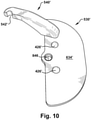
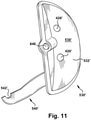
- a guide 530' according to this embodiment not forming part of the present invention is shown in Figs. 10-11 .
- the guide 530' includes a locating aperture 846.
- the guide 530' may include one or more handling features 426' (two shown), which may be configured to accept a handling tool (not shown) or otherwise to assist the user in moving the guide at or near the surgical site.
- the guide 530' of this embodiment operates similarly to the guide 530 of the first embodiment, as is shown in Fig. 12 .
- the instrument 316' of Figs. 10-11 is placed upon the glenoid fossa 102 surface.
- a landmark (not shown) may have been previously placed in the glenoid fossa 102 surface--if so, the locating aperture 846 receives the landmark as a part of placing the lower instrument surface 320' in contact with the patient tissue.
- the guide 530' is placed atop the instrument 316' with the lower guide surface 532' in contact with the upper instrument surface 322'.
- the instrument guiding features 538' of the guide 530' may mate with the guide interacting features 324' of the instrument 316'.
- the instrument and guide can be moved concurrently to move both the guide and the instrument into predetermined guide and instrument orientations with respect to the patient tissue.
- engagement between the guide 530' and the instrument 316' causes forces exerted upon the guide to be transferred to the instrument, and the user can move both the instrument and the guide concurrently either by moving just the guide, or by moving both the guide and instrument directly.
- a counterclockwise force exerted upon the orienting feature 540' will pivot the guide 530" -and thus the mated instrument-about the landmark.
- the guide 530' and mated instrument 316' may be rotated, for example, until the orienting indicator 542' achieves a predetermined signaling relationship with a landmark 744' such as the depicted guide pin. Accordingly, the guide 530' can rotate the instrument 316' into a predetermined instrument orientation with respect to the glenoid fossa 102' surface.
- the guide pin may deflect, if needed, to allow the guide 530' to be lifted longitudinally off the protruding end guide pin.
- the guide 530' may include at least one frangible portion to allow substantially laterally-oriented removal of the guide from around the guide pin or from engagement with the instrument 316'.
- the guide 530' could include one or more slots (not shown) to allow removal of the guide by sliding the guide sideways away from the guide pin and/or the instrument 316'.
- the guide and/or a stock instrument component could be configured for maintenance of the guide and/or instrument within the body, perhaps as a part of the completely installed prosthetic implant structure.
- the guide 530 may be used in conjunction with an implant and related structures such as those discussed in co-pending U.S. Patent Application No. to be determined, filed October 27, 201 1, titled “System and Method for Assisting with Attachment of a Stock Implant to a Patient Tissue” and claiming priority to U.S. Provisional Patent Application No. 61/408,324, filed October 29, 2010 and titled “System and Method for Assisting with Attachment of a Stock Implant to a Patient Tissue”.
- the mating relationships formed between the described structures need not keep the entirety of each of the "mating" surfaces in direct contact with each other but could include spacers or holdaways for partial direct contact, a liner or other intermediate member for indirect contact, or could even be approximated with intervening space remaining therebetween and no contact.
- the guide 530 may include a plurality of structures cooperatively forming the base body and temporarily or permanently attached together in such a manner as to permit relative motion (e.g., pivoting, sliding, or any other motion) therebetween.
- any structures or features described with reference to one embodiment or configuration of the present invention could be provided, singly or in combination with other structures or features, to any other embodiment or configuration, as it would be impractical to describe each of the embodiments and configurations discussed herein as having all of the options discussed with respect to all of the other embodiments and configurations.
- An adhesive such as, but not limited to, bone cement
- Any of the components described herein could have a surface treatment (e.g., texturization, notching, etc.), material choice, and/or other characteristic chosen to provide the component with a desired interaction property (e.g., tissue ingrowth, eluting of a therapeutic material, etc.) with the surrounding tissue.
Landscapes
- Health & Medical Sciences (AREA)
- Surgery (AREA)
- Life Sciences & Earth Sciences (AREA)
- Engineering & Computer Science (AREA)
- Orthopedic Medicine & Surgery (AREA)
- Medical Informatics (AREA)
- Animal Behavior & Ethology (AREA)
- Veterinary Medicine (AREA)
- Biomedical Technology (AREA)
- Heart & Thoracic Surgery (AREA)
- Public Health (AREA)
- Molecular Biology (AREA)
- Nuclear Medicine, Radiotherapy & Molecular Imaging (AREA)
- General Health & Medical Sciences (AREA)
- Dentistry (AREA)
- Oral & Maxillofacial Surgery (AREA)
- Robotics (AREA)
- Prostheses (AREA)
- Surgical Instruments (AREA)
- Apparatus For Radiation Diagnosis (AREA)
Claims (7)
- Kombination, umfassend eine Führung (530) und ein Standardinstrument (316), wobei die Führung (530) dazu betreibbar ist, das Standardinstrument (316) in Bezug auf ein Patientengewebe (100) anzuordnen, wobei die Führung (530) und das Standardinstrument (316) in Kombination umfassen:das Standardinstrument (316), das eine in Längsrichtung beabstandete obere und untere Instrumentenoberfläche (322, 320) aufweist, wobei die untere Instrumentenoberfläche (320) dazu konfiguriert ist, das Patientengewebe (100) zu berühren, und die obere Instrumentenoberfläche (322) dazu konfiguriert ist, die Führung (530) zu berühren, wobei das Standardinstrument (316) einen Instrumentenschaft (318) aufweist, der sich von der unteren Instrumentenoberfläche (320) erstreckt und dazu konfiguriert ist, in eine Öffnung in dem Patientengewebe (100) platziert zu werden, um das Standardinstrument (316) zu positionieren;die Führung (530), umfassend:eine untere Führungsoberfläche (532), die dazu konfiguriert ist, die obere Instrumentenoberfläche (322) des Standardinstruments (316) zu berühren, wenn die untere Instrumentenoberfläche (320) das Patientengewebe (100) berührt, wobei mindestens ein Abschnitt des Standardinstruments (316) in Längsrichtung zwischen der unteren Führungsoberfläche (532) und dem Patientengewebe (100) angeordnet ist und die obere Instrumentenoberfläche (322) in Längsrichtung von dem Patientengewebe (100) beabstandet ist, wobei die untere Führungsoberfläche (532) derart konturiert ist, dass sie im Wesentlichen mit mindestens einem Abschnitt der oberen Instrumentenoberfläche (322) zusammenpasst;eine obere Führungsoberfläche (634), die in Längsrichtung von der unteren Führungsoberfläche (532) durch einen Führungskörper (536) beabstandet ist, wobei die obere Führungsoberfläche (634) für einen Benutzer zugänglich ist, wenn die untere Führungsoberfläche (532) die obere Instrumentenoberfläche (322) berührt; undein Ausrichtungsmerkmal, umfassend einen Arm (540), der sich von dem Führungskörper (536) weg erstreckt, wobei ein erstes Ende des Arms (540) an der oberen Führungsoberfläche (634) angebracht ist und ein zweites Ende des Arms eine kerbenförmige Markierungseingriffsabschnitt (542) aufweist; wobei die Führung (530) derart angeordnet ist, dass sie das Instrument (316) in einer vorbestimmten Instrumentenbeziehung mit dem Patientengewebe (100) positioniert, wenn:(i) der kerbenförmige Markierungseingriffsabschnitt (542) des Ausrichtungsmerkmals in einer vorbestimmten Ausrichtungsbeziehung mit einer zuvor platzierten Markierung (744) steht; und(ii) sich die untere Führungsoberfläche (532) in Passkontakt mit mindestens einem Abschnitt der oberen Instrumentenoberfläche (322) in einer vorbestimmten relativen Führungs-/Instrumentenausrichtung befindet.
- Kombination nach Anspruch 1, wobei das Standardinstrument (316) mindestens ein Führungsinteraktionsmerkmal (324) beinhaltet und die Führung (530) mindestens ein Instrumentenführungsmerkmal (538) an einer vorbestimmten Merkmalsposition in Bezug auf den Führungskörper (536) beinhaltet, wobei mindestens ein Führungsinteraktionsmerkmal (324) des Instruments (316) zum Eingriff mit mindestens einem Instrumentenführungsmerkmal (538) der Führung (530) konfiguriert ist, wenn sich die Führung (530) und das Instrument ( 316) in der vorbestimmten relativen Führungs-/Instrumentenausrichtung befinden.
- Kombination nach Anspruch 1 oder 2, wobei die zuvor platzierte Markierung (744) an dem Patientengewebe (100) an einer Position befestigt ist, die von einer Position des Standardinstruments (316) beabstandet ist.
- Kombination nach Anspruch 2, wobei ein ausgewähltes von dem Führungsinteraktionsmerkmal (324) und dem Instrumentenführungsmerkmal (538) ein Vorsprung ist und das andere von dem Führungsinteraktionsmerkmal (324) und dem Instrumentenführungsmerkmal (538) ein Hohlraum ist und der Vorsprung derart angeordnet ist, dass er in den Hohlraum eindringt, um die Führung (530) und das Instrument (316) in dem Passkontakt in der vorbestimmten relativen Führungs-/Instrumenteneinrichtung in Eingriff zu nehmen.
- Kombination nach einem der vorhergehenden Ansprüche, wobei der kerbenförmige Markierungseingriffsabschnitt (542) eine vorbestimmte Signalisierungsbeziehung mit der Markierung (744) erreicht, während sich die Führung (530) und das Standardinstrument (316) in der vorbestimmten relativen Führungs-/Instrumentenausrichtung befinden, um anzugeben, dass das Instrument (316) eine vorbestimmte Instrumentenbeziehung mit dem Patientengewebe (100) erreicht hat.
- Kombination nach einem der vorhergehenden Ansprüche, wobei das Standardinstrument (316) und die Führung (530) derart angeordnet sind, dass sie zusammen bewegt werden, um sowohl die Führung (530) als auch das Standardinstrument (316) in vorbestimmte Führungs- und Instrumentenausrichtungen in Bezug auf das Patientengewebe (100) zu bewegen.
- Kombination nach einem der vorhergehenden Ansprüche, wobei das Standardinstrument (316) mindestens ein Modifizierungsmerkmal für das Patientengewebe (100) enthält, das eine vorbestimmte Position für ein Modifizierungsverfahren für das Patientengewebe (100) angibt, wenn sich das Instrument (316) in der vorbestimmten Instrumentenausrichtung in Bezug auf das Patientengewebe (100) befindet.
Applications Claiming Priority (2)
| Application Number | Priority Date | Filing Date | Title |
|---|---|---|---|
| US40837610P | 2010-10-29 | 2010-10-29 | |
| PCT/US2011/057954 WO2012058353A1 (en) | 2010-10-29 | 2011-10-27 | System and method for assisting with arrangement of a stock instrument with respect to a patient tissue |
Publications (2)
| Publication Number | Publication Date |
|---|---|
| EP2632383A1 EP2632383A1 (de) | 2013-09-04 |
| EP2632383B1 true EP2632383B1 (de) | 2022-02-23 |
Family
ID=44947213
Family Applications (1)
| Application Number | Title | Priority Date | Filing Date |
|---|---|---|---|
| EP11782295.7A Active EP2632383B1 (de) | 2010-10-29 | 2011-10-27 | System zur unterstützung der anordnung eines standardinstruments in bezug zu einem patientengewebe |
Country Status (4)
| Country | Link |
|---|---|
| US (4) | US9254155B2 (de) |
| EP (1) | EP2632383B1 (de) |
| CA (1) | CA2815655A1 (de) |
| WO (1) | WO2012058353A1 (de) |
Families Citing this family (87)
| Publication number | Priority date | Publication date | Assignee | Title |
|---|---|---|---|---|
| US8407067B2 (en) | 2007-04-17 | 2013-03-26 | Biomet Manufacturing Corp. | Method and apparatus for manufacturing an implant |
| US8608749B2 (en) | 2006-02-27 | 2013-12-17 | Biomet Manufacturing, Llc | Patient-specific acetabular guides and associated instruments |
| US8241293B2 (en) | 2006-02-27 | 2012-08-14 | Biomet Manufacturing Corp. | Patient specific high tibia osteotomy |
| US7967868B2 (en) | 2007-04-17 | 2011-06-28 | Biomet Manufacturing Corp. | Patient-modified implant and associated method |
| US8133234B2 (en) | 2006-02-27 | 2012-03-13 | Biomet Manufacturing Corp. | Patient specific acetabular guide and method |
| US8864769B2 (en) | 2006-02-27 | 2014-10-21 | Biomet Manufacturing, Llc | Alignment guides with patient-specific anchoring elements |
| US9339278B2 (en) | 2006-02-27 | 2016-05-17 | Biomet Manufacturing, Llc | Patient-specific acetabular guides and associated instruments |
| US9907659B2 (en) | 2007-04-17 | 2018-03-06 | Biomet Manufacturing, Llc | Method and apparatus for manufacturing an implant |
| US8608748B2 (en) | 2006-02-27 | 2013-12-17 | Biomet Manufacturing, Llc | Patient specific guides |
| US8092465B2 (en) | 2006-06-09 | 2012-01-10 | Biomet Manufacturing Corp. | Patient specific knee alignment guide and associated method |
| US8603180B2 (en) | 2006-02-27 | 2013-12-10 | Biomet Manufacturing, Llc | Patient-specific acetabular alignment guides |
| US8473305B2 (en) | 2007-04-17 | 2013-06-25 | Biomet Manufacturing Corp. | Method and apparatus for manufacturing an implant |
| US9345548B2 (en) | 2006-02-27 | 2016-05-24 | Biomet Manufacturing, Llc | Patient-specific pre-operative planning |
| US9289253B2 (en) | 2006-02-27 | 2016-03-22 | Biomet Manufacturing, Llc | Patient-specific shoulder guide |
| US20150335438A1 (en) | 2006-02-27 | 2015-11-26 | Biomet Manufacturing, Llc. | Patient-specific augments |
| US9918740B2 (en) | 2006-02-27 | 2018-03-20 | Biomet Manufacturing, Llc | Backup surgical instrument system and method |
| US8377066B2 (en) | 2006-02-27 | 2013-02-19 | Biomet Manufacturing Corp. | Patient-specific elbow guides and associated methods |
| US20110046735A1 (en) * | 2006-02-27 | 2011-02-24 | Biomet Manufacturing Corp. | Patient-Specific Implants |
| US9173661B2 (en) | 2006-02-27 | 2015-11-03 | Biomet Manufacturing, Llc | Patient specific alignment guide with cutting surface and laser indicator |
| US8591516B2 (en) | 2006-02-27 | 2013-11-26 | Biomet Manufacturing, Llc | Patient-specific orthopedic instruments |
| US10278711B2 (en) | 2006-02-27 | 2019-05-07 | Biomet Manufacturing, Llc | Patient-specific femoral guide |
| US8858561B2 (en) | 2006-06-09 | 2014-10-14 | Blomet Manufacturing, LLC | Patient-specific alignment guide |
| US9113971B2 (en) | 2006-02-27 | 2015-08-25 | Biomet Manufacturing, Llc | Femoral acetabular impingement guide |
| US8535387B2 (en) * | 2006-02-27 | 2013-09-17 | Biomet Manufacturing, Llc | Patient-specific tools and implants |
| US8568487B2 (en) | 2006-02-27 | 2013-10-29 | Biomet Manufacturing, Llc | Patient-specific hip joint devices |
| US9795399B2 (en) | 2006-06-09 | 2017-10-24 | Biomet Manufacturing, Llc | Patient-specific knee alignment guide and associated method |
| DE102009028503B4 (de) | 2009-08-13 | 2013-11-14 | Biomet Manufacturing Corp. | Resektionsschablone zur Resektion von Knochen, Verfahren zur Herstellung einer solchen Resektionsschablone und Operationsset zur Durchführung von Kniegelenk-Operationen |
| US8632547B2 (en) | 2010-02-26 | 2014-01-21 | Biomet Sports Medicine, Llc | Patient-specific osteotomy devices and methods |
| US9579106B2 (en) | 2010-03-31 | 2017-02-28 | New York Society For The Relief Of The Ruptured And Crippled, Maintaining The Hospital For Special Surgery | Shoulder arthroplasty instrumentation |
| US9271744B2 (en) | 2010-09-29 | 2016-03-01 | Biomet Manufacturing, Llc | Patient-specific guide for partial acetabular socket replacement |
| EP2632348B1 (de) | 2010-10-29 | 2019-07-17 | The Cleveland Clinic Foundation | System und verfahren zur verbindung einer führungshilfe mit einem patientengewebe |
| US9968376B2 (en) | 2010-11-29 | 2018-05-15 | Biomet Manufacturing, Llc | Patient-specific orthopedic instruments |
| US8486076B2 (en) * | 2011-01-28 | 2013-07-16 | DePuy Synthes Products, LLC | Oscillating rasp for use in an orthopaedic surgical procedure |
| US9241745B2 (en) | 2011-03-07 | 2016-01-26 | Biomet Manufacturing, Llc | Patient-specific femoral version guide |
| US8715289B2 (en) | 2011-04-15 | 2014-05-06 | Biomet Manufacturing, Llc | Patient-specific numerically controlled instrument |
| US9675400B2 (en) | 2011-04-19 | 2017-06-13 | Biomet Manufacturing, Llc | Patient-specific fracture fixation instrumentation and method |
| US8956364B2 (en) | 2011-04-29 | 2015-02-17 | Biomet Manufacturing, Llc | Patient-specific partial knee guides and other instruments |
| US8668700B2 (en) | 2011-04-29 | 2014-03-11 | Biomet Manufacturing, Llc | Patient-specific convertible guides |
| US8532807B2 (en) | 2011-06-06 | 2013-09-10 | Biomet Manufacturing, Llc | Pre-operative planning and manufacturing method for orthopedic procedure |
| US9084618B2 (en) | 2011-06-13 | 2015-07-21 | Biomet Manufacturing, Llc | Drill guides for confirming alignment of patient-specific alignment guides |
| US8764760B2 (en) | 2011-07-01 | 2014-07-01 | Biomet Manufacturing, Llc | Patient-specific bone-cutting guidance instruments and methods |
| US20130001121A1 (en) | 2011-07-01 | 2013-01-03 | Biomet Manufacturing Corp. | Backup kit for a patient-specific arthroplasty kit assembly |
| US10052114B2 (en) | 2011-07-12 | 2018-08-21 | Materialise, Nv | Shoulder base plate coverage and stability |
| US8597365B2 (en) | 2011-08-04 | 2013-12-03 | Biomet Manufacturing, Llc | Patient-specific pelvic implants for acetabular reconstruction |
| US9295497B2 (en) | 2011-08-31 | 2016-03-29 | Biomet Manufacturing, Llc | Patient-specific sacroiliac and pedicle guides |
| US9066734B2 (en) | 2011-08-31 | 2015-06-30 | Biomet Manufacturing, Llc | Patient-specific sacroiliac guides and associated methods |
| US9386993B2 (en) | 2011-09-29 | 2016-07-12 | Biomet Manufacturing, Llc | Patient-specific femoroacetabular impingement instruments and methods |
| KR20130046336A (ko) | 2011-10-27 | 2013-05-07 | 삼성전자주식회사 | 디스플레이장치의 멀티뷰 디바이스 및 그 제어방법과, 디스플레이 시스템 |
| WO2013062848A1 (en) | 2011-10-27 | 2013-05-02 | Biomet Manufacturing Corporation | Patient-specific glenoid guides |
| US9301812B2 (en) | 2011-10-27 | 2016-04-05 | Biomet Manufacturing, Llc | Methods for patient-specific shoulder arthroplasty |
| US9554910B2 (en) | 2011-10-27 | 2017-01-31 | Biomet Manufacturing, Llc | Patient-specific glenoid guide and implants |
| US9451973B2 (en) | 2011-10-27 | 2016-09-27 | Biomet Manufacturing, Llc | Patient specific glenoid guide |
| BE1021299B1 (nl) * | 2011-10-28 | 2015-10-26 | Materialise N.V. | Basisplaat voor de bedekking en stabiliteit van de schouder |
| US9237950B2 (en) | 2012-02-02 | 2016-01-19 | Biomet Manufacturing, Llc | Implant with patient-specific porous structure |
| EP2630935B1 (de) * | 2012-02-27 | 2014-12-31 | Arthrex, Inc. | Erweiterungsblock für Schultergelenkpfanne |
| US20150223941A1 (en) * | 2012-08-27 | 2015-08-13 | Conformis, Inc. | Methods, Devices and Techniques for Improved Placement and Fixation of Shoulder Implant Components |
| US9204977B2 (en) | 2012-12-11 | 2015-12-08 | Biomet Manufacturing, Llc | Patient-specific acetabular guide for anterior approach |
| US9060788B2 (en) | 2012-12-11 | 2015-06-23 | Biomet Manufacturing, Llc | Patient-specific acetabular guide for anterior approach |
| US9839438B2 (en) | 2013-03-11 | 2017-12-12 | Biomet Manufacturing, Llc | Patient-specific glenoid guide with a reusable guide holder |
| US9579107B2 (en) | 2013-03-12 | 2017-02-28 | Biomet Manufacturing, Llc | Multi-point fit for patient specific guide |
| US9498233B2 (en) | 2013-03-13 | 2016-11-22 | Biomet Manufacturing, Llc. | Universal acetabular guide and associated hardware |
| US9826981B2 (en) | 2013-03-13 | 2017-11-28 | Biomet Manufacturing, Llc | Tangential fit of patient-specific guides |
| US9517145B2 (en) | 2013-03-15 | 2016-12-13 | Biomet Manufacturing, Llc | Guide alignment system and method |
| US20150112349A1 (en) | 2013-10-21 | 2015-04-23 | Biomet Manufacturing, Llc | Ligament Guide Registration |
| US10282488B2 (en) | 2014-04-25 | 2019-05-07 | Biomet Manufacturing, Llc | HTO guide with optional guided ACL/PCL tunnels |
| US9408616B2 (en) | 2014-05-12 | 2016-08-09 | Biomet Manufacturing, Llc | Humeral cut guide |
| US10575968B2 (en) | 2014-05-16 | 2020-03-03 | Howmedica Osteonics Corp. | Guides for fracture system |
| US9681960B2 (en) | 2014-05-16 | 2017-06-20 | Howmedica Osteonics Corp. | Guides for fracture system |
| US9839436B2 (en) | 2014-06-03 | 2017-12-12 | Biomet Manufacturing, Llc | Patient-specific glenoid depth control |
| US9561040B2 (en) | 2014-06-03 | 2017-02-07 | Biomet Manufacturing, Llc | Patient-specific glenoid depth control |
| US9833245B2 (en) | 2014-09-29 | 2017-12-05 | Biomet Sports Medicine, Llc | Tibial tubercule osteotomy |
| US9826994B2 (en) | 2014-09-29 | 2017-11-28 | Biomet Manufacturing, Llc | Adjustable glenoid pin insertion guide |
| US9955984B2 (en) * | 2015-01-12 | 2018-05-01 | Biomet Manufacturing, Llc | Augmented glenoid and method for preparation |
| US9820868B2 (en) | 2015-03-30 | 2017-11-21 | Biomet Manufacturing, Llc | Method and apparatus for a pin apparatus |
| US10226262B2 (en) | 2015-06-25 | 2019-03-12 | Biomet Manufacturing, Llc | Patient-specific humeral guide designs |
| US10568647B2 (en) | 2015-06-25 | 2020-02-25 | Biomet Manufacturing, Llc | Patient-specific humeral guide designs |
| WO2018067966A1 (en) | 2016-10-07 | 2018-04-12 | New York Society For The Relief Of The Ruptured And Crippled, Maintaining The Hostpital For Special Surgery | Patient specific 3-d interactive total joint model and surgical planning system |
| US10722310B2 (en) | 2017-03-13 | 2020-07-28 | Zimmer Biomet CMF and Thoracic, LLC | Virtual surgery planning system and method |
| US11547482B2 (en) | 2018-12-13 | 2023-01-10 | Mako Surgical Corp. | Techniques for patient-specific morphing of virtual boundaries |
| US11986251B2 (en) | 2019-09-13 | 2024-05-21 | Treace Medical Concepts, Inc. | Patient-specific osteotomy instrumentation |
| US12193751B2 (en) | 2021-09-14 | 2025-01-14 | Arthrex, Inc. | Preoperative surgical planning systems and methods for generating and utilizing anatomical makeup classifications |
| US12433677B2 (en) * | 2021-09-14 | 2025-10-07 | Arthrex, Inc. | Surgical planning systems and methods with postoperative feedback loops |
| US12702484B2 (en) | 2022-03-31 | 2026-08-11 | Treace Medical Concepts, Inc. | Apparatus, system, and method for generating patient-specific implants and/or instrumentation |
| US12661133B2 (en) | 2022-05-12 | 2026-06-23 | Treace Medical Concepts, Inc. | Apparatus, system, and method for patient-specific methods and instrumentation |
| EP4539753A1 (de) | 2022-06-17 | 2025-04-23 | Treace Medical Concepts, Inc. | Vorrichtung, system und verfahren zur erzeugung patientenspezifischer implantate und/oder instrumente für osteotomien |
| US12653618B2 (en) | 2022-08-18 | 2026-06-16 | Arthrex, Inc. | Fragment registration and associated methods for repairing fractured bones |
| JP2026505040A (ja) | 2023-01-28 | 2026-02-10 | トリース メディカル コンセプツ,インコーポレイティド | 骨切り術のための装置、システム、及び方法 |
Family Cites Families (169)
| Publication number | Priority date | Publication date | Assignee | Title |
|---|---|---|---|---|
| US4841975A (en) | 1987-04-15 | 1989-06-27 | Cemax, Inc. | Preoperative planning of bone cuts and joint replacement using radiant energy scan imaging |
| US5030219A (en) * | 1990-01-22 | 1991-07-09 | Boehringer Mannheim Corporation | Glenoid component installation tools |
| US5098383A (en) | 1990-02-08 | 1992-03-24 | Artifax Ltd. | Device for orienting appliances, prostheses, and instrumentation in medical procedures and methods of making same |
| EP0630212B1 (de) | 1992-02-20 | 1998-07-08 | Synvasive Technology, Inc. | Chirurgischer schneideblock |
| BE1008372A3 (nl) | 1994-04-19 | 1996-04-02 | Materialise Nv | Werkwijze voor het vervaardigen van een geperfektioneerd medisch model uitgaande van digitale beeldinformatie van een lichaamsdeel. |
| US5682886A (en) | 1995-12-26 | 1997-11-04 | Musculographics Inc | Computer-assisted surgical system |
| US8083745B2 (en) | 2001-05-25 | 2011-12-27 | Conformis, Inc. | Surgical tools for arthroplasty |
| US7468075B2 (en) | 2001-05-25 | 2008-12-23 | Conformis, Inc. | Methods and compositions for articular repair |
| US8556983B2 (en) | 2001-05-25 | 2013-10-15 | Conformis, Inc. | Patient-adapted and improved orthopedic implants, designs and related tools |
| US8480754B2 (en) | 2001-05-25 | 2013-07-09 | Conformis, Inc. | Patient-adapted and improved articular implants, designs and related guide tools |
| US20070233269A1 (en) | 2001-05-25 | 2007-10-04 | Conformis, Inc. | Interpositional Joint Implant |
| US20070100462A1 (en) | 2001-05-25 | 2007-05-03 | Conformis, Inc | Joint Arthroplasty Devices |
| US20110071802A1 (en) | 2009-02-25 | 2011-03-24 | Ray Bojarski | Patient-adapted and improved articular implants, designs and related guide tools |
| US20090222103A1 (en) | 2001-05-25 | 2009-09-03 | Conformis, Inc. | Articular Implants Providing Lower Adjacent Cartilage Wear |
| US7618451B2 (en) | 2001-05-25 | 2009-11-17 | Conformis, Inc. | Patient selectable joint arthroplasty devices and surgical tools facilitating increased accuracy, speed and simplicity in performing total and partial joint arthroplasty |
| US8882847B2 (en) | 2001-05-25 | 2014-11-11 | Conformis, Inc. | Patient selectable knee joint arthroplasty devices |
| US8545569B2 (en) | 2001-05-25 | 2013-10-01 | Conformis, Inc. | Patient selectable knee arthroplasty devices |
| US8771365B2 (en) | 2009-02-25 | 2014-07-08 | Conformis, Inc. | Patient-adapted and improved orthopedic implants, designs, and related tools |
| US20110071645A1 (en) | 2009-02-25 | 2011-03-24 | Ray Bojarski | Patient-adapted and improved articular implants, designs and related guide tools |
| US8735773B2 (en) | 2007-02-14 | 2014-05-27 | Conformis, Inc. | Implant device and method for manufacture |
| US9603711B2 (en) | 2001-05-25 | 2017-03-28 | Conformis, Inc. | Patient-adapted and improved articular implants, designs and related guide tools |
| US7534263B2 (en) | 2001-05-25 | 2009-05-19 | Conformis, Inc. | Surgical tools facilitating increased accuracy, speed and simplicity in performing joint arthroplasty |
| US5916219A (en) | 1997-02-10 | 1999-06-29 | Matsuno; Shigeo | Tibial plateau resection guide |
| US7052499B2 (en) * | 1998-02-18 | 2006-05-30 | Walter Lorenz Surgical, Inc. | Method and apparatus for bone fracture fixation |
| JP2002519093A (ja) * | 1998-06-29 | 2002-07-02 | プルス、エンドプロテーティク、アクチエンゲゼルシャフト | 人工膝を挿入するための装置及び方法 |
| US7635390B1 (en) | 2000-01-14 | 2009-12-22 | Marctec, Llc | Joint replacement component having a modular articulating surface |
| US9308091B2 (en) | 2001-05-25 | 2016-04-12 | Conformis, Inc. | Devices and methods for treatment of facet and other joints |
| US20130211531A1 (en) | 2001-05-25 | 2013-08-15 | Conformis, Inc. | Patient-adapted and improved articular implants, designs and related guide tools |
| US8439926B2 (en) | 2001-05-25 | 2013-05-14 | Conformis, Inc. | Patient selectable joint arthroplasty devices and surgical tools |
| AU2007202573A1 (en) | 2001-05-25 | 2007-06-28 | Conformis, Inc. | Methods and compositions for articular resurfacing |
| CN100502808C (zh) | 2001-05-25 | 2009-06-24 | 肯弗默斯股份有限公司 | 用于关节表面再造的组合物 |
| FR2826859B1 (fr) * | 2001-07-09 | 2003-09-19 | Tornier Sa | Ancillaire de pose d'un composant humeral de prothese de coude |
| US7141053B2 (en) * | 2001-11-28 | 2006-11-28 | Wright Medical Technology, Inc. | Methods of minimally invasive unicompartmental knee replacement |
| US8801720B2 (en) | 2002-05-15 | 2014-08-12 | Otismed Corporation | Total joint arthroplasty system |
| US8965075B2 (en) | 2002-09-16 | 2015-02-24 | Imatx, Inc. | System and method for predicting future fractures |
| CN1728976A (zh) | 2002-10-07 | 2006-02-01 | 康复米斯公司 | 具有与关节表面相匹配的三维几何结构的微创关节植入物 |
| WO2004032806A1 (en) | 2002-10-07 | 2004-04-22 | Conformis, Inc. | Minimally invasive joint implant with 3-dimensional geometry matching the articular surfaces |
| CN1780594A (zh) | 2002-11-07 | 2006-05-31 | 康复米斯公司 | 用于确定半月板的大小和形状以及设计治疗的方法 |
| JP2006508746A (ja) | 2002-12-04 | 2006-03-16 | コンフォーミス・インコーポレイテッド | Mriにおける等方性撮像用の複数撮像平面の融合並びに等方性又は近似的等方性撮像を用いた量的画像解析 |
| AU2011203237B2 (en) | 2003-11-25 | 2012-06-14 | Conformis, Inc. | Patient selectable knee joint arthroplasty devices |
| US8175683B2 (en) | 2003-12-30 | 2012-05-08 | Depuy Products, Inc. | System and method of designing and manufacturing customized instrumentation for accurate implantation of prosthesis by utilizing computed tomography data |
| US7927335B2 (en) * | 2004-09-27 | 2011-04-19 | Depuy Products, Inc. | Instrument for preparing an implant support surface and associated method |
| US8043297B2 (en) * | 2004-11-03 | 2011-10-25 | Synthes Usa, Llc | Aiming arm for bone plates |
| US20060111722A1 (en) | 2004-11-19 | 2006-05-25 | Hacene Bouadi | Surgical cutting tool |
| EP1951158A4 (de) | 2005-11-21 | 2010-03-31 | Vertegen Inc | Vorrichtungen und verfahren zur behandlung von facettengelenken, uncovertebralgelenken, costovertebralgelenken und anderen gelenken |
| EP1951136A1 (de) | 2005-11-23 | 2008-08-06 | Conformis, Inc. | Implantatsgreifer |
| US7357057B2 (en) | 2006-01-06 | 2008-04-15 | Tung-Lung Chiang | Paper cutter |
| EP2671521A3 (de) | 2006-02-06 | 2013-12-25 | ConforMIS, Inc. | Vom Patienten auswählbare Gelenkarthroplastie-Vorrichtungen und chirurgische Instrumente |
| US8623026B2 (en) | 2006-02-06 | 2014-01-07 | Conformis, Inc. | Patient selectable joint arthroplasty devices and surgical tools incorporating anatomical relief |
| US9017336B2 (en) | 2006-02-15 | 2015-04-28 | Otismed Corporation | Arthroplasty devices and related methods |
| US9808262B2 (en) | 2006-02-15 | 2017-11-07 | Howmedica Osteonics Corporation | Arthroplasty devices and related methods |
| US8864769B2 (en) | 2006-02-27 | 2014-10-21 | Biomet Manufacturing, Llc | Alignment guides with patient-specific anchoring elements |
| US8407067B2 (en) * | 2007-04-17 | 2013-03-26 | Biomet Manufacturing Corp. | Method and apparatus for manufacturing an implant |
| US20110172672A1 (en) | 2006-02-27 | 2011-07-14 | Biomet Manufacturing Corp. | Instrument with transparent portion for use with patient-specific alignment guide |
| US9339278B2 (en) | 2006-02-27 | 2016-05-17 | Biomet Manufacturing, Llc | Patient-specific acetabular guides and associated instruments |
| US8092465B2 (en) | 2006-06-09 | 2012-01-10 | Biomet Manufacturing Corp. | Patient specific knee alignment guide and associated method |
| US8241293B2 (en) * | 2006-02-27 | 2012-08-14 | Biomet Manufacturing Corp. | Patient specific high tibia osteotomy |
| US8298237B2 (en) | 2006-06-09 | 2012-10-30 | Biomet Manufacturing Corp. | Patient-specific alignment guide for multiple incisions |
| US8282646B2 (en) | 2006-02-27 | 2012-10-09 | Biomet Manufacturing Corp. | Patient specific knee alignment guide and associated method |
| US8377066B2 (en) | 2006-02-27 | 2013-02-19 | Biomet Manufacturing Corp. | Patient-specific elbow guides and associated methods |
| US10278711B2 (en) | 2006-02-27 | 2019-05-07 | Biomet Manufacturing, Llc | Patient-specific femoral guide |
| US9173661B2 (en) | 2006-02-27 | 2015-11-03 | Biomet Manufacturing, Llc | Patient specific alignment guide with cutting surface and laser indicator |
| US8858561B2 (en) | 2006-06-09 | 2014-10-14 | Blomet Manufacturing, LLC | Patient-specific alignment guide |
| US9113971B2 (en) | 2006-02-27 | 2015-08-25 | Biomet Manufacturing, Llc | Femoral acetabular impingement guide |
| US8608749B2 (en) | 2006-02-27 | 2013-12-17 | Biomet Manufacturing, Llc | Patient-specific acetabular guides and associated instruments |
| US8608748B2 (en) * | 2006-02-27 | 2013-12-17 | Biomet Manufacturing, Llc | Patient specific guides |
| US8535387B2 (en) | 2006-02-27 | 2013-09-17 | Biomet Manufacturing, Llc | Patient-specific tools and implants |
| US8133234B2 (en) * | 2006-02-27 | 2012-03-13 | Biomet Manufacturing Corp. | Patient specific acetabular guide and method |
| US8603180B2 (en) | 2006-02-27 | 2013-12-10 | Biomet Manufacturing, Llc | Patient-specific acetabular alignment guides |
| US7967868B2 (en) | 2007-04-17 | 2011-06-28 | Biomet Manufacturing Corp. | Patient-modified implant and associated method |
| US8591516B2 (en) | 2006-02-27 | 2013-11-26 | Biomet Manufacturing, Llc | Patient-specific orthopedic instruments |
| US8070752B2 (en) * | 2006-02-27 | 2011-12-06 | Biomet Manufacturing Corp. | Patient specific alignment guide and inter-operative adjustment |
| US9289253B2 (en) | 2006-02-27 | 2016-03-22 | Biomet Manufacturing, Llc | Patient-specific shoulder guide |
| EP1996121A2 (de) | 2006-03-21 | 2008-12-03 | Conformis, Inc. | Gelenksinterponat |
| US20070270973A1 (en) * | 2006-04-10 | 2007-11-22 | Alexandria Research Technologies, Llc | Apparatus and method for sculpting the surface of a joint |
| US8372123B2 (en) * | 2006-12-08 | 2013-02-12 | Trimax Medical Management, Inc. | Sternal closure device and method of using same |
| US8460302B2 (en) | 2006-12-18 | 2013-06-11 | Otismed Corporation | Arthroplasty devices and related methods |
| US8814874B2 (en) * | 2007-02-13 | 2014-08-26 | Medtronic Navigation, Inc. | Navigated cut guide for total knee reconstruction |
| EP2591756A1 (de) | 2007-02-14 | 2013-05-15 | Conformis, Inc. | Implantat und Herstellungsverfahren |
| EP2129317B1 (de) | 2007-03-06 | 2014-11-05 | The Cleveland Clinic Foundation | Verfahren für die vorbereitung eines chirurgischen eingriffs |
| WO2008112996A1 (en) | 2007-03-14 | 2008-09-18 | Conformis, Inc. | Surgical tools for arthroplasty |
| GB2447702A (en) | 2007-03-23 | 2008-09-24 | Univ Leeds | Surgical bone cutting template |
| US8444651B2 (en) | 2007-05-14 | 2013-05-21 | Queen's University At Kingston | Patient-specific surgical guidance tool and method of use |
| US7682399B2 (en) * | 2007-06-06 | 2010-03-23 | Howmedica Osteonics Corp. | Acetabular shell |
| WO2008157412A2 (en) | 2007-06-13 | 2008-12-24 | Conformis, Inc. | Surgical cutting guide |
| GB0712290D0 (en) | 2007-06-25 | 2007-08-01 | Depuy Orthopaedie Gmbh | Surgical instrument |
| ES2662643T3 (es) | 2007-07-11 | 2018-04-09 | Smith & Nephew, Inc. | Métodos y aparato para determinar la colocación de pasadores durante la cirugía de cadera |
| US8425524B2 (en) | 2007-09-30 | 2013-04-23 | DePuy Synthes Products, LLC | Customized patient-specific multi-cutting blocks |
| US8460303B2 (en) | 2007-10-25 | 2013-06-11 | Otismed Corporation | Arthroplasty systems and devices, and related methods |
| US10582934B2 (en) | 2007-11-27 | 2020-03-10 | Howmedica Osteonics Corporation | Generating MRI images usable for the creation of 3D bone models employed to make customized arthroplasty jigs |
| US8545509B2 (en) | 2007-12-18 | 2013-10-01 | Otismed Corporation | Arthroplasty system and related methods |
| US8737700B2 (en) | 2007-12-18 | 2014-05-27 | Otismed Corporation | Preoperatively planning an arthroplasty procedure and generating a corresponding patient specific arthroplasty resection guide |
| US8777875B2 (en) | 2008-07-23 | 2014-07-15 | Otismed Corporation | System and method for manufacturing arthroplasty jigs having improved mating accuracy |
| US8480679B2 (en) | 2008-04-29 | 2013-07-09 | Otismed Corporation | Generation of a computerized bone model representative of a pre-degenerated state and useable in the design and manufacture of arthroplasty devices |
| US8160345B2 (en) | 2008-04-30 | 2012-04-17 | Otismed Corporation | System and method for image segmentation in generating computer models of a joint to undergo arthroplasty |
| US8221430B2 (en) | 2007-12-18 | 2012-07-17 | Otismed Corporation | System and method for manufacturing arthroplasty jigs |
| US8617171B2 (en) | 2007-12-18 | 2013-12-31 | Otismed Corporation | Preoperatively planning an arthroplasty procedure and generating a corresponding patient specific arthroplasty resection guide |
| US8715291B2 (en) | 2007-12-18 | 2014-05-06 | Otismed Corporation | Arthroplasty system and related methods |
| GB0803514D0 (en) | 2008-02-27 | 2008-04-02 | Depuy Int Ltd | Customised surgical apparatus |
| US8734455B2 (en) | 2008-02-29 | 2014-05-27 | Otismed Corporation | Hip resurfacing surgical guide tool |
| CN104382630B (zh) | 2008-03-03 | 2017-04-12 | 史密夫和内修有限公司 | 用于膝关节的小轮廓患者特定切削块 |
| EP2901969B1 (de) | 2008-03-05 | 2018-07-04 | ConforMIS, Inc. | Verfahren zur Herstellung eines Gelenkimplantats mit angepasstem Rand |
| EP2265199A4 (de) | 2008-03-05 | 2012-03-07 | Conformis Inc | Vom patienten auswählbare gelenk-arthroplastie-vorrichtungen und operationswerkzeuge |
| US8682052B2 (en) | 2008-03-05 | 2014-03-25 | Conformis, Inc. | Implants for altering wear patterns of articular surfaces |
| US8617175B2 (en) | 2008-12-16 | 2013-12-31 | Otismed Corporation | Unicompartmental customized arthroplasty cutting jigs and methods of making the same |
| US8078440B2 (en) | 2008-09-19 | 2011-12-13 | Smith & Nephew, Inc. | Operatively tuning implants for increased performance |
| US8992538B2 (en) | 2008-09-30 | 2015-03-31 | DePuy Synthes Products, Inc. | Customized patient-specific acetabular orthopaedic surgical instrument and method of use and fabrication |
| US8454619B1 (en) * | 2008-12-10 | 2013-06-04 | William C. Head | Prosthetic socket alignment |
| US20100185202A1 (en) | 2009-01-16 | 2010-07-22 | Lester Mark B | Customized patient-specific patella resectioning guide |
| WO2010099231A2 (en) | 2009-02-24 | 2010-09-02 | Conformis, Inc. | Automated systems for manufacturing patient-specific orthopedic implants and instrumentation |
| US9017334B2 (en) * | 2009-02-24 | 2015-04-28 | Microport Orthopedics Holdings Inc. | Patient specific surgical guide locator and mount |
| US20100217270A1 (en) | 2009-02-25 | 2010-08-26 | Conformis, Inc. | Integrated Production of Patient-Specific Implants and Instrumentation |
| SG173840A1 (en) | 2009-02-25 | 2011-09-29 | Conformis Inc | Patient-adapted and improved orthopedic implants, designs and related tools |
| US8337503B2 (en) | 2009-04-13 | 2012-12-25 | George John Lian | Custom radiographically designed cutting guides and instruments for use in total ankle replacement surgery |
| CN102448394B (zh) | 2009-04-16 | 2015-07-22 | 康复米斯公司 | 用于韧带修复的患者专属关节成形术装置 |
| US20110190775A1 (en) | 2010-02-02 | 2011-08-04 | Ure Keith J | Device and method for achieving accurate positioning of acetabular cup during total hip replacement |
| RU2011148292A (ru) | 2009-05-07 | 2013-06-20 | Смит Энд Нефью, Инк. | Соответствующее особенностям пациента направляющее устройство для проксимального отдела бедренной кости |
| US9597095B2 (en) * | 2009-05-15 | 2017-03-21 | Globus Medical, Inc | Screw guide and tissue retractor instrument |
| WO2010145769A1 (en) | 2009-06-17 | 2010-12-23 | Universität Bern | Methods and devices for patient-specific acetabular component alignment in total hip arthroplasty |
| US8308810B2 (en) * | 2009-07-14 | 2012-11-13 | Biomet Manufacturing Corp. | Multiple bearing acetabular prosthesis |
| US8414591B2 (en) | 2009-07-17 | 2013-04-09 | Materialise N.V. | Surgical guiding tool, methods for manufacture and uses thereof |
| DE102009028503B4 (de) | 2009-08-13 | 2013-11-14 | Biomet Manufacturing Corp. | Resektionsschablone zur Resektion von Knochen, Verfahren zur Herstellung einer solchen Resektionsschablone und Operationsset zur Durchführung von Kniegelenk-Operationen |
| US8876830B2 (en) | 2009-08-13 | 2014-11-04 | Zimmer, Inc. | Virtual implant placement in the OR |
| JP5719368B2 (ja) | 2009-08-26 | 2015-05-20 | コンフォーミス・インコーポレイテッドConforMIS, Inc. | 患者特異的整形外科用インプラント及びモデル |
| WO2011031914A1 (en) | 2009-09-10 | 2011-03-17 | Laurent Angibaud | Alignment guides for use in computer assisted orthopedic surgery to prepare a bone element for an implant |
| EP2493396B1 (de) | 2009-10-29 | 2016-11-23 | Zimmer, Inc. | Patientenspezifische fräsführung |
| CA2779283A1 (en) | 2009-11-04 | 2011-05-12 | Conformis, Inc. | Patient-adapted and improved orthopedic implants, designs and related tools |
| MX2012005649A (es) | 2009-11-17 | 2012-12-05 | Univ Kingston | Guia especifica de paciente para colocacion de la copa acetabular. |
| AU2010327987B2 (en) | 2009-12-11 | 2015-04-02 | Conformis, Inc. | Patient-specific and patient-engineered orthopedic implants |
| EP2512381B1 (de) | 2009-12-18 | 2017-10-25 | ConforMIS, Inc. | Patientenadaptierte und verbesserte orthopädische implantate, entwürfe und zugehörige instrumente |
| US8556901B2 (en) * | 2009-12-31 | 2013-10-15 | DePuy Synthes Products, LLC | Reciprocating rasps for use in an orthopaedic surgical procedure |
| US8632547B2 (en) | 2010-02-26 | 2014-01-21 | Biomet Sports Medicine, Llc | Patient-specific osteotomy devices and methods |
| US9066727B2 (en) | 2010-03-04 | 2015-06-30 | Materialise Nv | Patient-specific computed tomography guides |
| US9579106B2 (en) | 2010-03-31 | 2017-02-28 | New York Society For The Relief Of The Ruptured And Crippled, Maintaining The Hospital For Special Surgery | Shoulder arthroplasty instrumentation |
| CA2802190A1 (en) | 2010-06-11 | 2011-12-15 | Smith & Nephew, Inc. | Patient-matched instruments |
| WO2011153645A2 (en) | 2010-06-11 | 2011-12-15 | Sunnybrook Health Sciences Center | Method of forming patient-specific implant |
| WO2011160008A1 (en) | 2010-06-18 | 2011-12-22 | Howmedica Osteonics Corp. | Patient-specific total hip arthroplasty |
| CA2841427C (en) | 2010-07-09 | 2018-10-16 | The Cleveland Clinic Foundation | Method and apparatus for providing a relative location indication during a surgical procedure |
| US8808302B2 (en) | 2010-08-12 | 2014-08-19 | DePuy Synthes Products, LLC | Customized patient-specific acetabular orthopaedic surgical instrument and method of use and fabrication |
| CA2810233C (en) | 2010-09-07 | 2018-09-25 | The Cleveland Clinic Foundation | Positioning apparatus and method for a prosthetic implant |
| US8617170B2 (en) | 2010-09-29 | 2013-12-31 | DePuy Synthes Products, LLC | Customized patient-specific computer controlled cutting system and method |
| US9271744B2 (en) | 2010-09-29 | 2016-03-01 | Biomet Manufacturing, Llc | Patient-specific guide for partial acetabular socket replacement |
| US20120276509A1 (en) | 2010-10-29 | 2012-11-01 | The Cleveland Clinic Foundation | System of preoperative planning and provision of patient-specific surgical aids |
| CA2816339C (en) | 2010-10-29 | 2020-09-15 | The Cleveland Clinic Foundation | System of preoperative planning and provision of patient-specific surgical aids |
| BE1019572A5 (nl) | 2010-11-10 | 2012-08-07 | Materialise Nv | Geoptimaliseerde methoden voor de productie van patientspecifieke medische hulpmiddelen. |
| WO2012064513A1 (en) | 2010-11-11 | 2012-05-18 | Zimmer, Inc. | Patient-specific instruments for total hip arthroplasty |
| WO2012112701A2 (en) | 2011-02-15 | 2012-08-23 | Conformis, Inc. | Patent-adapted and improved articular implants, designs, surgical procedures and related guide tools |
| US9186154B2 (en) | 2011-03-17 | 2015-11-17 | Zimmer, Inc. | Patient-specific instruments for total ankle arthroplasty |
| US8715289B2 (en) | 2011-04-15 | 2014-05-06 | Biomet Manufacturing, Llc | Patient-specific numerically controlled instrument |
| US9675400B2 (en) | 2011-04-19 | 2017-06-13 | Biomet Manufacturing, Llc | Patient-specific fracture fixation instrumentation and method |
| US8668700B2 (en) | 2011-04-29 | 2014-03-11 | Biomet Manufacturing, Llc | Patient-specific convertible guides |
| US20140228860A1 (en) | 2011-08-03 | 2014-08-14 | Conformis, Inc. | Automated Design, Selection, Manufacturing and Implantation of Patient-Adapted and Improved Articular Implants, Designs and Related Guide Tools |
| JP2014531920A (ja) | 2011-08-15 | 2014-12-04 | コンフォーミス・インコーポレイテッドConforMIS, Inc. | 関節形成術インプラントを再置換するための再置換システム、ツール、および方法 |
| US20140257508A1 (en) | 2011-10-14 | 2014-09-11 | Conformis, Inc. | Methods and Systems for Identification, Assessment, Modeling and Repair of Anatomical Disparities in Joint Replacement |
| US20130184713A1 (en) | 2011-12-23 | 2013-07-18 | Conformis, Inc. | Anatomical Alignment Systems and Methods |
| US20140371866A1 (en) | 2012-02-07 | 2014-12-18 | Conformis, Inc. | Tibial implant devices, systems, and methods |
| US20130211410A1 (en) | 2012-02-07 | 2013-08-15 | Conformis, Inc. | Patella Resection Instrument Guide Having Optional Patient-Specific Features |
| US20140364857A1 (en) | 2012-02-07 | 2014-12-11 | Conformis, Inc. | Joint Arthroplasty Devices, Systems, and Methods |
| WO2013131066A1 (en) | 2012-03-02 | 2013-09-06 | Conformis, Inc. | Patient-adapted posterior stabilized knee implants, designs and related methods and tools |
| EP2833840A4 (de) | 2012-04-06 | 2016-09-21 | Conformis Inc | Erweiterte verfahren, techniken, vorrichtungen und systeme für kniegelenkimplantate zum halten des kreuzbandes |
| CN104363860B (zh) | 2012-04-13 | 2016-04-13 | 康复米斯公司 | 用于植入物部件的添加制造的装置和方法 |
| EP3187151B1 (de) | 2012-04-13 | 2018-12-05 | ConforMIS, Inc. | Patientenadaptierte gelenkarthroplastievorrichtungen und chirurgische instrumente |
| US9486226B2 (en) | 2012-04-18 | 2016-11-08 | Conformis, Inc. | Tibial guides, tools, and techniques for resecting the tibial plateau |
| US20130289570A1 (en) | 2012-04-27 | 2013-10-31 | Conformis, Inc. | Tibial Template and Punch System, Tools and Methods for Preparing the Tibia |
| US20130297031A1 (en) | 2012-05-02 | 2013-11-07 | Conformis, Inc. | Patient specific instruments and related methods for joint replacement |
| US9675471B2 (en) | 2012-06-11 | 2017-06-13 | Conformis, Inc. | Devices, techniques and methods for assessing joint spacing, balancing soft tissues and obtaining desired kinematics for joint implant components |
| US20160199198A1 (en) | 2012-07-03 | 2016-07-14 | Conformis, Inc. | Devices, Systems, and Methods for Impacting Joint Implant Components |
| US20150223941A1 (en) | 2012-08-27 | 2015-08-13 | Conformis, Inc. | Methods, Devices and Techniques for Improved Placement and Fixation of Shoulder Implant Components |
| IN2015DN02636A (de) | 2012-09-21 | 2015-09-18 | Conformis Inc |
-
2011
- 2011-10-27 EP EP11782295.7A patent/EP2632383B1/de active Active
- 2011-10-27 CA CA2815655A patent/CA2815655A1/en not_active Abandoned
- 2011-10-27 WO PCT/US2011/057954 patent/WO2012058353A1/en not_active Ceased
- 2011-10-27 US US13/282,528 patent/US9254155B2/en active Active
-
2013
- 2013-11-15 US US14/080,855 patent/US20140081342A1/en not_active Abandoned
-
2015
- 2015-12-15 US US14/969,964 patent/US10512496B2/en active Active
-
2016
- 2016-11-23 US US15/360,455 patent/US20170071647A1/en not_active Abandoned
Also Published As
| Publication number | Publication date |
|---|---|
| CA2815655A1 (en) | 2012-05-03 |
| US9254155B2 (en) | 2016-02-09 |
| WO2012058353A1 (en) | 2012-05-03 |
| US20170071647A1 (en) | 2017-03-16 |
| US20160095608A1 (en) | 2016-04-07 |
| US20140081342A1 (en) | 2014-03-20 |
| US20120109226A1 (en) | 2012-05-03 |
| WO2012058353A4 (en) | 2012-06-21 |
| US10512496B2 (en) | 2019-12-24 |
| EP2632383A1 (de) | 2013-09-04 |
Similar Documents
| Publication | Publication Date | Title |
|---|---|---|
| US10512496B2 (en) | System and method for assisting with arrangement of a stock instrument with respect to a patient tissue | |
| US10258352B2 (en) | System and method for assisting with attachment of a stock implant to a patient tissue | |
| US9060788B2 (en) | Patient-specific acetabular guide for anterior approach | |
| US9597201B2 (en) | Patient-specific acetabular guide for anterior approach | |
| US10376270B2 (en) | Universal acetabular guide and associated hardware | |
| US10307174B2 (en) | Apparatus and method for providing a reference indication to a patient tissue | |
| US20200046381A1 (en) | Patient-specific glenoid guides | |
| JP7128793B2 (ja) | 寛骨臼インプラント位置合わせデバイスおよび方法 | |
| US9820868B2 (en) | Method and apparatus for a pin apparatus | |
| US20160228132A1 (en) | Patient-specific glenoid guides |
Legal Events
| Date | Code | Title | Description |
|---|---|---|---|
| PUAI | Public reference made under article 153(3) epc to a published international application that has entered the european phase |
Free format text: ORIGINAL CODE: 0009012 |
|
| 17P | Request for examination filed |
Effective date: 20130523 |
|
| AK | Designated contracting states |
Kind code of ref document: A1 Designated state(s): AL AT BE BG CH CY CZ DE DK EE ES FI FR GB GR HR HU IE IS IT LI LT LU LV MC MK MT NL NO PL PT RO RS SE SI SK SM TR |
|
| DAX | Request for extension of the european patent (deleted) | ||
| STAA | Information on the status of an ep patent application or granted ep patent |
Free format text: STATUS: EXAMINATION IS IN PROGRESS |
|
| 17Q | First examination report despatched |
Effective date: 20161020 |
|
| GRAP | Despatch of communication of intention to grant a patent |
Free format text: ORIGINAL CODE: EPIDOSNIGR1 |
|
| STAA | Information on the status of an ep patent application or granted ep patent |
Free format text: STATUS: GRANT OF PATENT IS INTENDED |
|
| RIC1 | Information provided on ipc code assigned before grant |
Ipc: A61B 17/17 20060101AFI20210531BHEP Ipc: A61B 34/10 20160101ALN20210531BHEP |
|
| INTG | Intention to grant announced |
Effective date: 20210628 |
|
| RAP3 | Party data changed (applicant data changed or rights of an application transferred) |
Owner name: THE CLEVELAND CLINIC FOUNDATION |
|
| RIN1 | Information on inventor provided before grant (corrected) |
Inventor name: IANNOTTI, JOSEPH, P. Inventor name: BARSOUM, WAEL, K. Inventor name: BRYAN, JASON, A. |
|
| GRAS | Grant fee paid |
Free format text: ORIGINAL CODE: EPIDOSNIGR3 |
|
| GRAJ | Information related to disapproval of communication of intention to grant by the applicant or resumption of examination proceedings by the epo deleted |
Free format text: ORIGINAL CODE: EPIDOSDIGR1 |
|
| GRAL | Information related to payment of fee for publishing/printing deleted |
Free format text: ORIGINAL CODE: EPIDOSDIGR3 |
|
| STAA | Information on the status of an ep patent application or granted ep patent |
Free format text: STATUS: EXAMINATION IS IN PROGRESS |
|
| REG | Reference to a national code |
Ref country code: DE Ref legal event code: R079 Ref document number: 602011072533 Country of ref document: DE Free format text: PREVIOUS MAIN CLASS: A61B0019000000 Ipc: A61B0017170000 |
|
| GRAP | Despatch of communication of intention to grant a patent |
Free format text: ORIGINAL CODE: EPIDOSNIGR1 |
|
| STAA | Information on the status of an ep patent application or granted ep patent |
Free format text: STATUS: GRANT OF PATENT IS INTENDED |
|
| INTC | Intention to grant announced (deleted) | ||
| RIC1 | Information provided on ipc code assigned before grant |
Ipc: A61B 34/10 20160101ALN20211115BHEP Ipc: A61B 17/17 20060101AFI20211115BHEP |
|
| INTG | Intention to grant announced |
Effective date: 20211202 |
|
| GRAA | (expected) grant |
Free format text: ORIGINAL CODE: 0009210 |
|
| STAA | Information on the status of an ep patent application or granted ep patent |
Free format text: STATUS: THE PATENT HAS BEEN GRANTED |
|
| AK | Designated contracting states |
Kind code of ref document: B1 Designated state(s): AL AT BE BG CH CY CZ DE DK EE ES FI FR GB GR HR HU IE IS IT LI LT LU LV MC MK MT NL NO PL PT RO RS SE SI SK SM TR |
|
| REG | Reference to a national code |
Ref country code: GB Ref legal event code: FG4D |
|
| REG | Reference to a national code |
Ref country code: CH Ref legal event code: EP |
|
| REG | Reference to a national code |
Ref country code: AT Ref legal event code: REF Ref document number: 1469836 Country of ref document: AT Kind code of ref document: T Effective date: 20220315 |
|
| REG | Reference to a national code |
Ref country code: IE Ref legal event code: FG4D |
|
| REG | Reference to a national code |
Ref country code: DE Ref legal event code: R096 Ref document number: 602011072533 Country of ref document: DE |
|
| REG | Reference to a national code |
Ref country code: LT Ref legal event code: MG9D |
|
| REG | Reference to a national code |
Ref country code: NL Ref legal event code: MP Effective date: 20220223 |
|
| REG | Reference to a national code |
Ref country code: AT Ref legal event code: MK05 Ref document number: 1469836 Country of ref document: AT Kind code of ref document: T Effective date: 20220223 |
|
| PG25 | Lapsed in a contracting state [announced via postgrant information from national office to epo] |
Ref country code: SE Free format text: LAPSE BECAUSE OF FAILURE TO SUBMIT A TRANSLATION OF THE DESCRIPTION OR TO PAY THE FEE WITHIN THE PRESCRIBED TIME-LIMIT Effective date: 20220223 Ref country code: RS Free format text: LAPSE BECAUSE OF FAILURE TO SUBMIT A TRANSLATION OF THE DESCRIPTION OR TO PAY THE FEE WITHIN THE PRESCRIBED TIME-LIMIT Effective date: 20220223 Ref country code: PT Free format text: LAPSE BECAUSE OF FAILURE TO SUBMIT A TRANSLATION OF THE DESCRIPTION OR TO PAY THE FEE WITHIN THE PRESCRIBED TIME-LIMIT Effective date: 20220623 Ref country code: NO Free format text: LAPSE BECAUSE OF FAILURE TO SUBMIT A TRANSLATION OF THE DESCRIPTION OR TO PAY THE FEE WITHIN THE PRESCRIBED TIME-LIMIT Effective date: 20220523 Ref country code: NL Free format text: LAPSE BECAUSE OF FAILURE TO SUBMIT A TRANSLATION OF THE DESCRIPTION OR TO PAY THE FEE WITHIN THE PRESCRIBED TIME-LIMIT Effective date: 20220223 Ref country code: LT Free format text: LAPSE BECAUSE OF FAILURE TO SUBMIT A TRANSLATION OF THE DESCRIPTION OR TO PAY THE FEE WITHIN THE PRESCRIBED TIME-LIMIT Effective date: 20220223 Ref country code: HR Free format text: LAPSE BECAUSE OF FAILURE TO SUBMIT A TRANSLATION OF THE DESCRIPTION OR TO PAY THE FEE WITHIN THE PRESCRIBED TIME-LIMIT Effective date: 20220223 Ref country code: ES Free format text: LAPSE BECAUSE OF FAILURE TO SUBMIT A TRANSLATION OF THE DESCRIPTION OR TO PAY THE FEE WITHIN THE PRESCRIBED TIME-LIMIT Effective date: 20220223 Ref country code: BG Free format text: LAPSE BECAUSE OF FAILURE TO SUBMIT A TRANSLATION OF THE DESCRIPTION OR TO PAY THE FEE WITHIN THE PRESCRIBED TIME-LIMIT Effective date: 20220523 |
|
| PG25 | Lapsed in a contracting state [announced via postgrant information from national office to epo] |
Ref country code: PL Free format text: LAPSE BECAUSE OF FAILURE TO SUBMIT A TRANSLATION OF THE DESCRIPTION OR TO PAY THE FEE WITHIN THE PRESCRIBED TIME-LIMIT Effective date: 20220223 Ref country code: LV Free format text: LAPSE BECAUSE OF FAILURE TO SUBMIT A TRANSLATION OF THE DESCRIPTION OR TO PAY THE FEE WITHIN THE PRESCRIBED TIME-LIMIT Effective date: 20220223 Ref country code: GR Free format text: LAPSE BECAUSE OF FAILURE TO SUBMIT A TRANSLATION OF THE DESCRIPTION OR TO PAY THE FEE WITHIN THE PRESCRIBED TIME-LIMIT Effective date: 20220524 Ref country code: FI Free format text: LAPSE BECAUSE OF FAILURE TO SUBMIT A TRANSLATION OF THE DESCRIPTION OR TO PAY THE FEE WITHIN THE PRESCRIBED TIME-LIMIT Effective date: 20220223 Ref country code: AT Free format text: LAPSE BECAUSE OF FAILURE TO SUBMIT A TRANSLATION OF THE DESCRIPTION OR TO PAY THE FEE WITHIN THE PRESCRIBED TIME-LIMIT Effective date: 20220223 |
|
| PG25 | Lapsed in a contracting state [announced via postgrant information from national office to epo] |
Ref country code: IS Free format text: LAPSE BECAUSE OF FAILURE TO SUBMIT A TRANSLATION OF THE DESCRIPTION OR TO PAY THE FEE WITHIN THE PRESCRIBED TIME-LIMIT Effective date: 20220623 |
|
| PG25 | Lapsed in a contracting state [announced via postgrant information from national office to epo] |
Ref country code: SM Free format text: LAPSE BECAUSE OF FAILURE TO SUBMIT A TRANSLATION OF THE DESCRIPTION OR TO PAY THE FEE WITHIN THE PRESCRIBED TIME-LIMIT Effective date: 20220223 Ref country code: SK Free format text: LAPSE BECAUSE OF FAILURE TO SUBMIT A TRANSLATION OF THE DESCRIPTION OR TO PAY THE FEE WITHIN THE PRESCRIBED TIME-LIMIT Effective date: 20220223 Ref country code: RO Free format text: LAPSE BECAUSE OF FAILURE TO SUBMIT A TRANSLATION OF THE DESCRIPTION OR TO PAY THE FEE WITHIN THE PRESCRIBED TIME-LIMIT Effective date: 20220223 Ref country code: EE Free format text: LAPSE BECAUSE OF FAILURE TO SUBMIT A TRANSLATION OF THE DESCRIPTION OR TO PAY THE FEE WITHIN THE PRESCRIBED TIME-LIMIT Effective date: 20220223 Ref country code: DK Free format text: LAPSE BECAUSE OF FAILURE TO SUBMIT A TRANSLATION OF THE DESCRIPTION OR TO PAY THE FEE WITHIN THE PRESCRIBED TIME-LIMIT Effective date: 20220223 Ref country code: CZ Free format text: LAPSE BECAUSE OF FAILURE TO SUBMIT A TRANSLATION OF THE DESCRIPTION OR TO PAY THE FEE WITHIN THE PRESCRIBED TIME-LIMIT Effective date: 20220223 |
|
| REG | Reference to a national code |
Ref country code: DE Ref legal event code: R097 Ref document number: 602011072533 Country of ref document: DE |
|
| PG25 | Lapsed in a contracting state [announced via postgrant information from national office to epo] |
Ref country code: AL Free format text: LAPSE BECAUSE OF FAILURE TO SUBMIT A TRANSLATION OF THE DESCRIPTION OR TO PAY THE FEE WITHIN THE PRESCRIBED TIME-LIMIT Effective date: 20220223 |
|
| PLBE | No opposition filed within time limit |
Free format text: ORIGINAL CODE: 0009261 |
|
| STAA | Information on the status of an ep patent application or granted ep patent |
Free format text: STATUS: NO OPPOSITION FILED WITHIN TIME LIMIT |
|
| 26N | No opposition filed |
Effective date: 20221124 |
|
| PG25 | Lapsed in a contracting state [announced via postgrant information from national office to epo] |
Ref country code: SI Free format text: LAPSE BECAUSE OF FAILURE TO SUBMIT A TRANSLATION OF THE DESCRIPTION OR TO PAY THE FEE WITHIN THE PRESCRIBED TIME-LIMIT Effective date: 20220223 |
|
| PGFP | Annual fee paid to national office [announced via postgrant information from national office to epo] |
Ref country code: CH Payment date: 20221101 Year of fee payment: 12 |
|
| PG25 | Lapsed in a contracting state [announced via postgrant information from national office to epo] |
Ref country code: MC Free format text: LAPSE BECAUSE OF FAILURE TO SUBMIT A TRANSLATION OF THE DESCRIPTION OR TO PAY THE FEE WITHIN THE PRESCRIBED TIME-LIMIT Effective date: 20220223 |
|
| REG | Reference to a national code |
Ref country code: BE Ref legal event code: MM Effective date: 20221031 |
|
| PG25 | Lapsed in a contracting state [announced via postgrant information from national office to epo] |
Ref country code: LU Free format text: LAPSE BECAUSE OF NON-PAYMENT OF DUE FEES Effective date: 20221027 |
|
| PG25 | Lapsed in a contracting state [announced via postgrant information from national office to epo] |
Ref country code: IT Free format text: LAPSE BECAUSE OF FAILURE TO SUBMIT A TRANSLATION OF THE DESCRIPTION OR TO PAY THE FEE WITHIN THE PRESCRIBED TIME-LIMIT Effective date: 20220223 |
|
| PG25 | Lapsed in a contracting state [announced via postgrant information from national office to epo] |
Ref country code: BE Free format text: LAPSE BECAUSE OF NON-PAYMENT OF DUE FEES Effective date: 20221031 |
|
| PG25 | Lapsed in a contracting state [announced via postgrant information from national office to epo] |
Ref country code: IE Free format text: LAPSE BECAUSE OF NON-PAYMENT OF DUE FEES Effective date: 20221027 |
|
| PG25 | Lapsed in a contracting state [announced via postgrant information from national office to epo] |
Ref country code: HU Free format text: LAPSE BECAUSE OF FAILURE TO SUBMIT A TRANSLATION OF THE DESCRIPTION OR TO PAY THE FEE WITHIN THE PRESCRIBED TIME-LIMIT; INVALID AB INITIO Effective date: 20111027 |
|
| PG25 | Lapsed in a contracting state [announced via postgrant information from national office to epo] |
Ref country code: CY Free format text: LAPSE BECAUSE OF FAILURE TO SUBMIT A TRANSLATION OF THE DESCRIPTION OR TO PAY THE FEE WITHIN THE PRESCRIBED TIME-LIMIT Effective date: 20220223 |
|
| PG25 | Lapsed in a contracting state [announced via postgrant information from national office to epo] |
Ref country code: MK Free format text: LAPSE BECAUSE OF FAILURE TO SUBMIT A TRANSLATION OF THE DESCRIPTION OR TO PAY THE FEE WITHIN THE PRESCRIBED TIME-LIMIT Effective date: 20220223 |
|
| REG | Reference to a national code |
Ref country code: CH Ref legal event code: PL |
|
| PG25 | Lapsed in a contracting state [announced via postgrant information from national office to epo] |
Ref country code: CH Free format text: LAPSE BECAUSE OF NON-PAYMENT OF DUE FEES Effective date: 20231031 |
|
| PG25 | Lapsed in a contracting state [announced via postgrant information from national office to epo] |
Ref country code: CH Free format text: LAPSE BECAUSE OF NON-PAYMENT OF DUE FEES Effective date: 20231031 |
|
| PG25 | Lapsed in a contracting state [announced via postgrant information from national office to epo] |
Ref country code: MT Free format text: LAPSE BECAUSE OF FAILURE TO SUBMIT A TRANSLATION OF THE DESCRIPTION OR TO PAY THE FEE WITHIN THE PRESCRIBED TIME-LIMIT Effective date: 20220223 |
|
| PG25 | Lapsed in a contracting state [announced via postgrant information from national office to epo] |
Ref country code: TR Free format text: LAPSE BECAUSE OF FAILURE TO SUBMIT A TRANSLATION OF THE DESCRIPTION OR TO PAY THE FEE WITHIN THE PRESCRIBED TIME-LIMIT Effective date: 20220223 |
|
| PGFP | Annual fee paid to national office [announced via postgrant information from national office to epo] |
Ref country code: DE Payment date: 20251010 Year of fee payment: 15 |
|
| PGFP | Annual fee paid to national office [announced via postgrant information from national office to epo] |
Ref country code: GB Payment date: 20251013 Year of fee payment: 15 |
|
| PGFP | Annual fee paid to national office [announced via postgrant information from national office to epo] |
Ref country code: FR Payment date: 20251014 Year of fee payment: 15 |