EP2632464B1 - Inhibitoren des renalen kaliumkanals der äusseren medulla - Google Patents
Inhibitoren des renalen kaliumkanals der äusseren medulla Download PDFInfo
- Publication number
- EP2632464B1 EP2632464B1 EP20110836912 EP11836912A EP2632464B1 EP 2632464 B1 EP2632464 B1 EP 2632464B1 EP 20110836912 EP20110836912 EP 20110836912 EP 11836912 A EP11836912 A EP 11836912A EP 2632464 B1 EP2632464 B1 EP 2632464B1
- Authority
- EP
- European Patent Office
- Prior art keywords
- mmol
- carbon atoms
- dihydro
- benzofuran
- methyl
- Prior art date
- Legal status (The legal status is an assumption and is not a legal conclusion. Google has not performed a legal analysis and makes no representation as to the accuracy of the status listed.)
- Active
Links
- 0 BC(*)C(N1C(*)(*)C(*)N(C(*)C(*)*)C(*)(*)C(C)(C)C(C)(C)C1(C)C)=O Chemical compound BC(*)C(N1C(*)(*)C(*)N(C(*)C(*)*)C(*)(*)C(C)(C)C(C)(C)C1(C)C)=O 0.000 description 25
- LAVXOMKPCHCIBF-UHFFFAOYSA-N CC(C)(C)OC(N1CC(C(F)F)NCC1)=O Chemical compound CC(C)(C)OC(N1CC(C(F)F)NCC1)=O LAVXOMKPCHCIBF-UHFFFAOYSA-N 0.000 description 1
- BOTOGEDEVFJXFU-UHFFFAOYSA-N CC(CC1C#N)=C(CC(CN2C=CNCC2)=O)C(OC)=C1F Chemical compound CC(CC1C#N)=C(CC(CN2C=CNCC2)=O)C(OC)=C1F BOTOGEDEVFJXFU-UHFFFAOYSA-N 0.000 description 1
- MILNXEUASXNUDC-UHFFFAOYSA-N CC(CN(CC1)CCN1C(Cc(cc1)ccc1-[n]1nnnc1)=O)c(cc1)cc(CO2)c1C2=O Chemical compound CC(CN(CC1)CCN1C(Cc(cc1)ccc1-[n]1nnnc1)=O)c(cc1)cc(CO2)c1C2=O MILNXEUASXNUDC-UHFFFAOYSA-N 0.000 description 1
- PDNWLUUXDPWGGU-UHFFFAOYSA-N CC(CN(CC1)CCN1C(Cc(cc1)ccc1-[n]1nnnc1)=O)c(cc1C#N)ccc1F Chemical compound CC(CN(CC1)CCN1C(Cc(cc1)ccc1-[n]1nnnc1)=O)c(cc1C#N)ccc1F PDNWLUUXDPWGGU-UHFFFAOYSA-N 0.000 description 1
- VXBMCLXHXDMAHD-UHFFFAOYSA-N CC(Cc(cc1)cc(CO2)c1C2=O)=O Chemical compound CC(Cc(cc1)cc(CO2)c1C2=O)=O VXBMCLXHXDMAHD-UHFFFAOYSA-N 0.000 description 1
- DTALSPSCBCDSHI-UHFFFAOYSA-N CC(Cc(cc1)ccc1N1[N-][NH+]=C1)N(CC1)CCN1C(C1)C1c1ccc(C=O)c(COC)c1 Chemical compound CC(Cc(cc1)ccc1N1[N-][NH+]=C1)N(CC1)CCN1C(C1)C1c1ccc(C=O)c(COC)c1 DTALSPSCBCDSHI-UHFFFAOYSA-N 0.000 description 1
- GDYZAIROCXYGSI-UHFFFAOYSA-N CC(Cc1c2ccc(C3OC3)c1)OC2=O Chemical compound CC(Cc1c2ccc(C3OC3)c1)OC2=O GDYZAIROCXYGSI-UHFFFAOYSA-N 0.000 description 1
- NEKPPRBMPMNRST-UHFFFAOYSA-N CC(Cc1c2ccc(CC=O)c1)OC2=O Chemical compound CC(Cc1c2ccc(CC=O)c1)OC2=O NEKPPRBMPMNRST-UHFFFAOYSA-N 0.000 description 1
- ASVWEOBXVPTROL-UHFFFAOYSA-N CC(Cc1c2ccc(CCN(CC3)CCN3C(Cc(cc3)ccc3-[n]3nnnc3)=O)c1)OC2=O Chemical compound CC(Cc1c2ccc(CCN(CC3)CCN3C(Cc(cc3)ccc3-[n]3nnnc3)=O)c1)OC2=O ASVWEOBXVPTROL-UHFFFAOYSA-N 0.000 description 1
- QNZCUTBRGICVOR-MWCIZMGKSA-N CC(Cc1cc(CCN(CC2)CCN2C(Cc(cc2)ccc2NNN/N=C\C)=O)ccc11)OC1=O Chemical compound CC(Cc1cc(CCN(CC2)CCN2C(Cc(cc2)ccc2NNN/N=C\C)=O)ccc11)OC1=O QNZCUTBRGICVOR-MWCIZMGKSA-N 0.000 description 1
- DANAUHMFSCHCKS-UHFFFAOYSA-N CCc1cc(CCN(CC2)CCN2C(Cc(cc2C)cc(C)c2C#N)=O)ccc1C(O)=O Chemical compound CCc1cc(CCN(CC2)CCN2C(Cc(cc2C)cc(C)c2C#N)=O)ccc1C(O)=O DANAUHMFSCHCKS-UHFFFAOYSA-N 0.000 description 1
- SWAHMIRIACJBAO-UHFFFAOYSA-N CN1C=NNCC1 Chemical compound CN1C=NNCC1 SWAHMIRIACJBAO-UHFFFAOYSA-N 0.000 description 1
- NLIXILYDDITUDB-UHFFFAOYSA-N COc(c(CC=O)c1)cc(F)c1C#N Chemical compound COc(c(CC=O)c1)cc(F)c1C#N NLIXILYDDITUDB-UHFFFAOYSA-N 0.000 description 1
- XBTIHIUJAAVVAP-UHFFFAOYSA-N COc(cc(CC(N1CCN(CCc(cc2)cc(C=CO3)c2C3=O)CC1)=O)c(F)c1)c1C#N Chemical compound COc(cc(CC(N1CCN(CCc(cc2)cc(C=CO3)c2C3=O)CC1)=O)c(F)c1)c1C#N XBTIHIUJAAVVAP-UHFFFAOYSA-N 0.000 description 1
- MCUTTXUOLSSPBP-UHFFFAOYSA-N CSc1c(CCN2CCNCC2)ccc2c1COC2=O Chemical compound CSc1c(CCN2CCNCC2)ccc2c1COC2=O MCUTTXUOLSSPBP-UHFFFAOYSA-N 0.000 description 1
- IJDUNNMFKACGPX-BJQOMGFOSA-N C[C@@H](Cc1cc(C(CN(CC2)CCN2C(Cc(cc2)cnc2-[n]2nnnc2)=O)O)ccc11)OC1=O Chemical compound C[C@@H](Cc1cc(C(CN(CC2)CCN2C(Cc(cc2)cnc2-[n]2nnnc2)=O)O)ccc11)OC1=O IJDUNNMFKACGPX-BJQOMGFOSA-N 0.000 description 1
- IFNWESYYDINUHV-PHDIDXHHSA-N C[C@H]1N[C@H](C)CNC1 Chemical compound C[C@H]1N[C@H](C)CNC1 IFNWESYYDINUHV-PHDIDXHHSA-N 0.000 description 1
- MKZBPWFFERUKRB-IWVLXDLESA-N C[F](C)(C)/C(/C=C=[IH])=C/C=N Chemical compound C[F](C)(C)/C(/C=C=[IH])=C/C=N MKZBPWFFERUKRB-IWVLXDLESA-N 0.000 description 1
- OMAFFHIGWTVZOH-UHFFFAOYSA-N C[n]1nnnc1 Chemical compound C[n]1nnnc1 OMAFFHIGWTVZOH-UHFFFAOYSA-N 0.000 description 1
- QWXWYUICHVSTQY-UHFFFAOYSA-N Cc(c(C#N)c1)cc(CC(N2CCNCC2)=O)c1F Chemical compound Cc(c(C#N)c1)cc(CC(N2CCNCC2)=O)c1F QWXWYUICHVSTQY-UHFFFAOYSA-N 0.000 description 1
- PBLOYQAQGYUPCM-UHFFFAOYSA-N Cc(cc1)ncc1C#N Chemical compound Cc(cc1)ncc1C#N PBLOYQAQGYUPCM-UHFFFAOYSA-N 0.000 description 1
- ZDJAHPMWNYHRRX-UHFFFAOYSA-N Cc1c(CC(N2CCN(CCc(c(C)c3CO4)ccc3C4=O)CC2)=O)cnc(-[n]2nnnc2)c1 Chemical compound Cc1c(CC(N2CCN(CCc(c(C)c3CO4)ccc3C4=O)CC2)=O)cnc(-[n]2nnnc2)c1 ZDJAHPMWNYHRRX-UHFFFAOYSA-N 0.000 description 1
- VCTPBYIMYGVTND-UHFFFAOYSA-N Cc1c(COC2=O)c2ccc1C(CN(CC1)CCN1C(Cc(cc1)ccc1-[n]1nnnc1)=O)F Chemical compound Cc1c(COC2=O)c2ccc1C(CN(CC1)CCN1C(Cc(cc1)ccc1-[n]1nnnc1)=O)F VCTPBYIMYGVTND-UHFFFAOYSA-N 0.000 description 1
- LYRNWWPOYVKPAH-UHFFFAOYSA-N Cc1c(COC2=O)c2ccc1C(CN(CC1)CCN1C(Cc(cc1)ccc1-[n]1nnnc1)=O)OC Chemical compound Cc1c(COC2=O)c2ccc1C(CN(CC1)CCN1C(Cc(cc1)ccc1-[n]1nnnc1)=O)OC LYRNWWPOYVKPAH-UHFFFAOYSA-N 0.000 description 1
- GDTBACYBTXRQMO-UHFFFAOYSA-N Cc1c(COC2=O)c2ccc1CC(O)=O Chemical compound Cc1c(COC2=O)c2ccc1CC(O)=O GDTBACYBTXRQMO-UHFFFAOYSA-N 0.000 description 1
- HLDPTLIROCVDQV-UHFFFAOYSA-N Cc1c(COC=O)c(C)c(C(CN(CC2)CCN2C(Cc(cc(c(C#N)c2)F)c2F)=O)F)cc1 Chemical compound Cc1c(COC=O)c(C)c(C(CN(CC2)CCN2C(Cc(cc(c(C#N)c2)F)c2F)=O)F)cc1 HLDPTLIROCVDQV-UHFFFAOYSA-N 0.000 description 1
- LFOSWVOAEZLXCE-UHFFFAOYSA-N Cc1cc(CC=O)cc(CO2)c1C2=O Chemical compound Cc1cc(CC=O)cc(CO2)c1C2=O LFOSWVOAEZLXCE-UHFFFAOYSA-N 0.000 description 1
- QFMGECUJKXKFOI-UHFFFAOYSA-N N#Cc(c(CCC1CN2CCNCC2)c1cc1)c1F Chemical compound N#Cc(c(CCC1CN2CCNCC2)c1cc1)c1F QFMGECUJKXKFOI-UHFFFAOYSA-N 0.000 description 1
- VZGCAVQHWSQSTI-UHFFFAOYSA-N N#Cc1c(CCC2CN(CC3)CCN3C(Cc(cc3)ccc3-[n]3nnnc3)=O)c2ccc1F Chemical compound N#Cc1c(CCC2CN(CC3)CCN3C(Cc(cc3)ccc3-[n]3nnnc3)=O)c2ccc1F VZGCAVQHWSQSTI-UHFFFAOYSA-N 0.000 description 1
- NLQRVEYCBAPYGS-UHFFFAOYSA-N N#Cc1c(CCOC2CN(CC3)CCN3C(Cc(cc3)ncc3-[n]3nnnc3)=O)c2ccc1F Chemical compound N#Cc1c(CCOC2CN(CC3)CCN3C(Cc(cc3)ncc3-[n]3nnnc3)=O)c2ccc1F NLQRVEYCBAPYGS-UHFFFAOYSA-N 0.000 description 1
- GYCNHFWRPJXTSB-UHFFFAOYSA-N N#Cc1cc(Br)ccc1F Chemical compound N#Cc1cc(Br)ccc1F GYCNHFWRPJXTSB-UHFFFAOYSA-N 0.000 description 1
- DOHVMOVJARBHAJ-UHFFFAOYSA-N N#Cc1cc(CC=O)ccc1F Chemical compound N#Cc1cc(CC=O)ccc1F DOHVMOVJARBHAJ-UHFFFAOYSA-N 0.000 description 1
- PBMPNNKDJPQRGK-UHFFFAOYSA-N N#Cc1ccc(CCC(C2)=O)c2c1 Chemical compound N#Cc1ccc(CCC(C2)=O)c2c1 PBMPNNKDJPQRGK-UHFFFAOYSA-N 0.000 description 1
- HXTQUDYQICAAJV-UHFFFAOYSA-N N#Cc1ccc(CCN(CC2)CCN2C(Cc(cc2)ccc2-[n]2nnnc2)=O)cc1 Chemical compound N#Cc1ccc(CCN(CC2)CCN2C(Cc(cc2)ccc2-[n]2nnnc2)=O)cc1 HXTQUDYQICAAJV-UHFFFAOYSA-N 0.000 description 1
- MAJVXHJNUIVRAV-UHFFFAOYSA-N N#Cc1cccc2c1CCC2CN(CC1)CCN1C(C(CCc1c2)c1ccc2-[n]1nnnc1)=O Chemical compound N#Cc1cccc2c1CCC2CN(CC1)CCN1C(C(CCc1c2)c1ccc2-[n]1nnnc1)=O MAJVXHJNUIVRAV-UHFFFAOYSA-N 0.000 description 1
- AXRZMFJLNGBMRI-UHFFFAOYSA-N N#Cc1cccc2c1OCC2CN(CC1)CCN1C(Cc(cc1CO2)ccc1C2=O)=O Chemical compound N#Cc1cccc2c1OCC2CN(CC1)CCN1C(Cc(cc1CO2)ccc1C2=O)=O AXRZMFJLNGBMRI-UHFFFAOYSA-N 0.000 description 1
- KOGNXQTUEOQDDE-UHFFFAOYSA-N O=C(C(CC1)c(cc2)c1cc2N1NNN=C1)N1CCN(CCc(cc2CCO3)ccc2C3=O)CC1 Chemical compound O=C(C(CC1)c(cc2)c1cc2N1NNN=C1)N1CCN(CCc(cc2CCO3)ccc2C3=O)CC1 KOGNXQTUEOQDDE-UHFFFAOYSA-N 0.000 description 1
- KYQRAEXFYFCOMY-ULUSZKPHSA-N O=C(C1=C[C@H]2C(F)(F)F)OCC1=CC2Br Chemical compound O=C(C1=C[C@H]2C(F)(F)F)OCC1=CC2Br KYQRAEXFYFCOMY-ULUSZKPHSA-N 0.000 description 1
- VHNOBVZYSXQXNE-UHFFFAOYSA-N O=C(Cc(cc1)c(C2CC2)cc1-[n]1nnnc1)N1CCN(CCc(cc2)cc(CO3)c2C3=O)CC1 Chemical compound O=C(Cc(cc1)c(C2CC2)cc1-[n]1nnnc1)N1CCN(CCc(cc2)cc(CO3)c2C3=O)CC1 VHNOBVZYSXQXNE-UHFFFAOYSA-N 0.000 description 1
- PNKOFCXJJJEPNJ-UHFFFAOYSA-N O=C(Cc(cc1)ccc1-[n]1nnnc1)N(CC1)CCN1C(CC1)Cc(cc2CO3)c1cc2C3=O Chemical compound O=C(Cc(cc1)ccc1-[n]1nnnc1)N(CC1)CCN1C(CC1)Cc(cc2CO3)c1cc2C3=O PNKOFCXJJJEPNJ-UHFFFAOYSA-N 0.000 description 1
- XHLJUWAJJBVVQJ-UHFFFAOYSA-N O=C(Cc(cc1)ccc1-[n]1nnnc1)N1C2CN(CCc(cc3CO4)ccc3C4=O)CC1CC2 Chemical compound O=C(Cc(cc1)ccc1-[n]1nnnc1)N1C2CN(CCc(cc3CO4)ccc3C4=O)CC1CC2 XHLJUWAJJBVVQJ-UHFFFAOYSA-N 0.000 description 1
- LKLRNYYBQWYHND-UHFFFAOYSA-N O=C(Cc(cc1)ccc1-[n]1nnnc1)N1CCN(CCc(cc2)cc(CO3)c2C3=O)CC1 Chemical compound O=C(Cc(cc1)ccc1-[n]1nnnc1)N1CCN(CCc(cc2)cc(CO3)c2C3=O)CC1 LKLRNYYBQWYHND-UHFFFAOYSA-N 0.000 description 1
- UKNCNWUSFVBIRB-UHFFFAOYSA-N O=C(Cc(cc1)ccc1-[n]1nnnc1)N1CCN(CCc(cc2)cc(CO3)c2C3=O)CCC1 Chemical compound O=C(Cc(cc1)ccc1-[n]1nnnc1)N1CCN(CCc(cc2)cc(CO3)c2C3=O)CCC1 UKNCNWUSFVBIRB-UHFFFAOYSA-N 0.000 description 1
- QWNYBZNKNGRQMW-UHFFFAOYSA-N O=C(Cc(cc1F)ccc1-[n]1nnnc1)N1CCN(CCc(cc2CO3)ccc2C3=O)CC1 Chemical compound O=C(Cc(cc1F)ccc1-[n]1nnnc1)N1CCN(CCc(cc2CO3)ccc2C3=O)CC1 QWNYBZNKNGRQMW-UHFFFAOYSA-N 0.000 description 1
- BYVARJMJZYIIMQ-AATRIKPKSA-N O=C(Cc(nc1)ccc1-[n]1nnnc1)N(CC1)CCN1/C=C/c1cc2n[o]nc2cc1 Chemical compound O=C(Cc(nc1)ccc1-[n]1nnnc1)N(CC1)CCN1/C=C/c1cc2n[o]nc2cc1 BYVARJMJZYIIMQ-AATRIKPKSA-N 0.000 description 1
- SXIXTBZVXWZFMI-UHFFFAOYSA-N O=C1OCc2c(C(F)(F)F)c(Br)ccc12 Chemical compound O=C1OCc2c(C(F)(F)F)c(Br)ccc12 SXIXTBZVXWZFMI-UHFFFAOYSA-N 0.000 description 1
- HYEVMAXQPAEEGQ-UHFFFAOYSA-N O=C1OCc2c1ccc(CCN1CCNCCC1)c2 Chemical compound O=C1OCc2c1ccc(CCN1CCNCCC1)c2 HYEVMAXQPAEEGQ-UHFFFAOYSA-N 0.000 description 1
- CYOIIHUSHXXBMG-UHFFFAOYSA-N O=CCc(c(Cl)c1CO2)ccc1C2=O Chemical compound O=CCc(c(Cl)c1CO2)ccc1C2=O CYOIIHUSHXXBMG-UHFFFAOYSA-N 0.000 description 1
- BQQBSBLAFZGZRF-UHFFFAOYSA-N O=CCc(c(F)c1CO2)ccc1C2=O Chemical compound O=CCc(c(F)c1CO2)ccc1C2=O BQQBSBLAFZGZRF-UHFFFAOYSA-N 0.000 description 1
- LWJWPZAQVNWRQO-UHFFFAOYSA-N OC(C(CCC1)c(cc2)c1nc2-[n]1nnnc1)=O Chemical compound OC(C(CCC1)c(cc2)c1nc2-[n]1nnnc1)=O LWJWPZAQVNWRQO-UHFFFAOYSA-N 0.000 description 1
- RDESXHSSRWYMNY-UHFFFAOYSA-N OCCc(cc1CO2)ccc1C2=O Chemical compound OCCc(cc1CO2)ccc1C2=O RDESXHSSRWYMNY-UHFFFAOYSA-N 0.000 description 1
- QVWRTKSALBQMRO-UHFFFAOYSA-N [O-][N+](c1ccc(CCN2CCNCCC2)cc1)=O Chemical compound [O-][N+](c1ccc(CCN2CCNCCC2)cc1)=O QVWRTKSALBQMRO-UHFFFAOYSA-N 0.000 description 1
Classifications
-
- C—CHEMISTRY; METALLURGY
- C07—ORGANIC CHEMISTRY
- C07D—HETEROCYCLIC COMPOUNDS
- C07D405/00—Heterocyclic compounds containing both one or more hetero rings having oxygen atoms as the only ring hetero atoms, and one or more rings having nitrogen as the only ring hetero atom
- C07D405/02—Heterocyclic compounds containing both one or more hetero rings having oxygen atoms as the only ring hetero atoms, and one or more rings having nitrogen as the only ring hetero atom containing two hetero rings
- C07D405/12—Heterocyclic compounds containing both one or more hetero rings having oxygen atoms as the only ring hetero atoms, and one or more rings having nitrogen as the only ring hetero atom containing two hetero rings linked by a chain containing hetero atoms as chain links
-
- A—HUMAN NECESSITIES
- A61—MEDICAL OR VETERINARY SCIENCE; HYGIENE
- A61K—PREPARATIONS FOR MEDICAL, DENTAL OR TOILETRY PURPOSES
- A61K31/00—Medicinal preparations containing organic active ingredients
- A61K31/33—Heterocyclic compounds
- A61K31/395—Heterocyclic compounds having nitrogen as a ring hetero atom, e.g. guanethidine or rifamycins
- A61K31/495—Heterocyclic compounds having nitrogen as a ring hetero atom, e.g. guanethidine or rifamycins having six-membered rings with two or more nitrogen atoms as the only ring heteroatoms, e.g. piperazine or tetrazines
- A61K31/496—Non-condensed piperazines containing further heterocyclic rings, e.g. rifampin, thiothixene or sparfloxacin
-
- C—CHEMISTRY; METALLURGY
- C07—ORGANIC CHEMISTRY
- C07D—HETEROCYCLIC COMPOUNDS
- C07D257/00—Heterocyclic compounds containing rings having four nitrogen atoms as the only ring hetero atoms
- C07D257/02—Heterocyclic compounds containing rings having four nitrogen atoms as the only ring hetero atoms not condensed with other rings
- C07D257/04—Five-membered rings
-
- C—CHEMISTRY; METALLURGY
- C07—ORGANIC CHEMISTRY
- C07D—HETEROCYCLIC COMPOUNDS
- C07D307/00—Heterocyclic compounds containing five-membered rings having one oxygen atom as the only ring hetero atom
- C07D307/77—Heterocyclic compounds containing five-membered rings having one oxygen atom as the only ring hetero atom ortho- or peri-condensed with carbocyclic rings or ring systems
- C07D307/87—Benzo [c] furans; Hydrogenated benzo [c] furans
- C07D307/88—Benzo [c] furans; Hydrogenated benzo [c] furans with one oxygen atom directly attached in position 1 or 3
-
- C—CHEMISTRY; METALLURGY
- C07—ORGANIC CHEMISTRY
- C07D—HETEROCYCLIC COMPOUNDS
- C07D311/00—Heterocyclic compounds containing six-membered rings having one oxygen atom as the only hetero atom, condensed with other rings
- C07D311/02—Heterocyclic compounds containing six-membered rings having one oxygen atom as the only hetero atom, condensed with other rings ortho- or peri-condensed with carbocyclic rings or ring systems
-
- C—CHEMISTRY; METALLURGY
- C07—ORGANIC CHEMISTRY
- C07D—HETEROCYCLIC COMPOUNDS
- C07D311/00—Heterocyclic compounds containing six-membered rings having one oxygen atom as the only hetero atom, condensed with other rings
- C07D311/02—Heterocyclic compounds containing six-membered rings having one oxygen atom as the only hetero atom, condensed with other rings ortho- or peri-condensed with carbocyclic rings or ring systems
- C07D311/76—Benzo[c]pyrans
-
- C—CHEMISTRY; METALLURGY
- C07—ORGANIC CHEMISTRY
- C07D—HETEROCYCLIC COMPOUNDS
- C07D311/00—Heterocyclic compounds containing six-membered rings having one oxygen atom as the only hetero atom, condensed with other rings
- C07D311/02—Heterocyclic compounds containing six-membered rings having one oxygen atom as the only hetero atom, condensed with other rings ortho- or peri-condensed with carbocyclic rings or ring systems
- C07D311/78—Ring systems having three or more relevant rings
- C07D311/80—Dibenzopyrans; Hydrogenated dibenzopyrans
-
- C—CHEMISTRY; METALLURGY
- C07—ORGANIC CHEMISTRY
- C07D—HETEROCYCLIC COMPOUNDS
- C07D403/00—Heterocyclic compounds containing two or more hetero rings, having nitrogen atoms as the only ring hetero atoms, not provided for by group C07D401/00
- C07D403/02—Heterocyclic compounds containing two or more hetero rings, having nitrogen atoms as the only ring hetero atoms, not provided for by group C07D401/00 containing two hetero rings
- C07D403/10—Heterocyclic compounds containing two or more hetero rings, having nitrogen atoms as the only ring hetero atoms, not provided for by group C07D401/00 containing two hetero rings linked by a carbon chain containing aromatic rings
-
- C—CHEMISTRY; METALLURGY
- C07—ORGANIC CHEMISTRY
- C07D—HETEROCYCLIC COMPOUNDS
- C07D405/00—Heterocyclic compounds containing both one or more hetero rings having oxygen atoms as the only ring hetero atoms, and one or more rings having nitrogen as the only ring hetero atom
- C07D405/02—Heterocyclic compounds containing both one or more hetero rings having oxygen atoms as the only ring hetero atoms, and one or more rings having nitrogen as the only ring hetero atom containing two hetero rings
- C07D405/06—Heterocyclic compounds containing both one or more hetero rings having oxygen atoms as the only ring hetero atoms, and one or more rings having nitrogen as the only ring hetero atom containing two hetero rings linked by a carbon chain containing only aliphatic carbon atoms
-
- C—CHEMISTRY; METALLURGY
- C07—ORGANIC CHEMISTRY
- C07D—HETEROCYCLIC COMPOUNDS
- C07D405/00—Heterocyclic compounds containing both one or more hetero rings having oxygen atoms as the only ring hetero atoms, and one or more rings having nitrogen as the only ring hetero atom
- C07D405/14—Heterocyclic compounds containing both one or more hetero rings having oxygen atoms as the only ring hetero atoms, and one or more rings having nitrogen as the only ring hetero atom containing three or more hetero rings
-
- C—CHEMISTRY; METALLURGY
- C07—ORGANIC CHEMISTRY
- C07D—HETEROCYCLIC COMPOUNDS
- C07D413/00—Heterocyclic compounds containing two or more hetero rings, at least one ring having nitrogen and oxygen atoms as the only ring hetero atoms
- C07D413/02—Heterocyclic compounds containing two or more hetero rings, at least one ring having nitrogen and oxygen atoms as the only ring hetero atoms containing two hetero rings
- C07D413/12—Heterocyclic compounds containing two or more hetero rings, at least one ring having nitrogen and oxygen atoms as the only ring hetero atoms containing two hetero rings linked by a chain containing hetero atoms as chain links
-
- C—CHEMISTRY; METALLURGY
- C07—ORGANIC CHEMISTRY
- C07D—HETEROCYCLIC COMPOUNDS
- C07D413/00—Heterocyclic compounds containing two or more hetero rings, at least one ring having nitrogen and oxygen atoms as the only ring hetero atoms
- C07D413/14—Heterocyclic compounds containing two or more hetero rings, at least one ring having nitrogen and oxygen atoms as the only ring hetero atoms containing three or more hetero rings
-
- C—CHEMISTRY; METALLURGY
- C07—ORGANIC CHEMISTRY
- C07D—HETEROCYCLIC COMPOUNDS
- C07D471/00—Heterocyclic compounds containing nitrogen atoms as the only ring hetero atoms in the condensed system, at least one ring being a six-membered ring with one nitrogen atom, not provided for by groups C07D451/00 - C07D463/00
- C07D471/02—Heterocyclic compounds containing nitrogen atoms as the only ring hetero atoms in the condensed system, at least one ring being a six-membered ring with one nitrogen atom, not provided for by groups C07D451/00 - C07D463/00 in which the condensed system contains two hetero rings
- C07D471/08—Bridged systems
-
- C—CHEMISTRY; METALLURGY
- C07—ORGANIC CHEMISTRY
- C07D—HETEROCYCLIC COMPOUNDS
- C07D487/00—Heterocyclic compounds containing nitrogen atoms as the only ring hetero atoms in the condensed system, not provided for by groups C07D451/00 - C07D477/00
- C07D487/02—Heterocyclic compounds containing nitrogen atoms as the only ring hetero atoms in the condensed system, not provided for by groups C07D451/00 - C07D477/00 in which the condensed system contains two hetero rings
- C07D487/08—Bridged systems
-
- C—CHEMISTRY; METALLURGY
- C07—ORGANIC CHEMISTRY
- C07D—HETEROCYCLIC COMPOUNDS
- C07D495/00—Heterocyclic compounds containing in the condensed system at least one hetero ring having sulfur atoms as the only ring hetero atoms
- C07D495/02—Heterocyclic compounds containing in the condensed system at least one hetero ring having sulfur atoms as the only ring hetero atoms in which the condensed system contains two hetero rings
- C07D495/04—Ortho-condensed systems
Definitions
- ROMK Renal Outer Medullary Potassium channel
- Kir1.1 The Renal Outer Medullary Potassium (ROMK) channel (Kir1.1) (see e.g., Ho, K., et al., Cloning and expression of an inwardly rectifying ATP-regulated potassium channel, Nature, 1993, 362(6415): p. 31-8.1,2 ; and Shuck, M.E., et al., Cloning and characterization of multiple forms of the human kidney ROM-K potassium channel, J Biol Chem, 1994, 269(39): p.
- ROMK Renal Outer Medullary Potassium
- TALH thick ascending loop of Henle
- CCD cortical collecting duct
- ROMK provides a pathway for potassium secretion that is tightly coupled to sodium uptake through the amiloride-sensitive sodium channel (see Reinalter, S.C., et al., Pharmacotyping of hypokalaemic salt-losing tubular disorders, Acta Physiol Scand, 2004, 181(4): p. 513-21 ; and Wang, W., Renal potassium channels: recent developments, Curr Opin Nephrol Hypertens, 2004, 13(5): p. 549-55 ).
- ROMK channel also referred to herein as inhibitors of ROMK or ROMK inhibitors
- ROMK channel are predicted to represent novel diuretics for the treatment of hypertension and other conditions where treatment with a diuretic would be beneficial with potentially reduced liabilities (i.e., hypo- or hyperkalemia, new onset of diabetes, dyslipidemia) over the currently used clinical agents (see Lifton, R.P., A.G. Gharavi, and D.S. Geller, Molecular mechanisms of human hypertension, Cell, 2001, 104(4): p. 545-56 ).
- Human genetics Ji, W., et al., Rare independent mutations in renal salt handling genes contribute to blood pressure variation, Nat Genet, 2008, 40(5): p.
- One object of the present invention is to provide compounds of Formula I and the pharmaceutically acceptable salts thereof.
- the compounds of Formula I are inhibitors of the ROMK (Kir1.1) channel and can act as diuretics and natriuretics and are valuable pharmaceutically active compounds for the therapy and prophylaxis of diseases, including, but not limited to, cardiovascular diseases such as hypertension and conditions resulting from excessive salt and water retention. Therefore, an object of the invention is to provide a therapeutically or prophylactically effective amount of a compound of Formula I for use in a method of treatment of a patient in need of a diuretic and/or natriuretic agent.
- a further object is to provide compounds of Formula I in combination with other therapeutically effective agents, including other drugs useful for use in the treatment of hypertension and conditions resulting from excessive salt and water retention.
- the invention furthermore relates to processes for preparing compounds of Formula I, and pharmaceutical compositions which comprise compounds of Formula I.
- the present invention is directed to compounds having structural Formula I: and the pharmaceutically acceptable salts thereof wherein:
- R 1 is -H, methyl, methoxy, hydroxy, or fluoro, or is joined to R 10a by 2-3 carbon atoms or 1-2 carbon atoms and one heteroatom to form a ring, and pharmaceutically acceptable salts thereof.
- R 2 is -H or methyl, or is joined to R 10a by 1-2 carbon atoms or 0-1 carbon atoms and one heteroatom to form a ring, and pharmaceutically acceptable salts thereof.
- R 3 is -H or methyl, or is joined to R 10b by 2-3 carbon atoms or 1-2 carbon atoms and one heteroatom to form a ring, and pharmaceutically acceptable salts thereof.
- R 4 is -H, and pharmaceutically acceptable salts thereof.
- R 5 is -H, and pharmaceutically acceptable salts thereof.
- R 6 is -H, and pharmaceutically acceptable salts thereof.
- R 7 is -H, and pharmaceutically acceptable salts thereof.
- R 8 is -H, and pharmaceutically acceptable salts thereof.
- R 9 is H, and pharmaceutically acceptable salts thereof.
- R 10a is -H, halogen, methoxy, -SCH 3 , -COOCH 3 or -CH 3 , or is joined to R 1 by 2-3 carbon atoms or 1-2 carbon atoms and one heteroatom to form a ring, or is joined to R 2 by 1-2 carbon atoms or 0-1 carbon atoms and one heteroatom, and pharmaceutically acceptable salts thereof.
- R 10b is -H, halogen, methoxy, or -CH 3 , or is joined to R 3 by 2-3 carbon atoms or 1-2 carbon atoms and one heteroatom to form a ring, and pharmaceutically acceptable salts thereof.
- R 11a is -H, halogen, methoxy, ethoxy, or -CH 3 , and pharmaceutically acceptable salts thereof
- R 11b is -H, halogen, methoxy, or -CH 3 , and pharmaceutically acceptable salts thereof
- a is 1, and pharmaceutically acceptable salts thereof.
- R 6 is joined to R 8 by a carbon atom to form a ring, and pharmaceutically acceptable salts thereof.
- R 14 is -H or -CH 3 , or R 14 and R 15 , together with the atoms to which they are attached, form a phenyl ring.
- R 15 is -H, or R 15 and R 14 , together with the atoms to which they are attached, form a phenyl ring.
- alkyl is intended to include both branched-and straight-chain saturated aliphatic hydrocarbon groups having the specified number of carbon atoms. Commonly used abbreviations for alkyl groups are used throughout the specification.
- Cycloalkyl is a cyclized alkyl ring having the indicated number of carbon atoms. Examples of cycloalkyl include cyclopropyl, cyclobutyl, cyclopentyl and cyclohexyl. The cycloalkyl ring may be substituted on any available carbon which results in the creation of a stable structure, including the ring carbon which serves as the point of attachment to the rest of the molecule.
- an alkyl group that can be optionally substituted with 1-3 of -F includes, but is not limited to, -CH 3 , -CH 2 F, -CHF 2 , -CF 3 , -CH 2 CH 3 , -CH 2 -CH 2 F, -CH 2 -CHF 2 , -CHF-CH 2 F, -CH 2 CF 3 , -CHF-CHF 2 , -(CH 2 ) 2 CH 3 , -CH(CF 3 )-CH 3 , -(CH 2 ) 3 -CF 3 , -(CH 2 ) 5 -CF 3 , as appropriate for the defined number of carbon atoms for the given alkyl group.
- Halo or halogen refers to -F (fluoro), -Cl (chloro), -Br (bromo) and -I (iodo).
- Preferred halogens are -F and -Cl.
- variables depicted in a structural formula with a "floating" bond such as each of substituents R 10a , R 10b , R 11a and R 11b in structural Formula I, are permitted on any available carbon atom in the ring to which each is attached.
- the present invention encompasses all stereoisomeric forms of the compounds of Formula I. Centers of asymmetry that are present in the compounds of Formula I can all independently of one another have (R) configuration or (S) configuration. When bonds to the chiral carbon are depicted as straight lines in the structural Formulas of the invention, it is understood that both the (R) and (S) configurations of the chiral carbon, and hence both enantiomers and mixtures thereof, are embraced within the Formula. Similarly, when a compound name is recited without a chiral designation for a chiral carbon, it is understood that both the (R) and (S) configurations of the chiral carbon, and hence individual enantiomers and mixtures thereof, are embraced by the name. The production of specific stereoisomers or mixtures thereof may be identified in the Examples where such stereoisomers or mixtures were obtained, but this in no way limits the inclusion of all stereoisomers and mixtures thereof from being within the scope of this invention.
- the invention includes all possible enantiomers and diastereomers and mixtures of two or more stereoisomers, for example mixtures of enantiomers and/or diastereomers, in all ratios.
- enantiomers are a subject of the invention in enantiomerically pure form, both as levorotatory and as dextrorotatory antipodes, in the form of racemates and in the form of mixtures of the two enantiomers in all ratios.
- the invention includes both the cis form and the trans form as well as mixtures of these forms in all ratios.
- the preparation of individual stereoisomers can be carried out, if desired, by separation of a mixture by customary methods, for example by chromatography or crystallization, by the use of stereochemically uniform starting materials for the synthesis or by stereoselective synthesis.
- a derivatization can be carried out before a separation of stereoisomers.
- the separation of a mixture of stereoisomers can be carried out at an intermediate step during the synthesis of a compound of Formula I or it can be done on a final racemic product.
- Absolute stereochemistry may be determined by X-ray crystallography of crystalline products or crystalline intermediates which are derivatized, if necessary, with a reagent containing a stereogenic center of known configuration.
- the atoms may exhibit their natural isotopic abundances, or one or more of the atoms may be artificially enriched in a particular isotope having the same atomic number, but an atomic mass or mass number different from the atomic mass or mass number predominantly found in nature.
- the present invention is meant to include all suitable isotopic variations of the compounds of Formula I.
- different isotopic forms of hydrogen (H) include protium ( 1 H) and deuterium ( 2 H).
- Protium is the predominant hydrogen isotope found in nature. Enriching for deuterium may afford certain therapeutic advantages, such as increasing in vivo half-life or reducing dosage requirements, or may provide a compound useful as a standard for characterization of biological samples.
- Isotopically-enriched compounds within Formula I can be prepared without undue experimentation by conventional techniques well known to those skilled in the art or by processes analogous to those described in the Schemes and Examples herein using appropriate isotopically-enriched reagents and/or intermediates.
- the invention also includes the corresponding physiologically or toxicologically acceptable salts, in particular the pharmaceutically utilizable salts.
- the compounds of Formula I which contain acidic groups can be used according to the invention, for example, as alkali metal salts, alkaline earth metal salts or as ammonium salts.
- such salts include but are not limited to sodium salts, potassium salts, calcium salts, magnesium salts or salts with ammonia or organic amines such as, for example, ethylamine, ethanolamine, triethanolamine or amino acids.
- Compounds of Formula I which contain one or more basic groups i.e.
- the invention also includes, in addition to the salt forms mentioned, inner salts or betaines (zwitterions). Salts can be obtained from the compounds of Formula I by customary methods which are known to the person skilled in the art, for example by combination with an organic or inorganic acid or base in a solvent or dispersant, or by anion exchange or cation exchange from other salts.
- the present invention also includes all salts of the compounds of Formula I which, owing to low physiological compatibility, are not directly suitable for use in pharmaceuticals but which can be used, for example, as intermediates for chemical reactions or for the preparation of physiologically (i.e., pharmaceutically) acceptable salts.
- compounds of the present invention may exist in amorphous form and/or one or more crystalline forms, and as such all amorphous and crystalline forms and mixtures thereof of the compounds of Formula I are intended to be included within the scope of the present invention.
- some of the compounds of the instant invention may form solvates with water (i.e., a hydrate) or common organic solvents.
- solvates and hydrates, particularly the pharmaceutically acceptable solvates and hydrates, of the instant compounds are likewise encompassed within the scope of this invention, along with un-solvated and anhydrous forms.
- esters can optionally be made by esterification of an available carboxylic acid group or by formation of an ester on an available hydroxy group in a compound.
- labile amides can be made.
- Pharmaceutically acceptable esters or amides of the compounds of this invention may be prepared to act as pro-drugs which can be hydrolyzed back to an acid (or -COO- depending on the pH of the fluid or tissue where conversion takes place) or hydroxy form particularly in vivo and as such are encompassed within the scope of this invention.
- Examples of pharmaceutically acceptable pro-drug modifications include, but are not limited to, -C 1-6 alkyl esters and -C 1-6 alkyl substituted with phenyl esters.
- the compounds within the generic structural formulas, embodiments and specific compounds described and claimed herein encompass salts, all possible stereoisomers and tautomers, physical forms (e.g., amorphous and crystalline forms), solvate and hydrate forms thereof and any combination of these forms, as well as the salts thereof, pro-drug forms thereof, and salts of pro-drug forms thereof, where such forms are possible unless specified otherwise.
- the compounds of Formula I according to the invention are inhibitors of ROMK, and are therefore useful as diuretic and/or natriuretic agents.
- ROMK inhibitors help to increase urination and increase urine volume and also to prevent or reduce reabsorption of sodium in the kidneys leading to increased excretion of sodium and water. Therefore, the compounds are useful for treatment or prophylaxis of disorders that benefit from increased excretion of water and sodium from the body.
- an object of the instant invention is to provide a compound of Formula I for use in inhibiting ROMK.
- the inhibition of ROMK by the compounds of Formula I can be examined, for example, in any of the activity assays described below.
- Another object is to provide a compound of Formula I for use in causing diuresis, natriuresis or both.
- this invention further provides the use of compounds of Formula I in methods for treatment of, prevention of or reduction of risk for developing medical conditions that benefit from increased excretion of water and sodium, such as but not limited to one or more of hypertension, heart failure (both acute and chronic, also known as congestive heart failure) and/or other conditions resulting from excessive salt and water retention.
- pulmonary arterial hypertension PAH
- cardiovascular disease diabetes, endothelial dysfunction, diastolic dysfunction, stable and unstable angina pectoris, thromboses, restenosis, myocardial infarction, stroke, cardiac insufficiency, pulmonary hypertonia, atherosclerosis, hepatic cirrhosis, ascitis, pre-eclampsia, cerebral edema, nephropathy, nephrotic syndrome, acute and chronic kidney insufficiency, hypercalcemia, Dent's disease, Meniere's disease, edetamous states, and other conditions for which a diuretic would have therapeutic or prophylactic benefit.
- the compounds of the invention can be administered to a patient having, or at risk of having, one or more conditions for which a diuretic would have therapeutic or prophylactic benefit such as those described herein.
- compounds that are ROMK inhibitors can be identified as those compounds which, when tested, have an IC 50 of 5 ⁇ M or less, preferably 1 ⁇ M or less, and more preferably 0.25 ⁇ M or less, in at least one of the following assays: 1) the 86 Rb + Efflux Assay, 2) the Thallium Flux Assay, 3) the Electrophysiology Assay. These assays are described in more detail further below.
- the dosage amount of the compound to be administered depends on the individual case and is, as is customary, to be adapted to the individual circumstances to achieve an optimum effect. Thus, it depends on the nature and the severity of the disorder to be treated, and also on the sex, age, weight and individual responsiveness of the human or animal to be treated, on the efficacy and duration of action of the compounds used, on whether the therapy is acute or chronic or prophylactic, or on whether other active compounds are administered in addition to compounds of Formula I. A consideration of these factors is well within the purview of the ordinarily skilled clinician for the purpose of determining the therapeutically effective or prophylactically effective dosage amount needed to prevent, counter, or arrest the progress of the condition. It is expected that the compound will be administered chronically on a daily basis for a length of time appropriate to treat or prevent the medical condition relevant to the patient, including a course of therapy lasting days, months, years or the life of the patient.
- a daily dose of approximately 0.001 to 100 mg/kg, preferably 0.001 to 30 mg/kg, in particular 0.001 to 10 mg/kg (in each case mg per kg of bodyweight) is appropriate for administration to an adult weighing approximately 75 kg in order to obtain the desired results.
- the daily dose is preferably administered in a single dose or, in particular when larger amounts are administered, can be divided into several, for example two, three or four individual doses, and may be, for example but not limited to, 0.1 mg, 0.25 mg, 0.5 mg, 0.75 mg, 1 mg, 1.25 mg, 2.5 mg, 5 mg, 10 mg, 20 mg, 40 mg, 50 mg, 75 mg, 100 mg, etc., on a daily basis. In some cases, depending on the individual response, it may be necessary to deviate upwards or downwards from the given daily dose.
- the compound may be formulated for immediate or modified release such as extended or controlled release.
- patient includes animals, preferably mammals and especially humans, who use the instant active agents for the prohhylaxis or treatment of a medical condition.
- Administering of the drug to the patient includes both self-administration and administration to the patient by another person.
- the patient may be in need of treatment for an existing disease or medical condition, or may desire prophylactic treatment to prevent or reduce the risk for developing said disease or medical condition or developing long-term complications from a disease or medical condition.
- therapeutically effective amount is intended to mean that amount of a drug or pharmaceutical agent that will elicit the biological or medical response of a tissue, a system, animal or human that is being sought by a researcher, veterinarian, medical doctor or other clinician.
- a prophylactically effective amount is intended to mean that amount of a pharmaceutical drug that will prevent or reduce the risk of occurrence of the biological or medical event that is sought to be prevented in a tissue, a system, animal or human by a researcher, veterinarian, medical doctor or other clinician.
- a specific daily dosage amount can simultaneously be both a therapeutically effective amount, e.g., for treatment of hypertension, and a prophylactically effective amount, e.g., for prevention or reduction of risk of myocardial infarction or prevention and reduction of risk for complications related to hypertension.
- the ROMK inhibitors may be administered via any suitable route of administration such as, for example, orally, parenterally, or rectally in dosage unit formulations containing conventional non-toxic pharmaceutically acceptable carriers, adjuvants and vehicles.
- parenteral as used herein includes subcutaneous injections, intravenous, intramuscular, intrasternal injection or infusion techniques. Oral formulations are preferred, particularly solid oral dosage units such as pills, tablets or capsules.
- compositions comprised of a compound of Formula I and a pharmaceutically acceptable carrier.
- the pharmaceutical compositions of this invention containing the active ingredient may be in forms such as pills, tablets, troches, lozenges, aqueous or oily suspensions, dispersible powders or granules, emulsions, hard or soft capsules, or syrups or elixirs.
- Compositions intended for oral use may be prepared according to any method known to the art for the manufacture of pharmaceutical compositions and such compositions may contain one or more agents selected from the group consisting of sweetening agents, flavoring agents, coloring agents and preserving agents in order to provide pharmaceutically elegant and palatable preparations.
- Tablets contain the active ingredient in admixture with non-toxic pharmaceutically acceptable excipients, which are suitable for the manufacture of tablets.
- excipients may be for example, inert diluents, such as calcium carbonate, sodium carbonate, lactose, mannitol, calcium phosphate or sodium phosphate; granulating and disintegrating agents, for example, corn starch, or alginic acid; binding agents, for example starch, gelatin or acacia, and lubricating agents, for example, magnesium stearate, stearic acid or talc.
- compositions may also contain other customary additives, for example, wetting agents, stabilizers, emulsifiers, dispersants, preservatives, sweeteners, colorants, flavorings, aromatizers, thickeners, diluents, buffer substances, solvents, solubilizers, agents for achieving a depot effect, salts for altering the osmotic pressure, coating agents or antioxidants.
- customary additives for example, wetting agents, stabilizers, emulsifiers, dispersants, preservatives, sweeteners, colorants, flavorings, aromatizers, thickeners, diluents, buffer substances, solvents, solubilizers, agents for achieving a depot effect, salts for altering the osmotic pressure, coating agents or antioxidants.
- Oral immediate-release and time-controlled release dosage forms may be employed, as well as enterically coated oral dosage forms. Tablets may be uncoated or they may be coated by known techniques for aesthetic purposes, to mask taste or for other reasons. Coatings can also be used to delay disintegration and absorption in the gastrointestinal tract and thereby provide a sustained action over a longer period. For example, a time delay material such as glyceryl monostearate or glyceryl distearate may be employed.
- Formulations for oral use may also be presented as hard gelatin capsules wherein the active ingredient is mixed with an inert solid diluent, for example, calcium carbonate, calcium phosphate or kaolin, or as soft gelatin capsules wherein the active ingredients is mixed with water or miscible solvents such as propylene glycol, PEGs and ethanol, or an oil medium, for example peanut oil, liquid paraffin, or olive oil.
- an inert solid diluent for example, calcium carbonate, calcium phosphate or kaolin
- water or miscible solvents such as propylene glycol, PEGs and ethanol
- an oil medium for example peanut oil, liquid paraffin, or olive oil.
- Aqueous suspensions contain the active material in admixture with excipients suitable for the manufacture of aqueous suspensions.
- Oily suspensions may be formulated by suspending the active ingredient in a vegetable oil, for example arachis oil, olive oil, sesame oil or coconut oil, or in mineral oil such as liquid paraffin.
- the oily suspensions may contain a thickening agent, for example beeswax, hard paraffin or cetyl alcohol.
- Sweetening agents and flavoring agents may be added to provide a palatable oral preparation. These compositions may be preserved by the addition of an anti-oxidant such as ascorbic acid.
- Syrups and elixirs may be formulated with sweetening agents, for example glycerol, propylene glycol, sorbitol or sucrose.
- the instant invention also encompasses a process for preparing a pharmaceutical composition comprising combining a compound of Formula I with a pharmaceutically acceptable carrier. Also encompassed is the pharmaceutical composition which is made by combining a compound of Formula I with a pharmaceutically acceptable carrier.
- the carrier is comprised of one or more pharmaceutically acceptable excipients.
- a therapeutically effective amount of a compound of this invention can be used for the preparation of a medicament useful for inhibiting ROMK, for causing diuresis and/or natriuresis, and/or for treating, preventing or reducing the risk for any of the medical conditions described herein, in dosage amounts described herein.
- the amount of active compound of Formula I and/or its pharmaceutically acceptable salts in the pharmaceutical composition may be, for example but not limited to, from 0.1 to 200 mg, preferably from 0.1 to 50 mg, per dose on a free acid/free base weight basis, but depending on the type of the pharmaceutical composition and potency of the active ingredient it could also be lower or higher.
- Pharmaceutical compositions usually comprise 0.5 to 90 percent by weight of the active compound on a free acid/free base weight basis.
- the compounds of Formula I inhibit ROMK.
- They can also be employed as a scientific tool or as aid for biochemical investigations in which such an effect on ROMK is intended, and also for diagnostic purposes, for example in the in vitro diagnosis of cell samples or tissue samples.
- the compounds of Formula I can also be employed as intermediates for the preparation of other pharmaceutically active compounds.
- One or more additional pharmacologically active agents may be administered in combination with a compound of Formula I.
- the additional active agent (or agents) is intended to mean a pharmaceutically active agent (or agents) that is active in the body, including pro-drugs that convert to pharmaceutically active form after administration, which is different from the compound of Formula I, and also includes free-acid, free-base and pharmaceutically acceptable salts of said additional active agents when such forms are sold commercially or are otherwise chemically possible.
- any suitable additional active agent or agents including but not limited to anti-hypertensive agents, additional diuretics, anti-atherosclerotic agents such as a lipid modifying compound, anti-diabetic agents and/or anti-obesity agents may be used in any combination with the compound of Formula I in a single dosage formulation (a fixed dose drug combination), or may be administered to the patient in one or more separate dosage formulations which allows for concurrent or sequential administration of the active agents (co-administration of the separate active agents).
- additional active agent or agents including but not limited to anti-hypertensive agents, additional diuretics, anti-atherosclerotic agents such as a modifying compound, anti-diabetic agents and/or anti-obesity agents may be used in any combination with the compound of Formula I in a single dosage formulation (a fixed dose drug combination), or may be administered to the patient in one or more separate dosage formulations which allows for concurrent or sequential administration of the active agents (co-administration of the separate active agents).
- angiotensin converting enzyme inhibitors e.g, alacepril, benazepril, captopril, ceronapril, cilazapril, delapril, enalapril, enalaprilat, fosinopril, imidapril, lisinopril, moveltipril, perindopril, quinapril, ramipril, spirapril, temocapril, or trandolapril); angiotensin II receptor antagonists also known as angiotensin receptor blockers or ARBs (e.g., losartan i.e., COZAAR®, valsartan, candesartan, olmesartan, telmesartan, eprosartan, irbesartan and any of these drugs used in combination with hydrochlorothiazide such as HYZAAR
- hydrochlorothiazide HCTZ
- potassium sparing diuretics such as amiloride HCl, spironolactone, epleranone, triamterene, each with or without HCTZ
- neutral endopeptidase inhibitors e.g., thiorphan and phosphoramidon
- aldosterone antagonists e.g., thiorphan and phosphoramidon
- aldosterone antagonists e.g., aldosterone synthase inhibitors
- renin inhibitors e.g. urea derivatives of di- and tri-peptides (See U.S. Pat. No. 5,116,835 ), amino acids and derivatives ( U.S. Patents 5,095,119 and 5,104,869 ), amino acid chains linked by non-peptidic bonds ( U.S.
- Patent 5,114,937 di- and tri-peptide derivatives ( U.S. Patent 5,106,835 ), peptidyl amino diols ( U.S. Patents 5,063,208 and 4,845,079 ) and peptidyl beta-aminoacyl aminodiol carbamates ( U.S. Patent 5,089,471 ); also, a variety of other peptide analogs as disclosed in the following U.S.
- Patent 4,980,283 and fluoro- and chloro-derivatives of statone-containing peptides ( U.S. Patent 5,066,643 ); enalkrein; RO 42-5892; A 65317; CP 80794; ES 1005; ES 8891; SQ 34017; aliskiren (2(S),4(S),5(S),7(S)-N-(2-carbamoyl-2-methylpropyl)-5-amino-4-hydroxy-2,7-diisopropyl-8-[4-methoxy-3-(3-methoxypropoxy)-phenyl]-octanamid hemifumarate) SPP600, SPP630 and SPP635); endothelin receptor antagonists; vasodilators (e.g.
- calcium channel blockers e.g., amlodipine, nifedipine, verapamil, diltiazem,, felodipine, gallopamil, niludipine, nimodipine, nicardipine
- potassium channel activators e.g., nicorandil, pinacidil, cromakalim, minoxidil, aprilkalim, loprazolam
- sympatholitics e.g., beta-adrenergic blocking drugs (e.g., acebutolol, atenolol, betaxolol, bisoprolol, carvedilol, metoprolol, metoprolol tartate, nadolol, propranolol, sotalol, timolol); alpha adrenergic blocking drugs (e.g., doxazocin, prazocin or alpha methyldopa); central alpha a
- lipid lowering agents e.g., HMG-CoA reductase inhibitors such as simvastatin and lovastatin which are marketed as ZOCOR® and MEVACOR® in lactone pro-drug form and function as inhibitors after administration, and pharmaceutically acceptable salts of dihydroxy open ring acid HMG-CoA reductase inhibitors such as atorvastatin (particularly the calcium salt sold in LIPITOR®), rosuvastatin (particularly the calcium salt sold in CRESTOR®), pravastatin (particularly the sodium salt sold in PRAVACHOL®), and fluvastatin (particularly the sodium salt sold in LESCOL®); a cholesterol absorption inhibitor such as ezetimibe (ZETIA®), and ezetimibe in combination with any other lipid lowering agents such as the HMG-CoA reductase inhibitors noted above and particularly with simvastatin (VYTORIN®) or with atorvastatin calcium; niacin in immediate
- Compounds of the formula I may be prepared as shown in Scheme 1 by coupling of appropriately substituted piperazines 1 with carboxylic acids of the structure 2 . This can be accomplished in many ways well-known to the chemist, including by using EDC in the presence or absence of HOBt and a base such as triethylamine, or by using a variety of other amide coupling reagents such as HATU.
- compounds of the formula I may also be prepared as shown in Scheme 2 by reductive alkylation reaction of appropriately substituted acylpiperazines 3 with aldehydes or ketones of the structure 4 .
- This reaction may be accomplished in a wide variety of ways well-known to the chemist, including by use of reagents such as sodium triacetoxyborohydride in dichloromethane or 1,2-dichloroethane, or sodium cyanoborohydride (in the presence or absence of Ti(O- i -Pr) 4 ).
- the ketone or aldehyde 4 may be prepared by ozonolysis of a corresponding alkene and then treated with the piperazine 3 in the same pot using a reducing agent such as sodium triacetoxyborohydride as described above.
- a sub-class of compounds of the present invention having the formula Ia may be prepared as described in Scheme 4 by reaction of appropriately substituted acylpiperazine 3 with epoxides of the structure 6 in the presence or absence of a base such as triethylamine in solvents such as ethanol or DMSO with heating. This transformation may also be performed using microwave irradiation to provide the heating.
- intermediates of the structure type 1 may also be directly prepared according to Scheme 6 by reductive alkylation of piperazines 9 with aldehydes or ketones of the structure 4 using reagents such as sodium triacetoxyborohydride or sodium cyanoborohydride.
- Sub-classes of intermediates of the structures 1a , 1b , and 1c having hydroxyl, alkoxy, or fluoro groups, respectively can be prepared according to Scheme 7.
- protected piperazines of the structure 7 (with, for example a Boc protective group) are reacted with epoxides of the structure 6 in solvents such as ethanol or DMSO with heating, alternatively with a microwave apparatus to afford alcohols 8a .
- the protective group may then be removed as appropriate to the type of protective group to afford intermediates 1a .
- a Boc protective group this can be accomplished using HCl or TFA.
- the alcohols 8a may be treated with alkyl halides (for example iodomethane) in the presence of a base such as sodium hydride to afford alkoxy intermediates 8b , which may then be converted to the corresponding intermediates 1b by removal of the protective group as described above.
- alkyl halides for example iodomethane
- a base such as sodium hydride
- Another alternative involves treatment of the hydroxyl intermediate 8a with a reagent such as DAST to promote conversion of the hydroxyl group to a fluoro, affording compounds of the structure 8c .
- the protective group may be removed as described above to afford intermediates of the structure 1c .
- Intermediates of the structure 3 may be prepared according to Scheme 8 by initial coupling of protected piperazines (for example, with a Boc protective group) 10 with carboxylic acids of the structure 2 using any of a number of amide coupling conditions well-known to the chemist. For example EDC in the presence or absence of HOBt in dichloromethane, or HATU may be used to achieve amide coupling.
- the protective group may then be removed as appropriate to the type of protective group to provide intermediates of the structure 3 .
- the protective group is Boc
- removal can be accomplished in a variety of ways, including by treatment with HCl or TFA.
- Intermediates 2 may be prepared in a variety of ways.
- a sub-class ( 2a ) of carboxylic acids of the structure 2 may be prepared according to Scheme 9.
- malonates 12 are reacted in the presence of a base such as sodium hydride with nitro-substituted aromatic or heterocyclic groups bearing a halogen leaving group such as a fluoro or chloro ( 13 shown).
- the resulting coupled products 14 are decarboxylated with hydrolysis of the remaining ester to afford carboxylic acids 15 .
- Reduction of the nitro group can be achieved in a variety of ways.
- One approach is to reduce with hydrogen gas in the presence of a catalyst such as Pd on carbon.
- the aniline 16 may then be cyclized to the tetrazoles ( 2a ) by a number of different methods, including reaction (often with heating) with sodium azide and triethylorthoformate in a solvent such as acetic acid.
- intermediates of the sub-class 2a may be prepared according to Scheme 10.
- a mixed malonate 12a is used to afford compounds 14a in a similar fashion as described in Scheme 9.
- Decarboxylation under acidic conditions with, for example TFA provides the esters 17 .
- Reduction, under conditions described for Scheme 9, provides amines 18 .
- ester hydrolysis using a base such as lithium hydroxide or sodium hydroxide with water and an organic solvent such as THF or dioxane affords the intermediates 2a .
- Another sub-class of acids 2b can be prepared in a variety of ways.
- One approach is depicted in Scheme 11.
- Malonate 12b, in the presence of a base such as sodium hydride can be coupled to cyano aryl or heterocycle compounds bearing a halogen leaving group such as a chloride, bromide, or fluoride (for example 20 ).
- Hydrolysis and decarboxylation can be achieved under acidic conditions (for example TFA) to provide the acids 2b.
- acids 2b can be prepared according to Scheme 12.
- Commercially available cyano phenols or hydroxyl heterocycles ( 22 ) can be converted to their triffates 23 using, for example triflic anhydride. Heating 23 with (2- tert -butoxy-2-oxoethyl)(chloro)zinc (24) in the presence of a palladium catalyst such as palladium Tetrakis triphenylphoshine can provide the coupled products 25. Hydrolysis is then achieved under acidic conditions with, for example, TFA to afford the acids 2b .
- Aldehydes and ketones 4 may be prepared in numerous ways. One approach is described by Scheme 13. Aryl or heterocycle halides (bromide 26 shown) may be converted to their corresponding aryl or heterocycle allyl compounds 27 by, for example, reaction with allyltributylstannane whilst heating in the presence of a palladium catalyst under a variety of reaction conditions. Then the aldehydes and ketones may be obtained either by ozonolysis followed by treatment with dimethylsulfide or triphenylphosphine, or by treatment with osmium tetroxide followed by sodium periodate.
- Epoxides 6 may be prepared by a variety of methods. One approach is described by Scheme 14. Aryl or heterocycle halides (bromide 26 shown) may be coupled to form alkene products 28 in a number of ways, for example by Heck reaction or by reaction with vinyl tetrafluoroborate and a metal catalyst. The alkenes 28 can then be converted to the corresponding epoxides 6 by several ways, including treatment with meta -chloroperoxybenzoic acid.
- reactions sensitive to moisture or air were performed under nitrogen or argon using anhydrous solvents and reagents.
- the progress of reactions was determined by either analytical thin layer chromatography (TLC) usually performed with E. Merck precoated TLC plates, silica gel 60F-254, layer thickness 0.25 mm or liquid chromatography-mass spectrometry (LC-MS).
- TLC analytical thin layer chromatography
- LC-MS liquid chromatography-mass spectrometry
- the analytical LC-MS system used consisted of a Waters ZQ platform with electrospray ionization in positive ion detection mode with an Agilent 1100 series HPLC with autosampler.
- the column was usually a Waters Xterra MS C18, 3.0 ⁇ 50 mm, 5 ⁇ m.
- the flow rate was 1 mL/min, and the injection volume was 10 ⁇ L.
- UV detection was in the range 210-400 nm.
- the mobile phase consisted of solvent A (water plus 0.06% TFA) and solvent B (acetonitrile plus 0.05% TFA) with a gradient of 100% solvent A for 0.7 min changing to 100% solvent B over 3.75 min, maintained for 1.1 min, then reverting to 100% solvent A over 0.2 min.
- Preparative HPLC purifications were usually performed using a mass spectrometry directed system.
- Tetramethylsilane was used as internal reference in CD 3 Cl solutions, and residual CH 3 OH peak or TMS was used as internal reference in CD 3 OD solutions. Coupling constants (J) were reported in hertz (Hz). Chiral analytical chromatography was usually performed on one of Chiralpak AS, Chiralpak AD, Chiralcel OD, Chiralcel IA, or Chiralcel OJ columns (250x4.6 mm) (Daicel Chemical Industries, Ltd.) with noted percentage of either ethanol in hexane (%Et/Hex) or isopropanol in heptane (%IPA/Hep) as isocratic solvent systems.
- Chiral preparative chromatography was usually conducted on one of Chiralpak AS, Chiralpak AD, Chiralcel OD, Ciralcel IA, or Chiralcel OJ columns (20x250 mm) (Daicel Chemical Industries, Ltd.) with desired isocratic solvent systems identified on chiral analytical chromatography or by supercritical fluid (SFC) conditions.
- Celite® (Fluka) diatomite is diatomaceous earth, and can be referred to as "celite". Where retention times are provided, they are not intended to be a definitive characteristic of a particular compound, since retention times will vary depending on the chromatographic conditions and equipment used.
- Terminology referencing the process of crystallization, crystals or the like in the Intermediates and Examples section is used to describe the process and product resulting from precipitating a solid product from solution and does not necessarily mean that the precipitated solid was determined to be in a crystalline physical form.
- Abbreviations used herein include: -C(O)CH 3 (Ac); acetic acid (AcOH); -OC(O)CH 3 (OAc); aqueous (aq); Cbz (benzyloxycarbonyl); N;N-diisopropylethylamine (DIEA);diethylamine (DEA); N;N-dimethylformamide (DMF); ethyl acetate (EtOAc); diethyl ether (ether or Et 2 O); petroleum ether (PE); gram(s) (g); hour(s) (h or hr); 2-propanol (IPA); isobutyl alcohol (IBA); mass spectrum (ms or MS); microliter(s) ( ⁇ L); milligram(s) (mg); milliliter(s) (mL); millimole (mmol); minute(s) (min); methyl t-butylether (MTBE); (benzotriazol-1-yloxy)tripyrroli
- Triethylamine (22.6 mL, 161 mmol) was added to a stirred solution of BOC-piperazine (10.0 g, 53.7 mmol)and 4-nitrophenethyl bromide (12.4 g, 53.7 mmol) in 100 mL DMF then the mixture was heated at 50 °C for 16 h.
- the reaction mixture was poured into water and extracted three times with ethyl acetate.
- the combined organic layers were washed three times with water, three times with 0.1 N HCl, again with water, then finally with brine.
- the organic layer was dried over MgSO 4 , filtered, most of the solvent was removed under reduced pressure, and hexane was added.
- Step A 5-(1,3-dioxolan-2-ylmethyl)-2-benzofuran-1(3 H )-one
- bromo(1,3-dioxolan-2-ylmethyl)zinc solution (1.033 L, 516 mmol) was added via canula and the mixture was again degassed three times. The mixture was then heated at 85 °C for 5 h. Analysis by HPLC-MS indicated the reaction was not complete. The mixture was stirred at 85 °C for 5 more h. The mixture was then allowed to return to room temperature for overnight. 2-methylTHF (2L) and brine were added, and the mixture was stirred for 5 min. The layers were separated and the aqueous layer was extracted again with 2-methylTHF. The organic layers were combined, washed three times with brine (4L each), dried over MgSO 4 , filtered, and concentrated.
- Step C 1,1-dimethylethyl-4-[2-(1-oxo-1,3-dihydro-2-benzofuran-5-yl)ethyl]piperazine-1-carboxylate
- Step D 5-(2-pinerazin-1-ylethyl)-2-benzofuran-1(3 H )-one hydrochloride
- Step B 5-[2-(piperazin-1-yl)ethyl]-2,1,3-benzoxadiazole
- Step B 5-bromo-4-methyl-2-benzofuran-1(3 H )-one
- Step A 4-methyl-5-prop-2-en-1-yl-2-benzofuran-1(3 H )-one
- Step C 1,1-dimethylethyl-4-[2-(4-methyl-1-oxo-1,3-dihydro-2-benzofuran-5- yl)ethyl]piperazine-1-carboxylate
- Step D 4-methyl-5-(2-piperazin-1-ylethyl)-2-benzofuran-1(3 H )-one hydrochloride
- 1,1-Dimethylethyl-4-[2-(4-methyl-1-oxo-1,3-dihydro-2-benzofuran-5-yl)ethyl]piperazine-1-carboxylate (245 mg) was treated with 4N HCl in dioxane solution and the reaction was monitored until completion. The mixture was concentrated to afford 4-methyl-5-(2-piperazin-1-ylethyl)-2-benzofuran-1(3 H )-one hydrochloride.
- the hydrochloride can be converted to free base as needed by partitioning between organic solvent (EtOAc, DCM, or 30%IPA/CHCl 3 ) and saturated Na 2 CO 3 solution.
- the crude product containing a mixture of two regioisomer products was purified and seprated by MPLC eluting with 90% ethyl acetate/hexanes (750 mL), then 95% ethyl acetate/hexanes (750 mL) to afford the individual separated title products.
- the first isomer to elute was identified by HNMR to 5-(2-hydroxyethyl)-4-iodo-2-benzofuran-1(3 H )-one and the second isomer to elute was identified as 5-(2-hydroxyethyl)-6-iodo-2-benzofuran-1(3 H )-one.
- 5-(2-hydroxyethyl)-4-iodo-2-benzofuran-1(3 H )-one LCMS: m/z 305 (M+1) + ;
- Step B tert-butyl-4-[2-(4-iodo-1-oxo-1,3-dihydro-2-benzofuran-5-yl)ethyl]piperazine-1-carboxylate
- tert -Butyl 4-[2-(6-iodo-1-oxo-1,3-dihydro-2-benzofuran-5-yl)ethyl]piperazine-1-carboxylate was prepared in an analogous fashion to that described for the preparation of tert-butyl 4-[2-(4-iodo-1-oxo-1,3-dihydro-2-benzofuran-5-yl)ethyl]piperazine-1-carboxylate above starting from 5-(2-hydroxyethyl)-6-iodo-2-benzofuran-1(3 H )-one.
- 6-Iodo-5-[2-(piperazin-1-yl)ethyl]-2-benzofuran-1(3 H )-one hydrochloride was prepared from tert -butyl-4-[2-(6-iodo-1-oxo-1,3-dihydro-2-benzofuran-5-yl)ethyl]piperazine-1-carboxylate using 4N HCl in dioxane in an analogous fashion to that described for the synthesis of 4-methyl-5-(2-piperazin-1-ylethyl)-2-benzofuran-1(3 H )-one hydrochloride above.
- Step A tert -butyl 4-(2-[4-(methylsulfanyl)-1-oxo-1,3-dihydro-2-benzofuran-5-yl)ethyl]piperazine-1-carboxylate
- Step B 4-(2-[4-(methylsulfanyl)-1-oxo-1,3-dihydro-2-benzofuran-5-yl)ethyl]piperazine-1-ium chloride
- Step A 5-bromo-4-iodo-2-benzofuran-1(3 H )-one and 5-bromo-6-iodo-2-benzofuran-1(3 H )-one
- Step B 5-bromo-4-(trifluoromethyl)-2-benzofuran-1(3 H )-one and 5-bromo-6-(trifluoromethyl)-2-benzofuran-1(3 H )-one
- Step A tert -butyl-4-[2-(1-oxo-4-vinyl-1,3-dihydro-2-benzofuran-5-yl)ethyl]piperazine-1-carboxylate
- Step B tert -butyl-4-[2-(4-ethyl-1-oxo-1,3-dihydro-2-benzofuran-5-yl)ethyl]piperazine-1-carboxylate
- Step C 4-ethyl[2-(pirazin-1-yl)ethyl]-2-benzofuran-1(3 H )-one
- Step A tert -butyl-4-[2-(4-cyclopropyl-1-oxo-1,3-dihydro-2-benzofuran-5-yl)ethyl]piperazine-1-carboxylate
- Step B 4-cyclopropyl-5-[2-(piperazin-1-yl)ethyl]-2-benzofuran-1(3 H )-one
- the reaction was then cooled at -40 °C while 4-bromo-2-methylbenzonitrile (4.00 g, 20.4 mmol) in 10 mL of THF was added dropwise via syringe over 1 h. An internal temperature of ca. -40 °C was maintained during the addition.
- the resulting reaction mixture was stirred at -40 °C for 30 min and then charged with DMF (ca. 50 ppm water) in one portion.
- the reaction mixture was stirred at -40 °C for 15 min.
- the reaction mixture was quenched with MeOH (5 vol., 20 mL) and then charged with NaBH 4 (0.77 g, 20.4 mmol) in one portion and allowed to warm to room temperature.
- the reaction mixture was stirred for 30 min at -40 °C and then warmed to 15 °C at which point paraformaldehyde (50.3 g, 1674 mmol) was added in 3 portions as a solid keeping the internal temperature (ice water bath) below ⁇ 18 °C. Stirring was then continued at room temperature for 1 hour during which time the mixture turned an orange-yellow colour. After a second hour of stirring, the vessel was immersed in an ice water bath and 3N HCl (650 mL) was added at such a rate to keep the internal temperature less than 30 °C.
- the contents of the reaction vessel was subsequently transferred to a separatory funnel where it was extracted 3x 400 mL EtOAc and the combined organic phases were then concentrated to ⁇ 800 mL total volume.
- Amberlyst 15 resin (12 g) and the resulting mixture stirred at 48 °C overnight ( ⁇ 14 h). HPLC analysis the following morning indicated that cyclization to the desired halolactone was nearly complete.
- the resin was removed by filtration and the yellow solution concentrated to ⁇ 200 mL total volume at which point the desired product began to crystallize as a yellow solid which was then collected by filtration.
- the cake was subsequently washed with MTBE (2x 80 mL) to give the first crop of product.
- Step A 6-(1,3-dioxolan-2-ylmethyl)-3,4-dihydro-1 H -isochromen-1-one
- 6-bromo-3,4-dihydro-1 H -isochromen-1-one (10 g, 44 mmol) was combined with tri-t-butyl phosphonium tetrafluoroborate (256 mg, 0.881 mmol), palladium (II) acetate (99 mg, 0.44 mmol) and commercially available bromo(1,3-dioxolan-2-ylmethyl)zinc solution (0.5 M, 97 mL, 48 mmol) in DMF (100 mL), and the mixture was degassed three times by alternating vacuum and nitrogen purge. The mixture was then heated at 85 °C for 6 h, then was stirred at room temperature for overnight.
- Step B (1-oxo-3,4-dihydro-1 H -isochromen-6-yl)acetaldehyde
- 6-(1,3-Dioxolan-2-ylmethyl)-3,4-dihydro-1 H -isochromen-1-one (4.42 g, 18.9 mmol) was dissolved in dioxane (25 mL) and treated with 3 M HCl (40 mL). The reaction mixture was stirred at room temperature over night, then was warmed to 50 °C for 2 h to drive the reaction to completion (however this led to increased side product production based on LCMS). Ethyl acetate was added and the layers were separated. The aqueous layer was extracted again with ethyl acetate, and the combined organic layers were washed with brine and dried over MgSO 4 to afford the title compound.
- Step C tert -butyl-4-[2-(1-oxo-3,4-dihydro-1 H -isochromen-6-yl)ethyl]piperazine-1-carboxylate
- Step D 6-[2-(piperazin-1-yl)ethyl]-3 4-dihydro-1 H -isochromen-1-one hydrochloride
- Step A 6-Bromo-5-iodo-3.4-dihydro-1 H -isochromen-1-one
- Step B 6-Bromo-5-methyl-3,4-dihydro-1 H -isochromen-1-one
- Step C 5-Methyl-6-(prop-2-en-1-yl)-3,4-dihvdro-1 H -isochromen-1-one
- Step D (5-Methyl-1-oxo-3,4-dihydro-1 H -isochromen-6-yl)acetaldehyde
- Methyl Lithium (29.1 ml, 46.5 mmol) was added slowly via syringe to the cooled solution in order to make the lithio carboxylate. The resulting solution was stirred for 10 minutes and then transferred via cannula to the LDA solution at -78°C. The resulting bright red solution was stirred at -78°C for an additional 1 hour before being quenched with anhydrous acetaldehyde (7.88 ml, 140 mmol)
- a sealed tube was charged with aryl bromide, palladium(II) acetate (0.028 g, 0.124 mmol) and tri-t-butylphosphine-BF 4 complex (0.072 g, 0.249 mmol) and sealed.
- the tube was evacuated and refilled with nitrogen before DMF (12.44 ml) and 6-bromo-3-methyl-3,4-dihydro-1 H- isochromen-1-one (0.75g, 3.11 mmol) were added followed by bromo(1,3-dioxolan-2-ylmethyl)zinc (6.22 ml, 3.11 mmol).
- the tube was heated to 110 °C in the microwave for 75 minutes, after which it was cooled, diluted with EtOAc, filtered, concentrated and purified via MPLC (20-50% E/H) to afford 6-(1,3-dioxolan-2-ylmethyl)-3-methyl-3,4-dihydro-1 H- isochromen-1-one.
- Step B (3-methyl-1-oxo-3,4-dihydro-1 H -isochromen-6-yl)acetaldehyde
- Step A 6-ethenyl-3-methyl-3,4-dihydro-1 H -isochromen-1-one
- Step B 3-methyl-6-(oxiran-2-yl)-3,4-dihydro-1 H -isochromen-1-one
- Step A tert -butyl 4-[2-(3-methyl-1-oxo-3,4-dihydro-1 H -isochromen-6-yl)ethyl]piperazine-1-carboxylate
- Step B 3-methyl-6-[2-(piperazin-1-yl)ethyl]-3,4-dihydro-1 H -isochromen-1-one hydrochloride
- Step A 4-bromo- N,N -diethyl-2-methylbenzamide
- Step B 4-bromo- N,N -diethyl-2-(trifluoroacetyl)benzamide
- Step C 6-bromo-3-(trifluoromethyl)-3,4-dihydro-1 H -isochromen-1-one
- 6-[2-(Piperazin-1-yl)ethyl]-3-(trifluoromethyl)-3,4-dihydro-1 H -isochromen-1-one was prepared in an analogous fashion to that described for the synthesis of 3-methyl-6-[2-(piperazin-1-yl)ethyl]-3,4-dihydro-1 H -isochromen-1-one hydrochloride starting from 6-bromo-3-(trifluoromethyl)-3,4-dihydro-1 H -isochromen-1-one.
- Step A 4.6-dibromo-3,4-dihydro-1 H -isochromen-1-one
- 6-Bromo-3,4-dihydro-1 H -isochromen-1-one (3.00 g, 13.2 mmol) was dissolved in CCl 4 (150 mL) then added N-bromosuccinimide (2.352 g, 13.21 mmol) followed by benzoyl peroxide (0.0960 g, 0.396 mmol) and refluxed for 3 hrs. Filtered and concentrated then chromatographed through a 120 g ISCO Redi -sep. column and eluted with 0-25%ETOAc/Hexane to yield 4,6-dibromo-3,4-dihydro-1 H -isochromen-1-one.
- Step B 6-bromo-1 H -isochromen-1-one
- Step C 6-(1,3-dioxolan-2ylmethyl)-1 H -isochromen-1-one
- 6-Bromo-1 H -isochromen-1-one (980mg, 4.35 mmol), tributyl phosphonium tetrafluoroborate (25.3 mg, 0.087 mmol), palladium(ii) acetate (9.78 mg, 0.044 mmol) was suspended in DMF (10 mL) then added Rieki reagent (9.58 mL, 4.79 mmol) and degassed. The reaction was heated to 85°C for 10 hrs then stirred at RT overnight. Added methyltetrahydrofuran and washed with brine. The organic layer was dried over MgSO 4 , filtered and evaporated to dryness.
- Step D (1-oxo-1 H -isochromen-6-yl)acetaldehyde
- 6-(1,3-dioxolan-2ylmethyl)-1 H -isochromen-1-one (410 mg, 1.77 mmol) was dissolved in dioxane (20 mL) and HCl (20 mL, 3M) was added then stirred for 16hrs. The reaction was extracted with ethyl acetate then separated. The organic layer was washed with brine, dried over Na 2 SO 4 , filtered and concentrated.
- Step E tert -butyl 4-[2-(1-oxo-1H-isochromen-6-yl)ethyl]piperazine-1-carboxylate
- Step F 4-[2-(1-oxo-1 H -isochromen-6-yl)ethyl]piperazin-1-ium chloride
- Step A 9-methyl-6 H -benzo[ c ]chromen-6-one
- a sealed tube containing methyl 2-bromo-4-methylbenzoate (650 mg, 2.84 mmol), 2-(4,4,5,5-tetramethyl-1,3,2-dioxaborolan-2-yl)phenol (781 mg, 3.55 mmol) and TETRAKIS(TRIPHENYLPHOSPHINE)PALLADIUM(0) (164 mg, 0.142 mmol) was evacuated and backfilled with nitrogen before Toluene (1.29E+04 ⁇ l) and Ethanol (1290 ⁇ l) were added, followed by K 2 CO 3 (2838 ⁇ l, 5.68 mmol). The tube was heated in the microwave for 25 minutes at 130°C.
- Step B (6-oxo-6 H -benzo[c]chromen-9-yl)acetaldehyde
- the crude product was purified by MPLC (silica, 600g column) with 25% EtOAc/hexane -(3 L) then with 30% EtOAc/Hexane (2 L) to yield the target olefin.
- the olefin 28.4 g, 177 mmol
- DCM 400 mL
- mCPBA 47.7g, 213 mmol
- the mixture was stirred at room temperature overnight. Some SM remained so another 25 g of mCPBA was added and the mixture was stirred overnight.
- the mixture was poured into ice cold Na 2 SO 3 solution (saturated).
- Step A 5-ethenyl-4-methyl-2-benzofuran-1(3 H )one
- Step B 4-methyl-5-oxiran-2-yl-2-benzofuran-1(3 H )-one
- Racemic 4-methyl-5-oxiran-2-yl-2-benzofuran-1(3 H )-one was resolved on a ChiralPak® AD-H column (5x25cm)under supercritical fluid chromatography (SFC) conditions on a Berger MGIII preparative SFC instrument.
- the racemate was diluted to 50 mg/mL in 1:1 DCM:MeOH. The separation was accomplished using 10% EtOH/CO2, flow rate 200 mL/min, 100 bar, 25 °C. 500ul Injections were spaced every 2.12 mins.
- the resolution could also be achieved using a mobile phase of 8%MeOH / 98% CO 2 with a flow rate of 100mL/min.
- the sample was prepared by dissolving in methanol, 20mg/mL, and using a 1 mL volume per injection. After separation, the fractions were dried off via rotary evaporator at bath temperature 40°C.
- the slurry was cooled to ⁇ 10 °C and quenched with 931 mL MeOH slowly over 1.5 h (gas evolution). The resulting slurry was aged overnight at RT. The batch was cooled to ⁇ 10 °C then quenched with 1 N HCl (1.5 L) to get a homogeneous solution (pH solution ⁇ 1), which was aged for 30 min and then the organic solvents were removed by rotary evaporation to approximately 1.8 L of total reaction volume (bath temperature was set to 50 °C; internal temp of concentrate after rotary evaporation was ⁇ 40 °C). The slurry was held at 45 °C for 30 min then cooled slowly to 15°C. The solids were filtered and washed with cold (15°C) water (2 x 300 mL), providing 3-hydroxymethyl-2-methyl phenol.
- Step B 4-Bromo-3-hydroxymethyl-2-methyl phenol
- the cooling bath was removed, and potassium carbonate (741.0 g, 5,358 mmol) diluted with water to a total of 1.0 L was added. Off-gassing was observed, and the temperature increased to 25 °C. MTBE (1.5 L) was added, and the reaction mixture was transferred to a separatory funnel. The layers were separated. The aqueous layer was diluted with water (500 mL) and extracted with MTBE (1 L) + EtOAc (500 mL), and then MTBE (500 mL) + EtOAc (250 mL). The combined organic layers were washed with water (240 mL) and dried over sodium sulfate.
- potassium carbonate 741.0 g, 5,358 mmol
- the sodium sulfate was removed by filtration, washed with additional MTBE and concentrated under reduced pressure.
- MTBE (684 mL, 2 volumes) was added, and the suspension was heated to 40 °C to produce a homogeneous solution. The solution was allowed to cool to room temperature.
- Six volumes of heptane were added, and the supension was stirred overnight.
- the suspension was filtered, and the crystals were washed with 4:1 heptane: MTBE (500 mL), followed by heptane (500 mL).
- the solid was dried under vacuum, providing 4-bromo-3-hydroxymethyl-2-methyl phenol.
- Step D Trifluoromethanesulfonic acid 4-methyl-1-oxo-1,3-dihydro-isobenzofuran-5-yl ester
- reaction mixture was quenched with water (200 mL), then stirred with DARCO® KB (activated carbon, 25 g) for 15 min.
- DARCO® KB activate carbon, 25 g
- the biphasic mixture was filtered over Solka floc, washing with additional dichloromethane, and transferred to a separatory funnel, whereupon it was diluted with additional water (300 mL). The layers were separated, and the organic layer was washed with water (500 mL) and 10% brine (200 mL). The dichloromethane solution was dried over sodium sulfate, filtered and evaporated.
- the orange-red solid was adsorbed onto silica gel (27.5 g) and eluted through a pad of silica gel (271 g) with 25% ethyl acetate/hexanes.
- the resulting solution was concentrated under vacuum with the product crystallizing during concentration.
- the suspension was filtered, the solid washed with heptane and dried under vacuum and nitrogen, providing trifluoromethanesulfonic acid 4-methyl-1-oxo-1,3-dihydro-isobenzofuran-5-yl ester.
- Step E 5-(1-Butoxy-vinyl)-4-methyl-3 H -isobenzofuran-1-one
- Step F 5-(2-Bromo-acetyl)-4-methyl-3 H -isobenzofuran-1-one
- Step G 4-methyl-5-[(2 R )-oxiran-2-yl]-2-benzofuran-1(3 H )-one
- KRED MIF-20 (2.44 g) (available from Codexis, Inc., 200 Penobscot Drive, Redwood City, CA) was added to the erlenmeyer flask and the mixture was swirled to dissolve the solids.
- the resulting solution was added to the 5 L round bottom, which was then heated to 28 °C and aged for 6 hours, at which point the reaction was cooled to RT and triethylamine (50.2 mL, 360 mmol) was added.
- the resulting solution was aged at 40 °C for 1 h.
- the light slurry solution was cooled to RT, after which 122 g NaCl was added.
- the solution was aged at RT then extracted with 1.22 L isopropyl acetate (IPAc).
- the aqueous layer was re-extracted with 400 mL IPAc and the combined organics were washed with 400 mL 20 % brine solution, dried over MgSO 4 , filtered and concentrated by rotary evaporation.
- the resulting solids were taken up in 100 mL IPAc (thick slurry). Hexanes were added (400 mL) and the suspension aged at RT then filtered and washed w/ 5:1 Hexanes:IPAc solution (150 mL).
- the crystalline solids were dried under vacuum at RT to provide 4-methyl-5-[(2 R )-oxiran-2-yl]-2-benzofuran-1(3 H )-one.
- Step A 1,1-dimethylethyl-4-[2-fluoro-2-(4-methyl-1-oxo-1,3-dihydro-2-benzofuran-5-yl)ethyl]piperazine-1-carboxylate
- 1,1-Dimethylethyl-4-[2-hydroxy-2-(4-methyl-1-oxo-1,3-dihydro-2-benzofuran-5-yl)ethyl]piperazine-1-carboxylate (0.10 g, 0.27 mmol) was combined in a 50 mL flask with DMF (2 mL) and DCM (1 mL) and the flask was placed in a cooling bath at -20 °C. The mixture was then treated with NaH (0.021 g, 0.53 mmol) and stirred for 30 minute, followed by addition of iodomethane (0.0414 mL, 0.664 mmol) at -20 °C.
- Step B 4-methyl-5-[1-(methyloxy)-2-piperazin-1-ylethyl]-2-benzofuran-1(3 H )-one hydrochloride
- 1,1-Dimethylethyl-4-[2-(4-methyl-1-oxo-1,3-dihydro-2-benzofuran-5-yl)-2-(methyloxy)ethyl]-piperazine-1-carboxylate was treated with 4M HCl in dioxane (4 mL) and stirred at room temperature for 1 h. The reaction mixture was concentrated to dryness. Analysis by LC indicated complete removal of the Boc group and formation of compound 4-methyl-5-[1-(methyloxy)-2-piperazin-1-ylethyl]-2-benzofuran-1(3 H )-one hydrochloride.
- Step A 1,1-dimethylethyl-4-[2-(ethyloxy)-2-(4-methyl-1-oxo-1,3-dihydro-2-benzofuran-5-yl)ethyl]piperazine-1-carboxylate
- 1,1-Dimethylethyl-4-[2-hydroxy-2-(4-methyl-1-oxo-1,3-dihydro-2-benzofuran-5-yl)ethyl]piperazine-1-carboxylate (0.15 g, 0.40 mmol) in a 50 mL flask was dissolved in DMF (1.5 mL) and DCM (1.5 mL) and the flask was placed in a cooling bath at -30 °C. The mixture was then treated with NaH (0.023 g, 0.99 mmol) and the resulting mixture was stirred for 30 minutes, followed by treatment with iodoethane (0.080 mL, 0.99 mmol) at -30 °C.
- Step B 5-[1-(ethyloxy)-2-piperazin-1-ylethyl]-4-methyl-2-benzofuran-1(3 H )-one hydrochloride
- Step A 6-vinyl-3,4-dihydro-1 H -isochromen-1-one
- 6-bromo-3,4-dihydro-1 H -isochromen-1-one (20 g, 88 mmol, 1.0 eq)
- potassium trifluoro(vinyl)borate (23.6 g, 176 mmol, 2.0 eq)
- [1,1'-bis(diphenylposphino)-ferrocene]dichloropalladium(II) complex with dichloromethane(1:1) 7.2 g, 8.8 mmol, 0.1 eq
- triethylamine (24.5 mL, 2.0 eq).
- ethanol 400 mL
- the flask was degassed and filled with nitrogen.
- Step B 6-(oxiran-2-yl)-3,4-dihydro-1 H -isochromen-1-one
- 6-Vinyl-3,4-dihydro-1 H -isochromen-1-one (36.0 g, 207 mmol, 1.0 eq) was added into a 500 mL round bottom flask and dissolved in dichloromethane (500 mL). The solution was cooled to 0 °C, added portion wise 3-chloroperoxybenzoic acid (98.0 g, 413 mmol, 2.0 eq). The mixture was then purged with N 2 and stirred at r.t. for 18 hr. To above solution was added water (100 mL). The crude product was extracted with dichloromethane.
- 6-[1-Hydroxy-2-(piperazin-1-yl)ethyl]-3,4-dihydro-1- H -isochromen-1-one hydrochloride was prepared in an analogous fashion to that described for the synthesis of 1-[2-hydroxy-2-(4-methyl-1-oxo-1,3-dihydro-2-benzofuran-5-yl)ethyl]piperazin-1-ium chloride starting from 6-(oxiran-2-yl)-3,4-dihydro-1 H -isochromen-1-one and tert -butyl piperazine-1-carboxylate.
- Step A 4-methyl-5-prop-2-en-1-yl-2-benzofuran-1(3 H )-one
- Step B (4-methyl-1-oxo-1,3-dihydro-2-benzofuran-5-yl)acetic acid
- Step C 1,1-dimethylethyl (4-methyl-1-oxo-1,3-dihydro-2-benzofuran-5-yl)acetate
- Step D 1,1-dimethylethyl-2-(4-methyl-1-oxo-1,3-dihydro-2-benzofuran-5-yl)propanoate
- Step F 5-(2-hydroxy-1-methylethyl)-4-methyl-2-benzofuran-1(3 H )-one
- Step G 2-(4-Methyl-1-oxo-1,3-dihydro-2-benzofuran-5-yl)propanal
- Step A tert-Butyl-4-[2-(4-methyl-1-oxo-1,3-dihydro-2-benzofuran-5-yl)propyl]piperazine-1-carboxylate
- Step B 4-Methyl-5-(1-methyl-2-piperazin-1-ylethyl)-2-benzofuran-1(3 H )-one
- Step A 5-(2-methylprop-2-en-1-yl)-2-benzofuran-1(3 H )-one
- Step B 5-(2-oxopropyl)-2-benzofuran-1(3 H )-one
- 1-(2,1,3-Benzoxadiazol-5-yl)propan-2-one was prepared in an analogous fashion to the synthesis of 5-(2-oxopropyl)-2-benzofuran-1(3 H )-one described above starting from 5-bromo-2,1,3-benzoxadiazole.
- Step A tert -bulyl (1-oxo-1,3-dihydro-2-benzofuran-5-yl) acetate
- Step B O-oxo-13-dihydro-2-benzofuran-5-yl)acetic acid
- Step A tert -butyl 2-(1oxo-1,3-dihydro-1,2-benzofuran-5-yl) propanoate
- Step B (1-hydroxypropan-2-yl)-5-2-benzofuran-1(3)-one
- Step A 5-bromo-6-methyl-2-benzofuran-1(3 H ))-one
- Step B (6-methyl-1-oxo-1,3-dihydro-2-benzofuran-5-yl)acetaldehyde
- Step A 5-bromo-7-chloro-2-benzofuran-1(3 H )-one
- Step B (7-chloro-1-oxo-1.3-dihydro-2-benzofuran-5-yl)acetaldehyde
- the mixture was stirred under an atmosphere of carbon mono-oxide until the reaction turned black.
- the reaction was diluted with DCM (100 mL), filtered through a pad of Celite®, adsorbed onto silica gel, and purified by MPLC. After removal of solvent, the desired product was obtained.
- Step A 5-bromo-4-propyl-2-benzofuran-1(3 H )-one
- reaction was diluted with DCM (100 mL), filtered through a pad of Celite®, adsorbed onto silica gel, and purified by MPLC. After removal of solvent, the desired 5-bromo-4-propyl-2-benzofuran-1(3 H )-one was collected.
- Step B (1-oxo-4-propyl-1,3-dihydro-2-benzofuran-5-yl)acetaldehyde
- Step A 4,5-dibromo-2-benzofuran-1(3 H )-one
- Step B 5-allyl-4-bromo-2-benzofuran-1(3 H )-one
- Step A methyl 3-amino-2-chlorobenzoate
- Step B methyl 3-bromo-2-chlorobenzoate
- Step E 5-allyl-4-chloro-2-benzofuran-1(3 H )-one
- Step A 5-bromo-4-fluoro-2-benzofuran-1(3 H )-one
- Step B 5-allyl-4-fluoro-2-benzofuran-1(3 H )-one
- Step A tert -butyl 4-[2-(4-fluoro-1-oxo-1,3-dihydro-2-benzofuran-5-yl)ethyl]piperazine-1-carboxylate
- Step B 4-fluoro-5-[2-(piperazin-1-yl)ethyl]-2-benzofuran-1(3 H )-one hydrochloride
- Step A 5-bromo-7-fluoro-2-benzofuran-1(3 H )-one
- Step B 5-allyl-7-fluoro-2-benzofuran-1(3 H )-one
- Step A tert-butyl (1-oxo-1,3-dihydro-2-benzofuran-5-yl)acetate
- Step B 7,8-dihydronaphtho[2,3-c]furan-1,6(3 H ,5 H )-dione
- Step B Methyl 5-bromo-3-(bromomethyl)thiophene-2-carboxylate
- Step E 2-(Prop-2-en-1-yl)thieno[2,3- C ]furan-6(4 H )-one
- Step A methyl 3-ethenyl-4-methylthiophene-2-carboxylate
- Step B methyl 3-(hydroxymethyl)-4-methylthiophene-2-carboxylate
- methyl 3-ethenyl-4-methylthiophene-2-carboxylate (310 mg, 1.7 mmol, 1.0 eq) was dissolved in dichloromethane (3 mL). The solution was cooled to -78 °C. To above solution was bubbled through ozone till color change to purple, then bubbled with N 2 , and sodium borohydride (77 mg, 2.0 mmol) was added. The reaction was let warmed to r.t. and stirred at this temperature overnight. The reaction was quenched with small amount of water, extracted with dichloromethane, washed with water and brine. The organic phase was dried over MgSO 4 , filtered and concentrated.
- methyl 3-(hydroxymethyl)-4-methylthiophene-2-carboxylate (440 mg, 2.36 mmol, 1.0 eq) was dissolved in THF/MeOH/water (2:1:1, 2 mL). To above solution was added Lithium hydroxide (68 mg, 2.84 mmol). The mixture was heated at 100 °C for 30 min in microwave reactor, neutralized with 1 N HCl, extracted with dichloromethane, washed with brine and water. The organic phase was dried over MgSO 4 , filtered and concentrated.
- Step D 3-Methylthieno [2,3-c]furan-6-(4 H )-one
- Step F 3-Methyl-2-(prop-2-en-1-yl)thieno [2,3-c]furan-6-(4 H )-on
- Step A 5-bromo-3-methyl-2-benzofuran-1(3 H )-one
- Step B 3-methyl-5-(prop-2-en-1-yl)-2-benzofuran-1(3H)-one
- reaction mixture was poured into water and extracted with ethyl acetate; the organic layer was washed wtih brine 1x, dried and purified by MPLC eluting with 0-10% ethyl acetate / hexanes.to afford the title compound..
- Step A tert -butyl 4-[( E )-2-(1-oxo-1,3-dihydro-2-benzofuran-5-yl)ethenyl]piperazine-1-carboxylate
- Step B tert -butyl 4-[2-(1-oxo-1,3-dihydro-2-benzofuran-5-yl)cyclopropyl]piperazine-1-carboxylate
- Step C 5-[2-(piperazin-1-yl)cyclopropyl]-2-benzofuran-1(3 H )-one
- Step B tert -butyl 4-[2-(4-cyano-3-methoxyphenyl)ethyl]piperazine-1-carboxylate
- 2-Fluoro-4-[2-(piperazin-1-yl)ethyl]benzonitrile was prepared from 2-fluoro-4-(prop-2-en-1-yl)benzonitrile (described above) in an analogous fashion to that described for 2-methoxy-4-[2-(piperazin-1-yl)ethyl]benzonitrile.
- Step B 2-chloro-6-fluoro-3-(prop-2-en-1-yl)benzonitrile
- 6-Fluoro-2-methyl-3-(2-oxoethyl)benzonitrile was prepared in two steps starting from 3-bromo-6-fluoro-2-methylbenzonitrile in an analogous fashion to that described for the synthesis of 2-chloro-6-fluoro-3-(2-oxoethyl)benzonitrile (Steps B and C) above.
- 6-methoxy-2-methyl-3-(2-oxoethyl)benzonitrile was prepared in two steps starting from 3-bromo-6-methoxy-2-methylbenzonitrile in an analogous fashion to that described for the synthesis of 2-chloro-6-fluoro-3-(2-oxoethyl)benzonitrile (Steps B and C) above.
- Step B methyl 4-bromo-2-cyanobenzoate
- Step C methyl 2-cyano-4-(prop-2-en-1-yl)benzoate
- Step D methyl 2-cvano-4-(2-oxoethyl)benzoate
- the methyl 2-cyano-4-(prop-2-en-1-yl)benzoate (100 mg, 0.5 mmol) was dissolved in 1:1 CH 2 Cl 2 /MeOH (20 mL) containing pyridine (0.25 %). The solution was cooled to -78 °C, and O 3 was passed through until a blue color was present. N 2 was then bubbled through to discharge the blue color and Me 2 S (3 mol) was added. The reaction mixture was allowed to warm and left overnight. The mixtue was washed with 1 N HCl and aqueous NaHCO 3 and then dried and evaporated to give methyl 2-cyano-4-(2-oxoethyl)benzoate.
- Step C methyl (3-cyano-4-fluorophenyl)acetate
- Step D methyl 2-(3-cyano-4-fluorophenyl)propanoate
- Step B tert -butyl 4-(5-amino-2, 3-dihydxo-1 H -inden-2-yl)piperazine-1-carboxylate
- Step C tert -butyl 4-(5-cyano-2,3-dihydro-1 H -inden-2-yl) piperazine-1-carboxylate
- Step D 2-(piperazine-1-yl)-2, 3-dihydro-1 H -indene-5-carbonitrile
- Step A 7-bromo-3,4-dihdyronaphthalen-2(1 H )-one
- Step B 7-oxo-5,6,7,8-tetrahydronaphthalene-2-carbonitrile
- Step A 1-oxo-2,3-dihydro-1 H -indene-4-carbonitrile
- Step B (1E)-1-[(methyloxy)methylidene]-2,3-dihydro-1 H -indene-4-carbonitrile
- Step C 1-formyl-2,3-dihydro-1 H -indene-4-carbonitrile
- Step A 5-Fluoro-1-oxo-2,3-dihydro-1 H -indene-4-carbonitrile
- Step B 5-Fluoro-1-(methoxymethylidene)-2,3-dihydro-1 H -indene-4-carbonitrile
- Step C 5-Fluoro-1-formyl-2,3-dihydro-1 H -indene-4-carbonitrile
- Step A 5-Fluoro-1-methylidene-2,3-dihydro-1 H -indene-4-carbonitrile
- Step B 5-Fluoro-1-(hydroxymethyl)-2,3-dihydro-1 H -indene-4-carbonitrile
- Step C 5-Fluoro-1-(piperazin-1-ylmethyl)-2,3-dihydro-1 H -indene-4-carbonitrile
- Step A 5-oxo-5,6,7,8-tetrahydronaphthalen-1-yl trifluoromethanesulfonate
- Step B 5-oxo-5,6,7,8-tetrahydronaphthalene-1-carbonitrile
- 5-(Piperazin-1-ylmethyl)-5,6,7,8-tetrahydronaphthalene-1-carbonitrile was prepared starting from 5-formyl-5,6,7,8-tetrahydronaphthalene-1-carbonitrile and tert -butyl piperazine-1-carboxylate in two steps in an analogous fashion to that described for the synthesis of 2-methoxy-4-[2-(piperazin-1-yl)ethyl]benzonitrile above.
- Step B 8-bromo-2,3-dihydro-4 H -chromen-4-one
- Step C 8-bromo-4-(trimethylsilyl)-3,4-dihydro-2 H -chromene-4-carbonitrile
- Step D 8-bromo-3,4-dihydro-2 H -chromene-4-carboxylic acid
- Step E (8-bromo-3,4-dihydro-2 H -chromen-4-yl)methanol
- Step F 4-(hydroxymethyl)-3,4-dihydro-2 H -chromene-8-carbonitrile
- Step G 4-formyl-3,4-dihydro-2 H -chromene-8-carbonitrile
- Step B 5-bromo-3,4-dihydro-1 H -isochromene-1-carboxylic acid
- Step D 1-(hydroxymethyl)-3,4-dihydro-1 H -isochromene-5-carbonitrile
- Step E 1-formyl-3,4-dihydro-1 H -isochromene-5-carbonitrile
- Step B methyl 5-bromo-3,4-dihydro-1 H -isochromene-1-carboxylate
- TiCl 4 (76 g, 0.4 mol) was added over a period of 10 min to an ice-cooled mixture of 2-(2-bromophenyl)ethanol (20 g, 0.1 mol) and ethyl bis(ethyloxy)acetate (21.1 g, 0.120 mol) in 120 mL of CH 3 NO 2 . After stirring for 10 min, the ice bath was removed and the mixture was allowed to stire at room temperature overnight. The mixture was poured into ice/aqueous 1N HCl. Extracted with DCM and backwashed with 1N HCl and brine, dried over anhydrous sodium sulfate and concentrated.
- Step C 5-bromo-3,4-dihydro-1 H -isochromene-1-carboxylic acid
- Step D 5-bromo-N-methyl-N-(methyloxy)-3,4-dihydro-1 H -isochromene-1-carboxamide
- Step E 5-bromo-3,4-dihydro-1 H -isochromene-1-carbaldehyde
- Step F 1,1-dimethylethyl-4-[(5-bromo-3,4-dihydro-1 H -isochromen-1-yl)methyl]pirazine-1-carboxylate
- Step G 1,1-dimethylethyl4-[(5-cyano-3,4-dihydro-1 H -isochromen-1-yl)methyl]piperazine-1-carboxylate
- Step H 1-(piperazin-1-ylmethyl)-3,4-dihydro-1 H -isochromene-5-carbonitrile
- Step B 2-bromo-6-nitrobenzyl (2 E )-but-2-en-1-yl ether
- Step C 4-ethenyl-8-nitro-3,4-dihydro-1 H -isochromene
- Step D 4-ethenyl-3,4-dihydro-1 H -isochromen-8-amine
- Step E 4-ethenyl-3,4-dihydro-1 H -isochromene-8-carbonitrile
- Step F 4-formyl-3,4-dihydro-1 H -isochromene-8-carbonitrile
- Step D methyl (2-amino-3-fluorophenyl)acetatc
- Step E methyl (3-fluoro-2-iodophenyl)acetate
Landscapes
- Chemical & Material Sciences (AREA)
- Organic Chemistry (AREA)
- Health & Medical Sciences (AREA)
- Medicinal Chemistry (AREA)
- Pharmacology & Pharmacy (AREA)
- Epidemiology (AREA)
- Life Sciences & Earth Sciences (AREA)
- Animal Behavior & Ethology (AREA)
- General Health & Medical Sciences (AREA)
- Public Health (AREA)
- Veterinary Medicine (AREA)
- Pharmaceuticals Containing Other Organic And Inorganic Compounds (AREA)
Claims (25)
- Eine Verbindung mit der Strukturformel I:
 A
A


 R1 -H, -C1-6-Alkyl, -C3-6-Cycloalkyl, -OH, -F, -OC1-3-Alkyl, -OCF3 ist, oder R1 durch 2-3 Kohlenstoffatome oder 1-2 Kohlenstoffatome und ein Heteroatom mit R10a verbunden sein kann,um einen Ring zu bilden, oder R1 durch 1-4 Kohlenstoffatome oder 0-3 Kohlenstoffatome und ein Heteroatom mit R2 verbunden sein kann, um einen Ring zu bilden,R2 -H, -C1-6-Alkyl, -C3-6-Cycloalkyl, CF3, -CH2OH, -CO2R ist, oder R2 durch 1-4 Kohlenstoffatome oder 0-3 Kohlenstoffatome und ein Heteroatom mit R1 verbunden sein kann, um einen Ring zu bilden, oder R2 durch 1-2 Kohlenstoffatome oder 0-1 Kohlenstoffatome und ein Heteroatom mit R10a verbunden sein kann, um einen Ring zu bilden,R3 -H, -C1-6-Alkyl, -C3-6-Cycloalkyl, -OH, -F, -OC1-3-Alkyl, -CH2OH ist, oder R3 durch 2-3 Kohlenstoffatome oder 1-2 Kohlenstoffatome und ein Heteroatom mit R10b verbunden sein kann,um einen Ring zu bilden,R4 -H, -C1-6-Alkyl, -C3-6-Cycloalkyl, CH2OH, -CO2R, -CF3, -CF2H ist, oder R4 durch 2-5 Kohlenstoffatome oder 1-4 Kohlenstoffatome und ein Heteroatom mit R5 verbunden sein kann,um einen Ring zu bilden, oder R4 durch 1-3 Kohlenstoffatome oder 0-2 Kohlenstoffatome und ein Heteroatom mit R6 verbunden sein kann, um einen Ring zu bilden, oder R4 durch 1-2 Kohlenstoffatome oder 0-1 Kohlenstoffatome und ein Heteroatom mit R9 verbunden sein kann,um einen Ring zu bilden,R5 -H, -CH3 ist, oder R5 durch 2-5 Kohlenstoffatome oder 1-4 Kohlenstoffatome und ein Heteroatom mit R4 verbunden sein kann, um einen Ring zu bilden,R6 -H, -C1-6-Alkyl ist, oder R6 durch 1-3 Kohlenstoffatome oder 0-2 Kohlenstoffatome und ein Heteroatom mit R4 verbunden sein kann, um einen Ring zu bilden, oder R6 durch 1-4 Kohlenstoffatome oder 0-3 Kohlenstoffatome und ein Heteroatom mit R8 verbunden sein kann,um einen Ring zu bilden, oder R6 durch 1-4 Kohlenstoffatome oder 0-3 Kohlenstoffatome und ein Heteroatom mit R7 verbunden sein kann, um einen Ring zu bilden,R7 bei jedem Auftreten -H, -C1-6-Alkyl ist, oder R7 durch 1-3 Kohlenstoffatom oder 0-2 Kohlenstoffatome und ein Heteroatom mit R9 verbunden sein kann, um einen Ring zu bilden, oderR7 durch 1-4 Kohlenstoffatome oder 0-3 Kohlenstoffatome und ein Heteroatom mit R6 verbunden sein kann, um einen Ring zu bilden,R8 -H, -CH3 ist, oder R8 durch 2-5 Kohlenstoffatome oder 1-4 Kohlenstoffatome und ein Heteroatom mit R9 verbunden sein kann, um einen Ring zu bilden, oder R8 durch 1-4 Kohlenstoffatome oder 0-3 Kohlenstoffatome und ein Heteroatom mit R6 verbunden sein kann,um einen Ring zu bilden,R9 -H, -C1-6-Alkyl, -C3-6-Cycloalkyl, CH2OH, -CO2R, -CF3, -CF2H ist, oder R9 durch 2-5 Kohlenstoffatome oder 1-4 Kohlenstoffatome und ein Heteroatom mit R8 verbunden sein kann, um einen Ring zu bilden, oder R9 durch 1-3 Kohlenstoffatome oder 0-2 Kohlenstoffatome und ein Heteroatom mit R7 verbunden sein kann, um einen Ring zu bilden, oder R9 durch 1-2 Kohlenstoffatome oder 0-1 Kohlenstoffatome und ein Heteroatom mit R4 verbunden sein kann,um einen Ring zu bilden,R10a -H, -C1-6-Alkyl, -C3-6-Cycloalkyl, -Halogen, CF3, -CH2OH, -CO2R, -OR, -SR, -CN, -Aryl, -Heterocyclus ist, oder R10a durch 2-3 Kohlenstoffatome oder 1-2 Kohlenstoffatome und ein Heteroatom mit R1 verbunden sein kann, um einen Ring zu bilden, oder R10a durch 1-2 Kohlenstoffatome oder 0-1 Kohlenstoffatome und ein Heteroatom mit R2 verbunden sein kann, um einen Ring zu bilden, oder R10a durch 3-4 Kohlenstoffatome oder 2-3 Kohlenstoffatome und ein Heteroatom mit R11a verbunden sein kann, um einen Ring zu bilden,R10b -H, -C1-6-Alkyl, -C3-6-Cycloalkyl, -Halogen, CF3, -CH2OH, -CO2R, -OR, -SR, -CN, -Aryl, -Heterocyclus ist, oder R10b durch 2-3 Kohlenstoffatome oder 1-2 Kohlenstoffatome und ein Heteroatom mit R3 verbunden sein kann, um einen Ring zu bilden, oder R10b durch 3-4 Kohlenstoffatome oder 2-3 Kohlenstoffatome und ein Heteroatom mit R11b verbunden sein kann,um einen Ring zu bilden,R11a -H, -C1-6-Alkyl, -C3-6-Cycloalkyl, -Halogen, CF3, -CH2OH, -CO2R, -OR, -SR, -Aryl-, -Heterocyclus ist, oder R11a durch 3-4 Kohlenstoffatome oder 2-3 Kohlenstoffatome und ein Heteroatom mit R10a verbunden sein kann, um einen Ring zu bilden,R11b -H, -C1-6-Alkyl, -C3-6-Cycloalkyl, -Halogen, CF3, -CH2OH, -CO2R, -OR, -SR, -CN, -Aryl, -Heterocyclus ist, oder R11b durch 3-4 Kohlenstoffatome oder 2-3 Kohlenstoffatome und ein Heteroatom mit R10b verbunden sein kann, um einen Ring zu bilden,X S oder O ist,R -H, -C1-6-Alkyl, -C3-6-Cycloalkyl oder -Halogen ist,a 1 oder 2 ist,R12 bei jedem Auftreten -H oder -C1-6-Alkyl ist,R13 -H, C1-6-Alkyl oder -O-C1-6-Alkyl ist,R14 -H, -C1-6-Alkyl, C3-6-Cycloalkyl, -CF3 ist, oder R14 und R15 zusammen mit den Atomen, an die sie gebunden sind, einen Phenylring bilden, undR15 -H, -C1-6-Alkyl, C3-6-Cycloalkyl ist, oder R15 und R14 zusammen mit den Atomen, an die sie gebunden sind, einen Phenylring bilden.
 - Die Verbindung nach Anspruch 1, wobei
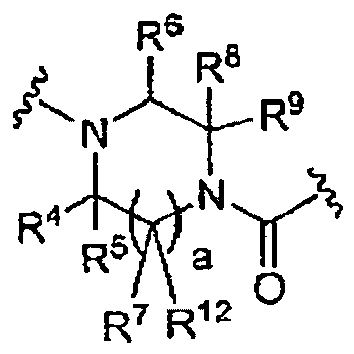


- Die Verbindung nach Anspruch 1, wobei R1 -H, Methyl, Methoxy, Hydroxy oder Fluor ist, oder durch 2-3 Kohlenstoffatome oder 1-2 Kohlenstoffatome und ein Heteroatom mit R10a verbunden ist, um einen Ring zu bilden, oder ein pharmazeutisch annehmbares Salz davon.
- Die Verbindung nach Anspruch 1 oder 2, wobei R2 -H oder Methyl ist oder durch 1-2 Kohlenstoffatome oder 0-1 Kohlenstoffatome und ein Heteroatom mit R10a verbunden ist, um einen Ring zu bilden, oder ein pharmazeutisch annehmbares Salz davon.
- Die Verbindung nach einem vorhergehenden Anspruch, wobei R3 -H oder Methyl ist oder durch 2-3 Kohlenstoffatome oder 1-2 Kohlenstoffatome und ein Heteroatom mit R10b verbunden ist, um einen Ring zu bilden, oder ein pharmazeutisch annehmbares Salz davon.
- Die Verbindung nach einem vorhergehenden Anspruch, wobei R4 -H ist, oder ein pharmazeutisch annehmbares Salz davon.
- Die Verbindung nach einem vorhergehenden Anspruch, wobei R5 -H ist, oder ein pharmazeutisch annehmbares Salz davon.
- Die Verbindung nach einem vorhergehenden Anspruch, wobei R6 -H ist, oder ein pharmazeutisch annehmbares Salz davon.
- Die Verbindung nach einem vorhergehenden Anspruch, wobei R7 -H ist, oder ein pharmazeutisch annehmbares Salz davon.
- Die Verbindung nach einem vorhergehenden Anspruch, wobei R8 -H ist, oder ein pharmazeutisch annehmbares Salz davon.
- Die Verbindung nach einem vorhergehenden Anspruch, wobei R9 -H ist, oder ein pharmazeutisch annehmbares Salz davon.
- Die Verbindung nach einem vorhergehenden Anspruch, wobei R10a -H, Halogen, Methoxy, -SCH3, -COOCH3 oder -CH3 ist, oder durch 2-3 Kohlenstoffatome oder 1-2 Kohlenstoffatome und ein Heteroatom mit R1 verbunden ist, um einen Ring zu bilden, oder durch 1-2 Kohlenstoffatome oder 0-1 Kohlenstoffatome und ein Heteroatom mit R2 verbunden ist, oder ein pharmazeutisch annehmbares Salz davon.
- Die Verbindung nach einem vorhergehenden Anspruch, wobei R10b -H, Halogen, Methoxy oder -CH3 ist oder durch 2-3 Kohlenstoffatome oder 1-2 Kohlenstoffatome und ein Heteroatom mit R3 verbunden ist, um einen Ring zu bilden, oder ein pharmazeutisch annehmbares Salz davon.
- Die Verbindung nach einem vorhergehenden Anspruch, wobei R11a -H, Halogen, Methoxy, Ethoxy oder -CH3 ist, oder ein pharmazeutisch annehmbares Salz davon.
- Die Verbindung nach einem vorhergehenden Anspruch, wobei R11b -H, Halogen, Methoxy oder -CH3 ist, oder ein pharmazeutisch annehmbares Salz davon.
- Die Verbindung nach einem vorhergehenden Anspruch, wobei a 1 ist, oder ein pharmazeutisch annehmbares Salz davon.
- Die Verbindung nach Anspruch 1, wobei R6 durch ein Kohlenstoffatom mit R8 verbunden ist, um einen Ring zu bilden, oder ein pharmazeutisch annehmbares Salz davon.
- Die Verbindung nach einem vorhergehenden Anspruch, wobei R14 -H oder -CH3 ist, oder R14 und R15 zusammen mit den Atomen, an die sie gebunden sind, einen Phenylring bilden, oder ein pharmazeutisch annehmbares Salz davon.
- Die Verbindung nach einem vorhergehenden Anspruch, wobei R15 -H ist, oder R15 und R14 zusammen mit den Atomen, an die sie gebunden sind, einen Phenylring bilden, oder ein pharmazeutisch annehmbares Salz davon.
- Die Verbindung nach Anspruch 1, ausgewählt aus der Gruppe, bestehend aus:5-[2-(4-{[4-(1H-Tetrazol-1-yl)phenyl]acetyl}piperazin-1-yl)ethyl]-2-benzofuran-1(3H)-on,1-{4-[2-(2,1,3-Benzoxadiazol-5-yl)ethyl]piperazin-1-yl}-2-[4-(1H-tetrazol-1-yl)phenyl]ethanon,6-Methyl-5-[2-(4-{[4-(1H-tetrazol-1-yl)phenyl]acetyl}piperazin-1-yl)ethyl]-2-benzofuran-1(3H)-on, 4-Methyl-5-[2-(4-{[(7R)-3-(1H-tetrazol-1-yl)-6,7-dihydro-5H-cyclopenta[c]pyridin-7-yl]carbonyl}piperazin-1-yl)ethyl]-2-benzofuran-1(3H)-on,4-Methyl-5-[2-(4-{[(7S)-3-(1H-tetrazol-1-yl)-6,7-dihydro-5H-cyclopenta[c]pyridin-7-yl]carbonyl}piperazin-1-yl)ethyl]-2-benzofuran-1(3H)-on,4-[(4-{[4-(1H-Tetrazol-1-yl)phenyl]acetyl}piperazin-1-yl)methyl]-3,4-dihydro-2H-chromen-8-carbonitril,4-({4-[(1-Oxo-1,3-dihydro-2-benzofuran-5-yl)acetyl]piperazin-1-yl}methyl)-3,4-dihydro-2H-chromen-8-carbonitril,5-[2-(4-{[3-Fluor-4-(1H-tetrazol-1-yl)phenyl]acetyl}piperazin-1-yl)ethyl]-2-benzofuran-1(3H)-on,4-[2-(4-{[4-(1H-Tetrazol-1-yl)phenyl]acetyl}piperazin-1-yl)ethyl]benzonitril,5-[2-(4-{[5-(1H-Tetrazol-1-yl)biphenyl-2-yl]acetyl}piperazin-1-yl)ethyl]-2-benzofuran-1(3H)-on,5-[2-(4-{[2-Cyclopropyl-4-(1H-tetrazol-1-yl)phenyl]acetyl}piperazin-1-yl)ethyl]-2-benzofuran-1(3H)-on,2-Methoxy-4-[2-(4-{[4-(1H-tetrazol-1-yl)phenyl]acetyl}piperazin-1-yl)ethyl]benzonitril,1-{8-[2-(4-Nitrophenyl)ethyl]-3,8-diazabicyclo[3.2.1]oct-3-yl}-2-[4-(1H-tetrazol-1-yl)phenyl]ethanon,1-{4-[2-(3-Nitrophenyl)ethyl]piperazin-1-yl}-2-[4-(1H-tetrazol-1-yl)phenyl]ethanon,5-[2-(4-{[4-(1H-Tetrazol-1-yl)phenyl]acetyl}piperazin-1-yl)propyl]-2-benzofuran-1(3H)-on,5-[1-4-{[4-(1H-Tetrazol-1-yl)phenyl]acetyl}piperazin-1-yl)propan-2-yl]-2-benzofuran-1(3H)-on,6-(4-{[4-(1H-Tetrazol-1-yl)phenyl]acetyl}piperazin-1-yl)-5,6,7,8-tetrahydronaphthalin-2-carbonitril,1-{4-[1-(2,1,3-Benzoxadiazol-5-yl)propan-2-yl]piperazin-1-yl}-2-[4-(1H-tetrazol-1-yl)phenyl]ethanon,6-(4-{[4-(1H-Tetrazol-1-yl)phenyl]acetyl}piperazin-1-yl)-5,6,7,8-tetrahydronaphtho[2,3-c]furan-1(3H)-on,1-{4-[2-(2,1,3-Benzoxadiazol-5-yl)-2-fluorethyl]piperazin-1-yl}-2-[4-(1H-tetrazol-1-yl)phenyl]ethanon,6-Fluor-2-methyl-3-[2-(4-{[4-(1H-tetrazol-1-yl)phenyl]acetyl}piperazin-1-yl)ethyl]benzonitril, 6-[1-Hydroxy-2-(4-{[4-(1H-tetrazol-1-yl)phenyl]acetyl}piperazin-1-yl)ethyl]-3,4-dihydro-1H-isochromen-1-on,6-[1-Hydroxy-2-(4-{[4-(1H-tetrazol-1-yl)phenyl]acetyl}piperazin-1-yl)ethyl]-3-methyl-3,4-dihydro-1H-isochromen-1-on,6-[(4-{[4-(1H-Tetrazol-1-yl)phenyl]acetyl}piperazin-1-yl)methyl]-8,9-dihydro-1H-furo[3,4-f]isochromen-3(6H)-on,5-Fluor-2-methoxy-4-(2-oxo-2-{4-[(3-oxo-3,6,8,9-tetrahydro-1H-furo[3,4-f]isochromen-6-yl)methyl]piperazin-1-yl}ethyl)benzonitril,3-Methyl-6-[2-(3-methyl-4-{[4-(1H-tetrazol-1-yl)phenyl]acetyl}piperazin-1-yl)ethyl]-3,4-dihydro-1H-isochromen-1-on,(3R)-3-methyl-6-[2-(4-{[6-(1H-tetrazol-1-yl)pyridin-3-yl]acetyl}piperazin-1-yl)ethyl]-3,4-dihydro-1H-isochromen-1-on,(3S)-3-Methyl-6-[2-(4-{[6-(1H-tetrazol-1-yl)pyridin-3-yl]acetyl}piperazin-1-yl)ethyl]-3,4-dihydro-1H-isochromen-1-on oder5-(2-Oxo-2-{4-[2-(1-oxo-1,3-dihydro-2-benzofuran-5-yl)ethyl]piperazin-1-yl}ethyl)-2-(1H-tetrazol-1-yl)benzonitril,oder ein pharmazeutisch annehmbares Salz davon.
- Die Verbindung nach Anspruch 1, ausgewählt aus der Gruppe, bestehend aus:


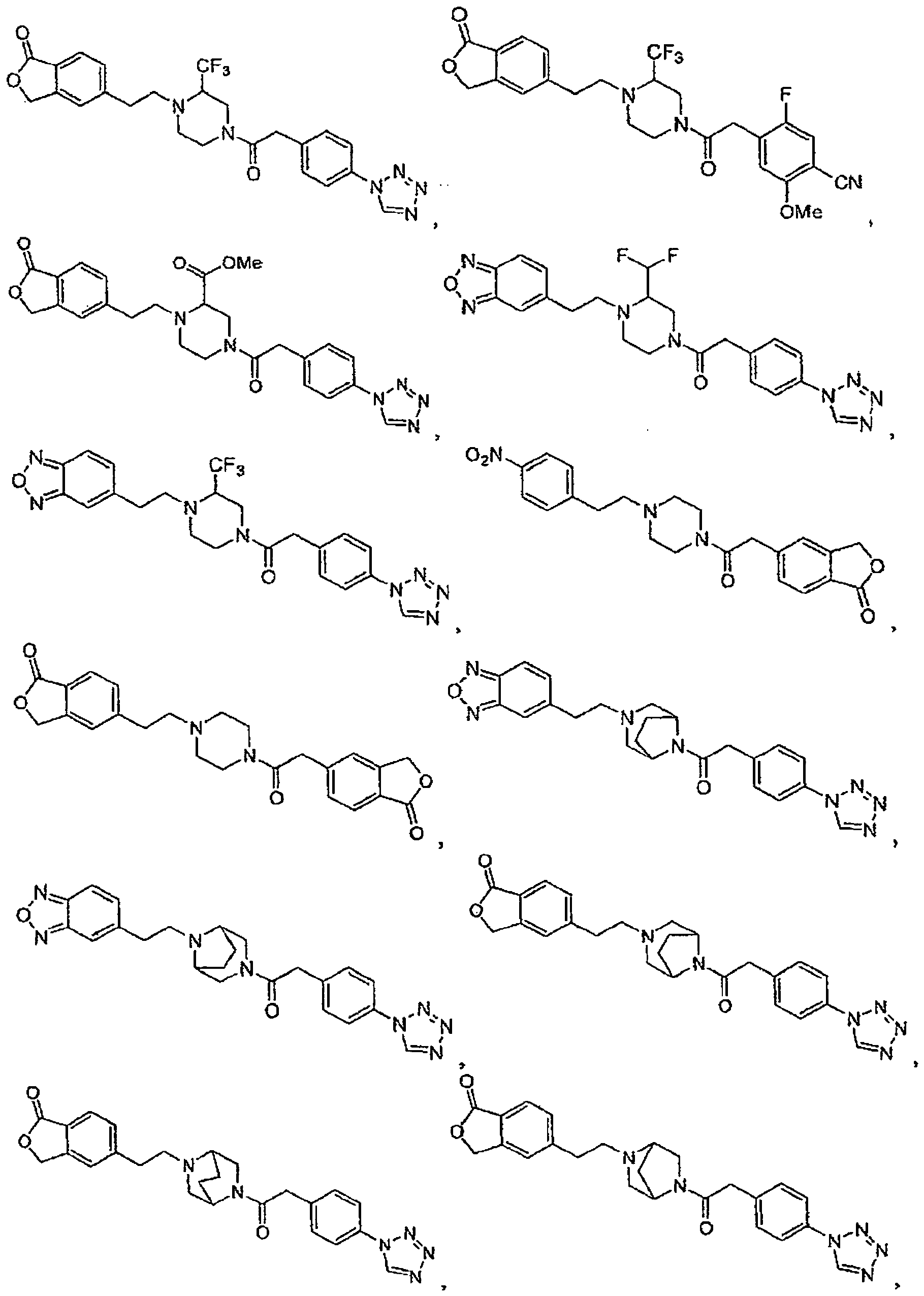


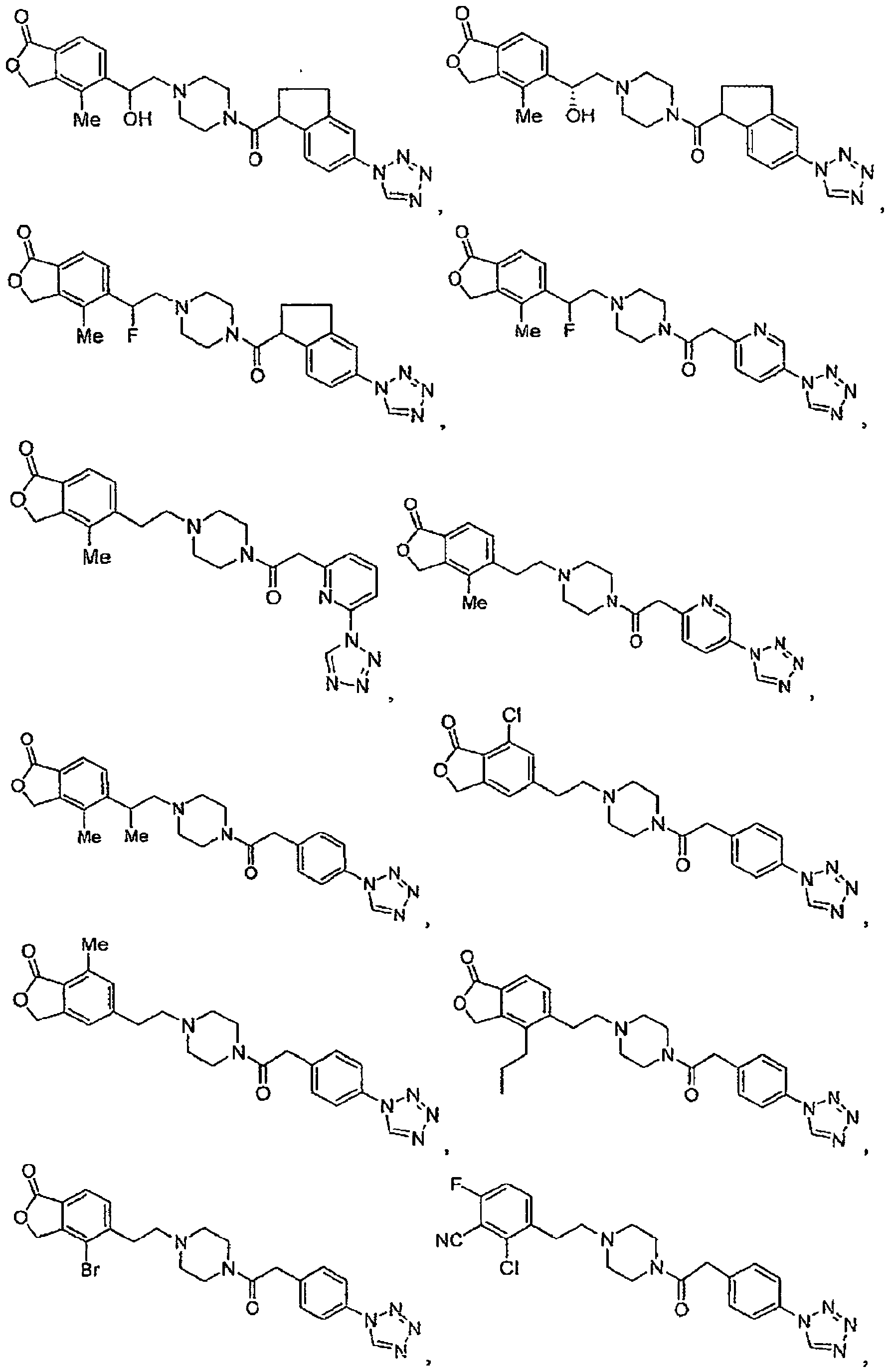


- Eine Zusammensetzung, die eine Verbindung nach einem vorhergehenden Anspruch oder ein pharmazeutisch annehmbares Salz davon und einen pharmazeutisch annehmbaren Träger umfasst.
- Eine Verbindung nach einem der Ansprüche 1 bis 21 oder ein pharmazeutisch annehmbares Salz davon zur Verwendung bei der Behandlung oder Prophylaxe von einer oder mehreren Störungen, ausgewählt aus der Gruppe, bestehend aus Leberzirrhose, akuter und chronischer Niereninsuffizienz, nephrotischem Syndrom, pulmonaler arterieller Hypertonie, kardiovaskulärer Erkrankung, Diabetes, Endothel-Dysfunktion, diastolischer Dysfunktion, stabiler und instabiler Angina pectoris, Thrombosen, Restenose, Myokardinfarkt, Schlaganfall, Herzinsuffizienz, Lungenhypertonie, Atherosklerose, Aszites, Präeklampsie, Zerebralödem, Nephropathie, Hyperkalzämie, Morbus Dent, Morbus Meniere, Hypertonie und Herzversagen, oder zur Verwendung zur Herbeiführung von Diurese, Natriurese oder beidem.
- Eine Verbindung nach einem der Ansprüche 1 bis 21 oder ein pharmazeutisch annehmbares Salz davon zur Verwendung in der Therapie.
- Eine Kombination, umfassend eine Verbindung nach einem der Ansprüche 1 bis 21 oder ein pharmazeutisch annehmbares Salz davon und ein oder mehrere zusätzliche pharmakologisch wirksame Mittel.
Applications Claiming Priority (2)
| Application Number | Priority Date | Filing Date | Title |
|---|---|---|---|
| US40821710P | 2010-10-29 | 2010-10-29 | |
| PCT/US2011/057421 WO2012058134A1 (en) | 2010-10-29 | 2011-10-24 | Inhibitors of the renal outer medullary potassium channel |
Publications (3)
| Publication Number | Publication Date |
|---|---|
| EP2632464A1 EP2632464A1 (de) | 2013-09-04 |
| EP2632464A4 EP2632464A4 (de) | 2014-03-26 |
| EP2632464B1 true EP2632464B1 (de) | 2015-04-29 |
Family
ID=45994341
Family Applications (1)
| Application Number | Title | Priority Date | Filing Date |
|---|---|---|---|
| EP20110836912 Active EP2632464B1 (de) | 2010-10-29 | 2011-10-24 | Inhibitoren des renalen kaliumkanals der äusseren medulla |
Country Status (3)
| Country | Link |
|---|---|
| US (1) | US9056859B2 (de) |
| EP (1) | EP2632464B1 (de) |
| WO (1) | WO2012058134A1 (de) |
Families Citing this family (35)
| Publication number | Priority date | Publication date | Assignee | Title |
|---|---|---|---|---|
| WO2012058116A1 (en) | 2010-10-27 | 2012-05-03 | Merck Sharp & Dohme Corp. | Inhibitors of the renal outer medullary potassium channel |
| KR20140052034A (ko) | 2011-08-19 | 2014-05-02 | 머크 샤프 앤드 돔 코포레이션 | 신장 외수질 칼륨 채널의 억제제 |
| WO2013039802A1 (en) | 2011-09-16 | 2013-03-21 | Merck Sharp & Dohme Corp. | Inhibitors of the renal outer medullary potassium channel |
| WO2013062892A1 (en) * | 2011-10-25 | 2013-05-02 | Merck Sharp & Dohme Corp. | Inhibitors of the renal outer medullary potassium channel |
| US8999991B2 (en) | 2011-10-25 | 2015-04-07 | Merck Sharp & Dohme Corp. | Inhibitors of the renal outer medullary potassium channel |
| WO2013066714A1 (en) * | 2011-10-31 | 2013-05-10 | Merck Sharp & Dohme Corp. | Inhibitors of the renal outer medullary potassium channel |
| WO2013066717A1 (en) | 2011-10-31 | 2013-05-10 | Merck Sharp & Dohme Corp. | Inhibitors of the renal outer medullary potassium channel |
| EP2773351B1 (de) | 2011-10-31 | 2017-08-23 | Merck Sharp & Dohme Corp. | Inhibitoren des renalen kaliumkanals der äusseren medulla |
| EP2790511B1 (de) | 2011-12-16 | 2016-09-14 | Merck Sharp & Dohme Corp. | Inhibitoren des renalen kaliumkanals der äusseren medulla |
| WO2014015495A1 (en) * | 2012-07-26 | 2014-01-30 | Merck Sharp & Dohme Corp. | Inhibitors of the renal outer medullary potassium channel |
| AR092031A1 (es) | 2012-07-26 | 2015-03-18 | Merck Sharp & Dohme | Inhibidores del canal de potasio medular externo renal |
| CA2891926A1 (en) | 2012-11-20 | 2014-05-30 | Merial, Inc. | Anthelmintic compounds and compositions and method of using thereof |
| WO2014085210A1 (en) | 2012-11-29 | 2014-06-05 | Merck Sharp & Dohme Corp. | Inhibitors of the renal outer medullary potassium channel |
| EP2984074A1 (de) | 2012-12-14 | 2016-02-17 | Basf Se | Malonsäuredinitrilverbindungen zur bekämpfung von tierischen schädlingen |
| US9573961B2 (en) | 2012-12-19 | 2017-02-21 | Merck Sharp & Dohme Corp. | Inhibitors of the renal outer medullary potassium channel |
| US9604998B2 (en) | 2013-02-18 | 2017-03-28 | Merck Sharp & Dohme Corp. | Inhibitors of the renal outer medullary potassium channel |
| EP2968288B1 (de) * | 2013-03-15 | 2018-07-04 | Merck Sharp & Dohme Corp. | Inhibitoren des renalen kaliumkanals der äusseren medulla |
| EP2970927A4 (de) * | 2013-03-15 | 2016-10-12 | Merck Sharp & Dohme | Immobilisierte ketoreduktasen und verfahren zur herstellung und verwendung immobilisierter ketoreduktasen |
| WO2015017305A1 (en) | 2013-07-31 | 2015-02-05 | Merck Sharp & Dohme Corp | Inhibitors of the renal outer medullary potassium channel |
| EP3083573B1 (de) | 2013-12-18 | 2024-08-07 | Merck Sharp & Dohme LLC | Inhibitoren des renalen kaliumkanals der äusseren medulla |
| US9561998B2 (en) | 2013-12-26 | 2017-02-07 | Sumitomo Chemical Company, Limited | Method for producing nitro compound |
| ES2765405T3 (es) | 2014-04-17 | 2020-06-09 | Boehringer Ingelheim Animal Health Usa Inc | Utilización de compuestos de malononitrilo para proteger animales de parásitos |
| WO2016008064A1 (en) | 2014-07-14 | 2016-01-21 | Merck Sharp & Dohme Corp. | Inhibitors of renal outer medullary potassium channel |
| WO2016091042A1 (zh) | 2014-12-08 | 2016-06-16 | 江苏恒瑞医药股份有限公司 | 吡啶甲酰胺类衍生物、其制备方法及其在医药上的应用 |
| CN105693706B (zh) * | 2014-12-10 | 2019-11-22 | 江苏恒瑞医药股份有限公司 | 异苯并呋喃酮类衍生物、其制备方法及其在医药上的应用 |
| US10513518B2 (en) | 2015-01-29 | 2019-12-24 | Merck Sharp & Dohme Corp. | Inhibitors of the renal outer medullary potassium channel |
| WO2016127358A1 (en) | 2015-02-12 | 2016-08-18 | Merck Sharp & Dohme Corp. | Inhibitors of renal outer medullary potassium channel |
| EA037300B1 (ru) | 2016-04-20 | 2021-03-05 | Бристол-Маерс Сквибб Компани | Замещенные бициклические гетероциклические соединения |
| WO2017213252A1 (en) | 2016-06-10 | 2017-12-14 | Sumitomo Chemical Company, Limited | Oxadiazole compound and use as pesticide |
| CN106432214B (zh) * | 2016-08-09 | 2019-05-07 | 成都拿盛科技有限公司 | 一种制备romk通道抑制剂中间体的方法 |
| SG11201903871TA (en) | 2016-11-03 | 2019-05-30 | Bristol Myers Squibb Co | Substituted bicycle heterocyclic derivatives useful as romk channel inhibitors |
| KR102674711B1 (ko) | 2017-02-28 | 2024-06-12 | 다이호야쿠힌고교 가부시키가이샤 | 피라졸로[3,4-d]피리미딘 화합물을 사용한 항종양 효과 증강제 |
| CN110678463B (zh) | 2017-06-01 | 2023-06-06 | 百时美施贵宝公司 | 经取代的含氮化合物 |
| CN112375057A (zh) * | 2021-01-18 | 2021-02-19 | 天津敬康生物科技有限公司 | 一种罗沙司他中间体iv的制备方法 |
| EP4353262A4 (de) * | 2021-06-10 | 2025-05-21 | UIF (University Industry Foundation), Yonsei University | Neue verbindung mit hemmender wirkung gegen pendrin und pharmazeutische verwendungen davon |
Family Cites Families (61)
| Publication number | Priority date | Publication date | Assignee | Title |
|---|---|---|---|---|
| US2988551A (en) | 1954-07-30 | 1961-06-13 | Union Chimique Belge Sa | Piperazine derivatives |
| GB949088A (en) | 1961-06-26 | 1964-02-12 | Lepetit Spa | Diazabicyclo-octane derivatives |
| US3435002A (en) | 1967-05-15 | 1969-03-25 | Gen Electric | Polyamide acid resins and polyimides therefrom |
| GB1575310A (en) | 1976-11-16 | 1980-09-17 | Anphar Sa | Piperidine derivatives |
| FR2522325B1 (fr) | 1982-02-26 | 1985-08-09 | Delalande Sa | Nouveaux derives aryliques de la piperazine, de l'homopiperazine et de n,n'-dialkyl diamino-1,2 ethane, leur procede de preparation et leur application en therapeutique |
| NL8202636A (nl) | 1982-06-29 | 1984-01-16 | Gist Brocades Nv | Piperazinederivaten, werkwijzen ter bereiding daarvan en farmaceutische preparaten die deze verbindingen bevatten. |
| US5145885A (en) | 1983-08-15 | 1992-09-08 | Ciba-Geigy Corporation | Photopolymerizable compositions containing aminoaryl ketone photoinitiators |
| DE3471486D1 (de) | 1983-08-15 | 1988-06-30 | Ciba Geigy Ag | Photocurable compositions |
| US4579863A (en) | 1983-12-06 | 1986-04-01 | Warner-Lambert Company | Substituted trans-1,2-diaminocyclohexyl amide compounds |
| US4661607A (en) | 1984-09-21 | 1987-04-28 | Chugai Seiyaku Kabushiki Kaisha | Furoxanthone derivatives useful as diuretics |
| GB8603120D0 (en) | 1986-02-07 | 1986-03-12 | Pfizer Ltd | Anti-dysrhythmia agents |
| US5215989A (en) | 1989-12-08 | 1993-06-01 | Merck & Co., Inc. | Nitrogen-containing heterocyclic compounds as class III antiarrhythmic agents |
| FR2673182A1 (fr) | 1991-02-22 | 1992-08-28 | Univ Caen | Piperazines n,n'-disubstituees, leur procede de preparation et leur application en therapeutique. |
| ATE197047T1 (de) | 1993-07-28 | 2000-11-15 | Santen Pharmaceutical Co Ltd | 1,4-di(phenylalkyl)piperazinderivate |
| US5614526A (en) | 1995-06-09 | 1997-03-25 | Hoffmann-La Roche Inc. | Use of phenoxy-piperzine derivatives |
| US6686353B1 (en) | 1996-05-20 | 2004-02-03 | Teijin Intellectual Property Center Limited | Diarylalkyl cyclic diamine derivatives as chemokine receptor antagonists |
| DE19637237A1 (de) | 1996-09-13 | 1998-03-19 | Merck Patent Gmbh | Piperazin-Derivate |
| AU3247700A (en) | 1999-03-03 | 2000-09-21 | Merck & Co., Inc. | Inhibitors of prenyl-protein transferase |
| EP1094063A1 (de) | 1999-10-18 | 2001-04-25 | Applied Research Systems ARS Holding N.V. | 9-(Piperazinylalkyl)carbazole als Bax-Modulatoren |
| GB0030304D0 (en) * | 2000-12-13 | 2001-01-24 | Lilly Co Eli | Compounds |
| JP2004501903A (ja) | 2000-06-29 | 2004-01-22 | 藤沢薬品工業株式会社 | ベンズヒドリル誘導体 |
| US6352158B1 (en) | 2000-07-06 | 2002-03-05 | Warner Lambert Company | Unit dose blister package with keyhole assisted opening feature |
| US6693099B2 (en) | 2000-10-17 | 2004-02-17 | The Procter & Gamble Company | Substituted piperazine compounds optionally containing a quinolyl moiety for treating multidrug resistance |
| GB0031088D0 (en) | 2000-12-20 | 2001-01-31 | Smithkline Beecham Plc | Medicaments |
| WO2002079146A2 (en) * | 2001-03-02 | 2002-10-10 | Bristol-Myers Squibb Company | Compounds useful as modulators of melanocortin receptors and pharmaceutical compositions comprising same |
| JP2005527492A (ja) * | 2002-01-23 | 2005-09-15 | イーライ・リリー・アンド・カンパニー | メラノコルチン受容体アゴニスト |
| CN1172919C (zh) | 2002-06-03 | 2004-10-27 | 上海医药工业研究院 | 芳烷醇哌嗪衍生物及其在制备抗抑郁症药物中的应用 |
| GB0220214D0 (en) | 2002-08-30 | 2002-10-09 | Novo Pharmaceuticals De Ltd | Compounds and their use |
| US20040204404A1 (en) | 2002-09-30 | 2004-10-14 | Robert Zelle | Human N-type calcium channel blockers |
| AU2003275632A1 (en) | 2002-10-25 | 2004-05-13 | Mitsubishi Pharma Corporation | N-oxide compounds |
| JPWO2004046110A1 (ja) | 2002-11-15 | 2006-03-16 | アステラス製薬株式会社 | メラニン凝集ホルモン受容体拮抗剤 |
| DE10329457A1 (de) | 2003-04-03 | 2005-01-20 | Merck Patent Gmbh | Ethinylprolinderivate |
| MXPA05010444A (es) | 2003-04-03 | 2005-11-04 | Merck Patent Gmbh | Compuestos de carbonilo. |
| CA2520894C (en) | 2003-04-03 | 2013-02-05 | Werner Mederski | Pyrazolidine-1,2-dicarboxyldiphenylamide derivatives as coagulation factor xa inhibitors for the treatment of thromboses |
| KR20060023154A (ko) | 2003-06-18 | 2006-03-13 | 메르크 파텐트 게엠베하 | 혈전증 치료용 응고 인자 xa 및 viia의 저해제로서의피롤리딘-1,2-디카르복실산-1-[(4-에티닐-페닐)-아미드]-2-[(페닐)-아미드] 유도체 |
| US7514438B2 (en) | 2003-08-13 | 2009-04-07 | Amgen, Inc. | Melanin concentrating hormone receptor antagonist |
| CN1897950A (zh) | 2003-10-14 | 2007-01-17 | 惠氏公司 | 稠合芳基和杂芳基衍生物及其使用方法 |
| GB0325956D0 (en) | 2003-11-06 | 2003-12-10 | Addex Pharmaceuticals Sa | Novel compounds |
| MX2007003319A (es) | 2004-09-20 | 2007-06-05 | Xenon Pharmaceuticals Inc | Derivados heterociclicos y su uso como agentes terapeuticos. |
| DE102004045796A1 (de) | 2004-09-22 | 2006-03-23 | Merck Patent Gmbh | Arzneimittel enthaltend Carbonylverbindungen sowie deren Verwendung |
| DE102004047254A1 (de) | 2004-09-29 | 2006-04-13 | Merck Patent Gmbh | Carbonylverbindungen |
| WO2006060461A1 (en) * | 2004-12-03 | 2006-06-08 | Schering Corporation | Substituted piperazines as cb1 antagonists |
| WO2006098342A1 (en) | 2005-03-16 | 2006-09-21 | Astellas Pharma Inc. | Piperazinyl compounds |
| GB0510139D0 (en) | 2005-05-18 | 2005-06-22 | Addex Pharmaceuticals Sa | Novel compounds B1 |
| US7754724B2 (en) | 2005-06-30 | 2010-07-13 | Dow Agrosciences Llc | N-substituted piperazines |
| WO2007037187A1 (ja) | 2005-09-27 | 2007-04-05 | Shionogi & Co., Ltd. | Pgd2受容体アンタゴニスト活性を有するスルホンアミド誘導体 |
| EP1976848A2 (de) | 2005-12-21 | 2008-10-08 | Schering Corporation | Phenoxypiperidine und analoge davon als histamin-h3-antagonisten |
| WO2007149456A2 (en) * | 2006-06-19 | 2007-12-27 | Vanderbilt University | Methods and compositions for diagnostic and therapeutic targeting of cox-2 |
| WO2008147864A2 (en) | 2007-05-22 | 2008-12-04 | Xenon Pharmaceuticals Inc. | Methods of using piperazine compounds in treating sodium channel-mediated diseases or conditions |
| CA2727780A1 (en) | 2008-06-13 | 2009-12-17 | Bionomics Limited | Novel potassium channel blockers and uses thereof |
| US8673920B2 (en) | 2009-05-06 | 2014-03-18 | Merck Sharp & Dohme Corp. | Inhibitors of the renal outer medullary potassium channel |
| WO2012058116A1 (en) | 2010-10-27 | 2012-05-03 | Merck Sharp & Dohme Corp. | Inhibitors of the renal outer medullary potassium channel |
| KR20140052034A (ko) | 2011-08-19 | 2014-05-02 | 머크 샤프 앤드 돔 코포레이션 | 신장 외수질 칼륨 채널의 억제제 |
| WO2013039802A1 (en) | 2011-09-16 | 2013-03-21 | Merck Sharp & Dohme Corp. | Inhibitors of the renal outer medullary potassium channel |
| US8999991B2 (en) | 2011-10-25 | 2015-04-07 | Merck Sharp & Dohme Corp. | Inhibitors of the renal outer medullary potassium channel |
| WO2013062892A1 (en) | 2011-10-25 | 2013-05-02 | Merck Sharp & Dohme Corp. | Inhibitors of the renal outer medullary potassium channel |
| WO2013066717A1 (en) | 2011-10-31 | 2013-05-10 | Merck Sharp & Dohme Corp. | Inhibitors of the renal outer medullary potassium channel |
| WO2013066714A1 (en) | 2011-10-31 | 2013-05-10 | Merck Sharp & Dohme Corp. | Inhibitors of the renal outer medullary potassium channel |
| EP2773351B1 (de) | 2011-10-31 | 2017-08-23 | Merck Sharp & Dohme Corp. | Inhibitoren des renalen kaliumkanals der äusseren medulla |
| EP2790511B1 (de) | 2011-12-16 | 2016-09-14 | Merck Sharp & Dohme Corp. | Inhibitoren des renalen kaliumkanals der äusseren medulla |
| AR092031A1 (es) | 2012-07-26 | 2015-03-18 | Merck Sharp & Dohme | Inhibidores del canal de potasio medular externo renal |
-
2011
- 2011-10-24 US US13/881,574 patent/US9056859B2/en active Active
- 2011-10-24 EP EP20110836912 patent/EP2632464B1/de active Active
- 2011-10-24 WO PCT/US2011/057421 patent/WO2012058134A1/en not_active Ceased
Also Published As
| Publication number | Publication date |
|---|---|
| WO2012058134A1 (en) | 2012-05-03 |
| US9056859B2 (en) | 2015-06-16 |
| EP2632464A1 (de) | 2013-09-04 |
| EP2632464A4 (de) | 2014-03-26 |
| US20130217680A1 (en) | 2013-08-22 |
Similar Documents
| Publication | Publication Date | Title |
|---|---|---|
| US9056859B2 (en) | Inhibitors of the renal outer medullary potassium channel | |
| EP2773199B1 (de) | Inhibitoren des renalen kaliumkanals der äusseren medulla | |
| EP2956142B1 (de) | Inhibitoren des renalen kaliumkanals der äusseren medulla | |
| EP2744499B1 (de) | Inhibitoren des renalen kaliumkanals der äusseren medulla | |
| EP2427444B1 (de) | INHIBITOREN DES KALIUMKANALS DES ÄUßEREN NIERENMARKS | |
| EP2632465B1 (de) | Inhibitoren des renalen kaliumkanals der äusseren medulla | |
| EP2877471B1 (de) | Spirokondensierte piperidinderivate als inhibitoren des renalen äusseren medullären kaliumkanals | |
| EP2773351B1 (de) | Inhibitoren des renalen kaliumkanals der äusseren medulla | |
| EP2790511B1 (de) | Inhibitoren des renalen kaliumkanals der äusseren medulla | |
| EP2755656B1 (de) | Inhibitoren des renalen kaliumkanals der äusseren medulla | |
| EP2934533B1 (de) | Inhibitoren des kaliumkanals des äusseren nierenmarks | |
| EP2773206A1 (de) | Inhibitoren des renalen kaliumkanals der äusseren medulla | |
| TW200813064A (en) | Purinone derivatives as HM74A agonists | |
| WO2014015495A1 (en) | Inhibitors of the renal outer medullary potassium channel | |
| EP3250204B1 (de) | Inhibitoren des renalen kaliumkanals der äusseren medulla | |
| EP3083573A2 (de) | Inhibitoren des renalen kaliumkanals der äusseren medulla | |
| HK1171013B (en) | Inhibitors of akt activity | |
| HK1171013A1 (en) | Inhibitors of akt activity |
Legal Events
| Date | Code | Title | Description |
|---|---|---|---|
| PUAI | Public reference made under article 153(3) epc to a published international application that has entered the european phase |
Free format text: ORIGINAL CODE: 0009012 |
|
| 17P | Request for examination filed |
Effective date: 20130529 |
|
| AK | Designated contracting states |
Kind code of ref document: A1 Designated state(s): AL AT BE BG CH CY CZ DE DK EE ES FI FR GB GR HR HU IE IS IT LI LT LU LV MC MK MT NL NO PL PT RO RS SE SI SK SM TR |
|
| DAX | Request for extension of the european patent (deleted) | ||
| A4 | Supplementary search report drawn up and despatched |
Effective date: 20140221 |
|
| RIC1 | Information provided on ipc code assigned before grant |
Ipc: A61K 31/496 20060101AFI20140217BHEP |
|
| GRAP | Despatch of communication of intention to grant a patent |
Free format text: ORIGINAL CODE: EPIDOSNIGR1 |
|
| INTG | Intention to grant announced |
Effective date: 20141114 |
|
| GRAS | Grant fee paid |
Free format text: ORIGINAL CODE: EPIDOSNIGR3 |
|
| GRAA | (expected) grant |
Free format text: ORIGINAL CODE: 0009210 |
|
| AK | Designated contracting states |
Kind code of ref document: B1 Designated state(s): AL AT BE BG CH CY CZ DE DK EE ES FI FR GB GR HR HU IE IS IT LI LT LU LV MC MK MT NL NO PL PT RO RS SE SI SK SM TR |
|
| REG | Reference to a national code |
Ref country code: GB Ref legal event code: FG4D |
|
| REG | Reference to a national code |
Ref country code: CH Ref legal event code: EP |
|
| REG | Reference to a national code |
Ref country code: AT Ref legal event code: REF Ref document number: 724066 Country of ref document: AT Kind code of ref document: T Effective date: 20150515 |
|
| REG | Reference to a national code |
Ref country code: IE Ref legal event code: FG4D |
|
| REG | Reference to a national code |
Ref country code: DE Ref legal event code: R096 Ref document number: 602011016178 Country of ref document: DE Effective date: 20150611 |
|
| REG | Reference to a national code |
Ref country code: NL Ref legal event code: VDEP Effective date: 20150429 |
|
| REG | Reference to a national code |
Ref country code: AT Ref legal event code: MK05 Ref document number: 724066 Country of ref document: AT Kind code of ref document: T Effective date: 20150429 |
|
| REG | Reference to a national code |
Ref country code: LT Ref legal event code: MG4D |
|
| PG25 | Lapsed in a contracting state [announced via postgrant information from national office to epo] |
Ref country code: NL Free format text: LAPSE BECAUSE OF FAILURE TO SUBMIT A TRANSLATION OF THE DESCRIPTION OR TO PAY THE FEE WITHIN THE PRESCRIBED TIME-LIMIT Effective date: 20150429 |
|
| PG25 | Lapsed in a contracting state [announced via postgrant information from national office to epo] |
Ref country code: ES Free format text: LAPSE BECAUSE OF FAILURE TO SUBMIT A TRANSLATION OF THE DESCRIPTION OR TO PAY THE FEE WITHIN THE PRESCRIBED TIME-LIMIT Effective date: 20150429 Ref country code: NO Free format text: LAPSE BECAUSE OF FAILURE TO SUBMIT A TRANSLATION OF THE DESCRIPTION OR TO PAY THE FEE WITHIN THE PRESCRIBED TIME-LIMIT Effective date: 20150729 Ref country code: LT Free format text: LAPSE BECAUSE OF FAILURE TO SUBMIT A TRANSLATION OF THE DESCRIPTION OR TO PAY THE FEE WITHIN THE PRESCRIBED TIME-LIMIT Effective date: 20150429 Ref country code: HR Free format text: LAPSE BECAUSE OF FAILURE TO SUBMIT A TRANSLATION OF THE DESCRIPTION OR TO PAY THE FEE WITHIN THE PRESCRIBED TIME-LIMIT Effective date: 20150429 Ref country code: PT Free format text: LAPSE BECAUSE OF FAILURE TO SUBMIT A TRANSLATION OF THE DESCRIPTION OR TO PAY THE FEE WITHIN THE PRESCRIBED TIME-LIMIT Effective date: 20150831 Ref country code: FI Free format text: LAPSE BECAUSE OF FAILURE TO SUBMIT A TRANSLATION OF THE DESCRIPTION OR TO PAY THE FEE WITHIN THE PRESCRIBED TIME-LIMIT Effective date: 20150429 |
|
| PG25 | Lapsed in a contracting state [announced via postgrant information from national office to epo] |
Ref country code: IS Free format text: LAPSE BECAUSE OF FAILURE TO SUBMIT A TRANSLATION OF THE DESCRIPTION OR TO PAY THE FEE WITHIN THE PRESCRIBED TIME-LIMIT Effective date: 20150829 Ref country code: AT Free format text: LAPSE BECAUSE OF FAILURE TO SUBMIT A TRANSLATION OF THE DESCRIPTION OR TO PAY THE FEE WITHIN THE PRESCRIBED TIME-LIMIT Effective date: 20150429 Ref country code: LV Free format text: LAPSE BECAUSE OF FAILURE TO SUBMIT A TRANSLATION OF THE DESCRIPTION OR TO PAY THE FEE WITHIN THE PRESCRIBED TIME-LIMIT Effective date: 20150429 Ref country code: GR Free format text: LAPSE BECAUSE OF FAILURE TO SUBMIT A TRANSLATION OF THE DESCRIPTION OR TO PAY THE FEE WITHIN THE PRESCRIBED TIME-LIMIT Effective date: 20150730 Ref country code: RS Free format text: LAPSE BECAUSE OF FAILURE TO SUBMIT A TRANSLATION OF THE DESCRIPTION OR TO PAY THE FEE WITHIN THE PRESCRIBED TIME-LIMIT Effective date: 20150429 |
|
| PG25 | Lapsed in a contracting state [announced via postgrant information from national office to epo] |
Ref country code: DK Free format text: LAPSE BECAUSE OF FAILURE TO SUBMIT A TRANSLATION OF THE DESCRIPTION OR TO PAY THE FEE WITHIN THE PRESCRIBED TIME-LIMIT Effective date: 20150429 Ref country code: EE Free format text: LAPSE BECAUSE OF FAILURE TO SUBMIT A TRANSLATION OF THE DESCRIPTION OR TO PAY THE FEE WITHIN THE PRESCRIBED TIME-LIMIT Effective date: 20150429 |
|
| REG | Reference to a national code |
Ref country code: DE Ref legal event code: R097 Ref document number: 602011016178 Country of ref document: DE |
|
| PG25 | Lapsed in a contracting state [announced via postgrant information from national office to epo] |
Ref country code: CZ Free format text: LAPSE BECAUSE OF FAILURE TO SUBMIT A TRANSLATION OF THE DESCRIPTION OR TO PAY THE FEE WITHIN THE PRESCRIBED TIME-LIMIT Effective date: 20150429 Ref country code: SK Free format text: LAPSE BECAUSE OF FAILURE TO SUBMIT A TRANSLATION OF THE DESCRIPTION OR TO PAY THE FEE WITHIN THE PRESCRIBED TIME-LIMIT Effective date: 20150429 Ref country code: RO Free format text: LAPSE BECAUSE OF NON-PAYMENT OF DUE FEES Effective date: 20150429 Ref country code: PL Free format text: LAPSE BECAUSE OF FAILURE TO SUBMIT A TRANSLATION OF THE DESCRIPTION OR TO PAY THE FEE WITHIN THE PRESCRIBED TIME-LIMIT Effective date: 20150429 |
|
| PLBE | No opposition filed within time limit |
Free format text: ORIGINAL CODE: 0009261 |
|
| STAA | Information on the status of an ep patent application or granted ep patent |
Free format text: STATUS: NO OPPOSITION FILED WITHIN TIME LIMIT |
|
| 26N | No opposition filed |
Effective date: 20160201 |
|
| PG25 | Lapsed in a contracting state [announced via postgrant information from national office to epo] |
Ref country code: IT Free format text: LAPSE BECAUSE OF FAILURE TO SUBMIT A TRANSLATION OF THE DESCRIPTION OR TO PAY THE FEE WITHIN THE PRESCRIBED TIME-LIMIT Effective date: 20150429 |
|
| PG25 | Lapsed in a contracting state [announced via postgrant information from national office to epo] |
Ref country code: SI Free format text: LAPSE BECAUSE OF FAILURE TO SUBMIT A TRANSLATION OF THE DESCRIPTION OR TO PAY THE FEE WITHIN THE PRESCRIBED TIME-LIMIT Effective date: 20150429 Ref country code: LU Free format text: LAPSE BECAUSE OF FAILURE TO SUBMIT A TRANSLATION OF THE DESCRIPTION OR TO PAY THE FEE WITHIN THE PRESCRIBED TIME-LIMIT Effective date: 20151024 |
|
| REG | Reference to a national code |
Ref country code: CH Ref legal event code: PL |
|
| PG25 | Lapsed in a contracting state [announced via postgrant information from national office to epo] |
Ref country code: MC Free format text: LAPSE BECAUSE OF FAILURE TO SUBMIT A TRANSLATION OF THE DESCRIPTION OR TO PAY THE FEE WITHIN THE PRESCRIBED TIME-LIMIT Effective date: 20150429 |
|
| REG | Reference to a national code |
Ref country code: IE Ref legal event code: MM4A |
|
| PG25 | Lapsed in a contracting state [announced via postgrant information from national office to epo] |
Ref country code: CH Free format text: LAPSE BECAUSE OF NON-PAYMENT OF DUE FEES Effective date: 20151031 Ref country code: LI Free format text: LAPSE BECAUSE OF NON-PAYMENT OF DUE FEES Effective date: 20151031 |
|
| PG25 | Lapsed in a contracting state [announced via postgrant information from national office to epo] |
Ref country code: BE Free format text: LAPSE BECAUSE OF FAILURE TO SUBMIT A TRANSLATION OF THE DESCRIPTION OR TO PAY THE FEE WITHIN THE PRESCRIBED TIME-LIMIT Effective date: 20150429 |
|
| REG | Reference to a national code |
Ref country code: FR Ref legal event code: PLFP Year of fee payment: 6 |
|
| PG25 | Lapsed in a contracting state [announced via postgrant information from national office to epo] |
Ref country code: IE Free format text: LAPSE BECAUSE OF NON-PAYMENT OF DUE FEES Effective date: 20151024 |
|
| PG25 | Lapsed in a contracting state [announced via postgrant information from national office to epo] |
Ref country code: BG Free format text: LAPSE BECAUSE OF FAILURE TO SUBMIT A TRANSLATION OF THE DESCRIPTION OR TO PAY THE FEE WITHIN THE PRESCRIBED TIME-LIMIT Effective date: 20150429 Ref country code: SM Free format text: LAPSE BECAUSE OF FAILURE TO SUBMIT A TRANSLATION OF THE DESCRIPTION OR TO PAY THE FEE WITHIN THE PRESCRIBED TIME-LIMIT Effective date: 20150429 Ref country code: HU Free format text: LAPSE BECAUSE OF FAILURE TO SUBMIT A TRANSLATION OF THE DESCRIPTION OR TO PAY THE FEE WITHIN THE PRESCRIBED TIME-LIMIT; INVALID AB INITIO Effective date: 20111024 |
|
| PG25 | Lapsed in a contracting state [announced via postgrant information from national office to epo] |
Ref country code: CY Free format text: LAPSE BECAUSE OF FAILURE TO SUBMIT A TRANSLATION OF THE DESCRIPTION OR TO PAY THE FEE WITHIN THE PRESCRIBED TIME-LIMIT Effective date: 20150429 Ref country code: SE Free format text: LAPSE BECAUSE OF FAILURE TO SUBMIT A TRANSLATION OF THE DESCRIPTION OR TO PAY THE FEE WITHIN THE PRESCRIBED TIME-LIMIT Effective date: 20150429 |
|
| PG25 | Lapsed in a contracting state [announced via postgrant information from national office to epo] |
Ref country code: MT Free format text: LAPSE BECAUSE OF FAILURE TO SUBMIT A TRANSLATION OF THE DESCRIPTION OR TO PAY THE FEE WITHIN THE PRESCRIBED TIME-LIMIT Effective date: 20150429 |
|
| REG | Reference to a national code |
Ref country code: FR Ref legal event code: PLFP Year of fee payment: 7 |
|
| PG25 | Lapsed in a contracting state [announced via postgrant information from national office to epo] |
Ref country code: MK Free format text: LAPSE BECAUSE OF FAILURE TO SUBMIT A TRANSLATION OF THE DESCRIPTION OR TO PAY THE FEE WITHIN THE PRESCRIBED TIME-LIMIT Effective date: 20150429 Ref country code: TR Free format text: LAPSE BECAUSE OF FAILURE TO SUBMIT A TRANSLATION OF THE DESCRIPTION OR TO PAY THE FEE WITHIN THE PRESCRIBED TIME-LIMIT Effective date: 20150429 |
|
| REG | Reference to a national code |
Ref country code: FR Ref legal event code: PLFP Year of fee payment: 8 |
|
| PG25 | Lapsed in a contracting state [announced via postgrant information from national office to epo] |
Ref country code: AL Free format text: LAPSE BECAUSE OF FAILURE TO SUBMIT A TRANSLATION OF THE DESCRIPTION OR TO PAY THE FEE WITHIN THE PRESCRIBED TIME-LIMIT Effective date: 20150429 |
|
| REG | Reference to a national code |
Ref country code: DE Ref legal event code: R081 Ref document number: 602011016178 Country of ref document: DE Owner name: MERCK SHARP & DOHME LLC, RAHWAY, US Free format text: FORMER OWNER: MERCK SHARP & DOHME CORP., RAHWAY, N.J., US |
|
| REG | Reference to a national code |
Ref country code: GB Ref legal event code: 732E Free format text: REGISTERED BETWEEN 20221013 AND 20221019 |
|
| PGFP | Annual fee paid to national office [announced via postgrant information from national office to epo] |
Ref country code: GB Payment date: 20250911 Year of fee payment: 15 |
|
| PGFP | Annual fee paid to national office [announced via postgrant information from national office to epo] |
Ref country code: FR Payment date: 20250912 Year of fee payment: 15 |
|
| PGFP | Annual fee paid to national office [announced via postgrant information from national office to epo] |
Ref country code: DE Payment date: 20250912 Year of fee payment: 15 |