EP2632802B1 - Balgklammer sowie entsprechende verfahren und vorrichtung zum umwickeln von ladungen - Google Patents
Balgklammer sowie entsprechende verfahren und vorrichtung zum umwickeln von ladungen Download PDFInfo
- Publication number
- EP2632802B1 EP2632802B1 EP11779537.7A EP11779537A EP2632802B1 EP 2632802 B1 EP2632802 B1 EP 2632802B1 EP 11779537 A EP11779537 A EP 11779537A EP 2632802 B1 EP2632802 B1 EP 2632802B1
- Authority
- EP
- European Patent Office
- Prior art keywords
- packaging material
- jaw member
- load
- belt
- assembly
- Prior art date
- Legal status (The legal status is an assumption and is not a legal conclusion. Google has not performed a legal analysis and makes no representation as to the accuracy of the status listed.)
- Active
Links
Images


Classifications
-
- B—PERFORMING OPERATIONS; TRANSPORTING
- B65—CONVEYING; PACKING; STORING; HANDLING THIN OR FILAMENTARY MATERIAL
- B65B—MACHINES, APPARATUS OR DEVICES FOR, OR METHODS OF, PACKAGING ARTICLES OR MATERIALS; UNPACKING
- B65B11/00—Wrapping, e.g. partially or wholly enclosing, articles or quantities of material, in strips, sheets or blanks, of flexible material
- B65B11/008—Wrapping, e.g. partially or wholly enclosing, articles or quantities of material, in strips, sheets or blanks, of flexible material by webs revolving around articles moved along the axis of revolution
-
- B—PERFORMING OPERATIONS; TRANSPORTING
- B65—CONVEYING; PACKING; STORING; HANDLING THIN OR FILAMENTARY MATERIAL
- B65B—MACHINES, APPARATUS OR DEVICES FOR, OR METHODS OF, PACKAGING ARTICLES OR MATERIALS; UNPACKING
- B65B11/00—Wrapping, e.g. partially or wholly enclosing, articles or quantities of material, in strips, sheets or blanks, of flexible material
- B65B11/02—Wrapping articles or quantities of material, without changing their position during the wrapping operation, e.g. in moulds with hinged folders
- B65B11/025—Wrapping articles or quantities of material, without changing their position during the wrapping operation, e.g. in moulds with hinged folders by webs revolving around stationary articles
-
- B—PERFORMING OPERATIONS; TRANSPORTING
- B65—CONVEYING; PACKING; STORING; HANDLING THIN OR FILAMENTARY MATERIAL
- B65B—MACHINES, APPARATUS OR DEVICES FOR, OR METHODS OF, PACKAGING ARTICLES OR MATERIALS; UNPACKING
- B65B11/00—Wrapping, e.g. partially or wholly enclosing, articles or quantities of material, in strips, sheets or blanks, of flexible material
- B65B11/04—Wrapping, e.g. partially or wholly enclosing, articles or quantities of material, in strips, sheets or blanks, of flexible material the articles being rotated
- B65B11/045—Wrapping, e.g. partially or wholly enclosing, articles or quantities of material, in strips, sheets or blanks, of flexible material the articles being rotated by rotating platforms supporting the articles
Definitions
- This disclosure relates generally to methods and apparatus for wrapping a load with packaging material, and more particularly, to methods and apparatus for clamping packaging material.
- Loads have been wrapped with packaging material by dispensing the packaging material with a packaging material dispenser, and providing relative rotation between the load and the packaging material dispenser to cover the load with the packaging material.
- Semi-automatic wrapping machines exist that require attachment of a leading end portion of the packaging material to the load by an operator prior to wrapping of the load. This is typically accomplished by collapsing the leading end portion into a rope, and then inserting the rope between layers of the load or tying the rope to an edge of a pallet or any suitable outcropping on the load. This attachment must be strong enough to resist a pulling force exerted by the packaging material dispenser on the packaging material during initiation of the relative rotation between the load and the packaging material dispenser.
- This type of attachment makes removing the packaging material difficult after the load has been shipped to its destination and is being unwrapped. Further, throughput is decreased due to the operator having to attach the leading end portion of the packaging material to each load before wrapping the load. Additionally, collapsing the leading end portion of the packaging material reduces its effective height, thus requiring the use of more packaging material to adequately cover the load.
- Automatic wrapping machines typically use packaging material clamps that grip the packaging material between two opposed surfaces and use electrical or pneumatic actuators to open and close the clamps.
- packaging material clamps may be overwrapped by the packaging material during wrapping, and may create a "tenting" effect due to their distance from the load, resulting in wasted packaging material and loosely wrapped loads. Additionally, such clamps are expensive and may require costly maintenance for the electrical and mechanical actuators. Furthermore, such clamps tend to collapse the packaging material or require collapsing of the packaging material prior to clamping, thus reducing the effective height of the packaging material.
- US 4,761,934 B discloses a clamp for clamping a web during stretch wrapping which includes a first longitudinally extending clamp element for engaging the web, a second longitudinally extending clamp element extendable in a direction generally parallel to the longitudinal direction of the first clamp element for clamping the web between the second clamp element and the first clamp element as the second clamp element is longitudinally extending in a direction parallel to the longitudinal direction of the first clamp element.
- the present disclosure is directed to overcoming one or more of the above-noted problems.
- a clamp assembly may include a first jaw member which may have a selectively inflatable bladder.
- the clamp assembly may further include a second jaw member which may have a belt. The first jaw member and the second jaw member may be configured to clamp material between the selectively inflatable bladder and the belt.
- the method may further include inflating the inflatable bladder against a first surface of the packaging material and moving the second jaw member relative to the first jaw member while engaging a second surface of the packaging material opposite the first surface with the belt.
- the method may include moving the belt relative to the second jaw member such that after a portion of the belt contacts a portion of the packaging material, the portion of the belt may remain fixed relative to the portion of the packaging material as the second jaw member moves relative to the first jaw member.
- the method may further include clamping the packaging material between the inflatable bladder and the belt without reducing a height of the packaging material.
- a packaging material clamp assembly may include a first longitudinally extending jaw member which may have a selectively expandable bladder, and a second longitudinally extending jaw member which may have a belt opposed to the selectively expandable bladder.
- first and second longitudinally extending jaw members may be configured to clamp packaging material between the selectively expandable bladder and the belt.
- an apparatus for wrapping a load with packaging material may include a packaging material dispenser which may be configured to dispense packaging material to the load.
- the apparatus may include a relative rotation assembly which may be configured to provide relative rotation between the packaging material dispenser and the load.
- the apparatus may include a clamp assembly which may have a first longitudinally extending jaw member including a selectively expandable bladder and a second longitudinally extending jaw member including a belt opposed to the selectively expandable bladder. The first and second longitudinally extending jaw members may be configured to clamp the packaging material between the selectively expandable bladder and the belt.
- a method for wrapping a load with packaging material may include positioning the load in a position to be wrapped, providing relative rotation between a packaging material dispenser and the load while the packaging material dispenser dispenses the packaging material, and extending a first longitudinally extending jaw member into a path of the dispensed packaging material, wherein the first longitudinally extending jaw member may include a selectively expandable bladder thereon.
- the method may include overwrapping the first longitudinally extending jaw member with packaging material such that the packaging material is adjacent the selectively expandable bladder, and extending a second longitudinally extending jaw member alongside the first longitudinally extending jaw member, wherein the second longitudinally extending jaw member may include a belt rotatably mounted thereon.
- the method may include contacting the packaging material with the belt while moving the belt to maintain at least a portion of the belt fixed relative to the selectively expandable bladder to clamp the packaging material between the belt and the selectively expandable bladder as the second longitudinally extending jaw member is extended.
- a clamp assembly may include a first jaw member including a selectively inflatable bladder with a first material engaging surface.
- the clamp assembly may also include a second jaw member including a second material engaging surface.
- the second jaw member may be movable relative to the first jaw member along a longitudinal axis of the second jaw member.
- the first jaw member and the second jaw member may be configured to clamp material between the first material engaging surface and the second material engaging surface.
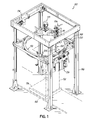
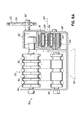
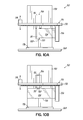
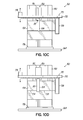
- FIG. 1 depicts a stretch wrapping apparatus 100 for wrapping a load 102 with packaging material 104 as depicted in FIGS. 10A-10D .
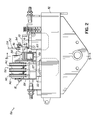
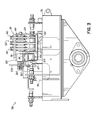
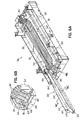
- the apparatus 100 may include an exemplary clamp assembly 106 having opposed first and second jaw members 108 and 110, each of which is movably mounted on a housing 112.
- the first and second jaw members 108 and 110 may lie substantially parallel with one another, and may be spaced from one another so as to receive the packaging material 104 therebetween.
- a length of each of the first and second jaw members 108 and 110 may be greater than an effective height (H) of the packaging material 104, the effective height (H) of the packaging material 104 corresponding to a distance between top and bottom edges of the packaging material 104 during wrapping of the load 102 as depicted in FIG. 6C .
- the first jaw member 108 and/or the second jaw member 110 may include low friction outer surfaces.
- the low friction outer surfaces may be made from a nonstick material, such as TeflonTM, or smooth metal, to minimize any undesirable frictional engagement between the outer surfaces and the packaging material 104.
- the first jaw member 108 and/or the second jaw member 110 may include low-friction panels (not shown) attached to their outer surfaces to minimize frictional engagement between the first and second jaw members 108 and 110 and the packaging material 104.
- the outer surfaces of the first jaw member 108 and/or the second jaw member 110 may be similar to the outer surfaces of jaw members described in U.S. Patent Application Publication No. 2009/0293435 .
- the first jaw member 108 may include a first inflatable bladder 114 defining a first material engaging surface 115.
- the first jaw member 108 may also include a first support 116, such as a formed channel or u-shaped bracket, having a cavity extending longitudinally along the first support 116 configured to receive at least a portion of the first inflatable bladder 114.
- the first support 116 may include any other suitable longitudinally extending recess, opening, or channel for receiving the first inflatable bladder 114. It is contemplated, for example, that the first inflatable bladder 114 may be secured on or in the first support 116 by a channel or cavity similar to that described in U.S. Patent Application Publication No. 2009/0293435 .
- the first inflatable bladder 114 may be mounted on or attached to a surface of the first support 116 without being received in a recess, cavity, or channel.
- the first inflatable bladder 114 may be attached to the first support 116 with adhesive, fasteners, and/or any other suitable attachment member.
- the first inflatable bladder 114 may be made of an elastomeric material, such as, for example, rubber.
- the first inflatable bladder 114 material may be selected based on its ability to frictionally engage the packaging material 104, as well as its ability to expand when pressurized. When the first inflatable bladder 114 is depressurized, it may cease to exert a force on the packaging material 104. Additionally or alternatively, when depressurized, the first inflatable bladder 114 may be contained within the first support 116 (i.e., may not extend beyond first support 116), out of contact with the packaging material 104.
- the first inflatable bladder 114 may extend longitudinally along the first jaw member 108 and may be sized to extend along the entire effective height (H) of the packaging material 104.
- the exact dimensions for the first inflatable bladder 114 may vary depending on a number of factors, such as, for example, the dimensions of the packaging material 104, the degree of clamping force desired, user preference, and/or other considerations.
- the first inflatable bladder 114 may be inflated using any suitable device (not shown) for delivering pressurizing fluid into the first bladder 114.
- the first inflatable bladder 114 may be pressurized via a reciprocating pump, a rotary pump, other suitable pressurizing devices known in the art, and any suitable combinations thereof.
- the pressurizing system may be positioned on any suitable supporting surface on the apparatus 100.
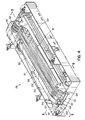
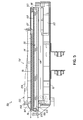
- the clamp assembly 106 may include a first actuation mechanism 118 configured to selectively actuate the first jaw member 108 such that the first jaw member 108 moves relative to the housing 112 between an extended position ( FIGS. 6A ), wherein the first jaw member 108 extends out from the housing 112, and a retracted position ( FIG. 4 ), wherein the first jaw member 108 is contained by the housing 112.
- the first actuation mechanism 118 may include, for example, a rodless cylinder, piston cylinder arrangement, pulley system, other motive systems known in the art, or any suitable combination thereof, and may be mounted on the housing 112.
- the clamp assembly 106 may also include a second actuation mechanism 120 configured to selectively actuate the second jaw member 110 such that the second jaw member 110 moves relative to the housing 112 between an extended position ( FIG. 7A ), where the second jaw member 110 extends out from the housing 112, and a retracted position ( FIG. 4 ), where the second jaw member 110 is contained by the housing 112. It should be understood that when the first and second jaw members 108 and 110 are both retracted, the first jaw member 108 is positioned adjacent the second jaw member 110 in the housing 112.
- the second actuation mechanism 120 may be similar to the first actuation mechanism 118, and may be mounted on the housing 112.
- first and second jaw members 108 and 110 may be independently extendable and retractable relative to each other, and/or extendable and retractable as a unit. Actuation of the first and second actuation mechanisms 118 and 120 may be triggered by a controller 122, as described in more detail below.
- the second jaw member 110 may include a second support 124 including, for example, a formed channel or C-shaped bracket.
- the second support 124 supports a belt assembly 126.
- the belt assembly 126 includes a fixed length belt 128 defining a second material engaging surface of the second jaw member 110.
- Belt 128 is supported on the second support 124 and routed around one or more bearings or pulleys 129. While the belt assembly 126 shown and described herein includes a fixed length belt 128, it will be appreciated that belt assembly 126 may alternatively include a looped or endless belt rotatably mounted on the second support 124.
- the arrangement of the belt 128 and the bearings or pulleys 129 may be similar to the arrangement described in U.S.
- the belt 128 may be at least partially received in a longitudinally extending recess, opening, or channel in the second support 124. It is also contemplated that at least a portion of the belt 128 faces the first inflatable bladder 114.
- the belt 128 may be movable relative to the second support 124, and may operate in a manner similar to the belt described in U.S. Patent No. 4,761,934 when clamping the packaging material 104. For example, when the first jaw member 108 is in its extended position and the second jaw member 110 is in its retracted position, at least a portion of the packaging material 104 may be wrapped over the side of the first jaw member 108 on which the first inflatable bladder 114 is positioned.
- the belt 128 of the second jaw member 110 may move with respect to the second support 124 by rotating around one or more of the bearings or pulleys 129 such that every portion of the belt 128 coming into contact with the packaging material 104 does not translate relative to the packaging material 104 after making contact with the packaging material 104. That is, the surface of the belt 128 opposing first bladder 114 may engage with packaging material 104, such that belt 128 "walks down" the clamped section of packaging material 104.
- Pressurizing the first inflatable bladder 114 may assist with clamping of the packaging material 104 between the first and second jaw members 108 and 110. For example, as pressure increases in the first inflatable bladder 114, the first inflatable bladder 114 may expand toward the second jaw member 110. Thus, a surface of the first inflatable bladder 114 may exert a clamping force on the packaging material 104 positioned between the surface of the inflatable bladder and the belt 128.
- Use of a bladder 114 overcomes a number of the prior art disadvantages. For example, using a bladder 114 eliminates the need for extremely tight tolerances in the space between the first and second jaw members 108 and 110 since the bladder 114 can dynamically account for space between first and second jaw members 108 and 110. Additionally, use of the bladder 114 improves distribution of the clamping force along the entire length of the first bladder 114. As such, the packaging material 104 may be evenly clamped between first and second jaw members 108 and 110.
- the packaging material 104 clamped between the first and second jaw members 108 and 110 may include an entirely flat portion of the packaging material 104, or alternatively, a portion of the packaging material 104 that is partially flat and partially roped or rolled into a cable.
- the portion of the packaging material 104 that is clamped may be similar to packaging material having a roped or rolled edge as described in U.S. Patent No. 7,779,607 B2 , U.S. Patent No. 7,568,327 , and/or U.S. Patent Application Publication No. 2007/0209324 .
- the roped or rolled portion of the packaging material 104 may include between approximately 3 to 5 inches of packaging material 104.
- any amount of packaging material to be held within the clamp assembly 106 as long as the clamp assembly 106 is capable of holding the packaging material 104 during start-up of a wrapping cycle, and preventing premature withdrawal of the packaging material 104 from the clamp assembly 106 under forces exerted on the packaging material 104 during the wrapping process. Nevertheless, for efficiency it is desirable to maintain as much of the effective height of the packaging material 104 as possible when clamping.
- the second jaw member 110 may also include a cutting device 130 and a sealing assembly 132.
- the cutting device 130 may be mounted proximate a cantilevered end of the second jaw member 110.
- the cutting device 130 may include, for example, a razor blade mounted on the second support 124 such that the razor blade travels alongside an edge of the first jaw member 108 when the first jaw member 108 is in its extended position and the second jaw member 110 is being moved to its extended position.
- the razor blade may have a sharp edge for cutting the packaging material 104 as the second jaw member 110 is extended.
- the cut may be made in the packaging material 104 along a portion of the packaging material 104 adjacent the portion held between the first inflatable bladder 114 of the first jaw member 108 and the belt 128 of the second jaw member 110.
- the cutting device 130 may be similar to the blade described in U.S. Patent No. 4,761,934 .
- the cutting device 130 may include a hot wire (not shown) extending along the height of at least one of the first and second jaw members 108 and 110.
- the hot wire may be heated for cutting the packaging material 104.
- one side of the packaging material 104 the side that extends to the load 102, may become a trailing end 134, while the other side of the packaging material 104, the side that extends to a packaging material dispenser 136, may become a new leading end 138.
- the new leading end 138 of packaging material 104 remains clamped between the first and second jaw members 108 and 110, in preparation for wrapping a subsequent load.
- the sealing assembly 132 may also be coupled to the second jaw member 110, and may be configured to press or seal the trailing end 134 against a wrapped load surface subsequent to cutting of the packaging material 104. As shown and embodied in FIGS. 2-4 , 6A-6C , 7A-7B , and 8 , the sealing assembly 132 may include one or more pressing belts 140. For example, the sealing assembly 132 may include three pressing belts 140, It is to be understood that any number of pressing belts 140 sufficient to seal down packaging material 104 may be used.
- the pressing belts 140 may be made of a flexible plastic, such as, for example, polyethylene. Alternatively, any suitable flexible material may be used.
- the pressing belts 140 may be mounted in a recess, opening, or channel, such as the one shown in the second support 124.
- the pressing belts 140 may be rotatably mounted on the second jaw member 110 by one or more bearings or pulleys, such as, for example, pulleys 142 and 144.
- the pressing belts 140 may be movable relative to the second support 124, and may operate in a manner similar to the belt 128 and the belt described in U.S. Patent No. 4,761,934 .
- the packaging material 104 may be wrapped over the side of the first jaw member 108 on which the first inflatable bladder 114 is positioned.
- the cutting device 130 cuts the packaging material 104 to form the leading end 138 and the trailing end 134, and the pressing belts 140 may press the trailing end 134 against the wrapped load surface.
- the pressing belts 140 may move with respect to the second support 124 by rotating around the pulleys 142 and 144 such that at least portions of the pressing belts 140 contacting the trailing end 134 do not translate relative to the trailing end 134 after making contact.
- the pressing belts 140 help maintain the trailing end 134 of the packaging material 104 in a substantially flat orientation, with little or no reduction in its effective height, while also pressing the trailing end 134 against the wrapped load 102 surface. Because the trailing end 134 undergoes substantially no reduction to its effective height, the trailing end 134 adheres easily to the wrapped load 102 surface. It is contemplated that sealing of the trailing end 134 against the wrapped load surface, clamping, and cutting all occur in one smooth operation during extension of the second jaw member 110.
- the clamp assembly 106 may be coupled to a non-rotating frame 146 by a support assembly such as a swing-arm assembly 148, such that the clamp assembly 106 is cantilevered from the non-rotating frame 146 by the swing-arm assembly 148.
- the first and second jaw members 108 and 110 when extended, may be further cantilevered from the housing 112.
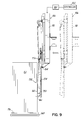
- the swing-arm assembly 148 may include one or more linkages 150 configured to move the clamp assembly 106 between a first radially outward position spaced apart from a surface of the load 102, and a second radially inward position contacting the surface of the load 102, as illustrated generally in FIG. 9 .
- the linkages 150 may be arranged in a parallelogram form, with the different linkages rotatably coupled at their ends by pivot points.
- the pivot points allow the parallelogram formed by the linkages 150 to contract and expand when moving the clamp assembly 106 between the first and second positions.
- the contraction and expansion of the parallelogram creates a path of movement for the clamp assembly 106 that is substantially linear as the clamp assembly 106 moves toward and away from a surface of the load 102.
- the swing-arm assembly 148 may include any other structure suitable for supporting and moving the clamp assembly 106, such as a bar, a frame, a wire structure, a telescoping element, or a truss.
- the swing-arm assembly 148 may include any appropriate deployment mechanism (not shown), such as, for example, a hydraulic pressure cylinder, a pneumatic pressure cylinder, and/or solenoid actuator, configured to move the swing-arm assembly 148, and in turn, move the clamp assembly 106 between its first and second positions.
- the deployment mechanism may be controlled by the controller 122 ( FIG. 9 ).
- the controller 122 may actuate the deployment mechanism at a desired time during the wrap cycle to move the clamp assembly 106 toward the load 102 or away from the load 102.
- a sensing assembly 152 may be provided on the first jaw member 108.
- the sensing assembly 152 may be configured to sense a position of the clamp assembly 106 relative to the load 102.
- the sensing assembly 152 may include an elongated bar or plate 154 whose top end is attached to a top end of the first jaw member 108 by a pivot or bearing 156 proximate the top end of the first jaw member 108.
- the elongated bar 154 may include a slot 158 near its bottom end configured to receive a post 160 on the first jaw member 108.
- the post 160 may extend from the first support 116 of the first jaw member 108.
- the elongated bar 154 may be spring-biased such that a lower portion of the elongated bar 154 extends away from the first jaw member 108 and toward the load 102 in the absence of a counteracting force.
- a sensor 164 such as a position sensor, laser sensor, photodetector, or any other suitable sensor device, may monitor the position of a portion of the elongated bar 154.
- sensor 164 may send a position signal to a controller 122 that controls actuation of the deployment mechanism that moves the swing-arm assembly 148 and the clamp assembly 106.
- the controller 122 may output a stop command to the deployment mechanism when the position signal indicates that the clamp assembly 106 has reached a desired position relative to the surface of the load 102.
- the sensing assembly 152 prevents the clamp assembly 106 from being damaged by being pressed against the load 102 with excessive force, and also prevents the clamp assembly 106 from causing an undesired shifting of the load 102, or from damaging the load 102 or layers of packaging material 104 wrapped thereon.
- FIG. 8A depicts another exemplary clamp assembly 106a having a second jaw member 110a, similar to the second jaw member 110 shown and described above with respect to FIGS. 2-5 and 6A-6C .
- the second jaw member 110a includes a second inflatable bladder 166.
- the second inflatable bladder 166 may be similar to the first inflatable bladder 114 on the first jaw member 108 in form and operation, and also similar to the bladder in U.S. Patent Application Publication No. 2009/0293435 .
- Any appropriate device for pressurizing the second inflatable bladder 166 may be employed, including, for example, a reciprocating pump, a rotary pump, other pressurizing systems known in the art, and any suitable combinations thereof.
- the pressurizing system may be positioned on the second jaw member 110a, the housing 112, the clamp swing-arm assembly 148, or any other appropriate location on apparatus 100.
- the second inflatable bladder 166 may be mounted in a recess, opening, or channel, such as the cavity shown in second support 124 of the second jaw member 110a. Alternatively, the second inflatable bladder 166 may be mounted on or attached to a surface of the second jaw member 110a without being received in a cavity. For example, the second inflatable bladder 166 may be attached to the second jaw member 110a with adhesive, brackets, fasteners, and/or any other suitable attachment member.
- the second inflatable bladder 166 may be positioned under the belt 128. That is, the second inflatable bladder 166 may be disposed between a surface of the second support 124 and the belt 128. In other words, the second inflatable bladder 166 may be disposed in contact with a surface of the belt 128 that does not contact the packaging material 104. Accordingly, when the second inflatable bladder 166 is pressurized, the belt 128 may be urged toward the first inflatable bladder 144, thus enhancing the clamping force exerted on the packaging material 104 by the belt 128 and the first inflatable bladder 114.
- the second inflatable bladder 166 When the second inflatable bladder 166 is depressurized, it may cease to urge the belt 128 against the packaging material 104. Additionally or alternatively, when the second inflatable bladder 166 is depressurized, the second inflatable bladder 166 may be contained within the second support 124 (i.e., may not extend beyond the second support 124).
- apparatus 100 is configured to wrap the packaging material 104 around the load 102.
- the apparatus 100 includes the nonrotating frame 146 ( FIG. 1 ) defining a wrapping space.
- the load 102 may be conveyed by a conveyor 168 into the wrapping space prior to wrapping, and out of the wrapping space subsequent to wrapping.
- the conveyor 168 may include a conveyor belt having either powered or unpowered rollers, or a drag-chain conveyor.
- the packaging material dispenser 136 is provided such that it dispenses the packaging material 104.
- the packaging material dispenser 136 may include a prestretch assembly for pre-stretching the packaging material 104 before it is applied on the load 102.
- the apparatus 100 may also include a relative rotation assembly 170 for providing relative rotation between the packaging material dispenser 136 and the load 102.
- the relative rotation assembly 170 may include, for example, a rotating arm, a rotatable turntable, or a rotating ring 172 shown in FIG. 1 .
- the apparatus 100 also includes a vertical drive assembly 174 for providing relative movement between the packaging material dispenser 136 and the load 102 in a vertical direction, along the axis of rotation of the packaging material dispenser 136 relative to the load 102.
- the relative rotation between the packaging material dispenser 136 and the load 102 in combination with the relative vertical movement of the packaging material dispenser 136 relative to the load 102, may serve to wrap the packaging material 104 spirally around the load 102 and a pallet 176 supporting the load 102.
- the packaging material dispenser 136, relative rotation assembly 170, and vertical drive assembly 174 may be similar to those described in U.S. Patent No. 7,779,607 B2 , U.S. Patent No. 7,707,801 , and/or U.S. Patent Application Publication No. 2009/0178374 .
- a method of wrapping the load 102 with the packaging material 104 using the apparatus 100 may include positioning the load 102 to be wrapped in the wrapping space of the apparatus 100 using, for example, the conveyor 168.
- the swing-arm assembly 148 may hold the clamp assembly 106 in the radially outward position to prevent interference between the load 102 and the clamp assembly 106.
- the first and second jaw members 108 and 110 may be in their extended positions, and may hold a leading end 138 of the packaging material 104 therebetween.
- the first inflatable bladder 114 may be pressurized, and may exert a clamping force on the leading end 138 of the packaging material 104 by urging it against the belt 128. If the second jaw 110a is being used, the second inflatable bladder 166 may also be pressurized to urge the belt 128 toward the first inflatable bladder 114, thus further enhancing the clamping force on the leading end 138.
- the clamp assembly 106 is moved toward a surface of the load 102 (i.e., towards the second radially inward position of the clamp assembly 106) by movement of the swing-arm assembly 148. This movement may bring the first and second jaw members 108 and 110, as well as the leading end 138 clamped therebetween, proximate the load 102. At some point, the elongated bar 154 may be brought into contact with the surface of the load 102 and may begin to move.
- the controller 122 When the sensor 164 senses that movement of the elongated bar 154 has reached a threshold indicative of the clamp assembly 106 having reached a desired position relative to the surface of the load 102, the controller 122 outputs a stop command to the deployment mechanism moving the swing-arm assembly 148.
- Relative rotation may be provided between the load 102 and the packaging material dispenser 136 to wrap the packaging material 104 around the load 102.
- the packaging material 104 is wrapped over the first and second jaw members 108 and 110 that are positioned proximate the load 102.
- the first inflatable bladder 114 and/or the second inflatable bladder 166 may be depressurized to cease clamping of the leading end 138 of the packaging material 104.
- the first and second jaw members 108 and 110 may be retracted and raised out of the packaging material dispensing path.
- depressurization of the first inflatable bladder 114 and/or the second inflatable bladder 166, and/or retraction of the first and second jaw members 108 and 110 may occur just prior to being overwrapped by the packaging material 104.
- the first and second jaw members 108 and 110 may be retracted substantially simultaneously or in any suitable order.
- the first and second jaw members 108 and 110 may be raised through actuation of the first and second actuation mechanisms 118 and 120, which may be controlled by the controller 122. Once the first and second jaw members 108 and 110 have been raised, the leading end 138 may be held in place by the overwrapped layers of the packaging material 104. Moreover, elastic recovery in the overwrapped layers may cause the layers to snap back toward the load 102, thus securing the leading end 138. With the first and second jaw members 108 and 110 free of the packaging material 104, the controller 122 may actuate the swing-arm assembly 148 to move the clamp assembly 106 away from load 102 (i.e., towards its first radially outward position).
- the packaging material dispenser 136 may continue to dispense packaging material 104 to load 102 in a spiral fashion, as described in U.S. Patent No. 7,779,607 .
- the first jaw member 108 may be extended and, along with the rest of the clamp assembly 106, may be moved toward the wrapped surface of the load 102 (i.e., toward its first radially inward position) by the swinging of the swing-arm assembly 148.
- the controller 122 stops moving the clamp assembly 106 toward the wrapped surface of the load 102 when the sensor 164 and the elongated bar 154 indicate that the desired position has been reached.
- At least one layer of the packaging material 104 may be wrapped over the first jaw member 108.
- the first inflatable bladder 114 may be pressurized at this time. Alternatively, the first inflatable bladder 114 may remain unpressurized.
- the second jaw member 110 is actuated to move to its extended position substantially parallel to and adjacent the first jaw member 108.
- the belt 128 may engage the packaging material 104, pressing the packaging material 104 against the first inflatable bladder 114.
- the cutting device 130 also begins cutting the packaging material 104 as the second jaw member 110 extends, creating a new leading end portion 138 on the side of the cut with the packaging material 104 that is held by the jaw members 108 and 110, and a new trailing end portion 134 on the side of the cut with the packaging material 104 that extends to the wrapped load 102.
- the pressing belts 140 begin to engage the new trailing end portion 134 by pressing or sealing the new trailing end portion 134 against the wrapped load 102 surface. Continued extension of the second jaw member 110 brings continued clamping, cutting, and sealing. If the first inflatable bladder 114 has not been pressurized, it may be pressurized during extension of the second jaw member 110, or after extension, to assist with clamping.
- Engagement of the belt 128 with the packaging material 104 helps to maintain the leading end 138 of the packaging material 104 in a relatively flat position as the second jaw member 110 is extended and the packaging material 104 is cut by the cutting device 130. Because the packaging material 104 is held relatively flat, its effective height is not reduced as would be the case if the packaging material 104 was collapsed into a rope or cable, thus providing for more efficient use of the packaging material 104. Engagement of the pressing belts 140 with the packaging material 104 helps to press or seal the trailing end 134 of the packaging material 104 against the wrapped load surface with little or no reduction in the effective height of the trailing end 134, thus providing for better adherence between the trailing end 140 and the layers of the packaging material 104 on the load 102.
- the controller 122 moves the swing-arm assembly 148 away from the wrapped load 102, bringing the extended first and second jaw members 108 and 110 away from the wrapped load 102.
- both the first and second jaw members 108 and 110 remain extended, and continue clamping the leading end 138, maintaining the leading end 138 in place.
- Moving the first and second jaw members 108 and 110 gets them out of the way of the wrapped load 102 as the wrapped load 102 is conveyed out of the wrapping area by the conveyor 168.
- a new unwrapped load 102 may then be conveyed into the wrapping area, and the method may repeat for another wrap cycle.
Landscapes
- Engineering & Computer Science (AREA)
- Mechanical Engineering (AREA)
- Basic Packing Technique (AREA)
Claims (16)
- Vorrichtung zum Umwickeln einer Last mit Verpackungsmaterial, umfassend einen Verpackungsmaterialdispenser (136), welcher ausgestaltet ist Verpackungsmaterial (104) an die Last (102) abzugeben; und eine Spannanordnung (106) zum Spannen des Verpackungsmaterials (104), wobei die Spannanordnung (106) ein erstes Backenteil (108), ein zweites Backenteil (110), welches benachbart und parallel zu dem ersten Backenteil (108) angeordnet ist, und ein bewegliches Band (128) auf dem zweiten Backenteil (110) umfasst, dadurch gekennzeichnet, dass die Spannanordnung (106) eine erste aufblasbare Blase (114) auf dem ersten Backenteil (108) umfasst und das erste und zweite Backenteil (108, 110) einen Raum zur Aufnahme des Verpackungsmaterials (104) zwischen der ersten aufblasbaren Blase (114) und dem Band (128) festlegen.
- Vorrichtung nach Anspruch 1, wobei die Spannanordnung (106) ferner ein Gehäuse (112) umfasst, und wobei das erste und zweite Backenteil (108, 110) wahlweise zwischen eingefahrenen Positionen und ausgefahrenen Positionen bezogen auf das Gehäuse (112) bewegbar sind.
- Vorrichtung nach Anspruch 2, wobei das erste und zweite Backenteil (108, 110) in den entsprechenden eingefahrenen Positionen beabstandet von dem Verpackungsmaterial (104) sind, und zum Eingriff mit dem Verpackungsmaterial (104) in den entsprechenden ausgefahrenen Positionen angeordnet sind.
- Vorrichtung nach Anspruch 2 oder Anspruch 3, wobei das erste und zweite Backenteil (108, 110) freitragend von dem Gehäuse (112) in den entsprechenden ausgefahrenen Positionen sind.
- Vorrichtung nach einem der Ansprüche bis 2 bis 4, wobei das Band (128) auf dem zweiten Backenteil (110) bewegt wird, wenn das zweite Backenteil (110) vorwärts in die ausgefahrene Position bewegt wird, um das Verpackungsmaterial (104) zwischen dem ersten und zweiten Backenteil (108, 110) zu empfangen, so dass jeder Abschnitt des Bandes (128), welcher in Kontakt mit dem Verpackungsmaterial (104) kommt, nicht in Bezug auf das Verpackungsmaterial (104) nach dem Kontakt verrückt und wobei das zweite Backenteil (110) entlang dem gespannten Abschnitt des Verpackungsmaterials (104) hinabläuft.
- Vorrichtung nach einem der vorhergehenden Ansprüche, wobei die erste aufblasbare Blase (114) wahlweise mit Druck beaufschlagt und vom Druck entspannt wird, um das Spannen und Entspannen des Verpackungsmaterials (104) zwischen dem ersten und zweiten Backenteil (108, 110) zu unterstützen.
- Vorrichtung nach einem der vorhergehenden Ansprüche, ferner umfassend eine Relativdrehanordnung (170), welche eine Relativdrehung zwischen dem Verpackungsmaterialdispenser (136) und der Last (102) bereitstellt, insbesondere umfassend zumindest einen drehenden Arm, einen drehbaren Drehtisch oder einen Drehring (172).
- Vorrichtung nach Anspruch 7, ferner umfassend eine Vertikalantriebsanordnung (174), welche eine Relativbewegung zwischen dem Verpackungsmaterialdispenser (136) und der Last (102) entlang einer Richtung im Wesentlichen parallel zu einer Drehachse der Relativdrehung zwischen dem Verpackungsmaterialdispenser (136) und der Last (102) bereitstellt.
- Vorrichtung nach einem der vorhergehenden Ansprüche, ferner umfassend eine Stützanordnung (148), welche die Spannanordnung (106) zur Bewegung zwischen einer ersten Position, welche radial nach außen von der Last (102) beabstandet ist, und einer zweiten Position näher zu der Last (102) hin unterstützt.
- Vorrichtung nach Anspruch 9, wobei die Stützanordnung (148) eine drehbare Schwenkarmanordnung (148) umfasst, welche insbesondere eine oder mehrere Verbindungen (150) umfasst, welche eine Parallellogrammform festlegt, welche zwischen einer kontrahierten Ausgestaltung und einer expandierten Ausgestaltung bewegbar ist, so dass wenn sich die Parallellogrammform zu der kontrahierten Ausgestaltung bewegt, die Spannanordnung (106) sich zu einer ersten Position bewegt, und wenn sich die Parallellogrammform zu der expandierten Ausgestaltung bewegt, sich die Spannanordnung (106) zu der zweiten Position bewegt.
- Vorrichtung nach einem der vorhergehenden Ansprüche, ferner umfassend eine Erfassungsanordnung (152), welche ausgestaltet ist eine Position der Spannanordnung (106) bezogen auf die Last (102) zu erfassen.
- Vorrichtung nach Anspruch 11, wobei die Erfassungsanordnung (152) eine längliche Stange (154) umfasst, welche bewegbar mit dem ersten Backenteil (108) gekoppelt ist, welche insbesondere in Bezug auf das erste Backenteil (108) bei Kontakt mit der Last (102) verschwenkt.
- Vorrichtung nach Anspruch 12, wobei die Erfassungsanordnung (152) ferner einen Positionsensor (164) umfasst, welcher eine Position der länglichen Stange (154) erfasst und ein Positionssignal an eine Steuereinheit (122) sendet, wobei die Steuereinheit (122) in Reaktion auf das Signal eine weitere Bewegung der Spannanordnung (106) in Richtung der Last (102) stoppt.
- Vorrichtung nach einem der vorhergehenden Ansprüche, ferner umfassend eine zweite aufblasbare Blase (166) auf dem zweiten Backenteil (110), wobei das Band (128) zwischen der zweiten aufblasbaren Blase (166) und der ersten aufblasbaren Blase (114) angeordnet ist, wenn das erste und zweite Backenteil (108, 110) benachbart zueinander angeordnet sind.
- Vorrichtung nach einem der vorhergehenden Ansprüche, ferner umfassend eine Verpackungsmaterialschneidevorrichtung (130), welche auf dem zweiten Backenteil (110) befestigt ist und/oder Verpackungsmaterial (104) schneidet, welches zwischen dem ersten und zweiten Backenteil (108, 110) aufgenommen ist, wenn das zweite Backenteil (110) zu der ausgefahrenen Position bewegt wird.
- Verfahren zum Umwickeln einer Last mit Verpackungsmaterial, umfassend Anordnen der Last (102) in einer Position, um umwickelt zu werden; Bereitstellen einer Relativdrehung zwischen einem Verpackungsmaterialdispenser (136) und der Last (102), während der Verpackungsmaterialdispenser (136) das Verpackungsmaterial (104) ausgibt; Ausfahren eines ersten längs erstreckenden Backenteils (108) in eine Bahn des ausgegebenen Verpackungsmaterials (104), wobei das erste längs erstreckende Backenteil (108) eine wahlweise expandierbare Blase (114) darauf umfasst; Umwickeln des ersten längs erstreckenden Backenteils (108) mit Verpackungsmaterial (104), so dass das Verpackungsmaterial (104) benachbart zu der wahlweise expandierbaren Blase (114) ist; Ausfahren eines zweiten längs erstreckenden Backenteils (110) entlang des ersten längs erstreckenden Backenteils (108), wobei das zweite längs erstreckende Backenteil (110) ein Band (128) umfasst, welches darauf bewegbar befestigt ist; und Kontaktieren des Verpackungsmaterials (104) mit dem Band (128) während Bewegen des Bandes (128), um zumindest einen Abschnitt des Bandes (128) feststehend in Bezug auf die wahlweise expandierbare Blase (114) beizubehalten, um dabei das Verpackungsmaterial (104) zwischen dem Band (128) und der wahlweise expandierbaren Blase (114) zu spannen, wenn das zweite längs erstreckende Backenteil (110) ausgefahren wird.
Applications Claiming Priority (2)
| Application Number | Priority Date | Filing Date | Title |
|---|---|---|---|
| US40854110P | 2010-10-29 | 2010-10-29 | |
| PCT/US2011/058240 WO2012058519A1 (en) | 2010-10-29 | 2011-10-28 | Bladder clamp and related methods and apparatus for wrapping loads |
Publications (2)
| Publication Number | Publication Date |
|---|---|
| EP2632802A1 EP2632802A1 (de) | 2013-09-04 |
| EP2632802B1 true EP2632802B1 (de) | 2015-12-30 |
Family
ID=44910317
Family Applications (1)
| Application Number | Title | Priority Date | Filing Date |
|---|---|---|---|
| EP11779537.7A Active EP2632802B1 (de) | 2010-10-29 | 2011-10-28 | Balgklammer sowie entsprechende verfahren und vorrichtung zum umwickeln von ladungen |
Country Status (5)
| Country | Link |
|---|---|
| US (1) | US9108753B2 (de) |
| EP (1) | EP2632802B1 (de) |
| AU (1) | AU2011320555A1 (de) |
| CA (1) | CA2814397C (de) |
| WO (1) | WO2012058519A1 (de) |
Families Citing this family (12)
| Publication number | Priority date | Publication date | Assignee | Title |
|---|---|---|---|---|
| US9016033B2 (en) * | 2010-10-01 | 2015-04-28 | Tien Heng Machinery Co., Ltd. | Film clamping and cutting device of film wrapping machine |
| CA3093344C (en) | 2012-06-08 | 2023-03-28 | Wulftec International Inc. | Apparatuses for wrapping a load and supplying film for wrapping a load and associated methods |
| US11066198B2 (en) * | 2012-06-18 | 2021-07-20 | TAB Industries, LLC | Stretch film dispenser for orbital pallet wrappers |
| WO2014139006A1 (en) * | 2013-03-15 | 2014-09-18 | Groupe Anderson Inc. | Wrapping device and method of operation thereof |
| US20170057673A1 (en) * | 2014-02-14 | 2017-03-02 | Krones Ag | Wrapping apparatus employing stretching film with improved retaining device |
| US20170204152A1 (en) | 2014-07-16 | 2017-07-20 | Moderna Therapeutics, Inc. | Chimeric polynucleotides |
| GB201417296D0 (en) * | 2014-09-30 | 2014-11-12 | Tube Line Mfg Ltd | Film cutter for hay-bale wrapper |
| FI20155083A7 (fi) * | 2015-02-09 | 2016-08-10 | Signode Ind Group Llc | Menetelmä muovikalvon käärimiseksi kuorman päälle sekä käärintäkone |
| ITUB20151361A1 (it) * | 2015-05-29 | 2016-11-29 | Aetna Group Spa | Macchina avvolgitrice |
| US11220081B2 (en) * | 2016-05-16 | 2022-01-11 | Cmd Corporation | Method and apparatus for pouch or bag making |
| GB2567475A (en) * | 2017-10-13 | 2019-04-17 | Asm Assembly Systems Singapore Pte Ltd | Inflatable pneumatic stencil clamp |
| CN112537478A (zh) * | 2020-12-17 | 2021-03-23 | 深圳市沃尔核材股份有限公司 | 绕膜装置和绕膜机 |
Family Cites Families (9)
| Publication number | Priority date | Publication date | Assignee | Title |
|---|---|---|---|---|
| US4761934A (en) * | 1987-02-27 | 1988-08-09 | Lantech | Parallel belted clamp |
| US4807427A (en) * | 1988-04-21 | 1989-02-28 | Liberty Industries, Inc. | Stretch wrapping roping apparatus |
| US5408808A (en) * | 1992-08-12 | 1995-04-25 | Oji Seitai Kaisha, Ltd. | Automatic full-web stretch-wrapping apparatus |
| US6095744A (en) * | 1997-01-15 | 2000-08-01 | Harrison; Ralph | Refuse container handling system |
| US6293074B1 (en) * | 1998-02-20 | 2001-09-25 | Lantech Management Corp. | Method and apparatus for stretch wrapping a load |
| US7568327B2 (en) | 2003-01-31 | 2009-08-04 | Lantech.Com, Llc | Method and apparatus for securing a load to a pallet with a roped film web |
| US7707801B2 (en) * | 2005-04-08 | 2010-05-04 | Lantech.Com, Llc | Method for dispensing a predetermined amount of film relative to load girth |
| AU2007221338A1 (en) * | 2006-02-23 | 2007-09-07 | Lantech.Com, Llc | Method and apparatus for securing a load to a pallet with a roped film web |
| US8695312B2 (en) * | 2008-05-28 | 2014-04-15 | Lantech.Com, Llc | Film clamp and related methods and apparatuses for wrapping loads |
-
2011
- 2011-10-28 EP EP11779537.7A patent/EP2632802B1/de active Active
- 2011-10-28 WO PCT/US2011/058240 patent/WO2012058519A1/en not_active Ceased
- 2011-10-28 US US13/283,836 patent/US9108753B2/en active Active
- 2011-10-28 AU AU2011320555A patent/AU2011320555A1/en not_active Abandoned
- 2011-10-28 CA CA2814397A patent/CA2814397C/en active Active
Also Published As
| Publication number | Publication date |
|---|---|
| WO2012058519A1 (en) | 2012-05-03 |
| CA2814397A1 (en) | 2012-05-03 |
| US9108753B2 (en) | 2015-08-18 |
| US20120102881A1 (en) | 2012-05-03 |
| CA2814397C (en) | 2018-10-23 |
| EP2632802A1 (de) | 2013-09-04 |
| AU2011320555A1 (en) | 2013-05-02 |
Similar Documents
| Publication | Publication Date | Title |
|---|---|---|
| EP2632802B1 (de) | Balgklammer sowie entsprechende verfahren und vorrichtung zum umwickeln von ladungen | |
| US9290285B2 (en) | Film clamp and related methods and apparatuses for wrapping loads | |
| EP4091947B1 (de) | Maschine zum stabilisieren von palettierten lasten mit spannrippen | |
| EP1056646B1 (de) | Verfahren und vorrichtung zum umhüllen einer ladung mit dehnfolie | |
| JP3157444B2 (ja) | 伸縮性包装材料の保持・包装方法及び装置 | |
| EP4008638B1 (de) | Maschine und verfahren zum stabilisieren von palettierten lasten | |
| CA2280198C (en) | Method and apparatus for stretch wrapping a load | |
| EP0511870A1 (de) | Vorrichtung und Verfahren zum Umwickeln einer palettisierten Ladung | |
| WO2009130531A1 (en) | Process for wrapping loads, in particular palletised loads, and relative system | |
| US11987406B2 (en) | Machine for stabilising palletised loads with reel change system | |
| US6662535B2 (en) | Apparatus for bagging material | |
| EP2090533A1 (de) | Verfahren zum Austausch der Rolle bei einem Abwickler | |
| CN116835022B (zh) | 自动打包机及其打包方法 | |
| WO2024102432A1 (en) | Paper wrapping device and related methods | |
| CA2377036C (en) | Apparatus for bagging material | |
| JPH0733107A (ja) | フルウェッブ式自動ストレッチ包装機 | |
| WO2007071063A1 (en) | Apparatus for bagging material | |
| AU2005201159A1 (en) | Method and apparatus for stretch wrapping a load |
Legal Events
| Date | Code | Title | Description |
|---|---|---|---|
| PUAI | Public reference made under article 153(3) epc to a published international application that has entered the european phase |
Free format text: ORIGINAL CODE: 0009012 |
|
| 17P | Request for examination filed |
Effective date: 20130429 |
|
| AK | Designated contracting states |
Kind code of ref document: A1 Designated state(s): AL AT BE BG CH CY CZ DE DK EE ES FI FR GB GR HR HU IE IS IT LI LT LU LV MC MK MT NL NO PL PT RO RS SE SI SK SM TR |
|
| DAX | Request for extension of the european patent (deleted) | ||
| GRAP | Despatch of communication of intention to grant a patent |
Free format text: ORIGINAL CODE: EPIDOSNIGR1 |
|
| INTG | Intention to grant announced |
Effective date: 20150710 |
|
| RIN1 | Information on inventor provided before grant (corrected) |
Inventor name: LANCASTER, PATRICK, R., III Inventor name: MOORE, PHILIP, R. Inventor name: JOHNSON, RICHARD, L. |
|
| GRAS | Grant fee paid |
Free format text: ORIGINAL CODE: EPIDOSNIGR3 |
|
| GRAA | (expected) grant |
Free format text: ORIGINAL CODE: 0009210 |
|
| AK | Designated contracting states |
Kind code of ref document: B1 Designated state(s): AL AT BE BG CH CY CZ DE DK EE ES FI FR GB GR HR HU IE IS IT LI LT LU LV MC MK MT NL NO PL PT RO RS SE SI SK SM TR |
|
| REG | Reference to a national code |
Ref country code: GB Ref legal event code: FG4D |
|
| REG | Reference to a national code |
Ref country code: CH Ref legal event code: EP |
|
| REG | Reference to a national code |
Ref country code: AT Ref legal event code: REF Ref document number: 767329 Country of ref document: AT Kind code of ref document: T Effective date: 20160115 |
|
| REG | Reference to a national code |
Ref country code: IE Ref legal event code: FG4D |
|
| REG | Reference to a national code |
Ref country code: DE Ref legal event code: R096 Ref document number: 602011022314 Country of ref document: DE |
|
| REG | Reference to a national code |
Ref country code: NL Ref legal event code: FP |
|
| REG | Reference to a national code |
Ref country code: LT Ref legal event code: MG4D |
|
| PG25 | Lapsed in a contracting state [announced via postgrant information from national office to epo] |
Ref country code: NO Free format text: LAPSE BECAUSE OF FAILURE TO SUBMIT A TRANSLATION OF THE DESCRIPTION OR TO PAY THE FEE WITHIN THE PRESCRIBED TIME-LIMIT Effective date: 20160330 Ref country code: LT Free format text: LAPSE BECAUSE OF FAILURE TO SUBMIT A TRANSLATION OF THE DESCRIPTION OR TO PAY THE FEE WITHIN THE PRESCRIBED TIME-LIMIT Effective date: 20151230 Ref country code: HR Free format text: LAPSE BECAUSE OF FAILURE TO SUBMIT A TRANSLATION OF THE DESCRIPTION OR TO PAY THE FEE WITHIN THE PRESCRIBED TIME-LIMIT Effective date: 20151230 |
|
| REG | Reference to a national code |
Ref country code: AT Ref legal event code: MK05 Ref document number: 767329 Country of ref document: AT Kind code of ref document: T Effective date: 20151230 |
|
| PG25 | Lapsed in a contracting state [announced via postgrant information from national office to epo] |
Ref country code: FI Free format text: LAPSE BECAUSE OF FAILURE TO SUBMIT A TRANSLATION OF THE DESCRIPTION OR TO PAY THE FEE WITHIN THE PRESCRIBED TIME-LIMIT Effective date: 20151230 Ref country code: GR Free format text: LAPSE BECAUSE OF FAILURE TO SUBMIT A TRANSLATION OF THE DESCRIPTION OR TO PAY THE FEE WITHIN THE PRESCRIBED TIME-LIMIT Effective date: 20160331 Ref country code: SE Free format text: LAPSE BECAUSE OF FAILURE TO SUBMIT A TRANSLATION OF THE DESCRIPTION OR TO PAY THE FEE WITHIN THE PRESCRIBED TIME-LIMIT Effective date: 20151230 Ref country code: RS Free format text: LAPSE BECAUSE OF FAILURE TO SUBMIT A TRANSLATION OF THE DESCRIPTION OR TO PAY THE FEE WITHIN THE PRESCRIBED TIME-LIMIT Effective date: 20151230 Ref country code: LV Free format text: LAPSE BECAUSE OF FAILURE TO SUBMIT A TRANSLATION OF THE DESCRIPTION OR TO PAY THE FEE WITHIN THE PRESCRIBED TIME-LIMIT Effective date: 20151230 |
|
| PG25 | Lapsed in a contracting state [announced via postgrant information from national office to epo] |
Ref country code: ES Free format text: LAPSE BECAUSE OF FAILURE TO SUBMIT A TRANSLATION OF THE DESCRIPTION OR TO PAY THE FEE WITHIN THE PRESCRIBED TIME-LIMIT Effective date: 20151230 Ref country code: CZ Free format text: LAPSE BECAUSE OF FAILURE TO SUBMIT A TRANSLATION OF THE DESCRIPTION OR TO PAY THE FEE WITHIN THE PRESCRIBED TIME-LIMIT Effective date: 20151230 |
|
| PG25 | Lapsed in a contracting state [announced via postgrant information from national office to epo] |
Ref country code: RO Free format text: LAPSE BECAUSE OF FAILURE TO SUBMIT A TRANSLATION OF THE DESCRIPTION OR TO PAY THE FEE WITHIN THE PRESCRIBED TIME-LIMIT Effective date: 20151230 Ref country code: SM Free format text: LAPSE BECAUSE OF FAILURE TO SUBMIT A TRANSLATION OF THE DESCRIPTION OR TO PAY THE FEE WITHIN THE PRESCRIBED TIME-LIMIT Effective date: 20151230 Ref country code: SK Free format text: LAPSE BECAUSE OF FAILURE TO SUBMIT A TRANSLATION OF THE DESCRIPTION OR TO PAY THE FEE WITHIN THE PRESCRIBED TIME-LIMIT Effective date: 20151230 Ref country code: EE Free format text: LAPSE BECAUSE OF FAILURE TO SUBMIT A TRANSLATION OF THE DESCRIPTION OR TO PAY THE FEE WITHIN THE PRESCRIBED TIME-LIMIT Effective date: 20151230 Ref country code: AT Free format text: LAPSE BECAUSE OF FAILURE TO SUBMIT A TRANSLATION OF THE DESCRIPTION OR TO PAY THE FEE WITHIN THE PRESCRIBED TIME-LIMIT Effective date: 20151230 Ref country code: IS Free format text: LAPSE BECAUSE OF FAILURE TO SUBMIT A TRANSLATION OF THE DESCRIPTION OR TO PAY THE FEE WITHIN THE PRESCRIBED TIME-LIMIT Effective date: 20160430 Ref country code: PL Free format text: LAPSE BECAUSE OF FAILURE TO SUBMIT A TRANSLATION OF THE DESCRIPTION OR TO PAY THE FEE WITHIN THE PRESCRIBED TIME-LIMIT Effective date: 20151230 Ref country code: PT Free format text: LAPSE BECAUSE OF FAILURE TO SUBMIT A TRANSLATION OF THE DESCRIPTION OR TO PAY THE FEE WITHIN THE PRESCRIBED TIME-LIMIT Effective date: 20160502 |
|
| REG | Reference to a national code |
Ref country code: DE Ref legal event code: R097 Ref document number: 602011022314 Country of ref document: DE |
|
| REG | Reference to a national code |
Ref country code: FR Ref legal event code: PLFP Year of fee payment: 6 |
|
| PG25 | Lapsed in a contracting state [announced via postgrant information from national office to epo] |
Ref country code: DK Free format text: LAPSE BECAUSE OF FAILURE TO SUBMIT A TRANSLATION OF THE DESCRIPTION OR TO PAY THE FEE WITHIN THE PRESCRIBED TIME-LIMIT Effective date: 20151230 |
|
| PLBE | No opposition filed within time limit |
Free format text: ORIGINAL CODE: 0009261 |
|
| STAA | Information on the status of an ep patent application or granted ep patent |
Free format text: STATUS: NO OPPOSITION FILED WITHIN TIME LIMIT |
|
| 26N | No opposition filed |
Effective date: 20161003 |
|
| PG25 | Lapsed in a contracting state [announced via postgrant information from national office to epo] |
Ref country code: BE Free format text: LAPSE BECAUSE OF FAILURE TO SUBMIT A TRANSLATION OF THE DESCRIPTION OR TO PAY THE FEE WITHIN THE PRESCRIBED TIME-LIMIT Effective date: 20151230 |
|
| PG25 | Lapsed in a contracting state [announced via postgrant information from national office to epo] |
Ref country code: SI Free format text: LAPSE BECAUSE OF FAILURE TO SUBMIT A TRANSLATION OF THE DESCRIPTION OR TO PAY THE FEE WITHIN THE PRESCRIBED TIME-LIMIT Effective date: 20151230 |
|
| REG | Reference to a national code |
Ref country code: CH Ref legal event code: PL |
|
| REG | Reference to a national code |
Ref country code: IE Ref legal event code: MM4A |
|
| PG25 | Lapsed in a contracting state [announced via postgrant information from national office to epo] |
Ref country code: CH Free format text: LAPSE BECAUSE OF NON-PAYMENT OF DUE FEES Effective date: 20161031 Ref country code: LI Free format text: LAPSE BECAUSE OF NON-PAYMENT OF DUE FEES Effective date: 20161031 |
|
| PG25 | Lapsed in a contracting state [announced via postgrant information from national office to epo] |
Ref country code: LU Free format text: LAPSE BECAUSE OF NON-PAYMENT OF DUE FEES Effective date: 20161028 |
|
| REG | Reference to a national code |
Ref country code: FR Ref legal event code: PLFP Year of fee payment: 7 |
|
| PG25 | Lapsed in a contracting state [announced via postgrant information from national office to epo] |
Ref country code: IE Free format text: LAPSE BECAUSE OF NON-PAYMENT OF DUE FEES Effective date: 20161028 |
|
| PG25 | Lapsed in a contracting state [announced via postgrant information from national office to epo] |
Ref country code: HU Free format text: LAPSE BECAUSE OF FAILURE TO SUBMIT A TRANSLATION OF THE DESCRIPTION OR TO PAY THE FEE WITHIN THE PRESCRIBED TIME-LIMIT; INVALID AB INITIO Effective date: 20111028 Ref country code: CY Free format text: LAPSE BECAUSE OF FAILURE TO SUBMIT A TRANSLATION OF THE DESCRIPTION OR TO PAY THE FEE WITHIN THE PRESCRIBED TIME-LIMIT Effective date: 20151230 |
|
| PG25 | Lapsed in a contracting state [announced via postgrant information from national office to epo] |
Ref country code: MT Free format text: LAPSE BECAUSE OF NON-PAYMENT OF DUE FEES Effective date: 20161031 Ref country code: MK Free format text: LAPSE BECAUSE OF FAILURE TO SUBMIT A TRANSLATION OF THE DESCRIPTION OR TO PAY THE FEE WITHIN THE PRESCRIBED TIME-LIMIT Effective date: 20151230 Ref country code: MC Free format text: LAPSE BECAUSE OF FAILURE TO SUBMIT A TRANSLATION OF THE DESCRIPTION OR TO PAY THE FEE WITHIN THE PRESCRIBED TIME-LIMIT Effective date: 20151230 |
|
| PG25 | Lapsed in a contracting state [announced via postgrant information from national office to epo] |
Ref country code: BG Free format text: LAPSE BECAUSE OF FAILURE TO SUBMIT A TRANSLATION OF THE DESCRIPTION OR TO PAY THE FEE WITHIN THE PRESCRIBED TIME-LIMIT Effective date: 20151230 |
|
| REG | Reference to a national code |
Ref country code: FR Ref legal event code: PLFP Year of fee payment: 8 |
|
| PG25 | Lapsed in a contracting state [announced via postgrant information from national office to epo] |
Ref country code: TR Free format text: LAPSE BECAUSE OF FAILURE TO SUBMIT A TRANSLATION OF THE DESCRIPTION OR TO PAY THE FEE WITHIN THE PRESCRIBED TIME-LIMIT Effective date: 20151230 Ref country code: AL Free format text: LAPSE BECAUSE OF FAILURE TO SUBMIT A TRANSLATION OF THE DESCRIPTION OR TO PAY THE FEE WITHIN THE PRESCRIBED TIME-LIMIT Effective date: 20151230 |
|
| PGFP | Annual fee paid to national office [announced via postgrant information from national office to epo] |
Ref country code: NL Payment date: 20181026 Year of fee payment: 8 |
|
| REG | Reference to a national code |
Ref country code: NL Ref legal event code: MM Effective date: 20191101 |
|
| PG25 | Lapsed in a contracting state [announced via postgrant information from national office to epo] |
Ref country code: NL Free format text: LAPSE BECAUSE OF NON-PAYMENT OF DUE FEES Effective date: 20191101 |
|
| PG25 | Lapsed in a contracting state [announced via postgrant information from national office to epo] |
Ref country code: IT Free format text: LAPSE BECAUSE OF NON-PAYMENT OF DUE FEES Effective date: 20191028 |
|
| P01 | Opt-out of the competence of the unified patent court (upc) registered |
Effective date: 20230512 |
|
| PGFP | Annual fee paid to national office [announced via postgrant information from national office to epo] |
Ref country code: GB Payment date: 20250923 Year of fee payment: 15 |
|
| PGFP | Annual fee paid to national office [announced via postgrant information from national office to epo] |
Ref country code: FR Payment date: 20250924 Year of fee payment: 15 |
|
| PGFP | Annual fee paid to national office [announced via postgrant information from national office to epo] |
Ref country code: DE Payment date: 20250923 Year of fee payment: 15 |