EP2633025B1 - Dispositif portable de collecte de particules et de microorganismes - Google Patents
Dispositif portable de collecte de particules et de microorganismes Download PDFInfo
- Publication number
- EP2633025B1 EP2633025B1 EP11787920.5A EP11787920A EP2633025B1 EP 2633025 B1 EP2633025 B1 EP 2633025B1 EP 11787920 A EP11787920 A EP 11787920A EP 2633025 B1 EP2633025 B1 EP 2633025B1
- Authority
- EP
- European Patent Office
- Prior art keywords
- air
- chamber
- particles
- microorganisms
- intended
- Prior art date
- Legal status (The legal status is an assumption and is not a legal conclusion. Google has not performed a legal analysis and makes no representation as to the accuracy of the status listed.)
- Not-in-force
Links
Images


Classifications
-
- G—PHYSICS
- G01—MEASURING; TESTING
- G01N—INVESTIGATING OR ANALYSING MATERIALS BY DETERMINING THEIR CHEMICAL OR PHYSICAL PROPERTIES
- G01N1/00—Sampling; Preparing specimens for investigation
- G01N1/02—Devices for withdrawing samples
- G01N1/22—Devices for withdrawing samples in the gaseous state
- G01N1/2202—Devices for withdrawing samples in the gaseous state involving separation of sample components during sampling
- G01N1/2211—Devices for withdrawing samples in the gaseous state involving separation of sample components during sampling with cyclones
-
- A—HUMAN NECESSITIES
- A62—LIFE-SAVING; FIRE-FIGHTING
- A62B—DEVICES, APPARATUS OR METHODS FOR LIFE-SAVING
- A62B18/00—Breathing masks or helmets, e.g. affording protection against chemical agents or for use at high altitudes or incorporating a pump or compressor for reducing the inhalation effort
- A62B18/04—Gas helmets
- A62B18/045—Gas helmets with fans for delivering air for breathing mounted in or on the helmet
-
- A—HUMAN NECESSITIES
- A62—LIFE-SAVING; FIRE-FIGHTING
- A62B—DEVICES, APPARATUS OR METHODS FOR LIFE-SAVING
- A62B7/00—Respiratory apparatus
- A62B7/10—Respiratory apparatus with filter elements
-
- C—CHEMISTRY; METALLURGY
- C12—BIOCHEMISTRY; BEER; SPIRITS; WINE; VINEGAR; MICROBIOLOGY; ENZYMOLOGY; MUTATION OR GENETIC ENGINEERING
- C12M—APPARATUS FOR ENZYMOLOGY OR MICROBIOLOGY; APPARATUS FOR CULTURING MICROORGANISMS FOR PRODUCING BIOMASS, FOR GROWING CELLS OR FOR OBTAINING FERMENTATION OR METABOLIC PRODUCTS, i.e. BIOREACTORS OR FERMENTERS
- C12M1/00—Apparatus for enzymology or microbiology
- C12M1/26—Inoculator or sampler
- C12M1/261—Airborne microorganism samplers
-
- G—PHYSICS
- G01—MEASURING; TESTING
- G01N—INVESTIGATING OR ANALYSING MATERIALS BY DETERMINING THEIR CHEMICAL OR PHYSICAL PROPERTIES
- G01N1/00—Sampling; Preparing specimens for investigation
- G01N1/02—Devices for withdrawing samples
- G01N1/22—Devices for withdrawing samples in the gaseous state
- G01N1/2202—Devices for withdrawing samples in the gaseous state involving separation of sample components during sampling
- G01N1/2208—Devices for withdrawing samples in the gaseous state involving separation of sample components during sampling with impactors
-
- G—PHYSICS
- G01—MEASURING; TESTING
- G01N—INVESTIGATING OR ANALYSING MATERIALS BY DETERMINING THEIR CHEMICAL OR PHYSICAL PROPERTIES
- G01N1/00—Sampling; Preparing specimens for investigation
- G01N1/02—Devices for withdrawing samples
- G01N1/22—Devices for withdrawing samples in the gaseous state
- G01N1/2273—Atmospheric sampling
-
- G—PHYSICS
- G01—MEASURING; TESTING
- G01N—INVESTIGATING OR ANALYSING MATERIALS BY DETERMINING THEIR CHEMICAL OR PHYSICAL PROPERTIES
- G01N1/00—Sampling; Preparing specimens for investigation
- G01N1/02—Devices for withdrawing samples
- G01N1/22—Devices for withdrawing samples in the gaseous state
- G01N1/24—Suction devices
-
- G—PHYSICS
- G01—MEASURING; TESTING
- G01N—INVESTIGATING OR ANALYSING MATERIALS BY DETERMINING THEIR CHEMICAL OR PHYSICAL PROPERTIES
- G01N1/00—Sampling; Preparing specimens for investigation
- G01N1/02—Devices for withdrawing samples
- G01N1/22—Devices for withdrawing samples in the gaseous state
- G01N1/2273—Atmospheric sampling
- G01N2001/2276—Personal monitors
Definitions
- the present invention relates to a portable device for collecting particles and microorganisms present in the ambient air, for the purpose of identification and enumeration of these particles and microorganisms.
- This identification and counting is important in many areas such as the pharmaceutical industry, the food industry, the medical community, the health services, veterinary services, site monitoring, etc., the particle size and microorganisms to be collected being between 0.5 microns and several tens of microns.
- devices of this type which comprise a removable centrifugal chamber containing a collection liquid, associated with air suction means.
- the enclosure includes an inlet and an outlet of air and forms a container for transporting a liquid sample containing the particles and microorganisms collected.
- respirators People who have to work in a contaminated atmosphere or who are exposed to nuclear, biological and / or chemical risks are required to wear respirators that can be equipped with filtering means, purifying the ambient air by filtration.
- These devices may be freely ventilated, if the air passes through the filters only because of the respiratory exchange of the user, or to assisted ventilation, if the ambient air is drawn through the filters using motorized means.
- the known breathing apparatuses do not make it possible to analyze the atmosphere in which the users have evolved.
- the user When carrying out such an analysis, the user must bring with him a dedicated collection device of the type described in the documents FR-A-2,855,831 and FR 2 905 379 above, and to make it work locally, which is not possible in some contexts.
- the invention aims in particular to provide a simple, effective and economical solution to this problem.
- a motorized personal respiratory protection device equipping a vest intended to be worn by a person, comprising a mask, intended to be worn by a user, and motorized air supply means, for example with a turbine , for drawing outside air through at least one filter for retaining particles or microorganisms present in the outside air, characterized in that it comprises a portable device for collecting particles and microorganisms present in the ambient air, mounted on the filter, upstream thereof in the direction of suction of the outside air, the collection device comprising a cyclonic conical or conical frustoconical air centrifuge chamber, external air inlet means in the enclosure, air outlet means of the enclosure, and means for connecting the air outlet means of the enclosure to air inlet means of the ap such individual motorized respiratory protection, the means for connecting the air outlet of the enclosure include means for connection to at least one inlet filter of the respiratory protection apparatus, the connection means comprise at least one bell-shaped mounting tip, fitting directly to the input filter of the device.
- the collection device is associated with a respiratory protection device in a manner permitting a collection of particles and microorganisms continuously, throughout the mission of the user, and during the entire operating life of the respirator.
- the collection device can be mounted and dismounted very easily on the filter.
- the inner surface of the cyclone chamber is made of or is covered with an electrostatic material or a nanofiber-based material for collecting particles or microorganisms.
- This material may for example be an "electret”, which is a dielectric material having a quasi-permanent polarization state.
- the external air inlet means open tangentially in the upper part of the enclosure and the air outlet means open axially in the upper part of the enclosure.
- the upper part of the enclosure has a diameter of between 10 and 50 mm, and the height or the axial dimension of the enclosure is between 10 and 100 mm.
- the invention furthermore relates to a motorized personal respiratory protection device comprising a mask, intended to be worn by a user, and motorized air supply means, for example to a turbine, for sucking air outside the body. through at least one filter intended to retain particles or microorganisms present in the outside air, characterized in that a collection device of the aforementioned type is mounted on the filter, upstream thereof in the direction of suction of the outside air.
- the air supply means, the filter and the collection device are sized to provide the user with a continuous air flow rate of less than 100 liters per minute, corresponding to his respiratory needs.
- the apparatus is intended to be worn and used for continuous periods of time of up to about 8 to 10 hours, the collection of particles and microorganisms of the outside air being made continuously and dry in the enclosure cyclonic device of the aforementioned device for the duration of use of the respiratory protective device.
- the collection device according to the invention can be connected to the air intake of a motor suction turbine powered by electric batteries, the assembly being intended to be worn by a person and to operate continuously for a period of several hours, for example about half a day.
- the invention also relates to a method for collecting and dosing particles and microorganisms present in the ambient air, characterized in that it consists, after using the aforementioned respiratory protection device, in disassembling the cyclonic chamber, rinsing its inner surface with a suitable liquid to recover the particles and / or microorganisms collected on this surface, and to analyze and / or assay the contents of the liquid sample thus obtained.
- This method can also consist in subjecting the chamber to ultrasound, after or during its rinsing, so as to take off particles and / or microorganisms from its inner surface.
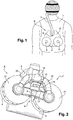
- the figure 1 represents a person wearing a vest 1 whose back is equipped with a motorized personal protective device A having a mask (not visible) connected by a conduit 2 to motorized air supply means 3, for example turbine, for drawing outside air through two filters 4 for retaining particles or microorganisms present in the surrounding atmosphere.
- motorized air supply means 3 for example turbine
- Each filter 4 is generally cylindrical in shape and has a central air inlet 5 located on its rear face.
- the apparatus A is equipped with control means 6 for starting or stopping the motorized means 3 for supplying air, and for adjusting the air flow supplying the mask.
- the invention proposes to equip such an apparatus with a device 7 for collecting particles and microorganisms present in the ambient air.
- This device 7 comprises a cyclonic chamber 8 for air centrifugation of conical or frustoconical shape, the structure of which is better visible at the figure 4 .
- This enclosure 8 is delimited, in its lower part, by a first part 9 of generally frustoconical or conical shape and whose inner surface 10 is covered with an electrostatic material, for example of the "electret" type, or a material with nanofiber base for collecting particles or microorganisms.
- the upper diameter of the first piece 9 is between 10 and 50 mm, its height h is between 10 and 100 mm.
- the upper end of the first part 9 is provided with an annular flange 11 extending radially outwards.
- the enclosure 8 is also delimited, in its upper part, by a second part 12, surmounting the first, having a cylindrical outer wall 13 and an axial tube 14 delimiting with the outer wall an annular air inlet channel 15 opening inside the enclosure.
- Wall external 13 has at least one opening 16 opening tangentially into the annular channel 15, so as to form an air inlet in the upper part of the enclosure 8.
- the lower end of the second part 12 is provided with a thread external.
- the two parts 9, 12 are fixed to each other by means of a ring 17 mounted by crimping or snapping on the flange 11 of the first part 9 and screwed onto the thread of the second part 12.
- the axial tube 14 forms an air outlet opening at its lower end into the chamber and connected at its upper end to a visible connection to the figures 2 and 3 .
- This connection 19 is in the general shape of T, one branch of which is connected to the air outlet 14 of the enclosure 8 and whose two other branches are connected to the two filters 4 via bent pipes 20 and end pieces. 21.
- the fitting 19 is fixed, for example by screwing, on the second part 12 of the cyclonic enclosure 8.
- each end piece 21 is cylindrical and form bells nestable directly on the filters 4. More particularly, each end piece 21 may be made of an elastomer material and comprises a central air outlet 22 ( figure 3 ) located opposite the central air inlet 5 of the filters 4.
- the air sucked by the motorized means 3 enters through the inlet 16 of the cyclone chamber 8 and swirls in this chamber so that the particles and microorganisms present in the ambient air are supplied by centrifugation to the electrostatic material or to the nanofiber material covering the inner surface 10 of the part 9.
- the chamber 8 operates dry, that is to say without any liquid is contained or injected into the chamber.
- the collection can also be performed in an enclosure 8 devoid of electrostatic material on its inner surface 10.
- the air flow required for good ventilation of the user is less than 100 liters per minute, even in case of relatively intense physical effort.
- the motorized supply means 3 and the cyclone enclosure 8 are sized to allow such a flow.
- the first part 9 is rinsed with a suitable liquid to recover the particles and / or microorganisms collected on the inner surface 10 in the form of a liquid sample that can be analyzed and / or assayed by conventional techniques . In this way, the particles or microorganisms present in the sample can be identified and counted.
- the first part 9 may be subjected to ultrasound, after or during rinsing.
- the invention makes it possible to collect particles or microorganisms in a continuous and efficient manner, throughout a mission whose duration can reach 10 hours.
- the collection device 7, and more particularly the cyclonic chamber 8, may be designed to allow the operation of the respiratory protection device 2, even in the event of the motorized supply means 3 being stopped, by simple aspiration. of air by the wearer.
- the pressure losses created by the collection device 7 must therefore be low enough for this.
- the collection device 7 according to the invention can be equipped with rapid disconnection means allowing the ambient air to be drawn directly through the 4 filters, without passing through the cyclonic chamber 8.
- the filters 4 are designed to generate sufficiently low pressure drops to allow the operation of the device 2 in case of failure of the power supply means 3.
- FIG. figure 5 A device 7 for collecting particles and microorganisms according to an alternative embodiment of the invention is represented in FIG. figure 5 .
- the air outlet of the enclosure 8 is connected to the air inlet of an electric motor suction turbine, housed in a housing 23 and powered by batteries, which are themselves housed in a housing 24.
- the housings 23 and 24 may be contiguous or spaced from each other.
- the air outlet of the turbine opens at 25 on the outside, in the upper part of the housing 24.
- the device 7 is intended to be worn by a person and to operate continuously for a period of several hours.
Landscapes
- Health & Medical Sciences (AREA)
- Life Sciences & Earth Sciences (AREA)
- General Health & Medical Sciences (AREA)
- Engineering & Computer Science (AREA)
- Chemical & Material Sciences (AREA)
- Biochemistry (AREA)
- Biomedical Technology (AREA)
- Molecular Biology (AREA)
- Analytical Chemistry (AREA)
- Physics & Mathematics (AREA)
- General Physics & Mathematics (AREA)
- Immunology (AREA)
- Pathology (AREA)
- Bioinformatics & Cheminformatics (AREA)
- Pulmonology (AREA)
- Emergency Management (AREA)
- Business, Economics & Management (AREA)
- Biotechnology (AREA)
- Wood Science & Technology (AREA)
- Zoology (AREA)
- Organic Chemistry (AREA)
- General Engineering & Computer Science (AREA)
- Genetics & Genomics (AREA)
- Sustainable Development (AREA)
- Microbiology (AREA)
- Medicinal Chemistry (AREA)
- Sampling And Sample Adjustment (AREA)
- Apparatus Associated With Microorganisms And Enzymes (AREA)
Description
- La présente invention concerne un dispositif portable de collecte de particules et de microorganismes présents dans l'air ambiant, à des fins d'identification et de dénombrement de ces particules et microorganismes.
- Cette identification et ce dénombrement sont importants dans de nombreux domaines tels que l'industrie pharmaceutique, l'industrie agro-alimentaire, le milieu médical, les services d'hygiène, les services vétérinaires, la surveillance de sites, etc, les dimensions des particules et microorganismes à collecter étant comprises entre 0,5 µm et plusieurs dizaines de microns.
- On connaît, par le document
FR-A-2 855 831 FR 2 905 379 - Il s'agit de dispositifs autonomes qui, bien que portatifs, présentent un encombrement relativement important. En fonctionnement, le débit d'air passant dans l'enceinte est relativement important, c'est-à-dire supérieur à 100 litres par minute. Le débit d'air est fonction des applications et est en général déterminé pour effectuer des prélèvements fiables et représentatifs en quelques minutes.
- Les personnes devant évoluer dans une atmosphère contaminée ou qui sont confrontées à des risques nucléaires, biologiques et/ou chimiques, sont tenues de porter des appareils de protection respiratoire qui peuvent être équipés de moyens filtrants, purifiant l'air ambiant par filtration.
- Ces appareils peuvent être à ventilation libre, si l'air ne traverse les filtres que du seul fait des échanges respiratoires de l'utilisateur, ou à ventilation assistée, si l'air ambiant est aspiré au travers des filtres à l'aide de moyens motorisés.
- Les appareils respiratoires connus ne permettent pas d'analyser l'atmosphère dans laquelle les utilisateurs ont évolué. Lorsque l'on veut effectuer une telle analyse, l'utilisateur doit emmener avec lui un dispositif de collecte dédié, du type de ceux décrits dans les documents
FR-A-2 855 831 FR 2 905 379 - L'invention a notamment pour but d'apporter une solution simple, efficace et économique à ce problème.
- A cet effet, elle propose un appareil individuel motorisé de protection respiratoire équipant un gilet destiné à être porté par une personne, comportant un masque, destiné à être porté par un utilisateur, et des moyens motorisés d'alimentation en air, par exemple à turbine, permettant d'aspirer de l'air extérieur au travers d'au moins un filtre destiné à retenir les particules ou les microorganismes présents dans l'air extérieur, caractérisé en ce qu'il comporte un dispositif portable de collecte de particules et de microorganismes présents dans l'air ambiant, monté sur le filtre, en amont de celui-ci dans le sens d'aspiration de l'air extérieur, le dispositif de collecte comportant une enceinte cyclonique de centrifugation d'air de forme conique ou tronconique, des moyens d'entrée d'air extérieur dans l'enceinte, des moyens de sortie d'air de l'enceinte, et des moyens de raccordement des moyens de sortie d'air de l'enceinte à des moyens d'entrée d'air de l'appareil individuel motorisé de protection respiratoire, les moyens de raccordement de la sortie d'air de l'enceinte comprennent des moyens de branchement sur au moins un filtre d'entrée de l'appareil de protection respiratoire, les moyens de branchement comportent au moins un embout de montage en forme de cloche, venant s'emboîter directement sur le filtre d'entrée de l'appareil.
- Le dispositif de collecte est associé à un appareil de protection respiratoire d'une façon permettant une collecte de particules et de microorganismes de façon continue, tout au long de la mission de l'utilisateur, et pendant toute la durée de fonctionnement de l'appareil de protection respiratoire.
- Le dispositif de collecte peut être monté et démonté très facilement sur le filtre.
- Selon une autre caractéristique de l'invention, la surface interne de l'enceinte cyclonique est constituée ou est recouverte d'un matériau électrostatique ou d'un matériau à base de nanofibres, destiné à collecter les particules ou les microorganismes.
- Ce matériau peut par exemple être un « électret », qui est un matériau diélectrique présentant un état de polarisation quasi permanent.
- De façon classique, les moyens d'entrée d'air extérieur débouchent tangentiellement dans la partie supérieure de l'enceinte et les moyens de sortie d'air débouchent axialement dans la partie supérieure de l'enceinte.
- Dans un mode de réalisation préféré de l'invention, la partie supérieure de l'enceinte a un diamètre compris entre 10 et 50 mm, et la hauteur ou la dimension axiale de l'enceinte est comprise entre 10 et 100 mm.
- L'invention concerne de plus un appareil individuel motorisé de protection respiratoire comportant un masque, destiné à être porté par un utilisateur, et des moyens motorisés d'alimentation en air, par exemple à turbine, permettant d'aspirer de l'air extérieur au travers d'au moins un filtre destiné à retenir les particules ou les microorganismes présents dans l'air extérieur, caractérisé en ce qu'un dispositif de collecte du type précité est monté sur le filtre, en amont de celui-ci dans le sens d'aspiration de l'air extérieur.
- Avantageusement, les moyens d'alimentation en air, le filtre et le dispositif de collecte sont dimensionnés pour fournir à l'utilisateur un débit d'air continu inférieur à 100 litres par minute, correspondant à ses besoins respiratoires.
- De préférence, l'appareil est destiné à être porté et utilisé pendant des périodes de temps continues pouvant atteindre 8 à 10 heures environ, la collecte des particules et des microorganismes de l'air extérieur étant faite en continu et à sec dans l'enceinte cyclonique du dispositif précité pendant toute la durée d'utilisation de l'appareil de protection respiratoire.
- En variante, le dispositif de collecte selon l'invention peut être raccordé à l'entrée d'air d'une turbine d'aspiration à moteur alimenté par des batteries électriques, l'ensemble étant destiné à être porté par une personne et à fonctionner en continu pendant une durée de plusieurs heures, par exemple d'une demi-journée environ.
- L'invention concerne également un procédé de collecte et de dosage des particules et des microorganismes présents dans l'air ambiant, caractérisé en ce qu'il consiste, après utilisation de l'appareil de protection respiratoire précité, à démonter l'enceinte cyclonique, à rincer sa surface interne avec un liquide approprié afin de récupérer les particules et/ou les microorganismes collectés sur cette surface, et à analyser et/ou doser le contenu de l'échantillon liquide ainsi obtenu.
- Ce procédé peut également consister à soumettre l'enceinte à des ultrasons, après ou lors de son rinçage, de façon à décoller les particules et/ou les microorganismes de sa surface interne.
- L'invention sera mieux comprise et d'autres détails, caractéristiques et avantages de l'invention apparaîtront à la lecture de la description suivante faite à titre d'exemple non limitatif en référence aux dessins annexés dans lesquels :
- la
figure 1 est une vue schématique représentant une personne portant un appareil individuel motorisé de protection respiratoire de l'art antérieur ; - la
figure 2 est une vue en perspective d'un appareil de protection respiratoire selon l'invention, - la
figure 3 est une vue en perspective d'un dispositif de collecte selon l'invention, - la
figure 4 est une vue en coupe axiale d'une enceinte cyclonique de centrifugation d'air. - la
figure 5 est une vue en perspective d'une variante de réalisation de l'invention. - La
figure 1 représente une personne portant un gilet 1 dont le dos est équipé d'un appareil individuel motorisé de protection respiratoire A comportant un masque (non visible) raccordé par un conduit 2 à des moyens motorisés d'alimentation en air 3, par exemple à turbine, permettant d'aspirer de l'air extérieur au travers de deux filtres 4 destinés à retenir les particules ou les microorganismes présents dans l'atmosphère environnante. - Chaque filtre 4 est de forme générale cylindrique et comporte une entrée d'air centrale 5 située sur sa face arrière.
- L'appareil A est équipé de moyens de commande 6 permettant de démarrer ou d'arrêter les moyens motorisés 3 d'alimentation en air, et de régler le débit d'air alimentant le masque.
- Comme cela est représenté à la
figure 2 , l'invention propose d'équiper un tel appareil avec un dispositif 7 de collecte de particules et de microorganismes présents dans l'air ambiant. - Ce dispositif 7 comporte une enceinte cyclonique 8 de centrifugation d'air de forme conique ou tronconique, dont la structure est mieux visible à la
figure 4 . - Cette enceinte 8 est délimitée, dans sa partie inférieure, par une première pièce 9 de forme générale tronconique ou conique et dont la surface interne 10 est recouverte d'un matériau électrostatique, par exemple du type « électret », ou d'un matériau à base de nanofibres destiné à collecter les particules ou les microorganismes. Le diamètre supérieur de la première pièce 9 est compris entre 10 et 50 mm, sa hauteur h est comprise entre 10 et 100 mm. L'extrémité supérieure de la première pièce 9 est pourvue d'un rebord annulaire 11 s'étendant radialement vers l'extérieur.
- L'enceinte 8 est également délimitée, dans sa partie supérieure, par une seconde pièce 12, surmontant la première, comportant une paroi externe 13 cylindrique et un tube axial 14 délimitant avec la paroi externe un canal annulaire d'entrée d'air 15 débouchant dans l'enceinte. La paroi externe 13 comporte au moins une ouverture 16 débouchant tangentiellement dans le canal annulaire 15, de façon à former une entrée d'air dans la partie supérieure de l'enceinte 8. L'extrémité inférieure de la seconde pièce 12 est pourvue d'un filetage externe.
- Les deux pièces 9, 12 sont fixées l'une à l'autre par l'intermédiaire d'une bague 17 montée par sertissage ou encliquetage sur le rebord 11 de la première pièce 9 et vissée sur le filetage de la seconde pièce 12.
- Le tube axial 14 forme une sortie d'air débouchant à son extrémité inférieure dans l'enceinte et reliée à son extrémité supérieure à un raccord visible aux
figures 2 et3 . Ce raccord 19 est en forme générale de T dont une branche est reliée à la sortie d'air 14 de l'enceinte 8 et dont les deux autres branches sont reliées aux deux filtres 4 par l'intermédiaire de canalisations coudées 20 et d'embouts de montage 21. Le raccord 19 est fixé, par exemple par vissage, sur la seconde pièce 12 de l'enceinte cyclonique 8. - Les embouts 21 sont cylindriques et forment des cloches emboîtables directement sur les filtres 4. Plus particulièrement, chaque embout 21 peut être réalisé en un matériau élastomère et comporte une sortie d'air 22 centrale (
figure 3 ) située en regard de l'entrée d'air centrale 5 des filtres 4. - Lors du fonctionnement de l'appareil respiratoire A, l'air aspiré par les moyens motorisés 3 entre par l'entrée 16 de l'enceinte cyclonique 8 et tourbillonne dans cette enceinte de sorte que les particules et microorganismes présents dans l'air ambiant soient amenés par centrifugation sur le matériau électrostatique ou sur le matériau à base de nanofibres recouvrant la surface interne 10 de la pièce 9.
- Contrairement à l'art antérieur précité, l'enceinte 8 fonctionne à sec, c'est-à-dire sans qu'aucun liquide ne soit contenu ou injecté dans l'enceinte.
- En variante, bien que cela soit moins efficace, la collecte peut également être réalisée dans une enceinte 8 dépourvue de matériau électrostatique sur sa surface interne 10.
- L'air sort ensuite de l'enceinte par la sortie 14 et traverse les canalisations 20 puis les filtres 4 afin d'être purifié avant d'atteindre le masque. Le débit d'air nécessaire à la bonne ventilation de l'utilisateur est inférieur à 100 litres par minutes, même en cas d'effort physique relativement intense. Les moyens d'alimentation motorisés 3 et l'enceinte cyclonique 8 sont dimensionnés pour autoriser un tel débit.
- Après avoir terminé sa mission, l'utilisateur arrête les moyens d'alimentation motorisés 3 de l'appareil de protection respiratoire et l'enceinte 8 peut être démontée. La première pièce 9 est rincée à l'aide d'un liquide approprié afin de récupérer les particules et/ou les microorganismes collectés sur la surface interne 10 sous forme d'un échantillon liquide qui peut être analysé et/ou dosé par des techniques conventionnelles. De cette manière, les particules ou les microorganismes présents dans l'échantillon peuvent être identifiés et dénombrés.
- Afin d'améliorer le décollement des particules ou des microorganismes, la première pièce 9 peut être soumise à des ultrasons, après ou lors de son rinçage.
- L'invention permet de collecter des particules ou des microorganismes de façon continue et efficace, tout au long d'une mission dont la durée peut atteindre 10 heures.
- Le dispositif de collecte 7, et plus particulièrement l'enceinte cyclonique 8, peuvent être conçus de façon à autoriser le fonctionnement de l'appareil de protection respiratoire 2, même en cas d'arrêt des moyens d'alimentation motorisés 3, par simple aspiration d'air par le porteur. Les pertes de charges créées par le dispositif de collecte 7 doivent donc être suffisamment faibles pour cela. Dans le cas contraire, le dispositif de collecte 7 selon l'invention peut être équipé de moyens de déconnexion rapide permettant à l'air ambiant d'être aspiré directement au travers des filtres 4, sans passer par l'enceinte cyclonique 8. Les filtres 4 sont en effet conçus pour générer des pertes de charge suffisamment faibles pour permettre le fonctionnement de l'appareil 2 en cas de panne des moyens motorisés d'alimentation 3.
- Un dispositif 7 de collecte de particules et de microorganismes selon une variante de réalisation de l'invention est représenté à la
figure 5 . Dans ce dispositif 7, la sortie d'air de l'enceinte 8 est raccordée à l'entrée d'air d'une turbine d'aspiration à moteur électrique, logée dans un boîtier 23 et alimentée par des batteries, elles-mêmes logées dans un boîtier 24. Les boîtiers 23 et 24 peuvent être contigus ou écartés l'un de l'autre. La sortie d'air de la turbine débouche en 25 à l'extérieur, en partie supérieure du boîtier 24. - Le dispositif 7 est destiné à être porté par une personne et à fonctionner en continu pendant une durée de plusieurs heures.
Claims (10)
- Appareil individuel motorisé de protection respiratoire (A) équipant un gilet destiné à être porté par une personne, comportant un masque, destiné à être porté par un utilisateur, et des moyens motorisés d'alimentation en air (3), par exemple à turbine, permettant d'aspirer de l'air extérieur au travers d'au moins un filtre (4) destiné à retenir les particules ou les microorganismes présents dans l'air extérieur, caractérisé en ce qu'il comporte un dispositif portable (7) de collecte de particules et de microorganismes présents dans l'air ambiant, monté sur le filtre (4), en amont de celui-ci dans le sens d'aspiration de l'air extérieur, le dispositif de collecte (7) comportant une enceinte cyclonique (8) de centrifugation d'air de forme conique ou tronconique, des moyens (16) d'entrée d'air extérieur dans l'enceinte (8), des moyens (14) de sortie d'air de l'enceinte (8), et des moyens de raccordement (19, 20, 21) des moyens de sortie d'air de l'enceinte à des moyens d'entrée d'air (4, 5) de l'appareil individuel motorisé de protection respiratoire (A), les moyens de raccordement de la sortie d'air de l'enceinte comprennent des moyens de branchement (21) sur au moins un filtre d'entrée (4) de l'appareil de protection respiratoire, les moyens de branchement comportent au moins un embout (21) de montage en forme de cloche, venant s'emboîter directement sur le filtre d'entrée (4) de l'appareil (A).
- Appareil (A) selon la revendication 1, caractérisé en ce que la surface interne (10) de l'enceinte cyclonique (8) est constituée ou est recouverte d'un matériau électrostatique ou d'un matériau à base de nanofibres destiné à collecter les particules ou les microorganismes.
- Appareil (A) selon la revendication 1 ou 2, caractérisé en ce que les moyens (16) d'entrée d'air extérieur débouchent tangentiellement dans la partie supérieure (12) de l'enceinte (8) et les 25 moyens (14) de sortie d'air débouchent axialement dans la partie supérieure (12) de l'enceinte (8).
- Appareil (A) selon l'une des revendications 1 à 3, caractérisé en ce que la partie supérieure de l'enceinte (8) a un diamètre compris entre 10 et 50 mm.
- Appareil (A) selon la revendication 3 ou 4, caractérisé en ce que la hauteur ou la dimension axiale de l'enceinte (8) est comprise entre 10 et 100 mm.
- Appareil (A) selon l'une des revendications 1 à 5, caractérisé en ce que la sortie d'air de l'enceinte peut également être raccordée à l'entrée d'air d'une turbine d'aspiration à moteur alimenté par des batteries, l'ensemble étant destiné à être porté par une personne et à fonctionner en continu pendant une durée de plusieurs heures.
- Appareil selon l'une des revendications 1 à 6, caractérisé en ce que les moyens d'alimentation en air (3), le filtre (4) et le dispositif de collecte (7) sont dimensionnés pour fournir à l'utilisateur un débit d'air continu inférieur à 100 litres par minute.
- Appareil selon l'une des revendications 1 à 7, caractérisé en ce qu'il est destiné à être porté et utilisé pendant des périodes de temps continues pouvant atteindre 8 à 10 heures environ, et en ce que la collecte des particules et des microorganismes de l'air extérieur est faite en continu et à sec dans l'enceinte cyclonique (8) du dispositif précité (7) pendant toute la durée d'utilisation de l'appareil de protection respiratoire (2).
- Procédé de collecte et de dosage des particules et des microorganismes présents dans l'air ambiant, caractérisé en ce qu'il consiste, après utilisation de l'appareil de protection respiratoire (A) selon l'une des revendications 1 à 8, à démonter l'enceinte cyclonique (8), à rincer sa surface interne (10) avec un liquide approprié afin de récupérer les particules et/ou les microorganismes collectés sur cette surface, et à analyser et/ou doser le contenu de l'échantillon ainsi produit.
- Procédé selon la revendication 9, caractérisé en ce qu'il consiste à soumettre l'enceinte (8) à des ultrasons, après ou lors de son rinçage, de façon à décoller les particules et/ou les microorganismes de sa surface interne (10).
Applications Claiming Priority (2)
| Application Number | Priority Date | Filing Date | Title |
|---|---|---|---|
| FR1058870A FR2966839B1 (fr) | 2010-10-27 | 2010-10-27 | Dispositif portable de collecte de particules et de microorganismes |
| PCT/FR2011/052445 WO2012056151A1 (fr) | 2010-10-27 | 2011-10-19 | Dispositif portable de collecte de particules et de microorganismes |
Publications (2)
| Publication Number | Publication Date |
|---|---|
| EP2633025A1 EP2633025A1 (fr) | 2013-09-04 |
| EP2633025B1 true EP2633025B1 (fr) | 2017-11-08 |
Family
ID=44168879
Family Applications (1)
| Application Number | Title | Priority Date | Filing Date |
|---|---|---|---|
| EP11787920.5A Not-in-force EP2633025B1 (fr) | 2010-10-27 | 2011-10-19 | Dispositif portable de collecte de particules et de microorganismes |
Country Status (9)
| Country | Link |
|---|---|
| US (2) | US9328322B2 (fr) |
| EP (1) | EP2633025B1 (fr) |
| JP (1) | JP6031036B2 (fr) |
| KR (1) | KR101845801B1 (fr) |
| CN (1) | CN103282482B (fr) |
| CA (1) | CA2815339C (fr) |
| FR (1) | FR2966839B1 (fr) |
| RU (1) | RU2587618C2 (fr) |
| WO (1) | WO2012056151A1 (fr) |
Families Citing this family (11)
| Publication number | Priority date | Publication date | Assignee | Title |
|---|---|---|---|---|
| JP6328493B2 (ja) * | 2014-05-28 | 2018-05-23 | 東京エレクトロン株式会社 | 測定装置及び測定方法 |
| WO2016174814A1 (fr) * | 2015-04-28 | 2016-11-03 | パナソニック株式会社 | Pompe d'aspiration |
| CN106310551A (zh) * | 2015-06-30 | 2017-01-11 | 吴新祥 | 一种个人携带式呼吸器 |
| CN106442025A (zh) * | 2016-10-17 | 2017-02-22 | 中国科学院深圳先进技术研究院 | 一种空气微生物采样装置 |
| CN108956214A (zh) * | 2018-08-27 | 2018-12-07 | 安徽省南北净化工程有限公司 | 便携可调式洁净手术室回风口空气采样装置 |
| PL4017564T3 (pl) * | 2019-08-20 | 2026-02-09 | D. Wheatley Enterprises, Inc. | Modułowy, zintegrowany system zasilanego aparatu oddechowego z funkcją oczyszczania powietrza |
| EP3839058B1 (fr) | 2019-12-18 | 2023-05-17 | Universidade de Évora | Procédé à plusieurs étapes pour le traitement de cyanobacteries aériennes dans des émissions d'interface air-eau |
| WO2022109724A1 (fr) | 2020-11-24 | 2022-06-02 | Eagle Aerospace Ltd. | Dispositif de décontamination de zone et de vérification de décontamination de zone |
| AU2022267355A1 (en) | 2021-04-30 | 2023-10-19 | Root Applied Sciences Inc. | Device for collecting material from air |
| KR102678870B1 (ko) | 2021-11-25 | 2024-06-26 | 국립한국해양대학교산학협력단 | 복합 바이오에어로졸 수집장치 |
| US11808673B2 (en) | 2022-03-04 | 2023-11-07 | Counterfog Corporation | Apparatus and methods for sampling air-borne particles |
Family Cites Families (30)
| Publication number | Priority date | Publication date | Assignee | Title |
|---|---|---|---|---|
| DE3107758A1 (de) * | 1980-03-04 | 1982-01-28 | National Research Development Corp., London | Auswaschvorrichtung |
| US4430995A (en) * | 1981-05-29 | 1984-02-14 | Hilton Joseph R | Power assisted air-purifying respirators |
| NO842275L (no) * | 1983-06-07 | 1984-12-10 | Racal Safety Ltd | Respirator. |
| EP0352938B1 (fr) * | 1988-07-26 | 1993-10-06 | RACAL HEALTH & SAFETY LIMITED | Appareil respiratoire |
| CH679122A5 (fr) * | 1989-09-29 | 1991-12-31 | Micronel Ag | |
| US5394870A (en) * | 1993-09-03 | 1995-03-07 | Minnesota Mining And Manufacturing Company | Respirator blower unit housing with pommel-like strap support member comprising lower exterior support surface |
| US5906203A (en) * | 1994-08-01 | 1999-05-25 | Safety Equipment Sweden Ab | Breathing apparatus |
| US5592935A (en) * | 1995-05-03 | 1997-01-14 | Minnesota Mining And Manufacturing Company | Positive/negative air pressure adaptor for use with respirators |
| JP3566821B2 (ja) * | 1995-11-14 | 2004-09-15 | 株式会社リコー | 固体捕集装置 |
| JP4585722B2 (ja) * | 2001-09-18 | 2010-11-24 | 株式会社オーディオテクニカ | コンデンサマイクロホン |
| JP2003210374A (ja) * | 2002-01-22 | 2003-07-29 | Duskin Co Ltd | 掃除装置 |
| JP3731656B2 (ja) * | 2002-04-16 | 2006-01-05 | 横河電機株式会社 | パーティクル捕集方法及びパーティクル捕集装置 |
| JP2003175102A (ja) * | 2002-11-22 | 2003-06-24 | Matsushita Ecology Systems Co Ltd | 肺胞到達液粒子発生方法及びそれを利用した治療器 |
| FR2855831B1 (fr) * | 2003-06-04 | 2005-09-02 | Bertin Technologies Sa | Dispositif de collecte de particules et de micro-organismes presents dans l'air ambiant |
| US7658190B1 (en) * | 2004-04-06 | 2010-02-09 | Sti Licensing Corp. | Portable air-purifying system utilizing enclosed filters |
| JP2006320713A (ja) * | 2005-05-16 | 2006-11-30 | Samsung Kwangju Electronics Co Ltd | マルチサイクロン集塵装置 |
| JP2007101331A (ja) * | 2005-10-04 | 2007-04-19 | Hario Kenkyusho:Kk | カスケードインパクタ及びそれを用いた分析用試料取得方法 |
| US20070163588A1 (en) | 2005-11-08 | 2007-07-19 | Jack Hebrank | Respirators for Delivering Clean Air to an Individual User |
| JP2009514654A (ja) * | 2005-11-08 | 2009-04-09 | ネクスト セイフティ インク | 空気供給装置 |
| CN101360545A (zh) * | 2005-12-22 | 2009-02-04 | 皇家器具有限公司 | 双级旋风真空清洁器 |
| US20070163591A1 (en) * | 2006-01-13 | 2007-07-19 | Ross Julian T | Method and system for providing breathable air in a closed circuit |
| JP2009541020A (ja) * | 2006-06-08 | 2009-11-26 | ダイソン テクノロジー リミテッド | 清掃及び/又は濾過装置 |
| KR20080013175A (ko) * | 2006-08-07 | 2008-02-13 | 삼성전자주식회사 | 공기청정기와 그 제어방법 |
| FR2905379B1 (fr) * | 2006-09-04 | 2008-11-07 | Bertin Technologies Soc Par Ac | Dispositif de collecte et de separation de particules et de microorganismes presents dans l'air ambiant |
| GB2461485B (en) * | 2007-05-15 | 2012-07-25 | Tti Floor Care North America | Cyclonic utility vacuum |
| JP2009039604A (ja) * | 2007-08-06 | 2009-02-26 | Fujitsu Ltd | 洗浄装置、洗浄槽、洗浄方法および洗浄制御プログラム |
| EP2211997B1 (fr) * | 2007-11-20 | 2020-03-25 | Avon Protection Systems, Inc. | Respirateur purificateur d'air alimenté modulaire |
| EP2100637B1 (fr) * | 2008-03-14 | 2012-07-11 | Covidien AG | Appareil respiratoire doté d'un indicateur de biocharge |
| FR2929860B1 (fr) * | 2008-04-11 | 2010-12-17 | Commissariat Energie Atomique | Dispositif d'extraction de particules de l'haleine expiree |
| GB2472098B (en) | 2009-07-24 | 2014-05-28 | Dyson Technology Ltd | An electrostatic filter |
-
2010
- 2010-10-27 FR FR1058870A patent/FR2966839B1/fr not_active Expired - Fee Related
-
2011
- 2011-10-19 WO PCT/FR2011/052445 patent/WO2012056151A1/fr not_active Ceased
- 2011-10-19 CN CN201180062607.7A patent/CN103282482B/zh not_active Expired - Fee Related
- 2011-10-19 CA CA2815339A patent/CA2815339C/fr active Active
- 2011-10-19 US US13/881,459 patent/US9328322B2/en active Active
- 2011-10-19 KR KR1020137013535A patent/KR101845801B1/ko not_active Expired - Fee Related
- 2011-10-19 JP JP2013535488A patent/JP6031036B2/ja not_active Expired - Fee Related
- 2011-10-19 EP EP11787920.5A patent/EP2633025B1/fr not_active Not-in-force
- 2011-10-19 RU RU2013119250/10A patent/RU2587618C2/ru active
-
2016
- 2016-04-22 US US15/136,076 patent/US10018537B2/en active Active
Non-Patent Citations (1)
| Title |
|---|
| None * |
Also Published As
| Publication number | Publication date |
|---|---|
| RU2013119250A (ru) | 2014-12-10 |
| RU2587618C2 (ru) | 2016-06-20 |
| CN103282482A (zh) | 2013-09-04 |
| US10018537B2 (en) | 2018-07-10 |
| WO2012056151A1 (fr) | 2012-05-03 |
| KR101845801B1 (ko) | 2018-04-05 |
| CN103282482B (zh) | 2015-07-15 |
| CA2815339A1 (fr) | 2012-05-03 |
| CA2815339C (fr) | 2019-07-02 |
| EP2633025A1 (fr) | 2013-09-04 |
| KR20140008309A (ko) | 2014-01-21 |
| FR2966839B1 (fr) | 2012-11-30 |
| JP6031036B2 (ja) | 2016-11-24 |
| US20160238493A1 (en) | 2016-08-18 |
| US20130312490A1 (en) | 2013-11-28 |
| JP2013541016A (ja) | 2013-11-07 |
| FR2966839A1 (fr) | 2012-05-04 |
| US9328322B2 (en) | 2016-05-03 |
Similar Documents
| Publication | Publication Date | Title |
|---|---|---|
| CA2815339C (fr) | Dispositif portable de collecte de particules et de microorganismes | |
| EP1629079B1 (fr) | Dispositif de collecte et de separation de particules et de micro-organismes presents dans l'air ambiant | |
| US7833303B1 (en) | Sifting apparatus with filter rotation and particle collection | |
| CA2951192A1 (fr) | Ensemble de prelevement et de transport de nano-objets contenus dans des aerosols, a cassette a ouverture securisee lors du prelevement | |
| EP2059583B1 (fr) | Dispositif de collecte et de separation de particules et de microorganismes presents dans l'air ambiant | |
| WO2013182822A1 (fr) | Procédé et dispositif de mesure continue et sans maintenance de particules dans l'air | |
| WO1993001312A1 (fr) | Cartouche, dispositif et procede de preparation d'acides nucleiques purifies, a partir d'un echantillon de cellules | |
| EP0752893B1 (fr) | Appareil a moucher les personnes | |
| EP3788342B1 (fr) | Dispositif de collecte de particules ou de micro-organismes | |
| FR2876115A1 (fr) | Procede, dispositif et systeme de prelevement d'air pour une analyse microbiologique | |
| EP1875847A1 (fr) | Appareil de séparation, par aspiration, de poussières dans un gaz | |
| EP0622055A1 (fr) | Dispositif collecteur filtrant d'un liquide visqueux | |
| US9097624B1 (en) | External filter assembly adapted for modifying a suction cleaning device to perform biological sampling | |
| FR2643285A1 (fr) | ||
| EP4225151A1 (fr) | Capuchon pour dispositif de collecte d'echantillon biologique et dispositif de collecte incluant un tel capuchon | |
| WO2012057738A1 (fr) | Appareil de tamisage | |
| FR2861279A1 (fr) | Recuperateur de poussiere externe pour aspirateur |
Legal Events
| Date | Code | Title | Description |
|---|---|---|---|
| PUAI | Public reference made under article 153(3) epc to a published international application that has entered the european phase |
Free format text: ORIGINAL CODE: 0009012 |
|
| 17P | Request for examination filed |
Effective date: 20130426 |
|
| AK | Designated contracting states |
Kind code of ref document: A1 Designated state(s): AL AT BE BG CH CY CZ DE DK EE ES FI FR GB GR HR HU IE IS IT LI LT LU LV MC MK MT NL NO PL PT RO RS SE SI SK SM TR |
|
| RIN1 | Information on inventor provided before grant (corrected) |
Inventor name: CHARPENTIER, JULIEN Inventor name: VALLAYER, BRUNO Inventor name: TROUCHET, DANIEL Inventor name: VERDIER, AMANDINE |
|
| DAX | Request for extension of the european patent (deleted) | ||
| 17Q | First examination report despatched |
Effective date: 20141203 |
|
| GRAP | Despatch of communication of intention to grant a patent |
Free format text: ORIGINAL CODE: EPIDOSNIGR1 |
|
| INTG | Intention to grant announced |
Effective date: 20170519 |
|
| GRAS | Grant fee paid |
Free format text: ORIGINAL CODE: EPIDOSNIGR3 |
|
| GRAA | (expected) grant |
Free format text: ORIGINAL CODE: 0009210 |
|
| AK | Designated contracting states |
Kind code of ref document: B1 Designated state(s): AL AT BE BG CH CY CZ DE DK EE ES FI FR GB GR HR HU IE IS IT LI LT LU LV MC MK MT NL NO PL PT RO RS SE SI SK SM TR |
|
| REG | Reference to a national code |
Ref country code: GB Ref legal event code: FG4D Free format text: NOT ENGLISH |
|
| REG | Reference to a national code |
Ref country code: CH Ref legal event code: EP Ref country code: AT Ref legal event code: REF Ref document number: 944157 Country of ref document: AT Kind code of ref document: T Effective date: 20171115 |
|
| REG | Reference to a national code |
Ref country code: IE Ref legal event code: FG4D Free format text: LANGUAGE OF EP DOCUMENT: FRENCH |
|
| REG | Reference to a national code |
Ref country code: DE Ref legal event code: R096 Ref document number: 602011043195 Country of ref document: DE |
|
| REG | Reference to a national code |
Ref country code: NL Ref legal event code: FP |
|
| REG | Reference to a national code |
Ref country code: LT Ref legal event code: MG4D |
|
| REG | Reference to a national code |
Ref country code: AT Ref legal event code: MK05 Ref document number: 944157 Country of ref document: AT Kind code of ref document: T Effective date: 20171108 |
|
| PG25 | Lapsed in a contracting state [announced via postgrant information from national office to epo] |
Ref country code: ES Free format text: LAPSE BECAUSE OF FAILURE TO SUBMIT A TRANSLATION OF THE DESCRIPTION OR TO PAY THE FEE WITHIN THE PRESCRIBED TIME-LIMIT Effective date: 20171108 Ref country code: FI Free format text: LAPSE BECAUSE OF FAILURE TO SUBMIT A TRANSLATION OF THE DESCRIPTION OR TO PAY THE FEE WITHIN THE PRESCRIBED TIME-LIMIT Effective date: 20171108 Ref country code: NO Free format text: LAPSE BECAUSE OF FAILURE TO SUBMIT A TRANSLATION OF THE DESCRIPTION OR TO PAY THE FEE WITHIN THE PRESCRIBED TIME-LIMIT Effective date: 20180208 Ref country code: LT Free format text: LAPSE BECAUSE OF FAILURE TO SUBMIT A TRANSLATION OF THE DESCRIPTION OR TO PAY THE FEE WITHIN THE PRESCRIBED TIME-LIMIT Effective date: 20171108 Ref country code: SE Free format text: LAPSE BECAUSE OF FAILURE TO SUBMIT A TRANSLATION OF THE DESCRIPTION OR TO PAY THE FEE WITHIN THE PRESCRIBED TIME-LIMIT Effective date: 20171108 |
|
| PG25 | Lapsed in a contracting state [announced via postgrant information from national office to epo] |
Ref country code: HR Free format text: LAPSE BECAUSE OF FAILURE TO SUBMIT A TRANSLATION OF THE DESCRIPTION OR TO PAY THE FEE WITHIN THE PRESCRIBED TIME-LIMIT Effective date: 20171108 Ref country code: IS Free format text: LAPSE BECAUSE OF FAILURE TO SUBMIT A TRANSLATION OF THE DESCRIPTION OR TO PAY THE FEE WITHIN THE PRESCRIBED TIME-LIMIT Effective date: 20180308 Ref country code: LV Free format text: LAPSE BECAUSE OF FAILURE TO SUBMIT A TRANSLATION OF THE DESCRIPTION OR TO PAY THE FEE WITHIN THE PRESCRIBED TIME-LIMIT Effective date: 20171108 Ref country code: GR Free format text: LAPSE BECAUSE OF FAILURE TO SUBMIT A TRANSLATION OF THE DESCRIPTION OR TO PAY THE FEE WITHIN THE PRESCRIBED TIME-LIMIT Effective date: 20180209 Ref country code: AT Free format text: LAPSE BECAUSE OF FAILURE TO SUBMIT A TRANSLATION OF THE DESCRIPTION OR TO PAY THE FEE WITHIN THE PRESCRIBED TIME-LIMIT Effective date: 20171108 Ref country code: RS Free format text: LAPSE BECAUSE OF FAILURE TO SUBMIT A TRANSLATION OF THE DESCRIPTION OR TO PAY THE FEE WITHIN THE PRESCRIBED TIME-LIMIT Effective date: 20171108 Ref country code: BG Free format text: LAPSE BECAUSE OF FAILURE TO SUBMIT A TRANSLATION OF THE DESCRIPTION OR TO PAY THE FEE WITHIN THE PRESCRIBED TIME-LIMIT Effective date: 20180208 |
|
| PG25 | Lapsed in a contracting state [announced via postgrant information from national office to epo] |
Ref country code: EE Free format text: LAPSE BECAUSE OF FAILURE TO SUBMIT A TRANSLATION OF THE DESCRIPTION OR TO PAY THE FEE WITHIN THE PRESCRIBED TIME-LIMIT Effective date: 20171108 Ref country code: DK Free format text: LAPSE BECAUSE OF FAILURE TO SUBMIT A TRANSLATION OF THE DESCRIPTION OR TO PAY THE FEE WITHIN THE PRESCRIBED TIME-LIMIT Effective date: 20171108 Ref country code: SK Free format text: LAPSE BECAUSE OF FAILURE TO SUBMIT A TRANSLATION OF THE DESCRIPTION OR TO PAY THE FEE WITHIN THE PRESCRIBED TIME-LIMIT Effective date: 20171108 Ref country code: CZ Free format text: LAPSE BECAUSE OF FAILURE TO SUBMIT A TRANSLATION OF THE DESCRIPTION OR TO PAY THE FEE WITHIN THE PRESCRIBED TIME-LIMIT Effective date: 20171108 Ref country code: CY Free format text: LAPSE BECAUSE OF FAILURE TO SUBMIT A TRANSLATION OF THE DESCRIPTION OR TO PAY THE FEE WITHIN THE PRESCRIBED TIME-LIMIT Effective date: 20171108 |
|
| REG | Reference to a national code |
Ref country code: DE Ref legal event code: R097 Ref document number: 602011043195 Country of ref document: DE |
|
| PG25 | Lapsed in a contracting state [announced via postgrant information from national office to epo] |
Ref country code: SM Free format text: LAPSE BECAUSE OF FAILURE TO SUBMIT A TRANSLATION OF THE DESCRIPTION OR TO PAY THE FEE WITHIN THE PRESCRIBED TIME-LIMIT Effective date: 20171108 Ref country code: PL Free format text: LAPSE BECAUSE OF FAILURE TO SUBMIT A TRANSLATION OF THE DESCRIPTION OR TO PAY THE FEE WITHIN THE PRESCRIBED TIME-LIMIT Effective date: 20171108 Ref country code: RO Free format text: LAPSE BECAUSE OF FAILURE TO SUBMIT A TRANSLATION OF THE DESCRIPTION OR TO PAY THE FEE WITHIN THE PRESCRIBED TIME-LIMIT Effective date: 20171108 |
|
| PLBE | No opposition filed within time limit |
Free format text: ORIGINAL CODE: 0009261 |
|
| STAA | Information on the status of an ep patent application or granted ep patent |
Free format text: STATUS: NO OPPOSITION FILED WITHIN TIME LIMIT |
|
| PG25 | Lapsed in a contracting state [announced via postgrant information from national office to epo] |
Ref country code: MT Free format text: LAPSE BECAUSE OF FAILURE TO SUBMIT A TRANSLATION OF THE DESCRIPTION OR TO PAY THE FEE WITHIN THE PRESCRIBED TIME-LIMIT Effective date: 20171108 |
|
| 26N | No opposition filed |
Effective date: 20180809 |
|
| REG | Reference to a national code |
Ref country code: FR Ref legal event code: PLFP Year of fee payment: 8 |
|
| PG25 | Lapsed in a contracting state [announced via postgrant information from national office to epo] |
Ref country code: SI Free format text: LAPSE BECAUSE OF FAILURE TO SUBMIT A TRANSLATION OF THE DESCRIPTION OR TO PAY THE FEE WITHIN THE PRESCRIBED TIME-LIMIT Effective date: 20171108 |
|
| REG | Reference to a national code |
Ref country code: CH Ref legal event code: PL |
|
| PG25 | Lapsed in a contracting state [announced via postgrant information from national office to epo] |
Ref country code: LU Free format text: LAPSE BECAUSE OF NON-PAYMENT OF DUE FEES Effective date: 20181019 Ref country code: MC Free format text: LAPSE BECAUSE OF FAILURE TO SUBMIT A TRANSLATION OF THE DESCRIPTION OR TO PAY THE FEE WITHIN THE PRESCRIBED TIME-LIMIT Effective date: 20171108 |
|
| REG | Reference to a national code |
Ref country code: IE Ref legal event code: MM4A |
|
| PG25 | Lapsed in a contracting state [announced via postgrant information from national office to epo] |
Ref country code: LI Free format text: LAPSE BECAUSE OF NON-PAYMENT OF DUE FEES Effective date: 20181031 Ref country code: CH Free format text: LAPSE BECAUSE OF NON-PAYMENT OF DUE FEES Effective date: 20181031 |
|
| PG25 | Lapsed in a contracting state [announced via postgrant information from national office to epo] |
Ref country code: IE Free format text: LAPSE BECAUSE OF NON-PAYMENT OF DUE FEES Effective date: 20181019 |
|
| PG25 | Lapsed in a contracting state [announced via postgrant information from national office to epo] |
Ref country code: TR Free format text: LAPSE BECAUSE OF FAILURE TO SUBMIT A TRANSLATION OF THE DESCRIPTION OR TO PAY THE FEE WITHIN THE PRESCRIBED TIME-LIMIT Effective date: 20171108 |
|
| PG25 | Lapsed in a contracting state [announced via postgrant information from national office to epo] |
Ref country code: PT Free format text: LAPSE BECAUSE OF FAILURE TO SUBMIT A TRANSLATION OF THE DESCRIPTION OR TO PAY THE FEE WITHIN THE PRESCRIBED TIME-LIMIT Effective date: 20171108 |
|
| PG25 | Lapsed in a contracting state [announced via postgrant information from national office to epo] |
Ref country code: HU Free format text: LAPSE BECAUSE OF FAILURE TO SUBMIT A TRANSLATION OF THE DESCRIPTION OR TO PAY THE FEE WITHIN THE PRESCRIBED TIME-LIMIT; INVALID AB INITIO Effective date: 20111019 Ref country code: MK Free format text: LAPSE BECAUSE OF NON-PAYMENT OF DUE FEES Effective date: 20171108 |
|
| PG25 | Lapsed in a contracting state [announced via postgrant information from national office to epo] |
Ref country code: AL Free format text: LAPSE BECAUSE OF FAILURE TO SUBMIT A TRANSLATION OF THE DESCRIPTION OR TO PAY THE FEE WITHIN THE PRESCRIBED TIME-LIMIT Effective date: 20171108 |
|
| P01 | Opt-out of the competence of the unified patent court (upc) registered |
Effective date: 20230517 |
|
| PGFP | Annual fee paid to national office [announced via postgrant information from national office to epo] |
Ref country code: NL Payment date: 20230926 Year of fee payment: 13 |
|
| PGFP | Annual fee paid to national office [announced via postgrant information from national office to epo] |
Ref country code: GB Payment date: 20231019 Year of fee payment: 13 |
|
| PGFP | Annual fee paid to national office [announced via postgrant information from national office to epo] |
Ref country code: IT Payment date: 20231010 Year of fee payment: 13 Ref country code: FR Payment date: 20231023 Year of fee payment: 13 Ref country code: DE Payment date: 20231011 Year of fee payment: 13 |
|
| PGFP | Annual fee paid to national office [announced via postgrant information from national office to epo] |
Ref country code: BE Payment date: 20231016 Year of fee payment: 13 |
|
| REG | Reference to a national code |
Ref country code: DE Ref legal event code: R119 Ref document number: 602011043195 Country of ref document: DE |
|
| REG | Reference to a national code |
Ref country code: NL Ref legal event code: MM Effective date: 20241101 |
|
| GBPC | Gb: european patent ceased through non-payment of renewal fee |
Effective date: 20241019 |
|
| PG25 | Lapsed in a contracting state [announced via postgrant information from national office to epo] |
Ref country code: DE Free format text: LAPSE BECAUSE OF NON-PAYMENT OF DUE FEES Effective date: 20250501 |
|
| PG25 | Lapsed in a contracting state [announced via postgrant information from national office to epo] |
Ref country code: GB Free format text: LAPSE BECAUSE OF NON-PAYMENT OF DUE FEES Effective date: 20241019 |
|
| PG25 | Lapsed in a contracting state [announced via postgrant information from national office to epo] |
Ref country code: NL Free format text: LAPSE BECAUSE OF NON-PAYMENT OF DUE FEES Effective date: 20241101 Ref country code: BE Free format text: LAPSE BECAUSE OF NON-PAYMENT OF DUE FEES Effective date: 20241031 |
|
| PG25 | Lapsed in a contracting state [announced via postgrant information from national office to epo] |
Ref country code: FR Free format text: LAPSE BECAUSE OF NON-PAYMENT OF DUE FEES Effective date: 20241031 |
|
| REG | Reference to a national code |
Ref country code: BE Ref legal event code: MM Effective date: 20241031 |
|
| PG25 | Lapsed in a contracting state [announced via postgrant information from national office to epo] |
Ref country code: IT Free format text: LAPSE BECAUSE OF NON-PAYMENT OF DUE FEES Effective date: 20241019 |