EP2633277B1 - Winkelempfindliche pixelvorrichtung - Google Patents
Winkelempfindliche pixelvorrichtung Download PDFInfo
- Publication number
- EP2633277B1 EP2633277B1 EP11837049.3A EP11837049A EP2633277B1 EP 2633277 B1 EP2633277 B1 EP 2633277B1 EP 11837049 A EP11837049 A EP 11837049A EP 2633277 B1 EP2633277 B1 EP 2633277B1
- Authority
- EP
- European Patent Office
- Prior art keywords
- grating
- light
- talbot
- periodic
- asp
- Prior art date
- Legal status (The legal status is an assumption and is not a legal conclusion. Google has not performed a legal analysis and makes no representation as to the accuracy of the status listed.)
- Active
Links
Images









Classifications
-
- G—PHYSICS
- G02—OPTICS
- G02B—OPTICAL ELEMENTS, SYSTEMS OR APPARATUS
- G02B27/00—Optical systems or apparatus not provided for by any of the groups G02B1/00 - G02B26/00, G02B30/00
- G02B27/42—Diffraction optics, i.e. systems including a diffractive element being designed for providing a diffractive effect
- G02B27/4205—Diffraction optics, i.e. systems including a diffractive element being designed for providing a diffractive effect having a diffractive optical element [DOE] contributing to image formation, e.g. whereby modulation transfer function MTF or optical aberrations are relevant
-
- H—ELECTRICITY
- H10—SEMICONDUCTOR DEVICES; ELECTRIC SOLID-STATE DEVICES NOT OTHERWISE PROVIDED FOR
- H10F—INORGANIC SEMICONDUCTOR DEVICES SENSITIVE TO INFRARED RADIATION, LIGHT, ELECTROMAGNETIC RADIATION OF SHORTER WAVELENGTH OR CORPUSCULAR RADIATION
- H10F30/00—Individual radiation-sensitive semiconductor devices in which radiation controls the flow of current through the devices, e.g. photodetectors
- H10F30/20—Individual radiation-sensitive semiconductor devices in which radiation controls the flow of current through the devices, e.g. photodetectors the devices having potential barriers, e.g. phototransistors
- H10F30/21—Individual radiation-sensitive semiconductor devices in which radiation controls the flow of current through the devices, e.g. photodetectors the devices having potential barriers, e.g. phototransistors the devices being sensitive to infrared, visible or ultraviolet radiation
-
- G—PHYSICS
- G01—MEASURING; TESTING
- G01J—MEASUREMENT OF INTENSITY, VELOCITY, SPECTRAL CONTENT, POLARISATION, PHASE OR PULSE CHARACTERISTICS OF INFRARED, VISIBLE OR ULTRAVIOLET LIGHT; COLORIMETRY; RADIATION PYROMETRY
- G01J1/00—Photometry, e.g. photographic exposure meter
- G01J1/02—Details
-
- G—PHYSICS
- G01—MEASURING; TESTING
- G01S—RADIO DIRECTION-FINDING; RADIO NAVIGATION; DETERMINING DISTANCE OR VELOCITY BY USE OF RADIO WAVES; LOCATING OR PRESENCE-DETECTING BY USE OF THE REFLECTION OR RERADIATION OF RADIO WAVES; ANALOGOUS ARRANGEMENTS USING OTHER WAVES
- G01S3/00—Direction-finders for determining the direction from which infrasonic, sonic, ultrasonic or electromagnetic waves, or particle emission, not having a directional significance, are being received
- G01S3/78—Direction-finders for determining the direction from which infrasonic, sonic, ultrasonic or electromagnetic waves, or particle emission, not having a directional significance, are being received using electromagnetic waves other than radio waves
- G01S3/782—Systems for determining direction or deviation from predetermined direction
-
- H—ELECTRICITY
- H10—SEMICONDUCTOR DEVICES; ELECTRIC SOLID-STATE DEVICES NOT OTHERWISE PROVIDED FOR
- H10F—INORGANIC SEMICONDUCTOR DEVICES SENSITIVE TO INFRARED RADIATION, LIGHT, ELECTROMAGNETIC RADIATION OF SHORTER WAVELENGTH OR CORPUSCULAR RADIATION
- H10F39/00—Integrated devices, or assemblies of multiple devices, comprising at least one element covered by group H10F30/00, e.g. radiation detectors comprising photodiode arrays
- H10F39/80—Constructional details of image sensors
- H10F39/806—Optical elements or arrangements associated with the image sensors
-
- H—ELECTRICITY
- H10—SEMICONDUCTOR DEVICES; ELECTRIC SOLID-STATE DEVICES NOT OTHERWISE PROVIDED FOR
- H10F—INORGANIC SEMICONDUCTOR DEVICES SENSITIVE TO INFRARED RADIATION, LIGHT, ELECTROMAGNETIC RADIATION OF SHORTER WAVELENGTH OR CORPUSCULAR RADIATION
- H10F39/00—Integrated devices, or assemblies of multiple devices, comprising at least one element covered by group H10F30/00, e.g. radiation detectors comprising photodiode arrays
- H10F39/80—Constructional details of image sensors
- H10F39/806—Optical elements or arrangements associated with the image sensors
- H10F39/8067—Reflectors
Definitions
- Embodiments of the invention are generally directed to the field of light field sensing and light field image detection. More particularly, embodiments of the invention are directed to a lens-less, angle-sensitive pixel (ASP) sensor and ASP devices having increased quantum efficiency and pixel density, which can measure the intensity and incident angle of a light field to provide an image of the light field.
- ASP angle-sensitive pixel
- the plenoptic function parameterizes the light rays passing through all space in terms of intensity, I , which is dependent on position in space ( x , y, z ), direction ( ⁇ , ⁇ ) , wavelength ( ⁇ ), time ( t ) , and polarization angle ( p ).
- I intensity
- I polarization angle
- Recording information about the light field of a scene provides a more complete description of that scene than a conventional photograph or movie, and is useful for a number of applications.
- the light field allows prediction of illumination patterns on a surface given known sources and the three-dimensional reconstruction of scenes (e.g., "light-field rendering” or "three-dimensional shape approximation”).
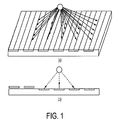
- Figures 1a, 1b show how one aspect of the light field, e.g., incident angle, can be used to localize a light source in three-dimensional space. Capturing the light field also permits construction of images with an arbitrary focal plane and aperture. This capability is useful in both photography and in microscopy for obtaining multiple focal planes without moving optics.
- SOI silicon-on-insulator
- EP1623671 A1 relates to an X-ray imaging apparatus that can avoid the need for a complex or large-scale X-ray source.
- This apparatus includes diffraction gratings, one of which being a phase-type diffraction grating.
- a second of the diffraction gratings is an amplitude-type diffraction grating.
- KAO CHING-FEN ET AL "Reflective-type optical encoder based on fractional Talbot self-image effect using phase grating", SIXTH INTERNATIONAL SYMPOSIUM ON PRECISION ENGINEERING MEASUREMENTS AND INSTRUMENTATION, SPIE, 1000 20TH ST. BELLINGHAM WA 98225-6705 USA, (20100824), vol. 7544, no. 1, doi:10.1117/ 12.886238, pages 1 - 6, XP060004980 discloses an optical encoder having a two-dimensional phase grating for providing more accuracy of phase-shift.
- the optical encoder further includes a second amplitude grating. This document concerns mainly the first two-dimensional phase grating.
- Document WO 2010/044943 A2 relates to a lens-less, angle-sensitive pixel device, comprising a device support structure, a first periodic, light diffracting structure having a period p1 disposed in or on a top surface of the support structure, a second periodic structure having a period P2 oriented parallel to the first periodic, light diffracting structure and disposed in the support structure at a selected distance below the first periodic light diffracting structure, as well as a sensor disposed in the support structure below the second periodic structure.
- M. TESTORF ET AL. "Talbot effect for oblique angle of light propagation", 15.08.1996, XP004011377 , in DE 199 12 945 A1 , in A. LOHMANN ET AL., "Making an array illuminator based on the Talbot effect", 10.10.1990, XP002314360 , and in CHING-FEN KAO ET AL., "Optical encoder based on Fractional-Talbot effect using two-dimensional phase grating, 01.05.2010, XP026929421 .
- CMOS complementary metal-oxide-semiconductor
- the metallic structures used to form the micron-scale fine-pitch transmission amplitude gratings to create the interference patterns from the incident light field, of the instant invention block a significant fraction of the available light. While reduced light sensitivity is not a significant problem for many applications, maintaining high sensitivity comparable to that of a traditional photodetector permits more widespread deployment of angle-sensitive imagers. In addition, the combination of this 'top' grating and an 'analyzer' grating as described herein, results in a structure of relatively significant size as well as sub-optimal quantum efficiency (QE). It would also be beneficial to improve angular acuity and reduce the wavelength dependence of the previously embodied ASPs. Accordingly there is a need for an improved ASP apparatus and associated systems that address these problems and concerns without compromising basic function or CMOS manufacturing capability.
- QE sub-optimal quantum efficiency
- an angle-sensitive pixel - ASP - device comprising a substrate and a phase grating having a period, p 1 , disposed in the substrate.
- the phase grating has a periodic variation of refractive index in a direction transverse to an incident light field and forms, by passing the incident light field therethrough, a periodic intensity pattern in a Talbot plane below the phase grating, as well as periodic intensity patterns with higher periodicity than the phase grating at depths above and below a 1 ⁇ 2 Talbot depth.
- the ASP device also comprises an amplitude transmission analyzer grating having a period, p 2 , placed at the depth of said Talbot pattern with higher periodicity than the phase grating, this depth being a 1 ⁇ 4 Talbot depth.
- the ASP device also comprises a sensor disposed at a selected distance below the analyzer grating.
- the pitch of the phase grating is twice the pitch of the analyzer grating.
- Pixel and detector devices disclosed herein are sensitive to both the intensity and the incident angle of incident light from an object scene.
- the disclosed apparatus utilize the Talbot effect of periodic light diffracting structures to characterize incident light by its magnitude and direction.
- Local micron-scale diffraction gratings at each of a large number of sensor sites are used to capture this information.
- ASPs angle-sensitive pixels
- An angle-sensitive pixel device may be manufactured entirely in a standard CMOS fabrication process.
- m, n are positive integers
- ⁇ is the wavelength of a monochromatic, plane, incident wavefront on the first periodic, light diffracting structure
- p 1 is equal to or greater than ⁇ .
- p 1 is equal to p 2 .
- the second periodic structure further includes at least two sets of at least two interleaved diffusion-type diodes, which could be finger diodes.
- the sets of diodes are, respectively, laterally displaced from the first periodic, light diffracting structure by a distance np 1 /m, where n can have the values 0, 1, 2, 3, 4, 5, 6, 7, 8 and m can have the values 2, 3, 4, 8.
- a micron-scale device requires both a periodic diffracting structure to generate Talbot self-images and a structure for analyzing these self-images.
- a periodic diffracting structure By sizing the entire device to fit within an area of at most tens of microns on a side, spatial resolution may be achieved that is comparable with existing image sensors.
- the periodic diffracting structure will have several periods within this area to produce an operable periodic self-image.
- the diffracting structure may have a period of only a few wavelengths.
- Contemporary planar photolithography techniques can easily achieve the resolution required to generate appropriate diffracting structures. Numerical modeling and simulation can accurately predict behavior for finite gratings built on a single-micron scale.
- the structure for analyzing the self-images generated by the periodic diffracting structure may be an integrated light detector; for example, at least two, periodic, interleaved sets of at least two diffusion-type diodes as are well known in the art.
- the structure for analyzing the self-images may be one or more layers of periodic structures followed by a sensor in the form of at least two, periodic, interleaved sets of diffusion-type diodes, one or more single, large, well-type diodes known in the art, or a combination of the interleaved diffusion diodes disposed (and partially enclosed) in the one or more single, large, well-type diodes.
- the one or more layers of periodic structures may or may not be arranged co-perpendicularly.
- a lens-less light-field detector includes a detector support structure; a first pixel device, and a second pixel device disposed linearly adjacent the first pixel device.
- the first pixel device comprises a first periodic, light diffracting structure having a period, p 1 , disposed in or on a top surface of the support structure; a second periodic structure having a period, p 2 , oriented parallel to the first periodic, light diffracting structure and disposed in the support structure at a selected distance below the first periodic, light diffracting structure, wherein the second periodic structure is not laterally displaced from the first periodic, light diffracting structure; and a first sensor disposed in the support structure at a first selected distance below the first periodic, light diffracting structure and the second periodic structure.
- the second pixel device comprises a first periodic, light diffracting structure having a period, p 1 , disposed in or on a top surface of the support structure; a second periodic structure having a period, p 2 , oriented parallel to the first periodic, light diffracting structure and disposed in the support structure at the selected distance below the first periodic, light diffracting structure, wherein the second periodic structure is laterally displaced from the first periodic, light diffracting structure by an amount ( m 2 / n 2 ) p 1 ; and a second sensor disposed in the support structure at the first selected distance below the first periodic, light diffracting structure, wherein m, n are positive integers, ⁇ is the wavelength of an monochromatic, plane, incident wavefront on the first periodic, light diffracting structure, p 1 is greater than ⁇ .
- the first and second pixel devices further comprise a first intermediate periodic, light diffracting structure having a period, p 1 , disposed between the first periodic, light diffracting structure and the second periodic structure, oriented perpendicularly to the first and second periodic structures; and a second intermediate periodic, light diffracting structure having a period, p 2 , disposed between the second periodic structure and the first and second sensors, oriented perpendicularly to the first and second periodic structures, wherein in the first pixel device, the first and second intermediate periodic, light diffracting structures are not laterally displaced from the respective first and second periodic structure, further wherein in the second pixel device, the first and second intermediate periodic, light diffracting structures are laterally displaced from the respective first and second periodic structures by an amount ( m 2 / n 2 ) p 1 .
- the detector further comprises at least an n th (n ⁇ 3) pixel device disposed linearly adjacent the (n th - 1) pixel device, including a first periodic, light diffracting structure having a period, p 1 , disposed in or on a top surface of the support structure; a second periodic structure having a period, p 2 , oriented parallel to the first periodic, light diffracting structure and disposed in the support structure at the selected distance below the first periodic, light diffracting structure, wherein the second periodic structure is laterally displaced from the first periodic, light diffracting structure by an amount ( m n / n ) p 1 , where ( m n / n n ) > ( m n-1 / n n-1 ) ; and an n th sensor disposed in the support structure at the first selected distance below the first periodic, light diffracting structure.
- every n th (n ⁇ 3) pixel device further comprises a first intermediate periodic, light diffracting structure having a period, p 1 , disposed between the first periodic structure and the second periodic structure, oriented perpendicularly to the first and second periodic structures; and a second intermediate periodic, light diffracting structure having a period, p 2 , disposed between the second periodic structure and the n th sensors, oriented perpendicularly to the first and second periodic structures, wherein in every n th (n ⁇ 3) pixel device, the first and second intermediate periodic, light diffracting structures are laterally displaced from the first periodic structure by an amount ( m n / n ) p 1 , where ( m n / n n ) > ( m n.1 / n n-1 ).
- a lens-less light field imaging device comprises a two-dimensional, MxN array of ASP-light-field detectors as set forth herein, where M, N are integers equal to or greater than one.
- the periodic diffracting structures may be of various forms including, but not limited to, diffraction gratings, parallel wire arrays, Ronchi rulings, phase gratings, and others well known in the art.
- Diffracting apertures may be in the form of slits or other aperture shapes, or mismatched refractive indices.
- Gratings may advantageously be made of metal or, in the case of phase gratings, CMOS process-compatible materials (e.g., silicon dioxide).
- the sensor(s) may be, without limitation, reverse-bias p-n junction diodes, forward-biased diodes, p-i-n diodes, charge-coupled devices (CCDs), single-photon avalanche diodes, or pairs of interleaved N+/p-substrate diffusion diodes.
- a device may incorporate one or more color filters if, for example, the incident light has a broad spectrum that may advantageously be narrowed.
- Imaging devices can enable extraction of information relating to the three-dimensional structure of the object light.
- Each ASP in the type of imager described herein may extract the incident angle of light as well as its brightness.
- Individual ASPs may be used to localize one or more light sources (such as for sun tracking, for example). When many such ASPs are combined in an array, such information may be used to reconstruct three-dimensional surfaces, or multiple distinct points in 3-D space, which may have application in, e.g., biological imaging.
- An imaging device according to embodiments of the invention may advantageously be built in a standard semiconductor manufacturing process such as those used to build microprocessors and present day digital camera imagers; for example, standard CMOS fabrication processes.
- Angle-sensitive pixel devices and light field image detectors incorporating these ASP devices measure both the intensity and the incident angle of incident light.
- the disclosed apparatus and methods utilize the Talbot effect.
- a property of the Talbot effect is its response to off-axis illumination.
- d >> ⁇ linear gratings illuminated by an off-axis plane wave incident at angle ⁇
- multiple sources of off-axis illumination each generate their own set of laterally shifted grating self-images, and these self-images superpose. For small angles, these self-images all form at approximately the same distances, and the superimposed image contains information about the magnitude of illumination as well as direction.
- the incident angles of light rays striking the grating can be determined by measuring the shift in Talbot self-images.
- CMOS circuits allows for the construction of very fine features, on the order of a single wavelength of light, and so allows for the construction of metal diffraction gratings and photodiode arrays that are smaller than the wavelength of visible light.
- the self-images need to form within microns of the diffraction grating. This may require the diffraction grating to have a period of only a few wavelengths.
- Conventional analyses of diffraction are invalid at these dimensions; however, numerical simulations such as those used to generate Figure 2 , confirm that, even for these geometries, diffraction generates Talbot-like self-images at regular distances. These periodic intensity patterns retain incident angle sensitivity.
- the challenge is to extract shifts in these periodic intensity patterns using structures on a pixel scale.
- the simplest approach to measuring these shifts is to place a small array of CCD or CMOS photosensors at the plane of self-image formation.
- the array captures the self-image directly, which can be used to determine the angle and intensity of incident light.
- the penetration depth of light in silicon limits the resolution of photodiodes to about 1 ⁇ m, making it difficult to resolve sub-micron features of the self-image.
- a micron-scale light-field imager device requires both a Talbot self-image generator and a structure that can analyze these images.
- the entire device structure In order to achieve spatial resolution comparable with existing image sensors, the entire device structure must fit within an area that is at most tens of microns on a side. To produce a reasonably periodic self-image, the grating must have several periods within this area. Together these two constraints suggest using a grating with a period of only a few wavelengths. Contemporary planar photolithography techniques can easily achieve the resolution required to generate appropriate diffraction gratings. Numerical modeling and simulation can accurately predict behavior for finite gratings built on a single-micron scale.
- the high density imager array would require a pixel pitch of 1 ⁇ 4 the grating pitch (e.g., on the order of 200 nm) to effectively resolve the features of the Talbot image.
- the grating pitch e.g., on the order of 200 nm
- a solution includes a second parallel analyzer grating 304 of identical period to the first grating 302 disposed at the self-image plane, as illustrated in Figures 3a, 3b .
- the second (analyzer) grating 304 uses the Moire effect to filter the Talbot image.
- the intensity peaks align with gaps in the second grating as shown in Figure 3b
- light passes through the analyzer grating 304.
- the bars of the analyzer grating block the light.
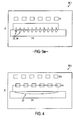
- Figure 4b shows an exemplary, diagrammatic illustration of such a structure embodiment 300-2 for extracting partial information about the diffraction pattern phase.
- Two metal gratings 302a, 302b are placed at a 90 degree lateral offset relative each other over a single, large well-diode 307 integrated into substrate 310.
- This approach decouples the design of the diodes from that of the gratings, allowing for better diodes.
- the finest features in this aspect are the gratings themselves rather than the photodiodes, the same class of structure can be built using lower resolution photolithography (i.e., in a larger feature size, cheaper manufacturing process).
- ASP angle-sensitive pixel
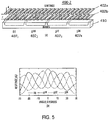
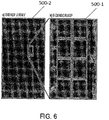
- the overall size of the exemplary eight-sensor ASP 500-1 is 20 ⁇ m by 40 ⁇ m, with each individual sensor being 10 ⁇ m square.
- the stacked diffraction gratings were built in wiring layers, above intrinsic p-n junction photodiodes.
- each grating in each of the eight sensors was a Ronchi ruling (equal width bars and gaps) using copper bars with a period of 880 nm. All other space was filled with silicon dioxide.
- One set of gratings was used to bus out the data generated, which eliminated the need for wiring lanes in the array. As the gratings provide a large number of bus lines, the eight ASP outputs are read in parallel.
- the grating separation, z was limited by available interconnect layer spacing, and pitch d chosen from numerical simulations to maximize modulation depth, m, for green (525 nm in vacuum, 350 nm in oxide) light.
- the top diffraction grating was positioned in the 6th metal layer and the analyzer grating in the 3rd metal layer, for a separation of 2 microns.
- a single p - n photodiode in each of the eight sensors measured the total light flux through the stacked gratings.
- a standard 3T active pixel sensor was used to buffer the photodiode outputs, and several multiplexers allowed access to each ASP individually.
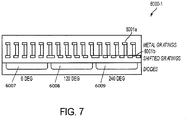
- Figure 7 shows an illustrative aspect of a device embodiment 6000-1 similar to that shown in Figure 5a in which three single diodes 6007, 6008, 6009 are disposed adjacent two grating layers 6001a, 6001b. Second grating layer 6001b is shifted relative to grating 6001a by 0, 1/3 and 2/3 of the grating period.
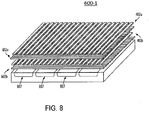
- a light field image detector 600-1 is illustrated in Figure 8 .
- a second set of gratings 602a, 602b rotated by 90 degrees and interleaved between grating 402a, 402b are provided in close proximity thereto. This second set of gratings is responsible for measuring the angle information ignored by the first set of sensors.
- a light source (commercial green LED, with center wavelength of 525 nm and spectral width of 32 nm) was mounted on a variable angle arm at a fixed distance from the fabricated arrays. No additional collimation or filtering was performed, as a non-ideal illumination source better approximates real-world imaging applications.
- the self-images observed are a superposition of the intensity patterns produced by each wavelength.
- the spectral width of the source is relatively narrow and the path length differences, which make the Talbot patterns, are shorter than the source's coherence length, so we did not expect significant deviation in performance from our monochromatic, coherent simulations.
- Fine-pitch gratings are known to polarize the light they transmit.
- a recent study on the polarization-dependent Talbot effect in high-density gratings predicts that gratings with period of approximately 2.5 ⁇ should show significant polarization sensitivity.
- the Talbot self-images formed at the 1 ⁇ 2 Talbot distance by TE (electric field parallel to the grating lines) polarized light should be approximately twice as bright as those formed by TM (magnetic field parallel to the grating lines) polarized light.
- TE electric field parallel to the grating lines
- TM magnetic field parallel to the grating lines
- Figure 4a shows a cross sectional schematic of a non-limiting exemplary device embodiment 300-1 of the invention.
- the device includes a metal slit grating 301 and a substrate 310 with multiple linear arrays of two integrated, interleaved fingered diodes (A) 307, (B) 308 that are relatively shifted by 180 degrees (i.e., offset by zero and one-half period of the grating) relative to the grating.
- Multi-finger diodes advantageously provide maximum photon capture.
- Figure 13 shows an imaging device 500-1 based upon a three-diode structure according to a non-limiting exemplary embodiment of the invention.
- the device includes a metal transmission grating 501 having multiple, periodic slit apertures 503.
- the light shadings indicated by reference numeral 504 do not represent any physical part of the device, rather merely the alignment between the grating and the diodes.
- the device further includes a single structure of three linear arrays of three interleaved diodes, 507, 508, 509, integrated in a substrate 510.
- the three illustrated diodes of diode array 507 are aligned with the grating (no offset) and thus will detect a zero degree phase shift in the interference pattern (not shown).
- the three illustrated diodes of diode array 508 are offset by 1/3 of the grating period and thus detect a 120 degree phase shift; while the three illustrated diodes of diode array 509 are offset by 2/3 of the grating period and thus detect a 240 degree phase shift.
- Figure 14 shows an alternate device arrangement 400-1 of diodes and grating according to a non-limiting, exemplary embodiment.
- an integrated, single-interleaved set of four diodes 407, 408, 409, 411 are positioned offset by zero, 1 ⁇ 4 , 1 ⁇ 2 and 3 ⁇ 4 of the grating 401 period providing respective phase shifts of 0°, 90°, 180° and 270°.
- the single-interleaved set of four diodes is different than, e.g., the two adjacent diode sets as shown in Figure 4a .
- the light shadow areas in the figure do not reflect any additional physical structure; rather, they only indicate alignment between diodes and metal.
- Figure 15 shows a cross-sectional schematic of a detector device 100-1 according to an alternative, non-limiting exemplary embodiment of the invention.
- Sensor device 100-1 incorporates one set of interleaved diodes 121 at 0 and 180 degrees relative to the grating and another set of interleaved diodes 123 at 90 and 270 degrees. This type of arrangement may prevent diode overlap.
- the two shifted gratings 101a, 101b are shown as darkly shaded while the lighter shading 103 beneath each grating is presented merely to show the alignment between the grating and the diodes and does not represent any physical structure of the device.
- Figure 16a shows a top view of components of a non-limiting, exemplary device aspect 8000-1 incorporating just two slits 8003 and two diodes 8007, 8008.
- Figure 16b is a cross-sectional view through the dashed line in Figure 16a . This design is compact, allowing for higher spatial resolution.
- Figures 17 (a-c) show top views of components of a non-limiting, exemplary full interleaved diode light-field sensor cell 5000-1, having gratings and diodes in both the vertical (5006a, b) and horizontal (5006c, d) orientations, which may be used to capture both azimuth and altitude information about the source object.
- Figure 17a illustrates the layout of diodes (e.g., n-type diffusion in p-substrate), wherein each set of vertically-oriented diodes 5006a, b contains a pair 5002, 5004 of interleaved diode arrays and each set of horizontally-oriented diodes 5006c, d contains a pair 5008, 5010 of interleaved diode arrays.
- Figure 17b shows the associated metal gratings 5001 with the same orientations as the corresponding diode arrays.
- the vertically-oriented gratings may be used as a data bus to carry information from each column to the edge of the array at 5015 without giving up area in the imager itself.
- the gratings may be used to tie many individual diodes to processing circuits away from the array itself. This maximizes the photosensitive area of the imager, recovering area lost to circuits required to convert light into electrical signals.
- Figure 17c shows an overlay of diodes and gratings shown in Figures 17a, b .
- Figure 15 which shows a cross-section of the horizontally-oriented detectors (i.e., along the dashed black line in Figures 17a-c , illustrates that the relative alignment of the diodes and metal grating are shifted for the 0/180° cases versus the 90/270° case.
- Figure 18 shows an exemplary device aspect 2000-1 similar to that of 100-1 except that all diodes are shifted by 1/8 of the grating pitch, representing phase shifts of -45°, 135°, 45° and -135°.
- This figure illustrates that the precise alignment of diodes and metal is less important than the relative alignment of diodes to each other.
- the 1/8 period shift should have no appreciable effect on the function of the structures disclosed herein. This insensitivity applies to all structures disclosed herein, and to the alignment of secondary gratings in the "double grating" embodiments described herein.
- Figure 19 graphically shows simulated photocurrents from four distinct diode arrays at 0, 90 180 and 270 degrees relative to a grating where the incident angle was swept from -30 to 30 degrees, according to an illustrative aspect of the invention.
- each diode shows multiple peaks, indicating that equations (1) may not necessarily lead to a unique angle extraction. This may be remedied by using multiple structures with different grating geometries (and therefore different values of "k"), placed adjacent to each other. If the mapping from incident angle to diode response is different, then different peaks of activity may be distinguished. This may then facilitate construction of a sensor that is able to cover the entire range of incident angles.
- each diode is responding to exactly the same incident angle of light, one may expect some redundancy in the responses in the eight diode aspect described above.
- D 0 + D 180 D 90 + D 270 , implying that maintaining all four separate signals may be redundant.
- This redundant information may be removed by redefining the response in terms of three numbers: D 0 ⁇ D 180 , D 90 ⁇ D 270 , and D 0 ⁇ D 180 + D 90 + D 270 .
- This recoding could be performed in either the analog or digital domain on the same integrated circuit as the sensors and gratings.
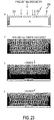
- Figure 21 shows a device embodiment 700-1 similar to that of device 100-1 in Figure 15 , with the exception that the two sets of interleaved diffusion-type diodes 121, 123 (721, 723) are, respectively, disposed in two single, large well-diodes 724, 725.
- crosstalk observed in the sub-micron size diffusion-type diodes may be reduced, since the large photodiodes collect the electrons and holes generated by photons that penetrate into the substrate beyond the thin, interleaved diodes.
- the large well diodes are fabricated deep enough to enclose the interleaved diodes but shallow enough to catch electrons.
- Interleaved/deep-well diodes can also be incorporated into devices which rely on multiple sets of gratings for angle sensitivity.
- An example device 800-1 using two gratings placed 1 ⁇ 2 Talbot distance apart vertically and photodiodes at the 1 st Talbot distance is shown in Figure 22 .
- the large-well photodiodes measure the total light flux passing through the two gratings.
- the mode of operation is identical to that of the basic multiple grating device.
- the interleaved photodiodes help locate the lateral offset of the periodic intensity pattern with greater accuracy. This provides improved characterization of incident angle around a set of known angles without interfering with basic function.
- Talbot self-images are used to perform incident angle measurements.
- Modern semiconductor manufacturing is used to form a micron-scale, fine-pitch transmission amplitude grating that creates interference patterns (Talbot images) from light impinging upon it. Changing the light field incident angle causes these interference patterns to shift laterally, which can be detected by a detector. Characterizing these shifts allows one to determine incident angle at a pixel scale.
- the above disclosed apparatus and method of incident angle measurement using a metalized top grating significantly reduces sensitivity of the detector to local light intensity.
- the metal gratings used to generate the interference patterns block a significant fraction of the available light. While reduced light sensitivity is not a significant problem for many applications, maintaining high sensitivity comparable to that of a traditional photodetector permits more widespread deployment of angle-sensitive imagers.
- a micron-scale phase grating formed at a pixel scale in an image sensor chip is used in place of the top, amplitude transmission grating.
- a phase grating similarly creates an interference pattern and therefore generates Talbot self-images, which we characterize in a manner similar to the embodiments disclosed above.
- a simple phase grating 2300 can be formed using crenellated structures such as those shown in Figure 23a .
- the shaded area 2310 is a material of refractive index n 1
- the white area 2312 is a material of refractive index n 2 .
- Incident wavefronts (arrow) which pass through the peaks of the crenellations exhibit a phase shift relative to those which pass through the valleys.
- Huygens' Principle the phase shift differences and the path length differences predict periodic intensity patterns similar to those observed with transmission amplitude gratings ( Figure 23b ).
- the location of these patterns is influenced by the illumination wavelength and (phase) grating pitch. As shown in Figures 23c, d , the intensity patterns shift laterally as the incident angle of illuminating light changes.
- the metal gratings used to achieve angle sensitivity block a significant fraction of incident light from the photodiode.
- QE quantum efficiency
- Figure 24a illustrates one exemplary ASP device 2400 and technique, with a periodic, rectangular binary phase structure 2300 implemented in an intermetal dielectric layer stack, and an amplitude grating 2420 positioned below (i.e., optically downstream) the phase grating 2300 in the plane where strong intensity (Talbot) patterns are created by the phase grating.
- strong intensity (Talbot) patterns are created by the phase grating.
- the intensity patterns shift due to changing incident light angle, they align with either the bars or the gaps of the amplitude grating 2420.
- intensity peaks align with the bars as shown in Figure 24b
- most of the light is blocked and a detector 2430 located below the analyzer grating registers a weak response.
- peaks align with the gaps as shown in Figure 24c most of the light passes through to the detector below. This produces the alternating strong and weak response shown in Figure 24d .
- FIG 25a illustrates an ASP device 2500 that includes the phase grating 2300 as illustrated in Figure 24a .
- an interleaved collection e.g., a pair
- the strong intensity (Talbot) patterns produced by incident light interacting with the phase grating.
- These detectors directly measure the patterns as they shift in response to incident angle. Intensity maxima on the detectors result in strong response, while intensity minima result in weak response, as illustrated in Figure 25b .
- the detectors 2550 are a pair of interleaved N+/p-substrate diffusion diodes.
- FIGS. 26a, b show a schematic structure of an ASP that uses a pair of interleaved N+/p-substrate diffusion diodes and a Finite-Difference Time-Domain (FDTD) simulation of the capture of the complementary phases of a single diffraction pattern.
- FDTD Finite-Difference Time-Domain
- amplitude-grating based ASPs are those that they can be made in completely standard CMOS with no post-processing. This has a variety of benefits, such as low cost and ease of manufacture. Unfortunately, a standard CMOS layer stack provides no ready-made components for phase gratings similar to the wires used for amplitude gratings.
- FIG. 27 A summary of the process is illustrated in Figure 27 for both interleaved diode ASPs (bottom) and analyzer grating ASPs (top).
- Figure 27a illustrates the cross section of a chip as manufactured, in which top two metal layers (black) have been used as etchstop layers.
- This basic post-processing requires only a few steps and no precision alignment, so the additional cost beyond that of the manufactured chip will be low. Additional steps may be advantageous, such as a bulk etch removing chemically distinct passivation layers. Protecting the input/output pads of the chip may also require a coarse alignment step and a low-resolution mask. Nevertheless, using the CMOS stack as a substrate for phase grating fabrication significantly simplifies manufacturing.
- phased gratings can be employed, such as nano-imprint lithography, or direct patterning using periodic masks and standard photolithography.
- the relative refractive index at the grating interface can be modified (from the 1:1.4 of air and SiO 2 ) with a conformal coat of additional material, as illustrated in Figure 27d ; for example, adding parylene would provide a 1.66:1.4 interface and provide protection from water. Altering the change in refractive index provides further control over the precise location of the self-images beyond that available through grating pitch and height. Preliminary simulations indicate that the heights ( ⁇ 1 ⁇ m) available in standard CMOS, and available interface indices (air, parylene) should provide reasonable performance. In addition, deliberately choosing a dispersive material will make it possible to generate wavelength-independent phase shifts, reducing the sensitivity of the Talbot effect to wavelength.
- the analyzer grating As disclosed hereinabove, another source of reduced sensitivity is the analyzer grating. Regardless of the (top) grating used to generate the Talbot self-images (amplitude or phase grating), the (bottom) analyzer grating will still block light that is out of alignment. However, if the lateral shift of the Talbot self-images is directly detected by photodiodes, the analyzer grating is no longer necessary.
- FIGS 28a-c One simple approach for accomplishing this is illustrated in Figures 28a-c .
- Using a second set of such interleaved photodiodes at a 1 ⁇ 4 pitch offset results in a set of outputs analogous to those shown in Figure 5 for stacked amplitude gratings. Ideally this would provide better quantum efficiency while requiring half as much area for a given ASP, since two measurements would result from each structure.
- Figure 28 illustrates a phase grating-based ASP using interleaved "fingered diodes" in place of an analyzer grating.
- Figures 28a, b are top views of the grating and diodes, where the different colors indicate different offsets.
- Figure 28c shows the ASP device in cross section.
- Figure 28d illustrates how shallowly penetrating photons (green arrows) generate photocurrent in desired diodes (red) but electrons from deeply penetrating photons can diffuse to either set of fingered diodes (red or blue), blurring angle sensitivity.
- Figure 28e illustrates how embedding interleaved diodes in a well causes deeper photons to be absorbed in or near the well's depletion regions, (violet) preventing blurring while still detecting all photons for intensity measures.
- Figure 28f shows an alternate interleaved design with three wider diodes to capture three angles.
- Such diodes can be made using the source/drain diffusions of a CMOS process, which are typically very shallow. Since these depths (also ⁇ 0.5 ⁇ m) are significantly shallower than the penetration depth of visible light, much of the light will be absorbed at depths greater than that of the photodiodes themselves. This implies both a reduced quantum efficiency as some photo-generated carriers diffuse away or recombine and, that many (likely the majority) of the photo-generated carriers will diffuse at least 0.5 ⁇ m before being absorbed by a photodiode.
- the interleaved, "fingered diodes” can be placed in a deeper, more lightly doped well. These wells are available in most modern CMOS processes with both n- and p- doping ( Fig 28e ). By providing a shallow boundary to the silicon below the fingered photodiodes, this well would absorb most of the carriers generated by deeply penetrating photons, reducing blurring. By measuring the current generated by these deep photons overall intensity could be measured with high quantum efficiency, even as the interleaved diodes extract incident angle information.
- a second challenge with interleaved diodes is that the pitch they require is very close to the limit of what is possible in reasonably priced (i.e., 180 nm) CMOS.
- One approach to reduce this problem while further increasing density is shown in Figure 28f .
- Simulations show that three distinct sets of fingered diodes, at a pitch of 2/3 the grating pitch, extract three periodic, angle sensitive signals split by 120 degrees (as compared to the 90 degree splits described hereinabove for the stacked amplitude grating ASPs). These three independent measurements are sufficient to extract everything about a simple Talbot self-image. Specifically, these three numbers map, after transformation to the total light intensity, modulation depth of the self image (reflects how "blurry" the incident angle is), and the angle itself. Thus such a structure can provide extremely dense ASPs.
- phase gratings and interleaved photodiodes can be independently deployed as improvements to stacked grating ASPs. The greatest benefit will result when combining these approaches to produce a sensor structure with an overall quantum efficiency and density equivalent to a typical angle insensitive pixel while simultaneously capturing additional information about the light field.
- the accuracy of an ASP array in localizing light sources in 3D space is inversely proportional to the angular gain of an ASP.
- phase grating simulation of Figure 23 shows Talbot patterns with higher (particularly, double) periodicity than the generating grating at depths above and below the 1 ⁇ 2 Talbot depth. If we place interleaved diodes or analyzer gratings at the depth and with the same pitch as these fractional patterns, the same lateral shift will correspond with a stronger change in response. This also corresponds to higher angular gain.
- Figure 29b shows that there are many higher-order Talbot depths available; all depths with higher spatial periodicity than the phase grating will exhibit high-order Talbot patterns (and thus greater angular sensitivity).
- Figure 29c shows the simulated angular sensitivity of this device; it has a b of 66.
- phase gratings are used to induce a phase shift, whereas materials of different indices of refraction contribute to different optical path lengths, one would assume that the depth of phase gratings should be proportional to the wavelength in use. When polychromatic light is observed, the depths of the phase gratings will not be tuned appropriately for all wavelengths without intervention. It is possible to mitigate this effect by using a dispersive substance such that over some range of wavelengths the difference in refractive indices of Si0 2 and the superstrate are somewhat proportional to wavelength. For example, if a plastic with similar optical dispersion to polyacrylate were patterned on top of the Si0 2 , the ideal grating thickness becomes less sensitive to wavelength.
- the range of appropriate phase grating heights is roughly proportional to wavelength.
- a dispersive medium such as a polyacrylate layer
- some of the wavelength dependence can be mitigated since the refractive indices of the media composing the gratings are closer at lower wavelengths than at high wavelengths.
- angular response of the ASPs were measured under green (523 nm, spectral half width 20 nm) plane wave illumination over an 80° range of incident angles.
- Figures 31a-d show the measured four phase output for each of the four ASP types. All four ASP structures trace the desired quadrature angle response.
- complementary phase responses were measured from a single 8 ⁇ m ⁇ 8 ⁇ m pixel.
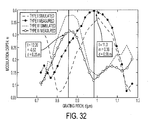
- Newer ASP designs, types II, III and IV exhibit modulation depths in the range 0.2-0.3 as compared to amplitude grating ASPs with peak modulation depths above 0.4.
- the QE of all the ASPs were measured and normalized to an n-well-p-substrate diode without gratings.
- the measured quantum efficiency of the four variants of ASPs shown in Figure 33 confirms that the efficiency loss caused by metal gratings can be recovered by a combination of phase gratings and interleaved diodes.
- temporal information of incident light as well as spatial and angular information is important.
- LIDAR in which the time delay between light pulse emission and reflected pulse detection provides a measure of distance.
- Fluorescence imaging can also benefit from temporal information, which provides a means to discriminate between stimulation photons and fluorescence photons without complex filter optics. Combining angle sensitivity with very high frame rates (upwards of 100M frames/s) allows for these and other applications to take advantage of the additional information contained in incident angle.
- CMOS chips can perform this class of high speed temporal imaging. Since the ASP can be manufactured in a standard CMOS process, and since angle sensitive behavior relies on purely optical phenomena, we believe high speed CMOS imaging techniques can be integrated into angle-sensitive pixels. For example, high speed devices, such as single-photon avalanche diodes and advanced detectors designed specifically for time resolved imaging as methods, may be employed to achieve this integration. These time-resolved ASPs will greatly enhance existing high speed image sensors.
- ASP miniaturization To achieve the required density within a small, low cost chip, various methods for ASP miniaturization can be employed. For example, current ASPs have distinct, local gratings for each diffraction grating/analyzer grating stack. These finite gratings exhibit edge effects which degrade the Talbot self images and therefore require a minimum number of repeated periods for robust function. Initial simulations have shown that different sensors can share the Talbot self images generated by a single, shared grating without compromising performance. This should permit drastic grating size reduction, since the required large grating is now amortized among several smaller sensors.
- the present disclosure includes a non-claimed method for extracting incident light-angle information from a light source object.
- the ability to detect said angle information has applications pertaining, but not limited to sensor networks and sensor arrays; direction and/or speed of motion detection of objects passing over a sensor such as, for example, the direction and speed of a vehicle passing over a sensor embedded in road pavement; detection/reception of multiple data streams from separate transmitters in a free-space optical communication system; bio-medical applications such as, e.g., detection of individual fluorescent cells in tissue containing such fluorescent cells, and others that would be appreciated by persons skilled in the art.
- the method may be accomplished entirely without the use of lenses, and performed with image sensors on the physical scale of silicon integrated circuits.
- a sensor array as described herein above may be positioned adjacent a piece of tissue containing fluorescent cells. Each cell would generate light whose incident angles (into the sensor) would indicate the cell's location in three-dimensional space. By triangulating back from the angles detected by each sensor in the array, as schematically illustrated in Figure 1b , the location of individual fluorescent cells could be detected, as well as changes in their fluorescence independently from the other fluorescent cells.
- many image sensor arrays could be deployed as part of a larger array of tissue culture chambers. Each individual image sensor would provide monitoring of its respective sample, providing high-throughput analysis of many samples at once.
- the method may be accomplished using an imaging sensor in combination with a lens system, which may be advantageous to image more distant objects.
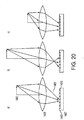
- an object 1402 at the focal plane of the lens system 1405 will appear completely in focus on the surface 1406 of the sensor array 1407, and will appear to have an even distribution of angles of incidence 1409.
- the array acts like a normal CMOS imager.
- Objects more distant than the focal plane of the lens system will generate blurred images on the array, but the blurring will show a variable set of incident angles that converge on the focal plane of the object, as shown in Figure 20b .
- Objects closer than the focal depth of the lens system will also appear blurred, but with a divergent set of incident angles, indicating a focal depth behind the array, as shown in Figure 20c .
- the imager can extract useful information that can be used to describe the location of objects both closer and farther away than the optical focal plane of the lens system.
- the imager by detecting incident angle, can extract information about an object region that is thicker than the normal depth of focus associated with a given lens system.
- this information may be used, e.g., to reconstruct the three-dimensional structure of a scene or, to computationally refocus the image to different focal depths after the image has been captured.
- the data from such an imager may be used to simultaneously refocus different parts of the image to different depths.
- a single light-emitting object will generate a sensor response that maps to a single incident angle, multiple light sources will result in a linear superposition of responses, each of which depends on the incident angle of each source.
- a given pixel design will work effectively for a limited range of wavelengths.
- this wavelength is known in advance, such as in fluorescent microscopy or communication systems using known LEDs, the gratings can be designed appropriately as known in the art.
- a color filter 1430 may be required in conjunction with the chip to limit the incident light wavelengths to the appropriate range.
- Modern imager processes typically include such color filters; thus they could be incorporated into the basic design.
- multiple color filter layers typically red, green and blue
- using these filters in conjunction with three separately tuned sets of gratings would permit light-field imaging in color.
- a response r(X s ,y s ,a) (where x s and y s are as above, and a is an index from 1 to 8 representing the phase associated with the diode) to any given stimulus s(x,y,z).
- FIG. 15 An example of this is shown in Figure 15 for two 16x16 arrays 101a and 101b, one where each pixel simply detects light, and the other where each pixel contains two fingered diodes and a metal grating, such that sets of four pixels form a cell.
- the grating based design For a focal plane four pixel widths from the imager plane, the grating based design generates a conversion matrix A whose singular values are consistently larger, by as much as a factor of 100 than those for a normal imager.
- calculating the pseudo-inverse for a grating-based imager yields a more accurate, lower noise result than with a normal imager.
- a second result of this approach is that one can calculate an error term based upon using the pseudo inverse.
- the method described herein above need not be applied to the entire image, but can be applied to subsections of the image such that they can be refocused independently and/or their range found, leading to better overall focus and/or a range map across the image.
- Another exemplary application pertains to imaging the three dimensional structure of fluorescing cells in tissue. Since the goal of such an application would be to be able to independently quantify the fluorescence of multiple cells at different focal planes, refocusing is not an appropriate approach. However, if one adds the two additional constraints: i) that all entries in s must be strictly positive (there is no such thing as negative fluorescence), and ii) that the fluorescent sources are relatively sparsely distributed in the volume being imaged, one may assume that the number of fluorescent cells is smaller than N 2 , the number of pixels. If this holds true, then one can find each of these sources iteratively and in order of brightness as follows:
- Each iteration of this algorithm finds the most likely dominant point source of the light field seen in r , includes that source in the estimate of the stimulus, s', then removes that portion of the effect from r permitting the algorithm to find the next most dominant source.
- the various embodiments described herein are compatible with a variety of integrated light detectors/sensors including, without limitation, reverse-biased p-n junction diodes, forward bias diodes (i.e., photovoltaics), p-i-n diodes, charge-coupled devices (CCDs), single-photon avalanche diodes, or pairs of interleaved N+/p-substrate diffusion diodes.
- reverse-biased p-n junction diodes i.e., photovoltaics
- p-i-n diodes i.e., charge-coupled devices (CCDs)
- CCDs charge-coupled devices
- single-photon avalanche diodes single-photon avalanche diodes
Landscapes
- Physics & Mathematics (AREA)
- General Physics & Mathematics (AREA)
- Optics & Photonics (AREA)
- Electromagnetism (AREA)
- Engineering & Computer Science (AREA)
- Radar, Positioning & Navigation (AREA)
- Remote Sensing (AREA)
- Spectroscopy & Molecular Physics (AREA)
- Solid State Image Pick-Up Elements (AREA)
- Diffracting Gratings Or Hologram Optical Elements (AREA)
- Spectrometry And Color Measurement (AREA)
- Investigating Or Analysing Materials By Optical Means (AREA)
Claims (5)
- Winkelempfindliche Pixel-, ASP, Vorrichtung (2400) umfassend:ein Substrat (310, 410, 510);ein Phasengitter (2300) mit einer Periode, p1, das in dem Substrat (310, 410, 510) angeordnet ist, wobei das Phasengitter (2300) eine periodische Änderung eines Brechungsindex in einer Richtung quer zu einem einfallenden Lichtfeld aufweist und, indem das einfallende Lichtfeld dadurch hindurchtritt, ein periodisches Intensitätsmuster in einer Talbot-Ebene unterhalb des Phasengitters sowie periodische Intensitätsmuster mit höherer Periodizität als das Phasengitter in Tiefen oberhalb und unterhalb einer halben Talbot-Tiefe bildet;ein Amplitudenübertragungsanalysatorgitter (2420) mit einer Periode, p2, das in der Tiefe des Talbot-Musters mit höherer Periodizität als das Phasengitter (2300) angeordnet ist, wobei diese Tiefe eine Viertel Talbot-Tiefe ist; undeinen Sensor (2430), der in einer ausgewählten Entfernung unterhalb des Analysatorgitters (2420) angeordnet ist,dadurch gekennzeichnet, dass der Abstand des Phasengitters (2300) doppelt so groß wie der Abstand des Analysatorgitters ist.
- ASP-Vorrichtung (2400) nach Anspruch 1, ferner umfassend ein dispergierendes Material, das über dem Phasengitter (2300) gemustert ist.
- ASP-Vorrichtung (2400) nach Anspruch 1, wobei der Sensor (2430) mindestens ein Paar periodischer, verschachtelter N+/p-Substratdiffusionsdioden umfasst.
- ASP-Vorrichtung (2400) nach Anspruch 1, wobei die Vorrichtung eine integrierte CMOS-Halbleiterstruktur ist.
- Lichtfeldabbildungsvorrichtung umfassend eine zweidimensionale MxN-Anordnung von ASP-Vorrichtungen nach Anspruch 1, wobei M, N ganze Zahlen sind, die gleich oder größer als Eins sind.
Applications Claiming Priority (3)
| Application Number | Priority Date | Filing Date | Title |
|---|---|---|---|
| US40720210P | 2010-10-27 | 2010-10-27 | |
| US201113055566A | 2011-04-06 | 2011-04-06 | |
| PCT/US2011/057970 WO2012058360A2 (en) | 2010-10-27 | 2011-10-27 | Light field image sensor, method and applications |
Publications (3)
| Publication Number | Publication Date |
|---|---|
| EP2633277A2 EP2633277A2 (de) | 2013-09-04 |
| EP2633277A4 EP2633277A4 (de) | 2014-07-02 |
| EP2633277B1 true EP2633277B1 (de) | 2020-06-17 |
Family
ID=45994734
Family Applications (1)
| Application Number | Title | Priority Date | Filing Date |
|---|---|---|---|
| EP11837049.3A Active EP2633277B1 (de) | 2010-10-27 | 2011-10-27 | Winkelempfindliche pixelvorrichtung |
Country Status (4)
| Country | Link |
|---|---|
| EP (1) | EP2633277B1 (de) |
| KR (1) | KR101904033B1 (de) |
| CN (1) | CN103299166B (de) |
| WO (1) | WO2012058360A2 (de) |
Families Citing this family (31)
| Publication number | Priority date | Publication date | Assignee | Title |
|---|---|---|---|---|
| US9971078B2 (en) | 2013-03-05 | 2018-05-15 | Rambus Inc. | Phase gratings with odd symmetry for high-resolution lensless optical sensing |
| US9110240B2 (en) | 2013-03-05 | 2015-08-18 | Rambus Inc. | Phase gratings with odd symmetry for high-resolution lensed and lensless optical sensing |
| CN103344964B (zh) * | 2013-06-18 | 2015-04-15 | 浙江大学 | 一种遥感区分灰霾类别的激光雷达装置 |
| US10075234B2 (en) * | 2014-03-25 | 2018-09-11 | Osram Sylvania Inc. | Techniques for emitting position information from luminaires |
| US9299733B2 (en) | 2014-06-02 | 2016-03-29 | Stmicroelectronics (Grenoble 2) Sas | Image sensor |
| CN111089612B (zh) * | 2014-09-24 | 2022-06-21 | 原相科技股份有限公司 | 光学传感器及光学感测系统 |
| US10509147B2 (en) | 2015-01-29 | 2019-12-17 | ams Sensors Singapore Pte. Ltd | Apparatus for producing patterned illumination using arrays of light sources and lenses |
| KR102544297B1 (ko) * | 2015-01-29 | 2023-06-15 | 에이엠에스-오스람 아시아 퍼시픽 피티이. 리미티드 | 패턴 조명을 생성하기 위한 장치 |
| CN107533139B (zh) * | 2015-03-17 | 2022-02-08 | 康奈尔大学 | 景深成像设备、方法和应用 |
| WO2017040826A1 (en) * | 2015-09-01 | 2017-03-09 | Massachusetts Institute Of Technology | Apparatus, systems, and methods for talbot spectrometers |
| US10284825B2 (en) | 2015-09-08 | 2019-05-07 | Rambus Inc. | Systems with integrated refractive and diffractive optics |
| EP3350998A1 (de) * | 2015-09-17 | 2018-07-25 | Thomson Licensing | Vorrichtung und verfahren zur codierung eines durch ein optisches erfassungssystem erfassten bildes |
| FR3041772B1 (fr) | 2015-09-30 | 2018-09-21 | St Microelectronics Sa | Procede de fabrication d'un filtre spectral nanostructure |
| WO2017131585A1 (en) | 2016-01-26 | 2017-08-03 | Heptagon Micro Optics Pte. Ltd. | Multi-mode illumination module and related method |
| WO2017210781A1 (en) * | 2016-06-07 | 2017-12-14 | Airy3D Inc. | Light field imaging device and method for depth acquisition and three-dimensional imaging |
| JP6713549B2 (ja) * | 2016-12-27 | 2020-06-24 | 富士フイルム株式会社 | 撮像装置及び撮像モジュール |
| FR3064112B1 (fr) * | 2017-03-16 | 2021-06-18 | Commissariat Energie Atomique | Dispositif imageur optique |
| JP6908470B2 (ja) * | 2017-08-25 | 2021-07-28 | 京セラ株式会社 | 電磁波検出装置、プログラム、および電磁波検出システム |
| CN107560546B (zh) * | 2017-10-11 | 2024-01-19 | 长光(沧州)光栅传感技术有限公司 | 光栅尺光电传感器 |
| EP3721621B1 (de) * | 2017-12-05 | 2025-07-23 | Airy3d Inc. | Verfahren zur lichtfeldbildverarbeitung zur tiefenerfassung |
| DE102017222970B4 (de) * | 2017-12-15 | 2025-04-30 | Microvision, Inc. | LIDAR Messsystem |
| WO2019239845A1 (ja) * | 2018-06-14 | 2019-12-19 | パナソニックIpマネジメント株式会社 | 物体検出装置および光検出器 |
| US10963300B2 (en) | 2018-12-06 | 2021-03-30 | Raytheon Company | Accelerating dataflow signal processing applications across heterogeneous CPU/GPU systems |
| US11105745B2 (en) | 2019-10-10 | 2021-08-31 | Visera Technologies Company Limited | Biosensor |
| CN110929828A (zh) * | 2019-12-06 | 2020-03-27 | 北京金衡融创网络科技有限公司 | 防伪标签及其识别方法、印刷品 |
| WO2022021425A1 (en) * | 2020-07-31 | 2022-02-03 | Huawei Technologies Co., Ltd. | Optical apparatus |
| CN112836172B (zh) * | 2020-12-31 | 2025-02-25 | 杭州电子科技大学 | 一种多层各向异性手征媒质的透射谱的计算方法 |
| CN114815241B (zh) * | 2021-12-16 | 2022-12-16 | 北京灵犀微光科技有限公司 | 抬头显示系统、方法及车载系统 |
| CN114839789B (zh) * | 2022-05-20 | 2023-09-12 | 西南科技大学 | 一种基于二值化空间调制的衍射聚焦方法以及装置 |
| CN115185100B (zh) * | 2022-06-22 | 2023-08-04 | 成都飞机工业(集团)有限责任公司 | 一种加密点阵式光场的生成方法 |
| CN115902765B (zh) * | 2022-09-20 | 2025-09-16 | 中国科学院微电子研究所 | 一种芯片式光学测向定位装置 |
Family Cites Families (9)
| Publication number | Priority date | Publication date | Assignee | Title |
|---|---|---|---|---|
| JP3897389B2 (ja) | 1996-02-22 | 2007-03-22 | キヤノン株式会社 | 光電変換装置の駆動方法及び光電変換装置 |
| JP3576885B2 (ja) | 1998-09-18 | 2004-10-13 | キヤノン株式会社 | 素子の製造方法 |
| DE19912945A1 (de) * | 1999-03-23 | 2000-09-28 | Juergen Jahns | Doppelgitteranordnung zur zeitlichen Filterung schneller optischer Signale |
| US6525815B2 (en) * | 2000-11-10 | 2003-02-25 | The Board Of Trustees Of The Leland Stanford Junior University | Miniaturized Talbot spectrometer |
| EP1623671A4 (de) | 2002-12-26 | 2008-11-05 | Atsushi Momose | Röntgendarstellungssystem und darstellungsverfahren |
| JP4233089B2 (ja) * | 2003-08-12 | 2009-03-04 | 株式会社リコー | 傾きセンサ、光ピックアップ装置及び光ディスク装置 |
| US7924973B2 (en) | 2007-11-15 | 2011-04-12 | Csem Centre Suisse D'electronique Et De Microtechnique Sa | Interferometer device and method |
| CN101960252B (zh) * | 2008-03-04 | 2013-07-31 | 惠普发展公司,有限责任合伙企业 | 采用导模谐振的角传感器、系统 |
| KR101629044B1 (ko) * | 2008-07-25 | 2016-06-09 | 코넬 유니버시티 | 광 필드 이미지 센서, 방법 및 적용 |
-
2011
- 2011-10-27 EP EP11837049.3A patent/EP2633277B1/de active Active
- 2011-10-27 KR KR1020137013124A patent/KR101904033B1/ko active Active
- 2011-10-27 WO PCT/US2011/057970 patent/WO2012058360A2/en not_active Ceased
- 2011-10-27 CN CN201180062806.8A patent/CN103299166B/zh active Active
Non-Patent Citations (1)
| Title |
|---|
| KAO C F ET AL: "Optical encoder based on Fractional-Talbot effect using two-dimensional phase grating", OPTICS COMMUNICATIONS, ELSEVIER, AMSTERDAM, NL, vol. 283, no. 9, 1 May 2010 (2010-05-01), pages 1950 - 1955, XP026929421, ISSN: 0030-4018, [retrieved on 20100114], DOI: 10.1016/J.OPTCOM.2009.12.057 * |
Also Published As
| Publication number | Publication date |
|---|---|
| WO2012058360A2 (en) | 2012-05-03 |
| KR20140038921A (ko) | 2014-03-31 |
| CN103299166B (zh) | 2015-09-23 |
| KR101904033B1 (ko) | 2018-10-04 |
| EP2633277A4 (de) | 2014-07-02 |
| EP2633277A2 (de) | 2013-09-04 |
| WO2012058360A3 (en) | 2012-11-01 |
| CN103299166A (zh) | 2013-09-11 |
Similar Documents
| Publication | Publication Date | Title |
|---|---|---|
| EP2633277B1 (de) | Winkelempfindliche pixelvorrichtung | |
| US9658060B2 (en) | Light field image sensor, method and applications | |
| US8809758B2 (en) | Light field image sensor with an angle-sensitive pixel (ASP) device | |
| US12474509B2 (en) | Light field imaging device and method for depth acquisition and three-dimensional imaging | |
| US10983216B2 (en) | Depth field imaging apparatus, methods, and applications | |
| US12259563B2 (en) | Light field imaging device and method for 3D sensing | |
| US20140198183A1 (en) | Sensing pixel and image sensor including same | |
| KR20130088852A (ko) | 각 감지 픽셀(asp)에 기초한 이미지 처리 시스템, 방법, 및 응용들 | |
| Feng et al. | Precision integration of grating-based polarizers onto focal plane arrays of near-infrared photovoltaic detectors for enhanced contrast polarimetric imaging | |
| Wang et al. | A light-field image sensor in 180 nm CMOS | |
| CN109884742B (zh) | 光场成像装置和光场成像方法 | |
| Wang et al. | Angle sensitive pixels in CMOS for lensless 3D imaging | |
| US12130180B2 (en) | Single chip spectral polarization imaging sensor | |
| Sivaramakrishnan et al. | Enhanced angle sensitive pixels for light field imaging | |
| Guo et al. | Fringing analysis and simulation for the Vera C. Rubin Observatory’s legacy survey of space and time | |
| Yang et al. | Integrated colour detectors in 0.18 µm CMOS technology | |
| Zheng | Angle-sensitive pixel design for wavefront sensing | |
| Wang | Angle Sensitive Pixels For Integrated Light Field Sensing | |
| Bray et al. | Front-side illuminated CMOS spectral pixel response and modulation transfer function characterization: impact of pixel layout details and pixel depletion volume | |
| JP2023011110A (ja) | 2波長赤外線センサ、及び撮像システム |
Legal Events
| Date | Code | Title | Description |
|---|---|---|---|
| PUAI | Public reference made under article 153(3) epc to a published international application that has entered the european phase |
Free format text: ORIGINAL CODE: 0009012 |
|
| 17P | Request for examination filed |
Effective date: 20130425 |
|
| AK | Designated contracting states |
Kind code of ref document: A2 Designated state(s): AL AT BE BG CH CY CZ DE DK EE ES FI FR GB GR HR HU IE IS IT LI LT LU LV MC MK MT NL NO PL PT RO RS SE SI SK SM TR |
|
| RIN1 | Information on inventor provided before grant (corrected) |
Inventor name: WANG, ALBERT Inventor name: GILL, PATRICK Inventor name: MOLNAR, ALYOSHA |
|
| DAX | Request for extension of the european patent (deleted) | ||
| A4 | Supplementary search report drawn up and despatched |
Effective date: 20140602 |
|
| RIC1 | Information provided on ipc code assigned before grant |
Ipc: G02B 27/42 20060101AFI20140526BHEP Ipc: H01L 27/146 20060101ALI20140526BHEP Ipc: G01S 3/782 20060101ALI20140526BHEP Ipc: G02B 27/44 20060101ALN20140526BHEP |
|
| STAA | Information on the status of an ep patent application or granted ep patent |
Free format text: STATUS: EXAMINATION IS IN PROGRESS |
|
| 17Q | First examination report despatched |
Effective date: 20171128 |
|
| REG | Reference to a national code |
Ref country code: DE Ref legal event code: R079 Ref document number: 602011067394 Country of ref document: DE Free format text: PREVIOUS MAIN CLASS: G01J0001000000 Ipc: G02B0027420000 |
|
| GRAP | Despatch of communication of intention to grant a patent |
Free format text: ORIGINAL CODE: EPIDOSNIGR1 |
|
| STAA | Information on the status of an ep patent application or granted ep patent |
Free format text: STATUS: GRANT OF PATENT IS INTENDED |
|
| INTG | Intention to grant announced |
Effective date: 20200109 |
|
| RIC1 | Information provided on ipc code assigned before grant |
Ipc: G02B 27/42 20060101AFI20191213BHEP Ipc: G02B 27/44 20060101ALN20191213BHEP Ipc: H01L 27/146 20060101ALI20191213BHEP Ipc: G01S 3/782 20060101ALI20191213BHEP |
|
| GRAS | Grant fee paid |
Free format text: ORIGINAL CODE: EPIDOSNIGR3 |
|
| GRAA | (expected) grant |
Free format text: ORIGINAL CODE: 0009210 |
|
| STAA | Information on the status of an ep patent application or granted ep patent |
Free format text: STATUS: THE PATENT HAS BEEN GRANTED |
|
| AK | Designated contracting states |
Kind code of ref document: B1 Designated state(s): AL AT BE BG CH CY CZ DE DK EE ES FI FR GB GR HR HU IE IS IT LI LT LU LV MC MK MT NL NO PL PT RO RS SE SI SK SM TR |
|
| REG | Reference to a national code |
Ref country code: GB Ref legal event code: FG4D |
|
| REG | Reference to a national code |
Ref country code: CH Ref legal event code: EP |
|
| REG | Reference to a national code |
Ref country code: IE Ref legal event code: FG4D |
|
| REG | Reference to a national code |
Ref country code: DE Ref legal event code: R096 Ref document number: 602011067394 Country of ref document: DE |
|
| REG | Reference to a national code |
Ref country code: AT Ref legal event code: REF Ref document number: 1282042 Country of ref document: AT Kind code of ref document: T Effective date: 20200715 |
|
| PG25 | Lapsed in a contracting state [announced via postgrant information from national office to epo] |
Ref country code: FI Free format text: LAPSE BECAUSE OF FAILURE TO SUBMIT A TRANSLATION OF THE DESCRIPTION OR TO PAY THE FEE WITHIN THE PRESCRIBED TIME-LIMIT Effective date: 20200617 Ref country code: NO Free format text: LAPSE BECAUSE OF FAILURE TO SUBMIT A TRANSLATION OF THE DESCRIPTION OR TO PAY THE FEE WITHIN THE PRESCRIBED TIME-LIMIT Effective date: 20200917 Ref country code: GR Free format text: LAPSE BECAUSE OF FAILURE TO SUBMIT A TRANSLATION OF THE DESCRIPTION OR TO PAY THE FEE WITHIN THE PRESCRIBED TIME-LIMIT Effective date: 20200918 Ref country code: LT Free format text: LAPSE BECAUSE OF FAILURE TO SUBMIT A TRANSLATION OF THE DESCRIPTION OR TO PAY THE FEE WITHIN THE PRESCRIBED TIME-LIMIT Effective date: 20200617 Ref country code: SE Free format text: LAPSE BECAUSE OF FAILURE TO SUBMIT A TRANSLATION OF THE DESCRIPTION OR TO PAY THE FEE WITHIN THE PRESCRIBED TIME-LIMIT Effective date: 20200617 |
|
| REG | Reference to a national code |
Ref country code: LT Ref legal event code: MG4D |
|
| REG | Reference to a national code |
Ref country code: NL Ref legal event code: MP Effective date: 20200617 |
|
| PG25 | Lapsed in a contracting state [announced via postgrant information from national office to epo] |
Ref country code: BG Free format text: LAPSE BECAUSE OF FAILURE TO SUBMIT A TRANSLATION OF THE DESCRIPTION OR TO PAY THE FEE WITHIN THE PRESCRIBED TIME-LIMIT Effective date: 20200917 Ref country code: RS Free format text: LAPSE BECAUSE OF FAILURE TO SUBMIT A TRANSLATION OF THE DESCRIPTION OR TO PAY THE FEE WITHIN THE PRESCRIBED TIME-LIMIT Effective date: 20200617 Ref country code: HR Free format text: LAPSE BECAUSE OF FAILURE TO SUBMIT A TRANSLATION OF THE DESCRIPTION OR TO PAY THE FEE WITHIN THE PRESCRIBED TIME-LIMIT Effective date: 20200617 Ref country code: LV Free format text: LAPSE BECAUSE OF FAILURE TO SUBMIT A TRANSLATION OF THE DESCRIPTION OR TO PAY THE FEE WITHIN THE PRESCRIBED TIME-LIMIT Effective date: 20200617 |
|
| REG | Reference to a national code |
Ref country code: AT Ref legal event code: MK05 Ref document number: 1282042 Country of ref document: AT Kind code of ref document: T Effective date: 20200617 |
|
| PG25 | Lapsed in a contracting state [announced via postgrant information from national office to epo] |
Ref country code: AL Free format text: LAPSE BECAUSE OF FAILURE TO SUBMIT A TRANSLATION OF THE DESCRIPTION OR TO PAY THE FEE WITHIN THE PRESCRIBED TIME-LIMIT Effective date: 20200617 Ref country code: NL Free format text: LAPSE BECAUSE OF FAILURE TO SUBMIT A TRANSLATION OF THE DESCRIPTION OR TO PAY THE FEE WITHIN THE PRESCRIBED TIME-LIMIT Effective date: 20200617 |
|
| PG25 | Lapsed in a contracting state [announced via postgrant information from national office to epo] |
Ref country code: ES Free format text: LAPSE BECAUSE OF FAILURE TO SUBMIT A TRANSLATION OF THE DESCRIPTION OR TO PAY THE FEE WITHIN THE PRESCRIBED TIME-LIMIT Effective date: 20200617 Ref country code: PT Free format text: LAPSE BECAUSE OF FAILURE TO SUBMIT A TRANSLATION OF THE DESCRIPTION OR TO PAY THE FEE WITHIN THE PRESCRIBED TIME-LIMIT Effective date: 20201019 Ref country code: AT Free format text: LAPSE BECAUSE OF FAILURE TO SUBMIT A TRANSLATION OF THE DESCRIPTION OR TO PAY THE FEE WITHIN THE PRESCRIBED TIME-LIMIT Effective date: 20200617 Ref country code: RO Free format text: LAPSE BECAUSE OF FAILURE TO SUBMIT A TRANSLATION OF THE DESCRIPTION OR TO PAY THE FEE WITHIN THE PRESCRIBED TIME-LIMIT Effective date: 20200617 Ref country code: CZ Free format text: LAPSE BECAUSE OF FAILURE TO SUBMIT A TRANSLATION OF THE DESCRIPTION OR TO PAY THE FEE WITHIN THE PRESCRIBED TIME-LIMIT Effective date: 20200617 Ref country code: IT Free format text: LAPSE BECAUSE OF FAILURE TO SUBMIT A TRANSLATION OF THE DESCRIPTION OR TO PAY THE FEE WITHIN THE PRESCRIBED TIME-LIMIT Effective date: 20200617 Ref country code: SM Free format text: LAPSE BECAUSE OF FAILURE TO SUBMIT A TRANSLATION OF THE DESCRIPTION OR TO PAY THE FEE WITHIN THE PRESCRIBED TIME-LIMIT Effective date: 20200617 Ref country code: EE Free format text: LAPSE BECAUSE OF FAILURE TO SUBMIT A TRANSLATION OF THE DESCRIPTION OR TO PAY THE FEE WITHIN THE PRESCRIBED TIME-LIMIT Effective date: 20200617 |
|
| PG25 | Lapsed in a contracting state [announced via postgrant information from national office to epo] |
Ref country code: SK Free format text: LAPSE BECAUSE OF FAILURE TO SUBMIT A TRANSLATION OF THE DESCRIPTION OR TO PAY THE FEE WITHIN THE PRESCRIBED TIME-LIMIT Effective date: 20200617 Ref country code: PL Free format text: LAPSE BECAUSE OF FAILURE TO SUBMIT A TRANSLATION OF THE DESCRIPTION OR TO PAY THE FEE WITHIN THE PRESCRIBED TIME-LIMIT Effective date: 20200617 Ref country code: IS Free format text: LAPSE BECAUSE OF FAILURE TO SUBMIT A TRANSLATION OF THE DESCRIPTION OR TO PAY THE FEE WITHIN THE PRESCRIBED TIME-LIMIT Effective date: 20201017 |
|
| REG | Reference to a national code |
Ref country code: DE Ref legal event code: R097 Ref document number: 602011067394 Country of ref document: DE |
|
| PLBE | No opposition filed within time limit |
Free format text: ORIGINAL CODE: 0009261 |
|
| STAA | Information on the status of an ep patent application or granted ep patent |
Free format text: STATUS: NO OPPOSITION FILED WITHIN TIME LIMIT |
|
| PG25 | Lapsed in a contracting state [announced via postgrant information from national office to epo] |
Ref country code: DK Free format text: LAPSE BECAUSE OF FAILURE TO SUBMIT A TRANSLATION OF THE DESCRIPTION OR TO PAY THE FEE WITHIN THE PRESCRIBED TIME-LIMIT Effective date: 20200617 |
|
| 26N | No opposition filed |
Effective date: 20210318 |
|
| PG25 | Lapsed in a contracting state [announced via postgrant information from national office to epo] |
Ref country code: SI Free format text: LAPSE BECAUSE OF FAILURE TO SUBMIT A TRANSLATION OF THE DESCRIPTION OR TO PAY THE FEE WITHIN THE PRESCRIBED TIME-LIMIT Effective date: 20200617 |
|
| REG | Reference to a national code |
Ref country code: CH Ref legal event code: PL |
|
| PG25 | Lapsed in a contracting state [announced via postgrant information from national office to epo] |
Ref country code: LU Free format text: LAPSE BECAUSE OF NON-PAYMENT OF DUE FEES Effective date: 20201027 Ref country code: MC Free format text: LAPSE BECAUSE OF FAILURE TO SUBMIT A TRANSLATION OF THE DESCRIPTION OR TO PAY THE FEE WITHIN THE PRESCRIBED TIME-LIMIT Effective date: 20200617 |
|
| PG25 | Lapsed in a contracting state [announced via postgrant information from national office to epo] |
Ref country code: LI Free format text: LAPSE BECAUSE OF NON-PAYMENT OF DUE FEES Effective date: 20201031 Ref country code: CH Free format text: LAPSE BECAUSE OF NON-PAYMENT OF DUE FEES Effective date: 20201031 |
|
| PG25 | Lapsed in a contracting state [announced via postgrant information from national office to epo] |
Ref country code: IE Free format text: LAPSE BECAUSE OF NON-PAYMENT OF DUE FEES Effective date: 20201027 |
|
| PG25 | Lapsed in a contracting state [announced via postgrant information from national office to epo] |
Ref country code: TR Free format text: LAPSE BECAUSE OF FAILURE TO SUBMIT A TRANSLATION OF THE DESCRIPTION OR TO PAY THE FEE WITHIN THE PRESCRIBED TIME-LIMIT Effective date: 20200617 Ref country code: MT Free format text: LAPSE BECAUSE OF FAILURE TO SUBMIT A TRANSLATION OF THE DESCRIPTION OR TO PAY THE FEE WITHIN THE PRESCRIBED TIME-LIMIT Effective date: 20200617 Ref country code: CY Free format text: LAPSE BECAUSE OF FAILURE TO SUBMIT A TRANSLATION OF THE DESCRIPTION OR TO PAY THE FEE WITHIN THE PRESCRIBED TIME-LIMIT Effective date: 20200617 |
|
| PG25 | Lapsed in a contracting state [announced via postgrant information from national office to epo] |
Ref country code: MK Free format text: LAPSE BECAUSE OF FAILURE TO SUBMIT A TRANSLATION OF THE DESCRIPTION OR TO PAY THE FEE WITHIN THE PRESCRIBED TIME-LIMIT Effective date: 20200617 |
|
| P01 | Opt-out of the competence of the unified patent court (upc) registered |
Effective date: 20230530 |
|
| PGFP | Annual fee paid to national office [announced via postgrant information from national office to epo] |
Ref country code: DE Payment date: 20251029 Year of fee payment: 15 |
|
| PGFP | Annual fee paid to national office [announced via postgrant information from national office to epo] |
Ref country code: GB Payment date: 20251027 Year of fee payment: 15 |
|
| PGFP | Annual fee paid to national office [announced via postgrant information from national office to epo] |
Ref country code: FR Payment date: 20251027 Year of fee payment: 15 |
|
| PGFP | Annual fee paid to national office [announced via postgrant information from national office to epo] |
Ref country code: BE Payment date: 20251027 Year of fee payment: 15 |