EP2633532B1 - Methode de conditionnement d'un supercondensateur à sa tension de fonctionnement - Google Patents
Methode de conditionnement d'un supercondensateur à sa tension de fonctionnement Download PDFInfo
- Publication number
- EP2633532B1 EP2633532B1 EP11787805.8A EP11787805A EP2633532B1 EP 2633532 B1 EP2633532 B1 EP 2633532B1 EP 11787805 A EP11787805 A EP 11787805A EP 2633532 B1 EP2633532 B1 EP 2633532B1
- Authority
- EP
- European Patent Office
- Prior art keywords
- supercapacitor
- voltage
- conditioning
- trifluoromethylsulfonyl
- imide
- Prior art date
- Legal status (The legal status is an assumption and is not a legal conclusion. Google has not performed a legal analysis and makes no representation as to the accuracy of the status listed.)
- Active
Links
Images



Classifications
-
- H—ELECTRICITY
- H01—ELECTRIC ELEMENTS
- H01G—CAPACITORS; CAPACITORS, RECTIFIERS, DETECTORS, SWITCHING DEVICES, LIGHT-SENSITIVE OR TEMPERATURE-SENSITIVE DEVICES OF THE ELECTROLYTIC TYPE
- H01G11/00—Hybrid capacitors, i.e. capacitors having different positive and negative electrodes; Electric double-layer [EDL] capacitors; Processes for the manufacture thereof or of parts thereof
-
- H—ELECTRICITY
- H01—ELECTRIC ELEMENTS
- H01G—CAPACITORS; CAPACITORS, RECTIFIERS, DETECTORS, SWITCHING DEVICES, LIGHT-SENSITIVE OR TEMPERATURE-SENSITIVE DEVICES OF THE ELECTROLYTIC TYPE
- H01G11/00—Hybrid capacitors, i.e. capacitors having different positive and negative electrodes; Electric double-layer [EDL] capacitors; Processes for the manufacture thereof or of parts thereof
- H01G11/14—Arrangements or processes for adjusting or protecting hybrid or EDL capacitors
-
- H—ELECTRICITY
- H01—ELECTRIC ELEMENTS
- H01G—CAPACITORS; CAPACITORS, RECTIFIERS, DETECTORS, SWITCHING DEVICES, LIGHT-SENSITIVE OR TEMPERATURE-SENSITIVE DEVICES OF THE ELECTROLYTIC TYPE
- H01G11/00—Hybrid capacitors, i.e. capacitors having different positive and negative electrodes; Electric double-layer [EDL] capacitors; Processes for the manufacture thereof or of parts thereof
- H01G11/22—Electrodes
- H01G11/26—Electrodes characterised by their structure, e.g. multi-layered, porosity or surface features
- H01G11/28—Electrodes characterised by their structure, e.g. multi-layered, porosity or surface features arranged or disposed on a current collector; Layers or phases between electrodes and current collectors, e.g. adhesives
-
- H—ELECTRICITY
- H01—ELECTRIC ELEMENTS
- H01G—CAPACITORS; CAPACITORS, RECTIFIERS, DETECTORS, SWITCHING DEVICES, LIGHT-SENSITIVE OR TEMPERATURE-SENSITIVE DEVICES OF THE ELECTROLYTIC TYPE
- H01G11/00—Hybrid capacitors, i.e. capacitors having different positive and negative electrodes; Electric double-layer [EDL] capacitors; Processes for the manufacture thereof or of parts thereof
- H01G11/54—Electrolytes
- H01G11/58—Liquid electrolytes
-
- H—ELECTRICITY
- H01—ELECTRIC ELEMENTS
- H01G—CAPACITORS; CAPACITORS, RECTIFIERS, DETECTORS, SWITCHING DEVICES, LIGHT-SENSITIVE OR TEMPERATURE-SENSITIVE DEVICES OF THE ELECTROLYTIC TYPE
- H01G11/00—Hybrid capacitors, i.e. capacitors having different positive and negative electrodes; Electric double-layer [EDL] capacitors; Processes for the manufacture thereof or of parts thereof
- H01G11/54—Electrolytes
- H01G11/58—Liquid electrolytes
- H01G11/62—Liquid electrolytes characterised by the solute, e.g. salts, anions or cations therein
-
- H—ELECTRICITY
- H01—ELECTRIC ELEMENTS
- H01G—CAPACITORS; CAPACITORS, RECTIFIERS, DETECTORS, SWITCHING DEVICES, LIGHT-SENSITIVE OR TEMPERATURE-SENSITIVE DEVICES OF THE ELECTROLYTIC TYPE
- H01G11/00—Hybrid capacitors, i.e. capacitors having different positive and negative electrodes; Electric double-layer [EDL] capacitors; Processes for the manufacture thereof or of parts thereof
- H01G11/84—Processes for the manufacture of hybrid or EDL capacitors, or components thereof
-
- H—ELECTRICITY
- H01—ELECTRIC ELEMENTS
- H01G—CAPACITORS; CAPACITORS, RECTIFIERS, DETECTORS, SWITCHING DEVICES, LIGHT-SENSITIVE OR TEMPERATURE-SENSITIVE DEVICES OF THE ELECTROLYTIC TYPE
- H01G13/00—Apparatus specially adapted for manufacturing capacitors; Processes specially adapted for manufacturing capacitors not provided for in groups H01G4/00 - H01G11/00
-
- H—ELECTRICITY
- H01—ELECTRIC ELEMENTS
- H01G—CAPACITORS; CAPACITORS, RECTIFIERS, DETECTORS, SWITCHING DEVICES, LIGHT-SENSITIVE OR TEMPERATURE-SENSITIVE DEVICES OF THE ELECTROLYTIC TYPE
- H01G11/00—Hybrid capacitors, i.e. capacitors having different positive and negative electrodes; Electric double-layer [EDL] capacitors; Processes for the manufacture thereof or of parts thereof
- H01G11/22—Electrodes
- H01G11/24—Electrodes characterised by structural features of the materials making up or comprised in the electrodes, e.g. form, surface area or porosity; characterised by the structural features of powders or particles used therefor
-
- H—ELECTRICITY
- H01—ELECTRIC ELEMENTS
- H01G—CAPACITORS; CAPACITORS, RECTIFIERS, DETECTORS, SWITCHING DEVICES, LIGHT-SENSITIVE OR TEMPERATURE-SENSITIVE DEVICES OF THE ELECTROLYTIC TYPE
- H01G11/00—Hybrid capacitors, i.e. capacitors having different positive and negative electrodes; Electric double-layer [EDL] capacitors; Processes for the manufacture thereof or of parts thereof
- H01G11/22—Electrodes
- H01G11/30—Electrodes characterised by their material
- H01G11/32—Carbon-based
- H01G11/44—Raw materials therefor, e.g. resins or coal
-
- H—ELECTRICITY
- H01—ELECTRIC ELEMENTS
- H01G—CAPACITORS; CAPACITORS, RECTIFIERS, DETECTORS, SWITCHING DEVICES, LIGHT-SENSITIVE OR TEMPERATURE-SENSITIVE DEVICES OF THE ELECTROLYTIC TYPE
- H01G11/00—Hybrid capacitors, i.e. capacitors having different positive and negative electrodes; Electric double-layer [EDL] capacitors; Processes for the manufacture thereof or of parts thereof
- H01G11/52—Separators
-
- Y—GENERAL TAGGING OF NEW TECHNOLOGICAL DEVELOPMENTS; GENERAL TAGGING OF CROSS-SECTIONAL TECHNOLOGIES SPANNING OVER SEVERAL SECTIONS OF THE IPC; TECHNICAL SUBJECTS COVERED BY FORMER USPC CROSS-REFERENCE ART COLLECTIONS [XRACs] AND DIGESTS
- Y02—TECHNOLOGIES OR APPLICATIONS FOR MITIGATION OR ADAPTATION AGAINST CLIMATE CHANGE
- Y02E—REDUCTION OF GREENHOUSE GAS [GHG] EMISSIONS, RELATED TO ENERGY GENERATION, TRANSMISSION OR DISTRIBUTION
- Y02E60/00—Enabling technologies; Technologies with a potential or indirect contribution to GHG emissions mitigation
- Y02E60/13—Energy storage using capacitors
Definitions
- This invention relates in general to the field of supercapacitors such as electrical double layer capacitors. More particularly, this invention relates to the method of increasing the working voltage of electrical double layer capacitor with enhanced working voltage, which has electrodes fabricated from porous carbon powder in which the pore sizes and the specific surface are created by extracting the non-carbon atoms from the carbon-rich organic or mineral compounds.
- the document DE 10 2008 060546 B3 discloses a method of conditioning electrolytic supercapacitors to its working voltage, comprising the following steps: a) slowly discharging the electrolytic capacitor via a suitably dimensioned load; b) charging of the electrolytic capacitor by applying a voltage increasing in steps, wherein the voltage is increased gradually (a voltage step is less than 0.3V) up to the nominal voltage of the electrolytic capacitor.
- Activated carbons commonly used in supercapacitors are characterized as microporous or micro/mesoporous carbons, which are made by pyrolytical carbonization and consequent chemical activation of different carbon-rich organic precursors.
- Most common precursors are coconut shells, resins and waxes, sugar, residues of a paper industry, etc.
- Micro and mesoporous carbon materials also may be derived from metal carbides. Such carbons are categorized as mineral amorphous carbons and are often called as carbide-derived carbons (CDC). These carbons are made by chlorinating the metal carbide powder at temperatures between 200 to 1000°C. Due to crystalline highly ordered carbon precursor, the CDC materials possess high apparent density and uniform between 200 to 1000°C. Due to crystalline highly ordered carbon precursor, the CDC materials possess high apparent density and uniform pore structure. A narrow, well controlled pore size distribution of CDC material has a key role in a superior electrical double layer capacitance of CDC-based electrodes that exceeding of 90 Farads per cm 3 in organic electrolyte [ Leis et al. Carbon 44 (2006) 2122-2129 ].
- CDC carbide-derived carbons
- the working voltage Uw of CDC-based supercapacitors is never reported more than 3V, but usually 2.7-2.85V.
- the reasons of limited working voltage for the micro/mesoporous carbon based supercapacitors are decomposition of impurities in electrode material and absorption of electrolyte components in the carbon that promote an intensive heat and gas generation at voltages over 3V.
- a supercapacitor If a supercapacitor is charged-discharged in a voltage range that exceeds the working (rated) one, the electrochemical system quickly looses its performance. It is mainly caused by decomposing of electrolyte on the chemically active surface of carbon. Decomposition of the electrolyte and a poisoning of carbon surface with decomposition products is promoted by the elevate temperature and chemical impurities (e.g. such as water and oxygen containing functional groups) trapped in micropores or chemically bound to a surface of carbon.
- chemical impurities e.g. such as water and oxygen containing functional groups
- micro/mesoporous for example amorphous carbon-based supercapacitors above 3V with maintaining the reasonable life time in terms of the number of charge-discharge cycles required in practical applications.
- the method of the present invention is applicable for all types of micro/mesoporous carbons, which may comprise of the activated carbon, originating of organic carbon-rich precursors. More specifically, the method of the present invention is applicable to the highly microporous carbons such as for example carbide-derived carbon (CDC).
- CDC carbide-derived carbon
- micropores and mesopores distinguish the pores, which sizes are less than 2nm and 2-50nm, respectively.
- microporous carbon electrodes usually exists a large fraction of micropores, which can not be penetrated by electrolyte molecules (or ions) at working voltage Uw. At increased voltage (i.e. over the working voltage) the molecules (ions) in polarised dielectric field will be compressed and can be absorbed, which locally generates a lot of the heat of adsorption that also promotes a chemical decomposition of the electrolyte adsorbed in carbon electrodes.
- the carbons used to make supercapacitor electrodes according to this invention are not limited to chemically pure carbon, but they may bear surface functional groups, be doped or other-wise chemically treated.
- the micro/mesoporous electrode pairs immersed to organic electrolyte when conditioned by stepwise increasing of the conditioning voltage Uc during galvanostatic cycling to the maximum working voltage Uw, can behave as electrical double layer capacitors (EDLC) up to the working voltage of at least 4V.
- EDLC electrical double layer capacitors
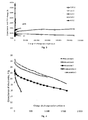
- fig 2 a comparative example 1 describing galvanostatic cycling of "1000F" CDC based prismatic supercapacitor without preliminary conditioning according to the method of the present invention to the working voltage (Uw) of 4.0V, the results of the first cycle shown in figure shows that working voltage 4V was not possible to reach. The temperature increase and expansion of the supercapacitor during first charge cycle went over the reasonable values. Further running of the experiment was not safe and was stopped at the -3.5V.
- Polarisable carbon electrodes were prepared as follows.
- the mixture of 92% (wt.) carbon and 8% (wt.) polytetrafluoroethylene (PTFE, Aldrich, 60% suspension in water) was rolled stepwise into the carbon film with a final thickness of 80-100 ⁇ m.
- the raw electrode sheets were coated from one side with a thin aluminium layer (2 ⁇ 1 ⁇ m) using the physical vapour deposition method.
- the electrodes were attached to current collector: Aluminium (Al) foil, and interleaved with an ion-permeable separator paper from Nippon Kodoshi®.
- the electrode pairs from positively and negatively charged electrodes were connected in parallel.
- the electrode pack prepared was placed in a sealed aluminium container and stored under vacuum to degas the electrode stack and then impregnated with the electrolyte.
- the electrolyte was 1.8M triethylmethylammonium tetrafluoroborate (TEMA) in anhydrous acetonitrile (AN, Riedel-de Ha ⁇ n, H2O ⁇ 0.003%).
- organic electrolyte including organic solvents: nitriles such as acetonitrile, acrylonitrile and propionitrile ; sulfoxides such as dimethyl, diethyl, ethyl methyl and benzylmethyl sulfoxide ; amides such as dimethyl formamide and pyrrolidones such as N-methylpyrrolidone, polar aprotic organic solvent such as a cyclic ester, chain carbonate, cyclic carbonate, chain ether and/or cyclic ether solvent or a mixture of such solvents and a salt.
- organic solvents such as a cyclic ester, chain carbonate, cyclic carbonate, chain ether and/or cyclic ether solvent or a mixture
- the electrolyte salt can be selected from the group of tetrafluorborates, or hexafluorophosphates or trifluoromethanesulfonate of tetraalkylammonium, tetrakis(dialkylamino) phosphonium, N,N-dialkyl-1,4-diazabicyclo[2.2.2]octanediium or their mixture.
- the electrolyte can be also at least one ionic liquids such selected from the group consisting of: butyltrimethylammonium bis(trifluoromethylsulfonyl)imide, 1-ethyl-3-methylimidazolium bis(trifluoromethylsulfonyl)imide, 1-methyl-3-propylimidazolium bis(trifluoromethylsulfonyl)imide, 1-hexyl-3-methylimidazolium bis(trifluoromethylsulfonyl)imide, 1-methyl-3-propylimidazolium iodide, 1-ethyl-3-methylimidazolium thiocyanate, 1-methyl-1-propylpiperidinium bis(trifluoromethylsulfonyl)imide, 1-butyl-2-methylpyridinium bis(trifluoromethylsulfonyl)imide, 1-butyl-4-methylpyridinium bis(trifluoromethylsulfon
- the supercapacitor cell After filling with the electrolyte, the supercapacitor cell is stored for penetration of micropores by electrolyte.
- the storing time depends from the storing temperature, for example in the storing temperature 60° C the storing time is at least 48h which guarantees that the micropores are fully penetrated by the electrolyte.
- the storing time of the supercapacitor can be increased or decreased to have the micropores fully penetrated by the electrolyte.
- said storing time can depend on the type of the electrolyte used.
- C capacitance
- ESR equivalent series resistance
- the capacitance was calculated at the frequency of 10mHz and the ESR at 100Hz.
- ⁇ Uc is a voltage step in the conditioning process.
- Table 1 Carbon Company BET surface area, m 2 /g Total pore volume, cm 3 /g Micropore volume, cm 3 /g Carbide-de rived TiC950/80 0 Skeleton Technologies 1400 0.70 0.57 Coconut-d erived YP-50F Kuraray Chemical Co 1430 0.71 0.58 Phenolic resin-deriv ed RP-20 Kuraray Chemical Co 1570 0.73 0.65 Carbide-de rived TiC950/80 0LPT Skeleton Technologies 1500 0.70 0.60 Carbide-de rived TiC1000PT Skeleton Technologies 2030 1.13 0.72
- Inventive example 1 describes a step-by-step conditioning of carbide-derived carbon electrodes for working voltage of 4.0V.
- a supercapacitor composed from the carbide-derived carbon TiC950/800 (see in Table 1) electrodes was electrochemically stabilised by cycling with constant current (50mA/F) between 2.85V and 1.425V. Galvanostatic cycling was continued until the capacitance (C), ESR (R) and the round trip efficiency (RTE) reached the stable values. (Usually it takes 50 to 100 cycles.). After that the supercapacitor was charged-discharged with constant potential sweep rate of 10mV/s by increasing the maximum voltage step-by-step to the value of 4.0V. The voltage step ( ⁇ Uc) was as maximum 0.2V as described in Table 2. The lower limit in voltage during cycling was fixed at 1.5V. Five cycles were done at each conditioning voltage step (Uc).
- the step-by-step conditioning for working voltage of 4.0V may also be done by using the constant DC current, constant power (CP), gradually increased constant voltage, pulse-current, pulse-power and pulse-voltage and other charge-discharge cycling methods of supercapacitor with or without AC signal.
- Inventive example 2 describes step-by-step conditioning as in Inventive example 1 with a difference that the coconut shell derived activated carbon (CSDAC) electrodes were used in supercapacitor.
- Table 2 Change of the ESR during conditioning process from 3V to 4V of CDC based supercapacitor. Charge-discharge cycling was done from Uc to 1.5V at each conditioning voltage (Uc 1 ... Uc 10 ).
- Inventive example 3 describes step-by-step conditioning as in Inventive example 1 with a difference that the phenolic resin derived activated carbon (PRDAC) electrodes were used in supercapacitor.
- PRDAC phenolic resin derived activated carbon
- CDC of Inventive example 1 represents the best performance mainly because it is produced from the precursor (TiC), which does not contain oxygen. Therefore, this carbon is free of oxygen containing functional groups, which otherwise would increase the decay of respective supercapacitor.
- the CDC TiC950/800 is post-treated in hydrogen at high temperature that chemically purifies the surface of carbon.
- Inventive example 4 describes galvanostatic cycling of "1000F" CDC based prismatic supercapacitor stepwise conditioned to the working voltage of 4.0V.
- Comparative example 1 shown in Figure 2 , represents the opposite case where a galvanostatic cycling of "1000F" CDC based prismatic supercapacitor not conditioned by the method of this invention, is unsuccessfully attempted according to the method of the present invention to charge to working voltage Uw 4.0V.
- This figure shows that working voltage Uw 4V was not possible to reach because of the temperature increase and expansion of the supercapacitor during first charge cycle went over the reasonable values. Further running of the experiment was not safe and was stopped at the ⁇ 3.5V.
- FIG. 3 describes the performance of supercapacitors, which were made of carbide-derived carbon TiC950/800LPT (see Table 1) according to the method of making supercapacitors, but were charged-discharged between Uw and Uw/2 without preliminary step-by-step conditioning up to working voltage Uw.
- Uw in these examples was varied from 2.85V to 4.0V.
- the step-by-step conditioning of supercapacitors by the method of this invention gives advantage for applying to the supercapacitor the working voltage of 3.0V and up.
- the present invention relates to the method of increasing the working voltage of electrical double layer capacitor with enhanced working voltage, which has electrodes fabricated from porous carbon powder in which the pore sizes and the specific surface are created by extracting the non-carbon atoms from the carbon-rich organic or mineral compounds.
- the method is performed by step-by-step treatment of supercapacitor with the conditioning voltage (Uc), which is increased gradually up to the working voltage (Uw) by the voltage step (DUc) which is less or equal to 0.2V.
Landscapes
- Engineering & Computer Science (AREA)
- Power Engineering (AREA)
- Microelectronics & Electronic Packaging (AREA)
- Chemical & Material Sciences (AREA)
- Chemical Kinetics & Catalysis (AREA)
- Electrochemistry (AREA)
- Manufacturing & Machinery (AREA)
- Electric Double-Layer Capacitors Or The Like (AREA)
Claims (10)
- La méthode pour le conditionnement d'un supercondensateur à sa tension de travail où le supercondensateur comprend au moins une paire des électrodes à charge positive et négative ainsi qu'au moins une électrode de charbon micro/mésoporeux et polarisable ; ce supercondensateur est intercalé à l'aide d'un séparateur poreux conducteur d'ions et immergé dans un électrolyte où l'effet destructif de la chaleur d'adsorption est supprimé au cours du processus de conditionnement qui comprend plusieurs étapes ; avant le conditionnement du supercondensateur, la cellule du supercondensateur remplie d'électrolyte pénétrant les micropores est stockée ; puis, le supercondensateur est traité à la tension de conditionnement (Uc) qui est augmentée progressivement à la tension de travail (Uw) avec un pas de voltage (ΔUc) qui est inférieur à 0,3V ; pendant l'étape de conditionnement, il y a le cycle de voltage au cours duquel le supercondensateur est chargé à la tension de conditionnement (Uc) et puis déchargé à la tension Uc-ΔU, où la valeur de xU reste entre 0 et Uc.
- La méthode selon la revendication 1, où le nombre d'étapes de conditionnement est prédéterminé par le pas de voltage (ΔUc) de façon à atteindre la tension de travail du supercondensateur.
- La méthode selon la revendication 1, où, avant d'être traité par la tension de conditionnement (Uc), le supercondensateur est électrochémiquement stabilisé à l'aide du cyclage galvanostatique avec un Uc inférieur à 3,0V jusqu'à l'obtention d'une capacité de performance stable selon ESR.
- La méthode selon la revendication 1 où le charbon micro/mésoporeux est un dérivé de carbide.
- La méthode selon la revendication 1 où le charbon micro/mésoporeux est un charbon actif dérivé des coquilles de noix de coco.
- La méthode selon la revendication 1 où le charbon micro/mésoporeux est un charbon actif dérivé de la résine de phénol.
- La méthode selon la revendication 1 où l'électrolyte utilisé pour l'immersion de l'électrode de charbon micro/mésoporeux est choisi parmi les électrolytes organiques comprenant les solvants organiques : nitriles comme acétonitrile, acrylonitrile et propionitrile ; sulfoxydes comme diméthyle, diéthyle, éthyle, méthyle et benzylméthylsulfoxide ; amides comme diméthylformamide et pyrrolidones comme N. methylpyrrolidone ; solvant aprotique polaire organique comme ester cyclique, carbonate en chaîne, carbonate cyclique, solvant d'éther en chaîne et/ou cyclique, un mélange desdits solvants où leurs sels.
- La méthode selon la revendication 7 où le sel d'électrolyte peut être chosi parmi les tetrafluorborates, les hexafluorophosphates, le trifluoromethanesulfonate de tetraalkylammonium, tetrakis(dialkylamino)phosphonium, le N,N-dialkyl-1,4-diazabicyclo(2.2.2)octanediium où leur mélange.
- La méthode selon la revendication 1 où l'électrolyte utilisé pour l'immersion de l'électrode de charbon micro/mésoporeux peut être également un liquide ionique choisi dans un groupe comprenant : butyltriméthylammonium bis(trifluoromethylsulfonyl)imide, 1-éthyle-3-methylmidazolium bis(trifluoromethylsulfonyl)imide, 1-méthyle-3-propylmidazolium bis(trifluoromethylsulfonyl)imide, 1-hexyl-3-methylmidazolium bis(trifluoromethylsulfonyl)imide, 1-méthyle-3-propylmidazolium iodide, 1-éthyle-3-methylmidazolium thiocyanate, 1-méthyle-1-propylpiperidinium bis(trifluoromethylsulfonyl)imide, 1-butyl-2-methylpyridinium bis(trifauoromethylsulfonyl)imide, 1-butyl-4-methylpyridinium bis(trifluoromethylsulfonyl)imide, 1-butyl-1-methylpyrrolidinium bis(trifluoromethylsuffonyl)imide, diethylmethylsulfonium bis(trifluoromethylsulfonyl)imide, lithium bis(trifluoromethylsulfonyl)imide ou leur mélanges.
- La méthode selon la revendication 1 où, avant conditionnement du supercondensateur, sa cellule est remplie d'électrolyte pour être stockée à une température dépassant la température ambiante pour la pénétration des micropores par l'électrolyte.
Priority Applications (4)
| Application Number | Priority Date | Filing Date | Title |
|---|---|---|---|
| PL11787805T PL2633532T3 (pl) | 2010-10-31 | 2011-10-31 | Sposób kondycjonowania super-kondensatorów do ich napięcia roboczego |
| EP15001742.4A EP2978003B1 (fr) | 2010-10-31 | 2011-10-31 | Méthode de conditionnement d'un supercondensateur jusqu'à sa tension de travail et supercondensateur |
| PL15001742T PL2978003T3 (pl) | 2010-10-31 | 2011-10-31 | Sposób kondycjonowania superkondensatora do jego napięcia roboczego oraz superkondensator |
| NO15001742A NO2978003T3 (fr) | 2010-10-31 | 2011-10-31 |
Applications Claiming Priority (2)
| Application Number | Priority Date | Filing Date | Title |
|---|---|---|---|
| US40863510P | 2010-10-31 | 2010-10-31 | |
| PCT/EP2011/069176 WO2012056050A2 (fr) | 2010-10-31 | 2011-10-31 | Condensateur à double couche électrique à tension de fonctionnement améliorée |
Related Child Applications (2)
| Application Number | Title | Priority Date | Filing Date |
|---|---|---|---|
| EP15001742.4A Division EP2978003B1 (fr) | 2010-10-31 | 2011-10-31 | Méthode de conditionnement d'un supercondensateur jusqu'à sa tension de travail et supercondensateur |
| EP15001742.4A Division-Into EP2978003B1 (fr) | 2010-10-31 | 2011-10-31 | Méthode de conditionnement d'un supercondensateur jusqu'à sa tension de travail et supercondensateur |
Publications (2)
| Publication Number | Publication Date |
|---|---|
| EP2633532A2 EP2633532A2 (fr) | 2013-09-04 |
| EP2633532B1 true EP2633532B1 (fr) | 2015-07-29 |
Family
ID=45033936
Family Applications (2)
| Application Number | Title | Priority Date | Filing Date |
|---|---|---|---|
| EP11787805.8A Active EP2633532B1 (fr) | 2010-10-31 | 2011-10-31 | Methode de conditionnement d'un supercondensateur à sa tension de fonctionnement |
| EP15001742.4A Active EP2978003B1 (fr) | 2010-10-31 | 2011-10-31 | Méthode de conditionnement d'un supercondensateur jusqu'à sa tension de travail et supercondensateur |
Family Applications After (1)
| Application Number | Title | Priority Date | Filing Date |
|---|---|---|---|
| EP15001742.4A Active EP2978003B1 (fr) | 2010-10-31 | 2011-10-31 | Méthode de conditionnement d'un supercondensateur jusqu'à sa tension de travail et supercondensateur |
Country Status (9)
| Country | Link |
|---|---|
| US (1) | US8911510B2 (fr) |
| EP (2) | EP2633532B1 (fr) |
| KR (1) | KR101933633B1 (fr) |
| EA (1) | EA025540B1 (fr) |
| ES (2) | ES2551176T3 (fr) |
| HU (2) | HUE036568T2 (fr) |
| NO (1) | NO2978003T3 (fr) |
| PL (2) | PL2978003T3 (fr) |
| WO (1) | WO2012056050A2 (fr) |
Families Citing this family (11)
| Publication number | Priority date | Publication date | Assignee | Title |
|---|---|---|---|---|
| US9312077B2 (en) | 2011-12-16 | 2016-04-12 | Calgon Carbon Corporation | Double layer capacitors |
| WO2013192162A1 (fr) * | 2012-06-20 | 2013-12-27 | E. I. Du Pont De Nemours And Company | Fluide et système de transfert thermique à basse température |
| US9318271B2 (en) | 2012-06-21 | 2016-04-19 | Schlumberger Technology Corporation | High temperature supercapacitor |
| DE102013112415A1 (de) * | 2013-11-12 | 2015-05-13 | Ludwig-Maximilians-Universität München | Vorrichtung und Verfahren zur Untersuchung eines oder mehrerer Phasenobjekte |
| EP3216039A1 (fr) * | 2014-11-03 | 2017-09-13 | Sachem, Inc. | Compositions électrolytiques basées sur des sels d'ammonium ou de phosphonium quaternaires d'alkyle mélangés pour dispositifs de stockage et de production d'énergie électrique |
| GB2548128B (en) | 2016-03-09 | 2021-12-15 | Zapgo Ltd | Method of reducing outgassing |
| WO2017201167A1 (fr) | 2016-05-20 | 2017-11-23 | Avx Corporation | Configuration d'électrodes pour ultracondensateur |
| WO2017201173A1 (fr) | 2016-05-20 | 2017-11-23 | Avx Corporation | Électrolyte non aqueux pour supercondensateur |
| KR102635455B1 (ko) | 2016-05-20 | 2024-02-13 | 교세라 에이브이엑스 컴포넌츠 코포레이션 | 고온용 울트라커패시터 |
| CN108766775B (zh) * | 2018-05-25 | 2019-05-28 | 常州大学 | 一种超低温高容量超级电容器的制备方法及其应用 |
| RU190386U1 (ru) * | 2019-02-21 | 2019-07-01 | Общество с ограниченной ответственностью «Углерод ЧГ» | Активный электрод для суперконденсатора |
Family Cites Families (11)
| Publication number | Priority date | Publication date | Assignee | Title |
|---|---|---|---|---|
| AT345402B (de) * | 1973-12-05 | 1978-09-11 | Siemens Ag | Verfahren zum nachformieren von elektrolytkondensatoren |
| GB2179793B (en) * | 1985-08-28 | 1988-09-21 | Stc Plc | Pulsing capacitors in manufacture |
| UA30509A (uk) * | 1998-05-18 | 2000-11-15 | Товариство З Обмеженою Відповідальністю "Юнк-Бюро" | Електроліт для електрохімічного конденсатору подвійного шару |
| JP3973183B2 (ja) * | 1998-09-22 | 2007-09-12 | 株式会社パワーシステム | 電気二重層コンデンサの製造方法 |
| TW505934B (en) * | 2001-02-01 | 2002-10-11 | Luxon Energy Devices Corp | Manufacture method of electrochemical capacitor |
| JP2004128035A (ja) * | 2002-09-30 | 2004-04-22 | Nippon Chemicon Corp | 固体電解コンデンサの製造方法 |
| JP2006261599A (ja) | 2005-03-18 | 2006-09-28 | Japan Gore Tex Inc | 電気二重層キャパシタの製造方法 |
| JP4706066B2 (ja) | 2005-08-19 | 2011-06-22 | 独立行政法人産業技術総合研究所 | 電気化学キャパシタ及びそれに用いる電極材料 |
| DE102008060546B3 (de) * | 2008-12-04 | 2010-04-01 | Imp Gmbh | Verfahren zum Nachformieren von Elektrolytkondensatoren |
| US9640334B2 (en) * | 2010-01-25 | 2017-05-02 | Nanotek Instruments, Inc. | Flexible asymmetric electrochemical cells using nano graphene platelet as an electrode material |
| US9053870B2 (en) * | 2010-08-02 | 2015-06-09 | Nanotek Instruments, Inc. | Supercapacitor with a meso-porous nano graphene electrode |
-
2011
- 2011-10-31 HU HUE15001742A patent/HUE036568T2/hu unknown
- 2011-10-31 ES ES11787805.8T patent/ES2551176T3/es active Active
- 2011-10-31 US US13/882,664 patent/US8911510B2/en not_active Expired - Fee Related
- 2011-10-31 EP EP11787805.8A patent/EP2633532B1/fr active Active
- 2011-10-31 NO NO15001742A patent/NO2978003T3/no unknown
- 2011-10-31 ES ES15001742.4T patent/ES2657342T3/es active Active
- 2011-10-31 HU HUE11787805A patent/HUE025995T2/en unknown
- 2011-10-31 PL PL15001742T patent/PL2978003T3/pl unknown
- 2011-10-31 KR KR1020137014180A patent/KR101933633B1/ko not_active Expired - Fee Related
- 2011-10-31 WO PCT/EP2011/069176 patent/WO2012056050A2/fr not_active Ceased
- 2011-10-31 PL PL11787805T patent/PL2633532T3/pl unknown
- 2011-10-31 EA EA201300517A patent/EA025540B1/ru not_active IP Right Cessation
- 2011-10-31 EP EP15001742.4A patent/EP2978003B1/fr active Active
Also Published As
| Publication number | Publication date |
|---|---|
| EA025540B1 (ru) | 2017-01-30 |
| HUE025995T2 (en) | 2016-05-30 |
| PL2978003T3 (pl) | 2018-04-30 |
| HUE036568T2 (hu) | 2018-07-30 |
| KR20140007803A (ko) | 2014-01-20 |
| PL2633532T3 (pl) | 2015-12-31 |
| EP2978003A3 (fr) | 2016-05-25 |
| WO2012056050A3 (fr) | 2012-07-26 |
| EP2633532A2 (fr) | 2013-09-04 |
| US8911510B2 (en) | 2014-12-16 |
| EP2978003B1 (fr) | 2017-08-30 |
| US20130283580A1 (en) | 2013-10-31 |
| ES2551176T3 (es) | 2015-11-16 |
| ES2657342T3 (es) | 2018-03-02 |
| EA201300517A1 (ru) | 2013-11-29 |
| KR101933633B1 (ko) | 2018-12-28 |
| WO2012056050A2 (fr) | 2012-05-03 |
| NO2978003T3 (fr) | 2018-01-27 |
| EP2978003A2 (fr) | 2016-01-27 |
Similar Documents
| Publication | Publication Date | Title |
|---|---|---|
| EP2633532B1 (fr) | Methode de conditionnement d'un supercondensateur à sa tension de fonctionnement | |
| CN103828002A (zh) | 高压电化学双电层电容器 | |
| US20170084402A1 (en) | Low resistance ultracapacitor electrode and manufacturing method thereof | |
| US10211001B2 (en) | Ultracapacitor with improved aging performance | |
| JP2016535456A (ja) | 高静電容量活性炭および炭素系電極 | |
| KR20160083855A (ko) | 알칼리 금속 이온 커패시터, 그 제조 방법 및 충방전 방법 | |
| EP3109877A1 (fr) | Condensateur et son procédé de charge et de décharge | |
| JP4370019B2 (ja) | 電気二重層コンデンサの電界賦活方法 | |
| KR102801846B1 (ko) | 고전압 전기이중층커패시터의 제조방법 | |
| Arbizzani et al. | Ilhypos ionic liquid-based supercapacitors | |
| KR100706715B1 (ko) | 하이브리드 전지 | |
| KR100663832B1 (ko) | 하이브리드 전지 | |
| KR20140037074A (ko) | 탄소 전극 및 전기화학적 커패시터 | |
| HK1254992A1 (en) | Electrolyte for three-volt ultracapacitor | |
| Béguin et al. | Guidelines for the optimization of EDLC carbon electrodes | |
| HK1212504A1 (en) | Electrolyte for three-volt ultracapacitor | |
| HK1212504B (en) | Electrolyte for three-volt ultracapacitor |
Legal Events
| Date | Code | Title | Description |
|---|---|---|---|
| PUAI | Public reference made under article 153(3) epc to a published international application that has entered the european phase |
Free format text: ORIGINAL CODE: 0009012 |
|
| 17P | Request for examination filed |
Effective date: 20130530 |
|
| AK | Designated contracting states |
Kind code of ref document: A2 Designated state(s): AL AT BE BG CH CY CZ DE DK EE ES FI FR GB GR HR HU IE IS IT LI LT LU LV MC MK MT NL NO PL PT RO RS SE SI SK SM TR |
|
| DAX | Request for extension of the european patent (deleted) | ||
| RAP1 | Party data changed (applicant data changed or rights of an application transferred) |
Owner name: OUE SKELETON TECHNOLOGIES GROUP |
|
| REG | Reference to a national code |
Ref country code: DE Ref legal event code: R079 Ref document number: 602011018314 Country of ref document: DE Free format text: PREVIOUS MAIN CLASS: H01G0009155000 Ipc: H01G0011140000 |
|
| GRAP | Despatch of communication of intention to grant a patent |
Free format text: ORIGINAL CODE: EPIDOSNIGR1 |
|
| RIC1 | Information provided on ipc code assigned before grant |
Ipc: H01G 11/14 20130101AFI20150115BHEP Ipc: H01G 11/84 20130101ALI20150115BHEP Ipc: H01G 11/58 20130101ALI20150115BHEP Ipc: H01G 11/52 20130101ALI20150115BHEP |
|
| INTG | Intention to grant announced |
Effective date: 20150204 |
|
| GRAS | Grant fee paid |
Free format text: ORIGINAL CODE: EPIDOSNIGR3 |
|
| GRAA | (expected) grant |
Free format text: ORIGINAL CODE: 0009210 |
|
| AK | Designated contracting states |
Kind code of ref document: B1 Designated state(s): AL AT BE BG CH CY CZ DE DK EE ES FI FR GB GR HR HU IE IS IT LI LT LU LV MC MK MT NL NO PL PT RO RS SE SI SK SM TR |
|
| REG | Reference to a national code |
Ref country code: GB Ref legal event code: FG4D |
|
| REG | Reference to a national code |
Ref country code: CH Ref legal event code: EP |
|
| REG | Reference to a national code |
Ref country code: AT Ref legal event code: REF Ref document number: 739861 Country of ref document: AT Kind code of ref document: T Effective date: 20150815 |
|
| REG | Reference to a national code |
Ref country code: IE Ref legal event code: FG4D |
|
| REG | Reference to a national code |
Ref country code: DE Ref legal event code: R096 Ref document number: 602011018314 Country of ref document: DE |
|
| REG | Reference to a national code |
Ref country code: CH Ref legal event code: NV Representative=s name: KIRKER AND CIE S.A., CH |
|
| REG | Reference to a national code |
Ref country code: SE Ref legal event code: TRGR |
|
| REG | Reference to a national code |
Ref country code: FR Ref legal event code: PLFP Year of fee payment: 5 |
|
| REG | Reference to a national code |
Ref country code: ES Ref legal event code: FG2A Ref document number: 2551176 Country of ref document: ES Kind code of ref document: T3 Effective date: 20151116 |
|
| REG | Reference to a national code |
Ref country code: NO Ref legal event code: T2 Effective date: 20150729 |
|
| REG | Reference to a national code |
Ref country code: AT Ref legal event code: MK05 Ref document number: 739861 Country of ref document: AT Kind code of ref document: T Effective date: 20150729 |
|
| REG | Reference to a national code |
Ref country code: LT Ref legal event code: MG4D |
|
| REG | Reference to a national code |
Ref country code: PL Ref legal event code: T3 |
|
| REG | Reference to a national code |
Ref country code: NL Ref legal event code: FP |
|
| PG25 | Lapsed in a contracting state [announced via postgrant information from national office to epo] |
Ref country code: LV Free format text: LAPSE BECAUSE OF FAILURE TO SUBMIT A TRANSLATION OF THE DESCRIPTION OR TO PAY THE FEE WITHIN THE PRESCRIBED TIME-LIMIT Effective date: 20150729 Ref country code: GR Free format text: LAPSE BECAUSE OF FAILURE TO SUBMIT A TRANSLATION OF THE DESCRIPTION OR TO PAY THE FEE WITHIN THE PRESCRIBED TIME-LIMIT Effective date: 20151030 Ref country code: LT Free format text: LAPSE BECAUSE OF FAILURE TO SUBMIT A TRANSLATION OF THE DESCRIPTION OR TO PAY THE FEE WITHIN THE PRESCRIBED TIME-LIMIT Effective date: 20150729 |
|
| PG25 | Lapsed in a contracting state [announced via postgrant information from national office to epo] |
Ref country code: RS Free format text: LAPSE BECAUSE OF FAILURE TO SUBMIT A TRANSLATION OF THE DESCRIPTION OR TO PAY THE FEE WITHIN THE PRESCRIBED TIME-LIMIT Effective date: 20150729 Ref country code: AT Free format text: LAPSE BECAUSE OF FAILURE TO SUBMIT A TRANSLATION OF THE DESCRIPTION OR TO PAY THE FEE WITHIN THE PRESCRIBED TIME-LIMIT Effective date: 20150729 Ref country code: PT Free format text: LAPSE BECAUSE OF FAILURE TO SUBMIT A TRANSLATION OF THE DESCRIPTION OR TO PAY THE FEE WITHIN THE PRESCRIBED TIME-LIMIT Effective date: 20151130 Ref country code: IS Free format text: LAPSE BECAUSE OF FAILURE TO SUBMIT A TRANSLATION OF THE DESCRIPTION OR TO PAY THE FEE WITHIN THE PRESCRIBED TIME-LIMIT Effective date: 20151129 Ref country code: HR Free format text: LAPSE BECAUSE OF FAILURE TO SUBMIT A TRANSLATION OF THE DESCRIPTION OR TO PAY THE FEE WITHIN THE PRESCRIBED TIME-LIMIT Effective date: 20150729 |
|
| REG | Reference to a national code |
Ref country code: EE Ref legal event code: FG4A Ref document number: E011553 Country of ref document: EE Effective date: 20151209 Ref country code: DE Ref legal event code: R082 Ref document number: 602011018314 Country of ref document: DE |
|
| PG25 | Lapsed in a contracting state [announced via postgrant information from national office to epo] |
Ref country code: DK Free format text: LAPSE BECAUSE OF FAILURE TO SUBMIT A TRANSLATION OF THE DESCRIPTION OR TO PAY THE FEE WITHIN THE PRESCRIBED TIME-LIMIT Effective date: 20150729 Ref country code: SK Free format text: LAPSE BECAUSE OF FAILURE TO SUBMIT A TRANSLATION OF THE DESCRIPTION OR TO PAY THE FEE WITHIN THE PRESCRIBED TIME-LIMIT Effective date: 20150729 |
|
| PGFP | Annual fee paid to national office [announced via postgrant information from national office to epo] |
Ref country code: EE Payment date: 20151130 Year of fee payment: 5 |
|
| REG | Reference to a national code |
Ref country code: DE Ref legal event code: R097 Ref document number: 602011018314 Country of ref document: DE |
|
| REG | Reference to a national code |
Ref country code: HU Ref legal event code: AG4A Ref document number: E025995 Country of ref document: HU |
|
| PG25 | Lapsed in a contracting state [announced via postgrant information from national office to epo] |
Ref country code: RO Free format text: LAPSE BECAUSE OF FAILURE TO SUBMIT A TRANSLATION OF THE DESCRIPTION OR TO PAY THE FEE WITHIN THE PRESCRIBED TIME-LIMIT Effective date: 20150729 Ref country code: LU Free format text: LAPSE BECAUSE OF FAILURE TO SUBMIT A TRANSLATION OF THE DESCRIPTION OR TO PAY THE FEE WITHIN THE PRESCRIBED TIME-LIMIT Effective date: 20151031 |
|
| PLBE | No opposition filed within time limit |
Free format text: ORIGINAL CODE: 0009261 |
|
| STAA | Information on the status of an ep patent application or granted ep patent |
Free format text: STATUS: NO OPPOSITION FILED WITHIN TIME LIMIT |
|
| PG25 | Lapsed in a contracting state [announced via postgrant information from national office to epo] |
Ref country code: MC Free format text: LAPSE BECAUSE OF FAILURE TO SUBMIT A TRANSLATION OF THE DESCRIPTION OR TO PAY THE FEE WITHIN THE PRESCRIBED TIME-LIMIT Effective date: 20150729 |
|
| 26N | No opposition filed |
Effective date: 20160502 |
|
| REG | Reference to a national code |
Ref country code: IE Ref legal event code: MM4A |
|
| PG25 | Lapsed in a contracting state [announced via postgrant information from national office to epo] |
Ref country code: SI Free format text: LAPSE BECAUSE OF FAILURE TO SUBMIT A TRANSLATION OF THE DESCRIPTION OR TO PAY THE FEE WITHIN THE PRESCRIBED TIME-LIMIT Effective date: 20150729 |
|
| REG | Reference to a national code |
Ref country code: FR Ref legal event code: PLFP Year of fee payment: 6 |
|
| PG25 | Lapsed in a contracting state [announced via postgrant information from national office to epo] |
Ref country code: IE Free format text: LAPSE BECAUSE OF NON-PAYMENT OF DUE FEES Effective date: 20151031 |
|
| PG25 | Lapsed in a contracting state [announced via postgrant information from national office to epo] |
Ref country code: BE Free format text: LAPSE BECAUSE OF FAILURE TO SUBMIT A TRANSLATION OF THE DESCRIPTION OR TO PAY THE FEE WITHIN THE PRESCRIBED TIME-LIMIT Effective date: 20150729 |
|
| REG | Reference to a national code |
Ref country code: EE Ref legal event code: MM4A Ref document number: E011553 Country of ref document: EE Effective date: 20161031 |
|
| PG25 | Lapsed in a contracting state [announced via postgrant information from national office to epo] |
Ref country code: BG Free format text: LAPSE BECAUSE OF FAILURE TO SUBMIT A TRANSLATION OF THE DESCRIPTION OR TO PAY THE FEE WITHIN THE PRESCRIBED TIME-LIMIT Effective date: 20150729 Ref country code: SM Free format text: LAPSE BECAUSE OF FAILURE TO SUBMIT A TRANSLATION OF THE DESCRIPTION OR TO PAY THE FEE WITHIN THE PRESCRIBED TIME-LIMIT Effective date: 20150729 |
|
| PG25 | Lapsed in a contracting state [announced via postgrant information from national office to epo] |
Ref country code: CY Free format text: LAPSE BECAUSE OF FAILURE TO SUBMIT A TRANSLATION OF THE DESCRIPTION OR TO PAY THE FEE WITHIN THE PRESCRIBED TIME-LIMIT Effective date: 20150729 |
|
| PG25 | Lapsed in a contracting state [announced via postgrant information from national office to epo] |
Ref country code: EE Free format text: LAPSE BECAUSE OF NON-PAYMENT OF DUE FEES Effective date: 20161031 |
|
| PG25 | Lapsed in a contracting state [announced via postgrant information from national office to epo] |
Ref country code: MT Free format text: LAPSE BECAUSE OF FAILURE TO SUBMIT A TRANSLATION OF THE DESCRIPTION OR TO PAY THE FEE WITHIN THE PRESCRIBED TIME-LIMIT Effective date: 20150729 |
|
| REG | Reference to a national code |
Ref country code: FR Ref legal event code: PLFP Year of fee payment: 7 |
|
| PG25 | Lapsed in a contracting state [announced via postgrant information from national office to epo] |
Ref country code: MK Free format text: LAPSE BECAUSE OF FAILURE TO SUBMIT A TRANSLATION OF THE DESCRIPTION OR TO PAY THE FEE WITHIN THE PRESCRIBED TIME-LIMIT Effective date: 20150729 |
|
| PG25 | Lapsed in a contracting state [announced via postgrant information from national office to epo] |
Ref country code: AL Free format text: LAPSE BECAUSE OF FAILURE TO SUBMIT A TRANSLATION OF THE DESCRIPTION OR TO PAY THE FEE WITHIN THE PRESCRIBED TIME-LIMIT Effective date: 20150729 |
|
| PGFP | Annual fee paid to national office [announced via postgrant information from national office to epo] |
Ref country code: TR Payment date: 20201027 Year of fee payment: 10 |
|
| PGFP | Annual fee paid to national office [announced via postgrant information from national office to epo] |
Ref country code: NO Payment date: 20201028 Year of fee payment: 10 Ref country code: CH Payment date: 20201030 Year of fee payment: 10 Ref country code: FI Payment date: 20201029 Year of fee payment: 10 Ref country code: CZ Payment date: 20201015 Year of fee payment: 10 Ref country code: HU Payment date: 20201031 Year of fee payment: 10 |
|
| PGFP | Annual fee paid to national office [announced via postgrant information from national office to epo] |
Ref country code: PL Payment date: 20201028 Year of fee payment: 10 |
|
| REG | Reference to a national code |
Ref country code: NO Ref legal event code: MMEP |
|
| REG | Reference to a national code |
Ref country code: FI Ref legal event code: MAE |
|
| REG | Reference to a national code |
Ref country code: CH Ref legal event code: PL |
|
| PG25 | Lapsed in a contracting state [announced via postgrant information from national office to epo] |
Ref country code: NO Free format text: LAPSE BECAUSE OF NON-PAYMENT OF DUE FEES Effective date: 20211031 Ref country code: HU Free format text: LAPSE BECAUSE OF NON-PAYMENT OF DUE FEES Effective date: 20211101 Ref country code: CZ Free format text: LAPSE BECAUSE OF NON-PAYMENT OF DUE FEES Effective date: 20211031 |
|
| PG25 | Lapsed in a contracting state [announced via postgrant information from national office to epo] |
Ref country code: LI Free format text: LAPSE BECAUSE OF NON-PAYMENT OF DUE FEES Effective date: 20211031 Ref country code: FI Free format text: LAPSE BECAUSE OF NON-PAYMENT OF DUE FEES Effective date: 20211031 Ref country code: CH Free format text: LAPSE BECAUSE OF NON-PAYMENT OF DUE FEES Effective date: 20211031 |
|
| PG25 | Lapsed in a contracting state [announced via postgrant information from national office to epo] |
Ref country code: PL Free format text: LAPSE BECAUSE OF NON-PAYMENT OF DUE FEES Effective date: 20211031 |
|
| PGFP | Annual fee paid to national office [announced via postgrant information from national office to epo] |
Ref country code: NL Payment date: 20231023 Year of fee payment: 13 |
|
| PGFP | Annual fee paid to national office [announced via postgrant information from national office to epo] |
Ref country code: GB Payment date: 20231025 Year of fee payment: 13 |
|
| PGFP | Annual fee paid to national office [announced via postgrant information from national office to epo] |
Ref country code: ES Payment date: 20231117 Year of fee payment: 13 |
|
| PGFP | Annual fee paid to national office [announced via postgrant information from national office to epo] |
Ref country code: SE Payment date: 20231025 Year of fee payment: 13 Ref country code: IT Payment date: 20231025 Year of fee payment: 13 Ref country code: FR Payment date: 20231023 Year of fee payment: 13 |
|
| PG25 | Lapsed in a contracting state [announced via postgrant information from national office to epo] |
Ref country code: TR Free format text: LAPSE BECAUSE OF NON-PAYMENT OF DUE FEES Effective date: 20211031 |
|
| REG | Reference to a national code |
Ref country code: NL Ref legal event code: MM Effective date: 20241101 |
|
| GBPC | Gb: european patent ceased through non-payment of renewal fee |
Effective date: 20241031 |
|
| REG | Reference to a national code |
Ref country code: SE Ref legal event code: EUG |
|
| PG25 | Lapsed in a contracting state [announced via postgrant information from national office to epo] |
Ref country code: GB Free format text: LAPSE BECAUSE OF NON-PAYMENT OF DUE FEES Effective date: 20241031 |
|
| PG25 | Lapsed in a contracting state [announced via postgrant information from national office to epo] |
Ref country code: NL Free format text: LAPSE BECAUSE OF NON-PAYMENT OF DUE FEES Effective date: 20241101 |
|
| PG25 | Lapsed in a contracting state [announced via postgrant information from national office to epo] |
Ref country code: FR Free format text: LAPSE BECAUSE OF NON-PAYMENT OF DUE FEES Effective date: 20241031 |
|
| PG25 | Lapsed in a contracting state [announced via postgrant information from national office to epo] |
Ref country code: IT Free format text: LAPSE BECAUSE OF NON-PAYMENT OF DUE FEES Effective date: 20241031 Ref country code: SE Free format text: LAPSE BECAUSE OF NON-PAYMENT OF DUE FEES Effective date: 20241101 |
|
| REG | Reference to a national code |
Ref country code: ES Ref legal event code: FD2A Effective date: 20251205 |
|
| PG25 | Lapsed in a contracting state [announced via postgrant information from national office to epo] |
Ref country code: ES Free format text: LAPSE BECAUSE OF NON-PAYMENT OF DUE FEES Effective date: 20241101 |
|
| PGFP | Annual fee paid to national office [announced via postgrant information from national office to epo] |
Ref country code: DE Payment date: 20251222 Year of fee payment: 15 |