EP2634683B1 - Navigationsverfahren innerhalb eines anzeigbaren Inhalts mit Hilfe von Navigationssteuerbefehlen, Navigationsvorrichtung und entsprechendes Computerprogramm - Google Patents
Navigationsverfahren innerhalb eines anzeigbaren Inhalts mit Hilfe von Navigationssteuerbefehlen, Navigationsvorrichtung und entsprechendes Computerprogramm Download PDFInfo
- Publication number
- EP2634683B1 EP2634683B1 EP13155095.6A EP13155095A EP2634683B1 EP 2634683 B1 EP2634683 B1 EP 2634683B1 EP 13155095 A EP13155095 A EP 13155095A EP 2634683 B1 EP2634683 B1 EP 2634683B1
- Authority
- EP
- European Patent Office
- Prior art keywords
- navigation
- image
- command
- movement
- content
- Prior art date
- Legal status (The legal status is an assumption and is not a legal conclusion. Google has not performed a legal analysis and makes no representation as to the accuracy of the status listed.)
- Active
Links
Images


Classifications
-
- G—PHYSICS
- G09—EDUCATION; CRYPTOGRAPHY; DISPLAY; ADVERTISING; SEALS
- G09G—ARRANGEMENTS OR CIRCUITS FOR CONTROL OF INDICATING DEVICES USING STATIC MEANS TO PRESENT VARIABLE INFORMATION
- G09G5/00—Control arrangements or circuits for visual indicators common to cathode-ray tube indicators and other visual indicators
- G09G5/36—Control arrangements or circuits for visual indicators common to cathode-ray tube indicators and other visual indicators characterised by the display of a graphic pattern, e.g. using an all-points-addressable [APA] memory
- G09G5/38—Control arrangements or circuits for visual indicators common to cathode-ray tube indicators and other visual indicators characterised by the display of a graphic pattern, e.g. using an all-points-addressable [APA] memory with means for controlling the display position
-
- G—PHYSICS
- G06—COMPUTING OR CALCULATING; COUNTING
- G06F—ELECTRIC DIGITAL DATA PROCESSING
- G06F3/00—Input arrangements for transferring data to be processed into a form capable of being handled by the computer; Output arrangements for transferring data from processing unit to output unit, e.g. interface arrangements
- G06F3/01—Input arrangements or combined input and output arrangements for interaction between user and computer
- G06F3/048—Interaction techniques based on graphical user interfaces [GUI]
- G06F3/0484—Interaction techniques based on graphical user interfaces [GUI] for the control of specific functions or operations, e.g. selecting or manipulating an object, an image or a displayed text element, setting a parameter value or selecting a range
- G06F3/0485—Scrolling or panning
-
- G—PHYSICS
- G06—COMPUTING OR CALCULATING; COUNTING
- G06F—ELECTRIC DIGITAL DATA PROCESSING
- G06F3/00—Input arrangements for transferring data to be processed into a form capable of being handled by the computer; Output arrangements for transferring data from processing unit to output unit, e.g. interface arrangements
- G06F3/01—Input arrangements or combined input and output arrangements for interaction between user and computer
- G06F3/048—Interaction techniques based on graphical user interfaces [GUI]
- G06F3/0487—Interaction techniques based on graphical user interfaces [GUI] using specific features provided by the input device, e.g. functions controlled by the rotation of a mouse with dual sensing arrangements, or of the nature of the input device, e.g. tap gestures based on pressure sensed by a digitiser
- G06F3/0488—Interaction techniques based on graphical user interfaces [GUI] using specific features provided by the input device, e.g. functions controlled by the rotation of a mouse with dual sensing arrangements, or of the nature of the input device, e.g. tap gestures based on pressure sensed by a digitiser using a touch-screen or digitiser, e.g. input of commands through traced gestures
- G06F3/04883—Interaction techniques based on graphical user interfaces [GUI] using specific features provided by the input device, e.g. functions controlled by the rotation of a mouse with dual sensing arrangements, or of the nature of the input device, e.g. tap gestures based on pressure sensed by a digitiser using a touch-screen or digitiser, e.g. input of commands through traced gestures for inputting data by handwriting, e.g. gesture or text
Definitions
- the invention relates to a method of navigation within a displayable content. Part of the content is displayed and navigation commands are used to move the viewing window visible on the screen.
- the present invention can warn the user that the end of the displayable content is reached.
- navigation commands occur when the user has started searching for items from a network or memory on their device.
- the elements are then presented on the screen in the form of a list of identifiers in which the user can navigate. If an item in the list interests him, the user can select it and launch an action on the associated item. For example, if the user asks to see all the applications available on his mobile phone, then he starts displaying a list of icons associated with the available applications.
- the user navigates the displayed list by moving a focus. When the focus is positioned on the desired icon, the user enters a selection command to activate the execution of the application associated with this icon.
- the patent application WO 2004/105392 describes a navigation within an ordered list of elements, displaying sub-lists. An item is in focus, and navigation controls move it. To locate this element within the displayed sub-list, the current element is framed by two elements of the list. This presentation is no longer possible when the item is the last (or first) of the list.
- the menu as described in Figures 9, 10 and 11 of this application, displays a sub-list with the item in focus preceded or followed by an empty slot. This empty slot is the distinguishing sign that an end of the list is reached. But this earlier document shows a lack of mobility of the display when the end of the list is reached, so the user can not determine if his device is out of service or if he has reached a limit of navigation.
- the document WO 2011/090255 published April 21, 2011 , describes navigating within a document displayed on a touch screen.
- Graphic distortion is applied to the part of the content displayed when an edge or an end is reached.
- Deformation consists of shrinking, stretching or bouncing the displayed content.
- the present invention allows to warn in another way that the end of the list of elements in the current direction of navigation is reached.
- the invention relates to a method of navigation within a visual content according to the introductory paragraph.
- the method includes a step of duplicating two identical images of said displayed portion when an end of the visual content in the direction of movement specified by the navigation command is displayed on a screen.
- a first image remains motionless and a second image moves in the direction of movement specified by the navigation command as long as this command is active.
- the user finds that his navigation control has been taken into account by his camera and seeing the duplication of the image at a certain time, he knows that the end of the visual content in this navigation direction is reached.
- the display means is a touch screen and the activation of the navigation control consists of moving an object on said screen.
- the displacement of the second image of the viewing window is controlled by the movement of the object on the screen. In this way, the user directly controls the displacement of the viewing window and facing the new displacement of the navigation window, he immediately realizes that the end of the visual content is reached.
- the navigation control is characterized by an active state and a rest state, and the amplitude of the displacement of the second image of the viewing window depends on the time during which the command is active. In this way, the user controls the movement of the navigation window using simple navigation commands.
- the speed of displacement of the second image of the viewing window is variable during the time during which the command is active. In this way, the second image that exceeds the end of the displayed menu moves less and less when it is removed from the screen.
- the introduction of the navigation command is carried out using a keyboard comprises navigation keys, these keys specifying a direction of movement. In this way, the user controls the movement of the navigation window using simple navigation keys.
- the introduction of the navigation command is done by voice recognition. In this way, the user controls the movement of the navigation window with his simple voice.
- the navigation comprises a step of returning to a displayed content with a single image triggered when the navigation command is no longer active.
- the moving speed of the second image varies during the return step.
- the displacement of the second image is optimized.
- the duration of displacement of the second image during the return step is less than the displacement time of the second image when the navigation control is activated. In this way, this step of returning to an initial navigation menu is faster.
- the invention also relates to a computer program characterized in that it comprises program code instructions for the implementation of a duplication step in two identical images of a content displayed during navigation in visual content as described above when this program is executed by a processor.
- the figure 1 presents the main elements of a smartphone according to an exemplary embodiment.
- the smartphone 1 comprises an ALU 1.1 central unit connected to an executable program memory MP 1.2, a screen S 1.3, a radio communication module 1.4, and an interface module 1.5 with a keyboard 1.6.
- the communication module enables communication in the radio frequency range compatible with wireless communication networks such as: 2G / GSM ("Global System Mobility Technology” in English, literally translated as “mobile group system technology”), or 3G / UMTS ("Universal Mobile Telephone System Technology”), or 4G / LTE ("Long Term Evolution Technology” in English, literally translated as “Long Term Evolution Technique”). ").
- the screen 1.3 is of touch type, thus the keyboard 1.6. is somehow integrated on the screen.
- the smartphone also includes a circuit 1.7 for displaying data on the screen, often called the OSD circuit, of the English “On Screen Display” (meaning “on-screen display”).
- the OSD 1.7 circuit is a text and graphics generator that displays on the screen menus, pictograms (for example, a number corresponding to the channel displayed) and which displays the navigation menus in accordance with the present invention.
- the OSD circuit 1.7 is controlled by the central unit 1.1 and is interposed between it and the screen 1.3.
- the program memory contains resident executable programs and optionally a part of type Read / Write for recording and executing downloaded programs. These downloaded programs are typically applications dedicated to a specific use such as messaging, searching information on the Internet, downloading audio and / or visual documents, teleshopping, etc.
- the program memory MP contains a navigation module which will be called thereafter: the "Navigator". This module is responsible for presenting documents or lists of items on the screen and managing the activation of navigation commands to change the content displayed on the screen. Navigation commands typically allow you to do scroll the displayed content on the screen in the direction specified by the entered command.
- the Navigator is advantageously implemented in the form of a program module stored in the MP memory. It can also be realized in the form of a specialized circuit of the ASIC type for example.
- the user launches his browser on his multimedia device 1. He then specifies the type of visual content on which he wishes to navigate.
- the term navigation refers to the display of identifiers of elements such as documents or parts of a document, and the introduction of commands to modify the contents of the viewing window.
- the browser can for example display a list of file identifiers, or a list of services accessible from a portable device, or the contents of a photo album, etc.
- the navigation content comprises a plurality of graphic identifiers arranged along at least one navigation line. At least two commands are available to specify a direction of movement in one direction and in the opposite direction along said line.
- the present invention prevents the user from reaching the last item on the navigation line in the direction specified by the currently activated command.
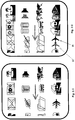
- the Figures 2.A to 2.F show screen appearances generated during the navigation according to a first embodiment.
- the screen 1.3 is that of a mobile phone said "smart" or smartphone in English, it is tactile type and a size of 4 cm wide by 6.5 cm in height. Activating navigation and selection commands is done by presenting your finger or any object such as a stylus on the 1.3 screen.
- the navigation menu includes sixteen icons giving access to as many applications. The sixteen icons are arranged in four columns of four icons. Given its size, the 1.3 screen can display only 12 icons in its entirety in the window of viewing.
- the figure 2.A presents the screen 1.3 with a viewing window displaying the 12 left icons in full, we can see part of the column of 4 icons on the right.
- the user's finger (or stylus) which is in the center of the screen, moves a few millimeters to the left.
- the figure 2.B presents a new viewing window where the 12 icons on the right are displayed in full.
- the user then continues to move his finger or stylus a few millimeters to the left, as shown by the arrow in the center of the figure.
- the Navigator detects that the end of the navigation menu in the direction of travel specified by the navigation command is reached, and therefore the entered command can not display other icons.
- the Navigator informs the user of this state.
- the displacement of the second image I2 of the viewing window is identical to the movement of the finger or stylus applied on the screen 1.3. In this way, the user sees that the movement of his finger or a stylus triggers a modification of the display in relation to the introduced command and deduces that his device 1 remains operational.
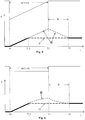
- the figure 3 illustrates this mode of operation.
- the curve presented shows the displacement "d" of the images I1 and I2 and the displacement of the object on the screen as a function of time "t".
- the command is considered "ACTIVE".
- the displacement starts at time T0 and ends at time T1.
- the displacement of the object on the screen controls the displacement of the image in the visual window, the object and the displayed image moving with the same amplitude and the same direction until at the moment T_L, the end of the navigation menu is reached in the direction of the movement specified by the object.
- T_L the image splits: one image I1 remains motionless, and the other image I2 continues to move according to the position of the object on the screen.
- the screen has, for example, the appearance illustrated in FIG. figure 2.D , the image I2 stops moving in the direction specified by the command.
- the image I2 goes back for a period R to position itself in the same place as the image I1.
- the two images are superimposed perfectly and merge to reform a single image. This backward movement of the second image I2 makes it clear to the user that part of his last command is erased because the end of the navigation menu is reached.
- the command input means is characterized by an activation state and a rest state.
- Such commands are for example navigation keys, typically marked with arrows indicating directions.
- the duration of the key press defines the displacement of the viewing window in the direction specified by the key.
- the viewing window stops moving within the navigation menu.
- Commands characterized by two states also consist of displaying icons on screen 1.3. These icons representing navigation commands of the type: “left”, “right”, “up”, “down” can be selected or not.
- Such commands can also be performed using a voice recognition engine for interpreting sound expressions such as "left", “right”, “up”, “down”.
- the speech recognition engine transcribes the sound signals into navigation commands. The end of the introduction of a command occurs when the user pronounces the word "stop”.
- the amplitude of the displacement is a function of the duration of activation of the command.
- the amplitude of the displacement is proportional to the duration.
- the amplitude of the displacement varies as a function of the duration of activation of the control according to a logarithmic function. The figure 4 illustrates this other mode.
- the upper part of the figure 4 shows the time during which a direction key is pressed, a navigation icon is selected, or a voice command is active.
- the displacement of the viewing window begins at time T0 when the user activates the command.
- T_L the end of the navigation menu is reached in the direction specified by the command.
- T_L the image splits: one image I1 remains motionless, and the other image I2 continues to move in the direction specified by the command.
- the speed of displacement of the image I2 varies less and less during the duration between the moments T_L and T1, according to a logarithmic variation. In this way, the image I2 disappears in the direction of the displacement after a very long moment of activation of the command, this situation not generally intervening.
- the image I2 goes back for a period R to position at the moment T2 at the same place as the image I1.
- the speed of movement of the return of the image to the same position as at time T_L varies logarithmically as a function of time.
- the duration of the return of the image I2 (that is to say the duration between T1 and T2) and the duration between T_L and T1 have the same value.
- the duration between T1 and T2 is a fraction of the duration between T_L and T1, so that the user does not wait too long for the return of the navigation menu with a single image.
- a ratio of 3 is optimal. For example, for a time between T_L and T1 of 1 second, the duration between T_L and T1 is 1/3 of seconds.
- the invention is not limited to the embodiments that have just been described.
- the invention can be implemented by any multimedia device having a user interface and a display means.
- the displayable contents reproduced by the device can be of text, photo or graphic type.
Landscapes
- Engineering & Computer Science (AREA)
- Theoretical Computer Science (AREA)
- General Engineering & Computer Science (AREA)
- Physics & Mathematics (AREA)
- General Physics & Mathematics (AREA)
- Human Computer Interaction (AREA)
- Computer Hardware Design (AREA)
- User Interface Of Digital Computer (AREA)
Claims (11)
- Verfahren zur Navigation auf einem visuellen Inhalt, wobei der Inhalt an einem Endgerät (1) verfügbar ist, das über ein Mittel zur Eingabe (1.6) von Navigationsbefehlen verfügt, wobei die Navigationsbefehle ermöglichen, einen Teil des Inhalts auszuwählen, um ihn auf einem Anzeigemittel (1.3) des Endgerätes anzuzeigen; wobei das Verfahren dadurch gekennzeichnet ist, dass es einen Schritt der Verdopplung des angezeigten Teils zu zwei identischen Bildern (I1, 12) umfasst, wenn ein Ende des Inhalts, das sich in der durch den Navigationsbefehl festgelegten Richtung der Verschiebung befindet, auf dem Anzeigemittel (1.3) angezeigt wird, wobei ein erstes Bild (I1) unbeweglich bleibt, während ein zweites Bild (I2) sich in der durch den Navigationsbefehl festgelegten Richtung der Verschiebung verschiebt, solange dieser Befehl aktiv ist.
- Verfahren zur Navigation nach Anspruch 1, wobei das Anzeigemittel ein Berührungsbildschirm (1.3, 1.6) ist und die Aktivierung des Navigationsbefehls darin besteht, ein Objekt auf diesem Bildschirm zu verschieben; wobei das Verfahren dadurch gekennzeichnet ist, dass die Verschiebung des zweiten Bildes (I2) des Visualisierungsfensters durch die Verschiebung des Objekts auf dem Bildschirm (1.3, 1.6) gesteuert wird.
- Verfahren zur Navigation nach Anspruch 1, wobei der Navigationsbefehl durch einen aktiven Zustand und einen Ruhezustand gekennzeichnet ist; wobei das Verfahren dadurch gekennzeichnet ist, dass die Amplitude der Verschiebung des zweiten Bildes (I2) des Visualisierungsfensters von der Zeit abhängt, während welcher der Befehl aktiv ist.
- Verfahren zur Navigation nach Anspruch 3, dadurch gekennzeichnet, dass die Verschiebungsgeschwindigkeit des zweiten Bildes (I2) des Visualisierungsfensters während der Zeit, während welcher der Befehl aktiv ist, variabel ist.
- Verfahren zur Navigation nach einem der Ansprüche 3 und 4, dadurch gekennzeichnet, dass das Mittel zur Eingabe von Navigationsbefehlen eine Tastatur (1.6) ist, die Navigationstasten aufweist, wobei diese Tasten eine Verschiebungsrichtung festlegen.
- Verfahren zur Navigation nach einem der Ansprüche 3 und 4, dadurch gekennzeichnet, dass die Eingabe von Navigationsbefehlen durch Spracherkennung erfolgt.
- Verfahren zur Navigation nach einem der vorhergehenden Ansprüche, dadurch gekennzeichnet, dass es einen Schritt der Rückkehr zu einem mit einem einzigen Bild angezeigten Inhalt umfasst, wobei dieser Rückkehrschritt ausgelöst wird, wenn der Navigationsbefehl nicht mehr aktiv ist.
- Verfahren zur Navigation nach Anspruch 7, dadurch gekennzeichnet, dass die Verschiebungsgeschwindigkeit des zweiten Bildes (I2) im Verlaufe des Rückkehrschrittes variiert.
- Verfahren zur Navigation nach Anspruch 7 oder 8, dadurch gekennzeichnet, dass die Dauer der Verschiebung des zweiten Bildes (I2) während des Rückkehrschrittes kürzer ist als die Verschiebungszeit des zweiten Bildes, wenn der Navigationsbefehl aktiv ist.
- Elektronisches Gerät (1), welches ein Mittel zur Anzeige (1.3) eines visuellen Inhalts und eines Mittels zur Eingabe (1.6) von Navigationsbefehlen umfasst, wobei die Navigationsbefehle ermöglichen, einen Teil des Inhalts auszuwählen, um ihn auf dem Anzeigemittel (1.3) anzuzeigen;
wobei das Gerät dadurch gekennzeichnet ist, dass es ein Mittel zur Verdopplung (1.1, 1.2) des angezeigten Teils zu zwei identischen Bildern, wenn ein Ende des Inhalts, das sich in der durch den Navigationsbefehl festgelegten Richtung der Verschiebung befindet, auf dem Anzeigemittel (1.3) angezeigt wird, umfasst, wobei ein erstes Bild unbeweglich bleibt, während ein zweites Bild sich in der durch den Navigationsbefehl festgelegten Richtung der Verschiebung verschiebt, solange dieser Befehl aktiv ist. - Computerprogramm, dadurch gekennzeichnet, dass es Programmcodeanweisungen zur Durchführung eines Schrittes der Verdopplung eines bei der Navigation in einem visuellen Inhalt angezeigten Inhalts zu zwei identischen Bildern nach einem der Ansprüche 1 bis 9, wenn dieses Programm von einem Prozessor ausgeführt wird, umfasst.
Applications Claiming Priority (1)
| Application Number | Priority Date | Filing Date | Title |
|---|---|---|---|
| FR1251820A FR2987470A1 (fr) | 2012-02-29 | 2012-02-29 | Procede de navigation au sein d'un contenu affichable a l'aide de commandes de navigation, dispositif de navigation et programme associe |
Publications (2)
| Publication Number | Publication Date |
|---|---|
| EP2634683A1 EP2634683A1 (de) | 2013-09-04 |
| EP2634683B1 true EP2634683B1 (de) | 2018-08-29 |
Family
ID=47678640
Family Applications (1)
| Application Number | Title | Priority Date | Filing Date |
|---|---|---|---|
| EP13155095.6A Active EP2634683B1 (de) | 2012-02-29 | 2013-02-13 | Navigationsverfahren innerhalb eines anzeigbaren Inhalts mit Hilfe von Navigationssteuerbefehlen, Navigationsvorrichtung und entsprechendes Computerprogramm |
Country Status (3)
| Country | Link |
|---|---|
| US (1) | US9099058B2 (de) |
| EP (1) | EP2634683B1 (de) |
| FR (1) | FR2987470A1 (de) |
Family Cites Families (14)
| Publication number | Priority date | Publication date | Assignee | Title |
|---|---|---|---|---|
| US7469381B2 (en) * | 2007-01-07 | 2008-12-23 | Apple Inc. | List scrolling and document translation, scaling, and rotation on a touch-screen display |
| JP4802098B2 (ja) | 2003-05-20 | 2011-10-26 | トムソン ライセンシング | エレメントのリストでナビゲートするための方法、リストにおけるエレメントの選択のためのオーディオビジュアルレシーバ |
| US7750893B2 (en) * | 2005-04-06 | 2010-07-06 | Nintendo Co., Ltd. | Storage medium storing input position processing program, and input position processing device |
| US20070132789A1 (en) * | 2005-12-08 | 2007-06-14 | Bas Ording | List scrolling in response to moving contact over list of index symbols |
| US7844915B2 (en) * | 2007-01-07 | 2010-11-30 | Apple Inc. | Application programming interfaces for scrolling operations |
| US8624925B2 (en) * | 2009-10-16 | 2014-01-07 | Qualcomm Incorporated | Content boundary signaling techniques |
| US8812985B2 (en) * | 2009-10-30 | 2014-08-19 | Motorola Mobility Llc | Method and device for enhancing scrolling operations in a display device |
| US20110161892A1 (en) * | 2009-12-29 | 2011-06-30 | Motorola-Mobility, Inc. | Display Interface and Method for Presenting Visual Feedback of a User Interaction |
| JP5636678B2 (ja) * | 2010-01-19 | 2014-12-10 | ソニー株式会社 | 表示制御装置、表示制御方法及び表示制御プログラム |
| US8522308B2 (en) * | 2010-02-11 | 2013-08-27 | Verizon Patent And Licensing Inc. | Systems and methods for providing a spatial-input-based multi-user shared display experience |
| US20120026181A1 (en) * | 2010-07-30 | 2012-02-02 | Google Inc. | Viewable boundary feedback |
| US9159298B2 (en) * | 2010-09-08 | 2015-10-13 | Lg Electronics Inc. | Terminal and contents sharing method for terminal |
| KR101677639B1 (ko) * | 2011-05-06 | 2016-11-18 | 엘지전자 주식회사 | 휴대 전자기기 및 이의 제어방법 |
| KR102111457B1 (ko) * | 2013-05-15 | 2020-05-15 | 엘지전자 주식회사 | 이동 단말기 및 이동 단말기의 제어 방법 |
-
2012
- 2012-02-29 FR FR1251820A patent/FR2987470A1/fr not_active Withdrawn
-
2013
- 2013-02-13 EP EP13155095.6A patent/EP2634683B1/de active Active
- 2013-02-28 US US13/781,116 patent/US9099058B2/en active Active
Also Published As
| Publication number | Publication date |
|---|---|
| US9099058B2 (en) | 2015-08-04 |
| EP2634683A1 (de) | 2013-09-04 |
| FR2987470A1 (fr) | 2013-08-30 |
| US20130226592A1 (en) | 2013-08-29 |
Similar Documents
| Publication | Publication Date | Title |
|---|---|---|
| US20240302952A1 (en) | User interfaces for viewing and accessing content on an electronic device | |
| US8413075B2 (en) | Gesture movies | |
| US10031656B1 (en) | Zoom-region indicator for zooming in an electronic interface | |
| CN108496150B (zh) | 一种屏幕截图和读取的方法及终端 | |
| RU2464648C2 (ru) | Режим турбопрокрутки для быстрого выбора элемента данных | |
| US8988353B2 (en) | Mobile device and method for editing pages used for a home screen | |
| EP2778885B1 (de) | Verfahren zur verarbeitung einer verbundgeste, entsprechende gerät und benutzerendgerät. | |
| EP2336867B1 (de) | Verfahren und Vorrichtung zur Anzeigekontrolle auf einer Anzeigevorrichtung für eine Vielzahl von Elementen einer Liste | |
| EP2381372A9 (de) | Visuelle Verschiebung von Mediensymbolen | |
| EP1929778B1 (de) | Verfahren zum durchsuchen einer liste durch kontinuierliches rollen eines graphischen merkmals und diesbezügliches endgerät | |
| KR102518172B1 (ko) | 컴퓨팅 시스템에서 사용자 어시스턴스를 제공하기 위한 장치 및 방법 | |
| TW201346702A (zh) | 用於在顯示器上執行物件的方法與裝置 | |
| CN102326140B (zh) | 用于显示附加信息项的方法和装置 | |
| EP2715499A1 (de) | Unsichtbare steuerung | |
| WO2013076596A2 (en) | An apparatus and associated methods | |
| EP2005729A1 (de) | Verfahren zur wiederherstellung mindestens einer multimedia-szene | |
| FR2964779A1 (fr) | Terminal mobile, et procede, programme d'ordinateur et moyens de stockage correspondants | |
| FR3041123A1 (de) | ||
| FR2913556A1 (fr) | Terminal de telecommunications mobile et procede de lecture d'une image en mouvement sur une page web a l'aide de celui-ci | |
| EP3387520A1 (de) | Direkte navigation in einem video-clip | |
| EP2634683B1 (de) | Navigationsverfahren innerhalb eines anzeigbaren Inhalts mit Hilfe von Navigationssteuerbefehlen, Navigationsvorrichtung und entsprechendes Computerprogramm | |
| FR2984545A1 (fr) | Procede de navigation au sein d'un contenu affichable a l'aide de commandes de navigation, dispositif de navigation et programme associe | |
| FR3081579A1 (fr) | Procede et dispositif de selection d’un raccourci affiche sur un ecran d’un vehicule comportant un designateur. | |
| CN114003155A (zh) | 终端设备、快捷启动功能的方法和存储介质 | |
| EP3548992A1 (de) | Navigation um benutzerdaten |
Legal Events
| Date | Code | Title | Description |
|---|---|---|---|
| PUAI | Public reference made under article 153(3) epc to a published international application that has entered the european phase |
Free format text: ORIGINAL CODE: 0009012 |
|
| AK | Designated contracting states |
Kind code of ref document: A1 Designated state(s): AL AT BE BG CH CY CZ DE DK EE ES FI FR GB GR HR HU IE IS IT LI LT LU LV MC MK MT NL NO PL PT RO RS SE SI SK SM TR |
|
| AX | Request for extension of the european patent |
Extension state: BA ME |
|
| RAP1 | Party data changed (applicant data changed or rights of an application transferred) |
Owner name: ORANGE |
|
| 17P | Request for examination filed |
Effective date: 20140224 |
|
| RBV | Designated contracting states (corrected) |
Designated state(s): AL AT BE BG CH CY CZ DE DK EE ES FI FR GB GR HR HU IE IS IT LI LT LU LV MC MK MT NL NO PL PT RO RS SE SI SK SM TR |
|
| STAA | Information on the status of an ep patent application or granted ep patent |
Free format text: STATUS: EXAMINATION IS IN PROGRESS |
|
| 17Q | First examination report despatched |
Effective date: 20171017 |
|
| GRAP | Despatch of communication of intention to grant a patent |
Free format text: ORIGINAL CODE: EPIDOSNIGR1 |
|
| STAA | Information on the status of an ep patent application or granted ep patent |
Free format text: STATUS: GRANT OF PATENT IS INTENDED |
|
| INTG | Intention to grant announced |
Effective date: 20180514 |
|
| RIN1 | Information on inventor provided before grant (corrected) |
Inventor name: ALVARADO, CUIHTLAUAC |
|
| GRAS | Grant fee paid |
Free format text: ORIGINAL CODE: EPIDOSNIGR3 |
|
| GRAA | (expected) grant |
Free format text: ORIGINAL CODE: 0009210 |
|
| STAA | Information on the status of an ep patent application or granted ep patent |
Free format text: STATUS: THE PATENT HAS BEEN GRANTED |
|
| AK | Designated contracting states |
Kind code of ref document: B1 Designated state(s): AL AT BE BG CH CY CZ DE DK EE ES FI FR GB GR HR HU IE IS IT LI LT LU LV MC MK MT NL NO PL PT RO RS SE SI SK SM TR |
|
| REG | Reference to a national code |
Ref country code: GB Ref legal event code: FG4D Free format text: NOT ENGLISH |
|
| REG | Reference to a national code |
Ref country code: CH Ref legal event code: EP |
|
| REG | Reference to a national code |
Ref country code: AT Ref legal event code: REF Ref document number: 1035907 Country of ref document: AT Kind code of ref document: T Effective date: 20180915 |
|
| REG | Reference to a national code |
Ref country code: IE Ref legal event code: FG4D Free format text: LANGUAGE OF EP DOCUMENT: FRENCH |
|
| REG | Reference to a national code |
Ref country code: DE Ref legal event code: R096 Ref document number: 602013042639 Country of ref document: DE |
|
| REG | Reference to a national code |
Ref country code: NL Ref legal event code: MP Effective date: 20180829 |
|
| REG | Reference to a national code |
Ref country code: LT Ref legal event code: MG4D |
|
| PG25 | Lapsed in a contracting state [announced via postgrant information from national office to epo] |
Ref country code: BG Free format text: LAPSE BECAUSE OF FAILURE TO SUBMIT A TRANSLATION OF THE DESCRIPTION OR TO PAY THE FEE WITHIN THE PRESCRIBED TIME-LIMIT Effective date: 20181129 Ref country code: SE Free format text: LAPSE BECAUSE OF FAILURE TO SUBMIT A TRANSLATION OF THE DESCRIPTION OR TO PAY THE FEE WITHIN THE PRESCRIBED TIME-LIMIT Effective date: 20180829 Ref country code: RS Free format text: LAPSE BECAUSE OF FAILURE TO SUBMIT A TRANSLATION OF THE DESCRIPTION OR TO PAY THE FEE WITHIN THE PRESCRIBED TIME-LIMIT Effective date: 20180829 Ref country code: NO Free format text: LAPSE BECAUSE OF FAILURE TO SUBMIT A TRANSLATION OF THE DESCRIPTION OR TO PAY THE FEE WITHIN THE PRESCRIBED TIME-LIMIT Effective date: 20181129 Ref country code: IS Free format text: LAPSE BECAUSE OF FAILURE TO SUBMIT A TRANSLATION OF THE DESCRIPTION OR TO PAY THE FEE WITHIN THE PRESCRIBED TIME-LIMIT Effective date: 20181229 Ref country code: GR Free format text: LAPSE BECAUSE OF FAILURE TO SUBMIT A TRANSLATION OF THE DESCRIPTION OR TO PAY THE FEE WITHIN THE PRESCRIBED TIME-LIMIT Effective date: 20181130 Ref country code: LT Free format text: LAPSE BECAUSE OF FAILURE TO SUBMIT A TRANSLATION OF THE DESCRIPTION OR TO PAY THE FEE WITHIN THE PRESCRIBED TIME-LIMIT Effective date: 20180829 Ref country code: NL Free format text: LAPSE BECAUSE OF FAILURE TO SUBMIT A TRANSLATION OF THE DESCRIPTION OR TO PAY THE FEE WITHIN THE PRESCRIBED TIME-LIMIT Effective date: 20180829 Ref country code: FI Free format text: LAPSE BECAUSE OF FAILURE TO SUBMIT A TRANSLATION OF THE DESCRIPTION OR TO PAY THE FEE WITHIN THE PRESCRIBED TIME-LIMIT Effective date: 20180829 |
|
| REG | Reference to a national code |
Ref country code: AT Ref legal event code: MK05 Ref document number: 1035907 Country of ref document: AT Kind code of ref document: T Effective date: 20180829 |
|
| PG25 | Lapsed in a contracting state [announced via postgrant information from national office to epo] |
Ref country code: LV Free format text: LAPSE BECAUSE OF FAILURE TO SUBMIT A TRANSLATION OF THE DESCRIPTION OR TO PAY THE FEE WITHIN THE PRESCRIBED TIME-LIMIT Effective date: 20180829 Ref country code: AL Free format text: LAPSE BECAUSE OF FAILURE TO SUBMIT A TRANSLATION OF THE DESCRIPTION OR TO PAY THE FEE WITHIN THE PRESCRIBED TIME-LIMIT Effective date: 20180829 Ref country code: HR Free format text: LAPSE BECAUSE OF FAILURE TO SUBMIT A TRANSLATION OF THE DESCRIPTION OR TO PAY THE FEE WITHIN THE PRESCRIBED TIME-LIMIT Effective date: 20180829 |
|
| PG25 | Lapsed in a contracting state [announced via postgrant information from national office to epo] |
Ref country code: IT Free format text: LAPSE BECAUSE OF FAILURE TO SUBMIT A TRANSLATION OF THE DESCRIPTION OR TO PAY THE FEE WITHIN THE PRESCRIBED TIME-LIMIT Effective date: 20180829 Ref country code: RO Free format text: LAPSE BECAUSE OF FAILURE TO SUBMIT A TRANSLATION OF THE DESCRIPTION OR TO PAY THE FEE WITHIN THE PRESCRIBED TIME-LIMIT Effective date: 20180829 Ref country code: EE Free format text: LAPSE BECAUSE OF FAILURE TO SUBMIT A TRANSLATION OF THE DESCRIPTION OR TO PAY THE FEE WITHIN THE PRESCRIBED TIME-LIMIT Effective date: 20180829 Ref country code: AT Free format text: LAPSE BECAUSE OF FAILURE TO SUBMIT A TRANSLATION OF THE DESCRIPTION OR TO PAY THE FEE WITHIN THE PRESCRIBED TIME-LIMIT Effective date: 20180829 Ref country code: PL Free format text: LAPSE BECAUSE OF FAILURE TO SUBMIT A TRANSLATION OF THE DESCRIPTION OR TO PAY THE FEE WITHIN THE PRESCRIBED TIME-LIMIT Effective date: 20180829 Ref country code: CZ Free format text: LAPSE BECAUSE OF FAILURE TO SUBMIT A TRANSLATION OF THE DESCRIPTION OR TO PAY THE FEE WITHIN THE PRESCRIBED TIME-LIMIT Effective date: 20180829 Ref country code: ES Free format text: LAPSE BECAUSE OF FAILURE TO SUBMIT A TRANSLATION OF THE DESCRIPTION OR TO PAY THE FEE WITHIN THE PRESCRIBED TIME-LIMIT Effective date: 20180829 |
|
| PG25 | Lapsed in a contracting state [announced via postgrant information from national office to epo] |
Ref country code: DK Free format text: LAPSE BECAUSE OF FAILURE TO SUBMIT A TRANSLATION OF THE DESCRIPTION OR TO PAY THE FEE WITHIN THE PRESCRIBED TIME-LIMIT Effective date: 20180829 Ref country code: SM Free format text: LAPSE BECAUSE OF FAILURE TO SUBMIT A TRANSLATION OF THE DESCRIPTION OR TO PAY THE FEE WITHIN THE PRESCRIBED TIME-LIMIT Effective date: 20180829 Ref country code: SK Free format text: LAPSE BECAUSE OF FAILURE TO SUBMIT A TRANSLATION OF THE DESCRIPTION OR TO PAY THE FEE WITHIN THE PRESCRIBED TIME-LIMIT Effective date: 20180829 |
|
| REG | Reference to a national code |
Ref country code: DE Ref legal event code: R097 Ref document number: 602013042639 Country of ref document: DE |
|
| PLBE | No opposition filed within time limit |
Free format text: ORIGINAL CODE: 0009261 |
|
| STAA | Information on the status of an ep patent application or granted ep patent |
Free format text: STATUS: NO OPPOSITION FILED WITHIN TIME LIMIT |
|
| 26N | No opposition filed |
Effective date: 20190531 |
|
| PG25 | Lapsed in a contracting state [announced via postgrant information from national office to epo] |
Ref country code: SI Free format text: LAPSE BECAUSE OF FAILURE TO SUBMIT A TRANSLATION OF THE DESCRIPTION OR TO PAY THE FEE WITHIN THE PRESCRIBED TIME-LIMIT Effective date: 20180829 |
|
| REG | Reference to a national code |
Ref country code: CH Ref legal event code: PL |
|
| PG25 | Lapsed in a contracting state [announced via postgrant information from national office to epo] |
Ref country code: MC Free format text: LAPSE BECAUSE OF FAILURE TO SUBMIT A TRANSLATION OF THE DESCRIPTION OR TO PAY THE FEE WITHIN THE PRESCRIBED TIME-LIMIT Effective date: 20180829 Ref country code: LU Free format text: LAPSE BECAUSE OF NON-PAYMENT OF DUE FEES Effective date: 20190213 |
|
| REG | Reference to a national code |
Ref country code: BE Ref legal event code: MM Effective date: 20190228 |
|
| REG | Reference to a national code |
Ref country code: IE Ref legal event code: MM4A |
|
| PG25 | Lapsed in a contracting state [announced via postgrant information from national office to epo] |
Ref country code: LI Free format text: LAPSE BECAUSE OF NON-PAYMENT OF DUE FEES Effective date: 20190228 Ref country code: CH Free format text: LAPSE BECAUSE OF NON-PAYMENT OF DUE FEES Effective date: 20190228 |
|
| PG25 | Lapsed in a contracting state [announced via postgrant information from national office to epo] |
Ref country code: IE Free format text: LAPSE BECAUSE OF NON-PAYMENT OF DUE FEES Effective date: 20190213 |
|
| PG25 | Lapsed in a contracting state [announced via postgrant information from national office to epo] |
Ref country code: BE Free format text: LAPSE BECAUSE OF NON-PAYMENT OF DUE FEES Effective date: 20190228 |
|
| PG25 | Lapsed in a contracting state [announced via postgrant information from national office to epo] |
Ref country code: TR Free format text: LAPSE BECAUSE OF FAILURE TO SUBMIT A TRANSLATION OF THE DESCRIPTION OR TO PAY THE FEE WITHIN THE PRESCRIBED TIME-LIMIT Effective date: 20180829 |
|
| PG25 | Lapsed in a contracting state [announced via postgrant information from national office to epo] |
Ref country code: PT Free format text: LAPSE BECAUSE OF FAILURE TO SUBMIT A TRANSLATION OF THE DESCRIPTION OR TO PAY THE FEE WITHIN THE PRESCRIBED TIME-LIMIT Effective date: 20181229 Ref country code: MT Free format text: LAPSE BECAUSE OF FAILURE TO SUBMIT A TRANSLATION OF THE DESCRIPTION OR TO PAY THE FEE WITHIN THE PRESCRIBED TIME-LIMIT Effective date: 20180829 |
|
| PG25 | Lapsed in a contracting state [announced via postgrant information from national office to epo] |
Ref country code: CY Free format text: LAPSE BECAUSE OF FAILURE TO SUBMIT A TRANSLATION OF THE DESCRIPTION OR TO PAY THE FEE WITHIN THE PRESCRIBED TIME-LIMIT Effective date: 20180829 |
|
| PG25 | Lapsed in a contracting state [announced via postgrant information from national office to epo] |
Ref country code: HU Free format text: LAPSE BECAUSE OF FAILURE TO SUBMIT A TRANSLATION OF THE DESCRIPTION OR TO PAY THE FEE WITHIN THE PRESCRIBED TIME-LIMIT; INVALID AB INITIO Effective date: 20130213 |
|
| PG25 | Lapsed in a contracting state [announced via postgrant information from national office to epo] |
Ref country code: MK Free format text: LAPSE BECAUSE OF FAILURE TO SUBMIT A TRANSLATION OF THE DESCRIPTION OR TO PAY THE FEE WITHIN THE PRESCRIBED TIME-LIMIT Effective date: 20180829 |
|
| PGFP | Annual fee paid to national office [announced via postgrant information from national office to epo] |
Ref country code: GB Payment date: 20260122 Year of fee payment: 14 |
|
| PGFP | Annual fee paid to national office [announced via postgrant information from national office to epo] |
Ref country code: DE Payment date: 20260121 Year of fee payment: 14 |
|
| PGFP | Annual fee paid to national office [announced via postgrant information from national office to epo] |
Ref country code: FR Payment date: 20260121 Year of fee payment: 14 |