EP2634760A1 - Substitutionsberechnungssystem, berechnungsvorrichtung, kapazitätsbereitstellungsvorrichtung, substitutionsberechnungsvorrichtung, kapazitätsbereitstellungsverfahren, programm und aufzeichnungsmedium - Google Patents
Substitutionsberechnungssystem, berechnungsvorrichtung, kapazitätsbereitstellungsvorrichtung, substitutionsberechnungsvorrichtung, kapazitätsbereitstellungsverfahren, programm und aufzeichnungsmedium Download PDFInfo
- Publication number
- EP2634760A1 EP2634760A1 EP11836267.2A EP11836267A EP2634760A1 EP 2634760 A1 EP2634760 A1 EP 2634760A1 EP 11836267 A EP11836267 A EP 11836267A EP 2634760 A1 EP2634760 A1 EP 2634760A1
- Authority
- EP
- European Patent Office
- Prior art keywords
- input information
- output information
- computing
- computing unit
- computation
- Prior art date
- Legal status (The legal status is an assumption and is not a legal conclusion. Google has not performed a legal analysis and makes no representation as to the accuracy of the status listed.)
- Ceased
Links
Images



















Classifications
-
- H—ELECTRICITY
- H04—ELECTRIC COMMUNICATION TECHNIQUE
- H04L—TRANSMISSION OF DIGITAL INFORMATION, e.g. TELEGRAPHIC COMMUNICATION
- H04L9/00—Cryptographic mechanisms or cryptographic arrangements for secret or secure communications; Network security protocols
- H04L9/06—Cryptographic mechanisms or cryptographic arrangements for secret or secure communications; Network security protocols the encryption apparatus using shift registers or memories for block-wise or stream coding, e.g. DES systems or RC4; Hash functions; Pseudorandom sequence generators
- H04L9/0618—Block ciphers, i.e. encrypting groups of characters of a plain text message using fixed encryption transformation
-
- G—PHYSICS
- G06—COMPUTING OR CALCULATING; COUNTING
- G06F—ELECTRIC DIGITAL DATA PROCESSING
- G06F21/00—Security arrangements for protecting computers, components thereof, programs or data against unauthorised activity
- G06F21/60—Protecting data
- G06F21/602—Providing cryptographic facilities or services
-
- H—ELECTRICITY
- H04—ELECTRIC COMMUNICATION TECHNIQUE
- H04L—TRANSMISSION OF DIGITAL INFORMATION, e.g. TELEGRAPHIC COMMUNICATION
- H04L9/00—Cryptographic mechanisms or cryptographic arrangements for secret or secure communications; Network security protocols
- H04L9/006—Cryptographic mechanisms or cryptographic arrangements for secret or secure communications; Network security protocols involving public key infrastructure [PKI] trust models
-
- H—ELECTRICITY
- H04—ELECTRIC COMMUNICATION TECHNIQUE
- H04L—TRANSMISSION OF DIGITAL INFORMATION, e.g. TELEGRAPHIC COMMUNICATION
- H04L9/00—Cryptographic mechanisms or cryptographic arrangements for secret or secure communications; Network security protocols
- H04L9/008—Cryptographic mechanisms or cryptographic arrangements for secret or secure communications; Network security protocols involving homomorphic encryption
-
- H—ELECTRICITY
- H04—ELECTRIC COMMUNICATION TECHNIQUE
- H04L—TRANSMISSION OF DIGITAL INFORMATION, e.g. TELEGRAPHIC COMMUNICATION
- H04L9/00—Cryptographic mechanisms or cryptographic arrangements for secret or secure communications; Network security protocols
- H04L9/14—Cryptographic mechanisms or cryptographic arrangements for secret or secure communications; Network security protocols using a plurality of keys or algorithms
-
- H—ELECTRICITY
- H04—ELECTRIC COMMUNICATION TECHNIQUE
- H04L—TRANSMISSION OF DIGITAL INFORMATION, e.g. TELEGRAPHIC COMMUNICATION
- H04L9/00—Cryptographic mechanisms or cryptographic arrangements for secret or secure communications; Network security protocols
- H04L9/30—Public key, i.e. encryption algorithm being computationally infeasible to invert or user's encryption keys not requiring secrecy
- H04L9/3006—Public key, i.e. encryption algorithm being computationally infeasible to invert or user's encryption keys not requiring secrecy underlying computational problems or public-key parameters
- H04L9/3013—Public key, i.e. encryption algorithm being computationally infeasible to invert or user's encryption keys not requiring secrecy underlying computational problems or public-key parameters involving the discrete logarithm problem, e.g. ElGamal or Diffie-Hellman systems
-
- H—ELECTRICITY
- H04—ELECTRIC COMMUNICATION TECHNIQUE
- H04L—TRANSMISSION OF DIGITAL INFORMATION, e.g. TELEGRAPHIC COMMUNICATION
- H04L9/00—Cryptographic mechanisms or cryptographic arrangements for secret or secure communications; Network security protocols
- H04L9/30—Public key, i.e. encryption algorithm being computationally infeasible to invert or user's encryption keys not requiring secrecy
- H04L9/3066—Public key, i.e. encryption algorithm being computationally infeasible to invert or user's encryption keys not requiring secrecy involving algebraic varieties, e.g. elliptic or hyper-elliptic curves
- H04L9/3073—Public key, i.e. encryption algorithm being computationally infeasible to invert or user's encryption keys not requiring secrecy involving algebraic varieties, e.g. elliptic or hyper-elliptic curves involving pairings, e.g. identity based encryption [IBE], bilinear mappings or bilinear pairings, e.g. Weil or Tate pairing
-
- H—ELECTRICITY
- H04—ELECTRIC COMMUNICATION TECHNIQUE
- H04L—TRANSMISSION OF DIGITAL INFORMATION, e.g. TELEGRAPHIC COMMUNICATION
- H04L2209/00—Additional information or applications relating to cryptographic mechanisms or cryptographic arrangements for secret or secure communication H04L9/00
- H04L2209/08—Randomization, e.g. dummy operations or using noise
-
- H—ELECTRICITY
- H04—ELECTRIC COMMUNICATION TECHNIQUE
- H04L—TRANSMISSION OF DIGITAL INFORMATION, e.g. TELEGRAPHIC COMMUNICATION
- H04L2209/00—Additional information or applications relating to cryptographic mechanisms or cryptographic arrangements for secret or secure communication H04L9/00
- H04L2209/76—Proxy, i.e. using intermediary entity to perform cryptographic operations
Definitions
- the present invention relates to a technique to perform computation using a result of computation performed on another apparatus.
- Decryption of a ciphertext encrypted using an encryption scheme such as public key cryptography or common key cryptography requires a particular decryption key (see Non-patent literature 1, for example).
- a second apparatus that has a decryption key provides the decryption key to the first apparatus and the first apparatus uses the decryption key to decrypt the ciphertext.
- the first apparatus provides the ciphertext to the second apparatus and the second apparatus decrypts the ciphertext and provides the result of decryption to the first apparatus.
- the decryption key needs to be taken out from the second apparatus to the outside, which poses security concerns.
- the first apparatus provides a ciphertext to the second apparatus and the second apparatus decrypts the ciphertext
- the first apparatus cannot verify the validity of decryption performed by the second apparatus.
- a computing apparatus outputs first input information ⁇ 1 and second input information ⁇ 2 that are elements of a group H and correspond to a ciphertext x
- a capability providing apparatus uses the first input information ⁇ 1 to correctly compute f( ⁇ 1 ) with a probability greater than a certain probability to provide the result of the computation as first output information z 1 and uses the second input information ⁇ 2 to correctly compute f( ⁇ 2 ) with a probability greater than a certain probability to provide the result of the computation as second output information z 2
- the capability providing apparatus provides only a computing capability to the computing apparatus without leaking secret information and the computing apparatus can use the computing capability to correctly perform computations.
- a proxy computing system 1 of the first embodiment includes, for example, a computing apparatus 11 which does not have a decryption key and a capability providing apparatus 12 which has a decryption key.
- the computing apparatus 11 requests the capability providing apparatus 12 to provide a capability of decrypting a ciphertext and uses the capability of decryption provided from the capability providing apparatus 12 to decrypt the ciphertext.
- the computing apparatus 11 and the capability providing apparatus 12 are configured to be able to exchange information.
- the computing apparatus 11 and the capability providing apparatus 12 are configured to be able to exchange information through a transmission line, a network, a portable recording medium and/or other medium.
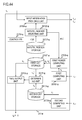
- the computing apparatus 11 of the first embodiment includes, for example, a natural number storage 1101, a natural number selecting unit 1102, an integer computing unit 1103, an input information providing unit 1104, a first computing unit 1105, a first power computing unit 1106, a first list storage 1107, a second computing unit 1108, a second power computing unit 1109, a second list storage 1110, a determining unit 1111, a final output unit 1112, and a controller 1113.
- Examples of the computing apparatus 11 include a device having a computing function and a memory function, such as a card reader-writer apparatus and a mobile phone, and a well-known or specialized computer that includes a CPU (central processing unit) and a RAM (random-access memory) in which a special program is loaded.
- a device having a computing function and a memory function such as a card reader-writer apparatus and a mobile phone
- a well-known or specialized computer that includes a CPU (central processing unit) and a RAM (random-access memory) in which a special program is loaded.
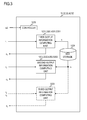
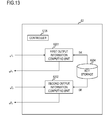
- the capability providing apparatus 12 of the first embodiment includes, for example, a first output information computing unit 1201, a second output information computing unit 1202, a key storage 1204 and a controller 1205.
- Examples of the capability providing apparatus 12 include a tamper-resistant module such as an IC card and an IC chip, a device having computing and memory functions, such as a mobile phone, and a well-known or specialized computer including a CPU and a RAM in which a special program is loaded.
- G and H be groups (for example commutative groups)
- f(x) be a decryption function for decrypting a ciphertext x, which is an element of the group H, with a particular decryption key s to obtain an element of the group G
- generators of the groups G and H be ⁇ g and ⁇ h , respectively
- X 1 and X 2 be random variables having values in the group G
- x 1 be a realization of the random variable X 1
- X 2 be a realization of the random variable X 2 .
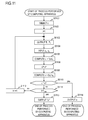
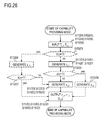
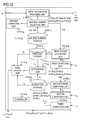
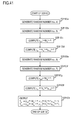
- the natural number selecting unit 1102 of the computing apparatus 11 randomly reads one pair of natural numbers (a, b) from a plurality of pairs of natural numbers (a, b) stored in the natural number storage 1101. At least part of information on the read pair of natural numbers (a, b) is sent to the integer computing unit 1103, the input information providing unit 1104, the first power computing unit 1106, and the second power computing unit 1109 (step S1100).
- the input information providing unit 1104 generates and outputs first input information ⁇ 1 and second input information ⁇ 2 which are elements of the group H and each of which corresponds to the input ciphertext x.
- each of the first input information ⁇ 1 and the second input information ⁇ 2 is information whose relation with the ciphertext x is scrambled. This enables the computing apparatus 11 to conceal the ciphertext x from the capability providing apparatus 12.
- the first input information ⁇ 1 of this embodiment further corresponds to the natural number b selected by the natural number selecting unit 1102 and the second input information ⁇ 2 further corresponds to the natural number a selected by the natural number selecting unit 1102. This enables the computing apparatus 11 to evaluate the decryption capability provided by the capability providing apparatus 12 with a high degree of accuracy (step S 1103).
- the first input information ⁇ 1 is input in the first output information computing unit 1201 of the capability providing apparatus 12 ( Fig. 3 ) and the second input information ⁇ 2 is input in the second output information computing unit 1202 (step S1200).
- the first output information computing unit 1201 uses the first input information ⁇ 1 and the decryption key s stored in the key storage 1204 to correctly compute f( ⁇ 1 ) with a probability greater than a certain probability and sets the result of the computation as first output information z 1 (step S1201).
- the second output information computing unit 1202 uses the second input information ⁇ 2 and the decryption key s stored in the key storage 1204 to correctly compute f( ⁇ 2 ) with a probability greater than a certain probability and sets the result of the computation as second output information z 2 (step S1202).
- the "certain probability" is a probability less than 100%.
- An example of the "certain probability” is a nonnegligible probability and an example of the "nonnegligible probability” is a probability greater than or equal to 1/ ⁇ (k), where ⁇ (k) is a polynomial that is a weakly increasing function (non-decreasing function) for a security parameter k. That is, the first output information computing unit 1201 and the second output information computing unit 1202 output computation results that have an intentional or unintentional error. In other words, the result of the computation by the first output information computing unit 1201 may or may not be f( ⁇ 1 ) and the result of the computation by the second output information computing unit 1202 may or may not be f( ⁇ 2 ).
- the first output information computing unit 1201 outputs the first output information z 1 and the second output information computing unit 1202 outputs the second output information z 2 (step S1203).
- the first output information z 1 is input in the first computing unit 1105 of the computing apparatus 11 ( Fig. 2 ) and the second output information z 2 is input in the second computing unit 1108.
- the first output information z 1 and the second output information z 2 are equivalent to the decryption capability provided by the capability providing apparatus 12 to the computing apparatus 11 (step S1104).
- generating (computing) f(x) b x 1 means computing a value of a formula defined as f(x) b x 1 . Any intermediate computation method may be used, provided that the value of the formula f(x) b x 1 can be eventually computed. The same applies to computations of the other formulae that appear herein.
- a computation defined at a group is expressed multiplicatively.
- ⁇ b " for ⁇ ⁇ G means that a computation defined at the group G is applied b times to ⁇ and " ⁇ 1 ⁇ 2 " for ⁇ 1 , ⁇ 2 ⁇ G means that a computation defined at the group G is performed on operands ⁇ 1 and ⁇ 2 (the same applies to second to fifth embodiments described later).
- the result u of the computation is sent to the first power computing unit 1106 (step S1105).
- the pair of the result u of the computation and u' computed on the basis of the result of the computation, (u, u'), is stored in the first list storage 1107 (step S 1106).
- the pair (v, v') of the result v of the computation and v' computed on the basis of the computation result is stored in the second list storage 1110 (step S 1109).
- the information indicating the computation is impossible means that the level of reliability that the capability providing apparatus 12 correctly performs computation is lower than a criterion defined by T max . In other words, the capability providing apparatus 12 was unable to perform a correct computation in T max trials.
- X be a random variable having a value in the group G.
- a sampler having an error X for w.
- a randomizable sampler For w ⁇ G, an entity that returns w a x' corresponding to a sample x' according to a random variable X whenever a natural number a is given is called a randomizable sampler having an error X for w.
- the combination of the input information providing unit 1104, the first output information computing unit 1201 and the first computing unit 1105 of this embodiment is a randomizable sampler having an error X 1 for f(x) (referred to as the "first randomizable sampler") and the combination of the input information providing unit 1104, the second output information computing unit 1202 and the second computing unit 1108 is a randomizable sampler having an error X 2 for f(x) (referred to as the "second randomizable sampler").
- L min (# ⁇ 1 (S), # ⁇ 2 (S)), where # ⁇ is the order of a set ⁇ . If the group G is a cyclic group or a group whose order is difficult to compute, it can be expected that the probability that an output other than " ⁇ " of the computing apparatus 11 is not f(x) is at most approximately T max 2 L/#S within a negligible error.
- L/#S is a negligible quantity and T max is a quantity approximately equal to a polynomial order, the computing apparatus 11 outputs a correct f(x) with an overwhelming probability.
- a proxy computing system of a second embodiment is an example that embodies the first randomizable sampler and the second randomizable sampler described above.
- the following description will focus on differences from the first embodiment and repeated description of commonalities with the first embodiment will be omitted.
- elements labeled with the same reference numerals have the same functions and the steps labeled with the same reference numerals represent the same processes.
- the proxy computing system 2 of the second embodiment includes a computing apparatus 21 in place of the computing apparatus 11 and a capability providing apparatus 22 in place of the capability providing apparatus 12.
- the computing apparatus 21 of the second embodiment includes, for example, a natural number storage 1101, a natural number selecting unit 1102, an integer computing unit 1103, an input information providing unit 2104, a first computing unit 2105, a first power computing unit 1106, a first list storage 1107, a second computing unit 2108, a second power computing unit 1109, a second list storage 1110, a determining unit 1111, a final output unit 1112 and a controller 1113.
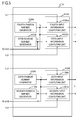
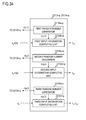
- the input information providing unit 2104 of this embodiment includes, for example, a first random number generator 2104a, a first input information computing unit 2104b, a second random number generator 2104c, and a second input information computing unit 2104d.
- the capability providing apparatus 22 of the second embodiment includes, for example, a first output information computing unit 2201, a second output information computing unit 2202, a key storage 1204, and a controller 1205.
- a decryption function f(x) is a homomorphic function
- a group H is a cyclic group
- a generator of the group H is ⁇ h
- the order of the group H is K H
- v f( ⁇ h ).
- a process of the second embodiment is the same as the process of the first embodiment except that steps S 1103 through S 1105, S 1108, and S1200 through S1203 of the first embodiment are replaced with steps S2103 through S2105, S2108, and S2200 through S2203, respectively.
- steps S2103 through S2105, S2108, and S2200 through S2203 will be described.
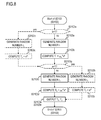
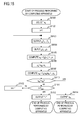
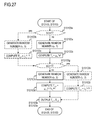
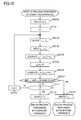
- the input information providing unit 2104 of the computing apparatus 21 ( Fig. 2 ) generates and outputs first input information ⁇ 1 and second input information ⁇ 2 which are elements of the group H and each of which corresponds to an input ciphertext x (Step S2103 of Fig. 6 ). A process at step S2103 of this embodiment will be described with reference to Fig. 8 .
- the first random number generator 2104a ( Fig. 4 ) generates a uniform random number r 1 that is a natural number greater than or equal to 0 and less than K H .
- the generated random number r 1 is sent to the first input information computing unit 2104b and the first computing unit 2105 (step S2103a).
- the superscript r1 on ⁇ h represents r 1 .
- ⁇ represents ⁇ ⁇ , namely ⁇ with subscript ⁇ , where ⁇ is a first letter, ⁇ is a second letter, and ⁇ is a number.
- the second random number generator 2104c generates a uniform random number r 2 that is a natural number greater than or equal to 0 and less than K H .
- the generated random number r 2 is sent to the second input information computing unit 2104d and the second computing unit 2108 (step S2103c).
- the first input information computing unit 2104b and the second input information computing unit 2104d output the first input information ⁇ 1 and the second input information ⁇ 2 thus generated (step S2103e).
- the first input information ⁇ 1 and the second input information ⁇ 2 in this embodiment are information whose relation with the ciphertext x is scrambled using random numbers r 1 , r 2 , respectively. This enables the computing apparatus 21 to conceal the ciphertext x from the capability providing apparatus 22.
- the first input information ⁇ 1 of this embodiment further corresponds to the natural number b selected by the natural number selecting unit 1102 and the second input information ⁇ 2 further corresponds to the natural number a selected by the natural number selecting unit 1102. This enables the computing apparatus 21 to evaluate the decryption capability provided by the capability providing apparatus 22 with a high degree of accuracy.
- the result of the computation may or may not be correct. That is, the result of the computation by the first output information computing unit 2201 may or may not be f( ⁇ h r1 x b ) (step S2201).
- the result of the computation may or may not be correct. That is, the result of the computation by the second output information computing unit 2202 may or may not be f( ⁇ h r2 x a ) (step S2202).
- the first output information computing unit 2201 outputs the first output information z 1 and the second output information computing unit 2202 outputs the second output information z 2 (step S2203).
- the first output information z 1 is input in the first computing unit 2105 of the computing apparatus 21 ( Fig. 2 ) and the second output information z 2 is input in the second computing unit 2108.
- the first output information z 1 and the second output information z 2 are equivalent to the decryption capability provided by the capability providing apparatus 22 to the computing apparatus 21 (step S2104).
- the first computing unit 2105 uses the input random number r 1 and the first output information z 1 to compute z 1 ⁇ -r1 and sets the result of the computation as u.
- the result u of the computation is sent to the first power computing unit 1106.
- the second computing unit 2108 uses the input random number r 2 and the second output information z 2 to compute z 2 ⁇ -r2 and sets the result of the computation as v.
- the result v of the computation is sent to the second power computing unit 1109.
- c be a natural number
- R and R' be random numbers
- z 1 ⁇ -r1 and z 2 ⁇ -r2 are, likewise, outputs of randomizable samplers having errors X 1 and X 2 , respectively, for f(x).
- the amounts of computations performed by samplers are in general smaller than the amounts of computations by randomizable samplers.
- the following description will focus on differences from the first and second embodiments and repeated description of commonalities with the first and second embodiments will be omitted.
- a proxy computing system 3 of the third embodiment includes a computing apparatus 31 in place of the computing apparatus 21 and a capability providing apparatus 32 in place of the capability providing apparatus 22.
- the computing apparatus 31 of the third embodiment includes, for example, a natural number storage 1101, a natural number selecting unit 1102, an integer computing unit 1103, an input information providing unit 3104, a first computing unit 2105, a first power computing unit 1106, a first list storage 1107, a second computing unit 2108, a second power computing unit 1109, a second list storage 1110, a determining unit 1111, a final output unit 1112, a controller 1113, and a third computing unit 3109.
- the capability providing apparatus 32 of the third embodiment includes, for example, a first output information computing unit 2201, a second output information computing unit 2202, a key storage 1204, a controller 1205, and a third output information computing unit 3203.
- a process of the third embodiment is the same as the process of the second embodiment except that steps S2103 through S2105, S2108, and S2200 through S2203 of the second embodiment are replaced with steps S3103 through S3105, S3108, S3200 through S3203, and S3205 through 3209, respectively.
- the following description will focus on processes at steps S3103 through S3105, S3108, S3200 through S3203, and S3205 through S3209.
- the input information providing unit 3104 of the computing apparatus 31 ( Fig. 2 ) generates and outputs first input information ⁇ 1 and second input information ⁇ 2 which are elements of a group H and each of which corresponds to an input ciphertext x (step S3103 of Fig. 6 ).
- the controller 1113 controls the input information providing unit 3104 according to natural numbers (a, b) selected by the natural number selecting unit 1102.
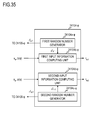
- the third input information computing unit 3104f uses the input random number r 3 and a ciphertext x to compute x r3 and sets x r3 as first input information ⁇ 1 (step S3103c). Then the process proceeds to step S3103g.
- the first input information computing unit 2104b, the second input information computing unit 2104d, and the third input information computing unit 3104f output the first input information ⁇ 1 and the second input information ⁇ 2 thus generated along with information on the corresponding natural numbers (a, b) (step S3103e).
- the first input information ⁇ 1 and the second input information ⁇ 2 in this embodiment are information whose relation with the ciphertext x is scrambled using random numbers r 1 , r 2 and r 3 . This enables the computing apparatus 31 to conceal the ciphertext x from the capability providing apparatus 32.
- the controller 1205 controls the first output information computing unit 2201, the second output information computing unit 2202 and the third output information computing unit 3203 according to input natural numbers (a, b).
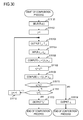
- step S3205 Determination is made by the controller 1113 as to whether b is equal to 1 (step S3205). If it is determined that b ⁇ 1, the process at step S2201 described above is performed. Then, determination is made by the controller 1113 as to whether a is equal to 1 (step S3208). If it is determined that a ⁇ 1, the process at step S2202 described above is performed and then the process proceeds to step S3203.
- the result of the computation may or may not be correct. That is, the result of the computation by the third output information computing unit 3203 may or may not be f(x r3 ) (step S3209). Then the process proceeds to step S3203.
- the result of the computation may or may not be correct. That is, the result of the computation by the third output information computing unit 3203 may or may not be f(x r3 ) (step S3206).
- the first output information computing unit 2201 which has generated the first output information z 1 , outputs the first output information z 1
- the second output information computing unit 2202 which has generated the second output information z 2 , outputs the second output information z 2
- the third output information computing unit 3202 which has generated the third output information z 3 , outputs the third output information z 3 (step S3203).
- the first output information z 1 is input in the first computing unit 2105 of the computing apparatus 31 ( Fig. 2 ), the second output information z 2 is input in the second computing unit 2108, and the third output information z 3 is input in the third computing unit 3109 (step S3104).
- the result v of the computation is sent to the second power computing unit 1109.
- the third computing unit 3109 may store each pair of random number r 3 and z 3 computed on the basis of the random number r 3 in a storage, not depicted, in sequence as ( ⁇ 1 , ⁇ 1 ), ( ⁇ 2 , ⁇ 2 ), ..., ( ⁇ m , ⁇ m ), ...
- m is a natural number.
- the third computing unit 3109 may compute ⁇ 1 , ⁇ 2 , .., ⁇ m that satisfies ⁇ 1 ⁇ 1 + ⁇ 2 ⁇ 2 + ...
- the properties are based on the fact that R is a random number. Therefore, considering that r 3 is a random number, z 1/R serves as a sampler having an error X 3 for f(x) likewise.
- a proxy computing system of a fourth embodiment is another example that embodies the first and second randomizable samplers described above.
- the proxy computing system 4 of the fourth embodiment includes a computing apparatus 41 in place of the computing apparatus 11 and a capability providing apparatus 42 in place of the capability providing apparatus 12.
- the computing apparatus 41 of the fourth embodiment includes, for example, a natural number storage 1101, a natural number selecting unit 1102, an integer computing unit 1103, an input information providing unit 4104, a first computing unit 4105, a first power computing unit 1106, a first list storage 1107, a second computing unit 4108, a second power computing unit 1109, a second list storage 1110, a determining unit 1111, a final output unit 1112, and a controller 1113.
- a natural number storage 1101 a natural number selecting unit 1102
- an integer computing unit 1103 an input information providing unit 4104
- a first computing unit 4105 includes a first power computing unit 1106, a first list storage 1107, a second computing unit 4108, a second power computing unit 1109, a second list storage 1110, a determining unit 1111, a final output unit 1112, and
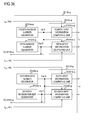
- the input information providing unit 4104 of this embodiment includes, for example, a fourth random number generator 4104a, a fifth random number generator 4104b, a first input information computing unit 4104c, a sixth random number generator 4104d, a seventh random number generator 4104e, and a second input information computing unit 4104f.
- the first input information computing unit 4104c includes, for example, a fourth input information computing unit 4104ca and a fifth input information computing unit 4104cb.
- the second input information computing unit 4104f includes, for example, a sixth input information computing unit 4104fa and a seventh input information computing unit 4104fb.
- the capability providing apparatus 42 of the fourth embodiment includes, for example, a first output information computing unit 4201, a second output information computing unit 4202, a key storage 1204, and a controller 1205.
- a group H is the direct product group G x G of a group G
- the group G is a cyclic group
- a ciphertext x (c 1 , c 2 ) ⁇ H
- f(c 1 , c 2 ) is a homomorphic function
- a generator of the group G is ⁇ g
- the order of the group G is K G
- a process of the fourth embodiment is the same as the process of the first embodiment except that steps S 1103 through S 1105, S 1108, and S1200 through S1203 of the first embodiment are replaced with steps S4103 through S4105, S4108, and S4200 through S4203, respectively.
- steps S4103 through S4105, S4108, and S4200 through S4203 will be described.
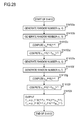
- a process at step S4103 of this embodiment will be described below with reference to Fig. 9 .
- the fourth random number generator 4104a ( Fig. 5 ) generates a uniform random number r 4 that is a natural number greater than or equal to 0 and less than K G .
- the generated random number r 4 is sent to the fourth input information computing unit 4104ca, the fifth input information computing unit 4104cb, and the first computing unit 4105 (step S4103a).
- the fifth random number generator 4104b generates a uniform random number r 5 that is a natural number greater than or equal to 0 and less than K G .
- the generated random number r 5 is sent to the fifth input information computing unit 4104cb and the first computing unit 4105 (step S4103b).
- the fourth input information computing unit 4104ca uses a natural number b selected by the natural number selecting unit 1102, c 2 included in the ciphertext x, and the random number r 4 to compute fourth input information c 2 b W r4 (step S4103c).
- the fifth input information computing unit 4104cb uses the natural number b selected by the natural number selecting unit 1102, c 1 included in the ciphertext x, and random numbers r 4 and r 5 to compute fifth input information c 1 b V r4 ⁇ g r5 (step S4103d).
- the sixth random number generator 4104d generates a uniform random number r 6 that is a natural number greater than or equal to 0 and less than K G .
- the generated random number r 6 is sent to the sixth input information computing unit 4104fa, the seventh input information computing unit 4104fb, and the second computing unit 4108 (step S4103e).
- the seventh random number generator 4104e generates a uniform random number r 7 that is a natural number greater than or equal to 0 and less than K G .
- the generated random number r 7 is sent to the sixth input information computing unit 4104fa and the second computing unit 4108 (step S4103f).
- the sixth input information computing unit 4104fa uses a natural number a selected by the natural number electing unit 1102, c 2 included in the ciphertext x, and the random number r 6 to compute sixth input information c 2 a W r6 (step S4103g).
- the seventh input information computing unit 4104fb uses the natural number a selected by the natural number selecting unit 1102, c 1 included in the ciphertext x, and the random number r 7 to compute seventh input information c 1 a V r6 ⁇ g r7 (step S4103h).
- the result of the computation may or may not be correct. That is, the result of the computation by the first output information computing unit 4201 may or may not be f(c 1 b V r4 ⁇ g r5 , c 2 b W r4 ) (step S4201).
- the result of the computation may or may not be correct.
- the result of the computation by the second output information computing unit 4202 may or may not be f(c 1 a V r6 ⁇ g r7 , c 2 a W r6 ) (step S4202).
- the first output information computing unit 4201 outputs the first output information z 1 and the second output information computing unit 4202 outputs the second output information z 2 (step S4203).
- the first output information z 1 is input in the first computing unit 4105 of the computing apparatus 41 ( Fig. 2 ) and the second output information z 2 is input in the second computing unit 4108 (step S4104).
- the first computing unit 4105 uses the input first output information z 1 and random numbers r 4 and r 5 to compute z 1 Y -r4 ⁇ g -r5 and sets the result of the computation as u (step S4105).
- the result u of the computation is sent to the first power computing unit 1106.
- the second computing unit 4108 uses the input second output information z 2 and random numbers r 6 and r 7 to compute z 2 Y -r6 ⁇ g -r7 and sets the result of the computation as v.
- the result v of the computation is sent to the second power computing unit 1109.
- c be a natural number
- R 1 , R 2 , R 1 ' and R 2 ' be random numbers
- z 1 Y -r4 ⁇ g -r5 and z 2 Y -r6 ⁇ g -r7 are, likewise, outputs of randomizable samplers having errors X 1 and X 2 , respectively, for f(c 1 , c 2 ).
- a plurality of pairs (a, b) of natural numbers a and b that are relatively prime to each other are stored in the natural number storage 1101 of the computing apparatus and the pairs (a, b) are used to perform the processes.
- one of a and b may be a constant.
- a may be fixed at 1 or b may be fixed at 1.
- one of the first randomizable sampler and the second randomizable sampler may be replaced with a sampler.
- the process for selecting the constant a or b is unnecessary, the constant a or b is not input in the processing units and each processing units can treat it as a constant in computations.
- a fifth embodiment is an example of such a variation, in which b is fixed at 1 and the second randomizable sampler is replaced with a sampler.
- the following description will focus on differences from the first embodiment. Specific examples of the first randomizable sampler and the sampler are similar to those described in the second to fourth embodiments and therefore description of the first randomizable sampler and the sampler will be omitted.
- a proxy computing system 5 of the fifth embodiment includes a computing apparatus 51 in place of the computing apparatus 11 of the first embodiment and a capability providing apparatus 52 in place of the capability providing apparatus 12.
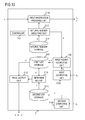
- the computing apparatus 51 of the fifth embodiment includes, for example, a natural number storage 5101, a natural number selecting unit 5102, an input information providing unit 5104, a first computing unit 5105, a first power computing unit 1106, a first list storage 1107, a second computing unit 5108, a second list storage 5110, a determining unit 5111, a final output unit 1112, and a controller 1113.
- the capability providing apparatus 52 of the fifth embodiment includes, for example, a first output information computing unit 5201, a second output information computing unit 5202, a key storage 1204, and a controller 1205.
- G and H be groups (for example commutative groups)
- f(x) be a decryption function for decrypting a ciphertext x, which is an element of the group H, with a particular decryption key s to obtain an element of the group G
- generators of the groups G and H be ⁇ g and ⁇ h , respectively
- X 1 and X 2 be random variables having values in the group G
- x 1 be a realization of the random variable X 1
- x 2 be a realization of the random variable X 2 . It is assumed here that a plurality of natural numbers a are stored in the natural number storage 5101 of the computing apparatus 51.
- the natural number selecting unit 5102 of the computing apparatus 51 randomly reads one natural number a from among the plurality of natural numbers a stored in the natural number storage 5101. Information on the read natural number a is sent to the input information providing unit 5104 and the first power computing unit 1106 (step S5100).
- the input information providing unit 5104 generates and outputs first input information ⁇ 1 and second input information ⁇ 2 which are elements of the group H and each of which corresponds to an input ciphertext x.
- the first input information ⁇ 1 and the second input information ⁇ 2 are information whose relation with the ciphertext x is scrambled. This enables the computing apparatus 51 to conceal the ciphertext x from the capability providing apparatus 52.
- the second input information ⁇ 2 of this embodiment further corresponds to the natural number a selected by the natural number selecting unit 5102. This enables the computing apparatus 51 to evaluate the decryption capability provided by the capability providing apparatus 52 with a high degree of accuracy (step S5103).
- the first input information ⁇ 1 is input in the first output information computing unit 5201 of the capability providing apparatus 52 ( Fig. 3 ) and the second input information ⁇ 2 is input in the second output information computing unit 5202 (step S5200).
- the first output information computing unit 5201 uses the first input information ⁇ 1 and the decryption key s stored in the key storage 1204 to correctly compute f( ⁇ 1 ) with a probability greater than a certain probability and sets the result of the computation as first output information z 1 (step S5201).
- the second output information computing unit 5202 uses the second input information ⁇ 2 and the decryption key s stored in the key storage 1204 to correctly compute f( ⁇ 2 ) with a probability greater than a certain probability and sets the result of the computation as second output information z 2 (step S5202). That is, the first output information computing unit 5201 and the second output information computing unit 5202 output computation results that have an intentional or unintentional error. In other words, the result of the computation by the first output information computing unit 5201 may or may not be f( ⁇ 1 ) and the result of the computation by the second output information computing unit 5202 may or may not be f( ⁇ 2 ).
- the first output information computing unit 5201 outputs the first output information z 1 and the second output information computing unit 5202 outputs the second output information z 2 (step S5203).
- the first output information z 1 is input in the first computing unit 5105 of the computing apparatus 51 ( Fig. 10 ) and the second output information z 2 is input in the second computing unit 5108.
- the first output information z 1 and the second output information z 2 are equivalent to the decryption capability provided by the capability providing apparatus 52 to the computing apparatus 51 (step S5104).
- the result u of the computation is sent to the first power computing unit 1106 (step S5105).
- the pair of the result u of the computation and u' computed on the basis of the result of the computation, (u, u'), is stored in the first list storage 1107 (step S 1106).
- a specific example of the result v of the computation is a result v of the computation of any of the second to fourth embodiments.
- the result v of the computation is stored in the second list storage 5110 (step S5108).
- a black-box F( ⁇ ) of f( ⁇ ) is a processing unit that takes an input of ⁇ ⁇ H and outputs z ⁇ G.
- each of the first output information computing unit 5201 and the second output information computing unit 5202 is equivalent to the black box F( ⁇ ) for the decryption function f( ⁇ ).
- ⁇ is a positive value and is equivalent to the "certain probability" stated above.
- a self-corrector C F (x) is a processing unit that takes an input of x ⁇ H, performs computation by using a black-box F( ⁇ ) for f( ⁇ ), and outputs j ⁇ G ⁇ .
- the computing apparatus 51 is equivalent to the self-corrector C F (x).
- j C F x > 1 - ⁇ If this is the case, the self-corrector C F (x) is called a robust self-corrector.
- An example of the negligible error ⁇ is a function vale ⁇ (k) of a security parameter k.
- An example of the function value ⁇ (k) is a function value ⁇ (k) such that ⁇ (k)p(k) ⁇ converges to 0 for a sufficiently large k, where p(k) is an arbitrary polynomial.
- a robust self-corrector can be constructed from an almost self-corrector.
- a robust self-corrector can be constructed by executing an almost self-constructor multiple times for the same x and selecting the most frequently output value, except ⁇ , as j.
- an almost self-corrector is executed O(log(1/ ⁇ )) times for the same x and the value most frequently output is selected as j to construct robust self-corrector.
- O( ⁇ ) represents O notation.
- An upper bound of the probability Pr ⁇ a ⁇ and ⁇ ⁇ e g
- ⁇ (k) a computation defined by the pair (G, ⁇ ) is called a pseudo-free action.
- a computation defined by a group is expressed multiplicatively in the fifth embodiment. That is, " ⁇ a " for ⁇ ⁇ G means that a computation defined at the group G is applied a times to ⁇ .
- An example of the negligible function ⁇ (k) is such that ⁇ (k)p(k) ⁇ converges to 0 for a sufficiently large k, where p(k) is an arbitrary polynomial.
- a computation defined by the pair (G, ⁇ ) is a pseudo-free action. For example, if the number of the elements
- of a set ⁇ ⁇ ⁇ ⁇ a( ⁇ )
- the group G is a residue group Z/pZ modulo prime p
- the prime p is the order of 2 k
- the set ⁇ ⁇ 0, ..., p - 2 ⁇
- a( ⁇ ) is ⁇ a ⁇ Z/pZ
- p - 1.
- the probability of Formula (4) is less than C -1 2 -k and a computation defined by such pair (G, ⁇ ) is a pseudo-free action.
- ⁇ (k') is asymptotically small
- k 0 is determined for an arbitrary constant ⁇ and the function value ⁇ (k') for any k' that satisfies k 0 ⁇ k' for k 0 is less than ⁇ .
- An example of k' is a security parameter k.
- ⁇ (k') is asymptotically large means that k 0 is determined for an arbitrary constant ⁇ and the function value 1 - ⁇ (k') for any k' that satisfies k 0 ⁇ k' for k 0 is less than ⁇ .
- the probability distribution D does not depend on a natural number a. That the probability distribution D a and the probability distribution D cannot be distinguished from each other means that the probability distribution D a and the probability distribution D cannot be distinguished from each other by a polynomial time algorithm.
- negligible ⁇ is a function value ⁇ (k) of the security parameter k.
- An example of the function value ⁇ (k) is a function value such that ⁇ (k)p(k) ⁇ converges to 0 for a sufficiently large k, where p(k) is an arbitrary polynomial.
- a sixth embodiment is a mode in which the present invention is applied to decryption of the GHV encryption scheme (see Reference literature 1 " C, Genrty, S. Halevi and V. Vaikuntanathan, 'A Simple BGNType Cryptosystem from LWE,' Advances in Cryptology - EUROCRYPT 2010, LNCS 6110, pp. 506 - 522, Springer-Verlag, 2010 ", for example), which is a type of lattice-based cryptography.
- the following description will focus on differences from the embodiments described above.
- a proxy computing system 6 of the sixth embodiment includes a computing apparatus 61 in place of the computing apparatus 11 of the first embodiment and a capability providing apparatus 62 in place of the capability providing apparatus 12.
- the computing apparatus 61 of the sixth embodiment includes, for example, a matrix storage 6101, a matrix selecting unit 6102, an input information providing unit 6104, a first computing unit 6105, a matrix product computing unit 6106, a first list storage 6107, a second computing unit 6108, a second list storage 6110, a determining unit 6111, a final output unit 6112, and a controller 1113.
- the input information providing unit 6104 of this embodiment includes, for example, a first random matrix selecting unit 6104a, a second random matrix selecting unit 6104b, a first encryption unit 6104c, a second encryption unit 6104d, a first input information computing unit 6104e, a third random matrix selecting unit 6104f, a fourth random matrix selecting unit 6104g, a third encryption unit 6104h, a fourth encryption unit 6104i, and a second input information computing unit 6104j.
- the capability providing apparatus 62 of the sixth embodiment includes, for example, a first output information computing unit 6201, a second output information computing unit 6202, a key storage 6204, and a controller 1205.
- G M be a set of l matrices
- H M be a set of l ⁇ l matrices
- M X 1 and M X 2 be random variables having values in the set G M
- M x 1 be a realization of the random variable M X 1
- M x 2 be a realization of the random variable M X 2
- a M be an element of the set H M .
- PK be a l ⁇ ⁇ matrix which is an encryption key (public key)
- PT be a plaintext PT ⁇ G M which is an element of the set G M
- x M be a ciphertext x M ⁇ H M which is an element of the set H M
- ENC M be an encryption function for encrypting the plaintext PT which is an element of the set G M to obtain the ciphertext x M ⁇ H M
- f M (x M ) be a decryption function for decrypting the ciphertext x M ⁇ H M with a particular decryption key SK to obtain the plaintext PT which is an element of the
- the decryption function f M (x M ) is a homomorphic function.
- G M be a set of l ⁇ l matrices (Z/2Z) l ⁇ l
- H M be a set of l ⁇ l matrices (Z/qZ) l ⁇ l
- the encryption key PK be a l ⁇ ⁇ matrix (Z/qZ) l ⁇ ⁇
- the decryption key SK be a l ⁇ l matrix (Z/qZ) l ⁇ l
- CM be a randomly selected ⁇ ⁇ l matrix (Z/qZ) ⁇ ⁇ l
- NM be a l ⁇ l matrix (Z/qZ) l ⁇ l according to a Gaussian distribution
- UM be a l ⁇ l unit matrix (Z/2Z) l ⁇ l
- the encryption function ENC M (PT) be PK ⁇ CM + 2 ⁇
- ⁇ T is the transposed matrix of ⁇
- (Z/qZ) ⁇ ⁇ l is a matrix of ⁇ rows and l columns having members of a factor ring Z/qZ modulo q as elements.
- the product between matrices ⁇ 1 and ⁇ 2 is written as ⁇ 1 ⁇ ⁇ 2 and the sum of matrices ⁇ 1 and ⁇ 2 is written as ⁇ 1 + ⁇ 2 .
- a matrix that is equal to the each element of a matrix ⁇ by a natural number ⁇ is written as ⁇ ⁇ ⁇ .
- a plurality of matrices a M ⁇ H M are stored in the matrix storage 6101 of the computing apparatus 61 ( Fig. 12 ) and a decryption key SK is stored in the key storage 6204 of the capability providing apparatus 62 ( Fig. 13 ) in a secure manner.
- the matrix selecting unit 6102 of the computing apparatus 61 uniformly randomly selects and reads one matrix a M from among the plurality of matrices stored in the matrix storage 6101.
- Information of the read matrix a M is sent to the input information providing unit 6104 and the matrix product computing unit 6106 (step S6100).
- the input information providing unit 6104 generates and outputs first input information M ⁇ 1 and second input information M ⁇ 2 which are elements of the set H M and each of which corresponds to an input ciphertext x M .
- the first input information M ⁇ 1 and the second input information M ⁇ 2 are information whose relation with the ciphertext x M is scrambled.
- the second input information M ⁇ 2 further corresponds to an element a M .
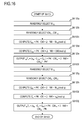
- step S6103 A specific example of step S6103 will be described below with reference to Fig. 16 .
- the first random matrix selecting unit 6104a of the input information providing unit 6104 uniformly randomly selects an element M R1 of the set G M (step 6103a).
- the selected M R1 is sent to the first encryption unit 6104c and the first computing unit 6105 (step S6103a).
- the second random matrix selecting unit 6104b selects uniform and random matrices CM 11 and CM 12 ⁇ (Z/qZ) ⁇ l of ⁇ ⁇ l.
- the selected CM 11 and CM 12 are sent to the first input information computing unit 6104e (step S6103b).
- the first ciphertext C R1 is sent to the first input information computing unit 6104e (step S6103c).
- the second ciphertext C UM is sent to the first input information computing unit 6104e (step S6103d).
- the first input information computing unit 6104e further takes an input of the ciphertext x M .
- the first input information computing unit 6104e obtains and outputs (x M ⁇ C UM + C R1 )+ PK ⁇ CM 11 + 2 ⁇ NM + CM 12 T ⁇ PK T as first input information M ⁇ 1 . Note that the order of the products of the matrices is not particularly specified.
- the third random matrix selecting unit 6104f uniformly randomly selects an element M R2 of the set G M .
- the selected M R2 is sent to the third encryption unit 6104h and the second computing unit 6108 (step S6103f).
- the fourth random matrix selecting unit 6104g selects random matrices CM 21 and CM 22 ⁇ (Z/qZ) ⁇ l of ⁇ ⁇ l.
- the selected CM 21 and CM 22 are sent to the second input information computing unit 6104j (step S6103g).
- the third ciphertext C R2 is sent to the second input information computing unit 6104j (step S6103h).
- Matrix a M is input in the fourth encryption unit 6104i.
- the fourth ciphertext C a is sent to the second input information computing unit 6104j (step S6103i).
- the second input information computing unit 6104j further takes an input of the ciphertext x M .
- the second input information computing unit 6104j obtains and outputs (x M ⁇ C a + C R2 ) + PK ⁇ CM 21 + 2 ⁇ NM + CM 22 T ⁇ PK T as second input information M ⁇ 2 .
- the first input information M ⁇ 1 is input in the first output information computing unit 6201 of the capability providing apparatus 62 ( Fig. 13 ) and the second input information M ⁇ 2 is input in the second output information computing unit 6202 (step S6200).
- the first output information computing unit 6201 outputs the first output information M z 1 and the second output information computing unit 6202 outputs the second output information M z 2 (step S6203).
- the first output information M z 1 is input in the first computing unit 6105 of the computing apparatus 61 ( Fig. 12 ) and the second output information M z 2 is input in the second computing unit 6108.
- the first output information M z 1 and the second output information M z 2 are equivalent to the decryption capability provided by the capability providing apparatus 62 to the computing apparatus 61 (step S6104).
- the first computing unit 5105 uses the first output information M z 1 to compute M z 1 - M R1 and sets the result of the computation as u M .
- the result u M of the computation is sent to the matrix product computing unit 6106.
- the pair (u M , u M ') of the result u M of the computation and u M ' computed on the basis of the result of the computation is stored in the first list storage 6107 (step S6106).
- the second computing unit 6108 uses the second output information M z 2 to compute M z 2 - M R2 and sets the result of the computation as v M .
- the result v M of the computation is stored in the second list storage 6110.
- the u M thus obtained can be a decryption result f M (x M ) resulting from decrypting the ciphertext x M with the decryption key SK with a high probability (the reason will be described later). Therefore, the process described above is repeated multiple times and the value most frequently obtained among the values obtained at step S6114 can be chosen as the decryption result.
- M z 2 F M ( M ⁇ 2 )
- M z 1 F M ( M ⁇ 1 )
- a correct decryption result f M (x M ) can be obtained in the sixth embodiment as well.
- G and H in the section «Reason why decryption result f(x) can be obtained» in the fifth embodiment are replaced with G M and H M
- f(x) is replaced with f M (x M )
- ⁇ is replaced with M ⁇
- F( ⁇ ) is replaced with F M ( M ⁇ )
- z is replaced with M z
- x is replaced with x M
- X 1 and X 2 are replaced with M X 1 and M X 2
- x 1 and x 2 are replaced with M x 1 and M x 2
- eg is replaced with a unit matrix M e g of ( ⁇ 1,l ) l ⁇ l
- multiplicative expressions are replaced with additive expressions (for example
- the capability providing apparatus provides first output information z 1 and second output information z 2 to the computing apparatus without providing a decryption key and the computing apparatus outputs u b' v a' in the embodiments described above.
- the probability of u b' v a' being the decryption value of the ciphertext x is high.
- the capability providing apparatus can provide the decryption capability to the computing apparatus without providing a decryption key.
- the present invention is not limited to the embodiments described above.
- the random variables X 1 , X 2 and X 3 may be the same or different.
- the random variables M X 1 and M X 2 may be the same or different.
- Each of the first random number generator, the second random number generator, the third random number generator, the fourth random number generator, the fifth random number generator, the sixth random number generator and the seventh random number generator generates uniform random numbers to achieve the highest security of the proxy computing system. However, if the level of security required is not so high, at least some of the first random number generator, the second random number generator, the third random number generator, the fourth random number generator, the fifth random number generator, the sixth random number generator and the seventh random number generator may generate random numbers that are not uniform random numbers. Similarly, a nonuniform random matrix may be selected in the sixth embodiment instead of uniformly randomly selecting a matrix.
- random numbers which are natural numbers greater than or equal to 0 and less than K H or random numbers that are natural numbers greater than or equal to 0 and less than K G be selected as in the embodiments described above, random numbers that are natural numbers greater than or equal to K H or K G may be selected instead.
- the process of the capability providing apparatus may be performed multiple times each time the computing apparatus provides first input information ⁇ 1 and second input information ⁇ 2 which are elements of a group H and correspond to the same a and b to the capability providing apparatus.
- This enables the computing apparatus to obtain a plurality of pieces of first output information z 1 , second output information z 2 , and third output information z 3 each time the computing apparatus provides first input information ⁇ 1 and the second input information ⁇ 2 to the capability providing apparatus. Consequently, the number of exchanges and the amount of communication between the computing apparatus and the capability providing apparatus can be reduced.
- the computing apparatus may provide a plurality of pieces of first input information ⁇ 1 and second input information ⁇ 2 to the capability providing apparatus at once and may obtain a plurality of pieces of corresponding first output information z 1 , second output information z 2 and third output information z 3 at once. This can reduce the number of exchanges between the computing apparatus and the capability providing apparatus. The same applies to the first input information M ⁇ 1 and the second input information M ⁇ 2 of the sixth embodiment.
- Check may be made to see whether u and v obtained at the first computing unit and the second computing unit of any of the first to fifth embodiments are elements of the group G. If u and v are elements of the group G, the process described above may be continued; if u or v is not an element of the group G, information indicating that the computation is impossible, for example, the symbol " ⁇ " may be output. Similarly, check may be made to see whether u M and v M obtained at the first computing unit and the second computing unit of the sixth embodiment is an element of G M . If u M and v M are elements of G M , the process described above may be continued; if u M or G M is not an element of G M , information indicating that the computation is impossible, for example, the symbol " ⁇ " may be output.
- the units of the computing apparatus may exchange data among them directly or through a memory, which is not depicted.
- the units of the capability providing apparatus may exchange data among them directly or through a memory, which is not depicted.
- the processes described above may be performed in time sequence as described, or may be performed in parallel with one another or individually, depending on the throughput of the apparatuses that performs the processes or as needed. It would be understood that other modifications can be made without departing from the spirit of the present invention.
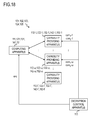
- a proxy computing system 101 of the seventh embodiment includes, for example, a computing apparatus 111 that not have a decryption key, capability providing apparatuses 112-1, ..., 112- ⁇ ( ⁇ is an integer greater than or equal to 2) that has decryption keys s 1 , ..., s ⁇ , respectively, and a decryption control apparatus 113 that controls a decryption capability of the computing apparatus 111.
- the decryption control apparatus 113 controls a decryption capability provided by the capability providing apparatuses 112-1, ..., 112- ⁇ to the computing apparatus 111 and the computing apparatus 111 uses the decryption capability provided by the capability providing apparatus 112-1, ..., 112- ⁇ to decrypt a ciphertext.
- the computing apparatus 111, the capability providing apparatuses 112-1, ..., 112- ⁇ , and the decryption control apparatus 113 are configured so that information can be exchanged between them.
- the computing apparatus 111, the probability providing apparatuses 112-1, ..., 112- ⁇ , and the decryption control apparatus 113 are capable of exchange information through a transmission line, a network, a portable recording medium, and/or other medium.
- the computing apparatus 111 of the seventh embodiment includes, for example, a natural number storage 11101, a natural number selecting unit 11102, an integer computing unit 11103, an input information providing unit 11104, a first computing unit 11105, a first power computing unit 11106, a first list storage 11107, a second computing unit 11108, a second power computing unit 11109, a second list storage 11110, a determining unit 11111, a final output unit 11112, a recovering unit 11100, and a controller 11113.
- a natural number storage 11101 for example, a natural number storage 11101, a natural number selecting unit 11102, an integer computing unit 11103, an input information providing unit 11104, a first computing unit 11105, a first power computing unit 11106, a first list storage 11107, a second computing unit 11108, a second power computing unit 11109, a second list storage 11110, a determining unit 11111, a final output unit 11112, a recovering unit 11100, and a controller 11113.
- Examples of the computing apparatus 111 include a device having a computing function and a memory function, such as a card reader-writer apparatus and a mobile phone, and a well-known or specialized computer that includes a CPU (central processing unit) and a RAM (random-access memory) in which a special program is loaded.
- a device having a computing function and a memory function such as a card reader-writer apparatus and a mobile phone
- a well-known or specialized computer that includes a CPU (central processing unit) and a RAM (random-access memory) in which a special program is loaded.
- Examples of the capability providing apparatus 112- include a tamper-resistant module such as an IC card and an IC chip, a device having computing and memory functions, such as a mobile phone, and a well-known or specialized computer including a CPU and a RAM in which a special program is loaded.
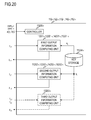
- the capability providing apparatuses 112-1, ..., 112- ⁇ are selected from the capability providing apparatuses 112-1, ..., 112- ⁇ . If there are capability providing apparatuses 112-( + 1), ..., 112- ⁇ , the capability providing apparatuses 112-( + 1), ..., 112- ⁇ have the same configuration as the capability providing apparatus 112- .
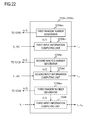
- the decryption control apparatus 113 of the seventh embodiment includes, for example, an ciphertext storage 11301, a control instruction unit 11302, an output unit 11303, a controller 11304, a key storage 11305, and an encryption unit 11306.
- Examples of the decryption control apparatus 113 include a device having computing and memory functions, such as a mobile phone, and a well-known or specialized computer that includes a CPU and a RAM in which a special program is loaded.
- ⁇ be an integer greater than or equal to 2
- ⁇ 1, ..., ⁇
- ⁇ be a decryption function for decrypting a ciphertext which is an element of the group with a particular decryption key to obtain an element of the group generators of the groups and be and respectively, and be random variables having values in the group be a realization of the random variable and be a realization of the random variable
- ⁇ in this embodiment is a constant. It is assumed here that a plurality of pairs of natural numbers and that are relatively prime to each other are stored in the natural number storage 11101 of the computing apparatus 111.
- the term "natural number" means an integer greater than or equal to 0.
- pairs of natural numbers and corresponding to a subset of are stored in the natural number storage 11101.
- a particular decryption key is stored in the key storage 12104 of the capability providing apparatus 112- in a secure manner.
- encryption keys pk 1 , ..., pk ⁇ corresponding to the decryption keys s 1 , ..., s ⁇ , respectively, are stored in the key storage 11305 of the decryption control apparatus 113.
- Examples of the decryption keys and encryption keys are secret keys and public keys of public key cryptography.
- Processes of the computing apparatus 111 are performed under the control of the controller 11113, processes of the capability providing apparatus 112- are performed under the control of the controller 11205- , and processes of the decryption control apparatus 113 are performed under the control of the controller 11304.
- a message mes is input in the encryption unit 11306 of the decryption control apparatus 113 ( Fig. 21 ).
- the encryption unit 11306 randomly selects ⁇ encryption keys pk 1 , ..., pk ⁇ from the encryption keys pk 1 , ..., pk ⁇ (step S11301).
- the encryption unit 11306 generates ⁇ shares sha 1 , ..., sha ⁇ from the message mes(step S11302). A method for generating the shares sha 1 , ..., sha ⁇ will be described below.
- the message mes is secret-shared by a secret sharing scheme such as Shamir's secret sharing to generate shares sha 1 , ..., sha ⁇ (End of description of examples of the method for generating shares).
- a secret sharing scheme such as Shamir's secret sharing to generate shares sha 1 , ..., sha ⁇ (End of description of examples of the method for generating shares).
- the generated ciphertexts ⁇ 1 , ..., ⁇ ⁇ are stored in the ciphertext storage 11301 (step S11303).
- the ciphertexts ⁇ 1 , ..., ⁇ ⁇ stored in the ciphertext storage 11301 are output from the output unit 11301 and input in the computing apparatus 111 ( Fig. 19 ) (step S 11304).
- the ciphertexts ⁇ 1 , ..., ⁇ ⁇ may or may not be sent at a time.
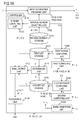
- a decryption process for decrypting a ciphertext ⁇ l will be described with reference to Fig. 25 .
- the natural number selecting unit 11102 of the computing apparatus 111 randomly reads one pair (a(l), b(l)) of natural numbers from among a plurality of pairs of natural numbers (a(l), b(l)) stored in the natural number storage 11101.
- At least part of information on the read pair of natural numbers (a(l), b(l)) is sent to the integer computing unit 11103, the input information providing unit 11104, the first power computing unit 11106, and the second power computing unit 11109 (step S11100).
- the input information providing unit 11104 of the computing apparatus 111 generates and outputs first input information ⁇ l,1 and second input information ⁇ l,2 which are elements of a group H l and each of which corresponds to the input ciphertext ⁇ l .
- the first input information ⁇ l,1 and the second input information ⁇ l,2 are information whose relation with the ciphertext ⁇ l is scrambled. This enables the computing apparatus 111 to conceal the ciphertext ⁇ l from the capability providing apparatus 112-l.
- the first input information ⁇ l,1 of this embodiment further corresponds to the natural number b(l) selected by the natural number selecting unit 11102 and the second input information ⁇ l,2 further corresponds to the natural number a(l) selected by the natural number selecting unit 11102.
- This enables the computing apparatus 111 to evaluate the decryption capability provided by the capability providing apparatus 112-l with a high degree of accuracy (step S11103).
- the first input information ⁇ l,1 is input in the first output information computing unit 11201-l of the capability providing apparatus 112-l ( Fig. 20 ) and the second input information ⁇ l,2 is input in the second output information computing unit 11202-l (step S11200).
- the first output information computing unit 11201 uses the first input information ⁇ l,1 and the decryption key s l stored in the key storage 11204-l to correctly compute f l ( ⁇ l,1 ) with a probability greater than a certain probability and sets the result of the computation as first output information z l,1 (step S11201).
- the second output information computing unit 11202-l uses the second input information ⁇ l,2 and the decryption key s l stored in the key storage 11204-l to correctly computes f l ( ⁇ l,2 ) with a probability greater than a certain probability and sets the result of the computation as second output information z l,2 (step S 11202).
- the "certain probability" is a probability less than 100%.
- the first output information computing unit 11201-l and the second output information computing unit 11202-l can output computation results that have an intentional or unintentional error.
- the result of the computation by the first output information computing unit 11201-l may or may not be f 1 ( ⁇ 1,l ) and the result of the computation by the second output information computing unit 11202-l may or may not be f 1 ( ⁇ l,2 ).
- the first output information computing unit 11201-l outputs the first output information z l,1 and the second output information computing unit 11202-l outputs the second output information z l,2 (step S 11203).
- the first output information z ,1 is input in the first computing unit 11105 of the computing apparatus 111 ( Fig. 19 ) and the second output information z l,2 is input in the second computing unit 11108.
- the first output information z ,1 and the second output information z l,2 are equivalent to the decryption capability provided by the capability providing apparatus 112- to the computing apparatus 111 (step S11104).
- generating (computing) ( ⁇ 1,l ) means computing a value of a formula defined as f 1 ( ⁇ l,2 ). Any intermediate computation method may be used, provided that the value of the formula ( ⁇ 1,l ) can eventually be computed. The same applies to computations of the other formulae that appear herein.
- the result u l of the computation is sent to the first power computing unit 11106 (step S 11105).
- the first power computing unit 11106 computes .
- the pair of the result of the computation and computed on the basis of the result of the computation, is stored in the first list storage 11107 (step S11106).
- the second computing unit 11108 generates a computation result from the second output information
- the result of the computation is sent to the second power computing unit 11109 (step S11108).
- the second power computing unit 11109 computes The pair of the result of the computation and computed on the basis of the computation result, is stored in the second list storage 11110 (step S11109).
- is a predetermined natural number. If the final output unit 11112 outputs information indicating that the computation is impossible, for example the symbol " ⁇ " (step S11113) and the process ends. If not the controller 11113 increments by 1, that is, sets + 1 (step S11112) and the process returns to step S11103.
- the information indicating the computation is impossible means that the reliability that the capability providing apparatus 112- correctly performs computation is lower than a criterion defined by . In other words, it means that the capability providing apparatus 112- was unable to perform a correct computation in trials.
- the final output unit 11112 uses and that correspond to and that are determined to satisfy to calculate and output (step S11114).
- the recovering unit 11100 For example if the shares have been generated by ⁇ Example 2 of shares>> described above, the recovering unit 11100 generates the exclusive OR of the decryption results f 1 ( ⁇ 1 ), ..., f ⁇ ( ⁇ ⁇ ) as the recovered value mes'. For example, if the shares have been generated by «Example 3 of shares» described above, the recovering unit 11100 generates the recovered value mes' from the decryption results f 1 ( ⁇ 1 ), ..., f ⁇ ( ⁇ ⁇ ) by using a recovering method corresponding to the secret sharing scheme.
- X be a random variable having a value in the group G.
- a sampler having an error X for w.
- a randomizable sampler For w ⁇ G, an entity that returns w a x' corresponding to a sample x' according to a random variable X whenever a natural number a is given is called a randomizable sampler having an error X for w.
- the combination of the input information providing unit 11104, the first output information computing unit 11201 and the first computing unit 11105 of this embodiment is a randomizable sampler having an error X 1 for f( ⁇ ) (referred to as the "first randomizable sampler") and the combination of the input information providing unit 11104, the second output information computing unit 11202 and the second computing unit 11108 is a randomizable sampler having an error X 2 for f( ⁇ ) (referred to as the "second randomizable sampler").
- L min (# ⁇ 1 (S), # ⁇ 2 (S)), where # ⁇ is the order of a set ⁇ . If the group G is a cyclic group or a group whose order is difficult to compute, it can be expected that the probability that an output other than " ⁇ " of the computing apparatus 111 is not f( ⁇ ) is at most approximately T 2 L/#S within a negligible error.
- L/#S is a negligible quantity and T is a quantity approximately equal to an polynomial order, the computing apparatus 111 outputs a correct with an overwhelming probability.
- a decryption control process of this embodiment will be described below.
- the decryption control apparatus 113 controls the decryption process performed by the computing apparatus 111
- the decryption control apparatus 113 outputs a decryption control instruction that controls the decryption process of the computing apparatus 111 to all of the capability providing apparatuses 112- .
- the capability providing apparatuses 112- in which the decryption control instruction is input controls whether to output both of first output information and second output information according to the input decryption control instruction.
- the computing apparatus 111 cannot decrypt the ciphertext unless the first output information and second output information are provided. Therefore, the decryption capability of the computing apparatus 111 can be controlled by controlling whether or not to output both of the first output information and second output information . Exemplary methods for controlling the decryption process will be described below.
- decryption control instructions include a decryption restricting instruction for restricting the decryption capability of the computing apparatus 111.
- the controller 11205- prevents output of both of the first output information and the second output information .
- the control instruction unit 11302 of the decryption control apparatus 113 ( Fig. 21 ) outputs the decryption restricting instruction for all .
- the decryption restricting instruction is output from the output unit 11303 to the capability providing apparatus 112- .
- the controller 11205- of the capability providing apparatus 112- determines whether or not the decryption restricting instruction has been input. If the decryption restriction instruction has not been input in the controller 11205- , the controller 11205- does not perform the decryption control process. On the other hand, if the decryption restriction instruction has been input in the controller 11205- , the controller 11205- performs control to prevent output of both of the first output information and second output information (decryption restriction mode).
- the controller 11205- prevents the first output information computing unit 11201- from outputting first output information and also prevents the second output information computing unit 11202- from outputting second output information .
- An example of control to prevent output of the first output information and/or the second output information is control to prevent output of the first output information and the second output information without preventing generation of the output information and/or the second output information .
- Another example of control to prevent output of the first output information and/or the second output information is control to causing the first output information computing unit 11201- and the second output information computing unit 11202- to output dummy information instead of the first output information and/or the second output information .
- an example of the dummy information is a random number or other information that is independent of the ciphertexts .
- Another example of control to prevent output of the first output information and/or the second output information is control to prevent generation of the first output information and the second output information . If control to prevent generation of the first output information and the second output information is performed, information required for generating the first output information and the second output information may optionally be nullified or removed. For example, the decryption key stored in the key storage 11204- may optionally be nullified or removed.
- the capability providing apparatus 112- outputs neither of the first output information and the second output information at step S11203. Accordingly, the computing apparatus 111 can obtain neither of the first output information and the second output information at step S11104 and cannot compute computation results and . Therefore a correct decryption result cannot be obtained. If correct decryption results cannot be obtained for all , the probability that a recovered value mes' obtained by the recovering unit 11100 will be equal to the message mes is negligibly small. Thus, the decryption capability of the computing apparatus 111 can be restricted.
- the decryption control instructions include a decryption permitting instruction for removing restriction on the decryption capability of the computing apparatus 111.
- the controller 11205- permits output of at least one of the first output information and the second output information .
- Example 2 of the method for controlling the decryption process is performed when, for example, output of the first output information and the second output information is to be permitted again after output of both of first output information and second output information is prevented by example 1 of the method for controlling the decryption process.
- the decryption permitting instruction may include the information and the information may be re-set in the capability providing apparatus 112- .
- Example 2 of the method for controlling the decryption process may also be performed to permit output of the first output information and the second output information when, for example, output of both of the first output information and the second output information is prevented in an initial state.
- the control instruction unit 11302 of the decryption control apparatus 113 ( Fig. 21 ) outputs the decryption permitting instruction for all .
- the decryption permitting instruction is output from the output unit 11303 to the capability providing apparatus 112-l.
- the controller 11205- of the capability providing apparatus 112- determines whether or not the decryption permitting instruction is input. If the decryption permitting instruction is not input in the controller 11205- , the controller 11205- does not perform decryption control process. On the other hand, if the decryption permitting instruction is input in the controller 11205- , the controller 11205- performs control to permit output of both of first output information and second output information (decryption permission mode).
- the capability providing apparatus 112- outputs both of the first output information and the second output information at step S11203. Accordingly, the computing apparatus 111 can obtain both of the first output information and the second output information at step S11104 and can compute or as a computation result. Therefore a correct decryption result can be obtained with a high probability. Thus, the restriction on the decryption capability of the computing apparatus 111 can be removed.
- each decryption control instruction corresponds to any one of (corresponds to the decryption function ) and the controller 11205- of the capability providing apparatus 112- controls whether to output all of the first output information and the second output information ( ⁇ 1,l ) that correspond to the decryption control instruction (corresponds to the decryption function corresponding to the decryption control instruction).
- a decryption control instruction may correspond to a plurality of and the controller 11205- of the capability providing apparatus 112- may control whether to output the first output information and the second output information corresponding to the decryption control instruction.
- a proxy computing system of an eighth embodiment is an example that embodies the first randomizable sampler and the second randomizable sampler described above.
- the following description will focus on differences from the seventh embodiment and repeated description of commonalities with the seventh embodiment, including the decryption control process, will be omitted.
- elements labeled with the same reference numerals have the same functions and the steps labeled with the same reference numerals represent the same processes.
- the proxy computing system 102 of the eighth embodiment includes a computing apparatus 121 in place of the computing apparatus 111 and capability providing apparatuses 122-1, ..., 122- ⁇ in place of the capability providing apparatuses 112-1, ..., 112- ⁇ .
- the computing apparatus 121 of the eighth embodiment includes, for example, a natural number storage 11101, a natural number selecting unit 11102, an integer computing unit 11103, an input information providing unit 12104, a first computing unit 12105, a first power computing unit 11106, a first list storage 11107, a second computing unit 12108, a second power computing unit 11109, a second list storage 11110, a determining unit 11111, a final output unit 11112 and a controller 11113.
- the input information providing unit 12104 of this embodiment includes, for example, a first random number generator 12104a, a first input information computing unit 12104b, a second random number generator 12104c, and a second input information computing unit 12104d.
- a decryption function is a homomorphic function
- a group H is a cyclic group
- An example of cryptography in which the decryption function is a homomorphic function is RSA cryptography. The rest of the assumptions are the same as those in the seventh embodiment, except that the computing apparatus 111 is replaced with the computing apparatus 121 and the capability providing apparatuses 112-1, ..., 112- ⁇ are replaced with the capability providing apparatuses 122-1, ..., 122- ⁇ .
- the process of the eighth embodiment is the same as the process of the seventh embodiment except that steps S11103 through S 11105, S 11108, and S11200 through S11203 of the seventh embodiment are replaced with steps S12103 through S12105, S12108, and S12200 through S12203, respectively.
- steps S12103 through S12105, S12108, and S12200 through S12203 will be described.
- the input information providing unit 12104 of the computing apparatus 121 ( Fig. 19 ) generates and outputs first input information ( ⁇ 1,l ) and second input information which corresponds to an input ciphertext (step S12103 of Fig. 25 ).
- a process at step S12103 of this embodiment will be described with reference to Fig. 27 .
- the first random number generator 12104a ( Fig. 22 ) generates a uniform random number r( , 1) that is a natural number greater than or equal to 0 and less than .
- the generated random number r( , 1) is sent to the first input information computing unit 12104b and the first computing unit 12105 (step S12103a).
- the second random number generator 12104c generates a uniform random number r(t, 2) that is a natural number greater than or equal to 0 and less than .
- the generated random number r(t, 2) is sent to the second input information computing unit 12104d and the second computing unit 12108 (step S12103c).
- the first input information computing unit 12104b and the second input information computing unit 12104d output the first input information and the second input information thus generated (step S12103e).
- the first input information and the second input information in this embodiment are information whose relation with the ciphertext is scrambled by using random numbers r( , 1) and r( , 2), respectively. This enables the computing apparatus 121 to conceal the ciphertext from the capability providing apparatus 122- .
- the first input information in this embodiment further corresponds to the natural number b( ) selected by the natural number selecting unit 11102 and the second input information further corresponds to the natural number a( ) selected by the natural number selecting unit 11102. This enables the computing apparatus 121 to evaluate the decryption capability provided by the capability providing apparatus 122- with a high degree of accuracy.
- the result of the computation may or may not be correct. That is, the result of the computation by the first output information computing unit 12201- may or may not be (step S12201).
- the result of the computation may or may not be correct. That is, the result of the computation by the second output information computing unit 12202- may or may not be (step S12202).
- the first output information computing unit 12201- outputs the first output information and the second output information computing unit 12202- outputs the second output information (step S 12203).
- the first output information is input in the first computing unit 12105 of the computing apparatus 121 ( Fig. 19 ) and the second input information is input in the second computing unit 12108.
- the first output information and the second output information are equivalent to the decryption capability provided by the capability providing apparatus 122- to the computing apparatus 121 (step S12104).
- the first computing unit 12105 uses the input random number r( , 1) and the first output information to compute and sets the result of the computation as .
- the result of the computation is sent to the first power computing unit 11106.
- the second computing unit 12108 uses the input random number r(t, 2) and the second output information to compute and sets the result of the computation as .
- the result of the computation is sent to the second power computing unit 11109.
- the reason will be described later (step S12108). ⁇ Reason why and are outputs of randomizable samplers having errors and , respectively, for
- c be a natural number
- R be a random number
- the amounts of computation performed by samplers in general are smaller than randomizable samplers.
- the following description will focus on differences from the seventh and eighth embodiments and repeated description of commonalities with the seventh and eighth embodiments, including the decryption control process, will be omitted.
- a proxy computing system 103 of the ninth embodiment includes a computing apparatus 131 in place of the computing apparatus 121 and capability providing apparatuses 132-1, ..., 132- ⁇ in place of the capability providing apparatuses 122-1, ..., 122- ⁇ .
- the computing apparatus 131 of the ninth embodiment includes, for example, a natural number storage 11101, a natural number selecting unit 11102, an integer computing unit 11103, an input information providing unit 12104, a first computing unit 12105, a first power computing unit 11106, a first list storage 11107, a second computing unit 12108, a second power computing unit 11109, a second list storage 11110, a determining unit 11111, a final output unit 11112, a controller 11113, and a third computing unit 13109.
- a natural number storage 11101 for example, a natural number storage 11101, a natural number selecting unit 11102, an integer computing unit 11103, an input information providing unit 12104, a first computing unit 12105, a first power computing unit 11106, a first list storage 11107, a second computing unit 12108, a second power computing unit 11109, a second list storage 11110, a determining unit 11111, a final output unit 11112, a controller 11113, and a third computing unit 13109.
- the capability providing apparatus 132- of the ninth embodiment includes, for example, a first output information computing unit 12201- , a second output information computing unit 12202- , a key storage 11204- , a controller 11205- , and a third output information computing unit 13203- .
- a decryption process of this embodiment will be described below. Differences from the eighth embodiment will be described. As illustrated in Figs. 25 and 26 , the process of the ninth embodiment is the same as the process of the eighth embodiment except that steps S12103 through S12105, S12108, and S12200 through S12203 of the eighth embodiment are replaced with steps S 13103 through S 13105, S 13108, S12200 through S12203, and S13205 through 13209, respectively. The following description will focus on processes at steps S13103 through S13105, S 13108, S12200 through S12203, and S13205 through S 13209.
- the input information providing unit 13104 of the computing apparatus 131 ( Fig. 19 ) generates and outputs first input information and second input information each of which corresponds to a input ciphertext (step S13103 of Fig. 25 ).
- a process at S13103 of this embodiment will be described below with reference to Fig. 27 .
- the controller 11113 controls the input information providing unit 13104 according to natural numbers ( , ) selected by the natural number selecting unit 11102.
- the first input information computing unit 12104b, the second input information computing unit 12104d, and the third input information computing unit 13104f output the first input information and the second input information thus generated along with information on corresponding natural numbers (step S13103e).
- the first input information and the second input information in this embodiment are information whose relation with the ciphertext is scrambled by using the random numbers r( , 1), r( , 2), and r( , 3), respectively. This enables the computing apparatus 131 to conceal the ciphertext from the capability providing apparatus 132- .
- the controller 11205- controls the first output information computing unit 12201- , the second output information computing unit 12202- , and the third output information computing unit 13203- according to input natural numbers .
- step S13205 Determination is made by the controller 11113 as to whether is equal to 1 (step S13205). If it is determined that ⁇ 1, the process at step S12201 described above is performed. Then, determination is made by the controller 11113 as to whether is equal to 1 (step S13208). If it is determined that ⁇ 1, the process at step S12202 described above is performed and then the process proceeds to step S13203.
- step S13208 1
- the result of the computation may or may not be correct. That is, the result of the computation by the third output information computing unit 13203- may or may not be (step S13209). Then the process proceeds to step S13203.
- the result of the computation may or may not be correct. That is, the result of the computation by the third output information computing unit 13203- may or may not be (step S13206).
- the third output information computing unit 13203- which has generated the third output information outputs the third output information
- the first output information is input in the first computing unit 12105 of the computing apparatus 131 ( Fig. 19 ), the second output information is input in the second computing unit 12108, and the third output information is input in the third computing unit 13109 (step S13104).
- the third computing unit 13109 computes and sets the result of the computation as .
- the result of the computation is sent to the second power computing unit 11109.
- the third computing unit 13109 may store each pair of the random number and computed on the basis of the random number in a storage, not depicted, in sequence as ( ⁇ 1 , ⁇ 1 ), ( ⁇ 2 , ⁇ 2 ), ..., ... Here, is a natural number greater than or equal to 1.
- ⁇ represents ⁇ ⁇ , namely ⁇ with subscript ⁇ , where ⁇ is a first letter, ⁇ is a second letter, and ⁇ is a number. ⁇ Reason why serves as a sampler having an error for >>
- the properties are based on the fact that R and R' are random numbers. Therefore, considering that r(t, 3) is a random number, serves as a sampler having an error for , likewise.
- a proxy computing system of a tenth embodiment is another example that embodies the first and second randomizable samplers described above.
- the following description will focus on differences from the seventh embodiment and repeated description of commonalities with the seventh embodiment, including the decryption control process, will be omitted.
- the proxy computing system 104 of the tenth embodiment includes a computing apparatus 141 in place of the computing apparatus 111 and capability providing apparatuses 142-1, ..., 142- ⁇ in place of the capability providing apparatuses 112-1, ..., 112- ⁇ .
- the computing apparatus 141 of the tenth embodiment includes, for example, a natural number storage 11101, a natural number selecting unit 11102, an integer computing unit 11103, an input information providing unit 14104, a first computing unit 14105, a first power computing unit 11106, a first list storage 11107, a second computing unit 14108, a second power computing unit 11109, a second list storage 11110, a determining unit 11111, a final output unit 11112, and a controller 11113.
- a natural number storage 11101 a natural number selecting unit 11102, an integer computing unit 11103, an input information providing unit 14104, a first computing unit 14105, a first power computing unit 11106, a first list storage 11107, a second computing unit 14108, a second power computing unit 11109, a second list storage 11110, a determining unit 11111, a final output unit 11112, and a controller 11113.
- the input information providing unit 14104 of this embodiment includes, for example, a fourth random number generator 14104a, a fifth random number generator 14104b, a first input information computing unit 14104c, a sixth random number generator 14104d, a seventh random number generator 14104e, and a second input information computing unit 14104f.
- the first input information computing unit 14104c includes, for example, a fourth input information computing unit 14104ca and a fifth input information computing unit 14104cb.
- the second input information computing unit 14104f includes, for example, a sixth input information computing unit 14104fa and a seventh input information computing unit 14104fb.
- the capability providing apparatus 142- of the tenth embodiment includes, for example, a first output information computing unit 14201- , a second output information computing unit 14202- , a key storage 11204- , and a controller 11205- . If there are capability providing apparatuses 142-( + 1), ..., 42- ⁇ , the capability providing apparatuses 142-( + 1), ..., 142- ⁇ have the same configuration as the capability providing apparatus 142- .
- the process of the tenth embodiment is the same as the process of the seventh embodiment except that steps S11103 through S 11105, S 11108, and S11200 through S11203 of the seventh embodiment are replaced with steps S14103 through S14105, S14108, and S14200 through S14203, respectively.
- steps S 14103 through S 14105, S 14108, and S 14200 through S 14203 will be described.
- a process at step S14103 of this embodiment will be described below with reference to Fig. 28 .
- the fourth random number generator 14104a ( Fig. 23 ) generates a uniform random number r( ,4) that is a natural number greater than or equal to 0 and less than .
- the generated random number r(t, 4) is sent to the fourth input information computing unit 14104ca, the fifth input information computing unit 14104cb, and the first computing unit 14105 (step S14103a).
- the fifth random number generator 14104b generates a uniform random number r( , 5) that is a natural number greater than or equal to 0 and less than .
- the generated random number r( , 5) is sent to the fifth input information computing unit 14104cb and the first computing unit 14105 (step S14103b).
- the fourth input information computing unit 14104ca uses a natural number selected by the natural number selecting unit 11102, included in the ciphertext , and the random number r( , 4) to compute fourth input information (step S14103c).
- the fifth input information computing unit 14104cb uses the natural number selected by the natural number selecting unit 11102, included in the ciphertext , and random numbers r( , 4) and r( , 5) to compute fifth input information (step S14103d).
- the sixth random number generator 14104d generates a uniform random number r( , 6) that is a natural number greater than or equal to 0 and less than .
- the generated random number r( , 6) is sent to the sixth input information computing unit 14104fa, the seventh input information computing unit 14104fb, and the second computing unit 14108 (step S14103e).
- the seventh random number generator 14104e generates a uniform random number r( 7) that is a natural number greater than or equal to 0 and less than K( l,G ).
- the generated random number r( , 7) is sent to the seventh input information computing unit 14104fb and the second computing unit 14108 (step S14103f).
- the sixth input information computing unit 14104fa uses a natural number selected by the natural number selecting unit 11102, included in the ciphertext , and the random number r( , 6) to compute sixth input information (step S14103g).
- the seventh input information computing unit 14104fb uses a natural number selected by the natural number selecting unit 11102, included in the ciphertext , and the random numbers r( , 6) and r( , 7) to compute seventh input information (step S14103h).
- the result of the computation may or may not be correct. That is, the result of the computation by the first output information computing unit 14201- may or may not be (step S14201).
- the result of the computation may or may not be correct. That is, the result of the computation by the second output information computing unit 14202- may or may not be , (step S14202).
- the first output information computing unit 14201- outputs the first output information and the second output information computing unit 14202- outputs the second output information (step S 14203).
- the first output information is input in the first computing unit 14105 of the computing apparatus 141 ( Fig. 19 ) and the second output information is input in the second computing unit 14108 (step S 14104).
- the first computing unit 14105 uses the input first output information and the random numbers r( , 4) and r( , 5) to compute and sets the result of the computation as (step S 14105).
- the result of the computation is sent to the first power computing unit 11106.
- the second computing unit 14108 uses the input second output information and the random numbers r( , 6) and r( , 7) to compute and sets the result of the computation as f 1 .
- the result of the computation is sent to the second power computing unit 11109.
- c be a natural number
- R 1 , R 2 , R 1 ' and R 2 ' be random numbers
- a plurality of pairs of natural numbers and that are relatively prime to each other are stored in the natural number storage 11101 of the computing apparatus and these pairs are used to perform processes.
- An eleventh embodiment is an example of such a variation, in which is fixed at 1 and the second randomizable sampler is replaced with a sampler.
- the following description will focus on differences from the seventh embodiment and description of commonalities with the seventh embodiment, including the decryption control process, will be omitted.
- Specific examples of the first randomizable sampler and the sampler are similar to those described in the eighth to tenth embodiments and therefore description of the first randomizable sampler and the sampler will be omitted.
- a proxy computing system 105 of the eleventh embodiment includes a computing apparatus 151 in place of the computing apparatus 111 of the seventh embodiment and capability providing apparatuses 152-1, ..., 152- ⁇ in place of the capability providing apparatuses 112-1, ..., 112- ⁇ .
- the computing apparatus 151 of the eleventh embodiment includes, for example, a natural number storage 15101, a natural number selecting unit 15102, an input information providing unit 15104, a first computing unit 15105, a first power computing unit 11106, a first list storage 11107, a second computing unit 15108, a second list storage 15110, a determining unit 15111, a final output unit 15112, and a controller 11113.
- the capability providing apparatus 152- of the eleventh embodiment includes, for example, a first output information computing unit 15201- , a second output information computing unit 15202- , a key storage 11204- , and a controller 11205- . If there are capability providing apparatuses 152-( + 1), ..., 52- ⁇ , the capability providing apparatuses 152-( + 1), ..., 52- ⁇ have the same configuration as the capability providing apparatus 152- .
- a decryption process of this embodiment will be described below.
- groups for example commutative groups
- a decryption function for decrypting a ciphertext which is an element of the group
- a particular decryption key to obtain an element of the group generators of the groups and be and respectively
- random variables having values in the group be a realization of the random variable and be a realization of the random variable .
- a plurality of natural numbers are stored in the natural number storage 15101 of the computing apparatus 151.
- the natural number selecting unit 15102 of the computing apparatus 151 randomly reads one natural number from among the plurality of natural numbers stored in the natural number storage 15101. Information on the read natural number is sent to the input information providing unit 15104 and the first power computing unit 11106 (step S 15100).
- the input information providing unit 15104 generates and outputs first input information and second input information each of which corresponds to the input ciphertext .
- the first input information and the second input information are information whose relation with the ciphertext is scrambled. This enables the computing apparatus 151 to conceal the ciphertext from the capability providing apparatus 152- .
- the second input information of this embodiment further corresponds to the natural number selected by the natural number selecting unit 15102. This enables the computing apparatus 151 to evaluate the decryption capability provided by the capability providing apparatus 152- with a high degree of accuracy (step S15103).
- the first input information is input in the first output information computing unit 15201- of the capability providing apparatus 152- ( Fig. 20 ) and the second input information is input in the second output information computing unit 15202- (step S15200).
- the first output information computing unit 15201- uses the first input information and the decryption key stored in the key storage 11204- to correctly compute ) with a probability greater than a certain probability and sets the result of the computation as first output information (step S15201).
- the second output information computing unit 15202- uses the second input information and the decryption key stored in the key storage 11204- to correctly compute with a probability greater than a certain probability and sets the result of the computation as second output information (step S15202). That is, the first output information computing unit 15201- and the second output information computing unit 15202- output computation results that have an intentional or unintentional error.
- the result of the computation by the first output information computing unit 15201- may or may not be and the result of the computation by the second output information computing unit 15202- may or may not be .
- the first output information computing unit 15201- outputs the first output information and the second output information computing unit 15202- outputs the second output information (step S 15203).
- the first output information is input in the first computing unit 15105 of the computing apparatus 151 ( Fig. 29 ) and the second output information is input in the second computing unit 15108.
- the first output information and the second output information are equivalent to the decryption capability provided by the capability providing apparatus 152- to the computing apparatus 151 (step S15104).
- the computation result is sent to the first power computing unit 11106 (step S15105).
- the first power computing unit 11106 computes The pair of the result of the computation and computed on the basis of the result of the computation, is stored in the first list storage 11107 (step S11106).
- the second computing unit 15108 generates a computation result from the second output information
- a specific example of the result of the computation is a result of the computation in any of the eighth to tenth embodiments.
- the result of the computation is stored in the second list storage 15110 (step S 15108).
- step S11111 the controller 11113 determines whether or not (step S11111).
- a black-box F( ⁇ ) of f( ⁇ ) is a processing unit that takes an input of ⁇ ⁇ H and outputs z ⁇ G.
- each of the first output information computing unit 15201 and the second output information computing unit 15202 is equivalent to the black box F( ⁇ ) for the decryption function f( ⁇ ).
- ⁇ is a positive value and is equivalent to the "certain probability" stated above.
- a self-corrector C F ( ⁇ ) is a processing unit that takes an input of ⁇ ⁇ H, performs computation by using a black-box F( ⁇ ) for f( ⁇ ), and outputs j ⁇ G ⁇ .
- the computing apparatus 151 is equivalent to the self-corrector C F ( ⁇ ).
- j C F ⁇ > 1 - ⁇ If this is the case, the self-corrector C F ( ⁇ ) is called a robust self-corrector.
- An example of the negligible error ⁇ is a function vale ⁇ (k) of a security parameter k.
- function value ⁇ (k) is a function value ⁇ (k) such that ⁇ (k)p(k) ⁇ converges to 0 for a sufficiently large k, where p(k) is an arbitrary polynomial.
- a robust self-corrector can be constructed from an almost self-corrector.
- a robust self-corrector can be constructed by executing an almost self-corrector multiple times for the same ⁇ and selecting the most frequently output value, except ⁇ , as j.
- an almost self-corrector is executed O(log(1/ ⁇ )) times for the same ⁇ and the value most frequently output is selected as j, thereby a robust self-corrector can be constructed.
- O( ⁇ ) represents O notation.
- An upper bound of the probability Pr ⁇ a ⁇ and ⁇ ⁇ e g
- ⁇ (k) a computation defined by the pair (G, ⁇ ) is called a pseudo-free action.
- ⁇ a means that a computation defined at the group G is applied a times to ⁇ .
- An example of the negligible function ⁇ (k) is such that ⁇ (k)p(k) ⁇ converges to 0 for a sufficiently large k, where p(k) is an arbitrary polynomial.
- a computation defined by the pair (G, ⁇ ) is a pseudo-free action. For example, if the number of the elements
- of a set ⁇ ⁇ ⁇ ⁇ a( ⁇ )
- the group G is a residue group Z/pZ modulo prime p
- the prime p is the order of 2 k
- the set ⁇ ⁇ 0, ..., p - 2 ⁇
- a( ⁇ ) is ⁇ a ⁇ Z/pZ
- p - 1.
- the probability of Formula (11) is less than C -1 2 -k and a computation defined by such pair (G, ⁇ ) is a pseudo-free action.
- ⁇ (k') is asymptotically small
- k 0 is determined for an arbitrary constant ⁇ and the function value ⁇ (k') for any k' that satisfies k 0 ⁇ k' for k 0 is less than ⁇ .
- An example of k' is a security parameter k.
- ⁇ (k') is asymptotically large means that k 0 is determined for an arbitrary constant ⁇ and the function value 1 - ⁇ (k') for any k' that satisfies k 0 ⁇ k' for k 0 is less than ⁇ .
- the probability distribution D does not depend on a natural number a. That the probability distribution D a and the probability distribution D cannot be distinguished from each other means that the probability distribution D a and the probability distribution D cannot be distinguished from each other by a polynomial time algorithm.
- negligible ⁇ is a function value ⁇ (k) of the security parameter k.
- An example of the function value ⁇ (k) is a function value such that ⁇ (k)p(k) ⁇ converges to 0 for a sufficiently large k, where p(k) is an arbitrary polynomial.
- the computing apparatus when the first output information and the second output information are provided to the computing apparatus, the computing apparatus can output with a certain probability. will be the decryption value of the ciphertext . On the other hand, if neither of the first output information and the second output information is provided to the computing apparatus, the computing apparatus cannot obtain the decryption value of the ciphertext .
- the capability providing apparatus in any of the seventh to eleventh embodiment can control whether or not to output both of the first output information and second output information to control the ciphertext decryption capability of the computing apparatus without providing a decryption key to the computing apparatus.
- ⁇ is an integer greater than or equal to 2 in the embodiments described above, ⁇ may be 1. That is, a configuration in which only one capability providing apparatus exists may be used. In that case, the computing apparatus does not need to include a recovering unit and may directly output a value output from the final output unit.
- the system of any of the first to fifth embodiments described above may further include a decryption control apparatus, the decryption control apparatus may output a decryption control instruction for controlling the decryption process of the computing apparatus to the capability providing apparatus, and the capability providing apparatus may control whether or not to output both of first output information z 1 and second output information z 2 from the first output information computing unit and the second output information computing unit according to the decryption control instruction.
- the decryption control apparatus may output a decryption control instruction for controlling the decryption process of the computing apparatus to the capability providing apparatus, and the capability providing apparatus may control whether or not to output both of first output information z 1 and second output information z 2 from the first output information computing unit and the second output information computing unit according to the decryption control instruction.
- the system of the sixth embodiment described above may further include a decryption control apparatus, the decryption control apparatus may output a decryption control instruction for controlling the decryption process of the computing apparatus to the capability providing apparatus, and the capability providing apparatus may control whether or not to output first output information M z 1 and second output information M z 2 from the first output information computing unit and the second output information computing unit according to the decryption control instruction.
- the decryption control apparatus may output a decryption control instruction for controlling the decryption process of the computing apparatus to the capability providing apparatus, and the capability providing apparatus may control whether or not to output first output information M z 1 and second output information M z 2 from the first output information computing unit and the second output information computing unit according to the decryption control instruction.
- Random variables may or may not be the same.
- Each of the first random number generator, the second random number generator, the third random number generator, the fourth random number generator, the fifth random number generator, the sixth random number generator and the seventh random number generator generates uniform random numbers to increase the security of the proxy computing system. However, if the level of security required is not so high, at least some of the first random number generator, second random number generator, the third random number generator, the fourth random number generator, the fifth random number generator, the sixth random number generator and the seventh random number generator may generate random numbers that are not uniform random numbers.
- random numbers that are natural numbers greater than or equal to 0 and less than or random numbers that are natural numbers greater than or equal to 0 and less than be selected as in the embodiments described above, random numbers that are natural numbers greater than or equal to or may be selected instead.
- the process of the capability providing apparatus may be performed multiple times each time the computing apparatus provides first input information and second input information corresponding to the same and ) to the capability providing apparatus. This enables the computing apparatus to obtain a plurality of pieces of first output information , second output information , and third output information each time the computing apparatus provides first input information , and the second input information to the capability providing apparatus. Consequently, the number of exchanges and the amount of communication between the computing apparatus and the capability providing apparatus can be reduced.
- the computing apparatus may provide a plurality of pieces of the first input information and the second input information to the capability providing apparatus at once and may obtain a plurality of pieces of corresponding first output information , second output information and third output information at once. This can reduce the number of exchanges between the computing apparatus and the capability providing apparatus.
- ⁇ in the embodiments is a constant, ⁇ may be a variable, provided that a value of ⁇ can be shared in the proxy computing system.
- the units of the computing apparatus may exchange data directly or through a memory, which is not depicted.
- the units of the capability providing apparatus may exchange data directly or through a memory, which is not depicted.
- Check may be made to see whether and obtained at the first computing unit and the second computing unit of any of the embodiments are elements of the group . If they are elements of the group the process described above may be continued; if or is not an element of the group information indicating that the computation is impossible, for example the symbol " ⁇ ", may be output.
- ⁇ computing apparatuses ( ⁇ is an integer greater than or equal to 2) shares one capability providing apparatus to perform computations and the capability providing apparatus receives payment for the capability.
- ⁇ computing apparatuses may share a plurality of capability providing apparatuses to perform computations.
- the apparatuses are configured to be able to exchange data between them.
- the apparatuses can exchange information through a transmission line, a network, a portable recording medium and other media.
- the capability providing apparatus 212 provides the capability of computing a function f ⁇ that maps elements of a group H ⁇ to elements of a group G ⁇ (the computing capability) to each computing apparatus 211- ⁇ .
- Each computing apparatus 211- ⁇ pays the capability providing apparatus 212 for the capability.
- the computing apparatus 211- ⁇ uses the provided capability to compute an element f ⁇ (x ⁇ ) of the group G ⁇ that corresponds to an element x ⁇ of the group H ⁇ . As illustrated in Fig.
- the computing apparatus 211- ⁇ of the twelfth embodiment includes, for example, a natural number storage 21101- ⁇ , a natural number selecting unit 21102- ⁇ , an integer computing unit 21103- ⁇ , an input information providing unit 21104- ⁇ , a first computing unit 21105- ⁇ , a first power computing unit 21106- ⁇ , a first list storage 21107- ⁇ , a second computing unit 21108- ⁇ , a second power computing unit 21109- ⁇ , a second list storage 21110- ⁇ , a determining unit 21111- ⁇ , a final output unit 21112- ⁇ , and a controller 21113- ⁇ .
- the computing apparatus 211- ⁇ performs processes under the control of the controller 21113- ⁇ .
- Examples of the computing apparatuses 211- ⁇ include devices having computing and memory functions, such as well-known or specialized computers, that include a CPU (central processing unit) and a RAM (random-access memory) in which a special program is loaded, server devices, a gateway devices, card reader-writer apparatuses and mobile phones.
- a CPU central processing unit
- RAM random-access memory
- the capability providing apparatus 212 of the twelfth embodiment includes, for example, a first output information computing unit 21201, a second output information computing unit 21202, and a controller 21205.
- the capability providing apparatus 212 performs processes under the control of the controller 21205.
- Examples of the capability providing apparatus 212 include a well-known or specialized computer, a device including computing and memory functions, such as a mobile phone, and a tamper-resistant module such as an IC card and an IC chip, that include a CPU and a RAM in which a special program is loaded.
- G ⁇ , H ⁇ be groups (for example commutative groups), X ⁇ ,1 and X ⁇ ,2 be random variables having values in the group G ⁇ , x ⁇ ,1 be a realization of the random variable X ⁇ ,1 , x ⁇ ,2 be a realization of the random variable X ⁇ ,2 , f ⁇ be a function that maps an element of the group H ⁇ to an element of the group G ⁇ , and a( ⁇ ) and b( ⁇ ) be natural numbers that are relatively prime to each other.
- f ⁇ include an encryption function, a decryption function, a re-encryption function, an image processing function, and a speech processing function.
- G ⁇ may be equal to H ⁇ or G ⁇ may be unequal to H ⁇ .
- computations on the groups G ⁇ and H ⁇ are multiplicatively expressed.
- a( ⁇ ) and b( ⁇ ) are natural numbers that are relatively prime to each other.
- the term "natural number" refers to an integer greater than or equal to 0.
- a set whose members are elements f ⁇ ( M ⁇ ) a( ⁇ )b( ⁇ ) of the group G ⁇ that correspond to elements M ⁇ of the group H ⁇ is referred to as a "class CL ⁇ (M ⁇ ) corresponding to elements M ⁇ ".
- CL ⁇ (M ⁇ ) and CL ⁇ ' (M ⁇ ' ) ( ⁇ ' ⁇ ⁇ ) are classes different from each other. If a function f ⁇ (M ⁇ ) is an injective function for an element M ⁇ , only one member belongs to the class CL ⁇ (M ⁇ ) corresponding to the same element M ⁇ for a pair of a( ⁇ ) and b( ⁇ ).
- the function f ⁇ (M ⁇ ) is not an injective function for the element M ⁇ (for example if the function f ⁇ is an encryption function of probabilistic encryption such as ElGamal encryption), a plurality of members belong to the class CL ⁇ (M ⁇ ) corresponding to the same element M ⁇ for the pair of a( ⁇ ) and b( ⁇ ) because a plurality of ciphertexts correspond to a pair of a plaintext and an encryption key.
- Processes performed by the computing apparatus 211- ⁇ by using the capability providing apparatus 212 will be described. The processes may be performed by any one of the computing apparatuses 211- ⁇ occupying the capability providing apparatus 212 for a certain period of time or may be performed concurrently by a plurality of computing apparatuses 211- ⁇ accessing the capability providing apparatus 212.
- An element x ⁇ of the group H ⁇ is input in the input information providing unit 21104- ⁇ of a computing apparatus 211- ⁇ ( Fig. 32 ). If the element x ⁇ has been already input in the input information providing unit 21104- ⁇ , the input operation may be omitted.
- the natural number selecting unit 21102- ⁇ of the computing apparatus 211- ⁇ in which the element x ⁇ is input in the input information providing unit 21104- ⁇ randomly reads one pair of natural numbers (a( ⁇ ), b( ⁇ )) from among the plurality of pairs of natural numbers (a( ⁇ ), b( ⁇ )) stored in the natural number storage 21101- ⁇ .
- At least some of information on the read pair of natural numbers (a( ⁇ ), b( ⁇ )) is sent to the integer computing unit 21103- ⁇ , the input information providing unit 21104- ⁇ , the first power computing unit 21106- ⁇ and the second power computing unit 21109- ⁇ (step S21100).
- the input information providing unit 21104- ⁇ generates and outputs first input information ⁇ ⁇ ,1 and second input information ⁇ ⁇ ,2 each of which corresponds to the input element x ⁇ .
- the first input information ⁇ ⁇ ,1 and the second input information ⁇ ⁇ ,2 are information whose relation with the element x ⁇ is scrambled. This enables the computing apparatus 211- ⁇ to conceal the element x ⁇ from the capability providing apparatus 212.
- the first input information ⁇ ⁇ ,1 of this embodiment further corresponds to the natural number b( ⁇ ) selected by the natural number selecting unit 21102- ⁇ and the second input information ⁇ ⁇ , 2 further corresponds to the natural number a( ⁇ ) selected by the natural number selecting unit 21102- ⁇ .
- This enables the computing apparatus 211- ⁇ to evaluate the computation capability provided by the capability providing apparatus 212 with a high degree of accuracy (step S21103).
- the first input information ⁇ ⁇ ,1 is input in the first output information computing unit 21201 of the capability providing apparatus 212 ( Fig. 33 ) and the second input information ⁇ ⁇ ,2 is input in the second output information computing unit 21202 (step S21200).
- the first output information computing unit 21201 uses the first input information ⁇ ⁇ ,1 to correctly compute f ⁇ ( ⁇ ⁇ ,1 ) with a probability greater than a certain probability and sets the obtained result of the computation as first output information z ⁇ ,1 (step S21201).
- the second output information computing unit 21202 uses the second input information ⁇ ⁇ , 2 to correctly computes f ⁇ ( ⁇ ⁇ ,2 ) with a probability greater than a certain probability and sets the obtained result of the computation as second output information z ⁇ ,2 (step S21202).
- the "certain probability" is a probability less than 100%.
- the first output information computing unit 21201 and the second output information computing unit 21202 can output computation results that have an intentional or unintentional error.
- the result of the computation by the first output information computing unit 21201 may or may not be f ⁇ ( ⁇ ⁇ ,1 ) and the result of the computation by the second output information computing unit 21202 may or may not be f ⁇ ( ⁇ ⁇ ,2 ).
- the first output information computing unit 21201 outputs the first output information z ⁇ ,1 and the second output information computing unit 21202 outputs the second output information z ⁇ ,2 (step S21203).
- the first output information z ⁇ ,1 is input in the first computing unit 21105- ⁇ of the computing apparatus 211- ⁇ ( Fig. 32 ) and the second output information z ⁇ ,2 is input in the second computing unit 21108- ⁇ .
- the first output information z ⁇ ,1 and the second output information z ⁇ ,2 are equivalent to the computation capability provided by the capability providing apparatus 212 to the computing apparatus 211- ⁇ (step S21104).
- a user of the computing apparatus 211- ⁇ to which the computation capability has been provided pays the capability providing apparatus 212 for the computation capability. The payment may be made through a well-known electronic payment process, for example.
- generating (computing) f ⁇ (x( ⁇ ) b( ⁇ ) x ⁇ ,1 means computing a value of a formula defined as f ⁇ (x ⁇ ) b( ⁇ ) x ⁇ ,1 .
- Any intermediate computation method may be used that can eventually compute the value of the formula f ⁇ (x ⁇ ) b( ⁇ ) x ⁇ ,1 .
- the result u ⁇ of the computation is sent to the first power computing unit 21106- ⁇ (step S21105).
- step S21114 If there is not a pair of u ⁇ ' and v ⁇ ' that belong to the class CL ⁇ (M ⁇ ) corresponding to the same element M ⁇ , the process proceeds to step S21114. If there is not a pair of u ⁇ ' and v ⁇ ' that belong to the class CL ⁇ (M ⁇ ) corresponding to the same element M ⁇ , the process proceeds to step S21108.
- the result v ⁇ of the computation is sent to the second power computing unit 21109- ⁇ (step S21108).
- step S21114 If there is not a pair of u ⁇ ' and v ⁇ ' that belong to the class CL ⁇ (M ⁇ ) corresponding to the same element M ⁇ , the process proceeds to step S2111. If there is not a pair of u ⁇ ' and v ⁇ ' that belong to the class CL ⁇ (M ⁇ ) corresponding to the same element M ⁇ , the process proceeds to step S21111.
- T is a predetermined natural number.
- the final output unit 21112- ⁇ outputs information indicating that the computation is impossible, for example the symbol " ⁇ " (step S21113) and the process ends.
- the information indicating that the computation is impossible means that the reliability that the capability providing apparatus 212 correctly performs computation is lower than a criterion defined by T. In other words, the capability providing apparatus 212 was unable to perform a correct computation in T trials.
- the final output unit 21112- ⁇ uses u ⁇ and v ⁇ that correspond to the pair of u ⁇ ' and v ⁇ ' that are determined to belong to the class CL ⁇ (M ⁇ ) corresponding to the same element M ⁇ to calculate and output u ⁇ b'( ⁇ ) v a'( ⁇ ) , and then the process ends (step S21114).
- the computing apparatus 211- ⁇ can obtain a correct computation result f ⁇ (x ⁇ ) if the capability providing apparatus 212 returns a correct solution with a probability greater than a certain probability.
- X ⁇ be a random variable having a value in the group G ⁇ .
- a sampler having an error X ⁇ for w ⁇ .
- an entity that returns w ⁇ a( ⁇ ) x ⁇ ' corresponding to a sample x ⁇ ' according to a random variable X ⁇ whenever a natural number a( ⁇ ) is given is called a randomizable sampler having an error X ⁇ for w ⁇ .
- the combination of the input information providing unit 21104- ⁇ , the first output information computing unit 21201 and the first computing unit 21105- ⁇ of this embodiment is a randomizable sampler having an error X ⁇ ,1 for f ⁇ (x ⁇ ) (referred to as the "first randomizable sampler") and the combination of the input information providing unit 21104- ⁇ , the second output information computing unit 21202 and the second computing unit 21108- ⁇ is a randomizable sampler having an error X ⁇ ,2 for f ⁇ (x ⁇ ) (referred to as the "second randomizable sampler").
- L min (# ⁇ 1 (S), # ⁇ 2 (S)), where # ⁇ is the order of a set ⁇ . If the group G ⁇ is a cyclic group or a group whose order is difficult to compute, it can be expected that the probability that an output of the computing apparatus 211- ⁇ other than " ⁇ " is not f ⁇ (x ⁇ ) is at most approximately T 2 L/#S within a negligible error.
- L/#S is a negligible quantity and T is a quantity approximately equal to a polynomial order
- the computing apparatus 211- ⁇ outputs a correct f ⁇ (x ⁇ ) with an overwhelming probability.
- a proxy computing system of an thirteenth embodiment is an example that embodies the first randomizable sampler and the second randomizable sampler described above.
- the following description will focus on differences from the twelfth embodiment and repeated description of commonalities with the twelfth embodiment will be omitted.
- elements labeled with the same reference numerals have the same functions and the steps labeled with the same reference numerals represent the same processes.
- the proxy computing system 202 of the thirteenth embodiment includes a computing apparatus 221- ⁇ in place of the computing apparatus 211- ⁇ and a capability providing apparatus 222 in place of the capability providing apparatus 212.
- the computing apparatus 221- ⁇ of the thirteenth embodiment includes, for example, a natural number storage 21101- ⁇ , a natural number selecting unit 21102- ⁇ , an integer computing unit 21103- ⁇ , an input information providing unit 22104- ⁇ , a first computing unit 22105- ⁇ , a first power computing unit 21106- ⁇ , a first list storage 21107- ⁇ , a second computing unit 22108- ⁇ , a second power computing unit 21109- ⁇ , a second list storage 21110- ⁇ , a determining unit 21111- ⁇ , a final output unit 21112- ⁇ , and a controller 21113- ⁇ .
- a natural number storage 21101- ⁇ As illustrated in Fig.
- the input information providing unit 22104- ⁇ of this embodiment includes, for example, a first random number generator 22104a- ⁇ , a first input information computing unit 22104b- ⁇ , a second random number generator 22104c- ⁇ , and a second input information computing unit 22104d- ⁇ .
- the capability providing unit 222 of the thirteenth embodiment includes, for example, a first output information computing unit 22201, a second output information computing unit 22202, and a controller 21205.
- a function f ⁇ is a homomorphic function
- a group H ⁇ is a cyclic group
- a generator of the group H ⁇ is ⁇ ⁇ ,h
- the order of the group H ⁇ is K ⁇ ,H
- v ⁇ f ⁇ ( ⁇ ⁇ ,h ).
- the process of the thirteenth embodiment is the same as the process of the twelfth embodiment except that steps S21103 through S21105, S21108, and S21200 through S21203 of the twelfth embodiment are replaced with steps S22103 through S22105, S22108, and S22200 through S22203, respectively.
- steps S22103 through S22105, S22108, and S22200 through S22203 will be described.
- the input information providing unit 22104- ⁇ of the computing apparatus 221- ⁇ ( Fig. 32 ) generates and outputs first input information ⁇ ⁇ ,1 and second input information ⁇ ⁇ ,2 each of which corresponds to an input element x ⁇ (step S22103 of Fig. 37 ).
- a process at step S22103 of this embodiment will be described below with reference to Fig. 39 .
- the first random number generator 22104a- ⁇ ( Fig. 34 ) generates a uniform random number r( ⁇ , 1) that is a natural number greater than or equal to 0 and less than K ⁇ ,H .
- the generated random number r( ⁇ , 1) is sent to the first input information computing unit 22104b- ⁇ and the first computing unit 22105- ⁇ (step S22103a).
- the second random number generator 22104c- ⁇ generates a uniform random number r( ⁇ , 2) that is a natural number greater than or equal to 0 and less than K ⁇ ,H .
- the generated random number r( ⁇ , 2) is sent to the second input information computing unit 22104d- ⁇ and the second computing unit 22108- ⁇ (step S22103c).
- the first input information computing unit 22104b- ⁇ and the second input information computing unit 22104d- ⁇ output the first input information ⁇ ⁇ ,1 and the second input information ⁇ ⁇ ,2 thus generated (step S22103e).
- the first input information ⁇ ⁇ ,1 and the second input information ⁇ ⁇ ,2 of this embodiment are information whose relation with the element x ⁇ is scrambled using random numbers r( ⁇ , 1) and r( ⁇ , 2), respectively. This enables the computing apparatus 221- ⁇ to conceal the element X ⁇ from the capability providing apparatus 222.
- the first input information ⁇ ⁇ ,1 of this embodiment further corresponds to the natural number b( ⁇ ) selected by the natural number selecting unit 21102- ⁇ and the second input information ⁇ ⁇ ,2 further corresponds to the natural number a( ⁇ ) selected by the natural number selecting unit 21102- ⁇ .
- the result of the computation may or may not be correct. That is, the result of the computation by the first output information computing unit 22201 may or may not be f ⁇ ( ⁇ ⁇ ,h r( ⁇ ,1) X b( ⁇ ) ) (step S22201).
- the result of the computation may or may not be correct. That is, the result of computation by the second output information computing unit 22202 may or may not be f ⁇ ( ⁇ ⁇ ,h r( ⁇ ,2) X ⁇ a( ⁇ ) ) (step S22202).
- the first output information computing unit 22201 outputs the first output information z ⁇ ,1 and the second output information computing unit 22202 outputs the second output information z ⁇ ,2 (step S22203).
- the first output information z ⁇ ,1 is input in the first computing unit 22105- ⁇ of the computing apparatus 221- ⁇ ( Fig. 32 ) and the second input information z ⁇ ,2 is input in the second computing unit 22108- ⁇ .
- the first output information z ⁇ ,1 and the second output information z ⁇ ,2 are equivalent to the computing capability provided by the capability providing apparatus 222 to the computing apparatus 221- ⁇ (step S22104).
- the first computing unit 22105- ⁇ uses the input random number r( ⁇ , 1) and the first output information z ⁇ ,1 to compute z ⁇ ,1 v ⁇ -r( ⁇ ,1) and sets the result of the computation as u ⁇ .
- the result u ⁇ of the computation is sent to the first power computing unit 21106- ⁇ .
- the second computing unit 22108- ⁇ uses the input random number r( ⁇ , 2) and the second output information z ⁇ ,2 to compute z ⁇ ,2 ⁇ ⁇ -r( ⁇ ,2) and sets the result of the computation as v ⁇ .
- the result v ⁇ of the computation is sent to the second power computing unit 21109- ⁇ .
- c be a natural number
- R and R' be random numbers
- the amounts of computations performed by samplers in general are smaller than the amounts of computations by randomizable samplers.
- the following description will focus on differences from the twelfth and thirteenth embodiments and repeated description of commonalities with the twelfth and thirteenth embodiments will be omitted.
- a proxy computing system 203 of the fourteenth embodiment includes a computing apparatus 231- ⁇ in place of the computing apparatus 32109- ⁇ and a capability providing apparatus 232 in place of the capability providing apparatus 222.
- the computing apparatus 32109- ⁇ of the fourteenth embodiment includes, for example, a natural number storage 21101- ⁇ , a natural number selecting unit 21102- ⁇ , an integer computing unit 21103- ⁇ , an input information providing unit 22104- ⁇ , a first computing unit 22105- ⁇ , a first power computing unit 21106- ⁇ , a first list storage 21107- ⁇ , a second computing unit 22108- ⁇ , a second power computing unit 21109- ⁇ , a second list storage 21110- ⁇ , a determining unit 21111- ⁇ , a final output unit 21112- ⁇ , a controller 21113- ⁇ , and a third computing unit 23109- ⁇ .
- the capability providing apparatus 232 of the fourteenth embodiment includes, for example, a first output information computing unit 22201, a second output information computing unit 22202, a controller 21205, and a third output information computing unit 23203.
- a process of the fourteenth embodiment is the same as the process of the thirteenth embodiment except that steps S22103 through S22105, S22108, and S22200 through S22203 of the thirteenth embodiment are replaced with steps S23103 through S23105, S23108, S22200 through S22203, and S23205 through 23209, respectively.
- the following description will focus on processes at steps S23103 through S23105, S23108, S22200 through S22203, and S23205 through S23209.
- the input information providing unit 23104- ⁇ of the computing apparatus 231- ⁇ ( Fig. 32 ) generates and outputs first input information ⁇ ⁇ ,1 and second input information ⁇ ⁇ ,2 each of which corresponds to an input element x ⁇ (step S23103 of Fig. 37 ).
- the controller 21113- ⁇ controls the input information providing unit 23104- ⁇ according to natural numbers (a( ⁇ ), b( ⁇ )) selected by the natural number selecting unit 21106- ⁇ .
- step S23103a Determination is made by the controller 32109- ⁇ as to whether b( ⁇ ) is equal to 1 (step S23103a). If it is determined that b( ⁇ ) ⁇ 1, the processes at steps S22103a and 22103b described above are performed and the process proceeds to step S23103g.
- the generated random number r( ⁇ ,3 ) is sent to the third input information computing unit 23104f- ⁇ and the third computing unit 23109- ⁇ (step S23103b).
- the third input information computing unit 23104f- ⁇ uses the input random number r( ⁇ , 3) and the element X ⁇ to compute x ⁇ r( ⁇ ,3) and sets it as first input information ⁇ ⁇ ,1 (step S23103c). Then the process proceeds to step S23103g.
- the first input information computing unit 22104b- ⁇ , the second input information computing unit 22104d- ⁇ , and the third input information computing unit 23104f- ⁇ output the first input information ⁇ ⁇ ,1 and the second input information ⁇ ⁇ ,2 thus generated along with information on the corresponding natural numbers (a( ⁇ ), b( ⁇ )) (step S23103e).
- the first input information ⁇ ⁇ ,1 and the second input information ⁇ ⁇ ,2 in this embodiment are information whose relation with the element x ⁇ is scrambled using the random numbers r( ⁇ , 1), r( ⁇ , 2) and r(3, ⁇ ). This enables the computing apparatus 231- ⁇ to conceal the element x ⁇ from the capability providing apparatus 232.
- the controller 21205 ( Fig. 33 ) controls the first output information computing unit 22201, the second output information computing unit 22202 and the third output information computing unit 23203 according to input natural numbers (a( ⁇ ), b( ⁇ )).
- the first input information ⁇ ⁇ ,1 ⁇ ⁇ ,h r( ⁇ ,1) x ⁇ b( ⁇ ) when b( ⁇ ) ⁇ 1 is input in the first output information computing unit 22201 of the capability providing apparatus 232 ( Fig. 33 )
- the second input information ⁇ ⁇ ,2 ⁇ ⁇ ,h r( ⁇ ,2) X ⁇ a( ⁇ ) when a( ⁇ ) ⁇ 1 is input in the second output information computing unit 22202.
- Determination is made by the controller 32109- ⁇ as to whether b( ⁇ ) is equal to 1 (step S23205). If it is determined that b( ⁇ ) ⁇ 1, the process at step S22201 described above is performed. Then, determination is made by the controller 32109- ⁇ as to whether a( ⁇ ) is equal to 1 (step S23208). If it is determined that a( ⁇ ) ⁇ 1, the process at step S22202 described above is performed and then the process proceeds to step S23203.
- the result of the computation may or may not be correct. That is, the result of the computation by the third output information computing unit 23203 may or may not be f ⁇ (x ⁇ r( ⁇ ,3) ) (step S23209). Then the process proceeds to step S23203.
- the result of the computation may or may not be correct. That is, the result of the computation by the third output information computing unit 23203 may or may not be f ⁇ (x ⁇ r( ⁇ ,3) ) (step S23206).
- the first output information computing unit 22201 which has generated the first output information z ⁇ ,1 , outputs the first output information z ⁇ ,1
- the second output information computing unit 22202 which has generated the second output information z ⁇ ,2 , outputs the second output information z ⁇ ,2
- the third output information computing unit 23202 which has generated the third output information z ⁇ ,3 , outputs the third output information z ⁇ ,3 (step S23203).
- the first output information z ⁇ ,1 is input in the first computing unit 22105- ⁇ of the computing apparatus 231- ⁇ ( Fig. 32 ), the second output information z ⁇ ,2 is input in the second computing unit 22108- ⁇ , and the third output information z ⁇ ,3 is input in the third computing unit 23109- ⁇ (step S23104).
- the computation result u ⁇ is sent to the first power computing unit 21106- ⁇ .
- the computation result v ⁇ is sent to the second power computing unit 21109- ⁇ .
- u ⁇ and/or v ⁇ may be calculated as follows.
- the third computing unit 23109- ⁇ may store each pair of a random number r( ⁇ , 3) and z ⁇ ,3 computed on the basis of that random number r( ⁇ , 3) in a storage, not depicted, in sequence as ( ⁇ 1 , ⁇ 1 ), ( ⁇ 2 , ⁇ 2 ), ..., ( ⁇ m , ⁇ m ), ... , where m is a natural number.
- the properties are based on the fact that R is a random number. Therefore, considering that r( ⁇ , 3) is a random number, z ⁇ 1/R serves as a sampler having an error X ⁇ ,3 for f ⁇ (x ⁇ ), likewise.
- a proxy computing system of a fifteenth embodiment is another example that embodies the first and second randomizable samplers described above.
- f ⁇ (x ⁇ ) C ⁇ ,2 (y( ⁇ ,2), m ⁇ ) which is an element of a group G ⁇ .
- the first ciphertext C ⁇ ,1 (y( ⁇ , 1), m ⁇ ) is a ciphertext obtained by encrypting a plaintext m ⁇ with a first encryption key y( ⁇ , 1) according to a first encryption scheme ENC ⁇ ,1 and the second ciphertext C ⁇ ,2 (y( ⁇ , 2), m ⁇ ) is a ciphertext obtained by encrypting the plaintext m ⁇ with a second encryption key y( ⁇ , 2) according to a second encryption scheme ENC ⁇ ,2 .
- the second encryption scheme ENC ⁇ ,2 is the ElGamal encryption and the function f ⁇ (x ⁇ ) is a homomorphic function.
- the first encryption scheme ENC ⁇ ,1 may be any encryption scheme; the first encryption scheme ENC ⁇ ,1 may be probabilistic encryption such as the ElGamal encryption or may be deterministic encryption such as RSA encryption.
- a proxy computing system 204 of the fifteenth embodiment includes a computing apparatus 241- ⁇ in place of the computing apparatus 221- ⁇ and a capability providing apparatus 242 in place of the capability providing apparatus 212.
- the computing apparatus 241- ⁇ of the fifteenth embodiment includes, for example, a natural number storage 21101- ⁇ , a natural number selecting unit 21102- ⁇ , an integer computing unit 21103- ⁇ , an input information providing unit 24104- ⁇ , a first computing unit 24105- ⁇ , a first power computing unit 21106- ⁇ , a first list storage 21107- ⁇ , a second computing unit 24108- ⁇ , a second power computing unit 21109- ⁇ , a second list storage 21110- ⁇ , a determining unit 24111- ⁇ , a final output unit 21112- ⁇ , and a controller 21113- ⁇ .
- a natural number storage 21101- ⁇ As illustrated in Fig.
- the input information providing unit 24104- ⁇ of this embodiment includes, for example, a first random number generator 24104a- ⁇ , a first input information computing unit 24104b- ⁇ , a second random number generator 24104c- ⁇ , and a second input information computing unit 24104d- ⁇ .
- the capability providing apparatus 242 of the fifteenth embodiment includes, for example, a first output information computing unit 24201, a second output information computing unit 24202, and a controller 21205.
- the group G ⁇ is the direct product group G ⁇ ,1 ⁇ G ⁇ ,2 of cyclic groups G ⁇ ,1 and G ⁇ ,2 , ⁇ ⁇ ,g1 is a generator of the group G ⁇ ,1 , ⁇ ⁇ ,g2 is a generator of the group G ⁇ ,2 , the second encryption key y( ⁇ , 2) is ⁇ ⁇ ,g2 s( ⁇ ,2) , an element C ⁇ ,2 (y( ⁇ , 2), m ⁇ ) is ( ⁇ ⁇ ,g1 r( ⁇ ) , m ⁇ y( ⁇ , 2) r( ⁇ ) ) ⁇ G ⁇ ,1 ⁇ G ⁇ ,2 , r( ⁇ ) is an integer random number, a value u ⁇ a( ⁇ ) is (c ⁇ ,1u , c ⁇ ,2u ) ⁇ G ⁇ ,1 ⁇ G ⁇ ,2 , and a value v ⁇ b(
- G ⁇ ,1 may be equal to G ⁇ ,2 or may be unequal to G ⁇ ,2 .
- the first encryption scheme ENC ⁇ ,1 may be any encryption scheme as stated above. If the first encryption scheme ENC ⁇ ,1 is the ElGamal encryption, the group H ⁇ is the direct product group H ⁇ ,1 ⁇ H ⁇ ,2 of cyclic groups H ⁇ ,1 and H ⁇ ,2 , r'( ⁇ ) is an integer random number, ⁇ ⁇ ,h1 is a generator of the group H ⁇ ,1 , ⁇ ⁇ ,h2 is a generator of the group H ⁇ ,2 , the first encryption key y( ⁇ , 1) is ⁇ ⁇ ,h2 s( ⁇ ,1) , the first ciphertext C ⁇ ,1 (y( ⁇ , 1), m ⁇ ) is ( ⁇ ⁇ ,h1 r'( ⁇ ) , m ⁇ y( ⁇ , 1) r'( ⁇ ) ) ⁇ H ⁇ ,1 ⁇
- A ( ⁇ 1 , ⁇ 2 ) ⁇ G ⁇ ,1 ⁇ G ⁇ ,2
- B ( ⁇ 1 , ⁇ 2 ) ⁇ G ⁇ ,1 ⁇ G ⁇ ,2
- ⁇ is a natural number
- a ⁇ represents ( ⁇ 1 ⁇ , ⁇ 2 ⁇ )
- a - ⁇ represents ( ⁇ 1 - ⁇ , ⁇ 2 - ⁇ )
- AB represents ( ⁇ 1 ⁇ 1 , ⁇ 2 ⁇ 2 ).
- A ( ⁇ 1 , ⁇ 2 ) ⁇ H ⁇ ,1 ⁇ H ⁇ ,2
- B ( ⁇ 1 , ⁇ 2 ) ⁇ H ⁇ ,1 ⁇ H ⁇ ,2
- a ⁇ represents ( ⁇ 1 ⁇ , ⁇ 2 ⁇ )
- a - ⁇ represents ( ⁇ 1 - ⁇ , ⁇ 2 - ⁇ )
- AB represents ( ⁇ 1 ⁇ 1 , ⁇ 2 ⁇ 2 ).
- e ⁇ ( ⁇ , ⁇ ) is a bilinear map that gives an element of a cyclic group G ⁇ ,T for ( ⁇ , ⁇ ) ⁇ G ⁇ ,1 ⁇ G ⁇ ,2 .
- bilinear map examples include functions and algorithms for performing pairing computations such as Weil pairing and Tate pairing (see Reference literature 2: Alfred J. Menezes, “ELLIPTIC CURVE PUBLIC KEY CRYPTOSYSTEMS", KLUWER ACADEMIC PUBLISHERS, ISBN 0-7923-9368-6, pp. 61 - 81 and Reference literature 3: RFC 5091, "Identity-Based Cryptography Standard (IBCS) #1", Supersingular Curve Implementations of the BF and BB 1 Cryptosystems, for example).
- IBCS Identity-Based Cryptography Standard
- a process of the fifteenth embodiment is the same as the process of the twelfth embodiment except that steps S21103 through S21105, S21107, S21108, S21110, and S21200 through S21203 of the twelfth embodiment are replaced with steps S24103 through S24105, S241017, S24108, S24110, and S24200 through S24203, respectively.
- steps S24103 through S24105, S24107, S24108, S24110, and S24200 through S24203 will be described.
- the process at step S24103 of this embodiment will be described below with reference to Fig. 40 .
- the first random number generator 24104a- ⁇ ( Fig. 35 ) generates an arbitrary element h r ⁇ ,1 ⁇ H ⁇ of the group H ⁇ .
- an element h r ⁇ ,1 is randomly and uniformly selected from the group H ⁇ (uniform random number).
- the generated element h r ⁇ ,1 is sent to the first input information computing unit 24104b- ⁇ and the first computing unit 24105- ⁇ (step S24103a).
- the first input information computing unit 24104b- ⁇ uses a natural number b( ⁇ ) selected by the natural number selecting unit 21102- ⁇ , the element X ⁇ , the element h r ⁇ ,1 , and the first encryption key y( ⁇ , 1) to compute X ⁇ b( ⁇ ) C ⁇ ,1 (y( ⁇ , 1), h r ⁇ ,1 ) as first input information ⁇ ⁇ ,1 (step S24103b).
- the second random number generator 24104c- ⁇ generates an arbitrary element h r ⁇ ,2 ⁇ H ⁇ of the group H ⁇ .
- an element h r ⁇ ,2 is randomly and uniformly selected from the group H ⁇ (uniform random number).
- the generated element h r ⁇ ,2 is sent to the second input information computing unit 24104d- ⁇ and the second computing unit 24108- ⁇ (step S24103c).
- the second input information computing unit 24104b- ⁇ uses a natural number a( ⁇ ) selected by the natural number selecting unit 21102- ⁇ , the element X ⁇ , the element h r ⁇ ,2 , and the first encryption key y( ⁇ , 1) to compute x ⁇ a( ⁇ ) C ⁇ ,1 (y( ⁇ , 1), h r ⁇ ,2 ) as second input information ⁇ ⁇ ,2 (step S24103d).
- the result of the computation may or may not be correct.
- the result of the computation by the first output information computing unit 24201 may or may not be f ⁇ (X ⁇ b( ⁇ ) C ⁇ ,1 (y( ⁇ , 1), h r ⁇ ,1 )) (step S24201).
- the function f ⁇ in this embodiment is a homomorphic function for encrypting a value that can be obtained by decrypting a ciphertext with the first decryption key s( ⁇ , 1) according to the first encryption scheme ENC ⁇ ,1 with the second encryption key y( ⁇ , 2) according to the ElGamal encryption.
- the function f ⁇ is a homomorphic function for encrypting a value that can be obtained by decrypting a ciphertext with the first decryption key s( ⁇ , 1) according to the ElGamal encryption with the second encryption key y( ⁇ , 2) according to the ElGamal encryption.
- the result of the computation may or may not be correct.
- the result of the computation by the second output information computing unit 24202 may or may not be f ⁇ (X ⁇ a( ⁇ ) C ⁇ ,1 (y( ⁇ , 1), h r ⁇ ,2 ))(step S24202).
- the first output information computing unit 24201 outputs the first output information z ⁇ ,1 and the second output information computing unit 24202 outputs the second output information z ⁇ ,2 (step S24203).
- the first output information z ⁇ ,1 is input in the first computing unit 24105- ⁇ of the computing apparatus 241- ⁇ ( Fig. 32 ) and the second output information z ⁇ ,2 is input in the second computing unit 24108- ⁇ (step S24104).
- the first computing unit 24105- ⁇ uses the input first output information z ⁇ ,1 , the element h r ⁇ ,1 , and the second encryption key y( ⁇ , 2) to compute z ⁇ ,1 (C ⁇ ,2 (y( ⁇ , 2), h r ⁇ ,1 )) -1 and sets the result of the computation as u ⁇ (step S24105).
- the second computing unit 24108- ⁇ uses the input second output information z ⁇ ,2 , the element h r ⁇ ,2 , and the second encryption key y( ⁇ , 2) to compute z ⁇ ,2 (C ⁇ ,2 (y( ⁇ , 2), h r ⁇ ,2 ) -1 and sets the result of the computation as v ⁇ .
- the result v ⁇ of the computation is sent to the second power computing unit 21106- ⁇ .
- z ⁇ ,2 (C ⁇ ,2 (y( ⁇ , 2), h r ⁇ ,2 )) -1 is an output of a randomizable sampler having an error X ⁇ ,2 for f ⁇ (x ⁇ ). The reason will be described later.
- the determining unit 24111- ⁇ determines whether or not there is a pair of u ⁇ ' and v ⁇ ' that belong to a class CL ⁇ (M ⁇ ) corresponding to the same element M ⁇ among the pairs (u ⁇ , u ⁇ ') stored in the first list storage 21107- ⁇ and the pairs (v ⁇ , v ⁇ ') stored in the second list storage 21110- ⁇ .
- a process at step S21108 is performed without performing the process at step S24107. If there is a pair of u ⁇ ' and v ⁇ ' that belong to the class CL ⁇ (M ⁇ ) corresponding to the same element M ⁇ (if there is a pair of u ⁇ ' and v ⁇ ' that satisfy the relation given above), the process proceeds to step S21114. If there is not a pair of u ⁇ ' and v ⁇ ' that belong to the class CL ⁇ (M ⁇ ) corresponding to the same element M ⁇ , the process proceeds to step S24108.
- the determining unit 24111- ⁇ determines whether there is a pair of u ⁇ ' and v ⁇ ' that belong to a class CL ⁇ (M ⁇ ) corresponding to the same element M ⁇ among the pairs (u ⁇ , u ⁇ ') stored in the first list storage 21107- ⁇ and the pairs (v ⁇ , v ⁇ ') stored in the second list storage 24110- ⁇ .
- step S21114 If there is a pair of u ⁇ ' and v ⁇ ' that belong the class CL ⁇ (M ⁇ ) corresponding to the same element M ⁇ , the process proceeds to step S21114. If there is not a pair of u ⁇ ' and v ⁇ ' that belong to the class CL ⁇ (M ⁇ ) corresponding to the same element M ⁇ , the process proceeds to step S21111.
- z ⁇ ,1 (C ⁇ ,2 (y( ⁇ , 2), h r ⁇ ,1 )) -1 and z ⁇ ,2 (C ⁇ ,2 (y( ⁇ , 2), h r ⁇ ,2 )) -1 are outputs of randomizable samples having errors X ⁇ ,1 and X ⁇ ,2 , respectively, for f ⁇ (x ⁇ ).
- u ⁇ ' and v ⁇ ' belong to classes corresponding to different elements. That is, u ⁇ ' belongs a class CL ⁇ (m ⁇ , u ) corresponding to an element m ⁇ ,u and v ⁇ ' belongs to a class CL ⁇ (m ⁇ , v ) corresponding to an element m ⁇ ,v (m ⁇ ,v ⁇ m ⁇ ,u ).
- N ⁇ is the composite number of primes ⁇ ⁇ and primes groups G ⁇ ,1 and G ⁇ ,2 are subgroups consisting of points on a first elliptic curve E ⁇ ,1 defined on a factor ring Z/N ⁇ Z modulo composite number N ⁇
- G ⁇ ,1 ⁇ and G ⁇ ,2 ⁇ are subgroups consisting of points on a second elliptic curve E ⁇ ,2 defined on a factor ring Z/ ⁇ ⁇ Z modulo prime ⁇ ⁇
- are subgroups consisting of points on a third elliptic curve E ⁇ ,3 defined on a factor ring Z/ Z modulo prime e ⁇ ( ⁇ , ⁇ ) is a bilinear map that yields an element of a cyclic group G ⁇ ,T for ( ⁇ , ⁇ ) ⁇ G ⁇ ,1 ⁇ G ⁇ ,2 , e ⁇ , ⁇ ( ⁇ ⁇ , ⁇ ⁇ ) is a second bilinear map that
- the bilinear map e ⁇ ( ⁇ , ⁇ ) is defined on the first elliptic curve E ⁇ ,1 defined on the factor ring Z/N ⁇ Z.
- the bilinear map e ⁇ ( ⁇ , ⁇ ) is defined on an elliptic curve defined on a factor ring in polynomial time
- a method for constructing a bilinear map e ⁇ ( ⁇ , ⁇ ) defined on an elliptic curve defined on a factor ring that can be computed in polynomial time (Reference literature 4: Alexander W. Dent and Steven D.
- an isomorphic map that maps an element ⁇ mod N ⁇ of a factor ring Z/N ⁇ Z to an element ⁇ mod ⁇ ⁇ of a residue field Z/ ⁇ ⁇ Z and an element ⁇ mod of a residue field Z/ Z can be HM ⁇ and a map that maps an element ⁇ ⁇ mod ( ⁇ ⁇ of a residue field Z/ ⁇ ⁇ Z and an element mod of a residue field Z/ Z to a an element ⁇ ⁇ + ⁇ ⁇ ⁇ ⁇ ' mod N ⁇ of factor ring Z/N ⁇ Z can be HM ⁇ -1 .
- ⁇ ⁇ ' and are natural numbers that satisfy ⁇ ⁇ ⁇ ⁇ ' + 1.
- the determining unit 24111 can compute the bilinear map e ⁇ ( ⁇ , ⁇ ) on the first elliptic curve E ⁇ ,1 defined on the factor ring Z/N ⁇ Z by performing the following process of steps A to D.
- the determining unit 24111 uses the isomorphic map HM ⁇ to map a point ⁇ ⁇ G ⁇ ,1 on the first elliptic curve E ⁇ ,1 defined on the factor ring Z/N ⁇ Z to a point ⁇ ⁇ ( ⁇ ) ⁇ G ⁇ ,1 ⁇ on the second elliptic curve E ⁇ ,2 defined on the residue field Z/ ⁇ ⁇ Z and a point ( ⁇ 1,l ) ⁇ ( ⁇ 1,l ) on the third elliptic curve E ⁇ ,3 defined on the residue field f 1 ( ⁇ l,2 ).
- Step B The determining unit 24111 uses the isomorphic map HM ⁇ to map a point ⁇ ⁇ G ⁇ ,2 on the first elliptic curve E ⁇ ,1 defined on the factor ring Z/N ⁇ Z to a point ⁇ ⁇ ( ⁇ ) ⁇ G ⁇ ,2 ⁇ on the second elliptic curve E ⁇ ,2 defined on the residue field Z/ ⁇ ⁇ Z and a point ( ⁇ 1,l ) ⁇ ( ⁇ 1,l ) on the third elliptic curve E ⁇ ,3 defined on the residue field f 1 ( ⁇ l,2 ).
- Step C The determining unit 24111 obtains e ⁇ , ⁇ ( ⁇ ⁇ ( ⁇ ), ⁇ ⁇ ( ⁇ )) and ( ⁇ 1,l ) on the second elliptic curve E ⁇ ,2 and the third elliptic curve E ⁇ ,3 .
- Step D The determining unit 24111 applies the inverse map HM ⁇ -1 to the obtained results of the computations e ⁇ , ⁇ ( ⁇ ⁇ ( ⁇ ), ⁇ ⁇ ( ⁇ )) and ( ⁇ 1,l ) to obtain a value e ⁇ ( ⁇ , ⁇ ).
- a proxy computing system of a sixteenth embodiment is another example that embodies the first randomizable sampler and the second randomizable sampler described above.
- H ⁇ is the direct product G ⁇ x G ⁇ of groups G ⁇ which are cyclic groups
- a function f ⁇ (x ⁇ )
- the proxy computing system 205 of the sixteenth embodiment includes a computing apparatus 251- ⁇ in place of the computing apparatus 211- ⁇ and a capability providing apparatus 252 in place of the capability providing apparatus 212.
- the computing apparatus 251- ⁇ of the sixteenth embodiment includes, for example, a natural number storage 21101- ⁇ , a natural number selecting unit 21102- ⁇ , an integer computing unit 21103- ⁇ , an input information providing unit 25104- ⁇ , a first computing unit 25105- ⁇ , a first power computing unit 21106- ⁇ , a first list storage 21107- ⁇ , a second computing unit 25108- ⁇ , a second power computing unit 21109- ⁇ , a second list storage 21110- ⁇ , a determining unit 21111- ⁇ , a final output unit 21112- ⁇ , and a controller 21113- ⁇ .
- a natural number storage 21101- ⁇ As illustrated in Fig.
- the input information providing unit 25104- ⁇ of this embodiment includes, for example, a fourth random number generator 25104a- ⁇ , a fifth random number generator 25104b- ⁇ , a first input information computing unit 25104c- ⁇ , a sixth random number generator 25104d- ⁇ , a seventh random number generator 25104e- ⁇ , and a second input information computing unit 25104f- ⁇ .
- the first input information computing unit 25104c- ⁇ includes, for example, a fourth input information computing unit 25104ca- ⁇ and a fifth input information computing unit 25104cb- ⁇ .
- the second input information computing unit 25104f- ⁇ includes, for example, a sixth input information computing unit 25104fa- ⁇ and a seventh input information computing unit 25104fb- ⁇ .
- the capability providing apparatus 252 of the sixteenth embodiment includes, for example, a first output information computing unit 25201, the second output information computing unit 25202, and a controller 21205.
- a group H ⁇ G ⁇ ⁇ G ⁇
- a generator of the group G ⁇ is ⁇ ⁇ ,g
- the order of the group G ⁇ is K ⁇ ,G
- a process of the sixteenth embodiment is the same as the process of the twelfth embodiment except that steps S21103 through S21105, S21108, and S21200 through S21203 of the twelfth embodiment are replaced with steps S25103 through S25105, S25108, and S25200 through S25203, respectively.
- steps S25103 through S25105, S25108, and S25200 through S25203 will be described.
- a process at step S25103 of this embodiment will be described below with reference to Fig. 41 .
- the fourth random number generator 25104a- ⁇ ( Fig. 36 ) generates a uniform random number r( ⁇ , 4) that is a natural number greater than or equal to 0 and less than K ⁇ ,G .
- the generated random number r( ⁇ , 4) is sent to the fourth input information computing unit 25104ca- ⁇ , the fifth input information computing unit 25104cb- ⁇ , and the first computing unit 25105- ⁇ (step S25103a).
- the fifth random number generator 25104b- ⁇ generates a uniform random number r( ⁇ , 5) that is a natural number greater than or equal to 0 and less than K ⁇ ,G .
- the generated random number r( ⁇ , 5) is sent to the fifth input information computing unit 25104cb- ⁇ and the first computing unit 25105- ⁇ (step S25103b).
- the fourth input information computing unit 25104ca- ⁇ uses a natural number b( ⁇ ) selected by the natural number selecting unit 21102- ⁇ , c ⁇ ,2 included in the element x ⁇ , and the random number r( ⁇ , 4) to compute fourth input information c ⁇ , 2 b( ⁇ ) W r( ⁇ ,4) (step S25103c).
- the fifth input information computing unit 25104cb- ⁇ uses the natural number b( ⁇ ) selected by the natural number selecting unit 21102- ⁇ , c ⁇ ,1 included in the element x ⁇ , and random numbers r( ⁇ , 4) and r( ⁇ 5) to compute fifth input information c ⁇ ,1 b( ⁇ ) V r( ⁇ ,4 ⁇ ⁇ ,g r( ⁇ ,5) (step S25103d).
- the sixth random number generator 25104d- ⁇ generates a uniform random number r( ⁇ , 6) that is a natural number greater than or equal to 0 and less than K ⁇ ,G .
- the generated random number r( ⁇ , 6) is sent to the sixth input information computing unit 25104fa- ⁇ , the seventh input information computing unit 25104fb- ⁇ , and the second computing unit 25108- ⁇ (step S25103e).
- the seventh random number generator 25104e- ⁇ generates a uniform random number r( ⁇ , 7) that is a natural number greater than or equal to 0 and less than K ⁇ ,G .
- the generated random number r( ⁇ , 7) is sent to the seventh input information computing unit 25104fb- ⁇ and the second computing unit 25108- ⁇ (step S25103f).
- the sixth input information computing unit 25104fa- ⁇ uses a natural number a( ⁇ ) selected by the natural number selecting unit 21102- ⁇ , c ⁇ ,2 included in the element x ⁇ , and the random number r( ⁇ , 6) to compute sixth input information c ⁇ ,2 a( ⁇ ) W r( ⁇ ,6) (step S25103g).
- the seventh input information computing unit 25104fb- ⁇ uses the natural number a( ⁇ ) selected by the natural number selecting unit 21102- ⁇ , c ⁇ ,1 included in the element x ⁇ , and the random numbers r( ⁇ , 6) and r( ⁇ , 7) to compute seventh input information c ⁇ ,1 a( ⁇ ) V r( ⁇ ,6) ⁇ g r( ⁇ ,7) (step S25103h).
- the result of the computation may or may not be correct.
- the result of the computation by the first output information computing unit 25201 may or may not be f ⁇ (c ⁇ ,1 b( ⁇ ) V ⁇ r( ⁇ ,4) ⁇ ⁇ ,g r( ⁇ ,5) , c ⁇ ,2 b( ⁇ ) W ⁇ r( ⁇ ,4) ) (step S25201).
- the result of the computation may or may not be correct.
- the result of the computation by the second output information computing unit 25202 may or may not be f ⁇ (c ⁇ ,1 a( ⁇ ) V ⁇ r( ⁇ ,6) ⁇ ⁇ ,g r( ⁇ ,7) , c ⁇ ,2 a( ⁇ ) W ⁇ r( ⁇ ,6) ) (step S25202).
- the first output information computing unit 25201 outputs the first output information z ⁇ ,1 and the second output information computing unit 25202 outputs the second output information z ⁇ ,2 (step S25203).
- the first output information z ⁇ ,1 is input in the first computing unit 25105- ⁇ of the computing apparatus 251- ⁇ ( Fig. 32 ) and the second output information z ⁇ ,2 is input in the second computing unit 25108- ⁇ (step S25104).
- the first computing unit 25105- ⁇ uses the input first output information z ⁇ ,1 and the random numbers r( ⁇ , 4) and r( ⁇ , 5) to compute z ⁇ ,1 Y -r( ⁇ ,4) ⁇ ⁇ ,g -r( ⁇ ,5) and sets the result of the computation as u ⁇ (step S25105).
- the result u ⁇ of the computation is sent to the first power computing unit 21106- ⁇ .
- z ⁇ ,4 Y ⁇ -r( ⁇ ,4) ⁇ ⁇ ,g -r( ⁇ ,5) is an output of a randomizable sampler having an error X ⁇ ,1 for f ⁇ (c ⁇ ,1 , c ⁇ ,2 ). The reason will be described later.
- the second computing unit 25108- ⁇ uses the input second output information z ⁇ ,2 and the random numbers r( ⁇ ,6) and r( ⁇ ,7) to compute z ⁇ ,2 Y ⁇ -r( ⁇ ,6) ⁇ ⁇ ,g -r( ⁇ ,7) and sets the result of the computation as v ⁇ .
- the result v ⁇ of the computation is sent to the second power computing unit 21109- ⁇ .
- z ⁇ ,5 Y ⁇ -r( ⁇ ,6) ⁇ ⁇ ,g -r( ⁇ ,7) is an output of a randomizable sampler having an error X ⁇ ,2 for f ⁇ (c ⁇ ,1 , c ⁇ ,2 ). The reason will be described later.
- z ⁇ Y ⁇ -R1 ⁇ ⁇ ,g -R2 is an output of a randomizable sampler having an error X ⁇ for f ⁇ (x ⁇ ).
- e ⁇ ,g is an identity element of the group G ⁇ .
- a( ⁇ ) and b( ⁇ ) are natural numbers and r( ⁇ , 4), r( ⁇ , 5), r( ⁇ , 6), and r( ⁇ , 7) are random numbers
- z ⁇ ,4 Y ⁇ -r( ⁇ ,4) ⁇ ⁇ ,g -r( ⁇ ,5) and z ⁇ ,5 Y ⁇ -r( ⁇ ,6) ⁇ ⁇ ,g -r( ⁇ ,7) are, likewise, outputs of randomizable samplers having errors X ⁇ ,1 and X ⁇ ,2 , respectively, for f ⁇ (c ⁇ ,1 , c ⁇ ,2 ).
- a proxy computing system of a seventeenth embodiment is another example that embodies the first randomizable sampler and the second randomizable sampler described above.
- the proxy computing system embodies an example of a first randomizable sampler and a second randomizable sampler in which a group H ⁇ is the direct product H 1, ⁇ ⁇ H 2, ⁇ of cyclic groups H 1, ⁇ and H 2, ⁇ , a generator of the cyclic group H 1, ⁇ is ⁇ 1, ⁇ , a generator of the cyclic group H 2, ⁇ is ⁇ 2, ⁇ , f ⁇ is a bilinear map that maps a pair of an element of the cyclic group H 1, ⁇ and an element of the cyclic group H 2, ⁇ to an element of a cyclic group G ⁇ , an element x ⁇ of a cyclic group H ⁇ is a pair of an element ⁇ 1, ⁇ of the cyclic group H 1, ⁇ and an element ⁇ 2, ⁇ of the cyclic group H 2, ⁇ , and ⁇ ⁇
- Examples of the bilinear map f ⁇ include functions and algorithms for computing pairings such as Weil pairing and Tate pairing. The following description will focus on differences from the twelfth embodiment and repeated description of commonalities with the twelfth embodiment will be omitted.
- the proxy computing system 207 of the seventeenth embodiment includes a computing apparatus 271- ⁇ in place of the computing apparatus 211- ⁇ and a capability providing apparatus 272 in place of the capability providing apparatus 212.
- the computing apparatus 271- ⁇ of the seventeenth embodiment includes, for example, a natural number storage 21101- ⁇ , a natural number selecting unit 21102- ⁇ , an integer computing unit 21103- ⁇ , an input information providing unit 27104- ⁇ , a first computing unit 27105- ⁇ , a first power computing unit 21106- ⁇ , a first list storage 21107- ⁇ , a second computing unit 27108- ⁇ , a second power computing unit 21109- ⁇ , a second list storage 21110- ⁇ , a determining unit 27111- ⁇ , a final output unit 21112- ⁇ , and a controller 21113- ⁇ .
- a natural number storage 21101- ⁇ the natural number selecting unit 21102- ⁇
- an integer computing unit 21103- ⁇ includes, for example, a natural number storage 21101- ⁇ , a natural number selecting unit 21102- ⁇ , an integer computing unit 21103- ⁇ , an input information providing unit 27104- ⁇ , a first computing unit 27105- ⁇ , a first power computing unit 21106- ⁇ , a first list storage 21107- ⁇
- the input information providing unit 27104- ⁇ of this embodiment includes, for example, a first random number generator 27104a- ⁇ , a second random number generator 27104c- ⁇ , a first input information computing unit 27104b- ⁇ , and a second input information computing unit 27104d- ⁇ .
- the capability providing apparatus 272 of the seventeenth embodiment includes, for example, a first output information computing unit 27201, the second output information computing unit 27202, and a controller 21205.
- a process of the seventeenth embodiment is the same as the process of the twelfth embodiment except that steps S21103 through S21105, S21107, S21108, S21110, and S21200 through S21203 of the twelfth embodiment are replaced with steps S27103 through S27105, S27107, S27108, S27110, and S27200 through S27203, respectively.
- steps S27103 through S27105, S27107, S27108, S27110 and S27200 through S27203 will be described.
- a process at step S27103 of this embodiment will be described below with reference to Fig. 43 .
- the first random number generator 27104a- ⁇ ( Fig. 42 ) generates uniform random numbers r( ⁇ , 11), r( ⁇ , 12), r( ⁇ , 13), r( ⁇ ,14), r( ⁇ , 15), and r( ⁇ , 16) that are natural numbers greater than or equal to 0 and less than or equal to 2 ⁇ (k)+k .
- ⁇ (k) represents a function value of a security parameter k.
- the generated random numbers r( ⁇ , 11), r( ⁇ , 12), r( ⁇ , 13), r( ⁇ ,14), r( ⁇ , 15), and r( ⁇ , 16) are sent to the first input information computing unit 27104b- ⁇ and the first computing unit 27105- ⁇ (step S27103a).
- the second random number generator 27104c- ⁇ ( Fig. 42 ) generates uniform random numbers r( ⁇ , 21), r( ⁇ , 22), r( ⁇ , 23), r( ⁇ ,24), r( ⁇ , 25) and r( ⁇ , 26) that are natural numbers greater than or equal to 0 and less than or equal to 2 ⁇ (k)+k .
- the generated random numbers r( ⁇ , 21), r( ⁇ , 22), r( ⁇ , 23), r( ⁇ ,24), r( ⁇ , 25) and r( ⁇ , 26) are sent to the second input information computing unit 27104d- ⁇ and the second computing unit 27108- ⁇ (step S27103e).
- the first input information computing unit 27104b- ⁇ outputs ⁇ 1, ⁇ ⁇ 1, ⁇ r( ⁇ ,11) ⁇ r( ⁇ ,12) , ⁇ 2, ⁇ b( ⁇ ) ⁇ 2, ⁇ r( ⁇ ,13) ⁇ r( ⁇ ,14) ), ( ⁇ 1, ⁇ r( ⁇ ,11) , ⁇ 2, ⁇ -b( ⁇ ) ⁇ r( ⁇ ,12) ⁇ 2, ⁇ r( ⁇ ,15) ), and ( ⁇ 1, ⁇ -r( ⁇ ,14) ⁇ 1, ⁇ r( ⁇ ,16) , ⁇ 2, ⁇ r( ⁇ ,13) ) as the first input information ⁇ ⁇ ,1 .
- the second input information computing unit 27104d- ⁇ outputs ( ⁇ 1, ⁇ ⁇ 1, ⁇ r( ⁇ ,21) ⁇ r( ⁇ ,22) , ⁇ 2, ⁇ a( ⁇ ) ⁇ 2, ⁇ r( ⁇ ,23) ⁇ r( ⁇ ,24) ),( ⁇ 1, ⁇ r( ⁇ ,21) , ⁇ 2, ⁇ -a( ⁇ ) ⁇ r( ⁇ ,22) ⁇ 2, ⁇ r( ⁇ ,25) ) and ( ⁇ 1, ⁇ -r( ⁇ ,24) ⁇ 1, ⁇ r( ⁇ ,26) , ⁇ 2, ⁇ r( ⁇ ,23) ) as the second input information ⁇ ⁇ ,2 (step S27103i).
- the first output information computing unit 27201 uses the first input information ⁇ ⁇ ,1 to correctly compute f ⁇ ( ⁇ 1, ⁇ ⁇ 1, ⁇ r( ⁇ ,11) ⁇ r( ⁇ ,12) , ⁇ 2, ⁇ b( ⁇ ) ⁇ 2, ⁇ r( ⁇ ,13) ⁇ ( ⁇ ,14) ), f ⁇ ( ⁇ 1, ⁇ r( ⁇ ,11) , ⁇ 2, ⁇ -b( ⁇ ) ⁇ r( ⁇ ,12) ⁇ 2, ⁇ r( ⁇ ,15) ), and f ⁇ ( ⁇ 1, ⁇ -r( ⁇ ,14) ⁇ 1, ⁇ r( ⁇ ,16) , ⁇ 2, ⁇ r( ⁇ ,13) ) with a probability greater than a certain probability and sets the obtained results of the computations, z ⁇ ,1,1 , z ⁇ ,1,2 and z ⁇ ,1,3 , as first output information z ⁇ ,1 .
- the results of the computations may or may not be correct (step S27201).
- the second output information computing unit 27202 uses the second input information ⁇ ⁇ ,2 to correctly compute f ⁇ ( ⁇ 1, ⁇ ⁇ 1, ⁇ r( ⁇ ,21) ⁇ r( ⁇ ,22) , ⁇ 2, ⁇ a( ⁇ ) ⁇ 2, ⁇ r( ⁇ ,23) ⁇ r( ⁇ ,24) ), f ⁇ ( ⁇ 1, ⁇ r( ⁇ ,21) , ⁇ 2, ⁇ -a( ⁇ ) ⁇ r( ⁇ ,22) ⁇ 2, ⁇ r( ⁇ ,25) ) and f ⁇ ( ⁇ 1, ⁇ -r( ⁇ ,24) ⁇ 1, ⁇ r( ⁇ ,26) , ⁇ 2, ⁇ r( ⁇ ,23) ) with a probability greater than a certain probability and sets the obtained results of the computations, z ⁇ ,2,1 , z ⁇ ,2,2 and z ⁇ ,2,3 , as second output information z ⁇ ,2 .
- the results of the computations may or may not be correct (step S27202).
- the first output information computing unit 27201 outputs the first output information z ⁇ ,1 and the second output information computing unit 27202 outputs the second output information z ⁇ ,2 (step S27203).
- the first output information z ⁇ ,1 is input in the first computing unit 27105- ⁇ of the computing apparatus 271- ⁇ ( Fig. 32 ) and the second output information z ⁇ ,2 is input in the second computing unit 27108- ⁇ (step S27104).
- u ⁇ f ⁇ ( ⁇ 1, ⁇ , ⁇ 2, ⁇ ) b( ⁇ ) x ⁇ ,1 . That is, z ⁇ ,1,1 z ⁇ ,1,2 z ⁇ ,1,3 ⁇ ⁇ -r( ⁇ ,11) ⁇ r( ⁇ ,12) ⁇ r( ⁇ ,13) ⁇ r( ⁇ ,14)-r( ⁇ ,11) ⁇ r( ⁇ ,15)-r( ⁇ ,13) ⁇ r( ⁇ ,16) is an output of a randomizable sampler having an error X ⁇ ,1 for f ⁇ ( ⁇ 1, ⁇ , ⁇ 2, ⁇ ). The reason will be described later.
- v ⁇ f ⁇ ( ⁇ 1, ⁇ , ⁇ 2, ⁇ ) a( ⁇ ) x ⁇ ,2 . That is, z ⁇ ,2,1 z ⁇ ,2,2 z ⁇ ,2,3 ⁇ ⁇ -r( ⁇ ,21) ⁇ r( ⁇ ,22) ⁇ r( ⁇ ,23) ⁇ r( ⁇ ,24)-r( ⁇ ,21) ⁇ r( ⁇ ,25)-r( ⁇ ,23) ⁇ r( ⁇ ,26) is an output of a randomizable sampler having an error X ⁇ ,2 for f ⁇ ( ⁇ 1, ⁇ , ⁇ 2, ⁇ ). The reason will be described later.
- z ⁇ ,2,1 ' z ⁇ ,2,1 f ⁇ ( ⁇ 1, ⁇ ⁇ 1, ⁇ r( ⁇ ,21) ⁇ r( ⁇ ,12) , ⁇ 2, ⁇ a( ⁇ ) ⁇ 2, ⁇ r( ⁇ ,23) ⁇ r( ⁇ ,24) ⁇ ) -1
- z ⁇ ,2,2' z ⁇ 2,2 f ⁇ ( ⁇ 1, ⁇ r( ⁇ ,21) , ⁇ 2, ⁇ -a( ⁇ ) ⁇ r( ⁇ ,22) ⁇ 2, ⁇ r( ⁇ ,25) ) -1
- z ⁇ ,2,3' z ⁇ ,2,3 f ⁇ ( ⁇ 1, ⁇ -r( ⁇ ,24) ⁇ 1, ⁇ r( ⁇ ,26) , ⁇ 2, ⁇ r( ⁇ ,23) ) -1 are satisfied.
- Each of z ⁇ ,2,1' , z ⁇ ,2,2' and z ⁇ ,2,3' is statistically close to a probability distribution that is independent of a( ⁇ ). Accordingly, a probability distribution formed by v ⁇ f ⁇ ( ⁇ 1, ⁇ , ⁇ 2, ⁇ ) -a( ⁇ ) is statistically close to a certain probability distribution X ⁇ ,2 that is independent of a( ⁇ ). Therefore, v ⁇ is an output of a randomizable sampler having an error X ⁇ ,2 for f ⁇ ( ⁇ 1, ⁇ , ⁇ 2, ⁇ ). Similarly, u ⁇ is an output of a randomizable sampler having an error X ⁇ ,1 for f ⁇ ( ⁇ 1, ⁇ , ⁇ 2, ⁇ ).
- a plurality of pairs (a( ⁇ ), b( ⁇ )) of natural numbers a( ⁇ ) and b( ⁇ ) that are relatively prime to each other are stored in the natural number storage 21101- ⁇ of the computing apparatus and the pairs (a( ⁇ ), b( ⁇ )) are used to perform the processes.
- one of a( ⁇ ) and b( ⁇ ) may be a constant.
- a( ⁇ ) may be fixed at 1 or b( ⁇ ) may be fixed at 1.
- one of the first randomizable sampler and the second randomizable sampler may be replaced with a sampler.
- An eighteenth embodiment is an example of such a variation, in which b( ⁇ ) is fixed at 1 and the second randomizable sampler is replaced with a sampler.
- the following description will focus on differences from the twelfth embodiment.
- Specific examples of the first randomizable sampler and the sampler are similar to those described in the thirteenth to seventeenth embodiments and therefore description of the first randomizable sampler and the sampler will be omitted.
- a proxy computing system 206 of the eighteenth embodiment includes a computing apparatus 261- ⁇ in place of the computing apparatus 211- ⁇ of the twelfth embodiment and a capability providing apparatus 262 in place of the capability providing apparatus 212. As illustrated in Fig. 31 , a proxy computing system 206 of the eighteenth embodiment includes a computing apparatus 261- ⁇ in place of the computing apparatus 211- ⁇ of the twelfth embodiment and a capability providing apparatus 262 in place of the capability providing apparatus 212. As illustrated in Fig.
- the computing apparatus 261- ⁇ of the eighteenth embodiment includes, for example, a natural number storage 26101- ⁇ , a natural number selecting unit 26102- ⁇ , an input information providing unit 26104- ⁇ , a first computing unit 26105- ⁇ , a first power computing unit 21106- ⁇ , a first list storage 21107- ⁇ , a second computing unit 26108- ⁇ , a second list storage 26110- ⁇ , a determining unit 26111- ⁇ , a final output unit 21112- ⁇ , and a controller 21113- ⁇ .
- the capability providing apparatus 262 of the eighteenth embodiment includes, for example, a first output information computing unit 26201, a second output information computing unit 26202, and a controller 21205.
- the natural number selecting unit 26102- ⁇ of the computing apparatus 261- ⁇ randomly reads one natural number a( ⁇ ) from among the plurality of natural numbers a( ⁇ ) stored in the natural number storage 26101- ⁇ .
- Information on the read natural number a( ⁇ ) is sent to the input information providing unit 26104- ⁇ and the first power computing unit 21106- ⁇ (step S26100).
- the input information providing unit 26104- ⁇ generates and outputs first input information ⁇ ⁇ ,1 and second input information ⁇ ⁇ ,2 each of that corresponds to an input element x ⁇ .
- the first input information ⁇ ⁇ ,1 and the second input information ⁇ ⁇ ,2 are information whose relation with the element x ⁇ is scrambled. This enables the computing apparatus 261- ⁇ to conceal the element x ⁇ from the capability providing apparatus 262.
- the second input information ⁇ ⁇ ,2 of this embodiment further corresponds to the natural number a( ⁇ ) selected by the natural number selecting unit 26102- ⁇ .
- the first input information ⁇ ⁇ ,1 is input in the first output information computing unit 26201 of the capability providing apparatus 262 ( Fig. 33 ) and the second input information ⁇ ⁇ ,2 is input in the second output information computing unit 26202 (step S26200).
- the first output information computing unit 26201 uses the first input information ⁇ ⁇ ,1 to correctly compute f ⁇ ( ⁇ ⁇ ,1 ) with a probability greater than a certain probability and sets the obtained result of the computation as first output information Z ⁇ ,1 (step S26201).
- the second output information computing unit 26202 uses the second input information ⁇ ⁇ ,2 to correctly compute f ⁇ ( ⁇ ⁇ ,2 ) with a probability greater than a certain probability and sets the obtained result of the computation as second output information z ⁇ ,2 (step S26202). That is, the first output information computing unit 26201 and the second output information computing unit 26202 can output computation results that have an intentional or unintentional error.
- the result of the computation by the first output information computing unit 26201 may or may not be f ⁇ ( ⁇ ⁇ ,1 ) and the result of the computation by the second output information computing unit 26202 may or may not be f ⁇ ( ⁇ ⁇ ,2 ).
- the first output information computing unit 26201 outputs the first output information Z ⁇ ,1 and the second output information computing unit 26202 outputs the second output information z ⁇ ,2 (step S26203).
- the first output information Z ⁇ ,1 is input in the first computing unit 26105- ⁇ of the computing apparatus 261- ⁇ ( Fig. 44 ) and the second output information z ⁇ ,2 is input in the second computing unit 26108- ⁇ .
- the first output information Z ⁇ ,1 and the second output information z ⁇ ,2 are equivalent to the computation capability provided by the capability providing apparatus 262 to the computing apparatus 261- ⁇ (step S26104).
- the result u ⁇ of the computation is sent to the first power computing unit 21106- ⁇ (step S26105).
- a specific example of the result v ⁇ of the computation is the result v ⁇ of the computation in any of the thirteenth to seventeenth embodiments.
- the result v ⁇ of the computation is stored in the second list storage 26110- ⁇ (step S26108).
- the determining unit 26111- ⁇ determines whether or not there is a pair of u ⁇ ' and v ⁇ that belong to a class CL ⁇ (M ⁇ ) corresponding to the same element M ⁇ among the pairs (u ⁇ , u ⁇ ') stored in the first list storage 21107- ⁇ and v ⁇ stored in the second list storage 26110- ⁇ as in any of the twelfth to seventeenth embodiments (step S26110). If there is a pair of u ⁇ ' and v ⁇ that belong to the class CL ⁇ (M ⁇ ) corresponding to the same M ⁇ , the process proceeds to step S26114. If there is not a pair of u ⁇ ' and v ⁇ that belong to the class CL ⁇ (M ⁇ ) corresponding to the same element M ⁇ , the process proceeds to step S21111.
- the final output unit 21112- ⁇ outputs u ⁇ corresponding to u ⁇ ' included in the pair of u ⁇ ' and v ⁇ determined to belong to the class CL ⁇ (M ⁇ ) corresponding to the same element M ⁇ (step S26114).
- a predetermined reliability that the selected u ⁇ is equal to f ⁇ (x ⁇ ) or higher can be achieved by repeating at least the process described above multiple times and selecting the value u ⁇ obtained with the highest frequency among the values obtained at step S26114.
- u ⁇ f ⁇ (x ⁇ ) can result with an overwhelming probability, depending on settings.
- a black-box F ⁇ ( ⁇ ⁇ ) of f ⁇ ( ⁇ ⁇ ) is a processing unit that takes an input of ⁇ ⁇ ⁇ H ⁇ and outputs z ⁇ ⁇ G ⁇ .
- each of the first output information computing unit 26201 and the second output information computing unit 26202 is equivalent to the black box F ⁇ ( ⁇ ⁇ ) for the decryption function f ⁇ ( ⁇ ⁇ ).
- ⁇ is a positive value and is equivalent to the "certain probability" mentioned above.
- a self-corrector C F (x ⁇ ) is a processing unit that takes an input of x ⁇ ⁇ H ⁇ , performs computation by using a black-box F ⁇ ( ⁇ ⁇ ) for f ⁇ ( ⁇ ⁇ ) and outputs j ⁇ G ⁇ .
- the computing apparatus 261- ⁇ is equivalent to the self-corrector C F (x ⁇ ).
- j C F x ⁇ > 1 - ⁇ If this is the case, the self-corrector C F (x ⁇ ) is called a robust self-corrector.
- An example of the negligible error ⁇ is a function vale ⁇ (k) of a security parameter k.
- function value ⁇ (k) is a function value ⁇ (k) such that ⁇ (k)p(k) ⁇ converges to 0 for a sufficiently large k, where p(k) is an arbitrary polynomial.
- a robust self-corrector can be constructed from an almost self-corrector.
- a robust self-corrector can be constructed by executing an almost self-constructor multiple times for the same x and selecting the most frequently output value, except ⁇ , as j.
- an almost self-corrector is executed O(log(1/ ⁇ )) times for the same x and the value most frequently output is selected as j, thereby a robust self-corrector can be constructed.
- O( ⁇ ) represents O notation.
- ⁇ ⁇ a( ⁇ ) means that a computation defined on the group G ⁇ is applied a( ⁇ ) times to ⁇ ⁇ .
- An example of the negligible function ⁇ (k) is such that ⁇ (k)p(k) ⁇ converges to 0 for a sufficiently large k, where p(k) is an arbitrary polynomial.
- a computation defined by the pair (G ⁇ , ⁇ ⁇ ) is a pseudo-free action. For example, if the number of the elements
- of a set ⁇ ⁇ ⁇ ⁇ ⁇ ⁇ a( ⁇ )( ⁇ ⁇ )
- a( ⁇ )( ⁇ ⁇ ) represents the result of a given computation on a( ⁇ ) and ⁇ ⁇ .
- the prime p is the order of 2 k
- the set ⁇ ⁇ ⁇ 0, ..., p - 2 ⁇
- a( ⁇ )( ⁇ ⁇ ) is ⁇ ⁇ a( ⁇ ) ⁇ Z/pZ
- p - 1.
- step S26110 of this embodiment determination is made as to whether there is a pair of u ⁇ ' and v ⁇ that belong to a class corresponding to the same element, that is, whether there is a pair of u ⁇ a( ⁇ ) and v ⁇ that belong to a class corresponding to the same element.
- u ⁇ a( ⁇ ) and v ⁇ belong to a class CL ⁇ (M ⁇ ) corresponding to the same element M ⁇ with an asymptotically large probability if T is a large value greater than a certain value determined by k, ⁇ and ⁇ (Yes at step S26110).
- Markov's inequality can be used to show that if T ⁇ 4/ ⁇ ⁇ , the probability that u ⁇ a( ⁇ ) and v ⁇ belong to a class corresponding to the same element (Yes at step S26110) is greater than 1/2.
- the computing apparatus 261- ⁇ is an almost self-corrector (see Formula (16)). Therefore, a robust self-corrector can be constructed from the computing apparatus 261- ⁇ as described above and a correct decryption result f ⁇ (x ⁇ ) can be obtained with an overwhelming probability. If a computation defined by (G ⁇ , ⁇ ⁇ ) is a pseudo-free action, the probability that an incorrect decryption result f ⁇ (x ⁇ ) is output when u ⁇ a( ⁇ ) and v ⁇ belong to the class CL ⁇ (M ⁇ ) corresponding to the same element M ⁇ is also negligible. In that case, the computing apparatus 261- ⁇ outputs a correct decryption result f ⁇ (x ⁇ ) or ⁇ with an overwhelming probability.
- ⁇ (k') is asymptotically small
- k 0 is determined for an arbitrary constant ⁇ and the function value ⁇ (k') for any k' that satisfies k 0 ⁇ k' for k 0 is less than ⁇ .
- An example of k' is a security parameter k.
- ⁇ (k') is asymptotically large means that k 0 is determined for an arbitrary constant ⁇ and the function value 1 - ⁇ (k') for any k' that satisfies ko ⁇ k' for k 0 is less than ⁇ .
- the probability distribution D a w ⁇ a( ⁇ ) x ⁇ 'w ⁇ -a( ⁇ ) of an error of w ⁇ a( ⁇ ) x ⁇ ' output from the randomizable sampler for a given natural number a( ⁇ ) do not depend on the natural number a( ⁇ ).
- That the probability distribution D a and the probability distribution D are indistinguishable from each other means that the probability distribution D a and the probability distribution D cannot be distinguished from each other by a polynomial time algorithm.
- a polynomial time algorithm For example, if ⁇ g ⁇ G ⁇ Pr g ⁇ D - Pr g ⁇ D a ⁇ ⁇ is satisfied for negligible ⁇ (0 ⁇ ⁇ 1), the probability distribution D a and the probability distribution D cannot be distinguished from each other by a polynomial time algorithm.
- An example of negligible ⁇ is a function value ⁇ (k) of the security parameter k.
- ⁇ (k) is a function value such that ⁇ (k)p(k) ⁇ converges to 0 for a sufficiently large k where p(k) is an arbitrary polynomial.
- a value u ⁇ b'( ⁇ ) v ⁇ a'( ⁇ ) obtained on each of the computing apparatuses ⁇ will be f ⁇ (x ⁇ ) with a high probability when the capability providing apparatus correctly computes f ⁇ ( ⁇ ⁇ ,1 ) and f ⁇ ( ⁇ ⁇ ,2 ) with a probability greater than a certain probability. Therefore, each of the computing apparatuses ⁇ can cause the capability providing apparatus to perform a computation without performing authentication and can obtain a correct result of the computation (for example, the result of decryption of a ciphertext) by using the result of the computation.
- random variables X ⁇ ,1 , X ⁇ ,2 and X ⁇ ,3 may or may not be the same.
- Each of the random number generators generates uniform random numbers to increase the security of the proxy computing system to the highest level. However, if the level of security required is not so high, at least some of the random number generators may generate random numbers that are not uniform random numbers.
- random natural numbers selected are natural numbers greater than or equal to 0 and less than K ⁇ ,H or natural numbers greater than or equal to 0 and less than or equal to 2 ⁇ (k)+k in the embodiments described above, random numbers that are natural numbers greater than or equal to K ⁇ ,H or natural numbers greater than 2 ⁇ (k)+k may be selected instead.
- ⁇ is a function of k.
- ⁇ may be the length of an element of the group H ⁇ as a bit string.
- the process of the capability providing apparatus may be performed multiple times each time the computing apparatus provides first input information ⁇ ⁇ ,1 and second input information ⁇ ⁇ ,2 corresponding to the same a( ⁇ ) and b( ⁇ ) to the capability providing apparatus.
- This enables the computing apparatus to obtain a plurality of pieces of first output information z ⁇ ,1 , second output information z ⁇ ,2 , and third output information z ⁇ ,3 each time the computing apparatus provides first input information ⁇ ⁇ ,1 , and second input information ⁇ ⁇ ,2 to the capability providing apparatus. Consequently, the number of exchanges and the amount of communication between the computing apparatus and the capability providing apparatus can be reduced.
- the computing apparatus may provide a plurality of pieces of the first input information ⁇ ⁇ ,1 and the second input information ⁇ ⁇ ,2 to the capability providing apparatus at once and may obtain a plurality of pieces of corresponding first output information z ⁇ ,1 , second output information z ⁇ ,2 and third output information z ⁇ ,3 at once. This can reduce the number of exchanges between the computing apparatus and the capability providing apparatus.
- the units of the computing apparatus may exchange data directly or through a memory, which is not depicted.
- the units of the capability providing apparatus may exchange data directly or through a memory, which is not depicted.
- Check may be made to see whether u ⁇ and v ⁇ obtained at the first computing unit and the second computing unit of any of the embodiments are elements of the group G ⁇ . They are elements of the group G ⁇ , the process described above may be continued; if u ⁇ or v ⁇ is not an element of the group G ⁇ , information indicating that the computation is impossible, for example the symbol " ⁇ ", may be output.
- any of the configurations described above is implemented by a computer, the processes of the functions the apparatuses need to include are described by a program.
- the processes of the functions are implemented on the computer by executing the program on the computer.
- the program describing the processes can be recorded on a computer-readable recording medium.
- An example of the computer-readable recording medium is a non-transitory recording medium. Examples of such a recording medium include a magnetic recording device, an optical disc, a magneto-optical recording medium, and a semiconductor memory.
- the program is distributed by selling, transferring, or lending a portable recording medium on which the program is recorded, such as a DVD or a CD-ROM.
- the program may be stored on a storage device of a server computer and transferred from the server computer to other computers over a network, thereby distributing the program.
- a computer that executes the program first stores the program recorded on a portable recording medium or transferred from a server computer into a storage device of the computer.
- the computer reads the program stored on the recording medium of the computer and executes the processes according to the read program.
- the computer may read the program directly from a portable recording medium and execute the processes according to the program or may execute the processes according to the program each time the program is transferred from the server computer to the computer.
- the processes may be executed using a so-called ASP (Application Service Provider) service in which the program is not transferred from a server computer to the computer but process functions are implemented by instructions to execute the program and acquisition of the results of the execution.
- ASP Application Service Provider
- the program in this mode encompasses information that is provided for processing by an electronic computer and is equivalent to the program (such as data that is not direct commands to a computer but has the nature that defines processing of the computer).
- apparatuses are configured by causing a computer to execute a predetermined program in the embodiments described above, at least some of the processes may be implemented by hardware.
- each of the computing apparatuses of the embodiments are capable of obtaining a correct result of computation by using the computation capability provided by the capability providing apparatus even if the capability providing apparatus is in a condition where the capability providing apparatus does not always perform a correct process. Accordingly, the computing apparatus does not need to perform verification for confirming the validity of the capability providing apparatus. Furthermore, if a plurality of computing apparatuses share the capability providing apparatus, the computing apparatuses can obtain a correct result of computation.
- proxy computing system can be used in, for example, volunteer-based distributed computing, P2P computing services, computing services paid for with payments for advertisements, computing services that are provided as network services or public infrastructures, and network services that are substitutes for computing packages licensed in the form of libraries.
Landscapes
- Engineering & Computer Science (AREA)
- Theoretical Computer Science (AREA)
- Computer Security & Cryptography (AREA)
- Computer Networks & Wireless Communication (AREA)
- Signal Processing (AREA)
- Computing Systems (AREA)
- General Physics & Mathematics (AREA)
- Physics & Mathematics (AREA)
- General Engineering & Computer Science (AREA)
- Software Systems (AREA)
- Computer Hardware Design (AREA)
- General Health & Medical Sciences (AREA)
- Bioethics (AREA)
- Health & Medical Sciences (AREA)
- Algebra (AREA)
- Pure & Applied Mathematics (AREA)
- Mathematical Physics (AREA)
- Mathematical Optimization (AREA)
- Mathematical Analysis (AREA)
- Storage Device Security (AREA)
- Complex Calculations (AREA)
Applications Claiming Priority (5)
| Application Number | Priority Date | Filing Date | Title |
|---|---|---|---|
| JP2010239342 | 2010-10-26 | ||
| JP2011005899 | 2011-01-14 | ||
| JP2011077779 | 2011-03-31 | ||
| JP2011088002 | 2011-04-12 | ||
| PCT/JP2011/074546 WO2012057134A1 (ja) | 2010-10-26 | 2011-10-25 | 代理計算システム、計算装置、能力提供装置、代理計算方法、能力提供方法、プログラム、及び記録媒体 |
Publications (2)
| Publication Number | Publication Date |
|---|---|
| EP2634760A1 true EP2634760A1 (de) | 2013-09-04 |
| EP2634760A4 EP2634760A4 (de) | 2017-01-11 |
Family
ID=45993841
Family Applications (1)
| Application Number | Title | Priority Date | Filing Date |
|---|---|---|---|
| EP11836267.2A Ceased EP2634760A4 (de) | 2010-10-26 | 2011-10-25 | Substitutionsberechnungssystem, berechnungsvorrichtung, kapazitätsbereitstellungsvorrichtung, substitutionsberechnungsvorrichtung, kapazitätsbereitstellungsverfahren, programm und aufzeichnungsmedium |
Country Status (5)
| Country | Link |
|---|---|
| US (5) | US9607158B2 (de) |
| EP (1) | EP2634760A4 (de) |
| JP (1) | JP5491638B2 (de) |
| CN (1) | CN103221988B (de) |
| WO (1) | WO2012057134A1 (de) |
Cited By (2)
| Publication number | Priority date | Publication date | Assignee | Title |
|---|---|---|---|---|
| EP3001401A4 (de) * | 2013-07-18 | 2017-03-22 | Nippon Telegraph And Telephone Corporation | Decodierungsvorrichtung, vorrichtung zur bereitstellung von decodierungskapazitäten, verfahren dafür und programm |
| EP3232603A4 (de) * | 2015-01-16 | 2018-03-14 | Nippon Telegraph and Telephone Corporation | Schlüsselaustauschverfahren, schlüsselaustauschsystem, schlüsselvorrichtung, endgerätevorrichtung und programm |
Families Citing this family (17)
| Publication number | Priority date | Publication date | Assignee | Title |
|---|---|---|---|---|
| WO2012057134A1 (ja) * | 2010-10-26 | 2012-05-03 | 日本電信電話株式会社 | 代理計算システム、計算装置、能力提供装置、代理計算方法、能力提供方法、プログラム、及び記録媒体 |
| US9542155B2 (en) * | 2011-03-04 | 2017-01-10 | Nippon Telegraph And Telephone Corporation | Proxy calculation system, method, request device and program thereof |
| US8750508B2 (en) * | 2012-06-15 | 2014-06-10 | Mitsubishi Electric Research Laboratories, Inc. | Method for outsourcing data for secure processing by untrusted third parties |
| US8898478B2 (en) * | 2012-06-15 | 2014-11-25 | Mitsubishi Electric Research Laboratories, Inc. | Method for querying data in privacy preserving manner using attributes |
| US9735963B2 (en) | 2013-01-16 | 2017-08-15 | Nippon Telegraph And Telephone Corporation | Decryption service providing device, processing device, safety evaluation device, program, and recording medium |
| JP5964759B2 (ja) * | 2013-01-18 | 2016-08-03 | 日本電信電話株式会社 | 計算システム |
| EP3001346B1 (de) * | 2013-07-18 | 2018-04-04 | Nippon Telegraph and Telephone Corporation | Verzeichnisdienstvorrichtung, clientvorrichtung, schlüssel-cloudsystem, verfahren dafür und programm |
| WO2015008605A1 (ja) | 2013-07-18 | 2015-01-22 | 日本電信電話株式会社 | 計算装置、計算方法、およびプログラム |
| US10686604B2 (en) | 2013-10-16 | 2020-06-16 | Nippon Telegraph And Telephone Corporation | Key device, key cloud system, decryption method, and program |
| US10275960B2 (en) | 2014-05-13 | 2019-04-30 | Nippon Telegraph And Telephone Corporation | Security system, management apparatus, permission apparatus, terminal apparatus, security method and program |
| US9842115B2 (en) * | 2014-05-30 | 2017-12-12 | Apple Inc. | Media asset proxies |
| JP6267658B2 (ja) * | 2015-01-09 | 2018-01-24 | 日本電信電話株式会社 | 署名生成装置、署名システム、署名生成方法、およびプログラム |
| JP5968484B1 (ja) * | 2015-03-18 | 2016-08-10 | 日本電信電話株式会社 | シェア復旧システム、シェア復旧方法、およびプログラム |
| DE102017117899A1 (de) * | 2017-08-07 | 2019-02-07 | Infineon Technologies Ag | Durchführen einer kryptografischen Operation |
| US20190318118A1 (en) * | 2018-04-16 | 2019-10-17 | International Business Machines Corporation | Secure encrypted document retrieval |
| US11764940B2 (en) | 2019-01-10 | 2023-09-19 | Duality Technologies, Inc. | Secure search of secret data in a semi-trusted environment using homomorphic encryption |
| US12099997B1 (en) | 2020-01-31 | 2024-09-24 | Steven Mark Hoffberg | Tokenized fungible liabilities |
Family Cites Families (28)
| Publication number | Priority date | Publication date | Assignee | Title |
|---|---|---|---|---|
| DE69737097T2 (de) * | 1996-08-19 | 2007-07-12 | Ntru Cryptosystems, Inc. | Kryptographisches verfahren und vorrichtung mit öffentlichem schlüssel |
| US6509728B1 (en) * | 1998-05-28 | 2003-01-21 | Anritsu Corporation | Spectrum analyzer having function of displaying amplitude probability distribution effectively |
| US6157955A (en) * | 1998-06-15 | 2000-12-05 | Intel Corporation | Packet processing system including a policy engine having a classification unit |
| JP3545613B2 (ja) * | 1998-09-04 | 2004-07-21 | 日本電信電話株式会社 | カオス力学系の同期を用いた暗号装置、復号装置、暗号システム |
| US7707420B1 (en) * | 1999-06-23 | 2010-04-27 | Research In Motion Limited | Public key encryption with digital signature scheme |
| US6678666B1 (en) * | 2000-06-05 | 2004-01-13 | Van W. Boulware | Method of conducting anti-fraud electronic bank security transactions having price-date-time variables and calculating apparatus thereof |
| JP2005084568A (ja) * | 2003-09-11 | 2005-03-31 | Nippon Telegr & Teleph Corp <Ntt> | セキュリティ方法、セキュリティ装置及びセキュリティプログラム |
| WO2006117806A2 (en) | 2005-05-04 | 2006-11-09 | Abdul Rahman Syed Ibrahim Abdu | Bilaterally generated encryption key system |
| FR2877453A1 (fr) * | 2004-11-04 | 2006-05-05 | France Telecom | Procede de delegation securisee de calcul d'une application bilineaire |
| JP4829628B2 (ja) * | 2005-10-31 | 2011-12-07 | 富士通株式会社 | 暗号化方法,暗号復号化方法,暗号化装置,暗号復号化装置および通信システム |
| WO2008099875A1 (ja) * | 2007-02-15 | 2008-08-21 | Nec Corporation | 鍵交換装置、鍵交換処理システム、鍵交換方法およびプログラム |
| FR2913154A1 (fr) * | 2007-02-28 | 2008-08-29 | France Telecom | Chiffrement broadcast base sur identite |
| US20090080658A1 (en) * | 2007-07-13 | 2009-03-26 | Brent Waters | Method and apparatus for encrypting data for fine-grained access control |
| US8356181B2 (en) * | 2007-11-15 | 2013-01-15 | Intel Corporation | Apparatus and method for a direct anonymous attestation scheme from short-group signatures |
| CN101911582B (zh) * | 2008-01-18 | 2012-09-05 | 三菱电机株式会社 | 密码参数设定装置、密钥生成装置、密码系统、密码参数设定方法和密钥生成方法 |
| JP5047198B2 (ja) * | 2008-01-21 | 2012-10-10 | 日本電信電話株式会社 | 秘密計算システム、秘密計算方法、秘密計算装置、検証装置、およびプログラム |
| US8949614B1 (en) * | 2008-04-18 | 2015-02-03 | Netapp, Inc. | Highly efficient guarantee of data consistency |
| US8145897B2 (en) * | 2008-09-29 | 2012-03-27 | Intel Corporation | Direct anonymous attestation scheme with outsourcing capability |
| CN102177677A (zh) * | 2008-10-22 | 2011-09-07 | 索尼公司 | 密钥共享系统 |
| US8341427B2 (en) | 2009-02-16 | 2012-12-25 | Microsoft Corporation | Trusted cloud computing and services framework |
| JP2010239342A (ja) | 2009-03-31 | 2010-10-21 | Kyocera Kinseki Corp | 圧電デバイス |
| JP5138638B2 (ja) | 2009-06-24 | 2013-02-06 | 日立オートモティブシステムズ株式会社 | ブレーキ制御装置 |
| JP5413100B2 (ja) | 2009-09-30 | 2014-02-12 | 株式会社村田製作所 | フェライト・磁石素子の磁力調整方法 |
| EP2808860A1 (de) * | 2010-01-12 | 2014-12-03 | Nippon Telegraph And Telephone Corporation | Proxyberechnungssystem, Proxyberechnungsverfahren, Proxyberechnungsanforderungsvorrichtung und Proxyberechnungsprogramm und Aufzeichnungsmedium dafür |
| US8331558B2 (en) * | 2010-02-18 | 2012-12-11 | King Fahd University Of Petroleum And Minerals | Method of cipher block chaining using elliptic curve cryptography |
| WO2012057134A1 (ja) * | 2010-10-26 | 2012-05-03 | 日本電信電話株式会社 | 代理計算システム、計算装置、能力提供装置、代理計算方法、能力提供方法、プログラム、及び記録媒体 |
| JP4740401B2 (ja) | 2011-02-09 | 2011-08-03 | 株式会社藤商事 | 弾球遊技機 |
| US9735963B2 (en) * | 2013-01-16 | 2017-08-15 | Nippon Telegraph And Telephone Corporation | Decryption service providing device, processing device, safety evaluation device, program, and recording medium |
-
2011
- 2011-10-25 WO PCT/JP2011/074546 patent/WO2012057134A1/ja not_active Ceased
- 2011-10-25 US US13/881,111 patent/US9607158B2/en active Active
- 2011-10-25 JP JP2012540874A patent/JP5491638B2/ja active Active
- 2011-10-25 CN CN201180050871.9A patent/CN103221988B/zh not_active Expired - Fee Related
- 2011-10-25 EP EP11836267.2A patent/EP2634760A4/de not_active Ceased
-
2016
- 2016-12-22 US US15/389,080 patent/US9794060B2/en active Active
- 2016-12-22 US US15/389,107 patent/US9960906B2/en active Active
- 2016-12-22 US US15/389,055 patent/US20170111165A1/en not_active Abandoned
-
2017
- 2017-08-23 US US15/684,672 patent/US10361841B2/en active Active
Non-Patent Citations (1)
| Title |
|---|
| See references of WO2012057134A1 * |
Cited By (3)
| Publication number | Priority date | Publication date | Assignee | Title |
|---|---|---|---|---|
| EP3001401A4 (de) * | 2013-07-18 | 2017-03-22 | Nippon Telegraph And Telephone Corporation | Decodierungsvorrichtung, vorrichtung zur bereitstellung von decodierungskapazitäten, verfahren dafür und programm |
| EP3232603A4 (de) * | 2015-01-16 | 2018-03-14 | Nippon Telegraph and Telephone Corporation | Schlüsselaustauschverfahren, schlüsselaustauschsystem, schlüsselvorrichtung, endgerätevorrichtung und programm |
| US10419213B2 (en) | 2015-01-16 | 2019-09-17 | Nippon Telegraph And Telephone Corporation | Key exchange method, key exchange system, key device, terminal device, and program |
Also Published As
| Publication number | Publication date |
|---|---|
| US9960906B2 (en) | 2018-05-01 |
| JPWO2012057134A1 (ja) | 2014-05-12 |
| US20170353296A1 (en) | 2017-12-07 |
| JP5491638B2 (ja) | 2014-05-14 |
| CN103221988B (zh) | 2016-08-03 |
| WO2012057134A1 (ja) | 2012-05-03 |
| EP2634760A4 (de) | 2017-01-11 |
| US10361841B2 (en) | 2019-07-23 |
| US20170104582A1 (en) | 2017-04-13 |
| US20130318360A1 (en) | 2013-11-28 |
| US9794060B2 (en) | 2017-10-17 |
| US9607158B2 (en) | 2017-03-28 |
| US20170104583A1 (en) | 2017-04-13 |
| CN103221988A (zh) | 2013-07-24 |
| US20170111165A1 (en) | 2017-04-20 |
Similar Documents
| Publication | Publication Date | Title |
|---|---|---|
| EP2634760A1 (de) | Substitutionsberechnungssystem, berechnungsvorrichtung, kapazitätsbereitstellungsvorrichtung, substitutionsberechnungsvorrichtung, kapazitätsbereitstellungsverfahren, programm und aufzeichnungsmedium | |
| KR101795771B1 (ko) | 정수 기반 준동형 암호 기법에서 압축 암복호화를 제공하는 시스템 및 방법 | |
| CN104429019B (zh) | 秘密分散系统、数据分散装置、分散数据变换装置以及秘密分散方法 | |
| US8938068B2 (en) | Functional encryption applied system, information output apparatus, information processing apparatus, encryption protocol execution method, information output method, information processing method, program and recording medium | |
| JP5562284B2 (ja) | 再暗号化システム、再暗号化装置、能力提供装置、再暗号化方法、能力提供方法、及びプログラム | |
| JP2015184490A (ja) | 暗号化装置、暗号化方法、情報処理装置および暗号化システム | |
| US20180294951A1 (en) | Methods and systems for enhanced data-centric scalar multiplicative homomorphic encryption systems using geometric algebra | |
| Biksham et al. | A lightweight fully homomorphic encryption scheme for cloud security | |
| JP6006809B2 (ja) | 復号サービス提供装置、処理装置、安全性評価装置、プログラム、および記録媒体 | |
| JP2010160235A (ja) | 検索システム、端末装置、データベース装置、検索方法及びプログラム | |
| JP5596616B2 (ja) | 情報提供システム、仲介装置、仲介方法、情報提供方法、及びプログラム | |
| KR102945948B1 (ko) | 비밀키 생성 장치 및 방법, 연산키 생성 장치 및 방법 | |
| GB2406246A (en) | Secure Provision of Image Data | |
| Mukhopadhyay et al. | Securing the data in clouds with hyperelliptic curve cryptography | |
| JP2026012260A (ja) | 鍵生成装置、鍵生成方法及び鍵生成プログラム | |
| KR101575681B1 (ko) | 속성 기반 암호화 방법 | |
| Chakraborty et al. | A secure cloud computing authentication using cryptography | |
| KR102022333B1 (ko) | 공개키 암호 알고리즘을 이용한 암호화/복호화 방법 및 장치 | |
| Beyene et al. | Performance Analysis of Homomorphic Cryptosystem on Data Security in Cloud Computing | |
| JP7786593B2 (ja) | 暗号システム、方法及びプログラム | |
| JP5752751B2 (ja) | 復号システム、端末装置、署名システム、その方法、及びプログラム | |
| Zhiyong et al. | On the LWE Cryptosystem with More General Disturbance | |
| Umadevi et al. | Outsourcing Private Cloud Using Symmetric Fully Homomorphic Encryption Using $\boldsymbol {Q^{n}}{_ {\boldsymbol {p}}} $ Matrices with Enhanced Access Control | |
| Akleylek et al. | New methods for public key cryptosystems based on XTR | |
| Sharma | A Review of Security of Data Storage and Retrieval on Cloud using Homomorphic Encryption. |
Legal Events
| Date | Code | Title | Description |
|---|---|---|---|
| PUAI | Public reference made under article 153(3) epc to a published international application that has entered the european phase |
Free format text: ORIGINAL CODE: 0009012 |
|
| 17P | Request for examination filed |
Effective date: 20130527 |
|
| AK | Designated contracting states |
Kind code of ref document: A1 Designated state(s): AL AT BE BG CH CY CZ DE DK EE ES FI FR GB GR HR HU IE IS IT LI LT LU LV MC MK MT NL NO PL PT RO RS SE SI SK SM TR |
|
| DAX | Request for extension of the european patent (deleted) | ||
| RIC1 | Information provided on ipc code assigned before grant |
Ipc: H04L 9/00 20060101ALI20160905BHEP Ipc: H04L 9/30 20060101ALI20160905BHEP Ipc: G09C 1/00 20060101AFI20160905BHEP |
|
| RA4 | Supplementary search report drawn up and despatched (corrected) |
Effective date: 20161213 |
|
| RIC1 | Information provided on ipc code assigned before grant |
Ipc: H04L 9/00 20060101ALI20161207BHEP Ipc: H04L 9/30 20060101ALI20161207BHEP Ipc: G09C 1/00 20060101AFI20161207BHEP |
|
| STAA | Information on the status of an ep patent application or granted ep patent |
Free format text: STATUS: EXAMINATION IS IN PROGRESS |
|
| 17Q | First examination report despatched |
Effective date: 20190408 |
|
| REG | Reference to a national code |
Ref country code: DE Ref legal event code: R003 |
|
| STAA | Information on the status of an ep patent application or granted ep patent |
Free format text: STATUS: THE APPLICATION HAS BEEN REFUSED |
|
| 18R | Application refused |
Effective date: 20210329 |