EP2634792A2 - Système de spectromètre de masse - Google Patents
Système de spectromètre de masse Download PDFInfo
- Publication number
- EP2634792A2 EP2634792A2 EP13154713.5A EP13154713A EP2634792A2 EP 2634792 A2 EP2634792 A2 EP 2634792A2 EP 13154713 A EP13154713 A EP 13154713A EP 2634792 A2 EP2634792 A2 EP 2634792A2
- Authority
- EP
- European Patent Office
- Prior art keywords
- estimation
- measurement
- component
- time
- mass spectrometric
- Prior art date
- Legal status (The legal status is an assumption and is not a legal conclusion. Google has not performed a legal analysis and makes no representation as to the accuracy of the status listed.)
- Granted
Links
Images












Classifications
-
- H—ELECTRICITY
- H01—ELECTRIC ELEMENTS
- H01J—ELECTRIC DISCHARGE TUBES OR DISCHARGE LAMPS
- H01J49/00—Particle spectrometers or separator tubes
- H01J49/26—Mass spectrometers or separator tubes
-
- H—ELECTRICITY
- H01—ELECTRIC ELEMENTS
- H01J—ELECTRIC DISCHARGE TUBES OR DISCHARGE LAMPS
- H01J49/00—Particle spectrometers or separator tubes
- H01J49/0027—Methods for using particle spectrometers
- H01J49/0031—Step by step routines describing the use of the apparatus
-
- H—ELECTRICITY
- H01—ELECTRIC ELEMENTS
- H01J—ELECTRIC DISCHARGE TUBES OR DISCHARGE LAMPS
- H01J49/00—Particle spectrometers or separator tubes
- H01J49/0027—Methods for using particle spectrometers
- H01J49/0036—Step by step routines describing the handling of the data generated during a measurement
Definitions
- the present invention relates to a mass spectrometric system.
- a system including a mass spectrometer to measure a specimen and estimating "content information" on each component of a plurality of components that may be contained in the specimen is widely available.
- the "content information" herein means concentration of a target component in the specimen, a logical value indicating whether the concentration of a target component exceeds a certain threshold or not, the order of concentration among target components, a logical value indicating whether the order of concentration among target components exceeds a certain order or not or values derived from these values.
- Patent Document 1 JP Patent Publication (Kokai) No. 2010-54406 A (Patent Document 1) as background art in this technical field mentions in paragraph 0008, "a peak appearing in a reference mass spectrum that is known for a target compound is compared with a peak having the same mass-to-charge ratio, m/z value, as that of the peak in the reference mass spectrum, the peak appearing in an actually-measured mass spectrum at each time in a predetermined time range around the time when the target compound appears.
- a shape of a chromatogram peak of the target compound is estimated using an intensity ratio of the peak at each time, and the existence or not of the target compound is determined on the basis of the shape of the estimated chromatogram peak”.
- Patent Document 2 JP Patent Publication (Kokai) No. 2011-33346 A (Patent Document 2) also is available. According to this publication, each peak appearing in an actually-measured mass spectrum at a designated time is examined as to whether a peak top of the mass chromatogram of the m/z thereof exists or not in a predetermined time range before and after a designated time. When the peak top exists, the spectrum peak of the m/z is determined as a pure peak due to a single compound only and when the peak top does not exist in such a range, the spectrum peak is determined as an impurity peak.
- a reference mass spectrum of a known compound is multiplied by a constant so as to perform fitting to the actual mass spectrum, and an intensity of an impurity peak exceeding the reference mass spectrum is corrected to the spectrum.
- the actual mass spectrum with reduced influences of impurity components can be obtained, and using this spectrum, a similarity to the reference mass spectrum of a known compound is calculated.
- a mass spectrometric system of the present invention may include: a mass spectrometric unit that measures a specimen and outputs a mass spectrum; and an estimator that has an estimation rule on content information, the estimation rule being assigned to each component and each measurement time.
- the estimator may estimate, based on a mass spectrum output from the mass spectrometric unit, content information on each component of a plurality of components that may be contained in the specimen in accordance with the estimation rule.
- the present invention can provide a mass spectrometric system capable of estimating content information precisely even when a spectrum to be measured has a tendency of transitioning in the intensity or the shape with the passage of measured time.
- the present embodiment describes an exemplary mass spectrometric system capable of estimating content information precisely even when a spectrum to be measured has a tendency of transitioning in the intensity or the shape with the passage of measured time.
- the “content information” means concentration of a target component in the specimen, a logical value indicating whether the concentration of a target component exceeds a certain threshold or not, the order of concentration among target components, a logical value indicating whether the order of concentration among target components exceeds a certain order or not or values derived from these values.
- concentration herein means an absolute concentration value or a relative concentration value that is obtained by normalization with a reference concentration corresponding to each component.
- the present embodiment may be a mass spectrometric system to detect a drug in a specimen.
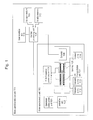
- Fig. 1 shows a hardware configuration of a mass spectrometric system 111 of the present embodiment.
- the mass spectrometric system 111 of the present embodiment includes a specimen introduction unit 101, an ionization unit 102, a high-frequency power source 103, a central processing unit 104, a monitor 105, a detector 106, an ion transportation unit 107, an ion trap 108, a storage medium 109, a volatile memory 110 and vacuum pumps 112 to 114.
- the vacuum pumps 112 to 114 keep appropriate pressure in a chamber connected to each of theses pumps.
- Vapor, droplet spray or micro-particulate specimen is introduced from the specimen introduction unit 101, and the introduced specimen is sent to the ionization unit 102 including an ion source for ionization.
- the ionization method here may be an electro-spray ionization method or a sonic spray ionization method, for example. These ions are sent from the ionization unit 102 to the ion trap 108 via the ion transportation unit 107.
- the ion trap 108 may be a quadrupole ion trap or a linear trap.
- the high-frequency power source 103 supplies high-frequency voltage to the ion trap 108 to let the ion trap 108 trap ions inside.
- the central processing unit 104 changes high-frequency voltage applied to the ion trap 108 with time, whereby ions are sent to the detector 106 at a different time in accordance with the m/z.
- the detector 106 converts the amount of arrived ions into a voltage value, and sends the same to the central processing unit 104.
- the central processing unit 104 converts time of a time-series voltage signal into m/z of ions, thus replacing with intensity-series data (called a mass spectrum) representing the amount of ions for each m/z, and stores the same in the volatile memory 110.
- the central processing unit 104 On the basis of the mass spectrum stored in the volatile memory 110, the central processing unit 104 performs estimation processing of content information on components. This processing is executed in accordance with an estimation rule stored in the storage medium 109.
- the monitor 105 presents the estimated content information.
- the monitor 105 may be a monitor via another PC connected via a network.
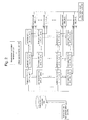
- Fig. 2 shows a processing block configuration of the mass spectrometric system 111 of the present embodiment.
- An estimation rule input/presentation unit 202 accepts an estimation rule corresponding to each time, each component and each measurement operation that is input by a user, and stores such a rule in an estimation rule database 203.
- the estimation rule input/presentation unit 202 presents each estimation rule stored in the estimation rule database 203 to a user.
- a measurement operation decision unit 201 decides a measurement operation to be performed next, and outputs a control sequence corresponding to the measurement operation.
- the control sequence is time-series voltage to be applied to a plurality of electrodes, including four steps of an accumulating step, a cooling step, a mass scanning step, and a releasing step.
- the control sequence may be the same as that disclosed in JP Patent Publication (Kokai) No. 2011-23184 A (Patent Document 3).
- a mass spectrometric unit 100 executes mass spectrometry in accordance with a control sequence input. As stated above, the mass spectrometric unit outputs a spectrum.
- An estimator E(t, i, a) receives a spectrum as an input, and when the spectrum is measured at a measurement time t by the execution of a measurement operation a and the measurement operation a measures a component i as a measurement target, estimates content information on the component i.
- the estimator E(t, i, a) executes estimation using an estimation rule corresponding to each time t, each component i and each measurement operation a.
- An estimation result presentation unit 204 presents the existence determination result res(i, a) or the concentration estimation value d(i, a) corresponding to each component i and each measurement operation a input to a user.
- a method of the presentation may be presentation of image information via the monitor 105, presentation by sound, printing of image information via a printer or the like.
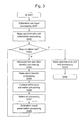
- Fig. 3 is a flowchart of the operation of the mass spectrometric system 111 of the present embodiment.
- estimation rule input processing is executed.
- the aforementioned estimation rule input/presentation unit 202 accepts an estimation rule corresponding to each time, each component and each measurement operation input by a user, and stores the rule in the estimation rule database 203.
- mass spectrometric unit initialization processing is executed.
- determination is made as to whether a stop condition is met or not.
- the stop condition may be acceptance of a stop operation from a user, detection of a measurement error or execution of mass spectrometry a predetermined number of times, for example.
- mass spectrometric unit end processing at S309 is executed and the procedure ends.
- steps from S304 to S308 are executed.
- the aforementioned measurement operation decision unit 201 decides a measurement operation to be performed next, and outputs a control sequence corresponding to the measurement operation.
- mass spectrometric processing at S305 the aforementioned mass spectrometric unit 100 executes mass spectrometry in accordance with the control sequence.
- content information estimation processing at S306 an estimator E(t_current, i, a(t_current)) corresponding to each component i and a measurement time t_current of the spectrum estimates content information of the component i.
- the aforementioned selection unit SEL(i, a) corresponding to each component i and each measurement operation a outputs the latest content information estimation result before t_current.
- the estimation result presentation unit 204 presents a content information estimation result to a user.
- the stop condition at S303 is not met, and an estimation result is presented at S308 during the execution of the loop from S303 to S308. Needless to say, an estimation result may be presented after the stop condition at S303 is met.
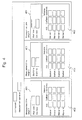
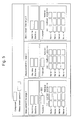
- Fig. 4 is an exemplary graphical user interface of the estimation rule input/presentation unit 202 of the present embodiment. This example especially shows a graphical user interface enabling setting for concentration estimation.
- the estimation rule input/presentation unit 202 has a list box of components and measurement operations.
- the estimation rule input/presentation unit 202 further displays an estimation rule corresponding to a component and a measurement operation that a user selects from this list box and accepts an input to change the estimation rule.
- the estimation rule input/presentation unit 202 has a measurement time setting panel 401 and an estimation rule setting panel 402 corresponding to each measurement time range, and therefore a user is allowed to set an estimation rule for each measurement time range.
- the measurement time setting panel has an input form for starting time and ending time of a measurement time range.
- the estimation rule setting panel has a plurality of forms called "markers", accepting m/z and input of a group of parameters associated with m/z. Information accepted by these forms may vary with the types of estimation rules.
- Fig. 4 shows an example where estimation is performed using m/z of a focused component, a coefficient to be multiplied to the intensity of the m/z and m/z of a reference material to normalize the intensity.
- the number of measurement time ranges and the number of markers are not limited to those illustrated in this drawing. As long as the storage area and the calculation resource permit, these numbers can be increased. Further, the input of detailed estimation rules such as an acceptable range of summation of intensities in the m/z axis direction may be accepted if needed. When a calibration curve is non-linear, high-order coefficients such as secondary and third-order coefficients may be accepted.
- each component and each measurement operation allows an estimation rule leading to precise estimation of content information to be set even when a spectrum to be measured has a tendency of transitioning in intensity and shape with the passage of measurement time.
- the estimation rule input/presentation unit 202 can present a different estimation rule for each measurement time, each component and each measurement operation enabling precise estimation of content information to a user in an easy-to-understand manner.
- Fig. 5 is another exemplary graphical user interface of the estimation rule input/presentation unit 202 of the present embodiment. This example especially shows a graphical user interface enabling setting for existence determination. Compared with Fig. 4 , the estimation rule setting panel has a threshold input form 501.
- each component and each measurement operation allows an estimation rule leading to precise estimation of content information to be set even when a spectrum to be measured has a tendency of transitioning in intensity and shape with the passage of measurement time.
- the estimation rule input/presentation unit 202 can present a different estimation rule for each measurement time, each component and each measurement operation enabling precise estimation of content information to a user in an easy-to-understand manner.
- Fig. 6 is still another exemplary graphical user interface of the estimation rule input/presentation unit 202 of the present embodiment.
- This example especially shows a graphical user interface enabling setting for existence determination based on the order of concentration.
- the estimation rule setting panel has an input form 601 of "order threshold".
- the existence determination based on the order of concentration is a determination method determining as positive when the order of concentration of the component is within the order threshold TH_o among all components, and as negative otherwise.
- This determination method is based on a relative order relation of concentration among components, and therefore when it is known beforehand that the specimen actually contains only a small number of components in the list of all components, determination can be made precisely.
- the component that is actually negative may be determined as positive due to the influences of these two impurity peaks.
- the component can be determined correctly as negative as long as the orders of the concentration of the two components that may be determined as positive due to these two impurity peaks are the second or lower.
- each component and each measurement operation allows an estimation rule leading to precise estimation of content information to be set even when a spectrum to be measured has a tendency of transitioning in intensity and shape with the passage of measurement time.
- the estimation rule input/presentation unit 202 can present a different estimation rule for each measurement time, each component and each measurement operation enabling precise estimation of content information to a user in an easy-to-understand manner.
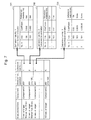
- Fig. 7 shows a data structure of the estimation rule database 203 of the present embodiment.
- This drawing especially shows an estimation rule for concentration estimation.
- Records 701 to 703 of the estimation rule are stored, each corresponding to a group of a measurement time, a component and a measurement operation.
- m/z of a focused component a coefficient to be multiplied to the intensity of the m/z and m/z of a reference material to normalize the intensity are used as parameters of the estimation rule, and a record of each estimation rule stores these parameters.
- Fig. 8 shows a data structure 801 of the estimation rule database 203 of the present embodiment.
- This drawing especially shows an estimation rule for existence determination.
- a record of the estimation rule and a threshold are stored, corresponding to each group of a measurement time, a component and a measurement operation.
- m/z of a focused component a coefficient to be multiplied to the intensity of the m/z and m/z of a reference material to normalize the intensity are used as parameters of the estimation rule, and a record of each estimation rule stores these parameters.
- Fig. 9 shows a data structure of the estimation rule database 203 of the present embodiment.
- This drawing especially shows an estimation rule for existence determination based on the order of concentration.
- a record of the estimation rule and an order threshold are stored, corresponding to each group of a measurement time, a component and a measurement operation.
- m/z of a focused component a coefficient to be multiplied to the intensity of the m/z and m/z of a reference material to normalize the intensity are used as parameters of the estimation rule, and a record of each estimation rule stores these parameters.
- Figs. 7 to 9 all illustrate an example where the types of content information to be estimated are the same for all of the records, where the content information is only one of the concentration of a component, the existence or not in the specimen or whether the concentration is within a certain order or not.
- the types of content information to be estimated may be changed depending on the component. Setting can be changed among the concentration estimation, the existence determination or the existence determination based on the concentration order depending on the measurement time, the component and the measurement operation.
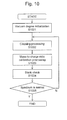
- Fig. 10 is a flowchart of the mass spectrometric unit initialization processing at S302 of the present embodiment.
- the vacuum pumps 112 to 114 exhaust air until the pressure of chambers connected is reduced to an appropriate pressure, and keep the pressure.
- a user is requested to introduce a specimen such as ammonia, and when the specimen is introduced, the measurement thereof is executed. Thereby, a substance (carry over) adhered during the measurement last time is cleaned.
- S1003 for mass-to-charge ratio calibration processing a user is requested to introduce a reference material specimen having a peak at known m/z, and when the specimen is introduced, the measurement thereof is executed. Based on the position of the peak of the measured spectrum, a correspondence table of element numbers on the array of mass spectrum and m/z is created.
- a user is requested to introduce a known specimen that does not contain a measurement target component, and when the specimen is introduced, the measurement thereof is executed.
- the obtained spectrum meets a predetermined condition, it is determined at S1005 that the spectrum is normal, and the procedure ends.
- it is determined at S1005 that the spectrum is abnormal and the procedure returns to the cleaning processing S1002.
- the spectrum may be determined as normal.
- the obtained spectrum is considered as a M-dimensional vector, and when a cosine similarity to a reference spectrum measured in the past is higher than a certain threshold, the spectrum may be determined as normal. In this way, the determination for normality may be made using an appropriate known method.
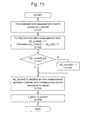
- Fig. 11 is a flowchart of the measurement operation decision processing at S304 of the present embodiment.
- a measurement operation is executed in a fixed order.
- a time elapsed from the measurement start is stored as t_current indicating the current measurement time.
- a measurement number 1 is stored for the next performing measurement operation a(t_current), and otherwise the value obtained by adding 1 to the measurement number a(t_prev) of the previous measurement operation is stored for the next performing measurement operation a(t_current).
- a(t_current) is A or less, the procedure directly proceeds to S1105, and otherwise at S1104 a measurement number 1 is stored as a(t_current), and the procedure proceeds to S1105.
- a(t_current) is decided as the next measurement operation number, and a control sequence corresponding to this measurement operation number is generated and output.
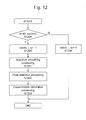
- Fig. 12 is a flowchart of the content information estimation processing at S306 of the present embodiment. This flowchart especially shows the case for concentration estimation.
- an estimator E(t_current, i, a) executes the following processing for each component i and each measurement operation a.
- the smoothing may be performed using a known appropriate method such as a moving-average method, Gaussian filter convolution or a FFT filter.
- peak detection processing is performed to extract a peak of each component.
- the peak detection method may be a known appropriate one.
- the position m_c of a m/z of the peak is calculated by Expression (2).
- y_c is stored at the intensity I_j of the marker j.
- 0 is stored as the intensity I_j of the marker j where distances from all peaks are not the threshold TH_X or lower.
- concentration calculation processing is performed, and estimated concentration d(t, i, a) is output.
- the value of d(t, i, a) may be calculated using Expression (3), for example.
- g_1, ⁇ , g_L are marker coefficients set as the estimation rule
- r_1, ⁇ , r_L are m/z of a reference material set as the estimation rule
- I_r_1, ⁇ , I_r_L are intensity of m/z of the reference material.
- the content information estimation processing of the present embodiment uses an appropriate estimation rule for each measurement time, component and measurement operation, even when the spectrum to be measured has a tendency of transitioning in intensity and shape with the passage of measurement time, content information can be estimated precisely.
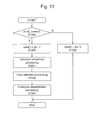
- Fig. 13 is a flowchart of the content information estimation processing at S306 of the present embodiment. This flowchart especially shows a flowchart for existence determination.
- an estimator E(t_current, i, a) executes the following processing for each component i and each measurement operation a. Branching based on the determination result at S1204, assignment processing at S1205 and S1206, the spectrum smoothing processing at S1201 and the peak detection processing at S1202 each are the same processing as those illustrated in Fig. 12 for concentration estimation.
- the res(t, i, a) may be calculated using Expression (4), for example.
- the content information estimation processing of the present embodiment uses an appropriate estimation rule for each measurement time, component and measurement operation, even when the spectrum to be measured has a tendency of transitioning in intensity and shape with the passage of measurement time, content information can be estimated precisely.
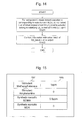
- Fig. 14 is a flowchart of the selection processing at S307 of the present embodiment.
- Fig. 15 is a graphical user interface of the estimation result presentation unit 204 of the present embodiment. This drawing especially shows the case of concentration estimation.
- the estimation result presentation unit 204 displays the latest result d_i of a concentration estimation value of each component.
- Component names 1501 and concentration estimation results 1502 are displayed in this example.
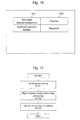
- Fig. 16 is a graphical user interface of the estimation result presentation unit 204 of the present embodiment. This drawing especially shows the case of existence determination.
- the estimation result presentation unit displays the latest result res_i of a label indicating whether each component is contained in the specimen or not.
- Component names 1601 and existence determination results 1602 are displayed in this example.
- Fig. 17 is a flowchart of the mass spectrometric unit end processing at S309 of the present embodiment.
- Cleaning processing at S1701 is the same processing as that of the cleaning processing at S1002.
- high-frequency power source stop processing at S1702 the high-frequency power source 103 is stopped.
- the vacuum pumps 112 to 114 are stopped in vacuum pump stop processing at S1703.
- the present embodiment describes an exemplary mass spectrometric system capable of estimating content information precisely even when a spectrum varies in intensity and shape for each measurement time stochastically.
- the intensity and the shape of a spectrum may vary stochastically for each measurement time due to factors such as fluctuations of voltage generated at an electric circuit of the mass spectrometric unit, fluctuations of timing when a control sequence is executed, fluctuations of devices during measurement, fluctuations of the accumulation amount of ions and fluctuations of ionization efficiency.
- Fig. 18 shows a processing block configuration of the mass spectrometric system 111 of the present embodiment.
- the configuration is different from Embodiment 1 in that an integration unit INT(i) exists for each component i instead of the selection unit.
- Fig. 19 is a flowchart of the operation of the mass spectrometric system 111 of the present embodiment. This operation is different from Embodiment 1 in that integration processing S1905 exists.
- the aforementioned integration unit INT(i) corresponding to each component i integrates all of the content information estimation results at measurement times before t_current, and outputs the integrated content information estimation result. The following describes this operation in details, with reference of Fig. 20 .
- Fig. 20 is a flowchart of the integration processing at S1905 of the present embodiment. This flowchart especially describes the case of existence determination.
- initialization processing is performed. 1 is stored as a measurement time number t and 0 is assigned as valid flag valid_i.
- the procedure proceeds to S2002. Otherwise, the procedure proceeds to S2008.
- the processing corresponds to the calculation of a difference between the frequency of "positive” and the frequency of "negative” as the estimation results during the entire measurement time.
- a measurement operation a(t) at the measurement time t is a measurement operation targeting at the component i
- the procedure proceeds to S2003. Otherwise, the procedure proceeds to S2007.
- N_pos is larger than a threshold TH_P
- “positive” is stored as the content information estimation result res_i at S2010, and the procedure proceeds to S2013.
- sig(z, ⁇ ) is calculated using Expression (5).
- ⁇ is an appropriate positive constant.
- res_i and c_i are output and the procedure ends.
- estimation results of measurement times enables cancellation of influences by fluctuations of the estimation results of the measurement times, thus increasing the probability that integrated content information estimation result is correct.
- the above example describes the case where content information estimation results of all measurement times after the measurement start are integrated. Needless to say, instead of using the content information estimation results for all of the measurement times, a part thereof may be used. Content information estimation results only during a measurement time section set beforehand only may be integrated, or content information estimation results during a measurement time section close to the current measurement time may be integrated.
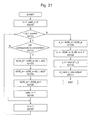
- Fig. 21 is a flowchart of the integration processing S1905. This drawing especially shows the flowchart for concentration estimation.
- ⁇ is an appropriate positive constant.
- the estimation may be performed by geometric average, harmonic average, or estimation based on a median.
- An appropriate known estimation method may be used.
- content information can be estimated precisely even when a spectrum varies in intensity and shape for each measurement time stochastically.
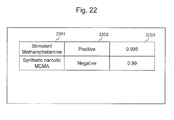
- Fig. 22 shows a graphical user interface of the estimation result presentation unit 204 of the present embodiment. This example especially shows the case of existence determination.
- integration posterior certainty 2203 displayed together with component names 2201 and existence determination results 2202 allows a user to know the probability that the content information estimation result is correct. Integration posterior certainty may be displayed similarly also in the case of concentration estimation.
- content information can be estimated precisely even when a spectrum varies in intensity and shape for each measurement time stochastically.
- the present embodiment describes an exemplary mass spectrometric system capable of estimating content information precisely even when the precision of a content information estimation result at each measurement time tends to transition with the passage of the measurement time.
- an estimation result at a time when a result with relatively low-degree of precision is obtained adversely affects the precision of the integrated content information estimation result.
- processing is performed so as to emphasize an estimation result at a time when a result with high-degree of precision can be obtained, whereby the precision of the integrated content information estimation result is improved.
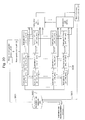
- Fig. 23 shows a processing block configuration of the mass spectrometric system 111 of the present embodiment.
- the configuration is different from Embodiment 2 in that certainty weight 2301 for each measurement time, each component and each measurement operation on the estimation rule database is input to an integration unit INT(i) corresponding to each component i, and the integration unit INT(i) executes integration using the certainty weight 2301.
- the present embodiment follows the same flowchart Fig. 19 as in Embodiment 2.
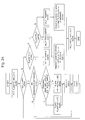
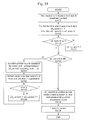
- Fig. 24 is a flowchart of the integration processing at S1905 of the present embodiment. This flowchart especially describes the case of existence determination.
- This flowchart is different from Fig. 20 of Embodiment 2 in that certainty weight w(t, i, a(t)) is added to N_pos at S2401 and the certainty weight w(t, i, a(t)) is subtracted from N_pos at S2402.
- certainty weight w(t, i, a(t) is added to N_pos at S2401 and the certainty weight w(t, i, a(t)) is subtracted from N_pos at S2402.
- certainty weight is not set for the component i
- estimation is enabled using certainty weight w(t, i', a(t)) of a component i' having similar volatility. This case leads to an advantage of avoiding a user's necessity of inputting a parameter for all components.
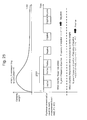
- Fig. 25 schematically shows the effect from the integration processing at S1905 of the present embodiment.
- N_pos becomes -1, and so res(i) will be "negative".
- certainty weight is counted, a result of a time zone 2501 with high-degree of precision is emphasized, whereby it can be determined as "positive".
- Fig. 26 is a flowchart of the integration processing at S1905. This drawing especially shows the flowchart for concentration estimation.
- This flowchart is different from Fig. 21 of Embodiment 2 in that at S2601 a value obtained by multiplying d(t, i, a(t)) by w(t, i, a(t)) is added to the total sum SUM_d of the concentration estimation values, at S2602, a value obtained by multiplying the square of d(t, i, a(t)) by w(t, i, a(t)) is added to the total sum SUM_s of the square of the concentration estimation values, and at S2603, w(t, i, a(t)) is added to the total sum SUM_w of the frequency of addition.
- estimation is performed for the concentration estimation as well while emphasizing a time with high certainty weight.
- certainty weight is not set for the component i
- estimation is enabled using certainty weight w(t, i', a(t)) of a component i' having similar volatility. This case leads to an advantage of avoiding a user's necessity of inputting a parameter for all components.
- Fig. 27 is another exemplary flowchart of the integration processing at S1905. This drawing especially shows the flowchart for existence determination.
- This flowchart is different from Fig. 24 in that at S2701 a value obtained by multiplying certainty weight w(t, i, a(t)) and posterior certainty c(t, i) is added to N_pos, and at S2702, a value obtained by multiplying certainty weight w(t, i, a(t)) and posterior certainty c(t, i) is subtracted from N_pos.
- the posterior certainty c(t, i) is calculated by Expression (6).
- the posterior certainty c(t, i) means the higher degree of probability that an estimation result based on a single spectrum measured at the measurement time is correct.
- an estimation result using a spectrum at a measurement time and of a measurement operation with high certainty weight w(t, i, a(t)) will be emphasized.
- the posterior certainty c(t, i) used enables the emphasis of an estimation result with a high probability that an estimation result based on the single spectrum measured at the measurement time is correct.
- a spectrum at each time follows a relatively simple probabilistic distribution such as a single normal distribution, the use of the posterior certainty c(t, i) enables precise estimation.
- Fig. 28 shows an exemplary graphical user interface of the estimation rule input/presentation unit 202 of the present embodiment.
- This example especially shows a graphical user interface enabling setting for concentration estimation.
- This example is different from Fig. 4 of Embodiment 1 in that a form 2801 is provided for inputting of certainty weight for each measurement time range and receiving an input 2802 of certainty weight.
- a form 2801 is provided for inputting of certainty weight for each measurement time range and receiving an input 2802 of certainty weight.
- Fig. 29 shows a data structure of the estimation rule database 203 of the present embodiment.
- This drawing especially shows an estimation rule for concentration estimation.
- This example is different from Fig. 7 of Embodiment 1 in that a column 2901 of certainty weight is provided for each group of a measurement time, a component and a measurement operation. Thereby, even when the precision of a content information estimation result at each measurement time tends to transition with the passage of the measurement time, an estimation rule enabling precise estimation of content information can be stored.
- the present embodiment describes an exemplary mass spectrometric system capable of precisely estimating content information of a plurality of components at the same time even when the precision of a content information estimation result at each measurement time tends to transition with the passage of the measurement time.
- a measurement operation can be selected effectively, and so content information can be estimated precisely.
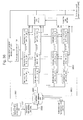
- Fig. 30 shows a processing block configuration of the mass spectrometric system 111 of the present embodiment.
- the configuration is different from Embodiment 3 in that certainty weight 3001 corresponding to each measurement time, each component and each measurement operation on the estimation rule database 203 is input to the measurement operation decision unit 201, and the measurement operation decision unit 201 decides a measurement operation using the certainty weight.
- An estimation rule and certainty weight corresponding to each time, each component and each measurement operation are input to the estimation rule database 203 from the estimation rule input/presentation unit 202.
- Each estimator receives, from the estimation rule database 203, an estimation rule 3002 corresponding to each time, each component and each measurement operation, and each integration unit receives, from the estimation rule database 203, certainty weight 3003 corresponding to each component and time.
- Each estimator inputs an estimation result 3004 corresponding to each time, each component and each measurement operation to the corresponding integration unit.
- the present embodiment follows the same flowchart Fig. 19 as in Embodiment 2.
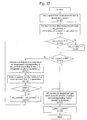
- Fig. 31 is a flowchart of the measurement operation decision processing at S304 of the present embodiment. The following descries a difference from Fig. 11 of Embodiment 1.
- determination is made whether a(t_current) is MS 1 or not. When it is MS 1 , the procedure proceeds to S1105, and otherwise the procedure proceeds to S3101.
- S3102 a uniform random number rand of 0 or more and less than 1 is generated.
- the procedure proceeds to S1105, and otherwise at S3104, 1 is added to the measurement operation number a(t_current) to set the following measurement operation number as a target, and the procedure returns to S1103.
- a measurement operation corresponding to a component with larger certainty weight w(t, i, a) leads to higher probability that rand is less than p, and therefore such a measurement operation is more likely to be selected as the next measurement operation.
- certainty weight is not set for the component i
- estimation is enabled using certainty weight w(t, i', a(t)) of a component i' having similar volatility. This case leads to an advantage of avoiding a user's necessity of inputting a parameter for all components.
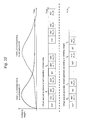
- Fig. 32 schematically shows the effect from the measurement operation decision processing S304 of the present embodiment.
- a measurement operation is uniformly executed for components even at a time with low-degree of precision of the content information estimation result.
- components may vaporize before sufficient estimation precision can be obtained.
- the present embodiment describes an exemplary mass spectrometric system enabling automatic learning of an estimation rule and certainty weight.
- Fig. 33 shows a processing block configuration of the mass spectrometric system 111 of the present embodiment.
- the configuration is different from Embodiment 4 in that a spectrum time series 3301 is read from a spectrum time-series database 3301, and an estimation rule learning unit 3302 estimates an estimation rule and certainty weight 3302 corresponding to each measurement time, each component and each measurement operation.
- the flowchart during measurement execution of the present embodiment follows the same flowchart Fig. 19 as in Embodiment 2. The following describes processing during learning.
- Fig. 34 is a flowchart showing an operation of an estimation rule learning unit. This flowchart especially shows the case for concentration estimation.
- a is A or less at S3402, the procedure proceeds to S3403, and otherwise the procedure ends.
- a spectrum time-series group D corresponding to the measurement operation a is read from the spectrum time-series database 3301.
- the spectrum time-series group D is converted into a concentration information added feature vector time-series group D'.
- an estimation rule R(t, i, a) for the component i corresponding to the measurement operation a for each measurement time t is calculated.
- This estimation parameter may be calculated by a known calculation method of a calibration curve.
- certainty weight w(t, i, a) for the component i corresponding to the measurement operation a is calculated for each time t.
- 1 is added to a, and the procedure returns to S3402.
- Fig. 35 is a flowchart showing the operation of the estimation rule learning unit. This flowchart especially shows the case for existence determination.
- the processing from S3501 to S3504 of Fig. 35 is the same as the processing from S3401 to S3404 of Fig. 34 , and S3508 is the same processing as that at S3407.
- the concentration information added feature vector time-series group D' is converted into the instruction signal added feature vector time-series group V by assigning an instruction signal to each element i based on whether the element is a threshold concentration or more or less than that for each component i.
- an estimation rule R(t, i, a) corresponding to the measurement operation a is calculated for each time t.
- This estimation parameter may be calculated by a known supervised pattern recognition learning method. For instance, a known method such as linear discriminant analysis, back propagation method of neural network, support vector machine sorter, relevance vector machine sorter or ID3 or C4.5 of decision tree may be used.
- certainty weight w(t, i, a) for the component i corresponding to the measurement operation a is calculated for each time t.
- the certainty weight w(t, i, a) may be calculated as an accuracy rate when all samples of the measurement time t, the component i and the measurement operation a are determined with the estimation rule R(t, i, a).
- a known index such as between-class variance versus within-class variance, where a larger index makes the determination easier, may be used.
- the present embodiment enables automatic learning of an estimation rule and certainty weight.
- the present embodiment describes an exemplary mass spectrometric system capable of precisely estimating content information of a plurality of components at the same time when the precision of a content information estimation result at each measurement time tends to transition with the passage of the measurement time, and there is a variation in measurement time required for estimation among components.
- the present embodiment deals with this problem by performing feedback of an estimation result integrated up to the current time to a measurement operation decision unit.
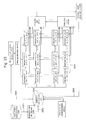
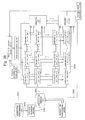
- Fig. 36 shows a processing block configuration of the mass spectrometric system 111 of the present embodiment.
- the configuration is different from Embodiment 5 in that an estimation result d_i or res_i for each component i output from the integration unit INT(i) and posterior certainty c_i are input to the measurement operation decision unit 201 and the measurement operation decision unit 201 decides a measurement operation in accordance with them.
- higher certainty weight w(t, i, a) means higher probability of selection
- higher integration posterior certainty c_i means lower probability of selection.
- Fig. 38 schematically shows the effect from the measurement operation decision processing S304 of the present embodiment.
- content information of a plurality of components can be estimated precisely and at the same time when the precision of a content information estimation result at each measurement time tends to transition with the passage of the measurement time, and there is a variation in measurement time required for estimation among components.
- the present embodiment describes an exemplary mass spectrometric system capable of precisely estimating content information even when a long time is required from acquisition of a specimen to measurement start.
- the present embodiment deals with this problem by correcting a measurement time in accordance with an elapsed time from acquisition of a specimen to measurement start.
- Fig. 39 shows a processing block configuration of the mass spectrometric system 111 of the present embodiment.
- w_e is an appropriate constant.
- the measurement operation decision unit 201 and the integration unit INT(i) also performs addition to t_current similarly for correction. An estimation rule and a certainty weight to be used are selected in accordance with the thus corrected t_current'.
- Fig. 40 shows a graphical user interface of the specimen acquisition time input unit 3901.
- the specimen acquisition time may be input at the specimen acquisition time using a depression button on a touch panel, or may be input using a button provided at a dropper used for specimen acquisition, or other devices may be used instead.
- content information can be estimated precisely even when a long time is required from acquisition of a specimen to measurement start.
- the present invention is not limited to the above-described embodiments, and may include various modification examples. For instance, the entire detailed configuration of the embodiments described above for explanatory convenience is not always necessary for the present invention. A part of one embodiment may be replaced with the configuration of another embodiment, or the configuration of one embodiment may be added to the configuration of another embodiment. A part of the configuration of each embodiment may additionally include another configuration, or a part of the configuration may be deleted or replaced.
- the above-described configurations, functions, processing parts, processing means and the like, a part or the entire of them, may be implemented by hardware by designing as an integrated circuit, for example.
- the above-described configurations, functions and the like may be implemented by software using a processor that interprets a program to implement these functions and executes the program.
- Information such as programs, tables and files to implement these functions may be placed on a recording device such as a memory, a hard disk or a SSD (Solid State Drive), or a recording medium such as an IC card, a SD card or a DVD.
- Control lines and information lines shown are those required for description, and all of the control line and information lines of a product are not always illustrated. It can be considered that in an actual product, almost all configurations are mutually connected.
Landscapes
- Chemical & Material Sciences (AREA)
- Analytical Chemistry (AREA)
- Other Investigation Or Analysis Of Materials By Electrical Means (AREA)
Applications Claiming Priority (1)
| Application Number | Priority Date | Filing Date | Title |
|---|---|---|---|
| JP2012047202A JP5947567B2 (ja) | 2012-03-02 | 2012-03-02 | 質量分析システム |
Publications (3)
| Publication Number | Publication Date |
|---|---|
| EP2634792A2 true EP2634792A2 (fr) | 2013-09-04 |
| EP2634792A3 EP2634792A3 (fr) | 2015-11-25 |
| EP2634792B1 EP2634792B1 (fr) | 2019-04-10 |
Family
ID=47713942
Family Applications (1)
| Application Number | Title | Priority Date | Filing Date |
|---|---|---|---|
| EP13154713.5A Active EP2634792B1 (fr) | 2012-03-02 | 2013-02-08 | Système de spectromètre de masse |
Country Status (4)
| Country | Link |
|---|---|
| US (1) | US9287105B2 (fr) |
| EP (1) | EP2634792B1 (fr) |
| JP (1) | JP5947567B2 (fr) |
| CN (1) | CN103293215B (fr) |
Cited By (1)
| Publication number | Priority date | Publication date | Assignee | Title |
|---|---|---|---|---|
| EP3442002A1 (fr) * | 2017-08-08 | 2019-02-13 | Shimadzu Corporation | Dispositif d'édition de séquences de fonctionnement, système de commande d'analyse, système d'analyse et procédé d'édition de séquences de fonctionnement |
Families Citing this family (4)
| Publication number | Priority date | Publication date | Assignee | Title |
|---|---|---|---|---|
| JP6041041B2 (ja) * | 2013-03-04 | 2016-12-07 | 株式会社島津製作所 | 分取クロマトグラフ装置 |
| JP6020314B2 (ja) * | 2013-04-04 | 2016-11-02 | 株式会社島津製作所 | クロマトグラフ質量分析データ処理装置 |
| US20150179420A1 (en) * | 2013-12-20 | 2015-06-25 | Thermo Finnigan Llc | Ionization System for Charged Particle Analyzers |
| JP7167105B2 (ja) * | 2020-09-17 | 2022-11-08 | 日本電子株式会社 | マススペクトル処理装置及び方法 |
Citations (3)
| Publication number | Priority date | Publication date | Assignee | Title |
|---|---|---|---|---|
| JP2010054406A (ja) | 2008-08-29 | 2010-03-11 | Shimadzu Corp | クロマトグラフ質量分析データ解析方法及び装置 |
| JP2011023184A (ja) | 2009-07-15 | 2011-02-03 | Hitachi High-Technologies Corp | 質量分析計及び質量分析方法 |
| JP2011033346A (ja) | 2009-07-29 | 2011-02-17 | Shimadzu Corp | クロマトグラフ質量分析データ解析方法及び装置 |
Family Cites Families (39)
| Publication number | Priority date | Publication date | Assignee | Title |
|---|---|---|---|---|
| EP0273040B1 (fr) * | 1986-03-26 | 1994-06-22 | GX BioSystems A/S | Confinement biologique |
| US5121443A (en) * | 1989-04-25 | 1992-06-09 | Spectra-Physics, Inc. | Neural net system for analyzing chromatographic peaks |
| JP2957802B2 (ja) * | 1992-05-19 | 1999-10-06 | 株式会社日立製作所 | クロマトグラフ装置 |
| US5859362A (en) * | 1996-10-22 | 1999-01-12 | Revenue Canada | Trace vapor detection |
| US6748333B1 (en) * | 1999-09-27 | 2004-06-08 | Hitachi, Ltd. | Method and apparatus for chromatographic data processing, and chromatograph |
| US7200494B2 (en) * | 2001-10-30 | 2007-04-03 | Hitachi, Ltd. | Method and apparatus for chromatographic data processing |
| US20020010566A1 (en) * | 2000-04-11 | 2002-01-24 | Chester Thomas Lee | Methods for modeling, predicting, and optimizing high performance liquid chromatography parameters |
| JP4782278B2 (ja) * | 2000-12-19 | 2011-09-28 | 株式会社島津製作所 | 液体クロマトグラフ質量分析計 |
| US6873915B2 (en) * | 2001-08-24 | 2005-03-29 | Surromed, Inc. | Peak selection in multidimensional data |
| US20030159523A1 (en) * | 2001-10-29 | 2003-08-28 | Renfro William Leonard | Contraband detection system |
| JP3743717B2 (ja) * | 2002-06-25 | 2006-02-08 | 株式会社日立製作所 | 質量分析データの解析方法および質量分析データの解析装置および質量分析データの解析プログラムならびにソリューション提供システム |
| JP2004271185A (ja) * | 2003-03-05 | 2004-09-30 | Shimadzu Corp | 質量分析装置用データ処理装置 |
| US6997031B2 (en) * | 2003-05-01 | 2006-02-14 | Waters Corporation | Fraction collector for composition analysis |
| US7425700B2 (en) * | 2003-05-22 | 2008-09-16 | Stults John T | Systems and methods for discovery and analysis of markers |
| US7072772B2 (en) * | 2003-06-12 | 2006-07-04 | Predicant Bioscience, Inc. | Method and apparatus for modeling mass spectrometer lineshapes |
| US20050267689A1 (en) * | 2003-07-07 | 2005-12-01 | Maxim Tsypin | Method to automatically identify peak and monoisotopic peaks in mass spectral data for biomolecular applications |
| US7473892B2 (en) | 2003-08-13 | 2009-01-06 | Hitachi High-Technologies Corporation | Mass spectrometer system |
| DE112005001166B4 (de) * | 2004-05-20 | 2014-10-09 | Waters Technologies Corp. (N.D.Ges.D. Staates Delaware) | Verfahren und Vorrichtung zum Identifizieren von Proteinen in Gemischen |
| US7254501B1 (en) * | 2004-12-10 | 2007-08-07 | Ahura Corporation | Spectrum searching method that uses non-chemical qualities of the measurement |
| JP2006138755A (ja) | 2004-11-12 | 2006-06-01 | Hitachi Ltd | 危険物探知装置および危険物探知方法 |
| US20070042426A1 (en) * | 2005-01-28 | 2007-02-22 | Kiernan Urban A | Biomarkers and assays for myocardial infarction |
| CA2596381C (fr) * | 2005-02-01 | 2016-05-03 | Metanomics Gmbh | Procede et systeme d'analyse spectrale de masse |
| US7277799B2 (en) * | 2005-02-09 | 2007-10-02 | Bruker Daltonics, Inc. | Isotope correlation filter for mass spectrometry |
| US7498568B2 (en) | 2005-04-29 | 2009-03-03 | Agilent Technologies, Inc. | Real-time analysis of mass spectrometry data for identifying peptidic data of interest |
| JP4843250B2 (ja) * | 2005-05-13 | 2011-12-21 | 株式会社日立ハイテクノロジーズ | 質量分析を用いた物質の同定方法 |
| JP4523488B2 (ja) | 2005-05-27 | 2010-08-11 | 株式会社日立ハイテクノロジーズ | 質量分析システムおよび質量分析方法 |
| JP4951752B2 (ja) * | 2005-11-17 | 2012-06-13 | 国立大学法人高知大学 | 易動度の正規化装置、正規化方法、正規化プログラムおよび自己組織化マップ、並びに、物質の検出方法、検出プログラム、検出ルール生成方法およびデータ構造 |
| US7548818B2 (en) * | 2005-12-07 | 2009-06-16 | Mds Analytical Technologies | Automated analysis of complex matrices using mass spectrometer |
| US7501621B2 (en) * | 2006-07-12 | 2009-03-10 | Leco Corporation | Data acquisition system for a spectrometer using an adaptive threshold |
| US7904253B2 (en) * | 2006-07-29 | 2011-03-08 | Cerno Bioscience Llc | Determination of chemical composition and isotope distribution with mass spectrometry |
| JP2007010683A (ja) * | 2006-09-05 | 2007-01-18 | Hitachi Ltd | イオントラップ質量分析計を用いた探知方法及び探知装置 |
| GB2466732B (en) * | 2007-10-30 | 2011-12-21 | Schlumberger Holdings | Chromatography data processing method and system |
| US7982181B1 (en) * | 2008-01-15 | 2011-07-19 | Thermo Finnigan Llc | Methods for identifying an apex for improved data-dependent acquisition |
| US7983852B2 (en) * | 2008-10-21 | 2011-07-19 | Thermo Finnigan Llc | Methods of automated spectral peak detection and quantification without user input |
| US8987662B2 (en) | 2009-05-14 | 2015-03-24 | Agilent Technologies, Inc. | System and method for performing tandem mass spectrometry analysis |
| CN101614698A (zh) * | 2009-07-27 | 2009-12-30 | 上海华质生物技术有限公司 | 质谱的监听装置和监听方法 |
| GB0919870D0 (en) | 2009-11-13 | 2009-12-30 | Micromass Ltd | A method to detect and quantitatively profile organic species using a mass spectrometer |
| US20130131998A1 (en) * | 2011-11-18 | 2013-05-23 | David A. Wright | Methods and Apparatus for Identifying Mass Spectral Isotope Patterns |
| JP6020314B2 (ja) * | 2013-04-04 | 2016-11-02 | 株式会社島津製作所 | クロマトグラフ質量分析データ処理装置 |
-
2012
- 2012-03-02 JP JP2012047202A patent/JP5947567B2/ja active Active
-
2013
- 2013-02-06 US US13/760,284 patent/US9287105B2/en active Active
- 2013-02-08 EP EP13154713.5A patent/EP2634792B1/fr active Active
- 2013-02-08 CN CN201310050829.8A patent/CN103293215B/zh active Active
Patent Citations (3)
| Publication number | Priority date | Publication date | Assignee | Title |
|---|---|---|---|---|
| JP2010054406A (ja) | 2008-08-29 | 2010-03-11 | Shimadzu Corp | クロマトグラフ質量分析データ解析方法及び装置 |
| JP2011023184A (ja) | 2009-07-15 | 2011-02-03 | Hitachi High-Technologies Corp | 質量分析計及び質量分析方法 |
| JP2011033346A (ja) | 2009-07-29 | 2011-02-17 | Shimadzu Corp | クロマトグラフ質量分析データ解析方法及び装置 |
Cited By (1)
| Publication number | Priority date | Publication date | Assignee | Title |
|---|---|---|---|---|
| EP3442002A1 (fr) * | 2017-08-08 | 2019-02-13 | Shimadzu Corporation | Dispositif d'édition de séquences de fonctionnement, système de commande d'analyse, système d'analyse et procédé d'édition de séquences de fonctionnement |
Also Published As
| Publication number | Publication date |
|---|---|
| EP2634792A3 (fr) | 2015-11-25 |
| JP5947567B2 (ja) | 2016-07-06 |
| CN103293215B (zh) | 2015-12-09 |
| CN103293215A (zh) | 2013-09-11 |
| US20130228677A1 (en) | 2013-09-05 |
| US9287105B2 (en) | 2016-03-15 |
| JP2013181910A (ja) | 2013-09-12 |
| EP2634792B1 (fr) | 2019-04-10 |
Similar Documents
| Publication | Publication Date | Title |
|---|---|---|
| US10121643B2 (en) | Chromatography/mass spectrometry data processing device | |
| EP2447980B1 (fr) | Procédé de génération d'un spectre de masse disposant d'une alimentation à résolution améliorée | |
| EP2634792B1 (fr) | Système de spectromètre de masse | |
| CN107112192B (zh) | 傅立叶变换质谱法 | |
| JP5847678B2 (ja) | 質量分析装置及び方法 | |
| US20130338935A1 (en) | Mass spectrometry data processing device | |
| US10153145B2 (en) | Method of mass spectrometry and a mass spectrometer | |
| US9460905B2 (en) | Method of assessing vacuum conditions in a mass spectrometer with transient signal decay rates | |
| JP7643494B2 (ja) | 波形解析方法及び波形解析装置 | |
| US10593528B2 (en) | Peak assessment for mass spectrometers | |
| JP2018504607A (ja) | 断片化エネルギーを切り替えながらの幅広い四重極rf窓の高速スキャニング | |
| US9640374B2 (en) | Deconvolution and identification algorithms for use on spectroscopic data | |
| JP2018504600A (ja) | 干渉検出および着目ピークのデコンボルーション | |
| US10297434B2 (en) | Method for extracting mass information from low resolution mass-to-charge ratio spectra of multiply charged species | |
| EP2483641B1 (fr) | Systèmes et procédés pour maintenir la précision de mesures de masse | |
| EP3254300B1 (fr) | Détection de similarité basée sur la spectrométrie de masse par le biais d'une soustraction de courbes | |
| JP2023536933A (ja) | 質量分析法における荷電状態割り当てのためのシステムおよび方法 | |
| US11410842B2 (en) | Time-frequency analysis | |
| US20220189753A1 (en) | Methods and systems for processing mass spectra | |
| WO2011146422A1 (fr) | Systèmes et procédés pour la détection d'une caractéristique en spectrométrie de masse à l'aide de l'analyse du spectre singulier |
Legal Events
| Date | Code | Title | Description |
|---|---|---|---|
| PUAI | Public reference made under article 153(3) epc to a published international application that has entered the european phase |
Free format text: ORIGINAL CODE: 0009012 |
|
| 17P | Request for examination filed |
Effective date: 20130412 |
|
| AK | Designated contracting states |
Kind code of ref document: A2 Designated state(s): AL AT BE BG CH CY CZ DE DK EE ES FI FR GB GR HR HU IE IS IT LI LT LU LV MC MK MT NL NO PL PT RO RS SE SI SK SM TR |
|
| AX | Request for extension of the european patent |
Extension state: BA ME |
|
| PUAL | Search report despatched |
Free format text: ORIGINAL CODE: 0009013 |
|
| AK | Designated contracting states |
Kind code of ref document: A3 Designated state(s): AL AT BE BG CH CY CZ DE DK EE ES FI FR GB GR HR HU IE IS IT LI LT LU LV MC MK MT NL NO PL PT RO RS SE SI SK SM TR |
|
| AX | Request for extension of the european patent |
Extension state: BA ME |
|
| RIC1 | Information provided on ipc code assigned before grant |
Ipc: H01J 49/00 20060101AFI20151022BHEP |
|
| STAA | Information on the status of an ep patent application or granted ep patent |
Free format text: STATUS: EXAMINATION IS IN PROGRESS |
|
| 17Q | First examination report despatched |
Effective date: 20171016 |
|
| GRAP | Despatch of communication of intention to grant a patent |
Free format text: ORIGINAL CODE: EPIDOSNIGR1 |
|
| STAA | Information on the status of an ep patent application or granted ep patent |
Free format text: STATUS: GRANT OF PATENT IS INTENDED |
|
| INTG | Intention to grant announced |
Effective date: 20180823 |
|
| GRAS | Grant fee paid |
Free format text: ORIGINAL CODE: EPIDOSNIGR3 |
|
| GRAA | (expected) grant |
Free format text: ORIGINAL CODE: 0009210 |
|
| STAA | Information on the status of an ep patent application or granted ep patent |
Free format text: STATUS: THE PATENT HAS BEEN GRANTED |
|
| AK | Designated contracting states |
Kind code of ref document: B1 Designated state(s): AL AT BE BG CH CY CZ DE DK EE ES FI FR GB GR HR HU IE IS IT LI LT LU LV MC MK MT NL NO PL PT RO RS SE SI SK SM TR |
|
| REG | Reference to a national code |
Ref country code: GB Ref legal event code: FG4D |
|
| REG | Reference to a national code |
Ref country code: CH Ref legal event code: EP Ref country code: AT Ref legal event code: REF Ref document number: 1119819 Country of ref document: AT Kind code of ref document: T Effective date: 20190415 |
|
| REG | Reference to a national code |
Ref country code: IE Ref legal event code: FG4D |
|
| REG | Reference to a national code |
Ref country code: DE Ref legal event code: R096 Ref document number: 602013053542 Country of ref document: DE |
|
| REG | Reference to a national code |
Ref country code: NL Ref legal event code: MP Effective date: 20190410 |
|
| REG | Reference to a national code |
Ref country code: LT Ref legal event code: MG4D |
|
| REG | Reference to a national code |
Ref country code: AT Ref legal event code: MK05 Ref document number: 1119819 Country of ref document: AT Kind code of ref document: T Effective date: 20190410 |
|
| PG25 | Lapsed in a contracting state [announced via postgrant information from national office to epo] |
Ref country code: NL Free format text: LAPSE BECAUSE OF FAILURE TO SUBMIT A TRANSLATION OF THE DESCRIPTION OR TO PAY THE FEE WITHIN THE PRESCRIBED TIME-LIMIT Effective date: 20190410 |
|
| PG25 | Lapsed in a contracting state [announced via postgrant information from national office to epo] |
Ref country code: LT Free format text: LAPSE BECAUSE OF FAILURE TO SUBMIT A TRANSLATION OF THE DESCRIPTION OR TO PAY THE FEE WITHIN THE PRESCRIBED TIME-LIMIT Effective date: 20190410 Ref country code: HR Free format text: LAPSE BECAUSE OF FAILURE TO SUBMIT A TRANSLATION OF THE DESCRIPTION OR TO PAY THE FEE WITHIN THE PRESCRIBED TIME-LIMIT Effective date: 20190410 Ref country code: PT Free format text: LAPSE BECAUSE OF FAILURE TO SUBMIT A TRANSLATION OF THE DESCRIPTION OR TO PAY THE FEE WITHIN THE PRESCRIBED TIME-LIMIT Effective date: 20190910 Ref country code: SE Free format text: LAPSE BECAUSE OF FAILURE TO SUBMIT A TRANSLATION OF THE DESCRIPTION OR TO PAY THE FEE WITHIN THE PRESCRIBED TIME-LIMIT Effective date: 20190410 Ref country code: FI Free format text: LAPSE BECAUSE OF FAILURE TO SUBMIT A TRANSLATION OF THE DESCRIPTION OR TO PAY THE FEE WITHIN THE PRESCRIBED TIME-LIMIT Effective date: 20190410 Ref country code: AL Free format text: LAPSE BECAUSE OF FAILURE TO SUBMIT A TRANSLATION OF THE DESCRIPTION OR TO PAY THE FEE WITHIN THE PRESCRIBED TIME-LIMIT Effective date: 20190410 Ref country code: NO Free format text: LAPSE BECAUSE OF FAILURE TO SUBMIT A TRANSLATION OF THE DESCRIPTION OR TO PAY THE FEE WITHIN THE PRESCRIBED TIME-LIMIT Effective date: 20190710 Ref country code: ES Free format text: LAPSE BECAUSE OF FAILURE TO SUBMIT A TRANSLATION OF THE DESCRIPTION OR TO PAY THE FEE WITHIN THE PRESCRIBED TIME-LIMIT Effective date: 20190410 |
|
| PG25 | Lapsed in a contracting state [announced via postgrant information from national office to epo] |
Ref country code: BG Free format text: LAPSE BECAUSE OF FAILURE TO SUBMIT A TRANSLATION OF THE DESCRIPTION OR TO PAY THE FEE WITHIN THE PRESCRIBED TIME-LIMIT Effective date: 20190710 Ref country code: GR Free format text: LAPSE BECAUSE OF FAILURE TO SUBMIT A TRANSLATION OF THE DESCRIPTION OR TO PAY THE FEE WITHIN THE PRESCRIBED TIME-LIMIT Effective date: 20190711 Ref country code: PL Free format text: LAPSE BECAUSE OF FAILURE TO SUBMIT A TRANSLATION OF THE DESCRIPTION OR TO PAY THE FEE WITHIN THE PRESCRIBED TIME-LIMIT Effective date: 20190410 Ref country code: RS Free format text: LAPSE BECAUSE OF FAILURE TO SUBMIT A TRANSLATION OF THE DESCRIPTION OR TO PAY THE FEE WITHIN THE PRESCRIBED TIME-LIMIT Effective date: 20190410 Ref country code: LV Free format text: LAPSE BECAUSE OF FAILURE TO SUBMIT A TRANSLATION OF THE DESCRIPTION OR TO PAY THE FEE WITHIN THE PRESCRIBED TIME-LIMIT Effective date: 20190410 |
|
| PG25 | Lapsed in a contracting state [announced via postgrant information from national office to epo] |
Ref country code: AT Free format text: LAPSE BECAUSE OF FAILURE TO SUBMIT A TRANSLATION OF THE DESCRIPTION OR TO PAY THE FEE WITHIN THE PRESCRIBED TIME-LIMIT Effective date: 20190410 Ref country code: IS Free format text: LAPSE BECAUSE OF FAILURE TO SUBMIT A TRANSLATION OF THE DESCRIPTION OR TO PAY THE FEE WITHIN THE PRESCRIBED TIME-LIMIT Effective date: 20190810 |
|
| REG | Reference to a national code |
Ref country code: DE Ref legal event code: R097 Ref document number: 602013053542 Country of ref document: DE |
|
| PG25 | Lapsed in a contracting state [announced via postgrant information from national office to epo] |
Ref country code: EE Free format text: LAPSE BECAUSE OF FAILURE TO SUBMIT A TRANSLATION OF THE DESCRIPTION OR TO PAY THE FEE WITHIN THE PRESCRIBED TIME-LIMIT Effective date: 20190410 Ref country code: DK Free format text: LAPSE BECAUSE OF FAILURE TO SUBMIT A TRANSLATION OF THE DESCRIPTION OR TO PAY THE FEE WITHIN THE PRESCRIBED TIME-LIMIT Effective date: 20190410 Ref country code: RO Free format text: LAPSE BECAUSE OF FAILURE TO SUBMIT A TRANSLATION OF THE DESCRIPTION OR TO PAY THE FEE WITHIN THE PRESCRIBED TIME-LIMIT Effective date: 20190410 Ref country code: CZ Free format text: LAPSE BECAUSE OF FAILURE TO SUBMIT A TRANSLATION OF THE DESCRIPTION OR TO PAY THE FEE WITHIN THE PRESCRIBED TIME-LIMIT Effective date: 20190410 Ref country code: SK Free format text: LAPSE BECAUSE OF FAILURE TO SUBMIT A TRANSLATION OF THE DESCRIPTION OR TO PAY THE FEE WITHIN THE PRESCRIBED TIME-LIMIT Effective date: 20190410 |
|
| PLBE | No opposition filed within time limit |
Free format text: ORIGINAL CODE: 0009261 |
|
| STAA | Information on the status of an ep patent application or granted ep patent |
Free format text: STATUS: NO OPPOSITION FILED WITHIN TIME LIMIT |
|
| PG25 | Lapsed in a contracting state [announced via postgrant information from national office to epo] |
Ref country code: IT Free format text: LAPSE BECAUSE OF FAILURE TO SUBMIT A TRANSLATION OF THE DESCRIPTION OR TO PAY THE FEE WITHIN THE PRESCRIBED TIME-LIMIT Effective date: 20190410 Ref country code: SM Free format text: LAPSE BECAUSE OF FAILURE TO SUBMIT A TRANSLATION OF THE DESCRIPTION OR TO PAY THE FEE WITHIN THE PRESCRIBED TIME-LIMIT Effective date: 20190410 |
|
| 26N | No opposition filed |
Effective date: 20200113 |
|
| PG25 | Lapsed in a contracting state [announced via postgrant information from national office to epo] |
Ref country code: TR Free format text: LAPSE BECAUSE OF FAILURE TO SUBMIT A TRANSLATION OF THE DESCRIPTION OR TO PAY THE FEE WITHIN THE PRESCRIBED TIME-LIMIT Effective date: 20190410 |
|
| PG25 | Lapsed in a contracting state [announced via postgrant information from national office to epo] |
Ref country code: SI Free format text: LAPSE BECAUSE OF FAILURE TO SUBMIT A TRANSLATION OF THE DESCRIPTION OR TO PAY THE FEE WITHIN THE PRESCRIBED TIME-LIMIT Effective date: 20190410 |
|
| REG | Reference to a national code |
Ref country code: DE Ref legal event code: R082 Ref document number: 602013053542 Country of ref document: DE Representative=s name: MERH-IP MATIAS ERNY REICHL HOFFMANN PATENTANWA, DE Ref country code: DE Ref legal event code: R081 Ref document number: 602013053542 Country of ref document: DE Owner name: HITACHI HIGH-TECH CORPORATION, JP Free format text: FORMER OWNER: HITACHI HIGH-TECHNOLOGIES CORPORATION, TOKYO, JP |
|
| REG | Reference to a national code |
Ref country code: CH Ref legal event code: PL |
|
| GBPC | Gb: european patent ceased through non-payment of renewal fee |
Effective date: 20200208 |
|
| REG | Reference to a national code |
Ref country code: BE Ref legal event code: MM Effective date: 20200229 |
|
| PG25 | Lapsed in a contracting state [announced via postgrant information from national office to epo] |
Ref country code: LU Free format text: LAPSE BECAUSE OF NON-PAYMENT OF DUE FEES Effective date: 20200208 Ref country code: MC Free format text: LAPSE BECAUSE OF FAILURE TO SUBMIT A TRANSLATION OF THE DESCRIPTION OR TO PAY THE FEE WITHIN THE PRESCRIBED TIME-LIMIT Effective date: 20190410 |
|
| PG25 | Lapsed in a contracting state [announced via postgrant information from national office to epo] |
Ref country code: CH Free format text: LAPSE BECAUSE OF NON-PAYMENT OF DUE FEES Effective date: 20200229 Ref country code: LI Free format text: LAPSE BECAUSE OF NON-PAYMENT OF DUE FEES Effective date: 20200229 |
|
| PG25 | Lapsed in a contracting state [announced via postgrant information from national office to epo] |
Ref country code: IE Free format text: LAPSE BECAUSE OF NON-PAYMENT OF DUE FEES Effective date: 20200208 Ref country code: GB Free format text: LAPSE BECAUSE OF NON-PAYMENT OF DUE FEES Effective date: 20200208 |
|
| PG25 | Lapsed in a contracting state [announced via postgrant information from national office to epo] |
Ref country code: BE Free format text: LAPSE BECAUSE OF NON-PAYMENT OF DUE FEES Effective date: 20200229 |
|
| PG25 | Lapsed in a contracting state [announced via postgrant information from national office to epo] |
Ref country code: MT Free format text: LAPSE BECAUSE OF FAILURE TO SUBMIT A TRANSLATION OF THE DESCRIPTION OR TO PAY THE FEE WITHIN THE PRESCRIBED TIME-LIMIT Effective date: 20190410 Ref country code: CY Free format text: LAPSE BECAUSE OF FAILURE TO SUBMIT A TRANSLATION OF THE DESCRIPTION OR TO PAY THE FEE WITHIN THE PRESCRIBED TIME-LIMIT Effective date: 20190410 |
|
| PG25 | Lapsed in a contracting state [announced via postgrant information from national office to epo] |
Ref country code: MK Free format text: LAPSE BECAUSE OF FAILURE TO SUBMIT A TRANSLATION OF THE DESCRIPTION OR TO PAY THE FEE WITHIN THE PRESCRIBED TIME-LIMIT Effective date: 20190410 |
|
| PGFP | Annual fee paid to national office [announced via postgrant information from national office to epo] |
Ref country code: DE Payment date: 20260121 Year of fee payment: 14 |
|
| PGFP | Annual fee paid to national office [announced via postgrant information from national office to epo] |
Ref country code: FR Payment date: 20260121 Year of fee payment: 14 |