EP2636716A2 - Absorptionszyklus mit ionischen Flüssigkeiten und Wasser als Arbeitsflüssigkeiten - Google Patents
Absorptionszyklus mit ionischen Flüssigkeiten und Wasser als Arbeitsflüssigkeiten Download PDFInfo
- Publication number
- EP2636716A2 EP2636716A2 EP13170547.7A EP13170547A EP2636716A2 EP 2636716 A2 EP2636716 A2 EP 2636716A2 EP 13170547 A EP13170547 A EP 13170547A EP 2636716 A2 EP2636716 A2 EP 2636716A2
- Authority
- EP
- European Patent Office
- Prior art keywords
- group
- refrigerant
- vapor
- liquid
- absorbent
- Prior art date
- Legal status (The legal status is an assumption and is not a legal conclusion. Google has not performed a legal analysis and makes no representation as to the accuracy of the status listed.)
- Withdrawn
Links
- 239000002608 ionic liquid Substances 0.000 title claims abstract description 77
- XLYOFNOQVPJJNP-UHFFFAOYSA-N water Substances O XLYOFNOQVPJJNP-UHFFFAOYSA-N 0.000 title claims abstract description 64
- 238000010521 absorption reaction Methods 0.000 title abstract description 58
- 239000012530 fluid Substances 0.000 title description 5
- 239000003507 refrigerant Substances 0.000 claims abstract description 192
- 239000000203 mixture Substances 0.000 claims abstract description 100
- 239000002250 absorbent Substances 0.000 claims abstract description 79
- 230000002745 absorbent Effects 0.000 claims abstract description 74
- 238000000034 method Methods 0.000 claims abstract description 27
- 238000010438 heat treatment Methods 0.000 claims abstract description 25
- 239000007788 liquid Substances 0.000 claims description 65
- 150000001450 anions Chemical class 0.000 claims description 45
- 150000001768 cations Chemical class 0.000 claims description 42
- 239000006096 absorbing agent Substances 0.000 claims description 36
- 150000001924 cycloalkanes Chemical group 0.000 claims description 16
- 125000001072 heteroaryl group Chemical group 0.000 claims description 16
- 125000005842 heteroatom Chemical group 0.000 claims description 15
- RWRIWBAIICGTTQ-UHFFFAOYSA-N difluoromethane Chemical compound FCF RWRIWBAIICGTTQ-UHFFFAOYSA-N 0.000 claims description 14
- 229910052760 oxygen Inorganic materials 0.000 claims description 14
- 229910052757 nitrogen Inorganic materials 0.000 claims description 13
- 229910052710 silicon Inorganic materials 0.000 claims description 13
- 229910052717 sulfur Inorganic materials 0.000 claims description 13
- 238000009835 boiling Methods 0.000 claims description 12
- UJPMYEOUBPIPHQ-UHFFFAOYSA-N 1,1,1-trifluoroethane Chemical compound CC(F)(F)F UJPMYEOUBPIPHQ-UHFFFAOYSA-N 0.000 claims description 7
- NPNPZTNLOVBDOC-UHFFFAOYSA-N 1,1-difluoroethane Chemical compound CC(F)F NPNPZTNLOVBDOC-UHFFFAOYSA-N 0.000 claims description 7
- QTBSBXVTEAMEQO-UHFFFAOYSA-M Acetate Chemical compound CC([O-])=O QTBSBXVTEAMEQO-UHFFFAOYSA-M 0.000 claims description 7
- 125000003158 alcohol group Chemical group 0.000 claims description 7
- GTLACDSXYULKMZ-UHFFFAOYSA-N pentafluoroethane Chemical compound FC(F)C(F)(F)F GTLACDSXYULKMZ-UHFFFAOYSA-N 0.000 claims description 7
- QAOWNCQODCNURD-UHFFFAOYSA-L sulfate group Chemical group S(=O)(=O)([O-])[O-] QAOWNCQODCNURD-UHFFFAOYSA-L 0.000 claims description 7
- 125000004122 cyclic group Chemical group 0.000 claims description 6
- 125000003107 substituted aryl group Chemical group 0.000 claims description 6
- LVGUZGTVOIAKKC-UHFFFAOYSA-N 1,1,1,2-tetrafluoroethane Chemical compound FCC(F)(F)F LVGUZGTVOIAKKC-UHFFFAOYSA-N 0.000 claims description 5
- WXGNWUVNYMJENI-UHFFFAOYSA-N 1,1,2,2-tetrafluoroethane Chemical compound FC(F)C(F)F WXGNWUVNYMJENI-UHFFFAOYSA-N 0.000 claims description 5
- UHCBBWUQDAVSMS-UHFFFAOYSA-N fluoroethane Chemical compound CCF UHCBBWUQDAVSMS-UHFFFAOYSA-N 0.000 claims description 5
- 125000001424 substituent group Chemical group 0.000 claims description 5
- 238000001704 evaporation Methods 0.000 claims description 4
- 125000003342 alkenyl group Chemical group 0.000 claims description 3
- 125000002619 bicyclic group Chemical group 0.000 claims description 2
- 125000002009 alkene group Chemical group 0.000 claims 6
- 125000002887 hydroxy group Chemical group [H]O* 0.000 claims 6
- 238000001816 cooling Methods 0.000 abstract description 28
- -1 thiazolium Chemical compound 0.000 description 23
- 150000001875 compounds Chemical class 0.000 description 18
- QGZKDVFQNNGYKY-UHFFFAOYSA-N Ammonia Chemical compound N QGZKDVFQNNGYKY-UHFFFAOYSA-N 0.000 description 16
- 229910052731 fluorine Inorganic materials 0.000 description 15
- 239000007789 gas Substances 0.000 description 12
- AMXOYNBUYSYVKV-UHFFFAOYSA-M lithium bromide Chemical compound [Li+].[Br-] AMXOYNBUYSYVKV-UHFFFAOYSA-M 0.000 description 12
- 229910000069 nitrogen hydride Inorganic materials 0.000 description 12
- NJMWOUFKYKNWDW-UHFFFAOYSA-N 1-ethyl-3-methylimidazolium Chemical compound CCN1C=C[N+](C)=C1 NJMWOUFKYKNWDW-UHFFFAOYSA-N 0.000 description 11
- 150000001336 alkenes Chemical class 0.000 description 11
- 239000000460 chlorine Substances 0.000 description 11
- 229910052801 chlorine Inorganic materials 0.000 description 11
- 229910002092 carbon dioxide Inorganic materials 0.000 description 10
- 238000005057 refrigeration Methods 0.000 description 10
- 241000894007 species Species 0.000 description 10
- 229910052794 bromium Inorganic materials 0.000 description 9
- 238000007906 compression Methods 0.000 description 8
- 238000010586 diagram Methods 0.000 description 8
- 230000003993 interaction Effects 0.000 description 8
- 230000006835 compression Effects 0.000 description 7
- 229910052740 iodine Inorganic materials 0.000 description 7
- UHOVQNZJYSORNB-UHFFFAOYSA-N Benzene Chemical compound C1=CC=CC=C1 UHOVQNZJYSORNB-UHFFFAOYSA-N 0.000 description 6
- PXGOKWXKJXAPGV-UHFFFAOYSA-N Fluorine Chemical compound FF PXGOKWXKJXAPGV-UHFFFAOYSA-N 0.000 description 6
- RAXXELZNTBOGNW-UHFFFAOYSA-O Imidazolium Chemical compound C1=C[NH+]=CN1 RAXXELZNTBOGNW-UHFFFAOYSA-O 0.000 description 6
- 239000011737 fluorine Substances 0.000 description 6
- 239000012071 phase Substances 0.000 description 6
- 239000000126 substance Substances 0.000 description 6
- OKTJSMMVPCPJKN-UHFFFAOYSA-N Carbon Chemical compound [C] OKTJSMMVPCPJKN-UHFFFAOYSA-N 0.000 description 5
- KYQCOXFCLRTKLS-UHFFFAOYSA-N Pyrazine Chemical compound C1=CN=CC=N1 KYQCOXFCLRTKLS-UHFFFAOYSA-N 0.000 description 5
- WTKZEGDFNFYCGP-UHFFFAOYSA-O Pyrazolium Chemical compound C1=CN[NH+]=C1 WTKZEGDFNFYCGP-UHFFFAOYSA-O 0.000 description 5
- 229910052799 carbon Inorganic materials 0.000 description 5
- 230000000694 effects Effects 0.000 description 5
- ZCQWOFVYLHDMMC-UHFFFAOYSA-O hydron;1,3-oxazole Chemical compound C1=COC=[NH+]1 ZCQWOFVYLHDMMC-UHFFFAOYSA-O 0.000 description 5
- CZPWVGJYEJSRLH-UHFFFAOYSA-O hydron;pyrimidine Chemical compound C1=CN=C[NH+]=C1 CZPWVGJYEJSRLH-UHFFFAOYSA-O 0.000 description 5
- RAXXELZNTBOGNW-UHFFFAOYSA-N imidazole Chemical class C1=CNC=N1 RAXXELZNTBOGNW-UHFFFAOYSA-N 0.000 description 5
- 238000002156 mixing Methods 0.000 description 5
- PBMFSQRYOILNGV-UHFFFAOYSA-N pyridazine Chemical compound C1=CC=NN=C1 PBMFSQRYOILNGV-UHFFFAOYSA-N 0.000 description 5
- JUJWROOIHBZHMG-UHFFFAOYSA-O pyridinium Chemical compound C1=CC=[NH+]C=C1 JUJWROOIHBZHMG-UHFFFAOYSA-O 0.000 description 5
- 125000001425 triazolyl group Chemical group 0.000 description 5
- QGZKDVFQNNGYKY-UHFFFAOYSA-O Ammonium Chemical compound [NH4+] QGZKDVFQNNGYKY-UHFFFAOYSA-O 0.000 description 4
- CURLTUGMZLYLDI-UHFFFAOYSA-N Carbon dioxide Chemical compound O=C=O CURLTUGMZLYLDI-UHFFFAOYSA-N 0.000 description 4
- VOPWNXZWBYDODV-UHFFFAOYSA-N Chlorodifluoromethane Chemical compound FC(F)Cl VOPWNXZWBYDODV-UHFFFAOYSA-N 0.000 description 4
- 229910002651 NO3 Inorganic materials 0.000 description 4
- NHNBFGGVMKEFGY-UHFFFAOYSA-N Nitrate Chemical compound [O-][N+]([O-])=O NHNBFGGVMKEFGY-UHFFFAOYSA-N 0.000 description 4
- ATUOYWHBWRKTHZ-UHFFFAOYSA-N Propane Chemical compound CCC ATUOYWHBWRKTHZ-UHFFFAOYSA-N 0.000 description 4
- 238000004378 air conditioning Methods 0.000 description 4
- 238000004458 analytical method Methods 0.000 description 4
- 125000003118 aryl group Chemical group 0.000 description 4
- 239000011203 carbon fibre reinforced carbon Substances 0.000 description 4
- NBVXSUQYWXRMNV-UHFFFAOYSA-N fluoromethane Chemical compound FC NBVXSUQYWXRMNV-UHFFFAOYSA-N 0.000 description 4
- 229910052739 hydrogen Inorganic materials 0.000 description 4
- NNPPMTNAJDCUHE-UHFFFAOYSA-N isobutane Chemical compound CC(C)C NNPPMTNAJDCUHE-UHFFFAOYSA-N 0.000 description 4
- 239000000314 lubricant Substances 0.000 description 4
- 239000000463 material Substances 0.000 description 4
- VNWKTOKETHGBQD-UHFFFAOYSA-N methane Chemical compound C VNWKTOKETHGBQD-UHFFFAOYSA-N 0.000 description 4
- XYFCBTPGUUZFHI-UHFFFAOYSA-O phosphonium Chemical compound [PH4+] XYFCBTPGUUZFHI-UHFFFAOYSA-O 0.000 description 4
- 150000003839 salts Chemical class 0.000 description 4
- 0 *C(C(*)N(*)C1*)NC1I Chemical compound *C(C(*)N(*)C1*)NC1I 0.000 description 3
- OHMHBGPWCHTMQE-UHFFFAOYSA-N 2,2-dichloro-1,1,1-trifluoroethane Chemical compound FC(F)(F)C(Cl)Cl OHMHBGPWCHTMQE-UHFFFAOYSA-N 0.000 description 3
- BVKZGUZCCUSVTD-UHFFFAOYSA-M Bicarbonate Chemical compound OC([O-])=O BVKZGUZCCUSVTD-UHFFFAOYSA-M 0.000 description 3
- LSNNMFCWUKXFEE-UHFFFAOYSA-M Bisulfite Chemical compound OS([O-])=O LSNNMFCWUKXFEE-UHFFFAOYSA-M 0.000 description 3
- 239000004215 Carbon black (E152) Substances 0.000 description 3
- 229910021592 Copper(II) chloride Inorganic materials 0.000 description 3
- 125000000217 alkyl group Chemical group 0.000 description 3
- 229910002056 binary alloy Inorganic materials 0.000 description 3
- 239000001273 butane Substances 0.000 description 3
- 239000001569 carbon dioxide Substances 0.000 description 3
- KYKAJFCTULSVSH-UHFFFAOYSA-N chloro(fluoro)methane Chemical compound F[C]Cl KYKAJFCTULSVSH-UHFFFAOYSA-N 0.000 description 3
- ORTQZVOHEJQUHG-UHFFFAOYSA-L copper(II) chloride Chemical compound Cl[Cu]Cl ORTQZVOHEJQUHG-UHFFFAOYSA-L 0.000 description 3
- 150000001923 cyclic compounds Chemical class 0.000 description 3
- 230000001419 dependent effect Effects 0.000 description 3
- PXBRQCKWGAHEHS-UHFFFAOYSA-N dichlorodifluoromethane Chemical compound FC(F)(Cl)Cl PXBRQCKWGAHEHS-UHFFFAOYSA-N 0.000 description 3
- 235000019404 dichlorodifluoromethane Nutrition 0.000 description 3
- 229930195733 hydrocarbon Natural products 0.000 description 3
- 150000002430 hydrocarbons Chemical class 0.000 description 3
- 239000001257 hydrogen Substances 0.000 description 3
- IJDNQMDRQITEOD-UHFFFAOYSA-N n-butane Chemical compound CCCC IJDNQMDRQITEOD-UHFFFAOYSA-N 0.000 description 3
- OFBQJSOFQDEBGM-UHFFFAOYSA-N n-pentane Natural products CCCCC OFBQJSOFQDEBGM-UHFFFAOYSA-N 0.000 description 3
- 238000005086 pumping Methods 0.000 description 3
- 238000011084 recovery Methods 0.000 description 3
- TXEYQDLBPFQVAA-UHFFFAOYSA-N tetrafluoromethane Chemical compound FC(F)(F)F TXEYQDLBPFQVAA-UHFFFAOYSA-N 0.000 description 3
- 238000012546 transfer Methods 0.000 description 3
- 239000012808 vapor phase Substances 0.000 description 3
- MXLZUALXSYVAIV-UHFFFAOYSA-N 1,2-dimethyl-3-propylimidazol-1-ium Chemical compound CCCN1C=C[N+](C)=C1C MXLZUALXSYVAIV-UHFFFAOYSA-N 0.000 description 2
- VXNZUUAINFGPBY-UHFFFAOYSA-N 1-Butene Chemical compound CCC=C VXNZUUAINFGPBY-UHFFFAOYSA-N 0.000 description 2
- OBBLBTCBHPSIMJ-UHFFFAOYSA-N 3-methyl-1-propylpyridin-1-ium Chemical compound CCC[N+]1=CC=CC(C)=C1 OBBLBTCBHPSIMJ-UHFFFAOYSA-N 0.000 description 2
- XKRFYHLGVUSROY-UHFFFAOYSA-N Argon Chemical compound [Ar] XKRFYHLGVUSROY-UHFFFAOYSA-N 0.000 description 2
- ZAMOUSCENKQFHK-UHFFFAOYSA-N Chlorine atom Chemical compound [Cl] ZAMOUSCENKQFHK-UHFFFAOYSA-N 0.000 description 2
- LVZWSLJZHVFIQJ-UHFFFAOYSA-N Cyclopropane Chemical compound C1CC1 LVZWSLJZHVFIQJ-UHFFFAOYSA-N 0.000 description 2
- OTMSDBZUPAUEDD-UHFFFAOYSA-N Ethane Chemical compound CC OTMSDBZUPAUEDD-UHFFFAOYSA-N 0.000 description 2
- 239000002841 Lewis acid Substances 0.000 description 2
- PXHVJJICTQNCMI-UHFFFAOYSA-N Nickel Chemical compound [Ni] PXHVJJICTQNCMI-UHFFFAOYSA-N 0.000 description 2
- KAESVJOAVNADME-UHFFFAOYSA-N Pyrrole Chemical class C=1C=CNC=1 KAESVJOAVNADME-UHFFFAOYSA-N 0.000 description 2
- 229910021529 ammonia Inorganic materials 0.000 description 2
- 230000008901 benefit Effects 0.000 description 2
- IAQRGUVFOMOMEM-UHFFFAOYSA-N butene Natural products CC=CC IAQRGUVFOMOMEM-UHFFFAOYSA-N 0.000 description 2
- 230000002596 correlated effect Effects 0.000 description 2
- 238000011156 evaluation Methods 0.000 description 2
- 125000004435 hydrogen atom Chemical class [H]* 0.000 description 2
- 239000001282 iso-butane Substances 0.000 description 2
- 150000007517 lewis acids Chemical class 0.000 description 2
- 238000002844 melting Methods 0.000 description 2
- 230000008018 melting Effects 0.000 description 2
- 239000001294 propane Substances 0.000 description 2
- QQONPFPTGQHPMA-UHFFFAOYSA-N propylene Natural products CC=C QQONPFPTGQHPMA-UHFFFAOYSA-N 0.000 description 2
- 125000004805 propylene group Chemical group [H]C([H])([H])C([H])([*:1])C([H])([H])[*:2] 0.000 description 2
- 239000002904 solvent Substances 0.000 description 2
- 125000003837 (C1-C20) alkyl group Chemical group 0.000 description 1
- JWPAOAULUAPZTP-UHFFFAOYSA-N 1,3-dioctylimidazol-1-ium Chemical compound CCCCCCCCN1C=C[N+](CCCCCCCC)=C1 JWPAOAULUAPZTP-UHFFFAOYSA-N 0.000 description 1
- IQQRAVYLUAZUGX-UHFFFAOYSA-N 1-butyl-3-methylimidazolium Chemical compound CCCCN1C=C[N+](C)=C1 IQQRAVYLUAZUGX-UHFFFAOYSA-N 0.000 description 1
- DADKKHHMGSWSPH-UHFFFAOYSA-N 1-butyl-3-methylpyridin-1-ium Chemical compound CCCC[N+]1=CC=CC(C)=C1 DADKKHHMGSWSPH-UHFFFAOYSA-N 0.000 description 1
- ILQHIGIKULUQFQ-UHFFFAOYSA-N 1-dodecyl-3-methylimidazolium Chemical compound CCCCCCCCCCCCN1C=C[N+](C)=C1 ILQHIGIKULUQFQ-UHFFFAOYSA-N 0.000 description 1
- FCZZZYZIQDHCIW-UHFFFAOYSA-N 1-heptyl-3-methylimidazol-3-ium Chemical compound CCCCCCC[N+]=1C=CN(C)C=1 FCZZZYZIQDHCIW-UHFFFAOYSA-N 0.000 description 1
- WXMVWUBWIHZLMQ-UHFFFAOYSA-N 3-methyl-1-octylimidazolium Chemical compound CCCCCCCCN1C=C[N+](C)=C1 WXMVWUBWIHZLMQ-UHFFFAOYSA-N 0.000 description 1
- IJGRMHOSHXDMSA-UHFFFAOYSA-N Atomic nitrogen Chemical compound N#N IJGRMHOSHXDMSA-UHFFFAOYSA-N 0.000 description 1
- 239000004338 Dichlorodifluoromethane Substances 0.000 description 1
- VGGSQFUCUMXWEO-UHFFFAOYSA-N Ethene Chemical compound C=C VGGSQFUCUMXWEO-UHFFFAOYSA-N 0.000 description 1
- 239000005977 Ethylene Substances 0.000 description 1
- UFHFLCQGNIYNRP-UHFFFAOYSA-N Hydrogen Chemical compound [H][H] UFHFLCQGNIYNRP-UHFFFAOYSA-N 0.000 description 1
- 244000162475 Juniperus rigida Species 0.000 description 1
- WHXSMMKQMYFTQS-UHFFFAOYSA-N Lithium Chemical compound [Li] WHXSMMKQMYFTQS-UHFFFAOYSA-N 0.000 description 1
- AFVFQIVMOAPDHO-UHFFFAOYSA-M Methanesulfonate Chemical compound CS([O-])(=O)=O AFVFQIVMOAPDHO-UHFFFAOYSA-M 0.000 description 1
- ZLMJMSJWJFRBEC-UHFFFAOYSA-N Potassium Chemical compound [K] ZLMJMSJWJFRBEC-UHFFFAOYSA-N 0.000 description 1
- 230000002378 acidificating effect Effects 0.000 description 1
- 239000000654 additive Substances 0.000 description 1
- 150000001298 alcohols Chemical class 0.000 description 1
- 150000001335 aliphatic alkanes Chemical class 0.000 description 1
- 150000001350 alkyl halides Chemical class 0.000 description 1
- 239000002168 alkylating agent Substances 0.000 description 1
- 229940100198 alkylating agent Drugs 0.000 description 1
- 238000013459 approach Methods 0.000 description 1
- 229910052786 argon Inorganic materials 0.000 description 1
- 150000001491 aromatic compounds Chemical class 0.000 description 1
- 125000004429 atom Chemical group 0.000 description 1
- QVGXLLKOCUKJST-UHFFFAOYSA-N atomic oxygen Chemical compound [O] QVGXLLKOCUKJST-UHFFFAOYSA-N 0.000 description 1
- 238000006243 chemical reaction Methods 0.000 description 1
- 150000005827 chlorofluoro hydrocarbons Chemical class 0.000 description 1
- 229910017052 cobalt Inorganic materials 0.000 description 1
- 239000010941 cobalt Substances 0.000 description 1
- GUTLYIVDDKVIGB-UHFFFAOYSA-N cobalt atom Chemical compound [Co] GUTLYIVDDKVIGB-UHFFFAOYSA-N 0.000 description 1
- 238000009833 condensation Methods 0.000 description 1
- 230000005494 condensation Effects 0.000 description 1
- 230000005493 condensed matter Effects 0.000 description 1
- 230000000875 corresponding effect Effects 0.000 description 1
- 230000007797 corrosion Effects 0.000 description 1
- 238000005260 corrosion Methods 0.000 description 1
- 229960003280 cupric chloride Drugs 0.000 description 1
- 238000004821 distillation Methods 0.000 description 1
- 239000000975 dye Substances 0.000 description 1
- 238000005516 engineering process Methods 0.000 description 1
- 150000002148 esters Chemical class 0.000 description 1
- RTZKZFJDLAIYFH-UHFFFAOYSA-N ether Substances CCOCC RTZKZFJDLAIYFH-UHFFFAOYSA-N 0.000 description 1
- 150000002170 ethers Chemical class 0.000 description 1
- 230000001747 exhibiting effect Effects 0.000 description 1
- 238000011049 filling Methods 0.000 description 1
- 238000005194 fractionation Methods 0.000 description 1
- UPWPDUACHOATKO-UHFFFAOYSA-K gallium trichloride Chemical compound Cl[Ga](Cl)Cl UPWPDUACHOATKO-UHFFFAOYSA-K 0.000 description 1
- 238000007429 general method Methods 0.000 description 1
- 229910052736 halogen Inorganic materials 0.000 description 1
- 150000002367 halogens Chemical class 0.000 description 1
- 125000000623 heterocyclic group Chemical group 0.000 description 1
- WMIYKQLTONQJES-UHFFFAOYSA-N hexafluoroethane Chemical compound FC(F)(F)C(F)(F)F WMIYKQLTONQJES-UHFFFAOYSA-N 0.000 description 1
- XLYOFNOQVPJJNP-UHFFFAOYSA-M hydroxide Chemical compound [OH-] XLYOFNOQVPJJNP-UHFFFAOYSA-M 0.000 description 1
- 150000002460 imidazoles Chemical class 0.000 description 1
- 239000003112 inhibitor Substances 0.000 description 1
- 238000005342 ion exchange Methods 0.000 description 1
- 229910052746 lanthanum Inorganic materials 0.000 description 1
- FZLIPJUXYLNCLC-UHFFFAOYSA-N lanthanum atom Chemical compound [La] FZLIPJUXYLNCLC-UHFFFAOYSA-N 0.000 description 1
- 239000007791 liquid phase Substances 0.000 description 1
- 229910052744 lithium Inorganic materials 0.000 description 1
- WPBNNNQJVZRUHP-UHFFFAOYSA-L manganese(2+);methyl n-[[2-(methoxycarbonylcarbamothioylamino)phenyl]carbamothioyl]carbamate;n-[2-(sulfidocarbothioylamino)ethyl]carbamodithioate Chemical compound [Mn+2].[S-]C(=S)NCCNC([S-])=S.COC(=O)NC(=S)NC1=CC=CC=C1NC(=S)NC(=O)OC WPBNNNQJVZRUHP-UHFFFAOYSA-L 0.000 description 1
- 229910052751 metal Inorganic materials 0.000 description 1
- 239000002184 metal Substances 0.000 description 1
- 238000005649 metathesis reaction Methods 0.000 description 1
- 230000007935 neutral effect Effects 0.000 description 1
- 238000006386 neutralization reaction Methods 0.000 description 1
- 229910052759 nickel Inorganic materials 0.000 description 1
- QJGQUHMNIGDVPM-UHFFFAOYSA-N nitrogen group Chemical group [N] QJGQUHMNIGDVPM-UHFFFAOYSA-N 0.000 description 1
- 150000002894 organic compounds Chemical class 0.000 description 1
- 239000001301 oxygen Substances 0.000 description 1
- VLTRZXGMWDSKGL-UHFFFAOYSA-M perchlorate Inorganic materials [O-]Cl(=O)(=O)=O VLTRZXGMWDSKGL-UHFFFAOYSA-M 0.000 description 1
- VLTRZXGMWDSKGL-UHFFFAOYSA-N perchloric acid Chemical compound OCl(=O)(=O)=O VLTRZXGMWDSKGL-UHFFFAOYSA-N 0.000 description 1
- 229920001223 polyethylene glycol Polymers 0.000 description 1
- 229910052700 potassium Inorganic materials 0.000 description 1
- 239000011591 potassium Substances 0.000 description 1
- LVTJOONKWUXEFR-FZRMHRINSA-N protoneodioscin Natural products O(C[C@@H](CC[C@]1(O)[C@H](C)[C@@H]2[C@]3(C)[C@H]([C@H]4[C@@H]([C@]5(C)C(=CC4)C[C@@H](O[C@@H]4[C@H](O[C@H]6[C@@H](O)[C@@H](O)[C@@H](O)[C@H](C)O6)[C@@H](O)[C@H](O[C@H]6[C@@H](O)[C@@H](O)[C@@H](O)[C@H](C)O6)[C@H](CO)O4)CC5)CC3)C[C@@H]2O1)C)[C@H]1[C@H](O)[C@H](O)[C@H](O)[C@@H](CO)O1 LVTJOONKWUXEFR-FZRMHRINSA-N 0.000 description 1
- 150000003222 pyridines Chemical class 0.000 description 1
- 150000003233 pyrroles Chemical class 0.000 description 1
- 125000001453 quaternary ammonium group Chemical group 0.000 description 1
- 150000003242 quaternary ammonium salts Chemical class 0.000 description 1
- 239000012429 reaction media Substances 0.000 description 1
- 229920006395 saturated elastomer Polymers 0.000 description 1
- 229930195734 saturated hydrocarbon Natural products 0.000 description 1
- 238000000926 separation method Methods 0.000 description 1
- 239000007787 solid Substances 0.000 description 1
- 238000010591 solubility diagram Methods 0.000 description 1
- 239000003381 stabilizer Substances 0.000 description 1
- UWHCKJMYHZGTIT-UHFFFAOYSA-N tetraethylene glycol Chemical compound OCCOCCOCCOCCO UWHCKJMYHZGTIT-UHFFFAOYSA-N 0.000 description 1
- 150000003568 thioethers Chemical class 0.000 description 1
- JOXIMZWYDAKGHI-UHFFFAOYSA-N toluene-4-sulfonic acid Chemical compound CC1=CC=C(S(O)(=O)=O)C=C1 JOXIMZWYDAKGHI-UHFFFAOYSA-N 0.000 description 1
- 230000001988 toxicity Effects 0.000 description 1
- 231100000419 toxicity Toxicity 0.000 description 1
- YCBRTSYWJMECAH-UHFFFAOYSA-N tributyl(tetradecyl)phosphanium Chemical compound CCCCCCCCCCCCCC[P+](CCCC)(CCCC)CCCC YCBRTSYWJMECAH-UHFFFAOYSA-N 0.000 description 1
- ITMCEJHCFYSIIV-UHFFFAOYSA-M triflate Chemical compound [O-]S(=O)(=O)C(F)(F)F ITMCEJHCFYSIIV-UHFFFAOYSA-M 0.000 description 1
- PYVOHVLEZJMINC-UHFFFAOYSA-N trihexyl(tetradecyl)phosphanium Chemical compound CCCCCCCCCCCCCC[P+](CCCCCC)(CCCCCC)CCCCCC PYVOHVLEZJMINC-UHFFFAOYSA-N 0.000 description 1
- 229930195735 unsaturated hydrocarbon Natural products 0.000 description 1
- 238000009834 vaporization Methods 0.000 description 1
- 230000008016 vaporization Effects 0.000 description 1
- 239000003039 volatile agent Substances 0.000 description 1
- 239000002918 waste heat Substances 0.000 description 1
Images

Classifications
-
- C—CHEMISTRY; METALLURGY
- C09—DYES; PAINTS; POLISHES; NATURAL RESINS; ADHESIVES; COMPOSITIONS NOT OTHERWISE PROVIDED FOR; APPLICATIONS OF MATERIALS NOT OTHERWISE PROVIDED FOR
- C09K—MATERIALS FOR MISCELLANEOUS APPLICATIONS, NOT PROVIDED FOR ELSEWHERE
- C09K5/00—Heat-transfer, heat-exchange or heat-storage materials, e.g. refrigerants; Materials for the production of heat or cold by chemical reactions other than by combustion
- C09K5/02—Materials undergoing a change of physical state when used
- C09K5/04—Materials undergoing a change of physical state when used the change of state being from liquid to vapour or vice versa
-
- C—CHEMISTRY; METALLURGY
- C09—DYES; PAINTS; POLISHES; NATURAL RESINS; ADHESIVES; COMPOSITIONS NOT OTHERWISE PROVIDED FOR; APPLICATIONS OF MATERIALS NOT OTHERWISE PROVIDED FOR
- C09K—MATERIALS FOR MISCELLANEOUS APPLICATIONS, NOT PROVIDED FOR ELSEWHERE
- C09K5/00—Heat-transfer, heat-exchange or heat-storage materials, e.g. refrigerants; Materials for the production of heat or cold by chemical reactions other than by combustion
- C09K5/02—Materials undergoing a change of physical state when used
- C09K5/04—Materials undergoing a change of physical state when used the change of state being from liquid to vapour or vice versa
- C09K5/047—Materials undergoing a change of physical state when used the change of state being from liquid to vapour or vice versa for absorption-type refrigeration systems
-
- F—MECHANICAL ENGINEERING; LIGHTING; HEATING; WEAPONS; BLASTING
- F25—REFRIGERATION OR COOLING; COMBINED HEATING AND REFRIGERATION SYSTEMS; HEAT PUMP SYSTEMS; MANUFACTURE OR STORAGE OF ICE; LIQUEFACTION SOLIDIFICATION OF GASES
- F25B—REFRIGERATION MACHINES, PLANTS OR SYSTEMS; COMBINED HEATING AND REFRIGERATION SYSTEMS; HEAT PUMP SYSTEMS
- F25B15/00—Sorption machines, plants or systems, operating continuously, e.g. absorption type
-
- F—MECHANICAL ENGINEERING; LIGHTING; HEATING; WEAPONS; BLASTING
- F25—REFRIGERATION OR COOLING; COMBINED HEATING AND REFRIGERATION SYSTEMS; HEAT PUMP SYSTEMS; MANUFACTURE OR STORAGE OF ICE; LIQUEFACTION SOLIDIFICATION OF GASES
- F25B—REFRIGERATION MACHINES, PLANTS OR SYSTEMS; COMBINED HEATING AND REFRIGERATION SYSTEMS; HEAT PUMP SYSTEMS
- F25B15/00—Sorption machines, plants or systems, operating continuously, e.g. absorption type
- F25B15/02—Sorption machines, plants or systems, operating continuously, e.g. absorption type without inert gas
-
- Y—GENERAL TAGGING OF NEW TECHNOLOGICAL DEVELOPMENTS; GENERAL TAGGING OF CROSS-SECTIONAL TECHNOLOGIES SPANNING OVER SEVERAL SECTIONS OF THE IPC; TECHNICAL SUBJECTS COVERED BY FORMER USPC CROSS-REFERENCE ART COLLECTIONS [XRACs] AND DIGESTS
- Y02—TECHNOLOGIES OR APPLICATIONS FOR MITIGATION OR ADAPTATION AGAINST CLIMATE CHANGE
- Y02A—TECHNOLOGIES FOR ADAPTATION TO CLIMATE CHANGE
- Y02A30/00—Adapting or protecting infrastructure or their operation
- Y02A30/27—Relating to heating, ventilation or air conditioning [HVAC] technologies
-
- Y—GENERAL TAGGING OF NEW TECHNOLOGICAL DEVELOPMENTS; GENERAL TAGGING OF CROSS-SECTIONAL TECHNOLOGIES SPANNING OVER SEVERAL SECTIONS OF THE IPC; TECHNICAL SUBJECTS COVERED BY FORMER USPC CROSS-REFERENCE ART COLLECTIONS [XRACs] AND DIGESTS
- Y02—TECHNOLOGIES OR APPLICATIONS FOR MITIGATION OR ADAPTATION AGAINST CLIMATE CHANGE
- Y02B—CLIMATE CHANGE MITIGATION TECHNOLOGIES RELATED TO BUILDINGS, e.g. HOUSING, HOUSE APPLIANCES OR RELATED END-USER APPLICATIONS
- Y02B30/00—Energy efficient heating, ventilation or air conditioning [HVAC]
- Y02B30/62—Absorption based systems
-
- Y—GENERAL TAGGING OF NEW TECHNOLOGICAL DEVELOPMENTS; GENERAL TAGGING OF CROSS-SECTIONAL TECHNOLOGIES SPANNING OVER SEVERAL SECTIONS OF THE IPC; TECHNICAL SUBJECTS COVERED BY FORMER USPC CROSS-REFERENCE ART COLLECTIONS [XRACs] AND DIGESTS
- Y02—TECHNOLOGIES OR APPLICATIONS FOR MITIGATION OR ADAPTATION AGAINST CLIMATE CHANGE
- Y02P—CLIMATE CHANGE MITIGATION TECHNOLOGIES IN THE PRODUCTION OR PROCESSING OF GOODS
- Y02P20/00—Technologies relating to chemical industry
- Y02P20/10—Process efficiency
Definitions
- the present invention relates to an absorption cooling or heating system utilizing a refrigerant pair comprising at least one refrigerant and at least one absorbent, wherein the absorbent in a preferred embodiment may be at least one ionic liquid.
- the absorption cooling and heating cycle is a more-than-100-year-old technique, and is well known from descriptions such as that by Haaf et al in "Refrigeration Technology" (Ullmann's Encyclopedia of Industrial Chemistry, Sixth Edition, Wiley-VCH Verlag GmbH, Weinheim, Germany, Volume 31, pages 269-312 ).
- the basic cooling cycle uses a low-temperature liquid refrigerant that absorbs heat from water, air or any medium to be cooled, and converts to a vapor phase (in the evaporator section).
- the refrigerant vapors are then compressed to a higher pressure by a generator, converted back into a liquid by rejecting heat to the external surroundings (in the condenser section), and then expanded to a low-pressure mixture of liquid and vapor (in the expander section) that goes back to the evaporator section and the cycle is repeated.
- An absorption system uses heat for compressing refrigerant vapors to a high-pressure.
- This invention provides for the execution or performance of an absorption cycle by operating or running a system or other equipment or apparatus that are suitable to accomplish heating or cooling in view of the heat rejected and absorbed during the repetition of the cycle.
- One embodiment of this invention thus provides a composition that includes water and at least one ionic liquid that absorbs water.
- the ionic liquid may comprise a cation selected from the group consisting of pyridinium, pyridazinium, pyrimidinium, pyrazinium, imidazolium, pyrazolium, thiazolium, oxazolium and triazolium as described herein.
- These compositions are useful as a refrigerant pair in an absorption heating or cooling cycle, and in a system that operates such a cycle.
- Another embodiment of this invention thus provides an apparatus for temperature adjustment that includes (a) an absorber that forms a mixture of a refrigerant and an absorbent; (b) a generator that receives the mixture from the absorber and heats the mixture to separate refrigerant, in vapor form, from the absorbent, and increases the pressure of the refrigerant vapor; (c) a condenser that receives the vapor from the generator and condenses the vapor under pressure to a liquid; (d) a pressure reduction device through which the liquid refrigerant leaving the condenser passes to reduce the pressure of the liquid to form a mixture of liquid and vapor refrigerant; (e) an evaporator that receives the mixture of liquid and vapor refrigerant that passes through the pressure reduction device to evaporate the remaining liquid to form refrigerant vapor; and (f) a conduit that passes the refrigerant vapor leaving the evaporator back to the absorber.
- Such an apparatus may be used for heating by locating the condenser in proximity to an object, medium or space to be heated, or the apparatus may be used for cooling by locating the evaporator in proximity to an object, medium or space to be cooled.
- this invention provides a process for adjusting the temperature of an object, medium or a space by (a) absorbing refrigerant vapor with an absorbent to form a mixture; (b) heating the mixture to separate refrigerant, in vapor form, from the absorbent and increase the pressure of the refrigerant vapor; (c) condensing the refrigerant vapor under pressure to a liquid; (d) reducing the pressure of the liquid refrigerant, and evaporating the refrigerant to form refrigerant vapor; and (e) repeating step (a) to re-absorb, with the absorbent, the refrigerant vapor.
- the temperature adjustment performed by the process may be an increase in temperature, and for that purpose refrigerant vapor is condensed to a liquid in proximity to an object, medium or space to be heated; or the temperature adjustment performed by the process may be a decrease in temperature, and for that purpose liquid refrigerant is evaporated in proximity to an object, medium or space to be cooled.
- the refrigerant may be water, and/or the absorbent may be one or more ionic liquids.
- An alkene requires a minimum of two carbons.
- a cyclic compound requires a minimum of three carbons.
- aromatic refers to benzene and compounds that resemble benzene in chemical behavior.
- an "azeotropic" or “constant boiling” mixture of two or more refrigerants is a mixture wherein the composition of the vapor and liquid phases are substantially the same at a temperature and pressure encountered in a cooling or heating cycle. Included in the definition of a constant boiling mixture is a "near-azeotropic" mixture, which, as described in U.S. Pat. No. 5,709,092 , maintains a substantially constant vapor pressure even after evaporative losses, thereby exhibiting constant boiling behavior.
- fluorinated ionic liquid is defined as an ionic liquid having at least one fluorine on either the cation or the anion.
- fluorinated cation or “fluorinated anion” is a cation or anion, respectively, comprising at least one fluorine.
- Heteroaryl refers to an alkyl group having a heteroatom.
- heteroatom is an atom other than carbon in the structure of an alkanyl, alkenyl, cyclic or aromatic compound.
- ionic liquid is defined as an organic salt that is fluid at or below about 100 °C.
- refrigerant is a fluidic substance such as water that may be used as a thermal energy transfer vehicle.
- a refrigerant when it changes phase from liquid to vapor (evaporates), removes heat from the surroundings; and when it changes phase from vapor to liquid (condenses), it adds heat to the surroundings.
- refrigerant may carry the connotation of a substance used only for cooling, the term is used herein in the generic sense of a thermal energy transfer vehicle or substance that is applicable for use in a system or apparatus that may be used for heating or cooling.
- refrigerant pair refers to a mixture suitable for use in the operation of an absorption cycle, which requires the presence of both a refrigerant and an absorbent, where the absorbent absorbs the refrigerant.
- the absorbent herein may be an ionic liquid.
- a "refrigerant pair composition” is a composition comprising a refrigerant pair, a refrigerant/absorbent pair, or a refrigerant/ionic liquid pair.
- vacuum refers to pressures less than about 1 bar but greater than about 10 -4 bar for practical use in absorption cycles.
- the present invention relates to an absorption cooling and heating system that utilizes refrigerant pairs comprising at least one refrigerant and at least one absorbent.
- the refrigerant may be water
- the absorbent may be one or more ionic liquids.
- the invention also provides a process for temperature adjustment, either cooling or heating, utilizing refrigerant/absorbent pairs in an absorption cooling or heating system.
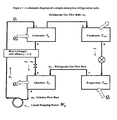
- FIG. 1 A schematic diagram for a simple absorption cycle, and the apparatus by which it is run, is shown in Figure 1 .
- the system is composed of condenser and evaporator units with an expansion valve similar to an ordinary vapor compression cycle, but an absorber-generator solution circuit replaces the compressor.
- the circuit may be composed of an absorber, a generator, a heat exchanger, a pressure control device and a pump for circulating the solution.
- the heat released by the absorber upon the absorption of the refrigerant by the absorbent may be used to heat a mixture of refrigerant and absorbent in the generator to separate the refrigerant in vapor form from the absorbent.
- a typical apparatus for operating an absorption cycle may include components such as an absorber-generator solution circuit as shown on the left side of the drawing, which by the outflow and inflow of heat increases the pressure of refrigerant vapor as a compressor does mechanically, where the circuit may be composed of an absorber, a generator, a heat exchanger, a pressure control device and a pump for circulating the solution.
- the apparatus also is composed of condenser and evaporator units with an expansion valve, as shown on the right side of the drawing.
- mixture of a refrigerant and an absorbent is formed in the absorber; the mixture is passed to a generator where the mixture is heated to separate refrigerant, in vapor form, from the absorbent, and the pressure of the refrigerant vapor is increased; the refrigerant vapor is passed to a condenser where the vapor is condensed under pressure to a liquid; the liquid refrigerant is passed to an expansion device where the pressure of the liquid refrigerant is reduced to form a mixture of liquid and vapor refrigerant; the mixture of liquid and vapor refrigerant is passed to an evaporator where the remaining liquid is evaporated to form refrigerant vapor; the refrigerant vapor leaving the evaporator is passed to the absorber to repeat step (a) and re-form a mixture of the refrigerant vapor and the absorbent.
- An apparatus as shown in Figure 1 and the apparatus as disclosed herein is capable of executing an absorption cycle using the refrigerants described herein and/or any one or more absorbents, including for example any of the ionic liquids described herein.
- the apparatus hereof is also capable of executing any one or more of the processes as described herein.
- Yet another embodiment of this invention is an apparatus substantially as shown or described in Figure 1 .
- the absorber side of the absorption cycle will consist primarily of the ionic liquid. In one embodiment, the concentration of ionic liquid on the absorber side is greater than about 50% by weight of that of the ionic liquid plus the water. In an alternative embodiment, the concentration of ionic liquid on the absorber side is greater than about 70% by weight of that of the ionic liquid plus the water.
- the generator side of the absorption cycle will consist primarily of water, with the concentration of water being as high as 99 weight percent or greater relative to the weight of the ionic liquid plus the water.
- This invention also provides an apparatus for heating an object, medium or space that includes (a) an absorber that forms a mixture of a refrigerant and an absorbent; (b) a generator that receives the mixture from the absorber and heats the mixture to separate refrigerant, in vapor form, from the absorbent, and increases the pressure of the refrigerant vapor; (c) a condenser, located in proximity to the object, medium or space to be heated, that receives the vapor from the generator and condenses the vapor under pressure to a liquid; (d) a pressure reduction device through which the liquid refrigerant leaving the condenser passes to reduce the pressure of the liquid to form a mixture of liquid and vapor refrigerant; (e) an evaporator that receives the mixture of liquid and vapor refrigerant that passes through the pressure reduction device to evaporate the remaining liquid to form refrigerant vapor; and (f) a conduit that passes the refrigerant vapor leaving the evaporator to the absorber.
- This invention also provides an apparatus for cooling an object, medium or space that includes (a) an absorber that forms a mixture of a refrigerant and an absorbent; (b) a generator that receives the mixture from the absorber and heats the mixture to separate refrigerant, in vapor form, from the absorbent, and increases the pressure of the refrigerant vapor; (c) a condenser that receives the vapor from the generator and condenses the vapor under pressure to a liquid; (d) a pressure reduction device through which the liquid refrigerant leaving the condenser passes to reduce the pressure of the liquid to form a mixture of liquid and vapor refrigerant; (e) an evaporator, located in proximity to the object, medium or space to be cooled, that receives the mixture of liquid and vapor refrigerant that passes through the pressure reduction device to evaporate the remaining liquid to form refrigerant vapor; and (f) a conduit that passes the refrigerant vapor leaving the evaporator to the absorber.
- An apparatus of this invention may be deployed for use in, or fabricated or operated as, a refrigerator, a freezer, an ice machine, an air conditioner, an industrial cooling system, a heater or heat pump.
- Each of these instruments may be situated in a residential, commercial or industrial setting, or may be incorporated into a mobilized device such as a car, truck, bus, train, airplane, or other device for transportation, or may be incorporated into a piece of equipment such as a medical instrument.
- This invention also provides a process for heating an object, medium or a space comprising (a) absorbing refrigerant vapor with an absorbent to form a mixture; (b) heating the mixture to separate refrigerant, in vapor form, from the absorbent and increase the pressure of the refrigerant vapor; (c) condensing the refrigerant vapor under pressure to a liquid in proximity to the object, medium or space to be heated; (d) reducing the pressure of the liquid refrigerant, and evaporating the refrigerant to form refrigerant vapor; and (e) repeating step (a) to re-absorb, with the absorbent, the refrigerant vapor.
- This invention also provides a process for cooling an object, medium or a space comprising (a) absorbing refrigerant vapor with an absorbent to form a mixture; (b) heating the mixture to separate refrigerant, in vapor form, from the absorbent and increase the pressure of the refrigerant vapor; (c) condensing the refrigerant vapor under pressure to a liquid; (d) reducing the pressure of the liquid refrigerant, and evaporating the refrigerant, in proximity to the object, medium or space to be cooled, to form refrigerant vapor; and (e) repeating step (a) to re-absorb, with the absorbent, the refrigerant vapor.
- This invention also provides a process for heating an object, medium or a space in an apparatus that executes an absorption cycle by (a) forming in an absorber a mixture of a refrigerant and an absorbent; (b) passing the mixture to a generator where the mixture is heated to separate refrigerant, in vapor form, from the absorbent, and the pressure of the refrigerant vapor is increased; (c) passing the refrigerant vapor to a condenser in proximity to the object, medium or space to be heated where the vapor is condensed under pressure to a liquid; (d) passing the liquid refrigerant to an expansion device where the pressure of the liquid refrigerant is reduced to form a mixture of liquid and vapor refrigerant; (e) passing the mixture of liquid and vapor refrigerant to an evaporator where the remaining liquid is evaporated to form refrigerant vapor; and (f) passing the refrigerant vapor leaving the evaporator to the absorber to repeat step (a) and re-form
- This invention also provides a process for cooling an object, medium or a space in an apparatus that executes an absorption cycle by (a) forming in an absorber a mixture of a refrigerant and an absorbent; (b) passing the mixture to a generator where the mixture is heated to separate refrigerant, in vapor form, from the absorbent, and the pressure of the refrigerant vapor is increased; (c) passing the refrigerant vapor to a condenser where the vapor is condensed under pressure to a liquid; (d) passing the liquid refrigerant to an expansion device where the pressure of the liquid refrigerant is reduced to form a mixture of liquid and vapor refrigerant; (e) passing the mixture of liquid and vapor refrigerant to an evaporator in proximity to the object, medium or space to be cooled where the remaining liquid is evaporated to form refrigerant vapor; and (f) passing the refrigerant vapor leaving the evaporator to the absorber to repeat step (a) and re-
- the absorbent separated from refrigerant in step (b) may be recirculated for use in a later step.
- the present invention provides refrigerant pair compositions for use in an absorption cycle, which can be used for cooling, or for generating heat, depending on the application.
- Water is used as a refrigerant in this invention, but a mixture of water with other refrigerants selected from the group consisting of a hydrofluorocarbon, a hydrochlorofluorocarbon, a chlorofluorocarbon, a fluorocarbon, nitrogen (N 2 ), oxygen (O 2 ), carbon dioxide (CO 2 ), ammonia (NH 3 ), argon (Ar), hydrogen (H 2 ), and non-fluorinated hydrocarbon, wherein the non-fluorinated hydrocarbon is selected from the group consisting of C 1 to C 4 straight-chain, branched or cyclic alkanes and C 1 to C 4 straight-chain, branched or cyclic alkenes, is within the scope of this invention as well.
- the second member of the refrigerant pair comprises at least one ionic liquid.
- Hydrofluorocarbon refrigerants may include compounds having any combination of hydrogen and fluorine with carbon and include compounds with carbon-carbon double bonds with normal boiling points below 0 °C.
- hydrofluorocarbon refrigerants useful for the invention include difluoromethane (HFC-32), pentafluoroethane (HFC-125), 1,1,2,2-tetrafluoroethane (HFC-134), 1,1,1,2-tetrafluoroethane (HFC-134a), 1,1,1-trifluoroethane (HFC-143a), 1,1-difluoroethane (HFC-152a) and fluoroethane (HFC-161).
- HFC-32 difluoromethane
- HFC-125 pentafluoroethane
- HFC-134 1,1,2,2-tetrafluoroethane
- HFC-134a 1,1,1,2-tetrafluoroethane
- HFC-143a 1,1,1-trifluoro
- the hydrofluorocarbon refrigerants are selected from the group consisting of difluoromethane (HFC-32), pentafluoroethane (HFC-125), 1,1,1,2-tetrafluoroethane (HFC-134a), 1,1,1-trifluoroethane (HFC-143a) and 1,1-difluoroethane (HFC-152a).
- Chlorofluorocarbon refrigerants may include compounds having any combination of chlorine and fluorine with carbon and include compounds with carbon-carbon double bonds with normal boiling points below 0 °C.
- An example of a chlorofluorocarbon refrigerant useful for the invention is dichlorodifluoromethane (CFC-12).
- Hydrochlorofluorocarbon refrigerants may include compounds with any combination of hydrogen, chlorine and fluorine with carbon and include compounds with carbon-carbon double bonds with normal boiling points below 0 °C.
- An example of a hydrochlorofluorocarbon refrigerant useful for the invention includes chlorodifluoromethane (HCFC-22).
- Fluorocarbon refrigerants may include compounds with any combination of fluorine and carbon and include compounds with carbon-carbon double bonds with normal boiling points below 0 °C.
- fluorocarbon refrigerants useful for the invention include perfluoromethane (FC-14) and perfluoroethane (FC-116).
- Non-fluorinated hydrocarbon refrigerants useful for the invention may include methane, ethane, ethylene, propane, cyclopropane, propylene, butane, butene and isobutane.
- a refrigerant as used herein may also be selected from the group consisting water, and mixtures of water with HFC-32, HFC-125, HFC-134, HFC-134a, HFC-143a, HFC-152a, HFC-161, HCFC-22, FC-14, FC-116, CFC-12, NH 3 , CO 2 , N 2 , O 2 , H 2 , Ar, methane, ethane, propane, cyclopropane, propylene, butane, butene, and isobutane.
- Mixtures of refrigerants are also useful for achieving proper boiling temperature or pressure appropriate for absorption equipment.
- mixtures that form azeotropes or constant boiling mixtures are sometimes preferred because minimal to no fractionation of the mixture will occur if the refrigerant leaks from the absorption cooling system.
- the absorbent used is an ionic liquid, which can in principle be any ionic liquid that absorbs water.
- An ionic liquid that absorbs water is an ionic liquid with which at least to some extent water is miscible, or in which at least to some extent water is soluble.
- the energy efficiency of the absorption cycle will increase in direct proportion to the extent to which the ionic liquid has high absorption for water (i.e. water has high miscibility therewith or water is soluble therein to a large extent).
- Ionic liquids are organic compounds that are liquid at room temperature (approximately 25°C). They differ from most salts in that they have very low melting points, and they tend to be liquid over a wide temperature range. Ionic liquids have essentially no vapor pressure, and they can either be neutral, acidic or basic. The properties of an ionic liquid can be tailored by varying the cation and anion.
- a cation or anion of an ionic liquid of the invention can in principle be any cation or anion such that the cation and anion together form an organic salt that is liquid at or below about 100°C.
- ionic liquids are formed by reacting a nitrogen-containing heterocyclic ring, preferably a heteroaromatic ring, with an alkylating agent (for example, an alkyl halide) to form a quaternary ammonium salt, and performing ion exchange or other suitable reactions with various Lewis acids or their conjugate bases to form the ionic liquid.
- alkylating agent for example, an alkyl halide
- suitable heteroaromatic rings include substituted pyridines, imidazole, substituted imidazole, pyrrole and substituted pyrroles.
- These rings can be alkylated with virtually any straight, branched or cyclic C 1-20 alkyl group, but preferably, the alkyl groups are C 1-16 groups, since groups larger than this may produce low melting solids rather than ionic liquids.
- Various triarylphosphines, thioethers and cyclic and non-cyclic quaternary ammonium salts may also been used for this purpose.
- Counterions that may be used include chloroaluminate, bromoaluminate, gallium chloride, tetrafluoroborate, tetrachloroborate, hexafluorophosphate, nitrate, trifluoromethane sulfonate, methylsulfonate, p-toluenesulfonate, hexafluoroantimonate, hexafluoroarsenate, tetrachloroaluminate, tetrabromoaluminate, perchlorate, hydroxide anion, copper dichloride anion, iron trichloride anion, zinc trichloride anion, as well as various lanthanum, potassium, lithium, nickel, cobalt, manganese, and other metal-containing anions.
- Ionic liquids may also be synthesized by salt metathesis, by an acid-base neutralization reaction or by quaternizing a selected nitrogen-containing compound; or they may be obtained commercially from several companies such as Merck (Darmstadt, Germany) or BASF (Mount Olive, NJ).
- ionic liquids useful herein included among those that are described in sources such as J. Chem. Tech. Biotechnol., 68:351-356 (1997 ); Chem. Ind., 68:249-263 (1996 ); J. Phys. Condensed matter, 5: (supp 34B):B99-B106 (1993 ); Chemical and Engineering News, Mar. 30, 1998, 32-37 ; J. Mater. Chem., 8:2627-2636 (1998 ); Chem. Rev., 99:2071-2084 (1999 ); and WO 05/113,702 (and references therein cited).
- a library i.e.
- a combinatorial library of ionic liquids may be prepared, for example, by preparing various alkyl derivatives of a quaternary ammonium cation, and varying the associated anions.
- the acidity of the ionic liquids can be adjusted by varying the molar equivalents and type and combinations of Lewis acids.
- ionic liquids suitable for use herein include those having cations selected from the following Formulae: wherein R 1 , R 2 , R 3 , R 4 , R 5 and R 6 are independently selected from the group consisting of:
- ionic liquids useful for the invention comprise fluorinated cations wherein at least one member selected from R 1 , R 2 , R 3 , R 4 , R 5 , R 6 , R 7 , R 8 , R 9 and R 10 comprises F - .
- ionic liquids useful herein may have anions selected from the group consisting of [CH 3 CO 2 ] - , [HSO 4 ] - , [CH 3 OSO 3 ] - , [C 2 H 5 OSO 3 ] - , [AlCl 4 ] - , [CO 3 ] 2- , [HCO 3 ] - , [NO 2 ] - , [NO 3 ] - , [SO 4 ] 2- , [PO 4 ] 3- , [HPO 4 ] 2 , [H 2 PO 4 ] - , [HSO 3 ] - , [CuCl 2 ] - , Cl - , Br - , I - , SCN - ; and preferably any fluorinated anion.
- Fluorinated anions useful herein include [BF 4 ] - , [PF 6 ] - , [SbF 6 ] - , [CF 3 SO 3 ] - , [HCF 2 CF 2 SO 3 ] - , [CF 3 HFCCF 2 SO 3 ] - , [HCClFCF 2 SO 3 ] - , [(CF 3 SO 2 ) 2 N] - , [(CF 3 CF 2 SO 2 ) 2 N] - , [(CF 3 SO 2 ) 3 C] - , [CF 3 CO 2 ] - , [CF 3 OCFHCF 2 SO 3 ] - , [CF 3 CF 2 OCFHCF 2 SO 3 ] - , [CF 3 CFHOCF 2 CF 2 SO 3 ] - , [CF 2 HCF 2 OCF 2 CF 2 SO 3 ] - , [CF 2 ICF 2 OCF 2 CF 2 SO 3 ] - , [CF 3 CF 2
- an ionic liquid suitable for use herein may have an anion of the Formula: wherein R 11 is selected from the group consisting of:
- ionic liquids suitable for use herein may have a cation selected from the group consisting of pyridinium, pyridazinium, pyrimidinium, pyrazinium, imidazolium, pyrazolium, thiazolium, oxazolium, triazolium, phosphonium, and ammonium as defined above; and an anion selected from the group consisting of [CH 3 CO 2 ] - , [HSO 4 ] - , [CH 3 OSO 3 ] - , [C 2 H 5 OSO 3 ] - , [AlCl 4 ] - , [CO 3 ] 2- , [HCO 3 ] - , [NO 2 ] - , [NO 3 ] - , [SO 4 ] 2- , [PO 4 ] 3- , [HPO 4 ] 2- , [H 2 PO 4 ] - , [HSO 3 ] - , [CuCl 2 ] ,
- ionic liquids suitable for use herein may have a cation selected from the group consisting of pyridinium, pyridazinium, pyrimidinium, pyrazinium, imidazolium, pyrazolium, thiazolium, oxazolium, triazolium, phosphonium, and ammonium as defined above; and an anion selected from the group consisting of [BF 4 ] - , [PF 6 ] - , [SbF 6 ] - , [CF 3 SO 3 ] - , [HCF 2 CF 2 SO 3 ] - , [CF 3 HFCCF 2 SO 3 ] - , [HCClFCF 2 SO 3 ] - , [(CF 3 SO 2 ) 2 N] - , [(CF 3 CF 2 SO 2 ) 2 N] - , [(CF 3 SO 2 ) 3 C] - , [CF 3 CO 2 ] - , [CF 3 CO 2
- ionic liquids suitable for use herein may have a cation selected from the group consisting of pyridinium, pyridazinium, pyrimidinium, pyrazinium, imidazolium, pyrazolium, thiazolium, oxazolium, triazolium, phosphonium, and ammonium as defined above, wherein at least one member selected from R 1 , R 2 , R 3 , R 4 , R 5 , R 6, R 7 , R 8 , R 9 , and R 10 comprises F - ; and an anion selected from the group consisting of [CH 3 CO 2 ] - , [HSO 4 ] - , [CH 3 OSO 3 ] - , [C 2 H 5 OSO 3 ] - , [AlCl 4 ] - , [CO 3 ] 2- , [HCO 3 ] - , [NO 2 ] - , [NO 3 ] - ,
- ionic liquids suitable for use herein may have a cation selected from the group consisting of pyridinium, pyridazinium, pyrimidinium, pyrazinium, imidazolium, pyrazolium, thiazolium, oxazolium, triazolium, phosphonium, and ammonium as defined above, wherein at least one member selected from R 1 , R 2 , R 3 , R 4 , R 5 , R 6, R 7 , R 8 , R 9 , and R 10 comprises F - ; and an anion selected from the group consisting of [BF 4 ] - , [PF 6 ] - , [SbF 6 ] - , [CF 3 SO 3 ] - , [HCF 2 CF 2 SO 3 ] - , [CF 3 HFCCF 2 SO 3 ] - , [HCCIFCF 2 SO 3 ] - , [(CF 3 SO 2 ) 2 N]
- ionic liquids suitable for use in this invention may have:
- the cation is 1-ethyl-3-methylimidazolium, and the anion is tetrafluoroborate.
- water would be expected to be more miscible with or soluble in ionic liquids that are hydrophilic to some extent, and ionic liquids having cations having at least one alcohol side chain, or those comprising anions having at least one acetate or sulfate group, would thus be desirable choices for use in various embodiments of this invention.
- Water will also preferably be miscible with or soluble in an ionic liquid as used herein over the temperature range of the operation of the absorption system, particularly from that of the evaporator to that of the generator.
- Evaporator temperatures can be as low as about 5°C.
- Single effect generator temperatures can be as high as about 150°C, while double effect generator temperatures can be as high as about 200°C.
- the concentration of either water or an ionic liquid in a composition formed therefrom may be in the range of from about 1% to about 99% by weight of the combined weight of the ionic liquid and water therein.
- an ionic liquid formed by selecting any of the individual cations described or disclosed herein, and by selecting any of the individual anions described or disclosed herein with which to pair the cation may be used as an absorbent in an absorption heating or cooling cycle.
- a subgroup of ionic liquids formed by selecting (i) a subgroup of any size of cations, taken from the total group of cations described and disclosed herein in all the various different combinations of the individual members of that total group, and (ii) a subgroup of any size of anions, taken from the total group of anions described and disclosed herein in all the various different combinations of the individual members of that total group, may be used as an absorbent.
- the ionic liquid or subgroup will be used in the absence of the members of the group of cations and/or anions that are omitted from the total group thereof to make the selection, and, if desirable, the selection may thus be made in terms of the members of the total group that are omitted from use rather than the members of the group that are included for use.
- Mixtures of ionic liquids may also be used herein as the absorbent, and such mixtures may be desirable, for example, for achieving proper absorption behavior, in particular if water is mixed with other components such as alcohols, esters or ethers which maybe used in combination with absorption equipment.
- Additives such as lubricants, corrosion inhibitors, stabilizers, dyes, and other appropriate materials may be added to the refrigerant pair compositions useful for the invention for a variety of purposes provided they do not have an undesirable influence on the extent to which water is soluble in an ionic liquid absorbent.
- the refrigerant pair compositions of the invention may be prepared by any convenient method, including mixing or combining the desired amounts of each component in an appropriate container using, for example, known types of stirrers having rotating mixing elements.
- thermodynamic property charts such as temperature-pressure-concentration (TPX ) and enthalpy-temperature (HT ) diagrams. These charts correspond to the familiar PH (pressure-enthalpy) or TS (temperature-entropy) diagram in the vapor compression cycle analysis.
- TPX temperature-pressure-concentration
- HT enthalpy-temperature
- thermodynamic charts for the absorption cycle are usually made by empirical correlation equations, which are fitted to experimental solubility and heat capacity data for solution properties, while the vapor phase properties are calculated with the refrigerant EOS.
- the solubility data may in certain instances be correlated using theoretical solution (often called "activity") models (Nezu, Y., supra ; Fatouh, M. and Murthy, S. S. [Renewable Energy, 1993, 3:31-37 ]; Bhatt, M.
- thermodynamic properties can therefore be used herein to calculate all thermodynamic properties consistently for use as an indicator of the utility of the refrigerants and ionic liquids disclosed herein as new absorption cycle fluid pairs ( Tillner-Roth R and Friend DG [J. Phys. Chem. Ref. Data, 1998, 27, 63-96 ]).
- the coefficients, ⁇ k are determined so as to reproduce the vapor pressure of each pure compound.
- ⁇ (T) for an absorbent is modeled by only two terms in eq 4, as applied for the case of refrigerant-lubricant oil mixtures (Yokozeki A, 2001, supra ).
- k ij l ij ⁇ l ji ⁇ x i + x j l ji ⁇ x i + l ij ⁇ x j
- the coefficient ⁇ 1 in eq 6 will be treated as an adjustable fitting parameter.
- Enthalpies at all locations and solubility in the absorber and generator units are calculated in a thermodynamically consistent way by use of the EOS model discussed above.
- the first step of cycle calculations is to obtain P eva and P con as saturated vapor pressures of a pure refrigerant at given temperatures: Bubble-Point P routine (Ness, HCV et al, supra). Then, using a usual TP (Temperature-Pressure) Flash routine (Ness, HCV et al, supra), absorbent compositions, x g and x a , in the generator and absorber units are calculated. This provides f (flow rate ratio) in eq 17.
- the thermodynamic properties at Point 3 are determined from the assumption (5): Bubble-Point T routine (Ness, HCV et al, supra). The enthalpy at Point 1 is obtained from eq 19.
- thermodynamic properties were employed (temperature-pressure-concentration diagram and enthalpy-temperature diagram in Stoecker and Jones, Refrigeration and Air Conditioning [McGraw-Hill, New York, 1982, 328-350 ]).
- Cycle calculations for an absorption refrigeration cycle may be readily made using the EOS as described herein, but analysis of the results requires a different approach than used in the case of an ordinary vapor compression cycle.
- a high pressure/temperature refrigerant gas is produced by a vapor compressor, where the thermodynamic process is theoretically a single isentropic step: inlet and exit enthalpies of the compressor are sufficient for describing the compressor work.
- the process of generating the corresponding high pressure/temperature gas is more complicated, and it is necessary to know enthalpies at several different locations as well as refrigerant-absorbent solubility differences at the absorber and generator units (related to the f value), as seen in eqs. 17, 21 and 22.
- the condenser and evaporator performance is the same for both cycles at given temperatures, and may be understood based on the latent heat of vaporization (or condensation).
- the refrigerating effect is the latent heat at the evaporator, which increases with an increase in the temperature difference between T c and T eva .
- the latent heat is larger for a refrigerant with a higher T c .
- the molar latent heat (J/mol) is generally not so much different among refrigerants at their boiling point (or far away from T c ), while the specific latent heat (J/kg) can be significantly different due to a large difference in molar masses.
- An absorbent as used in an absorption heating or cooling cycle is desirably a compound that has high solubility for a refrigerant (e.g. water) and also a very high boiling point relative to the refrigerant.
- a refrigerant e.g. water
- Example 1 exemplifies the system of water + [emim][BF 4 ], which has COP / f values of 0.525/18.2.
- the present invention also provides devices utilizing absorption cycles of the invention.
- Devices of the invention include, but are not limited to, refrigerators, car air conditioners, residential air conditioners, commercial air conditioners, transport air conditioners, commercial ice machines, transport ice machines, and industrial cooling systems.
- Refrigerants and ionic liquids, and methods of use thereof, suitable for use in this invention are also described in U.S. Application No. 11/346,028 and in U.S. Application No. 11/435,352 , each of which is incorporated in its entirety as a part hereof for all purposes.
- Solubility data for [emim][BF 4 ] in water was modeled using the equations of state as described above over a temperature range from 40 to 130°C and a composition range from 0 to 100 mole percent water in [emim][BF 4 ] (see Figure 2 ).
- the observed data points at 100 and 130°C are from M. Seiler, et al. (AIChE J. (2004) vol. 50, 2429 ).
Landscapes
- Engineering & Computer Science (AREA)
- Chemical & Material Sciences (AREA)
- Physics & Mathematics (AREA)
- Thermal Sciences (AREA)
- Mechanical Engineering (AREA)
- General Engineering & Computer Science (AREA)
- Chemical Kinetics & Catalysis (AREA)
- Combustion & Propulsion (AREA)
- Materials Engineering (AREA)
- Organic Chemistry (AREA)
- Sorption Type Refrigeration Machines (AREA)
- Organic Low-Molecular-Weight Compounds And Preparation Thereof (AREA)
Applications Claiming Priority (2)
| Application Number | Priority Date | Filing Date | Title |
|---|---|---|---|
| US75019605P | 2005-12-14 | 2005-12-14 | |
| EP06847633A EP1960491A2 (de) | 2005-12-14 | 2006-12-13 | Absorptionszyklus mit ionischen flüssigkeiten und wasser als arbeitsflüssigkeiten |
Related Parent Applications (1)
| Application Number | Title | Priority Date | Filing Date |
|---|---|---|---|
| EP06847633.2 Division | 2006-12-13 |
Publications (1)
| Publication Number | Publication Date |
|---|---|
| EP2636716A2 true EP2636716A2 (de) | 2013-09-11 |
Family
ID=38134158
Family Applications (2)
| Application Number | Title | Priority Date | Filing Date |
|---|---|---|---|
| EP13170547.7A Withdrawn EP2636716A2 (de) | 2005-12-14 | 2006-12-13 | Absorptionszyklus mit ionischen Flüssigkeiten und Wasser als Arbeitsflüssigkeiten |
| EP06847633A Withdrawn EP1960491A2 (de) | 2005-12-14 | 2006-12-13 | Absorptionszyklus mit ionischen flüssigkeiten und wasser als arbeitsflüssigkeiten |
Family Applications After (1)
| Application Number | Title | Priority Date | Filing Date |
|---|---|---|---|
| EP06847633A Withdrawn EP1960491A2 (de) | 2005-12-14 | 2006-12-13 | Absorptionszyklus mit ionischen flüssigkeiten und wasser als arbeitsflüssigkeiten |
Country Status (9)
| Country | Link |
|---|---|
| US (2) | US8506839B2 (de) |
| EP (2) | EP2636716A2 (de) |
| JP (1) | JP2009520073A (de) |
| KR (1) | KR20080081965A (de) |
| CN (1) | CN101360802A (de) |
| AU (1) | AU2006326450A1 (de) |
| BR (1) | BRPI0620676A2 (de) |
| CA (1) | CA2631824A1 (de) |
| WO (1) | WO2007070607A2 (de) |
Families Citing this family (70)
| Publication number | Priority date | Publication date | Assignee | Title |
|---|---|---|---|---|
| US8463441B2 (en) | 2002-12-09 | 2013-06-11 | Hudson Technologies, Inc. | Method and apparatus for optimizing refrigeration systems |
| US8715521B2 (en) * | 2005-02-04 | 2014-05-06 | E I Du Pont De Nemours And Company | Absorption cycle utilizing ionic liquid as working fluid |
| RU2007146973A (ru) * | 2005-05-18 | 2009-06-27 | Е.И.Дюпон де Немур энд Компани (US) | Гибридный парокомпрессионно-абсорбционный цикл |
| AR058054A1 (es) | 2005-09-22 | 2008-01-23 | Du Pont | Utilizacion de liquidos ionicos para la separacion de hidrofluorocarburos |
| US8506839B2 (en) | 2005-12-14 | 2013-08-13 | E I Du Pont De Nemours And Company | Absorption cycle utilizing ionic liquids and water as working fluids |
| CN101454420B (zh) * | 2006-05-31 | 2012-07-11 | 纳幕尔杜邦公司 | 利用离子液体作为压缩机润滑剂的蒸汽压缩 |
| WO2008057574A1 (en) | 2006-11-08 | 2008-05-15 | E. I. Du Pont De Nemours And Company | Process for the separation of tetrafluoroethylene from carbon dioxide using ionic liquids |
| US20080153697A1 (en) * | 2006-12-22 | 2008-06-26 | E. I. Dupont De Nemours And Company | Mixtures of ammonia and ionic liquids |
| JP5343068B2 (ja) * | 2007-04-03 | 2013-11-13 | イー・アイ・デュポン・ドウ・ヌムール・アンド・カンパニー | ポリオールおよびイオン液体の混合物を用いる熱伝達システム |
| US8075777B2 (en) * | 2007-05-16 | 2011-12-13 | E. I. Du Pont De Nemours And Company | Process for the separation of diastereomers |
| US7964760B2 (en) * | 2007-05-25 | 2011-06-21 | E.I. Du Pont De Nemours And Company | Process for the separation of fluorocarbons using ionic liquids |
| CN101970018A (zh) * | 2007-09-28 | 2011-02-09 | 纳幕尔杜邦公司 | 离子液体稳定剂组合物 |
| EP2067835A1 (de) * | 2007-12-07 | 2009-06-10 | Bp Exploration Operating Company Limited | Verbesserte wasserbasierte Bohrlochflüssigkeiten |
| EP2088389B1 (de) * | 2008-02-05 | 2017-05-10 | Evonik Degussa GmbH | Absorptionskältemaschine |
| EP2087930A1 (de) * | 2008-02-05 | 2009-08-12 | Evonik Degussa GmbH | Verfahren zur Absorption eines flüchtigen Stoffes in einem flüssigen Absorptionsmittel |
| WO2009109036A1 (en) * | 2008-03-04 | 2009-09-11 | Thermalfrost Inc. | Ammonia refrigeration system |
| US20110232306A1 (en) * | 2008-04-30 | 2011-09-29 | Honeywell International Inc. | Absorption refrigeration cycles using a lgwp refrigerant |
| US20110175498A1 (en) * | 2008-09-30 | 2011-07-21 | Cullen Bash | Data Center |
| DE102009051087A1 (de) | 2008-10-29 | 2010-05-06 | Basf Se | Arbeitsmedium für Kälte- und Wärmeprozesse, enthaltend ein Tetraalkylammoniumsalz |
| CA2741538A1 (en) * | 2008-11-07 | 2010-05-14 | E. I. Du Pont De Nemours And Company | Absorption cycle utilizing ionic compounds and/or non-ionic absorbents as working fluids |
| EP2350540A2 (de) * | 2008-11-26 | 2011-08-03 | E. I. du Pont de Nemours and Company | Absorptionszyklussystem mit zwei absorptionskreisen |
| US20100154419A1 (en) * | 2008-12-19 | 2010-06-24 | E. I. Du Pont De Nemours And Company | Absorption power cycle system |
| DE102009000543A1 (de) | 2009-02-02 | 2010-08-12 | Evonik Degussa Gmbh | Verfahren, Absorptionsmedien und Vorrichtung zur Absorption von CO2 aus Gasmischungen |
| DE102009013684A1 (de) * | 2009-03-20 | 2010-10-07 | Technische Universität Berlin | Wärmetauschereinheit und wärmetechnische Anlage |
| US20120017613A1 (en) | 2009-03-31 | 2012-01-26 | E. I. Du Pont De Nemours And Company | Temperature adjustment device |
| US20120011886A1 (en) * | 2009-03-31 | 2012-01-19 | Mark Brandon Shiflett | Ionic compounds in lithium bromide/water absorption cycle systems |
| AU2010234808A1 (en) | 2009-03-31 | 2011-09-22 | E. I. Du Pont De Nemours And Company | Temperature adjustment device |
| EP2445613A1 (de) | 2009-06-25 | 2012-05-02 | VTU Holding GmbH | Verfahren zur verwendung einer ionischen flüssigkeit und vorrichtung zur sorption von gas |
| WO2011056895A1 (en) | 2009-11-03 | 2011-05-12 | University Of Notre Dame Du Lac | Ionic liquids comprising heteraromatic anions |
| DE102009047564A1 (de) | 2009-12-07 | 2011-06-09 | Evonik Degussa Gmbh | Arbeitsmedium für eine Absorptionskältemaschine |
| US20110232305A1 (en) * | 2010-03-26 | 2011-09-29 | Exxonmobil Research And Engineering Company | Systems and methods for generating power and chilling using unutilized heat |
| EP2380941A1 (de) * | 2010-04-20 | 2011-10-26 | Evonik Degussa GmbH | Absorptionswärmepumpe mit Sorptionsmittel umfassend ein Lithiumsalz und ein organisches Salz mit gleichem Anion |
| EP2380940A1 (de) * | 2010-04-20 | 2011-10-26 | Evonik Degussa GmbH | Absorptionswärmepumpe mit Sorptionsmittel umfassend Lithiumchlorid und ein organisches Chloridsalz |
| US8474277B2 (en) * | 2010-07-13 | 2013-07-02 | General Electric Company | Compressor waste heat driven cooling system |
| WO2012062656A1 (de) * | 2010-11-08 | 2012-05-18 | Evonik Degussa Gmbh | Arbeitsmedium für absorptionswärmepumpen |
| DE102011077377A1 (de) | 2010-11-12 | 2012-05-16 | Evonik Degussa Gmbh | Verfahren zur Absorption von sauren Gasen aus Gasmischungen |
| SE535301C2 (sv) | 2011-03-02 | 2012-06-19 | Climatewell Ab Publ | Salt överdraget med nanopartiklar |
| DE102011083974A1 (de) * | 2011-10-04 | 2013-04-04 | Evonik Degussa Gmbh | Arbeitsmedium für Absorptionswärmepumpen |
| CN102443378A (zh) * | 2011-11-02 | 2012-05-09 | 中山大学 | 一种适用于吸收式制冷及热泵系统的亲水性离子液体/水循环工质对 |
| PH12014500533A1 (en) | 2011-11-14 | 2014-04-21 | Evonik Degussa Gmbh | Method and device for the separation of acidic gases from a gas mixture |
| DE102012200907A1 (de) | 2012-01-23 | 2013-07-25 | Evonik Industries Ag | Verfahren und Absorptionsmedium zur Absorption von CO2 aus einer Gasmischung |
| BR112014018886B1 (pt) * | 2012-02-02 | 2021-05-25 | Proionic Gmbh | usos de um meio de refrigeração para refrigeração em ambiente de alta temperatura |
| DE102012207509A1 (de) | 2012-05-07 | 2013-11-07 | Evonik Degussa Gmbh | Verfahren zur Absorption von CO2 aus einer Gasmischung |
| KR101453888B1 (ko) * | 2012-07-27 | 2014-10-21 | 한국화학연구원 | 이온성 액체 내의 고비점 유기화합물을 제거하는 이온성 액체의 정제방법 |
| DE102012220559A1 (de) * | 2012-11-12 | 2014-05-15 | Siemens Aktiengesellschaft | Kühlung für elektrische Generatoren |
| CN102965082B (zh) * | 2012-11-30 | 2015-03-04 | 中国地质大学(武汉) | 用于热源温度在60℃至130℃之间的吸收式热循环系统的工作物质对 |
| KR101326542B1 (ko) * | 2013-05-28 | 2013-11-07 | 한국기초과학지원연구원 | 압력차를 이용한 자연유도방식의 열교환방법 및 이를 이용한 가스압축기와 히트펌프 |
| WO2015048765A1 (en) | 2013-09-30 | 2015-04-02 | University Of Notre Dame Du Lac | Compounds, complexes, compositions, methods and systems for heating and cooling |
| CN103614118B (zh) * | 2013-12-04 | 2014-12-17 | 宁波赛茵特科技服务有限公司 | 一种飞机场专用融雪除冰剂 |
| CN104046334A (zh) * | 2014-06-23 | 2014-09-17 | 西安交通大学 | 一种官能团改性的相变储热离子液体 |
| US9612043B2 (en) | 2014-08-21 | 2017-04-04 | Azota Gas Processing, Ltd. | Mixed hydrocarbon refrigeration system with reduced work-energy requirements using a hybrid compression/adsorption heat cycle |
| JP6059187B2 (ja) * | 2014-09-02 | 2017-01-11 | トヨタ自動車株式会社 | 水蒸気吸放出材料、及び、lcst挙動測定方法 |
| JP6655063B2 (ja) * | 2015-03-20 | 2020-02-26 | 国立大学法人東京農工大学 | 吸収冷凍機および除湿機 |
| DE102015212749A1 (de) | 2015-07-08 | 2017-01-12 | Evonik Degussa Gmbh | Verfahren zur Entfeuchtung von feuchten Gasgemischen |
| WO2017058747A1 (en) * | 2015-09-28 | 2017-04-06 | University Of Florida Research Foundation, Inc. | Ionic liquid-based absorption cooling system with high coefficient of performance |
| US10168080B2 (en) * | 2016-05-26 | 2019-01-01 | Yazaki Corporation | Eutectic mixtures of ionic liquids in absorption chillers |
| WO2017205828A1 (en) | 2016-05-26 | 2017-11-30 | Yazaki Corporation | Guanidinium-based ionic liquids in absorption chillers |
| EP3257843A1 (de) | 2016-06-14 | 2017-12-20 | Evonik Degussa GmbH | Verfahren zur herstellung von hochreinem imidazoliumsalz |
| DE102016210481B3 (de) | 2016-06-14 | 2017-06-08 | Evonik Degussa Gmbh | Verfahren zum Reinigen einer ionischen Flüssigkeit |
| DE102016210484A1 (de) | 2016-06-14 | 2017-12-14 | Evonik Degussa Gmbh | Verfahren zur Entfeuchtung von feuchten Gasgemischen |
| EP3257568B1 (de) | 2016-06-14 | 2019-09-18 | Evonik Degussa GmbH | Verfahren zur entfeuchtung von feuchten gasgemischen mit ionischen flüssigkeiten |
| DE102016210483A1 (de) | 2016-06-14 | 2017-12-14 | Evonik Degussa Gmbh | Verfahren und Absorptionsmittel zur Entfeuchtung von feuchten Gasgemischen |
| DE102016210478A1 (de) | 2016-06-14 | 2017-12-14 | Evonik Degussa Gmbh | Verfahren zur Entfeuchtung von feuchten Gasgemischen |
| JP2018035950A (ja) * | 2016-08-29 | 2018-03-08 | 株式会社デンソー | 冷熱生成装置 |
| CN110449101B (zh) * | 2018-05-07 | 2021-10-15 | 中国石油化工股份有限公司 | 基于离子液体相变撤热抑制失控反应的反应器及其应用 |
| EP3886854A4 (de) | 2018-11-30 | 2022-07-06 | Nuvation Bio Inc. | Pyrrol- und pyrazolverbindungen und verfahren zu deren verwendung |
| JP7444356B2 (ja) * | 2019-12-06 | 2024-03-06 | サーマルガジェット株式会社 | 冷却装置 |
| CN111218323B (zh) * | 2020-02-24 | 2022-06-14 | 辽宁大学 | 一种环境友好型润滑油及其制备方法 |
| JP2023105593A (ja) * | 2022-01-19 | 2023-07-31 | 公益財団法人豊田理化学研究所 | 調湿材および装置 |
| JP2024002447A (ja) * | 2022-06-24 | 2024-01-11 | 公益財団法人豊田理化学研究所 | 調湿材および装置 |
Citations (2)
| Publication number | Priority date | Publication date | Assignee | Title |
|---|---|---|---|---|
| US5709092A (en) | 1990-12-17 | 1998-01-20 | E. I. Du Pont De Nemours And Company | Refrigation process using constant boiling compositions of HFC-32, HFC-125 and HFC-134a |
| WO2005113702A1 (de) | 2004-05-21 | 2005-12-01 | Basf Aktiengesellschaft | Neue arbeitsstoffpaare für absorptionswärmepumpen, absorptionskältemaschinen und wärmetransformatoren |
Family Cites Families (39)
| Publication number | Priority date | Publication date | Assignee | Title |
|---|---|---|---|---|
| US4388812A (en) | 1979-03-08 | 1983-06-21 | Clark Silas W | Variable valve for refrigeration system |
| DE3623680A1 (de) | 1986-07-12 | 1988-01-14 | Univ Essen | Stoffsysteme fuer sorptionsprozesse |
| DE4415199A1 (de) | 1994-04-30 | 1995-11-02 | Inst Luft Und Kaeltetechnik Gm | Kälteanlage |
| JPH08109372A (ja) * | 1994-08-17 | 1996-04-30 | Asahi Chem Ind Co Ltd | 含フッ素潤滑剤よりなる冷媒組成物 |
| HU218032B (hu) * | 1994-09-07 | 2000-05-28 | Witco Corporation | Szénhidrogén kenőanyagot tartalmazó hűtőfolyadék-kompozíciók |
| US6155057A (en) | 1999-03-01 | 2000-12-05 | Arizona Board Of Regents | Refrigerant fluid crystallization control and prevention |
| US6100230A (en) * | 1999-03-15 | 2000-08-08 | Alliedsignal Inc. | Azeotrope-like compositions of pentafluoropropane, hydrocarbons and water |
| US6339182B1 (en) | 2000-06-20 | 2002-01-15 | Chevron U.S.A. Inc. | Separation of olefins from paraffins using ionic liquid solutions |
| BR0208176B1 (pt) | 2001-03-20 | 2011-09-20 | processo para separar lìquidos ou gases condensáveis no estado condensado. | |
| US6579343B2 (en) | 2001-03-30 | 2003-06-17 | University Of Notre Dame Du Lac | Purification of gas with liquid ionic compounds |
| DE10208822A1 (de) * | 2002-03-01 | 2003-09-11 | Solvent Innovation Gmbh | Halogenfreie ionische Flüssigkeiten |
| KR100989299B1 (ko) | 2002-04-05 | 2010-10-22 | 유니버시티 오브 사우스 앨라배마 | 관능화된 이온성 액체, 및 그의 사용 방법 |
| US7750166B2 (en) | 2002-08-16 | 2010-07-06 | University Of South Alabama | Ionic liquids containing a sulfonate anion |
| KR100497950B1 (ko) | 2002-08-21 | 2005-06-29 | 한국화학연구원 | 이미다졸리움계 이온성 액체를 이용한 혼합가스 분리 방법 |
| DE10313207A1 (de) | 2003-03-25 | 2004-10-07 | Basf Ag | Reinigung oder Aufarbeitung von Ionischen Flüssigkeiten mit adsorptiven Trennverfahren |
| DE10316418A1 (de) | 2003-04-10 | 2004-10-21 | Basf Ag | Verwendung einer ionischen Flüssigkeit |
| EP2455440A3 (de) * | 2003-11-13 | 2014-02-19 | E. I. du Pont de Nemours and Company | Zusammensetzungen und Verfahren zur Minderung der Brandgefährlichkeit entzündlicher Kühlmittel |
| DE102004003958A1 (de) | 2004-01-26 | 2005-08-11 | Basf Ag | Herstellungsmethode für ionische Flüssigkeiten |
| JP4964119B2 (ja) | 2004-03-05 | 2012-06-27 | ハネウェル・インターナショナル・インコーポレーテッド | 複素環式アミン類のイオン液体 |
| US7955738B2 (en) | 2004-03-05 | 2011-06-07 | Honeywell International, Inc. | Polymer ionic electrolytes |
| US7722771B2 (en) * | 2004-04-12 | 2010-05-25 | Thar Technologies, Inc. | Continuous processing and solids handling in near-critical and supercritical fluids |
| US7313926B2 (en) | 2005-01-18 | 2008-01-01 | Rexorce Thermionics, Inc. | High efficiency absorption heat pump and methods of use |
| DE102005003115A1 (de) | 2005-01-21 | 2006-08-10 | Basf Ag | Verfahren zur Abdichtung rotierender Wellen |
| US8715521B2 (en) | 2005-02-04 | 2014-05-06 | E I Du Pont De Nemours And Company | Absorption cycle utilizing ionic liquid as working fluid |
| RU2007146973A (ru) | 2005-05-18 | 2009-06-27 | Е.И.Дюпон де Немур энд Компани (US) | Гибридный парокомпрессионно-абсорбционный цикл |
| US7709635B2 (en) | 2005-05-19 | 2010-05-04 | University Of South Alabama | Boronium-ion-based ionic liquids and methods of use thereof |
| DE102005028451B4 (de) | 2005-06-17 | 2017-02-16 | Evonik Degussa Gmbh | Verfahren zum Transport von Wärme |
| AR058054A1 (es) | 2005-09-22 | 2008-01-23 | Du Pont | Utilizacion de liquidos ionicos para la separacion de hidrofluorocarburos |
| US8506839B2 (en) | 2005-12-14 | 2013-08-13 | E I Du Pont De Nemours And Company | Absorption cycle utilizing ionic liquids and water as working fluids |
| CN101454420B (zh) | 2006-05-31 | 2012-07-11 | 纳幕尔杜邦公司 | 利用离子液体作为压缩机润滑剂的蒸汽压缩 |
| WO2008057574A1 (en) | 2006-11-08 | 2008-05-15 | E. I. Du Pont De Nemours And Company | Process for the separation of tetrafluoroethylene from carbon dioxide using ionic liquids |
| US20080153697A1 (en) | 2006-12-22 | 2008-06-26 | E. I. Dupont De Nemours And Company | Mixtures of ammonia and ionic liquids |
| WO2008122030A2 (en) | 2007-04-02 | 2008-10-09 | University Of South Alabama | Carbon dioxide scrubbing using ionic materials |
| US8075777B2 (en) | 2007-05-16 | 2011-12-13 | E. I. Du Pont De Nemours And Company | Process for the separation of diastereomers |
| US7964760B2 (en) | 2007-05-25 | 2011-06-21 | E.I. Du Pont De Nemours And Company | Process for the separation of fluorocarbons using ionic liquids |
| CN101970018A (zh) | 2007-09-28 | 2011-02-09 | 纳幕尔杜邦公司 | 离子液体稳定剂组合物 |
| WO2010006006A1 (en) | 2008-07-08 | 2010-01-14 | E. I. Du Pont De Nemours And Company | Compositions comprising ionic liquids and fluoroolefins and use thereof in absorption cycle systems |
| US8138354B2 (en) | 2008-12-04 | 2012-03-20 | E. I. Du Pont De Nemours And Company | N-substituted pyrrolidonium ionic liquids |
| US8119818B2 (en) | 2008-12-04 | 2012-02-21 | E. I. Du Pont De Nemours And Company | Functionalized N-substituted pyrrolidonium ionic liquids |
-
2006
- 2006-12-12 US US11/637,469 patent/US8506839B2/en not_active Expired - Fee Related
- 2006-12-13 WO PCT/US2006/047629 patent/WO2007070607A2/en not_active Ceased
- 2006-12-13 JP JP2008545788A patent/JP2009520073A/ja active Pending
- 2006-12-13 EP EP13170547.7A patent/EP2636716A2/de not_active Withdrawn
- 2006-12-13 EP EP06847633A patent/EP1960491A2/de not_active Withdrawn
- 2006-12-13 AU AU2006326450A patent/AU2006326450A1/en not_active Abandoned
- 2006-12-13 CA CA002631824A patent/CA2631824A1/en not_active Abandoned
- 2006-12-13 CN CNA2006800469925A patent/CN101360802A/zh active Pending
- 2006-12-13 BR BRPI0620676-0A patent/BRPI0620676A2/pt not_active IP Right Cessation
- 2006-12-13 KR KR1020087016843A patent/KR20080081965A/ko not_active Ceased
-
2013
- 2013-08-12 US US13/964,436 patent/US20130327084A1/en not_active Abandoned
Patent Citations (2)
| Publication number | Priority date | Publication date | Assignee | Title |
|---|---|---|---|---|
| US5709092A (en) | 1990-12-17 | 1998-01-20 | E. I. Du Pont De Nemours And Company | Refrigation process using constant boiling compositions of HFC-32, HFC-125 and HFC-134a |
| WO2005113702A1 (de) | 2004-05-21 | 2005-12-01 | Basf Aktiengesellschaft | Neue arbeitsstoffpaare für absorptionswärmepumpen, absorptionskältemaschinen und wärmetransformatoren |
Non-Patent Citations (29)
| Title |
|---|
| BHATT ET AL.: "Thermodynamic Modeling of Absorption-Resorption Heating Cycles with Some New Working Pairs", HEAT RECOVERY SYSTEM & CHP, vol. 12, 1992, pages 225 - 233 |
| BHATT, M. S. ET AL., HEAT RECOVERY SYSTEM & CHP, vol. 12, 1992, pages 225 - 233 |
| CHEM. IND., vol. 68, 1996, pages 249 - 263 |
| CHEM. REV., vol. 99, 1999, pages 2071 - 2084 |
| CHEMICAL AND ENGINEERING NEWS, 30 March 1998 (1998-03-30), pages 32 - 37 |
| DORGAN ET AL.: "American Society of Heating, Refrigeration and Air Conditioning Engineers", 1995 |
| EISEMAN: "A Comparison of Fluoroalkane Absorption Refrigerants", ASHRAE J., vol. 1, 1959, pages 45 |
| ERICKSON ET AL.: "Heat-Activated Dual-function Absorption Cycle", ASHRAE TRANS., 2004, pages 110 |
| FATOUH ET AL.: "Comparison of R-22 Absorption Pairs for Cooling Absorption Based on P-T-X Data", RENEWABLE ENERGY, vol. 3, 1993, pages 31 - 37 |
| FATOUH, M.; MURTHY, S. S., RENEWABLE ENERGY, vol. 3, 1993, pages 31 - 37 |
| HAAF ET AL.: "Ullmann's Encyclopedia of Industrial Chemistry, Sixth Edition,", vol. 31, WILEY-VCH VERLAG GMBH, article "Refrigeration Technology", pages: 269 - 312 |
| J. CHEM. TECH. BIOTECHNOL., vol. 68, 1997, pages 351 - 356 |
| J. MATER. CHEM., vol. 8, 1998, pages 2627 - 2636 |
| J. PHYS. CONDENSED MATTER, vol. 5, no. 34B, 1993, pages B99 - B106 |
| M. SEILER ET AL., AICHE J., vol. 50, 2004, pages 2429 |
| MASTRANGELO: "Solubility of Some Chlorofluorohydrocarbons in Tetraethylene Glycol Ether", ASHRAE J., vol. 1, 1959, pages 64 |
| NESS, H. C. V.; ABBOTT, M. M.: "Classical Thermodynamics of Nonelectrolyte Solutions with Applications to Phase Equilibria", 1982, MCGRAW-HILL |
| NEZU ET AL.: "Thermodynamic Properties of Working-Fluid Pairs with R-134a for Absorption Refrigeration System", NATURAL WORKING FLUIDS 2002, IIR GUSTAV LORENTZEN CONF. 5H . CHINA, 17 September 2002 (2002-09-17), pages 446 - 453 |
| REID RC ET AL.: "The Properties of Gases & Liquids, 4th edn.", 1987, MCGRAW-HILL |
| SHIFLETT, M. B.; YOKOZEKI, A., IND. ENG. CHEM. RES., vol. 44, 2005, pages 4453 - 4464 |
| STOECKER; JONES: "Refrigeration and Air Conditioning", 1982, MCGRAW-HILL, pages: 328 - 350 |
| TILLNER-ROTH R; FRIEND DG, J. PHYS. CHEM. REF. DATA, vol. 27, 1998, pages 63 - 96 |
| YOKOZEKI A, APPLIED ENERGY, vol. 80, 2005, pages 383 - 399 |
| YOKOZEKI A, PROC. INT. CONGRESS OF REFRIGERATION WASHINGTON, D.C., 2003 |
| YOKOZEKI A, PROC. INT. CONGRESS OF REFRIGERATION, WASHINGTON, D.C., 2003 |
| YOKOZEKI, A., APPLIED ENERGY, vol. 80, 2005, pages 383 - 399 |
| YOKOZEKI, A., INTL. J. THERMOPHYS., vol. 22, 2001, pages 1057 - 1071 |
| YOKOZEKI, A., PROC. INTL. COMPRESSOR ENG. CONF. AT PURDUE, vol. 1, 1994, pages 335 - 340 |
| YOKOZEKI, INT. J. THERMOPHYS., vol. 22, 2001, pages 1057 - 1071 |
Also Published As
| Publication number | Publication date |
|---|---|
| CA2631824A1 (en) | 2007-06-21 |
| CN101360802A (zh) | 2009-02-04 |
| US20070144186A1 (en) | 2007-06-28 |
| WO2007070607A2 (en) | 2007-06-21 |
| WO2007070607A3 (en) | 2007-08-09 |
| US20130327084A1 (en) | 2013-12-12 |
| AU2006326450A1 (en) | 2007-06-21 |
| EP1960491A2 (de) | 2008-08-27 |
| AU2006326450A2 (en) | 2008-09-11 |
| JP2009520073A (ja) | 2009-05-21 |
| US8506839B2 (en) | 2013-08-13 |
| KR20080081965A (ko) | 2008-09-10 |
| BRPI0620676A2 (pt) | 2011-11-22 |
Similar Documents
| Publication | Publication Date | Title |
|---|---|---|
| US8506839B2 (en) | Absorption cycle utilizing ionic liquids and water as working fluids | |
| EP2129737B1 (de) | Wärmeübertragungssysteme mit mischung aus polyolen und ionischen flüssigkeiten | |
| Asensio-Delgado et al. | Analysis of hybrid compression absorption refrigeration using low-GWP HFC or HFO/ionic liquid working pairs | |
| AU2006247417B2 (en) | Hybrid vapor compression-absorption cycle | |
| CN101155893B (zh) | 使用离子液体作为工作流体的吸收循环 | |
| Kim et al. | Analysis of [hmim][PF6] and [hmim][Tf2N] ionic liquids as absorbents for an absorption refrigeration system | |
| US20110203301A1 (en) | Absorption cycle utilizing ionic compounds and/or non-ionic absorbents as working fluids | |
| AU2009319848A2 (en) | Absorption cycle system having dual absorption circuits | |
| Boldoo et al. | Numerical investigation on thermal performance of absorption refrigeration system using MWCNT nanoparticle-enhanced 1-hexyl-3-methylimidazolium cation-based ionic liquids | |
| WO2019022141A1 (ja) | 共沸または共沸様組成物、熱サイクル用作動媒体および熱サイクルシステム | |
| JPH05279659A (ja) | ランキンサイクル用作動流体 | |
| MX2008007557A (en) | Absorption cycle utilizing ionic liquids and water as working fluids | |
| JPH11228945A (ja) | 冷媒組成物 | |
| EP4722612A1 (de) | Wärmekreislaufsystem und wärmekreislaufverfahren | |
| JPH0461910B2 (de) | ||
| HK1118092A (en) | Hybrid vapor compression-absorption cycle |
Legal Events
| Date | Code | Title | Description |
|---|---|---|---|
| PUAI | Public reference made under article 153(3) epc to a published international application that has entered the european phase |
Free format text: ORIGINAL CODE: 0009012 |
|
| AC | Divisional application: reference to earlier application |
Ref document number: 1960491 Country of ref document: EP Kind code of ref document: P |
|
| AK | Designated contracting states |
Kind code of ref document: A2 Designated state(s): AT BE BG CH CY CZ DE DK EE ES FI FR GB GR HU IE IS IT LI LT LU LV MC NL PL PT RO SE SI SK TR |
|
| STAA | Information on the status of an ep patent application or granted ep patent |
Free format text: STATUS: THE APPLICATION HAS BEEN WITHDRAWN |
|
| 18W | Application withdrawn |
Effective date: 20131107 |