EP2637096B1 - Système de planification et d'exécution de processus de calcul haute performance (HPC) d'effort optimal en temps réel - Google Patents
Système de planification et d'exécution de processus de calcul haute performance (HPC) d'effort optimal en temps réel Download PDFInfo
- Publication number
- EP2637096B1 EP2637096B1 EP12290079.8A EP12290079A EP2637096B1 EP 2637096 B1 EP2637096 B1 EP 2637096B1 EP 12290079 A EP12290079 A EP 12290079A EP 2637096 B1 EP2637096 B1 EP 2637096B1
- Authority
- EP
- European Patent Office
- Prior art keywords
- core
- processes
- scheduler
- per
- real
- Prior art date
- Legal status (The legal status is an assumption and is not a legal conclusion. Google has not performed a legal analysis and makes no representation as to the accuracy of the status listed.)
- Not-in-force
Links
Images


Classifications
-
- G—PHYSICS
- G06—COMPUTING OR CALCULATING; COUNTING
- G06F—ELECTRIC DIGITAL DATA PROCESSING
- G06F9/00—Arrangements for program control, e.g. control units
- G06F9/06—Arrangements for program control, e.g. control units using stored programs, i.e. using an internal store of processing equipment to receive or retain programs
- G06F9/46—Multiprogramming arrangements
- G06F9/48—Program initiating; Program switching, e.g. by interrupt
- G06F9/4806—Task transfer initiation or dispatching
- G06F9/4812—Task transfer initiation or dispatching by interrupt, e.g. masked
Definitions
- the present invention generally relates to scheduling activities on processors, more particularly, the scheduling and execution of best-effort, real-time and high-performance computing (HPC) processes on a multi-core processor.
- the invention in particular concerns a system for a mixture of best-effort, real-time and HPC processes wherein the overhead for HPC processes is reduced without sacrificing the high frequency needs that real-time processes pose.
- Computers have one or more processors for executing applications.
- Such an application is a software program that must be executed to get a certain job done by the computer.
- One item of sequential work that forms part of an application is called a process throughout this patent application, which further deals with the scheduling and execution of processes.
- a real-time process must be executed before a certain deadline expires.
- Examples of real-time processes are rendering video frames, controlling a robot, controlling an aircraft, controlling a cellular base station for mobile communications, etc.
- Real-time processes often are recurring. In a video rendering process for instance, a video frame must be processed every 30 milliseconds.
- Such recurring real-time processes are typically characterized by a period t (i.e. the time interval whereat the process must be repeated), a deadline d (i.e. the point in time by which a single execution of the process must be executed), and a cost c (i.e.
- Real-time processes are characterized as periodic or sporadic, the latter meaning that they have to be executed in response to an event that can occur at unpredictable points in time.
- a packet inspection process that is executed each time a packet arrives is sporadic.
- the processor or scheduler cannot predict when a packet will arrive but each time a packet arrives, the packet inspection process must be scheduled for execution within a certain deadline. It is important that a scheduler runs sufficiently frequently to verify if sporadic real-time processes must be scheduled.
- HPC processes in other words all start at the same point in time, run in lock step for some period of time, and at a given point in time exchange information in a synchronous fashion. It is important that HPC processes are not interrupted while being executed because if one of them is interrupted and delayed by a few milliseconds, thousands of other processes have to wait the next time the information-exchange takes place, thus causing thousands of milliseconds of delay.
- processors are becoming multi-core processors. Such a multi-core processor is able to execute multiple processes simultaneously.
- Each core of a multi-core processor can be seen as a separate processor in a multi-processor computer.
- the distinction between a multi-core processor and a multi-processor computer only lies in the packaging: a multi-core processor is a single IC or integrated circuit whereas multiple processors are implemented in multiple ICs. Whereas multi-processor computers typically had as many as eight processors, multi-core processors are expected to soon have as many as 256 or even 512 cores. Such multi-core processors will no longer function efficiently under control of a single operating system. Instead, a mini operating system will be running on each core.
- Each core is also expected to have a separate scheduler and a separate clock, i.e. a per-core scheduler with a per-core clock.
- TDM time-division multiplexing
- a scheduler In order to allocate different time slices to different processes, a scheduler is foreseen, i.e. a device or function that controls the allocation of the processes that need to be executed to processing cores.
- the scheduler typically operates in conjunction with a clock.
- the scheduler informs or programs the clock when a process is allocated to a processing core.
- the duration of the time interval that is allocated to a process depends on the needs of the process that will be executed, the deadlines of that process and other processes waiting for execution, the fair share of processor resources between the different processes, the degree of interactivity with other processes, etc.
- the clock generates an interrupt message for the scheduler when the time interval that was allocated to a process has lapsed, enabling the scheduler to regain control of the processor and allocate time slices to a different process.
- the processor shall save the execution state of the interrupted process such that execution of the process can be resumed later.
- processes may be waiting for an event. In such case, they indicate to the operating system that they are waiting for an event to happen.
- the operating system informs the scheduler such that the scheduler can choose other processes for execution.
- the best existing practice for real-time processes consists in invoking a scheduler as soon as a real-time process becomes executable, and relying on the scheduler to make a decision about the time slot(s) wherein the process will be executed.
- the core whereon the event that makes the process executable happened interrupts the core whereon the process is executed.
- the schedulers of cores with real-time processes arrange to operate at a frequency sufficiently high to meet the deadline of the process to be executed.
- the scheduler(s) thereto use interrupts. The overhead resulting from these interrupts becomes unacceptably high when the same technique would be used to also schedule execution of HPC processes.
- HPC processes consists in deactivating scheduling and executing the HPC process thereby using all available processing capacity.
- the system thus becomes a single-purpose system that does no longer execute real-time processes, but uses all processing capacity for the HPC process with minimum overhead.
- a drawback thereof is that real-time processes must be executed on a different system.
- the best existing practice for general purpose computing enabling execution of HPC processes and other processes consists in providing a noise core, i.e. a particular core where all interrupts are sent to, while all other cores can be used for execution of the HPC processes.
- Real-time processes can still be scheduled on the non-noise cores and the scheduler gets invoked by periodic interrupts from the clock.
- the clock is the only device whose interrupts are not passed onto the noise core, but directly to the core whose scheduler has to be invoked. Despite the fact the interrupts are sent to the noise core, there will still be an amount of noise caused by the scheduler. This amount of noise remains disruptive for the HPC process.
- the above identified objectives are realized by a system for scheduling and executing best-effort processes, real-time processes and high-performance computing or HPC processes as defined by claim 1, the system comprising:
- the invention introduces a scheduling system wherein schedulers in particular circumstances may temporarily deactivate their programmable clock altogether, such that no interrupts can be generated temporarily and the processing capacity can be used with minimal overhead for executing an HPC process.
- a clock that has been deactivated temporarily, can be reactivated by one of three events:
- the scheduler In the case of a process stopping execution to wait for an event, the scheduler will be invoked directly by the process. In the case the process activates a second process on the same core, the scheduler will be invoked by the ready function which is called directly or indirectly by the first process as a consequence of creating the second process. In the case where a process running on a different core activates a second process on the core, the other core must interrupt the core and the interrupt routing on that core must invoke the scheduler. This is done through an inter-core interrupt or ICI.
- the per-core scheduler of each core may be adapted to receive an instruction to execute a process on the core when the core is in idle, low-power state, and may be adapted to reactivate a deactivated per-core clock of the core.
- That core when there are no executable processes on a core, that core is idle. Such idle core may be waiting for the change of a particular variable. The waiting instruction may bring the core to a low-power state and allow the next instruction to be executed only when the particular variable changes. The next instruction shall then invoke the scheduler.
- the per-core scheduler may be adapted to advertise to cores different from its own core state information indicative for the current state of the per-core scheduler, and deadline information indicative for a deadline of a real-time process currently executed by its own core.
- a scheduler may publish information for use by other cores in making decisions about whether or not to use an inter-core interrupt or whether or not to trigger the memory variable the processor is waiting for. This way, inter-core interrupts are only used when necessary. If for instance a high priority process is running and a low priority process becomes executable, then it is not necessary to use an inter-core interrupt. The scheduler will be invoked by the clock.
- the scheduler on a core tells the other cores what process, if any, it is running and what its deadline is, if any. Moreover, the scheduler, when running the only runnable process on a core, knows that there are no scheduling decisions to be made unless another process comes into existence. It then turns off its clock so the process can use the whole machine uninterruptedly. When another process becomes runnable, that must have been caused by an action on the core itself, i.e. the process asking the ready function, or by an action on another core, i.e. via another core's ready function. These ready functions can restart the scheduler, locally by calling it or remotely through an inter-core interrupt.
- system according to the present invention may further comprise:
- one way to guarantee that deadlines for all real-time processes can be met is to restrict the number of real-time processes so that resources are not over-allocated. Thereto, an admission test may be carried out to make sure that sufficient resources remain available. Further, the real-time processes will be scheduled in a carefully calculated order, possibly allowing a more urgent real-time process to interrupt another one so it can meet its deadline.
- Fig. 1 shows a system with multi-core processor, more particularly two cores 102 and 103 sharing the system's memory 101.
- Fig. 1 further shows the operating system, OS1 or 104, and the operating system OS2 or 105 running on CORE2 or 103.
- These operating systems 104 and 105 host a per-core scheduler and a ready function.
- the per-core scheduler SCH1 or 141 and the ready function 142 form part of the operating system 104 running on the first core 102.
- the per-core scheduler SCH2 and the ready function 152 form part of the operating system 105 running on the second core 103.
- the processes are running. Fig.
- FIG. 1 shows the currently running processes, 106 or PROCESS1 running on the first core 102, and 107 or PROCESS2 running on the second core 103.
- Each of the schedulers 141 and 151 is accompanied by a run queue, not explicitly drawn in the figure.
- Each core further has its clock and an inter-core-interrupt handler.
- clock CLK1 or 121 and inter-core-interrupt handler 122 form part of the first core 102.
- clock CLK2 or 131 and inter-core-interrupt handler 132 form part of the second core 103.
- an HPC process is executed on the system illustrated by Fig. 1 .
- the HPC process is crafted to use the available number of processor cores, i.e. 102 and 103, optimally.
- the HPC process tends to execute precisely one sub-process per core. These sub-processes all start at the same time, run synchronously for some period of time and then, again at precisely the same time, exchange information in a synchronous fashion. Thereafter, the cycle repeats. It is important for the performance of the HPC process that sub-processes are not interrupted while they are executed. This allows them to remain synchronized. If an HPC process is scheduled on the system illustrated by Fig.
- real-time processes e.g. 106 and 107
- the per-core schedulers 141 and 151 each maintain their own run queue containing runnable processes sorted by their deadline.
- the deadline is set infinity, i.e. a special value that is greater than any deadline. Best-effort processes are thus always prioritized behind real-time processes in the queue.
- each of the schedulers 141 and 151 In order to follow the Earliest Deadline First or EDF strategy, each of the schedulers 141 and 151 always selects the process at the head of its run queue for execution.
- EDF Earliest Deadline First
- Some real-time processes can be designated sporadic which means that they are not periodic but get invoked to react to events that occur at unpredictable times.
- a process that deals with incoming network packets is an example of such process: the processor cannot predict when the next network packet will arrive, but when it arrives, it must schedule to process the incoming packet within a specified deadline.
- the per-core scheduler function of schedulers 141 and 151 must either run frequently enough to check whether sporadic processes must be scheduled (which would cause considerable overhead), or the per-core schedulers 141 and 151 must be invoked by arrival of the event that releases the sporadic process.
- the system according to the present invention illustrated by Fig.
- the per-core schedulers 141 and 151 publish information about their current status that is used by the ready function 142 and 152 to make an informed decision about whether or not a per-core scheduler should be interrupted. This allows the schedulers 141 and 151 to be much more efficient.
- the per-core schedulers 141 and 151 communicate with each other and eventually with processes running on other cores by exchanging messages. Additionally, every per-core scheduler exports two synchronization variables, status and deadline, that can be read by processes running on other cores. Each of these two variables occupies one word in the shared memory 101 that can be read and written atomically. Most existing computer architectures guarantee some form of atomic access to memory words.
- the first variable i.e. the state variable
- the per-core scheduler 141 deactivates its clock 121.
- the clock 121 is turned on.
- FIG. 1 A possible scenario is illustrated by the arrow sequence 181-186 and 191-195 in Fig. 1 .
- the first process 106 invokes the first scheduler 141 to wait for an event.
- the clock 121 on the first core 102 interrupts that first core 102 to run its scheduling function 141. This is indicated by arrow 182.
- process 106 will run on the first core 102.
- the process 106 then invokes the ready function 142 to start a second process or awaken another process. This is indicated by arrow 183 in Fig. 1 .
- the second process 107 invokes the second scheduler 151 to wait for an event.
- the clock 131 on the second core 103 interrupts that second core 103 to run its scheduling function 151. This is indicated by arrow 192 in Fig. 1 .
- process 107 will run on the second core 103.
- the process 107 then invokes the ready function 152 to start a second process or awaken another process. This is indicated by arrow 193.
- the ready function 152 on the second core changes the state of the first process 106 to ready and then invokes the scheduler 141 on the first core by means of an inter-core-interrupt 184 to take care of another process.
- the inter-core-interrupt handler 122 invokes the scheduler 141 as is indicated by arrow 185, to awaken a local process as a result of a request from another core.
- the ready function 142 thereupon calls the scheduler 141 in order to decide whether to run the current process or the one just made ready.
- the inter-core-interrupt handler 132 may invoke the scheduler 151 as is indicated by arrow 194, to awaken a local process as a result of a request from another core.
- the scheduler 151 decides whether to run the current process or the one made ready by another core.
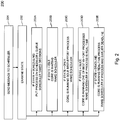
- Fig. 2 illustrates implementation of the ready function 200, corresponding to 142 or 152 in Fig. 1 , called to put a process on the queue for execution by a core, e.g. 102.
- a message is sent by the ready function 200 to the corresponding scheduler 141.
- the scheduler 141 can be invoked directly.
- an ICI can be used to invoke scheduler 141. Both scenario's are illustrated by the arrows in Fig. 1 .
- the state variable of scheduler 141 must be examined as is indicated by step 202.
- the ready function 142 puts the process on the scheduler's queue and the scheduler 141 will continue to take scheduling decisions in function of deadlines (priorities) of the processes listed in its queue. This is indicated by step 203A in Fig. 2 .
- the state variable is "Idle”
- the core 102 is waiting and the scheduler 141 must be wakened as is indicated by step 203B.
- the state variable is "Only” and the core 102 is running the sole best-effort process in its queue, as is indicated by step 203C.
- the state variable is "Slice" core 102 is running one out of a plurality of best-effort processes in its queue.
- Step 203D specifies that scheduler 141 must be wakened if the new process is a real-time process, i.e. a process with deadline different from infinity.
- the core 102 is running a real-time process and scheduler 141 must be wakened in case the new process has an earlier deadline, as indicated by step 203E.
- the second variable i.e. the deadline variable
- the deadline variable indicates the deadline of the currently executed real-time process. As shown above, this variable is only relevant if the state variable is set to "Deadline". For convenience, the deadline variable is set to Infinity if the state variable is Slice.
- a new process is put on the run queue of a core, e.g. 102, by calling the ready function 200 whose operation is illustrated by Fig. 2 .
- the ready function 200 sends a message to the core's scheduler 141 and optionally issues an inter-core interrupt for the ICI handler.
- Such an inter-core interrupt is issued either if the core 102 has disabled its clock interrupt or if the process running on the core 102 has a later deadline (lower priority) than the new process that becomes runnable. That latter condition is necessary to ensure that an Earliest Deadline First process is respected by the scheduler 141.
- Both the ICI handler 122 and clock interrupt handlers invoke the scheduler 141 by calling a schedule function as illustrated by Fig. 3 .
- This schedule function 300 may also be called explicitly by a running process, in order to yield the core 102 to another process.
- Fig. 3 illustrates the process executed by the scheduler 141 when invoked. It is noticed that the schedule function 300 has a loop 302-314 wherein it repeats its decision-making process until there are no more ready notifications that came in while the scheduling decision was being made. It is however expected that the loop is executed just once because it is unlikely that a ready message will arrive in the very short time interval needed to make a scheduling decision.
- the scheduler 141 starts running when it is invoked. It sets a parameter P to the current process as is indicated by step 301.
- the state variable is set "Scheduling" as is indicated by step 302. No interruptions are needed now because the scheduler 141 will process its queue of pending scheduler events. If there is a current process P and this process is still executable when the scheduler 141 is invoked, the scheduler 141 will put the current process P back on the run queue to be continued continued later. This is indicated by step 303.
- the scheduler now starts processing new events, i.e. the pending messages from ready calls, in step 304. Thereto, the scheduler 141 sorts the run queue in step 305, e.g. applying the EDF algorithm.
- step 306 it is checked whether the process P is a best effort process. If this is not the case, i.e. when its deadline differs from Infinity, the state variable is set "Deadline" as is indicated by step 310. Otherwise, if the process P is a best-effort process,it is checked in step 311 if the run queue has become empty by taking process P from the run queue. In case the run queue is not empty, the state variable is set "Slice" as indicated by step 313.
- the state variable is set "Only” as is indicated by step 312
- the scheduling function 300 leaves the loop 302-314 when there are no race conditions and the decisions of the scheduler 141 are executed on core 102.
- the core state is "Idle” in step 315, nothing is changed in step 316.
- the clock 121 is turned off in step 317 because there is no foreseeable necessity for making scheduling decisions, and the process P is run.
- the clock 121 is programmed to allocate a time slice to the current process P and to generate an interrupt thereafter. This is done in step 318. The current process P is run thereafter.
- the state and deadline variables are set and the scheduler 141 will be awakened early if external events require so..
Landscapes
- Engineering & Computer Science (AREA)
- Software Systems (AREA)
- Theoretical Computer Science (AREA)
- Physics & Mathematics (AREA)
- General Engineering & Computer Science (AREA)
- General Physics & Mathematics (AREA)
- Multi Processors (AREA)
Claims (4)
- Système de planification et d'exécution de processus de meilleur délai, de processus en temps réel et de processus de calcul à haute performance ou HPC (106, 107), ledit système comprenant :- un processeur multicoeur comprenant plusieurs coeurs (102, 103) pour exécuter lesdits processus de meilleur délai, processus en temps réel et processus HPC (106, 107) ;- un coeur appelé coeur de bruit pour gérer des interruptions générées par un dispositif ;- pour chaque coeur (102, 103) dans ledit processeur multicoeur, un planificateur par coeur (141, 151) avec une fille d'attente d'exécution par coeur et une horloge par coeur (121, 131) pour l'exécution de planification basée sur une interruption des processus (106, 107) sur un coeur respectif (102, 103) dudit processeur multicoeur, tous les planificateurs par coeur (141, 151) étant adaptés pour pouvoir désactiver leur horloge par coeur (121, 131) temporairement pour exécuter un processus HPC ou un processus de meilleur délai, et chaque planificateur par coeur (141, 151) pouvant réactiver son horloge par coeur (121, 131) lorsqu'un processus exécuté sur ledit coeur (141, 151) arrête l'exécution pour attendre un événement ;- une fonction prête (142, 152) adaptée pour recevoir à partir d'un coeur (102, 103) une notification d'un évènement qui entraîne l'exécution d'un processus sur ledit coeur (102, 103) ou un autre coeur (103, 102), ladite fonction prête (142, 152) étant adaptée pour réactiver le planificateur (141, 151) qui a précédemment désactivé l'horloge par coeur (121, 131) dudit coeur (102, 103) ; et- un gestionnaire d'interruption entre coeurs (122, 132) adapté pour recevoir une notification d'un coeur (102, 103) pour entraîner une interruption sur un coeur différent (103, 102), ledit gestionnaire d'interruption entre coeurs (122, 132) étant adapté pour activer un planificateur (141, 151) avec une horloge par coeur (121, 131) désactivée dudit coeur différent (103, 102).
- Système selon la revendication 1, dans lequel ledit planificateur par coeur (141, 151) de chaque coeur (102, 103) est adapté pour recevoir une instruction pour exécuter un processus sur ledit coeur (102, 103) lorsque ledit coeur (102, 103) est en état inactif à faible puissance et est adapté pour réactiver ensuite une horloge par coeur (121, 131) désactivée dudit coeur (102, 103).
- Système selon la revendication 1, dans lequel ledit planificateur par coeur (141, 151) de chaque coeur (102, 103) est adapté pour annoncer aux coeurs (102, 103) différents de son propre coeur (102, 103) des informations d'état indiquant un état actuel dudit planificateur par coeur (141, 151) et des informations de date limite indiquant une date limite d'un processus en temps réel exécuté actuellement par son propre coeur (102, 103).
- Système selon la revendication 1, comprenant en outre :- une fonction de contrôle d'admission adaptée pour exécuter un test d'admission pour un processus en temps réel en déterminant si des ressources de traitement suffisantes sont disponibles dans lesdits coeurs (102, 103) pour exécuter ledit processus en temps réel.
Priority Applications (1)
| Application Number | Priority Date | Filing Date | Title |
|---|---|---|---|
| EP12290079.8A EP2637096B1 (fr) | 2012-03-07 | 2012-03-07 | Système de planification et d'exécution de processus de calcul haute performance (HPC) d'effort optimal en temps réel |
Applications Claiming Priority (1)
| Application Number | Priority Date | Filing Date | Title |
|---|---|---|---|
| EP12290079.8A EP2637096B1 (fr) | 2012-03-07 | 2012-03-07 | Système de planification et d'exécution de processus de calcul haute performance (HPC) d'effort optimal en temps réel |
Publications (2)
| Publication Number | Publication Date |
|---|---|
| EP2637096A1 EP2637096A1 (fr) | 2013-09-11 |
| EP2637096B1 true EP2637096B1 (fr) | 2017-02-15 |
Family
ID=45952976
Family Applications (1)
| Application Number | Title | Priority Date | Filing Date |
|---|---|---|---|
| EP12290079.8A Not-in-force EP2637096B1 (fr) | 2012-03-07 | 2012-03-07 | Système de planification et d'exécution de processus de calcul haute performance (HPC) d'effort optimal en temps réel |
Country Status (1)
| Country | Link |
|---|---|
| EP (1) | EP2637096B1 (fr) |
Families Citing this family (2)
| Publication number | Priority date | Publication date | Assignee | Title |
|---|---|---|---|---|
| CN105718320B (zh) | 2016-01-18 | 2020-11-06 | 华为技术有限公司 | 一种时钟任务处理方法、装置及设备 |
| JP7287147B2 (ja) * | 2019-06-26 | 2023-06-06 | 富士通株式会社 | 演算処理装置および演算処理装置の制御方法 |
-
2012
- 2012-03-07 EP EP12290079.8A patent/EP2637096B1/fr not_active Not-in-force
Non-Patent Citations (1)
| Title |
|---|
| None * |
Also Published As
| Publication number | Publication date |
|---|---|
| EP2637096A1 (fr) | 2013-09-11 |
Similar Documents
| Publication | Publication Date | Title |
|---|---|---|
| US9904576B2 (en) | Method and apparatus implemented in processors for real-time scheduling and task organization based on response time order of magnitude | |
| CN108984267B (zh) | 工业服务器的微内核架构控制系统及工业服务器 | |
| Gu et al. | Resource efficient isolation mechanisms in mixed-criticality scheduling | |
| US9298504B1 (en) | Systems, devices, and techniques for preempting and reassigning tasks within a multiprocessor system | |
| CN111897637B (zh) | 作业调度方法、装置、主机及存储介质 | |
| US20150293787A1 (en) | Method For Scheduling With Deadline Constraints, In Particular In Linux, Carried Out In User Space | |
| CN106775964A (zh) | 时间/事件混合触发的操作系统架构及任务调度方法 | |
| Tan et al. | StateOS: A memory-efficient hybrid operating system for IoT devices | |
| EP2637096B1 (fr) | Système de planification et d'exécution de processus de calcul haute performance (HPC) d'effort optimal en temps réel | |
| WO2015188016A2 (fr) | Planificateur de tâches en temps réel économe en énergie | |
| Tamaş-Selicean et al. | Optimization of time-partitions for mixed-criticality real-time distributed embedded systems | |
| Teper et al. | Bridging the Gap between ROS~ 2 and Classical Real-Time Scheduling for Periodic Tasks | |
| KR101377195B1 (ko) | 컴퓨터 마이크로 작업 | |
| Simon et al. | On real-time feedback control systems: Requirements, achievements and perspectives | |
| US20090187261A1 (en) | Control Apparatus for Process input-Output Device | |
| KR20130022976A (ko) | 데드라인 기반 우선순위상속 시스템 및 그 방법 | |
| CN119536936A (zh) | 任务调度方法及装置、控制器、电子设备和存储介质 | |
| CN112527532B (zh) | 一种基于消息的路径调度方法 | |
| Gaitan et al. | Using Dual Priority scheduling to improve the resource utilization in the nMPRA microcontrollers | |
| Khemaissia et al. | New Reconfigurable Middleware for Feasible Adaptive RT-Linux. | |
| Gaitan et al. | Methods to improve the performances of the real-time operating systems for small microcontrollers | |
| Huang et al. | Analysis | |
| Kakkar | Scheduling techniques for operating systems for medical and IoT devices: A review | |
| Dasari et al. | Applying Reservation-based Scheduling to a μC-based Hypervisor: An industrial case study | |
| CN119829234B (zh) | 一种多任务生产者环境下的串行智能调度方法 |
Legal Events
| Date | Code | Title | Description |
|---|---|---|---|
| PUAI | Public reference made under article 153(3) epc to a published international application that has entered the european phase |
Free format text: ORIGINAL CODE: 0009012 |
|
| AK | Designated contracting states |
Kind code of ref document: A1 Designated state(s): AL AT BE BG CH CY CZ DE DK EE ES FI FR GB GR HR HU IE IS IT LI LT LU LV MC MK MT NL NO PL PT RO RS SE SI SK SM TR |
|
| AX | Request for extension of the european patent |
Extension state: BA ME |
|
| 111Z | Information provided on other rights and legal means of execution |
Free format text: AL AT BE BG CH CY CZ DE DK EE ES FI FR GB GR HR HU IE IS IT LI LT LU LV MC MK MT NL NO PL PT RO RS SE SI SK SM TR Effective date: 20140303 |
|
| 17P | Request for examination filed |
Effective date: 20140311 |
|
| RBV | Designated contracting states (corrected) |
Designated state(s): AL AT BE BG CH CY CZ DE DK EE ES FI FR GB GR HR HU IE IS IT LI LT LU LV MC MK MT NL NO PL PT RO RS SE SI SK SM TR |
|
| RAP1 | Party data changed (applicant data changed or rights of an application transferred) |
Owner name: ALCATEL LUCENT |
|
| D11X | Information provided on other rights and legal means of execution (deleted) | ||
| GRAP | Despatch of communication of intention to grant a patent |
Free format text: ORIGINAL CODE: EPIDOSNIGR1 |
|
| INTG | Intention to grant announced |
Effective date: 20160610 |
|
| GRAJ | Information related to disapproval of communication of intention to grant by the applicant or resumption of examination proceedings by the epo deleted |
Free format text: ORIGINAL CODE: EPIDOSDIGR1 |
|
| INTC | Intention to grant announced (deleted) | ||
| GRAP | Despatch of communication of intention to grant a patent |
Free format text: ORIGINAL CODE: EPIDOSNIGR1 |
|
| INTG | Intention to grant announced |
Effective date: 20161206 |
|
| GRAS | Grant fee paid |
Free format text: ORIGINAL CODE: EPIDOSNIGR3 |
|
| GRAA | (expected) grant |
Free format text: ORIGINAL CODE: 0009210 |
|
| AK | Designated contracting states |
Kind code of ref document: B1 Designated state(s): AL AT BE BG CH CY CZ DE DK EE ES FI FR GB GR HR HU IE IS IT LI LT LU LV MC MK MT NL NO PL PT RO RS SE SI SK SM TR |
|
| REG | Reference to a national code |
Ref country code: CH Ref legal event code: EP Ref country code: GB Ref legal event code: FG4D |
|
| REG | Reference to a national code |
Ref country code: IE Ref legal event code: FG4D |
|
| REG | Reference to a national code |
Ref country code: AT Ref legal event code: REF Ref document number: 868254 Country of ref document: AT Kind code of ref document: T Effective date: 20170315 |
|
| REG | Reference to a national code |
Ref country code: FR Ref legal event code: PLFP Year of fee payment: 6 |
|
| REG | Reference to a national code |
Ref country code: DE Ref legal event code: R096 Ref document number: 602012028682 Country of ref document: DE |
|
| REG | Reference to a national code |
Ref country code: NL Ref legal event code: MP Effective date: 20170215 |
|
| REG | Reference to a national code |
Ref country code: LT Ref legal event code: MG4D |
|
| REG | Reference to a national code |
Ref country code: AT Ref legal event code: MK05 Ref document number: 868254 Country of ref document: AT Kind code of ref document: T Effective date: 20170215 |
|
| PG25 | Lapsed in a contracting state [announced via postgrant information from national office to epo] |
Ref country code: NO Free format text: LAPSE BECAUSE OF FAILURE TO SUBMIT A TRANSLATION OF THE DESCRIPTION OR TO PAY THE FEE WITHIN THE PRESCRIBED TIME-LIMIT Effective date: 20170515 Ref country code: HR Free format text: LAPSE BECAUSE OF FAILURE TO SUBMIT A TRANSLATION OF THE DESCRIPTION OR TO PAY THE FEE WITHIN THE PRESCRIBED TIME-LIMIT Effective date: 20170215 Ref country code: GR Free format text: LAPSE BECAUSE OF FAILURE TO SUBMIT A TRANSLATION OF THE DESCRIPTION OR TO PAY THE FEE WITHIN THE PRESCRIBED TIME-LIMIT Effective date: 20170516 Ref country code: FI Free format text: LAPSE BECAUSE OF FAILURE TO SUBMIT A TRANSLATION OF THE DESCRIPTION OR TO PAY THE FEE WITHIN THE PRESCRIBED TIME-LIMIT Effective date: 20170215 Ref country code: LT Free format text: LAPSE BECAUSE OF FAILURE TO SUBMIT A TRANSLATION OF THE DESCRIPTION OR TO PAY THE FEE WITHIN THE PRESCRIBED TIME-LIMIT Effective date: 20170215 |
|
| PG25 | Lapsed in a contracting state [announced via postgrant information from national office to epo] |
Ref country code: PT Free format text: LAPSE BECAUSE OF FAILURE TO SUBMIT A TRANSLATION OF THE DESCRIPTION OR TO PAY THE FEE WITHIN THE PRESCRIBED TIME-LIMIT Effective date: 20170615 Ref country code: ES Free format text: LAPSE BECAUSE OF FAILURE TO SUBMIT A TRANSLATION OF THE DESCRIPTION OR TO PAY THE FEE WITHIN THE PRESCRIBED TIME-LIMIT Effective date: 20170215 Ref country code: NL Free format text: LAPSE BECAUSE OF FAILURE TO SUBMIT A TRANSLATION OF THE DESCRIPTION OR TO PAY THE FEE WITHIN THE PRESCRIBED TIME-LIMIT Effective date: 20170215 Ref country code: BG Free format text: LAPSE BECAUSE OF FAILURE TO SUBMIT A TRANSLATION OF THE DESCRIPTION OR TO PAY THE FEE WITHIN THE PRESCRIBED TIME-LIMIT Effective date: 20170515 Ref country code: SE Free format text: LAPSE BECAUSE OF FAILURE TO SUBMIT A TRANSLATION OF THE DESCRIPTION OR TO PAY THE FEE WITHIN THE PRESCRIBED TIME-LIMIT Effective date: 20170215 Ref country code: LV Free format text: LAPSE BECAUSE OF FAILURE TO SUBMIT A TRANSLATION OF THE DESCRIPTION OR TO PAY THE FEE WITHIN THE PRESCRIBED TIME-LIMIT Effective date: 20170215 Ref country code: RS Free format text: LAPSE BECAUSE OF FAILURE TO SUBMIT A TRANSLATION OF THE DESCRIPTION OR TO PAY THE FEE WITHIN THE PRESCRIBED TIME-LIMIT Effective date: 20170215 Ref country code: AT Free format text: LAPSE BECAUSE OF FAILURE TO SUBMIT A TRANSLATION OF THE DESCRIPTION OR TO PAY THE FEE WITHIN THE PRESCRIBED TIME-LIMIT Effective date: 20170215 |
|
| PG25 | Lapsed in a contracting state [announced via postgrant information from national office to epo] |
Ref country code: EE Free format text: LAPSE BECAUSE OF FAILURE TO SUBMIT A TRANSLATION OF THE DESCRIPTION OR TO PAY THE FEE WITHIN THE PRESCRIBED TIME-LIMIT Effective date: 20170215 Ref country code: RO Free format text: LAPSE BECAUSE OF FAILURE TO SUBMIT A TRANSLATION OF THE DESCRIPTION OR TO PAY THE FEE WITHIN THE PRESCRIBED TIME-LIMIT Effective date: 20170215 Ref country code: IT Free format text: LAPSE BECAUSE OF FAILURE TO SUBMIT A TRANSLATION OF THE DESCRIPTION OR TO PAY THE FEE WITHIN THE PRESCRIBED TIME-LIMIT Effective date: 20170215 Ref country code: SK Free format text: LAPSE BECAUSE OF FAILURE TO SUBMIT A TRANSLATION OF THE DESCRIPTION OR TO PAY THE FEE WITHIN THE PRESCRIBED TIME-LIMIT Effective date: 20170215 Ref country code: CZ Free format text: LAPSE BECAUSE OF FAILURE TO SUBMIT A TRANSLATION OF THE DESCRIPTION OR TO PAY THE FEE WITHIN THE PRESCRIBED TIME-LIMIT Effective date: 20170215 |
|
| REG | Reference to a national code |
Ref country code: CH Ref legal event code: PL |
|
| REG | Reference to a national code |
Ref country code: DE Ref legal event code: R097 Ref document number: 602012028682 Country of ref document: DE |
|
| PG25 | Lapsed in a contracting state [announced via postgrant information from national office to epo] |
Ref country code: MC Free format text: LAPSE BECAUSE OF FAILURE TO SUBMIT A TRANSLATION OF THE DESCRIPTION OR TO PAY THE FEE WITHIN THE PRESCRIBED TIME-LIMIT Effective date: 20170215 Ref country code: SM Free format text: LAPSE BECAUSE OF FAILURE TO SUBMIT A TRANSLATION OF THE DESCRIPTION OR TO PAY THE FEE WITHIN THE PRESCRIBED TIME-LIMIT Effective date: 20170215 Ref country code: DK Free format text: LAPSE BECAUSE OF FAILURE TO SUBMIT A TRANSLATION OF THE DESCRIPTION OR TO PAY THE FEE WITHIN THE PRESCRIBED TIME-LIMIT Effective date: 20170215 Ref country code: PL Free format text: LAPSE BECAUSE OF FAILURE TO SUBMIT A TRANSLATION OF THE DESCRIPTION OR TO PAY THE FEE WITHIN THE PRESCRIBED TIME-LIMIT Effective date: 20170215 |
|
| PLBE | No opposition filed within time limit |
Free format text: ORIGINAL CODE: 0009261 |
|
| STAA | Information on the status of an ep patent application or granted ep patent |
Free format text: STATUS: NO OPPOSITION FILED WITHIN TIME LIMIT |
|
| REG | Reference to a national code |
Ref country code: IE Ref legal event code: MM4A |
|
| 26N | No opposition filed |
Effective date: 20171116 |
|
| PG25 | Lapsed in a contracting state [announced via postgrant information from national office to epo] |
Ref country code: LU Free format text: LAPSE BECAUSE OF NON-PAYMENT OF DUE FEES Effective date: 20170307 |
|
| PG25 | Lapsed in a contracting state [announced via postgrant information from national office to epo] |
Ref country code: CH Free format text: LAPSE BECAUSE OF NON-PAYMENT OF DUE FEES Effective date: 20170331 Ref country code: IE Free format text: LAPSE BECAUSE OF NON-PAYMENT OF DUE FEES Effective date: 20170307 Ref country code: SI Free format text: LAPSE BECAUSE OF FAILURE TO SUBMIT A TRANSLATION OF THE DESCRIPTION OR TO PAY THE FEE WITHIN THE PRESCRIBED TIME-LIMIT Effective date: 20170215 Ref country code: LI Free format text: LAPSE BECAUSE OF NON-PAYMENT OF DUE FEES Effective date: 20170331 |
|
| REG | Reference to a national code |
Ref country code: BE Ref legal event code: MM Effective date: 20170331 |
|
| REG | Reference to a national code |
Ref country code: FR Ref legal event code: PLFP Year of fee payment: 7 |
|
| PGFP | Annual fee paid to national office [announced via postgrant information from national office to epo] |
Ref country code: GB Payment date: 20180321 Year of fee payment: 7 Ref country code: DE Payment date: 20180322 Year of fee payment: 7 |
|
| PG25 | Lapsed in a contracting state [announced via postgrant information from national office to epo] |
Ref country code: BE Free format text: LAPSE BECAUSE OF NON-PAYMENT OF DUE FEES Effective date: 20170331 |
|
| PGFP | Annual fee paid to national office [announced via postgrant information from national office to epo] |
Ref country code: FR Payment date: 20180328 Year of fee payment: 7 |
|
| PG25 | Lapsed in a contracting state [announced via postgrant information from national office to epo] |
Ref country code: MT Free format text: LAPSE BECAUSE OF NON-PAYMENT OF DUE FEES Effective date: 20170307 |
|
| PG25 | Lapsed in a contracting state [announced via postgrant information from national office to epo] |
Ref country code: HU Free format text: LAPSE BECAUSE OF FAILURE TO SUBMIT A TRANSLATION OF THE DESCRIPTION OR TO PAY THE FEE WITHIN THE PRESCRIBED TIME-LIMIT; INVALID AB INITIO Effective date: 20120307 |
|
| REG | Reference to a national code |
Ref country code: DE Ref legal event code: R119 Ref document number: 602012028682 Country of ref document: DE |
|
| PG25 | Lapsed in a contracting state [announced via postgrant information from national office to epo] |
Ref country code: CY Free format text: LAPSE BECAUSE OF NON-PAYMENT OF DUE FEES Effective date: 20170215 |
|
| GBPC | Gb: european patent ceased through non-payment of renewal fee |
Effective date: 20190307 |
|
| PG25 | Lapsed in a contracting state [announced via postgrant information from national office to epo] |
Ref country code: MK Free format text: LAPSE BECAUSE OF FAILURE TO SUBMIT A TRANSLATION OF THE DESCRIPTION OR TO PAY THE FEE WITHIN THE PRESCRIBED TIME-LIMIT Effective date: 20170215 |
|
| PG25 | Lapsed in a contracting state [announced via postgrant information from national office to epo] |
Ref country code: DE Free format text: LAPSE BECAUSE OF NON-PAYMENT OF DUE FEES Effective date: 20191001 Ref country code: GB Free format text: LAPSE BECAUSE OF NON-PAYMENT OF DUE FEES Effective date: 20190307 |
|
| PG25 | Lapsed in a contracting state [announced via postgrant information from national office to epo] |
Ref country code: FR Free format text: LAPSE BECAUSE OF NON-PAYMENT OF DUE FEES Effective date: 20190331 |
|
| PG25 | Lapsed in a contracting state [announced via postgrant information from national office to epo] |
Ref country code: TR Free format text: LAPSE BECAUSE OF FAILURE TO SUBMIT A TRANSLATION OF THE DESCRIPTION OR TO PAY THE FEE WITHIN THE PRESCRIBED TIME-LIMIT Effective date: 20170215 |
|
| PG25 | Lapsed in a contracting state [announced via postgrant information from national office to epo] |
Ref country code: AL Free format text: LAPSE BECAUSE OF FAILURE TO SUBMIT A TRANSLATION OF THE DESCRIPTION OR TO PAY THE FEE WITHIN THE PRESCRIBED TIME-LIMIT Effective date: 20170215 Ref country code: IS Free format text: LAPSE BECAUSE OF FAILURE TO SUBMIT A TRANSLATION OF THE DESCRIPTION OR TO PAY THE FEE WITHIN THE PRESCRIBED TIME-LIMIT Effective date: 20170615 |