EP2637409B1 - Masquage de bits de signe de vecteur de déplacement - Google Patents
Masquage de bits de signe de vecteur de déplacement Download PDFInfo
- Publication number
- EP2637409B1 EP2637409B1 EP13157145.7A EP13157145A EP2637409B1 EP 2637409 B1 EP2637409 B1 EP 2637409B1 EP 13157145 A EP13157145 A EP 13157145A EP 2637409 B1 EP2637409 B1 EP 2637409B1
- Authority
- EP
- European Patent Office
- Prior art keywords
- motion vector
- vector difference
- sign
- difference component
- magnitude
- Prior art date
- Legal status (The legal status is an assumption and is not a legal conclusion. Google has not performed a legal analysis and makes no representation as to the accuracy of the status listed.)
- Active
Links
Images




Classifications
-
- H—ELECTRICITY
- H04—ELECTRIC COMMUNICATION TECHNIQUE
- H04N—PICTORIAL COMMUNICATION, e.g. TELEVISION
- H04N19/00—Methods or arrangements for coding, decoding, compressing or decompressing digital video signals
- H04N19/50—Methods or arrangements for coding, decoding, compressing or decompressing digital video signals using predictive coding
- H04N19/503—Methods or arrangements for coding, decoding, compressing or decompressing digital video signals using predictive coding involving temporal prediction
- H04N19/51—Motion estimation or motion compensation
- H04N19/513—Processing of motion vectors
-
- H—ELECTRICITY
- H04—ELECTRIC COMMUNICATION TECHNIQUE
- H04N—PICTORIAL COMMUNICATION, e.g. TELEVISION
- H04N19/00—Methods or arrangements for coding, decoding, compressing or decompressing digital video signals
- H04N19/46—Embedding additional information in the video signal during the compression process
- H04N19/467—Embedding additional information in the video signal during the compression process characterised by the embedded information being invisible, e.g. watermarking
-
- H—ELECTRICITY
- H04—ELECTRIC COMMUNICATION TECHNIQUE
- H04N—PICTORIAL COMMUNICATION, e.g. TELEVISION
- H04N19/00—Methods or arrangements for coding, decoding, compressing or decompressing digital video signals
- H04N19/48—Methods or arrangements for coding, decoding, compressing or decompressing digital video signals using compressed domain processing techniques other than decoding, e.g. modification of transform coefficients, variable length coding [VLC] data or run-length data
-
- H—ELECTRICITY
- H04—ELECTRIC COMMUNICATION TECHNIQUE
- H04N—PICTORIAL COMMUNICATION, e.g. TELEVISION
- H04N19/00—Methods or arrangements for coding, decoding, compressing or decompressing digital video signals
- H04N19/50—Methods or arrangements for coding, decoding, compressing or decompressing digital video signals using predictive coding
- H04N19/503—Methods or arrangements for coding, decoding, compressing or decompressing digital video signals using predictive coding involving temporal prediction
- H04N19/51—Motion estimation or motion compensation
- H04N19/513—Processing of motion vectors
- H04N19/517—Processing of motion vectors by encoding
- H04N19/52—Processing of motion vectors by encoding by predictive encoding
Definitions
- the present application generally relates to data compression and, in particular, to methods and devices for motion vector sign bit hiding when encoding and decoding residual video data.
- Data compression occurs in a number of contexts. It is very commonly used in communications and computer networking to store, transmit, and reproduce information efficiently. It finds particular application in the encoding of images, audio and video. Video presents a significant challenge to data compression because of the large amount of data required for each video frame and the speed with which encoding and decoding often needs to occur.
- the current state-of-the-art for video encoding is the ITU-T H.264/AVC video coding standard. It defines a number of different profiles for different applications, including the Main profile, Baseline profile and others.
- a next-generation video encoding standard is currently under development through a joint initiative of MPEG-ITU termed High Efficiency Video Coding (HEVC/H.265). The initiative may eventually result in a video-coding standard that will form part of a suite of standards identified as MPEG-H.
- H.264 There are a number of standards for encoding/decoding images and videos, including H.264, that use block-based coding processes.
- the image or frame is divided into blocks, typically 4x4 or 8x8, and the blocks are spectrally transformed into coefficients, quantized, and entropy encoded.
- the data being transformed is not the actual pixel data, but is residual data following a prediction operation.
- Predictions can be intra-frame, i.e. block-to-block within the frame/image, or inter-frame, i.e. between frames (also called motion prediction). It is expected that HEVC/H.265 will also have these features.
- Motion prediction involves search for and selecting a prediction block from a previously decoded reference picture or frame. This prediction block is specified to the decoder by way of a motion vector. Rather than explicitly encoding the motion vector, most motion vectors are specified as motion vector differences relative to a predicted motion vector. In many implementations, the motion vector difference is encoded as two elements: a horizontal offset and a vertical offset. Each element may be preceded by a non-zero flag. If the non-zero flag indicates the offset is zero, no further data regarding that element need be encoded. If non-zero, then the magnitude of the element/offset is encoded followed by a sign bit indicating whether the offset is positive or negative.
- W-J CHIEN ET AL "Adaptive resolution on motion vector difference", 6. JCT-VC MEETING; 97. MPEG MEETING; 14-7-2011 - 22-7-2011; TORINO ; (JOINT COLLABORATIVE TEAM ON VIDEO CODING OF ISO/IEC JTC1/SC29/WG11 AND ITU-T SG.16); 12 July 2011, XP030009590, discloses a coding method to signal the resolution of the motion vector difference.
- the motion accuracy of the motion vector difference can be adaptively selected to be 1/4th pel or 1/8th pel and signaled via a motion resolution flag.
- a joint coding of motion resolution flag and motion vector difference are also proposed.
- the present invention proposes a method of decoding a bitstream of inter-coded video using sign bit hiding having the features of claim 1, a decoder for decoding a bitstream of inter-coded video using sign bit hiding having the features of claim 8, and a non-transitory medium having the features of claim 9. Preferred embodiments are described in the dependent claims.
- the present application describes a method of decoding a bitstream of inter-coded video using sign bit hiding, wherein a prediction block in a reference frame is specified by a motion vector, the bitstream encoding a horizontal motion vector difference component and a vertical motion vector difference component, wherein the motion vector is determined, in the decoder, based on a predicted motion vector adjusted by the horizontal motion vector difference component and the vertical motion vector difference component.
- the method includes decoding a part of the bitstream to reconstruct a magnitude of one of the motion vector difference components and to reconstruct a magnitude of the other of the motion vector difference components; determining a parity by summing said magnitude of the one of the motion vector difference components and said magnitude of the other of the motion vector difference components to obtain said parity; inferring a sign for said one of the motion vector difference components based on whether said parity is even or odd; and assigning the sign to said magnitude to reconstruct said one of the motion vector difference components.
- the present application describes a method of encoding motion vectors difference components in a bitstream using parity-based sign bit hiding.
- the method may include limiting the motion vector search space in a sub-pixel search to locations that satisfy a parity condition for hiding the sign bit of one of the components of the motion vector difference.
- the present application describes a decoder configured to implement such method of decoding.
- the present application describes non-transitory computer-readable media storing computer-executable program instructions which, when executed, configured a processor to perform the described method of decoding.
- H.264 for video coding and/or the developing HEVC/H.265 standard.
- HEVC/H.265 the developing HEVC/H.265 standard.
- present application is not limited to H.264/AVC or HEVC/H.265 but may be applicable to other video coding/decoding standards, including possible future standards, multi-view coding standards, scalable video coding standards, and reconfigurable video coding standards.
- a frame may contain one or more slices. It will also be appreciated that certain encoding/decoding operations are performed on a frame-by-frame basis, some are performed on a slice-by-slice basis, some picture-by-picture, some tile-by-tile, and some by rectangular slice group, depending on the particular requirements or terminology of the applicable image or video coding standard.
- the applicable image or video coding standard may determine whether the operations described below are performed in connection with frames and/or slices and/or pictures and/or tiles and/or rectangular slice groups, as the case may be. Accordingly, those ordinarily skilled in the art will understand, in light of the present disclosure, whether particular operations or processes described herein and particular references to frames, slices, pictures, tiles, rectangular slice groups are applicable to frames, slices, pictures, tiles, rectangular slice groups, or some or all of those for a given embodiment. This also applies to transform units, coding units, groups of coding units, etc., as will become apparent in light of the description below.
- Figure 1 shows, in block diagram form, an encoder 10 for encoding video.
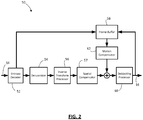
- Figure 2 shows a block diagram of a decoder 50 for decoding video.
- the encoder 10 and decoder 50 described herein may each be implemented on an application-specific or general purpose computing device, containing one or more processing elements and memory.
- the operations performed by the encoder 10 or decoder 50, as the case may be, may be implemented by way of application-specific integrated circuit, for example, or by way of stored program instructions executable by a general purpose processor.
- the device may include additional software, including, for example, an operating system for controlling basic device functions.
- the range of devices and platforms within which the encoder 10 or decoder 50 may be implemented will be appreciated by those ordinarily skilled in the art having regard to the following description.
- the encoder 10 receives a video source 12 and produces an encoded bitstream 14.
- the decoder 50 receives the encoded bitstream 14 and outputs a decoded video frame 16.
- the encoder 10 and decoder 50 may be configured to operate in conformance with a number of video compression standards.
- the encoder 10 and decoder 50 may be H.264/AVC compliant.
- the encoder 10 and decoder 50 may conform to other video compression standards, including evolutions of the H.264/AVC standard, like HEVC/H.265.
- the encoder 10 includes a spatial predictor 21, a coding mode selector 20, transform processor 22, quantizer 24, and entropy encoder 26.
- the coding mode selector 20 determines the appropriate coding mode for the video source, for example whether the subject frame/slice is of I, P, or B type, and whether particular coding units (e.g . macroblocks, coding units, etc.) within the frame/slice are inter or intra coded.
- the transform processor 22 performs a transform upon the spatial domain data.
- the transform processor 22 applies a block-based transform to convert spatial domain data to spectral components. For example, in many embodiments a discrete cosine transform (DCT) is used.
- DCT discrete cosine transform
- transforms such as a discrete sine transform or others may be used in some instances.
- the block-based transform is performed on a coding unit, macroblock or sub-block basis, depending on the size of the macroblocks or coding units.
- a typical 16x16 macroblock contains sixteen 4x4 transform blocks and the DCT process is performed on the 4x4 blocks.
- the transform blocks may be 8x8, meaning there are four transform blocks per macroblock.
- the transform blocks may be other sizes.
- a 16x16 macroblock may include a non-overlapping combination of 4x4 and 8x8 transform blocks.
- a "set” in this context is an ordered set in which the coefficients have coefficient positions.
- the set of transform domain coefficients may be considered as a "block” or matrix of coefficients.
- the phrases a "set of transform domain coefficients" or a “block of transform domain coefficients” are used interchangeably and are meant to indicate an ordered set of transform domain coefficients.
- the set of transform domain coefficients is quantized by the quantizer 24.
- the quantized coefficients and associated information are then encoded by the entropy encoder 26.
- the block or matrix of quantized transform domain coefficients may be referred to herein as a "transform unit" (TU).
- the TU may be non-square, e.g. a non-square quadrature transform (NSQT).
- Intra-coded frames/slices are encoded without reference to other frames/slices. In other words, they do not employ temporal prediction.
- intra-coded frames do rely upon spatial prediction within the frame/slice, as illustrated in Figure 1 by the spatial predictor 21. That is, when encoding a particular block the data in the block may be compared to the data of nearby pixels within blocks already encoded for that frame/slice. Using a prediction algorithm, the source data of the block may be converted to residual data. The transform processor 22 then encodes the residual data.
- H.264 for example, prescribes nine spatial prediction modes for 4x4 transform blocks. In some embodiments, each of the nine modes may be used to independently process a block, and then rate-distortion optimization is used to select the best mode.
- a motion predictor 36 uses the frames/slices stored in the frame store 34 as source frames/slices for comparison to a current frame for the purpose of identifying similar blocks.
- the "source data" which the transform processor 22 encodes is the residual data that comes out of the motion prediction process.
- it may include information regarding the reference frame, a spatial displacement or "motion vector", and residual pixel data that represents the differences (if any) between the reference block and the current block.
- Information regarding the reference frame and/or motion vector may not be processed by the transform processor 22 and/or quantizer 24, but instead may be supplied to the entropy encoder 26 for encoding as part of the bitstream along with the quantized coefficients.
- the decoder 50 includes an entropy decoder 52, dequantizer 54, inverse transform processor 56, spatial compensator 57, and deblocking processor 60.
- the deblocking processor 60 may include deblocking and filtering processors.
- a frame buffer 58 supplies reconstructed frames for use by a motion compensator 62 in applying motion compensation.
- the spatial compensator 57 represents the operation of recovering the video data for a particular intra-coded block from a previously decoded block.
- the bitstream 14 is received and decoded by the entropy decoder 52 to recover the quantized coefficients.
- Side information may also be recovered during the entropy decoding process, some of which may be supplied to the motion compensation loop for use in motion compensation, if applicable.
- the entropy decoder 52 may recover motion vectors and/or reference frame information for inter-coded macroblocks.
- the quantized coefficients are then dequantized by the dequantizer 54 to produce the transform domain coefficients, which are then subjected to an inverse transform by the inverse transform processor 56 to recreate the "video data".
- the recreated "video data” is the residual data for use in spatial compensation relative to a previously decoded block within the frame.
- the spatial compensator 57 generates the video data from the residual data and pixel data from a previously decoded block.
- the recreated "video data" from the inverse transform processor 56 is the residual data for use in motion compensation relative to a reference block from a different frame. Both spatial and motion compensation may be referred to herein as "prediction operations".
- the motion compensator 62 locates a reference block within the frame buffer 58 specified for a particular inter-coded macroblock or coding unit. It does so based on the reference frame information and motion vector specified for the inter-coded macroblock or coding unit. It then supplies the reference block pixel data for combination with the residual data to arrive at the reconstructed video data for that coding unit/macroblock.
- a deblocking/filtering process may then be applied to a reconstructed frame/slice, as indicated by the deblocking processor 60.
- the frame/slice is output as the decoded video frame 16, for example for display on a display device.
- the video playback machine such as a computer, set-top box, DVD or Blu-Ray player, and/or mobile handheld device, may buffer decoded frames in a memory prior to display on an output device.
- motion vectors are specified in the bitstream as a differential from a predicted motion vector, e.g. a previous motion vector. That is, a motion vector may be specified by the relative change from the predicted motion vector. In at least some embodiments, this is done by specifying the motion vector difference in the x-direction (horizontal) and the difference in the y-direction (vertical).
- the differential may be specified by first encoding a non-zero flag. If the non-zero flag indicates that the difference is non-zero, then the motion vector difference component is encoded, followed by a sign bit to indicate whether the difference is positive or negative. If the flag indicates that the difference is zero, then nothing further need be encoded with respect to that motion vector difference component.
- the differential may be specified by first encoding a non-zero flag and then, if non-zero, encoding a greater-than-one flag. If the greater-than-one flag indicates that the motion vector difference component magnitude is greater than one, then the magnitude-minus-two is encoded. If the non-zero flag is set, then the greater-than-one flag and the magnitude-minus-two (if present) are followed by a sign bit.
- the motion vector search may be performed at full pixel, 1 ⁇ 2 pixel, 1 ⁇ 4 pixel, or even 1 ⁇ 8 pixel resolution in some implementations.
- the sign bit of one or more motion vectors is not encoded in the bitstream and is inferred by the decoder based on a parity calculation.
- the parity calculation reflects whether the corresponding motion vector difference component is positive or negative.
- the search range of magnitudes for the motion vector are reduced from ⁇ ...-4, -3, -2, -1, 0, 1, 2, 3, 4, ... ⁇ to ⁇ ...-3, -1, 0, 2, 4, ... ⁇ .
- the motion vectors, whether fractional or not are specified in binary format. Accordingly, the last bit of the motion vector indicates its parity, i.e. even or odd, even where that last bit indicates a fraction, such as 1/4 versus 2/4.
- This example sign bit hiding may be realized at the encoder by reducing the number of candidate motion vectors to those that have horizontal and vertical components that meet these restrictions. If implemented for both the horizontal and vertical components, the search space is reduced, thus reducing encoder complexity but sacrificing some sub-pixel resolution, and a bit is saved for each component.
- the sign bit hiding for one of the motion vector components is based on the sum of the absolute-value of the two components, i.e . the sum of their magnitudes. That is, the sum of the two components produces a parity (e.g. a parity bit) and that parity indicates the sign of one of the components.
- the sign of the other component is explicitly coded in the bitstream (provided that component is non-zero).
- the parity in this example implementation may involve summing the least significant bit of the horizontal motion vector difference component and the least significant bit of the vertical motion vector difference component. If the sum is zero (e.g. 0 or binary '10') then the parity is even. If the sum is 1, then the parity is odd. It will be appreciated that the parity calculation test may be implemented as an XOR operation.
- the encoder By hiding the sign of one component in the parity of the sum of the magnitudes of the two components, the encoder has the freedom to choose to adjust either of the components in order to ensure the parity is correct for encoding the sign. In practice, the encoder may simply restrict its motion vector search to locations that result in the correct parity.
- Figure 3 illustrates an example of a partial motion vector search space 100 at quarter-pixel resolution.
- the large dark circles 102 indicate pixel locations (i.e. whole-pixel locations), whereas the large white circles 104 indicate half-pixel locations and the small white circles 106 indicate quarter-pixel locations.
- the encoder may limit its search space to a motion vector that satisfies the parity condition for sign hiding.
- the sign of one of the components is positive and is to be hidden in the parity of the sum of the magnitudes of the two components, and a positive sign is to be hidden using even parity.
- the encoder would only consider motion vector candidates in its search that result in a sum having even parity. That is, if the horizontal motion vector difference component and vertical motion vector difference component of a location result in an odd parity, then that position is not considered in the motion vector search.
- Figure 4 illustrates the partial motion vector search space 100 with the quarter pixel-locations removed that would (in this example) result in an odd parity. Accordingly, all the candidate locations remaining, including the whole-pixel and half-pixel locations, result in an even parity from the sum of the magnitudes of the horizontal and vertical motion vector difference components. It will be appreciated that this example may be dependent on the prediction from which the motion vector difference is calculated, so in some instances the pattern shown in Figure 4 may result in an odd parity.
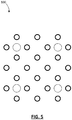
- Figure 5 illustrates the partial motion vector search space for the same example adjusted to remove the locations that would result in an even parity.
- the whole-pixel locations are shown in phantom lines to aid in understanding the illustration but are not valid candidates in the search space. Accordingly, for this example, all the remaining locations produced the desired parity for sign bit hiding.
- the sign bit of the horizontal motion vector difference component is hidden for each motion vector.
- the sign bit of the vertical motion vector difference component is hidden for each motion vector.
- the sign bit of the difference component that has the greatest magnitude is hidden.
- the encoder and decoder are configured to hide the sign bit for a predetermined one of the components.
- the sign bit is hidden for the difference component that results in the largest magnitude component of the actual motion vector (the predicted components plus their respective difference values).
- the sign bit of one of the components (vertical or horizontal) is always hidden unless the component is zero, in which case the sign bit of the other component is hidden.
- sign bit hiding may be conditional on the motion vector having certain characteristics. That is, both the encoder and decoder evaluate whether the motion vector has the required characteristic before determining whether a sign bit is hidden for one of the components.
- the characteristic is the absolute magnitude of the previous or 'reference' motion vector; that is, the motion vector that the motion vector difference components are designed to adjust.
- the magnitude of the predicted motion vector is indicative of the degree of motion in that portion of the frame of video.
- a frame or picture with significant motion may be less sensitive to resolution of the motion vectors, whereas a relatively static frame or picture may be more sensitive to fine texture differences.
- the frame or picture header may specify a threshold value.
- the condition uses an average (perhaps weighted) of two or more previous motion vectors and determines if their average magnitude exceeds the threshold.
- the sign bit hiding may be conditional on the magnitude of the motion vector difference components themselves. That is, if the summed magnitude of the motion vector difference components exceeds a threshold, then sign bit hiding is used for one of the motion vector difference components.
- the condition is that at least one of the motion vector difference components has a magnitude that exceeds a threshold.
- sign bit hiding may be turned on or turned off on a frame or picture basis.
- a bit in the frame or picture header may indicate whether sign bit hiding is used for motion vectors within the frame or picture.
- the decision at the encoder to use sign bit hiding or not may be based upon the characteristics of the picture, such as the degree of motion in the picture overall. This may be based upon a running (perhaps weighted) average of motion vector magnitude in one or more preceding pictures or frames. Other factors may also be used to determine whether to use sign bit hiding.
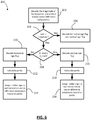
- FIG. 6 shows an example method 200 of decoding motion vectors with sign bit hiding.
- the method 200 in this example is based upon sign bit hiding that is enabled when the sum of the magnitudes of the motion vector difference components exceeds a threshold, and in which the sign bit of the largest of the motion vector difference component is hidden in the parity of their summation.
- the method 200 begins with operation 202 in which the magnitude of the horizontal motion vector difference component and the magnitude of the vertical motion vector difference component are decoded from the bitstream.
- This operation 202 may include decoding a non-zero flag of each of the components. If the non-zero flag of one of the components indicates that the component is zero, then no further decoding of that motion vector difference component occurs and no sign bit is required for that component. If both motion vector difference components are zero, then the method 200 ends at operation 202 since no further decoding is required and no sign bits are hidden.
- the decoder determines whether the sum of the magnitudes of the motion vector difference components is larger than a threshold value.
- the threshold value may be specified in a picture, frame or slice header, or may be otherwise communicated from the encoder to the decoder.
- the threshold value may be a default predetermined value in the absence of an explicit value communicated in one of the headers.
- the threshold test is based upon the sum of the magnitudes of the motion vector difference components.
- a number of other conditional tests may be applied in other embodiments to determine whether to hide a sign bit in any given case.
- no conditional test is applied and sign bit hiding is either enabled for all motion vectors in the picture or not.
- the decoder determines which of the motion vector difference components has the greater magnitude. This may be implemented as a greater-than-or-equal-to operation in some cases, to address the situation in which the magnitudes are the same. In this example, the condition is expressed as H_mvd ⁇ V_mvd.
- the sign bit for the vertical component is decoded from the bitstream. Conversely, if the horizontal motion vector difference component is less than the vertical motion vector difference component, then in operation 210 the sign bit for the horizontal component is decoded from the bitstream. Operations 210 and 216 may be implemented by simply decoding a sign bit and assigning the sign bit to either the horizontal or vertical component dependent upon the condition expressed in operation 208.
- the parity is calculated.
- the parity is based on the sum of the magnitudes of the motion vector difference components. If the sum is even, the hidden sign bit is positive. If the sum is odd, the hidden sign bit is negative.
- the hidden sign indicated by the parity is assigned to the vertical or horizontal motion vector difference component, respectively.
- the encoder may select a motion vector using 1/8 pixel resolution, at least in one direction.
- the motion vector may then be encoded using sign bit hiding (for both components if 1/8 th resolution is used in both dimensions, or one component if only used in one dimension).
- sign bit hiding for both components if 1/8 th resolution is used in both dimensions, or one component if only used in one dimension.
- the resulting motion vector resolution, even with sign bit hiding is 1 ⁇ 4 pixel, although 1/8 th pixel signaling requires 1 extra bit. Accordingly, in this embodiment the sign bit is replaced with an extra resolution bit.
- the switch from a sign bit to an extra bit of resolution that disguises a sign bit may nonetheless result in efficiencies in encoding.
- a flag in the picture or frame or slice header may indicate whether 1/8 th pixel motion vector resolution is enabled.
- Example syntax is set out below: mvd_coding( mvd_x, mvd_y) ⁇ Descriptor abs_mvd_greater0_flag[ 0 ] ae(v) if(abs_mvd_ greater0_flag[0] ) ⁇ abs_mvd_greater1_flag[ 0 ] ae(v) if(abs_mvd_ greater1_flag[1]) abs_mvd_minus2[ 0 ] ae(v) ⁇ abs_mvd_greater0_flag[ 1 ] ae(v) if(abs_mvd_ greater0_flag[1]) ⁇ abs_mvd_greater1_flag[ 1 ] ae(v) if(abs_mvd_ greater1_flag[1]) abs_mvd_minus2[ 1 ] ae(v) if(abs_mvd_ greater1
- the decoder first decodes the horizontal motion vector greater-than-zero flag ( abs_mvd_greater0_flag ) and, if that flag is 1, then decodes the horizontal motion vector greater-than-one flag. If the greater-than-one flag is set then it decodes the magnitude of the horizontal motion vector difference component minus two ( abs_mvd_minus2 ). The decoder uses the same process to decode the elements of the vertical motion vector difference component. A sign bit ( mvd_sign_flag ) is then decoded from the bitstream.
- the decoder determines the magnitude of the horizontal motion vector difference component as the horizontal motion vector greater-than-zero flag times the minus2 element plus two (as noted above, the minus 2 element is set to -1 in the case where the greater-than-one flag is zero so as to properly realize a motion vector difference component of 1).
- the decoder determines the magnitude of the vertical motion vector difference component in the same manner.
- the decoder then assigns the sign bit to the vertical motion vector difference component by multiplying the magnitude by (1-2*mvd_sign_flag).
- Another example syntax is shown below.
- a similar decoding process is used; however, the hidden sign is applied to the horizontal motion vector difference component if the magnitude of the horizontal motion vector difference component is less than the magnitude of the vertical motion vector difference component. Otherwise, the hidden sign is applied to the vertical motion vector difference component.
- the encoder 900 includes a processor 902, memory 904, and an encoding application 906.
- the encoding application 906 may include a computer program or application stored in memory 904 and containing instructions for configuring the processor 902 to perform operations such as those described herein.
- the encoding application 906 may encode and output bitstreams encoded in accordance with the processes described herein. It will be understood that the encoding application 906 may be stored in on a computer readable medium, such as a compact disc, flash memory device, random access memory, hard drive, etc.
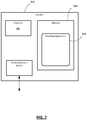
- the decoder 1000 includes a processor 1002, a memory 1004, and a decoding application 1006.
- the decoding application 1006 may include a computer program or application stored in memory 1004 and containing instructions for configuring the processor 1002 to perform operations such as those described herein.
- the decoding application 1006 may include an entropy decoder configured to reconstruct residuals based, at least in part, on reconstructing significant-coefficient flags, as described herein. It will be understood that the decoding application 1006 may be stored in on a computer readable medium, such as a compact disc, flash memory device, random access memory, hard drive, etc.
- the decoder and/or encoder may be implemented in a number of computing devices, including, without limitation, servers, suitably programmed general purpose computers, audio/video encoding and playback devices, set-top television boxes, television broadcast equipment, and mobile devices.
- the decoder or encoder may be implemented by way of software containing instructions for configuring a processor to carry out the functions described herein.
- the software instructions may be stored on any suitable non-transitory computer-readable memory, including CDs, RAM, ROM, Flash memory, etc.
- the encoder described herein and the module, routine, process, thread, or other software component implementing the described method/process for configuring the encoder may be realized using standard computer programming techniques and languages.
- the present application is not limited to particular processors, computer languages, computer programming conventions, data structures, other such implementation details.
- Those skilled in the art will recognize that the described processes may be implemented as a part of computer-executable code stored in volatile or non-volatile memory, as part of an application-specific integrated chip (ASIC), etc.
- ASIC application-specific integrated chip
Landscapes
- Engineering & Computer Science (AREA)
- Multimedia (AREA)
- Signal Processing (AREA)
- Compression Or Coding Systems Of Tv Signals (AREA)
Claims (9)
- Procédé de décodage d'un flux binaire de vidéo inter-codée en utilisant une dissimulation de bit de signe, dans lequel un bloc de prédiction dans une trame de référence est spécifié par un vecteur de mouvement, le flux binaire codant une composante de différence de vecteur de mouvement horizontale et une composante de différence de vecteur de mouvement verticale, dans lequel le vecteur de mouvement est déterminé, dans le décodeur, sur la base d'un vecteur de mouvement prédit ajusté par la composante de différence de vecteur de mouvement horizontale et la composante de différence de vecteur de mouvement verticale, le procédé comprenant les étapes consistant à :décoder (202) une partie du flux binaire pour reconstruire une amplitude de l'une des composantes de différence de vecteur de mouvement et pour reconstruire une amplitude de l'autre des composantes de différence de vecteur de mouvement ;déterminer (204, 206) une parité en sommant ladite amplitude de ladite une des composantes de différence de vecteur de mouvement et ladite amplitude de l'autre des composantes de différence de vecteur de mouvement pour obtenir ladite parité ;déduire (210 à 212, 216 à 218) un signe pour ladite une des composantes de différence de vecteur de mouvement selon que ladite parité est paire ou impaire ; etattribuer (208, 214, 220) le signe à ladite amplitude pour reconstruire ladite une des composantes de différence de vecteur de mouvement.
- Procédé selon la revendication 1, comprenant en outre l'étape consistant à déterminer qu'un en-tête d'image dans le flux binaire contient un indicateur de dissimulation de bit de signe de vecteur de mouvement indicatif du fait que des bits de signe de vecteur de mouvement dans une image correspondante sont cachés.
- Procédé selon la revendication 1 ou 2, dans lequel l'attribution (208, 214, 220) dudit signe comprend l'attribution (220) dudit signe à la composante de différence de vecteur de mouvement horizontale à moins que la composante de différence de vecteur de mouvement horizontale soit nulle, auquel cas l'attribution comprend l'attribution (214) dudit signe à la composante de différence de vecteur de mouvement verticale.
- Procédé selon la revendication 1 ou 2, dans lequel l'attribution (208, 214, 220) dudit signe comprend l'attribution (214) dudit signe à la composante de différence de vecteur de mouvement verticale à moins que la composante de différence de vecteur de mouvement verticale soit nulle, auquel cas l'attribution (208, 214, 220) comprend l'attribution (220) dudit signe à la composante de différence de vecteur de mouvement horizontale.
- Procédé selon la revendication 1 ou 2, dans lequel l'attribution (208, 214, 220) comprend la détermination (208) de celle de la composante de différence de vecteur de mouvement horizontale et de la composante de différence de vecteur de mouvement verticale qui a une plus grande amplitude et l'attribution (208, 214, 220) dudit signe à la composante de différence de vecteur de mouvement ayant la plus grande amplitude.
- Procédé selon l'une quelconque des revendications 1 à 5, comprenant en outre, avant l'attribution, l'étape consistant à confirmer (204) qu'un test de seuil basé sur l'amplitude est satisfait.
- Procédé selon la revendication 6, dans lequel la confirmation (204) comprend la détermination que la somme des amplitudes des composantes de différence de vecteur de mouvement dépasse une valeur de seuil.
- Décodeur (1000) pour décoder un flux binaire de vidéo inter-codée en utilisant une dissimulation de bit de signe, dans lequel un bloc de prédiction dans une trame de référence est spécifié par un vecteur de mouvement, le flux binaire codant une composante de différence de vecteur de mouvement horizontale et une composante de différence de vecteur de mouvement verticale, dans lequel le vecteur de mouvement est déterminé, dans le décodeur, sur la base d'un vecteur de mouvement prédit ajusté par la composante de différence de vecteur de mouvement horizontale et la composante de différence de vecteur de mouvement verticale, le décodeur comprenant :un processeur (1002) ;une mémoire (1004) ; etune application de décodage (1006) mémorisée dans la mémoire (1004) et contenant des instructions qui, lorsqu'elles sont exécutées, amènent le processeur (1002) à effectuer le procédé selon l'une quelconque des revendications 1 à 7.
- Support non transitoire pouvant être lu par processeur mémorisant des instructions exécutables par processeur qui, lorsqu'elles sont exécutées, amènent un ou plusieurs processeurs à effectuer le procédé selon l'une quelconque des revendications 1 à 7.
Applications Claiming Priority (1)
| Application Number | Priority Date | Filing Date | Title |
|---|---|---|---|
| US201261608248P | 2012-03-08 | 2012-03-08 |
Publications (2)
| Publication Number | Publication Date |
|---|---|
| EP2637409A1 EP2637409A1 (fr) | 2013-09-11 |
| EP2637409B1 true EP2637409B1 (fr) | 2019-07-31 |
Family
ID=47757456
Family Applications (1)
| Application Number | Title | Priority Date | Filing Date |
|---|---|---|---|
| EP13157145.7A Active EP2637409B1 (fr) | 2012-03-08 | 2013-02-28 | Masquage de bits de signe de vecteur de déplacement |
Country Status (3)
| Country | Link |
|---|---|
| US (1) | US9363512B2 (fr) |
| EP (1) | EP2637409B1 (fr) |
| CA (1) | CA2807786C (fr) |
Families Citing this family (24)
| Publication number | Priority date | Publication date | Assignee | Title |
|---|---|---|---|---|
| FR2982446A1 (fr) | 2011-11-07 | 2013-05-10 | France Telecom | Procede de codage et decodage d'images, dispositif de codage et decodage et programmes d'ordinateur correspondants |
| FR2982447A1 (fr) | 2011-11-07 | 2013-05-10 | France Telecom | Procede de codage et decodage d'images, dispositif de codage et decodage et programmes d'ordinateur correspondants |
| US20140133574A1 (en) * | 2012-11-13 | 2014-05-15 | Mediatek Inc. | Method and Apparatus for Sign Data Hiding of Video and Image Data |
| US9774879B2 (en) | 2013-08-16 | 2017-09-26 | Sony Corporation | Intra-block copying enhancements for HEVC in-range-extension (RExt) |
| US9749642B2 (en) | 2014-01-08 | 2017-08-29 | Microsoft Technology Licensing, Llc | Selection of motion vector precision |
| US9774881B2 (en) * | 2014-01-08 | 2017-09-26 | Microsoft Technology Licensing, Llc | Representing motion vectors in an encoded bitstream |
| KR101953855B1 (ko) | 2014-04-01 | 2019-03-04 | 후아웨이 테크놀러지 컴퍼니 리미티드 | 다중 계층 구조 부호화 유닛에서의 데이터 은닉을 위한 방법 및 장치 |
| CN106791871B (zh) * | 2015-11-25 | 2019-07-02 | 中国科学院声学研究所 | 一种运动矢量调制信息隐藏检测方法 |
| CA3014299A1 (fr) | 2016-02-12 | 2017-08-17 | Huawei Technologies Co., Ltd. | Procede et appareil pour une selection d'ordre de balayage |
| CN108605132B (zh) | 2016-02-12 | 2020-12-15 | 华为技术有限公司 | 选择扫描顺序的方法和装置 |
| WO2017194773A1 (fr) * | 2016-05-13 | 2017-11-16 | Telefonaktiebolaget Lm Ericsson (Publ) | Codage et décodage de différence de vecteur de mouvement |
| EP3491824B1 (fr) | 2016-08-04 | 2023-04-26 | Huawei Technologies Co., Ltd. | Procédé et appareil pour cacher des données dans des paramètres de prédiction |
| US10812791B2 (en) * | 2016-09-16 | 2020-10-20 | Qualcomm Incorporated | Offset vector identification of temporal motion vector predictor |
| US10701391B2 (en) * | 2017-03-23 | 2020-06-30 | Qualcomm Incorporated | Motion vector difference (MVD) prediction |
| CN108153913B (zh) * | 2018-01-24 | 2020-08-07 | 鼎富智能科技有限公司 | 回复信息生成模型的训练方法、回复信息生成方法及装置 |
| WO2019156469A1 (fr) * | 2018-02-09 | 2019-08-15 | 삼성전자 주식회사 | Procédé et appareil de décodage vidéo, et procédé et appareil de codage vidéo |
| BR112021010602A2 (pt) * | 2018-12-26 | 2021-08-24 | Panasonic Intellectual Property Corporation Of America | Método de codificação de dados tridimensionais, método de decodificação de dados tridimensionais, dispositivo de codificação de dados tridimensionais, e dispositivo de decodificação de dados tridimensionais |
| CN110324634B (zh) * | 2019-07-05 | 2021-10-01 | 中国科学技术大学 | 一种基于运动矢量嵌入失真分解的视频隐写方法 |
| US11245920B2 (en) * | 2019-08-23 | 2022-02-08 | Qualcomm Incorporated | Escape code coding for motion vector difference in video coding |
| CN121173953A (zh) * | 2019-12-30 | 2025-12-19 | Oppo广东移动通信有限公司 | 帧间预测方法、编码器、解码器及存储介质 |
| US20240373051A1 (en) * | 2021-07-01 | 2024-11-07 | Industry Academy Cooperation Foundation Of Sejong University | Video encoding and decoding method using code bit hiding |
| US12155839B2 (en) | 2021-10-21 | 2024-11-26 | Tencent America LLC | Adaptive resolution for single-reference motion vector difference |
| AU2022435738A1 (en) * | 2022-01-18 | 2023-10-05 | Tencent America LLC | Interdependence between adaptive resolution of motion vector difference and signaling/derivation of motion vector-related parameters |
| WO2025106217A1 (fr) * | 2023-11-14 | 2025-05-22 | Google Llc | Détermination implicite de signe mvd et de parité pour codage vidéo |
Family Cites Families (6)
| Publication number | Priority date | Publication date | Assignee | Title |
|---|---|---|---|---|
| US20050013498A1 (en) * | 2003-07-18 | 2005-01-20 | Microsoft Corporation | Coding of motion vector information |
| JP4896944B2 (ja) * | 2008-11-13 | 2012-03-14 | 株式会社東芝 | 画像復号装置 |
| US9060176B2 (en) * | 2009-10-01 | 2015-06-16 | Ntt Docomo, Inc. | Motion vector prediction in video coding |
| EP2559243B1 (fr) * | 2010-04-13 | 2014-08-27 | Fraunhofer-Gesellschaft zur Förderung der angewandten Forschung e.V. | Un décodeur vidéo et un codeur vidéo au moyen d'une prédiction avec compensation de mouvement |
| US8787459B2 (en) * | 2010-11-09 | 2014-07-22 | Sony Computer Entertainment Inc. | Video coding methods and apparatus |
| US9532066B2 (en) * | 2011-01-21 | 2016-12-27 | Qualcomm Incorporated | Motion vector prediction |
-
2013
- 2013-02-22 US US13/774,199 patent/US9363512B2/en active Active
- 2013-02-22 CA CA2807786A patent/CA2807786C/fr active Active
- 2013-02-28 EP EP13157145.7A patent/EP2637409B1/fr active Active
Non-Patent Citations (1)
| Title |
|---|
| None * |
Also Published As
| Publication number | Publication date |
|---|---|
| US9363512B2 (en) | 2016-06-07 |
| EP2637409A1 (fr) | 2013-09-11 |
| US20130235936A1 (en) | 2013-09-12 |
| CA2807786C (fr) | 2016-06-21 |
| CA2807786A1 (fr) | 2013-09-08 |
Similar Documents
| Publication | Publication Date | Title |
|---|---|---|
| EP2637409B1 (fr) | Masquage de bits de signe de vecteur de déplacement | |
| US12186395B2 (en) | Multiple sign bit hiding within a transform unit | |
| EP3644611B1 (fr) | Masquage de bits à signalisation multiple dans une unité de transformation | |
| EP2637405B1 (fr) | Mode bypass adaptatif pour le codage des valeurs absolues de coefficients de transformée | |
| US12389004B2 (en) | Methods and devices for context set selection | |
| US20130272384A1 (en) | Modified contexts for level coding of video data | |
| US20140003488A1 (en) | Position-based context selection for greater-than-one flag decoding and encoding | |
| EP2680580B1 (fr) | Corbeilles codées avec contexte le plus défavorable réduit dans la compression vidéo avec masquage de parité | |
| HK40000199B (en) | Multiple sign bit hiding within a transform unit | |
| HK40000199A (en) | Multiple sign bit hiding within a transform unit | |
| HK1182241B (en) | Multiple sign bit hiding within a transform unit | |
| HK1182241A (en) | Multiple sign bit hiding within a transform unit |
Legal Events
| Date | Code | Title | Description |
|---|---|---|---|
| PUAI | Public reference made under article 153(3) epc to a published international application that has entered the european phase |
Free format text: ORIGINAL CODE: 0009012 |
|
| 17P | Request for examination filed |
Effective date: 20130228 |
|
| AK | Designated contracting states |
Kind code of ref document: A1 Designated state(s): AL AT BE BG CH CY CZ DE DK EE ES FI FR GB GR HR HU IE IS IT LI LT LU LV MC MK MT NL NO PL PT RO RS SE SI SK SM TR |
|
| AX | Request for extension of the european patent |
Extension state: BA ME |
|
| 17Q | First examination report despatched |
Effective date: 20130826 |
|
| RAP1 | Party data changed (applicant data changed or rights of an application transferred) |
Owner name: BLACKBERRY LIMITED |
|
| STAA | Information on the status of an ep patent application or granted ep patent |
Free format text: STATUS: EXAMINATION IS IN PROGRESS |
|
| REG | Reference to a national code |
Ref country code: DE Ref legal event code: R079 Ref document number: 602013058398 Country of ref document: DE Free format text: PREVIOUS MAIN CLASS: H04N0007360000 Ipc: H04N0019520000 |
|
| GRAP | Despatch of communication of intention to grant a patent |
Free format text: ORIGINAL CODE: EPIDOSNIGR1 |
|
| STAA | Information on the status of an ep patent application or granted ep patent |
Free format text: STATUS: GRANT OF PATENT IS INTENDED |
|
| RIC1 | Information provided on ipc code assigned before grant |
Ipc: H04N 19/467 20140101ALI20190201BHEP Ipc: H04N 19/52 20140101AFI20190201BHEP Ipc: H04N 19/48 20140101ALI20190201BHEP |
|
| INTG | Intention to grant announced |
Effective date: 20190220 |
|
| GRAS | Grant fee paid |
Free format text: ORIGINAL CODE: EPIDOSNIGR3 |
|
| GRAA | (expected) grant |
Free format text: ORIGINAL CODE: 0009210 |
|
| STAA | Information on the status of an ep patent application or granted ep patent |
Free format text: STATUS: THE PATENT HAS BEEN GRANTED |
|
| AK | Designated contracting states |
Kind code of ref document: B1 Designated state(s): AL AT BE BG CH CY CZ DE DK EE ES FI FR GB GR HR HU IE IS IT LI LT LU LV MC MK MT NL NO PL PT RO RS SE SI SK SM TR |
|
| REG | Reference to a national code |
Ref country code: CH Ref legal event code: EP Ref country code: GB Ref legal event code: FG4D |
|
| REG | Reference to a national code |
Ref country code: DE Ref legal event code: R096 Ref document number: 602013058398 Country of ref document: DE |
|
| REG | Reference to a national code |
Ref country code: AT Ref legal event code: REF Ref document number: 1162267 Country of ref document: AT Kind code of ref document: T Effective date: 20190815 |
|
| REG | Reference to a national code |
Ref country code: IE Ref legal event code: FG4D |
|
| REG | Reference to a national code |
Ref country code: NL Ref legal event code: MP Effective date: 20190731 |
|
| REG | Reference to a national code |
Ref country code: LT Ref legal event code: MG4D |
|
| REG | Reference to a national code |
Ref country code: AT Ref legal event code: MK05 Ref document number: 1162267 Country of ref document: AT Kind code of ref document: T Effective date: 20190731 |
|
| PG25 | Lapsed in a contracting state [announced via postgrant information from national office to epo] |
Ref country code: PT Free format text: LAPSE BECAUSE OF FAILURE TO SUBMIT A TRANSLATION OF THE DESCRIPTION OR TO PAY THE FEE WITHIN THE PRESCRIBED TIME-LIMIT Effective date: 20191202 Ref country code: BG Free format text: LAPSE BECAUSE OF FAILURE TO SUBMIT A TRANSLATION OF THE DESCRIPTION OR TO PAY THE FEE WITHIN THE PRESCRIBED TIME-LIMIT Effective date: 20191031 Ref country code: SE Free format text: LAPSE BECAUSE OF FAILURE TO SUBMIT A TRANSLATION OF THE DESCRIPTION OR TO PAY THE FEE WITHIN THE PRESCRIBED TIME-LIMIT Effective date: 20190731 Ref country code: HR Free format text: LAPSE BECAUSE OF FAILURE TO SUBMIT A TRANSLATION OF THE DESCRIPTION OR TO PAY THE FEE WITHIN THE PRESCRIBED TIME-LIMIT Effective date: 20190731 Ref country code: LT Free format text: LAPSE BECAUSE OF FAILURE TO SUBMIT A TRANSLATION OF THE DESCRIPTION OR TO PAY THE FEE WITHIN THE PRESCRIBED TIME-LIMIT Effective date: 20190731 Ref country code: FI Free format text: LAPSE BECAUSE OF FAILURE TO SUBMIT A TRANSLATION OF THE DESCRIPTION OR TO PAY THE FEE WITHIN THE PRESCRIBED TIME-LIMIT Effective date: 20190731 Ref country code: NL Free format text: LAPSE BECAUSE OF FAILURE TO SUBMIT A TRANSLATION OF THE DESCRIPTION OR TO PAY THE FEE WITHIN THE PRESCRIBED TIME-LIMIT Effective date: 20190731 Ref country code: AT Free format text: LAPSE BECAUSE OF FAILURE TO SUBMIT A TRANSLATION OF THE DESCRIPTION OR TO PAY THE FEE WITHIN THE PRESCRIBED TIME-LIMIT Effective date: 20190731 Ref country code: NO Free format text: LAPSE BECAUSE OF FAILURE TO SUBMIT A TRANSLATION OF THE DESCRIPTION OR TO PAY THE FEE WITHIN THE PRESCRIBED TIME-LIMIT Effective date: 20191031 |
|
| PG25 | Lapsed in a contracting state [announced via postgrant information from national office to epo] |
Ref country code: AL Free format text: LAPSE BECAUSE OF FAILURE TO SUBMIT A TRANSLATION OF THE DESCRIPTION OR TO PAY THE FEE WITHIN THE PRESCRIBED TIME-LIMIT Effective date: 20190731 Ref country code: GR Free format text: LAPSE BECAUSE OF FAILURE TO SUBMIT A TRANSLATION OF THE DESCRIPTION OR TO PAY THE FEE WITHIN THE PRESCRIBED TIME-LIMIT Effective date: 20191101 Ref country code: ES Free format text: LAPSE BECAUSE OF FAILURE TO SUBMIT A TRANSLATION OF THE DESCRIPTION OR TO PAY THE FEE WITHIN THE PRESCRIBED TIME-LIMIT Effective date: 20190731 Ref country code: IS Free format text: LAPSE BECAUSE OF FAILURE TO SUBMIT A TRANSLATION OF THE DESCRIPTION OR TO PAY THE FEE WITHIN THE PRESCRIBED TIME-LIMIT Effective date: 20191130 Ref country code: LV Free format text: LAPSE BECAUSE OF FAILURE TO SUBMIT A TRANSLATION OF THE DESCRIPTION OR TO PAY THE FEE WITHIN THE PRESCRIBED TIME-LIMIT Effective date: 20190731 Ref country code: RS Free format text: LAPSE BECAUSE OF FAILURE TO SUBMIT A TRANSLATION OF THE DESCRIPTION OR TO PAY THE FEE WITHIN THE PRESCRIBED TIME-LIMIT Effective date: 20190731 |
|
| PG25 | Lapsed in a contracting state [announced via postgrant information from national office to epo] |
Ref country code: TR Free format text: LAPSE BECAUSE OF FAILURE TO SUBMIT A TRANSLATION OF THE DESCRIPTION OR TO PAY THE FEE WITHIN THE PRESCRIBED TIME-LIMIT Effective date: 20190731 |
|
| PG25 | Lapsed in a contracting state [announced via postgrant information from national office to epo] |
Ref country code: IT Free format text: LAPSE BECAUSE OF FAILURE TO SUBMIT A TRANSLATION OF THE DESCRIPTION OR TO PAY THE FEE WITHIN THE PRESCRIBED TIME-LIMIT Effective date: 20190731 Ref country code: RO Free format text: LAPSE BECAUSE OF FAILURE TO SUBMIT A TRANSLATION OF THE DESCRIPTION OR TO PAY THE FEE WITHIN THE PRESCRIBED TIME-LIMIT Effective date: 20190731 Ref country code: PL Free format text: LAPSE BECAUSE OF FAILURE TO SUBMIT A TRANSLATION OF THE DESCRIPTION OR TO PAY THE FEE WITHIN THE PRESCRIBED TIME-LIMIT Effective date: 20190731 Ref country code: EE Free format text: LAPSE BECAUSE OF FAILURE TO SUBMIT A TRANSLATION OF THE DESCRIPTION OR TO PAY THE FEE WITHIN THE PRESCRIBED TIME-LIMIT Effective date: 20190731 Ref country code: DK Free format text: LAPSE BECAUSE OF FAILURE TO SUBMIT A TRANSLATION OF THE DESCRIPTION OR TO PAY THE FEE WITHIN THE PRESCRIBED TIME-LIMIT Effective date: 20190731 |
|
| PG25 | Lapsed in a contracting state [announced via postgrant information from national office to epo] |
Ref country code: IS Free format text: LAPSE BECAUSE OF FAILURE TO SUBMIT A TRANSLATION OF THE DESCRIPTION OR TO PAY THE FEE WITHIN THE PRESCRIBED TIME-LIMIT Effective date: 20200224 Ref country code: SK Free format text: LAPSE BECAUSE OF FAILURE TO SUBMIT A TRANSLATION OF THE DESCRIPTION OR TO PAY THE FEE WITHIN THE PRESCRIBED TIME-LIMIT Effective date: 20190731 Ref country code: SM Free format text: LAPSE BECAUSE OF FAILURE TO SUBMIT A TRANSLATION OF THE DESCRIPTION OR TO PAY THE FEE WITHIN THE PRESCRIBED TIME-LIMIT Effective date: 20190731 Ref country code: CZ Free format text: LAPSE BECAUSE OF FAILURE TO SUBMIT A TRANSLATION OF THE DESCRIPTION OR TO PAY THE FEE WITHIN THE PRESCRIBED TIME-LIMIT Effective date: 20190731 |
|
| REG | Reference to a national code |
Ref country code: DE Ref legal event code: R097 Ref document number: 602013058398 Country of ref document: DE |
|
| PLBE | No opposition filed within time limit |
Free format text: ORIGINAL CODE: 0009261 |
|
| STAA | Information on the status of an ep patent application or granted ep patent |
Free format text: STATUS: NO OPPOSITION FILED WITHIN TIME LIMIT |
|
| PG2D | Information on lapse in contracting state deleted |
Ref country code: IS |
|
| PG25 | Lapsed in a contracting state [announced via postgrant information from national office to epo] |
Ref country code: IS Free format text: LAPSE BECAUSE OF FAILURE TO SUBMIT A TRANSLATION OF THE DESCRIPTION OR TO PAY THE FEE WITHIN THE PRESCRIBED TIME-LIMIT Effective date: 20191030 |
|
| 26N | No opposition filed |
Effective date: 20200603 |
|
| PG25 | Lapsed in a contracting state [announced via postgrant information from national office to epo] |
Ref country code: SI Free format text: LAPSE BECAUSE OF FAILURE TO SUBMIT A TRANSLATION OF THE DESCRIPTION OR TO PAY THE FEE WITHIN THE PRESCRIBED TIME-LIMIT Effective date: 20190731 |
|
| REG | Reference to a national code |
Ref country code: CH Ref legal event code: PL |
|
| REG | Reference to a national code |
Ref country code: BE Ref legal event code: MM Effective date: 20200229 |
|
| PG25 | Lapsed in a contracting state [announced via postgrant information from national office to epo] |
Ref country code: LU Free format text: LAPSE BECAUSE OF NON-PAYMENT OF DUE FEES Effective date: 20200228 Ref country code: MC Free format text: LAPSE BECAUSE OF FAILURE TO SUBMIT A TRANSLATION OF THE DESCRIPTION OR TO PAY THE FEE WITHIN THE PRESCRIBED TIME-LIMIT Effective date: 20190731 |
|
| PG25 | Lapsed in a contracting state [announced via postgrant information from national office to epo] |
Ref country code: CH Free format text: LAPSE BECAUSE OF NON-PAYMENT OF DUE FEES Effective date: 20200229 Ref country code: LI Free format text: LAPSE BECAUSE OF NON-PAYMENT OF DUE FEES Effective date: 20200229 |
|
| PG25 | Lapsed in a contracting state [announced via postgrant information from national office to epo] |
Ref country code: IE Free format text: LAPSE BECAUSE OF NON-PAYMENT OF DUE FEES Effective date: 20200228 |
|
| PG25 | Lapsed in a contracting state [announced via postgrant information from national office to epo] |
Ref country code: BE Free format text: LAPSE BECAUSE OF NON-PAYMENT OF DUE FEES Effective date: 20200229 |
|
| PG25 | Lapsed in a contracting state [announced via postgrant information from national office to epo] |
Ref country code: MT Free format text: LAPSE BECAUSE OF FAILURE TO SUBMIT A TRANSLATION OF THE DESCRIPTION OR TO PAY THE FEE WITHIN THE PRESCRIBED TIME-LIMIT Effective date: 20190731 Ref country code: CY Free format text: LAPSE BECAUSE OF FAILURE TO SUBMIT A TRANSLATION OF THE DESCRIPTION OR TO PAY THE FEE WITHIN THE PRESCRIBED TIME-LIMIT Effective date: 20190731 |
|
| PG25 | Lapsed in a contracting state [announced via postgrant information from national office to epo] |
Ref country code: MK Free format text: LAPSE BECAUSE OF FAILURE TO SUBMIT A TRANSLATION OF THE DESCRIPTION OR TO PAY THE FEE WITHIN THE PRESCRIBED TIME-LIMIT Effective date: 20190731 |
|
| REG | Reference to a national code |
Ref country code: DE Ref legal event code: R082 Ref document number: 602013058398 Country of ref document: DE Ref country code: DE Ref legal event code: R081 Ref document number: 602013058398 Country of ref document: DE Owner name: MALIKIE INNOVATIONS LTD., IE Free format text: FORMER OWNER: BLACKBERRY LIMITED, WATERLOO, ONTARIO, CA |
|
| REG | Reference to a national code |
Ref country code: GB Ref legal event code: 732E Free format text: REGISTERED BETWEEN 20240530 AND 20240605 |
|
| PGFP | Annual fee paid to national office [announced via postgrant information from national office to epo] |
Ref country code: GB Payment date: 20260223 Year of fee payment: 14 |
|
| PGFP | Annual fee paid to national office [announced via postgrant information from national office to epo] |
Ref country code: DE Payment date: 20260220 Year of fee payment: 14 |
|
| PGFP | Annual fee paid to national office [announced via postgrant information from national office to epo] |
Ref country code: FR Payment date: 20260224 Year of fee payment: 14 |