EP2638894A1 - Pharmazeutische Zusammensetzung mit Phospholipid - Google Patents
Pharmazeutische Zusammensetzung mit Phospholipid Download PDFInfo
- Publication number
- EP2638894A1 EP2638894A1 EP13001361.8A EP13001361A EP2638894A1 EP 2638894 A1 EP2638894 A1 EP 2638894A1 EP 13001361 A EP13001361 A EP 13001361A EP 2638894 A1 EP2638894 A1 EP 2638894A1
- Authority
- EP
- European Patent Office
- Prior art keywords
- weight
- phospholipid
- concentration
- pharmaceutical composition
- composition according
- Prior art date
- Legal status (The legal status is an assumption and is not a legal conclusion. Google has not performed a legal analysis and makes no representation as to the accuracy of the status listed.)
- Granted
Links
Images


Classifications
-
- A—HUMAN NECESSITIES
- A61—MEDICAL OR VETERINARY SCIENCE; HYGIENE
- A61K—PREPARATIONS FOR MEDICAL, DENTAL OR TOILETRY PURPOSES
- A61K31/00—Medicinal preparations containing organic active ingredients
- A61K31/185—Acids; Anhydrides, halides or salts thereof, e.g. sulfur acids, imidic, hydrazonic or hydroximic acids
- A61K31/19—Carboxylic acids, e.g. valproic acid
- A61K31/195—Carboxylic acids, e.g. valproic acid having an amino group
- A61K31/196—Carboxylic acids, e.g. valproic acid having an amino group the amino group being directly attached to a ring, e.g. anthranilic acid, mefenamic acid, diclofenac, chlorambucil
-
- A—HUMAN NECESSITIES
- A61—MEDICAL OR VETERINARY SCIENCE; HYGIENE
- A61K—PREPARATIONS FOR MEDICAL, DENTAL OR TOILETRY PURPOSES
- A61K31/00—Medicinal preparations containing organic active ingredients
- A61K31/185—Acids; Anhydrides, halides or salts thereof, e.g. sulfur acids, imidic, hydrazonic or hydroximic acids
- A61K31/19—Carboxylic acids, e.g. valproic acid
- A61K31/192—Carboxylic acids, e.g. valproic acid having aromatic groups, e.g. sulindac, 2-aryl-propionic acids, ethacrynic acid
-
- A—HUMAN NECESSITIES
- A61—MEDICAL OR VETERINARY SCIENCE; HYGIENE
- A61K—PREPARATIONS FOR MEDICAL, DENTAL OR TOILETRY PURPOSES
- A61K36/00—Medicinal preparations of undetermined constitution containing material from algae, lichens, fungi or plants, or derivatives thereof, e.g. traditional herbal medicines
- A61K36/18—Magnoliophyta (angiosperms)
- A61K36/185—Magnoliopsida (dicotyledons)
- A61K36/28—Asteraceae or Compositae (Aster or Sunflower family), e.g. chamomile, feverfew, yarrow or echinacea
-
- A—HUMAN NECESSITIES
- A61—MEDICAL OR VETERINARY SCIENCE; HYGIENE
- A61K—PREPARATIONS FOR MEDICAL, DENTAL OR TOILETRY PURPOSES
- A61K36/00—Medicinal preparations of undetermined constitution containing material from algae, lichens, fungi or plants, or derivatives thereof, e.g. traditional herbal medicines
- A61K36/18—Magnoliophyta (angiosperms)
- A61K36/185—Magnoliopsida (dicotyledons)
- A61K36/48—Fabaceae or Leguminosae (Pea or Legume family); Caesalpiniaceae; Mimosaceae; Papilionaceae
-
- A—HUMAN NECESSITIES
- A61—MEDICAL OR VETERINARY SCIENCE; HYGIENE
- A61K—PREPARATIONS FOR MEDICAL, DENTAL OR TOILETRY PURPOSES
- A61K36/00—Medicinal preparations of undetermined constitution containing material from algae, lichens, fungi or plants, or derivatives thereof, e.g. traditional herbal medicines
- A61K36/18—Magnoliophyta (angiosperms)
- A61K36/88—Liliopsida (monocotyledons)
- A61K36/899—Poaceae or Gramineae (Grass family), e.g. bamboo, corn or sugar cane
-
- A—HUMAN NECESSITIES
- A61—MEDICAL OR VETERINARY SCIENCE; HYGIENE
- A61K—PREPARATIONS FOR MEDICAL, DENTAL OR TOILETRY PURPOSES
- A61K47/00—Medicinal preparations characterised by the non-active ingredients used, e.g. carriers or inert additives; Targeting or modifying agents chemically bound to the active ingredient
- A61K47/06—Organic compounds, e.g. natural or synthetic hydrocarbons, polyolefins, mineral oil, petrolatum or ozokerite
- A61K47/24—Organic compounds, e.g. natural or synthetic hydrocarbons, polyolefins, mineral oil, petrolatum or ozokerite containing atoms other than carbon, hydrogen, oxygen, halogen, nitrogen or sulfur, e.g. cyclomethicone or phospholipids
-
- A—HUMAN NECESSITIES
- A61—MEDICAL OR VETERINARY SCIENCE; HYGIENE
- A61K—PREPARATIONS FOR MEDICAL, DENTAL OR TOILETRY PURPOSES
- A61K47/00—Medicinal preparations characterised by the non-active ingredients used, e.g. carriers or inert additives; Targeting or modifying agents chemically bound to the active ingredient
- A61K47/44—Oils, fats or waxes according to two or more groups of A61K47/02-A61K47/42; Natural or modified natural oils, fats or waxes, e.g. castor oil, polyethoxylated castor oil, montan wax, lignite, shellac, rosin, beeswax or lanolin
-
- A—HUMAN NECESSITIES
- A61—MEDICAL OR VETERINARY SCIENCE; HYGIENE
- A61K—PREPARATIONS FOR MEDICAL, DENTAL OR TOILETRY PURPOSES
- A61K9/00—Medicinal preparations characterised by special physical form
- A61K9/0012—Galenical forms characterised by the site of application
- A61K9/0014—Skin, i.e. galenical aspects of topical compositions
-
- A—HUMAN NECESSITIES
- A61—MEDICAL OR VETERINARY SCIENCE; HYGIENE
- A61K—PREPARATIONS FOR MEDICAL, DENTAL OR TOILETRY PURPOSES
- A61K9/00—Medicinal preparations characterised by special physical form
- A61K9/10—Dispersions; Emulsions
- A61K9/12—Aerosols; Foams
-
- A—HUMAN NECESSITIES
- A61—MEDICAL OR VETERINARY SCIENCE; HYGIENE
- A61P—SPECIFIC THERAPEUTIC ACTIVITY OF CHEMICAL COMPOUNDS OR MEDICINAL PREPARATIONS
- A61P29/00—Non-central analgesic, antipyretic or antiinflammatory agents, e.g. antirheumatic agents; Non-steroidal antiinflammatory drugs [NSAID]
-
- A—HUMAN NECESSITIES
- A61—MEDICAL OR VETERINARY SCIENCE; HYGIENE
- A61K—PREPARATIONS FOR MEDICAL, DENTAL OR TOILETRY PURPOSES
- A61K38/00—Medicinal preparations containing peptides
Definitions
- the present invention relates to a pharmaceutical composition for use in humans and animals having the features of the preamble of patent claim 1.
- compositions for use in humans and animals which have at least one systemically and / or locally acting, topically administrable active ingredient have been known for a long time.
- the EP 0 704 206 A such a pharmaceutical composition, which is present as a liquid and which is topically sprayable as droplets. It is also known from the DE 10 2010 027 315 such a pharmaceutical composition, which is present as a liquid and which is applied topically as a foam in humans or animals, wherein both known compositions consistently have a phospholipid containing phosphatidylcholine in a concentration of at least 60 wt.%, Based on the total content of phospholipid , The oil content of this phospholipid is neither in the EP 0 704 206 still in the DE 10 2010 027 315 A quantified.
- the present invention has for its object to provide a pharmaceutical composition of the type specified, which has a particularly high permeability for pharmaceutical agents.
- the pharmaceutical composition according to the invention which is used for topical application in humans or animals, has at least one, systemically and / or locally acting, topically administrable pharmaceutical active substance, which is also referred to below as active ingredient. Furthermore, in the composition according to the invention at least one, the transport of the active ingredient in a topical application of the composition according to the invention by the cell membrane improving phospholipid, wherein the phospholipid has a concentration of phosphatidylcholine of at least 60 wt.%, Based on the total weight of the phospholipid (dry weight) , contains.
- the pharmaceutical composition according to the invention has such a liquid consistency that they can be sprayed as droplets or mist or as a foam on suitable, commercial applicators, for example via the, in the DE 10 2010 027 315 A1 described topical by the company Rexam / Airspray (www.rexamairspray.com) under the name "M3 mini foamer” (M3 mini foamer) or via corresponding applicators, which are manufactured and sold by the company Calmar / MeadWestvaco (Keltec) Applicable, the content of DE 10 2010 027 315 is added to the disclosure of the present application.
- the claimed composition contains such a phospholipid which, in addition to at least 60% by weight of phosphatidylcholine, furthermore contains oil in a concentration of at most 7.5% by weight and in particular a concentration of oil between 7.5% by weight and 2% by weight. , based on the total dry weight of the phospholipid.
- the quantitative determination of this oil which is contained in the composition of the invention in the phospholipid, according to the analytical method, as described below at the beginning of the embodiments under the heading "quantitative determination of the oil contained in the phospholipid" exactly.
- composition according to the invention has a number of advantages.
- the composition according to the invention has an improved pharmaceutical activity, which is attributed to the fact that by selecting the special phospholipid described above, on the one hand by a minimum concentration of 60 wt.% Phosphatidylcholine and on the other hand by a limited concentration of oil not more than 7.5% by weight and in particular a concentration of oil between 7.5% by weight and 2% by weight, characterized, accelerated penetration and in particular accelerated permeation of the systemic and / or locally active pharmaceutical active ingredients brought about, so that accordingly These drugs reach the respective site of action in higher concentrations and / or faster in the topical application of the pharmaceutical composition.
- composition according to the invention comprises such a phospholipid, which contains a maximum concentration of oil of 5.8 wt.% And in particular a concentration of oil between 5.8 wt.% And 2 wt
- concentration of oil between 5.8 wt.% And 2 wt
- the composition according to the invention comprises at least one phospholipid, which is preferably a phospholipid mixture which contains phosphatidylcholine as the main constituent nor lyso-phosphatidylcholine, phosphatidic acid, phosphatidylethanolamine and / or phosphatidylinositol.
- phospholipid used in the present specification is of course to cover not only a single phospholipid but also a mixture of phospholipids, which phospholipid or phospholipid mixture may be of natural or synthetic origin.
- any phospholipid may be present in the composition according to the invention, provided that this phospholipid has the aforementioned minimum concentration of phosphatidylcholine of at least 60% by weight and the maximum concentrations of oil listed above for the composition according to the invention. Therefore, such embodiments of the composition according to the invention are covered by the present description, in which the phospholipid or phospholipid mixture contained in the composition according to the invention is a synthetic phospholipid or a synthetic phospholipid mixture.
- the pharmaceutical composition according to the invention comprises such a phospholipid or phospholipid mixture consisting of vegetable constituents, in particular from grain seeds and / or oil-rich seeds, and preferably from soybeans or sunflowers.
- the phospholipid can also be a phospholipid mixture.
- the phospholipid present in the composition according to the invention has a concentration of lyso-phosphatidylcholine of less than 5.6% by weight, preferably a concentration of between 5.5% by weight and 1.5% by weight, of phosphatidylethanolamine of less than 5, 2% by weight, preferably a concentration of between 5.1% by weight and 2.3% by weight, and of phosphatidic acid of less than 2.9% by weight, preferably a concentration of between 2.5% by weight and 0.9 % By weight, based in each case on the total concentration of phospholipid.
- glycophospholipids, sterols or other accompanying phospholipids, in particular other lyso-phospholipids preferably in low concentrations, i. Concentrations in the range of about 1 wt.% To 2 wt.% Be contained.
- the composition according to the invention is present before its application as a liquid composition which is applied as mist, droplets or foam.
- the composition according to the invention then contains, depending on the desired and / or for the respective Application required viscosity of an inorganic or organic solvent, wherein as the inorganic solvent is water and as an organic solvent is a physiologically acceptable solvent in the composition of the invention.
- Water in the sense of the present description comprises all aqueous systems which are physiologically acceptable and legally permitted and, in addition to distilled water, deionized water, ultrapure water, also covers those aqueous systems which contain buffer systems corresponding to the pH value or else salts, in particular Common salt.
- the composition according to the invention contains, in addition to water or in addition to water, at least one alcohol, in particular ethanol, isopropanol, one or more glycols and / or glycerol.
- at least one alcohol in particular ethanol, isopropanol, one or more glycols and / or glycerol.
- ethanol when used in the composition according to the invention, its concentration is limited, in particular to a concentration of at most 8% by weight and preferably to a concentration of between 2% by weight and 6% by weight, based in each case on the total weight of the composition according to the invention.
- Suitable glycols provided as organic solvents in specific embodiments in the composition of the invention are selected from the group comprising propylene glycol, butylene glycol, pentylene glycol and hexylene glycol.
- composition according to the invention provides that it contains a solvent mixture of water and at least one alcohol, preferably isopropanol.
- the concentration of the inorganic and / or organic solvent present in the composition according to the invention varies.
- the concentration of water in the liquid composition according to the invention is between 50% by weight and 95% by weight, in particular between 55% by weight and 75% by weight, and the concentration of the at least one organic solvent and preferably of the alcohol between 5% by weight. % and 50% by weight, in particular between 8% by weight and 25% by weight.
- the active substance contained in the composition according to the invention is selected from the group consisting of local anesthetics, antiallergic drugs, dermatics, drugs against influenza and colds, agents for the treatment of neuropathies, agents for the treatment of circulatory disorders, chemotherapeutics, quinine, antifungals, antibiotics, thalidomide, Serotonin, eicosanoids, analgesics, anticonvulsants, non-steroidal anti-inflammatory drugs, leukotrienes, leukotriene inhibitors, androgens, antiandrogens, corticosteroids, opiate receptor antagonists, anticoagulants, antiplatelet agents, histamine antagonists, regulatory and enzymatic peptides and proteins, nucleic acids (single- and double-stranded
- the concentration of the active ingredient in the composition according to the invention varies and lies between 0.01% by weight and 15% by weight, based on the total weight of the composition according to the invention.
- Particularly suitable embodiments which are distinguished by a particularly high pharmaceutical activity in a topical application, contain as at least one pharmaceutical active substance an analgesic selected from the group comprising diclofenac, ketoprofen and ibuprofen.
- the composition according to the invention advantageously comprises a diclofenac derivative and preferably an alkali metal salt of diclofenac, which is present in particular as the sodium salt in the composition according to the invention.
- compositions of the invention containing as active ingredient diclofenac in that the diclofenac and in particular the alkali metal salt of diclofenac and preferably the sodium salt of diclofenac in a concentration between 0.1% by weight and 10% by weight, preferably in a concentration of between 1% by weight and 6% by weight and in particular between 2% by weight and 4% by weight, in the composition.
- composition according to the invention comprises at least one active substance ketoprofen
- concentration of ketoprofen in the composition according to the invention varies between 5% by weight and 15% by weight, preferably between 8% by weight and 12% by weight.
- concentration of phospholipid contained in the composition according to the invention depends in particular on which active ingredient is contained in the composition according to the invention, which disease is to be topically and / or systemically treated with the composition according to the invention and which type of application, be it as mist, droplets or foam, is selected.
- the viscosity of the liquid composition can be varied so that a desired size of the mist droplets or droplets can be adjusted accordingly or the type of foam can be varied by the phospholipid concentration .
- the composition according to the invention preferably has the at least one phospholipid in a concentration between 0.5% by weight and 20% by weight, in particular in a concentration between 5% by weight and 13% by weight.
- the latter in particular further comprises at least one complexing agent, in particular ethylene tetraacetic acid, at least one buffer substance, in particular a phosphate buffer, at least an antioxidant, in particular palmitoyl ascorbic acid, at least one perfume and / or an aroma.
- topical includes any topical external application of the composition of the invention, in particular an application to the skin of humans and animals.
- skin covers not only the respective diseased skin areas but also healthy skin areas and all accessible surfaces of the human or animal body to which the composition of the invention for local application and / or systemic application can be applied, so in particular next to the actual skin or scalp also nails, hair, teeth, hooves or the mucous membrane in the mouth, nose, vagina or foreskin, the areas of the ear and in particular the areas of the inner ear, the area of the intestinal lining and the rectum, the area of the eyes, especially the area under the eyelid, such as conjunctiva, cornea and lacrimal sac.
- the present invention furthermore relates to the use of at least one phospholipid as permeation and / or penetration accelerator in a pharmaceutical composition as described above as a pharmaceutical composition according to the invention and which is used in humans and animals and at least one systemically and / or locally acting, having topically administrable active ingredient.
- the use according to the invention provides that the phospholipid, the phosphatidylcholine in a concentration of at least 60% by weight, based on the phospholipid, further comprises oil in a concentration of at most 7.5% by weight. contains up to 2% by weight.
- this pharmaceutical composition has such a liquid consistency that it can be sprayed as a droplet or as a foam.
- the use according to the invention includes all the advantages analogous or identical, as previously described extensively in the pharmaceutical composition according to the invention, so that reference is expressly made to avoid repetition.
- the oil concentration has a decisive influence on the penetration and permeation of the at least one active ingredient, to the effect that the drug in a topical application faster in and / or by the respective barrier, in particular through the skin, the scalp, the fur, the nails, the hair, the teeth, the hooves, the mucous membrane in the mouth, nose, vagina or foreskin, through the areas of the ear, the intestinal lining and the rectum, the area of the eyes and preferably the area is transported below the eyelid.
- the oil concentration in the phospholipid is between 7.5% by weight and 2% by weight, in particular between 5.8% by weight and 2% by weight and preferably between 4% by weight. and 2% by weight varies, as evidenced by Figures 3 and 4, which are described below in detail in the exemplary embodiments.
- the phospholipid is a phospholipid mixture which, in addition to phosphatidylcholine, also has lyso-phosphatidylcholine, phosphatidic acid, phosphatidylethanolamine and / or phosphatidylinositol.
- the phospholipid used in the inventive use is preferably a phospholipid isolated from vegetable constituents, in particular from cereal seeds and / or oil-rich seeds and preferably from soybeans or sunflowers.
- the phospholipid when in the inventive use, has a concentration of phosphatidylcholine of at least 75 wt.% And in particular 78.1 wt.% ⁇ 3 wt.%, The above-described improvements in the penetration and permeation are further increased, These and the following concentration data refer to the dry weight of the respective phospholipid.
- the phospholipid has a concentration of lyso-phosphatidylcholine of less than 5.6% by weight and in particular between 5.5% by weight and 1.5% by weight of phosphatidylethanolamine of less than 5 , 2% by weight and in particular between 5.1% by weight and 2.3% by weight and of phosphatidic acid of less than 2.9% by weight and in particular between 2.5% by weight and 0.9% by weight ,
- the oil contained in the phospholipid used according to the invention comprises free fatty acids, sterols, mono- and diglycerides, triglycerides, tocopherol and / or fatty acid esters.
- composition according to the invention and the use according to the invention are explained in more detail below with reference to exemplary embodiments in conjunction with the figures.
- weight values in grams given above are determined on an analytical balance with an accuracy of 0.0001 g, wherein the phospholipid starting substance to be analyzed on the analytical balance of the order of about 1 g is accurately weighed.
- the column is prepared as follows:
- the silica gel used as adsorbent (silica gel 60, 0.063-02 mm, for example manufacturer: Merck, Article No. 7754) is first on a constant water content of 14.3 wt.% Adjusted.
- the water content of the respective silica gel used is determined in advance by Karl Fischer titration and the missing amount of water to achieve the water content of 14.3 wt.% Added. From the thus treated silica gel, the water content is again determined by a Karl Fischer titration, so that it is ensured that the silica gel has a water content of 14.3 wt.%.
- the analytical and gravimetric quantitative oil content determination method described above was modified to employ the column chromatographic separation of the oil described herein as a preparative column chromatographic separation to prepare the phospholipids described below and identified as phospholipids 1 to 5, which are described in their entirety Differ oil content.
- the loaded with the oil-free phospholipid adsorbent was removed from the preparative column and the diethyl ether gently removed.
- the thus dried adsorbent was extracted several times with a mixture of chloroform and methanol (2: 1, V: V), whereby the extracts containing the oil-free phospholipid in solution were combined. After gentle separation of the solvent mixture, the thus isolated dry phospholipid was weighed to form five, with respect to the same concentrated phospholipid samples and dissolved in ethanol. To each of the five ethanolic phospholipid solutions, the oil previously obtained in the separation with diethyl ether in the predetermined amounts (2 wt.%, 4 wt.%, 5.8 wt.%, 7.5 wt.%, 9 wt.%) added after this oil has also been previously dissolved in ethanol. After vigorously mixing the respective oil-free phospholipid with the oil, the ethanol was stripped off to form the following quantitated phospholipids 1 to 5, and these phospholipids 1 to 5 were used to prepare Examples 1 to 10.
- the concentration was Phosphatidylcholine 76 ⁇ 3% by weight, Lysophosphatidylcholine ⁇ 6% by weight Phosphatidylamine ⁇ 6 wt.% And Phosphatidic acid ⁇ 6% by weight, each of these figures being based on the dry weight of the phospholipid.
- all phospholipids had an acid number less than 10 and a peroxide value also less than 10.
- the working examples 1 to 5 each had as active pharmaceutical ingredient 10% by weight of ketoprofen and the working examples 6 to 10 in each case as pharmaceutical active ingredient 4% by weight of diclofenac sodium.
- embodiments 1 to 5 each contained 59.48% by weight of water, 10% by weight of propylene glycol, 8% by weight of isopropanol, 0.25% by weight of sodium dihydrogen phosphate, dihydrate, 0.57% by weight of disodium phosphate, dodecahydrate, 1.55 wt.% Sodium hydroxide solution and 0.15 wt.% Peppermint oil on.
- the above-mentioned 10% by weight of the phospholipids 1 to 5 each had 7.5% by weight of phospholipid 1 to 5 and 2.5% by weight of absolute ethanol.
- embodiments 6 to 10 each contained 56.38% by weight of water, 15% by weight of propylene glycol, 10.25% by weight of isopropanol, 0.12% by weight of sodium dihydrogen phosphate, dihydrate, 0.20% by weight of peppermint oil, 0 , 66% by weight of disodium phosphate, dodecahydrate 0.04% by weight of disodium edetate, 0.02% by weight of palmitoyl ascorbic acid.
- ketoprofen as active ingredient 1 to 5
- an identical production method was used.
- ketoprofen, propylene glycol and isopropanol was mixed in a mixing vessel, wherein this mixing process was carried out under nitrogen or argon.
- the mixture prepared beforehand was mixed with the respective phospholipid (phospholipid 1 to 5) at a temperature between 20 ° C. and 25 ° C. and then mixed until a clear, yellowish solution resulted. Then this yellowish clear solution became the previously mixed second mixed buffer solution was added, the two solutions were mixed (under argon or nitrogen) at a temperature of at most 30 ° C until a homogeneous solution resulted, which was added to the remaining buffer solution and the peppermint oil and their pH Value has been set to a value between 7.3 and 7.5.
- the propylene glycol, the isopropyl alcohol and the respective phospholipid were mixed with gentle stirring to a homogeneous solution.
- the ascorbyl palmitate and the diclofenac sodium were added.
- the thus-prepared homogeneous mixture was mixed until a clear solution resulted which was mixed with peppermint oil with continuous stirring.
- this was adjusted by the addition of sodium hydroxide solution or dilute hydrochloric acid to a value between pH 7.4 - 7.6.
- the temperature was kept constant between 20 ° C and 30 ° C.
- In situ model shown is particularly suitable for the comparative determination of the permeation rates. This model is based on the experience of many in vivo experiments on pigs and volunteers. It has been developed considering the most relevant in vivo conditions and has already been tested several times, so that it has been validated with corresponding in vivo subject studies.
- test set for determining the permeation is below the test to be examined skin sample and covered with a metal grid 12 acceptor medium 13 of 90 ml at 35 ° C and pumped continuously by means of pump 1 with 1000 ml / h.
- the permeation chamber 5 filled with the acceptor medium 13 has a volume of 50 ml, the compensating vessel 3 for sampling and the tubes 4 take up a total volume of 40 ml.
- the lumen can be filled with various skin physiological solutions. Decisive for the choice of the acceptor medium is the solubility of the active substance and its detection.
- a phosphate buffer solution pH 7.4 and for the active ingredient diclofenac sodium a phosphate buffer solution pH 8.0 was selected.
- the selection of the acceptor medium takes into account the sinking conditions for the respective active substance.
- the chamber 5 was filled bubble-free, so that a complete and uniform flushing of the tissue could take place.
- the application area 7 was 28.3 cm 2 .
- the samples were taken intermittently by manual removal from the circulating medium and subsequent automatic sample collection for HPLC. The duration of the experiment was limited to 8 hours, at the beginning, after 30 minutes, one hour, two hours, four hours, six hours and eight hours, respective samples of the acceptor medium were taken and analyzed.
- the flow velocity of the introduced, tempered air and the swirling on the skin surface is used in the illustration 1 experimental setup the horny layer is not hydrated.
- Served for this purpose was an air circuit which provided an air supply of 300 ml of air / minute at 23 ° C. via the line 8, introduction into a hood 9 arranged above the application surface 7, within which a fan 10 provided an air turbulence, and exhaust hoses 11 for removal the air provides.
- the skin sample to be examined was placed on a metal grid 12, covered with the hood 9 (without occlusion), with the air flow, which is swirled by the fan 10, flows around.
- the skin sample applied to the metal grid 12 is charged with the respective composition, wherein the measuring method for determining the permeation is described below.
- the temperature control which is only indicated schematically by 2
- a hood 6 which covers the measuring arrangement, in particular for preventing soiling.
- the application area available for the application was 28.3 cm 2 .
- the skin was taken fresh, transported dry and cooled at 4 ° C. After 2 hours at the latest, the permeation test was started.
- the whole skin was prepared by peeling the subcutaneous adipose tissue on a peeling block with depth adjustment and placed on its perfect condition by means of tightness test in the chamber with medium by pressure rinsing before and after the examination and microscopically tested.
- the skin thickness (without adipose tissue) was 1 mm ⁇ 0.1 mm.
- the macroscopically undamaged and leak-proof skin samples were transferred directly to the experimental apparatus, with the skin samples fixed on a grid and the available area conditioned without occlusion.
- the conditioning was achieved by regulating the preheating temperature of the medium and the temperature of the air hoses, as well as the speed of the air stream sweeping across the surface of the sample. These parameters are kept constant within a series of experiments.
- the skin sample was uniformly circulated by the phosphate buffer.
- the temperature of the skin sample was checked with probes and the humidity with the corneometer.
- the skin sample was supplied via the phosphate buffer. Possible contamination of the skin with the disinfectant phenylmercuroborate was taken into account in the analysis.
- liquid compositions were evenly distributed on the application area of 28.3 cm 2 using a microdispenser (round-shaped pestle). A distribution of the applied compositions on the skin sample was repeated 5 minutes after the first application.
- the concentration of ketoprofen was high-pressure liquid chromatographic (HPLC column, Xterra RP18 5 .mu.m, 4.6 x 150 mm mode: isocratic - flow: 1.0 mL.min-1, eluent: H 2 0 / ACN / KH 2 PO 4 ; buffer pH 3.5 (55: 43: 2 (v / v / v)), buffer: pa chemicals + deionized water, non-degassed superplasticizer) using a UV detector (UV detector Waters Alliance 2795 with detector Waters 2487 dual wavelength 254 nm) ,
- the determination of the concentration of diclofenac sodium was also carried out by high pressure liquid chromatography using a UV detector (HPLC system with the following components: HPLC pump Merck / Hitachi L-6200, (ternary / low pressure gradient), UV detector Merck / Hitachi L-4000 , Two-beam instrument, measuring range 195-380 nm, integrator Merck / Hitachi D-2500, HPLC column: LiChrospher 100 (Merck), RP18 (5 ⁇ m), 250 mm length, LiChroCART cartridge system, flow agent: methanol / citrate buffer (3 / 1), plasticizer not degassed).
- HPLC pump Merck / Hitachi L-6200 (ternary / low pressure gradient)
- UV detector Merck / Hitachi L-4000 Two-beam instrument, measuring range 195-380 nm
- integrator Merck / Hitachi D-2500 HPLC column: LiChrospher 100 (Merck), RP18 (5 ⁇ m), 250 mm length
Landscapes
- Health & Medical Sciences (AREA)
- Life Sciences & Earth Sciences (AREA)
- Chemical & Material Sciences (AREA)
- Animal Behavior & Ethology (AREA)
- Natural Medicines & Medicinal Plants (AREA)
- Veterinary Medicine (AREA)
- Public Health (AREA)
- General Health & Medical Sciences (AREA)
- Medicinal Chemistry (AREA)
- Pharmacology & Pharmacy (AREA)
- Epidemiology (AREA)
- Engineering & Computer Science (AREA)
- Microbiology (AREA)
- Mycology (AREA)
- Medical Informatics (AREA)
- Botany (AREA)
- Biotechnology (AREA)
- Alternative & Traditional Medicine (AREA)
- Oil, Petroleum & Natural Gas (AREA)
- Chemical Kinetics & Catalysis (AREA)
- General Chemical & Material Sciences (AREA)
- Dispersion Chemistry (AREA)
- Molecular Biology (AREA)
- Dermatology (AREA)
- Biophysics (AREA)
- Bioinformatics & Cheminformatics (AREA)
- Nuclear Medicine, Radiotherapy & Molecular Imaging (AREA)
- Pain & Pain Management (AREA)
- Organic Chemistry (AREA)
- Rheumatology (AREA)
- Immunology (AREA)
- Proteomics, Peptides & Aminoacids (AREA)
- Medicinal Preparation (AREA)
- Pharmaceuticals Containing Other Organic And Inorganic Compounds (AREA)
- Acyclic And Carbocyclic Compounds In Medicinal Compositions (AREA)
- Medicines That Contain Protein Lipid Enzymes And Other Medicines (AREA)
Abstract
Description
- Die vorliegende Erfindung betrifft eine pharmazeutische Zusammensetzung zur Anwendung beim Mensch und Tier mit den Merkmalen des Oberbegriffs des Patentanspruchs 1.
- Pharmazeutische Zusammensetzungen zur Anwendung beim Mensch und Tier, die mindestens einen systemisch und/oder lokal wirkenden, topisch applizierbaren Wirkstoff aufweisen, sind seit langem bekannt.
- So beschreibt beispielsweise die
EP 0 704 206 A eine derartige pharmazeutische Zusammensetzung, die als Flüssigkeit vorliegt und die als Tröpfchen topisch aufsprühbar ist. Ebenso bekannt ist aus derDE 10 2010 027 315 eine solche pharmazeutische Zusammensetzung, die als Flüssigkeit vorliegt und die als Schaum beim Mensch oder Tier topisch appliziert wird, wobei beide bekannten Zusammensetzungen übereinstimmend ein Phospholipid aufweisen, das Phosphatidylcholin in einer Konzentration von wenigstens 60 Gew.%, bezogen auf den Gesamtgehalt an Phospholipid, enthalten. Der Ölgehalt dieses Phospholipids wird weder in derEP 0 704 206 noch in derDE 10 2010 027 315 A quantifiziert. Zwar nennt dieEP 0 704 206 A für den dort angesprochenen phospholipidischen Gelbildner eine Konzentration von 9 Gew.% an anderen, nicht näher analysierten üblichen Begleitlipiden, läßt jedoch offen, wie diese Begleitlipide bestimmt werden, während dieDE 10 2010 027 315 A1 zwar ölartige Bestandteile beschreibt, aber ebenfalls nicht darlegt, wie diese ölartigen Bestandteile quantitativ bestimmt werden. - Der vorliegenden Erfindung liegt die Aufgabe zugrunde, eine pharmazeutische Zusammensetzung der angegebenen Art zur Verfügung zu stellen, die ein besonders hohes Permeationsvermögen für pharmazeutische Wirkstoffe besitzt.
- Diese Aufgabe wird erfindungsgemäß durch eine Zusammensetzung mit den kennzeichnenden Merkmalen des Patentanspruchs 1 gelöst.
- Die erfindungsgemäße pharmazeutische Zusammensetzung, die zur topischen Anwendung beim Menschen oder beim Tier verwendet, wird, weist mindestens einen, systemisch und/oder lokal wirkenden, topisch applizierbaren pharmazeutischen Wirkstoff auf, der nachfolgend auch kurz als Wirkstoff bezeichnet wird. Desweiteren ist in der erfindungsgemäßen Zusammensetzung mindestens ein, den Transport des Wirkstoffes bei einer topischen Applikation der erfindungsgemäßen Zusammensetzung durch die Zellmembrane verbesserndes Phospholipid enthalten, wobei das Phospholipid eine Konzentration an Phosphatidylcholin von wenigstens 60 Gew.%, bezogen auf das Gesamtgewicht des Phospholipids (Trockengewicht), enthält. Die erfindungsgemäße pharmazeutische Zusammensetzung besitzt eine solche flüssige Konsistenz, daß sie als Tröpfchen oder Nebel aufsprühbar oder als Schaum über geeignete, handelsübliche Applikatoren, so z.B. über den, in der
DE 10 2010 027 315 A1 beschriebenen Applikator, der von der Firma Rexam/Airspray (www.rexamairspray.com) unter der Bezeichnung "M3 Minischäumer" (M3 mini foamer) oder über entsprechende Applikatoren, die von der Firma Calmar/MeadWestvaco (Keltec) hergestellt und vertrieben werden, topisch applizierbar ist, wobei der Inhalt derDE 10 2010 027 315 der Offenbarung der vorliegenden Anmeldung hinzugefügt wird. Erfindungsgemäß ist in der beanspruchten Zusammensetzung ein solches Phospholipid enthalten, das neben wenigstens 60 Gew.% Phosphatidylcholin desweiteren Öl in einer Konzentration von maximal 7,5 Gew.% und insbesondere eine Konzentration an Öl zwischen 7,5 Gew.% und 2 Gew.%, bezogen auf das Trocken-Gesamtgewicht des Phospholipids, aufweist. Hierbei erfolgt die quantitative Bestimmung dieses Öls, das in der erfindungsgemäßen Zusammensetzung in dem Phospholipid enthalten ist, nach der Analysenmethode, wie sie nachfolgend zu Beginn der Ausführungsbeispiele unter der Überschrift "quantitative Bestimmung des im Phospholipid enthaltenen Öls" exakt beschrieben ist. - Die erfindungsgemäße Zusammensetzung weist eine Reihe von Vorteilen auf. So ist zunächst festzuhalten, daß die erfindungsgemäße Zusammensetzung eine verbesserte pharmazeutische Wirksamkeit besitzt, was darauf zurückgeführt wird, daß durch Auswahl des zuvor beschriebenen speziellen Phospholipids, das sich einerseits durch eine Mindestkonzentration von 60 Gew.% Phosphatidylcholin und andererseits durch eine begrenzte Konzentration an Öl von maximal 7,5 Gew.% und insbesondere eine Konzentration an Öl zwischen 7,5 Gew.% und 2 Gew.%, auszeichnet, eine beschleunigte Penetration und insbesondere eine beschleunigte Permeation der systemtisch und/oder lokal wirkenden pharmazeutischen Wirkstoffe herbeiführt, so daß dementsprechend diese Wirkstoffe in höheren Konzentrationen und/oder schneller bei der topischen Applikation der pharmazeutischen Zusammensetzung an den jeweiligen Wirkort gelangen. Desweiteren konnte überraschend festgestellt werden, daß durch Begrenzung der Ölkonzentration in den in der erfindungsgemäßen Zusammensetzung enthaltenen Phospholipiden eine Verbesserung der Lagerstabilität der erfindungsgemäßen Zusammensetzung herbeigeführt wird, was darauf zurückgeführt wird, daß derartige, in den Phospholipiden üblicherweise vorhandenen Ölen oftmals eine hohe Konzentration an ungesättigten Doppelbindungen aufweisen, die eine relativ hohe Oxidationsempfindlichkeit bei Lagerung in einer Luftatmosphäre besitzen. Sollten derartige Oxidationsvorgänge verstärkt ablaufen, können diese, so nach den Vorstellungen des Erfinders der vorliegenden Anmeldung, dazu führen, daß unerwünschte Oxidationsprodukte entstehen, die ihrerseits insbesondere bei oxidationsempfindlichen Wirkstoffen den beschleunigten Zerfall des Wirkstoffes und/oder des Phospholipids katalysieren und/oder herbeiführen, was eine verringerte Lagerstabilität und/oder eine reduzierte pharmazeutische Wirksamkeit verursachen kann. Treten die zuvor beschriebenen Oxidationsvorgänge des im Phospholipid vorhandenen Öls auf und bewirken oder katalysieren diese Ölabbauprodukte den Abbau des Phospholipids, so führen bereits geringe Spuren von Phospholipidabbauprodukten zu einer unangenehmen und unerwünschten Geruchsentwicklung in der erfindungsgemäßen Zusammensetzung, die um so stärker wird, je länger die erfindungsgemäße Zusammensetzung nach der ersten Benutzung gelagert wird. Diese Geruchsentwicklung hält wiederum den Patienten davon ab, die erfindungsgemäße Zusammensetzung in dem Umfang anzuwenden, wie er medizinisch indiziert und/oder notwendig ist.
- Die zuvor angesprochene erhöhte Penetration und Permeation der erfindungsgemäßen Zusammensetzung wird nach Auffassung des Erfinders auch darauf zurückgeführt, daß in dem Öl insbesondere freie Fettsäuren, Sterole, Mono- und Diglyceride, Triglyceride, Tocopherol und/oder Fettsäureester sowie vergleichbare Substanzen enthalten sind, die die Permeation und/oder die Penetration des Wirkstoffes negativ beeinflussen können.
- Insbesondere dann, wenn die erfindungsgemäße Zusammensetzung ein solches Phospholipid aufweist, das eine Konzentration an Öl von maximal 5,8 Gew.% und insbesondere eine Konzentration an Öl zwischen 5,8 Gew.% und 2 Gew.%, enthält, werden die zuvor bei der erfindungsgemäßen Zusammensetzung beschriebenen Vorteile weiter verstärkt.
- Eine noch deutlichere Verbesserung der Vorteile tritt dann bei der erfindungsgemäßen Zusammensetzung auf, wenn diese ein solches Phospholipid enthält, das weniger als 4,8 Gew.% und insbesondere zwischen 2 Gew.% und 4,8 Gew.%, aufweist.
- Wie bereits vorstehend bei der erfindungsgemäßen Zusammensetzung beschrieben, weist die erfindungsgemäße Zusammensetzung mindestens ein Phospholipid auf, wobei es sich vorzugsweise hierbei um ein Phospholipidgemisch handelt, das neben Phosphatidylcholin als Hauptbestandteil noch Lyso-Phosphatidylcholin, Phosphatidsäure, Phosphatidylethanolamin und/oder Phosphatidylinositol enthält.
- Desweiteren deckt der in der vorliegenden Beschreibung verwendete Begriff "und/oder" sowohl additiv als auch alternativ die so verknüpften einzelnen Elemente einer Aufzählung ab, so daß diese Elemente wahlweise mit "und" bzw. mit "oder" verknüpft zu verstehen sind. Desweiteren umfassen die im Singular verwendeten Begriffe selbstverständlich auch den Plural.
- Ferner ist festzuhalten, daß der in der vorliegenden Beschreibung verwendete Begriff Phospholipid selbstverständlich nicht nur ein einzelnes Phospholipid sondern auch ein Gemisch von Phospholipiden abdeckt, wobei das Phospholipid bzw. das Phospholipidgemisch natürlichen oder synthetischen Ursprungs sein kann.
- Somit kann grundsätzlich in der erfindungsgemäßen Zusammensetzung jedes Phospholipid enthalten sein, sofern dieses Phospholipid die zuvor genannte Mindestkonzentration an Phosphatidylcholin von wenigstens 60 Gew.% sowie die vorstehend bei der erfindungsgemäßen Zusammensetzung aufgeführten Maximalkonzentrationen an Öl aufweist. Von daher sind auch solche Ausführungsformen der erfindungsgemäßen Zusammensetzung durch die vorliegende Beschreibung abgedeckt, bei denen das in der erfindungsgemäßen Zusammensetzung enthaltene Phospholipid bzw. Phospholipidgemisch ein synthetisches Phospholipid bzw. ein synthetisches Phospholipidgemisch ist. Vorzugsweise weist jedoch die erfindungsgemäße pharmazeutische Zusammensetzung ein solches Phospholipid bzw. Phospholipidgemisch auf, das aus pflanzlichen Bestandteilen, insbesondere aus Getreidesamen und/oder ölreichen Samen und vorzugsweise aus Sojabohnen oder Sonnenblumen isoliert ist.
- Bei einer weiteren Ausführungsform der erfindungsgemäßen pharmazeutischen Zusammensetzung enthält diese ein solches Phospholipid, dessen Konzentration an Phosphatidylcholin mindestens 75 Gew.% beträgt, wobei eine ganz besonders bevorzugte Ausgestaltung der erfindungsgemäßen Zusammensetzung ein solches Phospholipid aufweist, bei dem die Konzentration an Phosphatidylcholin bei 78,1 Gew.% ± 3 Gew.% liegt. Die zuvor aufgeführten Konzentrationswerte des Phosphatidylcholins beziehen sich auf das Trockengewicht des Phospholipids.
- Vorstehend ist bereits bei der Beschreibung der erfindungsgemäßen Zusammensetzung wiederholt darauf hingewiesen worden, daß das Phospholipid auch ein Phospholipidgemisch sein kann. Insbesondere weist das in der erfindungsgemäßen Zusammensetzung enthaltene Phospholipid eine Konzentration an Lyso-Phosphatidylcholin von weniger als 5,6 Gew.%, vorzugsweise eine Konzentration zwischen 5,5 Gew.% und 1,5 Gew.%, an Phosphatidylethanolamin von weniger als 5,2 Gew.%, vorzugsweise eine Konzentration zwischen 5,1 Gew.% und 2,3 Gew.%, und an Phosphatidsäure von weniger als 2,9 Gew.%, vorzugsweise eine Konzentration zwischen 2,5 Gew.% und 0,9 Gew.%, jeweils bezogen auf die Gesamtkonzentration an Phospholipid, auf. Ferner können in der erfindungsgemäßen Zusammensetzung Glycophospholipide, Sterine oder sonstige Begleitphospholipide, insbesondere sonstige Lyso-Phospholipide, vorzugsweise in geringen Konzentrationen, d.h. Konzentrationen im Bereich von etwa 1 Gew.% bis 2 Gew.%, enthalten sein.
- Vorzugsweise liegt die erfindungsgemäße Zusammensetzung vor ihrer Applikation als flüssige Zusammensetzung vor, die als Nebel, Tröpfchen oder Schaum appliziert wird. Hierbei enthält dann die erfindungsgemäße Zusammensetzung, abhängig von der gewünschten und/oder für die jeweilige Applikation erforderlichen Viskosität ein anorganisches oder organisches Lösungsmittel, wobei als anorganisches Lösungsmittel Wasser und als organisches Lösungsmittel ein physiologisch unbedenkliches Lösungsmittel in der erfindungsgemäßen Zusammensetzung enthalten ist.
- Wasser im Sinne der vorliegenden Beschreibung umfaßt alle wäßrigen Systeme, die physiologisch unbedenklich und rechtlich zugelassen sind und deckt neben destilliertem Wasser, entionisiertem Wasser, hochreinem Wasser auch solche wäßrigen Systeme ab, die zur Korrektur des pH-Wertes entsprechende Puffersysteme enthalten oder auch Salze, insbesondere Kochsalz, aufweisen.
- Als bevorzugte organische, physiologisch unbedenkliche Lösungsmittel enthält die erfindungsgemäße Zusammensetzung neben Wasser oder zusätzlich zu Wasser mindestens einen Alkohol, insbesondere Ethanol, Isopropanol, ein oder mehrere Glykole und/oder Glycerin. Üblicherweise wird bei Verwendung von Ethanol in der erfindungsgemäßen Zusammensetzung dessen Konzentration begrenzt, so insbesondere auf eine Konzentration von maximal 8 Gew.% und vorzugsweise auf eine Konzentration zwischen 2 Gew.% und 6 Gew.%, jeweils bezogen auf das Gesamtgewicht der erfindungsgemäßen Zusammensetzung.
- Geeignete Glykole, die als organische Lösungsmittel bei speziellen Ausführungsformen in der erfindungsgemäßen Zusammensetzung vorgesehen sind, werden aus der Gruppe ausgewählt, die Propylenglykol, Butylenglykol, Pentylenglykol und Hexylenglykol umfaßt.
- Eine weitere Ausführungsform der erfindungsgemäßen Zusammensetzung sieht vor, daß diese ein Lösungsmittelgemisch aus Wasser und mindestens einem Alkohol, vorzugsweise Isopropanol, enthält.
- Abhängig von der erwünschten und/oder der für die jeweilige Applikationsform erforderlichen Viskosität, variiert die Konzentration des in der erfindungsgemäßen Zusammensetzung enthaltenen anorganischen und/oder organischen Lösungsmittels. Vorzugsweise liegt die Konzentration des Wassers in der flüssigen erfindungsgemäßen Zusammensetzung zwischen 50 Gew.% und 95 Gew.%, insbesondere zwischen 55 Gew.% und 75 Gew.%, und die Konzentration des mindestens einen organischen Lösungsmittels und vorzugsweise des Alkohols zwischen 5 Gew.% und 50 Gew.%, insbesondere zwischen 8 Gew.% und 25 Gew.%.
- Bezüglich des in der erfindungsgemäßen Zusammensetzung enthaltenen mindestens einen pharmazeutischen Wirkstoffes ist allgemein festzuhalten, daß es sich hierbei um einen solchen pharmazeutischen Wirkstoff handelt, der bei einer topischen Applikation eine lokale und/oder systemische pharmazeutische Wirksamkeit besitzt. Insbesondere wird der in der erfindungsgemäßen Zusammensetzung enthaltene Wirkstoff aus der Gruppe ausgewählt, die Lokalanästhetika, Antiallergika, Dermatika, Wirkstoffe gegen grippale Infekte und Erkältungskrankheiten, Wirkstoffe zur Behandlung von Neuropathien, Wirkstoffe zur Behandlung von Durchblutungsstörungen, Chemotherapeutika, Chinin, Antimykotika, Antibiotika, Thalidomid, Serotonin, Eicosanoide, Analgetika, Antikonvulsiva, Nicht-steroidale Antirheumatika, Leukotriene, Leukotrienhemmer, Androgene, Antiandrogene, Kortikoide, Opiatrezeptor-Antagonisten, Blutgerinnung hemmende Stoffe, Thrombozytenaggregationshemmer, Histaminantagonisten, regulatorisch und enzymatisch wirkende Peptide und Proteine, Nukleinsäuren (einzel- und doppelsträngige DNA, einzel- und doppelsträngige RNA, snRNA, DNA-Oligonukleotide, RNA-Oligonukleotide) und Oligopeptide, Antipruriginosa, Antidiabetika, Prostaglandine, Prostaglandinsynthesehemmer, Antiviral wirkende oder virostatisch wirkende Substanzen, Antimikrobiell-wirkende Substanzen, Wirkstoffe gegen Prione, Immunsupressiva, Hormone, Wirkstoffe zur Behandlung von Warzen oder Wunden, insbesondere chronischen Wunden, Vitamine, Pflanzenextrakte oder Auszüge aus Pflanzenextrakten, Psychopharmaka, den Schlaf beeinflussende Wirkstoffe, Analeptika, Allgemeinanästhetika, Muskelrelaxantien, Antiepileptika, Antiparkinsonmittel, Antiemetika, Antiparasitika, Ganglionär angreifende Substanzen, am Symphatikus angreifende Substanzen, am Parasymphatikus angreifende Substanzen, antibakteriell wirkende Pharmaka, Calciumantagonisten, Herz- /Kreislaufmittel, Antiasthmatika, Antitussiva, Expektorantien, Hepatika, Diuretika, Choleretika, Desinfektionsmittel, Spurenelemente, Antiinfektiva, Zytostatika, Antimetaboliten, Hormonantagonisten, Immunmodulatoren sowie Derivate und Salze der zuvor genannten Wirkstoffe umfaßt.
- Abhängig von dem jeweiligen Wirkstoff und der Art der topischen Applikation variiert die Konzentration des Wirkstoffes in der erfindungsgemäßen Zusammensetzung und liegt zwischen 0,01 Gew.% und 15 Gew.%, bezogen auf das Gesamtgewicht der erfindungsgemäßen Zusammensetzung.
- Besonders geeignete Ausführungsformen, die sich durch eine besonders hohe pharmazeutische Wirksamkeit bei einer topischen Applikation auszeichnet, enthalten als mindestens einen pharmazeutischen Wirkstoff ein Analgetikum, das aus der Gruppe ausgewählt ist, die Diclofenac, Ketoprofen und Ibuprofen umfaßt.
- Wird bei der zuvor beschriebenen Ausführungsform als Wirkstoff Diclofenac ausgewählt, so weist vorteilhafterweise die erfindungsgemäße Zusammensetzung ein Diclofenac-Derivat und vorzugsweise ein Alkalisalz von Diclofenac auf, das insbesondere als Natriumsalz in der erfindungsgemäßen Zusammensetzung vorhanden ist.
- Gute Ergebnisse lassen sich mit der topisch zu applizierenden erfindungsgemäßen Zusammensetzung, die als Wirkstoff Diclofenac enthält, dadurch erreichen, daß das Diclofenac und insbesondere das Alkalisalz von Diclofenac und vorzugsweise das Natriumsalz von Diclofenac in einer Konzentration zwischen 0,1 Gew.% und 10 Gew.%, vorzugsweise in einer Konzentration zwischen 1 Gew.% und 6 Gew.% und insbesondere zwischen 2 Gew.% und 4 Gew.%, in der Zusammensetzung enthalten ist.
- Weist hingegen eine andere Ausführungsform der erfindungsgemäßen Zusammensetzung als mindestens einen Wirkstoff Ketoprofen auf, so variiert hierbei die Konzentration des Ketoprofens in der erfindungsgemäßen Zusammensetzung zwischen 5 Gew.% und 15 Gew.%, vorzugsweise zwischen 8 Gew.% und 12 Gew.%.
- Bezüglich der Konzentration an Phospholipid, das in der erfindungsgemäßen Zusammensetzung enthalten ist, ist allgemein festzuhalten, daß sich diese Konzentration insbesondere danach richtet, welcher Wirkstoff in der erfindungsgemäßen Zusammensetzung enthalten ist, welche Erkrankung mit der erfindungsgemäßen Zusammensetzung topisch und/oder systemisch behandelt werden soll und welche Art der Applikation, sei es als Nebel, Tröpfchen oder Schaum, ausgewählt wird. Insbesondere läßt sich durch die Variation der Konzentration des in der erfindungsgemäßen Zusammensetzung enthaltenen mindestens einen Phospholipids auch die Viskosität der flüssigen Zusammensetzung variieren, so daß dementsprechend eine erwünschte Größe der Nebeltröpfchen oder Tröpfchen eingestellt werden kann oder auch die Art des Schaumes durch die Phospholipidkonzentration variiert werden kann. Vorzugsweise weist die erfindungsgemäße Zusammensetzung das mindestens eine Phospholipid in einer Konzentration zwischen 0,5 Gew.% und 20 Gew.%, insbesondere in einer Konzentration zwischen 5 Gew.% und 13 Gew.%, auf.
- In Weiterbildung der zuvor beschriebenen Ausführungsformen der erfindungsgemäßen Zusammensetzung weist diese insbesondere desweiteren mindestens einen Komplexbildner, insbesondere Ethylentetraessigsäure, mindestens eine Puffersubstanz, insbesondere einen Phosphatpuffer, mindestens ein Antioxidationsmittel, insbesondere Palmitoylascorbinsäure, mindestens einen Duftstoff und/oder ein Aroma auf.
- Der in dem vorliegenden Text verwendete Begriff "topisch" umfaßt jede örtlich begrenzte äußerliche Anwendung der erfindungsgemäßen Zusammensetzung, insbesondere eine Applikation auf die Haut von Mensch und Tier. Hierbei deckt der Begriff Haut nicht nur die jeweils erkrankten Hautbereiche sondern auch gesunde Hautbereiche sowie alle zugänglichen Oberflächen des menschlichen oder tierischen Körpers ab, auf die die erfindungsgemäße Zusammensetzung zur lokalen Anwendung und/oder zur systemischen Anwendung appliziert werden kann, so insbesondere neben der eigentlichen Haut oder Kopfhaut auch Nägel, Haare, Zähne, Hufe oder die Schleimhaut in Mund, Nase, Vagina oder Vorhaut, die Bereiche des Ohrs und insbesondere die Bereiche des inneren Ohres, den Bereich des Darmausgangs und des Enddarmes, den Bereich der Augen, insbesondere den Bereich unter dem Augenlid, wie beispielsweise Bindehaut, Hornhaut und Tränensack zu nennen sind.
- Die vorliegende Erfindung betrifft desweiteren die Verwendung von mindestens einem Phospholipid als Permeations- und/oder Penetrationsbeschleuniger in einer pharmazeutischen Zusammensetzung, wie diese zuvor als erfindungsgemäße pharmazeutische Zusammensetzung beschrieben ist und die bei Mensch und Tier angewendet wird und mindestens einen systemisch und/oder lokal wirkenden, topisch applizierbaren Wirkstoff aufweist. Um diesen Wirkstoff durch die Zellmembrane zu transportieren, sieht die erfindungsgemäße Verwendung vor, daß das Phospholipid, das Phosphatidylcholin in einer Konzentration von wenigstens 60 Gew.%, bezogen auf das Phospholipid, aufweist desweiteren Öl in einer Konzentration von maximal 7,5 Gew.% bis 2 Gew.% enthält. Hierbei besitzt diese pharmazeutische Zusammensetzung eine solche flüssige Konsistenz, daß sie als Tröpfchen oder als Schaum versprühbar ist.
- Die erfindungsgemäße Verwendung beinhaltet alle die Vorteile analog oder identisch, wie sie zuvor ausgiebig bei der erfindungsgemäßen pharmazeutischen Zusammensetzung beschrieben sind, so daß zur Vermeidung von Wiederholungen hierauf ausdrücklich verwiesen wird. Insbesondere ist jedoch hervorzuheben, daß sich überraschend gezeigt hat, daß die Ölkonzentration einen entscheidenden Einfluß auf das Penetrations- und Permeationsverhalten des wenigstens einen Wirkstoffes hat, dahingehend, daß der Wirkstoff bei einer topischen Anwendung schneller in und/oder durch die jeweilige Barriere, so insbesondere durch die Haut, die Kopfhaut, das Fell, die Nägel, die Haare, die Zähne, die Hufe, die Schleimhaut in Mund, Nase, Vagina oder Vorhaut, durch die Bereiche des Ohres, der Darmausgangs und des Enddarms, den Bereich der Augen und vorzugsweise den Bereich unterhalb des Augenlids transportiert wird.
- Am stärksten ist die erhöhte Penetrations- und Permeationsverbesserung dann festzustellen, wenn die Ölkonzentration im Phospholipid zwischen 7,5 Gew.% und 2 Gew.%, insbesondere zwischen 5,8 Gew.% und 2 Gew.% und vorzugsweise zwischen 4 Gew.% und 2 Gew.% variiert, wie dies die nachfolgend noch im Detail bei den Ausführungsbeispielen beschriebenen Abbildungen 3 und 4 augenfällig belegen.
- Eine bevorzugte Weiterbildung der erfindungsgemäßen Verwendung sieht vor, daß hierbei das Phospholipid ein Phospholipidgemisch ist, das desweiteren neben Phosphatidylcholin noch Lyso-Phosphatidylcholin, Phosphatidsäure, Phosphatidylethanolamin und/oder Phosphatidylinositol aufweist.
- Bevorzugt ist das bei der erfindungsgemäßen Verwendung eingesetzte Phospholipid ein aus pflanzlichen Bestandteilen, insbesondere aus Getreidesamen und/oder ölreichen Samen und vorzugsweise aus Sojabohnen oder Sonnenblumen, isoliertes Phospholipid.
- Insbesondere dann, wenn bei der erfindungsgemäßen Verwendung das Phospholipid eine Konzentration an Phosphatidylcholin von mindestens 75 Gew.% und insbesondere 78,1 Gew.% ± 3 Gew.% aufweist, sind die zuvor beschriebenen Verbesserungen des Penetrations- und Permeationsvermögens weiter gesteigert, wobei sich diese und die folgenden Konzentrationsangaben auf das Trockengewicht des jeweiligen Phospholipids beziehen.
- Besonders geeignet ist es, wenn bei der erfindungsgemäßen Verwendung das Phospholipid eine Konzentration an Lyso-Phosphatidylcholin von weniger als 5,6 Gew.% und insbesondere zwischen 5,5 Gew.% und 1,5 Gew.%, an Phosphatidylethanolamin von weniger als 5,2 Gew.% und insbesondere zwischen 5,1 Gew.% und 2,3 Gew.% und an Phosphatidsäure von weniger als 2,9 Gew.% und insbesondere zwischen 2,5 Gew.% und 0,9 Gew.% enthält.
- Insbesondere weist das bei der erfindungsgemäßen Verwendung in dem eingesetzten Phospholipid enthaltene Öl freie Fettsäuren, Sterole, Mono - und Diglyceride, Triglyceride, Tocopherol und/oder Fettsäureester auf.
- Vorteilhafte Weiterbildungen der erfindungsgemäßen Zusammensetzung sowie der erfindungsgemäßen Verwendung sind in den Unteransprüchen angegeben.
- Die erfindungsgemäße Zusammensetzung sowie die erfindungsgemäße Verwendung werden nachfolgend anhand von Ausführungsbeispielen in Verbindung mit den Abbildungen näher erläutert.
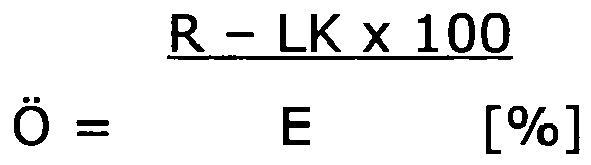
- Das jeweils zu untersuchende Phospholipid wird gewogen, in etwa 15 ml bis 20 ml Diethylether gelöst und quantitativ auf eine Chromatografiesäule, wie sie nachfolgend beschrieben ist, unter Verwendung von etwa 130 ml bis 150 ml Diethylether als Eluierungsmittel aufgetrennt. Das gesamte Ethereluat wird in einem zuvor ausgewogenen Rundkolben aufgefangen. Anschließend wird das aufgefangene Diethylether-Eluat unter Vakuum im Rotationsdampfer abdestilliert und der Rundkolben mit dem darin befindlichen Ölen nach Klimatisierung im Normklima zurückgewogen, während die ölfreien Phospholipide in der Säule durch das Adsorbens adsorbiert sind und dort verbleiben. Hieraus errechnet sich der Anteil des in dem Phospholipid enthaltenen Öls wie folgt:
- E = Einwaage an phospholipidischer Ausgangssubstanz [g]
- LK = Leergewicht des Rundkolbens [g]
- R = Rückwaage des Rundkolbens nach Abdestillieren des Diethylethers und Lagerung im Normklima [g]
- Ö = prozentualer Ölanteil in der phospholipidischen Ausgangssubstanz
- Die zuvor angegebenen Gewichtswerte in Gramm werden auf einer Analysenwaage mit einer Genauigkeit von 0,0001 g bestimmt, wobei die zu analysierende phospholipidische Ausgangssubstanz auf der Analysenwaage in der Größenordnung von etwa 1 g exakt eingewogen wird.
- Zur Herstellung der Säule wird wie folgt vorgegangen:
- Das als Adsorbens verwendete Kieselgel (Kieselgel 60, 0,063-02 mm, beispielsweise Hersteller: Merck, Artikel-Nr. 7754) wird zunächst auf einen konstanten Wassergehalt von 14,3 Gew.% eingestellt. Hierzu wird vorab der Wassergehalt des jeweils verwendeten Kieselgels mittels Karl-Fischer-Titration bestimmt und die fehlende Menge an Wasser zur Erreichung des Wassergehaltes von 14,3 Gew.% zugesetzt. Von dem so behandelten Kieselgel wird nochmals über eine Karl-Fischer-Titration der Wassergehalt bestimmt, so daß sichergestellt ist, daß das Kieselgel einen Wassergehalt von 14,3 Gew.% aufweist.
- 30 g des auf einen Wassergehalt von 14,3 Gew.% eingestellten Kieselgels wird in Diethylether aufgeschlämmt und in die Chromatografiesäule eingebracht, die einen Durchmesser von 25 mm aufweist. Der überschüssige Ether wird so weit aus der Säule abgelassen, bis oberhalb des Adsorbens eine etwa 1 cm hohe Etherschicht stehen bleibt. Auf die so vorbereitete Säule wird dann die zu analysierende Probe aufgetragen und aufgetrennt, wie dies eingangs beschrieben ist.
- Alle bei dieser Analyse verwendeten Lösungsmittel liegen in der p.a.-Reinheit vor.
- Die zuvor beschriebene analytische und gravimetrische Methode zur Bestimmung des quantitativen Ölanteils wurde dahingehend abgewandelt, daß die dort beschriebene säulenchromatografische Abtrennung des Öls nunmehr als präparative säulenchromatografische Abtrennung angewandt wurde, um die nachfolgend beschriebenen und mit Phospholipid 1 bis 5 bezeichneten Phospholipide herzustellen, die sich in ihrem Ölgehalt unterscheiden.
- Hierzu wurde wie folgt vorgegangen:
- 4.500 g des auf einen Wassergehalt von 14,3 Gew.% eingestellten Kieselgels wird in Diethylether aufgeschlämmt und in eine präparative Chromatografiesäule eingebracht, wobei der Wassergehalt des Kieselgels so eingestellt und überprüft worden ist, wie dies vorstehend bei der quantitativen Bestimmung des Ölgehaltes des Phospholipids beschrieben ist. Der überschüssige Ether wird so weit aus der Säule abgelassen, bis oberhalb des Adsorbens eine etwa 1 cm hohe Etherschicht stehen bleibt. Auf die so vorbereitete Säule wird dann die präparativ aufzutrennende, in etwa 2,5 I Diethylether gelöste Phospholipid-Probe (Einwaage etwa 150 g) aufgetragen und aufgetrennt, wie dies ebenfalls eingangs bei der quantitativen Bestimmung des Öls beschrieben ist. Das aufgefangene Diethylether-Eluat wird unter Vakuum unter Gewinnung des so isolierten Öles abdestilliert. Hiernach konnten etwa 140 g Öl isoliert werden.
- Das mit dem ölfreien Phospholipid beladene Adsorbens wurde aus der präparativen Säule entfernt und der Diethylether schonend entfernt.
- Das so getrocknete Adsorbens wurde mit einer Mischung aus Chloroform und Methanol (2:1; V:V) mehrfach extrahiert, wobei die Extrakte, die das ölfreie Phospholipid in Lösung enthielten, vereinigt wurden. Nach schonender Abtrennung des Lösungsmittelgemisches wurde das so isolierte trockene Phospholipid unter Ausbildung von fünf, bezüglich des Phospholipids gleichkonzentrierten Proben eingewogen und in Ethanol gelöst. Zu jeder der fünf ethanolischen Phospholipidlösungen wurde das zuvor bei der Auftrennung mit Diethylether gewonnene Öl in den vorgegebenen Mengen (2 Gew.%, 4 Gew.%, 5,8 Gew.%, 7,5 Gew.%, 9 Gew.%) zugesetzt, nachdem dieses Öl zuvor ebenfalls in Ethanol gelöst worden ist. Nach intensivem Vermischen des jeweils ölfreien Phospholipids mit dem Öl wurde das Ethanol unter Ausbildung der nachfolgend quantifizierten Phospholipide 1 bis 5 abgezogen, wobei diese Phospholipide 1 bis 5 zur Herstellung der Ausführungsbeispiele 1 bis 10 verwendet wurde.
- Hierbei wiesen diese fünf unterschiedlichen Phospholipidproben folgenden Ölgehalt auf:
- Phospholipid 1, Ölgehalt 7,5 Gew.%
- Phospholipid 2, Ölgehalt 5,8 Gew.%
- Phospholipid 3, Ölgehalt 4 Gew.%
- Phospholipid 4, Ölgehalt 2 Gew.% und
- Phospholipid 5, Ölgehalt 9 Gew.%.
- Bei allen fünf Phospholipiden (Phospholipid 1 bis 5) betrug die Konzentration an
Phosphatidylcholin 76 ± 3 Gew.%,
Lyso-Phosphatidylcholin ≤ 6 Gew.%
Phosphatidylamin ≤ 6 Gew.% und
Phosphatidsäure ≤ 6 Gew.%,
wobei sich diese Angaben jeweils auf das Trockengewicht des Phospholipids beziehen. - Alle Phospholipide wiesen darüber hinaus eine Säurezahl kleiner als 10 und einen Peroxidwert ebenfalls kleiner als 10 auf.
- Es wurden die nachfolgenden Ausführungsbeispiele 1 bis 10 unter Verwendung der zuvor beschriebenen Phospholipide 1 bis 5 hergestellt.
- Übereinstimmend wiesen die Ausführungsbeispiele 1 bis 5 jeweils als pharmazeutischen Wirkstoff 10 Gew.% Ketoprofen und die Ausführungsbeispiele 6 bis 10 jeweils als pharmazeutischen Wirkstoff 4 Gew.% Diclofenac-Natrium auf.
- Darüber hinaus enthielten die Ausführungsbeispiele 1 bis 5 jeweils 59,48 Gew.% Wasser, 10 Gew.% Propylenglykol, 8 Gew.% Isopropanol, 0,25 Gew.% Natriumdihydrogenphosphat,Dihydrat, 0,57 Gew.% Dinatriumphosphat,Dodecahydrat, 1,55 Gew.% Natriumhydroxidlösung und 0,15 Gew.% Pfefferminzöl auf.
- Die Ausführungsbeispiele 1 bis 5 unterschieden sich lediglich darin, daß sie zwar identische Mengen, d.h. 10 Gew.%, des zuvor beschriebenen und spezifizierten Phospholipids aufwiesen, wobei es sich bei diesem Phospholipid um die vorstehend aufgeführten Phospholipide 1 bis 5 handelte, die sich in ihrer Ölkonzentration wie folgt unterschieden:
- Ausführungsbeispiel 1 enthält 10 Gew.% Phospholipid 1 (Ölgehalt 7,5 Gew. %)
- Ausführungsbeispiel 2 enthält 10 Gew.% Phospholipid 2 (Ölgehalt 5,8 Gew.%)
- Ausführungsbeispiel 3 enthält 10 Gew.% Phospholipid 3 (Ölgehalt 4 Gew.%)
- Ausführungsbeispiel 4 enthält 10 Gew.% Phospholipid 4 (Ölgehalt 2 Gew.%)
- Ausführungsbeispiel 5 enthält 10 Gew.% Phospholipid 5 (Ölgehalt 9 Gew.%)
- Die zuvor aufgeführten 10 Gew.% der Phospholipide 1 bis 5 wiesen jeweils 7,5 Gew.% Phospholipid 1 bis 5 und 2,5 Gew.% absolutem Ethanol auf.
- Darüber hinaus enthielten die Ausführungsbeispiele 6 bis 10 jeweils 56,38 Gew.% Wasser, 15 Gew.% Propylenglykol, 10,25 Gew.% Isopropanol, 0,12 Gew.% Natriumdihydrogenphosphat,Dihydrat, 0,20 Gew.% Pfefferminzöl, 0,66 Gew.% Dinatriumphosphat,Dodecahydrat 0,04 Gew.% Dinatrium-Edetate, 0,02 Gew.% Palmitoylascorbinsäure auf.
- Die Ausführungsbeispiele 6 bis 10 unterschieden sich lediglich darin, daß sie zwar identische Mengen, d.h. 13,33 Gew.%, des zuvor beschriebenen Phospholipids aufwiesen, wobei es sich bei diesem Phospholipid um die vorstehend aufgeführten Phospholipide 1 bis 5 handelte, die sich in ihrer Ölkonzentration wie folgt unterschieden:
- Ausführungsbeispiel 6 enthält 13,33 Gew.% Phospholipid 1 (Ölgehalt 7,5 Gew.%)
- Ausführungsbeispiel 7 enthält 13,33 Gew.% Phospholipid 2 (Ölgehalt 5,8 Gew.%)
- Ausführungsbeispiel 8 enthält 13,33 Gew.% Phospholipid 3 (Ölgehalt 4 Gew.%)
- Ausführungsbeispiel 9 enthält 13,33 Gew.% Phospholipid 4 (Ölgehalt 2 Gew.%)
- Ausführungsbeispiel 10 enthält 13,33 Gew.% Phospholipid 5 (Ölgehalt 9 Gew.%)
- Die zuvor aufgeführten 13,33 Gew.% der Phospholipide 1 bis 5 wiesen jeweils 9,998 Gew.% Phospholipid 1 bis 5 und 3,332 Gew.% absolutem Ethanol auf.
- Für alle, Ketoprofen als Wirkstoff enthaltenden Ausführungsbeispiele 1 bis 5 wurde ein identisches Herstellungsverfahren verwendet. Hierzu wurde Ketoprofen, Propylenglykol und Isopropanol in einem Mischbehälter vermischt, wobei dieser Mischvorgang unter Stickstoff oder Argon ausgeführt wurde.
- Etwa 90 Gew.% der Natriumdihydrogenphosphat-Menge, sowie das Dinatriumphosphat und die Natriumhydroxidlösung wurden miteinander vermischt.
- Die zuvor als erstes hergestellte Mischung wurde bei einer Temperatur zwischen 20 °C und 25 °C mit dem jeweiligen Phospholipid (Phospholipid 1 bis 5) versetzt und anschließend so lange gemischt, bis eine klare, gelbliche Lösung resultierte. Zu dieser gelblichen klaren Lösung wurde dann die zuvor als zweites beschriebene vermischte Pufferlösung zugesetzt, wobei die beiden Lösungen solange (unter Argon oder Stickstoff) bei einer Temperatur von maximal 30 °C vermischt wurden, bis eine homogene Lösung resultierte, die mit der restlichen Pufferlösung und dem Pfefferminzöl versetzt wurde und deren pH-Wert auf einen Wert zwischen 7,3 und 7,5 eingestellt wurde.
- Für alle, Diclofenac-Natrium als Wirkstoff enthaltenden Ausführungsbeispiele 6 bis 10 wurde ein identisches Herstellungsverfahren verwendet. Hierzu wurde etwa 90 Gew.% des Wassers (gereinigtes Wasser) bei einer Temperatur zwischen 25 °C und 30 °C und einer Drehzahl von 600 Umdrehungen/min mit dem Dinatriumphosphat, Natriumdihydrogenphosphat und dem Natrium-Edetate vermischt. Die so erstellte Lösung wurde auf eine Temperatur auf 20 °C und 25 °C abgekühlt.
- In einem zweiten Mischbehälter wurde das Propylenglykol, der Isopropylalkohol und das jeweilige Phospholipid (Phospholipid 1 bis 5) unter vorsichtigem Rühren zu einer homogenen Lösung vermischt. Zu dieser Mischung wurde unter Beibehaltung des Rührens das Ascorbylpalmitat und das Diclofenac-Natrium zugesetzt. Die so erstellte homogene Mischung wurde so lange gemischt, bis eine klare Lösung resultierte, die mit Pfefferminzöl unter kontinuierlichem Rühren versetzt wurde. Nach Messung des pH-Wertes wurde dieser durch Zusatz von Natriumhydroxid-Lösung oder verdünnter Salzsäure auf einen Wert zwischen pH 7,4 - 7,6 eingestellt. Während der Herstellung wurde die Temperatur konstant zwischen 20 °C und 30 °C gehalten.
- Das nachfolgend beschriebene und in
Abbildung 1 gezeigte in-situ-Modell ist insbesondere geeignet zur vergleichenden Bestimmung der Permeationsraten. Diesem Modell liegt die Erfahrung vieler in vivo-Versuche an Jungschweinen und an Probanden zugrunde. Es wurde unter Berücksichtigung möglichst relevanter in-vivo-Bedingungen entwickelt und konnte bereits mehrfach erprobt werden, so daß es mit korrespondierenden in-vivo-Probandenstudien validiert worden ist. - In dem in
Abbildung 1 gezeigten Versuchsaufbau zur Bestimmung der Permeation wird das unterhalb der zu untersuchenden Hautprobe und mit einem Metallgitter 12 abgedeckte Akzeptormedium 13 von 90 ml auf 35°C temperiert und kontinuierlich mittels Pumpe 1 mit 1000 ml/h umgepumpt. Die mit dem Akzeptormedium 13 gefüllte Permeationskammer 5 besitzt ein Volumen von 50 ml, das Ausgleichsgefäß 3 zur Probenentnahme und die Schläuche 4 nehmen 40 ml Gesamtvolumen ein. Das Lumen kann mit verschiedenen, hautphysiologischen Lösungen gefüllt werden. Maßgebend für die Wahl des Akzeptormediums ist die Löslichkeit des Wirkstoffes und dessen Nachweis. - Für den Wirkstoff Ketoprofen wurde eine Phosphatpufferlösung pH 7,4 und für den Wirkstoff Diclofenac-Natrium wurde eine Phosphatpufferlösung pH 8,0 ausgewählt. Die Auswahl des Akzeptormediums berücksichtigt die Sinkbedingungen für den jeweiligen Wirkstoff.
- Die Kammer 5 wurde blasenfrei gefüllt, damit eine vollständige und gleichmäßige Unterspülung des Gewebes erfolgen konnte. Die Applikationsfläche 7 betrug 28,3 cm2. Die Entnahme von Proben erfolgte intermittierend durch manuelle Entnahme aus dem zirkulierenden Medium und anschließender automatischer Probensammlung für die HPLC. Die Versuchsdauer wurde auf 8 Stunden begrenzt, wobei zu Beginn, nach 30 Minuten, einer Stunde, zwei Stunden, vier Stunden, sechs Stunden und acht Stunden jeweils entsprechende Proben des Akzeptormediums entnommen und analysiert wurden.
- Aufgrund der Anordnung des Luftstroms, der Strömungsgeschwindigkeit der eingeleiteten, temperierten Luft und der Verwirbelung auf der Hautfläche wird bei dem verwendeten und in
Abbildung 1 gezeigten Versuchsaufbau die Hornschicht nicht hydratisiert. Hierzu diente ein Luftkreislauf, der eine Luftzufuhr von 300 ml Luft/Minute bei 23 °C über die Leitung 8, ein Einführen in eine oberhalb der Applikationsfläche 7 angeordnete Haube 9, innerhalb der ein Ventilator 10 für eine Luftverwirbelung sorgte, und Abluftschläuche 11 zur Abführung der Luft vorsieht. - Die jeweils zu untersuchende Hautprobe wurde auf ein Metallgitter 12 aufgelegt, mit der Haube 9 (ohne Okklusion) abgedeckt, mit dem Luftstrom, der mittels des Ventilators 10 verwirbelte wird, umströmt. Die auf das Metallgitter 12 aufgelegte Hautprobe wird mit der jeweiligen Zusammensetzung beaufschlagt, wobei nachfolgend die Meßmethode zur Bestimmung der Permeation beschrieben ist. Zur Konstanthaltung der Lufttemperatur und der Temperatur des Akzeptormediums dient die nur schematisch mit 2 bezeichnete Temperaturregelung, während eine Haube 6, die die Meßanordnung insbesondere zur Verhinderung von Verschmutzungen, abdeckt.
- Die in situ Experimente wurden an excorporierter humaner Bauchhaut von unterschiedlichen Spendern durchgeführt. Die Spender waren zwischen 40 und 50 Jahre alt. Die Untersuchungen wurden an operativ entfernter, abdominaler Humanhaut durchgeführt. Die Größe der zur Verfügung stehenden Hautlappen variierte. Daraus ergab sich die Durchführung von Vierfachversuchen je Humanhautlappen.
- Die zur Applikation zur Verfügung stehende Applikationsfläche betrug 28,3 cm2. Die Haut wurde frisch entnommen, trocken und bei 4°C gekühlt transportiert. Spätestens nach 2 Stunden wurde der Permeationsversuch begonnen. Die Ganzhaut wurde durch Abschälen des subcutanen Fettgewebes auf einem Schälblock mit Tiefeneinstellung präpariert und auf ihren einwandfreien Zustand mittels Dichtigkeitsprüfung in der Kammer mit Medium durch Druckspülung vor und nach der Untersuchung und mikroskopisch geprüft. Die Hautdicke (ohne Fettgewebe) betrug 1 mm ± 0,1 mm. Das makroskopisch unverletzte und auf Dichtigkeit geprüfte Hautproben wurden direkt in die Versuchsapparatur überführt, wobei die Hautproben auf einem Gitter fixiert und die zur Verfügung stehende Fläche ohne Okklusion konditioniert wurde. Die Konditionierung wurde durch die Regulierung der Vorwärmtemperatur des Mediums und der Temperierung der Luftschläuche sowie durch die Geschwindigkeit des über die Probenfläche streichenden Luftstroms erreicht. Diese Parameter werden innerhalb einer Versuchsreihe konstant gehalten. Die Hautprobe wurde gleichmäßig zirkulierend vom Phosphatpuffer unterspült. Die Temperatur der Hautprobe wurde mit Meßsonden und die Feuchtigkeit mit dem Corneometer überprüft. Die Versorgung der Hautprobe erfolgte über den Phosphatpuffer. Eine mögliche Kontamination der Haut mit dem Desinfektionsmittel Phenylmercuroborat wurde bei der Analytik berücksichtigt.
- Die flüssigen Zusammensetzungen wurden mit einem Mikrodispensor gleichmäßig auf der Applikationsfläche von 28,3 cm2 verteilt (Rundpistill). Eine Verteilung der aufgetragenen Zusammensetzungen auf der Hautprobe wurde 5 Minuten nach erstem Auftragen nochmals vorgenommen.
- Bei Applikation von bis zu 1 g Zusammensetzung pro 28,3 cm2 Applikationsfläche war kein Überschuß der jeweiligen Zusammensetzung auf der Oberfläche der Haut im Bereich der Applikationsfläche erkennbar.
- Die Permeationsprofile von Ketoprofen und Diclofenac-Natrium wurden durch Entnahme von Doppelproben nach 0, 0,5, 1, 2, 4, 6 und 8 Stunden erstellt. Die Bestimmung des Ketoprofens und des Diclofenac-Natriums erfolgte im Anschluß direkt nach der Entnahme über eine Autosampleranlage. Zur Beurteilung der Permeation des jeweiligen Wirkstoffes wurde dessen Konzentration im Akzeptormedium bestimmt.
- Hierzu wurde die Konzentration des Ketoprofens hochdruckflüssigkeitschromatografisch (HPLC-Säule, Xterra RP18 5µm, 4.6 x 150 mm - Modus: isokratisch - Fluss: 1.0 mL.min-1, Fließmittel: H20/ACN/KH2PO4; Puffer pH 3.5 (55:43:2 (v/v/v)), Puffer: p.a. Chemikalien + deionisiertes Wasser; Fließmittel nicht entgast) unter Verwendung eines UV-Detektors (UV-Detektor Waters Alliance 2795 mit Detektor Waters 2487 dual wavelength 254 nm) bestimmt.
- Die Bestimmung der Konzentration des Diclofenac-Natriums erfolgte ebenfalls hochdruckflüssigkeitschromatografisch unter Verwendung eines UV-Detektors (HPLC-System mit folgenden Komponenten: HPLC-Pumpe Merck/Hitachi L-6200, (ternär / Niederdruckgradient), UV-Detektor Merck/Hitachi L-4000, Zweistrahlgerät, Meßbereich 195-380 nm, Integrator Merck/Hitachi D-2500, HPLC-Säule: LiChrospher 100 (Merck), RP18 (5u.m), 250 mm Länge, LiChroCART-Kartuschensystem, Fließmittel: Methanol/Citratpuffer (3/1); Fließmittel nicht entgast).
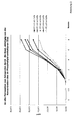
- Die Ergebnisse der zuvor beschriebenen Permeationsuntersuchungen sind in der nachfolgenden Tabelle 1 und der zugehörigen
Abbildung 2 für den Wirkstoff Ketroprofen und in der nachfolgenden Tabelle 2 und der zugehörigenAbbildung 3 für den Wirkstoff Diclofenac-Natrium zusammengefaßt. - Es wurde bei allen Untersuchungen stets dieselbe, vorstehend angegebene Menge der Zusammensetzung auf die Hautprobe aufgetragen, die einer Wirkstoffkonzentration von ca. 25 mg Ketoprofen bzw. von ca. 10 mg Diclofenac-Natrium entsprach. Die wiedergegebenen Werte entsprechen jeweils dem Mittelwert aus einer Vierfachbestimmung.
Tabelle 1 Permeation von Ketoprofen in das Akzeptormedium Konzentration (µg) Ketoprofen pro Volumeneinheit (ml) des Akzeptormediums Ausführungsbeispiel 1 2 3 4 5 Ölkonzentration 7,5 Gew.% 5,8 Gew.% 4,0 Gew.% 2,0 Gew.% 9,0 Gew.% Entnahmezeit in h Konzentration in µg/ml 0 0,000 0,000 0,000 0,000 0,000 0.5 0,008 0,011 0,013 0,013 0,002 1 0,239 0,274 0,310 0,303 0,195 2 2,987 3,524 4,241 3,912 2,389 4 8,726 10,558 11,518 11,021 7,329 6 15,309 18,112 21,738 19,442 12,706 8 17,901 21,018 24,345 22,182 14,499 Tabelle 2 Permeation von Diclofenac-Natrium in das Akzeptormedium Konzentration (µg) Diclofenac-Natrium pro Volumeneinheit (ml) des Akzeptormediums Ausführungsbeispiel 6 7 8 9 10 Ölkonzentration 7,5 Gew.% 5,8 Gew.% 4,0 Gew.% 2,0 Gew.% 9,0 Gew.% Entnahmezeit in h Konzentration in µg/ml 0 0,000 0,000 0,000 0,000 0,000 0.5 0,000 0,009 0,015 0,011 0,000 1 0,052 0,061 0,073 0,066 0,042 2 0,601 0,726 1,019 0,799 0,492 4 1,890 2,223 2,613 2,417 1,625 6 3,343 4,019 4,542 4,273 2,808 8 3,669 4,462 5,133 4,659 3,192
Claims (32)
- Pharmazeutische Zusammensetzung zur Anwendung bei Mensch und Tier, mit mindestens einem systemisch und/oder lokal wirkenden, topisch applizierbaren Wirkstoff und mit mindestens einem den Transport des Wirkstoffes durch die Zellmembrane verbessernden Phospholipid, das Phosphatidylcholin in einer Konzentration von wenigstens 60 Gew.%, bezogen auf das Phospholipid, enthält, wobei die Zusammensetzung eine solche flüssige Konsistenz aufweist, daß sie als Tröpfchen oder als Schaum versprühbar ist, dadurch gekennzeichnet, daß die Zusammensetzung ein solches Phospholipid aufweist, das neben wenigstens 60 Gew.% Phosphatidylcholin desweiteren Öl in einer Konzentration von maximal 7,5 Gew.% enthält.
- Pharmazeutische Zusammensetzung nach Anspruch 1, dadurch gekennzeichnet, daß die Zusammensetzung ein solches Phospholipid aufweist, das eine Konzentration an Öl von maximal 5,8 Gew.% enthält.
- Pharmazeutische Zusammensetzung nach Anspruch 1 oder 2, dadurch gekennzeichnet, daß die Zusammensetzung ein solches Phospholipid aufweist, das eine Konzentration an Öl von weniger als 4,8 Gew.%, insbesondere zwischen 2 Gew.% und 4,8 Gew.%, enthält.
- Pharmazeutische Zusammensetzung nach einem der vorangehenden Ansprüche, dadurch gekennzeichnet, daß das mindestens eine Phospholipid ein Phospholipidgemisch ist und desweiteren neben Phosphatidylcholin noch Lyso-Phosphatidylcholin, Phosphatidsäure, Phosphatidylethanolamin und/oder Phosphatidylinositol aufweist.
- Pharmazeutische Zusammensetzung nach einem der vorangehenden Ansprüche, dadurch gekennzeichnet, daß das Phospholipid ein aus pflanzlichen Bestandteilen, insbesondere aus Getreidesamen und/oder ölreichen Samen und vorzugsweise aus Sojabohnen oder Sonnenblumen, isoliertes Phospholipid ist.
- Pharmazeutisches Zusammensetzung nach einem der vorangehenden Ansprüche, dadurch gekennzeichnet, daß das Phospholipid eine Konzentration an Phosphatidylcholin von mindestens 75 Gew.% aufweist.
- Pharmazeutische Zusammensetzung nach einem der vorangehenden Ansprüche, dadurch gekennzeichnet, daß das Phospholipid eine Konzentration an Phosphatidylcholin von 78,1 Gew.% ± 3 Gew.% aufweist.
- Pharmazeutische Zusammensetzung nach Anspruch 7, dadurch gekennzeichnet, daß das Phospholipid eine Konzentration an Lyso-Phosphatidylcholin von weniger als 5,6 Gew.%, an Phosphatidylethanolamin von weniger als 5,2 Gew.% und an Phosphatidsäure von weniger als 2,9 Gew.% enthält.
- Pharmazeutische Zusammensetzung nach Anspruch 8, dadurch gekennzeichnet, daß das Phospholipid das Lyso-Phosphatidylcholin in einer Konzentration zwischen 5,5 Gew.% und 1,5 Gew.%, das Phosphatidylethanolamin in einer Konzentration zwischen 5,1 Gew.% und 2,3 Gew.% und die Phosphatidsäure in einer Konzentration zwischen 2,5 Gew.% und 0,9 Gew.% enthält.
- Pharmazeutische Zusammensetzung nach einem der vorangehenden Ansprüche, dadurch gekennzeichnet, daß die Zusammensetzung ein anorganisches oder organisches Lösungsmittel aufweist.
- Pharmazeutische Zusammensetzung nach Anspruch 10, dadurch gekennzeichnet, daß die Zusammensetzung Wasser und/oder einen Alkohol, insbesondere Ethanol, Isopropanol, ein oder mehrere Glykole und/oder Glycerin, als Lösungsmittel enthält.
- Pharmazeutische Zusammensetzung nach Anspruch 11, dadurch gekennzeichnet, daß die Zusammensetzung als Glykol Propylenglykol, Butylenglykol, Pentylenglykol und/oder Hexylenglykol aufweist.
- Pharmazeutische Zusammensetzung nach einem der vorangehenden Ansprüche, dadurch gekennzeichnet, daß die Zusammensetzung ein Lösungsmittelgemisch aus Wasser und mindestens einem Alkohol, vorzugsweise Isopropanol, enthält.
- Pharmazeutische Zusammensetzung nach Anspruch 13, dadurch gekennzeichnet, daß die Konzentration des Wassers in der flüssigen Zusammensetzung zwischen 50 Gew.% und 95 Gew.%, vorzugsweise zwischen 55 Gew.% und 75 Gew.%, und die Konzentration des mindestens einen Alkohols zwischen 5 Gew.% und 50 Gew.%, vorzugsweise zwischen 8 Gew.% und 25 Gew.%, variiert.
- Pharmazeutische Zusammensetzung nach einem der vorangehenden Ansprüche, dadurch gekennzeichnet, daß der mindestens eine Wirkstoff aus der Gruppe ausgewählt ist, die Lokalanästhetika, Antiallergika, Dermatika, Wirkstoffe gegen grippale Infekte und Erkältungskrankheiten, Wirkstoffe zur Behandlung von Neuropathien, Wirkstoffe zur Behandlung von Durchblutungsstörungen, Chemotherapeutika, Chinin, Antimykotika, Antibiotika, Thalidomid, Serotonin, Eicosanoide, Analgetika, Antikonvulsiva, Nicht-steroidale Antirheumatika, Leukotriene, Leukotrienhemmer, Androgene, Antiandrogene, Kortikoide, Opiatrezeptor-Antagonisten, Blutgerinnung hemmende Stoffe, Thrombozytenaggregationshemmer, Histaminantagonisten, regulatorisch und enzymatisch wirkende Peptide und Proteine, Nukleinsäuren (einzel- und doppelsträngige DNA, einzel- und doppelsträngige RNA, snRNA, DNA-Oligonukleotide, RNA-Oligonukleotide) und Oligopeptide, Antipruriginosa, Antidiabetika, Prostaglandine, Prostaglandinsynthesehemmer, Antiviral wirkende oder virostatisch wirkende Substanzen, Antimikrobiell-wirkende Substanzen, Wirkstoffe gegen Prione, Immunsupressiva, Hormone, Wirkstoffe zur Behandlung von Warzen oder Wunden, insbesondere chronischen Wunden, Vitamine, Pflanzenextrakte oder Auszüge aus Pflanzenextrakten, Psychopharmaka, den Schlaf beeinflussende Wirkstoffe, Analeptika, Allgemeinanästhetika, Muskelrelaxantien, Antiepileptika, Antiparkinsonmittel, Antiemetika, Antiparasitika, Ganglionär angreifende Substanzen, am Symphatikus angreifende Substanzen, am Parasymphatikus angreifende Substanzen, antibakteriell wirkende Pharmaka, Calciumantagonisten, Herz- /Kreislaufmittel, Antiasthmatika, Antitussiva, Expektorantien, Hepatika, Diuretika, Choleretika, Desinfektionsmittel, Spurenelemente, Antiinfektiva, Zytostatika, Antimetaboliten, Hormonantagonisten, Immunmodulatoren sowie Derivate und Salze der zuvor genannten Wirkstoffe umfaßt.
- Pharmazeutische Zusammensetzung nach Anspruch 15, dadurch gekennzeichnet, daß das Analgetikum aus der Gruppe ausgewählt ist, die Diclofenac, Ketoprofen und Ibuprofen umfaßt.
- Pharmazeutische Zusammensetzung nach Anspruch 15 oder 16, dadurch gekennzeichnet, daß das Analgetikum Diclofenac ist und daß das Diclofenac in der Zusammensetzung als Alkalisalz, insbesondere als Natriumsalz, vorliegt.
- Pharmazeutische Zusammensetzung nach einem der Ansprüche 15 bis 17, dadurch gekennzeichnet, daß das Diclofenac in einer Konzentration zwischen 0,1 Gew.% und 10 Gew.%, vorzugsweise in einer Konzentration zwischen 1 Gew.% und 6 Gew.%, in der Zusammensetzung enthalten ist.
- Pharmazeutische Zusammensetzung nach Anspruch 15 oder 16, dadurch gekennzeichnet, daß die Zusammensetzung als mindestens einen Wirkstoff Ketoprofen enthält und daß die Konzentration des Ketoprofens in der Zusammensetzung zwischen 5 Gew.% und 15 Gew.%, vorzugsweise zwischen 8 Gew.% und 12 Gew.%, variiert.
- Pharmazeutische Zusammensetzung nach einem der vorangehenden Ansprüche, dadurch gekennzeichnet, daß die Zusammensetzung das mindestens eine Phospholipid in einer Konzentration zwischen 0,5 Gew.% und 20 Gew.%, vorzugsweise in einer Konzentration zwischen 5 Gew.% und 13 Gew.%, aufweist.
- Pharmazeutische Zusammensetzung nach einem der vorangehenden Ansprüche, dadurch gekennzeichnet, daß die Zusammensetzung desweiteren mindestens einen Komplexbildner, insbesondere Ethylentetraessigsäure, mindestens eine Puffersubstanz, insbesondere einen Phosphatpuffer, mindestens ein Antioxidationsmittel, insbesondere Palmitoylascorbinsäure, mindestens einen Duftstoff und/oder ein Aroma aufweist.
- Pharmazeutische Zusammensetzung nach einem der vorangehenden Ansprüche, dadurch gekennzeichnet, daß das in dem mindestens einem Phospholipid enthaltene Öl freie Fettsäuren, Sterole, Mono- und Diglyceride, Triglyceride, Tocopherol und/oder Fettsäureester aufweist.
- Verwendung von mindestens einem Phospholipid als Permeations - und/oder Penetrationsbeschleuniger in einer pharmazeutischen Zusammensetzung nach einem der vorangehenden Ansprüche, dadurch gekennzeichnet, daß das Phospholipid Phosphatidylcholin in einer Konzentration von wenigstens 60 Gew.%, bezogen auf das Phospholipid, enthält und daß das Phospholipid neben den wenigstens 60 Gew.% Phosphatidylcholin desweiteren Öl in einer Konzentration zwischen 7,5 Gew.% und 2 Gew.%, enthält.
- Verwendung nach Anspruch 23, dadurch gekennzeichnet, daß das Phospholipid desweiteren Öl in einer Konzentration zwischen 5,8 Gew.% und 2 Gew.% enthält.
- Verwendung nach Anspruch 23 oder 24, dadurch gekennzeichnet, daß das Phospholipid desweiteren Öl in einer Konzentration zwischen 4 Gew.% und 2 Gew.% enthält.
- Verwendung nach einem der Ansprüche 23 bis 25, dadurch gekennzeichnet, daß das Phospholipid ein Phospholipidgemisch ist und desweiteren neben Phosphatidylcholin noch Lyso-Phosphatidylcholin, Phosphatidsäure, Phosphatidylethanolamin und/oder Phosphatidylinositol aufweist.
- Verwendung nach einem der Ansprüche 23 bis 26, dadurch gekennzeichnet, daß das Phospholipid ein aus pflanzlichen Bestandteilen, insbesondere aus Getreidesamen und/oder ölreichen Samen und vorzugsweise aus Sojabohnen oder Sonnenblumen, isoliertes Phospholipid ist.
- Verwendung nach einem der Ansprüche 23 bis 27, dadurch gekennzeichnet, daß das Phospholipid eine Konzentration an Phosphatidylcholin von mindestens 75 Gew.% aufweist.
- Verwendung nach Anspruch 28, dadurch gekennzeichnet, daß das Phospholipid eine Konzentration an Phosphatidylcholin von 78,1 Gew.% ± 3 Gew.% aufweist.
- Verwendung nach einem der Ansprüche 23 bis 29, dadurch gekennzeichnet, daß das Phospholipid eine Konzentration an Lyso-Phosphatidylcholin von weniger als 5,6 Gew.%, an Phosphatidylethanolamin von weniger als 5,2 Gew.% und an Phosphatidsäure von weniger als 2,9 Gew.% enthält.
- Verwendung nach einem der Ansprüche 23 bis 30, dadurch gekennzeichnet, daß das Phospholipid das Lyso-Phosphatidylcholin in einer Konzentration zwischen 5,5 Gew.% und 1,5 Gew.%, das Phosphatidylethanolamin in einer Konzentration zwischen 5,1 Gew.% und 2,3 Gew.% und die Phosphatidsäure in einer Konzentration zwischen 2,5 Gew.% und 0,9 Gew.% enthält.
- Verwendung nach einem der Ansprüche 23 bis 31, dadurch gekennzeichnet, daß das in dem mindestens einem Phospholipid enthaltene Öl freie Fettsäuren, Sterole, Mono- und Diglyceride, Triglyceride, Tocopherol und/oder Fettsäuren aufweist.
Priority Applications (3)
| Application Number | Priority Date | Filing Date | Title |
|---|---|---|---|
| SI201330401A SI2638894T1 (sl) | 2012-05-15 | 2013-03-18 | Farmacevtski sestavek, ki vsebuje fosfolipid |
| RS20160854A RS55291B1 (sr) | 2012-05-15 | 2013-03-18 | Farmaceutska kompozicija koja sadrži fosfolipid |
| HRP20161318TT HRP20161318T1 (hr) | 2012-05-15 | 2016-10-11 | Farmaceutski pripravak koji sadržava fosfolipid |
Applications Claiming Priority (2)
| Application Number | Priority Date | Filing Date | Title |
|---|---|---|---|
| DE102012009575 | 2012-05-15 | ||
| DE102013004199A DE102013004199A1 (de) | 2012-05-15 | 2013-03-12 | Pharmazeutische Zusammensetzung |
Publications (2)
| Publication Number | Publication Date |
|---|---|
| EP2638894A1 true EP2638894A1 (de) | 2013-09-18 |
| EP2638894B1 EP2638894B1 (de) | 2016-09-14 |
Family
ID=47901750
Family Applications (1)
| Application Number | Title | Priority Date | Filing Date |
|---|---|---|---|
| EP13001361.8A Active EP2638894B1 (de) | 2012-05-15 | 2013-03-18 | Pharmazeutische Zusammensetzung mit Phospholipid |
Country Status (18)
| Country | Link |
|---|---|
| EP (1) | EP2638894B1 (de) |
| JP (1) | JP2013237669A (de) |
| BR (1) | BR102013011801B1 (de) |
| CA (1) | CA2815477C (de) |
| CY (1) | CY1118727T1 (de) |
| DE (1) | DE102013004199A1 (de) |
| DK (1) | DK2638894T3 (de) |
| ES (1) | ES2606031T3 (de) |
| HR (1) | HRP20161318T1 (de) |
| HU (1) | HUE029793T2 (de) |
| LT (1) | LT2638894T (de) |
| MX (1) | MX342069B (de) |
| PL (1) | PL2638894T3 (de) |
| PT (1) | PT2638894T (de) |
| RS (1) | RS55291B1 (de) |
| RU (1) | RU2659943C2 (de) |
| SI (1) | SI2638894T1 (de) |
| SM (1) | SMT201600419B (de) |
Families Citing this family (3)
| Publication number | Priority date | Publication date | Assignee | Title |
|---|---|---|---|---|
| US10596117B1 (en) | 2014-12-31 | 2020-03-24 | Eric Morrison | Lipoleosomes as carriers for aromatic amide anesthetic compounds |
| US10561627B2 (en) | 2014-12-31 | 2020-02-18 | Eric Morrison | Ibuprofen nanoparticle carriers encapsulated with hermetic surfactant films |
| US11007161B1 (en) | 2014-12-31 | 2021-05-18 | Eric Morrison | Ibuprofen nanoparticle carriers encapsulated with hermatic surfactant films |
Citations (3)
| Publication number | Priority date | Publication date | Assignee | Title |
|---|---|---|---|---|
| EP0521398A2 (de) * | 1991-07-05 | 1993-01-07 | Rhone-Poulenc Rorer | Phospholipidische Zusammensetzung |
| EP0704206A1 (de) | 1994-09-30 | 1996-04-03 | Jürgen Dr. Regenold | Pharmazeutische Zusammensetzung |
| DE102010027315A1 (de) | 2009-07-24 | 2011-01-27 | Mika Pharma Gesellschaft Für Die Entwicklung Und Vermarktung Pharmazeutischer Produkte Mbh | Verfahren zur Entwicklung einer als Schaum auf die Haut zu applizierende flüssige Zusammensetzung sowie eine topisch applizierbare Zusammensetzung |
Family Cites Families (4)
| Publication number | Priority date | Publication date | Assignee | Title |
|---|---|---|---|---|
| US6113921A (en) * | 1993-03-23 | 2000-09-05 | Pharmos Corp. | Topical and transdermal delivery system utilizing submicron oil spheres |
| DE4313402A1 (de) * | 1993-04-23 | 1994-10-27 | Hexal Pharma Gmbh | Transdermale Wirkstoffzubereitung |
| CN1133465C (zh) * | 1993-10-07 | 2004-01-07 | 奥当特克斯公司 | 局部用药配方的吸收增强剂 |
| EP1812073A1 (de) * | 2004-09-24 | 2007-08-01 | Lipo Chemicals Inc | Abgabesystem für topisch applizierte verbindungen |
-
2013
- 2013-03-12 DE DE102013004199A patent/DE102013004199A1/de not_active Ceased
- 2013-03-18 EP EP13001361.8A patent/EP2638894B1/de active Active
- 2013-03-18 PT PT130013618T patent/PT2638894T/pt unknown
- 2013-03-18 LT LTEP13001361.8T patent/LT2638894T/lt unknown
- 2013-03-18 PL PL13001361T patent/PL2638894T3/pl unknown
- 2013-03-18 RS RS20160854A patent/RS55291B1/sr unknown
- 2013-03-18 HU HUE13001361A patent/HUE029793T2/en unknown
- 2013-03-18 ES ES13001361.8T patent/ES2606031T3/es active Active
- 2013-03-18 SI SI201330401A patent/SI2638894T1/sl unknown
- 2013-03-18 DK DK13001361.8T patent/DK2638894T3/en active
- 2013-05-08 JP JP2013098271A patent/JP2013237669A/ja active Pending
- 2013-05-09 CA CA2815477A patent/CA2815477C/en active Active
- 2013-05-10 RU RU2013121269A patent/RU2659943C2/ru active
- 2013-05-10 MX MX2013005306A patent/MX342069B/es active IP Right Grant
- 2013-05-13 BR BR102013011801-0A patent/BR102013011801B1/pt not_active IP Right Cessation
-
2016
- 2016-10-11 HR HRP20161318TT patent/HRP20161318T1/hr unknown
- 2016-11-14 CY CY20161101165T patent/CY1118727T1/el unknown
- 2016-11-18 SM SM201600419T patent/SMT201600419B/it unknown
Patent Citations (3)
| Publication number | Priority date | Publication date | Assignee | Title |
|---|---|---|---|---|
| EP0521398A2 (de) * | 1991-07-05 | 1993-01-07 | Rhone-Poulenc Rorer | Phospholipidische Zusammensetzung |
| EP0704206A1 (de) | 1994-09-30 | 1996-04-03 | Jürgen Dr. Regenold | Pharmazeutische Zusammensetzung |
| DE102010027315A1 (de) | 2009-07-24 | 2011-01-27 | Mika Pharma Gesellschaft Für Die Entwicklung Und Vermarktung Pharmazeutischer Produkte Mbh | Verfahren zur Entwicklung einer als Schaum auf die Haut zu applizierende flüssige Zusammensetzung sowie eine topisch applizierbare Zusammensetzung |
Non-Patent Citations (1)
| Title |
|---|
| GUO Z ET AL: "Enzymatic modification of phospholipids for functional applications and human nutrition", BIOTECHNOLOGY ADVANCES, ELSEVIER PUBLISHING, BARKING, GB, vol. 23, no. 3, 1 May 2005 (2005-05-01), pages 203 - 259, XP027719397, ISSN: 0734-9750, [retrieved on 20050501] * |
Also Published As
| Publication number | Publication date |
|---|---|
| SMT201600419B (it) | 2017-01-10 |
| CY1118727T1 (el) | 2017-07-12 |
| JP2013237669A (ja) | 2013-11-28 |
| PL2638894T3 (pl) | 2017-02-28 |
| BR102013011801A2 (pt) | 2015-11-10 |
| BR102013011801B1 (pt) | 2022-08-09 |
| RS55291B1 (sr) | 2017-03-31 |
| EP2638894B1 (de) | 2016-09-14 |
| ES2606031T3 (es) | 2017-03-17 |
| MX342069B (es) | 2016-09-13 |
| RU2013121269A (ru) | 2014-11-20 |
| MX2013005306A (es) | 2013-11-26 |
| SI2638894T1 (sl) | 2017-01-31 |
| HUE029793T2 (en) | 2017-04-28 |
| PT2638894T (pt) | 2016-12-13 |
| DE102013004199A1 (de) | 2013-11-21 |
| CA2815477A1 (en) | 2013-11-15 |
| HRP20161318T1 (hr) | 2016-12-16 |
| LT2638894T (lt) | 2017-02-10 |
| RU2659943C2 (ru) | 2018-07-04 |
| CA2815477C (en) | 2017-05-02 |
| DK2638894T3 (en) | 2016-10-17 |
Similar Documents
| Publication | Publication Date | Title |
|---|---|---|
| EP1282446B1 (de) | Pharmazeutische und/oder kosmetische zubereitung enthaltend ein organosiloxan und ein phospholipid | |
| EP0704206B1 (de) | Pharmazeutische Zusammensetzung | |
| DE10196213B4 (de) | Verwendung von Tetrahydropiperin zur Erhöhung der Bioverfügbarkeit von Nährstoffen und pharmazeutischen Präparationen | |
| EP3145511B1 (de) | Zusammensetzung zur behandlung des auges | |
| DE69029654T2 (de) | Verwendung von lipoxin a 4? und dessen derivaten als antagonisten für trägreagierende anaphylaxmittel | |
| WO2001076572A2 (de) | Verwendung von kompatiblen soluten als substanzen mit radikalfangenden eigenschaften | |
| EP0582239A1 (de) | Pharmazeutische und/oder kosmetische Zubereitung sowie die Verwendung einer derartigen Zubereitung | |
| DE69512929T2 (de) | Salze von aminoalkoholen und diese enthaltende pharmazeutische zusammensetzungen | |
| DE69222318T2 (de) | Hautpflegemittel | |
| DE69524662T2 (de) | Topisches Arzneimittel mit vernarbungsfördernder Wirkung | |
| EP2638894B1 (de) | Pharmazeutische Zusammensetzung mit Phospholipid | |
| DE10141018A1 (de) | Verwendung von negativ geladenen Phospholipiden, sowie Zusammensetzungen umfassend Phospholipide zur Behandlung des Auges | |
| DE69103624T2 (de) | Ipriflavone enthaltende pharmazeutische zubereitungen, verfahren zur herstellung und therapeutische verwendung. | |
| EP1064002B1 (de) | Verwendung von sphingosin-1-phosphat, sphingosin-1-phosphat-derivaten und/oder deren gemische zur behandlung von entzündlichen hautkrankheiten | |
| DE60005992T2 (de) | Verwendung von ubiquinon q 10 zur vorbeugung und behandlung von postoperativen okularen pathologien | |
| DE4006564C2 (de) | Verwendung von Hexadecylphosphocholin bei der Behandlung von Psoriasis | |
| DE69711588T2 (de) | Nimesulid enthaltende pharmazeutische zubereitung zur topischen anwendung | |
| WO1996030003A1 (de) | Arzneistoffe zur selektiven bekämpfung von tumorgewebe | |
| DE3633315A1 (de) | Mittel zur prophylaxe und behandlung von hautverbrennungen durch strahlen | |
| DE69019759T2 (de) | Liposomale zusammensetzungen. | |
| DE69926633T2 (de) | Injizierbare arzneiformulierungen von partricin derivaten | |
| US20160374970A1 (en) | Pharmaceutical composition | |
| EP1131101A1 (de) | Khellin-zubereitung und deren verwendung zur topischen therapie | |
| WO2002032460A1 (de) | Verwendung von biologisch abbaubaren, substituierten kohlenwasserstoffen, deren ester, ether und/oder amide zur prophylaxe von inhalationsallergischen reaktionen und/oder zur pflege der nasenschleimhaut | |
| DE10313272A1 (de) | Verwendung von Miltefosine zur Behandlung von aktinischer oder multiplen aktinischer Keratosen |
Legal Events
| Date | Code | Title | Description |
|---|---|---|---|
| PUAI | Public reference made under article 153(3) epc to a published international application that has entered the european phase |
Free format text: ORIGINAL CODE: 0009012 |
|
| AK | Designated contracting states |
Kind code of ref document: A1 Designated state(s): AL AT BE BG CH CY CZ DE DK EE ES FI FR GB GR HR HU IE IS IT LI LT LU LV MC MK MT NL NO PL PT RO RS SE SI SK SM TR |
|
| AX | Request for extension of the european patent |
Extension state: BA ME |
|
| 17P | Request for examination filed |
Effective date: 20140312 |
|
| 17Q | First examination report despatched |
Effective date: 20151223 |
|
| RIC1 | Information provided on ipc code assigned before grant |
Ipc: A61K 31/192 20060101ALI20160309BHEP Ipc: A61K 9/00 20060101AFI20160309BHEP Ipc: A61K 9/12 20060101ALI20160309BHEP Ipc: A61P 29/00 20060101ALI20160309BHEP Ipc: A61K 47/24 20060101ALI20160309BHEP Ipc: A61K 31/196 20060101ALI20160309BHEP |
|
| GRAP | Despatch of communication of intention to grant a patent |
Free format text: ORIGINAL CODE: EPIDOSNIGR1 |
|
| INTG | Intention to grant announced |
Effective date: 20160429 |
|
| GRAS | Grant fee paid |
Free format text: ORIGINAL CODE: EPIDOSNIGR3 |
|
| GRAA | (expected) grant |
Free format text: ORIGINAL CODE: 0009210 |
|
| AK | Designated contracting states |
Kind code of ref document: B1 Designated state(s): AL AT BE BG CH CY CZ DE DK EE ES FI FR GB GR HR HU IE IS IT LI LT LU LV MC MK MT NL NO PL PT RO RS SE SI SK SM TR |
|
| REG | Reference to a national code |
Ref country code: GB Ref legal event code: FG4D Free format text: NOT ENGLISH |
|
| REG | Reference to a national code |
Ref country code: CH Ref legal event code: EP |
|
| REG | Reference to a national code |
Ref country code: IE Ref legal event code: FG4D Free format text: LANGUAGE OF EP DOCUMENT: GERMAN |
|
| REG | Reference to a national code |
Ref country code: HR Ref legal event code: TUEP Ref document number: P20161318 Country of ref document: HR |
|
| REG | Reference to a national code |
Ref country code: RO Ref legal event code: EPE |
|
| REG | Reference to a national code |
Ref country code: AT Ref legal event code: REF Ref document number: 828134 Country of ref document: AT Kind code of ref document: T Effective date: 20161015 |
|
| REG | Reference to a national code |
Ref country code: DK Ref legal event code: T3 Effective date: 20161013 |
|
| REG | Reference to a national code |
Ref country code: DE Ref legal event code: R096 Ref document number: 502013004428 Country of ref document: DE |
|
| REG | Reference to a national code |
Ref country code: SE Ref legal event code: TRGR |
|
| REG | Reference to a national code |
Ref country code: NL Ref legal event code: FP |
|
| REG | Reference to a national code |
Ref country code: PT Ref legal event code: SC4A Ref document number: 2638894 Country of ref document: PT Date of ref document: 20161213 Kind code of ref document: T Free format text: AVAILABILITY OF NATIONAL TRANSLATION Effective date: 20161202 |
|
| REG | Reference to a national code |
Ref country code: CH Ref legal event code: NV Representative=s name: SCHMAUDER AND PARTNER AG PATENT- UND MARKENANW, CH |
|
| REG | Reference to a national code |
Ref country code: HR Ref legal event code: T1PR Ref document number: P20161318 Country of ref document: HR |
|
| REG | Reference to a national code |
Ref country code: NO Ref legal event code: T2 Effective date: 20160914 |
|
| REG | Reference to a national code |
Ref country code: EE Ref legal event code: FG4A Ref document number: E013084 Country of ref document: EE Effective date: 20161031 |
|
| REG | Reference to a national code |
Ref country code: ES Ref legal event code: FG2A Ref document number: 2606031 Country of ref document: ES Kind code of ref document: T3 Effective date: 20170317 |
|
| REG | Reference to a national code |
Ref country code: FR Ref legal event code: PLFP Year of fee payment: 5 |
|
| REG | Reference to a national code |
Ref country code: GR Ref legal event code: EP Ref document number: 20160402775 Country of ref document: GR Effective date: 20170222 |
|
| REG | Reference to a national code |
Ref country code: HU Ref legal event code: AG4A Ref document number: E029793 Country of ref document: HU |
|
| REG | Reference to a national code |
Ref country code: SK Ref legal event code: T3 Ref document number: E 22869 Country of ref document: SK |
|
| REG | Reference to a national code |
Ref country code: DE Ref legal event code: R097 Ref document number: 502013004428 Country of ref document: DE |
|
| PLBE | No opposition filed within time limit |
Free format text: ORIGINAL CODE: 0009261 |
|
| STAA | Information on the status of an ep patent application or granted ep patent |
Free format text: STATUS: NO OPPOSITION FILED WITHIN TIME LIMIT |
|
| 26N | No opposition filed |
Effective date: 20170615 |
|
| REG | Reference to a national code |
Ref country code: FR Ref legal event code: PLFP Year of fee payment: 6 |
|
| REG | Reference to a national code |
Ref country code: HR Ref legal event code: ODRP Ref document number: P20161318 Country of ref document: HR Payment date: 20190308 Year of fee payment: 7 |
|
| REG | Reference to a national code |
Ref country code: HR Ref legal event code: ODRP Ref document number: P20161318 Country of ref document: HR Payment date: 20200421 Year of fee payment: 8 |
|
| REG | Reference to a national code |
Ref country code: HR Ref legal event code: ODRP Ref document number: P20161318 Country of ref document: HR Payment date: 20210409 Year of fee payment: 9 |
|
| REG | Reference to a national code |
Ref country code: DE Ref legal event code: R082 Ref document number: 502013004428 Country of ref document: DE Representative=s name: NOTARBARTOLO & GERVASI GMBH, DE |
|
| REG | Reference to a national code |
Ref country code: HR Ref legal event code: ODRP Ref document number: P20161318 Country of ref document: HR Payment date: 20220315 Year of fee payment: 10 |
|
| PGFP | Annual fee paid to national office [announced via postgrant information from national office to epo] |
Ref country code: MK Payment date: 20220315 Year of fee payment: 10 |
|
| PGFP | Annual fee paid to national office [announced via postgrant information from national office to epo] |
Ref country code: AL Payment date: 20220324 Year of fee payment: 10 |
|
| REG | Reference to a national code |
Ref country code: HR Ref legal event code: ODRP Ref document number: P20161318 Country of ref document: HR Payment date: 20230201 Year of fee payment: 11 |
|
| PGFP | Annual fee paid to national office [announced via postgrant information from national office to epo] |
Ref country code: NO Payment date: 20230309 Year of fee payment: 11 Ref country code: MC Payment date: 20230228 Year of fee payment: 11 |
|
| PGFP | Annual fee paid to national office [announced via postgrant information from national office to epo] |
Ref country code: IS Payment date: 20230208 Year of fee payment: 11 |
|
| P01 | Opt-out of the competence of the unified patent court (upc) registered |
Effective date: 20230525 |
|
| REG | Reference to a national code |
Ref country code: HR Ref legal event code: ODRP Ref document number: P20161318 Country of ref document: HR Payment date: 20240307 Year of fee payment: 12 |
|
| PG25 | Lapsed in a contracting state [announced via postgrant information from national office to epo] |
Ref country code: MC Free format text: LAPSE BECAUSE OF NON-PAYMENT OF DUE FEES Effective date: 20240402 |
|
| PG25 | Lapsed in a contracting state [announced via postgrant information from national office to epo] |
Ref country code: MC Free format text: LAPSE BECAUSE OF NON-PAYMENT OF DUE FEES Effective date: 20240402 |
|
| PG25 | Lapsed in a contracting state [announced via postgrant information from national office to epo] |
Ref country code: NO Free format text: LAPSE BECAUSE OF NON-PAYMENT OF DUE FEES Effective date: 20240331 |
|
| PG25 | Lapsed in a contracting state [announced via postgrant information from national office to epo] |
Ref country code: NO Free format text: LAPSE BECAUSE OF NON-PAYMENT OF DUE FEES Effective date: 20240331 |
|
| REG | Reference to a national code |
Ref country code: HR Ref legal event code: ODRP Ref document number: P20161318 Country of ref document: HR Payment date: 20250305 Year of fee payment: 13 |
|
| PGFP | Annual fee paid to national office [announced via postgrant information from national office to epo] |
Ref country code: DE Payment date: 20250325 Year of fee payment: 13 |
|
| PGFP | Annual fee paid to national office [announced via postgrant information from national office to epo] |
Ref country code: BG Payment date: 20250317 Year of fee payment: 13 |
|
| PGFP | Annual fee paid to national office [announced via postgrant information from national office to epo] |
Ref country code: SI Payment date: 20250303 Year of fee payment: 13 |
|
| PGFP | Annual fee paid to national office [announced via postgrant information from national office to epo] |
Ref country code: ES Payment date: 20250617 Year of fee payment: 13 |
|
| PGFP | Annual fee paid to national office [announced via postgrant information from national office to epo] |
Ref country code: IT Payment date: 20250328 Year of fee payment: 13 |
|
| PGFP | Annual fee paid to national office [announced via postgrant information from national office to epo] |
Ref country code: CH Payment date: 20250401 Year of fee payment: 13 |
|
| PGFP | Annual fee paid to national office [announced via postgrant information from national office to epo] |
Ref country code: CY Payment date: 20250305 Year of fee payment: 13 |
|
| PGFP | Annual fee paid to national office [announced via postgrant information from national office to epo] |
Ref country code: LU Payment date: 20260226 Year of fee payment: 14 |
|
| PGFP | Annual fee paid to national office [announced via postgrant information from national office to epo] |
Ref country code: SM Payment date: 20260330 Year of fee payment: 14 |
|
| PGFP | Annual fee paid to national office [announced via postgrant information from national office to epo] |
Ref country code: SE Payment date: 20260327 Year of fee payment: 14 |
|
| PGFP | Annual fee paid to national office [announced via postgrant information from national office to epo] |
Ref country code: GB Payment date: 20260330 Year of fee payment: 14 Ref country code: LT Payment date: 20260311 Year of fee payment: 14 |
|
| REG | Reference to a national code |
Ref country code: HR Ref legal event code: ODRP Ref document number: P20161318 Country of ref document: HR Payment date: 20260317 Year of fee payment: 14 |
|
| PGFP | Annual fee paid to national office [announced via postgrant information from national office to epo] |
Ref country code: IE Payment date: 20260327 Year of fee payment: 14 Ref country code: DK Payment date: 20260325 Year of fee payment: 14 |
|
| PGFP | Annual fee paid to national office [announced via postgrant information from national office to epo] |
Ref country code: AT Payment date: 20260324 Year of fee payment: 14 Ref country code: HR Payment date: 20260317 Year of fee payment: 14 |
|
| PGFP | Annual fee paid to national office [announced via postgrant information from national office to epo] |
Ref country code: FI Payment date: 20260324 Year of fee payment: 14 Ref country code: RO Payment date: 20260317 Year of fee payment: 14 Ref country code: BE Payment date: 20260330 Year of fee payment: 14 |
|
| PGFP | Annual fee paid to national office [announced via postgrant information from national office to epo] |
Ref country code: HU Payment date: 20260320 Year of fee payment: 14 Ref country code: NL Payment date: 20260330 Year of fee payment: 14 |
|
| PGFP | Annual fee paid to national office [announced via postgrant information from national office to epo] |
Ref country code: RS Payment date: 20260317 Year of fee payment: 14 |
|
| PGFP | Annual fee paid to national office [announced via postgrant information from national office to epo] |
Ref country code: FR Payment date: 20260330 Year of fee payment: 14 |
|
| PGFP | Annual fee paid to national office [announced via postgrant information from national office to epo] |
Ref country code: TR Payment date: 20260316 Year of fee payment: 14 |
|
| PGFP | Annual fee paid to national office [announced via postgrant information from national office to epo] |
Ref country code: PT Payment date: 20260311 Year of fee payment: 14 Ref country code: CZ Payment date: 20260312 Year of fee payment: 14 |
|
| PGFP | Annual fee paid to national office [announced via postgrant information from national office to epo] |
Ref country code: GR Payment date: 20260324 Year of fee payment: 14 Ref country code: PL Payment date: 20260313 Year of fee payment: 14 Ref country code: MT Payment date: 20260325 Year of fee payment: 14 |
|
| PGFP | Annual fee paid to national office [announced via postgrant information from national office to epo] |
Ref country code: EE Payment date: 20260325 Year of fee payment: 14 Ref country code: LV Payment date: 20260331 Year of fee payment: 14 Ref country code: SK Payment date: 20260311 Year of fee payment: 14 |