EP2639332A1 - Procédé de métallisation de surfaces en matière synthétique non conductrices - Google Patents
Procédé de métallisation de surfaces en matière synthétique non conductrices Download PDFInfo
- Publication number
- EP2639332A1 EP2639332A1 EP12159652.2A EP12159652A EP2639332A1 EP 2639332 A1 EP2639332 A1 EP 2639332A1 EP 12159652 A EP12159652 A EP 12159652A EP 2639332 A1 EP2639332 A1 EP 2639332A1
- Authority
- EP
- European Patent Office
- Prior art keywords
- solution
- metal
- plastic
- iodate
- plastic surface
- Prior art date
- Legal status (The legal status is an assumption and is not a legal conclusion. Google has not performed a legal analysis and makes no representation as to the accuracy of the status listed.)
- Withdrawn
Links
- 229920003023 plastic Polymers 0.000 title claims abstract description 109
- 239000004033 plastic Substances 0.000 title claims abstract description 109
- 238000000034 method Methods 0.000 title claims description 152
- 229910052751 metal Inorganic materials 0.000 claims abstract description 99
- 239000002184 metal Substances 0.000 claims abstract description 99
- -1 iodate ions Chemical class 0.000 claims abstract description 54
- 239000000084 colloidal system Substances 0.000 claims abstract description 46
- 150000002739 metals Chemical class 0.000 claims abstract description 11
- 150000001875 compounds Chemical class 0.000 claims abstract description 8
- 230000000737 periodic effect Effects 0.000 claims abstract description 7
- 239000000243 solution Substances 0.000 claims description 150
- 238000011282 treatment Methods 0.000 claims description 75
- 238000001465 metallisation Methods 0.000 claims description 63
- 238000005554 pickling Methods 0.000 claims description 29
- MHAJPDPJQMAIIY-UHFFFAOYSA-N Hydrogen peroxide Chemical compound OO MHAJPDPJQMAIIY-UHFFFAOYSA-N 0.000 claims description 26
- 229920000122 acrylonitrile butadiene styrene Polymers 0.000 claims description 26
- LYCAIKOWRPUZTN-UHFFFAOYSA-N ethylene glycol Natural products OCCO LYCAIKOWRPUZTN-UHFFFAOYSA-N 0.000 claims description 25
- XECAHXYUAAWDEL-UHFFFAOYSA-N acrylonitrile butadiene styrene Chemical compound C=CC=C.C=CC#N.C=CC1=CC=CC=C1 XECAHXYUAAWDEL-UHFFFAOYSA-N 0.000 claims description 22
- 239000004676 acrylonitrile butadiene styrene Substances 0.000 claims description 22
- NUJOXMJBOLGQSY-UHFFFAOYSA-N manganese dioxide Chemical compound O=[Mn]=O NUJOXMJBOLGQSY-UHFFFAOYSA-N 0.000 claims description 21
- WGCNASOHLSPBMP-UHFFFAOYSA-N hydroxyacetaldehyde Natural products OCC=O WGCNASOHLSPBMP-UHFFFAOYSA-N 0.000 claims description 19
- 239000000203 mixture Substances 0.000 claims description 17
- 239000003638 chemical reducing agent Substances 0.000 claims description 13
- 150000007522 mineralic acids Chemical class 0.000 claims description 9
- 239000007864 aqueous solution Substances 0.000 claims description 8
- 239000004417 polycarbonate Substances 0.000 claims description 8
- 229920000515 polycarbonate Polymers 0.000 claims description 8
- JLKDVMWYMMLWTI-UHFFFAOYSA-M potassium iodate Chemical compound [K+].[O-]I(=O)=O JLKDVMWYMMLWTI-UHFFFAOYSA-M 0.000 claims description 7
- 239000001230 potassium iodate Substances 0.000 claims description 7
- 235000006666 potassium iodate Nutrition 0.000 claims description 7
- 229940093930 potassium iodate Drugs 0.000 claims description 7
- 125000002914 sec-butyl group Chemical group [H]C([H])([H])C([H])([H])C([H])(*)C([H])([H])[H] 0.000 claims description 6
- 229920000642 polymer Polymers 0.000 claims description 5
- ICIWUVCWSCSTAQ-UHFFFAOYSA-N iodic acid Chemical class OI(=O)=O ICIWUVCWSCSTAQ-UHFFFAOYSA-N 0.000 claims description 4
- 125000004108 n-butyl group Chemical group [H]C([H])([H])C([H])([H])C([H])([H])C([H])([H])* 0.000 claims description 4
- 239000004952 Polyamide Substances 0.000 claims description 3
- 238000007772 electroless plating Methods 0.000 claims description 3
- 150000004677 hydrates Chemical class 0.000 claims description 3
- VGYYSIDKAKXZEE-UHFFFAOYSA-L hydroxylammonium sulfate Chemical compound O[NH3+].O[NH3+].[O-]S([O-])(=O)=O VGYYSIDKAKXZEE-UHFFFAOYSA-L 0.000 claims description 3
- 229910000378 hydroxylammonium sulfate Inorganic materials 0.000 claims description 3
- 229920002647 polyamide Polymers 0.000 claims description 3
- 239000004151 Calcium iodate Substances 0.000 claims description 2
- 239000011260 aqueous acid Substances 0.000 claims description 2
- UHWJJLGTKIWIJO-UHFFFAOYSA-L calcium iodate Chemical compound [Ca+2].[O-]I(=O)=O.[O-]I(=O)=O UHWJJLGTKIWIJO-UHFFFAOYSA-L 0.000 claims description 2
- 235000019390 calcium iodate Nutrition 0.000 claims description 2
- WTDHULULXKLSOZ-UHFFFAOYSA-N hydroxylamine hydrochloride Substances Cl.ON WTDHULULXKLSOZ-UHFFFAOYSA-N 0.000 claims description 2
- WCYJQVALWQMJGE-UHFFFAOYSA-M hydroxylammonium chloride Chemical compound [Cl-].O[NH3+] WCYJQVALWQMJGE-UHFFFAOYSA-M 0.000 claims description 2
- UYNRPXVNKVAGAN-UHFFFAOYSA-L magnesium;diiodate Chemical compound [Mg+2].[O-]I(=O)=O.[O-]I(=O)=O UYNRPXVNKVAGAN-UHFFFAOYSA-L 0.000 claims description 2
- NALMPLUMOWIVJC-UHFFFAOYSA-N n,n,4-trimethylbenzeneamine oxide Chemical compound CC1=CC=C([N+](C)(C)[O-])C=C1 NALMPLUMOWIVJC-UHFFFAOYSA-N 0.000 claims description 2
- 125000000740 n-pentyl group Chemical group [H]C([H])([H])C([H])([H])C([H])([H])C([H])([H])C([H])([H])* 0.000 claims description 2
- 239000011697 sodium iodate Substances 0.000 claims description 2
- 235000015281 sodium iodate Nutrition 0.000 claims description 2
- 229940032753 sodium iodate Drugs 0.000 claims description 2
- 238000005530 etching Methods 0.000 abstract description 7
- 230000007704 transition Effects 0.000 abstract 2
- QAOWNCQODCNURD-UHFFFAOYSA-N Sulfuric acid Chemical compound OS(O)(=O)=O QAOWNCQODCNURD-UHFFFAOYSA-N 0.000 description 56
- KDLHZDBZIXYQEI-UHFFFAOYSA-N Palladium Chemical compound [Pd] KDLHZDBZIXYQEI-UHFFFAOYSA-N 0.000 description 43
- VEXZGXHMUGYJMC-UHFFFAOYSA-N Hydrochloric acid Chemical compound Cl VEXZGXHMUGYJMC-UHFFFAOYSA-N 0.000 description 31
- PXHVJJICTQNCMI-UHFFFAOYSA-N Nickel Chemical compound [Ni] PXHVJJICTQNCMI-UHFFFAOYSA-N 0.000 description 26
- 239000002253 acid Substances 0.000 description 24
- 150000002334 glycols Chemical class 0.000 description 24
- 239000000853 adhesive Substances 0.000 description 22
- 230000001070 adhesive effect Effects 0.000 description 22
- 229910052763 palladium Inorganic materials 0.000 description 21
- 238000006722 reduction reaction Methods 0.000 description 16
- XLYOFNOQVPJJNP-UHFFFAOYSA-N water Substances O XLYOFNOQVPJJNP-UHFFFAOYSA-N 0.000 description 14
- 229910052759 nickel Inorganic materials 0.000 description 13
- 230000001681 protective effect Effects 0.000 description 12
- RYGMFSIKBFXOCR-UHFFFAOYSA-N Copper Chemical compound [Cu] RYGMFSIKBFXOCR-UHFFFAOYSA-N 0.000 description 11
- 229910052802 copper Inorganic materials 0.000 description 11
- 239000010949 copper Substances 0.000 description 11
- 150000003839 salts Chemical class 0.000 description 11
- FPZWZCWUIYYYBU-UHFFFAOYSA-N 2-(2-ethoxyethoxy)ethyl acetate Chemical compound CCOCCOCCOC(C)=O FPZWZCWUIYYYBU-UHFFFAOYSA-N 0.000 description 10
- 238000007747 plating Methods 0.000 description 10
- POAOYUHQDCAZBD-UHFFFAOYSA-N 2-butoxyethanol Chemical compound CCCCOCCO POAOYUHQDCAZBD-UHFFFAOYSA-N 0.000 description 9
- 239000002904 solvent Substances 0.000 description 9
- PWHULOQIROXLJO-UHFFFAOYSA-N Manganese Chemical compound [Mn] PWHULOQIROXLJO-UHFFFAOYSA-N 0.000 description 8
- 230000000694 effects Effects 0.000 description 8
- 150000002736 metal compounds Chemical class 0.000 description 8
- 239000011135 tin Substances 0.000 description 8
- JYLNVJYYQQXNEK-UHFFFAOYSA-N 3-amino-2-(4-chlorophenyl)-1-propanesulfonic acid Chemical compound OS(=O)(=O)CC(CN)C1=CC=C(Cl)C=C1 JYLNVJYYQQXNEK-UHFFFAOYSA-N 0.000 description 7
- ATJFFYVFTNAWJD-UHFFFAOYSA-N Tin Chemical compound [Sn] ATJFFYVFTNAWJD-UHFFFAOYSA-N 0.000 description 7
- 239000012190 activator Substances 0.000 description 7
- 229910052718 tin Inorganic materials 0.000 description 7
- NBIIXXVUZAFLBC-UHFFFAOYSA-N Phosphoric acid Chemical compound OP(O)(O)=O NBIIXXVUZAFLBC-UHFFFAOYSA-N 0.000 description 6
- MTHSVFCYNBDYFN-UHFFFAOYSA-N diethylene glycol Chemical class OCCOCCO MTHSVFCYNBDYFN-UHFFFAOYSA-N 0.000 description 6
- PIBWKRNGBLPSSY-UHFFFAOYSA-L palladium(II) chloride Chemical compound Cl[Pd]Cl PIBWKRNGBLPSSY-UHFFFAOYSA-L 0.000 description 6
- 239000006223 plastic coating Substances 0.000 description 6
- 239000003929 acidic solution Substances 0.000 description 5
- 230000004913 activation Effects 0.000 description 5
- 239000003513 alkali Substances 0.000 description 5
- GRWVQDDAKZFPFI-UHFFFAOYSA-H chromium(III) sulfate Chemical compound [Cr+3].[Cr+3].[O-]S([O-])(=O)=O.[O-]S([O-])(=O)=O.[O-]S([O-])(=O)=O GRWVQDDAKZFPFI-UHFFFAOYSA-H 0.000 description 5
- ICIWUVCWSCSTAQ-UHFFFAOYSA-M iodate Chemical compound [O-]I(=O)=O ICIWUVCWSCSTAQ-UHFFFAOYSA-M 0.000 description 5
- 229910021626 Tin(II) chloride Inorganic materials 0.000 description 4
- UORVGPXVDQYIDP-UHFFFAOYSA-N borane Chemical compound B UORVGPXVDQYIDP-UHFFFAOYSA-N 0.000 description 4
- KRVSOGSZCMJSLX-UHFFFAOYSA-L chromic acid Substances O[Cr](O)(=O)=O KRVSOGSZCMJSLX-UHFFFAOYSA-L 0.000 description 4
- 238000000151 deposition Methods 0.000 description 4
- 230000008021 deposition Effects 0.000 description 4
- 238000007598 dipping method Methods 0.000 description 4
- AWJWCTOOIBYHON-UHFFFAOYSA-N furo[3,4-b]pyrazine-5,7-dione Chemical compound C1=CN=C2C(=O)OC(=O)C2=N1 AWJWCTOOIBYHON-UHFFFAOYSA-N 0.000 description 4
- 230000007062 hydrolysis Effects 0.000 description 4
- 238000006460 hydrolysis reaction Methods 0.000 description 4
- 150000002500 ions Chemical class 0.000 description 4
- 239000011133 lead Substances 0.000 description 4
- 238000007254 oxidation reaction Methods 0.000 description 4
- 239000004800 polyvinyl chloride Substances 0.000 description 4
- 235000011150 stannous chloride Nutrition 0.000 description 4
- 239000000758 substrate Substances 0.000 description 4
- 231100000331 toxic Toxicity 0.000 description 4
- 230000002588 toxic effect Effects 0.000 description 4
- JTXMVXSTHSMVQF-UHFFFAOYSA-N 2-acetyloxyethyl acetate Chemical compound CC(=O)OCCOC(C)=O JTXMVXSTHSMVQF-UHFFFAOYSA-N 0.000 description 3
- VYZAMTAEIAYCRO-UHFFFAOYSA-N Chromium Chemical compound [Cr] VYZAMTAEIAYCRO-UHFFFAOYSA-N 0.000 description 3
- WSFSSNUMVMOOMR-UHFFFAOYSA-N Formaldehyde Chemical compound O=C WSFSSNUMVMOOMR-UHFFFAOYSA-N 0.000 description 3
- HEMHJVSKTPXQMS-UHFFFAOYSA-M Sodium hydroxide Chemical compound [OH-].[Na+] HEMHJVSKTPXQMS-UHFFFAOYSA-M 0.000 description 3
- 230000002378 acidificating effect Effects 0.000 description 3
- 229910000147 aluminium phosphate Inorganic materials 0.000 description 3
- 229910052804 chromium Inorganic materials 0.000 description 3
- 239000011651 chromium Substances 0.000 description 3
- KRKNYBCHXYNGOX-UHFFFAOYSA-N citric acid Chemical compound OC(=O)CC(O)(C(O)=O)CC(O)=O KRKNYBCHXYNGOX-UHFFFAOYSA-N 0.000 description 3
- YPTUAQWMBNZZRN-UHFFFAOYSA-N dimethylaminoboron Chemical compound [B]N(C)C YPTUAQWMBNZZRN-UHFFFAOYSA-N 0.000 description 3
- 238000007654 immersion Methods 0.000 description 3
- 230000003647 oxidation Effects 0.000 description 3
- 150000002940 palladium Chemical class 0.000 description 3
- ACVYVLVWPXVTIT-UHFFFAOYSA-M phosphinate Chemical compound [O-][PH2]=O ACVYVLVWPXVTIT-UHFFFAOYSA-M 0.000 description 3
- 229920000915 polyvinyl chloride Polymers 0.000 description 3
- 239000008057 potassium phosphate buffer Substances 0.000 description 3
- 239000002244 precipitate Substances 0.000 description 3
- 230000002829 reductive effect Effects 0.000 description 3
- 241000894007 species Species 0.000 description 3
- 238000003860 storage Methods 0.000 description 3
- TXUICONDJPYNPY-UHFFFAOYSA-N (1,10,13-trimethyl-3-oxo-4,5,6,7,8,9,11,12,14,15,16,17-dodecahydrocyclopenta[a]phenanthren-17-yl) heptanoate Chemical compound C1CC2CC(=O)C=C(C)C2(C)C2C1C1CCC(OC(=O)CCCCCC)C1(C)CC2 TXUICONDJPYNPY-UHFFFAOYSA-N 0.000 description 2
- HXDLWJWIAHWIKI-UHFFFAOYSA-N 2-hydroxyethyl acetate Chemical compound CC(=O)OCCO HXDLWJWIAHWIKI-UHFFFAOYSA-N 0.000 description 2
- 101710190443 Acetyl-CoA carboxylase 1 Proteins 0.000 description 2
- 102100021334 Bcl-2-related protein A1 Human genes 0.000 description 2
- XEEYBQQBJWHFJM-UHFFFAOYSA-N Iron Chemical compound [Fe] XEEYBQQBJWHFJM-UHFFFAOYSA-N 0.000 description 2
- GRYLNZFGIOXLOG-UHFFFAOYSA-N Nitric acid Chemical compound O[N+]([O-])=O GRYLNZFGIOXLOG-UHFFFAOYSA-N 0.000 description 2
- 229920001890 Novodur Polymers 0.000 description 2
- 239000004372 Polyvinyl alcohol Substances 0.000 description 2
- FAPWRFPIFSIZLT-UHFFFAOYSA-M Sodium chloride Chemical compound [Na+].[Cl-] FAPWRFPIFSIZLT-UHFFFAOYSA-M 0.000 description 2
- 239000000654 additive Substances 0.000 description 2
- 229910000085 borane Inorganic materials 0.000 description 2
- 239000000872 buffer Substances 0.000 description 2
- 238000006243 chemical reaction Methods 0.000 description 2
- 150000001845 chromium compounds Chemical class 0.000 description 2
- JOPOVCBBYLSVDA-UHFFFAOYSA-N chromium(6+) Chemical compound [Cr+6] JOPOVCBBYLSVDA-UHFFFAOYSA-N 0.000 description 2
- 238000004140 cleaning Methods 0.000 description 2
- 239000011248 coating agent Substances 0.000 description 2
- 238000000576 coating method Methods 0.000 description 2
- 229910000365 copper sulfate Inorganic materials 0.000 description 2
- ARUVKPQLZAKDPS-UHFFFAOYSA-L copper(II) sulfate Chemical compound [Cu+2].[O-][S+2]([O-])([O-])[O-] ARUVKPQLZAKDPS-UHFFFAOYSA-L 0.000 description 2
- 125000001495 ethyl group Chemical group [H]C([H])([H])C([H])([H])* 0.000 description 2
- XLLIQLLCWZCATF-UHFFFAOYSA-N ethylene glycol monomethyl ether acetate Natural products COCCOC(C)=O XLLIQLLCWZCATF-UHFFFAOYSA-N 0.000 description 2
- 239000007789 gas Substances 0.000 description 2
- PCHJSUWPFVWCPO-UHFFFAOYSA-N gold Chemical compound [Au] PCHJSUWPFVWCPO-UHFFFAOYSA-N 0.000 description 2
- 229910052737 gold Inorganic materials 0.000 description 2
- 239000010931 gold Substances 0.000 description 2
- 238000009434 installation Methods 0.000 description 2
- LBSANEJBGMCTBH-UHFFFAOYSA-N manganate Chemical compound [O-][Mn]([O-])(=O)=O LBSANEJBGMCTBH-UHFFFAOYSA-N 0.000 description 2
- 229910052748 manganese Inorganic materials 0.000 description 2
- 239000011572 manganese Substances 0.000 description 2
- 239000011159 matrix material Substances 0.000 description 2
- 238000000465 moulding Methods 0.000 description 2
- 230000007935 neutral effect Effects 0.000 description 2
- LGQLOGILCSXPEA-UHFFFAOYSA-L nickel sulfate Chemical compound [Ni+2].[O-]S([O-])(=O)=O LGQLOGILCSXPEA-UHFFFAOYSA-L 0.000 description 2
- 229910000363 nickel(II) sulfate Inorganic materials 0.000 description 2
- 229910017604 nitric acid Inorganic materials 0.000 description 2
- 239000012811 non-conductive material Substances 0.000 description 2
- 238000011369 optimal treatment Methods 0.000 description 2
- 239000003002 pH adjusting agent Substances 0.000 description 2
- 239000002245 particle Substances 0.000 description 2
- ACVYVLVWPXVTIT-UHFFFAOYSA-N phosphinic acid Chemical class O[PH2]=O ACVYVLVWPXVTIT-UHFFFAOYSA-N 0.000 description 2
- BASFCYQUMIYNBI-UHFFFAOYSA-N platinum Chemical compound [Pt] BASFCYQUMIYNBI-UHFFFAOYSA-N 0.000 description 2
- 229920002451 polyvinyl alcohol Polymers 0.000 description 2
- 235000019422 polyvinyl alcohol Nutrition 0.000 description 2
- 239000012286 potassium permanganate Substances 0.000 description 2
- LWIHDJKSTIGBAC-UHFFFAOYSA-K potassium phosphate Substances [K+].[K+].[K+].[O-]P([O-])([O-])=O LWIHDJKSTIGBAC-UHFFFAOYSA-K 0.000 description 2
- 229910052709 silver Inorganic materials 0.000 description 2
- 239000004332 silver Substances 0.000 description 2
- GGCZERPQGJTIQP-UHFFFAOYSA-N sodium;9,10-dioxoanthracene-2-sulfonic acid Chemical compound [Na+].C1=CC=C2C(=O)C3=CC(S(=O)(=O)O)=CC=C3C(=O)C2=C1 GGCZERPQGJTIQP-UHFFFAOYSA-N 0.000 description 2
- 239000001119 stannous chloride Substances 0.000 description 2
- 239000000126 substance Substances 0.000 description 2
- 238000009864 tensile test Methods 0.000 description 2
- 238000012360 testing method Methods 0.000 description 2
- AXZWODMDQAVCJE-UHFFFAOYSA-L tin(II) chloride (anhydrous) Chemical compound [Cl-].[Cl-].[Sn+2] AXZWODMDQAVCJE-UHFFFAOYSA-L 0.000 description 2
- BJINVQNEBGOMCR-UHFFFAOYSA-N 2-(2-methoxyethoxy)ethyl acetate Chemical compound COCCOCCOC(C)=O BJINVQNEBGOMCR-UHFFFAOYSA-N 0.000 description 1
- GWQAFGZJIHVLGX-UHFFFAOYSA-N 2-(2-propoxyethoxy)ethyl acetate Chemical compound CCCOCCOCCOC(C)=O GWQAFGZJIHVLGX-UHFFFAOYSA-N 0.000 description 1
- SVONRAPFKPVNKG-UHFFFAOYSA-N 2-ethoxyethyl acetate Chemical compound CCOCCOC(C)=O SVONRAPFKPVNKG-UHFFFAOYSA-N 0.000 description 1
- QMAQLCVJIYANPZ-UHFFFAOYSA-N 2-propoxyethyl acetate Chemical compound CCCOCCOC(C)=O QMAQLCVJIYANPZ-UHFFFAOYSA-N 0.000 description 1
- KWSLGOVYXMQPPX-UHFFFAOYSA-N 5-[3-(trifluoromethyl)phenyl]-2h-tetrazole Chemical compound FC(F)(F)C1=CC=CC(C2=NNN=N2)=C1 KWSLGOVYXMQPPX-UHFFFAOYSA-N 0.000 description 1
- ZCYVEMRRCGMTRW-UHFFFAOYSA-N 7553-56-2 Chemical compound [I] ZCYVEMRRCGMTRW-UHFFFAOYSA-N 0.000 description 1
- QTBSBXVTEAMEQO-UHFFFAOYSA-N Acetic acid Chemical compound CC(O)=O QTBSBXVTEAMEQO-UHFFFAOYSA-N 0.000 description 1
- 244000298643 Cassia fistula Species 0.000 description 1
- VEXZGXHMUGYJMC-UHFFFAOYSA-M Chloride anion Chemical compound [Cl-] VEXZGXHMUGYJMC-UHFFFAOYSA-M 0.000 description 1
- 241000196324 Embryophyta Species 0.000 description 1
- LFQSCWFLJHTTHZ-UHFFFAOYSA-N Ethanol Chemical compound CCO LFQSCWFLJHTTHZ-UHFFFAOYSA-N 0.000 description 1
- 108010010803 Gelatin Proteins 0.000 description 1
- 239000006173 Good's buffer Substances 0.000 description 1
- 229910021586 Nickel(II) chloride Inorganic materials 0.000 description 1
- BQCADISMDOOEFD-UHFFFAOYSA-N Silver Chemical compound [Ag] BQCADISMDOOEFD-UHFFFAOYSA-N 0.000 description 1
- QAOWNCQODCNURD-UHFFFAOYSA-L Sulfate Chemical compound [O-]S([O-])(=O)=O QAOWNCQODCNURD-UHFFFAOYSA-L 0.000 description 1
- NINIDFKCEFEMDL-UHFFFAOYSA-N Sulfur Chemical compound [S] NINIDFKCEFEMDL-UHFFFAOYSA-N 0.000 description 1
- FEWJPZIEWOKRBE-UHFFFAOYSA-N Tartaric acid Natural products [H+].[H+].[O-]C(=O)C(O)C(O)C([O-])=O FEWJPZIEWOKRBE-UHFFFAOYSA-N 0.000 description 1
- HCHKCACWOHOZIP-UHFFFAOYSA-N Zinc Chemical compound [Zn] HCHKCACWOHOZIP-UHFFFAOYSA-N 0.000 description 1
- GOPYZMJAIPBUGX-UHFFFAOYSA-N [O-2].[O-2].[Mn+4] Chemical class [O-2].[O-2].[Mn+4] GOPYZMJAIPBUGX-UHFFFAOYSA-N 0.000 description 1
- 230000001133 acceleration Effects 0.000 description 1
- 150000007513 acids Chemical class 0.000 description 1
- 230000000996 additive effect Effects 0.000 description 1
- 239000000443 aerosol Substances 0.000 description 1
- 229910052783 alkali metal Inorganic materials 0.000 description 1
- 150000001340 alkali metals Chemical class 0.000 description 1
- 150000001447 alkali salts Chemical class 0.000 description 1
- 229910045601 alloy Inorganic materials 0.000 description 1
- 239000000956 alloy Substances 0.000 description 1
- 150000003863 ammonium salts Chemical class 0.000 description 1
- 230000015572 biosynthetic process Effects 0.000 description 1
- KGBXLFKZBHKPEV-UHFFFAOYSA-N boric acid Chemical compound OB(O)O KGBXLFKZBHKPEV-UHFFFAOYSA-N 0.000 description 1
- 239000004327 boric acid Substances 0.000 description 1
- 125000003178 carboxy group Chemical group [H]OC(*)=O 0.000 description 1
- 150000001732 carboxylic acid derivatives Chemical class 0.000 description 1
- 239000002738 chelating agent Substances 0.000 description 1
- 230000000536 complexating effect Effects 0.000 description 1
- 239000008139 complexing agent Substances 0.000 description 1
- 239000000470 constituent Substances 0.000 description 1
- 239000000356 contaminant Substances 0.000 description 1
- 150000004696 coordination complex Chemical class 0.000 description 1
- 150000001879 copper Chemical class 0.000 description 1
- 238000005260 corrosion Methods 0.000 description 1
- 230000007797 corrosion Effects 0.000 description 1
- 150000002019 disulfides Chemical class 0.000 description 1
- 238000004070 electrodeposition Methods 0.000 description 1
- 235000019441 ethanol Nutrition 0.000 description 1
- 238000000605 extraction Methods 0.000 description 1
- 229920000159 gelatin Polymers 0.000 description 1
- 239000008273 gelatin Substances 0.000 description 1
- 235000019322 gelatine Nutrition 0.000 description 1
- 235000011852 gelatine desserts Nutrition 0.000 description 1
- 239000004615 ingredient Substances 0.000 description 1
- 239000011630 iodine Substances 0.000 description 1
- 229910052740 iodine Inorganic materials 0.000 description 1
- 229910052741 iridium Inorganic materials 0.000 description 1
- GKOZUEZYRPOHIO-UHFFFAOYSA-N iridium atom Chemical compound [Ir] GKOZUEZYRPOHIO-UHFFFAOYSA-N 0.000 description 1
- 229910052742 iron Inorganic materials 0.000 description 1
- 238000011068 loading method Methods 0.000 description 1
- 238000004519 manufacturing process Methods 0.000 description 1
- 239000000463 material Substances 0.000 description 1
- QMMRZOWCJAIUJA-UHFFFAOYSA-L nickel dichloride Chemical compound Cl[Ni]Cl QMMRZOWCJAIUJA-UHFFFAOYSA-L 0.000 description 1
- 229910000510 noble metal Inorganic materials 0.000 description 1
- 239000000615 nonconductor Substances 0.000 description 1
- 239000002736 nonionic surfactant Substances 0.000 description 1
- 239000003960 organic solvent Substances 0.000 description 1
- 150000002898 organic sulfur compounds Chemical class 0.000 description 1
- 239000007800 oxidant agent Substances 0.000 description 1
- 230000001590 oxidative effect Effects 0.000 description 1
- YJVFFLUZDVXJQI-UHFFFAOYSA-L palladium(ii) acetate Chemical compound [Pd+2].CC([O-])=O.CC([O-])=O YJVFFLUZDVXJQI-UHFFFAOYSA-L 0.000 description 1
- 239000008363 phosphate buffer Substances 0.000 description 1
- 229910052697 platinum Inorganic materials 0.000 description 1
- 229920000036 polyvinylpyrrolidone Polymers 0.000 description 1
- 239000001267 polyvinylpyrrolidone Substances 0.000 description 1
- 235000013855 polyvinylpyrrolidone Nutrition 0.000 description 1
- 235000011009 potassium phosphates Nutrition 0.000 description 1
- 239000010970 precious metal Substances 0.000 description 1
- 238000002360 preparation method Methods 0.000 description 1
- 229910052703 rhodium Inorganic materials 0.000 description 1
- 239000010948 rhodium Substances 0.000 description 1
- MHOVAHRLVXNVSD-UHFFFAOYSA-N rhodium atom Chemical compound [Rh] MHOVAHRLVXNVSD-UHFFFAOYSA-N 0.000 description 1
- CVHZOJJKTDOEJC-UHFFFAOYSA-N saccharin Chemical compound C1=CC=C2C(=O)NS(=O)(=O)C2=C1 CVHZOJJKTDOEJC-UHFFFAOYSA-N 0.000 description 1
- 229940081974 saccharin Drugs 0.000 description 1
- 235000019204 saccharin Nutrition 0.000 description 1
- 239000000901 saccharin and its Na,K and Ca salt Substances 0.000 description 1
- CQLFBEKRDQMJLZ-UHFFFAOYSA-M silver acetate Chemical compound [Ag+].CC([O-])=O CQLFBEKRDQMJLZ-UHFFFAOYSA-M 0.000 description 1
- 229940071536 silver acetate Drugs 0.000 description 1
- 239000011780 sodium chloride Substances 0.000 description 1
- 229910001379 sodium hypophosphite Inorganic materials 0.000 description 1
- 239000011877 solvent mixture Substances 0.000 description 1
- 239000011593 sulfur Substances 0.000 description 1
- 229910052717 sulfur Inorganic materials 0.000 description 1
- 239000011975 tartaric acid Substances 0.000 description 1
- 235000002906 tartaric acid Nutrition 0.000 description 1
- 150000003568 thioethers Chemical class 0.000 description 1
- 150000003606 tin compounds Chemical class 0.000 description 1
- 229910001432 tin ion Inorganic materials 0.000 description 1
- 239000002351 wastewater Substances 0.000 description 1
- 229910052725 zinc Inorganic materials 0.000 description 1
- 239000011701 zinc Substances 0.000 description 1
Images


Classifications
-
- C—CHEMISTRY; METALLURGY
- C23—COATING METALLIC MATERIAL; COATING MATERIAL WITH METALLIC MATERIAL; CHEMICAL SURFACE TREATMENT; DIFFUSION TREATMENT OF METALLIC MATERIAL; COATING BY VACUUM EVAPORATION, BY SPUTTERING, BY ION IMPLANTATION OR BY CHEMICAL VAPOUR DEPOSITION, IN GENERAL; INHIBITING CORROSION OF METALLIC MATERIAL OR INCRUSTATION IN GENERAL
- C23C—COATING METALLIC MATERIAL; COATING MATERIAL WITH METALLIC MATERIAL; SURFACE TREATMENT OF METALLIC MATERIAL BY DIFFUSION INTO THE SURFACE, BY CHEMICAL CONVERSION OR SUBSTITUTION; COATING BY VACUUM EVAPORATION, BY SPUTTERING, BY ION IMPLANTATION OR BY CHEMICAL VAPOUR DEPOSITION, IN GENERAL
- C23C18/00—Chemical coating by decomposition of either liquid compounds or solutions of the coating forming compounds, without leaving reaction products of surface material in the coating; Contact plating
- C23C18/16—Chemical coating by decomposition of either liquid compounds or solutions of the coating forming compounds, without leaving reaction products of surface material in the coating; Contact plating by reduction or substitution, e.g. electroless plating
- C23C18/1601—Process or apparatus
- C23C18/1603—Process or apparatus coating on selected surface areas
-
- C—CHEMISTRY; METALLURGY
- C23—COATING METALLIC MATERIAL; COATING MATERIAL WITH METALLIC MATERIAL; CHEMICAL SURFACE TREATMENT; DIFFUSION TREATMENT OF METALLIC MATERIAL; COATING BY VACUUM EVAPORATION, BY SPUTTERING, BY ION IMPLANTATION OR BY CHEMICAL VAPOUR DEPOSITION, IN GENERAL; INHIBITING CORROSION OF METALLIC MATERIAL OR INCRUSTATION IN GENERAL
- C23C—COATING METALLIC MATERIAL; COATING MATERIAL WITH METALLIC MATERIAL; SURFACE TREATMENT OF METALLIC MATERIAL BY DIFFUSION INTO THE SURFACE, BY CHEMICAL CONVERSION OR SUBSTITUTION; COATING BY VACUUM EVAPORATION, BY SPUTTERING, BY ION IMPLANTATION OR BY CHEMICAL VAPOUR DEPOSITION, IN GENERAL
- C23C18/00—Chemical coating by decomposition of either liquid compounds or solutions of the coating forming compounds, without leaving reaction products of surface material in the coating; Contact plating
- C23C18/16—Chemical coating by decomposition of either liquid compounds or solutions of the coating forming compounds, without leaving reaction products of surface material in the coating; Contact plating by reduction or substitution, e.g. electroless plating
- C23C18/1601—Process or apparatus
- C23C18/1619—Apparatus for electroless plating
- C23C18/1621—Protection of inner surfaces of the apparatus
- C23C18/1625—Protection of inner surfaces of the apparatus through chemical processes
-
- C—CHEMISTRY; METALLURGY
- C23—COATING METALLIC MATERIAL; COATING MATERIAL WITH METALLIC MATERIAL; CHEMICAL SURFACE TREATMENT; DIFFUSION TREATMENT OF METALLIC MATERIAL; COATING BY VACUUM EVAPORATION, BY SPUTTERING, BY ION IMPLANTATION OR BY CHEMICAL VAPOUR DEPOSITION, IN GENERAL; INHIBITING CORROSION OF METALLIC MATERIAL OR INCRUSTATION IN GENERAL
- C23C—COATING METALLIC MATERIAL; COATING MATERIAL WITH METALLIC MATERIAL; SURFACE TREATMENT OF METALLIC MATERIAL BY DIFFUSION INTO THE SURFACE, BY CHEMICAL CONVERSION OR SUBSTITUTION; COATING BY VACUUM EVAPORATION, BY SPUTTERING, BY ION IMPLANTATION OR BY CHEMICAL VAPOUR DEPOSITION, IN GENERAL
- C23C18/00—Chemical coating by decomposition of either liquid compounds or solutions of the coating forming compounds, without leaving reaction products of surface material in the coating; Contact plating
- C23C18/16—Chemical coating by decomposition of either liquid compounds or solutions of the coating forming compounds, without leaving reaction products of surface material in the coating; Contact plating by reduction or substitution, e.g. electroless plating
- C23C18/1601—Process or apparatus
- C23C18/1619—Apparatus for electroless plating
- C23C18/1628—Specific elements or parts of the apparatus
- C23C18/163—Supporting devices for articles to be coated
-
- C—CHEMISTRY; METALLURGY
- C23—COATING METALLIC MATERIAL; COATING MATERIAL WITH METALLIC MATERIAL; CHEMICAL SURFACE TREATMENT; DIFFUSION TREATMENT OF METALLIC MATERIAL; COATING BY VACUUM EVAPORATION, BY SPUTTERING, BY ION IMPLANTATION OR BY CHEMICAL VAPOUR DEPOSITION, IN GENERAL; INHIBITING CORROSION OF METALLIC MATERIAL OR INCRUSTATION IN GENERAL
- C23C—COATING METALLIC MATERIAL; COATING MATERIAL WITH METALLIC MATERIAL; SURFACE TREATMENT OF METALLIC MATERIAL BY DIFFUSION INTO THE SURFACE, BY CHEMICAL CONVERSION OR SUBSTITUTION; COATING BY VACUUM EVAPORATION, BY SPUTTERING, BY ION IMPLANTATION OR BY CHEMICAL VAPOUR DEPOSITION, IN GENERAL
- C23C18/00—Chemical coating by decomposition of either liquid compounds or solutions of the coating forming compounds, without leaving reaction products of surface material in the coating; Contact plating
- C23C18/16—Chemical coating by decomposition of either liquid compounds or solutions of the coating forming compounds, without leaving reaction products of surface material in the coating; Contact plating by reduction or substitution, e.g. electroless plating
- C23C18/1601—Process or apparatus
- C23C18/1633—Process of electroless plating
- C23C18/1635—Composition of the substrate
- C23C18/1639—Substrates other than metallic, e.g. inorganic or organic or non-conductive
- C23C18/1641—Organic substrates, e.g. resin, plastic
-
- C—CHEMISTRY; METALLURGY
- C23—COATING METALLIC MATERIAL; COATING MATERIAL WITH METALLIC MATERIAL; CHEMICAL SURFACE TREATMENT; DIFFUSION TREATMENT OF METALLIC MATERIAL; COATING BY VACUUM EVAPORATION, BY SPUTTERING, BY ION IMPLANTATION OR BY CHEMICAL VAPOUR DEPOSITION, IN GENERAL; INHIBITING CORROSION OF METALLIC MATERIAL OR INCRUSTATION IN GENERAL
- C23C—COATING METALLIC MATERIAL; COATING MATERIAL WITH METALLIC MATERIAL; SURFACE TREATMENT OF METALLIC MATERIAL BY DIFFUSION INTO THE SURFACE, BY CHEMICAL CONVERSION OR SUBSTITUTION; COATING BY VACUUM EVAPORATION, BY SPUTTERING, BY ION IMPLANTATION OR BY CHEMICAL VAPOUR DEPOSITION, IN GENERAL
- C23C18/00—Chemical coating by decomposition of either liquid compounds or solutions of the coating forming compounds, without leaving reaction products of surface material in the coating; Contact plating
- C23C18/16—Chemical coating by decomposition of either liquid compounds or solutions of the coating forming compounds, without leaving reaction products of surface material in the coating; Contact plating by reduction or substitution, e.g. electroless plating
- C23C18/1601—Process or apparatus
- C23C18/1633—Process of electroless plating
- C23C18/1655—Process features
- C23C18/166—Process features with two steps starting with addition of reducing agent followed by metal deposition
-
- C—CHEMISTRY; METALLURGY
- C23—COATING METALLIC MATERIAL; COATING MATERIAL WITH METALLIC MATERIAL; CHEMICAL SURFACE TREATMENT; DIFFUSION TREATMENT OF METALLIC MATERIAL; COATING BY VACUUM EVAPORATION, BY SPUTTERING, BY ION IMPLANTATION OR BY CHEMICAL VAPOUR DEPOSITION, IN GENERAL; INHIBITING CORROSION OF METALLIC MATERIAL OR INCRUSTATION IN GENERAL
- C23C—COATING METALLIC MATERIAL; COATING MATERIAL WITH METALLIC MATERIAL; SURFACE TREATMENT OF METALLIC MATERIAL BY DIFFUSION INTO THE SURFACE, BY CHEMICAL CONVERSION OR SUBSTITUTION; COATING BY VACUUM EVAPORATION, BY SPUTTERING, BY ION IMPLANTATION OR BY CHEMICAL VAPOUR DEPOSITION, IN GENERAL
- C23C18/00—Chemical coating by decomposition of either liquid compounds or solutions of the coating forming compounds, without leaving reaction products of surface material in the coating; Contact plating
- C23C18/16—Chemical coating by decomposition of either liquid compounds or solutions of the coating forming compounds, without leaving reaction products of surface material in the coating; Contact plating by reduction or substitution, e.g. electroless plating
- C23C18/18—Pretreatment of the material to be coated
- C23C18/20—Pretreatment of the material to be coated of organic surfaces, e.g. resins
- C23C18/22—Roughening, e.g. by etching
-
- C—CHEMISTRY; METALLURGY
- C23—COATING METALLIC MATERIAL; COATING MATERIAL WITH METALLIC MATERIAL; CHEMICAL SURFACE TREATMENT; DIFFUSION TREATMENT OF METALLIC MATERIAL; COATING BY VACUUM EVAPORATION, BY SPUTTERING, BY ION IMPLANTATION OR BY CHEMICAL VAPOUR DEPOSITION, IN GENERAL; INHIBITING CORROSION OF METALLIC MATERIAL OR INCRUSTATION IN GENERAL
- C23C—COATING METALLIC MATERIAL; COATING MATERIAL WITH METALLIC MATERIAL; SURFACE TREATMENT OF METALLIC MATERIAL BY DIFFUSION INTO THE SURFACE, BY CHEMICAL CONVERSION OR SUBSTITUTION; COATING BY VACUUM EVAPORATION, BY SPUTTERING, BY ION IMPLANTATION OR BY CHEMICAL VAPOUR DEPOSITION, IN GENERAL
- C23C18/00—Chemical coating by decomposition of either liquid compounds or solutions of the coating forming compounds, without leaving reaction products of surface material in the coating; Contact plating
- C23C18/16—Chemical coating by decomposition of either liquid compounds or solutions of the coating forming compounds, without leaving reaction products of surface material in the coating; Contact plating by reduction or substitution, e.g. electroless plating
- C23C18/18—Pretreatment of the material to be coated
- C23C18/20—Pretreatment of the material to be coated of organic surfaces, e.g. resins
- C23C18/22—Roughening, e.g. by etching
- C23C18/24—Roughening, e.g. by etching using acid aqueous solutions
-
- C—CHEMISTRY; METALLURGY
- C23—COATING METALLIC MATERIAL; COATING MATERIAL WITH METALLIC MATERIAL; CHEMICAL SURFACE TREATMENT; DIFFUSION TREATMENT OF METALLIC MATERIAL; COATING BY VACUUM EVAPORATION, BY SPUTTERING, BY ION IMPLANTATION OR BY CHEMICAL VAPOUR DEPOSITION, IN GENERAL; INHIBITING CORROSION OF METALLIC MATERIAL OR INCRUSTATION IN GENERAL
- C23C—COATING METALLIC MATERIAL; COATING MATERIAL WITH METALLIC MATERIAL; SURFACE TREATMENT OF METALLIC MATERIAL BY DIFFUSION INTO THE SURFACE, BY CHEMICAL CONVERSION OR SUBSTITUTION; COATING BY VACUUM EVAPORATION, BY SPUTTERING, BY ION IMPLANTATION OR BY CHEMICAL VAPOUR DEPOSITION, IN GENERAL
- C23C18/00—Chemical coating by decomposition of either liquid compounds or solutions of the coating forming compounds, without leaving reaction products of surface material in the coating; Contact plating
- C23C18/16—Chemical coating by decomposition of either liquid compounds or solutions of the coating forming compounds, without leaving reaction products of surface material in the coating; Contact plating by reduction or substitution, e.g. electroless plating
- C23C18/52—Chemical coating by decomposition of either liquid compounds or solutions of the coating forming compounds, without leaving reaction products of surface material in the coating; Contact plating by reduction or substitution, e.g. electroless plating using reducing agents for coating with metallic material not provided for in a single one of groups C23C18/32 - C23C18/50
Definitions
- the present invention relates to a method of metallizing electrically non-conductive plastic surfaces of articles.
- the rack mounting the said objects is treated with an iodine-containing solution to prevent metallization of the rack.
- the articles can be metallized by known methods.
- the frame remains free of metal.
- Articles made of electrically non-conductive plastic can be metallized with an electroless metallization process.
- the article is first cleaned and pickled, then treated with a precious metal and finally metallized.
- the pickling is typically carried out by means of chromic acid.
- the etching serves to make the surface of the object susceptible to the subsequent metallization, so that the surfaces of the objects in the subsequent treatment steps are well wetted with the respective solutions and the deposited metal finally adheres sufficiently firmly to the surface.
- the surface of articles of, for example, acrylonitrile-butadiene-styrene copolymer (ABS copolymer) is etched using chromosulfuric acid, so that superficially microcaverns form, in which metal is deposited and subsequently adheres firmly there.
- ABS copolymer acrylonitrile-butadiene-styrene copolymer
- the plastic for electroless metallization by means of an activator containing a noble metal, activated and then electroless metallized. Subsequently, a thicker metal layer can be applied electrolytically.
- permanganates in alkaline medium for the metallization of printed circuit boards as a carrier of electronic circuits has long been established. Since the hexavalent (manganate) formed in the oxidation is water-soluble and has sufficient stability in the alkaline state, the manganate can be electrolytically re-oxidized similarly to the trivalent chromium to the original oxidant, in this case the permanganate.
- permanganate is also described for the metallization of plastics other than printed circuit board material.
- a solution of alkaline permanganate has not proved to be suitable, since in this way a reliable, sufficient adhesive strength between metal layer and plastic substrate could not be produced. This adhesive strength is determined in the peel test. It should have at least a value of 0.4 N / mm.
- EP 1 0010 52 is an acidic permanganate solution which is said to be suitable for use in plastic plating. EP 1 0010 52 does not report the bond strengths achievable with this pretreatment. Our own tests have shown that the adhesive strengths are below a value of 0.4 N / mm. In addition, the in EP 1 0010 52 not stable solutions described. A constant quality of the metallization can therefore not be achieved.
- WO 2009/023628 A2 strongly acidic solutions containing an alkali permanganate salt proposed.
- the solution contains about 20 g / l alkali permanganate salt in 40-85% by weight phosphoric acid.
- Such solutions form colloidal manganese (IV) species that are difficult to separate.
- the WO 2009/023628 A2 lead the colloids after a short time to a coating of sufficient quality is no longer possible.
- sources of manganese (VII) that contain no alkali or alkaline earth ions.
- the preparation of such manganese (VII) sources is expensive.
- the toxic chromosulfuric acid is still used for the etching treatment of plastics.
- the objects are usually attached to racks.
- racks These are metal carrier systems that allow the simultaneous treatment of a large number of objects with the successive solutions of the individual process steps and last steps for the electrolytic deposition of one or more metal layers.
- the racks are usually self-coated with plastic. Therefore, the racks in principle also represent a substrate for metallization processes on plastic surfaces.
- the additional metallization of the racks is undesirable because the metal layers must be removed from the racks after the articles have been coated. This means an additional expense for the removal associated with additional consumption of chemicals.
- the productivity of the metallization plant is lower in this case, since the racks must first be demetallised before re-loading with objects. If the demetallization has to take place with half-concentrated hydrochloric acid and / or with nitric acid, vapors and aerosols are produced, which lead to corrosion in the environment.
- chromic acid stains significantly reduces this problem.
- the chromic acid also penetrates during the pickling in the plastic coating of the racks and diffuses during the subsequent process steps out of this and thus prevents the metallization of the frame.
- patent DE 195 10 855 C2 describes a method for selective or partial electrolytic metallization of non-conductive materials. This is the simultaneous Metallization of the frames prevented by treatment steps with adsorption-promoting solutions, so-called conditioners, is dispensed with. However, it is emphasized that the metallization process of non-conductive materials in DE 195 10 855 C2 only suitable for direct metallization.
- the present invention is therefore based on the problem that it is not yet possible to avoid the metallization of the racks and at the same time to achieve a metallization of objects made of electrically non-conductive plastic with sufficient process reliability and adhesion of the subsequently applied metal layers.
- articles are understood to mean objects which are made of at least one electrically non-conductive plastic or which are covered with at least one layer of at least one electrically non-conductive plastic.
- the objects thus have surfaces of at least one electrically non-conductive plastic.
- plastic surfaces are understood as meaning said surfaces of the objects.
- process steps of the present invention are carried out in the order given, but not necessarily immediately consecutively. It is possible to carry out further process steps and, in each case, additional rinsing steps, preferably with water, between the steps.
- the rack according to the invention By treating the rack according to the invention with a solution containing a source of iodate ions, the metallization of the rack is avoided, while the electrically non-conductive plastic surfaces of objects are coated with metal.
- the frame thus remains free of metal during the process according to the invention.
- the racks can be returned directly to the production cycle without further treatment and used to metallize further objects.
- the plastic surfaces are made of at least one electrically non-conductive plastic.
- the at least one electrically nonconducting plastic is selected from the group comprising an acrylonitrile-butadiene-styrene copolymer (ABS copolymer), a polyamide (PA), a polycarbonate (PC) and a mixture of an ABS copolymer with at least one other polymer.
- the electrically non-conductive plastic is an ABS copolymer or a mixture of an ABS copolymer with at least one further polymer.
- the at least one further polymer is particularly preferably polycarbonate (PC), that is to say particularly preferred are ABS / PC mixtures.
- the treatment according to the invention of the rack with a solution containing a source of iodate ions is also referred to below as protecting the rack.
- the protection of the frame can take place at different times during the method according to the invention.
- treating the rack with a solution containing a source of iodate ions takes place prior to step A).
- the frame alone, without the objects, is treated with the solution containing a source of iodate ions.
- Step A) of the method according to the invention is the attachment of the objects in racks, which allow the simultaneous treatment of a large number of objects with the successive solutions of the individual process steps as well as the electrical contacting during the last steps for the electrolytic deposition of one or more metal layers.
- the treatment of the articles according to the method of the invention is preferably carried out in a conventional dipping process by successively immersing the articles in solutions in containers in which the respective treatment takes place.
- the articles can either be attached to racks or filled with drums into the solutions.
- An attachment to racks is preferred.
- the racks are usually self-coated with plastic.
- the plastic is usually polyvinyl chloride (PVC).
- the further process step A i) is also referred to as a pretreatment step.
- this pretreatment step the adhesion strength between the plastic of the article and the metal layer is increased.
- a glycol compound is understood as meaning compounds of the following general formula (I): wherein n is an integer between 1 and 4; and R 1 and R 2, independently of one another, denote -H, -CH 3 , -CH 2 -CH 3 , -CH 2 -CH 2 -CH 3 , -CH (CH 3 ) -CH 3 , -CH 2 -CH 2 -CH 2 - CH 3 , -CH (CH 3 ) -CH 2 -CH 3 , -CH 2 -CH (CH 3 ) -CH 3 , -CH 2 -CH 2 -CH 2 -CH 2 -CH 3 , -CH (CH 3 ) -CH 2 -CH 2 -CH 3 , -CH 2 -CH (CH 3 ) -CH 2 -CH 3 , -CH 2 -CH (CH 3 ) -CH 2 -CH 3 , -CH 2 -CH 2 -CH 3 , -CH 2 -CH
- the glycol compounds include the glycols themselves as well as glycol derivatives.
- the glycol derivatives, the glycol esters and the glycol ether esters are calculated as glycol derivatives.
- the glycol compounds are solvents.
- Preferred glycol compounds are ethylene glycol, diethylene glycol, ethylene glycol monomethyl ether acetate, ethylene glycol monoethyl ether acetate, ethylene glycol monopropyl ether acetate, ethylene glycol acetate, diethylene glycol monoethyl ether acetate, diethylene glycol monomethyl ether acetate, diethylene glycol monopropyl ether acetate, butyl glycol, ethylene glycol monobutyl ether, ethylene glycol diacetate and mixtures thereof.
- the water concentration of the solution containing a glycol compound also has an influence on the hydrolysis of the glycol esters and glycol ether esters.
- the solution must contain water for two reasons: on the one hand to obtain a non-flammable treatment solution and on the other hand to adjust the strength of the attack on the plastic surface can.
- a pure solvent, ie 100% of a glycol compound would dissolve most uncrosslinked polymers or leave at least one unacceptable surface. It has therefore been found to be very advantageous to buffer the solution of a glycol ester or glycol ether ester and thus to keep it in the neutral pH range, which means to trap the protons produced by hydrolysis of the solvent.
- a phosphate buffer mixture has proven to be sufficiently suitable for this purpose. The readily soluble potassium phosphates allow sufficiently high concentrations with good buffer capacity at solvent concentrations up to 40% vol.
- the optimal treatment time of the plastic surface depends on the plastic used, the temperature and the type and concentration of the glycol compound.
- the treatment parameters have an influence on the adhesion between the treated plastic surface and the metal layer applied in subsequent process steps. Higher temperatures or concentrations of the glycol compounds also affect the texture of the plastic surface. In any case, it should be possible for the subsequent pickling step B) to remove the solvent from the plastic matrix again, because otherwise the subsequent steps of the process, in particular the activation according to process step C), will be disturbed.
- Adhesive strengths of at least 0.8 N / mm are obtained with the method according to the invention, which is significantly above the required minimum value of 0.4 N / mm.
- the treatment duration in process step A i) is between 1 and 30 minutes, preferably between 5 and 20 minutes and more preferably between 7 and 15 minutes.
- the treatment temperature is between 20 ° C and 70 ° C, depending on the type of solvent or solvent mixture used.
- a treatment temperature between 20 ° C and 50 ° C, more preferably a treatment temperature between 20 ° C and 45 ° C.
- the treatment of the plastic surfaces according to process step A i) can be carried out in an aqueous solution containing a glycol compound or in an aqueous solution containing two or more different glycol compounds.
- the total concentration of glycol compounds in the aqueous solution is 5% vol. -50% vol., Preferably 10% vol. - 40% vol., And more preferably 20% vol. - 40% vol.
- the concentration data for the glycol compound / glycol compounds in% always means a concentration in% vol.
- treating the rack with a solution containing a source of iodate ions takes place between method steps A) and B).
- the treatment of the frame with a solution containing a source of iodate ions between the method steps A) and A i) take place or between the method steps A i) and B).
- the frame is therefore treated together with the objects with the solution containing a source of iodate ions.
- the terms "treating the rack with a solution containing a source of iodate ions" and “treating the rack with a solution containing a source of iodate ions” in the context of this invention mean that the guarding of the rack can take place alone, without the objects (e.g. when protecting the rack occurs prior to step A) or that the rack may be protected together with the items (for example, if the rack is protected at any time after step A)).
- the protection of the rack takes place on its own or together with the objects, it provides special protection of the plastic casing of the racks prior to metal deposition, while the objects which are mounted in the racks during process step A) are metallised.
- the protection of the frame ensures that the plastic coating of the frames in the later process steps C) to D) is not metallized, that is, the racks remain free of metal. This effect is particularly pronounced on a PVC sheathing of the racks.
- the pickling treatment according to process step B) is carried out in a pickling solution.
- the pickling solution contains a source of permanganate ions.
- the source of permanganate ions is selected from the group of alkali metal permanganates containing potassium permanganate and sodium permanganate.
- the source of permanganate ions is present in the pickling solution at a concentration of between 30 g / l and 250 g / l, preferably between 30 g / l and 180 g / l, more preferably between 90 g / l and 180 g / l and more preferably 100 g / l.
- Potassium permanganate may be due to its Solubility in a concentration of up to 70 g / l contained in the pickling solution.
- Sodium permanganate can be contained in the pickling solution at a concentration of up to 250 g / l.
- the lower concentration limit of each of these two salts is typically 30 g / l.
- the content of sodium permanganate is preferably between 90 g / l and 180 g / l.
- the pickling solution is preferably acidic, that is it preferably contains an acid.
- alkaline permanganate solutions which are routinely used in the printed circuit board industry as a pickling solution, are not suitable for the present invention because they do not provide sufficient adhesion between the plastic surface and the metal layer.
- Acids used in the pickling solution are preferably inorganic acids.
- the inorganic acid in the pickling solution according to process step B) is selected from the group comprising sulfuric acid, nitric acid and phosphoric acid.
- the acid concentration must not be too high, otherwise the pickling solution will not be stable.
- the acid concentration is between 0.02-0.6 mol / l based on a monobasic acid. It is preferably between 0.06 and 0.45 mol / l, more preferably between 0.07 and 0.30 mol / l in each case based on a monobasic acid.
- Sulfuric acid is preferably used in a concentration between 0.035 and 0.15 mol / l, which corresponds to an acid concentration between 0.07 and 0.30 mol / l based on a monobasic acid.
- the pickling solution can be operated at temperatures between 30 ° C and 90 ° C, preferably between 55 ° C to 75 ° C. Although it has been found that sufficiently high bond strengths between metal layers and plastic surfaces can be achieved even at low temperatures between 30 ° C and 55 ° C. However, it can then not be ensured that all solvent of the treatment with glycol compound according to process step A i) is removed from the plastic surface. This is especially true for pure ABS. Thus, if step A i) is carried out in the process according to the invention, the temperatures in the subsequent process step B) are to be higher, namely in the range of 55 ° C to 90 ° C, preferably in the range of 55 ° C to 75 ° C.
- the optimal treatment time depends on the treated plastic surface and the selected temperature of the pickling solution.
- the best adhesion is between Plastic surface and then applied metal layer at a treatment time of between 5 and 30 minutes achieved, preferably between 10 and 25 minutes and more preferably between 10 and 15 minutes.
- a longer treatment time than 30 minutes usually does not lead to an improvement in the adhesive strength.
- An acidic permanganate solution is very reactive at elevated temperatures, for example at 70 ° C. It then form by the oxidation reaction with the plastic surface much manganese (IV) species, which precipitate out. These manganese (IV) species are predominantly manganese (IV) oxides or oxide hydrates and are referred to below simply as manganese dioxide.
- the manganese dioxide precipitate interferes with the subsequent metallization when it remains on the plastic surface. During activation according to method step C), it ensures that areas of the plastic surface are not covered with metal colloid or generates unacceptable roughness of the metal layer to be applied in later method steps.
- the pickling solution contains no chromium or chromium compounds; the pickling solution contains neither chromium (III) ions nor chromium (VI) ions.
- the pickling solution according to the invention is thus free of chromium or chromium compounds; the pickling solution is free of chromium (III) ions and chromium (VI) ions.
- the articles are cleaned by rinsing off excess permanganate solution. The rinsing takes place in one or more, preferably three, rinsing steps with water.
- the further process step B i) is also referred to as a reduction treatment.
- This reduction treatment manganese dioxide adhering to the plastic surfaces is reduced to water-soluble manganese (II) ions.
- the reduction treatment is carried out after the permanganate treatment according to process step B) and optionally after rinsing off.
- an acidic solution of a reducing agent is used.
- the reducing agent is selected from the group consisting of hydroxylammonium sulfate, hydroxylammonium chloride and hydrogen peroxide.
- Preferred is an acidic solution of hydrogen peroxide because hydrogen peroxide is neither toxic nor complexing.
- the content of hydrogen peroxide in the solution of reduction treatment is between 25 ml / l and 35 ml / l of a 30% hydrogen peroxide solution (wt%), preferably 30 ml / l of a 30% hydrogen peroxide solution (wt. -%).
- the acid used in the reduction solution is an inorganic acid, preferably sulfuric acid.
- the acid concentration is 0.5 mol / l to 5.0 mol / l, preferably 1.0 mol / l to 3.0 mol / l, particularly preferably 1.0 mol / l to 2.0 mol / l in each case based on a monobasic acid.
- concentrations of 50 g / l of 96% sulfuric acid to 100 g / l of 96% sulfuric acid are particularly preferred, resulting in an acid concentration of 1.0 mol / l to 2.0 mol / l based on a monobasic Acid corresponds.
- the reduction treatment removes the manganese dioxide precipitate, which has a disruptive effect on the metallization of the objects.
- the reduction treatment of process step B i) thereby promotes the uniform continuous coverage of the articles with the desired metal layer and promotes the adhesion and smoothness of the metal layer applied to the articles.
- the reduction treatment according to process step B i) also has an advantageous effect on the metallization of the plastic coating of the frame.
- the unwanted occupancy of the plastic coating with palladium during process step C) is suppressed. This effect is particularly pronounced when the reducing solution contains a strong inorganic acid, preferably sulfuric acid. Hydrogen peroxide is also preferred over hydroxylammonium sulfate or chloride in the reducing solution because it better suppresses framework metallization.
- the reduction treatment according to process step B i) is carried out at a temperature between 30 ° C and 50 ° C, preferably at 40 ° C to 45 ° C.
- the Reduction treatment is carried out for a period of between 1 and 10 minutes, preferably between 3 to 6 minutes. In order to achieve sufficient protection of the racks prior to activation, it is advantageous to increase the treatment time in the reducing solution to 3 to 10 minutes, preferably to 3 to 6 minutes.
- the reducing agent hydrogen peroxide used must be replenished from time to time.
- the consumption of hydrogen peroxide can be calculated from the amount of manganese dioxide bound on the plastic surfaces. In practice, it is sufficient to observe the evolution of gas in the reduction reaction during process step B i) and to meter the original amount of hydrogen peroxide, for example 30 ml / l of a 30% solution, as the gas evolution subsides.
- elevated operating temperature of the reducing solution for example at 40 ° C, the reaction is completed quickly and after one minute at the latest.
- the treatment of the rack with a solution containing a source of iodate ions takes place between the method steps B) and C), particularly preferably between the method steps B i) and B ii).
- FIG. 2A shows a part of a frame after a plastic surface of a plate-shaped object, which is fixed in the frame has been coppered.
- the method for applying the copper layer corresponded to the metallization method according to the invention with the deviation that the protection of the frame was not performed.
- the part of the frame that came into contact with the different treatment solutions of the metallization process is completely covered by a layer of copper.
- FIG. 2B shows a corresponding part of a frame after a plastic surface of a plate-shaped object which is mounted in the frame, including the protection of the frame was coppered.
- the plastic surface of the article carries a uniform copper layer, while the plastic sheath of the frame was not coppered.
- the plastic coating of the frame continues to bear the black-green color, which is caused by long use of the frame.
- the treatment with iodate ions is particularly advantageous if the process step C ii) according to one embodiment of the invention consists of an electroless plating of the objects in a metallization solution.
- the iodate ions are sufficiently stable in aqueous solution and are consumed only by extraction.
- the effect of protecting the rack increases with increasing concentration of iodate ions and with increasing operating temperature.
- a determination of the optimum concentration will be described in Embodiment 1.
- the protection of the frame is carried out at a temperature of 20 ° C to 70 ° C, more preferably from 45 ° C to 55 ° C.
- Suitable sources of iodate ions are selected from the group of metal iodates containing sodium iodate, potassium iodate, magnesium iodate, calcium iodate and their hydrates.
- the concentration of the metal iodates is between 5 g / l and 50 g / l, preferably from 15 g / l to 25 g / l.
- the duration of treatment of the frame with iodate ions is between 1 to 20 minutes, preferably between 2 to 15 minutes and particularly preferably between 5 to 10 minutes.
- the solution containing a source of iodate ions may further contain an acid.
- the inorganic acids are selected from the group comprising sulfuric acid and phosphoric acid, preferably sulfuric acid.
- the acid concentration is 0.02 mol / l to 2.0 mol / l, preferably 0.06 mol / l to 1.5 mol / l, particularly preferably 0.1 mol / l to 1.0 mol / l in each case based on a monobasic acid.
- concentrations of 5 g / l of 96% sulfuric acid to 50 g / l of 96% sulfuric acid are particularly preferred, resulting in an acid concentration of 0.1 mol / l to 1.0 mol / l based on a monobasic Acid corresponds.
- composition of the solution containing a source of iodate ions and the temperature and duration of the treatment of the frame apply regardless of the time in the inventive process, takes place to protect the frame.
- treating the rack with a solution containing a source of iodate ions shows a storage effect.
- a metallization cycle is understood as meaning a metallization process which contains the process steps A) to D) already described, but not the treatment of the framework with a solution containing a source of iodate ions.
- non-metallized articles are mounted in the racks and metallized articles are produced therefrom.
- the inventive method comprising treating the rack with a solution containing a source of iodate ions is carried out and then one to four Metallmaschineszyklen be performed.
- the rack is not metallized during the process of the invention nor during the subsequent metallization cycles, although the metallization cycles do not involve treating the rack with a solution containing a source of iodate ions. Treating the rack with a solution containing a source of iodate ions during the process of the invention is sufficient to avoid metalization of the rack during one to four subsequent metallization cycles.
- the process of the present invention further includes process step C) wherein a plastic surface is treated with a solution of a metal colloid or a compound of a metal.
- the metal of the metal colloid or of the metal compound is selected from the group comprising the metals of subgroup I of the Periodic Table of the Elements (PSE) and subgroup VIII of the PSE.
- the VIII subgroup metal of the PSE is selected from the group consisting of palladium, platinum, iridium, rhodium and a mixture of two or more of these metals.
- the metal of the 1st subgroup of the PSE is selected from the group containing gold, silver and a mixture of these metals.
- the metal of the metal colloid palladium is preferred.
- the metal colloid is stabilized with a protective colloid.
- the protective colloid is selected from the group comprising metallic protective colloids, organic protective colloids and other protective colloids.
- metallic protective colloid tin ions are preferable.
- the organic protective colloid is selected from the group comprising polyvinyl alcohol, polyvinylpyrrolidone and gelatin, polyvinyl alcohol is preferred.
- the solution of the metal colloid in process step C) is an activator solution with a palladium / tin colloid.
- This colloid solution is generated from a palladium salt, a stannous salt and an inorganic acid.
- palladium salt palladium chloride is preferred.
- stannous salt tin (II) chloride is preferred.
- the inorganic acid may consist of hydrochloric acid or sulfuric acid, preferably hydrochloric acid.
- the colloid solution is formed by reduction of the palladium chloride to palladium with the aid of stannous chloride. The conversion of the palladium chloride into the colloid is complete, therefore the colloid solution no longer contains palladium chloride.
- the concentration of palladium is 5 mg / l-100 mg / l, preferably 20 mg / l-50 mg / l and particularly preferably 30 mg / l-45 mg / l, based on Pd 2+ .
- the concentration of tin (II) chloride 0.5 g / l - 10 g / l, preferably 1 g / L - 5 g / l, and most preferably 2 g / l - 4 g / l, based on Sn 2+.
- the concentration of hydrochloric acid is 100 ml / l - 300 ml / l (37 wt% HCl).
- a palladium / tin colloidal solution additionally contains tin (IV) ions, which are formed by oxidation of tin (II) ions.
- the temperature of the colloid solution during process step C) is 20 ° C-50 ° C and preferably 35 ° C-45 ° C.
- the treatment time with the activator solution is 0.5 min-10 min, preferably 2 min-5 min and particularly preferably 3 min-5 min.
- the solution of a compound of a metal is used instead of the metal colloid.
- a solution of a metal compound a solution containing an acid and a metal salt is used.
- the metal of the metal salt consists of one or more of the above listed metals of the I. and VIII. Subgroup of the PSE.
- the metal salt may be a palladium salt, preferably palladium chloride, palladium sulfate or palladium acetate, or a silver salt, preferably silver acetate.
- the acid is preferably in hydrochloric acid.
- a metal complex can also be used, for example a palladium complex salt, such as a salt of a palladium-aminopyridine complex.
- the metal compound is present in process step C) in a concentration of 40 mg / l to 80 mg / l, based on the metal.
- the solution of the metal compound can be operated at a temperature of 25 ° C to 70 ° C, preferably at 25 ° C.
- the Treatment time with the solution of a metal compound is 0.5 min - 10 min, preferably 2 min - 6 min and more preferably 3 min - 5 min.
- process step B ii) is carried out between process steps B i) and C). If in the method according to the invention at method step B i) the protection of the racks followed, method step B ii) is particularly preferably carried out between protecting the racks and method step C).
- the treatment of the plastic surfaces according to process step B ii) is also referred to as pretreatment and the aqueous acidic solution used as a pre-dip solution.
- the pre-dip solution has the same composition as the colloid solution in step C), without containing the metal of the colloid and its protective colloid.
- the pre-dip solution contains exclusively hydrochloric acid if the colloid solution also contains hydrochloric acid. For pre-dipping a brief immersion in the pre-dipping solution at ambient temperature is sufficient. Without rinsing the plastic surfaces, they are further treated directly after treatment in the pre-dip solution with the colloid solution of process step C).
- Process step B ii) is preferably carried out if process step C) consists of treating a plastic surface with a solution of a metal colloid. Process step B ii) can also be carried out if process step C) consists of treating a plastic surface with a solution of a compound of a metal.
- Table 1 Embodiment of plastic metallization step ingredients duration temperature A) Attach --- --- --- A i) Pretreatment Glycol compound as an organic solvent in water 2-15 min 35-50 ° C B) pickling 100 g / l sodium permanganate, 10 g / l 96% sulfuric acid 5-15 min 70 ° C B i) Reduce 100 g / l 96% sulfuric acid, 30 ml / l hydrogen peroxide, 30% by weight 1 min 45 ° C Protect the frame 20 g / l potassium iodate 2-5 min 40-60 ° C B ii) Prelude Hydrochloric acid, about 10% by weight 1 min 20 ° C C) Activate Hydrochloric acid palladium / tin colloid 3-6 min 20-45 ° C C i) Accelerate Sulfuric acid (5%) 2-6 min 40-50 ° C C ii) electrolessly deposit metal Chemically reductive nickel plating or copper plating 6-20 min
- the plastic surfaces are treated with an accelerator solution in order to remove constituents of the colloid of the colloid solution, for example a protective colloid, from the plastic surfaces.
- an aqueous solution of an acid is preferably used as accelerator solution.
- the acid is selected, for example, from the group comprising sulfuric acid, hydrochloric acid, citric acid and tetrafluoroboric acid.
- the accelerator solution is used to remove the tin compounds which serve as a protective colloid.
- step C i) a reduction treatment is carried out if in step C) a solution of a metal compound has been used instead of a metal colloid for the activation.
- the reducing agent solution used therefor contains hydrochloric acid and stannous chloride.
- the reductant solution may also contain another reducing agent, such as NaH 2 PO 2 or else a borane or borohydride, such as an alkali or alkaline earth borane or dimethylaminoborane.
- NaH 2 PO 2 is used in the reductor solution.
- the plastic surfaces can first be rinsed.
- Process step C i) and optionally one or more rinsing steps are followed by process step C ii), in which the plastic surfaces are electrolessly metallized.
- electroless nickel plating for example, a conventional nickel bath containing, among others, nickel sulfate, a hypophosphite, for example, sodium hypophosphite, as a reducing agent, and organic chelating agents and pH adjusting agents (for example, a buffer) is used.
- Dimethylaminoborane or a mixture of hypophosphite and dimethylaminoborane can likewise be used as the reducing agent.
- electroless copper plating may be carried out using an electroless copper bath, typically a copper salt, for example, copper sulfate or copper hypophosphite, a reducing agent such as formaldehyde or a hypophosphite salt, for example an alkali or ammonium salt, or hypophosphorous acid, or one or more complexing agents such as tartaric acid and a pH adjusting agent such as sodium hydroxide.
- a copper salt for example, copper sulfate or copper hypophosphite
- a reducing agent such as formaldehyde or a hypophosphite salt, for example an alkali or ammonium salt, or hypophosphorous acid
- complexing agents such as tartaric acid and a pH adjusting agent such as sodium hydroxide.
- the surface thus rendered conductive can then be metallized further electrolytically to obtain a functional or decorative surface.
- Step D) of the process according to the invention is the metallization of the plastic surface with a metallization solution.
- the metallizing according to process step D) can be carried out electrolytically.
- any metal deposition baths can be used, for example for the deposition of nickel, copper, silver, gold, tin, zinc, iron, lead or their Alloys.
- Such deposition baths are familiar to the person skilled in the art.
- As a bright nickel bath typically a Watts nickel bath is used, which contains nickel sulfate, nickel chloride and boric acid and saccharin as an additive.
- a composition which contains copper sulfate, sulfuric acid, sodium chloride, and organic sulfur compounds in which the sulfur is in a low oxidation state, for example, organic sulfides or disulfides, as additives.
- the metallization of the plastic surface in process step D) results in that the plastic surface is coated with metal, wherein the metal is selected from the above-mentioned metals for the electrodeposition baths.
- protecting the frame means that the frame or racks are not covered with metal and thus remain free of metal.
- the adhesion strength between metal and plastic substrate increases in the first time after the application of the metal layer. At room temperature, this process is completed in about three days. This can be significantly accelerated by storage at elevated temperature. The process is completed at 80 ° C after about an hour. It is believed that the initial low adhesion is caused by a thin layer of water located at the interface between metal and nonconductive substrate and hindering the formation of electrostatic forces.
- the treatment of the metallized plastic surfaces at elevated temperature is therefore advantageous.
- Such a step may be to treat a copper-metallized ABS plastic article for a period of between 5 minutes and 60 minutes at elevated temperature in the range of 50 ° C to 80 ° C, preferably at a temperature of 70 ° C in a water bath, so that the water can be distributed at the boundary layer of metal - plastic in the plastic matrix.
- the treatment or storage of the metallized plastic surfaces at elevated temperature leads to a initial, lower adhesive strength is further enhanced, so that after the process step D i) an adhesive strength of the applied to the plastic surface metal layer is achieved, which is in the desired range of at least or greater than 0.8 N / mm.
- the method according to the invention therefore makes it possible to avoid the metallization of the frames and at the same time to achieve metallization of electrically non-conductive plastic surfaces of objects with good process reliability and excellent adhesion of the subsequently applied metal layers.
- the adhesive strength of the metal layers applied to plastic surfaces reaches values of 0.8 N / mm and higher.
- the adhesive strengths achieved are also significantly higher than those which can be obtained according to the prior art.
- the method of the invention is not only suitable for metallizing planar plastic surfaces but also for irregularly shaped plastic surfaces, such as e.g. shower heads, whereby the metallization of the racks is successfully avoided.
- the treatment of the plastic surfaces according to the method of the invention is preferably carried out in a conventional dipping process by immersing the articles successively in solutions in containers in which the respective treatment takes place.
- the articles can either be attached to racks or filled with drums into the solutions. An attachment to racks is preferred.
- the articles can also be treated in so-called continuous installations, for example by lying on trays and being conveyed continuously through the installations in a horizontal direction.
- An ABS molded part (shower head) was attached to a PVC coated support frame (step A)).
- a PVC coated support frame For this example, an old support frame was selected which had a particularly strong tendency to frame metallization.
- the molded article was immersed with the holder for ten minutes in a solution of 15% 2- (2-ethoxyethoxy) ethyl acetate and 10% butoxyethanol adjusted to pH 7 with a potassium phosphate buffer and maintained in a thermostat at 45 ° C (Process step A i)). It was then rinsed under running water for one minute and then treated in a bath of 100 g / l sodium permanganate and 10 g / l 96% sulfuric acid kept at 70 ° C (step B)).
- step B i After a treatment time of ten minutes, rinsing under water again and adhering manganese dioxide in a solution of 50 g / l 96% sulfuric acid and 30 ml / l 30% hydrogen peroxide was removed (step B i), see Table 2). Following this reduction, the rack with the ABS molded article in a solution with various concentrations of potassium iodate (0, 5, 10, 20, 40 g / l) in 50 g / l 96% sulfuric acid at 50 ° C ten Treated for minutes (protecting the frame).
- step C ii) and then rinsed.
- the ABS molded part was then completely and faultlessly covered with a light gray nickel layer.
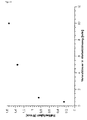
- the PVC coating of the support rack was differently coated with nickel as shown in FIG. 1 is illustrated. While without iodate treatment (0 g / l KlO 3 in FIG. 1 ) an occupancy of the frame with nickel of 75% of the surface of the frame can be observed, the treatment of the frame with 40 g / l KlO 3 already leads to a negligible occupancy of nickel of 2% of the surface of the frame.
- Example 2 The sequence of the process steps in Example 1 is summarized in Table 2.
- valve caps round moldings about 7 cm in diameter
- plastic Novodur P2MC ABS
- process step A i a solution of 10% ethylene glycol diacetate and 10% ethylene glycol monobutyl ether was used in process step A i). This solution was held at 45 ° C, the valve caps were treated for five minutes. Subsequently, all the process steps of Example 1 were carried out. Following the reduction (step B i)), the rack was treated with the valve caps in a solution containing 20 g / l potassium iodate in 50 g / l 96% sulfuric acid at 50 ° C for ten minutes.
- step D After electroless nickel plating, an additional 70 minutes of copper plating (Cupracid HT Fa. Atotech, 3.5 A / dm 2 , room temperature, step D)). After rinsing, the valve caps were stored at 80 ° C for 30 minutes (step D i)). Subsequently, the metal layer was removed from the plastic with a tensile testing machine (Instron) ( ASTM B 533 1985 Reapproved 2009 ) and so determines the adhesion. Adhesive strengths of the metal layers to the plastic of the valve caps of 1.14 N / mm and 1.17 N / mm were determined. The occupancy of the frame with metal was 4% of the frame surface and was therefore negligible.
- Instron tensile testing machine
- Bayblend T45 plates were treated at 45 ° C. for a varying time in a 15% solution of 2- (2-ethoxyethoxy) ethyl acetate and 10% butoxyethanol adjusted to pH 7 with a potassium phosphate buffer.
- the plates were then rinsed under running water for about one minute and then placed in a bath of 100 g / l sodium permanganate and 10 g / l 96% sulfuric acid kept at 70 ° C. After a treatment period of ten minutes, rinsing again under water for one minute and then cleaning the dark brown plates in a solution of 50 g / l 96% sulfuric acid and 30 ml / l of 30% hydrogen peroxide from deposited manganese dioxide.
- the plates were three minutes in a colloidal activator based on a palladium colloid (Adhemax activator PL Fa. Atotech, 25 ppm palladium) at 45 ° C. activated.
- Adhemax activator PL Fa. Atotech 25 ppm palladium
- the protective sheaths of the palladium particles were removed for five minutes at 50 ° C. (Adhemax Accelerator ACC1 from Atotech).
- the plates were then electroless nickel-plated for 10 minutes (Adhemax LFS, Atotech.) At 45 ° C, rinsed and copper-plated at 3.5 A / dm 2 for 70 minutes at room temperature (Cupracid HT, Fa. Atotech). After rinsing, the plates were stored at 80 ° C for 1 hour. Subsequently, a strip about 1 cm wide of the respective metallized plastic plate was cut out with a knife and the metal layer was removed from the plastic using a tensile testing machine (Instron) ( ASTM B 533 1985 Reapproved 2009 ). The adhesive strengths of the metal layers are in FIG. 3 shown.
- the residence time of the plastic surfaces in the solution of the glycol compounds has an influence on the adhesive strength of the applied metal layers. Without treatment with glycol compounds (residence time 0 min in FIG. 3 ) only an adhesive strength of 0.25 N / mm was obtained. After only 5 minutes of treatment with glycol compounds, on the other hand, a good adhesive strength of 0.9 N / mm was already achieved, which continues to increase with longer treatment time.
- Sheets of ABS plastic (Novodur P2MC), as described in Example 3, variously treated with a 15% solution of 2- (2-ethoxyethoxy) ethyl acetate and 10% butoxyethanol, subjected to the further metallization process and the adhesive strengths of the applied Metal layer determined.
- the adhesive strengths of the metal layer as a function of the treatment time with the solution of the glycol compounds are in FIG. 4 shown. Again, the influence of treatment duration (in FIG. 4 referred to as residence time in the Vorbeizates) on the adhesion of the deposited metal layers clearly visible. Without treatment with glycol compounds (residence time 0 min in FIG. 4 ) only an adhesive strength of 0.25 N / mm was obtained. After only 5 minutes of treatment with glycol compounds, on the other hand, a very good adhesive strength of 1.4 N / mm was already achieved, which continues to increase with longer treatment time.
Landscapes
- Chemical & Material Sciences (AREA)
- General Chemical & Material Sciences (AREA)
- Chemical Kinetics & Catalysis (AREA)
- Engineering & Computer Science (AREA)
- Materials Engineering (AREA)
- Mechanical Engineering (AREA)
- Metallurgy (AREA)
- Organic Chemistry (AREA)
- Inorganic Chemistry (AREA)
- Chemically Coating (AREA)
- Physical Vapour Deposition (AREA)
- Treatments Of Macromolecular Shaped Articles (AREA)
Priority Applications (12)
| Application Number | Priority Date | Filing Date | Title |
|---|---|---|---|
| EP12159652.2A EP2639332A1 (fr) | 2012-03-15 | 2012-03-15 | Procédé de métallisation de surfaces en matière synthétique non conductrices |
| KR1020147028815A KR101872065B1 (ko) | 2012-03-15 | 2013-03-15 | 비전도성 플라스틱 표면의 금속화 방법 |
| ES13712718.9T ES2587104T3 (es) | 2012-03-15 | 2013-03-15 | Proceso para metalizar superficies plásticas no conductoras |
| BR112014021995-8A BR112014021995B1 (pt) | 2012-03-15 | 2013-03-15 | Processo para metalização de superfícies de plástico não condutor |
| PL13712718.9T PL2825690T3 (pl) | 2012-03-15 | 2013-03-15 | Sposób metalizowania powierzchni nieprzewodzących tworzyw sztucznych |
| EP13712718.9A EP2825690B1 (fr) | 2012-03-15 | 2013-03-15 | Procédé pour la métallisation de surfaces plastiques non conductrices |
| US14/376,857 US9181622B2 (en) | 2012-03-15 | 2013-03-15 | Process for metallizing nonconductive plastic surfaces |
| PT137127189T PT2825690T (pt) | 2012-03-15 | 2013-03-15 | Processo para a metalização de superfícies plásticas não condutoras |
| JP2014561461A JP6150822B2 (ja) | 2012-03-15 | 2013-03-15 | 非導電性プラスチック表面の金属化方法 |
| PCT/EP2013/055356 WO2013135862A2 (fr) | 2012-03-15 | 2013-03-15 | Procédé pour la métallisation de surfaces plastiques non conductrices |
| CN201380014373.8A CN104254641B (zh) | 2012-03-15 | 2013-03-15 | 将非电导塑料表面金属化的方法 |
| CA2866766A CA2866766C (fr) | 2012-03-15 | 2013-03-15 | Procede pour la metallisation de surfaces plastiques non conductrices |
Applications Claiming Priority (1)
| Application Number | Priority Date | Filing Date | Title |
|---|---|---|---|
| EP12159652.2A EP2639332A1 (fr) | 2012-03-15 | 2012-03-15 | Procédé de métallisation de surfaces en matière synthétique non conductrices |
Publications (1)
| Publication Number | Publication Date |
|---|---|
| EP2639332A1 true EP2639332A1 (fr) | 2013-09-18 |
Family
ID=48013942
Family Applications (2)
| Application Number | Title | Priority Date | Filing Date |
|---|---|---|---|
| EP12159652.2A Withdrawn EP2639332A1 (fr) | 2012-03-15 | 2012-03-15 | Procédé de métallisation de surfaces en matière synthétique non conductrices |
| EP13712718.9A Active EP2825690B1 (fr) | 2012-03-15 | 2013-03-15 | Procédé pour la métallisation de surfaces plastiques non conductrices |
Family Applications After (1)
| Application Number | Title | Priority Date | Filing Date |
|---|---|---|---|
| EP13712718.9A Active EP2825690B1 (fr) | 2012-03-15 | 2013-03-15 | Procédé pour la métallisation de surfaces plastiques non conductrices |
Country Status (11)
| Country | Link |
|---|---|
| US (1) | US9181622B2 (fr) |
| EP (2) | EP2639332A1 (fr) |
| JP (1) | JP6150822B2 (fr) |
| KR (1) | KR101872065B1 (fr) |
| CN (1) | CN104254641B (fr) |
| BR (1) | BR112014021995B1 (fr) |
| CA (1) | CA2866766C (fr) |
| ES (1) | ES2587104T3 (fr) |
| PL (1) | PL2825690T3 (fr) |
| PT (1) | PT2825690T (fr) |
| WO (1) | WO2013135862A2 (fr) |
Families Citing this family (7)
| Publication number | Priority date | Publication date | Assignee | Title |
|---|---|---|---|---|
| US11047052B2 (en) | 2014-07-10 | 2021-06-29 | Okuno Chemical Industries Co., Ltd. | Resin plating method |
| US9506150B2 (en) | 2014-10-13 | 2016-11-29 | Rohm And Haas Electronic Materials Llc | Metallization inhibitors for plastisol coated plating tools |
| FR3027923B1 (fr) * | 2014-11-04 | 2023-04-28 | Pegastech | Procede de metallisation de pieces plastiques |
| ES2727075T5 (es) * | 2015-02-23 | 2022-05-27 | Macdermid Enthone Inc | Composición inhibidora para bastidores cuando se utilizan mordientes exentos de cromo en un proceso de galvanizado sobre materiales plásticos |
| EP3181726A1 (fr) | 2015-12-18 | 2017-06-21 | ATOTECH Deutschland GmbH | Solution de gravure pour le traitement de surfaces en plastique non conducteur et procédé de gravure de telles surfaces |
| EP3228729A1 (fr) | 2016-04-04 | 2017-10-11 | COVENTYA S.p.A. | Procédé de métallisation d'un article ayant une surface en plastique évitant la métallisation de la crémaillère qui fixe l'article dans le bain de placage |
| GB2587662A (en) * | 2019-10-04 | 2021-04-07 | Macdermid Inc | Prevention of unwanted plating on rack coatings for electrodeposition |
Citations (7)
| Publication number | Priority date | Publication date | Assignee | Title |
|---|---|---|---|---|
| DE3248000A1 (de) * | 1981-12-30 | 1983-07-07 | Occidental Chemical Corp., 48089 Warren, Mich. | Verfahren fuer vorbehandlung von kunststoffsubstraten fuer die stromlose metallisierung |
| US4448811A (en) * | 1981-12-30 | 1984-05-15 | Omi International Corporation | Oxidizing agent for acidic accelerator in electroless metal plating process |
| DE19611137A1 (de) | 1996-03-21 | 1997-09-25 | Lpw Anlagen Gmbh | Verfahren zur galvanotechnischen Direktmetallisierung einer Kunststoffoberfläche |
| DE19510855C2 (de) | 1995-03-17 | 1998-04-30 | Atotech Deutschland Gmbh | Verfahren zum selektiven oder partiellen elektrolytischen Metallisieren von Substraten aus nichtleitenden Materialien |
| EP1001052A2 (fr) | 1998-11-13 | 2000-05-17 | LPW-Chemie GmbH | Procédé pour metalliser une surface de plastique |
| EP1942207A1 (fr) * | 2006-12-08 | 2008-07-09 | Atotech Deutschland Gmbh | Solution de prétraitement et procédé de formation d'une couche d'un métal de revêtement sur un substrat doté d'une surface en plastique |
| WO2009023628A2 (fr) | 2007-08-10 | 2009-02-19 | Enthone Inc. | Décapant sans chrome pour surfaces plastiques |
Family Cites Families (12)
| Publication number | Priority date | Publication date | Assignee | Title |
|---|---|---|---|---|
| US4610895A (en) * | 1984-02-01 | 1986-09-09 | Shipley Company Inc. | Process for metallizing plastics |
| US4948630A (en) * | 1984-06-07 | 1990-08-14 | Enthone, Inc. | Three step process for treating plastics with alkaline permanganate solutions |
| EP0309243B1 (fr) * | 1987-09-25 | 1993-08-18 | Engelhard Technologies Limited | Traitement de pré-décapage d'un substrat plastique |
| US5286530A (en) * | 1993-01-13 | 1994-02-15 | General Electric Company | Method for providing adherent metal coatings on cyanate ester polymer surfaces |
| US5591354A (en) * | 1994-10-21 | 1997-01-07 | Jp Laboratories, Inc. | Etching plastics with nitrosyls |
| MXPA01004811A (es) * | 1998-11-13 | 2002-09-18 | Enthone Omi Inc | Proceso para metalizar una superficie de plastico. |
| JP4849420B2 (ja) * | 2007-06-20 | 2012-01-11 | 奥野製薬工業株式会社 | エッチング液の電解処理方法 |
| JP5131683B2 (ja) * | 2007-07-04 | 2013-01-30 | 奥野製薬工業株式会社 | 樹脂成形体のめっき処理に用いるめっき用治具 |
| JP2009203505A (ja) * | 2008-02-27 | 2009-09-10 | Murata Mfg Co Ltd | 無電解めっき方法と電子部品 |
| CN101654564B (zh) * | 2008-08-23 | 2012-05-30 | 比亚迪股份有限公司 | 一种塑料组合物及其表面选择性金属化工艺 |
| EP2639334A1 (fr) * | 2012-03-15 | 2013-09-18 | Atotech Deutschland GmbH | Procédé de métallisation de surfaces en matière synthétique non conductrices |
| EP2639333A1 (fr) * | 2012-03-15 | 2013-09-18 | Atotech Deutschland GmbH | Procédé de métallisation de surfaces en matière synthétique non conductrices |
-
2012
- 2012-03-15 EP EP12159652.2A patent/EP2639332A1/fr not_active Withdrawn
-
2013
- 2013-03-15 WO PCT/EP2013/055356 patent/WO2013135862A2/fr not_active Ceased
- 2013-03-15 ES ES13712718.9T patent/ES2587104T3/es active Active
- 2013-03-15 KR KR1020147028815A patent/KR101872065B1/ko active Active
- 2013-03-15 BR BR112014021995-8A patent/BR112014021995B1/pt active IP Right Grant
- 2013-03-15 PL PL13712718.9T patent/PL2825690T3/pl unknown
- 2013-03-15 PT PT137127189T patent/PT2825690T/pt unknown
- 2013-03-15 CA CA2866766A patent/CA2866766C/fr active Active
- 2013-03-15 CN CN201380014373.8A patent/CN104254641B/zh active Active
- 2013-03-15 JP JP2014561461A patent/JP6150822B2/ja active Active
- 2013-03-15 US US14/376,857 patent/US9181622B2/en active Active
- 2013-03-15 EP EP13712718.9A patent/EP2825690B1/fr active Active
Patent Citations (7)
| Publication number | Priority date | Publication date | Assignee | Title |
|---|---|---|---|---|
| DE3248000A1 (de) * | 1981-12-30 | 1983-07-07 | Occidental Chemical Corp., 48089 Warren, Mich. | Verfahren fuer vorbehandlung von kunststoffsubstraten fuer die stromlose metallisierung |
| US4448811A (en) * | 1981-12-30 | 1984-05-15 | Omi International Corporation | Oxidizing agent for acidic accelerator in electroless metal plating process |
| DE19510855C2 (de) | 1995-03-17 | 1998-04-30 | Atotech Deutschland Gmbh | Verfahren zum selektiven oder partiellen elektrolytischen Metallisieren von Substraten aus nichtleitenden Materialien |
| DE19611137A1 (de) | 1996-03-21 | 1997-09-25 | Lpw Anlagen Gmbh | Verfahren zur galvanotechnischen Direktmetallisierung einer Kunststoffoberfläche |
| EP1001052A2 (fr) | 1998-11-13 | 2000-05-17 | LPW-Chemie GmbH | Procédé pour metalliser une surface de plastique |
| EP1942207A1 (fr) * | 2006-12-08 | 2008-07-09 | Atotech Deutschland Gmbh | Solution de prétraitement et procédé de formation d'une couche d'un métal de revêtement sur un substrat doté d'une surface en plastique |
| WO2009023628A2 (fr) | 2007-08-10 | 2009-02-19 | Enthone Inc. | Décapant sans chrome pour surfaces plastiques |
Also Published As
| Publication number | Publication date |
|---|---|
| JP2015513617A (ja) | 2015-05-14 |
| CA2866766A1 (fr) | 2013-09-19 |
| KR20140138286A (ko) | 2014-12-03 |
| JP6150822B2 (ja) | 2017-06-21 |
| CN104254641A (zh) | 2014-12-31 |
| BR112014021995B1 (pt) | 2020-12-15 |
| CN104254641B (zh) | 2016-05-18 |
| PL2825690T3 (pl) | 2016-11-30 |
| CA2866766C (fr) | 2020-03-10 |
| EP2825690A2 (fr) | 2015-01-21 |
| KR101872065B1 (ko) | 2018-06-27 |
| WO2013135862A2 (fr) | 2013-09-19 |
| EP2825690B1 (fr) | 2016-05-18 |
| US9181622B2 (en) | 2015-11-10 |
| WO2013135862A3 (fr) | 2013-11-07 |
| US20150001177A1 (en) | 2015-01-01 |
| PT2825690T (pt) | 2016-07-28 |
| ES2587104T3 (es) | 2016-10-20 |
Similar Documents
| Publication | Publication Date | Title |
|---|---|---|
| EP2639333A1 (fr) | Procédé de métallisation de surfaces en matière synthétique non conductrices | |
| EP2639334A1 (fr) | Procédé de métallisation de surfaces en matière synthétique non conductrices | |
| DE60109486T2 (de) | Verfahren zur chemischen vernickelung | |
| EP3126547B1 (fr) | Composition et procédé de métallisation de surfaces non conductrices en plastique | |
| EP2639332A1 (fr) | Procédé de métallisation de surfaces en matière synthétique non conductrices | |
| EP0081129A1 (fr) | Procédé pour l'activation de surfaces de substrats pour la métallisation sans courant électrique | |
| EP2360294B1 (fr) | Procédé de métallisation d'objets comportant au moins deux matières plastiques différentes sur la surface | |
| DE19822075C2 (de) | Verfahren zur metallischen Beschichtung von Substraten | |
| DE2541896C3 (de) | Verfahren zum Behandeln einer Substratoberfläche von polymeren! Kunststoffmaterial vor der stromlosen Metallbeschichtung und Lösung zur Durchführung des Verfahrens | |
| EP1441045B1 (fr) | Procédé d'activation d'un substrat plastique pour sa galvanisation | |
| DE102010012204A1 (de) | Verbessertes Verfahren zur Direktmetallisierung von nicht leitenden Substraten | |
| EP0815292A1 (fr) | Procede de metallisation electrolytique selective ou partielle de surfaces de substrats composes de materiaux non conducteurs | |
| KR20150024327A (ko) | 비전도성 플라스틱 표면의 금속화 방법 | |
| DE3121015A1 (de) | Verfahren zur aktivierung von gebeizten oberflaechen und loesung zur durchfuehrung desselben | |
| DE20221901U1 (de) | Lösung zur Vorbehandlung einer zu metallisierenden Kunstoffoberfläche | |
| DE102023114956A1 (de) | Verfahren zum Beizen nichtleitender Kunststoffe | |
| EP0772700A1 (fr) | Solution colloidale de palladium et son utilisation | |
| EP0650537B1 (fr) | Metallisation de matieres plastiques | |
| EP1763594B1 (fr) | Procede pour ameliorer la soudabilite de revetements en nickel | |
| DE202023107029U1 (de) | Gegenstand mit einer gebeizten Oberfläche aus einem nichtleitenden Kunststoff | |
| DE102023133219A1 (de) | Verbessertes Verfahren zum Beizen nichtleitender Kunststoffe | |
| DE29923736U1 (de) | Vorbereitung nichtleitender Oberflächen für eine anschließende Galvanisierung |
Legal Events
| Date | Code | Title | Description |
|---|---|---|---|
| PUAI | Public reference made under article 153(3) epc to a published international application that has entered the european phase |
Free format text: ORIGINAL CODE: 0009012 |
|
| AK | Designated contracting states |
Kind code of ref document: A1 Designated state(s): AL AT BE BG CH CY CZ DE DK EE ES FI FR GB GR HR HU IE IS IT LI LT LU LV MC MK MT NL NO PL PT RO RS SE SI SK SM TR |
|
| AX | Request for extension of the european patent |
Extension state: BA ME |
|
| STAA | Information on the status of an ep patent application or granted ep patent |
Free format text: STATUS: THE APPLICATION IS DEEMED TO BE WITHDRAWN |
|
| 18D | Application deemed to be withdrawn |
Effective date: 20140319 |