EP2639582B1 - Système d'identification d'odeur et/ou gaz - Google Patents
Système d'identification d'odeur et/ou gaz Download PDFInfo
- Publication number
- EP2639582B1 EP2639582B1 EP12001781.9A EP12001781A EP2639582B1 EP 2639582 B1 EP2639582 B1 EP 2639582B1 EP 12001781 A EP12001781 A EP 12001781A EP 2639582 B1 EP2639582 B1 EP 2639582B1
- Authority
- EP
- European Patent Office
- Prior art keywords
- tuple
- odour
- chemical sensor
- gas
- measurement
- Prior art date
- Legal status (The legal status is an assumption and is not a legal conclusion. Google has not performed a legal analysis and makes no representation as to the accuracy of the status listed.)
- Active
Links
Images


Classifications
-
- G—PHYSICS
- G01—MEASURING; TESTING
- G01N—INVESTIGATING OR ANALYSING MATERIALS BY DETERMINING THEIR CHEMICAL OR PHYSICAL PROPERTIES
- G01N33/00—Investigating or analysing materials by specific methods not covered by groups G01N1/00 - G01N31/00
- G01N33/0004—Gaseous mixtures, e.g. polluted air
- G01N33/0009—General constructional details of gas analysers, e.g. portable test equipment
- G01N33/0027—General constructional details of gas analysers, e.g. portable test equipment concerning the detector
- G01N33/0031—General constructional details of gas analysers, e.g. portable test equipment concerning the detector comprising two or more sensors, e.g. a sensor array
-
- G—PHYSICS
- G01—MEASURING; TESTING
- G01N—INVESTIGATING OR ANALYSING MATERIALS BY DETERMINING THEIR CHEMICAL OR PHYSICAL PROPERTIES
- G01N33/00—Investigating or analysing materials by specific methods not covered by groups G01N1/00 - G01N31/00
- G01N33/0004—Gaseous mixtures, e.g. polluted air
Definitions
- an odour measuring apparatus capable of determining the similarity of the odour of an unknown sample with high objectivity and performing measurements with sensitivity similar to that of the human nose.
- An m-dimensional space is created from detection signals of m pieces of odour sensors, and a standard odour vector representing the result of measurement of a standard odour and another vector representing the result of measurement of an unknown sample are drawn in the space. From the angle theta between the two vectors, a degree of similarity is determined within the range from 0 to 100%, where the degree of similarity is corrected taking account of the difference in sensitivity between the odour sensor and the human nose. The degree of similarity of the unknown odour is calculated for each of plural standard odours measured beforehand, and which standard odour is the closest to the odour of the unknown sample is objectively shown by numeral values.
- Odor Recognition for intelligent Systems by A. Loutfi and S. Coradeschi, IEEE Intelligent Systems, January/February 2008, p. 41 - 48 , refers to a robot movable on the floor.
- the robot includes an electronic nose for sensing odours.
- the odour and/or gas identification system comprises a portable electronic device, a database, and an evaluation unit.
- the portable electronic device comprises a chemical sensor which is sensitive to different chemical analytes.
- a gas in the environment of the portable electronic device may be investigated at least as to the absence or presence of the subject analytes the chemical sensor is sensitive to.
- the detection of chemical substances or compounds contained in such gas may be of interest to a user.
- the gas may contain substances or compounds that can be smelled by a human being and in such case the gas composition may be perceived as an odour, scent or flavour, and such gas would be denoted and understood by the human being by an identifier for the odour.
- gases may not contain substances that can be smelled by a human being or may contain substances that can be smelled, however, only at a very little degree such that a concentration is not sufficient for a human to smell. Still such gas may be denoted und understood by a human being by an identifier denoting a corresponding chemical formula or a corresponding name.
- Analytes may include chemical substances and/or chemical compounds, and may specifically include one or more of, for example, CO2, NOX, ethanol, CO, ozone, ammonia, formaldehyde, or xylene without limitation.
- the chemical sensor is adapted to detect at least one property of at least two different analytes, and preferably is sensitive to five or more different analytes.
- the gas supplied to the chemical sensor may be analyzed by means of the chemical sensor as to if and which of the chemical substances or compounds the chemical sensor is sensitive to are present in the gas supplied.
- a combination of analytes detected in the gas supplied may suggest for a certain odour or for a certain gas. It is always subject to a design of the chemical sensor as to how many different analytes > 1 and/or how many different properties of an analyte the chemical sensor is sensitive to.
- the chemical sensor is capable of measuring one or more properties of multiple different analytes.
- the chemical sensor may be understood as a sensor device for detecting one or even more properties of more than one analyte.
- a property may, for example, be a concentration of an analyte in a gas which, for example, may be the air surrounding the device.
- Other properties may be, for example, chemical properties such as a binding energy of an analyte.
- the chemical sensor may comprise at least sensor material, e.g. in form of a layer, an analyte may interact with.
- an electrical property of the sensor material may be modified upon interaction such as its electrical conductance, which principle preferably is applied in metal oxide chemical sensors, or an optical property of the sensor material may be modified such as its transmission rate, for example. Then, the electrical or optical property of a combination of the analyte and the sensor material is measured and allows a conclusion as to the analyte, such as by way of comparison to a property of the sensor material measured without the presence of the analyte. It is noted that for the different analytes the chemical sensor is sensitive to it is not required to always measure the same property per analyte. Different properties may be measured for different analytes.
- the chemical sensor may be embodied as a sensor array.
- a sensor array may comprise a set of sensor cells, wherein each sensor cell may provide a layer of a material exhibiting different sensitivity such that each cell of the sensor array may specifically be mainly sensitive to a different analyte and as such may enable the portable electronic device to detect the presence or absence or concentration of such analyte.
- "Mainly” in this context shall mean that a sensor cell is more sensitive to the subject analyte than to other analytes.
- each sensor cell may provide a sensor material, e.g. in form of a layer and also denoted as sensitive layer, an analyte may interact with. As a result of the interaction, which e.g.
- a sensor cell of such sensor array may in one embodiment exhibit not only sensitivity to its main analyte, but also to analytes other than the main analyte since such sensor cell may exhibit a cross-sensitivity to one or more analytes possibly representing main analytes for other cells.
- the chemical sensor may be a single sensor cell, e.g. with a single layer, which however, may be sensitive to multiple different analytes. Such single cell may, in one embodiment, be sensitive to different analytes only under different operating conditions.
- the sensor cell may mainly be sensitive to a first analyte x when being heated to a first temperature tx, and may mainly be sensitive to a second analyte y when being heated to a second temperature ty which is different from the first temperature tx.
- a sensor array may comprise multiple sensor cells wherein at least one of the multiple sensor cells - and in another variant preferably all of the multiple sensor cells - is/are designed such that such cell/s may mainly be sensitive to different analytes under different operating conditions such as under different temperatures.
- each of such cell/s may be provided with an individual heater. In other embodiments, all cells may be heated by the same heater.
- the chemical sensor may be based on one of the following measurement principles without limitation: A chemomechanical principle, in which a mass change upon absorption is transformed into a surface acoustic wave, or into a cantilever resonance, for example.
- thermal sensing concepts applied, e.g. by making use of pellistors which may serve as a catalytic thermal sensor in which heat is generated or consumed during combustion.
- the chemical sensor may rely on optical detection, such as in form of a microspectrometer, or an NDIR, or may make use of electrochemical reactions such as being enabled by solid state electrolytes in combination with voltammetric, potentiometric, or conductometric measurement principles.
- Chemiresistors may also be used, such as conducting and carbon-loaded polymers, preferably in a low-temperature arena, or, metal-oxide sensors such as tin oxide, tungsten oxide, gallium oxide, indium oxide, zinc oxide, titanium oxide, which preferably may be applied in a high-temperature arena.
- ISFET ion-selective FET
- chemocapacitors wherein it is preferred to use a polymer as active material.
- the individual sensor cells may preferably be embodied as discrete sensor cells arranged on a common conductor board.
- the sensor cells may be represented by multiple chips the sensing structures are integrated in.
- each individual chip may be packaged, i.e. encapsulated, and arranged on a conductor board.
- such multiple sensor chips may comprise a common package, such that these chips are encapsulated by a common encapsulation, which package finally is arranged on the conductor board.
- the sensor cells are monolithically integrated into a common sensor chip with a common substrate for all sensor cells. Such monolithic sensor chip may still be encapsulated and be arranged on and electrically connected to a conductor board of the portable electronic device.
- Calibration data may be stored in a nonvolatile memory of the chemical sensor. Such calibration data may be applied to the sensor signal for compensating for drifts in the sensor signal, for example.
- the chemical sensor may be adapted to supply a measurement tuple comprising a set of tuple elements with each tuple element of the set of tuple elements being assigned to a dedicated cell of the chemical sensor and/or to a dedicated operating condition of the chemical sensor or of a cell of the chemical sensor.
- each tuple element may hold a value measured with respect to the assigned sensor cell and/or the assigned operating condition during an odour and/or gas measurement.
- each sensor cell and/or each operating condition is embodied for being mainly sensitive to an analyte assigned, each measurement tuple may also be interpreted as an indicator of the presence and possibly a concentration of such analyte.
- the chemical sensor provides a measurement result in form of a tuple with each tuple element representing the result of an individual sensor cell in case of a sensor array which sensor cell is mainly sensitive to one of the analytes.
- the measurement result of the chemical sensor with respect to a measurement - i.e. a measurement taken simultaneously by all sensor cells or taken within a reasonable time frame for belonging to the same measurement scenario - is assembled in a data structure referred to as measurement tuple and is supplied to an evaluation unit as will be explained later on.
- each measurement tuple element provides a normalized value.
- values measured by the cells are normalized with respect to a norm.
- norm may be, for example, the value measured by one of the cells.
- each value measured is divided by the value measured by one of the sensor cells.
- the value of each measurement is dependent on a magnitude/strength of the gas or odour, such magnitude dependence may not be preferred in comparing the measurement tuple to the one or more reference tuples as will be explained later on.
- all tuple elements be it the ones of the measurement tuple and be it the ones of the one or more reference tuples contain normalized values and all make use of a common norm. Then, a tuple may also be considered as a normalized vector.
- the chemical sensor may be assigned a processing unit for supporting the assembly of the measurement tuple.
- processing unit may be a processing unit dedicated to the chemical sensor unit, or may be a processing unit of the portable electronic device that is made available for the subject task.
- the measurement tuple is supplied in combination with one or more of the following data: a chemical sensor unit identifier, a time stamp, global positioning information referring to the location of the portable electronic device at the time of measurement, etc. With such additional information, the odour and/or gas identification request may be better tracked.
- a tuple in general may also be referred to as vector.
- the database is a database containing a set of reference tuples with each reference tuple representing an odour and/or gas and comprising a set of tuple elements and an identifier for the odour and/or gas represented by the concerned reference tuple.
- each reference tuple representing an odour and/or gas
- a set of tuple elements and an identifier for the odour and/or gas represented by the concerned reference tuple.
- For a given reference tuple its elements are assigned to dedicated cells of the chemical sensor and/or dedicated operating conditions of the chemical sensor or of the cell of the chemical sensor, and as a result possibly to the various analytes the chemical sensor mainly is sensitive to.
- a reference tuple representing the odour of a "tulip" may contain nine tuple elements with each tuple element providing a value reflecting the presence, absence, or partial presence of the assigned analyte out of the nine analytes the chemical sensor mainly is sensitive to.
- Each reference tuple is tagged by an identifier identifying the odour and/or gas which the subject reference tuple represents.
- the identifyer may be embodied as a numeral identifier which, for example, may generally be used in a classification system for odours and/or gases. Or it may be a verbal descriptor of the odour, such as "rose", for example. Or it may be any other kind of identifier for identifying odour and/or gases.
- the comparison in the evaluation unit may include a determination of a deviation between each measurement tuple element and its counterpart reference tuple element.
- a measurement tuple element and its counterpart reference tuple element are linked in that they are assigned to the same cell of the chemical sensor and/or to the same operating condition of the chemical sensor or of the cell of the chemical sensor.
- both tuple elements indicate a value, an in particular a normalized value, of e.g. the absence, presence or partial presence of the assigned analyte which is measured on the one hand, and which is provided within the reference tuple for characterizing the presence of the assigned analyte in the subject odour on the other hand.
- a tuple generally contains at least two tuple elements, there may be at least two deviations determined in the evaluation process.
- at least three tuple elements are required for allowing comparison of at least two of the tuple elements of the measurement and the reference tuple since one of the tuple elements is used for normalization.
- it may depend on a result of the at least two deviations if or if not an odour and/or gas identifier is returned.
- each deviation may be compared to an assigned threshold, and the identifier of the reference tuple under investigation is returned in case a number n of deviations is below the assigned thresholds. This means that at least n analytes need to closely match a typical concentration of the subject analytes as is manifested in the subject reference tuple for the subject odour/gas.
- the identifier of two or more measurement tuples may be returned. This may be the case, if no single reference tuple unambiguously matches the measurement tuple. In such case, the two or more reference tuples coming closest to the measurement tuple are selected for an odour and/or gas suggestion. For example, the identifiers of n reference tuples with a lowest accumulation value of all tuple element deviations may be returned. In another embodiment, a statement as to a likelihood of the different odours and/or gases suggested may be returned in combination with the identifiers. In another scenario, a void identifier may be returned in case no single reference tuple has sufficiently matched the measurement tuple.
- the evaluation unit may apply some sort of pattern recognition for comparing the measurement tuple to one or more reference tuples.
- a comparison between tuples and/or graphical representations of the tuples may include a comparison of a deviation between the measurement tuple and a reference tuple to a variable threshold, or, in another embodiment, to a threshold corridor/range within which the measurement tuple is expected to fall for compliance.
- all the reference tuples are compared to the measurement tuple in order to increase chances of a match. Smart algorithms may be applied for performing the measurement step.
- the database and the evaluation unit are arranged remote from the portable electronic device.
- a server / a server system / a cloud system may preferably be used for providing the database.
- the evaluation unit may be represented by processing power at the same system remote from the portable electronic device or on a different system remote from the portable electronic device.
- a service provider may offer services to users or subscribers of identifying odours and/or gases received in form of measurement tuples.
- a user may register with the provider and receive the odour and/or gas identifiers in return for a measurement tuple sent. Any transmission of a measurement tuple and/or of an identifier return is performed via a wireless link, e.g. based on a UMTS or a GPRS standard.
- the provider may return the identifier via SMS.
- the database is remote from the portable electronic device, however, the evaluation unit is arranged in the portable electronic device.
- the evaluation unit may be embodied as hardware or firmware or as software on a general purpose processor unit of the portable electronic device.
- the electronic portable device requests one or more reference tuples from the database for comparing the measurement tuple to locally, i.e. on the portable electronic device.
- a wireless link is used for requesting/fetching and receiving reference tuples from the database.
- any portable electronic device such as a mobile phone, and in particular a smart phone, a handheld computer, an electronic reader, a tablet computer, a game controller, a pointing device, a photo or a video camera, or a computer peripheral - which listing is not limited - may in addition to its original function support the chemical and/or odour and/or gas identification as to its environment.
- Such portable electronic device as a result may primarily be designed for computing and/or telecommunication and/or other tasks in the IT arena, and now may be enhanced by the function of providing chemical information as to its environment. The user may learn about chemical substances, compositions and/or odours present in the devices surroundings, and may use, transmit or else further analyse such information.
- such information may also be transmitted elsewhere and used elsewhere.
- the user himself/herself may benefit from the information provided by the chemical sensor in that actions may be taken in response to detected gases and/or odours, including but not limited to toxic substances and compounds such as CO.
- An alarm may be triggered once such compound is identified in form of a return of the "CO" identifier, for example.
- Other measurements may be taken out of pure interest, such as, for example, the measurement of the odour of a flower or the odour of a drink.
- the identifier/name of an odour unknown to the user such as "sunflower", for example, or "bourbon 10 yrs old"
- the user may display to the user.
- These sensors may help in compensating temperature induced and/or humidity induced signal variations in a signal of the chemical sensor.
- the temperature sensor and/or the humidity sensor may be arranged in proximity to the chemical sensor, for example in the same opening of a housing of the portable electronic device.
- any measurement finalized by the chemical sensor unit may initiate a transfer of the measurement tuple to the evaluation unit and may initiate an evaluation there.
- the portable electronic device may comprise a selector unit for offering a selection of one or more of a multitude of databases to the user for applying reference tuples from.
- the selector unit may be built in form of a key or a touchscreen, for example.
- official or commercial provider databases may be trusted more than private user databases such a selection is desirable. This may be true, for example, for databases containing reference vectors representing vapours of organic solvents.
- An associate service provider may have collected and tagged the signal vectors under controlled conditions.
- an odour and/or gas is measured with a portable electronic device comprising a chemical sensor unit, the chemical sensor unit being sensitive to different analytes.
- a measurement tuple is supplied comprising a set of tuple elements with each tuple element of the set of tuple elements providing a value measured by a dedicated cell of the chemical sensor and/or under a dedicated operating condition of the chemical sensor or of a cell of the chemical sensor during an odour and/or gas measurement.
- the measurement tuple is compared to one or more reference tuples with each reference tuple representing an odour and/or gas and comprising a set of tuple elements and an identifier for the odour and/or gas represented by the reference tuple.
- Each tuple element of the set of tuple elements provides a value characteristic for being sensed by the dedicated cell of the chemical sensor and/or under the dedicated operating condition of the chemical sensor or of the cell of the chemical sensor in the presence of the odour and/or gas represented by the concerned reference tuple.
- Subject to a result of the comparison of one or more odour and/or gas identifiers are returned to the portable electronic device.
- a computer program medium comprising computer program code means for implementing the following steps when executed on a processing unit:
- a measurement tuple is received from a chemical sensor unit and comprises a set of tuple elements with each tuple element of the set of tuple elements provides a value measured by a dedicated cell of the chemical sensor and/or under a dedicated operating condition of the chemical sensor or of a cell of the chemical sensor during an odour and/or gas measurement.
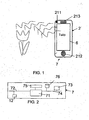
- FIG. 1 illustrates a usage scenario with a mobile phone 7 according to an embodiment of the present invention.
- a chemical sensor is arranged in another opening 211 of the front wall 21, which substances respectively, is sensed by the chemical sensor.
- the sensed odour is compared to reference odours and is finally identified as an odour from tulips. This result is displayed on a display 6 of the mobile phone 7.
- FIG. 2 shows a schematic hardware oriented block diagram of a portable electronic device in form of a mobile phone 7.
- a microprocessor 71 is connected via electrical conductors 72 to a chemical sensor 12, which electrical conductors 72 specifically may be conductors of a flexible printed circuit board.
- the chemical sensor 12 contains signal processing capability in order to output an odour and/or gas tuple measured.
- a routine for analysing the odour supplied by the chemical sensor 12 in form of a measurement tuple may be executed by an evaluation unit.
- a hardware of the evaluation unit may be represented by the microprocessor 71, and a software of the evaluation unit may be represented by a program element stored in a memory 73 connected to the microprocessor 71 via a bus system 74.
- a database 76 containing reference tuple data may be connected to the microprocessor 71 via the bus system 74, too.
- a wireless interface 75 may be connected to the microprocessor 71.
- Figure 3 illustrates a functional diagram of an odour and/or gas identification system according to an embodiment of the present invention.
- the portable electronic device may be embodied as a tablet computer 1 comprising a chemical sensor not further shown in Figure 3 .
- the chemical sensor provides a measurement tuple mt to an evaluation unit 3 remote from the tablet computer 1.
- the evaluation unit 3 may be embodied in a server hosting a service for odour and/or gas identification. Once the evaluation unit 3 has received a measurement tuple mt, this is taken as a request to start an identification process which is initiated by submit-bodied in a server hosting a service for odour and/or gas identification.
- the evaluation unit 3 Once the evaluation unit 3 has received a measurement tuple mt, this is taken as a request to start an identification process which is initiated by submitting a request rq to a database 4 for reference tuple data.
- the database 4 is remote from the tablet computer 1 and the evaluation unit 3 and contains storage space for storing reference tuples rt representing odours and/or gases, for example.
- the reference tuples rt are transmitted to the evaluation unit 3 as requested and are compared to the measurement tuple mt there.
- an identifier id for the odour and/or gas represented by this specific reference tuple rt is returned to the tablet computer 1.
- step S4 the evaluation unit which may together with a data-base reside in a server, retrieves the i th reference tuple from the database and compares the measurement tuple to the i th reference tuple. In case the measurement tuple matches the i th reference tuple (Y), an identifier of the subject reference tuple is returned by the evaluation unit to the portable electronic device in step S5. In step S6, the identifier may be displayed on a display of the portable electronic device.
- the reference tuple counter i is increased in step S7, and in step S4 the measurement tuple is compared to the next reference tuple from the database.
- FIG. 5 illustrates a top view on a chip 112 representing a chemical sensor as is used in an embodiment of the present invention.
- the chip 112 comprises a chemical sensor structure 1121 which takes the shape of a sensor array comprising multiple symbolic sensor cells 1122, in the present example, thirty six sensor cells 1122.
- a humidity sensitive structure 1111 is arranged next to the chemical sensor structure 1121, and electronic circuitry 1123 is integrated into the chemical sensor chip 112 which electronic circuitry 112 is responsible for applying a humidity compensation of the signal supplied by the chemical sensor structure 1121, for linearizing and A/D converting the sensor signal, and for building the measurement tuple, for example.
- FIG. 6 illustrates an illustration of a comparison step in a method according to an embodiment of the present invention.
- a sample measurement tuple mt is depicted containing nine measurement tuple elements mt1 ...mx ... mt9, each tuple element holding a value wherein only the value 2.0 of the first measurement tuple element mt1 is shown for illustration purposes.
- a sample reference tuple rt is depicted containing nine reference tuple elements rt1 ....rtx ... rt9, each tuple element holding a value wherein only the value 1.8 of the first reference tuple element rt1 is shown for illustration purposes.
- the first measurement tuple element mt1 is assigned to a first sensor cell of the chemical sensor which first sensor cell is mainly sensitive to a first analyte.
- the corresponding first reference tuple element rt1 is assigned to the same sensor cell and hence, provides a value as to the same first analyte.
- the value of the first measured tuple element mt1 is compared to the first reference tuple element rt1 by determining a deviation mt1-rt1 which deviation is compared to a first threshold t1, which threshold is the present example is set to 0.4.
- a concentration of 2.0 of the first analyte was measured.
- the reference odour named "X" typically shows a concentration of this analyte of 1.8.
- the measured odour and/or gas may be "X" subject to a concentration of the other analytes measured which concentrations may be compared to the reference concentrations in the same way.
- FIG. 7 illustrates in diagrams a) and b) two different measurement tuples mt as used in an embodiment of the present invention.
- Each measurement tuple mt is sensed by a chemical sensor being sensitive to eight analytes, such that a measurement tuple mt contains eight tuple elements mt1 ... mt8.
- the measurement tuple mt according to diagram 7a) represents a measurement of a first gas/odour
- the measurement tuple mt according to diagram 7b) represents a measurement of a second gas/odour.
- Each measurement tuple mt is represented by a spider diagram with eight axes, and with the value of each tuple element mt1 ...
- each measured value may be converted into a normalized value by dividing the value by the value measured for the first sensor cell, i.e. mt1.
- normalized patterns are compared to each other.
- Other approaches of normalizations may be applied, for example, a normalization with respect to an area of the spider diagram, etc.
- Such spider diagram measurement tuple representation may support graphical pattern recognition.
- the reference tuples may also be stored as graphical representations in form of spider diagrams. In a best match algorithm, the reference pattern that matches the measurement pattern best is identified and its tag is returned.
Landscapes
- Chemical & Material Sciences (AREA)
- Life Sciences & Earth Sciences (AREA)
- Engineering & Computer Science (AREA)
- Health & Medical Sciences (AREA)
- Analytical Chemistry (AREA)
- Food Science & Technology (AREA)
- Medicinal Chemistry (AREA)
- Physics & Mathematics (AREA)
- Combustion & Propulsion (AREA)
- Biochemistry (AREA)
- General Health & Medical Sciences (AREA)
- General Physics & Mathematics (AREA)
- Immunology (AREA)
- Pathology (AREA)
- Investigating Or Analyzing Materials By The Use Of Electric Means (AREA)
- Investigating Or Analysing Biological Materials (AREA)
- Investigating Or Analyzing Materials By The Use Of Fluid Adsorption Or Reactions (AREA)
Claims (15)
- Système d'identification d'odeur et/ou de gaz, comprenant
un dispositif électronique portable comprenant un capteur chimique (12) sensitif à des différents analytes et étant adapté à fournir un tuple de mesures (mt) comprenant un ensemble d'éléments de tuple avec chaque élément de tuple (mtx) de l'ensemble d'éléments de tuple (mtx) donnant une valeur mesurée pendant une mesure d'odeur et/ou de gaz par une cellule dédié du capteur chimique et/ou dans une condition d'opération dédié du capteur chimique ou d'une cellule du capteur chimique;
une base de données (76, 4), la base de données étant arrangée loin du dispositif électronique portable, contenant un ensemble de tuples de référence (rt), chaque tuple de référence (rt) représentant une odeur et/ou un gaz et comprenant- un ensemble d'éléments de tuple, chaque élément de tuple (rtx) de l'ensemble d'éléments de tuple (rtx) donnant une valeur caractéristique pour être captée par la cellule dédiée du capteur chimique et/ou dans une condition d'opération dédié du capteur chimique ou de la cellule du capteur chimique en présence de l'odeur et/ou du gaz représenté par le tuple de référence concerné (rt), et- un identifiant (id) pour l'odeur et/ou le gaz représenté par le tuple de référence concerné (rt);une unité (71, 3) pour comparer le tuple de mesure (mt) avec un ou plusieurs tuples de référence (rt) de l'ensemble de tuples de référence (rt) et faisant l'objet d'un résultat de la comparaison apportant un ou plusieurs identifiants d'odeur et/ou de gaz (id) au dispositif électronique portable,
le dispositif électronique portable étant un de:un téléphone mobile (7),un ordinateur portable,un lecteur électronique,un ordinateur tablette (1),un contrôleur de jeu,un dispositif de pointage,un appareil photo ou vidéo,une périphérique d'ordinateur,l'unité d'évaluation (3) étant arrangée loin du dispositif électronique portable,le dispositif électronique portable étant adapté à envoyer le tuple de mesures (mt) à l'unité d'évaluation (3),l'unité d'évaluation (3) étant adaptée à recevoir le tuple de mesures (mt) du dispositif électronique et étant adaptée à envoyer l'un ou les plusieurs identifiants d'odeur et/ou de gaz au dispositif électronique portable, etune liaison sans fil étant utilisée pour envoyer le tuple de mesures (mt) et/ou l'un ou les plusieurs identifiants d'odeur et/ou de gaz (id). - Système d'identification d'odeur et/ou de gaz, comprenant
un dispositif électronique portable comprenant un capteur chimique (12) sensitif à des différents analytes et étant adapté à fournir un tuple de mesures (mt) comprenant un ensemble d'éléments de tuple avec chaque élément de tuple (mtx) de l'ensemble d'éléments de tuple (mtx) donnant une valeur mesurée pendant une mesure d'odeur et/ou de gaz par une cellule dédié du capteur chimique et/ou dans une condition d'opération dédié du capteur chimique ou d'une cellule du capteur chimique;
une base de données (76, 4), la base de données étant arrangée loin du dispositif électronique portable, contenant un ensemble de tuples de référence (rt), chaque tuple de référence (rt) représentant une odeur et/ou un gaz et comprenant- un ensemble d'éléments de tuple, chaque élément de tuple (rtx) de l'ensemble d'éléments de tuple (rtx) donnant une valeur caractéristique pour être captée par la cellule dédiée du capteur chimique et/ou dans une condition d'opération dédié du capteur chimique ou de la cellule du capteur chimique en présence de l'odeur et/ou du gaz représenté par le tuple de référence concerné (rt), et- un identifiant (id) pour l'odeur et/ou le gaz représenté par le tuple de référence concerné (rt);une unité d'évaluation (71, 3) pour comparer le tuple de mesures (mt) avec un ou plusieurs tuples de référence (rt) de l'ensemble de tuples de référence (rt) et faisant l'objet d'un résultat de la comparaison apportant un ou plusieurs identifiants d'odeur et/ou de gaz (id) au dispositif électronique portable,
le dispositif électronique portable étant un de:un téléphone mobile (7),un ordinateur portable,un lecteur électronique,un ordinateur tablette (1),un contrôleur de jeu,un dispositif de pointage,un appareil photo ou vidéo,une périphérique d'ordinateur,le dispositif électronique portable contenant l'unité d'évaluation (71),le dispositif électronique portable étant adapté à amener un ou plusieurs tuples de référence (rt) de la base de données (4) afin de le ou les comparer avec le tuple de mesures (mt), etune liaison sans fil étant utilisée pour amener l'un ou les plusieurs tuples de référence (rt) de la base de données (4). - Système selon l'une des revendications précédentes,
comprenant un écran (6) pour montrer l'un ou les plusieurs identifiants d'odeur et/ou de gaz (id), et
particulièrement le dispositif électronique portable comprenant l'écran (6). - Système selon l'une des revendications précédentes,
le capteur chimique (12) comprenant un réseau de cellules de capteur (1122), et
particulièrement chaque cellule de capteur (1122) étant généralement sensible à un autre analyte que le capteur chimique (12). - Système selon l'une des revendications précédentes,
le dispositif électronique portable comprenant au moins un de- un capteur de température pour compenser des variations de signal dépendantes de température dans un signal du capteur chimique (12), et- un capteur d'humidité (1111) pour compenser des variations de signal dépendantes d'humidité dans un signal du capteur chimique (12). - Système selon l'une des revendications précédentes,
le dispositif électronique portable comprenant une unité d'entrée pour déclencher une mesure d'odeur et/ou de gaz. - Système selon l'une des revendications précédentes,
le capteur chimique (12) étant adapté à fournir des tuples de mesure (mt) de manière continue dans le temps. - Système selon l'une des revendications précédentes,
le dispositif électronique portable comprenant une unité de sélection pour sélectionner une ou plusieurs bases de données (76, 4) d'une pluralité de bases de données afin d'appliquer des tuples de référence (rt) d'elle ou d'elles. - Système selon l'une des revendications précédentes,
le capteur chimique (12) étant adapté à fournir le tuple de mesures (mt) en combinaison avec un identifiant du capteur chimique, et particulièrement en combinaison avec un horodatage. - Dispositif portable pour l'utilisation dans un système d'identification d'odeur et/ou de gaz selon l'une des revendications précédentes.
- Procédé pour identifier une odeur et/ou un gaz, comprenant les étapes
de mesurer une odeur et/ou un gaz avec un dispositif électronique portable comprenant un capteur chimique (12), le capteur chimique (12) étant sensible à des différents analytes, le dispositif électronique portable étant un téléphone portable (7) ou un ordinateur portable ou un lecteur électronique ou un ordinateur tablette (1) ou un contrôleur de jeu ou un dispositif de pointage ou un appareil photo ou vidéo ou une périphérique d'ordinateur,
de fournir un tuple de mesures (mt) comprenant un ensemble d'éléments de tuple avec chaque élément de tuple (mtx) de l'ensemble d'éléments de tuple (mtx) donnant une valeur mesurée pendant une mesure d'odeur et/ou de gaz par une cellule dédié du capteur chimique et/ou dans une condition d'opération dédié du capteur chimique ou d'une cellule du capteur chimique;
le dispositif électronique portable envoyant le tuple de mesures (mt) par une liaison sans fil à une unité d'évaluation (3) arrangée loin du dispositif électronique portable,
l'unité d'évaluation (3) recevant le tuple de mesures (mt) du dispositif électronique et comparaissant le tuple de mesures (mt) avec un ou plusieurs tuples de référence (rt) d'une base de données, la base de données étant arrangée loin du dispositif électronique portable, chaque tuple de référence (rt) représentant une odeur et/ou un gaz et comprenant- un ensemble d'éléments de tuple, chaque élément de tuple (rtx) de l'ensemble d'éléments de tuple (rtx) donnant une valeur caractéristique pour être captée par la cellule dédiée du capteur chimique et/ou dans une condition d'opération dédié du capteur chimique ou de la cellule du capteur chimique en présence de l'odeur et/ou du gaz représenté par le tuple de référence concerné (rt), et- un identifiant (id) pour l'odeur et/ou le gaz représenté par le tuple de référence concerné (rt);l'unité d'évaluation (3) renvoyant un ou plusieurs identifiants d'odeur et/ou du gaz par une liaison sans fil au dispositif électronique portable, faisant l'objet d'un résultat de la comparaison. - Procédé pour identifier une odeur et/ou un gaz, comprenant les étapes
de mesurer une odeur et/ou un gaz avec un dispositif électronique portable comprenant un capteur chimique (12), le capteur chimique (12) étant sensible à des différents analytes, le dispositif électronique portable étant un téléphone portable (7) ou un ordinateur portable ou un lecteur électronique ou un ordinateur tablette (1) ou un contrôleur de jeu ou un dispositif de pointage ou un appareil photo ou vidéo ou une périphérique d'ordinateur,
de fournir un tuple de mesures (mt) comprenant un ensemble d'éléments de tuple avec chaque élément de tuple (mtx) de l'ensemble d'éléments de tuple (mtx) donnant une valeur mesurée pendant une mesure d'odeur et/ou de gaz par une cellule dédié du capteur chimique et/ou dans une condition d'opération dédié du capteur chimique ou d'une cellule du capteur chimique;
une unité d'évaluation (71) incorporée dans le dispositif électronique portable amenant un ou plusieurs tuples de référence (rt) d'une base de données (4) par une liaison sans fil pour le ou les comparer avec le tuple de mesures (mt),
de comparer le tuple de mesure (mt) avec un ou plusieurs des tuples de référence (rt) amenés de la base de données, la base de données étant arrangée loin du dispositif électronique portable, chaque tuple de référence (rt) représentant une odeur et/ou un gaz et comprenant- un ensemble d'éléments de tuple, chaque élément de tuple (rtx) de l'ensemble d'éléments de tuple (rtx) donnant une valeur caractéristique pour être captée par la cellule dédiée du capteur chimique et/ou dans une condition d'opération dédié du capteur chimique ou de la cellule du capteur chimique en présence de l'odeur et/ou du gaz représenté par le tuple de référence concerné (rt), et- un identifiant (id) pour l'odeur et/ou le gaz représenté par le tuple de référence concerné (rt); etretournant un ou plusieurs identifiants d'odeur et/ou da gaz au dispositif électronique portable faisant l'objet d'un résultat de la comparaison. - Procédé pour identifier une odeur et/ou un gaz selon la revendication 11 ou 12,
le tuple de mesures (mt) étant comparé avec l'un ou les plusieurs tuples de référence (rt) en déterminant une déviation entre des éléments du tuple de mesures (mtx) ensemble avec des éléments du tuple de référence (rtx) équivalents et un élément du tuple de mesures (mtx) ensemble avec son élément du tuple de référence (rtx) équivalent attribués à la même cellule du capteur chimique et/ou à la même condition d'opération du capteur chimique ou de la cellule du capteur chimique, et
l'identifiant (id) d'un tuple de référence (rt) comparé avec le tuple de mesures (mt) étant retourné faisant objet des déviations déterminées, et
particulièrement les éléments du tuple (mtx, rtx) à comparer comprenant des valeurs normalisées. - Procédé selon la revendication 13,
chaque déviation étant comparée avec un seuil (tx) attribué, et
l'identifiant (id) d'un tuple de référence (rt) comparé avec le tuple de mesures (mt) étant retourné en cas un numéro n de déviations est inférieur aux seuils attribués (tx). - Elément de programme d'ordinateur comprenant des moyens de code de programme d'ordinateur pour implémenter les étapes suivantes quand ils sont executés dans une unité de traitement d'un téléphone mobile (7) ou d'un ordinateur portable ou d'un lecteur électronique ou d'un ordinateur tablette (1) ou d'un contrôleur de jeu ou d'un dispositif de pointage ou d'un appareil photo ou vidéo ou d'une périphérique d'ordinateur:recevoir un tuple de mesures (mt) d'une unité de capteur chimique (12) et comprenant un ensemble d'éléments de tuple avec chaque élément de tuple (mtx) de l'ensemble d'éléments de tuple donnant une valeur mesurée par une cellule dédié du capteur chimique et/ou dans une condition d'opération dédié du capteur chimique ou d'une cellule du capteur chimique pendant une mesure d'odeur et/ou de gaz;amener un ou plusieurs tuples de référence (12) par une liaison sans fil d'une base de données, la base de données étant arrangée loin du dispositif électronique portable, chaque tuple de référence (rt) représentant une odeur et/ou un gaz et comprenant- un ensemble d'éléments de tuple, chaque élément de tuple (rtx) de l'ensemble d'éléments de tuple (rtx) donnant une valeur caractéristique pour être captée par la cellule dédiée du capteur chimique et/ou dans une condition d'opération dédié du capteur chimique ou de la cellule du capteur chimique en présence de l'odeur et/ou du gaz représenté par le tuple de référence concerné (rt), et- un identifiant (id) pour l'odeur et/ou le gaz représenté par le tuple de référence concerné (rt) comparant ledit tuple de mesures (mt) avec ledit un ou lesdits plusieurs tuples de référence (rt); etretourner un ou plusieurs identifiants d'odeur et/ou de gaz (id) faisant objet d'un résultat de la comparaison.
Priority Applications (3)
| Application Number | Priority Date | Filing Date | Title |
|---|---|---|---|
| EP12001781.9A EP2639582B1 (fr) | 2012-03-15 | 2012-03-15 | Système d'identification d'odeur et/ou gaz |
| US13/798,377 US20130244336A1 (en) | 2012-03-15 | 2013-03-13 | Odour and/or gas identification system |
| CN201310082271.1A CN103308650B (zh) | 2012-03-15 | 2013-03-15 | 气味和/或气体识别系统 |
Applications Claiming Priority (1)
| Application Number | Priority Date | Filing Date | Title |
|---|---|---|---|
| EP12001781.9A EP2639582B1 (fr) | 2012-03-15 | 2012-03-15 | Système d'identification d'odeur et/ou gaz |
Publications (2)
| Publication Number | Publication Date |
|---|---|
| EP2639582A1 EP2639582A1 (fr) | 2013-09-18 |
| EP2639582B1 true EP2639582B1 (fr) | 2015-07-01 |
Family
ID=46027497
Family Applications (1)
| Application Number | Title | Priority Date | Filing Date |
|---|---|---|---|
| EP12001781.9A Active EP2639582B1 (fr) | 2012-03-15 | 2012-03-15 | Système d'identification d'odeur et/ou gaz |
Country Status (3)
| Country | Link |
|---|---|
| US (1) | US20130244336A1 (fr) |
| EP (1) | EP2639582B1 (fr) |
| CN (1) | CN103308650B (fr) |
Cited By (1)
| Publication number | Priority date | Publication date | Assignee | Title |
|---|---|---|---|---|
| EP3062103B1 (fr) * | 2015-02-27 | 2024-07-17 | Alpha M.O.S. | Dispositif d'analyse de fluide portable avec capacité d'apprentissage |
Families Citing this family (42)
| Publication number | Priority date | Publication date | Assignee | Title |
|---|---|---|---|---|
| JP5252132B2 (ja) * | 2010-07-06 | 2013-07-31 | 株式会社島津製作所 | におい識別装置 |
| EP2642289A1 (fr) | 2012-03-20 | 2013-09-25 | Sensirion AG | Dispositif électronique portable |
| US9772317B2 (en) | 2012-07-26 | 2017-09-26 | Sensirion Ag | Method for operating a portable electronic device |
| KR102161546B1 (ko) * | 2014-02-05 | 2020-10-05 | 삼성전자 주식회사 | 전자 기기 및 그의 운용 방법 |
| CN111398529B (zh) * | 2014-08-29 | 2022-06-03 | 株式会社而摩比特 | 嗅觉系统、气味识别装置、气味识别方法 |
| US9829472B2 (en) * | 2014-09-08 | 2017-11-28 | Michael Hacikyan | Portable hand-held oxygen monitor |
| WO2016176085A1 (fr) | 2015-04-29 | 2016-11-03 | Honeywell International Inc. | Système permettant d'intégrer de multiples données de capteur chimique pour détecter un composé non mesuré |
| US20170343521A1 (en) * | 2016-05-26 | 2017-11-30 | Electronics And Telecommunications Research Institute | Apparatus and method for generating olfactory information |
| JP7010446B2 (ja) | 2016-09-27 | 2022-01-26 | 株式会社アロマビット | 匂い測定装置及び匂い測定システム |
| US10371679B2 (en) | 2016-11-08 | 2019-08-06 | Michael Hacikyan | Wireless oxygen monitor |
| EP3627139B1 (fr) * | 2017-05-17 | 2024-11-27 | Aroma Bit, Inc. | Méthode de préparation des données originales d'une image d'odeur |
| EP3644319A4 (fr) * | 2017-06-19 | 2021-03-31 | Aroma Bit, Inc. | Structure de données et dispositif de génération de données complexes |
| WO2019069957A1 (fr) * | 2017-10-03 | 2019-04-11 | 日本電気株式会社 | Dispositif serveur, procédé d'analyse de données de capteur d'odeurs et support d'enregistrement lisible par ordinateur |
| JP7006701B2 (ja) * | 2017-10-03 | 2022-01-24 | 日本電気株式会社 | サーバ装置、ニオイセンサデータ解析方法、及びプログラム |
| JP7006700B2 (ja) * | 2017-10-03 | 2022-01-24 | 日本電気株式会社 | サーバ装置、ニオイセンサデータ解析方法、及びプログラム |
| CN108088955A (zh) * | 2017-11-30 | 2018-05-29 | 苏州慧闻纳米科技有限公司 | 一种抗干扰气体传感器 |
| CN108132333A (zh) * | 2017-12-21 | 2018-06-08 | 广东工业大学 | 一种红酒气味识别方法及相关装置 |
| KR102106561B1 (ko) * | 2018-03-30 | 2020-05-04 | 울산과학기술원 | 센서 기반 실시간 악취 분류 장치 및 방법 |
| US11177039B2 (en) | 2018-05-22 | 2021-11-16 | International Business Machines Corporation | Assessing a treatment service based on a measure of trust dynamics |
| WO2019226564A1 (fr) | 2018-05-22 | 2019-11-28 | Boston Scientific Neuromodulation Corporation | Traitement adaptatif par neurostimulation électrique pour réduire la perception de la douleur |
| US11004563B2 (en) * | 2018-05-22 | 2021-05-11 | International Business Machines Corporation | Adaptive pain management and reduction based on monitoring user conditions |
| AU2019274427B2 (en) | 2018-05-22 | 2022-04-14 | Boston Scientific Neuromodulation Corporation | Adaptive chronic pain relief via implanted electrical neurostimulation |
| US10957434B2 (en) | 2018-05-22 | 2021-03-23 | International Business Machines Corporation | Updating a prescription status based on a measure of trust dynamics |
| US10943674B2 (en) | 2018-05-22 | 2021-03-09 | International Business Machines Corporation | Updating a clinical trial participation status based on a measure of trust dynamics |
| US10964433B2 (en) | 2018-05-22 | 2021-03-30 | International Business Machines Corporation | Assessing a medical procedure based on a measure of trust dynamics |
| US11557398B2 (en) | 2018-05-22 | 2023-01-17 | International Business Machines Corporation | Delivering a chemical compound based on a measure of trust dynamics |
| CN109580878A (zh) * | 2018-11-15 | 2019-04-05 | 深圳市安帕尔科技有限公司 | 一种手持式气体检测救生仪 |
| KR102221535B1 (ko) * | 2019-05-23 | 2021-03-02 | 엘지전자 주식회사 | 센서 어셈블리 및 그 제어방법 |
| US12017506B2 (en) | 2020-08-20 | 2024-06-25 | Denso International America, Inc. | Passenger cabin air control systems and methods |
| US11813926B2 (en) | 2020-08-20 | 2023-11-14 | Denso International America, Inc. | Binding agent and olfaction sensor |
| US11932080B2 (en) | 2020-08-20 | 2024-03-19 | Denso International America, Inc. | Diagnostic and recirculation control systems and methods |
| US11881093B2 (en) | 2020-08-20 | 2024-01-23 | Denso International America, Inc. | Systems and methods for identifying smoking in vehicles |
| US12377711B2 (en) | 2020-08-20 | 2025-08-05 | Denso International America, Inc. | Vehicle feature control systems and methods based on smoking |
| US11760170B2 (en) | 2020-08-20 | 2023-09-19 | Denso International America, Inc. | Olfaction sensor preservation systems and methods |
| US11636870B2 (en) | 2020-08-20 | 2023-04-25 | Denso International America, Inc. | Smoking cessation systems and methods |
| US12251991B2 (en) | 2020-08-20 | 2025-03-18 | Denso International America, Inc. | Humidity control for olfaction sensors |
| US12269315B2 (en) | 2020-08-20 | 2025-04-08 | Denso International America, Inc. | Systems and methods for measuring and managing odor brought into rental vehicles |
| US11828210B2 (en) | 2020-08-20 | 2023-11-28 | Denso International America, Inc. | Diagnostic systems and methods of vehicles using olfaction |
| US11760169B2 (en) | 2020-08-20 | 2023-09-19 | Denso International America, Inc. | Particulate control systems and methods for olfaction sensors |
| US11409797B2 (en) * | 2020-08-31 | 2022-08-09 | MS∧2 Inc. | Systems and methods for generating smell data and a database thereof |
| US12228543B2 (en) | 2021-05-19 | 2025-02-18 | Aquasol Corporation, Llc | Handheld portable oxygen monitor |
| CN118861762B (zh) * | 2024-07-01 | 2025-07-25 | 海南电网设计有限责任公司 | 一种青苗种类识别方法及系统 |
Family Cites Families (11)
| Publication number | Priority date | Publication date | Assignee | Title |
|---|---|---|---|---|
| US5832411A (en) * | 1997-02-06 | 1998-11-03 | Raytheon Company | Automated network of sensor units for real-time monitoring of compounds in a fluid over a distributed area |
| CA2325137C (fr) * | 1998-03-20 | 2008-11-18 | Cyrano Sciences, Inc. | Appareil de detection portable |
| US6917845B2 (en) * | 2000-03-10 | 2005-07-12 | Smiths Detection-Pasadena, Inc. | Method for monitoring environmental condition using a mathematical model |
| JP3882720B2 (ja) * | 2002-02-19 | 2007-02-21 | 株式会社島津製作所 | におい測定装置 |
| US20080047329A1 (en) * | 2002-06-11 | 2008-02-28 | Intelligent Technologies International, Inc. | Remote Monitoring of Fluid Reservoirs |
| CN1194227C (zh) * | 2003-06-02 | 2005-03-23 | 江苏大学 | 基于气体传感器阵列技术的食品气味快速无损检测方法及装置 |
| CN101000357B (zh) * | 2007-01-08 | 2012-07-04 | 华东理工大学 | 一种小型自动化机器嗅觉仪器与气味分析方法 |
| CN100518118C (zh) * | 2007-10-19 | 2009-07-22 | 华中科技大学 | 一种电子鼻网络服务系统 |
| CN101470121A (zh) * | 2007-12-29 | 2009-07-01 | 广东工业大学 | 一种嵌入式仿生嗅觉气味识别方法及装置 |
| US9978251B2 (en) * | 2009-12-28 | 2018-05-22 | Honeywell International Inc. | Wireless location-based system and method for detecting hazardous and non-hazardous conditions |
| JP5403621B2 (ja) * | 2010-02-19 | 2014-01-29 | 学校法人常翔学園 | 匂い識別方法 |
-
2012
- 2012-03-15 EP EP12001781.9A patent/EP2639582B1/fr active Active
-
2013
- 2013-03-13 US US13/798,377 patent/US20130244336A1/en not_active Abandoned
- 2013-03-15 CN CN201310082271.1A patent/CN103308650B/zh active Active
Non-Patent Citations (1)
| Title |
|---|
| ANAND D MANE ET AL: "Explosive detection with mobile telephony an attempt towards a safe ambience", SIGNAL PROCESSING, COMMUNICATION, COMPUTING AND NETWORKING TECHNOLOGIES (ICSCCN), 2011 INTERNATIONAL CONFERENCE ON, IEEE, 21 July 2011 (2011-07-21), pages 187 - 191, XP031940738, ISBN: 978-1-61284-654-5, DOI: 10.1109/ICSCCN.2011.6024541 * |
Cited By (1)
| Publication number | Priority date | Publication date | Assignee | Title |
|---|---|---|---|---|
| EP3062103B1 (fr) * | 2015-02-27 | 2024-07-17 | Alpha M.O.S. | Dispositif d'analyse de fluide portable avec capacité d'apprentissage |
Also Published As
| Publication number | Publication date |
|---|---|
| CN103308650A (zh) | 2013-09-18 |
| EP2639582A1 (fr) | 2013-09-18 |
| US20130244336A1 (en) | 2013-09-19 |
| CN103308650B (zh) | 2017-03-01 |
Similar Documents
| Publication | Publication Date | Title |
|---|---|---|
| EP2639582A1 (fr) | Système d'identification d'odeur et/ou gaz | |
| EP2677314B1 (fr) | Capteur chimique dans un dispositif électronique portable | |
| US20140244198A1 (en) | Calibration of a chemical sensor in a portable electronic device | |
| EP2763032B1 (fr) | Dispositif électronique portable à capteur chimique intégré et son procédé de fonctionnement | |
| Kumar et al. | Environmental monitoring systems: A review | |
| US10548531B2 (en) | Foldable-case-integrated-type multi-device | |
| US20200064294A1 (en) | Nano gas sensor system based on a hybrid nanostructure sensor array, electronics, algorithms, and normalized cloud data to detect, measure and optimize detection of gases to provide highly granular and actionable gas sensing information | |
| EP3521803A1 (fr) | Dispositif de mesure d'odeur et dispositif de gestion de données d'odeur | |
| Acharyya et al. | Smart and selective gas sensor system empowered with machine learning over IoT platform | |
| JP2002538457A (ja) | 知覚データを検出しコンピュータネットワークで伝送する装置、システム、および方法 | |
| EP2796872B1 (fr) | Dispositif de détection portable | |
| JP2022550531A (ja) | 嗅覚センサシステム及び方法 | |
| JP2011164083A (ja) | 携帯型センサー装置 | |
| US11020032B2 (en) | Fluid sampling apparatus and method | |
| Liu et al. | From gas sensing to AI–gas sensing | |
| US20140219452A1 (en) | Authentication of a chemical sensor in a portable electronic device | |
| US9448217B2 (en) | Gas sensing system | |
| Al-Okby et al. | Evaluating of iaq-index and tvoc as measurements parameters for iot-based hazardous gases detection and alarming systems | |
| Au et al. | Live demonstration: a mobile diagnostic system for rapid detection and tracking of infectious diseases | |
| US20220214284A1 (en) | Apparatus and methods for assaying a liquid sample | |
| US9606094B2 (en) | Portable electronic device with improved chemical sampling | |
| Choi et al. | Multi-purpose connected electronic nose system for health screening and indoor air quality monitoring | |
| Routier et al. | Single-point calibration process based integrated electrical impedance analyzer for multi-selective gas detection | |
| Zajc et al. | System architecture and security issues of smartphone-based point-of-care devices | |
| US20210190749A1 (en) | Machine olfaction system and method |
Legal Events
| Date | Code | Title | Description |
|---|---|---|---|
| PUAI | Public reference made under article 153(3) epc to a published international application that has entered the european phase |
Free format text: ORIGINAL CODE: 0009012 |
|
| AK | Designated contracting states |
Kind code of ref document: A1 Designated state(s): AL AT BE BG CH CY CZ DE DK EE ES FI FR GB GR HR HU IE IS IT LI LT LU LV MC MK MT NL NO PL PT RO RS SE SI SK SM TR |
|
| AX | Request for extension of the european patent |
Extension state: BA ME |
|
| 17P | Request for examination filed |
Effective date: 20140220 |
|
| RBV | Designated contracting states (corrected) |
Designated state(s): AL AT BE BG CH CY CZ DE DK EE ES FI FR GB GR HR HU IE IS IT LI LT LU LV MC MK MT NL NO PL PT RO RS SE SI SK SM TR |
|
| 17Q | First examination report despatched |
Effective date: 20140414 |
|
| GRAP | Despatch of communication of intention to grant a patent |
Free format text: ORIGINAL CODE: EPIDOSNIGR1 |
|
| INTG | Intention to grant announced |
Effective date: 20150220 |
|
| RIN1 | Information on inventor provided before grant (corrected) |
Inventor name: GRAF, MARKUS Inventor name: MAYER, FELIX |
|
| GRAS | Grant fee paid |
Free format text: ORIGINAL CODE: EPIDOSNIGR3 |
|
| GRAA | (expected) grant |
Free format text: ORIGINAL CODE: 0009210 |
|
| AK | Designated contracting states |
Kind code of ref document: B1 Designated state(s): AL AT BE BG CH CY CZ DE DK EE ES FI FR GB GR HR HU IE IS IT LI LT LU LV MC MK MT NL NO PL PT RO RS SE SI SK SM TR |
|
| REG | Reference to a national code |
Ref country code: GB Ref legal event code: FG4D |
|
| REG | Reference to a national code |
Ref country code: AT Ref legal event code: REF Ref document number: 734258 Country of ref document: AT Kind code of ref document: T Effective date: 20150715 Ref country code: CH Ref legal event code: NV Representative=s name: E. BLUM AND CO. AG PATENT- UND MARKENANWAELTE , CH Ref country code: CH Ref legal event code: EP |
|
| REG | Reference to a national code |
Ref country code: IE Ref legal event code: FG4D |
|
| REG | Reference to a national code |
Ref country code: DE Ref legal event code: R096 Ref document number: 602012008290 Country of ref document: DE |
|
| REG | Reference to a national code |
Ref country code: AT Ref legal event code: MK05 Ref document number: 734258 Country of ref document: AT Kind code of ref document: T Effective date: 20150701 |
|
| REG | Reference to a national code |
Ref country code: NL Ref legal event code: MP Effective date: 20150701 |
|
| REG | Reference to a national code |
Ref country code: LT Ref legal event code: MG4D |
|
| PG25 | Lapsed in a contracting state [announced via postgrant information from national office to epo] |
Ref country code: FI Free format text: LAPSE BECAUSE OF FAILURE TO SUBMIT A TRANSLATION OF THE DESCRIPTION OR TO PAY THE FEE WITHIN THE PRESCRIBED TIME-LIMIT Effective date: 20150701 Ref country code: NO Free format text: LAPSE BECAUSE OF FAILURE TO SUBMIT A TRANSLATION OF THE DESCRIPTION OR TO PAY THE FEE WITHIN THE PRESCRIBED TIME-LIMIT Effective date: 20151001 Ref country code: LV Free format text: LAPSE BECAUSE OF FAILURE TO SUBMIT A TRANSLATION OF THE DESCRIPTION OR TO PAY THE FEE WITHIN THE PRESCRIBED TIME-LIMIT Effective date: 20150701 Ref country code: LT Free format text: LAPSE BECAUSE OF FAILURE TO SUBMIT A TRANSLATION OF THE DESCRIPTION OR TO PAY THE FEE WITHIN THE PRESCRIBED TIME-LIMIT Effective date: 20150701 Ref country code: GR Free format text: LAPSE BECAUSE OF FAILURE TO SUBMIT A TRANSLATION OF THE DESCRIPTION OR TO PAY THE FEE WITHIN THE PRESCRIBED TIME-LIMIT Effective date: 20151002 |
|
| PG25 | Lapsed in a contracting state [announced via postgrant information from national office to epo] |
Ref country code: ES Free format text: LAPSE BECAUSE OF FAILURE TO SUBMIT A TRANSLATION OF THE DESCRIPTION OR TO PAY THE FEE WITHIN THE PRESCRIBED TIME-LIMIT Effective date: 20150701 Ref country code: IS Free format text: LAPSE BECAUSE OF FAILURE TO SUBMIT A TRANSLATION OF THE DESCRIPTION OR TO PAY THE FEE WITHIN THE PRESCRIBED TIME-LIMIT Effective date: 20151101 Ref country code: AT Free format text: LAPSE BECAUSE OF FAILURE TO SUBMIT A TRANSLATION OF THE DESCRIPTION OR TO PAY THE FEE WITHIN THE PRESCRIBED TIME-LIMIT Effective date: 20150701 Ref country code: PL Free format text: LAPSE BECAUSE OF FAILURE TO SUBMIT A TRANSLATION OF THE DESCRIPTION OR TO PAY THE FEE WITHIN THE PRESCRIBED TIME-LIMIT Effective date: 20150701 Ref country code: SE Free format text: LAPSE BECAUSE OF FAILURE TO SUBMIT A TRANSLATION OF THE DESCRIPTION OR TO PAY THE FEE WITHIN THE PRESCRIBED TIME-LIMIT Effective date: 20150701 Ref country code: RS Free format text: LAPSE BECAUSE OF FAILURE TO SUBMIT A TRANSLATION OF THE DESCRIPTION OR TO PAY THE FEE WITHIN THE PRESCRIBED TIME-LIMIT Effective date: 20150701 Ref country code: HR Free format text: LAPSE BECAUSE OF FAILURE TO SUBMIT A TRANSLATION OF THE DESCRIPTION OR TO PAY THE FEE WITHIN THE PRESCRIBED TIME-LIMIT Effective date: 20150701 Ref country code: PT Free format text: LAPSE BECAUSE OF FAILURE TO SUBMIT A TRANSLATION OF THE DESCRIPTION OR TO PAY THE FEE WITHIN THE PRESCRIBED TIME-LIMIT Effective date: 20151102 |
|
| REG | Reference to a national code |
Ref country code: DE Ref legal event code: R097 Ref document number: 602012008290 Country of ref document: DE |
|
| PG25 | Lapsed in a contracting state [announced via postgrant information from national office to epo] |
Ref country code: DK Free format text: LAPSE BECAUSE OF FAILURE TO SUBMIT A TRANSLATION OF THE DESCRIPTION OR TO PAY THE FEE WITHIN THE PRESCRIBED TIME-LIMIT Effective date: 20150701 Ref country code: SK Free format text: LAPSE BECAUSE OF FAILURE TO SUBMIT A TRANSLATION OF THE DESCRIPTION OR TO PAY THE FEE WITHIN THE PRESCRIBED TIME-LIMIT Effective date: 20150701 Ref country code: IT Free format text: LAPSE BECAUSE OF FAILURE TO SUBMIT A TRANSLATION OF THE DESCRIPTION OR TO PAY THE FEE WITHIN THE PRESCRIBED TIME-LIMIT Effective date: 20150701 Ref country code: EE Free format text: LAPSE BECAUSE OF FAILURE TO SUBMIT A TRANSLATION OF THE DESCRIPTION OR TO PAY THE FEE WITHIN THE PRESCRIBED TIME-LIMIT Effective date: 20150701 Ref country code: CZ Free format text: LAPSE BECAUSE OF FAILURE TO SUBMIT A TRANSLATION OF THE DESCRIPTION OR TO PAY THE FEE WITHIN THE PRESCRIBED TIME-LIMIT Effective date: 20150701 |
|
| PLBE | No opposition filed within time limit |
Free format text: ORIGINAL CODE: 0009261 |
|
| STAA | Information on the status of an ep patent application or granted ep patent |
Free format text: STATUS: NO OPPOSITION FILED WITHIN TIME LIMIT |
|
| PG25 | Lapsed in a contracting state [announced via postgrant information from national office to epo] |
Ref country code: RO Free format text: LAPSE BECAUSE OF FAILURE TO SUBMIT A TRANSLATION OF THE DESCRIPTION OR TO PAY THE FEE WITHIN THE PRESCRIBED TIME-LIMIT Effective date: 20150701 |
|
| 26N | No opposition filed |
Effective date: 20160404 |
|
| PG25 | Lapsed in a contracting state [announced via postgrant information from national office to epo] |
Ref country code: BE Free format text: LAPSE BECAUSE OF NON-PAYMENT OF DUE FEES Effective date: 20160331 Ref country code: SI Free format text: LAPSE BECAUSE OF FAILURE TO SUBMIT A TRANSLATION OF THE DESCRIPTION OR TO PAY THE FEE WITHIN THE PRESCRIBED TIME-LIMIT Effective date: 20150701 |
|
| PG25 | Lapsed in a contracting state [announced via postgrant information from national office to epo] |
Ref country code: LU Free format text: LAPSE BECAUSE OF FAILURE TO SUBMIT A TRANSLATION OF THE DESCRIPTION OR TO PAY THE FEE WITHIN THE PRESCRIBED TIME-LIMIT Effective date: 20160315 Ref country code: MC Free format text: LAPSE BECAUSE OF FAILURE TO SUBMIT A TRANSLATION OF THE DESCRIPTION OR TO PAY THE FEE WITHIN THE PRESCRIBED TIME-LIMIT Effective date: 20150701 |
|
| REG | Reference to a national code |
Ref country code: IE Ref legal event code: MM4A |
|
| PG25 | Lapsed in a contracting state [announced via postgrant information from national office to epo] |
Ref country code: BE Free format text: LAPSE BECAUSE OF FAILURE TO SUBMIT A TRANSLATION OF THE DESCRIPTION OR TO PAY THE FEE WITHIN THE PRESCRIBED TIME-LIMIT Effective date: 20150701 |
|
| REG | Reference to a national code |
Ref country code: FR Ref legal event code: ST Effective date: 20161130 |
|
| PG25 | Lapsed in a contracting state [announced via postgrant information from national office to epo] |
Ref country code: FR Free format text: LAPSE BECAUSE OF NON-PAYMENT OF DUE FEES Effective date: 20160331 Ref country code: IE Free format text: LAPSE BECAUSE OF NON-PAYMENT OF DUE FEES Effective date: 20160315 |
|
| PG25 | Lapsed in a contracting state [announced via postgrant information from national office to epo] |
Ref country code: NL Free format text: LAPSE BECAUSE OF FAILURE TO SUBMIT A TRANSLATION OF THE DESCRIPTION OR TO PAY THE FEE WITHIN THE PRESCRIBED TIME-LIMIT Effective date: 20150701 |
|
| PG25 | Lapsed in a contracting state [announced via postgrant information from national office to epo] |
Ref country code: MT Free format text: LAPSE BECAUSE OF FAILURE TO SUBMIT A TRANSLATION OF THE DESCRIPTION OR TO PAY THE FEE WITHIN THE PRESCRIBED TIME-LIMIT Effective date: 20150701 |
|
| PG25 | Lapsed in a contracting state [announced via postgrant information from national office to epo] |
Ref country code: CY Free format text: LAPSE BECAUSE OF FAILURE TO SUBMIT A TRANSLATION OF THE DESCRIPTION OR TO PAY THE FEE WITHIN THE PRESCRIBED TIME-LIMIT Effective date: 20150701 Ref country code: SM Free format text: LAPSE BECAUSE OF FAILURE TO SUBMIT A TRANSLATION OF THE DESCRIPTION OR TO PAY THE FEE WITHIN THE PRESCRIBED TIME-LIMIT Effective date: 20150701 Ref country code: HU Free format text: LAPSE BECAUSE OF FAILURE TO SUBMIT A TRANSLATION OF THE DESCRIPTION OR TO PAY THE FEE WITHIN THE PRESCRIBED TIME-LIMIT; INVALID AB INITIO Effective date: 20120315 |
|
| PG25 | Lapsed in a contracting state [announced via postgrant information from national office to epo] |
Ref country code: MT Free format text: LAPSE BECAUSE OF FAILURE TO SUBMIT A TRANSLATION OF THE DESCRIPTION OR TO PAY THE FEE WITHIN THE PRESCRIBED TIME-LIMIT Effective date: 20160331 Ref country code: TR Free format text: LAPSE BECAUSE OF FAILURE TO SUBMIT A TRANSLATION OF THE DESCRIPTION OR TO PAY THE FEE WITHIN THE PRESCRIBED TIME-LIMIT Effective date: 20150701 Ref country code: MK Free format text: LAPSE BECAUSE OF FAILURE TO SUBMIT A TRANSLATION OF THE DESCRIPTION OR TO PAY THE FEE WITHIN THE PRESCRIBED TIME-LIMIT Effective date: 20150701 |
|
| PG25 | Lapsed in a contracting state [announced via postgrant information from national office to epo] |
Ref country code: BG Free format text: LAPSE BECAUSE OF FAILURE TO SUBMIT A TRANSLATION OF THE DESCRIPTION OR TO PAY THE FEE WITHIN THE PRESCRIBED TIME-LIMIT Effective date: 20150701 |
|
| PG25 | Lapsed in a contracting state [announced via postgrant information from national office to epo] |
Ref country code: AL Free format text: LAPSE BECAUSE OF FAILURE TO SUBMIT A TRANSLATION OF THE DESCRIPTION OR TO PAY THE FEE WITHIN THE PRESCRIBED TIME-LIMIT Effective date: 20150701 |
|
| P01 | Opt-out of the competence of the unified patent court (upc) registered |
Effective date: 20230602 |
|
| PGFP | Annual fee paid to national office [announced via postgrant information from national office to epo] |
Ref country code: CH Payment date: 20250401 Year of fee payment: 14 |
|
| REG | Reference to a national code |
Ref country code: CH Ref legal event code: U11 Free format text: ST27 STATUS EVENT CODE: U-0-0-U10-U11 (AS PROVIDED BY THE NATIONAL OFFICE) Effective date: 20260401 |
|
| PGFP | Annual fee paid to national office [announced via postgrant information from national office to epo] |
Ref country code: GB Payment date: 20260324 Year of fee payment: 15 |
|
| PGFP | Annual fee paid to national office [announced via postgrant information from national office to epo] |
Ref country code: DE Payment date: 20260320 Year of fee payment: 15 |