EP2639792A1 - Sprachsteuerung von Anwendungen durch Verknüpfung von Benutzereingaben mit Handlung-Kontext-Identifiziererpaaren - Google Patents
Sprachsteuerung von Anwendungen durch Verknüpfung von Benutzereingaben mit Handlung-Kontext-Identifiziererpaaren Download PDFInfo
- Publication number
- EP2639792A1 EP2639792A1 EP13305250.6A EP13305250A EP2639792A1 EP 2639792 A1 EP2639792 A1 EP 2639792A1 EP 13305250 A EP13305250 A EP 13305250A EP 2639792 A1 EP2639792 A1 EP 2639792A1
- Authority
- EP
- European Patent Office
- Prior art keywords
- action
- context
- application
- framework
- vca
- Prior art date
- Legal status (The legal status is an assumption and is not a legal conclusion. Google has not performed a legal analysis and makes no representation as to the accuracy of the status listed.)
- Ceased
Links
Images



Classifications
-
- G—PHYSICS
- G10—MUSICAL INSTRUMENTS; ACOUSTICS
- G10L—SPEECH ANALYSIS TECHNIQUES OR SPEECH SYNTHESIS; SPEECH RECOGNITION; SPEECH OR VOICE PROCESSING TECHNIQUES; SPEECH OR AUDIO CODING OR DECODING
- G10L21/00—Speech or voice signal processing techniques to produce another audible or non-audible signal, e.g. visual or tactile, in order to modify its quality or its intelligibility
-
- G—PHYSICS
- G10—MUSICAL INSTRUMENTS; ACOUSTICS
- G10L—SPEECH ANALYSIS TECHNIQUES OR SPEECH SYNTHESIS; SPEECH RECOGNITION; SPEECH OR VOICE PROCESSING TECHNIQUES; SPEECH OR AUDIO CODING OR DECODING
- G10L15/00—Speech recognition
- G10L15/08—Speech classification or search
- G10L15/18—Speech classification or search using natural language modelling
- G10L15/1822—Parsing for meaning understanding
-
- G—PHYSICS
- G06—COMPUTING OR CALCULATING; COUNTING
- G06F—ELECTRIC DIGITAL DATA PROCESSING
- G06F3/00—Input arrangements for transferring data to be processed into a form capable of being handled by the computer; Output arrangements for transferring data from processing unit to output unit, e.g. interface arrangements
- G06F3/16—Sound input; Sound output
- G06F3/167—Audio in a user interface, e.g. using voice commands for navigating, audio feedback
-
- G—PHYSICS
- G10—MUSICAL INSTRUMENTS; ACOUSTICS
- G10L—SPEECH ANALYSIS TECHNIQUES OR SPEECH SYNTHESIS; SPEECH RECOGNITION; SPEECH OR VOICE PROCESSING TECHNIQUES; SPEECH OR AUDIO CODING OR DECODING
- G10L15/00—Speech recognition
- G10L15/22—Procedures used during a speech recognition process, e.g. man-machine dialogue
- G10L2015/223—Execution procedure of a spoken command
Definitions
- GUIs graphical user interfaces
- developers may use GUI event handling mechanisms to define the control over the GUIs.
- GUI events are typically generated by GUI components (e.g., buttons) and received by event listeners/handlers (code that contains the business logic, written by the developer) for processing.
- Figure 1 illustrates an exemplary UI menu tree structure for the Waze application, which is a popular social navigation app that allows users to share traffic conditions.
- this application utilizes a hierarchical tree menu structure having a main menu that includes a number of menu items, such as "Share” illustrated in the Figure.
- menu items such as "Share” illustrated in the Figure.
- the user might select the "Share” command and then be presented with further sub-menu options, such as "Email”. Selection of this item allows the user to enter an e-mail utility to communicate with another person.
- these hierarchical tree structures are limited by screen assets, since one can only put so much on a typical small screen; even on big screens, the GUI can still be difficult to use if there are too many GUI components. Thus the hierarchical trees can be difficult for users to navigate.
- touch control with touch control, a touch input is of a specified and controlled type (e.g., specific button press, slider drag, etc.) and can be easily recognized deterministically through the touch panel. For example, if an application is expecting a user to select one of three options for a purchase, it can present three mutually exclusive radio buttons to the user. When the user selects one, it is clear which of the three expected buttons the user selected.
- a touch input is of a specified and controlled type (e.g., specific button press, slider drag, etc.) and can be easily recognized deterministically through the touch panel. For example, if an application is expecting a user to select one of three options for a purchase, it can present three mutually exclusive radio buttons to the user. When the user selects one, it is clear which of the three expected buttons the user selected.
- Voice control provides many benefits that are not present in the traditional touch-screen or keyboard device user-interface, in addition to generally being hands free. With voice control, it is easier for the user to discover and use various functionalities of the application-one does not have to have a detailed knowledge of a command/menu tree structure to know where to locate various functions.
- a voice UI is not limited by the screen assets available on the device and can help avoid an overload of control elements on a display. Also, a voice UI may be easier to learn how to use, since commands can be issued in natural language, and simple tutorials can be very effective.
- a user can rate a particular application without having to know where the "rate" function is within a menu structure, and can set application parameters and values without knowing, e.g., whether a particular setting is in a "general” or “advanced” setting area. It is also easier to navigate functionalities within the application. For example, a user may need only say, "Change language to French", in order to change the operative language of the application or device-the user does not have to wander through a menu hierarchy to locate this functionality.
- voice control allows including multiple parameters in one spoken phrase (e.g., "Rate this application as 5 stars--best app ever!), or even multiple actions in one spoken phrase: "Report traffic jam and find new route”; or "Find San Francisco Zoo and make it a favorite”. This is simple to do even if the multiple actions would normally be located in two separate branches of a touch UI menu tree.
- An application programmer may wish to add a voice UI for a common action such as geographic navigation. Once added, the navigation could then be performed by the user with respect to an address (e.g., "drive to 123 N. Main St.") or to a favorite, such as a friend's home ("drive to Joe Schmoe's house”) (presuming the address is in the user's contact book or otherwise accessible).
- an application programmer may wish to add a voice UI for a special action that is defined by the programmer-such as a report action (e.g., "the traffic at my location is heavy").
- Waze application developers of the Waze application have recently added support for a few simple voice commands (e.g., "drive to", “report traffic") into Waze.
- a few simple voice commands e.g., "drive to", "report traffic”
- an app like Waze should interact with users using natural language (as opposed to strict commands) for most functionalities, if not all, to be fully hands-free. Building such a complete voice UI, however, is a daunting task. Whereas developers have access to some fair-quality speech recognition engines, they have less access to technologies on natural language understanding.
- Solutions on speech-to-text APIs help developers to translate speech input into text. Developers use an API to feed speech input to the speech engine behind the solution, which in turn returns a piece of text (e.g., "How to I get home?"). The developer may then parse the text to figure out the intention (i.e., what program functionality the user intends to execute) of the speech (e.g., find direction to home address) and turn the text into actionable commands. Obviously, much work on natural language understanding is needed by the developer to process natural language commands in plain text format.
- Solutions on invocation of apps by speech provide a means for developers to link their apps with a speech-enabled dispatch center. For example, if an app is linked with Siri, then users can launch the app from Siri using voice commands. However, there are no voice commands supported in the app itself, once the app is launched.
- a speech recognition and natural language understanding engine and associated development framework that allows a simplified development of voice control applications (or to integrate voice control into existing applications) for developers.
- developers are given a specification and/or library categorizing common natural language sentences (e.g., "drive to”, “how do I get to”, “find direction to”, ...) into actions (commands in an abstract format; e.g., the above sentences may all belong to a single action called "direction"). Developers may use an API to connect actions with code for handling them (e.g., code for getting direction).
- the framework makes use of the speech recognition and natural language understanding engine to translate speech input into structured action-context pairs, where context refers to the parameters of the action (e.g., "home"), and dispatches the pairs to the corresponding code for execution.
- the speech recognition and natural language understanding engine may assemble automatically a grammar that is specialized to the application with information provided by the framework, alleviating the burden of the developer.
- developers are provided with an ability to build voice control inside their apps in an easy manner using the novel programming model described herein.
- the framework may also provide API for developers to define custom actions and/or commands as needed, beyond what is already offered built-in by the framework.
- the framework relies on a set of predefined action-context pairs to work, and defines a handler definition mechanism (e.g., types, classes, or interfaces for the developer to use to define actions, contexts, and handlers), a registration mechanism (e.g., table, hash, or mapping to hold the registration at runtime), a dispatching mechanism (e.g., looking up the registration at runtime), and other utility mechanisms (e.g., start recognition, text-to-speech, or other elements), the mechanisms being, e.g., in a form of callable algorithms executable on a processor.
- a handler definition mechanism e.g., types, classes, or interfaces for the developer to use to define actions, contexts, and handlers
- a registration mechanism e.g., table, hash, or mapping to hold the registration at runtime
- a dispatching mechanism e.g., looking up the registration at runtime
- other utility mechanisms e.g., start recognition, text-to-spe
- action A way to refer to the intention behind a set of natural language sentences (voice commands) that serve similar purposes.
- a "direction” action can be used to refer to the intention behind many different sentences, including “drive to ", “how do I get to ", “find direction to ", etc.
- a programmer may look up a specification provided by the framework for supported (predefined) actions.
- a programmer may also define custom actions by providing a list of special keywords/phrases for a given action, and these can be consumed by (integrated into) the present framework engine in pre-defined ways.
- command Information that is needed, from the application's point of view, to execute a particular handler or routine.
- a command consists of an action and a context, with the context capturing parameters of the action.
- (direction, ⁇ home ⁇ ) can be a command made up of the action "direction” and the context consisting of a single parameter "home”.
- a command in the framework is different from a natural language sentence (voice command) spoken by a user of the application. Instead, it is a structured, actionable entity amenable to program processing without further translation or handling.
- common action This is an action that might be used in a variety of applications. For example, "navigation" might be pertinent to any number of applications.
- the framework provides support on common actions so that the developer does not have to redo the work on natural language understanding that has already been done. context A list of parameters and their values.
- a context may contain built-in or reserved parameters. There may be some value assigned to the confidence of speech recognition, and error handling may be included as well.
- the framework engine may assign values to parameters based on descriptors. Types can be a simple kind of descriptor, when there is no ambiguity (e.g., two different types of parameters, such as time and address). However, when there is ambiguity (e.g., a "from” address and a "to” address), the framework engine may assign the parameters in an arbitrary order. Advanced descriptors may be used to provide semantic guidelines for parameters, e.g., telling between a "start date” and an "end date", or telling between "the 1st person” and "the 2nd person".
- framework An application development environment that includes the access to a backend speech recognition engine and/or NLP library and associated tools for utilizing them.
- NLP library Natural language processing library that contains knowledge about grammar for natural language sentences that correspond to supported common actions, as well as knowledge for building grammar for natural language sentences that correspond to uncommon actions defined though framework APIs. This can be a third-party product that is referenced by the framework. This library for natural language understanding can be accessed through routines or API of the framework, which helps developers make their applications voice enabled in a simple manner.
- speech engine A product (here a third-party product) that provides routines for converting spoken words into language that a computer understands, i.e., computer-readable text and intents.
- the speech engine can be closely-coupled with parts or all of the NLP library.
- stage A way to organize voice user interface within an application. Every stage has a designated set of allowed actions.
- UE User equipment Any user device comprising a user interface.
- UI User interface voice, touch, or other).
- GUI is a graphical user interface.
- uncommon action This is an action that is not predefined in the framework, which, for practical reasons, only includes a finite number of predefined actions.
- the framework provides an API for developers to define custom uncommon actions for their applications.
- the approach described herein is different from adding voice commands to existing GUI components, where the organization of voice commands follows exactly the GUI structure.
- developers may build a voice UI that is separate and orthogonal to the GUI as needed. This allows the development of a UI that is optimized for voice control, as opposed to just adding voice input to an existing UI optimized for touch. Nonetheless, it is straightforward to apply the approach described herein to develop a voice UI following an existing GUI structure, if that is desired.
- the approach described herein does not require programmers to define grammar on common actions predefined by the framework. It uses the NLP library to capture knowledge about synonyms (e.g., "buy”, “I'd like", “give me”, etc), alternative ways to say things (e.g., “left we go”, “go left”), and different combination and permutation of parameters in the context (e.g., for a ordering a pizza, the order of size, crust, topping in the voice command).
- the framework generally relies on a backend speech recognition engine and NLP library (common to all applications) to work, a custom engine specialized for any specific application can be assembled during an optional engine optimization process, during which the framework backend constructs a custom speech recognition engine based on all the allowed voice commands of the application.
- the framework provides programmatic support for handling ambiguous and/or partial input, such as a missing parameter (E.g., "I'd like to share” (missing parameter: Facebook or Twitter)) or a missing command (e.g., "I'd like John to see this" (missing command: email or text)).
- a missing parameter E.g., "I'd like to share” (missing parameter: Facebook or Twitter)
- a missing command e.g., "I'd like John to see this” (missing command: email or text)
- APIs are provided in the framework for developers to trigger built-in routines for resolving ambiguity and/or partial input without having to implement the actual mechanisms from scratch.
- the application To implement voice control in an application, the application must make use of a speech recognition engine (provided by a third party, for purposes of this application). This engine takes speech input and translates them into structured, actionable commands (intents). In order for this to work, the speech recognition engine has to have a well defined grammar (or an equivalent entity that captures knowledge about natural language understanding in the context of the application) for the application, i.e., a set of all the words, phrases and sentences that can be accepted as commands in the application.
- a well defined grammar or an equivalent entity that captures knowledge about natural language understanding in the context of the application
- commands might have a number of parameters.
- an "order pizza" command might have three parameters: size, topping, and crust.
- the application will not be able to recognize the parameters. Things get extremely complex when trying to define a grammar to capture natural language commands.
- grammars for commonly used domains are built by experts and organized in a speech recognition and/or NLP library, to be accessed by application developers through the use of a programming framework.
- a developer specifies what code should be executed when a particular command in the domain is triggered, and the framework provides code for sending voice input to the proper engine based on the pre-built grammar of the relevant domains, obtaining an action-context pair back from the engine, and/or triggering the code specified by the developer.
- the NLP library's support on common actions can be viewed as a predefined set of voice UI components. Developers may simply pick those of interest to the application and reuse them.
- the framework provides a mechanism for the developer to define custom commands.
- custom commands In case of conflict between custom commands and common actions supported by the library, one of a few conflict resolution mechanisms may be used. For example, the developer could expressly override the common action, or could chain a follow-on to execute before or after the common action.
- the developer describes what code to execute when specific actions are triggered using an API of the framework, the framework provides code to access the backend engine and triggers corresponding application code based on the intent returned from the backend engine, and the backend engine translates speech input into intents.
- the framework provides an API to define new custom commands. For example, in the exemplary pizza ordering application discussed above, a three-parameter action "order" may be specified by the developer along with its parameters (crust, topping, size). Note that the developer is not composing a grammar from scratch for the speech engine. Instead, the developer is declaring actions and parameters using a framework API. The framework will generate a grammar automatically to capture all possible combinations of parameter sequencing in which the end-user can speak them. Similarly, the framework can identify at runtime if a parameter is missing or erroneous and/or trigger routines to ask the user for further input automatically, if the developer uses the relevant API in their application.
- types might be used to specify and identify a particular parameter (e.g., an address is different from a date).
- a particular parameter e.g., an address is different from a date.
- the type recognition scheme does not work, and another mechanism must be used, such as a more accurate descriptor.
- the developer simply specifies the action (for common or predefined actions) without having to specify how the action is represented in natural language.
- a method for enabling or enhancing a use of voice control in a voice controlled application (VCA) via a development framework comprising: providing in the framework a plurality of action-context pairs-also called framework action-context pairs-usable in a memory of an application development device comprising a processor, that serve to direct execution of the VCA, wherein the framework context defines a list of parameters related to the action and their respective value types; providing at least one of a voice recognition engine (VRE) and a natural language library to match each action-context pair with semantically related vocabulary; providing in the framework a registration mechanism that permits an association to be formed between an action-context pair and a handler in the voice controlled application.
- VRE voice recognition engine
- a voice controlled application (VCA) development system comprising: a processor; a storage device accessible by the processor; a voice controlled application development framework comprising: a plurality of action-context pairs-also called framework action-context pairs-that serve to direct execution of the VCA, wherein the framework context defines a list of parameters related to the action and their respective value types; at least one of a voice recognition engine (VRE) and a natural language library to match each action-context pair with semantically related vocabulary; and a registration mechanism that permits an association to be formed between an action-context pair and a handler in the voice controlled application.
- VRE voice recognition engine
- a user equipment comprising: a microphone; a storage area; a VCA executable file that uses action-context pairs and associated VCA application handlers associated with each action-context pair; an assignment element that assigns VCA handler execution addresses to each of the application action-context pairs at run-time; an access element for accessing at least one of a voice recognition engine (VRE) and a natural language library on the UE or on a networked cloud and translating voice input into a run-time action-context pair, wherein the run-time context contains a list of parameter values related to the action; an execution element that executes a specific VCA handler at the VCA handler execution address associated with the run-time action-context pair.
- VRE voice recognition engine
- a non-tangible computer readable media is also provided that contains software code instructions that, when executed on a processor, implement the above described method(s).
- a framework permits an application developer to easily and quickly create voice controlled applications that can be run from a user equipment (UE), while at the same time permitting the application developer to easily integrate new voice commands and functionality into his application.
- UE user equipment
- FIG. 2 is a basic block diagram illustrating an exemplary user equipment (UE) 10 device and an exemplary backend engine 150 on the Cloud according to an embodiment of the invention.
- a UE 10 may be a smartphone, PDA, tablet computing device, laptop computing device, personal computer, or other computing device.
- the backend engine 150 may be situated on a Web server or other hosting services.
- the UE 10 preferably comprises a display 20 that serves as a user output device for applications.
- the display 20 is also a touch screen that also serves as a user input device for applications. As various applications are run, and as various stages within the application are activated, different screens may be displayed to the user on the display 20.
- the voice controlled UE 10 comprises a microphone 30 via which voice commands are input.
- the UE 10 may also preferably comprise a speaker 50, although a speaker is not essential.
- the device comprises a processor 40 (which actually may be made of a plurality of separate processors having various responsibilities in the device), to execute various applications, library routines, system code, etc.
- the UE also comprises a memory 100 that contains, among other things, storage for applications 110.
- Applications build using the framework have framework routines 200 embedded therein, which communicates with the backend engine 150 at runtime.
- the backend engine 150 comprises a speech recognition engine 152 and an NLP library 154.
- the NLP library 154 may be closely coupled with the speech recognition engine 152 so there may be no distinction between the two from a developer's perspective.
- Figure 2A shows an alternative embodiment to that shown in Figure 2 in which a custom speech/NLP engine 152, 154 is included in the application 110 and deployed as part of the application 110 on the UE 10. In this case, no Cloud service is needed for hosting the speech/NLP engine 152, 154.
- An embodiment that is a hybrid of Figure 2 and Figure 2A can be applied as well, where a custom engine 150 is deployed as part of the application 110 and at the same time a full-blown engine 150 is deployed on the Cloud to complement the former.
- the custom engine 150 can be small and fast in supporting selected voice commands, whereas the engine150 on the Cloud can be bigger, less responsive (since its performance is dependent on the network), but support a complete set of voice commands.
- the framework provides an API for voice-enabling applications based on actions.
- the following tables provide exemplary actions that may be used to form the framework.
- the actions may be organized according to vertical actions (those that are common across multiple domains; examples are given in Table 1) and horizontal actions (those that are specific to a single domain; examples are given in Table 2).
- Table 1 Exemplary Vertical (Domain Independent) Actions Verticals Examples of Speech Input Search Find... Search for... Tell me about... Share Tell my friends... Share with... Forward to... Navigate Go back (application) Go home Edit settings Help How do I use... What is... What can I say? ... ...
- Table 2 Exemplary Horizontal (Domain Dependent) Actions Horizontals Topics Examples of Speech Input Navigation Directions How do I get to...
- the framework may provide documentation on supported actions, such as those shown in Table 3.
- An Action ID e.g., ACT_H_DIRECTION
- category e.g., Navigation
- Parameters e.g., P1, P2
- P1, P2 list all parameters associated with a particular action. Meaning describes the intention behind the action and Examples details what natural-language sentences are considered as commands for the action.
- an action may have multiple interfaces-for example, navigation may take either an address or a person's name (which would be further translatable or resolvable into an address).
- the framework supports a set of actions commonly used in voice control, such as geographic navigation, calling, texting, payment, camera operations, etc.
- the support can be expanded in a backward-compatible way-i.e., as new common actions are added, the framework can still support all of the original actions.
- the framework may also be standardized and/or backed by a standard as well.
- the framework provides an "action handler registration" API for such purposes.
- a version of the API is illustrated as follows in a simplified format for ease of understanding:
- RegResult is a type for describing the return result of the routine. It is usually “void” (no result expected) or “int” (integer value indicating error code, etc), but can be any type as needed.
- Action is the type describing actions as defined by the framework.
- Hapler h declares a parameter h of type “Handler”, where Handler is the type describing action handlers (code that handles actions) as defined by the framework.
- a developer may use the API to register listeners (code) for actions of interest.
- code For example, the following pseudocode illustrates how this may be done:
- the first code block above calls addActionListener to associate the action ACT_V_SEARCH with an anonymous function. It essentially tells the framework to use the anonymous function to process voice commands related to the action.
- the second code block above serves a similar purpose on the action ACT_H_DIRECTION.
- a developer may also define custom actions for use in action handler registration.
- custom actions may be used in Various methods, from simple (verb, parameters) pairs (as is used in the following sample code) to existing standards for specifying complete grammar (e.g., Speech Recognition Grammar Specification (GRXML), Java Speech Grammar Format (JSFG)).
- GRXML Speech Recognition Grammar Specification
- JSFG Java Speech Grammar Format
- the framework may provide the action registration API in different interfaces, such as the following:
- the API may consist of multiple function interfaces using a subset or all the above list parameters.
- the Action and Handler parameters serve the same purpose as discussed previously.
- the Stage parameter specifies when to listen to the action of interest. For example, the developer may define two stages in the application, with one stage accepting voice commands related to geographic navigation and another accepting voice commands related to social networking.
- the Params parameter specifies mandatory parameters of the voice command.
- the framework can provide code to ask the user for missing parameters. For example, if an address parameter is listed as mandatory for a navigation action in the API call, yet at runtime the user speaks a navigation command without a target address, then code from the framework can be triggered to ask the user for the target address.
- Figure 8 is a flow chart of one embodiment of the implementation of the action registration API S810.
- the framework sets up a registration table for every stage declared by the developer. During action registration, the framework obtains the table for the stage S820, sets up an entry mapping the action to the parameters p and handler h S830, and puts the entry into the table S840.
- the framework may provide variants of the action registration API. Some may allow one to register a handler for an action in multiple stages (e.g., it would be useful for a help command to be available in all stages). Some may register a handler for all unhandled actions (e.g., to implement a behavior for unexpected voice commands). Some may provide default handlers (e.g., to use a default warning for unsupported commands). Although an application may be expecting a particular voice input (e.g., waiting for an address or direction in a map application), and thus the voice input can be considered synchronous, it is also possible to view the handling as asynchronous, possibly through the registration of the handlers in multiple stages of the application, or even through system/operating system-level "stages".
- the framework provides an API for the developer to register certain commands in multiple or all stages, which can be supported from a technical point of view given the registration support for individual stages.
- the developer may make as many calls to the action registration API as needed so that all allowed voice commands are handled.
- the framework constructs a registration table for every stage connecting actions to handlers. The table, in turn, is used at runtime by the framework for command dispatching based on the user's speech input.
- Figure 3 illustrates an exemplary mechanism in the form of a registration table 250 that may be used for invoking the appropriate application handlers 112 in a given application.
- the application may be in a particular stage 252.
- the exemplary navigation application is in Stage A 252A in which it is anticipating some set of possible inputs from the user 5.
- a registration can be temporary (e.g., for one-time or limited duration use).
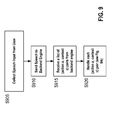
- Figures 9 and 9A together show a flow chart for one embodiment of voice command dispatching. It collects speech input from the user S905, send the speech to the backend engine S910, receives an answer from the backend engine S915, and tries to assemble a context according to the user's requirement before triggering the corresponding handler.
- the developer may use APIs provided by the framework.
- One embodiment of such an API is a routine to be called when listening starts, e.g., startListeningToVoiceCommand().
- the routine may take a stage parameter specifying what commands are expected.
- the implementation of the routine triggers code to record user voice input. The recording stops when a specific routine is called (e.g., endListeningToVoiceCommand()) or a timeout is reached.
- the framework sends the speech to the backend engine for recognition S910 after packaging it in an appropriate format.
- the framework receives an answer back from the backend engine in the form of a list of action-context pairs S915, which are handled one by one S920.
- the first command may be dispatched while the remaining command(s) is (are) buffered.
- Buffered commands may be processed when the current handler finishes execution.
- the framework looks up the registration table for the current stage to get expected parameters and handler S924. If the context received from the backend engine is complete with respect to the expected parameters S926, the handler is triggered using the complete context S928. If not, the framework prompts the user for the missing parameters S930, collects the missing parameters from the user S932.
- the framework may provide an API for obtaining user's voice input without going through action registration. This provides a lightweight voice control mechanism useful for simple interactions with the user.
- this API takes a prompt and a list of context entries, e.g., ask(String prompt, Context c).
- the implementation of this API prompts the user for specific input (one or more items) S930 and collects the speech input from the user S932. It sends the speech to the backend engine S934, receives the missing parameter(s) from the backend engine S936, and adds the parameter into the context S938 prior to returning to check if the context is complete S926.
- the framework can provide a combination of the following APIs:
- the framework may facilitate an optional process of grammar compilation, as illustrated in Figure 5 .
- the process works based on the action handler registration S510 (280) and the specification of custom commands S520 provided by the developer through framework APIs during development.
- the grammar compilation process S530 collects actions from the action handler registration S510 and composes a custom grammar S540 for them based on the NLP library 154.
- the grammar compilation process S530 further collects specification of custom commands S520 and expands the custom grammar S540 accordingly.
- the resultant custom grammar S540 can be used at runtime to guide a speech recognition engine.
- Ambiguity may arise during grammar compilation. Errors may be raised accordingly so that the developer may then chose to: change allowed actions, change specifications of uncommon actions, specify priorities of actions, and/or defer the resolution of ambiguity until runtime (e.g., by asking the user).
- the speech recognition engine may use a special action to indicate ambiguity and the framework may provide routines to handle them accordingly.
- the framework may facilitate an optional process of engine optimization S630, as illustrated in Figure 6 .
- the situation is similar to the process of grammar compilation shown in Figure 5 , except that the resulting produced custom speech engine S640 is a self-contained speech recognition engine to be used at runtime.
- the custom speech engine S640 can be provided either on the Cloud or shipped to the UE 10 together with the application.
- the action handlers are registered S300 at application initialization time. This involves associating addresses of application handlers along with the actions as described previously.
- the application will be in a particular state and expecting user 5 input via either a touch screen input or voice input S302.
- the exemplary navigation application might be expecting, as one possibility for input, the command, "where am I?". If the user 5 issues this voice command to the Application S304, the speech engine translates S306 this inquiry into an action S308 associated with a particular context of parameters for the action, if any, the action having been registered when the application was initialized S300.
- the action/context are then dispatched by the command dispatching S310.
- the speech engine may be a standard component obtained from third parties and based on existing art. If the optional grammar compilation process is used, the speech engine would be guided by a custom grammar during recognition. If the optional engine optimization process is used, the speech engine would be the custom engine. If neither is used, the speech engine may use a standard grammar that characterizes all actions supported by the framework. In the latter case, the application, via the framework, may send a list of allowed actions to the speech engine during initialization or together with a recognition request to narrow down the list of possible actions to recognize, although this is not essential.
- the command dispatching routine S310 determines the address (pointer) of the appropriate handler for handling the command and causes the application to execute the code at the location pointed to. Its internal workings were discussed above in Figures 9 and 9A .
- the system or systems described herein may be implemented on any form of computer or computers and the components may be implemented as dedicated applications or in client-server architectures, including a web-based architecture, and can include functional programs, codes, and code segments.
- Any of the computers may comprise a processor, a memory for storing program data and executing it, a permanent storage such as a disk drive, a communications port for handling communications with external devices, and user interface devices, including a display, keyboard, mouse, etc.
- these software modules may be stored as program instructions or computer readable codes executable on the processor on a computer-readable media such as read-only memory (ROM), random-access memory (RAM), CD-ROMs, magnetic tapes, floppy disks, and optical data storage devices.
- the computer readable recording medium can also be distributed over network coupled computer systems so that the computer readable code is stored and executed in a distributed fashion. This media is readable by the computer, stored in the memory, and executed by the processor.
- the embodiments herein may be described in terms of functional block components and various processing steps. Such functional blocks may be realized by any number of hardware and/or software components that perform the specified functions.
- the described embodiments may employ various integrated circuit components, e.g., memory elements, processing elements, logic elements, look-up tables, and the like, which may carry out a variety of functions under the control of one or more microprocessors or other control devices.
- the elements of the described embodiments are implemented using software programming or software elements the invention may be implemented with any programming or scripting language such as C, C++, Java, assembler, or the like, with the various algorithms being implemented with any combination of data structures, objects, processes, routines or other programming elements.
- Functional aspects may be implemented in algorithms that execute on one or more processors.
- the embodiments of the invention could employ any number of conventional techniques for electronics configuration, signal processing and/or control, data processing and the like.
- the words “mechanism” and “element” are used broadly and are not limited to mechanical or physical embodiments, but can include software routines in conjunction with processors, etc.
Landscapes
- Engineering & Computer Science (AREA)
- Computational Linguistics (AREA)
- Health & Medical Sciences (AREA)
- Audiology, Speech & Language Pathology (AREA)
- Human Computer Interaction (AREA)
- Physics & Mathematics (AREA)
- Acoustics & Sound (AREA)
- Multimedia (AREA)
- Artificial Intelligence (AREA)
- Quality & Reliability (AREA)
- Signal Processing (AREA)
- User Interface Of Digital Computer (AREA)
Applications Claiming Priority (1)
| Application Number | Priority Date | Filing Date | Title |
|---|---|---|---|
| US201261611803P | 2012-03-16 | 2012-03-16 |
Publications (1)
| Publication Number | Publication Date |
|---|---|
| EP2639792A1 true EP2639792A1 (de) | 2013-09-18 |
Family
ID=47997307
Family Applications (1)
| Application Number | Title | Priority Date | Filing Date |
|---|---|---|---|
| EP13305250.6A Ceased EP2639792A1 (de) | 2012-03-16 | 2013-03-06 | Sprachsteuerung von Anwendungen durch Verknüpfung von Benutzereingaben mit Handlung-Kontext-Identifiziererpaaren |
Country Status (2)
| Country | Link |
|---|---|
| US (1) | US9437206B2 (de) |
| EP (1) | EP2639792A1 (de) |
Cited By (68)
| Publication number | Priority date | Publication date | Assignee | Title |
|---|---|---|---|---|
| WO2016085775A3 (en) * | 2014-11-28 | 2016-08-04 | Microsoft Technology Licensing, Llc | Extending digital personal assistant action providers |
| US20190361729A1 (en) * | 2012-05-15 | 2019-11-28 | Apple Inc. | Systems and Methods for Integrating Third Party Services with a Digital Assistant |
| US10978090B2 (en) | 2013-02-07 | 2021-04-13 | Apple Inc. | Voice trigger for a digital assistant |
| US10984798B2 (en) | 2018-06-01 | 2021-04-20 | Apple Inc. | Voice interaction at a primary device to access call functionality of a companion device |
| US11009970B2 (en) | 2018-06-01 | 2021-05-18 | Apple Inc. | Attention aware virtual assistant dismissal |
| US11037565B2 (en) | 2016-06-10 | 2021-06-15 | Apple Inc. | Intelligent digital assistant in a multi-tasking environment |
| US11070949B2 (en) | 2015-05-27 | 2021-07-20 | Apple Inc. | Systems and methods for proactively identifying and surfacing relevant content on an electronic device with a touch-sensitive display |
| US11087759B2 (en) | 2015-03-08 | 2021-08-10 | Apple Inc. | Virtual assistant activation |
| US11120372B2 (en) | 2011-06-03 | 2021-09-14 | Apple Inc. | Performing actions associated with task items that represent tasks to perform |
| US11126400B2 (en) | 2015-09-08 | 2021-09-21 | Apple Inc. | Zero latency digital assistant |
| US11133008B2 (en) | 2014-05-30 | 2021-09-28 | Apple Inc. | Reducing the need for manual start/end-pointing and trigger phrases |
| US11152002B2 (en) | 2016-06-11 | 2021-10-19 | Apple Inc. | Application integration with a digital assistant |
| US11169616B2 (en) | 2018-05-07 | 2021-11-09 | Apple Inc. | Raise to speak |
| US11237797B2 (en) | 2019-05-31 | 2022-02-01 | Apple Inc. | User activity shortcut suggestions |
| US11257504B2 (en) | 2014-05-30 | 2022-02-22 | Apple Inc. | Intelligent assistant for home automation |
| US11348582B2 (en) | 2008-10-02 | 2022-05-31 | Apple Inc. | Electronic devices with voice command and contextual data processing capabilities |
| US11380310B2 (en) | 2017-05-12 | 2022-07-05 | Apple Inc. | Low-latency intelligent automated assistant |
| US11388291B2 (en) | 2013-03-14 | 2022-07-12 | Apple Inc. | System and method for processing voicemail |
| US11405466B2 (en) | 2017-05-12 | 2022-08-02 | Apple Inc. | Synchronization and task delegation of a digital assistant |
| US11423886B2 (en) | 2010-01-18 | 2022-08-23 | Apple Inc. | Task flow identification based on user intent |
| US11431642B2 (en) | 2018-06-01 | 2022-08-30 | Apple Inc. | Variable latency device coordination |
| US11467802B2 (en) | 2017-05-11 | 2022-10-11 | Apple Inc. | Maintaining privacy of personal information |
| US11500672B2 (en) | 2015-09-08 | 2022-11-15 | Apple Inc. | Distributed personal assistant |
| US11516537B2 (en) | 2014-06-30 | 2022-11-29 | Apple Inc. | Intelligent automated assistant for TV user interactions |
| US11526368B2 (en) | 2015-11-06 | 2022-12-13 | Apple Inc. | Intelligent automated assistant in a messaging environment |
| US11532306B2 (en) | 2017-05-16 | 2022-12-20 | Apple Inc. | Detecting a trigger of a digital assistant |
| US11580990B2 (en) | 2017-05-12 | 2023-02-14 | Apple Inc. | User-specific acoustic models |
| US11599331B2 (en) | 2017-05-11 | 2023-03-07 | Apple Inc. | Maintaining privacy of personal information |
| US11657813B2 (en) | 2019-05-31 | 2023-05-23 | Apple Inc. | Voice identification in digital assistant systems |
| US11671920B2 (en) | 2007-04-03 | 2023-06-06 | Apple Inc. | Method and system for operating a multifunction portable electronic device using voice-activation |
| US11670289B2 (en) | 2014-05-30 | 2023-06-06 | Apple Inc. | Multi-command single utterance input method |
| US11675491B2 (en) | 2019-05-06 | 2023-06-13 | Apple Inc. | User configurable task triggers |
| US11675829B2 (en) | 2017-05-16 | 2023-06-13 | Apple Inc. | Intelligent automated assistant for media exploration |
| US11696060B2 (en) | 2020-07-21 | 2023-07-04 | Apple Inc. | User identification using headphones |
| US11705130B2 (en) | 2019-05-06 | 2023-07-18 | Apple Inc. | Spoken notifications |
| US11710482B2 (en) | 2018-03-26 | 2023-07-25 | Apple Inc. | Natural assistant interaction |
| US11727219B2 (en) | 2013-06-09 | 2023-08-15 | Apple Inc. | System and method for inferring user intent from speech inputs |
| US11755276B2 (en) | 2020-05-12 | 2023-09-12 | Apple Inc. | Reducing description length based on confidence |
| US11755295B2 (en) | 2021-06-04 | 2023-09-12 | Bank Of America Corporation | Software development system |
| US11765209B2 (en) | 2020-05-11 | 2023-09-19 | Apple Inc. | Digital assistant hardware abstraction |
| US11783815B2 (en) | 2019-03-18 | 2023-10-10 | Apple Inc. | Multimodality in digital assistant systems |
| US11790914B2 (en) | 2019-06-01 | 2023-10-17 | Apple Inc. | Methods and user interfaces for voice-based control of electronic devices |
| US11798547B2 (en) | 2013-03-15 | 2023-10-24 | Apple Inc. | Voice activated device for use with a voice-based digital assistant |
| US11809783B2 (en) | 2016-06-11 | 2023-11-07 | Apple Inc. | Intelligent device arbitration and control |
| US11809483B2 (en) | 2015-09-08 | 2023-11-07 | Apple Inc. | Intelligent automated assistant for media search and playback |
| US11838734B2 (en) | 2020-07-20 | 2023-12-05 | Apple Inc. | Multi-device audio adjustment coordination |
| US11853647B2 (en) | 2015-12-23 | 2023-12-26 | Apple Inc. | Proactive assistance based on dialog communication between devices |
| US11854539B2 (en) | 2018-05-07 | 2023-12-26 | Apple Inc. | Intelligent automated assistant for delivering content from user experiences |
| US11853536B2 (en) | 2015-09-08 | 2023-12-26 | Apple Inc. | Intelligent automated assistant in a media environment |
| US11888791B2 (en) | 2019-05-21 | 2024-01-30 | Apple Inc. | Providing message response suggestions |
| US11886805B2 (en) | 2015-11-09 | 2024-01-30 | Apple Inc. | Unconventional virtual assistant interactions |
| US11893992B2 (en) | 2018-09-28 | 2024-02-06 | Apple Inc. | Multi-modal inputs for voice commands |
| US11914848B2 (en) | 2020-05-11 | 2024-02-27 | Apple Inc. | Providing relevant data items based on context |
| US11947873B2 (en) | 2015-06-29 | 2024-04-02 | Apple Inc. | Virtual assistant for media playback |
| US11978436B2 (en) | 2022-06-03 | 2024-05-07 | Apple Inc. | Application vocabulary integration with a digital assistant |
| US12001933B2 (en) | 2015-05-15 | 2024-06-04 | Apple Inc. | Virtual assistant in a communication session |
| US12010262B2 (en) | 2013-08-06 | 2024-06-11 | Apple Inc. | Auto-activating smart responses based on activities from remote devices |
| US12014118B2 (en) | 2017-05-15 | 2024-06-18 | Apple Inc. | Multi-modal interfaces having selection disambiguation and text modification capability |
| US12051413B2 (en) | 2015-09-30 | 2024-07-30 | Apple Inc. | Intelligent device identification |
| US12067985B2 (en) | 2018-06-01 | 2024-08-20 | Apple Inc. | Virtual assistant operations in multi-device environments |
| US12073147B2 (en) | 2013-06-09 | 2024-08-27 | Apple Inc. | Device, method, and graphical user interface for enabling conversation persistence across two or more instances of a digital assistant |
| US12087308B2 (en) | 2010-01-18 | 2024-09-10 | Apple Inc. | Intelligent automated assistant |
| US12197817B2 (en) | 2016-06-11 | 2025-01-14 | Apple Inc. | Intelligent device arbitration and control |
| US12223282B2 (en) | 2016-06-09 | 2025-02-11 | Apple Inc. | Intelligent automated assistant in a home environment |
| US12254887B2 (en) | 2017-05-16 | 2025-03-18 | Apple Inc. | Far-field extension of digital assistant services for providing a notification of an event to a user |
| US12260234B2 (en) | 2017-01-09 | 2025-03-25 | Apple Inc. | Application integration with a digital assistant |
| US12556890B2 (en) | 2011-06-03 | 2026-02-17 | Apple Inc. | Active transport based notifications |
| US12619452B2 (en) | 2023-07-20 | 2026-05-05 | Apple Inc. | Intelligent automated assistant in a messaging environment |
Families Citing this family (98)
| Publication number | Priority date | Publication date | Assignee | Title |
|---|---|---|---|---|
| US8677377B2 (en) | 2005-09-08 | 2014-03-18 | Apple Inc. | Method and apparatus for building an intelligent automated assistant |
| US10002189B2 (en) | 2007-12-20 | 2018-06-19 | Apple Inc. | Method and apparatus for searching using an active ontology |
| US9330720B2 (en) | 2008-01-03 | 2016-05-03 | Apple Inc. | Methods and apparatus for altering audio output signals |
| US20100030549A1 (en) | 2008-07-31 | 2010-02-04 | Lee Michael M | Mobile device having human language translation capability with positional feedback |
| US8682667B2 (en) | 2010-02-25 | 2014-03-25 | Apple Inc. | User profiling for selecting user specific voice input processing information |
| US9262612B2 (en) | 2011-03-21 | 2016-02-16 | Apple Inc. | Device access using voice authentication |
| US10134385B2 (en) | 2012-03-02 | 2018-11-20 | Apple Inc. | Systems and methods for name pronunciation |
| US20140136508A1 (en) | 2012-11-09 | 2014-05-15 | Palo Alto Research Center Incorporated | Computer-Implemented System And Method For Providing Website Navigation Recommendations |
| US9218819B1 (en) | 2013-03-01 | 2015-12-22 | Google Inc. | Customizing actions based on contextual data and voice-based inputs |
| WO2014197335A1 (en) | 2013-06-08 | 2014-12-11 | Apple Inc. | Interpreting and acting upon commands that involve sharing information with remote devices |
| KR102161439B1 (ko) * | 2013-07-16 | 2020-10-05 | 삼성전자 주식회사 | 휴대 단말기에서 음성 인식을 수행하는 방법 및 장치 |
| US10095471B2 (en) * | 2013-09-20 | 2018-10-09 | Oracle International Corporation | Context aware voice interface for computing devices |
| US9451434B2 (en) | 2013-11-27 | 2016-09-20 | At&T Intellectual Property I, L.P. | Direct interaction between a user and a communication network |
| US10296160B2 (en) | 2013-12-06 | 2019-05-21 | Apple Inc. | Method for extracting salient dialog usage from live data |
| US10978060B2 (en) * | 2014-01-31 | 2021-04-13 | Hewlett-Packard Development Company, L.P. | Voice input command |
| US9430463B2 (en) | 2014-05-30 | 2016-08-30 | Apple Inc. | Exemplar-based natural language processing |
| US9633004B2 (en) | 2014-05-30 | 2017-04-25 | Apple Inc. | Better resolution when referencing to concepts |
| US9818400B2 (en) | 2014-09-11 | 2017-11-14 | Apple Inc. | Method and apparatus for discovering trending terms in speech requests |
| US10074360B2 (en) | 2014-09-30 | 2018-09-11 | Apple Inc. | Providing an indication of the suitability of speech recognition |
| US9668121B2 (en) | 2014-09-30 | 2017-05-30 | Apple Inc. | Social reminders |
| US10127911B2 (en) | 2014-09-30 | 2018-11-13 | Apple Inc. | Speaker identification and unsupervised speaker adaptation techniques |
| US20160225369A1 (en) * | 2015-01-30 | 2016-08-04 | Google Technology Holdings LLC | Dynamic inference of voice command for software operation from user manipulation of electronic device |
| US10152299B2 (en) | 2015-03-06 | 2018-12-11 | Apple Inc. | Reducing response latency of intelligent automated assistants |
| US9721566B2 (en) | 2015-03-08 | 2017-08-01 | Apple Inc. | Competing devices responding to voice triggers |
| US10567477B2 (en) | 2015-03-08 | 2020-02-18 | Apple Inc. | Virtual assistant continuity |
| WO2016151700A1 (ja) * | 2015-03-20 | 2016-09-29 | 株式会社 東芝 | 意図理解装置、方法およびプログラム |
| US10083688B2 (en) | 2015-05-27 | 2018-09-25 | Apple Inc. | Device voice control for selecting a displayed affordance |
| US9578173B2 (en) | 2015-06-05 | 2017-02-21 | Apple Inc. | Virtual assistant aided communication with 3rd party service in a communication session |
| US11025565B2 (en) | 2015-06-07 | 2021-06-01 | Apple Inc. | Personalized prediction of responses for instant messaging |
| US10209851B2 (en) | 2015-09-18 | 2019-02-19 | Google Llc | Management of inactive windows |
| US10891106B2 (en) * | 2015-10-13 | 2021-01-12 | Google Llc | Automatic batch voice commands |
| US20170147286A1 (en) * | 2015-11-20 | 2017-05-25 | GM Global Technology Operations LLC | Methods and systems for interfacing a speech dialog with new applications |
| US10049668B2 (en) | 2015-12-02 | 2018-08-14 | Apple Inc. | Applying neural network language models to weighted finite state transducers for automatic speech recognition |
| US10417346B2 (en) | 2016-01-23 | 2019-09-17 | Microsoft Technology Licensing, Llc | Tool for facilitating the development of new language understanding scenarios |
| US10339481B2 (en) * | 2016-01-29 | 2019-07-02 | Liquid Analytics, Inc. | Systems and methods for generating user interface-based service workflows utilizing voice data |
| US9922648B2 (en) | 2016-03-01 | 2018-03-20 | Google Llc | Developer voice actions system |
| US9818405B2 (en) * | 2016-03-15 | 2017-11-14 | SAESTEK Ses ve Iletisim Bilgisayar Tekn. San. Ve Tic. A.S. | Dialog management system |
| US11436656B2 (en) | 2016-03-18 | 2022-09-06 | Palo Alto Research Center Incorporated | System and method for a real-time egocentric collaborative filter on large datasets |
| US10587708B2 (en) | 2016-03-28 | 2020-03-10 | Microsoft Technology Licensing, Llc | Multi-modal conversational intercom |
| US10171410B2 (en) | 2016-03-28 | 2019-01-01 | Microsoft Technology Licensing, Llc | Cross-mode communiation |
| US11487512B2 (en) | 2016-03-29 | 2022-11-01 | Microsoft Technology Licensing, Llc | Generating a services application |
| US11599709B2 (en) * | 2016-05-19 | 2023-03-07 | Palo Alto Research Center Incorporated | Natural language web browser |
| US11227589B2 (en) | 2016-06-06 | 2022-01-18 | Apple Inc. | Intelligent list reading |
| US10049670B2 (en) | 2016-06-06 | 2018-08-14 | Google Llc | Providing voice action discoverability example for trigger term |
| US10049663B2 (en) | 2016-06-08 | 2018-08-14 | Apple, Inc. | Intelligent automated assistant for media exploration |
| AU2017100589B4 (en) * | 2016-06-11 | 2017-08-31 | Apple Inc. | Application integration with a digital assistant |
| US11093834B2 (en) | 2016-07-06 | 2021-08-17 | Palo Alto Research Center Incorporated | Computer-implemented system and method for predicting activity outcome based on user attention |
| US10261752B2 (en) * | 2016-08-02 | 2019-04-16 | Google Llc | Component libraries for voice interaction services |
| US10573299B2 (en) * | 2016-08-19 | 2020-02-25 | Panasonic Avionics Corporation | Digital assistant and associated methods for a transportation vehicle |
| US9691384B1 (en) | 2016-08-19 | 2017-06-27 | Google Inc. | Voice action biasing system |
| US10474753B2 (en) | 2016-09-07 | 2019-11-12 | Apple Inc. | Language identification using recurrent neural networks |
| US10043516B2 (en) | 2016-09-23 | 2018-08-07 | Apple Inc. | Intelligent automated assistant |
| US11281993B2 (en) | 2016-12-05 | 2022-03-22 | Apple Inc. | Model and ensemble compression for metric learning |
| US11507216B2 (en) * | 2016-12-23 | 2022-11-22 | Realwear, Inc. | Customizing user interfaces of binary applications |
| US10276161B2 (en) * | 2016-12-27 | 2019-04-30 | Google Llc | Contextual hotwords |
| US10467509B2 (en) | 2017-02-14 | 2019-11-05 | Microsoft Technology Licensing, Llc | Computationally-efficient human-identifying smart assistant computer |
| US10417266B2 (en) | 2017-05-09 | 2019-09-17 | Apple Inc. | Context-aware ranking of intelligent response suggestions |
| DK201770383A1 (en) | 2017-05-09 | 2018-12-14 | Apple Inc. | USER INTERFACE FOR CORRECTING RECOGNITION ERRORS |
| DK201770439A1 (en) | 2017-05-11 | 2018-12-13 | Apple Inc. | Offline personal assistant |
| US10395654B2 (en) | 2017-05-11 | 2019-08-27 | Apple Inc. | Text normalization based on a data-driven learning network |
| US11301477B2 (en) | 2017-05-12 | 2022-04-12 | Apple Inc. | Feedback analysis of a digital assistant |
| DK201770432A1 (en) | 2017-05-15 | 2018-12-21 | Apple Inc. | Hierarchical belief states for digital assistants |
| DK201770431A1 (en) | 2017-05-15 | 2018-12-20 | Apple Inc. | Optimizing dialogue policy decisions for digital assistants using implicit feedback |
| US10403278B2 (en) | 2017-05-16 | 2019-09-03 | Apple Inc. | Methods and systems for phonetic matching in digital assistant services |
| US10311144B2 (en) | 2017-05-16 | 2019-06-04 | Apple Inc. | Emoji word sense disambiguation |
| EP3635578B1 (de) * | 2017-05-18 | 2025-10-15 | Peloton Interactive, Inc. | Systeme und verfahren für crwodsourcing-aktionen und -befehle |
| US10657328B2 (en) | 2017-06-02 | 2020-05-19 | Apple Inc. | Multi-task recurrent neural network architecture for efficient morphology handling in neural language modeling |
| US10445429B2 (en) | 2017-09-21 | 2019-10-15 | Apple Inc. | Natural language understanding using vocabularies with compressed serialized tries |
| US10755051B2 (en) | 2017-09-29 | 2020-08-25 | Apple Inc. | Rule-based natural language processing |
| US10636424B2 (en) | 2017-11-30 | 2020-04-28 | Apple Inc. | Multi-turn canned dialog |
| US10733982B2 (en) | 2018-01-08 | 2020-08-04 | Apple Inc. | Multi-directional dialog |
| US11294975B1 (en) * | 2018-01-10 | 2022-04-05 | Zoho Corporation Private Limited | Systems and methods for automated skill creation and selection |
| US10733375B2 (en) | 2018-01-31 | 2020-08-04 | Apple Inc. | Knowledge-based framework for improving natural language understanding |
| US10789959B2 (en) | 2018-03-02 | 2020-09-29 | Apple Inc. | Training speaker recognition models for digital assistants |
| US10592604B2 (en) | 2018-03-12 | 2020-03-17 | Apple Inc. | Inverse text normalization for automatic speech recognition |
| US10909331B2 (en) | 2018-03-30 | 2021-02-02 | Apple Inc. | Implicit identification of translation payload with neural machine translation |
| US10984780B2 (en) | 2018-05-21 | 2021-04-20 | Apple Inc. | Global semantic word embeddings using bi-directional recurrent neural networks |
| US11386266B2 (en) | 2018-06-01 | 2022-07-12 | Apple Inc. | Text correction |
| US10504518B1 (en) | 2018-06-03 | 2019-12-10 | Apple Inc. | Accelerated task performance |
| US11545144B2 (en) * | 2018-07-27 | 2023-01-03 | Samsung Electronics Co., Ltd. | System and method supporting context-specific language model |
| US11010561B2 (en) | 2018-09-27 | 2021-05-18 | Apple Inc. | Sentiment prediction from textual data |
| US11170166B2 (en) | 2018-09-28 | 2021-11-09 | Apple Inc. | Neural typographical error modeling via generative adversarial networks |
| US10839159B2 (en) | 2018-09-28 | 2020-11-17 | Apple Inc. | Named entity normalization in a spoken dialog system |
| US11475898B2 (en) | 2018-10-26 | 2022-10-18 | Apple Inc. | Low-latency multi-speaker speech recognition |
| US11638059B2 (en) | 2019-01-04 | 2023-04-25 | Apple Inc. | Content playback on multiple devices |
| US11423908B2 (en) | 2019-05-06 | 2022-08-23 | Apple Inc. | Interpreting spoken requests |
| US11475884B2 (en) | 2019-05-06 | 2022-10-18 | Apple Inc. | Reducing digital assistant latency when a language is incorrectly determined |
| US11496600B2 (en) | 2019-05-31 | 2022-11-08 | Apple Inc. | Remote execution of machine-learned models |
| US11289073B2 (en) | 2019-05-31 | 2022-03-29 | Apple Inc. | Device text to speech |
| US11360641B2 (en) | 2019-06-01 | 2022-06-14 | Apple Inc. | Increasing the relevance of new available information |
| US20210026594A1 (en) | 2019-07-23 | 2021-01-28 | Cdw Llc | Voice control hub methods and systems |
| US11488406B2 (en) | 2019-09-25 | 2022-11-01 | Apple Inc. | Text detection using global geometry estimators |
| US11769013B2 (en) * | 2019-11-11 | 2023-09-26 | Salesforce, Inc. | Machine learning based tenant-specific chatbots for performing actions in a multi-tenant system |
| US11763090B2 (en) | 2019-11-11 | 2023-09-19 | Salesforce, Inc. | Predicting user intent for online system actions through natural language inference-based machine learning model |
| US11810578B2 (en) | 2020-05-11 | 2023-11-07 | Apple Inc. | Device arbitration for digital assistant-based intercom systems |
| CN113936695A (zh) * | 2020-06-29 | 2022-01-14 | 大众问问(北京)信息科技有限公司 | 一种语音有效性的检测方法、装置及设备 |
| US11691076B2 (en) | 2020-08-10 | 2023-07-04 | Jocelyn Tan | Communication with in-game characters |
| US12230261B2 (en) * | 2020-09-23 | 2025-02-18 | Samsung Electronics Co., Ltd. | Electronic apparatus and method for controlling user interface elements by voice |
Citations (2)
| Publication number | Priority date | Publication date | Assignee | Title |
|---|---|---|---|---|
| US20030014251A1 (en) * | 2001-04-27 | 2003-01-16 | Shuvranshu Pokhariyal | Speech recognition framework |
| WO2011097174A1 (en) * | 2010-02-05 | 2011-08-11 | Nuance Communications, Inc. | Language context sensitive command system and method |
Family Cites Families (6)
| Publication number | Priority date | Publication date | Assignee | Title |
|---|---|---|---|---|
| US7130807B1 (en) * | 1999-11-22 | 2006-10-31 | Accenture Llp | Technology sharing during demand and supply planning in a network-based supply chain environment |
| US7590589B2 (en) * | 2004-09-10 | 2009-09-15 | Hoffberg Steven M | Game theoretic prioritization scheme for mobile ad hoc networks permitting hierarchal deference |
| US7739117B2 (en) * | 2004-09-20 | 2010-06-15 | International Business Machines Corporation | Method and system for voice-enabled autofill |
| US20060074980A1 (en) * | 2004-09-29 | 2006-04-06 | Sarkar Pte. Ltd. | System for semantically disambiguating text information |
| US7561673B2 (en) * | 2004-09-30 | 2009-07-14 | Microsoft Corporation | Integration of speech services with telecommunications |
| US20060136220A1 (en) * | 2004-12-22 | 2006-06-22 | Rama Gurram | Controlling user interfaces with voice commands from multiple languages |
-
2013
- 2013-03-06 EP EP13305250.6A patent/EP2639792A1/de not_active Ceased
- 2013-03-15 US US13/835,335 patent/US9437206B2/en active Active
Patent Citations (2)
| Publication number | Priority date | Publication date | Assignee | Title |
|---|---|---|---|---|
| US20030014251A1 (en) * | 2001-04-27 | 2003-01-16 | Shuvranshu Pokhariyal | Speech recognition framework |
| WO2011097174A1 (en) * | 2010-02-05 | 2011-08-11 | Nuance Communications, Inc. | Language context sensitive command system and method |
Cited By (119)
| Publication number | Priority date | Publication date | Assignee | Title |
|---|---|---|---|---|
| US11979836B2 (en) | 2007-04-03 | 2024-05-07 | Apple Inc. | Method and system for operating a multi-function portable electronic device using voice-activation |
| US11671920B2 (en) | 2007-04-03 | 2023-06-06 | Apple Inc. | Method and system for operating a multifunction portable electronic device using voice-activation |
| US11348582B2 (en) | 2008-10-02 | 2022-05-31 | Apple Inc. | Electronic devices with voice command and contextual data processing capabilities |
| US11900936B2 (en) | 2008-10-02 | 2024-02-13 | Apple Inc. | Electronic devices with voice command and contextual data processing capabilities |
| US12431128B2 (en) | 2010-01-18 | 2025-09-30 | Apple Inc. | Task flow identification based on user intent |
| US12087308B2 (en) | 2010-01-18 | 2024-09-10 | Apple Inc. | Intelligent automated assistant |
| US12165635B2 (en) | 2010-01-18 | 2024-12-10 | Apple Inc. | Intelligent automated assistant |
| US11423886B2 (en) | 2010-01-18 | 2022-08-23 | Apple Inc. | Task flow identification based on user intent |
| US11120372B2 (en) | 2011-06-03 | 2021-09-14 | Apple Inc. | Performing actions associated with task items that represent tasks to perform |
| US12556890B2 (en) | 2011-06-03 | 2026-02-17 | Apple Inc. | Active transport based notifications |
| US20190361729A1 (en) * | 2012-05-15 | 2019-11-28 | Apple Inc. | Systems and Methods for Integrating Third Party Services with a Digital Assistant |
| US12613730B2 (en) | 2012-05-15 | 2026-04-28 | Apple Inc. | Systems and methods for integrating third party services with a digital assistant |
| US11321116B2 (en) | 2012-05-15 | 2022-05-03 | Apple Inc. | Systems and methods for integrating third party services with a digital assistant |
| US11269678B2 (en) * | 2012-05-15 | 2022-03-08 | Apple Inc. | Systems and methods for integrating third party services with a digital assistant |
| US12009007B2 (en) | 2013-02-07 | 2024-06-11 | Apple Inc. | Voice trigger for a digital assistant |
| US11636869B2 (en) | 2013-02-07 | 2023-04-25 | Apple Inc. | Voice trigger for a digital assistant |
| US10978090B2 (en) | 2013-02-07 | 2021-04-13 | Apple Inc. | Voice trigger for a digital assistant |
| US11557310B2 (en) | 2013-02-07 | 2023-01-17 | Apple Inc. | Voice trigger for a digital assistant |
| US11862186B2 (en) | 2013-02-07 | 2024-01-02 | Apple Inc. | Voice trigger for a digital assistant |
| US12277954B2 (en) | 2013-02-07 | 2025-04-15 | Apple Inc. | Voice trigger for a digital assistant |
| US11388291B2 (en) | 2013-03-14 | 2022-07-12 | Apple Inc. | System and method for processing voicemail |
| US11798547B2 (en) | 2013-03-15 | 2023-10-24 | Apple Inc. | Voice activated device for use with a voice-based digital assistant |
| US12073147B2 (en) | 2013-06-09 | 2024-08-27 | Apple Inc. | Device, method, and graphical user interface for enabling conversation persistence across two or more instances of a digital assistant |
| US11727219B2 (en) | 2013-06-09 | 2023-08-15 | Apple Inc. | System and method for inferring user intent from speech inputs |
| US12010262B2 (en) | 2013-08-06 | 2024-06-11 | Apple Inc. | Auto-activating smart responses based on activities from remote devices |
| US11699448B2 (en) | 2014-05-30 | 2023-07-11 | Apple Inc. | Intelligent assistant for home automation |
| US12118999B2 (en) | 2014-05-30 | 2024-10-15 | Apple Inc. | Reducing the need for manual start/end-pointing and trigger phrases |
| US11670289B2 (en) | 2014-05-30 | 2023-06-06 | Apple Inc. | Multi-command single utterance input method |
| US12067990B2 (en) | 2014-05-30 | 2024-08-20 | Apple Inc. | Intelligent assistant for home automation |
| US11133008B2 (en) | 2014-05-30 | 2021-09-28 | Apple Inc. | Reducing the need for manual start/end-pointing and trigger phrases |
| US11257504B2 (en) | 2014-05-30 | 2022-02-22 | Apple Inc. | Intelligent assistant for home automation |
| US11810562B2 (en) | 2014-05-30 | 2023-11-07 | Apple Inc. | Reducing the need for manual start/end-pointing and trigger phrases |
| US11838579B2 (en) | 2014-06-30 | 2023-12-05 | Apple Inc. | Intelligent automated assistant for TV user interactions |
| US12200297B2 (en) | 2014-06-30 | 2025-01-14 | Apple Inc. | Intelligent automated assistant for TV user interactions |
| US11516537B2 (en) | 2014-06-30 | 2022-11-29 | Apple Inc. | Intelligent automated assistant for TV user interactions |
| CN107004413B (zh) * | 2014-11-28 | 2021-02-26 | 微软技术许可有限责任公司 | 扩展数字个人助理动作提供者 |
| CN107004413A (zh) * | 2014-11-28 | 2017-08-01 | 微软技术许可有限责任公司 | 扩展数字个人助理动作提供者 |
| US10192549B2 (en) | 2014-11-28 | 2019-01-29 | Microsoft Technology Licensing, Llc | Extending digital personal assistant action providers |
| WO2016085775A3 (en) * | 2014-11-28 | 2016-08-04 | Microsoft Technology Licensing, Llc | Extending digital personal assistant action providers |
| US11842734B2 (en) | 2015-03-08 | 2023-12-12 | Apple Inc. | Virtual assistant activation |
| US11087759B2 (en) | 2015-03-08 | 2021-08-10 | Apple Inc. | Virtual assistant activation |
| US12236952B2 (en) | 2015-03-08 | 2025-02-25 | Apple Inc. | Virtual assistant activation |
| US12154016B2 (en) | 2015-05-15 | 2024-11-26 | Apple Inc. | Virtual assistant in a communication session |
| US12001933B2 (en) | 2015-05-15 | 2024-06-04 | Apple Inc. | Virtual assistant in a communication session |
| US11070949B2 (en) | 2015-05-27 | 2021-07-20 | Apple Inc. | Systems and methods for proactively identifying and surfacing relevant content on an electronic device with a touch-sensitive display |
| US11947873B2 (en) | 2015-06-29 | 2024-04-02 | Apple Inc. | Virtual assistant for media playback |
| US11954405B2 (en) | 2015-09-08 | 2024-04-09 | Apple Inc. | Zero latency digital assistant |
| US11126400B2 (en) | 2015-09-08 | 2021-09-21 | Apple Inc. | Zero latency digital assistant |
| US11550542B2 (en) | 2015-09-08 | 2023-01-10 | Apple Inc. | Zero latency digital assistant |
| US11500672B2 (en) | 2015-09-08 | 2022-11-15 | Apple Inc. | Distributed personal assistant |
| US11809483B2 (en) | 2015-09-08 | 2023-11-07 | Apple Inc. | Intelligent automated assistant for media search and playback |
| US11853536B2 (en) | 2015-09-08 | 2023-12-26 | Apple Inc. | Intelligent automated assistant in a media environment |
| US12204932B2 (en) | 2015-09-08 | 2025-01-21 | Apple Inc. | Distributed personal assistant |
| US12051413B2 (en) | 2015-09-30 | 2024-07-30 | Apple Inc. | Intelligent device identification |
| US11526368B2 (en) | 2015-11-06 | 2022-12-13 | Apple Inc. | Intelligent automated assistant in a messaging environment |
| US11809886B2 (en) | 2015-11-06 | 2023-11-07 | Apple Inc. | Intelligent automated assistant in a messaging environment |
| US11886805B2 (en) | 2015-11-09 | 2024-01-30 | Apple Inc. | Unconventional virtual assistant interactions |
| US11853647B2 (en) | 2015-12-23 | 2023-12-26 | Apple Inc. | Proactive assistance based on dialog communication between devices |
| US12223282B2 (en) | 2016-06-09 | 2025-02-11 | Apple Inc. | Intelligent automated assistant in a home environment |
| US11037565B2 (en) | 2016-06-10 | 2021-06-15 | Apple Inc. | Intelligent digital assistant in a multi-tasking environment |
| US12175977B2 (en) | 2016-06-10 | 2024-12-24 | Apple Inc. | Intelligent digital assistant in a multi-tasking environment |
| US11657820B2 (en) | 2016-06-10 | 2023-05-23 | Apple Inc. | Intelligent digital assistant in a multi-tasking environment |
| US11809783B2 (en) | 2016-06-11 | 2023-11-07 | Apple Inc. | Intelligent device arbitration and control |
| US11749275B2 (en) | 2016-06-11 | 2023-09-05 | Apple Inc. | Application integration with a digital assistant |
| US11152002B2 (en) | 2016-06-11 | 2021-10-19 | Apple Inc. | Application integration with a digital assistant |
| US12293763B2 (en) | 2016-06-11 | 2025-05-06 | Apple Inc. | Application integration with a digital assistant |
| US12197817B2 (en) | 2016-06-11 | 2025-01-14 | Apple Inc. | Intelligent device arbitration and control |
| US12260234B2 (en) | 2017-01-09 | 2025-03-25 | Apple Inc. | Application integration with a digital assistant |
| US11599331B2 (en) | 2017-05-11 | 2023-03-07 | Apple Inc. | Maintaining privacy of personal information |
| US11467802B2 (en) | 2017-05-11 | 2022-10-11 | Apple Inc. | Maintaining privacy of personal information |
| US11580990B2 (en) | 2017-05-12 | 2023-02-14 | Apple Inc. | User-specific acoustic models |
| US11862151B2 (en) | 2017-05-12 | 2024-01-02 | Apple Inc. | Low-latency intelligent automated assistant |
| US11405466B2 (en) | 2017-05-12 | 2022-08-02 | Apple Inc. | Synchronization and task delegation of a digital assistant |
| US11380310B2 (en) | 2017-05-12 | 2022-07-05 | Apple Inc. | Low-latency intelligent automated assistant |
| US11538469B2 (en) | 2017-05-12 | 2022-12-27 | Apple Inc. | Low-latency intelligent automated assistant |
| US11837237B2 (en) | 2017-05-12 | 2023-12-05 | Apple Inc. | User-specific acoustic models |
| US12014118B2 (en) | 2017-05-15 | 2024-06-18 | Apple Inc. | Multi-modal interfaces having selection disambiguation and text modification capability |
| US12254887B2 (en) | 2017-05-16 | 2025-03-18 | Apple Inc. | Far-field extension of digital assistant services for providing a notification of an event to a user |
| US11532306B2 (en) | 2017-05-16 | 2022-12-20 | Apple Inc. | Detecting a trigger of a digital assistant |
| US11675829B2 (en) | 2017-05-16 | 2023-06-13 | Apple Inc. | Intelligent automated assistant for media exploration |
| US12026197B2 (en) | 2017-05-16 | 2024-07-02 | Apple Inc. | Intelligent automated assistant for media exploration |
| US12211502B2 (en) | 2018-03-26 | 2025-01-28 | Apple Inc. | Natural assistant interaction |
| US11710482B2 (en) | 2018-03-26 | 2023-07-25 | Apple Inc. | Natural assistant interaction |
| US11907436B2 (en) | 2018-05-07 | 2024-02-20 | Apple Inc. | Raise to speak |
| US11169616B2 (en) | 2018-05-07 | 2021-11-09 | Apple Inc. | Raise to speak |
| US11900923B2 (en) | 2018-05-07 | 2024-02-13 | Apple Inc. | Intelligent automated assistant for delivering content from user experiences |
| US11487364B2 (en) | 2018-05-07 | 2022-11-01 | Apple Inc. | Raise to speak |
| US11854539B2 (en) | 2018-05-07 | 2023-12-26 | Apple Inc. | Intelligent automated assistant for delivering content from user experiences |
| US11360577B2 (en) | 2018-06-01 | 2022-06-14 | Apple Inc. | Attention aware virtual assistant dismissal |
| US11630525B2 (en) | 2018-06-01 | 2023-04-18 | Apple Inc. | Attention aware virtual assistant dismissal |
| US12061752B2 (en) | 2018-06-01 | 2024-08-13 | Apple Inc. | Attention aware virtual assistant dismissal |
| US12067985B2 (en) | 2018-06-01 | 2024-08-20 | Apple Inc. | Virtual assistant operations in multi-device environments |
| US11009970B2 (en) | 2018-06-01 | 2021-05-18 | Apple Inc. | Attention aware virtual assistant dismissal |
| US12080287B2 (en) | 2018-06-01 | 2024-09-03 | Apple Inc. | Voice interaction at a primary device to access call functionality of a companion device |
| US10984798B2 (en) | 2018-06-01 | 2021-04-20 | Apple Inc. | Voice interaction at a primary device to access call functionality of a companion device |
| US11431642B2 (en) | 2018-06-01 | 2022-08-30 | Apple Inc. | Variable latency device coordination |
| US11893992B2 (en) | 2018-09-28 | 2024-02-06 | Apple Inc. | Multi-modal inputs for voice commands |
| US11783815B2 (en) | 2019-03-18 | 2023-10-10 | Apple Inc. | Multimodality in digital assistant systems |
| US12136419B2 (en) | 2019-03-18 | 2024-11-05 | Apple Inc. | Multimodality in digital assistant systems |
| US12216894B2 (en) | 2019-05-06 | 2025-02-04 | Apple Inc. | User configurable task triggers |
| US12154571B2 (en) | 2019-05-06 | 2024-11-26 | Apple Inc. | Spoken notifications |
| US11675491B2 (en) | 2019-05-06 | 2023-06-13 | Apple Inc. | User configurable task triggers |
| US11705130B2 (en) | 2019-05-06 | 2023-07-18 | Apple Inc. | Spoken notifications |
| US11888791B2 (en) | 2019-05-21 | 2024-01-30 | Apple Inc. | Providing message response suggestions |
| US11237797B2 (en) | 2019-05-31 | 2022-02-01 | Apple Inc. | User activity shortcut suggestions |
| US11657813B2 (en) | 2019-05-31 | 2023-05-23 | Apple Inc. | Voice identification in digital assistant systems |
| US11790914B2 (en) | 2019-06-01 | 2023-10-17 | Apple Inc. | Methods and user interfaces for voice-based control of electronic devices |
| US11765209B2 (en) | 2020-05-11 | 2023-09-19 | Apple Inc. | Digital assistant hardware abstraction |
| US11914848B2 (en) | 2020-05-11 | 2024-02-27 | Apple Inc. | Providing relevant data items based on context |
| US11924254B2 (en) | 2020-05-11 | 2024-03-05 | Apple Inc. | Digital assistant hardware abstraction |
| US12197712B2 (en) | 2020-05-11 | 2025-01-14 | Apple Inc. | Providing relevant data items based on context |
| US11755276B2 (en) | 2020-05-12 | 2023-09-12 | Apple Inc. | Reducing description length based on confidence |
| US11838734B2 (en) | 2020-07-20 | 2023-12-05 | Apple Inc. | Multi-device audio adjustment coordination |
| US11696060B2 (en) | 2020-07-21 | 2023-07-04 | Apple Inc. | User identification using headphones |
| US12219314B2 (en) | 2020-07-21 | 2025-02-04 | Apple Inc. | User identification using headphones |
| US11750962B2 (en) | 2020-07-21 | 2023-09-05 | Apple Inc. | User identification using headphones |
| US11755295B2 (en) | 2021-06-04 | 2023-09-12 | Bank Of America Corporation | Software development system |
| US11978436B2 (en) | 2022-06-03 | 2024-05-07 | Apple Inc. | Application vocabulary integration with a digital assistant |
| US12619452B2 (en) | 2023-07-20 | 2026-05-05 | Apple Inc. | Intelligent automated assistant in a messaging environment |
Also Published As
| Publication number | Publication date |
|---|---|
| US20130246050A1 (en) | 2013-09-19 |
| US9437206B2 (en) | 2016-09-06 |
Similar Documents
| Publication | Publication Date | Title |
|---|---|---|
| US9437206B2 (en) | Voice control of applications by associating user input with action-context identifier pairs | |
| US20220221959A1 (en) | Annotations in software applications for invoking dialog system functions | |
| AU2015210460B2 (en) | Speech recognition repair using contextual information | |
| KR102394289B1 (ko) | 맥락을 인식하는 인간-대-컴퓨터 대화 | |
| RU2349969C2 (ru) | Синхронное понимание семантических объектов, реализованное с помощью тэгов речевого приложения | |
| US8484025B1 (en) | Mapping an audio utterance to an action using a classifier | |
| US7962344B2 (en) | Depicting a speech user interface via graphical elements | |
| KR102490776B1 (ko) | 디지털 개인 비서 내에서 헤드리스로 작업을 완료하기 위한 기법 | |
| US10276157B2 (en) | Systems and methods for providing a voice agent user interface | |
| KR101912058B1 (ko) | 자연어 음성 서비스 환경에서 하이브리드 처리를 위한 시스템 및 방법 | |
| CN103299361B (zh) | 翻译语言 | |
| US20140095171A1 (en) | Systems and methods for providing a voice agent user interface | |
| US20140095172A1 (en) | Systems and methods for providing a voice agent user interface | |
| US20190042185A1 (en) | Flexible voice-based information retrieval system for virtual assistant | |
| CN110998526A (zh) | 用户配置的且自定义的交互式对话应用 | |
| CA2791277A1 (en) | Using context information to facilitate processing of commands in a virtual assistant | |
| CN110610701B (zh) | 语音交互方法、语音交互提示方法、装置和设备 | |
| US20140095167A1 (en) | Systems and methods for providing a voice agent user interface | |
| CN103003874A (zh) | 基于语言属性到联系人条目的分配而提供文本服务 | |
| AU2020264367B2 (en) | Contextual voice commands | |
| US9720748B1 (en) | Predefined intents for native applications | |
| US20140095168A1 (en) | Systems and methods for providing a voice agent user interface | |
| HK1183153A (en) | Speech recognition repair using contextual information |
Legal Events
| Date | Code | Title | Description |
|---|---|---|---|
| PUAI | Public reference made under article 153(3) epc to a published international application that has entered the european phase |
Free format text: ORIGINAL CODE: 0009012 |
|
| AK | Designated contracting states |
Kind code of ref document: A1 Designated state(s): AL AT BE BG CH CY CZ DE DK EE ES FI FR GB GR HR HU IE IS IT LI LT LU LV MC MK MT NL NO PL PT RO RS SE SI SK SM TR |
|
| AX | Request for extension of the european patent |
Extension state: BA ME |
|
| RAP1 | Party data changed (applicant data changed or rights of an application transferred) |
Owner name: ORANGE |
|
| 17P | Request for examination filed |
Effective date: 20140318 |
|
| RBV | Designated contracting states (corrected) |
Designated state(s): AL AT BE BG CH CY CZ DE DK EE ES FI FR GB GR HR HU IE IS IT LI LT LU LV MC MK MT NL NO PL PT RO RS SE SI SK SM TR |
|
| 17Q | First examination report despatched |
Effective date: 20141126 |
|
| STAA | Information on the status of an ep patent application or granted ep patent |
Free format text: STATUS: THE APPLICATION HAS BEEN REFUSED |
|
| 18R | Application refused |
Effective date: 20161012 |