EP2640138A1 - Rekonfiguration von Zeitvorlaufsgruppen - Google Patents
Rekonfiguration von Zeitvorlaufsgruppen Download PDFInfo
- Publication number
- EP2640138A1 EP2640138A1 EP12001807.2A EP12001807A EP2640138A1 EP 2640138 A1 EP2640138 A1 EP 2640138A1 EP 12001807 A EP12001807 A EP 12001807A EP 2640138 A1 EP2640138 A1 EP 2640138A1
- Authority
- EP
- European Patent Office
- Prior art keywords
- random access
- timing advance
- advance group
- mobile terminal
- timing
- Prior art date
- Legal status (The legal status is an assumption and is not a legal conclusion. Google has not performed a legal analysis and makes no representation as to the accuracy of the status listed.)
- Withdrawn
Links
- 238000000034 method Methods 0.000 claims abstract description 179
- 230000005540 biological transmission Effects 0.000 claims abstract description 110
- 238000010295 mobile communication Methods 0.000 claims abstract description 14
- 230000004044 response Effects 0.000 claims description 90
- 230000011664 signaling Effects 0.000 claims description 78
- 230000002776 aggregation Effects 0.000 claims description 42
- 238000004220 aggregation Methods 0.000 claims description 42
- 238000004891 communication Methods 0.000 claims description 11
- 239000000969 carrier Substances 0.000 abstract description 31
- 230000001934 delay Effects 0.000 abstract description 4
- 230000008859 change Effects 0.000 description 31
- 230000009849 deactivation Effects 0.000 description 14
- 230000008569 process Effects 0.000 description 12
- 230000004913 activation Effects 0.000 description 11
- 238000005516 engineering process Methods 0.000 description 7
- 238000001228 spectrum Methods 0.000 description 7
- 239000000872 buffer Substances 0.000 description 6
- 230000007246 mechanism Effects 0.000 description 6
- 238000013468 resource allocation Methods 0.000 description 6
- 238000010586 diagram Methods 0.000 description 5
- 230000006870 function Effects 0.000 description 5
- 230000007774 longterm Effects 0.000 description 5
- 238000005259 measurement Methods 0.000 description 5
- 238000012545 processing Methods 0.000 description 5
- 230000001360 synchronised effect Effects 0.000 description 5
- CIWBSHSKHKDKBQ-JLAZNSOCSA-N Ascorbic acid Chemical compound OC[C@H](O)[C@H]1OC(=O)C(O)=C1O CIWBSHSKHKDKBQ-JLAZNSOCSA-N 0.000 description 4
- 241000760358 Enodes Species 0.000 description 4
- 238000007726 management method Methods 0.000 description 4
- 101150116295 CAT2 gene Proteins 0.000 description 3
- 101100326920 Caenorhabditis elegans ctl-1 gene Proteins 0.000 description 3
- 101100494773 Caenorhabditis elegans ctl-2 gene Proteins 0.000 description 3
- 101100112369 Fasciola hepatica Cat-1 gene Proteins 0.000 description 3
- 101100005271 Neurospora crassa (strain ATCC 24698 / 74-OR23-1A / CBS 708.71 / DSM 1257 / FGSC 987) cat-1 gene Proteins 0.000 description 3
- 101100126846 Neurospora crassa (strain ATCC 24698 / 74-OR23-1A / CBS 708.71 / DSM 1257 / FGSC 987) katG gene Proteins 0.000 description 3
- 125000004122 cyclic group Chemical group 0.000 description 3
- 230000001419 dependent effect Effects 0.000 description 3
- 230000001965 increasing effect Effects 0.000 description 3
- 230000003595 spectral effect Effects 0.000 description 3
- 101000741965 Homo sapiens Inactive tyrosine-protein kinase PRAG1 Proteins 0.000 description 2
- 102100038659 Inactive tyrosine-protein kinase PRAG1 Human genes 0.000 description 2
- 101100005280 Neurospora crassa (strain ATCC 24698 / 74-OR23-1A / CBS 708.71 / DSM 1257 / FGSC 987) cat-3 gene Proteins 0.000 description 2
- 101150039363 SIB2 gene Proteins 0.000 description 2
- 230000002860 competitive effect Effects 0.000 description 2
- 230000000295 complement effect Effects 0.000 description 2
- 238000007906 compression Methods 0.000 description 2
- 230000001627 detrimental effect Effects 0.000 description 2
- 230000004069 differentiation Effects 0.000 description 2
- 238000011156 evaluation Methods 0.000 description 2
- 238000003780 insertion Methods 0.000 description 2
- 230000037431 insertion Effects 0.000 description 2
- 238000012423 maintenance Methods 0.000 description 2
- 238000013507 mapping Methods 0.000 description 2
- 238000012360 testing method Methods 0.000 description 2
- 230000001960 triggered effect Effects 0.000 description 2
- 101710085003 Alpha-tubulin N-acetyltransferase Proteins 0.000 description 1
- 101710085461 Alpha-tubulin N-acetyltransferase 1 Proteins 0.000 description 1
- 101100274486 Mus musculus Cited2 gene Proteins 0.000 description 1
- 101150096622 Smr2 gene Proteins 0.000 description 1
- 230000003213 activating effect Effects 0.000 description 1
- 238000013459 approach Methods 0.000 description 1
- 238000003491 array Methods 0.000 description 1
- 238000013475 authorization Methods 0.000 description 1
- 230000006835 compression Effects 0.000 description 1
- 230000008878 coupling Effects 0.000 description 1
- 238000010168 coupling process Methods 0.000 description 1
- 238000005859 coupling reaction Methods 0.000 description 1
- 230000006837 decompression Effects 0.000 description 1
- 238000011161 development Methods 0.000 description 1
- 238000002592 echocardiography Methods 0.000 description 1
- 230000002708 enhancing effect Effects 0.000 description 1
- 238000005562 fading Methods 0.000 description 1
- 239000000796 flavoring agent Substances 0.000 description 1
- 235000019634 flavors Nutrition 0.000 description 1
- 235000003642 hunger Nutrition 0.000 description 1
- 230000036039 immunity Effects 0.000 description 1
- 230000006872 improvement Effects 0.000 description 1
- 238000012986 modification Methods 0.000 description 1
- 230000004048 modification Effects 0.000 description 1
- 229920000915 polyvinyl chloride Polymers 0.000 description 1
- 230000010076 replication Effects 0.000 description 1
- 239000000523 sample Substances 0.000 description 1
- 238000000638 solvent extraction Methods 0.000 description 1
- 230000037351 starvation Effects 0.000 description 1
- 230000003068 static effect Effects 0.000 description 1
- 208000037918 transfusion-transmitted disease Diseases 0.000 description 1
- 230000007704 transition Effects 0.000 description 1
Images






Classifications
-
- H—ELECTRICITY
- H04—ELECTRIC COMMUNICATION TECHNIQUE
- H04W—WIRELESS COMMUNICATION NETWORKS
- H04W56/00—Synchronisation arrangements
- H04W56/004—Synchronisation arrangements compensating for timing error of reception due to propagation delay
- H04W56/0045—Synchronisation arrangements compensating for timing error of reception due to propagation delay compensating for timing error by altering transmission time
Definitions
- the invention relates to methods for reconfiguring timing advance groups by a mobile terminal in a mobile communication system.
- the invention is also providing apparatus and system for performing the methods described herein, as well as computer readable media the instructions of which cause the apparatus and system to perform the methods described herein.
- LTE Long Term Evolution
- High-Speed Downlink Packet Access HSDPA
- HSUPA High Speed Uplink Packet Access
- LTE Long Term Evolution
- the work item (WI) specification on Long-Term Evolution (LTE) called Evolved UMTS Terrestrial Radio Access (UTRA) and UMTS Terrestrial Radio Access Network (UTRAN) is to be finalized as Release 8 (LTE Rel. 8).
- LTE system represents efficient packet-based radio access and radio access networks that provide full IP-based functionalities with low latency and low cost.
- scalable multiple transmission bandwidths are specified such as 1.4, 3.0, 5.0, 10.0, 15.0, and 20.0 MHz, in order to achieve flexible system deployment using a given spectrum.
- Orthogonal Frequency Division Multiplexing OFDM
- OFDM Orthogonal Frequency Division Multiplexing
- SC-FDMA Single-carrier frequency division multiple access
- UE user equipment
- MIMO multiple-input multiple-output
- the E-UTRAN consists of eNodeB, providing the E-UTRA user plane (PDCP/RLC/MAC/PHY) and control plane (RRC) protocol terminations towards the user equipment (UE).
- the eNodeB hosts the Physical (PHY), Medium Access Control (MAC), Radio Link Control (RLC), and Packet Data Control Protocol (PDCP) layers that include the functionality of user-plane header-compression and encryption. It also offers Radio Resource Control (RRC) functionality corresponding to the control plane.
- RRC Radio Resource Control
- the eNodeBs are interconnected with each other by means of the X2 interface.
- the eNodeBs are also connected by means of the S1 interface to the EPC (Evolved Packet Core), more specifically to the MME (Mobility Management Entity) by means of the S1-MME and to the Serving Gateway (SGW) by means of the S1-U.
- EPC Evolved Packet Core
- MME Mobility Management Entity
- SGW Serving Gateway
- the S1 interface supports a many-to-many relation between MMEs/Serving Gateways and eNodeBs.
- the SGW routes and forwards user data packets, while also acting as the mobility anchor for the user plane during inter-eNodeB handovers and as the anchor for mobility between LTE and other 3GPP technologies (terminating S4 interface and relaying the traffic between 2G/3G systems and PDN GW).
- the SGW terminates the downlink data path and triggers paging when downlink data arrives for the user equipment. It manages and stores user equipment contexts, e.g. parameters of the IP bearer service, network internal routing information. It also performs replication of the user traffic in case of lawful interception.
- user equipment contexts e.g. parameters of the IP bearer service, network internal routing information. It also performs replication of the user traffic in case of lawful interception.
- the MME is the key control-node for the LTE access-network. It is responsible for idle mode user equipment tracking and paging procedure including retransmissions. It is involved in the bearer activation/deactivation process and is also responsible for choosing the SGW for a user equipment at the initial attach and at time of intra-LTE handover involving Core Network (CN) node relocation. It is responsible for authenticating the user (by interacting with the HSS).
- NAS Non-Access Stratum
- the Non-Access Stratum (NAS) signaling terminates at the MME and it is also responsible for generation and allocation of temporary identities to user equipments. It checks the authorization of the user equipment to camp on the service provider's Public Land Mobile Network (PLMN) and enforces user equipment roaming restrictions.
- PLMN Public Land Mobile Network
- the MME is the termination point in the network for ciphering/integrity protection for NAS signaling and handles the security key management. Lawful interception of signaling is also supported by the MME.
- the MME also provides the control plane function for mobility between LTE and 2G/3G access networks with the S3 interface terminating at the MME from the SGSN.
- the MME also terminates the S6a interface towards the home HSS for roaming user equipments.
- the downlink component carrier of a 3GPP LTE system is subdivided in the time-frequency domain in so-called sub-frames.
- each sub-frame is divided into two downlink slots as shown in Fig. 3 , wherein the first downlink slot comprises the control channel region (PDCCH region) within the first OFDM symbols.
- Each sub-frame consists of a give number of OFDM symbols in the time domain (12 or 14 OFDM symbols in 3GPP LTE (Release 8)), wherein each of OFDM symbol spans over the entire bandwidth of the component carrier.
- the OFDM symbols thus each consists of a number of modulation symbols transmitted on respective N RB DL ⁇ N sc RB subcarriers as also shown in Fig. 4 .
- a physical resource block is defined as N symb DL consecutive OFDM symbols in the time domain and N sc RB consecutive subcarriers in the frequency domain as exemplified in Fig. 4 .
- a physical resource block thus consists of N RB DL ⁇ N sc RB resource elements, corresponding to one slot in the time domain and 180 kHz in the frequency domain (for further details on the downlink resource grid, see for example 3GPP TS 36.211, "Evolved Universal Terrestrial Radio Access (E-UTRA); Physical Channels and Modulation (Release 8)", version 8.9.0 or 9.0.0, section 6.2, available at http://www.3gpp.org and incorporated herein by reference).
- component carrier refers to a combination of several resource blocks.
- cell refers to a combination of downlink and optionally uplink resources.
- the linking between the carrier frequency of the downlink resources and the carrier frequency of the uplink resources is indicated in the system information transmitted on the downlink resources.
- the basic physical resource used for data transmission consists of a frequency resource of size BWgrant during one time interval, e.g. a sub-frame of 0.5 ms, onto which coded information bits are mapped.
- a sub-frame also referred to as transmission time interval (TTI)
- TTI transmission time interval
- the uplink scheme allows for both scheduled access, i.e. controlled by eNB, and contention-based access.
- the UE In case of scheduled access the UE is allocated a certain frequency resource for a certain time (i.e. a time/frequency resource) for uplink data transmission. However, some time/frequency resources can be allocated for contention-based access. Within these time/frequency resources, UEs can transmit without first being scheduled.
- One scenario where UE is making a contention-based access is for example the random access, i.e. when UE is performing initial access to a cell or for requesting uplink resources.
- For the scheduled access Node B scheduler assigns a user a unique frequency/time resource for uplink data transmission. More specifically the scheduler determines
- the allocation information is signalled to the UE via a scheduling grant, sent on the L1/L2 control channel.
- a scheduling grant contains at least information which part of the frequency band the UE is allowed to use, the validity period of the grant, and the transport format the UE has to use for the upcoming uplink transmission.
- the shortest validity period is one sub-frame. Additional information may also be included in the grant message, depending on the selected scheme. Only “per UE" grants are used to grant the right to transmit on the UL-SCH (i.e. there are no "per UE per RB” grants). Therefore the UE needs to distribute the allocated resources among the radio bearers according to some rules, which will be explained in detail in the next section.
- HSUPA Unlike in HSUPA there is no UE based transport format selection.
- the eNB decides the transport format based on some information, e.g. reported scheduling information and QoS info, and UE has to follow the selected transport format.
- HSUPA Node B assigns the maximum uplink resource and UE selects accordingly the actual transport format for the data transmissions.
- one essential aspect of the LTE scheduling scheme is to provide mechanisms with which the operator can control the partitioning of its aggregated cell capacity between the radio bearers of the different QoS classes.
- the QoS class of a radio bearer is identified by the QoS profile of the corresponding SAE bearer signalled from AGW to eNB as described before.
- An operator can then allocate a certain amount of its aggregated cell capacity to the aggregated traffic associated with radio bearers of a certain QoS class.
- the main goal of employing this class-based approach is to be able to differentiate the treatment of packets depending on the QoS class they belong to.
- L1/L2 control signaling needs to be transmitted on the downlink along with the data.
- the control signaling needs to be multiplexed with the downlink data in a sub frame (assuming that the user allocation can change from sub frame to sub frame).
- user allocation might also be performed on a TTI (Transmission Time Interval) basis, where the TTI length may be a multiple of the sub frames.
- TTI length may be fixed in a service area for all users, may be different for different users, or may even by dynamic for each user.
- the L1/2 control signaling needs only be transmitted once per TTI.
- the L1/L2 control signalling is transmitted on the Physical Downlink Control Channel (PDCCH).
- PDCCH Physical Downlink Control Channel
- the information sent on the L1/L2 control signaling may be separated into the following two categories:
- L1/L2 control signaling is transmitted on the downlink (PDCCH) to tell the UE about the transmission details.
- This L1/L2 control signaling typically contains information on:
- the L1/L2 control information may also contain additional information or may omit some of the information.
- additional information may also contain additional information or may omit some of the information.
- the L1/L2 control information does not contain a HARQ process number, since a synchronous HARQ protocol is employed for LTE uplink.
- the HARQ process to be used for an uplink transmission is given by the timing.
- the redundancy version (RV) information is jointly encoded with the transport format information, i.e. the RV info is embedded in the transport format (TF) field.
- the TF respectivley MCS field has for example a size of 5bits, which corresponds to 32 entries. 3 TF/MCS table entries are reserved for indicating RVs 1,2 or 3. The remaining MCS table entries are used to signal the MCS level (TBS) implicitly indicating RV0.
- the size of the CRC field of the PDCCH is 16bits. Further detailed information on the control information for uplink resource allocation on PUSCH can be found in TS36.212 section 5.3.3 and TS36.213 section 8.6.
- PDSCH Downlink assignments
- RV Redundancy Version
- the modulation order information is jointly encoded with the transport format information. Similar to the uplink case there is 5bit MCS field signalled on PDCCH. 3 of the entries are reserved to signal an explicit modulation order, providing no Transport format (Transport block) info. For the remaining 29 entries modulation order and Transport block size info are signalled. Further detailed information on the control information for uplink resource allocation on PUSCH can be found in TS36.212 section 5.3.3 and TS36.213 section 7.1.7
- RACH Random Access
- Random Access in LTE is used to achieve uplink time synchronization for a user equipment which either has not yet acquired, or has lost, its uplink synchronization. Once a user equipment has achieved uplink synchronization, the eNodeB can schedule uplink transmission resources for it. The following scenarios are therefore relevant for random access:
- D-SR dedicated scheduling request
- LTE offers two types of random access procedures allowing access to be either contention based, i.e. implying an inherent risk of collision, or contention-free (non-contention based). It should be noted that contention-based random access can be applied for all five scenarios listed above, whereas a non-contention based random access procedure can only be applied for the downlink data arrival and handover scenario.
- Fig. 7 shows the contention based RACH procedure of LTE. This procedure consists of four "steps".
- the user equipment transmits 701 a random access preamble on the Physical Random Access Channel (PRACH) to the eNodeB.
- PRACH Physical Random Access Channel
- the preamble is selected by user equipment from the set of available random access preambles reserved by eNodeB for contention based access.
- there are 64 preambles per cell which can be used for contention-free as well as contention based random access.
- the set of contention based preambles can be further subdivided into two groups, so that the choice of preamble can carry one bit of information to indicate information relating to the amount of transmission resources needed for the first scheduled transmission, which is referred to as msg3 in TS36.321 (see step 703).
- the system information broadcasted in the cell contain the information which signatures (preambles) are in each of the two subgroups as well as the meaning of each subgroup.
- the user equipment randomly selects one preamble from the subgroup corresponding to the size of transmission resource needed for message 3 transmission.
- the initial preamble transmission power setting is based on an open-loop estimation with full compensation of the path loss. This is designed to ensure that the received power of the preambles is independent of the path-loss.
- the eNB may also configure an additional power offset, depending for example on the desired received SINR, the measured uplink interference and noise level in the time-frequency slots allocated to RACH preambles, and possibly on the preamble format. Furthermore, the eNB may configure preamble power ramping so that the transmission for each retransmitted preamble, i.e. in case the PRACH transmission attempt was not successfully, is increased by a fixed step.
- PREAMBLE_RECEIVED_TARGET_POWER is set to: preambleInitialReceivedTargetPower + DELTA_PREAMBLE + PREAMBLE_TRANSMISSION_COUNTER - 1 * powerRampingStep .
- eNodeB After eNodeB has detected a RACH preamble, it sends 702 a Random Access Response (RAR) message on the PDSCH (Physical Downlink Shared Channel) addressed on the PDCCH with the (Random Access) RA-RNTI identifying the time-frequency slot in which the preamble was detected. If multiple user equipments transmitted the same RACH preamble in the same PRACH resource, which is also referred to as collision, they would receive the same random access response.
- RAR Random Access Response
- the RAR message conveys the detected RACH preamble, a timing alignment command (TA command) for synchronization of subsequent uplink transmissions, an initial uplink resource assignment (grant) for the transmission of the first scheduled transmission (see step 703) and an assignment of a Temporary Cell Radio Network Temporary Identifier (T-CRNTI).
- TA command timing alignment command
- T-CRNTI Temporary Cell Radio Network Temporary Identifier
- the RAR message can also contain a so-called back-off indicator, which the eNodeB can set to instruct the user equipment to back off for a period of time before retrying a random access attempt.
- the user equipment monitors the PDCCH for reception of random access response within a given time window, which is configured by the eNodeB. In case user equipment doesn't receive a random access response within the configured time window, it retransmits the preamble at the next PRACH opportunity considering a potentially back off period.
- RACH response MAC PDU consists of a MAC header and zero or more MAC Random Access Responses (MAC RAR) and optionally padding as shown in Fig. 16 .
- MAC RAR MAC Random Access Responses
- the MAC header is of variable size.
- a MAC PDU header itself consists of one or more MAC PDU subheaders; each subheader corresponding to a MAC RAR except for the Backoff Indicator subheader. If included, the Backoff Indicator subheader is only included once and is the first subheader included within the MAC PDU header.
- a MAC PDU subheader consists of the three header fields E/T/RAPID (as illustrated in Fig. 13 ) but for the Backoff Indicator subheader which consists of the five header field E/T/R/R/BI (as shown in Fig. 14 ).
- a MAC RAR consists of the four fields R/Timing Advance Command/UL Grant/Temporary C-RNTI (as shown in Fig. 15 ).
- Padding may occur after the last MAC RAR. Presence and length of padding is implicit based on TB size, size of MAC header and number of RARs.
- the user equipment transmits 703 the first scheduled uplink transmission on the resources assigned by the grant within the random access response.
- This scheduled uplink transmission conveys the actual random access procedure message like for example RRC connection request, tracking area update or buffer status report. Furthermore it includes either the C-RNTI for user equipments in RRC_CONNECTED mode or the unique 48-bit user equipment identity if the user equipments are in RRC_IDLE mode.
- a preamble collision having occurred in step 701
- the colliding user equipments will receive the same T-CRNTI within the random access response and will also collide in the same uplink resources when transmitting 703 their scheduled transmission. This may result in interference that no transmission from a colliding user equipment can be decoded at the eNodeB, and the user equipments will restart the random access procedure after having reached maximum number of retransmission for their scheduled transmission. In case the scheduled transmission from one user equipment is successfully decoded by eNodeB, the contention remains unsolved for the other user equipments.
- the eNode B For resolution of this type of contention, the eNode B sends 704 a contention resolution message addressed to the C-RNTI or Temporary C-RNTI, and, in the latter case, echoes the 48-bit user equipment identity contained the scheduled transmission of step 703. It supports HARQ.
- the HARQ feedback In case of collision followed by a successful decoding of the message sent in step 703, the HARQ feedback (ACK) is only transmitted by the user equipment which detects its own identity, either C-RNTI or unique user equipment ID.
- ACK HARQ feedback
- Other UEs understand that there was a collision at step 1 and can quickly exit the current RACH procedure and start another one.
- Fig. 8 is illustrating the contention-free random access procedure of 3GPP LTE Rel. 8/9.
- the eNodeB provides 801 the user equipment with the preamble to use for random access so that there is no risk of collisions, i.e. multiple user equipment transmitting the same preamble.
- the user equipment is sending 802 the preamble which was signaled by eNodeB in the uplink on a PRACH resource. Since the case that multiple UEs are sending the same preamble is avoided for a contention-free random access, no contention resolution is necessary, which in turn implies that step 704 of the contention based procedure shown in Fig. 7 can be omitted. Essentially a contention-free random access procedure is finished after having successfully received the random access response.
- the so-called RACH order is a PDCCH with DCI format 1 A where specific codepoints are set to predefined values in order to distinguish the RACH ordering from normal downlink resource allocation.
- the RACH order indicates the preamble to be used by the mobile terminal for the RACH access.
- the RACH order /PDCCH order could also trigger a contention based RACH access, i.e. by means of indicating a ra-Preamblelndex (Random Access Preamble) value equal to 000000.
- the first three steps of the contention-based random access procedure occur on the PCell, while contention resolution (step 704) can be cross-scheduled by the PCell.
- SC-FDMA single-carrier frequency division multiple access
- Uplink orthogonality is maintained by ensuring that the transmissions from different user equipments in a cell are time-aligned at the receiver of the eNodeB. This avoids intra-cell interference occurring, both between user equipments assigned to transmit in consecutive sub-frames and between user equipments transmitting on adjacent subcarriers.
- Time alignment of the uplink transmissions is achieved by applying a timing advance at the user equipment's transmitter, relative to the received downlink timing as exemplified in Fig. 9 . The main role of this is to counteract differing propagation delays between different user equipments.
- the initial timing advance is set by means of the random access procedure as described above.
- the user equipment transmits a random access preamble based on which the eNodeB can estimate the uplink timing.
- the eNodeB responds with an 11-bit initial timing advance command contained within the Random Access Response (RAR) message.
- RAR Random Access Response
- the timing advance is updated from time to time to counteract changes in the arrival time of the uplink signals at the eNodeB.
- the eNodeB may measure any uplink signal which is useful. The details of the uplink timing measurements at the eNodeB are not specified, but left to the implementation of the eNodeB.
- the timing advance update commands are generated at the Medium Access Control (MAC) layer in the eNodeB and transmitted to the user equipment as MAC control elements which may be multiplexed together with data on the Physical Downlink Shared Channel (PDSCH).
- MAC Medium Access Control
- PDSCH Physical Downlink Shared Channel
- the update commands have a granularity of 0.52 ⁇ s.
- the range of the update commands is ⁇ 16 ⁇ s, allowing a step change in uplink timing equivalent to the length of the extended cyclic prefix. They would typically not be sent more frequently than about every 2 seconds. In practice, fast updates are unlikely to be necessary, as even for a user equipment moving at 500 km/h the change in round-trip path length is not more than 278 m/s, corresponding to a change in round-trip time of 0.93 ⁇ s/s.
- the eNodeB balances the overhead of sending regular timing update commands to all the UEs in the cell against a UE's ability to transmit quickly when data arrives in its transmit buffer.
- the eNodeB therefore configures a timer for each user equipment, which the user equipment restarts each time a timing advance update is received. In case the user equipment does not receive another timing advance update before the timer expires, it must then consider that it has lost uplink synchronization (see also section 5.2 of 3GPP TS 36.321, "Evolved Universal Terrestrial Radio Access (E-UTRA); Medium Access Control (MAC) protocol specification", version 10.2.0, available at http://www.3gpp.org and incorporated herein by reference).
- E-UTRA Evolved Universal Terrestrial Radio Access
- MAC Medium Access Control
- the UE in order to avoid the risk of generating interference to uplink transmissions from other user equipments, the UE is not permitted to make uplink transmissions of any sort (except the transmission of a random access preamble) and needs to revert to the initial timing alignment procedure in order to restore the uplink timing.
- the user equipment Upon reception of a timing advance command, the user equipment shall adjust its uplink transmission timing for PUCCH/PUSCH/SRS of the primary cell.
- the timing advance command indicates the change of the uplink timing relative to the current uplink timing as multiples of 16 T s .
- Uplink transmission power control in a mobile communication system serves an important purpose: it balances the need for sufficient transmitted energy per bit to achieve the required Quality-of-Service (QoS), against the needs to minimize interference to other users of the system and to maximize the battery life of the mobile terminal.
- QoS Quality-of-Service
- PC Power Control
- the idea of classic PC schemes in uplink is that all users are received with the same SINR, which is known as full compensation.
- 3GPP has adopted for LTE the use of Fractional Power Control (FPC). This new functionality makes users with a higher path-loss operate at a lower SINR requirement so that they will more likely generate less interference to neighbouring cells.
- PUSCH Physical Uplink Shared Channel
- PUCCH Physical Uplink Control Channel
- SRSs Sounding Reference Signals
- the basic open-loop operating point for the transmit power per resource block depends on a number of factors including the inter-cell interference and cell load. It can be further broken down into two components, a semi-static base level P0, further comprised of a common power level for all UEs in the cell (measured in dBm) and a UE-specific offset, and an open-loop path-loss compensation component.
- the dynamic offset part of the power per resource block can also be further broken down into two components, a component dependent on the MCS and explicit Transmitter Power Control (TPC) commands.
- TPC Transmitter Power Control
- the MCS-dependent component (referred to in the LTE specifications as ⁇ TF , where TF stands for 'Transport Format') allows the transmitted power per RB to be adapted according to the transmitted information data rate.
- the other component of the dynamic offset is the UE-specific TPC commands. These can operate in two different modes: accumulative TPC commands (available for PUSCH, PUCCH and SRS) and absolute TPC commands (available for PUSCH only). For the PUSCH, the switch between these two modes is configured semi-statically for each UE by RRC signalling - i.e. the mode cannot be changed dynamically. With the accumulative TPC commands, each TPC command signals a power step relative to the previous level.
- the frequency spectrum for IMT-Advanced was decided at the World Radiocommunication Conference 2007 (WRC-07). Although the overall frequency spectrum for IMT-Advanced was decided, the actual available frequency bandwidth is different according to each region or country. Following the decision on the available frequency spectrum outline, however, standardization of a radio interface started in the 3rd Generation Partnership Project (3GPP). At the 3GPP TSG RAN #39 meeting, the Study Item description on "Further Advancements for E-UTRA (LTE-Advanced)" was approved. The study item covers technology components to be considered for the evolution of E-UTRA, e.g. to fulfill the requirements on IMT-Advanced. Two major technology components which are currently under consideration for LTE-A are described in the following.
- the bandwidth that the LTE-Advanced system is able to support is 100 MHz, while an LTE system can only support 20 MHz.
- the lack of radio spectrum has become a bottleneck of the development of wireless networks, and as a result it is difficult to find a spectrum band which is wide enough for the LTE-Advanced system. Consequently, it is urgent to find a way to gain a wider radio spectrum band, wherein a possible answer is the carrier aggregation functionality.
- carrier aggregation two or more component carriers (component carriers) are aggregated in order to support wider transmission bandwidths up to 100MHz.
- component carriers component carriers
- Several cells in the LTE system are aggregated into one wider channel in the LTE-Advanced system which is wide enough for 100 MHz even though these cells in LTE are in different frequency bands.
- All component carriers can be configured to be LTE Rel. 8/9 compatible, at least when the aggregated numbers of component carriers in the uplink and the downlink are the same. Not all component carriers aggregated by a user equipment may necessarily be Rel. 8/9 compatible. Existing mechanism (e.g. barring) may be used to avoid Rel-8/9 user equipments to camp on a component carrier.
- a user equipment may simultaneously receive or transmit one or multiple component carriers (corresponding to multiple serving cells) depending on its capabilities.
- a LTE-A Rel. 10 user equipment with reception and/or transmission capabilities for carrier aggregation can simultaneously receive and/or transmit on multiple serving cells, whereas an LTE Rel. 8/9 user equipment can receive and transmit on a single serving cell only, provided that the structure of the component carrier follows the Rel. 8/9 specifications.
- Carrier aggregation is supported for both contiguous and non-contiguous component carriers with each component carrier limited to a maximum of 110 Resource Blocks in the frequency domain using the Rel. 8/9 numerology. It is possible to configure a user equipment to aggregate a different number of component carriers originating from the same eNodeB and of possibly different bandwidths in the uplink and the downlink:
- Component carriers originating from the same eNodeB need not to provide the same coverage.
- the spacing between centre frequencies of contiguously aggregated component carriers shall be a multiple of 300 kHz. This is in order to be compatible with the 100 kHz frequency raster of Rel. 8/9 and at the same time preserve orthogonality of the subcarriers with 15 kHz spacing. Depending on the aggregation scenario, the n x 300 kHz spacing can be facilitated by insertion of a low number of unused subcarriers between contiguous component carriers.
- the nature of the aggregation of multiple carriers is only exposed up to the MAC layer.
- a transport block and its potential HARQ retransmissions need to be mapped on the same component carrier.
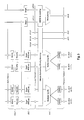
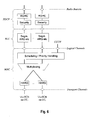
- the Layer 2 structure with activated carrier aggregation is shown in Fig. 5 and Fig. 6 for the downlink and uplink respectively.
- the user equipment When carrier aggregation is configured, the user equipment only has one RRC connection with the network.
- one serving cell provides the security input (one ECGI, one PCI and one ARFCN) and the non-access stratum mobility information (e.g. TAI) similarly as in LTE Rel. 8/9.
- the component carrier corresponding to that cell is referred to as the downlink Primary Cell (PCell).
- PCell Downlink Primary Cell
- DL PCell Downlink PCell
- UL PCell uplink PCell
- the carrier corresponding to the PCell is the Downlink Primary Component Carrier (DL PCC), while in the uplink it is the Uplink Primary Component Carrier (UL PCC).
- SCells can be configured to form a set of serving cells, together with the PCell. Therefore, the configured set of serving cells for a user equipment always consists of one PCell and one or more SCells.
- the characteristics of the downlink and uplink PCell and SCells are
- RRC reconfiguration, addition and removal of SCells
- RRC can also add, remove, or reconfigure SCells for usage with the target PCell.
- dedicated RRC signaling is used for sending all required system information of the SCell, i.e. while in connected mode, user equipments need not acquire broadcast system information directly from the SCells.
- a user equipment When carrier aggregation is configured, a user equipment may be scheduled over multiple component carriers simultaneously, but at most one random access procedure should be ongoing at any time.
- Cross-carrier scheduling allows the Physical Downlink Control Channel (PDCCH) of a component carrier to schedule resources on another component carrier.
- a component carrier identification field (CIF) is introduced in the respective Downlink Control Information (DCI) formats.
- DCI Downlink Control Information
- a linking between uplink and downlink component carriers allows identifying the uplink component carrier for which the grant applies when there is no-cross-carrier scheduling.
- the linkage of downlink component carriers to uplink component carriers does not necessarily need to be one to one. In other words, more than one downlink component carrier can link to the same uplink component carrier. At the same time, a downlink component carrier can only link to one uplink component carrier.
- an activation/deactivation mechanism of SCells is supported (i.e. activation/deactivation does not apply to PCell).
- activation/deactivation does not apply to PCell.
- the UE does not need to receive the corresponding PDCCH or PDSCH, cannot transmit in the corresponding uplink, nor is it required to perform CQI measurements.
- the UE shall receive PDSCH and PDCCH (if the UE is configured to monitor PDCCH from this SCell), and is expected to be able to perform CQI measurements.
- the activation/deactivation mechanism is based on the combination of a MAC control element and deactivation timers.
- the MAC control element carries a bitmap for the activation and deactivation of SCells: a bit set to 1 denotes activation of the corresponding SCell, while a bit set to 0 denotes deactivation.
- SCells can be activated and deactivated individually, and a single activation/deactivation command can activate/deactivate a subset of the SCells.
- the corresponding activation/deactivation MAC CE is shown in Fig. 12 . It should be noted, that even though there is a maxmimum of 4 SCells a UE can aggregate, the MAC CE contains 7 entries, each of them corresponding to an SCell configured with SCellIndex i.
- One deactivation timer is maintained per SCell but one common value is configured per UE by RRC.
- the UE In currents specifications (Rel-10) of the 3GPP standards the UE only maintains one timing advance value and applies this to UL transmissions on all aggregated component carriers. Only the aggregagtion of cells within the same frequency band, also referred to as intra-frequency carrier aggregation, is supported. Basically uplink timing synchronization is performed for Pcell, e.g. by RACH procedure on Pcell, and UE uses same uplink timing for uplink transmissions on aggregated Scells. However in Rel-11when uplink component cells are aggregated from different bands, they can experience different channel, interference and coverage characteristics. Furthermore deployment scenarios with frequency selective repeaters (as shown in Fig. 11 ) or remote radio heads (as shown in Fig. 10 ) may require a separate timing advance for certain serving cells due to different propagation delays among the aggregated serving cells.
- each group contains at least one serving cell with configured uplink, and the mapping of each serving cell to a TA group is configured by the serving eNB with RRC signaling. Presumable when an SCell is configured for aggregation, eNB will assign the SCell the TA group it belongs to. The mapping between a SCell and a TA group may be reconfigured with RRC signaling.
- a UE supporting multiple TAs is required to support at least 2 TA groups; i.e. one TA group containing the PCell (pTAG) and one or more TA groups not containing the PCell (sTAG).
- UE needs to support RACH procedure on SCell for the multi-TA case.
- parallel RACH procedures shall not be supported by a UE. More in particular if a new RA procedure is requested (either by UE or network) while another RA procedure is already ongoing, it is up to the UE implementation whether to continue with the ongoing procedure or start with the new procedure.
- a new RA procedure is requested (either by UE or network) while another RA procedure is already ongoing, it is up to the UE implementation whether to continue with the ongoing procedure or start with the new procedure.
- a PDCCH order format 1A DCI
- a contention-based RACH procedure on an SCell is not supported.
- the UE Upon new UL data arrival the UE shall not trigger an RA procedure on an SCell.
- the PDCCH for Msg2 (RACH response message) can be sent on a different serving cell than the SCell in which the preamble was sent.
- MAC layer does not indicate it to RRC i.e. RLF is not triggered (this is different to RACH procedure on Pcell).
- the pathloss reference handling of pTAG follows REL-10 principles.
- the SIB2 linked downlink of the SCell is used as a pathloss reference.
- the radio network could simply change the DL Timing Reference Cell without un-necessarily invoking a Random Access Procedure; this can happen when the radio network need not assess the TA of the new DL Timing Reference Cell (e.g. if it is confident about the timing relation of the new DL Timing Reference Cell or when the new DL Timing Reference Cell would be the only remaining cell in the TA subsequent to an impending procedure).
- the prior-art is not optimized from Signaling perspective such that more than one layer 1, layer 2 and layer 3 signaling messages are sent for the said purpose when only one would suffice.
- the present invention strives to avoid the various disadvantages mentioned above.
- One object of the invention is to propose a mechanism for re-configuration of a timing advance group by assigning a downlink timing candidate cell to become the downlink timing reference cell without reverting to the contention-free RACH procedure.
- the invention defines a subset of predefined preamble indices for a random access procedure, wherein an UE, upon reception of a signaling/control message including one predefined preamble index that is part of the subset, reconfigures the timing advance group by assigning the downlink timing candidate cell, for which the preamble index was received, to become the new downlink timing reference cell of the timing advance group.
- Another object of the invention is to provide for mechanism to test/probe of the propagation delay (or Timing Advance) for a different cell than the downlink timing reference cell by the eNodeB without immediate reconfiguration of the timing advance group, namely without assigning the tested cell to become the new downlink timing reference cell of the timing advance group.
- the invention defines another subset of predefined preamble indices for a random access procedure, wherein an UE, upon reception of a signaling/control message including one predefined preamble index that is part of the other subset, the mobile terminal initiates the random access procedure by transmitting a random access preamble corresponding to the received preamble index for the downlink timing candidate cell to the aggregation access point and maintains the configuration of the timing advance group.
- the subset of predefined preamble of the first aspect and the other subset of the second aspect are complementary.
- the present invention provides a method for re-configuration of a timing advance group by a mobile terminal in a mobile communication system.
- the mobile terminal is in communication with an aggregation access point and configured with a timing advance group including a downlink timing reference cell and a downlink timing candidate cell.
- the mobile terminal receives a signalling/control message for the downlink timing candidate cell, wherein the signalling/control message includes a preamble index for a random access procedure.
- the mobile terminal initiates the random access procedure by transmitting a random access preamble corresponding to the received preamble index for the downlink timing candidate cell to the aggregation access point and maintains the configuration of the timing advance group until the mobile terminal receives re-configuration information for the timing advance group.
- the mobile terminal re-configures the timing advance group by assigning the downlink timing candidate cell, for which the preamble index for the random access procedure was received, to become the new downlink timing reference cell of the timing advance group.
- the mobile terminal receives the re-configuration information for the timing advance group as a random access response message from the aggregated access point including reconfiguration information in response to the transmission of the random access preamble.
- the signalling/control message including a preamble index for a random access procedure is a downlink control information (DCI) message.
- DCI downlink control information
- the signalling/control message including a preamble index for a random access procedure is a RRC connection configuration message.
- the mobile terminal upon re-configuration of the timing advance group by the mobile terminal, acknowledges reception of the signalling/control message including the preamble index for a random access procedure.
- the mobile terminal acknowledges reception of the signalling/control message including the preamble index for a random access procedure by transmitting a RRC connection reconfiguration complete message.
- the aggregation access point upon transmission of the random access preamble corresponding to the received preamble index for the newly assigned downlink timing reference cell by the mobile terminal to the aggregation access point, transmits a random access response message including a timing advance command and an information for requesting or non-requesting the mobile terminal to:
- the mobile terminal upon reception by the mobile terminal of a random access response message including a timing advance command and a request information, the mobile terminal:
- the mobile terminal upon reception by the mobile terminal of a random access response message including a timing advance command and a non-request information, the mobile terminal neither re-configures the timing advance group by assigning a new downlink timing reference cell nor time-aligns the downlink timing reference cell.
- the mobile terminal after elapse of a predetermined timeout after transmission of the random access preamble including the received preamble index for the downlink timing candidate cell to the aggregation access point, the mobile terminal maintains the downlink timing reference cell.
- the request / non-request information is included in the reserved-Bit of the random access response message.
- the mobile terminal in case the reserved-Bit has a first value, the mobile terminal is requested to re-configure the timing advance group by assigning the new downlink timing reference cell and to time-align the new downlink timing reference cell. In case the reserved-Bit has a second value, the mobile terminal is not-requested to re-configure the timing advance group and neither assigns a new downlink timing reference cell nor time-aligns the new downlink timing reference cell.
- the mobile terminal in case the mobile terminal receives a signalling/control message for the downlink timing candidate cell, wherein the signalling/control message includes a preamble index for a random access procedure which is not equal to a subset of predefined preamble indices, the mobile terminal in response to a transmission of the random access preamble receives a random access response message from the aggregated access point including a timing advance command, a request information and a timing advance group assignment information. Further, the mobile terminal re-configures another timing advance group by assigning the downlink timing candidate cell, for which the preamble index for the random access procedure was received, to become a member of the other timing advance group indicated by the timing advance group assignment information. Further, the mobile terminal does not time-align the downlink timing reference cell using the received timing advance command. Further, the mobile terminal does not re-configure the timing advance group by assigning a new downlink timing reference cell.
- the present invention further provides a mobile terminal for re-configuring a timing advance group in a mobile communication system.
- the mobile terminal is in communication with an aggregation access point and is configured with a timing advance group including a downlink timing reference cell and a downlink timing candidate cell.
- a receiver of the mobile terminal receives a signalling/control message for the downlink timing candidate cell, the signalling/control message including a preamble index for a random access procedure.
- a transmitter of the mobile terminal transmits a random access preamble.
- a processor of the mobile terminal initiates the random access procedure by the transmitter transmitting a random access preamble corresponding to the received preamble index for the downlink timing candidate cell to the aggregation access point and maintains the configuration of the timing advance group until reception of re-configuration information for the timing advance group, in case the received preamble index for the random access procedure is not part of a subset of predefined preamble indices. Further, the processor of the mobile terminal re-configures the timing advance group by assigning the downlink timing candidate cell, for which the preamble index for the random access procedure was received, to become the new downlink timing reference cell of the timing advance group, in case the received preamble index for the random access procedure is part of the subset of predefined preamble indices.
- the receiver receives a random access response message from the aggregated access point including re-configuration information for a timing advance group in response to the transmission of the random access preamble.
- the signalling/control message including a preamble index for a random access procedure is a downlink control information (DCI) message.
- DCI downlink control information
- the signalling/control message including a preamble index for a random access procedure is a RRC connection configuration message.
- the mobile terminal upon re-configuration of the timing advance group, acknowledges reception of the signalling/control message including the preamble index for a random access procedure.
- the mobile terminal acknowledges reception of the signalling/control message including the preamble index for a random access procedure by the transmitter transmitting a RRC connection reconfiguration complete message.
- the receiver upon transmission of the random access preamble corresponding to the received preamble index for the newly assigned downlink timing reference cell to the aggregated access point, receives from the aggregated access point a random access response message including a timing advance command and an information for requesting or non-requesting the mobile terminal to:
- the processor upon reception of a random access response message including a timing advance command and a request information, re-configures the timing advance group by assigning the downlink timing candidate cell, for which the preamble index for the random access procedure was received, to become the new downlink timing reference cell of the timing advance group. Further, the processor time-aligns the new downlink timing reference cell using the received timing advance command.
- the mobile terminal upon reception of a random access response message including a timing advance command and a non-request information, neither re-configures the timing advance group by assigning a new downlink timing reference cell nor time-aligns the downlink timing reference cell.
- a timer is provided in the mobile terminal, wherein, after elapse of a predetermined timeout after transmission of the random access preamble including the received preamble index for the downlink timing candidate cell to the aggregation access point, the processor maintains the downlink timing reference cell.
- the request / non-request information is included in the reserved-Bit of the random access response message.
- the mobile terminal in case the reserved-Bit has a first value, the mobile terminal is requested to re-configure the timing advance group by assigning the new downlink timing reference cell and to time-align the new downlink timing reference cell. In case the reserved-Bit has a second value, the mobile terminal is not-requested to re-configure the timing advance group and neither assigns a new downlink timing reference cell nor time-aligns the new downlink timing reference cell.
- the receiver in case the receiver receives a signalling/control message for the downlink timing candidate cell that includes a preamble index for a random access procedure which is not equal to a subset of predefined preamble indices, and receives, in response to a transmission of the random access preamble, a random access response message from the aggregated access point including a timing advance command, a request information and a timing advance group assignment information, the processor re-configures another timing advance group by assigning the downlink timing candidate cell, for which the preamble index for the random access procedure was received, to become a member of the other timing advance group indicated by the timing advance group assignment information. Further, the processor does not time-align the downlink timing reference cell using the received timing advance command. Further, the processor does not re-configure the timing advance group by assigning a new downlink timing reference cell.
- the present invention provides an aggregated access point for re-configuring a timing advance group of a mobile terminal in a mobile communication system.
- the mobile terminal is in communication with the aggregation access point and is configured with a timing advance group including a downlink timing reference cell and a downlink timing candidate cell.
- a transmitter of the aggregated access point transmits a signalling/control message for the downlink timing candidate cell to the mobile terminal, the signalling/control message including a preamble index for a random access procedure.
- a receiver of the aggregated access point receives a random access preamble.
- a processor of the aggregated access point triggers the mobile terminal to perform a random access procedure and to maintain the configuration of the timing advance group until reception of re-configuration information for the timing advance group, in case the received preamble index for the random access procedure is not part of a subset of predefined preamble indices. Further, the processor triggers the mobile terminal to re-configure the timing advance group by assigning the downlink timing candidate cell, for which the preamble index for the random access procedure was received, to become the new downlink timing reference cell of the timing advance group, in case the received preamble index for the random access procedure is part of the subset of predefined preamble indices.
- the transmitter transmits a random access response message to the mobile terminal including re-configuration information for a timing advance group in response to the reception of the random access preamble.
- the present invention further provides a computer readable medium storing instructions that, when executed by a processor of a mobile terminal, cause the mobile terminal to re-configure a timing advance group in a mobile communication system, as follows.
- a signalling/control message for the downlink timing candidate cell is received, wherein the signalling/control message includes a preamble index for a random access procedure.
- the mobile terminal initiates the random access procedure by transmitting a random access preamble corresponding to the received preamble index for the downlink timing candidate cell to the aggregation access point and maintains the configuration of the timing advance group until the mobile terminal receives re-configuration information for the timing advance group.
- the mobile terminal re-configures the timing advance group by assigning the downlink timing candidate cell, for which the preamble index for the random access procedure was received, to become the new downlink timing reference cell of the timing advance group.
- timing advance group refers to a network configuration where a plurality of cells, on which an UE is performing uplink transmissions, are aggregated in a timing advance group (i.e. the cells are configured to be members of the timing advance group). For each group, the UE is configured with only one timing advance. In other words, the UE is performing uplink transmission on all cells aggregated in the group with a single timing advance value. This uplink timing advance is applied by the UE for uplink transmissions on the various cells of the timing advance group with respect to the downlink reception timing of a single downlink timing reference cell.
- the term “reference cell” or “downlink timing reference cell” refers to that cell (PCell or one of the SCells) of a timing advance group for which the downlink reception timing serves as the reference for the timing alignment group and to which the timing advance for uplink transmissions from cells within this timing alignment group is applied to.
- the downlink timing reference cell in a PCell Timing advance group may be the PCell since the downlink of the PCell is always activated and also determines the radio link failure behaviour for the mobile terminal.
- a cell may be a SCell for which a RACH procedure is being performed. Nevertheless, it may also be any of the activated and time-aligned SCells in the pTAG or sTAG, previously being time-aligned according to the present invention.
- aggregation access point is used to denote the location in the access network, i.e. a node, at which the uplink transmissions of the user equipment on the different uplink component carriers are aggregated (e.g. eNode or base station). Aggregation as such refers to
- the conjoint processing of protocol data units received in the transmissions on the different uplink component carriers from the user equipment may be - in one exemplary implementation - the conjoint processing of PDUs obtained from the transmissions on the different uplink component carriers in the MAC layer or RLC layer of the aggregation access point, e.g. for the purpose of PDU reordering.
- the term “candidate cell” or “downlink timing candidate cell” refers to a cell, which uplink transmissions are time-aligned and which is thus a candidate for the reconfiguration of a timing advance group of the invention.
- the “downlink timing candidate cell” would be most of the times one of the SCells that has not lost its uplink time alignment and does not experience bad radio conditions (which can exemplary determined based on its DL radio quality RSRP/RSRQ/ RSSI /CQI or any other quality parameter).
- a downlink reference cell can be advantageously used for time alignment of uplink transmissions via the various cells aggregated in the timing advance group.
- an eNodeB configuring the UE may decide to remove (or deactivate) the downlink timing reference cell.
- the eNodeB may decide to reconfigure the timing advance group by changing the downlink timing reference cell for the UE.
- the eNodeB may ensure good uplink transmission timings for the other cells of the timing advance group.
- the eNodeB may re-configure the timing advance group so that the UE is provided with a downlink timing reference cell allowing for a good timing alignment of all uplink transmissions on the various cells of the timing advance group.
- a time alignment of a cell, and thereby a reconfiguration of a timing advance group may be achieved by a contention-free RACH procedure.
- the contention-free RACH procedure includes three steps: first an eNodeB transmits a Random access preamble assignment message also indicated "PDCCH order" for a candidate cell.
- the candidate cell thereupon becomes for timing advance group of the UE the new downlink timing reference cell.
- the UE responds by transmitting a random access preamble corresponding to the preamble assignment message.
- the UE is provided with a random access response including a timing advance command upon which the UE assigns the candidate cell to become the new reference cell and time aligns the candidate cell using the timing advance command provided with the random access response.
- a timing advance groups is re-configured.
- the eNodeB may transmit an additional RRC connection reconfiguration message for removal/deactivation of the previous downlink timing reference cell.
- the UE transmits a RRC connection reconfiguration complete message to the eNodeB.
- an UE when an UE receives a DCI format 1A message including 144 information bits on the PDCCH scrambled with the UE's C-RNTI and the information bits set as defined in Table 1 below, the UE is ordered by eNodeB to initiate a random access procedure on the cell the PDCCH was received for.
- Table 1 - Bit setting for PDCCH with DCI format 1 A ordering RACH procedure Description Number of bits Setting Carrier indicator 0-3 Flag for format0/format1A 1 1 Localized/Distributed VRB assignment flag 1 0 Resource block assignment ⁇ log 2 ⁇ N RB DL ⁇ N RB DL + 1 / 2 ⁇ All set to 1 Preamble Index 6 000000 for contention based RACH Remaining 63 values for preamble selection PRACH Mask Index 4 All remaining bits 0
- the cell for which the PDCCH order was received for becomes the downlink timing reference cell of the SCell timing advance group (sTAG) in which the cell is located. Accordingly, the subsequent uplink transmissions of all uplinks on the SCells within the sTAG are based on this cells downlink timing with the current timing advance applied.
- sTAG SCell timing advance group
- the DCI format 1A message includes a filed for a preamble index.
- Each one of the 63 possible, non-zero preamble indices may be selected by the eNodeB and in order to determine a corresponding RACH preamble which is sent by the UE to the eNodeB. Since a RACH preamble can thereby be pre-allocated to each UE a contention case (i.e. two UEs using the same preamble for RACH procedure) may be prevented from happening. In other words, by the eNodeB selecting preamble indices for the UEs to perform RACH procedures, the UEs may perform contention-free RACH procedures and no contention resolution is needed.
- a special case is where the eNodeB transmits a DCI format 1A message with a preamble index that is set to all 0 (i.e. "000000"). Then each UE may perform a contention based RACH procedure, namely each UE may select a preamble to be used for the RACH procedure as described in the technical background section. For an ordered RACH procedure on a SCell, contention based RACH procedures are not allowed. Accordingly, the preamble index with the value "000000" in DCI format 1A, when included on a PRACH for a SCell, is currently not defined.
- One object of the invention is the re-configuration of a timing advance group by assigning a downlink timing candidate cell to become the downlink timing reference cell without reverting to the contention-free RACH procedure.
- the invention defines a subset of predefined preamble indices for a random access procedure, wherein an UE, upon reception of a signaling/control message including one predefined preamble index that is part of the subset, reconfigures the timing advance group by assigning the downlink timing candidate cell, for which the preamble index was received, to become the new downlink timing reference cell of the timing advance group.
- Another object of the invention is to provide for a test of the propagation delay for different cell than the downlink timing reference cell by the eNodeB without immediate reconfiguration of the timing advance group, namely without assigning the tested cell to become the new downlink timing reference cell of the timing advance group.
- the invention defines another subset of predefined preamble indices for a random access procedure, wherein an UE, upon reception of a signaling/control message including one predefined preamble index that is part of the other subset, the mobile terminal initiates the random access procedure by transmitting a random access preamble corresponding to the received preamble index for the downlink timing candidate cell to the aggregation access point and maintains the configuration of the timing advance group.
- the mobile terminal maintains the downlink timing reference cell until the mobile terminal receives, in response to the transmission of the random access preamble, a random access response message from the aggregated access point including re-configuration of the timing advance group.
- the subset of predefined preamble of the first aspect and the other subset of the second aspect are complementary.
- FIG. 19 a specific example of a reconfiguration of a timing advance group according to the invention is shown.
- the UE is configured with three cells, namely cell A, cell B and cell C. All three cells are aggregated in the same timing advance group.
- the UE is configured with cell A as the downlink timing reference cell. Accordingly, all uplink transmissions by the UE on the three cells of the timing advance group are time aligned with respect to the downlink reception timing of cell A.
- the network, or eNodeB may decide that UE cannot keep cell A as downlink timing reference cell.
- the eNodeB decides that the timing advance group of the UE has to be reconfigured, namely that cell B is to become the new downlink timing reference cell.
- the eNodeB transmits a PDCCH order including an all-zero preamble index for cell B to the UE.
- the PDCCH order is transmitted using a DCI format 1A which, as a preamble index field, has the bit pattern "000000".
- the UE When the UE receives the PDCCH order including an all-zero preamble index for the UE re-configures the timing advance group by assigning cell B, for which the preamble index was received in the PDCCH order, to become the new downlink timing reference cell of the timing advance group.
- the preamble index with the value "000000" in DCI format 1 A, when included on a PRACH for a SCell is conventionally not defined.
- FIG. 20 another specific example of the reconfiguration of a timing advance group according to the invention is shown.
- the UE is also configured with three cells, namely cell A, cell B and cell C. All three cells are aggregated in the same timing advance group.
- the UE is configured with cell A as the downlink timing reference cell. Accordingly, all uplink transmissions by the UE on the three cells of the timing advance group are time aligned with respect to the downlink reception timing of cell A.
- the network or eNodeB may decide that cell A as the downlink timing reference cell is not optimal for time alignment of all cells of the timing advance group. In this case, the eNodeB may decide that cell B is a candidate cell for becoming a new downlink timing reference cell.
- the eNodeB is provided with means to determine the propagation delay via the candidate cell B, before the eNodeB actually triggers a reconfiguration of the timing advance group for the UE.
- the eNodeB transmits a PDCCH order including a not all-zero preamble index for the cell B to the UE.
- the PDCCH order is transmitted using a DCI format 1A which, as a preamble index filed, has the bit pattern not equal to "000000", for instance "000001", "000010" or "000011".
- the UE When the UE receives the PDCCH order including a preamble index which is not all-zero, the UE transmits in response thereto a corresponding random access preamble on cell B to the eNodeB.
- the eNodeB is provided with means to derive a timing advance for the respective cell B. Based on the timing advance for cell B, the eNodeB can determine whether or not to request change of the downlink timing reference cell for the timing advance group of the UE.
- the UE when the UE receives via a PDCCH order a preamble index which is not all-zero, the UE initiates the random access procedure by transmitting a random access preamble corresponding to the received preamble index for cell B and maintains the configuration of the timing advance group until the UE receives a random access response message from the eNodeB including re-configuration information of the timing advance group.
- the eNodeB decides that the timing advance for cell B determined from the random access preamble received by the eNodeB is not ok (i.e. is for example larger than a predetermined threshold), the eNode may decide not to reconfigure the timing advance group by assigning cell B to become the new downlink timing reference cell and to maintain the current configuration of the timing advance group.
- the re-configuration of the timing advance group may be achieved by the UE receiving a random access response message including re- configuration information for a timing advance group.
- the re-configuration of the timing advance group may be achieved by receiving a PDCCH order including an all-zero preamble index as explained with respect to Fig. 19 .
- the random access response message includes a timing advance command for a cell of the timing advance group which shall be used by the UE for timing alignment of the cell B and is received by the UE in response to the transmission of the random access preamble on the cell B.
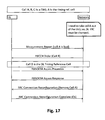
- eNodeB after probing the timing of a cell, i.e. eNodeB has received the RACH preamble and measured the roundtrip time, eNodeB includes it's decision for this cell in the Random Access Response (RAR).
- RAR Random Access Response
- the eNode may decide not to reconfigure the timing advance group by assigning cell B to become the new downlink timing reference cell and to maintain the current configuration of the timing advance group.
- the eNodeB transmits a random access response to the UE which includes, further to a timing advance command, a non-request or request information.
- the non-request information for example, in the random access response is an information for non-requesting a change of the downlink timing reference cell and additionally, for ignoring the timing advance command of the random access response message.
- the random access response message is transmitted in response to the random access preamble transmitted by the UE to the eNodeB.
- the UE may receive a random access response message from the eNodeB including re-configuration information for the timing advance group.
- the UE maintains the configuration of the timing advance group until the mobile terminal receives new reconfiguration information for the timing advance group.
- This re-configuration information for the timing advance group may be transmitted by the eNodeB to the UE in form of a random access response message).
- the UE shall proceed with a RACH procedure on that cell but shall not change the DL timing reference to this cell.
- the non-request information in the reserved-bit of the random access response message as indicated "R" bit in Fig. 15 .
- RAR random access response
- the UE will change the downlink timing reference to the cell where it just performed RACH procedure on and also apply the timing advance command received in the random access response. If the R bit is set to zero the UE will ignore the timing advance command in the RAR and not change the downlink timing reference cell.
- the UE may acknowledge the reception of this PDCCH order on the appropriate resources on the PUCCH, in case the preamble index set in the PDCCH order is "000000". Specifically, since the PDCCH order with preamble index set to 000000 now triggers the DL timing reference cell change without any further related uplink signaling (i.e. the RACH preamble transmission in the UL is not related to this procedure anymore), it is advantageous if the UE acknowledges the reception of this PDCCH on the appropriate resources on the PUCCH. This may enhance the reliability of this signaling procedure.
- FIG. 21 a further specific example of the reconfiguration of a timing advance group according to the invention is shown.
- This particular example is similar to that of Fig. 20 and also the UE is configured with three cells, namely cell A, cell B and cell C. All three cells are aggregated in a timing advance group.
- the UE is configured with cell A as the downlink timing reference cell. Accordingly, all uplink transmissions by the UE on the three cells of the timing advance group are time aligned with respect to the downlink reception timing of cell A.
- the network or eNodeB may decide that cell A as the downlink timing reference cell is not optimal for time alignment of all cells of the timing advance group. In this case, the eNodeB may decide that cell B is a candidate cell for becoming a new downlink timing reference cell.
- the eNodeB is provided with means to determine the propagation delay via the candidate cell B, before the eNodeB actually triggers a reconfiguration of the timing advance group for the UE.
- the eNodeB transmits a PDCCH order including a not all-zero preamble index for the cell B to the UE.
- the PDCCH order is transmitted using a DCI format 1A which, as a preamble index filed, has the bit pattern not equal to "000000", for instance "000001", "000010" or "000011".
- the UE When the UE receives the PDCCH order including a preamble index which is not all-zero, the UE transmits in response thereto a corresponding random access preamble on cell B to the eNodeB.
- the eNodeB is provided with means to derive a timing advance for the respective cell B. Based on the timing advance for cell B, the eNodeB can determine whether or not to request change of the downlink timing reference cell for the timing advance group of the UE.
- the eNodeB decides that the timing advance for the cell B is ok and then the eNodeB transmits re-configuration information to the UE.
- the re-configuration of the timing advance group may be achieved by the UE receiving a random access response message including re-configuring information for a timing advance group.
- the re-configuration of the timing advance group may be achieved by receiving a PDCCH order including an all-zero preamble index as illustrated with respect to Fig. 22 .
- the random access response message include a timing advance command that is based on the evaluation of the random access preamble sent by cell B, which can be used by the UE for timing alignment of the cell B and is received by the UE in response to the transmission of the random access preamble on the cell B.
- the UE when the UE receives via a PDCCH order a preamble index which is not all-zero, the UE initiates the random access procedure by transmitting a random access preamble corresponding to the received preamble index for cell B and maintains the configuration of the timing advance group until the UE receives a random access response message from the eNodeB including re-configuration information of the timing advance group.
- eNodeB after probing the timing of a cell, i.e. eNodeB has received the RACH preamble and measured the roundtrip time, eNodeB includes it's decision for this cell in the Random Access Response (RAR).
- RAR Random Access Response
- the R bit in the prior art RAR is used.
- the eNodeB transmits a random access response to the UE which includes, further to a timing advance command, a request information.
- the request information in the random access response is an information for requesting a reconfiguration of the timing advance group.
- the UE receiving a random access response including request information assigns cell B, for which the preamble index for the random access procedure was received, to become the new downlink timing reference cell of the timing advance group.
- the UE time-aligns time-align cell B using the received timing advance command of the random access response message.
- the random access response message is transmitted by the eNodeB in response to the random access preamble to the UE.
- the UE may receive a random access response message from the eNodeB including re-configuration information for the timing advance group.
- the non-request information in the reserved-bit of the random access response message as indicated "R" bit in Fig. 15 .
- RAR random access response
- the UE will change the downlink timing reference to the cell where it just performed RACH procedure on and also apply the timing advance command received in the random access response. If the R bit is set to zero the UE will ignore the timing advance command in the RAR and not change the downlink timing reference cell.
- a random access response message for an SCell may include a new timing advance group (TAG) for the SCell.
- TAG timing advance group
- the random access response message includes a timing advance group assignment information in addition to the R bit (i.e. that indicates application of timing advance command and downlink timing reference cell change).
- two octets for Temporary C-RNTI and can be redefined to indicate the appropriate TAG identity.
- means are provided to change the downlink timing reference cell when the network sends signaling information to add a new cell to the UE's Timing advance group (TAG), or any other end (e.g. when configuring measurements in the UE) similarly as described above.
- TAG Timing advance group
- the R Bit in a random access response message may be used by the UE to interpret the timing advance group assignment information and Timing advance command of the random access response.
- the eNodeB may indicate that the timing advance command is not to be applied by the UE, no downlink timing reference cell change is to be performed by the UE, but the cell for which the RAR is received, is to be assigned to the indicated timing advance group. Needless to say, that with an assignment of a cell to a new timing advance group, its previous timing advance group is updated by removing the cell therefrom.
- Another variation of the signaling of TA command application and DL timing reference cell change in the RAR is that eNodeB omits the RAR when no change of DL timing reference cell shall be done. Only when DL timing reference cell shall be changed a RAR is send. This variation implies that UE waits for RAR within the RAR window but does not retransmit the PRACH preamble as it would do in the prior art. This variation does then not require the usage of the R bit in the RAR as described above.
- FIG. 23 an alternative embodiment is shown providing an alternative solution for the reconfiguration of timing advance groups.
- the UE Upon the reception of RRC signaling message for downlink timing reference cell change, the UE would straightaway change the downlink timing reference cell to the new indicated cell irrespective of whether or not a valid preamble index is signaled. This is done in the RRC Connection Reconfiguration message.
- the invention provides for means to decouple the change of the downlink timing reference cell from the RACH order the following new rules are applied to the reception of a PDCCH ordering a RACH procedure on a SCell.
- the invention allows for a change the downlink timing reference cell to the newly indicated downlink timing reference cell only if the indicated preamble is part of a subset of value (like "000000") else it may need to perform the RACH Procedure first (when the preamble has some valid value that is not equal to any of the special values).
- the network shall indicate an actual change of DL Timing Reference Cell to the new cell in the RAR (Random Access Response message).
- the invention enables probing of one cell within a sTAG whether it's timing is suited for this cell and finds it unsuitable it needs to go through the procedure. Namely, it can be avoided falsely changing to cell B after probing that cell and then changing back to a suited (e.g. previous) cell.
- this invention provides a mean to optimize the signaling and avoid un-necessary RACH.
- the invention adds signaling information (to the existing RRC signaling that removes (or adds another cell in different embodiment) the current DL Timing Reference Cell) that is necessary to:
- the UE shall change the DL Timing Reference Cell to the new indicated DL Timing Reference Cell only if the indicated preamble is some special value (like 00000) else it may need to perform the RACH Procedure first (when the preamble has some valid value that is not equal to any of the special values).
- the network shall indicate an actual change of DL Timing Reference Cell to the new cell in the RAR (Random Access Response message).
- a computing device or processor may for example be general purpose processors, digital signal processors (DSP), application specific integrated circuits (ASIC), field programmable gate arrays (FPGA) or other programmable logic devices, etc.
- DSP digital signal processors
- ASIC application specific integrated circuits
- FPGA field programmable gate arrays
- the various embodiments of the invention may also be performed or embodied by a combination of these devices.
- the various embodiments of the invention may also be implemented by means of software modules, which are executed by a processor or directly in hardware. Also a combination of software modules and a hardware implementation may be possible.
- the software modules may be stored on any kind of computer readable storage media, for example RAM, EPROM, EEPROM, flash memory, registers, hard disks, CD-ROM, DVD, etc.
Landscapes
- Engineering & Computer Science (AREA)
- Computer Networks & Wireless Communication (AREA)
- Signal Processing (AREA)
- Mobile Radio Communication Systems (AREA)
Priority Applications (1)
| Application Number | Priority Date | Filing Date | Title |
|---|---|---|---|
| EP12001807.2A EP2640138A1 (de) | 2012-03-16 | 2012-03-16 | Rekonfiguration von Zeitvorlaufsgruppen |
Applications Claiming Priority (1)
| Application Number | Priority Date | Filing Date | Title |
|---|---|---|---|
| EP12001807.2A EP2640138A1 (de) | 2012-03-16 | 2012-03-16 | Rekonfiguration von Zeitvorlaufsgruppen |
Publications (1)
| Publication Number | Publication Date |
|---|---|
| EP2640138A1 true EP2640138A1 (de) | 2013-09-18 |
Family
ID=45894006
Family Applications (1)
| Application Number | Title | Priority Date | Filing Date |
|---|---|---|---|
| EP12001807.2A Withdrawn EP2640138A1 (de) | 2012-03-16 | 2012-03-16 | Rekonfiguration von Zeitvorlaufsgruppen |
Country Status (1)
| Country | Link |
|---|---|
| EP (1) | EP2640138A1 (de) |
Cited By (37)
| Publication number | Priority date | Publication date | Assignee | Title |
|---|---|---|---|---|
| US9386490B2 (en) | 2012-06-20 | 2016-07-05 | Ofinno Technologies, Llc | Wireless device handover signalling |
| US9386604B2 (en) | 2012-04-01 | 2016-07-05 | Ofinno Technologies, Llc | Random access mechanism for a wireless device and base station |
| US9414332B2 (en) | 2012-04-17 | 2016-08-09 | Ofinno Technologies, Llc | Signal power management in a multicarrier wireless device |
| CN106385707A (zh) * | 2016-09-18 | 2017-02-08 | 广州市大喜通信技术有限公司 | 一种td‑lte自动时延调整方法及装置 |
| US9615339B2 (en) | 2012-04-17 | 2017-04-04 | Comcast Cable Communications, Llc | Transmit power control in multicarrier communications |
| US9642098B2 (en) | 2012-01-25 | 2017-05-02 | Comcast Cable Communications, Llc | Managing sounding signals to limit power in a multicarrier wireless device |
| US9648643B2 (en) | 2012-01-25 | 2017-05-09 | Comcast Cable Communications, Llc | Managing sounding reference signals in a wireless device |
| US9661661B2 (en) | 2012-01-25 | 2017-05-23 | Comcast Cable Communications, Llc | Primary and secondary cell group configuration |
| US9706454B2 (en) | 2012-06-20 | 2017-07-11 | Comcast Cable Communications. LLC | Carrier configuration in wireless networks |
| US9717061B2 (en) | 2012-06-18 | 2017-07-25 | Comcast Cable Communications, Llc | Wireless device connection to an application server |
| US9736795B2 (en) | 2012-04-16 | 2017-08-15 | Comcast Cable Communications, Llc | Signal transmission power adjustment in a wireless device |
| US9756593B2 (en) | 2014-05-12 | 2017-09-05 | Telefonaktiebolaget Lm Ericsson (Publ) | Handling timing differences in timing advance groups in a communication device |
| US9820283B2 (en) | 2012-04-16 | 2017-11-14 | Comcast Cable Communications, Llc | Transmit power control in multicarrier communications |
| US9872280B2 (en) | 2012-06-20 | 2018-01-16 | Comcast Cable Communications, Llc | Automobile communication device |
| US9894640B2 (en) | 2012-06-18 | 2018-02-13 | Comcast Cable Communications, Llc | Carrier grouping in multicarrier wireless networks |
| CN108696892A (zh) * | 2017-02-21 | 2018-10-23 | 中国移动通信有限公司研究院 | 一种小区重配方法、装置、系统和相关设备 |
| US10123288B2 (en) | 2012-04-01 | 2018-11-06 | Comcast Cable Communications, Llc | Wireless device timing advance configuration |
| US10154500B2 (en) | 2012-01-25 | 2018-12-11 | Comcast Cable Communications, Llc | Wireless multicarrier random access process |
| CN109874150A (zh) * | 2017-12-05 | 2019-06-11 | 财团法人工业技术研究院 | 一种集中式无线存取网络控制方法 |
| CN110476379A (zh) * | 2016-09-30 | 2019-11-19 | 瑞典爱立信有限公司 | 用于无线电通信网络的节点和操作方法 |
| US10499300B2 (en) | 2012-06-20 | 2019-12-03 | Comcast Cable Communications, Llc | Handover signalling in wireless networks |
| US10524222B2 (en) | 2011-07-25 | 2019-12-31 | Comcast Cable Communications, Llc | Carrier grouping in multicarrier communications |
| WO2020063945A1 (en) * | 2018-09-28 | 2020-04-02 | Mediatek Singapore Pte. Ltd. | Timing advance validation for transmission in preconfigured uplink resources in nb-iot |
| CN111107620A (zh) * | 2018-10-25 | 2020-05-05 | 中兴通讯股份有限公司 | 基准定时的确定方法及装置、存储介质和电子装置 |
| WO2021239199A1 (en) * | 2020-05-25 | 2021-12-02 | Nokia Technologies Oy | Apparatuses of a radio communications network, methods to operate an apparatus of a communications network |
| US11218975B2 (en) | 2012-04-16 | 2022-01-04 | Comcast Cable Communications, Llc | Signal power management in a multicarrier wireless device |
| US20220007314A1 (en) * | 2020-07-02 | 2022-01-06 | Qualcomm Incorporated | Cell synchronization in physical (phy) layer and medium access control (mac) layer mobility |
| CN114175769A (zh) * | 2019-09-06 | 2022-03-11 | 诺基亚技术有限公司 | 基于到达时间的上行链路信道同步 |
| US11582704B2 (en) | 2012-04-16 | 2023-02-14 | Comcast Cable Communications, Llc | Signal transmission power adjustment in a wireless device |
| US11622372B2 (en) | 2012-06-18 | 2023-04-04 | Comcast Cable Communications, Llc | Communication device |
| US11825419B2 (en) | 2012-04-16 | 2023-11-21 | Comcast Cable Communications, Llc | Cell timing in a wireless device and base station |
| US11882560B2 (en) | 2012-06-18 | 2024-01-23 | Comcast Cable Communications, Llc | Carrier grouping in multicarrier wireless networks |
| US11943813B2 (en) | 2012-04-01 | 2024-03-26 | Comcast Cable Communications, Llc | Cell grouping for wireless communications |
| US11950292B2 (en) | 2018-11-02 | 2024-04-02 | Beijing Xiaomi Mobile Software Co., Ltd. | Data transmission method and apparatus based on timing advance |
| WO2024140659A1 (zh) * | 2022-12-28 | 2024-07-04 | 展讯通信(上海)有限公司 | 信息获取方法及通信装置 |
| WO2024192598A1 (zh) * | 2023-03-17 | 2024-09-26 | 北京小米移动软件有限公司 | 一种定时提前量确定方法、装置及存储介质 |
| WO2024207190A1 (en) * | 2023-04-04 | 2024-10-10 | Apple Inc. | Timing advance management in wireless communications |
Citations (2)
| Publication number | Priority date | Publication date | Assignee | Title |
|---|---|---|---|---|
| US20110103331A1 (en) * | 2009-11-05 | 2011-05-05 | Richard Lee-Chee Kuo | Method and apparatus to activate component carriers in a wireless communication network |
| WO2011100596A2 (en) * | 2010-02-12 | 2011-08-18 | Interdigital Patent Holdings, Inc. | Methods and apparatus for optimizing uplink random access channel transmission |
-
2012
- 2012-03-16 EP EP12001807.2A patent/EP2640138A1/de not_active Withdrawn
Patent Citations (2)
| Publication number | Priority date | Publication date | Assignee | Title |
|---|---|---|---|---|
| US20110103331A1 (en) * | 2009-11-05 | 2011-05-05 | Richard Lee-Chee Kuo | Method and apparatus to activate component carriers in a wireless communication network |
| WO2011100596A2 (en) * | 2010-02-12 | 2011-08-18 | Interdigital Patent Holdings, Inc. | Methods and apparatus for optimizing uplink random access channel transmission |
Non-Patent Citations (1)
| Title |
|---|
| STEFANIA SESIA; ISSAM TOUFIK; MATTHEW BAKER: "LTE - The UMTS Long Term Evolution: From Theory to Practice", 2009, JOHN WILEY & SONS, LTD. |
Cited By (108)
| Publication number | Priority date | Publication date | Assignee | Title |
|---|---|---|---|---|
| US12108355B2 (en) | 2011-07-25 | 2024-10-01 | Comcast Cable Communications, Llc | Carrier grouping in multicarrier communications |
| US10524222B2 (en) | 2011-07-25 | 2019-12-31 | Comcast Cable Communications, Llc | Carrier grouping in multicarrier communications |
| US11147034B2 (en) | 2011-07-25 | 2021-10-12 | Comcast Cable Communications, Llc | Carrier grouping in multicarrier communications |
| US11743853B2 (en) | 2011-07-25 | 2023-08-29 | Comcast Cable Communications, Llc | Carrier grouping in multicarrier communications |
| US11516812B2 (en) | 2012-01-25 | 2022-11-29 | Comcast Cable Communications, Llc | Resource allocation for multicarrier communications |
| US11792859B2 (en) | 2012-01-25 | 2023-10-17 | Comcast Cable Communications, Llc | Multicarrier communications employing time alignment timers |
| US9648643B2 (en) | 2012-01-25 | 2017-05-09 | Comcast Cable Communications, Llc | Managing sounding reference signals in a wireless device |
| US9661661B2 (en) | 2012-01-25 | 2017-05-23 | Comcast Cable Communications, Llc | Primary and secondary cell group configuration |
| US12114369B2 (en) | 2012-01-25 | 2024-10-08 | Comcast Cable Communications, Llc | Multicarrier communications employing time alignment timers |
| US12101816B2 (en) | 2012-01-25 | 2024-09-24 | Comcast Cable Communications, Llc | Sounding reference signal transmission in a wireless network |
| US12101828B2 (en) | 2012-01-25 | 2024-09-24 | Comcast Cable Communications, Llc | Multicarrier signal transmission in wireless communications |
| US10531495B2 (en) | 2012-01-25 | 2020-01-07 | Comcast Cable Communications, Llc | Sounding reference signal transmission in a wireless network |
| US9743431B2 (en) | 2012-01-25 | 2017-08-22 | Comcast Cable Communications, Llc | Multicarrier signal transmission in wireless communications |
| US11903000B2 (en) | 2012-01-25 | 2024-02-13 | Comcast Cable Communications, Llc | Resource allocation for multicarrier communications |
| US11800570B2 (en) | 2012-01-25 | 2023-10-24 | Comcast Cable Communications, Llc | Multicarrier signal transmission in wireless communications |
| US10863551B2 (en) | 2012-01-25 | 2020-12-08 | Comcast Cable Communications, Llc | Sounding reference signal transmission in a wireless network |
| US10588155B2 (en) | 2012-01-25 | 2020-03-10 | Comcast Cable Communications, Llc | Configuration of multiple timing advance groups in wireless communication devices |
| US12232149B2 (en) | 2012-01-25 | 2025-02-18 | Comcast Cable Communications, Llc | Resource allocation for multicarrier communications |
| US10652928B2 (en) | 2012-01-25 | 2020-05-12 | Comcast Cable Communications, Llc | Primary and secondary cell group configuration |
| US9642098B2 (en) | 2012-01-25 | 2017-05-02 | Comcast Cable Communications, Llc | Managing sounding signals to limit power in a multicarrier wireless device |
| US9848445B2 (en) | 2012-01-25 | 2017-12-19 | Comcast Cable Communications, Llc | Multicarrier communications employing time alignment timers |
| US11252762B2 (en) | 2012-01-25 | 2022-02-15 | Comcast Cable Communications, Llc | Multicarrier communications employing time alignment timers |
| US10154500B2 (en) | 2012-01-25 | 2018-12-11 | Comcast Cable Communications, Llc | Wireless multicarrier random access process |
| US9888499B2 (en) | 2012-01-25 | 2018-02-06 | Comcast Cable Communications, Llc | Configuration of multiple timing advance groups in wireless communication devices |
| US11013011B2 (en) | 2012-01-25 | 2021-05-18 | Comcast Cable Communications, Llc | Wireless multicarrier random access process |
| US10039131B2 (en) | 2012-01-25 | 2018-07-31 | Comcast Cable Communications, Llc | Sounding reference signal transmission in a wireless network |
| US10687364B2 (en) | 2012-01-25 | 2020-06-16 | Comcast Cable Communications, Llc | Multicarrier communications employing time alignment timers |
| US10085288B2 (en) | 2012-01-25 | 2018-09-25 | Comcast Cable Communications, Llc | Multicarrier signal transmission in wireless communications |
| US11395348B2 (en) | 2012-04-01 | 2022-07-19 | Comcast Cable Communications, Llc | Cell grouping for wireless communications |
| US10123288B2 (en) | 2012-04-01 | 2018-11-06 | Comcast Cable Communications, Llc | Wireless device timing advance configuration |
| US10939472B2 (en) | 2012-04-01 | 2021-03-02 | Comcast Cable Communications, Llc | Random access mechanism for a wireless device and base station |
| US12563604B2 (en) | 2012-04-01 | 2026-02-24 | Comcast Cable Communications, Llc | Cell grouping for wireless communications |
| US10397957B2 (en) | 2012-04-01 | 2019-08-27 | Comcast Cable Communications, Llc | Random access mechanism for a wireless device and base station |
| US9801211B2 (en) | 2012-04-01 | 2017-10-24 | Comcast Cable Communications, Llc | Random access mechanism for a wireless device and base station |
| US11943813B2 (en) | 2012-04-01 | 2024-03-26 | Comcast Cable Communications, Llc | Cell grouping for wireless communications |
| US9386604B2 (en) | 2012-04-01 | 2016-07-05 | Ofinno Technologies, Llc | Random access mechanism for a wireless device and base station |
| US10820278B2 (en) | 2012-04-16 | 2020-10-27 | Comcast Cable Communications, Llc | Wireless device preamble transmission timing |
| US9736795B2 (en) | 2012-04-16 | 2017-08-15 | Comcast Cable Communications, Llc | Signal transmission power adjustment in a wireless device |
| US10375655B2 (en) | 2012-04-16 | 2019-08-06 | Comcast Cable Communications, Llc | Signal transmission power adjustment in a wireless device |
| US12563501B2 (en) | 2012-04-16 | 2026-02-24 | Comcast Cable Communications, Llc | Wireless device transmission timing |
| US11252679B2 (en) | 2012-04-16 | 2022-02-15 | Comcast Cable Communications, Llc | Signal transmission power adjustment in a wireless device |
| US10523389B2 (en) | 2012-04-16 | 2019-12-31 | Comcast Cable Communications, Llc | Cell timing in a wireless device and base station |
| US10523390B2 (en) | 2012-04-16 | 2019-12-31 | Comcast Cable Communications, Llc | Uplink transmissions in a wireless device |
| US10368322B2 (en) | 2012-04-16 | 2019-07-30 | Comcast Cable Communications, Llc | Signal transmission power adjustment in a wireless device |
| US12439344B2 (en) | 2012-04-16 | 2025-10-07 | Comcast Cable Communications, Llc | Transmit power control in multicarrier communications |
| US12356336B2 (en) | 2012-04-16 | 2025-07-08 | Comcast Cable Communications, Llc | Signal transmission power adjustment in a wireless device |
| US10575259B2 (en) | 2012-04-16 | 2020-02-25 | Comcast Cable Communications, Llc | Signal power management in a multicarrier wireless device |
| US12185258B2 (en) | 2012-04-16 | 2024-12-31 | Comcast Cable Communications, Llc | Cell timing in a wireless device and base station |
| US11337161B2 (en) | 2012-04-16 | 2022-05-17 | Comcast Cable Communications, Llc | Wireless device transmission timing |
| US11218975B2 (en) | 2012-04-16 | 2022-01-04 | Comcast Cable Communications, Llc | Signal power management in a multicarrier wireless device |
| US10278134B2 (en) | 2012-04-16 | 2019-04-30 | Comcast Cable Communications, Llc | Wireless device preamble transmission timing |
| US10681701B2 (en) | 2012-04-16 | 2020-06-09 | Comcast Cable Communications, Llc | Transmit power control in multicarrier communications |
| US11997610B2 (en) | 2012-04-16 | 2024-05-28 | Comcast Cable Communications, Llc | Wireless device transmission timing |
| US11277241B2 (en) | 2012-04-16 | 2022-03-15 | Comcast Cable Communications, Llc | Cell timing in a wireless device and base station |
| US11895594B2 (en) | 2012-04-16 | 2024-02-06 | Comcast Cable Communications, Llc | Transmit control in multicarrier communications |
| US11825419B2 (en) | 2012-04-16 | 2023-11-21 | Comcast Cable Communications, Llc | Cell timing in a wireless device and base station |
| US10064191B2 (en) | 2012-04-16 | 2018-08-28 | Comcast Cable Communications, Llc | Transmit power control in multicarrier communications |
| US11582704B2 (en) | 2012-04-16 | 2023-02-14 | Comcast Cable Communications, Llc | Signal transmission power adjustment in a wireless device |
| US11064494B2 (en) | 2012-04-16 | 2021-07-13 | Comcast Cable Communications, Llc | Transmit power control in multicarrier communications |
| US11711769B2 (en) | 2012-04-16 | 2023-07-25 | Comcast Cable Communications, Llc | Signal transmission power adjustment in a wireless device |
| US11115937B2 (en) | 2012-04-16 | 2021-09-07 | Comcast Cable Communications, Llc | Signal transmission power adjustment in a wireless device |
| US9820283B2 (en) | 2012-04-16 | 2017-11-14 | Comcast Cable Communications, Llc | Transmit power control in multicarrier communications |
| US9844006B2 (en) | 2012-04-17 | 2017-12-12 | Comcast Cable Communications, Llc | Wireless device preamble transmission timing |
| US9615339B2 (en) | 2012-04-17 | 2017-04-04 | Comcast Cable Communications, Llc | Transmit power control in multicarrier communications |
| US9414332B2 (en) | 2012-04-17 | 2016-08-09 | Ofinno Technologies, Llc | Signal power management in a multicarrier wireless device |
| US9867137B2 (en) | 2012-04-17 | 2018-01-09 | Comcast Cable Communications, Llc | Signal power management in a multicarrier wireless device |
| US9769772B2 (en) | 2012-04-20 | 2017-09-19 | Comcast Cable Communications, Llc | Uplink transmissions in a wireless device |
| US9763203B2 (en) | 2012-04-20 | 2017-09-12 | Comcast Cable Communications, Llc | Cell timing in a wireless device and base station |
| US9681399B2 (en) | 2012-04-20 | 2017-06-13 | Comcast Cable Communications, Llc | Configuration of cell groups in wireless communication devices |
| US11882560B2 (en) | 2012-06-18 | 2024-01-23 | Comcast Cable Communications, Llc | Carrier grouping in multicarrier wireless networks |
| US10129798B2 (en) | 2012-06-18 | 2018-11-13 | Comcast Cable Communications, Llc | Carrier configuration in wireless networks |
| US10383068B2 (en) | 2012-06-18 | 2019-08-13 | Comcast Cable Communications, Llc | Transmission of content to a wireless device via cell groups |
| US10327195B2 (en) | 2012-06-18 | 2019-06-18 | Comcast Cable Communications, Llc | Wireless device handover signalling |
| US12356404B2 (en) | 2012-06-18 | 2025-07-08 | Comcast Cable Communications, Llc | Carrier grouping in multicarrier wireless networks |
| US10805908B2 (en) | 2012-06-18 | 2020-10-13 | Comcast Cable Communications, Llc | Carrier grouping in multicarrier wireless networks |
| US11558855B2 (en) | 2012-06-18 | 2023-01-17 | Comcast Cable Communications, Llc | Carrier grouping in multicarrier wireless networks |
| US10555290B2 (en) | 2012-06-18 | 2020-02-04 | Comcast Cable Communications, Llc | Automobile communication device |
| US9894640B2 (en) | 2012-06-18 | 2018-02-13 | Comcast Cable Communications, Llc | Carrier grouping in multicarrier wireless networks |
| US11076392B2 (en) | 2012-06-18 | 2021-07-27 | Comcast Cable Communications, Llc | Communication device |
| US9717061B2 (en) | 2012-06-18 | 2017-07-25 | Comcast Cable Communications, Llc | Wireless device connection to an application server |
| US11622372B2 (en) | 2012-06-18 | 2023-04-04 | Comcast Cable Communications, Llc | Communication device |
| US9843982B2 (en) | 2012-06-20 | 2017-12-12 | Comcast Cable Communications, Llc | Wireless device handover signaling |
| US9872280B2 (en) | 2012-06-20 | 2018-01-16 | Comcast Cable Communications, Llc | Automobile communication device |
| US9706454B2 (en) | 2012-06-20 | 2017-07-11 | Comcast Cable Communications. LLC | Carrier configuration in wireless networks |
| US9386490B2 (en) | 2012-06-20 | 2016-07-05 | Ofinno Technologies, Llc | Wireless device handover signalling |
| US10499300B2 (en) | 2012-06-20 | 2019-12-03 | Comcast Cable Communications, Llc | Handover signalling in wireless networks |
| US9756593B2 (en) | 2014-05-12 | 2017-09-05 | Telefonaktiebolaget Lm Ericsson (Publ) | Handling timing differences in timing advance groups in a communication device |
| CN106385707A (zh) * | 2016-09-18 | 2017-02-08 | 广州市大喜通信技术有限公司 | 一种td‑lte自动时延调整方法及装置 |
| US11595165B2 (en) | 2016-09-30 | 2023-02-28 | Telefonaktiebolaget Lm Ericsson (Publ) | Node for a radio communication network and operating method |
| CN110476379A (zh) * | 2016-09-30 | 2019-11-19 | 瑞典爱立信有限公司 | 用于无线电通信网络的节点和操作方法 |
| CN108696892A (zh) * | 2017-02-21 | 2018-10-23 | 中国移动通信有限公司研究院 | 一种小区重配方法、装置、系统和相关设备 |
| CN109874150B (zh) * | 2017-12-05 | 2022-05-31 | 财团法人工业技术研究院 | 一种集中式无线存取网络控制方法 |
| CN109874150A (zh) * | 2017-12-05 | 2019-06-11 | 财团法人工业技术研究院 | 一种集中式无线存取网络控制方法 |
| WO2020063945A1 (en) * | 2018-09-28 | 2020-04-02 | Mediatek Singapore Pte. Ltd. | Timing advance validation for transmission in preconfigured uplink resources in nb-iot |
| US11147117B2 (en) | 2018-09-28 | 2021-10-12 | Mediatek Singapore Pte. Ltd. | Timing advance validation for transmission in preconfigured uplink resources in NB-IoT |
| CN111107620A (zh) * | 2018-10-25 | 2020-05-05 | 中兴通讯股份有限公司 | 基准定时的确定方法及装置、存储介质和电子装置 |
| CN111107620B (zh) * | 2018-10-25 | 2023-02-21 | 中兴通讯股份有限公司 | 基准定时的确定方法及装置、存储介质和电子装置 |
| US12143954B2 (en) | 2018-10-25 | 2024-11-12 | Zte Corporation | Method and device for determining reference timing, storage medium, and electronic apparatus |
| EP3873141A4 (de) * | 2018-10-25 | 2022-01-26 | ZTE Corporation | Verfahren und vorrichtung zur bestimmung der referenzzeit sowie speichermedium und elektronisches gerät |
| US11950292B2 (en) | 2018-11-02 | 2024-04-02 | Beijing Xiaomi Mobile Software Co., Ltd. | Data transmission method and apparatus based on timing advance |
| CN114175769A (zh) * | 2019-09-06 | 2022-03-11 | 诺基亚技术有限公司 | 基于到达时间的上行链路信道同步 |
| WO2021239199A1 (en) * | 2020-05-25 | 2021-12-02 | Nokia Technologies Oy | Apparatuses of a radio communications network, methods to operate an apparatus of a communications network |
| CN115669100A (zh) * | 2020-05-25 | 2023-01-31 | 诺基亚技术有限公司 | 无线电通信网络的装置、用于操作通信网络的装置的方法 |
| US11832198B2 (en) * | 2020-07-02 | 2023-11-28 | Qualcomm Incorporated | Cell synchronization in physical (PHY) layer and medium access control (MAC) layer mobility |
| US20220007314A1 (en) * | 2020-07-02 | 2022-01-06 | Qualcomm Incorporated | Cell synchronization in physical (phy) layer and medium access control (mac) layer mobility |
| WO2024140659A1 (zh) * | 2022-12-28 | 2024-07-04 | 展讯通信(上海)有限公司 | 信息获取方法及通信装置 |
| WO2024192598A1 (zh) * | 2023-03-17 | 2024-09-26 | 北京小米移动软件有限公司 | 一种定时提前量确定方法、装置及存储介质 |
| WO2024207190A1 (en) * | 2023-04-04 | 2024-10-10 | Apple Inc. | Timing advance management in wireless communications |
Similar Documents
| Publication | Publication Date | Title |
|---|---|---|
| US12185259B2 (en) | Transmit power control for physical random access channels | |
| US11844027B2 (en) | Transmit power control for physical random access channels | |
| US11463967B2 (en) | Transmit power control for physical random access channels | |
| EP2640138A1 (de) | Rekonfiguration von Zeitvorlaufsgruppen | |
| EP2760241B1 (de) | Übertragungsleistungssteuerung für physikalische Direktzugriffskanäle | |
| US9749927B2 (en) | Timing advance configuration for multiple uplink component carriers | |
| EP2557867A1 (de) | Einstellung des Zeitvorlaufs für Träger mit mehreren Komponenten für Aufwärtsverbindungen | |
| EP2835929A1 (de) | Verfahren und Vorrichtung für Kleinzellenverbesserungen in einem drahtlosen Kommunikationssystem | |
| US20180139668A1 (en) | Terminal device, base station apparatus, integrated circuit, and wireless communication method | |
| CN105191450A (zh) | 终端装置、通信方法以及集成电路 | |
| EP2498556A1 (de) | Zeitvorlaufkonfiguration für mehrfache Aufwärtsverbindungskomponententräger | |
| WO2025094662A1 (ja) | 端末装置、および、基地局装置 |
Legal Events
| Date | Code | Title | Description |
|---|---|---|---|
| PUAI | Public reference made under article 153(3) epc to a published international application that has entered the european phase |
Free format text: ORIGINAL CODE: 0009012 |
|
| AK | Designated contracting states |
Kind code of ref document: A1 Designated state(s): AL AT BE BG CH CY CZ DE DK EE ES FI FR GB GR HR HU IE IS IT LI LT LU LV MC MK MT NL NO PL PT RO RS SE SI SK SM TR |
|
| AX | Request for extension of the european patent |
Extension state: BA ME |
|
| STAA | Information on the status of an ep patent application or granted ep patent |
Free format text: STATUS: THE APPLICATION IS DEEMED TO BE WITHDRAWN |
|
| 18D | Application deemed to be withdrawn |
Effective date: 20140319 |