EP2640352B1 - Kollagenhydrolysat für die verwendung zur verbesserung der gesundheit der menschlichen haut, haare und/oder nägel - Google Patents
Kollagenhydrolysat für die verwendung zur verbesserung der gesundheit der menschlichen haut, haare und/oder nägel Download PDFInfo
- Publication number
- EP2640352B1 EP2640352B1 EP11764723.0A EP11764723A EP2640352B1 EP 2640352 B1 EP2640352 B1 EP 2640352B1 EP 11764723 A EP11764723 A EP 11764723A EP 2640352 B1 EP2640352 B1 EP 2640352B1
- Authority
- EP
- European Patent Office
- Prior art keywords
- collagen hydrolysate
- collagen
- molecular weight
- skin
- hydrolyzate
- Prior art date
- Legal status (The legal status is an assumption and is not a legal conclusion. Google has not performed a legal analysis and makes no representation as to the accuracy of the status listed.)
- Active
Links
Images


Classifications
-
- A—HUMAN NECESSITIES
- A61—MEDICAL OR VETERINARY SCIENCE; HYGIENE
- A61K—PREPARATIONS FOR MEDICAL, DENTAL OR TOILETRY PURPOSES
- A61K8/00—Cosmetics or similar toiletry preparations
- A61K8/18—Cosmetics or similar toiletry preparations characterised by the composition
- A61K8/30—Cosmetics or similar toiletry preparations characterised by the composition containing organic compounds
- A61K8/64—Proteins; Peptides; Derivatives or degradation products thereof
- A61K8/65—Collagen; Gelatin; Keratin; Derivatives or degradation products thereof
-
- A—HUMAN NECESSITIES
- A61—MEDICAL OR VETERINARY SCIENCE; HYGIENE
- A61K—PREPARATIONS FOR MEDICAL, DENTAL OR TOILETRY PURPOSES
- A61K38/00—Medicinal preparations containing peptides
- A61K38/16—Peptides having more than 20 amino acids; Gastrins; Somatostatins; Melanotropins; Derivatives thereof
- A61K38/17—Peptides having more than 20 amino acids; Gastrins; Somatostatins; Melanotropins; Derivatives thereof from animals; from humans
- A61K38/39—Connective tissue peptides, e.g. collagen, elastin, laminin, fibronectin, vitronectin, cold insoluble globulin [CIG]
-
- A—HUMAN NECESSITIES
- A23—FOODS OR FOODSTUFFS; TREATMENT THEREOF, NOT COVERED BY OTHER CLASSES
- A23L—FOODS, FOODSTUFFS OR NON-ALCOHOLIC BEVERAGES, NOT OTHERWISE PROVIDED FOR; PREPARATION OR TREATMENT THEREOF
- A23L33/00—Modifying nutritive qualities of foods; Dietetic products; Preparation or treatment thereof
- A23L33/10—Modifying nutritive qualities of foods; Dietetic products; Preparation or treatment thereof using additives
- A23L33/17—Amino acids, peptides or proteins
- A23L33/18—Peptides; Protein hydrolysates
-
- A—HUMAN NECESSITIES
- A61—MEDICAL OR VETERINARY SCIENCE; HYGIENE
- A61Q—SPECIFIC USE OF COSMETICS OR SIMILAR TOILETRY PREPARATIONS
- A61Q19/00—Preparations for care of the skin
-
- A—HUMAN NECESSITIES
- A61—MEDICAL OR VETERINARY SCIENCE; HYGIENE
- A61Q—SPECIFIC USE OF COSMETICS OR SIMILAR TOILETRY PREPARATIONS
- A61Q19/00—Preparations for care of the skin
- A61Q19/08—Anti-ageing preparations
-
- C—CHEMISTRY; METALLURGY
- C07—ORGANIC CHEMISTRY
- C07H—SUGARS; DERIVATIVES THEREOF; NUCLEOSIDES; NUCLEOTIDES; NUCLEIC ACIDS
- C07H3/00—Compounds containing only hydrogen atoms and saccharide radicals having only carbon, hydrogen, and oxygen atoms
-
- A—HUMAN NECESSITIES
- A61—MEDICAL OR VETERINARY SCIENCE; HYGIENE
- A61Q—SPECIFIC USE OF COSMETICS OR SIMILAR TOILETRY PREPARATIONS
- A61Q3/00—Manicure or pedicure preparations
-
- A—HUMAN NECESSITIES
- A61—MEDICAL OR VETERINARY SCIENCE; HYGIENE
- A61Q—SPECIFIC USE OF COSMETICS OR SIMILAR TOILETRY PREPARATIONS
- A61Q5/00—Preparations for care of the hair
- A61Q5/002—Preparations for repairing the hair, e.g. hair cure
Definitions
- the present invention relates to the use of collagen hydrolyzate for stimulating the biosynthesis of extracellular matrix proteins by skin cells to increase the elasticity of the skin, to reduce wrinkling and / or to increase the moisture content of the skin.
- the US 4,130,555 discloses a peptide mixture prepared by hydrolysis of a collagen-containing material or gelatin and having a relatively narrow molecular weight distribution.
- the DE 42 44 418 A1 discloses peptide preparations and methods for their production, preferably by partial hydrolysis of connective tissue, collagen, elastin and keratin containing tripeptides or peptide sequences Gly-His-Lys and / or Gly-Asp-Ser.
- the EP 0 120 722 A1 discloses a method for stimulating the proliferation of cells, particularly fibroblasts, by the action of peptides or polypeptides, whereby the peptides or polypeptides are encapsulated in a hydrated lipid phase.
- the FR 2 900 155 A1 discloses a hydrolyzate of cartilage containing from 45 to 70% by weight hydrolyzed type II collagen, the average molecular weight of the peptide fraction being between 500 and 1000 daltons.
- the CN 101 518 645 discloses a product of marine collagen peptides and its therapeutic use for improving kidney function.
- the invention has for its object to further increase the positive effects of collagen hydrolyzate on the health of the skin, hair and / or nails and to propose a particularly effective collagen hydrolyzate for this use.
- Collagen hydrolysates contain peptides with different chain lengths or molecular weights that are involved in the cleavage of collagen protein chains arise, wherein the molecular weight distributions of these peptides can differ significantly depending on the production conditions of the hydrolyzate. It has now surprisingly been found that a collagen hydrolyzate with the abovementioned properties has a particularly advantageous effect on skin health in various respects, ie shows significantly better results than the previously used collagen hydrolysates which contain a significantly lower proportion of low molecular weight peptides and / or do not contain the characteristic peptides.
- the molecular weight distribution of the collagen hydrolyzate may be e.g. be determined very accurately and reproducibly by means of gel permeation chromatography using a calibration standard of defined collagen fragments.
- At least 45% by weight of the collagen hydrolyzate has a molecular weight of less than 1500 Da, i. a certain proportion of the peptides of the collagen hydrolyzate is particularly short-chained. It has been shown that very pronounced effects on skin health can be achieved by means of such particularly low molecular weight fractions, which are present in currently used collagen hydrolysates only in a significantly smaller amount.
- the average molecular weight (weight average M W ) of the collagen hydrolyzate used according to the invention is typically in the range from about 1700 to about 2300 Da.
- the presence of the characteristic peptides of the collagen hydrolyzate which interestingly contribute significantly to its effectiveness, can be determined in particular by means of MALDI mass spectroscopy, the characteristic peptides appearing as peaks in the mass spectrum.
- the at least four characteristic peptides have at least one molecular weight distribution determined by MALDI mass spectroscopy Double intensity, more preferably at least four times the intensity compared to their environment.
- the collagen hydrolyzate comprises a peptide between 620 and 690 Da, a peptide between 790 and 860 Da, a peptide between 980 and 1050 Da, and a peptide between 1175 and 1245 Da. These peptides distinguish the collagen hydrolyzate according to the invention in a characteristic manner from known collagen hydrolysates.
- collagen hydrolyzate may also have characteristic peptides between 1500 and 3500 Da, which are also a distinguishing feature to collagen hydrolysates according to the prior art.
- the collagen hydrolyzate preferably has a proportion of hydroxyproline of 12% by weight or more.
- the amino acid hydroxyproline formed by post-translational hydroxylation of proline occurs exclusively in collagen, so that a high proportion of hydroxyproline in the collagen hydrolyzate represents a measure of the substantial absence of other connective tissue proteins (eg elastin and proteoglycans), the fragments of which depend on the preparation process in certain cases
- Quantities may also be included in collagen hydrolysates.
- the collagen hydrolyzate is produced by enzymatic hydrolysis of gelatin.
- Gelatin comprises denatured collagen and is recovered from the connective tissue or bones of various animal species by various methods known to those skilled in the art.
- the gelatin used as starting material for the collagen hydrolyzate is preferably obtained from the skin of mammals, in particular from pork rind or cattle split, but the use of gelatine from poultry is not excluded.
- the enzymatic hydrolysis of the gelatin is carried out by at least one endoprotease, wherein it is provided in the invention to use several endoproteases (ie, at least two different endoproteases), thereby correspondingly affecting the amino acid profile of the resulting collagen hydrolyzate and the positive effect of the hydrolyzate on health of skin, hair and / or nails increase.
- the collagen hydrolyzate is produced by the subsequent action of at least two endoproteases with a different specificity, namely at least two different metalloproteases and / or serine proteases, ie proteases which cleave the amino acid sequence of the collagen molecules respectively before and after certain amino acids .
- the metalloproteases and / or serine proteases are enzymes from the microorganisms Bacillus subtilis or Bacillus amyloliquefaciens or from Bacillus licheniformis.
- the characteristic molecular weight distribution of the collagen hydrolyzate be obtained, but also the nature of the amino acids at the termini of the peptides contained in the hydrolyzate is influenced.
- the invention also relates to the non-therapeutic use of the collagen hydrolyzate for stimulating the biosynthesis of extracellular matrix proteins by skin cells.
- Skin cells include, in particular, fibroblasts that synthesize, inter alia, collagen (mainly of type I), elastin and proteoglycans.
- collagen mainly of type I
- elastin mainly of type I
- proteoglycans The formation of these proteins in sufficient quantities is crucial for the development or regeneration of the extracellular matrix of the skin, which in turn is essential for the properties of the skin such as resilience and elasticity and their moisture balance.
- the skin cells also include the keratinocytes, which are responsible for the keratinization of the outermost layer of skin as well as for the formation of hair and nails.
- stimulation of these cells by the collagen hydrolyzate used according to the invention can bring about an improvement in the barrier function of the skin as well as the health of the hair and / or nails.
- An essential aspect of the invention relates to the non-therapeutic use of the collagen hydrolyzate for increasing the elasticity of the skin and / or the reduction of wrinkling.
- These properties of the skin usually deteriorate as a result of aging and as a result of environmental influences, such as, for example, aging. UV radiation or toxic substances. Since the matrix proteins collagen and elastin are responsible for the resilience and elasticity of the skin, these effects can be counteracted by their increased synthesis, which is stimulated to a particular degree by the collagen hydrolyzate used according to the invention, and the skin's health can be markedly improved.
- Another important aspect of the invention relates to the non-therapeutic use of the collagen hydrolyzate to increase the moisture content of the skin.
- a major contribution to the ability of the skin to bind sufficient amounts of moisture is provided by the proteoglycans (e.g., versican, biglycan and decorin) contained in the extracellular matrix, whose synthesis is also demonstrated to be stimulated by the collagen hydrolyzate used in the present invention.
- the moisture content of the skin can be reduced by harmful environmental influences such as UV radiation, the loss of moisture is often accompanied by less suppleness, cracking and excess keratinization of the skin.
- Another aspect of the invention relates to the collagen hydrolyzate for therapeutic use for improving the barrier function of the skin.
- Essential for this barrier function are the so-called CE proteins (cornified envelope proteins), including involucrin, loricrin and filaggrin, their biosynthesis is demonstrably stimulated by the low molecular weight collagen hydrolyzate.
- the use of collagen hydrolyzate according to the invention improves the reduction of moisture loss, the barrier function and the natural protection of the skin against pathogenic germs and toxic substances.
- the use of the collagen hydrolyzate according to the invention also leads to an anti-oxidative action in the area of the skin, whereby the frequency of DNA damage (mutations), e.g. by UV radiation or mutagenic substances, can be reduced.
- mutations e.g. by UV radiation or mutagenic substances
- Such mutations are one of the causes of premature aging of cells and thereby promote skin aging (slackening, wrinkling, etc.), so that this process can be inhibited by the use of the invention.
- the collagen hydrolyzate is intended for oral ingestion.
- Oral uptake often results in more effective transport of the collagen hydrolyzate through the circulation to the site of action, i. in particular to the skin cells, than in a topical application.
- this application form for the user is usually associated with a much lower cost.
- the collagen hydrolyzate is used as a dietary supplement.
- the collagen hydrolyzate serves to improve skin health in the sense of a general health care or also a cosmetic application;
- Such dietary supplements may be referred to as “nutraceuticals” or “nutricosmetics”.
- a use of the collagen hydrolyzate for the treatment of a clinical disease is possible in the context of the present invention, such as in the presence of atopic dermatitis, in which the patients have an increased tendency to dry, chapped skin.
- the dietary supplement can be offered in almost any form, e.g. in the form of tablets, capsules, dragees, lozenges or even a solution (for example in single vials or in drinks).
- the collagen hydrolyzate may be included in a food or beverage, e.g. in confectionery or in an instant powder for making beverages.
- the hydrolyzate can be taken in this way by the user without additional effort in the context of the normal diet (so-called "Functional Ford").
- “Functional Ford” it is particularly advantageous if the collagen hydrolyzate is substantially tasteless.
- Another embodiment of the invention relates to the topical application of the collagen hydrolyzate, i. the application in the form of cosmetic products for application to the skin, the hair and / or the nails.
- the collagen hydrolyzate can be contained in particular in a cream, an ointment, a lotion or a gel. It is also beneficial if the collagen hydrolyzate is added to a personal care product such as a shower gel or a hair shampoo is added, for example in an amount of about 5 to 10 wt.%.
- the starting material used is an aqueous solution of pork skin gelatine (type A, 200 to 250 g Bloom) with a concentration of 20 to 40% by weight (dry matter).
- the gelatin is enzymatically hydrolysed by the successive action of two different endoproteases of microbial origin at 50 to 60 ° C for 120 to 180 min, using as the first enzyme an endoprotease from Bacillus subtilis or from Bacillus amyloliquefaciens and as second enzyme an endoprotease Bacillus licheniformis. Subsequently, the enzymes are thermally inactivated and the solution spray-dried.
- the molecular weight distribution of the resulting collagen hydrolyzate can be determined by gel permeation chromatography using the following parameters: Stationary phase: TSK 2000 SW XL (Tosoh Bioscience GmbH) Mobile phase: 0.4 mol / l sodium dihydrogen phosphate pH 5.3 Flow rate: 0.5 ml / min Calibration Standard: defined collagen type I fragments (FILK, Freiberg) detection: UV detector Knauer K-2501 at 214 nm
- the hydroxyproline content of this low molecular weight hydrolyzate is about 12 to 13 wt.% And can be determined photometrically after oxidation with chloramine-T and reaction with p-dimethylamino-benzaldehyde. More than 50% of the N-terminal amino acids of the hydrolyzate are hydrophobic amino acids, especially alanine, leucine and isoleucine.
- the cells were incubated for 24 hours with in each case 0.5 mg / ml of the low molecular weight or the high molecular weight hydrolyzate and then the expression of collagen RNA, biglycan RNA and versican RNA determined by real-time PCR and semiquantitative (based on a control without hydrolyzate) evaluated.
- the results are as column charts for type I collagen in the Figure 1A , for Biglykan in the FIG. 1B and for Versican in the Figure 1C
- the graphs each show the mean of at least 18 measurements.
- the left filled column represents respectively the control, the middle hatched column for the high molecular weight hydrolyzate (for comparison) and the right dotted column for the low molecular weight hydrolyzate (according to the invention).
- Hairless mice represent an established model system, which is often used in dermatological problems, and the insights gained are in principle transferable to the human skin (see, eg T. Fujimura et al .; J. Dermatol. Sci. 2000 (24) 105-111 and Y. Nishimori et al .; J. Invest. Dermatol. 2001 (117) 1458-1463 ).
- the animals were fed 150 ⁇ g of collagen hydrolyzate per kg of body weight daily for a period of three weeks, the control group receiving BSA instead. At the same time, all animals received a weekly UVB radiation dose of 18 mJ / cm 2 skin surface, which negatively affects the skin moisture.
- the moisture content of the skin was measured after one week and three weeks with a Corneometer CM 825 (manufactured by Courage & Khazaka).
- the measurement principle is based on the change in the capacitance of a measuring capacitor by the dielectric constant of the bound water in the upper skin layers, which differs significantly from the dielectric constant of most other substances.
- the results are as bar graphs for the measurement after a week in the FIG. 2A and for the measurement after three weeks in the FIG. 2B
- the diagrams show the mean value and the standard error from 7 measurements, respectively.
- the left filled column represents respectively the control, the middle hatched column for the high molecular weight hydrolyzate (for comparison) and the right dotted column for the low molecular weight hydrolyzate (according to the invention).
- So-called "cornified envelope” proteins play an important role in the barrier function of the skin against the penetration of pathogenic germs and toxic substances.
- Synthesis of the CE proteins involucrin, loricrin and filaggrin was determined in hairless mice previously fed daily with 150 ⁇ g collagen hydrolyzate per kg body weight for five weeks (as described above). Quantification of proteins relative to a control group (Feeding with BSA) was carried out by SDS-polyacrylamide gel electrophoresis and Western Blot with specific antibodies after extraction of the proteins from the skin.
- the results are shown as a bar chart in the FIG. 3
- the diagram shows in each case the mean value and the standard error from 7 measurements.
- the left column stands for involucrin, the middle column for loricrin and the right column for filaggrin.
- the anti-oxidative effect of the low molecular weight collagen hydrolyzate was determined in a cell-free system by means of a malondialdehyde assay.
- FIGS. 4A to 4C show the corresponding mass spectra or molecular weight distributions of the collagen hydrolysates A, B and C, wherein the ordinate is the molecular weight or the mass number and the abscissa on the intensity is plotted.
- a comparison of the three spectra shows that the hydrolyzate A according to the invention comprises the following characteristic peptides according to Table 2, the corresponding peaks having a double to fourfold intensity compared to their surroundings: Table 2 about 656 da about 825 da about 1,014 Da about 1,211 Da about 1,927 Da about 2.410 Da about 3,433 Da
- the four peptides between 600 and 1500 Da have no equivalents in the two commercial hydrolysates B and C, and thus are particularly characteristic of the hydrolyzate A.
- the left column represents Type I collagen, the center pillar decorin, and the right pillar Versican.
- the mean value from at least 7 measurements is shown as well as the standard error.
Landscapes
- Health & Medical Sciences (AREA)
- Life Sciences & Earth Sciences (AREA)
- General Health & Medical Sciences (AREA)
- Veterinary Medicine (AREA)
- Public Health (AREA)
- Animal Behavior & Ethology (AREA)
- Engineering & Computer Science (AREA)
- Chemical & Material Sciences (AREA)
- Epidemiology (AREA)
- Proteomics, Peptides & Aminoacids (AREA)
- Dermatology (AREA)
- Birds (AREA)
- Gerontology & Geriatric Medicine (AREA)
- Molecular Biology (AREA)
- Pharmacology & Pharmacy (AREA)
- Medicinal Chemistry (AREA)
- Immunology (AREA)
- Bioinformatics & Cheminformatics (AREA)
- Gastroenterology & Hepatology (AREA)
- Zoology (AREA)
- Biomedical Technology (AREA)
- Food Science & Technology (AREA)
- Polymers & Plastics (AREA)
- Nutrition Science (AREA)
- Mycology (AREA)
- Organic Chemistry (AREA)
- Biochemistry (AREA)
- Biotechnology (AREA)
- Genetics & Genomics (AREA)
- Cosmetics (AREA)
- Medicines That Contain Protein Lipid Enzymes And Other Medicines (AREA)
- Peptides Or Proteins (AREA)
Description
- Die vorliegende Erfindung betrifft die Verwendung von Kollagenhydrolysat zur Stimulation der Biosynthese extrazellulärer Matrixproteine durch Hautzellen, zur Erhöhung der Spannkraft der Haut, zur Verminderung der Faltenbildung und/oder zur Erhöhung des Feuchtigkeitsgehalts der Haut.
- Es ist seit einiger Zeit bekannt, dass durch die orale Aufnahme von Kollagenhydrolysat vorteilhafte Effekte in Bezug auf die Gesundheit der Haut, aber auch der Haare und/oder Nägel beim Menschen erzielt werden können (siehe z.B. Vivian Zague: "A new view concerning the effects of collagen hydrolysate intake on skin properties" in Arch. Dermatol. Res. 2008 (9) 479-483). Unter einer Verbesserung der Gesundheit der Haut wird in diesem Zusammenhang jede positive Beeinflussung der natürlichen Eigenschaften und Funktionen der Haut verstanden, wobei diese Eigenschaften und Funktionen sowohl in Folge der Alterung als auch zusätzlich durch verschiedene negative Umwelteinflüsse beeinträchtigt werden können. Auch auf die Eigenschaften der Haare und/oder Nägel wirkt sich die Aufnahme von Kollagenhydrolysat vorteilhaft aus.
- Die
US 4,130,555 offenbart eine Peptidmischung, die durch Hydrolyse eines Kollagen enthaltenden Materials oder Gelatine hergestellt ist, und die eine relativ enge Molekulargewichtsverteilung aufweist. - Die
DE 42 44 418 A1 offenbart Peptid-Präparate und Verfahren zu deren Herstellung, vorzugsweise durch partielle Hydrolyse von Bindegewebe, Kollagen, Elastin und Keratin, die Tripeptide oder Peptidsequenzen Gly-His-Lys und/oder Gly-Asp-Ser enthalten. - Die
EP 0 120 722 A1 offenbart ein Verfahren für die Stimulation der Vermehrung von Zellen, insbesondere von Fibroblasten, durch die Wirkung von Peptiden oder Polypeptiden, wobei die Peptide oder Polypeptide in einer hydratisierten Lipidphase verkapselt werden. - Die
FR 2 900 155 A1 - In einem Artikel von J. Huo und Z. Zhao in Agricultural Sciences in China 2009 (8) 723-729 wird die enzymatische Hydrolyse von Kollagen aus der Haut von Kabeljau (Gadus morrhua) sowie dessen Molekulargewichtsverteilung beschrieben.
- Die
CN 101 518 645 offenbart ein Produkt aus marinen Kollagenpeptiden und dessen therapeutische Anwendung für die Verbesserung der Nierenfunktion. - Die Broschüre "Peptan - The perfect protein for a healthy lifestyle" der Firma Rousselot beschreibt Hydrolysate aus Kollagen von Schweinen, Rindern und Fischen und deren vorteilhafte Wirkung auf das Erscheinungsbild der Haut.
- In einem Artikel von G. Zhang et al. in Food Hydrocolloids 2009 (23) 2001-2007 wird die Untersuchung von Markerpeptiden in Kollagenhydrolysaten, die durch Hydrolyse von boviner und porciner Gelatine mit Trypsin erhalten wurden, beschrieben.
- Der Erfindung liegt die Aufgabe zugrunde, die positiven Effekte von Kollagenhydrolysat auf die Gesundheit von Haut, Haaren und/oder Nägeln weiter zu steigern und ein für diese Verwendung besonders effektives Kollagenhydrolysat vorzuschlagen.
- Diese Aufgabe wird durch die nicht-therapeutische Verwendung eines Kollagenhydrolysats gemäß Anspruch 1 gelöst.
- Kollagenhydrolysate enthalten Peptide mit unterschiedlichen Kettenlängen bzw. Molekulargewichten, die bei der Spaltung der Proteinketten des Kollagens entstehen, wobei sich die Molekulargewichtsverteilungen dieser Peptide in Abhängigkeit von den Herstellungsbedingungen des Hydrolysats deutlich unterscheiden können. Es hat sich nun überraschenderweise gezeigt, dass sich ein Kollagenhydrolysat mit den vorstehend genannten Eigenschaften in verschiedener Hinsicht besonders vorteilhaft auf die Hautgesundheit auswirkt, d.h. deutlich bessere Ergebnisse zeigt als die bisher eingesetzten Kollagenhydrolysate, die einen wesentlich geringeren Anteil an niedermolekularen Peptiden enthalten und/oder die die charakteristischen Peptide nicht enthalten.
- Die Molekulargewichtsverteilung des Kollagenhydrolysats kann z.B. mittels einer Gelpermeationschromatographie unter Verwendung eines Kalibrierungsstandards aus definierten Kollagenfragmenten sehr genau und reproduzierbar bestimmt werden.
- Mindestens 45 Gew.% des Kollagenhydrolysats weisen ein Molekulargewicht von weniger als 1.500 Da auf, d.h. ein gewisser Anteil der Peptide des Kollagenhydrolysats ist besonders kurzkettig. Es hat sich gezeigt, dass durch solche besonders niedermolekularen Anteile, die in derzeit verwendeten Kollagenhydrolysaten nur in wesentlich geringerer Menge enthalten sind, sehr ausgeprägte Effekte auf die Hautgesundheit erzielt werden können.
- Das mittlere Molekulargewicht (Gewichtsmittel MW) des erfindungsgemäß verwendeten Kollagenhydrolysats liegt typischerweise im Bereich von ca. 1.700 bis ca. 2.300 Da.
- Das Vorhandensein der charakteristischen Peptide des Kollagenhydrolysats, die interessanterweise wesentlich zu dessen Wirksamkeit beitragen, kann insbesondere mittels MALDI-Massenspektroskopie bestimmt werden, wobei die charakteristischen Peptide im Massenspektrum als Peaks auftreten. Die mindestens vier charakteristischen Peptide weisen in einer mittels MALDI-Massenspektroskopie bestimmten Molekulargewichtsverteilung eine mindestens doppelte Intensität, weiter bevorzugt eine mindestens vierfache Intensität im Vergleich zu ihrer Umgebung auf.
- Bei einer bevorzugten Ausführungsform der Erfindung umfasst das Kollagenhydrolysat ein Peptid zwischen 620 und 690 Da, ein Peptid zwischen 790 und 860 Da, ein Peptid zwischen 980 und 1.050 Da und ein Peptid zwischen 1.175 und 1.245 Da auf. Diese Peptide unterscheiden das Kollagenhydrolysat gemäß der Erfindung auf charakteristische Weise von bekannten Kollagenhydrolysaten.
- Das Kollagenhydrolysat kann zusätzlich auch charakteristische Peptide zwischen 1.500 und 3.500 Da aufweisen, die ebenfalls ein Unterscheidungsmerkmal zu Kollagenhydrolysaten gemäß dem Stand der Technik darstellen.
- Bevorzugt weist das Kollagenhydrolysat einen Anteil an Hydroxyprolin von 12 Gew.% oder mehr auf. Die durch post-translationale Hydroxylierung von Prolin gebildete Aminosäure Hydroxyprolin kommt ausschließlich in Kollagen vor, sodass ein hoher Anteil an Hydroxyprolin im Kollagenhydrolysat ein Maß für die weitgehende Abwesenheit von anderen Bindegewebsproteinen (z.B. Elastin und Proteoglykane) darstellt, deren Fragmente in Abhängigkeit vom Herstellungsverfahren in gewissen Mengen ebenfalls in Kollagenhydrolysaten enthalten sein können.
- Günstig ist es, wenn das Kollagenhydrolysat durch enzymatische Hydrolyse von Gelatine hergestellt ist. Gelatine umfasst denaturiertes Kollagen und wird mittels verschiedener, dem Fachmann bekannter Verfahren aus dem Bindegewebe oder aus den Knochen verschiedener Tierarten gewonnen. Im Rahmen der vorliegenden Erfindung wird die als Ausgangsmaterial für das Kollagenhydrolysat eingesetzte Gelatine vorzugsweise aus der Haut von Säugetieren, insbesondere aus Schweineschwarte oder Rinderspalt, gewonnen, wobei aber auch die Verwendung von Gelatine aus Geflügel nicht ausgeschlossen ist.
- Die enzymatische Hydrolyse der Gelatine erfolgt durch mindestens eine Endoprotease, wobei es im Rahmen der Erfindung vorgesehen ist, mehrere Endoproteasen (d.h. mindestens zwei verschiedene Endoproteasen) einzusetzen, um dadurch das Aminosäureprofil des resultierenden Kollagenhydrolysats entsprechend zu beeinflussen und die positive Wirkung des Hydrolysats auf die Gesundheit von Haut, Haaren und/oder Nägeln zu erhöhen.
- Gemäß der Erfindung ist das Kollagenhydrolysat durch die nacheinander folgende Einwirkung von mindestens zwei Endoproteasen mit einer unterschiedlichen Spezifität, nämlich von mindestens zwei verschiedenen Metalloproteasen und/oder Serinproteasen, hergestellt, d.h. von Proteasen, die die Aminosäuresequenz der Kollagenmoleküle jeweils vor bzw. hinter bestimmten Aminosäuren spalten. Es handelt es sich bei den Metalloproteasen und/oder Serinproteasen um Enzyme aus den Mikroorganismen Bacillus subtilis oder Bacillus amyloliquefaciens bzw. aus Bacillus licheniformis.
- Durch die Auswahl geeigneter Endoproteasen kann nicht nur die charakteristische Molekulargewichtsverteilung des Kollagenhydrolysats erhalten werden, sondern es wird auch die Art der Aminosäuren an den Termini der in dem Hydrolysat enthaltenen Peptide beeinflusst. In dieser Hinsicht ist es z.B. bevorzugt, wenn mindestens 50% der N-terminalen Aminosäuren des Kollagenhydrolysats hydrophobe Aminosäuren sind, insbesondere Alanin, Leucin und Isoleucin.
- Die Erfindung betrifft insbesondere auch die nicht-therapeutische Verwendung des Kollagenhydrolysats zur Stimulation der Biosynthese extrazellulärer Matrixproteine durch Hautzellen. Hautzellen umfassen insbesondere Fibroblasten, die u.a. Kollagen (hauptsächlich vom Typ I), Elastin sowie Proteoglykane synthetisieren. Die Bildung dieser Proteine in ausreichender Menge ist entscheidend für den Aufbau bzw. die Regeneration der extrazellulären Matrix der Haut, die wiederum wesentlich bestimmend ist für die Eigenschaften der Haut wie Spannkraft und Elastizität sowie ihren Feuchtigkeitshaushalt.
- Zu den Hautzellen zählen auch die Keratinozyten, die sowohl für die Verhornung der äußersten Hautschicht als auch für die Bildung von Haaren und Nägeln verantwortlich sind. Somit kann eine Stimulation dieser Zellen durch das erfindungsgemäß verwendete Kollagenhydrolysat eine Verbesserung der Barrierefunktion der Haut sowie der Gesundheit der Haare und/oder Nägel bewirken.
- Ein wesentlicher Aspekt der Erfindung betrifft die nicht-therapeutische Verwendung des Kollagenhydrolysats zur Erhöhung der Spannkraft der Haut und/oder der Verminderung der Faltenbildung. Diese Eigenschaften der Haut verschlechtern sich in der Regel alterungsbedingt sowie in Folge von Umwelteinflüssen wie z.B. UV-Strahlung oder toxischen Substanzen. Da für die Spannkraft und Elastizität der Haut insbesondere die Matrixproteine Kollagen und Elastin verantwortlich sind, kann durch deren vermehrte Synthese, die durch das erfindungsgemäß verwendete Kollagenhydrolysat in besonderem Maße stimuliert wird, diesen Effekten entgegengewirkt und die Hautgesundheit deutlich verbessert werden.
- Ein weiterer wichtiger Aspekt der Erfindung betrifft die nicht-therapeutische Verwendung des Kollagenhydrolysats zur Erhöhung des Feuchtigkeitsgehalts der Haut. Einen wesentlichen Beitrag zur Fähigkeit der Haut, ausreichende Mengen an Feuchtigkeit zu binden, leisten die in der extrazellulären Matrix enthaltenen Proteoglykane (z.B. Versican, Biglykan und Decorin), deren Synthese durch das erfindungsgemäß verwendete Kollagenhydrolysat ebenfalls nachweislich stimuliert wird. Auch der Feuchtigkeitsgehalt der Haut kann durch schädliche Umwelteinflüsse wie UV-Strahlung reduziert sein, wobei der Feuchtigkeitsverlust häufig mit einer geringeren Geschmeidigkeit, Rissigkeit und überschüssigen Verhornung der Haut einhergeht.
- Ein weiterer Aspekt der Erfindung betrifft das Kollagenhydrolysat für die therapeutische Verwendung zur Verbesserung der Barrierefunktion der Haut. Eine wesentliche Rolle für diese Barrierefunktion spielen die so genannten CE-Proteine ("Cornified Envelope"-Proteine), u.a. Involucrin, Loricrin und Filaggrin, deren Biosynthese
durch das niedermolekulare Kollagenhydrolysat nachweislich stimuliert wird. Somit wird durch die erfindungsgemäße Verwendung von Kollagenhydrolysat die Verminderung des Feuchtigkeitsverlustes, die Barrierefunktion sowie der natürliche Schutz der Haut gegen pathogene Keime und toxische Substanzen verbessert. - Die erfindungsgemäße Verwendung des Kollagenhydrolysats führt zusätzlich auch zu einer anti-oxidativen Wirkung im Bereich der Haut, wodurch die Häufigkeit von DNA-Schädigungen (Mutationen), z.B. durch UV-Strahlung oder mutagene Substanzen, reduziert werden kann. Solche Mutationen stellen eine der Ursachen für die frühzeitige Alterung von Zellen dar und fördern dadurch Alterungserscheinungen der Haut (Nachlassen der Spannkraft, Faltenbildung usw.), sodass dieser Vorgang durch die erfindungsgemäße Verwendung gehemmt werden kann.
- Gemäß einer bevorzugten Ausführungsform der Erfindung ist das Kollagenhydrolysat für eine orale Aufnahme vorgesehen. Bei oraler Aufnahme ergibt sich häufig ein effektiverer Transport des Kollagenhydrolysats über den Blutkreislauf zum Wirkungsort, d.h. insbesondere zu den Hautzellen, als bei einer topischen Anwendung. Zudem ist diese Anwendungsform für den Benutzer in der Regel mit einem wesentlich geringeren Aufwand verbunden.
- Vorzugsweise wird das Kollagenhydrolysat als Nahrungsergänzungsmittel eingesetzt. Das Kollagenhydrolysat dient dabei in der Regel der Verbesserung der Hautgesundheit im Sinne einer allgemeinen Gesundheitsvorsorge oder auch einer kosmetischen Anwendung; solche Nahrungsergänzungsmittel können als "Nutraceuticals" oder "Nutricosmetics" bezeichnet werden. Aber auch eine Verwendung des Kollagenhydrolysats zur Behandlung eines klinisches Krankheitsbildes ist im Rahmen der vorliegenden Erfindung möglich, so z.B. bei Vorliegen einer atopischen Dermatitis, bei der die Patienten eine erhöhte Neigung zu trockener, rissiger Haut haben.
- Das Nahrungsergänzungsmittel kann in nahezu beliebiger Form angeboten werden, z.B. in Form von Tabletten, Kapseln, Dragees, Pastillen oder auch einer Lösung (z.B. in Einzelampullen oder in Getränken).
- Das Kollagenhydrolysat kann alternativ auch in einem Nahrungs- oder Genussmittel enthalten sein, z.B. in Süßwaren oder in einem Instantpulver zur Zubereitung von Getränken. Das Hydrolysat kann auf diese Weise vom Benutzer ohne zusätzlichen Aufwand im Rahmen der normalen Ernährung aufgenommen werden (so genanntes "Functional Ford"). In diesem Zusammenhang ist es besonders vorteilhaft, wenn das Kollagenhydrolysat im Wesentlichen geschmacksneutral ist.
- Günstig ist es, wenn eine täglich Aufnahme von ca. 1,5 bis 5 g, bevorzugt ca. 2 bis 3 g, weiter bevorzugt ca. 2,3 bis 2,7 g des Kollagenhydrolysats vorgesehen ist. Es hat sich gezeigt, dass durch die orale Aufnahme dieser Menge an Hydrolysat bereits innerhalb von wenigen Wochen die Hautgesundheit merklich verbessert werden kann.
- Eine weitere Ausführungsform der Erfindung betrifft die topische Anwendung des Kollagenhydrolysats, d.h. die Anwendung in Form von kosmetischen Produkten zum Aufbringen auf die Haut, die Haare und/oder die Nägel. Das Kollagenhydrolysat kann dabei insbesondere in einer Creme, einer Salbe, einer Lotion oder einem Gel enthalten sein. Günstig ist es auch, wenn das Kollagenhydrolysat einem Körperpflegeprodukt wie z.B. einem Duschgel oder einem Haarshampoo beigefügt wird, beispielsweise in einer Menge von ca. 5 bis 10 Gew.%.
- Diese und weitere Vorteile der Erfindung werden anhand der nachfolgenden Beispiele unter Bezugnahme auf die Figuren näher beschrieben. Es zeigen im Einzelnen:
- Figuren 1A bis 1C:
- Diagramme betreffend die Stimulation der Synthese von Typ-I-Kollagen, Biglykan bzw. Versican;
- Figuren 2A und 2B:
- Diagramme betreffend die Erhöhung der Hautfeuchtigkeit bei haarlosen Mäusen;
- Figur 3:
- ein Diagramm betreffend die Stimulation der Synthese von CE-Proteinen;
- Figur 4A bis 4C:
- MALDI-Massenspektren verschiedener Kollagenhydrolysate; und
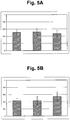
- Figur 5A und 5B:
- Diagramme betreffend die Stimulation der Synthese von Typ-I-Kollagen, Decorin und Versican.
- Zur Herstellung eines erfindungsgemäßen Kollagenhydrolysats wird als Ausgangsmaterial eine wässrige Lösung einer Schweineschwartengelatine (Typ A, 200 bis 250 g Bloom) mit einer Konzentration von 20 bis 40 Gew.% (Trockensubstanz) eingesetzt. Die Gelatine wird durch die nacheinander folgende Einwirkung von zwei verschiedenen Endoproteasen mikrobiellen Ursprungs bei 50 bis 60°C während 120 bis 180 min enzymatisch hydrolysiert, wobei als erstes Enzym eine Endoprotease aus Bacillus subtilis oder aus Bacillus amyloliquefaciens verwendet wird und als zweites Enzym eine Endoprotease aus Bacillus licheniformis. Anschließend werden die Enzyme thermisch inaktiviert und die Lösung sprühgetrocknet.
- Die Molekulargewichtsverteilung des resultierenden Kollagenhydrolysats kann mittels Gelpermeationschromatographie unter Verwendung der folgenden Parameter bestimmt werden:
Stationäre Phase: TSK 2000 SW XL (Tosoh Bioscience GmbH) Mobile Phase: 0,4 mol/l Natriumdihydrogenphosphat pH 5,3 Flussrate: 0,5 ml/min Kalibrierungsstandard: definierte Kollagen-Typ-I-Fragmente (FILK, Freiberg) Detektion: UV-Detektor Knauer K-2501 bei 214 nm - Die Bestimmung ergab eine Molekulargewichtsverteilung des erfindungsgemäßen Kollagenhydrolysats (im Folgenden als niedermolekulares Hydrolysat bezeichnet) gemäß der nachfolgenden Tabelle 1. Zum Vergleich ist in der Tabelle 1 auch die Molekulargewichtsverteilung eines kommerziell erhältlichen Kollagenhydrolysats angegeben, die mit derselben Methode bestimmt wurde (im Folgenden als hochmolekulares Hydrolysat bezeichnet):
Tabelle 1 MW-Bereich niedermol. Hydrolysat hochmol. Hydrolysat > 7.500 Da < 5 Gew.% < 10 Gew.% 3.500 - 7.500 Da ca. 12-18 Gew.% ca. 25-35 Gew.% 1.500 - 3.500 Da ca. 25-31 Gew.% ca. 29-35 Gew.% 500 - 1.500 Da ca. 40-46 Gew.% ca. 24-30 Gew.% < 500 Da ca. 5-10 Gew.% ca. 2-5 Gew.% - Der Hydroxyprolingehalt dieses niedermolekularen Hydrolysats beträgt ca. 12 bis 13 Gew.% und kann nach Oxidation mit Chloramin-T und Umsetzung mit p-Dimethylamino-benzaldehyd photometrisch bestimmt werden. Mehr als 50% der N-terminalen Aminosäuren des Hydrolysats sind hydrophobe Aminosäuren, insbesondere Alanin, Leucin und Isoleucin.
- Die Stimulation der Synthese von Kollagen (Typ I) sowie der Proteoglykane Biglykan und Versican wurde in vitro an humanen dermalen Fibroblasten (Hautzellen) untersucht. Hierfür wurden die Zellen für 24 Stunden mit jeweils 0,5 mg/ml des niedermolekularen bzw. des hochmolekularen Hydrolysats inkubiert und anschließend die Expression von Kollagen-RNA, Biglykan-RNA und Versican-RNA mittels Realtime-PCR bestimmt und semiquantitativ (bezogen auf eine Kontrolle ohne Hydrolysat) ausgewertet.
- Die Ergebnisse sind als Säulendiagramme für Typ-I-Kollagen in der
Figur 1A , für Biglykan in derFigur 1B und für Versican in derFigur 1C dargestellt, wobei die Diagramme jeweils den Mittelwert aus mindestens 18 Messungen zeigen. Auf der Abszisse ist die RNA-Expression relativ zur Kontrolle (=1) aufgetragen. Die linke ausgefüllte Säule steht jeweils für die Kontrolle, die mittlere schraffierte Säule für das hochmolekulare Hydrolysat (als Vergleich) und die rechte gepunktete Säule für das niedermolekulare Hydrolysat (gemäß der Erfindung). - Es zeigt sich, dass die Synthese aller drei Matrixproteine durch beide Kollagenhydrolysate stimuliert wird, wobei der positive Effekt des niedermolekularen Hydrolysats jeweils stärker ausgeprägt ist als derjenige des hochmolekularen Hydrolysats. Beim Kollagen, welches neben Elastin hauptverantwortlich für die Spannkraft und Elastizität der Haut ist, sowie beim Versican, das für den Feuchtigkeitshaushalt der Haut eine wichtige Rolle spielt, fällt der verstärkte Effekt des niedermolekularen Hydrolysats besonders deutlich aus.
- Die Beeinflussung der Hautfeuchtigkeit durch Kollagenhydrolysat wurde an haarlosen Mäusen direkt untersucht. Haarlose Mäuse stellen ein etabliertes Modellsystem dar, das bei dermatologischen Fragestellungen häufig eingesetzt wird, und die daraus gewonnenen Erkenntnisse sind prinzipiell auf die menschliche Haut übertragbar (siehe z.B. T. Fujimura et al.; J. Dermatol. Sci. 2000 (24) 105-111 und Y. Nishimori et al.; J. Invest. Dermatol. 2001 (117) 1458-1463).
- Die Tiere wurden während eines Zeitraums von drei Wochen täglich mit 150 µg Kollagenhydrolysat pro kg Körpergewicht gefüttert, die Kontrollgruppe erhielt stattdessen BSA. Gleichzeitig erhielten alle Tiere eine wöchentliche UV-B-Strahlungsdosis von 18 mJ/cm2 Hautoberfläche, wodurch die Hautfeuchtigkeit negativ beeinflusst wird.
- Der Feuchtigkeitsgehalt der Haut wurde nach einer Woche und nach drei Wochen mit einem Corneometer CM 825 (Hersteller: Courage & Khazaka) gemessen. Das Messprinzip beruht hierbei auf der Änderung der Kapazität eines Messkondensators durch die Dielektrizitätskonstante des in den oberen Hautschichten gebundenen Wassers, die sich von den Dielektrizitätskonstanten der meisten anderen Stoffe deutlich unterscheidet.
- Die Ergebnisse sind als Säulendiagramme für die Messung nach einer Woche in der
Figur 2A und für die Messung nach drei Wochen in derFigur 2B dargestellt, wobei die Diagramme jeweils den Mittelwert und den Standardfehler aus 7 Messungen zeigen. Auf der Abszisse ist die Hautfeuchtigkeit relativ zur Kontrolle (=1) aufgetragen. Die linke ausgefüllte Säule steht jeweils für die Kontrolle, die mittlere schraffierte Säule für das hochmolekulare Hydrolysat (als Vergleich) und die rechte gepunktete Säule für das niedermolekulare Hydrolysat (gemäß der Erfindung). - Es zeigt sich, dass die Erhöhung der Hautfeuchtigkeit durch das niedermolekulare Hydrolysat sowohl nach einer Woche als auch nach drei Wochen jeweils stärker ist als durch das hochmolekulare Hydrolysat. Dies ist ein weitere Beleg für die besondere Wirksamkeit des erfindungsgemäß verwendeten Hydrolysats bei der Verbesserung der Hautgesundheit.
- So genannte "Cornified Envelope"-Proteine spielen eine wichtige Rolle für die Barrierefunktion der Haut gegen das Eindringen von pathogenen Keimen und toxischen Substanzen. Die Synthese der CE-Proteine Involucrin, Loricrin und Filaggrin wurde bei haarlosen Mäusen bestimmt, die zuvor fünf Wochen mit täglich 150 µg Kollagenhydrolysat pro kg Körpergewicht gefüttert wurden (wie oben beschrieben). Die Quantifizierung der Proteine relativ zu einer Kontrollgruppe (Fütterung mit BSA) erfolgte mittels SDS-Polyacrylamid-Gelelektrophorese und Western-Blot mit spezifischen Antikörpern nach Extraktion der Proteine aus der Haut.
- Die Ergebnisse sind als Säulendiagramm in der
Figur 3 dargestellt, wobei das Diagramm jeweils den Mittelwert und den Standardfehler aus 7 Messungen zeigt. Auf der Abszisse ist die Menge der CE-Proteine nach Fütterung mit dem niedermolekularen Hydrolysat relativ zur Kontrolle (=1) aufgetragen. Die linke Säule steht für Involucrin, die mittlere Säule für Loricrin und die rechte Säule für Filaggrin. - Es zeigt sich, das die Synthese aller drei untersuchten CE-Proteine durch die orale Aufnahme des erfindungsgemäß verwendeten Kollagenhydrolysats stimuliert wird, im Fall von Involucrin sogar um mehr als das Dreifache.
- Die anti-oxidative Wirkung des niedermolekularen Kollagenhydrolysats wurde in einem zellfreien System mittels eine Malondialdehyd-Assays ermittelt.
- Dabei zeigte sich, dass die Bildung von reaktiven Sauerstoff-Spezies durch das Kollagenhydrolysat um durchschnittlich ca. 7% verringert wird. Im Bereich der Haut kann dadurch die Häufigkeit von DNA-Schädigungen reduziert werden, sodass Alterungserscheinungen durch die erfindungsgemäße Verwendung entgegengewirkt werden kann.
- Das gemäß Beispiel 1 hergestellte, niedermolekulare Kollagenhydrolysat gemäß der Erfindung, das ein mittleres Molekulargewicht von ca. 2.000 Da aufweist (im folgenden Hydrolysat A), wurde zwei kommerziell erhältlichen Kollagenhydrolysaten mit einem mittleren Molekulargewicht von ca. 2.100 Da (im Folgenden Hydrolysat B) und ca. 2.900 Da (im Folgenden Hydrolysat C) gegenübergestellt.
- Die genauen Molekulargewichtsverteilungen dieser drei Hydrolysate wurden mittels MALDI-Massenspektroskopie (MALDI-MS) analysiert. Hierzu wurden die Proben in 0,1%iger Trifluoressigsäure auf eine Endkonzentration von 10 µg/µl eingestellt und anschließend unter Verwendung von µC18-Material gereinigt. Die Proben wurden mit einer HCCA-Matrix auf ein MALDI-Target präpariert und die Massenspektren unter Verwendung eines Ultraflex-III-TOF/TOF-Massenspektrometers (Hersteller: Bruker Daltonics) bestimmt.
- Die
Figuren 4A bis 4C zeigen die entsprechenden Massenspektren bzw. Molekulargewichtsverteilungen der Kollagenhydrolysate A, B bzw. C, wobei auf der Ordinate das Molekulargewicht bzw. die Massenzahl und auf der Abszisse die Intensität aufgetragen ist. Ein Vergleich der drei Spektren zeigt, dass das erfindungsgemäße Hydrolysat A die folgenden charakteristischen Peptide gemäß der Tabelle 2 umfasst, wobei die entsprechenden Peaks eine doppelte bis vierfache Intensität im Vergleich zu ihrer Umgebung aufweisen:Tabelle 2 ca. 656 Da ca. 825 Da ca. 1.014 Da ca. 1.211 Da ca. 1.927 Da ca. 2.410 Da ca. 3.433 Da - Insbesondere die vier Peptide zwischen 600 und 1.500 Da haben keine Entsprechungen bei den beiden kommerziellen Hydrolysaten B und C, und sind somit für das Hydrolysat A besonders charakteristisch.
- Die Stimulation der Synthese von Kollagen (Typ I) sowie der Proteoglykane Decorin und Versican wurde in vitro an humanen dermalen Fibroblasten (Hautzellen) untersucht. Hierfür wurden die Zellen für 24 Stunden mit jeweils 0,5 mg/ml der Hydrolysate A, B bzw. C inkubiert und anschließend die Expression von Kollagen-RNA, Decorin-RNA und Versican-RNA mittels Realtime-PCR bestimmt und semiquantitativ ausgewertet. Decorin spielt eine wichtige Rolle bei der Bildung der Kollagenfasern in der Haut.
- Die Ergebnisse sind als Säulendiagramme für das Hydrolysat B in der
Figur 5A und für das Hydrolysat C in derFigur 5B dargestellt, wobei auf der Abszisse jeweils die RNA-Expression bei den kommerziellen Hydrolysaten B bzw. C relativ zur RNA-Expression bei dem erfindungsgemäßen Hydrolysat A (=1) aufgetragen ist. Die linke Säule steht jeweils für Typ-I-Kollagen, die mittlere Säule für Decorin und die rechte Säule für Versican. Es ist jeweils der Mittelwert aus mindestens 7 Messungen dargestellt sowie der Standardfehler. - Interessanterweise zeigen die Daten, dass bei allen drei Matrixproteinen eine im Vergleich zum Hydrolysat A deutlich geringere Stimulation der RNA-Synthese durch die beiden Hydrolysate B und C erfolgt, deren mittleres Molekulargewicht nur geringfügig höher ist. Die charakteristischen Peptide des Hydrolysats A scheinen somit eine entscheidende Rolle für dessen vorteilhafte Wirkung zu spielen.
- Im Folgenden sind einige beispielhafte Rezepturen für die Verwendung des Kollagenhydrolysats gemäß der Erfindung angegeben, die selbstverständlich in vielfältiger Weise abgewandelt werden können:
Kapsetten (Nahrungsergänzungsmittel) Glycerin 53,67 Gew.% Kollagenhydrolysat 21,95 Gew.% Gelatine 10,08 Gew.% Guarkernmehl 6,00 Gew.% Lecithin 5,00 Gew.% Citronensäure 2,00 Gew.% Aroma (Cassis) 0,50 Gew.% Orangenöl 0,50 Gew.% Acesulfam-K 0,30 Gew.% Schokolade Kakaomasse 51,0 Gew.% Saccharose 22,4 Gew.% Kakaobutter 16,6 Gew.% Kollagenhydrolysat 10,0 Gew.% Getränk Wasser 63,00 Gew.% Aloe-Vera-Konzentrat 31,00 Gew.% Kollagenhydrolysat 4,00 Gew.% Saccharose 1,50 Gew.% Citronensäure 0,26 Gew.% Aromen und Farbst. 0,24 Gew.% Sucralose 0,0031 Gew.% Haarshampoo Wasser 58,8 Gew.% Natriumlaureth-11-carboxylat 18,0 Gew.% Cocoamidopropyl-Betain 9,0 Gew.% Kollagenhydrolysat 6,0 Gew.% PEG-6 Capryl/Caproyl-Glyceride 3,0 Gew.% PEG-150 Distearat 2,5 Gew.% Laureth-7 2,0 Gew.% Kaliumsorbat 0,5 Gew.% Parfum 0,2 Gew.%
Claims (11)
- Nicht-therapeutische Verwendung von Kollagenhydrolysat zur Stimulation der Biosynthese extrazellulärer Matrixproteine durch Hautzellen, zur Erhöhung der Spannkraft der Haut, zur Verminderung der Faltenbildung und/oder zur Erhöhung des Feuchtigkeitsgehaltes der Haut,
dadurch gekennzeichnet,
dass das Kollagenhydrolysat durch die nacheinander folgende Einwirkung von zwei Endoproteasen mit einer unterschiedlichen Spezifität bei 50 bis 60 °C während 120 bis 180 min hergestellt ist, wobei als erstes Enzym eine Endoprotease aus Bacillus subtilis oder aus Bacillus amyloliquefaciens verwendet wird und als zweites Enzym eine Endoprotease aus Bacillus licheniformis, dass mindestens 45 Gew.% des Kollagenhydrolysats ein Molekulargewicht von weniger als 1.500 Da aufweisen, und
dass das Kollagenhydrolysat mindestens vier charakteristische Peptide mit einem Molekulargewicht zwischen 600 und 1.200 Da umfasst, die in einer mittels MALDI-Massenspektroskopie bestimmten Molekulargewichtsverteilung eine mindestens doppelte Intensität im Vergleich zu ihrer Umgebung aufweisen, wobei das Massenspektrum unter Verwendung eines TOF/TOF-Massenspektrometers bestimmt wurde mit einer Probe des Kollagenhydrolysats, die in 0,1%-iger Trifluoressigsäure auf eine Endkonzentration von 10 µg/µl eingestellt, unter Verwendung von µC18-Material gereinigt und mit einer HCCA-Matrix auf ein MALDI-Target präpariert wurde. - Verwendung nach Anspruch 1, wobei die mindestens vier charakteristischen Peptide in der mittels MALDI-Massenspektroskopie bestimmten Molekulargewichtsverteilung eine mindestens vierfache Intensität im Vergleich zu ihrer Umgebung aufweisen.
- Verwendung nach einem der vorangehenden Ansprüche, wobei das Kollagenhydrolysat ein Peptid zwischen 620 und 690 Da, ein Peptid zwischen 790 und 860 Da, ein Peptid zwischen 980 und 1.050 Da und ein Peptid zwischen 1.175 und 1.245 Da umfasst.
- Verwendung nach einem der vorangehenden Ansprüche, wobei das Kollagenhydrolysat weitere charakteristische Peptide mit einem Molekulargewicht zwischen 1.500 und 3.500 Da umfasst.
- Verwendung nach einem der vorangehenden Ansprüche, wobei das Kollagenhydrolysat einen Anteil an Hydroxyprolin von 12 Gew.% oder mehr aufweist.
- Verwendung nach einem der vorangehenden Ansprüche, wobei mindestens 50% der N-terminalen Aminosäuren des Kollagenhydrolysats hydrophobe Aminosäuren sind, insbesondere Alanin, Leucin und Isoleucin.
- Verwendung nach einem der vorangehenden Ansprüche, wobei das Kollagenhydrolysat für eine orale Aufnahme vorgesehen ist, und insbesondere ein Nahrungsergänzungsmittel ist oder in einem Nahrungs- oder Genussmittel enthalten ist.
- Verwendung nach Anspruch 7, wobei eine tägliche Aufnahme von ca. 1,5 bis 5 g, bevorzugt ca. 2 bis 3 g, weiter bevorzugt ca. 2,3 bis 2,7 g des Kollagenhydrolysats vorgesehen ist.
- Verwendung nach einem der Ansprüche 1 bis 6, wobei das Kollagenhydrolysat für eine topische Anwendung vorgesehen ist.
- Verwendung nach Anspruch 9, wobei das Kollagenhydrolysat in einer Creme, einer Salbe, einer Lotion, einem Gel oder einem Shampoo enthalten ist.
- Kollagenhydrolysat zur Anwendung in einem Verfahren zur Verbesserung der Barrierefunktion der Haut,
dadurch gekennzeichnet,
dass dass das Kollagenhydrolysat durch die nacheinander folgende Einwirkung von zwei Endoproteasen mit einer unterschiedlichen Spezifität bei 50 bis 60 °C während 120 bis 180 min hergestellt ist, wobei als erstes Enzym eine Endoprotease aus Bacillus subtilis oder aus Bacillus amyloliquefaciens verwendet wird und als zweites Enzym eine Endoprotease aus Bacillus licheniformis, dass mindestens 45 Gew.% des Kollagenhydrolysats ein Molekulargewicht von weniger als 1.500 Da aufweisen, und dass das Kollagenhydrolysat mindestens vier charakteristische Peptide mit einem Molekulargewicht zwischen 600 und 1.200 Da umfasst, die in einer mittels MALDI-Massenspektroskopie bestimmten Molekulargewichtsverteilung eine mindestens doppelte Intensität im Vergleich zu ihrer Umgebung aufweisen, wobei das Massenspektrum unter Verwendung eines TOF/TOF-Massenspektrometers bestimmt wurde mit einer Probe des Kollagenhydrolysats, die in 0,1%-iger Trifluoressigsäure auf eine Endkonzentration von 10 µg/µl eingestellt, unter Verwendung von µC18-Material gereinigt und mit einer HCCA-Matrix auf ein MALDI-Target präpariert wurde.
Priority Applications (1)
| Application Number | Priority Date | Filing Date | Title |
|---|---|---|---|
| PL11764723T PL2640352T3 (pl) | 2010-11-15 | 2011-09-29 | Hydrolizat kolagenu do zastosowania do poprawy zdrowia ludzkiej skóry, włosów i/lub paznokci |
Applications Claiming Priority (2)
| Application Number | Priority Date | Filing Date | Title |
|---|---|---|---|
| DE201010060564 DE102010060564A1 (de) | 2010-11-15 | 2010-11-15 | Verwendung von Kollagenhydrolysat zur Verbesserung der Gesundheit der menschlichen Haut, Haare und/oder Nägel |
| PCT/EP2011/067028 WO2012065782A2 (de) | 2010-11-15 | 2011-09-29 | Kollagenhydrolysat für die verwendung zur verbesserung der gesundheit der menschlichen haut, haare und/oder nägel |
Publications (2)
| Publication Number | Publication Date |
|---|---|
| EP2640352A2 EP2640352A2 (de) | 2013-09-25 |
| EP2640352B1 true EP2640352B1 (de) | 2017-08-30 |
Family
ID=44759679
Family Applications (1)
| Application Number | Title | Priority Date | Filing Date |
|---|---|---|---|
| EP11764723.0A Active EP2640352B1 (de) | 2010-11-15 | 2011-09-29 | Kollagenhydrolysat für die verwendung zur verbesserung der gesundheit der menschlichen haut, haare und/oder nägel |
Country Status (13)
| Country | Link |
|---|---|
| US (1) | US9072724B2 (de) |
| EP (1) | EP2640352B1 (de) |
| KR (1) | KR101662004B1 (de) |
| CN (1) | CN103209678B (de) |
| AU (1) | AU2011331466B2 (de) |
| BR (1) | BR112013011894B1 (de) |
| CA (1) | CA2816900C (de) |
| DE (1) | DE102010060564A1 (de) |
| ES (1) | ES2641922T3 (de) |
| MX (1) | MX344236B (de) |
| PL (1) | PL2640352T3 (de) |
| RU (1) | RU2577699C2 (de) |
| WO (1) | WO2012065782A2 (de) |
Cited By (3)
| Publication number | Priority date | Publication date | Assignee | Title |
|---|---|---|---|---|
| DE102019207859A1 (de) | 2018-12-21 | 2020-06-25 | Gelita Ag | Synthetische und rekombinant hergestellte Kollagenpeptide mit biologischer Wirksamkeit |
| WO2021083968A1 (de) | 2019-10-31 | 2021-05-06 | Gelita Ag | Ernährungsphysiologisch optimiertes kollagenpeptid |
| US11998654B2 (en) | 2018-07-12 | 2024-06-04 | Bard Shannon Limited | Securing implants and medical devices |
Families Citing this family (32)
| Publication number | Priority date | Publication date | Assignee | Title |
|---|---|---|---|---|
| MX359181B (es) * | 2011-11-29 | 2018-09-17 | Gelita Ag | Hidrolizado de colágeno y uso del mismo. |
| EP2878295A4 (de) * | 2012-07-24 | 2015-12-23 | J Oil Mills Inc | Zusammensetzung |
| DE102012110612A1 (de) * | 2012-11-06 | 2014-05-08 | Gelita Ag | Kollagenhydrolysat und dessen Verwendung |
| WO2014114939A1 (en) | 2013-01-23 | 2014-07-31 | Bottled Science Limited | Skin enhancing beverage composition |
| DE102013104897A1 (de) * | 2013-05-13 | 2014-11-13 | Gelita Ag | Wirkstoff zur Behandlung von Sarkopenie |
| DE202013104626U1 (de) | 2013-10-14 | 2013-10-22 | Quiris Healthcare Gmbh & Co. Kg | Zusammensetzung enthaltend Kollagen-Hydrolysat und Vitamin C |
| DE202013011917U1 (de) | 2013-10-14 | 2014-10-13 | Quiris Healthcare Gmbh & Co. Kg | Zusammensetzung enthaltend Kollagen-Hydrolysat und Vitamin C |
| CN105828829A (zh) * | 2013-12-18 | 2016-08-03 | 帝斯曼知识产权资产管理有限公司 | 用于含角蛋白的组织的包含溶菌酶水解物的组合物 |
| WO2016194760A1 (ja) * | 2015-05-29 | 2016-12-08 | ロート製薬株式会社 | 美容方法およびそれに用いる皮膚外用剤、並びに遊走付与剤、皮膚状態を向上させる美容方法に用いられる成分のスクリーニング方法 |
| HRP20210071T4 (hr) † | 2016-02-03 | 2024-02-16 | Fresenius Kabi Deutschland Gmbh | Visoko kalorijska, visoko proteinska nutritivna formula koja sadrži kolagen |
| CA3056759C (en) | 2016-03-22 | 2024-01-23 | Avicenna Nutraceutical, Llc | Hydrolyzed collagen compositions and methods of making thereof |
| CN106519020B (zh) * | 2016-10-31 | 2019-10-18 | 华南理工大学 | 一种具有美容功效的功能性肽及其制备方法和用途 |
| US11058657B2 (en) * | 2016-11-16 | 2021-07-13 | Fresenius Kabi Deutschland Gmbh | Nutritional composition for use in therapy of cancer patients |
| CN109982585B (zh) | 2016-11-16 | 2024-03-15 | 费森尤斯卡比德国有限公司 | 用于患有肌少症和/或衰弱症的患者或肌少症前期和/或衰弱症前期患者的疗法中的用途的营养组合物 |
| EP3541205B1 (de) | 2016-11-16 | 2024-05-22 | Fresenius Kabi Deutschland GmbH | Ernährungsmässig vollständige flüssige zusammensetzungen zur verwendung in der therapie von unterernährung im zusammenhang mit chronisch obstruktiver lungenerkrankung, neurologischen erkrankungen oder störungen und/oder wunden, die kollagenhydrolysat enthalten |
| EP3621985A4 (de) | 2017-05-11 | 2021-03-17 | Avicenna Nutraceutical, LLC | Verfahren zur erzeugung von kollagen |
| RU2658380C1 (ru) * | 2017-08-25 | 2018-06-21 | Сергей Валерьевич Штерман | Напиток для улучшения состояния кожи и суставов |
| US11180541B2 (en) | 2017-09-28 | 2021-11-23 | Geltor, Inc. | Recombinant collagen and elastin molecules and uses thereof |
| AR114501A1 (es) | 2017-12-22 | 2020-09-16 | Tessenderlo Group Nv | Hidrolizado de proteínas y proceso para sus preparación |
| DE102019202606A1 (de) | 2018-11-06 | 2020-05-07 | Gelita Ag | Rekombinante Herstellung eines Kollagenpeptidpräparates und dessen Verwendung |
| DE102018133374A1 (de) * | 2018-12-21 | 2020-06-25 | Gelita Ag | Kollagenhydrolysat zur Verwendung gegen Hautkrankheiten und Darmkrankheiten |
| TW202104254A (zh) | 2019-04-12 | 2021-02-01 | 美商格爾托公司 | 重組彈性蛋白及其生產 |
| WO2021110748A1 (en) | 2019-12-03 | 2021-06-10 | Laboratorio Genove, S.A. | A day-and-night and inside-outside collagen-containing treatment |
| WO2021146240A1 (en) | 2020-01-13 | 2021-07-22 | Cargill, Incorporated | Turkey collagen hydrolysates and methods of making |
| AU2021211721A1 (en) | 2020-01-24 | 2022-08-18 | Geltor, Inc. | Animal-free dietary collagen |
| DE102020104279A1 (de) | 2020-02-18 | 2021-08-19 | Gelita Ag | Kollagenhydrolysat als Wirkstoff gegen Parodontitis oder Gingivitis |
| DE102020126594A1 (de) * | 2020-10-09 | 2022-04-14 | Gelita Ag | Kollagenhydrolysat als Wirkstoff zum Verzögern der Alterung |
| DE102021202830A1 (de) | 2021-03-23 | 2022-09-29 | Gelita Ag | Rekombinantes Typ II-Kollagen zur therapeutischen Verwendung |
| CN113501861A (zh) * | 2021-08-01 | 2021-10-15 | 青海瑞肽生物科技有限公司 | 一种高分辨质谱筛选牦牛胶原蛋白特征片段的方法 |
| CN116836262B (zh) * | 2023-03-13 | 2024-11-05 | 南京迪诺薇华生物科技有限公司 | 一种重组类胶原蛋白的水解肽、其制备方法及其用途 |
| DE202024000671U1 (de) | 2024-03-27 | 2024-05-22 | SanoOne GmbH | Kollagenhydrolysat-Zusammensetzung für Gelenke, Haut und optimierte Muskelregeneration |
| EP4666996A1 (de) | 2024-06-21 | 2025-12-24 | Quiris Healthcare GmbH & Co. KG | Zusammensetzung mit peptiden pflanzlichen ursprungs |
Family Cites Families (12)
| Publication number | Priority date | Publication date | Assignee | Title |
|---|---|---|---|---|
| US413055A (en) * | 1889-10-15 | Yarn-reeling machine | ||
| US4130555A (en) * | 1977-09-06 | 1978-12-19 | Nippi Incorporated | Peptide mixtures derived from collagenous material or gelatin |
| FR2540381B1 (fr) * | 1983-02-08 | 1986-05-30 | Dior Sa Parfums Christian | Procede pour stimuler la croissance des cellules; composition cosmetique, pharmaceutique et composition complementaire pour milieu de culture cellulaire appliquant ce procede |
| JP2886283B2 (ja) * | 1990-07-05 | 1999-04-26 | ホーユー株式会社 | 毛髪処理剤 |
| DE4244418A1 (en) * | 1991-12-30 | 1993-07-01 | Gerhard Quelle | Cosmetic and pharmaceutical compsn. contg. specific tri:peptide(s) - is prepd. by controlled hydrolysis of collagen, etc., for stimulating cell respiration or collagen synthesis, etc. |
| US6025327A (en) * | 1997-08-08 | 2000-02-15 | Biocell Technology, Llc | Hydrolyzed collagen type II and use thereof |
| EP1898872A2 (de) * | 2005-03-21 | 2008-03-19 | Johnson & Johnson Consumer Companies, Inc. | Hautzusammensetzungen mit spannungspolymeren und ihre verwendung |
| FR2900155B1 (fr) | 2006-04-21 | 2008-06-27 | Diana Naturals Sa | Hydrolisat de cartilage aviaire, procede d'obtention et utilisations |
| JP5689222B2 (ja) | 2006-11-15 | 2015-03-25 | 株式会社明治 | コラーゲンペプチド組成物及びこれを含有する飲食品 |
| JP2007326869A (ja) * | 2007-07-27 | 2007-12-20 | Seiwa Kasei Co Ltd | 魚鱗由来加水分解コラーゲン |
| KR100862979B1 (ko) * | 2007-12-31 | 2008-10-13 | 씨엔에이바이오텍(주) | 화장품용 콜라겐 펩타이드 조성물 및 그 제조방법 |
| CN101518645A (zh) * | 2008-02-29 | 2009-09-02 | 李勇 | 海洋胶原肽在制备保护肾脏功能、延缓慢性肾衰进程药物、保健食品或食品中的用途 |
-
2010
- 2010-11-15 DE DE201010060564 patent/DE102010060564A1/de not_active Withdrawn
-
2011
- 2011-09-29 CN CN201180054946.0A patent/CN103209678B/zh active Active
- 2011-09-29 MX MX2013005398A patent/MX344236B/es active IP Right Grant
- 2011-09-29 BR BR112013011894A patent/BR112013011894B1/pt active IP Right Grant
- 2011-09-29 KR KR1020137010552A patent/KR101662004B1/ko active Active
- 2011-09-29 EP EP11764723.0A patent/EP2640352B1/de active Active
- 2011-09-29 ES ES11764723.0T patent/ES2641922T3/es active Active
- 2011-09-29 CA CA2816900A patent/CA2816900C/en active Active
- 2011-09-29 WO PCT/EP2011/067028 patent/WO2012065782A2/de not_active Ceased
- 2011-09-29 AU AU2011331466A patent/AU2011331466B2/en active Active
- 2011-09-29 RU RU2013127136/15A patent/RU2577699C2/ru active
- 2011-09-29 PL PL11764723T patent/PL2640352T3/pl unknown
-
2013
- 2013-05-07 US US13/888,812 patent/US9072724B2/en active Active
Non-Patent Citations (1)
| Title |
|---|
| None * |
Cited By (5)
| Publication number | Priority date | Publication date | Assignee | Title |
|---|---|---|---|---|
| US11998654B2 (en) | 2018-07-12 | 2024-06-04 | Bard Shannon Limited | Securing implants and medical devices |
| DE102019207859A1 (de) | 2018-12-21 | 2020-06-25 | Gelita Ag | Synthetische und rekombinant hergestellte Kollagenpeptide mit biologischer Wirksamkeit |
| WO2020127929A1 (de) | 2018-12-21 | 2020-06-25 | Gelita Ag | Synthetische und rekombinant hergestellte kollagenpeptide mit biologischer wirksamkeit |
| WO2021083968A1 (de) | 2019-10-31 | 2021-05-06 | Gelita Ag | Ernährungsphysiologisch optimiertes kollagenpeptid |
| US12528857B2 (en) | 2019-10-31 | 2026-01-20 | Gelita Ag | Nutritionally-optimized collagen peptide |
Also Published As
| Publication number | Publication date |
|---|---|
| KR101662004B1 (ko) | 2016-10-04 |
| AU2011331466A1 (en) | 2013-06-20 |
| US20130252899A1 (en) | 2013-09-26 |
| RU2577699C2 (ru) | 2016-03-20 |
| WO2012065782A2 (de) | 2012-05-24 |
| MX344236B (es) | 2016-12-07 |
| CA2816900C (en) | 2016-08-23 |
| RU2013127136A (ru) | 2014-12-27 |
| CN103209678A (zh) | 2013-07-17 |
| WO2012065782A3 (de) | 2012-07-26 |
| KR20130102601A (ko) | 2013-09-17 |
| BR112013011894B1 (pt) | 2018-07-17 |
| CN103209678B (zh) | 2016-11-09 |
| BR112013011894A2 (pt) | 2016-07-19 |
| ES2641922T3 (es) | 2017-11-14 |
| US9072724B2 (en) | 2015-07-07 |
| CA2816900A1 (en) | 2012-05-24 |
| EP2640352A2 (de) | 2013-09-25 |
| AU2011331466B2 (en) | 2016-02-25 |
| PL2640352T3 (pl) | 2017-12-29 |
| MX2013005398A (es) | 2013-07-29 |
| DE102010060564A1 (de) | 2012-05-16 |
Similar Documents
| Publication | Publication Date | Title |
|---|---|---|
| EP2640352A2 (de) | Kollagenhydrolysat für die verwendung zur verbesserung der gesundheit der menschlichen haut, haare und/oder nägel | |
| EP2785420B1 (de) | Kosmetische verwendung von kollagenhydrolysat | |
| WO2020094728A1 (de) | Rekombinante herstellung eines kollagenpeptidpräparates und dessen verwendung | |
| EP2371375A1 (de) | Peptide zur hemmung von hautalterung | |
| DE102004045187A1 (de) | Wirkstoff, der in der Lage ist, die Überführung von inaktivem TGFb-latent in aktiven TGFb zu induzieren | |
| DE2741003A1 (de) | Aus collagenhaltigem material oder gelatine erhaltene peptidmischungen, verfahren zu deren herstellung und deren verwendungen | |
| WO2015083630A1 (ja) | コラーゲンペプチド、エラスチンペプチドおよびプロテオグリカンを含む組成物 | |
| JP2002238497A (ja) | 食品組成物 | |
| DE69804203T2 (de) | Verwendung einer aus hibiskus-esculentus-samen extrahierten proteinfraktion in der kosmetik | |
| EP1663274B1 (de) | Pflanzliche plazenta-extrakte, verfahren zu ihrer herstellung und ihre verwendung | |
| JP3908126B2 (ja) | 表皮角化正常化剤及びこれを含有する皮膚外用剤 | |
| KR102153463B1 (ko) | 다이펩타이드 함량이 높은 콜라겐 가수분해물, 그 제조 방법 및 이의 응용 | |
| JP3172753B2 (ja) | 生体ヒアルロン酸合成促進剤 | |
| KR102768676B1 (ko) | 동애등에 유충으로부터 분리한 단백 가수분해물을 유효성분으로 포함하는 피부미백 및 피부주름 개선용 화장료 조성물 | |
| KR20220163294A (ko) | 자하거 모사 화장료 조성물 | |
| DE102020210725A1 (de) | Ernährungsphysiologisch optimiertes Kollagenpeptid | |
| EP3735960A1 (de) | Kosmetische zubereitung enthaltend resveratrol | |
| KR100837879B1 (ko) | 녹용에서 추출한 콜라겐을 함유하는 기능성 강화 화장료조성물 및 그 제조방법 | |
| DE102011055800A1 (de) | Verwendung von Kollagenhydrolysat | |
| DE69803169T2 (de) | Verwendung eines bambaraerdnuss-samenextraktes in einer kosmetischen zusamensetzung | |
| KR101997231B1 (ko) | 효소반응을 이용하여 제조된 꿀 추출물을 유효성분으로 함유하는 화장료 조성물 | |
| JP2006028020A (ja) | コラーゲンと黒砂糖エキスとを含有する化粧料組成物 | |
| DE202016000228U1 (de) | Aminosäuren-haltige Zusammensetzung | |
| JPH03200707A (ja) | 皮膚外用剤 | |
| JP2006193503A (ja) | 皮膚外用組成物及び食品組成物 |
Legal Events
| Date | Code | Title | Description |
|---|---|---|---|
| PUAI | Public reference made under article 153(3) epc to a published international application that has entered the european phase |
Free format text: ORIGINAL CODE: 0009012 |
|
| 17P | Request for examination filed |
Effective date: 20130531 |
|
| AK | Designated contracting states |
Kind code of ref document: A2 Designated state(s): AL AT BE BG CH CY CZ DE DK EE ES FI FR GB GR HR HU IE IS IT LI LT LU LV MC MK MT NL NO PL PT RO RS SE SI SK SM TR |
|
| DAX | Request for extension of the european patent (deleted) | ||
| TPAC | Observations filed by third parties |
Free format text: ORIGINAL CODE: EPIDOSNTIPA |
|
| 17Q | First examination report despatched |
Effective date: 20150609 |
|
| REG | Reference to a national code |
Ref country code: DE Ref legal event code: R079 Ref document number: 502011012916 Country of ref document: DE Free format text: PREVIOUS MAIN CLASS: A61K0008650000 Ipc: A61Q0003000000 |
|
| GRAP | Despatch of communication of intention to grant a patent |
Free format text: ORIGINAL CODE: EPIDOSNIGR1 |
|
| RIC1 | Information provided on ipc code assigned before grant |
Ipc: A23L 33/18 20160101ALI20170301BHEP Ipc: A61K 38/39 20060101ALI20170301BHEP Ipc: A61K 8/65 20060101ALI20170301BHEP Ipc: A61Q 19/08 20060101ALI20170301BHEP Ipc: A61Q 3/00 20060101AFI20170301BHEP Ipc: A61Q 5/00 20060101ALI20170301BHEP |
|
| INTG | Intention to grant announced |
Effective date: 20170328 |
|
| GRAJ | Information related to disapproval of communication of intention to grant by the applicant or resumption of examination proceedings by the epo deleted |
Free format text: ORIGINAL CODE: EPIDOSDIGR1 |
|
| GRAL | Information related to payment of fee for publishing/printing deleted |
Free format text: ORIGINAL CODE: EPIDOSDIGR3 |
|
| GRAS | Grant fee paid |
Free format text: ORIGINAL CODE: EPIDOSNIGR3 |
|
| GRAR | Information related to intention to grant a patent recorded |
Free format text: ORIGINAL CODE: EPIDOSNIGR71 |
|
| GRAA | (expected) grant |
Free format text: ORIGINAL CODE: 0009210 |
|
| INTC | Intention to grant announced (deleted) | ||
| REG | Reference to a national code |
Ref country code: FR Ref legal event code: PLFP Year of fee payment: 7 |
|
| AK | Designated contracting states |
Kind code of ref document: B1 Designated state(s): AL AT BE BG CH CY CZ DE DK EE ES FI FR GB GR HR HU IE IS IT LI LT LU LV MC MK MT NL NO PL PT RO RS SE SI SK SM TR |
|
| INTG | Intention to grant announced |
Effective date: 20170724 |
|
| REG | Reference to a national code |
Ref country code: GB Ref legal event code: FG4D Free format text: NOT ENGLISH |
|
| REG | Reference to a national code |
Ref country code: CH Ref legal event code: EP |
|
| REG | Reference to a national code |
Ref country code: AT Ref legal event code: REF Ref document number: 922976 Country of ref document: AT Kind code of ref document: T Effective date: 20170915 |
|
| REG | Reference to a national code |
Ref country code: IE Ref legal event code: FG4D Free format text: LANGUAGE OF EP DOCUMENT: GERMAN |
|
| REG | Reference to a national code |
Ref country code: DE Ref legal event code: R096 Ref document number: 502011012916 Country of ref document: DE |
|
| REG | Reference to a national code |
Ref country code: NL Ref legal event code: FP |
|
| REG | Reference to a national code |
Ref country code: SE Ref legal event code: TRGR |
|
| REG | Reference to a national code |
Ref country code: ES Ref legal event code: FG2A Ref document number: 2641922 Country of ref document: ES Kind code of ref document: T3 Effective date: 20171114 |
|
| REG | Reference to a national code |
Ref country code: LT Ref legal event code: MG4D |
|
| PG25 | Lapsed in a contracting state [announced via postgrant information from national office to epo] |
Ref country code: HR Free format text: LAPSE BECAUSE OF FAILURE TO SUBMIT A TRANSLATION OF THE DESCRIPTION OR TO PAY THE FEE WITHIN THE PRESCRIBED TIME-LIMIT Effective date: 20170830 Ref country code: FI Free format text: LAPSE BECAUSE OF FAILURE TO SUBMIT A TRANSLATION OF THE DESCRIPTION OR TO PAY THE FEE WITHIN THE PRESCRIBED TIME-LIMIT Effective date: 20170830 Ref country code: NO Free format text: LAPSE BECAUSE OF FAILURE TO SUBMIT A TRANSLATION OF THE DESCRIPTION OR TO PAY THE FEE WITHIN THE PRESCRIBED TIME-LIMIT Effective date: 20171130 Ref country code: LT Free format text: LAPSE BECAUSE OF FAILURE TO SUBMIT A TRANSLATION OF THE DESCRIPTION OR TO PAY THE FEE WITHIN THE PRESCRIBED TIME-LIMIT Effective date: 20170830 |
|
| PG25 | Lapsed in a contracting state [announced via postgrant information from national office to epo] |
Ref country code: GR Free format text: LAPSE BECAUSE OF FAILURE TO SUBMIT A TRANSLATION OF THE DESCRIPTION OR TO PAY THE FEE WITHIN THE PRESCRIBED TIME-LIMIT Effective date: 20171201 Ref country code: BG Free format text: LAPSE BECAUSE OF FAILURE TO SUBMIT A TRANSLATION OF THE DESCRIPTION OR TO PAY THE FEE WITHIN THE PRESCRIBED TIME-LIMIT Effective date: 20171130 Ref country code: IS Free format text: LAPSE BECAUSE OF FAILURE TO SUBMIT A TRANSLATION OF THE DESCRIPTION OR TO PAY THE FEE WITHIN THE PRESCRIBED TIME-LIMIT Effective date: 20171230 Ref country code: LV Free format text: LAPSE BECAUSE OF FAILURE TO SUBMIT A TRANSLATION OF THE DESCRIPTION OR TO PAY THE FEE WITHIN THE PRESCRIBED TIME-LIMIT Effective date: 20170830 Ref country code: RS Free format text: LAPSE BECAUSE OF FAILURE TO SUBMIT A TRANSLATION OF THE DESCRIPTION OR TO PAY THE FEE WITHIN THE PRESCRIBED TIME-LIMIT Effective date: 20170830 |
|
| PG25 | Lapsed in a contracting state [announced via postgrant information from national office to epo] |
Ref country code: DK Free format text: LAPSE BECAUSE OF FAILURE TO SUBMIT A TRANSLATION OF THE DESCRIPTION OR TO PAY THE FEE WITHIN THE PRESCRIBED TIME-LIMIT Effective date: 20170830 Ref country code: RO Free format text: LAPSE BECAUSE OF FAILURE TO SUBMIT A TRANSLATION OF THE DESCRIPTION OR TO PAY THE FEE WITHIN THE PRESCRIBED TIME-LIMIT Effective date: 20170830 Ref country code: CZ Free format text: LAPSE BECAUSE OF FAILURE TO SUBMIT A TRANSLATION OF THE DESCRIPTION OR TO PAY THE FEE WITHIN THE PRESCRIBED TIME-LIMIT Effective date: 20170830 |
|
| PG25 | Lapsed in a contracting state [announced via postgrant information from national office to epo] |
Ref country code: SM Free format text: LAPSE BECAUSE OF FAILURE TO SUBMIT A TRANSLATION OF THE DESCRIPTION OR TO PAY THE FEE WITHIN THE PRESCRIBED TIME-LIMIT Effective date: 20170830 Ref country code: SK Free format text: LAPSE BECAUSE OF FAILURE TO SUBMIT A TRANSLATION OF THE DESCRIPTION OR TO PAY THE FEE WITHIN THE PRESCRIBED TIME-LIMIT Effective date: 20170830 Ref country code: MC Free format text: LAPSE BECAUSE OF FAILURE TO SUBMIT A TRANSLATION OF THE DESCRIPTION OR TO PAY THE FEE WITHIN THE PRESCRIBED TIME-LIMIT Effective date: 20170830 Ref country code: EE Free format text: LAPSE BECAUSE OF FAILURE TO SUBMIT A TRANSLATION OF THE DESCRIPTION OR TO PAY THE FEE WITHIN THE PRESCRIBED TIME-LIMIT Effective date: 20170830 |
|
| REG | Reference to a national code |
Ref country code: DE Ref legal event code: R097 Ref document number: 502011012916 Country of ref document: DE |
|
| REG | Reference to a national code |
Ref country code: IE Ref legal event code: MM4A |
|
| PG25 | Lapsed in a contracting state [announced via postgrant information from national office to epo] |
Ref country code: LU Free format text: LAPSE BECAUSE OF NON-PAYMENT OF DUE FEES Effective date: 20170929 |
|
| PLBE | No opposition filed within time limit |
Free format text: ORIGINAL CODE: 0009261 |
|
| STAA | Information on the status of an ep patent application or granted ep patent |
Free format text: STATUS: NO OPPOSITION FILED WITHIN TIME LIMIT |
|
| PG25 | Lapsed in a contracting state [announced via postgrant information from national office to epo] |
Ref country code: IE Free format text: LAPSE BECAUSE OF NON-PAYMENT OF DUE FEES Effective date: 20170929 |
|
| 26N | No opposition filed |
Effective date: 20180531 |
|
| REG | Reference to a national code |
Ref country code: FR Ref legal event code: PLFP Year of fee payment: 8 |
|
| PG25 | Lapsed in a contracting state [announced via postgrant information from national office to epo] |
Ref country code: SI Free format text: LAPSE BECAUSE OF FAILURE TO SUBMIT A TRANSLATION OF THE DESCRIPTION OR TO PAY THE FEE WITHIN THE PRESCRIBED TIME-LIMIT Effective date: 20170830 |
|
| PG25 | Lapsed in a contracting state [announced via postgrant information from national office to epo] |
Ref country code: MT Free format text: LAPSE BECAUSE OF FAILURE TO SUBMIT A TRANSLATION OF THE DESCRIPTION OR TO PAY THE FEE WITHIN THE PRESCRIBED TIME-LIMIT Effective date: 20170830 |
|
| PG25 | Lapsed in a contracting state [announced via postgrant information from national office to epo] |
Ref country code: HU Free format text: LAPSE BECAUSE OF FAILURE TO SUBMIT A TRANSLATION OF THE DESCRIPTION OR TO PAY THE FEE WITHIN THE PRESCRIBED TIME-LIMIT; INVALID AB INITIO Effective date: 20110929 |
|
| PG25 | Lapsed in a contracting state [announced via postgrant information from national office to epo] |
Ref country code: CY Free format text: LAPSE BECAUSE OF NON-PAYMENT OF DUE FEES Effective date: 20170830 |
|
| PG25 | Lapsed in a contracting state [announced via postgrant information from national office to epo] |
Ref country code: MK Free format text: LAPSE BECAUSE OF FAILURE TO SUBMIT A TRANSLATION OF THE DESCRIPTION OR TO PAY THE FEE WITHIN THE PRESCRIBED TIME-LIMIT Effective date: 20170830 |
|
| PG25 | Lapsed in a contracting state [announced via postgrant information from national office to epo] |
Ref country code: PT Free format text: LAPSE BECAUSE OF FAILURE TO SUBMIT A TRANSLATION OF THE DESCRIPTION OR TO PAY THE FEE WITHIN THE PRESCRIBED TIME-LIMIT Effective date: 20170830 |
|
| PG25 | Lapsed in a contracting state [announced via postgrant information from national office to epo] |
Ref country code: AL Free format text: LAPSE BECAUSE OF FAILURE TO SUBMIT A TRANSLATION OF THE DESCRIPTION OR TO PAY THE FEE WITHIN THE PRESCRIBED TIME-LIMIT Effective date: 20170830 |
|
| P01 | Opt-out of the competence of the unified patent court (upc) registered |
Effective date: 20230519 |
|
| PGFP | Annual fee paid to national office [announced via postgrant information from national office to epo] |
Ref country code: NL Payment date: 20250704 Year of fee payment: 15 |
|
| REG | Reference to a national code |
Ref country code: CH Ref legal event code: U11 Free format text: ST27 STATUS EVENT CODE: U-0-0-U10-U11 (AS PROVIDED BY THE NATIONAL OFFICE) Effective date: 20251001 |
|
| PGFP | Annual fee paid to national office [announced via postgrant information from national office to epo] |
Ref country code: DE Payment date: 20250919 Year of fee payment: 15 |
|
| PGFP | Annual fee paid to national office [announced via postgrant information from national office to epo] |
Ref country code: PL Payment date: 20250714 Year of fee payment: 15 Ref country code: TR Payment date: 20250926 Year of fee payment: 15 Ref country code: IT Payment date: 20250825 Year of fee payment: 15 |
|
| PGFP | Annual fee paid to national office [announced via postgrant information from national office to epo] |
Ref country code: BE Payment date: 20250818 Year of fee payment: 15 Ref country code: GB Payment date: 20250807 Year of fee payment: 15 |
|
| PGFP | Annual fee paid to national office [announced via postgrant information from national office to epo] |
Ref country code: FR Payment date: 20250808 Year of fee payment: 15 Ref country code: AT Payment date: 20250827 Year of fee payment: 15 |
|
| PGFP | Annual fee paid to national office [announced via postgrant information from national office to epo] |
Ref country code: SE Payment date: 20250812 Year of fee payment: 15 |
|
| PGFP | Annual fee paid to national office [announced via postgrant information from national office to epo] |
Ref country code: CH Payment date: 20251001 Year of fee payment: 15 |
|
| PGFP | Annual fee paid to national office [announced via postgrant information from national office to epo] |
Ref country code: ES Payment date: 20251015 Year of fee payment: 15 |