EP2641427B1 - Systèmes et procédés d'optimisation de liaison - Google Patents
Systèmes et procédés d'optimisation de liaison Download PDFInfo
- Publication number
- EP2641427B1 EP2641427B1 EP11841738.5A EP11841738A EP2641427B1 EP 2641427 B1 EP2641427 B1 EP 2641427B1 EP 11841738 A EP11841738 A EP 11841738A EP 2641427 B1 EP2641427 B1 EP 2641427B1
- Authority
- EP
- European Patent Office
- Prior art keywords
- cells
- backhaul
- demand
- demands
- connector node
- Prior art date
- Legal status (The legal status is an assumption and is not a legal conclusion. Google has not performed a legal analysis and makes no representation as to the accuracy of the status listed.)
- Active
Links
Images



Classifications
-
- H—ELECTRICITY
- H04—ELECTRIC COMMUNICATION TECHNIQUE
- H04W—WIRELESS COMMUNICATION NETWORKS
- H04W28/00—Network traffic management; Network resource management
- H04W28/16—Central resource management; Negotiation of resources or communication parameters, e.g. negotiating bandwidth or QoS [Quality of Service]
- H04W28/18—Negotiating wireless communication parameters
- H04W28/22—Negotiating communication rate
-
- H—ELECTRICITY
- H04—ELECTRIC COMMUNICATION TECHNIQUE
- H04W—WIRELESS COMMUNICATION NETWORKS
- H04W72/00—Local resource management
- H04W72/50—Allocation or scheduling criteria for wireless resources
- H04W72/54—Allocation or scheduling criteria for wireless resources based on quality criteria
-
- H—ELECTRICITY
- H04—ELECTRIC COMMUNICATION TECHNIQUE
- H04L—TRANSMISSION OF DIGITAL INFORMATION, e.g. TELEGRAPHIC COMMUNICATION
- H04L5/00—Arrangements affording multiple use of the transmission path
- H04L5/003—Arrangements for allocating sub-channels of the transmission path
- H04L5/0037—Inter-user or inter-terminal allocation
-
- H—ELECTRICITY
- H04—ELECTRIC COMMUNICATION TECHNIQUE
- H04W—WIRELESS COMMUNICATION NETWORKS
- H04W72/00—Local resource management
- H04W72/50—Allocation or scheduling criteria for wireless resources
- H04W72/52—Allocation or scheduling criteria for wireless resources based on load
-
- H—ELECTRICITY
- H04—ELECTRIC COMMUNICATION TECHNIQUE
- H04W—WIRELESS COMMUNICATION NETWORKS
- H04W84/00—Network topologies
- H04W84/02—Hierarchically pre-organised networks, e.g. paging networks, cellular networks, WLAN [Wireless Local Area Network] or WLL [Wireless Local Loop]
- H04W84/04—Large scale networks; Deep hierarchical networks
- H04W84/042—Public Land Mobile systems, e.g. cellular systems
- H04W84/045—Public Land Mobile systems, e.g. cellular systems using private Base Stations, e.g. femto Base Stations, home Node B
-
- Y—GENERAL TAGGING OF NEW TECHNOLOGICAL DEVELOPMENTS; GENERAL TAGGING OF CROSS-SECTIONAL TECHNOLOGIES SPANNING OVER SEVERAL SECTIONS OF THE IPC; TECHNICAL SUBJECTS COVERED BY FORMER USPC CROSS-REFERENCE ART COLLECTIONS [XRACs] AND DIGESTS
- Y02—TECHNOLOGIES OR APPLICATIONS FOR MITIGATION OR ADAPTATION AGAINST CLIMATE CHANGE
- Y02D—CLIMATE CHANGE MITIGATION TECHNOLOGIES IN INFORMATION AND COMMUNICATION TECHNOLOGIES [ICT], I.E. INFORMATION AND COMMUNICATION TECHNOLOGIES AIMING AT THE REDUCTION OF THEIR OWN ENERGY USE
- Y02D30/00—Reducing energy consumption in communication networks
- Y02D30/70—Reducing energy consumption in communication networks in wireless communication networks
Definitions
- the present invention(s) relate to backhaul systems, and more particularly, some embodiments relate to systems and methods for backhaul optimization.
- the radio access network In wireless cellular systems, the radio access network is often a bottleneck to achieving high capacity. This bottleneck is often a result of impairments of the wireless medium. In comparison to radio access network capacity, backhaul capacity is typically large. Further, dedicated backhaul links are assumed to provide the needed capacity to support backhaul requirements.
- picocells The new trend to improve cellular coverage (especially indoors) and network capacity is to populate a network with low power base stations, thus adding cells of smaller radius referred to as "picocells.”
- picocells Unfortunately, the increased density of picocells when compared to a macrocell network raises a number of design issues. In particular, large number of picocells typically require automation of the operation and optimization of transmit parameters. This leads to the concept of self-organizing networks (SONs).
- SONs self-organizing networks
- the presence of a large number of picocells impact the backhaul. For example, providing a dedicated backhaul (such as fiber) to each picocell leads to a large deployment cost. In such settings, the idea of wireless backhaul that connects multiple picocells becomes very attractive.
- backhaul communication is performed over a wireless channel shared among multiple picocells.
- the channel is typically non-line-of-sight or near-line-of-sight.
- the backhaul capacity per picocell may match or even fall below the total throughput provided by that picocell to its mobile users. Therefore, unlike backhaul in the macro cellular networks, in these settings the backhaul becomes constrained. Overall, the differences of the considered backhaul from the dedicated backhaul are:
- US 2008/232256 A1 discloses a number of contending nodes and colliding nodes for a plurality of links of a network is determined.
- the capacity of each of the plurality of links is determined.
- a sum of the traffic demand of each of the plurality of links divided the throughput of each of the plurality of links is used to form a cost function for the network.
- One, or more, of a group consisting of a plurality of frequency assignments, a plurality of transmit powers, and a plurality of clear channel assessment (CCA) values is searched to obtain a global minimum for the cost function.
- the frequency assignments, transmit powers, and/or CCA values providing the global minimum for the cost function are selected.
- US 2009/161612 A1 discloses a method and system for assigning subcarrier frequency resource for a relay enhanced cellular communication system including a base station, one or more mobile stations and one or more relay stations, is provided.
- Subcarrier assignment involves allocating subcarriers to one or more relay communication links between the base station and relay stations, to accommodate minimum data rate requirements of the access communication links; and allocating subcarriers to one or more access communication links between relay stations and mobile stations to approximate the data rates achieved on the corresponding relay communication links, wherein allocating subcarriers to one or more access communication links includes reusing subcarriers among access communication links in different relay cells.
- a system according to claim 1 Various embodiments provide for systems and methods of backhaul optimization. Also described is a system comprising a plurality of low power cells and a connector node.
- the connector node may be in communication with the plurality of low power cells.
- the connector node may be configured to receive demands from each of the plurality of low power cells. Each of the demands may indicate a demand at a predetermined time.
- the connector node may be further configured to determine a rate for each of the plurality of low power cells based on the demands of each of the low power cells and the assigned rate of the other of the plurality of low power cells.
- the connector node may be further configured to allocate capacity based on the determined rates.
- At least one of the low power cells is a picocell or a femtocell.
- the system may further comprise a core network wherein the connector node is in further communication with the core network.
- each of the plurality of low power cells is configured to determine demand based on current demand and expected demand at the predetermined time.
- Each of the plurality of low power cells may be configured to determine demand based on a quality of service of one or more users of the low power cells.
- the connector node is configured to determine a difference between each of the demands from the plurality of low power cells and rates for each of the low power cells, sum the differences, and determine the assigned rates based on a minimum of the sum.
- the difference between at least one of the demands from the plurality of low power cells and at least one of the rates may be weighted.
- a channel between the connector node and at least one of the plurality of low power cells may be near-line-of-sight.
- the connector node changes the predetermined time based on an observed history of usage of the low power cells.
- a method comprising receiving demands, by a connector node from each of a plurality of low power cells, each of the demands indicating a demand at a predetermined time, determining, by the connector node, a rate for each of the plurality of low power cells based on the demands of each of the low power cells for the predetermined time as well as the assigned rate of the other of the plurality of low power cells, and allocating capacity, by the connector node, based on the determined rates.
- An exemplary computer readable medium may comprise executable instructions.
- the instructions may be executable by a processor to perform a method.
- the method may comprise receiving demands, by a connector node from each of a plurality of low power cells, each of the demands indicating a demand at a predetermined time, determining, by the connector node, a rate for each of the plurality of low power cells based on the demands of each of the low power cells for the predetermined time as well as the assigned rate of the other of the plurality of low power cells, and allocating capacity, by the connector node, based on the determined rates
- Backhaul allocation may determine the rate and power allocation given to each picocell, as well as time/bandwidth allocation in case the transmission scheme does not transmit simultaneously to all users.
- An exemplary method in some embodiments may provide for optimally allocating available backhaul capacity among picocells to maximize the picocell utility.
- backhaul allocation exploits characteristics of the backhaul wireless channel and also adapts to changes in user traffic at picocells.
- a method for optimization of wireless backhaul sharing in cellular networks where the backhaul capacity is limited is discussed.
- This situation occurs, for example, in cellular networks deploying low power (and hence, short coverage) base stations which may be referred to as picocells and femtocells (e.g., low power cells).
- the proposed backhaul sharing optimization can achieve different objectives as desired by the network operator including: maximum revenue, maximum throughput, fairness, prioritization of services in a picocell (i.e., quality-of-service (QoS)), and prioritization of picocells.
- QoS quality-of-service
- the utility metric may also depend on the user traffic in each picocell and it may aim to maximize utilization of picocell/femtocell access network.
- Some embodiments allow a wireless backhaul to be shared among picocells based on the demands as well as conditions of the underlying wireless channel between the connector node (CN) providing backhaul and the picocells/femtocells utilizing this backhaul.
- an exemplary method to determine transmission parameters e.g., transmission power and backhaul rate
- the optimal choice of power and rate allocation may depend on the utility metric.
- the parameters may be optimized such that picocell utility (which may depend on demands) may be maximized. The maximization may exploit the characteristics of the time-varying wireless channel between the CN and picocells to increase the total backhaul capacity.
- the backhaul may adapt to the time-varying load.
- Exemplary methods described herein may focus on communication from the CN to the picocells, but the same methodology may apply, in some embodiments, for the backhaul optimization to support the uplink traffic delivered from the picocells to the CN.
- Some embodiments may apply for any physical layer transmission scheme deployed for communication between the connector node and picocells/femtocells.
- the transmission scheme, power allocation and the wireless channel conditions may determine the set of backhaul rates that can be delivered to picocells, referred to as the achievable rate region. These rates may be determined either theoretically or experimentally. Unlike in the dedicated backhaul case, their property is that, due to the shared wireless backhaul channel, there is a tradeoff between the backhaul rates allocated to different picocells.
- the method may determine an operating point on the given achievable rate region by determining allocated powers and backhaul rates for picocells, based on the above demands. Instead of considering only the achievable rate region, the method in some embodiments apply more generally to consideration of the achievable region that captures rates, traffic delays, outage probabilities, etc.
- the operating point may be obtained by optimization (minimization) of a properly designed cost function. Minimization of the cost function may result in the maximum utility of the picocells.
- the required property of the cost function may be that, if there exists an operating point in the achievable rate region at which the demands can be fully satisfied, that point is chosen as the operating point by the optimization. In this case, the backhaul capacity is not a constraint. Otherwise, the operating point obtained by optimization is on the boundary of the achievable region.
- Some embodiments described herein describe single CN providing backhaul to a set of picocells. However, some embodiments may readily apply to a network scenario in which there is multiple CNs each providing backhaul to a different set of picocells. All CNs may operate in the same bandwidth. Thus, this setting may capture the impact of interference introduced by a CN at the picocells that are served by other CNs. The effect of interference may be captured in the achievable rate region.
- the achievable rate region may characterize a set of backhaul rates that can be delivered at all picocells in the network. Again, based on demands for all picocells, an operating point on the region may be determined, thereby determining powers and rates that CNs need to allocate to picocells they serve.
- Some embodiments may be used to determine an optimal sharing of available spectrum between the downlink and uplink backhaul traffic, based on their traffic and demands. To accommodate changing demands in the access network, some embodiments re-allocate backhaul in every time interval T CN or at different time interval T CN .
- the cost function may depend on users' traffic in each picocell and their targeted QoS, in the next time interval.
- the traffic demand for a picocell for the next T CN may be estimated based on these values.
- the CN may obtain this estimate from picocells at the beginning of each interval T CN .
- the traffic demand may also depend on the anticipated number of newly admitted users in the next time interval, and the anticipated number of terminated calls and services. These values may be estimated, for example, based on the history of traffic and depending on the time of the day/week.
- the policy decisions about the allocated QoS for each session of each subscriber may be determined by the Policy and Charging Rules Function (PCRF) that makes session-level policy decisions.
- PCRF Policy and Charging Rules Function
- the PCRF may provide these decisions to the Policy and Charging Enforcement Function (PCEF) located in the packet data network gateway (PDN G W), as well as to the bearer-binding and event-reporting function (BBERF). Location of the BBERF may depend on the access technology used. Thus, PCRF, PERF, and BBERF may have the information related to the traffic demands and needed for the proposed backhaul optimization that depends on QoS.
- PCRF, PERF, and BBERF may have the information related to the traffic demands and needed for the proposed backhaul optimization that depends on QoS.
- this information is provided to the picocells from PCRF in the form of total rate, delay, etc, required for each QoS class in each picocell (calculated either by a picocell or by PCRF).
- This information may not necessarily equal the actual traffic that arrives at the Serving Gateway (GW) to be forwarded to the picocell.
- GW Serving Gateway
- the picocell may use both information from PCRF and the Serving GW in order to obtain a traffic estimate that may be used in the optimization. This estimate may be then sent to the CN to be incorporated into the cost function.
- information about the number of users and their QoS may be directly known at a picocell, which forwards this information to the CN.
- Some embodiments apply to networks in which the backhaul is provided over a wireless channel simultaneously to several base stations (e.g., low power base stations such as picocells or femtocells).
- base stations e.g., low power base stations such as picocells or femtocells.
- cellular networks e.g., 3G networks, 4G networks, LTE, WiMAX, and Wi-Fi
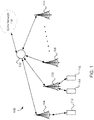
- FIG. 1 shows the considered system 100 in which a connector node (CN) 102 provides the backhaul connection to a set of picocells 104, 106, 108, and 110 in accordance with some embodiments.
- FIG. 1 depicts a picocell network with the CN 102 providing backhaul connection to the core network 118.
- CN connector node
- the CN 102 may be any device configured to communicate with any number of digital devices such as base stations.
- a digital device is any device with a processor or memory.
- the CN 102 may comprise one or more antennas configured to communicate with other nodes or cells such as picocells, macrocells, femtocells, or any other device.
- the cells may be low power cells.
- the nodes in communication with the CN 102 may be any combination of picocells, macrocells, femtocells, and/or any other device.
- the CN 102 is depicted as communicating with picocells 104, 106, 108, and 110.
- Each picocell may communicate with one or more digital devices such as mobile devices 112, 114, and 116.
- the mobile devices may be any mobile customer equipment, cellular communications devices, or the like.
- the core network 118 is any network that may communicate with one or more other digital devices such as another connector node, network device (e.g., router or switch), Internet, or any other digital device
- the backhaul to the picocells is provided by the CN 102 which communicates to picocells 104, 106, 108, and 110 over one or more wireless channels. Attached to each picocell 104, 106, 108, and 110 may be a wireless transceiver for backhaul communication. Both the CN 102 and the picocells 104, 106, 108, and 110 may be equipped with one or more antennas for backhaul communication. The number of antennas at the CN 102 is denoted by M and the number of antennas at each picocell (e.g., picocell 104) is denoted by R.
- the channel can be line-of-sight or, typically, near-line-of-sight or non-line-of-sight.
- the focus will be on the communication from the CN 102 to the picocells 104, 106, 108, and 110, but the proposed methodology of at least some embodiments described herein apply to both communication directions (i.e., from/to the CN 102 to/from the picocells 104, 106, 108, and 110).
- Each picocell may communicate with one or more mobile users 112.
- Receiver noise z i ⁇ C Rx 1 has i.i.d. components with zero mean and variance N.
- a block fading channel may be considered where channel gains are constant over the length of one code-block. In some embodiments, we assume that the channel gain matrices are known at the CN 102, which has an average transmit power constraint P.
- a method may apply for any physical layer transmission scheme deployed over the backhaul wireless channel (1) to deliver data to picocells 104, 106, 108, and 110.
- Channel (1) may be identical to the Gaussian MIMO broadcast channel or equivalently the downlink channel of a MIMO cellular system with no intra-cell interference.
- Optimal and suboptimal transmission schemes for this channel may include but are not limited to: dirty paper coding, superposition coding, beamforming and TDMA/FDMA transmission with or without channel dependent scheduling.
- maximizing the sum throughput may be achieved by a simple TDMA approach in which, in each block, the transmitter may send data only to the user with the best channel gain, in that way exploiting multiuser diversity.
- the choice of a particular transmission scheme may determine the set of rates that can be simultaneously or near simultaneously delivered to a plurality of picocells.
- An achievable set of rates is referred to as an achievable rate region for that transmission scheme.
- the set of achievable rates for a specific scheme is denoted as C(P).
- the choice of an operating point on the achievable rate region C(P) may be done based on the network performance objective desired to be achieved.
- objectives include, without limitation: maximum revenue, maximum throughput, fairness, prioritization of services in a picocell (e.g., quality-of-service (QoS)) and prioritization of picocells.
- Optimization may be done by introducing a defined metric that captures desired objectives.
- the utility metric may also depend on user traffic in each picocell. Transmit powers and backhaul rates of each picocell may be determined such that picocell utility is maximized. This maximization may exploit multiuser diversity to increase the total backhaul capacity. Furthermore, as the load in the access network changes, the backhaul may adapt to the time-varying load.
- the CN 102 may allocate backhaul resources to track long term changes.
- T CN time interval
- the T CN is a predetermined time interval and may be chosen based on observed history such as dynamics of the traffic change (e.g., rush hour, weekend, etc.). Those skilled in the art will appreciate that the T CN may be changed due to other conditions (e.g., weather change, emergency, special events).
- a backhaul rate allocated to picocell i is denoted R i (t).
- the demand for backhaul at each time interval T CN at a picocell i is denoted D i (t).
- a value of D i (t) is determined by picocell i based on the current load of the picocell, anticipated load in the next T CN interval, QoS for each user, and interference from other picocells.
- a picocell e.g., picocell 102 may report a value of D i (t) every T CN (e.g., every T CN seconds).
- the chosen transmission scheme determines C(p) and is thus may be known to the CN 102.
- CN 102 may choose transmit powers and rates for the next interval T CN as follows.
- the picocell utility may be maximized based on a cost function that is inversely related to utility (maximum utility corresponds to minimum cost).
- the cost function may satisfy the following:
- D (D 1 ,...,D N )
- R (R 1 ,...,R N ).
- the optimization (4) may be shown to yield the optimal solution to (2).
- a solution to (4) may be a set of rates R 1 ⁇ , ... , R N ⁇ on the boundary of C(P).
- the optimal solution determines the specific point in region C(P) and thus determines the power allocation that achieves this point, and that the CN 102 should use.
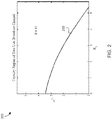
- FIG. 2 illustrates a typical rate region that can be achieved over a wireless backhaul channel with two picocells in accordance with some embodiments.
- the typical rate region is bounded by boundary 202.
- FIG. 3 shows a solution 300 to the backhaul allocation problem for specific values of traffic demands at two picocells, denoted ( D 1 , D 2 ) at point 304 for the case of the achievable rate region of FIG. 1 in accordance with some embodiments.
- Optimal rates are denoted R 1 ⁇ R 2 ⁇ at point 306 and are on the boundary 302 of the achievable rate region.
- the closest point along the boundary 302 of available rates is the point closest to ( D 1 , D 2 ) 304 (e.g., (3, 4)) which is point 306 R 1 ⁇ R 2 ⁇ .
- FIG. 4 presents allocated backhaul rates 400 to two picocells as a function of their demands ( D 1 , D 2 ), for the achievable rate region of FIG. 1 in accordance with some embodiments.
- Picocell 2 is penalized more than picocell 1 because the channel to picocell 1 is better than to picocell 2 (this can be observed from FIG. 2 ).
- the allocation (4) assigns rates based on both demands and wireless channel characteristics, as was our goal.
- the penalty parameter the penalty parameter. This enables the algorithm to control the penalty based on demand. For example, for larger values of p, picocells with higher demand may be penalized more, and vice versa. This ensures some level of fairness in resource allocation. If no demands are reported by picocells in interval T CN , the backhaul can be chosen: to maximize total capacity, equal for all picocells, based on the classes of picocells, etc.
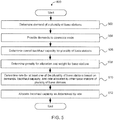
- FIG. 5 is a flowchart 500 of a method of allocation of backhaul capacity according to some embodiments.
- each of a plurality of base stations determines demand.
- Demand may be based on current demands by one or more users and expected demand for a predetermined time (e.g., T CN ).
- Demand may also be based on interference between base stations and/or quality of service (QoS) for one or more users.
- the base stations may be any digital device such as a picocell or femtocell.
- each base station provides the determined demands to the connector node over a wireless network.
- each base station comprises a module that determines demands and/or provides the demands to the connector node.
- the module may be any hardware or software.
- the base station may comprise a processor, memory, and computer readable medium that stores executable instructions.
- the computer readable medium is any medium, such as a hard drive, compact disk, solid state drive, or the like configured to store data.
- the computer readable medium may be nontransitory.
- the instructions may be executable by a processor to determine demand and provide the demand to the connector node.
- the connector node requests demands from one or more base stations.
- the base stations provide the demands to the connector node without waiting for a request.
- the demand provided by the base stations to the connector node represents a single value for each base station.
- the demand provided by each base station may include additional information such as quality of service demands or other information.
- the overall backhaul capacity for the plurality of base stations is determined.
- the overall backhaul capacity may be determined based on past communication between any number of base stations and the central node.
- the overall backhaul capacity may be based, in part, on the effects of weather on the rate of service between one or more base stations and the central node, events, time of day, time of year, or the like.
- the determination of backhaul capacity may be updated at any time to take into account current conditions (e.g., availability of base stations, extreme weather, or the like).
- penalties for allocation of resources and weight for each base station may be determined. Allocation of resources may be represented by exponent p in equations 3 and 5.
- the penalty parameter p may be selected based on the difference between demand and available rates for a base station.
- the penalty parameter may be different for different base stations and/or may be updated at any time.
- the weight per base station may be represented by exponent w in equations 3 and 5. Any number of base stations may have the same or different weights.
- the determination of a weight may be influenced based on QoS of one or more users or dataflows associated with the base station or any other base station.
- a rate for each base station is determined.
- the rate for a base station may be based on demands of a plurality of base stations, backhaul capacity, and the rates allocated to other base stations of the plurality of base stations.
- a summation is generated based on all base stations.
- the difference between demand and a rate to be determined is identified and the difference penalized by the penalty parameter (exponent p) (e.g., see equation 5).
- Each penalized difference is multiplied by a weight for the associated base station (e.g., see w in equation 4).
- the results are added together to create an equation with a set of unknown rates (i.e., one unknown rate for each base station).
- a minimum is used to determine the optimal result (e.g.. shortest distance between an available rate(s) and demand(s)) to determine rates for each of the base stations.
- step 512 the CN node allocates backhaul capacity based on the determined rate.
- the CN node may comprise one or more modules to perform one or more functions.
- the modules may be hardware or software.
- the CN node comprises a processor, memory, and a computer readable medium comprising executable instructions to perform all or some of the steps in FIG. 5 .
- Some embodiments may be generalized to allow optimization of the total backhaul allocated to several picocells. This generalization may be referred to as backhaul allocation over regions. After the backhaul rate and power allocation have been performed at the CN, there may be a set of picocells for which the demand has not been met (i.e., R i ⁇ D i ). These picocells may not be able to support their users nor admit new ones. Hence, the picocells may attempt to handoff some of their users to the neighboring cells. Based on demands and channel conditions, the backhaul allocation may result in a scenario in which the demand was not met for a group of neighboring picocells without handoffs or alternatives.
- R a is the sum backhaul rate allocated to the set of picocells S a .
- problem (6) reduces to (2).
- S a to be a set of neighboring nodes.
- the solution determines the sum rate R a for the set S a .
- FIG. 6 shows a network of picocells grouped over regions in accordance with some embodiments. In this example, there are four neighboring cells in each region.
- the proposed broadcast allocation approach is also generalized to allow backhaul optimization over regions.
- Backhaul can also be optimized when delivering uplink traffic from picocells to the CN.
- the channel from picocells to the CN is a multiple-access channel (MAC), and the optimal power allocation in fading is known.
- MAC multiple-access channel
- multiuser diversity maximizes the total throughput.
- a similar methodology for the backhaul allocation for traffic from picocells to the CN may be applied. In this case, a solution to the optimization of backhaul allocation may determine transmit powers at picocells as well as the backhaul capacity available for each of them.
- some embodiments described herein may be used to determine the optimal sharing of available spectrum between the downlink and uplink backhaul traffic, based on their traffic and demands. Furthermore, some embodiments may readily apply to a network scenario in which there are multiple CNs each providing backhaul to a different set of picocells. In some embodiments, all CNs may operate in the same bandwidth. Thus, this setting captures the impact of interference introduced by a CN at the picocells that are served by other CNs. In at least one approach, the effect of interference may be captured in the achievable rate region. The achievable rate region may characterize a set of backhaul rates that may be delivered at all picocells in the network. It may also capture the interference management scheme deployed at the CN. Again, based on demands for all picocells, an operating point on the region may be determined, thereby determining powers and rates that CNs may need to allocate to picocells they serve.
Landscapes
- Engineering & Computer Science (AREA)
- Signal Processing (AREA)
- Computer Networks & Wireless Communication (AREA)
- Quality & Reliability (AREA)
- Mobile Radio Communication Systems (AREA)
- Remote Monitoring And Control Of Power-Distribution Networks (AREA)
- Supply And Distribution Of Alternating Current (AREA)
Claims (16)
- Système (100) comprenant :une pluralité de cellules (104, 106, 108, 110) qui sont configurées pour assurer une connectivité de réseau sans fil sur des dispositifs, chaque cellule étant configurée pour générer et envoyer une demande, chaque demande indiquant une charge courante pour la cellule considérée de la pluralité de cellules, et indiquant une charge anticipée pour la cellule considérée de la pluralité de cellules à un temps subséquent prédéterminé ; etun nœud de connecteur (102) qui est en communication sans fil avec la pluralité de cellules sur un canal de liaison terrestre sans fil partagé, le nœud de connecteur étant configuré pour assurer une liaison terrestre sur ou depuis un réseau central, le nœud de connecteur étant configuré pour :recevoir ladite demande en provenance de chacune de la pluralité de cellules ;déterminer un débit de liaison terrestre particulier pour chacune de la pluralité de cellules sur la base des demandes qui sont reçues, de caractéristiques du canal de liaison terrestre sans fil partagé et de débits de liaison terrestre attribués qui sont associés aux autres cellules de la pluralité de cellules ; etallouer une capacité sur la base des débits de liaison terrestre particuliers ;dans lequel le nœud de connecteur détermine que le débit de liaison terrestre particulier pour chaque cellule de la pluralité de cellules est égal à la demande lorsque les demandes en provenance de la pluralité de cellules constituent un jeu de débits atteignables, et que le débit de liaison terrestre particulier pour chacune de la pluralité de cellules est établi à un débit pouvant être atteint sur la base du jeu de demandes en provenance de la pluralité de cellules et sur la base de caractéristiques de canal lorsque le jeu de demandes est déterminé comme inatteignable.
- Système selon la revendication 1, dans lequel au moins l'une de la pluralité de cellules est une picocellule ou une femtocellule.
- Système selon la revendication 1, comprenant en outre un réseau central, dans lequel le nœud de connecteur (102) est en communication supplémentaire avec le réseau central.
- Système selon la revendication 1, dans lequel chacune de la pluralité de cellules est configurée pour déterminer une demande donnée sur la base d'une demande courante et d'une demande attendue au temps subséquent prédéterminé ; ou dans lequel chacune de la pluralité de cellules est configurée pour déterminer une demande donnée sur la base d'une qualité de service d'un ou de plusieurs utilisateurs des cellules.
- Système selon la revendication 1, dans lequel le nœud de connecteur (102) qui est configuré pour déterminer le débit de liaison terrestre particulier pour chacune de la pluralité de cellules comprend le fait que le nœud de connecteur est configuré pour déterminer une différence entre chaque demande du jeu de demandes et chaque débit du jeu de débits de liaison terrestre attribués, pour sommer les différences et pour déterminer les débits de liaison terrestre particuliers sur la base d'un minimum de la somme.
- Système selon la revendication 5, dans lequel la différence entre au moins une demande du jeu de demandes en provenance de la pluralité de cellules et au moins un débit du jeu de débits de liaison terrestre attribués est pondérée.
- Système selon la revendication 1, dans lequel un canal entre le nœud de connecteur (102) et au moins l'une de la pluralité de cellules est en visibilité directe.
- Système selon la revendication 1, dans lequel le nœud de connecteur (102) modifie le temps subséquent prédéterminé sur la base d'un historique observé d'utilisation des cellules.
- Système selon la revendication 1, dans lequel chaque demande est en outre générée sur la base d'une qualité de mesure de service pour chacun des dispositifs dont on anticipe qu'ils sont destinés à être connectés à la cellule de la pluralité de cellules.
- Procédé comprenant :la réception, par un nœud de connecteur (102) qui est en communication sans fil avec une pluralité de cellules sur un canal de liaison terrestre sans fil partagé, le nœud de connecteur étant configuré pour assurer une liaison terrestre sur ou depuis un réseau central, d'une demande qui est générée par et envoyée depuis chacune de la pluralité de cellules, les cellules de la pluralité de cellules étant configurées pour assurer une connectivité de réseau sans fil sur des dispositifs, chaque demande du jeu de demandes indiquant une charge courante pour la cellule considérée de la pluralité de cellules, et indiquant une charge anticipée pour la cellule considérée de la pluralité de cellules à un temps subséquent prédéterminé ;la détermination, par le nœud de connecteur, d'un débit de liaison terrestre particulier qui est destiné à être appliqué pour chacune de la pluralité de cellules sur la base des demandes qui sont reçues, de caractéristiques du canal de liaison terrestre sans fil partagé et de débits de liaison terrestre attribués qui sont associés à d'autres cellules de la pluralité de cellules, le débit de liaison terrestre particulier pour chacune de la pluralité de cellules devant être égal à la demande lorsque les demandes en provenance de la pluralité de cellules constituent un jeu de débits pouvant être réalisés, et le débit de liaison terrestre particulier pour chacune de la pluralité de cellules devant être établi à un débit pouvant être réalisé sur la base du jeu de demandes et de caractéristiques de canal lorsque le jeu de demandes est déterminé comme inatteignable ; etl'allocation d'une capacité, par le nœud de connecteur, sur la base des débits de liaison terrestre particuliers.
- Procédé selon la revendication 10, comprenant en outre le passage d'une information, par le nœud de connecteur, depuis au moins l'une de la pluralité de cellules jusqu'à un réseau central.
- Procédé selon la revendication 10, comprenant en outre la détermination, par chacune de la pluralité de cellules, d'une demande donnée sur la base d'une demande courante et d'une demande attendue au temps subséquent prédéterminé, ou le procédé comprenant en outre la détermination, par chacune de la pluralité de cellules, d'une demande donnée sur la base d'une qualité de service d'un ou de plusieurs utilisateur(s) des cellules.
- Procédé selon la revendication 10, dans lequel la détermination, par le nœud de connecteur, du débit de liaison terrestre particulier pour chacune de la pluralité de cellules comprend la détermination d'une différence entre chaque demande du jeu de demandes et chaque débit du jeu de débits de liaison terrestre attribués, la sommation des différences et la détermination des débits de liaison terrestre particuliers sur la base d'un minimum de la somme.
- Procédé selon la revendication 13, dans lequel la différence entre au moins une demande du jeu de demandes en provenance de la pluralité de cellules et au moins un débit du jeu de débits de liaison terrestre attribués est pondérée.
- Procédé selon la revendication 10, comprenant en outre la modification, par le nœud de connecteur, du temps subséquent prédéterminé sur la base d'un historique observé d'utilisation des cellules.
- Support non transitoire pouvant être lu par un ordinateur et configuré pour stocker des instructions pouvant être exécutées, les instructions pouvant être exécutées par un processeur pour réaliser un procédé, le procédé comprenant :la réception, par un nœud de connecteur (102) qui est en communication sans fil avec une pluralité de cellules sur un canal de liaison terrestre sans fil partagé, le nœud de connecteur étant configuré pour assurer une liaison terrestre sur ou depuis un réseau central, d'une demande qui est générée par et envoyée depuis chacune de la pluralité de cellules, les cellules de la pluralité de cellules étant configurées pour assurer une connectivité de réseau sans fil sur des dispositifs, chaque demande du jeu de demandes indiquant une charge courante pour la cellule considérée de la pluralité de cellules, et indiquant une charge anticipée pour la cellule considérée de la pluralité de cellules à un temps subséquent prédéterminé ;la détermination, par le nœud de connecteur, d'un débit de liaison terrestre particulier à appliquer pour chacune de la pluralité de cellules sur la base des demandes qui sont reçues, de caractéristiques du canal de liaison terrestre sans fil partagé et de débits de liaison terrestre attribués qui sont associés à d'autres cellules de la pluralité de cellules, le débit de liaison terrestre particulier pour chacune de la pluralité de cellules devant être égal à la demande lorsque les demandes en provenance de la pluralité de cellules constituent un jeu de débits atteignables, et le débit de liaison terrestre particulier pour chacune de la pluralité de cellules devant être établi à un débit pouvant être réalisé sur la base du jeu de demandes et sur la base de caractéristiques de canal lorsque le jeu de demandes est déterminé comme inatteignable ; etl'allocation d'une capacité, par le nœud de connecteur, sur la base des débits de liaison terrestre particuliers.
Priority Applications (1)
| Application Number | Priority Date | Filing Date | Title |
|---|---|---|---|
| SI201131937T SI2641427T1 (sl) | 2010-11-17 | 2011-11-17 | Sistemi in metode za backhaul optimizacijo |
Applications Claiming Priority (2)
| Application Number | Priority Date | Filing Date | Title |
|---|---|---|---|
| US41486010P | 2010-11-17 | 2010-11-17 | |
| PCT/US2011/061284 WO2012068421A1 (fr) | 2010-11-17 | 2011-11-17 | Systèmes et procédés d'optimisation de liaison |
Publications (3)
| Publication Number | Publication Date |
|---|---|
| EP2641427A1 EP2641427A1 (fr) | 2013-09-25 |
| EP2641427A4 EP2641427A4 (fr) | 2015-10-07 |
| EP2641427B1 true EP2641427B1 (fr) | 2020-11-04 |
Family
ID=46084419
Family Applications (1)
| Application Number | Title | Priority Date | Filing Date |
|---|---|---|---|
| EP11841738.5A Active EP2641427B1 (fr) | 2010-11-17 | 2011-11-17 | Systèmes et procédés d'optimisation de liaison |
Country Status (7)
| Country | Link |
|---|---|
| US (3) | US8774724B2 (fr) |
| EP (1) | EP2641427B1 (fr) |
| CN (1) | CN103314619A (fr) |
| MY (1) | MY162370A (fr) |
| SG (1) | SG190301A1 (fr) |
| SI (1) | SI2641427T1 (fr) |
| WO (1) | WO2012068421A1 (fr) |
Families Citing this family (28)
| Publication number | Priority date | Publication date | Assignee | Title |
|---|---|---|---|---|
| EP2398293A1 (fr) * | 2010-06-17 | 2011-12-21 | Alcatel Lucent | Procédé pour la gestion d'un réseau de télécommunications sans fil |
| EP2641427B1 (fr) * | 2010-11-17 | 2020-11-04 | Aviat Networks, Inc. | Systèmes et procédés d'optimisation de liaison |
| WO2014044310A1 (fr) * | 2012-09-20 | 2014-03-27 | Telefonaktiebolaget L M Ericsson (Publ) | Procédé et nœud de réseau pour améliorer l'utilisation de ressources d'une cellule radio |
| US9277497B2 (en) | 2012-10-26 | 2016-03-01 | New Jersey Institute Of Technology | Cell size optimization for energy savings in cellular networks with hybrid energy supplies |
| US20140293904A1 (en) * | 2013-03-28 | 2014-10-02 | Futurewei Technologies, Inc. | Systems and Methods for Sparse Beamforming Design |
| WO2014167066A1 (fr) * | 2013-04-10 | 2014-10-16 | Nec Europe Ltd. | Réseau de communication mobile et procédé d'exploitation d'un réseau de communication mobile |
| US10979203B2 (en) | 2013-09-04 | 2021-04-13 | Qualcomm Incorporated | Channel selection to reduce interference to a wireless local area network from a cellular network |
| US9642139B1 (en) | 2013-11-14 | 2017-05-02 | Sprint Communications Company L.P. | In-band backhaul from a wireless macrocell |
| EP2884797B1 (fr) * | 2013-12-12 | 2018-02-07 | Alcatel Lucent | Procédé et appareil pour la commande d'un noeud de réseau d'accès dans un système de communication sans fil |
| CN103974403B (zh) * | 2014-04-11 | 2018-03-13 | 广州杰赛科技股份有限公司 | 无线终端接入点的功率控制方法及系统 |
| US9986574B2 (en) | 2014-04-18 | 2018-05-29 | Qualcomm Incorporated | Channel selection metrics in shared spectrum |
| WO2016023210A1 (fr) * | 2014-08-14 | 2016-02-18 | 华为技术有限公司 | Appareil et procédé de distribution de ressource de retour |
| US9538550B2 (en) | 2014-10-03 | 2017-01-03 | Nokia Solutions And Networks Oy | Cooperative uplink reception suitable for non-ideal backhaul |
| US9971397B2 (en) | 2014-10-08 | 2018-05-15 | Apple Inc. | Methods and apparatus for managing power with an inter-processor communication link between independently operable processors |
| US10044414B2 (en) | 2014-10-10 | 2018-08-07 | Nokia Solutions And Networks Oy | Methods and apparatus for coordinated multipoint communication |
| WO2016107569A1 (fr) * | 2014-12-30 | 2016-07-07 | Mediatek Inc. | Mise en correspondance de débit et stockage de bits de canal souple permettant un codage par superposition |
| US9814044B1 (en) * | 2015-02-13 | 2017-11-07 | Sprint Spectrum L.P. | Allocation of carriers between base stations with overlapping coverage based on a comparison of their respective backhaul capacities |
| US10042794B2 (en) | 2015-06-12 | 2018-08-07 | Apple Inc. | Methods and apparatus for synchronizing uplink and downlink transactions on an inter-device communication link |
| US20170245179A1 (en) * | 2016-02-23 | 2017-08-24 | Huawei Technologies Co., Ltd. | Method and Apparatus for Dynamic Backhaul Resource Allocation in a Radio Access Network |
| US10558580B2 (en) | 2016-02-29 | 2020-02-11 | Apple Inc. | Methods and apparatus for loading firmware on demand |
| US10198364B2 (en) | 2016-03-31 | 2019-02-05 | Apple Inc. | Memory access protection apparatus and methods for memory mapped access between independently operable processors |
| US10551902B2 (en) | 2016-11-10 | 2020-02-04 | Apple Inc. | Methods and apparatus for providing access to peripheral sub-system registers |
| US10775871B2 (en) | 2016-11-10 | 2020-09-15 | Apple Inc. | Methods and apparatus for providing individualized power control for peripheral sub-systems |
| KR101958323B1 (ko) * | 2016-11-22 | 2019-03-15 | 주식회사 하이딥 | 압력 감지부 및 이를 포함하는 터치 입력 장치 |
| US10346226B2 (en) | 2017-08-07 | 2019-07-09 | Time Warner Cable Enterprises Llc | Methods and apparatus for transmitting time sensitive data over a tunneled bus interface |
| US10430352B1 (en) | 2018-05-18 | 2019-10-01 | Apple Inc. | Methods and apparatus for reduced overhead data transfer with a shared ring buffer |
| US10585699B2 (en) | 2018-07-30 | 2020-03-10 | Apple Inc. | Methods and apparatus for verifying completion of groups of data transactions between processors |
| US11516102B2 (en) * | 2021-02-11 | 2022-11-29 | Verizon Patent And Licensing Inc. | Systems and methods for bandwidth allocation at wireless integrated access backhaul nodes |
Family Cites Families (11)
| Publication number | Priority date | Publication date | Assignee | Title |
|---|---|---|---|---|
| US7177598B2 (en) * | 2000-11-15 | 2007-02-13 | Wi-Lan, Inc. | Method and system for reducing channel interference in a frame-synchronized wireless communication system |
| US7836181B2 (en) * | 2004-09-21 | 2010-11-16 | Alcatel-Lucent Usa Inc. | Fairness and load balancing in wireless LANs using association control |
| US7640020B2 (en) * | 2005-12-19 | 2009-12-29 | Motorola, Inc. | Method and apparatus for assigning backhaul methods |
| US7796605B2 (en) | 2006-07-28 | 2010-09-14 | Research In Motion Limited | Apparatus, and associated method, for facilitating radio sub-system selection in a packet radio communication system |
| US8630256B2 (en) * | 2006-12-05 | 2014-01-14 | Qualcomm Incorporated | Method and system for reducing backhaul utilization during base station handoff in wireless networks |
| US7688762B2 (en) | 2007-03-21 | 2010-03-30 | Cisco Technology, Inc. | Mesh backhaul network planning |
| US8594678B2 (en) * | 2007-04-18 | 2013-11-26 | Qualcomm Incorporated | Backhaul network for femto base stations |
| US8259630B2 (en) | 2007-12-21 | 2012-09-04 | Samsung Electronics Co., Ltd. | Method and system for subcarrier allocation in relay enhanced cellular systems with resource reuse |
| US9826409B2 (en) * | 2008-10-24 | 2017-11-21 | Qualcomm Incorporated | Adaptive semi-static interference avoidance in cellular networks |
| US8693316B2 (en) * | 2009-02-10 | 2014-04-08 | Qualcomm Incorporated | Access point resource negotiation and allocation over a wireless interface |
| EP2641427B1 (fr) * | 2010-11-17 | 2020-11-04 | Aviat Networks, Inc. | Systèmes et procédés d'optimisation de liaison |
-
2011
- 2011-11-17 EP EP11841738.5A patent/EP2641427B1/fr active Active
- 2011-11-17 CN CN201180065440XA patent/CN103314619A/zh active Pending
- 2011-11-17 MY MYPI2013001778A patent/MY162370A/en unknown
- 2011-11-17 SI SI201131937T patent/SI2641427T1/sl unknown
- 2011-11-17 US US13/299,342 patent/US8774724B2/en active Active
- 2011-11-17 SG SG2013037593A patent/SG190301A1/en unknown
- 2011-11-17 WO PCT/US2011/061284 patent/WO2012068421A1/fr not_active Ceased
-
2014
- 2014-05-30 US US14/291,668 patent/US9468008B2/en active Active
-
2016
- 2016-10-10 US US15/289,743 patent/US9907075B2/en active Active
Non-Patent Citations (1)
| Title |
|---|
| None * |
Also Published As
| Publication number | Publication date |
|---|---|
| US8774724B2 (en) | 2014-07-08 |
| MY162370A (en) | 2017-06-15 |
| SG190301A1 (en) | 2013-06-28 |
| US20170026975A1 (en) | 2017-01-26 |
| US9907075B2 (en) | 2018-02-27 |
| CN103314619A (zh) | 2013-09-18 |
| SI2641427T1 (sl) | 2021-01-29 |
| EP2641427A1 (fr) | 2013-09-25 |
| EP2641427A4 (fr) | 2015-10-07 |
| US20140349668A1 (en) | 2014-11-27 |
| US9468008B2 (en) | 2016-10-11 |
| US20120231806A1 (en) | 2012-09-13 |
| WO2012068421A1 (fr) | 2012-05-24 |
Similar Documents
| Publication | Publication Date | Title |
|---|---|---|
| EP2641427B1 (fr) | Systèmes et procédés d'optimisation de liaison | |
| US8976690B2 (en) | Femto-relay systems and methods of managing same | |
| EP2816833B1 (fr) | Commande de ressources radio pour cellules à technologie à double accès | |
| US9980218B2 (en) | System and method for user terminal-aware cell switch-off | |
| Rohde et al. | Interference aware positioning of aerial relays for cell overload and outage compensation | |
| Elsherif et al. | Resource allocation and inter-cell interference management for dual-access small cells | |
| JP5070987B2 (ja) | 無線ネットワークにおける無線リソースの再使用システムと方法 | |
| CN102595616B (zh) | 蜂窝通信网络中的测量辅助的动态频率重用 | |
| KR101447441B1 (ko) | 멀티-홉 셀룰러 네트워크에서의 경로 관리를 위한 방법 및모바일 시스템 그리고 상기 방법 및 상기 모바일시스템에서 이용되는 데이터 프레임 | |
| US12362897B2 (en) | TDD configuration coordination for networks using adjacent bands | |
| US11038639B1 (en) | Performing MU-MIMO based on bandwidth parts | |
| Khan et al. | Backhaul, QoS, and channel-aware load balancing optimization in SDN-based LTE networks | |
| Thakur et al. | An energy efficient cell selection framework for femtocell networks with limited backhaul link capacity | |
| US9560668B1 (en) | Systems and methods for scheduling low-delay transmissions in a communication network | |
| US12192977B2 (en) | Managing wireless device frequency band assignment | |
| Ji et al. | Dynamic context-aware optimization of D2D communications | |
| Budka | Cellular digital packet data: Channel availability | |
| US10148346B1 (en) | Systems and methods for determining a frequency band for wireless backhaul | |
| US10172122B1 (en) | Identification of uplink interference in a long-term evolution (LTE) communication system | |
| Mishra et al. | Efficient resource allocation using whale optimization for cell-free massive mimo networks in 6g hetnet | |
| US20230397176A1 (en) | Methods and apparatus for resource allocation in a fixed wireless network | |
| Hwang et al. | Association scheme with traffic control for IEEE 802.11 wireless LANs | |
| Akbari et al. | Resource Allocation for OFDMA systems with trade-off between throughout and quality of service | |
| US10575216B1 (en) | Systems and methods for scheduling resources for relay nodes in a wireless network | |
| Arribas et al. | Exact Resource Allocation for Weighted Proportional Fair Wireless Relay Networks |
Legal Events
| Date | Code | Title | Description |
|---|---|---|---|
| PUAI | Public reference made under article 153(3) epc to a published international application that has entered the european phase |
Free format text: ORIGINAL CODE: 0009012 |
|
| 17P | Request for examination filed |
Effective date: 20130617 |
|
| AK | Designated contracting states |
Kind code of ref document: A1 Designated state(s): AL AT BE BG CH CY CZ DE DK EE ES FI FR GB GR HR HU IE IS IT LI LT LU LV MC MK MT NL NO PL PT RO RS SE SI SK SM TR |
|
| DAX | Request for extension of the european patent (deleted) | ||
| RA4 | Supplementary search report drawn up and despatched (corrected) |
Effective date: 20150909 |
|
| RIC1 | Information provided on ipc code assigned before grant |
Ipc: H04L 5/00 20060101ALN20150903BHEP Ipc: H04W 28/22 20090101AFI20150903BHEP Ipc: H04W 72/04 20090101ALN20150903BHEP Ipc: H04W 84/04 20090101ALN20150903BHEP Ipc: H04W 72/08 20090101ALI20150903BHEP |
|
| STAA | Information on the status of an ep patent application or granted ep patent |
Free format text: STATUS: EXAMINATION IS IN PROGRESS |
|
| 17Q | First examination report despatched |
Effective date: 20161209 |
|
| RIC1 | Information provided on ipc code assigned before grant |
Ipc: H04W 28/22 20090101AFI20190729BHEP Ipc: H04W 84/04 20090101ALN20190729BHEP |
|
| REG | Reference to a national code |
Ref country code: DE Ref legal event code: R079 Ref document number: 602011069203 Country of ref document: DE Free format text: PREVIOUS MAIN CLASS: H04W0040000000 Ipc: H04W0028220000 |
|
| GRAP | Despatch of communication of intention to grant a patent |
Free format text: ORIGINAL CODE: EPIDOSNIGR1 |
|
| STAA | Information on the status of an ep patent application or granted ep patent |
Free format text: STATUS: GRANT OF PATENT IS INTENDED |
|
| RIC1 | Information provided on ipc code assigned before grant |
Ipc: H04W 84/04 20090101ALN20200422BHEP Ipc: H04W 28/22 20090101AFI20200422BHEP |
|
| INTG | Intention to grant announced |
Effective date: 20200512 |
|
| GRAS | Grant fee paid |
Free format text: ORIGINAL CODE: EPIDOSNIGR3 |
|
| GRAA | (expected) grant |
Free format text: ORIGINAL CODE: 0009210 |
|
| STAA | Information on the status of an ep patent application or granted ep patent |
Free format text: STATUS: THE PATENT HAS BEEN GRANTED |
|
| AK | Designated contracting states |
Kind code of ref document: B1 Designated state(s): AL AT BE BG CH CY CZ DE DK EE ES FI FR GB GR HR HU IE IS IT LI LT LU LV MC MK MT NL NO PL PT RO RS SE SI SK SM TR |
|
| REG | Reference to a national code |
Ref country code: GB Ref legal event code: FG4D |
|
| REG | Reference to a national code |
Ref country code: CH Ref legal event code: EP |
|
| REG | Reference to a national code |
Ref country code: AT Ref legal event code: REF Ref document number: 1332437 Country of ref document: AT Kind code of ref document: T Effective date: 20201115 |
|
| REG | Reference to a national code |
Ref country code: DE Ref legal event code: R096 Ref document number: 602011069203 Country of ref document: DE |
|
| REG | Reference to a national code |
Ref country code: IE Ref legal event code: FG4D |
|
| REG | Reference to a national code |
Ref country code: NL Ref legal event code: MP Effective date: 20201104 |
|
| REG | Reference to a national code |
Ref country code: AT Ref legal event code: MK05 Ref document number: 1332437 Country of ref document: AT Kind code of ref document: T Effective date: 20201104 |
|
| PG25 | Lapsed in a contracting state [announced via postgrant information from national office to epo] |
Ref country code: GR Free format text: LAPSE BECAUSE OF FAILURE TO SUBMIT A TRANSLATION OF THE DESCRIPTION OR TO PAY THE FEE WITHIN THE PRESCRIBED TIME-LIMIT Effective date: 20210205 Ref country code: PT Free format text: LAPSE BECAUSE OF FAILURE TO SUBMIT A TRANSLATION OF THE DESCRIPTION OR TO PAY THE FEE WITHIN THE PRESCRIBED TIME-LIMIT Effective date: 20210304 Ref country code: NO Free format text: LAPSE BECAUSE OF FAILURE TO SUBMIT A TRANSLATION OF THE DESCRIPTION OR TO PAY THE FEE WITHIN THE PRESCRIBED TIME-LIMIT Effective date: 20210204 Ref country code: FI Free format text: LAPSE BECAUSE OF FAILURE TO SUBMIT A TRANSLATION OF THE DESCRIPTION OR TO PAY THE FEE WITHIN THE PRESCRIBED TIME-LIMIT Effective date: 20201104 Ref country code: RS Free format text: LAPSE BECAUSE OF FAILURE TO SUBMIT A TRANSLATION OF THE DESCRIPTION OR TO PAY THE FEE WITHIN THE PRESCRIBED TIME-LIMIT Effective date: 20201104 |
|
| PG25 | Lapsed in a contracting state [announced via postgrant information from national office to epo] |
Ref country code: BG Free format text: LAPSE BECAUSE OF FAILURE TO SUBMIT A TRANSLATION OF THE DESCRIPTION OR TO PAY THE FEE WITHIN THE PRESCRIBED TIME-LIMIT Effective date: 20210204 Ref country code: AT Free format text: LAPSE BECAUSE OF FAILURE TO SUBMIT A TRANSLATION OF THE DESCRIPTION OR TO PAY THE FEE WITHIN THE PRESCRIBED TIME-LIMIT Effective date: 20201104 Ref country code: IS Free format text: LAPSE BECAUSE OF FAILURE TO SUBMIT A TRANSLATION OF THE DESCRIPTION OR TO PAY THE FEE WITHIN THE PRESCRIBED TIME-LIMIT Effective date: 20210304 Ref country code: ES Free format text: LAPSE BECAUSE OF FAILURE TO SUBMIT A TRANSLATION OF THE DESCRIPTION OR TO PAY THE FEE WITHIN THE PRESCRIBED TIME-LIMIT Effective date: 20201104 Ref country code: SE Free format text: LAPSE BECAUSE OF FAILURE TO SUBMIT A TRANSLATION OF THE DESCRIPTION OR TO PAY THE FEE WITHIN THE PRESCRIBED TIME-LIMIT Effective date: 20201104 Ref country code: LV Free format text: LAPSE BECAUSE OF FAILURE TO SUBMIT A TRANSLATION OF THE DESCRIPTION OR TO PAY THE FEE WITHIN THE PRESCRIBED TIME-LIMIT Effective date: 20201104 Ref country code: PL Free format text: LAPSE BECAUSE OF FAILURE TO SUBMIT A TRANSLATION OF THE DESCRIPTION OR TO PAY THE FEE WITHIN THE PRESCRIBED TIME-LIMIT Effective date: 20201104 |
|
| REG | Reference to a national code |
Ref country code: LT Ref legal event code: MG9D |
|
| PG25 | Lapsed in a contracting state [announced via postgrant information from national office to epo] |
Ref country code: HR Free format text: LAPSE BECAUSE OF FAILURE TO SUBMIT A TRANSLATION OF THE DESCRIPTION OR TO PAY THE FEE WITHIN THE PRESCRIBED TIME-LIMIT Effective date: 20201104 |
|
| REG | Reference to a national code |
Ref country code: CH Ref legal event code: PL |
|
| PG25 | Lapsed in a contracting state [announced via postgrant information from national office to epo] |
Ref country code: CZ Free format text: LAPSE BECAUSE OF FAILURE TO SUBMIT A TRANSLATION OF THE DESCRIPTION OR TO PAY THE FEE WITHIN THE PRESCRIBED TIME-LIMIT Effective date: 20201104 Ref country code: EE Free format text: LAPSE BECAUSE OF FAILURE TO SUBMIT A TRANSLATION OF THE DESCRIPTION OR TO PAY THE FEE WITHIN THE PRESCRIBED TIME-LIMIT Effective date: 20201104 Ref country code: SM Free format text: LAPSE BECAUSE OF FAILURE TO SUBMIT A TRANSLATION OF THE DESCRIPTION OR TO PAY THE FEE WITHIN THE PRESCRIBED TIME-LIMIT Effective date: 20201104 Ref country code: RO Free format text: LAPSE BECAUSE OF FAILURE TO SUBMIT A TRANSLATION OF THE DESCRIPTION OR TO PAY THE FEE WITHIN THE PRESCRIBED TIME-LIMIT Effective date: 20201104 Ref country code: SK Free format text: LAPSE BECAUSE OF FAILURE TO SUBMIT A TRANSLATION OF THE DESCRIPTION OR TO PAY THE FEE WITHIN THE PRESCRIBED TIME-LIMIT Effective date: 20201104 Ref country code: LU Free format text: LAPSE BECAUSE OF NON-PAYMENT OF DUE FEES Effective date: 20201117 Ref country code: LT Free format text: LAPSE BECAUSE OF FAILURE TO SUBMIT A TRANSLATION OF THE DESCRIPTION OR TO PAY THE FEE WITHIN THE PRESCRIBED TIME-LIMIT Effective date: 20201104 |
|
| REG | Reference to a national code |
Ref country code: DE Ref legal event code: R097 Ref document number: 602011069203 Country of ref document: DE |
|
| REG | Reference to a national code |
Ref country code: BE Ref legal event code: MM Effective date: 20201130 |
|
| PG25 | Lapsed in a contracting state [announced via postgrant information from national office to epo] |
Ref country code: LI Free format text: LAPSE BECAUSE OF NON-PAYMENT OF DUE FEES Effective date: 20201130 Ref country code: MC Free format text: LAPSE BECAUSE OF FAILURE TO SUBMIT A TRANSLATION OF THE DESCRIPTION OR TO PAY THE FEE WITHIN THE PRESCRIBED TIME-LIMIT Effective date: 20201104 Ref country code: DK Free format text: LAPSE BECAUSE OF FAILURE TO SUBMIT A TRANSLATION OF THE DESCRIPTION OR TO PAY THE FEE WITHIN THE PRESCRIBED TIME-LIMIT Effective date: 20201104 Ref country code: CH Free format text: LAPSE BECAUSE OF NON-PAYMENT OF DUE FEES Effective date: 20201130 |
|
| PLBE | No opposition filed within time limit |
Free format text: ORIGINAL CODE: 0009261 |
|
| STAA | Information on the status of an ep patent application or granted ep patent |
Free format text: STATUS: NO OPPOSITION FILED WITHIN TIME LIMIT |
|
| 26N | No opposition filed |
Effective date: 20210805 |
|
| PG25 | Lapsed in a contracting state [announced via postgrant information from national office to epo] |
Ref country code: NL Free format text: LAPSE BECAUSE OF FAILURE TO SUBMIT A TRANSLATION OF THE DESCRIPTION OR TO PAY THE FEE WITHIN THE PRESCRIBED TIME-LIMIT Effective date: 20201104 Ref country code: IE Free format text: LAPSE BECAUSE OF NON-PAYMENT OF DUE FEES Effective date: 20201117 Ref country code: AL Free format text: LAPSE BECAUSE OF FAILURE TO SUBMIT A TRANSLATION OF THE DESCRIPTION OR TO PAY THE FEE WITHIN THE PRESCRIBED TIME-LIMIT Effective date: 20201104 |
|
| PG25 | Lapsed in a contracting state [announced via postgrant information from national office to epo] |
Ref country code: TR Free format text: LAPSE BECAUSE OF FAILURE TO SUBMIT A TRANSLATION OF THE DESCRIPTION OR TO PAY THE FEE WITHIN THE PRESCRIBED TIME-LIMIT Effective date: 20201104 Ref country code: MT Free format text: LAPSE BECAUSE OF FAILURE TO SUBMIT A TRANSLATION OF THE DESCRIPTION OR TO PAY THE FEE WITHIN THE PRESCRIBED TIME-LIMIT Effective date: 20201104 Ref country code: CY Free format text: LAPSE BECAUSE OF FAILURE TO SUBMIT A TRANSLATION OF THE DESCRIPTION OR TO PAY THE FEE WITHIN THE PRESCRIBED TIME-LIMIT Effective date: 20201104 |
|
| PG25 | Lapsed in a contracting state [announced via postgrant information from national office to epo] |
Ref country code: MK Free format text: LAPSE BECAUSE OF FAILURE TO SUBMIT A TRANSLATION OF THE DESCRIPTION OR TO PAY THE FEE WITHIN THE PRESCRIBED TIME-LIMIT Effective date: 20201104 |
|
| PG25 | Lapsed in a contracting state [announced via postgrant information from national office to epo] |
Ref country code: BE Free format text: LAPSE BECAUSE OF NON-PAYMENT OF DUE FEES Effective date: 20201130 |
|
| PGFP | Annual fee paid to national office [announced via postgrant information from national office to epo] |
Ref country code: DE Payment date: 20251118 Year of fee payment: 15 |
|
| PGFP | Annual fee paid to national office [announced via postgrant information from national office to epo] |
Ref country code: GB Payment date: 20251104 Year of fee payment: 15 |
|
| PGFP | Annual fee paid to national office [announced via postgrant information from national office to epo] |
Ref country code: IT Payment date: 20251118 Year of fee payment: 15 |
|
| PGFP | Annual fee paid to national office [announced via postgrant information from national office to epo] |
Ref country code: FR Payment date: 20251126 Year of fee payment: 15 |
|
| PGFP | Annual fee paid to national office [announced via postgrant information from national office to epo] |
Ref country code: SI Payment date: 20251028 Year of fee payment: 15 |