EP2641677A1 - Plaquette de coupe - Google Patents
Plaquette de coupe Download PDFInfo
- Publication number
- EP2641677A1 EP2641677A1 EP11840956.4A EP11840956A EP2641677A1 EP 2641677 A1 EP2641677 A1 EP 2641677A1 EP 11840956 A EP11840956 A EP 11840956A EP 2641677 A1 EP2641677 A1 EP 2641677A1
- Authority
- EP
- European Patent Office
- Prior art keywords
- region
- cutting edge
- cutting
- rake
- rake face
- Prior art date
- Legal status (The legal status is an assumption and is not a legal conclusion. Google has not performed a legal analysis and makes no representation as to the accuracy of the status listed.)
- Withdrawn
Links
- 230000007423 decrease Effects 0.000 claims description 6
- 239000010935 stainless steel Substances 0.000 abstract description 11
- 229910001220 stainless steel Inorganic materials 0.000 abstract description 11
- 230000002159 abnormal effect Effects 0.000 abstract description 9
- 230000003247 decreasing effect Effects 0.000 description 10
- 238000011156 evaluation Methods 0.000 description 9
- 239000000463 material Substances 0.000 description 9
- 238000000034 method Methods 0.000 description 4
- 229910045601 alloy Inorganic materials 0.000 description 2
- 239000000956 alloy Substances 0.000 description 2
- PNEYBMLMFCGWSK-UHFFFAOYSA-N aluminium oxide Inorganic materials [O-2].[O-2].[O-2].[Al+3].[Al+3] PNEYBMLMFCGWSK-UHFFFAOYSA-N 0.000 description 2
- 229910052799 carbon Inorganic materials 0.000 description 2
- 229910052593 corundum Inorganic materials 0.000 description 2
- 230000000694 effects Effects 0.000 description 2
- 238000005482 strain hardening Methods 0.000 description 2
- 229910001845 yogo sapphire Inorganic materials 0.000 description 2
- 238000005229 chemical vapour deposition Methods 0.000 description 1
- 239000011248 coating agent Substances 0.000 description 1
- 238000000576 coating method Methods 0.000 description 1
- 239000002131 composite material Substances 0.000 description 1
- 238000012790 confirmation Methods 0.000 description 1
- 239000002173 cutting fluid Substances 0.000 description 1
- 229910003460 diamond Inorganic materials 0.000 description 1
- 239000010432 diamond Substances 0.000 description 1
- 238000010438 heat treatment Methods 0.000 description 1
- 239000002184 metal Substances 0.000 description 1
- 229910044991 metal oxide Inorganic materials 0.000 description 1
- 150000004706 metal oxides Chemical class 0.000 description 1
- JMANVNJQNLATNU-UHFFFAOYSA-N oxalonitrile Chemical compound N#CC#N JMANVNJQNLATNU-UHFFFAOYSA-N 0.000 description 1
- 230000002093 peripheral effect Effects 0.000 description 1
Images






Classifications
-
- B—PERFORMING OPERATIONS; TRANSPORTING
- B23—MACHINE TOOLS; METAL-WORKING NOT OTHERWISE PROVIDED FOR
- B23B—TURNING; BORING
- B23B27/00—Tools for turning or boring machines; Tools of a similar kind in general; Accessories therefor
- B23B27/14—Cutting tools of which the bits or tips or cutting inserts are of special material
- B23B27/16—Cutting tools of which the bits or tips or cutting inserts are of special material with exchangeable cutting bits or cutting inserts, e.g. able to be clamped
- B23B27/1603—Cutting tools of which the bits or tips or cutting inserts are of special material with exchangeable cutting bits or cutting inserts, e.g. able to be clamped with specially shaped plate-like exchangeable cutting inserts, e.g. chip-breaking groove
- B23B27/1607—Cutting tools of which the bits or tips or cutting inserts are of special material with exchangeable cutting bits or cutting inserts, e.g. able to be clamped with specially shaped plate-like exchangeable cutting inserts, e.g. chip-breaking groove characterised by having chip-breakers
-
- B—PERFORMING OPERATIONS; TRANSPORTING
- B23—MACHINE TOOLS; METAL-WORKING NOT OTHERWISE PROVIDED FOR
- B23B—TURNING; BORING
- B23B27/00—Tools for turning or boring machines; Tools of a similar kind in general; Accessories therefor
-
- B—PERFORMING OPERATIONS; TRANSPORTING
- B23—MACHINE TOOLS; METAL-WORKING NOT OTHERWISE PROVIDED FOR
- B23B—TURNING; BORING
- B23B27/00—Tools for turning or boring machines; Tools of a similar kind in general; Accessories therefor
- B23B27/14—Cutting tools of which the bits or tips or cutting inserts are of special material
-
- B—PERFORMING OPERATIONS; TRANSPORTING
- B23—MACHINE TOOLS; METAL-WORKING NOT OTHERWISE PROVIDED FOR
- B23B—TURNING; BORING
- B23B27/00—Tools for turning or boring machines; Tools of a similar kind in general; Accessories therefor
- B23B27/14—Cutting tools of which the bits or tips or cutting inserts are of special material
- B23B27/141—Specially shaped plate-like cutting inserts, i.e. length greater or equal to width, width greater than or equal to thickness
-
- B—PERFORMING OPERATIONS; TRANSPORTING
- B23—MACHINE TOOLS; METAL-WORKING NOT OTHERWISE PROVIDED FOR
- B23B—TURNING; BORING
- B23B2200/00—Details of cutting inserts
- B23B2200/04—Overall shape
- B23B2200/0447—Parallelogram
-
- B—PERFORMING OPERATIONS; TRANSPORTING
- B23—MACHINE TOOLS; METAL-WORKING NOT OTHERWISE PROVIDED FOR
- B23B—TURNING; BORING
- B23B2200/00—Details of cutting inserts
- B23B2200/04—Overall shape
- B23B2200/0447—Parallelogram
- B23B2200/0452—Parallelogram rounded
-
- B—PERFORMING OPERATIONS; TRANSPORTING
- B23—MACHINE TOOLS; METAL-WORKING NOT OTHERWISE PROVIDED FOR
- B23B—TURNING; BORING
- B23B2200/00—Details of cutting inserts
- B23B2200/08—Rake or top surfaces
- B23B2200/081—Rake or top surfaces with projections
-
- B—PERFORMING OPERATIONS; TRANSPORTING
- B23—MACHINE TOOLS; METAL-WORKING NOT OTHERWISE PROVIDED FOR
- B23B—TURNING; BORING
- B23B2200/00—Details of cutting inserts
- B23B2200/08—Rake or top surfaces
- B23B2200/085—Rake or top surfaces discontinuous
-
- B—PERFORMING OPERATIONS; TRANSPORTING
- B23—MACHINE TOOLS; METAL-WORKING NOT OTHERWISE PROVIDED FOR
- B23B—TURNING; BORING
- B23B2200/00—Details of cutting inserts
- B23B2200/20—Top or side views of the cutting edge
- B23B2200/201—Details of the nose radius and immediately surrounding area
-
- B—PERFORMING OPERATIONS; TRANSPORTING
- B23—MACHINE TOOLS; METAL-WORKING NOT OTHERWISE PROVIDED FOR
- B23B—TURNING; BORING
- B23B2200/00—Details of cutting inserts
- B23B2200/20—Top or side views of the cutting edge
- B23B2200/202—Top or side views of the cutting edge with curved cutting edge
-
- B—PERFORMING OPERATIONS; TRANSPORTING
- B23—MACHINE TOOLS; METAL-WORKING NOT OTHERWISE PROVIDED FOR
- B23B—TURNING; BORING
- B23B2200/00—Details of cutting inserts
- B23B2200/24—Cross section of the cutting edge
- B23B2200/242—Cross section of the cutting edge bevelled or chamfered
-
- B—PERFORMING OPERATIONS; TRANSPORTING
- B23—MACHINE TOOLS; METAL-WORKING NOT OTHERWISE PROVIDED FOR
- B23B—TURNING; BORING
- B23B2200/00—Details of cutting inserts
- B23B2200/28—Angles
- B23B2200/286—Positive cutting angles
-
- Y—GENERAL TAGGING OF NEW TECHNOLOGICAL DEVELOPMENTS; GENERAL TAGGING OF CROSS-SECTIONAL TECHNOLOGIES SPANNING OVER SEVERAL SECTIONS OF THE IPC; TECHNICAL SUBJECTS COVERED BY FORMER USPC CROSS-REFERENCE ART COLLECTIONS [XRACs] AND DIGESTS
- Y10—TECHNICAL SUBJECTS COVERED BY FORMER USPC
- Y10T—TECHNICAL SUBJECTS COVERED BY FORMER US CLASSIFICATION
- Y10T407/00—Cutters, for shaping
- Y10T407/23—Cutters, for shaping including tool having plural alternatively usable cutting edges
- Y10T407/235—Cutters, for shaping including tool having plural alternatively usable cutting edges with integral chip breaker, guide or deflector
Definitions
- the present invention relates to a cutting insert which is appropriately used in light cutting for turning a difficult-to-cut material such as stainless steel.
- Patent Document 1 has described such a problem that burrs will occur easily upon cutting these difficult-to-cut materials such as stainless steel, these burrs undergo work hardening to result in extremely low machinability and, therefore, a cutting edge of a cutting boundary which is exposed to the burrs is increased in chipping to fracture the cutting edge or greatly decrease the tool life due to what is called abnormal wear.
- Patent Document 1 proposes a cutting insert in which a cutting edge is formed substantially linearly at an inclination angle which is greater than 0° but smaller than 20° so that a distance of the cutting edge from a bottom face of a flat insert main body is small at a corner section and gradually increases as moving toward the center of the cutting edge, a breaker rake face of a chip breaker on an upper face is set at an angle of 20 to 30° and there is formed at an inner part of the breaker rake face a breaker wall which rises in a direction at which the height of the bottom face is gradually increased from a bottom of the chip breaker toward the inner part thereof, by which an upper face part inside the chip breaker is made lower than a peripheral cutting edge section.
- the cutting insert it is possible to reduce the occurrence of burrs even where the cutting edge is increased in inclination angle to cut a difficult-to-cut material such as stainless steel. Further, abnormal wear can be suppressed as much as possible to extend the tool life. Furthermore, what is called tenacious chips coming from a difficult-to-cut material can be broken into pieces reliably by the breaker wall of the chip breaker. Still further, even where the chips move along the breaker wall, resistance associated with the movement thereof can be reduced to prevent heating.
- Patent Document 2 proposes a cutting insert which is used appropriately in cutting stainless steel, that is, a breaker flute is formed to have a cross section which is constituted with a land (rake angle ⁇ 1), a first inclination face (rake angle 02), a second inclination face (rake angle 03) and a steep face, each of which has a positive rake angle sequentially from a cutting edge to a center so as to give the relationship of ⁇ 2> ⁇ 1> ⁇ 3>0, and the rake angle 01 of the land is increased at the corner but decreased at the center of a major cutting edge, while the width of the land is decreased at the corner but increased at the center of the major cutting edge.
- Patent Document 2 since the contact area between the breaker flute and the chips is small, the thus constituted cutting insert can suppress cutting resistance. Further, since a position of the cutting edge corresponding to the depth of cut where fracturing will take place easily is strengthened, the position is to be high in fracturing resistance.
- Patent Document 2 describes that the above-described result has been obtained in particular when the thus constituted cutting insert is used to perform light cutting of stainless steel (SUS304) under conditions that the cutting speed is 100 m/min, the depth of cut is 1 mm and the feed rate is 0.2 mm/rev.
- SUS304 stainless steel
- the present invention has been made in view of the above situation, an object of which is to provide a cutting insert which is capable of suppressing an undue decrease in the strength of a cutting edge on light cutting of a difficult-to-cut material such as stainless steel to ensure fracturing resistance and chipping resistance and also capable of suppressing the occurrence of burrs at a cutting boundary, thereby preventing abnormal wear.
- the cutting insert of the present invention is provided with an insert main body having a rake face and a flank face and a cutting edge formed at a ridge section between the rake face and the flank face in the insert main body.
- the cutting edge is provided with a corner section which forms a convex arc shape when seen in a planar view from a direction facing the rake face and a linear section which is in contact with the corner section at least at one end of the corner section and extends linearly.
- the cutting edge is provided with a first region along the corner section when seen in the planar view, a second region along the linear section and a third region positioned between the first region and the second region.
- a rake angle of the cutting edge in the third region is greater than rake angles of the cutting edges in the first region and the second region.
- the third region of the cutting edge is disposed at a cutting boundary when light cutting is performed by a turning process.
- the cutting edge is increased in sharpness at the cutting boundary to suppress the occurrence of burrs, thus making it possible to prevent progress of abnormal wear due to the burrs.
- the cutting edge is smaller in rake angle but inversely greater in wedge angle, thus making it possible to increase the strength of the cutting edge. It is therefore possible to ensure the fracturing resistance and chipping resistance and extend the insert life.
- the third region of the cutting edge is to be more reliably disposed in a range which includes the cutting boundary.
- the border between the third region and the first region is positioned in a range of R x 3/8 to R x 3/4 (mm) with respect to a radius R (mm) of the corner section from a tangent line which is orthogonal to an extension line of the linear section to the corner section and in contact with the corner section, along the extension line, when seen in the planar view, and the border between the third region and the second region is in a range of R x 3/2 to R x 15/8 (mm) with respect to the radius R
- the third region is positioned in a range of R x 3/4 to R x 3/2 (mm) with respect to the radius R (mm) of the corner section from the tangent line which is orthogonal to the extension line of the linear section to the corner section and in contact with the corner section, along the extension line, when seen in the planar view. That is, it is acceptable that the border between the third region and the first regions and the border between the third region and the second region at which a rake angle is sequentially decreased to the first region and the second region from the third region having a greater rake angle are disposed at the position of R x 3/4 (mm) and the position of R x 3/2 (mm).
- a positive rake face which is on the side of the cutting edge and forms the rake angle and a flat rake face which is inside the positive rake face and smaller in rake angle than the positive rake face are included in the rake face, and the width of the positive rake face in a direction orthogonal to the cutting edge in the third region is the smallest among the regions when seen in the planar view. It is thereby possible to prevent fracturing of the cutting edge in the third region having a greater rake angle.
- the cutting edge included in the third region is curved between the first and second regions so as to put a dent in the rake face when seen in a side view facing the flank face.
- the cutting edge can be further improved in sharpness in the third region to suppress the occurrence of burrs more reliably.
- the present invention it is possible to prevent the fracturing and chipping of the cutting edge on light cutting of a difficult-to-cut material such as stainless steel and also improve sharpness of the cutting edge at a cutting boundary to suppress the occurrence of burrs. It is also possible to prevent abnormal wear and perform a stable and efficient turning process.
- an insert main body 1 is formed as a flat polygonal plate with a hard material such as a sintered hard alloy, a pair of polygonal faces are given as rake faces 2 and side faces around the rake faces 2 are given as flank faces 3.
- an attachment hole 4 for attaching the insert main body 1 to a holder of a indexable tool is formed on the insert main body 1 so as to go through the insert main body 1 in a thickness direction thereof (in a vertical direction in Fig. 3, Fig. 4 , Fig. 6 to Fig. 11 , and Fig. 13 to Fig. 21 ) and opened at the center of the rake face 2.
- a metal oxide layer such as Al 2 O 3 or a carbon-nitride layer such as TiCN may be coated on the surface of the insert main body 1 in a singular or a multi-layered form. It is also possible to coat a diamond layer thereon.
- a ridge section between adjacent flank faces 3 is formed in a shape of a raised cylindrical face which is smoothly in contact with the flank faces 3 and a cutting edge 5 is formed at a ridge section between the flank faces 3 and the rake face 2. Therefore, the cutting edge 5 is provided with a corner section 6 formed as a convex arc shape at a ridge section between the adjacent flank faces 3 when seen in a planar view from the thickness direction facing the rake face 2 (when seen in a planar view along the center line of the attachment hole 4).
- the present embodiment is also provided with a pair of linear sections 7 which are in contact with the corner section 6 at both ends of the corner section 6 and extend linearly.
- the cutting insert of the present embodiment is given as a negative type insert in which the flank face 3 extends in the above-described thickness direction and is devoid of a relief angle.
- the insert main body 1 of the present embodiment is formed as a flat rhomboid plate and a pair of rhomboid faces is given as rake faces 2. Therefore, the corner section 6 of the cutting edge 5 is such that the one formed at a rhomboid acute-angled corner and the one formed at an obtuse-angled corner by the rake faces 2 are alternately placed in a circumferential direction.
- the corner section 6 formed at the acute-angled corner and the linear sections 7 continuous thereto are mainly used in turning a workpiece.
- a boss section 8 which protrudes so as to rise in the thickness direction from the rake face 2 is formed around an opening section of the attachment hole 4 at the center of the rake face 2.
- an upper face of the boss section 8 is at a position which protrudes in the thickness direction to a slightly greater extent than the cutting edge 5 on each of the rake faces 2 and given as a flat plane perpendicular to the thickness direction.
- a side face of the boss section 8 intersects with an upper face obtusely and is given as an inclination face which becomes wider when moving from the upper face toward the rake face 2.
- a pair of protruded sections 9 in the shape of a circular truncated cone are formed so as to rise and protrude from the rake face 2.
- An upper face of each of the protruded sections 9 is also at the same position as the upper face of the boss section 8 in the thickness direction and given as a flat plane perpendicular to the thickness direction.
- the insert main body 1 is formed so as to be symmetrical with respect to the bisector Q when seen in the planar view and also symmetrical in the thickness direction and, therefore, the insert main body 1 has a shape of front/back-reversal symmetric.
- a protrusion streak 10 which protrudes so as to rise from the rake face 2 is formed so as to extend along the bisector Q, with intervals kept between the protruded sections 9 and the corner section 6.
- the protrusion streak 10 is formed in such a manner that the width of the protrusion streak 10 when seen in the planar view is gradually increased as being spaced away from the corner section 6 along the bisector Q and the position of the protrusion streak 10 is raised in two stages in the thickness direction of the upper face thereof.
- the upper face of a higher stage is positioned lower than the boss face 8 and the upper faces of the protruded sections 9 in the thickness direction.
- Each of the upper faces of two stages of the protrusion streak 10 is also given as a flat plane perpendicular to the thickness direction and a side face thereof is given as an inclination face which becomes wider along the rake face 2.
- a ridge section between the upper face and the side face is chamfered to give a cross section which is in the shape of a convex arc.
- the rake face 2 is provided on the side of the cutting edge 5 and communicates with the cutting edge 5 without a land or the like in the present embodiment, provided with a positive rake face 2A which is curved to be thin in the thickness direction as being spaced away from the cutting edge 5 on a cross section perpendicular to the cutting edge 5 when seen in the planar view, thereby giving a positive rake angle ⁇ , and also provided with a flat rake face 2B which is inside the positive rake face 2A, giving a rake angle which is smaller than that of the positive rake face 2A and extending at the rake angle of 0°, that is, in a direction perpendicular to the thickness direction on the cross section in the present embodiment.
- the protrusion streak 10 is provided in an extended manner on the bisector Q of the corner section 6 and in the vicinity thereof.
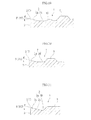
- no flat rake face 2B is present as shown in Fig. 13 and Fig. 14 , or the flat rake face 2B is made extremely small as shown in Fig. 15 .
- a space between the positive rake face 2A and the flat rake face 2B communicates with a recessed curved face more smoothly.
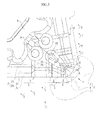
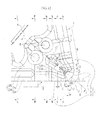
- a rake angle ⁇ of the cutting edge 5 which is formed by the positive rake face 2A, that is, an inclination angle formed by the positive rake face 2A in a direction perpendicular to the thickness direction on a cross section orthogonal to the cutting edge 5 when seen in the planar view is such that a rake angle ⁇ 3 of the cutting edge 5 in the third region C is greater than rake angles ⁇ 1, ⁇ 2 of the cutting edges 5 in the first region A and the second region B.
- the rake angle ⁇ 3 is to be constant in the third region C and the rake angle ⁇ gradually decreased from the border D between the third region C and the first region A and the border E between the third region C and the second region B toward the first and the second regions as being spaced away from the third region C along the cutting edges 5 in the first region A and the second region B.
- the rake angle ⁇ 1 is to be constant at a part including a corner tip 6A on the bisector Q of the corner section 6 (a part from the corner tip 6A to a cross section O to O in Fig. 12 ).
- the rake angle ⁇ 2 is to be constant at a part which is a predetermined length on the side of the third region C (a part between a cross section N to N and a cross section W to W in Fig. 12 ).
- the rake angle ⁇ 3 which is made large in the third region C is desirably set in a range of 15 to 25°. Furthermore, the rake angles ⁇ 1, ⁇ 2 which are made smaller than 15 to 25° in the first region A and the second region B are desirably set smaller than the rake angle ⁇ 3 in a range of 10 to 20°. In the present embodiment, the rake angles ⁇ 1, ⁇ 2 which are constant in the first region A and the second region B are set to be 15° and are set equal with each other. The rake angle ⁇ 3 in the third region C is to be 20°.
- the third region C is such that the border D between the third region C and the first region A and the border E between the third region C and the second region B are disposed at a position of R x 3/4 (mm) and a position of R x 3/2 (mm) with respect to a radius R (mm) of the corner section 6 from a tangent line J which is orthogonal to an extension line I of the linear section 7 of the cutting edge 5 to the corner section 6 and in contact with the corner section 6, along the extension line I, when seen in the planar view, and the range of R x 3/4 (mm) to R x 3/2 (mm) is given as the third region C.
- the third region C is given as a region which includes a contact point between the corner section 6 and the linear section 7 at the cutting edge 5 (a position of a Z to Z cross section in Fig. 12 ). It is, however, acceptable that the border D between the third region C and the first region A is positioned in a range of R x 3/8 (mm) to R x 3/4 (mm) with respect to the radius R (mm) from the tangent line J, along the extension line I, when seen in the planar view.
- the border E between the third region C and the second region B is positioned in a range of R x 3/2 to R x 15/8 (mm) with respect to the radius R (mm) from the tangent line J, along the extension line I, when seen in the planar view.
- the width of the positive rake face 2A in a direction orthogonal to the cutting edge 5 is smallest in the third region C, as shown in Fig. 5 and Fig. 12 .
- the width of the positive rake face 2A in a direction orthogonal to the cutting edge 5 gradually decreases at a part where the rake angle is increased from 01 to 03 toward the border D between the third region C and the first region A in the first region A.
- the width of the positive rake face 2A also gradually decreases in the third region C beyond the border D toward the third region C so as to be spaced away from the first region A and becomes smallest at a contact point between the corner section 6 and the linear section 7 in the cutting edge 5.
- the width of the positive rake face 2A is gradually increased beyond the border E between the second region B and the third region C up to a part where the rake angle is gradually decreased from ⁇ 3 to ⁇ 2. Furthermore, the width of the positive rake face 2A is also constant at a part where the rake angle ⁇ 2 is constant in the second region B.
- the positive rake face 2A is provided in two stages made up of a first positive rake face 2a having a smaller rake angle (for example, 10°) than the rake angle ⁇ 2 on the side of the cutting edge 5 and a second positive rake face 2b which is inside of the first positive rake face 2a and has a rake angle ⁇ 2.
- a total width of the positive rake face 2A is greater than the width of the part where the rake angle ⁇ 2 is to be constant.
- the cutting edge 5 is curved so as to put a dent in the thickness direction from the corner tip 6A of the corner section 6 through the border D between the first region A and the third region C and the border E between the second region B and the third region C up to a part where the rake angle ⁇ 2 starts to be constant in the second region B. Therefore, the cutting edge 5 is curved so as to put a dent in the thickness direction as moving toward the second region B from the first region A all over in the third region C.
- the cutting edge 5 when seen in the above side view, the cutting edge 5 is curved by giving a raised curve that rises in the thickness direction from the corner tip 6A to the contact point between the corner section 6 and the linear section 7.
- the cutting edge 5 is curved so as to put a dent in the thickness direction by giving a recessed curve smoothly communicating with the raised curve from the contact point. That is, the cutting edge 5 is formed as a recessed and raised curve having an inflexion point in the third region C.
- the cutting edge 5 which dents in the thickness direction as described above is inclined upward so as to rise linearly in the thickness direction after giving a recessed curve as moving toward the opposite side of the third region C at the part where the rake angle ⁇ 2 is constant in the second region B. Furthermore, the cutting edge 5 extends on a flat plane perpendicular to the thickness direction via a raised curve at a part changing from the part where the rake angle ⁇ 2 is constant to a part where the positive rake face 2A is constituted with the first positive rake face 2a and the second positive rake face 2b.
- a position of the thickness direction on the flat plane where the cutting edge 5 extends is made equal to a position of the cutting edge 5 at the corner tip 6A, which is lower than upper faces of the boss section 8 and the protruded section 9 but slightly higher than an upper face of the higher stage of the protrusion streak 10.
- the cutting edge 5 is curved and changes in such a manner that the width of the positive rake face 2A where the rake angle ⁇ 3 is to be constant when seen in the planar view becomes smallest in the third region C, as described above.
- the flat rake face 2B extending inside the positive rake face 2A is such that the position of the thickness direction on a cross section orthogonal to the cutting edge 5 when seen in the planar view is also inclined downward so as to be gradually lower along the cutting edge 5 from the contact point between the corner section 6 and the linear section 7 where the width of the positive rake face 2A becomes smallest toward the part where the rake angle ⁇ 2 starts to be constant in the second region B where the position of the thickness direction of the cutting edge 5 is lowest. Further, the depth of the thickness direction from the cutting edge 5 on the cross section is gradually increased.
- the flat rake face 2B in which the position of the thickness direction is lowered at the part where the rake angle ⁇ 2 of the second region B starts to be constant is such that the width of the positive rake face 2A is constant at the part where the rake angle ⁇ 2 is to be constant and the cutting edge 5 is inclined upward so as to rise in the thickness direction as moving toward the opposite side of the third region C.
- the position of the thickness direction on the cross section orthogonal to the cutting edge 5 is also inclined so as to gradually rise as moving toward the opposite side of the third region C along the cutting edge 5.
- the flat rake face 2B is such that the position of the thickness direction (height) thereof is made equal in a direction along the cutting edge 5 and in the present embodiment given as a flat plane perpendicular to the thickness direction. Further, the width of the flat rake face 2B formed in between from the positive rake face 2A to the protrusion streak 10 via the recessed curved face in a direction orthogonal to the cutting edge 5 when seen in the planar view is substantially constant at a part where the flat rake face 2B is inclined downward (a part where the positive rake face 2A is gradually increased in width) as shown in Fig. 5 and Fig. 12 .
- the linear section 7 extending from the corner section 6 of the cutting edge 5 which has cut into a workpiece to a feeding direction of the corner section 6 cuts into the workpiece.
- a position of the tangent line J which is orthogonal to the extension line I of the linear section 7 to the corner section 6 and in contact with the corner section 6 is practically a tip of the depth of cut of the cutting edge 5.
- a cutting boundary is substantially positioned in a range of R x 3/4 to R x 3/2 (mm) with respect to the radius R (mm) of the corner section 6 in the linear section 7 from the tangent line J, along the extension line I.
- the cutting edge 5 is given as the third region of which the rake angle ⁇ 3 is smaller than the rake angle ⁇ 1 of the first region A and the rake angle ⁇ 2 of the second region B and imparted excellent sharpness.
- the thus described third region C is positioned at a cutting boundary, by which, for example, when a difficult-to-cut material such as stainless steel is subjected to turning, occurrence of burrs can be suppressed at the cutting boundary. Therefore, it is possible to avoid such a negative circle in that the cutting edge 5 cuts into the burrs which have undergone work hardening in association with feeding and abnormal wear of the cutting edge 5 proceeds and the cutting edge 5 is thereby decreased in sharpness with burrs more likely to occur. It is thus possible to perform stable and efficient light cutting.
- the rake angles ⁇ 1, ⁇ 2 of the cutting edges 5 are made smaller than the rake angle ⁇ 3 in the third region C.
- these cutting edges 5 can be inversely increased in wedge angle to have a great cutting edge strength. Therefore, the cutting edge 5 as a whole retains sufficient fracturing resistance and chipping resistance and reduction in insert life due to the fracturing and the chipping is also prevented, by which it is possible to provide a cutting insert longer in service life.
- the rake face 2 is provided with the positive rake face 2A which is on the side of the cutting edge 5 and gives the rake angles ⁇ ( ⁇ 1 to ⁇ 3) in the first, the second and the third regions A, B, C and the flat rake face 2B which is inside of the positive rake face 2A and gives a rake angle smaller than the rake angles ⁇ of the positive rake face 2A or giving a rake angle of 0° in particular in the present embodiment.
- the width thereof in a direction orthogonal to the cutting edge 5 of the positive rake face 2A when seen in a planar view from the direction facing the rake face 2 along the thickness direction is made smallest.
- the flat rake face 2B having a smaller rake angle is in a position closest to the cutting edge 5.
- the flat rake face 2B having a smaller rake angle is brought close to the cutting edge 5, by which the insert main body 1 can be increased in thickness at a position close to the cutting edge 5.
- back metal can be ensured to prevent the cutting edge 5 from being unnecessarily reduced in strength and rigidity.
- the positive rake face 2A has a large width, and the flat rake face 2B having a smaller rake angle than the rake angles ⁇ 1, ⁇ 2 which are smaller than the rake angle ⁇ 3 and the protrusion streak 10 are kept away from the cutting edge 5.
- the flat rake face 2B having a smaller rake angle than the rake angles ⁇ 1, ⁇ 2 which are smaller than the rake angle ⁇ 3 and the protrusion streak 10 are kept away from the cutting edge 5.
- the rake angle of the flat rake face 2B on a cross section orthogonal to the cutting edge 5 when seen in the planar view is given as 0° and extends perpendicularly in the thickness direction of the insert main body 1.
- the flat rake face 2B is not necessarily flat in a strict sense and, as with the positive rake face 2A, the flat rake face 2B is curved so as to put a dent in the thickness direction as moving toward the inside of the rake face 2.
- the cutting edge 5 when seen in a side view facing the flank face 3, the cutting edge 5 is curved so as to put a dent toward the thickness direction as moving toward the second region B from the first region A in the third region C.
- a cutting edge inclination can be set so as to be great to the side of a positive angle, thereby lowering the cutting force.
- the cutting edge 5 in the third region C is increased in rake angle 03, the cutting edge 5 in the third region C is further improved in sharpness, thus making it possible to suppress the occurrence of burrs more reliably.
- chips generated on light cutting having a cutting boundary in the third region C collide with side faces of the protrusion streak 10 protruding inside thereof after passing through the positive rake face 2A of the rake face 2 to the flat rake face 2B and are separated and treated.
- the position of the thickness direction at the flat rake face 2B on a cross section orthogonal to the cutting edge 5 when seen in the planar view is inclined downward so as to be gradually lower along the cutting edge 5. Further, the depth of the flat rake face 2B in the thickness direction from the cutting edge 5 on the above described cross section is also gradually increased.
- a pocket which houses chips can be reliably increased in capacity.
- chips generated in particular from the vicinity of a cutting boundary positioned in the third region C can be smoothly guided into the large capacity pocket and duly treated without clogging or the like. Therefore, in the present embodiment, it is also possible to prevent such a situation that burrs easily occur due to clogging of chips generated in the vicinity of the cutting boundary.
- the insert main body 1 is made symmetrical with respect to the bisector Q of the corner section 6 and available in what is called a free-type cutting insert which can be attached to a holder of a right-handed indexable tool and also to a holder of a left-handed indexable tool.
- the first region A, the second region B and the third region C including the third region C of which the rake angle ⁇ is made greater are set for the cutting edge 5 which covers an area from one end of the corner section 6 which cuts into a workpiece to the linear section 7 at least facing to a feed direction. Therefore, the present invention is also applicable in what is called a handed cutting insert in which such first region A, the second region B and the third region C are not set to the cutting edge 5 extending from the other end of the corner section 6, in contrast to the above description.
- the model number was CNMG120408, the nominal radius of corner section 6 was 0.8 (mm) and the actually measured radius R was 0.794 (mm).
- the rake angle 03 of the cutting edge 5 in the third region C was 20°
- the rake angles ⁇ 1, ⁇ 2 in the first region A and the second region B were to be constant and each of which was 15°.
- the insert main body 1 was made with a sintered hard alloy (type M30 according to JIS B 4053-1998), the surface of which was coated by a CVD method with about a 5 ⁇ m-thick composite layer prepared by coating Al 2 O 3 on TiCN.
- the workpiece was a round bar made with SUS 304 (hardness of 169HB) and subjected to wet cutting by using cutting fluid (A3 type 1, JIS K 2241: 2000).
- cutting fluid A3 type 1, JIS K 2241: 2000.
- the workpiece with an outer diameter of 57.6 mm was subjected to continuous cutting over a distance of 0.10 m in a rotation-axis direction of the workpiece under cutting conditions that the depth of cut was 1.0 mm, the feed rate was 0.1 mm/rev and the cutting speed was 150 m/min.
- one 10 mm-wide flute was formed on an outer circumference of the workpiece with an outer diameter of 44.8 mm in the rotation-axis direction of the workpiece so as to cause interrupted cutting.
- the workpiece was cut under cutting conditions that the depth of cut was 1.5 mm, the feed rate was 0.2 mm/rev and the cutting speed was 150 m/min over a distance of 0.10 m in the rotation-axis direction of the workpiece.
- the fracturing resistance there was found no chipping or fracturing which resulted in cutting failure.
- slight chipping was found on confirmation after completion of cutting in the examples 1, 2 and 4 in which a range of the third region C having a greater rake angle ⁇ 3 was 0.7 mm or more which was longer than 3/4 of the radius R (mm) of the corner section 6.
- no chipping was found in the examples 3, 5, and 6 in which the range of the third region C was 0.6 mm or less which was 3/4 of the radius R (mm) of the corner section 6.
- the example 3 was evaluated highest in which the third region C was in a range of R x 3/4 to R x 3/2 (mm) with respect to the radius R (mm) of the corner section.
- the present invention relates to a cutting insert which is provided with an insert main body having a rake face and a flank face and a cutting edge formed at a ridge section between the rake face and the flank face in the insert main body.
- the cutting insert of the present invention on light cutting of a difficult-to-cut material such as stainless steel, the cutting edge was prevented from fracturing and chipping and also improved in sharpness at a cutting boundary to suppress the occurrence of burrs, thus making it possible to avoid abnormal wear and perform an efficient turning process.
Landscapes
- Engineering & Computer Science (AREA)
- Mechanical Engineering (AREA)
- Cutting Tools, Boring Holders, And Turrets (AREA)
Applications Claiming Priority (3)
| Application Number | Priority Date | Filing Date | Title |
|---|---|---|---|
| JP2010254999 | 2010-11-15 | ||
| JP2011246397A JP5853613B2 (ja) | 2010-11-15 | 2011-11-10 | 切削インサート |
| PCT/JP2011/076305 WO2012067114A1 (fr) | 2010-11-15 | 2011-11-15 | Plaquette de coupe |
Publications (2)
| Publication Number | Publication Date |
|---|---|
| EP2641677A1 true EP2641677A1 (fr) | 2013-09-25 |
| EP2641677A4 EP2641677A4 (fr) | 2016-03-02 |
Family
ID=46084038
Family Applications (1)
| Application Number | Title | Priority Date | Filing Date |
|---|---|---|---|
| EP11840956.4A Withdrawn EP2641677A4 (fr) | 2010-11-15 | 2011-11-15 | Plaquette de coupe |
Country Status (6)
| Country | Link |
|---|---|
| US (1) | US9364898B2 (fr) |
| EP (1) | EP2641677A4 (fr) |
| JP (1) | JP5853613B2 (fr) |
| KR (1) | KR101793768B1 (fr) |
| CN (1) | CN103209792B (fr) |
| WO (1) | WO2012067114A1 (fr) |
Cited By (3)
| Publication number | Priority date | Publication date | Assignee | Title |
|---|---|---|---|---|
| EP3006140A1 (fr) | 2014-10-08 | 2016-04-13 | Sandvik Intellectual Property AB | Insert de tournage et outil de tournage |
| US10213839B2 (en) | 2014-09-18 | 2019-02-26 | Kyocera Corporation | Cutting insert, cutting tool, and method of manufacturing machined product |
| EP3539698A1 (fr) * | 2018-03-15 | 2019-09-18 | Tungaloy Corporation | Insert de coupe, support et outil de coupe comprenant un insert de coupe |
Families Citing this family (21)
| Publication number | Priority date | Publication date | Assignee | Title |
|---|---|---|---|---|
| WO2011142297A1 (fr) * | 2010-05-11 | 2011-11-17 | 株式会社タンガロイ | Plaquette de coupe |
| KR20140038975A (ko) * | 2011-05-03 | 2014-03-31 | 다이아몬드 이노베이션즈, 인크. | 칩 박육화를 유발하는 와이퍼를 선단 날 상에 갖는 인서트 |
| JP5926366B2 (ja) * | 2012-02-29 | 2016-05-25 | 京セラ株式会社 | 切削インサート、切削工具および切削加工物の製造方法 |
| US9707625B2 (en) * | 2012-02-29 | 2017-07-18 | Kyocera Corporation | Cutting insert, cutting tool, and method of manufacturing machined product |
| US8939684B2 (en) * | 2012-05-15 | 2015-01-27 | Iscar, Ltd. | Cutting insert with chip-control arrangement having recess depths and projection heights which increase with distance from cutting edge |
| SE1350348A1 (sv) | 2013-03-20 | 2014-09-21 | Sandvik Intellectual Property | Dubbelsidigt, indexerbart svarvskär |
| US9409237B2 (en) * | 2013-09-16 | 2016-08-09 | Iscar, Ltd. | Finish depth turning insert comprising a chip control arrangement |
| WO2016043127A1 (fr) * | 2014-09-16 | 2016-03-24 | 住友電気工業株式会社 | Plaquette de coupe et son procédé de fabrication |
| CN109475946B (zh) * | 2016-08-31 | 2020-06-26 | 住友电工硬质合金株式会社 | 切削刀具 |
| US11446745B2 (en) * | 2018-09-27 | 2022-09-20 | Iscar, Ltd. | Turning insert having peninsula and island protrusions, and turning tool |
| EP3865232B1 (fr) * | 2018-10-11 | 2024-09-18 | Sumitomo Electric Hardmetal Corp. | Plaquette de coupe et outil de coupe de diamètre intérieur |
| JP2020069598A (ja) * | 2018-10-31 | 2020-05-07 | 京セラ株式会社 | 切削インサート、切削工具、及び切削加工物の製造方法 |
| EP3702075B1 (fr) * | 2019-02-28 | 2023-12-20 | AB Sandvik Coromant | Insert tournant de découpe de métal |
| WO2021095520A1 (fr) * | 2019-11-13 | 2021-05-20 | 京セラ株式会社 | Insert de coupe, outil de coupe et procédé de fabrication de pièce coupée |
| DE112020005293B4 (de) * | 2019-12-11 | 2024-05-16 | Kyocera Corporation | Einsatz, schneidwerkzeug und verfahren zum schneiden eines werkstücks mit dem schneidwerkzeug |
| JP7344385B2 (ja) * | 2020-05-26 | 2023-09-13 | 京セラ株式会社 | 切削インサート、切削工具及び切削加工物の製造方法 |
| JP7419531B2 (ja) * | 2020-06-17 | 2024-01-22 | 住友電工ハードメタル株式会社 | 切削インサート及び切削インサートの製造方法 |
| DE102020117101A1 (de) | 2020-06-29 | 2021-12-30 | Kennametal Inc. | Schneideinsatz und Zerspanungswerkzeug |
| CN114309682A (zh) | 2020-09-30 | 2022-04-12 | 肯纳金属公司 | 切削刀片 |
| US11819927B2 (en) * | 2021-06-11 | 2023-11-21 | Taegutec Ltd. | Cutting insert and cutting tool assembly including same |
| KR102907692B1 (ko) * | 2023-12-07 | 2026-01-05 | 주식회사 나노테크 | 절삭인서트 |
Family Cites Families (15)
| Publication number | Priority date | Publication date | Assignee | Title |
|---|---|---|---|---|
| JPS6342965Y2 (fr) | 1980-09-04 | 1988-11-10 | ||
| CH667407A5 (fr) * | 1986-03-27 | 1988-10-14 | Stellram Sa | Fraise a plaquettes de coupe amovibles. |
| FR2624414A1 (fr) * | 1987-12-11 | 1989-06-16 | Safety | Plaquette de coupe a aretes de coupe surelevees |
| JP3269217B2 (ja) | 1992-10-26 | 2002-03-25 | 三菱マテリアル株式会社 | スローアウェイチップ |
| SE500719C2 (sv) * | 1993-01-27 | 1994-08-15 | Sandvik Ab | Skär med skruvformigt vriden spånyta |
| JP3366751B2 (ja) * | 1994-10-19 | 2003-01-14 | 東芝タンガロイ株式会社 | スローアウェイチップ |
| US6065907A (en) * | 1998-12-23 | 2000-05-23 | Kennametal Inc. | Cutting insert with chip control |
| JP2001038507A (ja) | 1999-07-29 | 2001-02-13 | Toshiba Tungaloy Co Ltd | スローアウェイチップ |
| JP2001157903A (ja) * | 1999-11-29 | 2001-06-12 | Mitsubishi Materials Corp | スローアウェイチップ |
| JP4613404B2 (ja) * | 2000-08-30 | 2011-01-19 | 株式会社タンガロイ | スローアウェイチップ |
| JP3812473B2 (ja) * | 2001-11-20 | 2006-08-23 | 三菱マテリアル株式会社 | スローアウェイチップ |
| JP4923569B2 (ja) * | 2005-12-27 | 2012-04-25 | 株式会社タンガロイ | スローアウェイチップ |
| CN101720264B (zh) * | 2007-06-26 | 2011-06-01 | 特固克有限会社 | 带有在其转角区域形成的突出部的切削刀片 |
| WO2009096516A1 (fr) | 2008-01-30 | 2009-08-06 | Kyocera Corporation | Insert de coupe, outil de coupe et méthode de coupe |
| JP5158490B2 (ja) * | 2008-03-06 | 2013-03-06 | 住友電工ハードメタル株式会社 | 刃先交換式切削チップ |
-
2011
- 2011-11-10 JP JP2011246397A patent/JP5853613B2/ja active Active
- 2011-11-15 CN CN201180054744.6A patent/CN103209792B/zh active Active
- 2011-11-15 US US13/885,232 patent/US9364898B2/en active Active
- 2011-11-15 EP EP11840956.4A patent/EP2641677A4/fr not_active Withdrawn
- 2011-11-15 KR KR1020137012286A patent/KR101793768B1/ko active Active
- 2011-11-15 WO PCT/JP2011/076305 patent/WO2012067114A1/fr not_active Ceased
Cited By (4)
| Publication number | Priority date | Publication date | Assignee | Title |
|---|---|---|---|---|
| US10213839B2 (en) | 2014-09-18 | 2019-02-26 | Kyocera Corporation | Cutting insert, cutting tool, and method of manufacturing machined product |
| EP3006140A1 (fr) | 2014-10-08 | 2016-04-13 | Sandvik Intellectual Property AB | Insert de tournage et outil de tournage |
| WO2016055468A1 (fr) | 2014-10-08 | 2016-04-14 | Sandvik Intellectual Property Ab | Plaquette de coupe d'outil rotatif et outil rotatif |
| EP3539698A1 (fr) * | 2018-03-15 | 2019-09-18 | Tungaloy Corporation | Insert de coupe, support et outil de coupe comprenant un insert de coupe |
Also Published As
| Publication number | Publication date |
|---|---|
| KR101793768B1 (ko) | 2017-11-03 |
| KR20130122745A (ko) | 2013-11-08 |
| JP5853613B2 (ja) | 2016-02-09 |
| WO2012067114A1 (fr) | 2012-05-24 |
| JP2012121131A (ja) | 2012-06-28 |
| CN103209792A (zh) | 2013-07-17 |
| CN103209792B (zh) | 2016-01-27 |
| EP2641677A4 (fr) | 2016-03-02 |
| US9364898B2 (en) | 2016-06-14 |
| US20130236258A1 (en) | 2013-09-12 |
Similar Documents
| Publication | Publication Date | Title |
|---|---|---|
| EP2641677A1 (fr) | Plaquette de coupe | |
| EP2435204B1 (fr) | Plaquette de coupe | |
| EP1702702B1 (fr) | Plaquette de coupe pour fraise à surface | |
| KR101798695B1 (ko) | 절삭 인서트 | |
| CN102905824B (zh) | 切削刀片 | |
| CN102427904B (zh) | 切削镶刀及切削工具、以及使用该切削工具的切削加工物的制造方法 | |
| CN102802855B (zh) | 切削镶刀及切削工具、以及使用该切削工具的切削加工物的制造方法 | |
| KR101720553B1 (ko) | 절삭 인서트, 절삭 공구 및 절삭 가공물의 제조 방법 | |
| EP2412464B2 (fr) | Outil de fraisage | |
| KR101233838B1 (ko) | 절삭용 인서트 | |
| KR20120050483A (ko) | 절삭 인서트 및 절삭공구 | |
| CN114951720B (zh) | 切削刀片 | |
| CN104203463A (zh) | 切削刀片 | |
| KR102493702B1 (ko) | 칩 형성 장치를 갖는 네거티브 마무리 선삭 인서트 | |
| JP6052455B1 (ja) | 切削インサートおよび切削工具 | |
| KR100558249B1 (ko) | 절삭 인서트 | |
| JP4784378B2 (ja) | 超高圧焼結体切削工具 | |
| JP2015077647A (ja) | 往路と復路加工用の縦送りインサート、及びこのインサートを装着した刃先交換式回転切削工具 | |
| US11458546B2 (en) | Throwaway insert | |
| JP2007290057A (ja) | 超高圧焼結体切削工具 |
Legal Events
| Date | Code | Title | Description |
|---|---|---|---|
| PUAI | Public reference made under article 153(3) epc to a published international application that has entered the european phase |
Free format text: ORIGINAL CODE: 0009012 |
|
| 17P | Request for examination filed |
Effective date: 20130517 |
|
| AK | Designated contracting states |
Kind code of ref document: A1 Designated state(s): AL AT BE BG CH CY CZ DE DK EE ES FI FR GB GR HR HU IE IS IT LI LT LU LV MC MK MT NL NO PL PT RO RS SE SI SK SM TR |
|
| DAX | Request for extension of the european patent (deleted) | ||
| RA4 | Supplementary search report drawn up and despatched (corrected) |
Effective date: 20160128 |
|
| RIC1 | Information provided on ipc code assigned before grant |
Ipc: B23B 27/14 20060101AFI20160122BHEP Ipc: B23B 27/00 20060101ALI20160122BHEP |
|
| GRAP | Despatch of communication of intention to grant a patent |
Free format text: ORIGINAL CODE: EPIDOSNIGR1 |
|
| INTG | Intention to grant announced |
Effective date: 20180703 |
|
| STAA | Information on the status of an ep patent application or granted ep patent |
Free format text: STATUS: THE APPLICATION IS DEEMED TO BE WITHDRAWN |
|
| 18D | Application deemed to be withdrawn |
Effective date: 20181114 |