EP2642011A1 - Procédé d'équipement et dispositif d'équipement avec application de liquide définie - Google Patents
Procédé d'équipement et dispositif d'équipement avec application de liquide définie Download PDFInfo
- Publication number
- EP2642011A1 EP2642011A1 EP13159183.6A EP13159183A EP2642011A1 EP 2642011 A1 EP2642011 A1 EP 2642011A1 EP 13159183 A EP13159183 A EP 13159183A EP 2642011 A1 EP2642011 A1 EP 2642011A1
- Authority
- EP
- European Patent Office
- Prior art keywords
- nip
- web
- application
- liquor
- fleet
- Prior art date
- Legal status (The legal status is an assumption and is not a legal conclusion. Google has not performed a legal analysis and makes no representation as to the accuracy of the status listed.)
- Granted
Links
- 238000000034 method Methods 0.000 title claims abstract description 42
- 239000000463 material Substances 0.000 claims abstract description 16
- 239000007788 liquid Substances 0.000 claims description 60
- 238000007730 finishing process Methods 0.000 claims description 14
- 239000004744 fabric Substances 0.000 claims description 2
- 239000011324 bead Substances 0.000 description 11
- 230000008569 process Effects 0.000 description 11
- 230000035515 penetration Effects 0.000 description 10
- 230000008901 benefit Effects 0.000 description 8
- 238000011156 evaluation Methods 0.000 description 7
- 230000000694 effects Effects 0.000 description 6
- 230000032258 transport Effects 0.000 description 6
- 239000006260 foam Substances 0.000 description 5
- 239000004745 nonwoven fabric Substances 0.000 description 5
- XLYOFNOQVPJJNP-UHFFFAOYSA-N water Substances O XLYOFNOQVPJJNP-UHFFFAOYSA-N 0.000 description 5
- 239000011248 coating agent Substances 0.000 description 4
- 238000000576 coating method Methods 0.000 description 4
- 238000010790 dilution Methods 0.000 description 4
- 239000012895 dilution Substances 0.000 description 4
- 238000001035 drying Methods 0.000 description 4
- 230000001105 regulatory effect Effects 0.000 description 4
- 239000000126 substance Substances 0.000 description 4
- 230000002093 peripheral effect Effects 0.000 description 3
- 239000000758 substrate Substances 0.000 description 3
- 239000004753 textile Substances 0.000 description 3
- 230000008859 change Effects 0.000 description 2
- 238000010028 chemical finishing Methods 0.000 description 2
- 239000003795 chemical substances by application Substances 0.000 description 2
- 238000005470 impregnation Methods 0.000 description 2
- 239000000203 mixture Substances 0.000 description 2
- 238000003860 storage Methods 0.000 description 2
- RNFJDJUURJAICM-UHFFFAOYSA-N 2,2,4,4,6,6-hexaphenoxy-1,3,5-triaza-2$l^{5},4$l^{5},6$l^{5}-triphosphacyclohexa-1,3,5-triene Chemical compound N=1P(OC=2C=CC=CC=2)(OC=2C=CC=CC=2)=NP(OC=2C=CC=CC=2)(OC=2C=CC=CC=2)=NP=1(OC=1C=CC=CC=1)OC1=CC=CC=C1 RNFJDJUURJAICM-UHFFFAOYSA-N 0.000 description 1
- 230000000844 anti-bacterial effect Effects 0.000 description 1
- 238000013459 approach Methods 0.000 description 1
- 238000004061 bleaching Methods 0.000 description 1
- 230000000903 blocking effect Effects 0.000 description 1
- 238000006243 chemical reaction Methods 0.000 description 1
- 238000002788 crimping Methods 0.000 description 1
- 238000004132 cross linking Methods 0.000 description 1
- 230000007547 defect Effects 0.000 description 1
- 238000007598 dipping method Methods 0.000 description 1
- 230000009189 diving Effects 0.000 description 1
- 238000004043 dyeing Methods 0.000 description 1
- 238000005265 energy consumption Methods 0.000 description 1
- 239000003063 flame retardant Substances 0.000 description 1
- 238000005189 flocculation Methods 0.000 description 1
- 230000016615 flocculation Effects 0.000 description 1
- 238000009472 formulation Methods 0.000 description 1
- 238000000265 homogenisation Methods 0.000 description 1
- 230000000749 insecticidal effect Effects 0.000 description 1
- 238000007639 printing Methods 0.000 description 1
- 238000007670 refining Methods 0.000 description 1
- 230000002940 repellent Effects 0.000 description 1
- 239000005871 repellent Substances 0.000 description 1
- 239000007921 spray Substances 0.000 description 1
- 238000009988 textile finishing Methods 0.000 description 1
Images



Classifications
-
- D—TEXTILES; PAPER
- D06—TREATMENT OF TEXTILES OR THE LIKE; LAUNDERING; FLEXIBLE MATERIALS NOT OTHERWISE PROVIDED FOR
- D06B—TREATING TEXTILE MATERIALS USING LIQUIDS, GASES OR VAPOURS
- D06B1/00—Applying liquids, gases or vapours onto textile materials to effect treatment, e.g. washing, dyeing, bleaching, sizing or impregnating
- D06B1/10—Applying liquids, gases or vapours onto textile materials to effect treatment, e.g. washing, dyeing, bleaching, sizing or impregnating by contact with a member carrying the treating material
- D06B1/14—Applying liquids, gases or vapours onto textile materials to effect treatment, e.g. washing, dyeing, bleaching, sizing or impregnating by contact with a member carrying the treating material with a roller
- D06B1/142—Applying liquids, gases or vapours onto textile materials to effect treatment, e.g. washing, dyeing, bleaching, sizing or impregnating by contact with a member carrying the treating material with a roller where an element is used to mitigate the quantity of treating material that the textile material can retain
-
- D—TEXTILES; PAPER
- D06—TREATMENT OF TEXTILES OR THE LIKE; LAUNDERING; FLEXIBLE MATERIALS NOT OTHERWISE PROVIDED FOR
- D06B—TREATING TEXTILE MATERIALS USING LIQUIDS, GASES OR VAPOURS
- D06B23/00—Component parts, details, or accessories of apparatus or machines, specially adapted for the treating of textile materials, not restricted to a particular kind of apparatus, provided for in groups D06B1/00 - D06B21/00
- D06B23/24—Means for regulating the amount of treating material picked up by the textile material during its treatment
- D06B23/26—Means for regulating the amount of treating material picked up by the textile material during its treatment in response to a test conducted on the textile material
-
- D—TEXTILES; PAPER
- D06—TREATMENT OF TEXTILES OR THE LIKE; LAUNDERING; FLEXIBLE MATERIALS NOT OTHERWISE PROVIDED FOR
- D06B—TREATING TEXTILE MATERIALS USING LIQUIDS, GASES OR VAPOURS
- D06B1/00—Applying liquids, gases or vapours onto textile materials to effect treatment, e.g. washing, dyeing, bleaching, sizing or impregnating
- D06B1/10—Applying liquids, gases or vapours onto textile materials to effect treatment, e.g. washing, dyeing, bleaching, sizing or impregnating by contact with a member carrying the treating material
- D06B1/14—Applying liquids, gases or vapours onto textile materials to effect treatment, e.g. washing, dyeing, bleaching, sizing or impregnating by contact with a member carrying the treating material with a roller
- D06B1/144—Applying liquids, gases or vapours onto textile materials to effect treatment, e.g. washing, dyeing, bleaching, sizing or impregnating by contact with a member carrying the treating material with a roller the treating material being kept in a trough formed between the roller and non-rotating elements
Definitions
- the invention relates to a finishing method and a device with defined fleet order for the equipment of a web.
- Chemical finishing processes include, for example: dyeing, printing, flame retardant, bleaching, machine-washable equipment, nano-equipment, stain-resistant equipment, UV blocking equipment, antistatic equipment, antibacterial equipment, iron-free equipment, burnout equipment, repellent equipment, or insecticidal equipment.
- the equipment of a web comprises in particular the order of the generally liquid chemical, the so-called fleet, on the web.
- the functionality of the finished fabric is guaranteed by the amount of applied chemical (so-called oil pick-up, OPU). This is the amount of chemical that remains on the web after drying. It results from the applied fleet quantity (so-called wet pick-up, WPU) times the fleet concentration.
- OPU oil pick-up
- the invention has set itself the task of providing a method and an apparatus for finishing a web, with improvements in at least one of the mentioned disadvantages.
- a liquor is first applied to a material web by means of a coating unit which permits a defined liquor application. Subsequently, the web is passed through a nip. In other words, the web is guided through a nip, which is arranged in the web transport direction behind the application unit.
- the nip is preferably arranged directly behind the applicator or only separated by deflection rollers of the applicator. The nip may be formed by a squeezing.
- a defined fleet order means, in particular, a selected, specific and constant fleet order (WPU).
- the application unit which permits a defined liquor application, preferably comprises an application roller and particularly preferably a KissRoll applicator.
- a KissRoll applicator is in particular a coating unit, in which the web is rotated on a in a liquor bath in a scoop, with A fleet of wet application roll is transported past, in order to apply the fleet on the web. The fleet takeover is not as in a foulard the system left but specifically determined.
- the rotational speed of the applicator roll can be varied, for example, taking into account the liquor level in the scoop.
- the peripheral speed of the applicator roll must therefore not correspond to the web speed.
- the web preferably wraps around the applicator roll in a certain angular range.
- This foam can hardly be handled and it leads, if it is carried away by the web, to defects on the finished goods.
- the large amount of entrainment (up to 400%) of the fleet resulting from the high speed produces a great weight force and, as a result, a corresponding product tension. This can lead to width drops, in the worst case, qualities with low wet tensile strength, the web tear.
- wet-on-wet equipment such as wet-on-wet finishing
- Wet-on-wet finishing is the application of finishing agents to an already wet web. This process is currently used primarily in textile finishing.
- the background is that in order to achieve certain effects on the web, it is often necessary to impregnate a textile web with two or more fleets. For procedural reasons, this sometimes has to be done in two consecutive application steps.
- Reasons for a two-step application may be that pre-crosslinking is required to improve the penetration of product 2.
- the chemicals used in the two approaches can not be prepared in a bath, without causing undesirable reactions, eg. As for flocculation, clumping or the like.
- One reason for a two-step application can also be that the baths have different temperatures for procedural reasons.
- a plurality of, for example two, a defined fleet order permitting application units are provided one behind the other, which particularly preferably apply different fleets.
- the wet-in-wet application has a very special significance for the equipment of hydroentangled nonwovens (spunlace). Due to the web-forming process, the nonwoven web is wet anyway and would have to be dried in between for a classic dry-in-wet finish. Only then could she undergo the refining process and then be dried a second time.
- the wet-on-wet application allows in-line equipment without the energy-intensive step of this intermediate drying.
- the wet-on-wet application in the padder creates a problem that makes this process very complex. During the impregnation in the trough (net trough) there is a fleet exchange in the goods.
- the application unit which permits a defined liquor application, comprises an application roller or KissRoll applicator
- the advantages of both application methods can be combined while at the same time avoiding or reducing the respective disadvantages become.
- the amount of the defined liquor application can preferably be influenced quickly and reliably in a large range by the speed of the application roller in the application unit, which comprises an application roller or KissRoll applicator.
- the application unit which allows a defined fleet order, also a defined fleet order.
- this is 50% of the net weight of the web.
- the WPU is 25%. Other values are conceivable.
- no liquor is squeezed by the nip. It thus takes place by the order aggregate, which allows a defined fleet order, preferably no surplus order.
- the entire fleet that has been applied preferably remains on the web.
- the liquid content in the web before the nip thus preferably corresponds to the liquid content in the web after the nip.
- the nip does not take over the task in this embodiment, which he takes over in a foulard, where he brings about by reducing the surplus order only the exact order quantity. Surprisingly, its use has also proved to be very advantageous in this embodiment.
- no liquor is squeezed off by the nip after the end of a starting phase.
- a starting phase preferably so much liquor is squeezed through the nip until a liquid wedge forms in front of the nip.
- the introduced liquor is homogenized by the nip and further preferably distributed and particularly preferably improves the penetration.
- the nip only serves to even out the volume of liquor on the substrate over the width and to press it into the product.
- the web is inserted horizontally or from above into the nip.
- the web thus runs in the nip in particular horizontally or obliquely downward or vertically downward.
- the process is a wet-on-wet finishing process.
- the advantages of the invention are particularly effective in such a method.
- the method is not limited to a wet-on-wet finishing method, it is generally suitable for the equipment.
- the method is or includes, for example, a dry-in-wet application.
- the process comprises a nonwoven finishing process, in one embodiment for hydroentangled nonwoven web.
- a nonwoven finishing process in one embodiment for hydroentangled nonwoven web.
- the advantages of the invention are particularly well in such a process to advantage.
- the method is not limited to a specific web material or a specific web composition.
- the process comprises, for example, a finishing process for thermobonded nonwovens.
- the method can also be, for example, a finishing method for needled nonwovens, etc.
- the web speed is preferably more than 300 m per minute, more preferably between 300 m per minute and 400 m per minute.
- nip with a certain storage volume.
- this it is meant that accumulating liquid in front of the nip and not immediately flushed down.
- the line load in the nip and the defined liquor application amount are preferably coordinated so that forms a liquid wedge before the nip. This is preferably done in such a way that more liquid is squeezed off in a star phase than is applied, and more preferably after that, just as much liquid is squeezed off as is applied.
- the size of this liquid wedge that is, the amount of the liquid jamming in front of the nip - at least after a start phase - is largely constant.
- the liquid wedge may also be referred to as liquid bead or liquor bead. In a preferred embodiment, therefore, apart from a starting phase, no liquor is squeezed off and still a liquid wedge is formed or maintained.
- the liquid wedge may be advantageous for the homogenization of the liquor in the web. He also creates a condition for a very advantageous regulation.
- the actual value of the size of the liquid wedge is determined and compared with a desired value and depending on the deviation of the actual value of the desired value, the amount of the defined fleet order is changed.
- the size of the liquid wedge is preferably kept substantially constant.
- the liquid wedge, in particular the height or the size of this liquid wedge is therefore preferably used as a controlled variable.
- the determination of the actual value is preferably done by a measuring device.
- the application unit which permits a defined fleet order comprises a request roll or KissRoll applicator
- the amount of the defined fleet order is preferably changed by changing the rotational speed of the request roll.
- the actual value of the size of the liquid wedge is preferably determined and compared with a desired value, and the line load in the nip is changed as a function of the deviation of the actual value from the desired value.
- the liquid wedge, in particular the height or size of this liquid wedge is used as a controlled variable.
- the object is achieved in that the equipment device according to the invention with defined liquor application for equipping a material web comprises an application aggregate which permits a defined liquor application onto a material web and a nip is arranged in the web transport direction behind this application aggregate.
- a nip forming rollers are arranged.
- the nip is preferably arranged directly behind the applicator or only separated by deflection rollers of the applicator.
- the nip may be formed by a squeezing.
- the application unit which permits a defined fleet order, preferably comprises an application roller. It particularly preferably comprises a KissRoll applicator.
- the nip does not squeeze any liquor off.
- the entire fleet that has been applied therefore, preferably remains on the web.
- the line load in the nip is preferably adjustable or controllable so that the entire liquor that has been applied remains on the material web.
- the nip preferably does not squeeze any liquor after a start phase has elapsed. In a starting phase, the nip preferably squeezes out so much liquor until a liquid wedge forms in front of the nip.
- the nip preferably uniformizes the applied liquor. More preferably, the nip distributes the applied liquor and particularly preferably improves the penetration.
- the web runs horizontally or from above into the nip.
- the web thus runs in the nip in particular horizontally or obliquely or vertically downwards.
- the device equips the web in one wet-on-wet embodiment.
- the device is not limited to wet-on-wet equipment.
- the device equips the web, for example, dry-in-wet.
- the device preferably equips fleece, in one embodiment spunlace reinforced with water jet.
- the device is not limited to a specific web material or web condition.
- the device equips, for example, thermobonded nonwovens.
- the device can also equip, for example, needled nonwovens.
- the device preferably transports the web at more than 300 m per minute, more preferably at a speed between 300 m and 400 m per minute.
- the line load in the nip and the order amount are coordinated so that forms a liquid wedge before the nip.
- the line load in the nip and the application amount are matched to one another such that a liquid wedge forms in front of the nip.
- the line load in the nip and the application amount are preferably matched or regulated so that in a star phase more liquid is squeezed off, as is applied and further preferred as much liquid is squeezed off, as is applied.
- a measuring device which determines the size of the liquid wedge, ie the actual value, and there is provided a control and evaluation unit which compares this actual value with a desired value and changes the amount of the defined fleet order depending on the deviation from actual value to desired value.
- the size of the liquid wedge is thus used as a controlled variable.
- Amount of the defined fleet order changed by changing the speed of the application roller.
- a measuring device is preferably provided, by means of which the size of the liquid wedge, ie the actual value, can be determined, and it is further preferred to provide a control and evaluation unit, by means of which this actual value is comparable to a desired value and depending on the deviation from the actual value to setpoint, the quantity of the defined fleet order can be changed.
- control and evaluation unit preferably changes the line load in the squeezing unit as a function of the deviation of the actual value of the size of the liquid wedge from the desired value.
- the line load in the squeezing unit can be changed, preferably as a function of deviation of the actual value of the size of the liquid wedge from the desired value, by means of the control and evaluation unit.
- the size of the liquid wedge is used as a controlled variable.
- the amount of the defined fleet order is preferably changed by changing the speed of the application roller.
- Fig. 1 is shown a known from the prior art padder.
- Fig. 2 shows what happens when the web transport speed is increased in such a or similar pad about a certain value, in particular 150 m per minute.
- Fleet 2 sprays out of the net trough 14 and it forms foam 11, which is difficult to control.
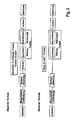
- Fig. 3 illustrates the benefits of a wet-on-wet process in equipping a hydroentangled web 3. Because it is recognizable (lower half of Fig. 3 ), that in this case eliminates the drying of the web 3 before Fleet application.
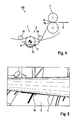
- Fig. 4 shows an embodiment of a device according to the invention.
- the web 3 may be hydroentangled web.
- the application unit 1, which allows a defined fleet order includes in this Embodiment, an application roller 6 and is more specifically a KissRoll applicator 5.
- This includes an application roller 6, which rotates in a bath in a baster 12 and two guide rollers 16, 16 '.
- the application roller 6 is partially immersed in the fleet 2 and is wetted by the fleet 2. Outside the scoop 12, the web 3 is guided over a certain angular range of the applicator roll 6 along.
- the fleet 2 passes from the application roller on the web 3.
- the amount of this applied liquor can be easily and reliably controlled or regulated in a wide range, in particular via the rotational speed of the applicator roll 6.
- the peripheral speed of the application roller 6 need not correspond to the web transport speed, but it is a relative speed between the applicator roll 6 and the web 3 permissible.
- the web 3 at the in Fig. 4 shown embodiment inserted horizontally into a nip 4. This uniforms the fleet 2 in the web 3 and improves the penetration.
- a defined amount of liquor is applied to the web 3 and distributed in the subsequent nip 4 evenly, in particular across the width.
- the order quantity is determined via the peripheral speed of the application roller 6.
- the line load pL in the nip 4 is then adjusted so that, although a liquid wedge 10 forms before the nip 4, but no liquor 2 is squeezed. (The liquid wedge 10 is in Fig.
- the nip 4 behind the liquor application now only serves to even out and distribute the offered liquor 2 in the web and to improve the penetration. In this way, for example, a closed and homogeneous surface coating can be achieved with the lowest possible application quantity.
- the position of the nip 4 forming rollers is basically arbitrary. The axes of rotation of the two rollers can lie in a horizontal or vertical plane, as well as in all intermediate positions.
- the nip 4 is formed by a squeezing 7.
- the optimum setting thus requires individual coordination between the application quantity (speed of the application roller) and the line load in the nip, depending on the substrate to be equipped and the liquor to be applied.
- Fig. 5 shows in a perspective view of such a nip 4. It can be seen that in any case no significant amount of liquor 2 flows from the nip 4. The liquid wedge 10 is thus smaller than the storage volume of the nip. 4
- Fig. 6 schematically shows a finishing process according to the invention with defined product order.
- Fig. 7 shows a specific embodiment, namely a gusset mode.
- the axes of rotation of the rollers forming the nip 4 lie in a horizontal plane.
- the web 3 is guided vertically from above into the nip 4, the web runs in the nip 4 so vertically downwards.
- the line load in the nip 4 and the application amount over the application roller 6 are coordinated so that forms a liquid wedge 10 before the nip 4 and on the upper side of the nip 4.
- a measuring device 9 is provided in this embodiment, which measures the height of this liquid wedge 10.
- This actual value 15 of the liquid wedge 10 is forwarded to a control and evaluation unit 8 and compared there with a desired value 13.
- the rotational speed of the application roller 6 is changed. In this way, the size of the liquid wedge 10 is kept constant. In other words, the level height in the "gusset" (ie liquid wedge) is regulated by the amount of application in the KissRoll and kept constant.
- the line load pL preferably remains constant in this embodiment. The residual moisture after the nip remains at least largely unchanged.
- Fig. 7 shows that the residual moisture content of the web 3 before the finishing process, for example, 55%, after the liquor order on the application roller can be 80% and this moisture content of 80% is not changed by the nip 4.
- the liquor order in this example is therefore 25%, since there is a 100% addition of the liquor order to the residual moisture present in the web before liquor application. A liquor dilution or a replacement of water contained in the web 3 by fleet 2 does not take place.
- a liquid bead control preferably takes place via the application quantity.
- the WPU is determined in this embodiment - largely or at least almost exclusively - on the line load pL in the nip.
- the line load pL is set in the nip, for example, to an empirical value. As long as it is ensured that a liquid bead forms in front of the nip, the residual moisture after the nip (ie the WPU) is, at least in many finishing processes, a function of this line load pL. From the order system is "only" the tailor-made provision of this liquid supply causes. If necessary, the line load pL can be changed to change the WPU. In this case, a change of the order quantity by the order system takes place via the regulation immediately.
- This in Fig. 7 embodiment shown is particularly suitable for finishing processes in which it can be assumed that remains largely exactly the same due to the constant line load pL in the nip of the WPU, if enough liquid is provided by the application system.
- the control in this embodiment is preferably ensured that on the one hand enough liquid is provided by the application system, on the other hand, not more liquid than required reaches the nip, so is provided exactly the right amount.
- Fig. 8 shows another embodiment.
- the height of the liquid wedge 10 measured and this actual value 15 compared with a desired value 13 in a control and evaluation unit 8. This changed at the in Fig. 8 shown embodiment, not the speed of the application roller 6, but the line load pL of the nip 4.
- the size of the liquid wedge 10 is used as a control variable for the application amount and in the embodiment of Fig. 8 the size of the liquid wedge 10 is used as a controlled variable for the line load pL.
- the amount of application on the application roller 6 is controlled via the speed of the application roller 6 and kept constant. This can be done for example by continuously a defined amount of liquor is supplied to the scoop tank 12 and the fleet level is used in the scoop 12 as a control variable for the speed of the applicator roll.
- the level height in the liquid wedge 10 is how Fig. 8 shows, regulated by the line load pL and kept constant. Nevertheless, the residual moisture at constant fleet level, after squeezing - at least largely, so within narrow limits - remains unchanged. Also at the in Fig. 8 Fleet order is 25% with an increase in humidity from 55% to 80%. As with the in Fig. 7 shown embodiment, a 100% addition of Fleet order and a liquor dilution does not take place.
- the WPU is largely or at least almost exclusively determined by the application system in front of the nip.
- the line load is preferably adjusted automatically only so that a liquid bead forms in front of the nip. If, at the maximum permissible line load, the applied quantity of liquor is not sufficient for "beading", the speed of the application roller and thus the application quantity can be increased until the bead forms before the nip.
- Fig. 8 is particularly suitable for finishing processes where it can be assumed that the application system will achieve a largely exactly consistent order. By the control shown in the figure in this embodiment is preferably ensured that exactly this amount also passes through the nip.
- the nip 4 may be followed by a dryer (not shown).
- an application method and an application device which is capable of transferring defined amounts of liquor to a substrate, e.g. B. by means of KissRoll and often required for the effect uniformity and penetration in the subsequent nip 4.
- a substrate e.g. B. by means of KissRoll
- the foulard basin replaced by the KissRoll application.
Landscapes
- Engineering & Computer Science (AREA)
- Textile Engineering (AREA)
- Treatment Of Fiber Materials (AREA)
Applications Claiming Priority (1)
| Application Number | Priority Date | Filing Date | Title |
|---|---|---|---|
| DE102012102289A DE102012102289A1 (de) | 2012-03-19 | 2012-03-19 | Ausrüstungsverfahren und Ausrüstungsvorrichtung mit definiertem Flottenauftrag |
Publications (2)
| Publication Number | Publication Date |
|---|---|
| EP2642011A1 true EP2642011A1 (fr) | 2013-09-25 |
| EP2642011B1 EP2642011B1 (fr) | 2014-12-03 |
Family
ID=47901795
Family Applications (1)
| Application Number | Title | Priority Date | Filing Date |
|---|---|---|---|
| EP13159183.6A Revoked EP2642011B1 (fr) | 2012-03-19 | 2013-03-14 | Procédé d'équipement et dispositif d'équipement avec application de liquide définie |
Country Status (2)
| Country | Link |
|---|---|
| EP (1) | EP2642011B1 (fr) |
| DE (1) | DE102012102289A1 (fr) |
Citations (7)
| Publication number | Priority date | Publication date | Assignee | Title |
|---|---|---|---|---|
| US3757545A (en) * | 1971-10-19 | 1973-09-11 | Stevens & Co Inc J P | Padding apparatus with anti-flowback guide |
| GB1332143A (en) * | 1969-12-17 | 1973-10-03 | Lowenstein Sons Inc M | Precision deposition onto a textile substrate |
| DE2815177A1 (de) * | 1977-04-07 | 1978-10-19 | Scott Paper Co | Verfahren zum herstellen eines mittels waerme aktivierbaren stoffkonditionierungserzeugnisses |
| DE3137596A1 (de) * | 1980-10-02 | 1982-06-09 | Sando Iron Works Co., Ltd., Wakayama | Vorrichtung zum kontinuierlichen aufbringen einer behandlungsloesung auf eine stoffbahn |
| GB2114471A (en) * | 1982-01-30 | 1983-08-24 | Texma Masch Gmbh | Coating or impregnation of substrates in web form |
| US4893485A (en) * | 1987-04-16 | 1990-01-16 | Triatex International Ag | Apparatus for the continuous application of treating liquor on an absorptive, compressible material web |
| DE9203504U1 (de) * | 1992-03-16 | 1993-07-15 | Eduard Küsters Maschinenfabrik GmbH & Co. KG, 47805 Krefeld | Vorrichtung zum Auftragen einer Behandlungsflüssigkeit |
Family Cites Families (1)
| Publication number | Priority date | Publication date | Assignee | Title |
|---|---|---|---|---|
| DE102006038339B4 (de) | 2006-08-15 | 2008-08-21 | Andritz Küsters GmbH & Co. KG | Verfahren und Vorrichtung zur Ausrüstung einer Warenbahn |
-
2012
- 2012-03-19 DE DE102012102289A patent/DE102012102289A1/de not_active Ceased
-
2013
- 2013-03-14 EP EP13159183.6A patent/EP2642011B1/fr not_active Revoked
Patent Citations (7)
| Publication number | Priority date | Publication date | Assignee | Title |
|---|---|---|---|---|
| GB1332143A (en) * | 1969-12-17 | 1973-10-03 | Lowenstein Sons Inc M | Precision deposition onto a textile substrate |
| US3757545A (en) * | 1971-10-19 | 1973-09-11 | Stevens & Co Inc J P | Padding apparatus with anti-flowback guide |
| DE2815177A1 (de) * | 1977-04-07 | 1978-10-19 | Scott Paper Co | Verfahren zum herstellen eines mittels waerme aktivierbaren stoffkonditionierungserzeugnisses |
| DE3137596A1 (de) * | 1980-10-02 | 1982-06-09 | Sando Iron Works Co., Ltd., Wakayama | Vorrichtung zum kontinuierlichen aufbringen einer behandlungsloesung auf eine stoffbahn |
| GB2114471A (en) * | 1982-01-30 | 1983-08-24 | Texma Masch Gmbh | Coating or impregnation of substrates in web form |
| US4893485A (en) * | 1987-04-16 | 1990-01-16 | Triatex International Ag | Apparatus for the continuous application of treating liquor on an absorptive, compressible material web |
| DE9203504U1 (de) * | 1992-03-16 | 1993-07-15 | Eduard Küsters Maschinenfabrik GmbH & Co. KG, 47805 Krefeld | Vorrichtung zum Auftragen einer Behandlungsflüssigkeit |
Also Published As
| Publication number | Publication date |
|---|---|
| EP2642011B1 (fr) | 2014-12-03 |
| DE102012102289A1 (de) | 2013-09-19 |
Similar Documents
| Publication | Publication Date | Title |
|---|---|---|
| DE2935413C2 (de) | Vorrichtung zum kontinuierlichen Behandeln einer textilen oder ähnlichen Warenbahn mit einem Behandlungsmedium in Schaumform | |
| EP0290703A1 (fr) | Procédé permettant d'apporter des liquides de traitement sur des matières textiles en bandes | |
| DE3610943C1 (de) | Verfahren und Vorrichtung zum beidseitigen Auftragen von fluessigen,pastoesen oder schaumigen Massen auf Materialbahnen | |
| EP1394312B1 (fr) | Procédé pour l'encollage des bandes ou fils textiles | |
| DE60315909T2 (de) | Behandlungsvorrichtung zur chemischen Modifizierung von tierischen Fasern in Form einer laufenden Materialbahn | |
| DE4308501C2 (de) | Verfahren und Vorrichtung zum Färben von textilen Warenbahnen | |
| DE2600841C2 (de) | Verfahren und Vorrichtung zum fortlaufenden Herstellen einer Schichtstoffbahn | |
| EP2642011B1 (fr) | Procédé d'équipement et dispositif d'équipement avec application de liquide définie | |
| EP0286767B1 (fr) | Procédé et installation pour l'application en continu des liquides sur une matière en bande absorbante compressible | |
| DE4333716C1 (de) | Verfahren und Vorrichtungen zur Aufbringung von Präparationen auf Garne bzw. Fäden am laufenden Faden | |
| EP2933364B1 (fr) | Procédé d'alimentation d'une nappe de fils dotée d'un bain | |
| DE2556487C3 (de) | Vorrichtung zum kontinuierlichen Imprägnieren von Textilien in Strangform | |
| DE3145342A1 (de) | Verfahren und vorrichtung zum impraegnieren eines bahnfoermig gefuehrten substrates | |
| EP3004447A1 (fr) | Dispositif d'enduction et/ou imprégnation d'une bande continue de matériau textile | |
| DE69309363T2 (de) | Verfahren zum Indigofärben von Strähngarnen | |
| DE69027605T2 (de) | Verfahren und Vorrichtung zum kontinuierlichen Mercerisieren | |
| EP0929710A1 (fr) | Procede et dispositif pour le traitement d'une bande, notamment textile | |
| DE102009026170B4 (de) | Verfahren und Vorrichtung zur Ausrüstung einer Warenbahn | |
| EP0340166B1 (fr) | Procédé et dispositif pour étirer un tissu en largeur dans une installation de mercerisage | |
| DE2410152A1 (de) | Vorrichtung zum benetzen und verdichten von losen fasern | |
| DE2012107A1 (en) | Regulating impregnation rate of filament winding | |
| DE3615579C1 (en) | Apparatus for the application of a liquor | |
| DE3002324A1 (de) | Verfahren und vorrichtung zum kontinuierlichen mercerisieren von offener oder schlauchfoermiger, roher oder gefaerbter wirkware | |
| WO2008145094A1 (fr) | Procédé et système d'apprêtage d'un produit textile tubulaire | |
| DE19538326C2 (de) | Vorrichtung und Verfahren zum Schlichten einer Fadenschar |
Legal Events
| Date | Code | Title | Description |
|---|---|---|---|
| PUAI | Public reference made under article 153(3) epc to a published international application that has entered the european phase |
Free format text: ORIGINAL CODE: 0009012 |
|
| AK | Designated contracting states |
Kind code of ref document: A1 Designated state(s): AL AT BE BG CH CY CZ DE DK EE ES FI FR GB GR HR HU IE IS IT LI LT LU LV MC MK MT NL NO PL PT RO RS SE SI SK SM TR |
|
| AX | Request for extension of the european patent |
Extension state: BA ME |
|
| 17P | Request for examination filed |
Effective date: 20131007 |
|
| RBV | Designated contracting states (corrected) |
Designated state(s): AL AT BE BG CH CY CZ DE DK EE ES FI FR GB GR HR HU IE IS IT LI LT LU LV MC MK MT NL NO PL PT RO RS SE SI SK SM TR |
|
| GRAP | Despatch of communication of intention to grant a patent |
Free format text: ORIGINAL CODE: EPIDOSNIGR1 |
|
| RIC1 | Information provided on ipc code assigned before grant |
Ipc: D06B 1/14 20060101AFI20140730BHEP Ipc: D06B 23/26 20060101ALI20140730BHEP |
|
| INTG | Intention to grant announced |
Effective date: 20140902 |
|
| GRAS | Grant fee paid |
Free format text: ORIGINAL CODE: EPIDOSNIGR3 |
|
| GRAA | (expected) grant |
Free format text: ORIGINAL CODE: 0009210 |
|
| AK | Designated contracting states |
Kind code of ref document: B1 Designated state(s): AL AT BE BG CH CY CZ DE DK EE ES FI FR GB GR HR HU IE IS IT LI LT LU LV MC MK MT NL NO PL PT RO RS SE SI SK SM TR |
|
| REG | Reference to a national code |
Ref country code: GB Ref legal event code: FG4D Free format text: NOT ENGLISH |
|
| REG | Reference to a national code |
Ref country code: AT Ref legal event code: REF Ref document number: 699455 Country of ref document: AT Kind code of ref document: T Effective date: 20141215 Ref country code: CH Ref legal event code: EP |
|
| REG | Reference to a national code |
Ref country code: IE Ref legal event code: FG4D Free format text: LANGUAGE OF EP DOCUMENT: GERMAN |
|
| REG | Reference to a national code |
Ref country code: DE Ref legal event code: R096 Ref document number: 502013000216 Country of ref document: DE Effective date: 20150115 |
|
| REG | Reference to a national code |
Ref country code: NL Ref legal event code: VDEP Effective date: 20141203 |
|
| PG25 | Lapsed in a contracting state [announced via postgrant information from national office to epo] |
Ref country code: LT Free format text: LAPSE BECAUSE OF FAILURE TO SUBMIT A TRANSLATION OF THE DESCRIPTION OR TO PAY THE FEE WITHIN THE PRESCRIBED TIME-LIMIT Effective date: 20141203 Ref country code: ES Free format text: LAPSE BECAUSE OF FAILURE TO SUBMIT A TRANSLATION OF THE DESCRIPTION OR TO PAY THE FEE WITHIN THE PRESCRIBED TIME-LIMIT Effective date: 20141203 Ref country code: FI Free format text: LAPSE BECAUSE OF FAILURE TO SUBMIT A TRANSLATION OF THE DESCRIPTION OR TO PAY THE FEE WITHIN THE PRESCRIBED TIME-LIMIT Effective date: 20141203 Ref country code: NL Free format text: LAPSE BECAUSE OF FAILURE TO SUBMIT A TRANSLATION OF THE DESCRIPTION OR TO PAY THE FEE WITHIN THE PRESCRIBED TIME-LIMIT Effective date: 20141203 Ref country code: NO Free format text: LAPSE BECAUSE OF FAILURE TO SUBMIT A TRANSLATION OF THE DESCRIPTION OR TO PAY THE FEE WITHIN THE PRESCRIBED TIME-LIMIT Effective date: 20150303 |
|
| REG | Reference to a national code |
Ref country code: LT Ref legal event code: MG4D |
|
| PG25 | Lapsed in a contracting state [announced via postgrant information from national office to epo] |
Ref country code: HR Free format text: LAPSE BECAUSE OF FAILURE TO SUBMIT A TRANSLATION OF THE DESCRIPTION OR TO PAY THE FEE WITHIN THE PRESCRIBED TIME-LIMIT Effective date: 20141203 Ref country code: GR Free format text: LAPSE BECAUSE OF FAILURE TO SUBMIT A TRANSLATION OF THE DESCRIPTION OR TO PAY THE FEE WITHIN THE PRESCRIBED TIME-LIMIT Effective date: 20150304 Ref country code: RS Free format text: LAPSE BECAUSE OF FAILURE TO SUBMIT A TRANSLATION OF THE DESCRIPTION OR TO PAY THE FEE WITHIN THE PRESCRIBED TIME-LIMIT Effective date: 20141203 Ref country code: LV Free format text: LAPSE BECAUSE OF FAILURE TO SUBMIT A TRANSLATION OF THE DESCRIPTION OR TO PAY THE FEE WITHIN THE PRESCRIBED TIME-LIMIT Effective date: 20141203 Ref country code: SE Free format text: LAPSE BECAUSE OF FAILURE TO SUBMIT A TRANSLATION OF THE DESCRIPTION OR TO PAY THE FEE WITHIN THE PRESCRIBED TIME-LIMIT Effective date: 20141203 Ref country code: CY Free format text: LAPSE BECAUSE OF FAILURE TO SUBMIT A TRANSLATION OF THE DESCRIPTION OR TO PAY THE FEE WITHIN THE PRESCRIBED TIME-LIMIT Effective date: 20141203 |
|
| PG25 | Lapsed in a contracting state [announced via postgrant information from national office to epo] |
Ref country code: CZ Free format text: LAPSE BECAUSE OF FAILURE TO SUBMIT A TRANSLATION OF THE DESCRIPTION OR TO PAY THE FEE WITHIN THE PRESCRIBED TIME-LIMIT Effective date: 20141203 Ref country code: RO Free format text: LAPSE BECAUSE OF FAILURE TO SUBMIT A TRANSLATION OF THE DESCRIPTION OR TO PAY THE FEE WITHIN THE PRESCRIBED TIME-LIMIT Effective date: 20141203 Ref country code: SK Free format text: LAPSE BECAUSE OF FAILURE TO SUBMIT A TRANSLATION OF THE DESCRIPTION OR TO PAY THE FEE WITHIN THE PRESCRIBED TIME-LIMIT Effective date: 20141203 Ref country code: EE Free format text: LAPSE BECAUSE OF FAILURE TO SUBMIT A TRANSLATION OF THE DESCRIPTION OR TO PAY THE FEE WITHIN THE PRESCRIBED TIME-LIMIT Effective date: 20141203 Ref country code: PT Free format text: LAPSE BECAUSE OF FAILURE TO SUBMIT A TRANSLATION OF THE DESCRIPTION OR TO PAY THE FEE WITHIN THE PRESCRIBED TIME-LIMIT Effective date: 20150403 |
|
| PGFP | Annual fee paid to national office [announced via postgrant information from national office to epo] |
Ref country code: DE Payment date: 20150331 Year of fee payment: 3 |
|
| PG25 | Lapsed in a contracting state [announced via postgrant information from national office to epo] |
Ref country code: PL Free format text: LAPSE BECAUSE OF FAILURE TO SUBMIT A TRANSLATION OF THE DESCRIPTION OR TO PAY THE FEE WITHIN THE PRESCRIBED TIME-LIMIT Effective date: 20141203 Ref country code: IS Free format text: LAPSE BECAUSE OF FAILURE TO SUBMIT A TRANSLATION OF THE DESCRIPTION OR TO PAY THE FEE WITHIN THE PRESCRIBED TIME-LIMIT Effective date: 20150403 |
|
| REG | Reference to a national code |
Ref country code: DE Ref legal event code: R026 Ref document number: 502013000216 Country of ref document: DE |
|
| PLBI | Opposition filed |
Free format text: ORIGINAL CODE: 0009260 |
|
| 26 | Opposition filed |
Opponent name: A. MONFORTS TEXTILMASCHINEN GMBH & CO. KG. Effective date: 20150902 |
|
| PLAX | Notice of opposition and request to file observation + time limit sent |
Free format text: ORIGINAL CODE: EPIDOSNOBS2 |
|
| PLAB | Opposition data, opponent's data or that of the opponent's representative modified |
Free format text: ORIGINAL CODE: 0009299OPPO |
|
| PG25 | Lapsed in a contracting state [announced via postgrant information from national office to epo] |
Ref country code: LU Free format text: LAPSE BECAUSE OF FAILURE TO SUBMIT A TRANSLATION OF THE DESCRIPTION OR TO PAY THE FEE WITHIN THE PRESCRIBED TIME-LIMIT Effective date: 20150314 Ref country code: MC Free format text: LAPSE BECAUSE OF FAILURE TO SUBMIT A TRANSLATION OF THE DESCRIPTION OR TO PAY THE FEE WITHIN THE PRESCRIBED TIME-LIMIT Effective date: 20141203 Ref country code: DK Free format text: LAPSE BECAUSE OF FAILURE TO SUBMIT A TRANSLATION OF THE DESCRIPTION OR TO PAY THE FEE WITHIN THE PRESCRIBED TIME-LIMIT Effective date: 20141203 |
|
| R26 | Opposition filed (corrected) |
Opponent name: A. MONFORTS TEXTILMASCHINEN GMBH & CO. KG Effective date: 20150902 |
|
| REG | Reference to a national code |
Ref country code: FR Ref legal event code: ST Effective date: 20151130 |
|
| REG | Reference to a national code |
Ref country code: IE Ref legal event code: MM4A |
|
| PG25 | Lapsed in a contracting state [announced via postgrant information from national office to epo] |
Ref country code: IE Free format text: LAPSE BECAUSE OF NON-PAYMENT OF DUE FEES Effective date: 20150314 |
|
| PG25 | Lapsed in a contracting state [announced via postgrant information from national office to epo] |
Ref country code: FR Free format text: LAPSE BECAUSE OF NON-PAYMENT OF DUE FEES Effective date: 20150331 Ref country code: SI Free format text: LAPSE BECAUSE OF FAILURE TO SUBMIT A TRANSLATION OF THE DESCRIPTION OR TO PAY THE FEE WITHIN THE PRESCRIBED TIME-LIMIT Effective date: 20141203 |
|
| PLBB | Reply of patent proprietor to notice(s) of opposition received |
Free format text: ORIGINAL CODE: EPIDOSNOBS3 |
|
| RDAF | Communication despatched that patent is revoked |
Free format text: ORIGINAL CODE: EPIDOSNREV1 |
|
| REG | Reference to a national code |
Ref country code: DE Ref legal event code: R103 Ref document number: 502013000216 Country of ref document: DE Ref country code: DE Ref legal event code: R064 Ref document number: 502013000216 Country of ref document: DE |
|
| PGFP | Annual fee paid to national office [announced via postgrant information from national office to epo] |
Ref country code: IT Payment date: 20160331 Year of fee payment: 4 |
|
| RDAG | Patent revoked |
Free format text: ORIGINAL CODE: 0009271 |
|
| STAA | Information on the status of an ep patent application or granted ep patent |
Free format text: STATUS: PATENT REVOKED |
|
| REG | Reference to a national code |
Ref country code: CH Ref legal event code: PLX |
|
| 27W | Patent revoked |
Effective date: 20160318 |
|
| GBPR | Gb: patent revoked under art. 102 of the ep convention designating the uk as contracting state |
Effective date: 20160318 |
|
| PG25 | Lapsed in a contracting state [announced via postgrant information from national office to epo] |
Ref country code: LI Free format text: LAPSE BECAUSE OF THE APPLICANT RENOUNCES Effective date: 20141203 Ref country code: CH Free format text: LAPSE BECAUSE OF THE APPLICANT RENOUNCES Effective date: 20141203 |
|
| REG | Reference to a national code |
Ref country code: AT Ref legal event code: MA03 Ref document number: 699455 Country of ref document: AT Kind code of ref document: T Effective date: 20160318 |
|
| PG25 | Lapsed in a contracting state [announced via postgrant information from national office to epo] |
Ref country code: HU Free format text: LAPSE BECAUSE OF FAILURE TO SUBMIT A TRANSLATION OF THE DESCRIPTION OR TO PAY THE FEE WITHIN THE PRESCRIBED TIME-LIMIT; INVALID AB INITIO Effective date: 20130314 |
|
| PG25 | Lapsed in a contracting state [announced via postgrant information from national office to epo] |
Ref country code: MT Free format text: LAPSE BECAUSE OF FAILURE TO SUBMIT A TRANSLATION OF THE DESCRIPTION OR TO PAY THE FEE WITHIN THE PRESCRIBED TIME-LIMIT Effective date: 20141203 |
|
| PG25 | Lapsed in a contracting state [announced via postgrant information from national office to epo] |
Ref country code: AL Free format text: LAPSE BECAUSE OF FAILURE TO SUBMIT A TRANSLATION OF THE DESCRIPTION OR TO PAY THE FEE WITHIN THE PRESCRIBED TIME-LIMIT Effective date: 20141203 |
|
| PG25 | Lapsed in a contracting state [announced via postgrant information from national office to epo] |
Ref country code: BG Free format text: LAPSE BECAUSE OF FAILURE TO SUBMIT A TRANSLATION OF THE DESCRIPTION OR TO PAY THE FEE WITHIN THE PRESCRIBED TIME-LIMIT Effective date: 20141203 |
|
| PG25 | Lapsed in a contracting state [announced via postgrant information from national office to epo] |
Ref country code: TR Free format text: LAPSE BECAUSE OF FAILURE TO SUBMIT A TRANSLATION OF THE DESCRIPTION OR TO PAY THE FEE WITHIN THE PRESCRIBED TIME-LIMIT Effective date: 20141203 |