EP2642716A1 - Dispositif de communication électronique - Google Patents
Dispositif de communication électronique Download PDFInfo
- Publication number
- EP2642716A1 EP2642716A1 EP12250070.5A EP12250070A EP2642716A1 EP 2642716 A1 EP2642716 A1 EP 2642716A1 EP 12250070 A EP12250070 A EP 12250070A EP 2642716 A1 EP2642716 A1 EP 2642716A1
- Authority
- EP
- European Patent Office
- Prior art keywords
- information
- data item
- dissemination
- derived
- user
- Prior art date
- Legal status (The legal status is an assumption and is not a legal conclusion. Google has not performed a legal analysis and makes no representation as to the accuracy of the status listed.)
- Ceased
Links
Images








Classifications
-
- H—ELECTRICITY
- H04—ELECTRIC COMMUNICATION TECHNIQUE
- H04L—TRANSMISSION OF DIGITAL INFORMATION, e.g. TELEGRAPHIC COMMUNICATION
- H04L63/00—Network architectures or network communication protocols for network security
- H04L63/10—Network architectures or network communication protocols for network security for controlling access to devices or network resources
-
- G—PHYSICS
- G06—COMPUTING OR CALCULATING; COUNTING
- G06F—ELECTRIC DIGITAL DATA PROCESSING
- G06F21/00—Security arrangements for protecting computers, components thereof, programs or data against unauthorised activity
- G06F21/60—Protecting data
- G06F21/606—Protecting data by securing the transmission between two devices or processes
-
- H—ELECTRICITY
- H04—ELECTRIC COMMUNICATION TECHNIQUE
- H04L—TRANSMISSION OF DIGITAL INFORMATION, e.g. TELEGRAPHIC COMMUNICATION
- H04L51/00—User-to-user messaging in packet-switching networks, transmitted according to store-and-forward or real-time protocols, e.g. e-mail
-
- H—ELECTRICITY
- H04—ELECTRIC COMMUNICATION TECHNIQUE
- H04L—TRANSMISSION OF DIGITAL INFORMATION, e.g. TELEGRAPHIC COMMUNICATION
- H04L2463/00—Additional details relating to network architectures or network communication protocols for network security covered by H04L63/00
- H04L2463/101—Additional details relating to network architectures or network communication protocols for network security covered by H04L63/00 applying security measures for digital rights management
Definitions
- the present invention relates to an electronic communications device, and a method of operating an electronic communications device. It has utility in controlling the dissemination of information. There are manifold reasons for controlling the dissemination of information including maintaining privacy and confidentiality and complying with copyright laws.
- a problem with the ease of use of modern electronic communications devices is that it is easy for information which is intended to be kept amongst a set of one or more users to be inadvertently or deliberately disseminated to people who do not belong to that set of users.
- a method of operating an electronic communications device to control the dissemination of information from said electronic communication device comprising:
- the method further comprises providing the user with a user interface which enables the generation of said derived information from said source information.
- a user interface which enables the generation of said derived information from said source information.
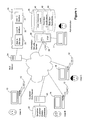
- Figure 1 illustrates an enterprise computer network.
- Employees of the enterprise (User A, User B, User C) are each provided with a personal computer (10, 14, 18).
- the personal computers have conventional software as well as interprocess communications software enabling the invocation of software installed on remote machines and data item transfer management client software installed from CD-ROM 12.
- the personal computer 10 of User A and the personal computer 14 of User B are additionally provided with a database client program (whose functionality will be described with reference to Figure 6 below) installed from CD-ROM 12. That database client program includes a facility to 'export' the results of a database query to a spreadsheet file.
- the data item transfer management client software could, of course, be installed from some other storage medium (e.g. memory stick), or be downloaded from a computer server over the Internet.
- the personal computers will offer persistent storage for user data using disk hardware, and that the software installed on the personal computers will include an operating system program which will organise such persistently stored data into files.
- the conventional software found on each personal computer also includes an e-mail messaging client (e.g. Microsoft Outlook 2010) configured to co-operate with mail server 24 to enable users A, B, C to send one another e-mail data items, which might themselves include other files or data items as 'attachments'.
- the conventional software further includes a data buffer (e.g.
- the data item transfer management client software comprises i) an add-in for Microsoft Outlook, and ii) an add-in for the database client program.
- Each of the personal computers 10, 14, 18 is configured to allow each user to access data on their personal computer, but not to allow access to data on the personal computers of the other users.
- the enterprise computer network further includes three server computers (20, 24, 26). These comprise a customer data server computer 20, a mail server computer 24, and an information security server computer 26.
- the customer data server computer 20 has conventional hardware and software and provides a query interface to a database 22 which includes sensitive customer data.
- the database allows the database administrator to assign security classifications to tables within the database. The assigned security classifications are also stored within the database.
- the mail server 24 has conventional hardware and software and co-operates with the e-mail client programs on each of the personal computers 10, 14, 18 to offer users an electronic mail service. To enable that service, the mail server computer stores users' e-mails in mailbox store 28 which includes a mailbox 30 for user A, a mailbox 32 for user B and a mailbox 34 for user C.
- the information security server computer 26 has, in addition to conventional software and hardware, interprocess communications software enabling the invocation of software installed on remote machines (compatible with the similar software installed on the personal computers 10, 14, 18) and a data item transfer management program installed from CD-ROM 36.
- the software could, of course, be installed from some other storage medium (e.g. memory stick), or be downloaded from a computer server over the Internet.
- the data item transfer management program provides an administrator working at console 27 with a graphical user interface enabling him to create, amend and delete user clearance levels data 40 stored in associated persistent storage 38.
- the administration program also provides a messaging interface allowing the data item transfer management client programs running on personal computers 10, 14, 18 to create, update and delete entries in data item security classification data 42 and data item derivation data 44.
- the data item transfer management program offers policy decision point functionality which data item transfer management client software running on a personal computer 10, 14, 18 can invoke to determine, on the basis of data supplied with the invocation message and the three data sets (40, 42, 44) whether a user-requested data item transfer should be allowed to proceed.
- Those data items whose transfer is controlled by the data item transfer management software have a structure ( Figure 2 ) which in addition to the data item's content 60 includes a data item header 58 and three metadata fields 62, 64, 66. It will realised by those skilled in the art that in this particular example where a mail message data item is used, the data item structure used by the application is likely to be much more complex than the simplified version shown here - but the data item structure still includes the elements shown here and programmatic access to the values of those elements is available to the programmer of the add-ins.
- the first of the three metadata items is a Boolean value 62 (here referred to as 'lsDerivative') indicating whether content in the data item is copied from another data item.
- the third of the three metadata items is a unique data item identifier 66.
- the second 64 of the three metadata items is another unique data item which identifies the data item from which some of or all of the content of this data item was copied.
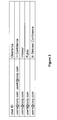
- the structure of the user clearance level table 40 stored by the Information Security Server 26 is illustrated in Figure 3 .
- this data is maintained by an administrator.
- the data is a table which associates one or more user IDs (in this example the user's e-mail address is used as a globally unique user ID) with one of four security clearances - namely, Public, Internal, In Confidence, In Strictest Confidence.
- user IDs in this example the user's e-mail address is used as a globally unique user ID
- security clearances namely, Public, Internal, In Confidence, In Strictest Confidence.
- Figure 4 shows the structure of the data item security classifications table maintained by the Information Security Server in co-operation with the data item transfer management clients operating on each of the personal computers 10, 14, 18.
- This table associates a security classification with each data item ID.
- This data item ID corresponds to the data item ID 66 included within the metadata of each data item.
- Figure 5 shows the structure of the data item derivations table 44 stored by the Information Security Server computer 26.
- Each record in the table associates a derivative data item (identified by its unique data item ID) with the data item from which it is derived (again identified by its unique data item ID).
- the data item derivations table includes an indication that the security classification for that data item is to be found in the security classifications table.
- the creation of a data item capable of subsequent dissemination (or at least any data item with a security classification greater than some threshold) is logged.
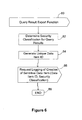
- the operation ( Figure 6 ) of the add-in to the database client program installed on the personal computers 10, 14 of user A and user B is triggered 80 on a request by the user to export the results of a database query to a file.
- the add-in examines the query and queries the database's system catalog to discover the security classification(s) assigned to table(s) accessed by the query, and then associates 82 the highest of those security classifications with the query result.
- a unique data item ID is then generated 84 for the exported file (in this embodiment, the file's pathname (including a unique computer name) is used).
- a request to log the creation of a data item is passed 86 to the Information Security Server 26 using the interprocess communications software running on the personal computer 10, 14, 18 and the Information Security Server computer 26.
- a data item transfer check procedure included within the add-in begins when the issuance of a data item dissemination command by the user is detected 100. Since the add-in on each of the personal computers 10, 14, 18 is, in this embodiment for Microsoft Outlook, this corresponds to the user clicking on the 'Send' button displayed on the screen of the personal computer (10, 14, 18) using his mouse and the familiar Windows, Icon, Mouse, Pointer interface provided with Microsoft Windows.
- the recipient information ( Figure 2 , item 58) from the message is inspected 102 and stored temporarily.
- a message security classification procedure (104-115) is performed.
- the procedure begins with the performance of a test 104 to find whether the IsDerivative metadata in the message is set to TRUE. If the IsDerivative value is not set to TRUE, then the user is presented 106 with a drop down menu inviting him to specify whether the message he intends to send should be classified as Public, Internal, In Confidence, or In Strictest Confidence. The user's response is stored temporarily by the program. If the IsDerivative value is TRUE, then an original data item security classification look-up (108 - 112) is triggered.
- the original data item security classification look-up (108 - 112) begins by reading 108 the unique data item ID found in the IsDerivedFrom metadata 64 included with the derivative data item the user intends to transfer. Thereafter, using the interprocess communications software installed on the personal computer, a request for the security classification of the original data item from which the source data item derives is sent 110 to the Information Security Server computer 26.
- the request message includes the source data item ID read in step 108.
- a response message is then received 112, which message includes an indication of the security classification given to the original data item from which information in the data item which the user intends to disseminate is ultimately derived.
- the security classification of the message which the user intends to disseminate is then set 114 to the security classification of the data item from which that data item is ultimately derived. Thereafter, a dialogue box is displayed 115 to the user of the personal computer allowing them to raise the security classification applied to the message (which they might wish to do if they have added even more sensitive information to it) or confirm the security classification applied to the message by the system.
- the interprocess communications software running on the personal computer 10, 14, 18 and the Information Security Server computer 26 is further used to pass 116 a request to the Information Security Server computer 26 requesting a decision as to whether the intended recipient of the message should be sent a message having the security classification given to it by the message security classification procedure (104 - 115).
- the request includes the user ID of the intended recipient of the message temporarily stored in step 102 and the security classification given to the message by the message security classification procedure (104 - 115).
- the process then waits for a reply.
- a reply is received 118, and found to be a 'deny' response, a message is displayed 120 to the user indicating that permission to send this message to this recipient has been denied.
- the message sending, or more generally, data item transfer, is aborted and the data item transfer check procedure ends 122, returning control to Microsoft Outlook.
- the message is given 124 a unique data item ID (in this instance using an globally unique identifier obtained by concatenating the current date and time to the sender's e-mail address).
- a transferable data item creation recording procedure (126 - 130) is performed.
- the transferable data item creation recording procedure begins with the performance of a test 126 to find whether the IsDerivative metadata in the message is set to TRUE. If the IsDerivative value is not set to TRUE, then a request to log the creation of an original data item is passed to the Information Security Server 26 using the interprocess communications software running on the personal computer 10, 14, 18 and the Information Security Server computer 26.
- an original data item security classification request handling procedure run by the Information Security Server computer 26 begins on receiving 140 a request for the security classification of an original data item from a personal computer 10, 14, 18.
- the data item derivations table ( Figure 5 ) is then accessed to find 142 the unique data item ID of the data item from which the source data item is ultimately derived.
- Those skilled in the art will have little difficulty in providing a procedure to trace the ancestry of the source data item by following the chain of parent data items back through the data item derivations table ( Figure 5 ) until an original data item is reached. It is of course possible that the source data item itself is original and hence that no such chain needs to be traversed.
- the security classification given to the original data item is looked up 144 in the data item security classifications table ( Figure 4 ), and returned 146 to the personal computer 10, 14, 18 which sent the request. Once the response has been sent, the original data item security classification request handling procedure ends.
- a data item transfer authorization request handling procedure run by the Information Security Server computer 26 begins on receiving 160 a transfer authorization request from a personal computer 10, 14, 18. It will be remembered that the data item transfer authorization request message includes the recipient's e-mail address, and the message security classification found in the message security classification procedure (106 - 115).
- the user clearance level table ( Figure 3 ) is queried 162 to determine the clearance level of the recipient, and a test 164 is then carried out to find whether the clearance level of the intended recipient is greater than or equal to the message's security classification. If the clearance level of the intended recipient is equal to or greater than the message's security classification, then a response indicating that the data item transfer is authorized is sent 166 to the personal computer 10, 14, 18 from which the request was received. Otherwise, a response indicating that the data item transfer is not permitted is sent 168 to the personal computer 10, 14, 18 from which the request was received.
- An original data item creation logging request handling procedure run by the Information Security Server computer 26 receives 180, from one of the personal computers 10, 14, 18, a message requesting the logging of the creation of an original transferable data item.
- the request includes a globally unique data item ID, and a security classification for the newly created transferable data item.
- the globally unique data item ID, and the associated security classification are then added to the data item security classification table ( Figure 4 ).
- a derived data item creation logging request handling procedure run by the Information Security Server computer 26 is triggered by the receipt 190, from one of the personal computers 10, 14, 18, of a message requesting the logging of the creation of a derived transferable data item.
- the request includes a globally unique derived data item ID, and the globally unique identifier of the data item from which it is directly derived.
- the globally unique data item ID, and the associated globally unique data item ID of the data item from which it is directly derived are then added to the data item derivation table ( Figure 5 ).
- the mail message is given a unique identifier at the time it is transmitted because only then are the contents of the message fixed.
- Microsoft Outlook and other e-mail clients allow a user to modify the content of an e-mail right up to the time the e-mail is sent.
- a data item can be created independently of any subsequent transfer of the data item.
- the derived data item is made transferable - e.g. by saving it as a file on, a persistent storage device - the derived data item is given a unique ID and a record of its derivation is stored centrally.
- the transfer process is interrupted to check whether the transfer of the derived data item meets centrally stored file transfer rules. If the transfer violates those rules, the transfer is aborted.
- the central derivation record entered on the creation of the derived data item is used to discover the original data item from which the derived data item is ultimately derived.
- the file transfer security check then applies the rules as they would be applied to the original data item in order to determine whether the transfer of the derived data item is to be authorized. This corresponds to Figure 5 above.
- the derivation of a data item from another is bundled together with the creation of a transferable version of the derived data item. Examples are a 'Save As..' command. In such a case, an entry can be made in the data item derivation table immediately after the transferable version of the derived data item is created.
- the copying of the data item takes place independently of whether a uniquely identifiable transferable version is subsequently produced. Examples include attaching the file to an e-mail (perhaps converting the file type to a different file type at the same time), and using a data buffer facility (e.g. the Clipboard in Windows) to copy content from one data item to another.
- a data buffer facility e.g. the Clipboard in Windows
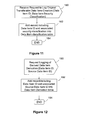
- a data buffer input handling procedure begins on detecting 200 an activation of the 'Cut' or 'Copy' command in an application. On detecting usage of the cut or copy command, the globally unique identifier of the document from which content has been cut is found 202, and is added 204 to the clipboard along with the content selected to be cut or copied. The data buffer input handling procedure then ends 206.
- a data buffer output handling procedure begins on detecting 210 the issuance of a 'Paste' command. A test 212 is then performed to find whether a Source Data Item ID is included in the Clipboard contents.
- the paste functionality is conventional - i.e. the contents of the clipboard are pasted 214 into the destination data item, and the data buffer handling procedure ends 216.
- a derivation recording process (218, 220) is carried out.
- the derivation recording process begins by setting 218 the IsDerivative property ( Figure 2 , 62) of the data item into which the clipboard contents are being inserted to TRUE. Thereafter, the IsDerivedFrom property ( Figure 2 , 64) of the data item into which the clipboard contents are being inserted is set 220 to the Source Data Item ID found on the clipboard.
- the metadata related to the derivation ( Figure 2 , 62, 64) are arranged to be immutable once set.
- the clipboard contents are pasted 222 into the target data item. Thereafter, the data buffer output handling procedure ends 224.
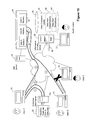
- the illustrative scenario is shown in Figure 15 .
- the scenario begins when User A runs the database client on his personal computer 10 to query the sensitive customer details database 22. The results of that query are returned to User A's personal computer. User A then exports the results of that query to a file on his personal computer. In accordance with the processing seen in Figure 6 and Figure 11 , this results in that file being assigned an 'In Confidence' security classification. In particular, it results in an entry like that seen in the table of Figure 4 .
- User A runs an application to view the exported file, and uses his computers data buffer copying facility to copy two records from the exported file into an e-mail message ( Figure 16 ).
- the process seen in Figures 13 and 14 results in the IsDerivative field 240 of the e-mail's metadata being set immutably to TRUE, and the IsDerivedFrom field 242 of the e-mail's metadata being immutably set to the unique ID of the exported file.
- step 142 of Figure 9 finds from the data items derivations data ( Figure 5 ) that the origin of information in this e-mail is the exported file ⁇ userA ⁇ data ⁇ Online Gamers.xls. The security classification of that file is once again found to be 'In Confidence'. Hence, on this occasion, when authorization to send the e-mail message to User C is sought by the add-in to User B's e-mail program, that authorization is denied.
- each electronic device is arranged in operation to record, in a repository shared by the electronic devices, a security classification for an original data item stored on the device, and further arranged in operation to enable the creation of data items derived from original data items or from derived data items, each electronic device labelling derived data items with a reference to a data item from which the derived data item was directly or indirectly derived.
- Each electronic device is further arranged to receive derived data items from other devices in the network, and to control transmission of derived data items in dependence on the reference within the derived data item and the security classification in the shared repository for the original data item from which the derived data item originates.
- Using the shared repository allows the centralised update of the security classification of an original data item and documents which originate from that original data item. A single update can then alter the degree to which the networked devices are able to disseminate the original data item and all data items originating from it. This advantageously eases the administration of the network.
- a register of the provenance of data items derived within the network of electronic devices is maintained.
- a method of operating an electronic communications device is disclosed.
- Conventional electronic communications devices offer the benefit that they facilitate both the copying of information and the transfer of the copied information to other devices. However, this results in the unwanted dissemination of private or confidential information also being facilitated.
- the disclosed electronic communications device labels derivative transferable information it generates with a derivation label enabling the origin of the derived information to be found.
- the electronic communications device is arranged to interrupt a transfer of derivative transferable information to seek (116) authorization for the transfer.
- the authorization involves accessing security data which, in combination with the derivation label, enables the security classification applied to the origin of the derived information to be found (112).
- the electronic communications device is arranged to abort the transfer or alert the user to the fact that the transfer would breach security transfer rules.
- the method is of use in controlling the dissemination of private or confidential information via networked electronic communications devices.
Landscapes
- Engineering & Computer Science (AREA)
- Computer Networks & Wireless Communication (AREA)
- Signal Processing (AREA)
- Computer Hardware Design (AREA)
- Computer Security & Cryptography (AREA)
- General Engineering & Computer Science (AREA)
- Computing Systems (AREA)
- Theoretical Computer Science (AREA)
- Bioethics (AREA)
- General Health & Medical Sciences (AREA)
- Software Systems (AREA)
- Physics & Mathematics (AREA)
- General Physics & Mathematics (AREA)
- Health & Medical Sciences (AREA)
- Information Transfer Between Computers (AREA)
- Computer And Data Communications (AREA)
Priority Applications (1)
| Application Number | Priority Date | Filing Date | Title |
|---|---|---|---|
| EP12250070.5A EP2642716A1 (fr) | 2012-03-22 | 2012-03-22 | Dispositif de communication électronique |
Applications Claiming Priority (1)
| Application Number | Priority Date | Filing Date | Title |
|---|---|---|---|
| EP12250070.5A EP2642716A1 (fr) | 2012-03-22 | 2012-03-22 | Dispositif de communication électronique |
Publications (1)
| Publication Number | Publication Date |
|---|---|
| EP2642716A1 true EP2642716A1 (fr) | 2013-09-25 |
Family
ID=45976215
Family Applications (1)
| Application Number | Title | Priority Date | Filing Date |
|---|---|---|---|
| EP12250070.5A Ceased EP2642716A1 (fr) | 2012-03-22 | 2012-03-22 | Dispositif de communication électronique |
Country Status (1)
| Country | Link |
|---|---|
| EP (1) | EP2642716A1 (fr) |
Cited By (1)
| Publication number | Priority date | Publication date | Assignee | Title |
|---|---|---|---|---|
| CN105430195A (zh) * | 2015-12-31 | 2016-03-23 | 中科创达软件股份有限公司 | 一种数据发送方法 |
Citations (3)
| Publication number | Priority date | Publication date | Assignee | Title |
|---|---|---|---|---|
| US6138119A (en) * | 1997-02-25 | 2000-10-24 | Intertrust Technologies Corp. | Techniques for defining, using and manipulating rights management data structures |
| US20020077986A1 (en) * | 2000-07-14 | 2002-06-20 | Hiroshi Kobata | Controlling and managing digital assets |
| WO2004077770A1 (fr) * | 2003-02-28 | 2004-09-10 | Bluespace Group Ltd | Systeme de messagerie |
-
2012
- 2012-03-22 EP EP12250070.5A patent/EP2642716A1/fr not_active Ceased
Patent Citations (3)
| Publication number | Priority date | Publication date | Assignee | Title |
|---|---|---|---|---|
| US6138119A (en) * | 1997-02-25 | 2000-10-24 | Intertrust Technologies Corp. | Techniques for defining, using and manipulating rights management data structures |
| US20020077986A1 (en) * | 2000-07-14 | 2002-06-20 | Hiroshi Kobata | Controlling and managing digital assets |
| WO2004077770A1 (fr) * | 2003-02-28 | 2004-09-10 | Bluespace Group Ltd | Systeme de messagerie |
Cited By (1)
| Publication number | Priority date | Publication date | Assignee | Title |
|---|---|---|---|---|
| CN105430195A (zh) * | 2015-12-31 | 2016-03-23 | 中科创达软件股份有限公司 | 一种数据发送方法 |
Similar Documents
| Publication | Publication Date | Title |
|---|---|---|
| US12021859B2 (en) | Policies and encryption to protect digital information | |
| US11057355B2 (en) | Protecting documents using policies and encryption | |
| US9838432B2 (en) | System and method for automatic data protection in a computer network | |
| US8528099B2 (en) | Policy based management of content rights in enterprise/cross enterprise collaboration | |
| US8141129B2 (en) | Centrally accessible policy repository | |
| US20070199068A1 (en) | Managed control of processes including privilege escalation | |
| US20150121446A1 (en) | Accessing protected content for archiving | |
| CA2362716A1 (fr) | Systeme de transmission par courrier electronique de messages et de documents s'autodetruisant | |
| CN101569129A (zh) | 网络安全系统和方法 | |
| JP2008217815A (ja) | ルーティング制御機構を有する特権通信システム | |
| JP2012009027A (ja) | 動的アクセスコントロールを用いるポリシーの生成 | |
| WO2019229546A1 (fr) | Commandes d'accès binaires à plusieurs parties | |
| US10044764B2 (en) | Context-aware delegation engine | |
| Poleg | Automatic Trust Based Segregation for Mobile Devices |
Legal Events
| Date | Code | Title | Description |
|---|---|---|---|
| PUAI | Public reference made under article 153(3) epc to a published international application that has entered the european phase |
Free format text: ORIGINAL CODE: 0009012 |
|
| AK | Designated contracting states |
Kind code of ref document: A1 Designated state(s): AL AT BE BG CH CY CZ DE DK EE ES FI FR GB GR HR HU IE IS IT LI LT LU LV MC MK MT NL NO PL PT RO RS SE SI SK SM TR |
|
| AX | Request for extension of the european patent |
Extension state: BA ME |
|
| STAA | Information on the status of an ep patent application or granted ep patent |
Free format text: STATUS: THE APPLICATION HAS BEEN REFUSED |
|
| 18R | Application refused |
Effective date: 20131012 |