EP2642778A1 - Serveur d'authentification et procédés permettant d'autoriser des jetons comprenant des données d'emplacement - Google Patents
Serveur d'authentification et procédés permettant d'autoriser des jetons comprenant des données d'emplacement Download PDFInfo
- Publication number
- EP2642778A1 EP2642778A1 EP12160877.2A EP12160877A EP2642778A1 EP 2642778 A1 EP2642778 A1 EP 2642778A1 EP 12160877 A EP12160877 A EP 12160877A EP 2642778 A1 EP2642778 A1 EP 2642778A1
- Authority
- EP
- European Patent Office
- Prior art keywords
- mobile device
- token
- service
- server
- data
- Prior art date
- Legal status (The legal status is an assumption and is not a legal conclusion. Google has not performed a legal analysis and makes no representation as to the accuracy of the status listed.)
- Granted
Links
Images


Classifications
-
- H—ELECTRICITY
- H04—ELECTRIC COMMUNICATION TECHNIQUE
- H04L—TRANSMISSION OF DIGITAL INFORMATION, e.g. TELEGRAPHIC COMMUNICATION
- H04L63/00—Network architectures or network communication protocols for network security
- H04L63/08—Network architectures or network communication protocols for network security for authentication of entities
- H04L63/0807—Network architectures or network communication protocols for network security for authentication of entities using tickets, e.g. Kerberos
-
- H—ELECTRICITY
- H04—ELECTRIC COMMUNICATION TECHNIQUE
- H04W—WIRELESS COMMUNICATION NETWORKS
- H04W12/00—Security arrangements; Authentication; Protecting privacy or anonymity
- H04W12/06—Authentication
- H04W12/065—Continuous authentication
-
- H—ELECTRICITY
- H04—ELECTRIC COMMUNICATION TECHNIQUE
- H04W—WIRELESS COMMUNICATION NETWORKS
- H04W12/00—Security arrangements; Authentication; Protecting privacy or anonymity
- H04W12/06—Authentication
- H04W12/069—Authentication using certificates or pre-shared keys
-
- H—ELECTRICITY
- H04—ELECTRIC COMMUNICATION TECHNIQUE
- H04W—WIRELESS COMMUNICATION NETWORKS
- H04W4/00—Services specially adapted for wireless communication networks; Facilities therefor
- H04W4/18—Information format or content conversion, e.g. adaptation by the network of the transmitted or received information for the purpose of wireless delivery to users or terminals
- H04W4/185—Information format or content conversion, e.g. adaptation by the network of the transmitted or received information for the purpose of wireless delivery to users or terminals by embedding added-value information into content, e.g. geo-tagging
Definitions
- Embodiments disclosed herein relate generally to an authentication server and methods for granting tokens to a mobile device for accessing a service on a service server.
- service server To access some services offered by service providers, mobile devices are required to authenticate themselves to, for example, the service via a server (hereinafter “service server") before the service server will allow the mobile devices access to the services.
- service server There are different existing protocols and architectures for authentication of a mobile device.
- a client obtains a ticket from an authentication server and then uses that ticket to access a service provided by the service server.
- mobile devices today are able to browse the Internet using web browser.
- mobile devices communicate with web servers directly.
- mobile devices communicate with web servers through a browsing proxy.
- FIG. 1 is a block diagram of a mobile device in accordance with one example implementation
- FIG. 2 is a diagram of a system in accordance with one example implementation
- FIG. 3 is a block diagram of an authentication server in accordance with one example implementation
- FIG. 4 is a block diagram of a token generated by an authentication server in accordance with one example implementation
- FIG. 5 is a flow chart of a method of generating a token in accordance with at least one example embodiment.
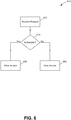
- FIG. 6 is a flow chart of a method of authorizing a mobile device to access a service provided by a service server in accordance with at least one example embodiment.
- Embodiments disclosed herein relate generally to an authentication server and method for granting tokens comprising location data to a mobile device for accessing a service on a service server.
- mobile devices are able to access more and more sophisticated network services than mobile devices of previous generations. For example, many mobile devices are currently able to provide access to the Internet through web browsing software.
- an Internet-facing server e.g. an HTTP proxy
- resources e.g. web pages, media items, etc.
- some service plans may only allow access to certain web pages (e.g. the network service provider's own 'sports' portal, social media web pages, etc.) while denying access to other web pages (e.g. other hosts' 'sports' web pages, etc.).
- Other service plans may allow access to text and image data, but deny access to audio and video data. It may also be desirable to be able to allow or deny access to resources where a server providing these resources (e.g. an HTTP proxy) does not need to have direct knowledge of a mobile device's service plan.
- network service providers may be desirable for network service providers to permit a mobile device access to a particular network service under certain conditions but not others.
- an Internet-facing server e.g. an HTTP proxy
- resources e.g. web pages, media items, etc.
- some service plans may only allow access to certain web pages (e.g. the network service provider's own 'sports' portal, social media web pages, etc.) and charge for such access on a first fee tier (e.g.
- a token-granting server is responsible for Authentication, Authorization, and Accounting (AAA), either directly or by proxy (for example, a relay in front of the TGS might perform authentication and authorization).
- AAA Authentication, Authorization, and Accounting
- This token-granting server has knowledge of a device's service plan, and inserts a plan identifier or other authorization data into the token it issues to the device.
- This token may be at least partially encrypted to prevent unauthorized access to the service.
- the device sends this token to the service server (e.g. an HTTP proxy) with every request; the server decrypts the token, and inspects the service plan identifier.
- the service server can then apply rules or other logic when processing the request, and control access by the device as required based on the identifier.
- the use of tokens allows the service server to control access to the service without having to authenticate the identity of the mobile device requesting the service, allowing the service server to offload many of the tasks and resources associated with device authentication to the token-granting server.
- location data is provided in the token by, for example, the token-granting server. It may be desirable to control access to a network service based on a location of the requesting device. For example, a company may want to restrict access to its intranet service server to devices located at or near company property. Also, a network operator may want to provide full access to a service when the device is in its 'home' region, but only provide limited access when the device is outside of its home region (e.g. when roaming).
- a service server can authorize access to the service based on a location of the mobile device requesting the service while also deferring authentication functions to the TGS through the use of the token.
- the location data in the token may identify a registered location for the mobile device.
- the location data may correspond to a billing address associated with the device.
- the location data in the token may be independent of the physical location of the mobile device at the time the token was requested. This may allow the service server to compare the registered location of the mobile device with a determined physical location of the mobile device at the time the mobile device requests access the service.
- the location data in the token may identify a location of the mobile device at the time the token was requested by the mobile device.
- the location of the mobile device may be determined by a Global Positioning System (GPS) or an assisted Global Positioning System (aGPS).
- GPS Global Positioning System
- aGPS assisted Global Positioning System
- Such a location may be a relatively fine-grained location (e.g. within a few meters, or a few city blocks) and may represent the vicinity of a home address, or the vicinity of a work address.
- a location may be a relatively coarse-grained location (e.g. identifying a city/metro area, a country, or a group of countries (e.g. Europe)).
- the service server may be able to compare the location of the mobile device at the time the token was requested with a determined physical location of the mobile device at the time the mobile device requests access to the service. This may allow additional or more nuanced rules or other logic (e.g. regarding access, fee tiers, etc.) to be applied to the request.
- expiration data is associated with authorization tokens issued in token-based authentication schemes.
- a time-restricted token may only be valid within 48 hours of being issued.
- a device may be expected to acquire a new token in order to continue to access the service after the 48 hours period.
- network efficiency e.g. additional network resources needed to generate and transmit a greater number of tokens.
- a time-restricted token may only be valid until a particular date or time or both (e.g., March 14, 2012 at 1:59 EST).
- the duration of a token's validity may be dependent on a location of the mobile device. For example, a token may expire after determining that a location of the mobile device has changed.
- Providing a token comprising location data may present an alternative to the use of time-restricted tokens, or may allow time-restricted tokens to be provided with additional or enhanced functionality. For example, in a prior authentication scheme, if a company wanted to restrict access to its intranet service server to devices located at or near company property, the company may consider issuing very short-lived tokens, so that if an employee's device was issued a new token at or near the end of a work day, the token would not still be valid by the time employee returned home. By providing a token comprising location data, a company may be able to issue tokens less frequently, and with longer expiry times, as authorization to access the intranet service server can be based at least in part on a location of the mobile device requesting the service.
- a method of generating a token for use by a mobile device to establish authorization for the mobile device to access a service provided by a service server comprising: receiving, at an authentication server, a request for the token from the mobile device, generating the token at the authentication server, the token comprising location data identifying a location for the mobile device and authentication data indicating a level of access that the mobile device is permitted to have to the service provided by the service server, and transmitting the token to the mobile device.
- the request received from the mobile device comprises data on which the location data of the token is based.
- the method further comprises receiving, at the authentication server, data, from at least one of a location services server and a network provider, on which the location data of the token is based.
- the location data identifies a geographical location of the mobile device.
- the location data may identify the geographical location in which the mobile device operates at a time the request is transmitted from the mobile device to the authentication server.
- the method further comprises receiving, at the authentication server, policy data from a policy server, and the authentication data of the token is generated based on the policy data.
- the authentication data of the token indicates that the service server is to control access by the mobile device to the service based on the location data of the token.
- At least one of the location data and the authentication data of the token is encrypted using a secret shared between the authentication server and the service server.
- the request for the token from the mobile device is received by the authentication server via a relay, and the token is generated in response to the relay successfully authenticating the mobile device.
- the request comprises a device identifier
- the method further comprises, prior to generating the token, verifying that the device identifier corresponds to a source address of a message containing the request for the token.
- the authentication data indicates that the mobile device is authorized to access a browsing proxy server.
- an authentication server comprising: a receiver capable of receiving a request for a token from a mobile device, the token for use by the mobile device to establish authorization for the mobile device to access a service provided by a service server; a transmitter capable of transmitting the token to the mobile device; a memory; and a processor capable of generating the token, the token comprising location data identifying a location for the mobile device and authentication data indicating a level of access that the mobile device is permitted to have to the service provided by the service server, and causing the token to be transmitted to the mobile device.
- the request received from the mobile device comprises data on which the location data of the token is based.
- the processor is capable of receiving data, from at least one of a location services server and a network provider, on which the location data of the token is based.
- the location data identifies a geographical location of the mobile device.
- the location data may identify the geographical location in which the mobile device operates at a time the request is transmitted from the mobile device to the authentication server.
- the processor is capable of receiving policy data from a policy server, and authentication data of the token is generated based on the policy data.
- the authentication data of the token indicates that the service server is to control access by the mobile device to the service based on the location data of the token.
- the processor is capable of encrypting at least one of the location data and the authentication data of the token using a secret shared between the authentication server and the service server.
- the receiver receives the request for the token via a relay
- the processor is capable of generating the token in response to the relay successfully authenticating the mobile device.
- the request comprises a device identifier
- the processor is capable of verifying, prior to generating the token, that the device identifier corresponds to a source address of a message containing the request for the token.
- the authentication data indicates that the mobile device is authorized to access a browsing proxy server.
- a mobile device comprising: a processor and a memory, the processor being capable of transmitting a request to an authentication server for a token, the token for use by the mobile device to establish authorization for the mobile device to access a service provided by a service server, and the processor being capable of receiving the token from the authentication server, the token comprising location data identifying a location for the mobile device and authentication data indicating a level of access that the mobile device is permitted to have to the service provided by the service server.
- the processor is capable of transmitting a request to the service server to access the service, the request comprising the token received from the authentication server, and the token is usable by the service server to authorize the mobile device to access the service.
- a computer-readable medium having computer-readable instructions stored thereon that, when executed by a processor on a mobile device, cause the mobile device to obtain a token for establishing authorization to access a service provided from a service server by transmitting a request to an authentication server for a token, the token for use by the mobile device to establish authorization for the mobile device to access a service provided by a service server; and receiving the token from the authentication server, the token comprising location data identifying a location for the mobile device and authentication data indicating a level of access that the mobile device is permitted to have to the service provided by the service server.
- the computer-readable medium may include non-transitory computer-readable storage media.
- a method of authorizing a mobile device to access a service provided by a service server comprising: receiving, at the service server, a request from the mobile device to access the service, wherein the request comprises a token generated by an authentication server, the token comprising location data identifying a location for the mobile device and authentication data indicating a level of access that the mobile device is permitted to have to the service provided by the service server; determining, at the service server, whether the mobile device is authorized to access the service based on both the authentication data and the location data in the token generated by the authentication server; and allowing or denying the mobile device access to the service based on the determining.
- the authentication data of the token indicates that the service server is to control access by the mobile device to the service based on the location data of the token.
- determining whether the mobile device is authorized to access the service may comprise comparing the location data in the token to policy data associated with the service; if the policy data indicates that access to the service is authorized based on the location data, the mobile device is authorized to access the service, and if the policy data indicates that access to the service is denied based on the location data, the mobile device is denied access to the service.
- Embodiments of the present application are not limited to any particular mobile device architecture or server architecture; it is to be understood that alternate embodiments are feasible.
- different embodiments may, in variant implementations, be associated with different operating systems or computer programming languages.
- the mobile device 201 in the example comprises a two-way communication device having data and voice communication capabilities, and the capability to communicate with other computer systems, for example, via the Internet.
- the device 201 may be a multiple-mode communication device configured for both data and voice communications, a smartphone, a mobile telephone or a PDA (personal digital assistant) enabled for wireless communication, a tablet computing device, or a computer system with a wireless modem, for example.
- the device 201 may be a multiple-mode communication device configured for data communications but not voice communications, or for voice communications but not data communications.
- the mobile device 201 may comprise a rigid case (not shown) housing the components of the device 201.
- the internal components of the device 201 are typically constructed on a printed circuit board (PCB).
- the mobile device 201 may comprise a controller comprising at least one processor 240 (such as a microprocessor) which controls the overall operation of the device 201.
- the processor 240 interacts with device subsystems, which may include, for example, a wireless communication subsystem 211 (sometimes referred to as a radio layer) for exchanging radio frequency signals with the wireless network 101 to perform communication functions.
- the processor 240 may interact with additional device subsystems including, for example, a display screen 204 such as a liquid crystal display (LCD) screen, input devices 206 such as a keyboard and control buttons, flash memory 244, random access memory (RAM) 246, read only memory (ROM) 248, auxiliary input/output (I/O) subsystems 250, one or more data ports 252 such as a serial data port and/or a Universal Serial Bus (USB) data port, one or more speakers 256, one or more microphones 258, a short-range communication subsystem 262, and potentially other device subsystems generally designated as 264.
- a display screen 204 such as a liquid crystal display (LCD) screen
- input devices 206 such as a keyboard and control buttons
- flash memory 244 random access memory (RAM) 246, read only memory (ROM) 248, auxiliary input/output (I/O) subsystems 250
- data ports 252 such as a serial data port and/or a Universal Serial Bus (USB) data port
- speakers 256
- the device 201 may comprise a touchscreen display in some embodiments.
- the touchscreen display may be constructed using a touch-sensitive input surface connected to an electronic controller and which may overlay the display screen 204.
- the touch-sensitive overlay and the electronic controller provide a touch-sensitive input device and the processor 240 typically interacts with the touch-sensitive overlay via the electronic controller.
- the communication subsystem 211 may include a receiver 214, a transmitter 216, and associated components, such as one or more antenna elements 218 and 220, local oscillators (LOs) 222, and a processing module such as a digital signal processor (DSP) 224.
- the antenna elements 218 and 220 may be embedded or internal to the mobile device 201 and a single antenna may be shared by both receiver and transmitter, as is known in the art.
- the particular design of the wireless communication subsystem 211 typically depends on the wireless network 101 in which mobile device 201 is intended to operate.
- the mobile device 201 may communicate with any one of a plurality of fixed transceiver base stations (not shown) of the wireless network 101 within its geographic coverage area.
- the mobile device 201 may send and receive communication signals over the wireless network 101 after the required network registration or activation procedures have been completed.
- Signals received by the antenna 218 through the wireless network 101 are input to the receiver 214, which may perform such common receiver functions as signal amplification, frequency down conversion, filtering, channel selection, etc., as well as analog-to-digital (A/D) conversion.
- A/D conversion of a received signal allows more complex communication functions such as demodulation and decoding to be performed in the DSP 224.
- signals to be transmitted are processed, including modulation and encoding, for example, by the DSP 224.
- These DSP-processed signals are output to the transmitter 216 for digital-to-analog (D/A) conversion, frequency up conversion, filtering, amplification, and transmission to the wireless network 101 via the antenna 220.
- the DSP 224 not only processes communication signals, but may also provide for receiver and transmitter control. For example, the gains applied to communication signals in the receiver 214 and the transmitter 216 may be adaptively controlled through automatic gain control algorithms implemented in the DSP 224.
- the processor 240 operates under stored program control and executes software modules 221 stored in memory such as persistent memory, for example, in the flash memory 244.
- the software modules 221 may comprise, for example, operating system software 223, software applications 225 comprising an email messaging application 272 (also referred to as an email client 272), a personal address book 274, a calendar application 276, a phone application 278, an authentication module 280 and a browsing module 282.
- Example embodiments of the authentication module 280 will be discussed in detail later herein. It is recognized that the authentication module 280 and its various components as described herein can form a discrete module running on the device 201, or the functions of the authentication module 280 can be distributed on the device 201 as separate modules or integrated within other existing modules as desired. Such discrete or distributed implementations all fall within the embodiments of the authentication module 280 as described herein.
- the authentication module 280 is configured to obtain tokens from an authentication server for accessing a browsing proxy.
- the token is for accessing a server containing data files.
- the token is for accessing a service, such as banking services. Once obtained, a token can be used by the browsing module 282 to access the browsing proxy directly and enable the user of the mobile device 201 to access the Internet.
- the software applications 225 also may include a range of applications, including, for example, a notepad application, Internet browser application, voice communication (i.e. telephony) application, map application, or a media player application, or any combination thereof.
- Each of the software applications 225 may include layout information defining the placement of particular fields and graphic elements (e.g. text fields, input fields, icons, etc.) in the user interface (i.e. the display screen 204) according to the application.
- the software modules 221 or parts thereof may be temporarily loaded into volatile memory such as the RAM 246.
- the RAM 246 is used for storing runtime data variables and other types of data or information, as will be apparent to those skilled in the art. Although specific functions are described for various types of memory, this is merely one example, and those skilled in the art will appreciate that a different assignment of functions to different types of memory could also be used.
- the auxiliary I/O subsystems 250 may comprise an external communication link or interface, for example, an Ethernet connection.
- the mobile device 201 may comprise other wireless communication interfaces for communicating with other types of wireless networks, for example, a wireless network such as an orthogonal frequency division multiplexed (OFDM) network or a GPS (Global Positioning System) subsystem 260 comprising a GPS receiver or transceiver for communicating with a GPS satellite network.
- a wireless network such as an orthogonal frequency division multiplexed (OFDM) network or a GPS (Global Positioning System) subsystem 260 comprising a GPS receiver or transceiver for communicating with a GPS satellite network.
- OFDM orthogonal frequency division multiplexed
- GPS Global Positioning System
- the auxiliary I/O subsystems 250 may comprise a pointing or navigational input device such as a clickable trackball or scroll wheel or thumbwheel, or a vibrator for providing vibratory notifications in response to various events on the device 201 such as receipt of an electronic message or incoming phone call, or for other purposes such as haptic feedback (touch feedback).
- a pointing or navigational input device such as a clickable trackball or scroll wheel or thumbwheel
- a vibrator for providing vibratory notifications in response to various events on the device 201 such as receipt of an electronic message or incoming phone call, or for other purposes such as haptic feedback (touch feedback).
- the mobile device 201 also includes a removable memory card or module 230 (typically comprising flash memory) and a memory card interface 232.
- Network access is typically associated with a subscriber or user of the mobile device 201 via the memory card 230, which may be a Subscriber Identity Module (SIM) card for use in a GSM network or other type of memory card for use in the relevant wireless network type.
- SIM Subscriber Identity Module
- the memory card 230 is inserted in or connected to the memory card interface 232 of the mobile device 201 in order to operate in conjunction with the wireless network 101.
- the mobile device 201 also stores other data 227 in a persistent memory, which in one example embodiment is the flash memory 244.
- the data 227 includes service data comprising information required by the mobile device 201 to establish and maintain communication with the wireless network 101.
- the data 227 may also include user application data such as email messages, address book and contact information, calendar and schedule information, notepad documents, image files, and other commonly stored user information stored on the mobile device 201 by its user, and other data.
- the data 227 stored in the persistent memory (e.g. flash memory 244) of the mobile device 201 may be organized, at least partially, into a number of databases each containing data items of the same data type or associated with the same application. For example, email messages, contact records, and task items may be stored in individual databases within the device memory.
- the mobile device 201 may also include a battery 238 as a power source, which is typically one or more rechargeable batteries that may be charged, for example, through charging circuitry coupled to a battery interface such as the serial data port 252.
- the battery 238 provides electrical power to at least some of the electrical circuitry in the mobile device 201, and the battery interface 236 provides a mechanical and electrical connection for the battery 238.
- the battery interface 236 is coupled to a regulator (not shown) which provides power V+ to the circuitry of the mobile device 201.
- Mobile device 201 may also be solar-powered.
- the short-range communication subsystem 262 is an additional optional component which provides for communication between the mobile device 201 and different systems or devices, which need not necessarily be similar devices.
- the subsystem 262 may include an infrared device and associated circuits and components, or a wireless bus protocol compliant communication mechanism such as a Bluetooth® communication module to provide for communication with similarly-enabled systems and devices.
- One or more applications that control basic device operations, including data and voice communication applications will normally be installed on the mobile device 201 during or after manufacture. Additional applications and/or upgrades to the operating system 221 or software applications 225 may also be loaded onto the mobile device 201 through the wireless network 101, the auxiliary I/O subsystem 250, the serial port 252, the short-range communication subsystem 262, or other suitable subsystem 264.
- the downloaded programs or code modules may be permanently installed, for example, written into the program memory (i.e. the flash memory 244), or written into and executed from the RAM 246 for execution by the processor 240 at runtime. Such flexibility in application installation may increase the functionality of the mobile device 201 and may provide enhanced on-device functions, communication-related functions, or both. For example, secure communication applications may enable electronic commerce functions and other such financial transactions to be performed using the mobile device 201.
- the mobile device 201 may provide two principal modes of communication: a data communication mode and a voice communication mode.
- a data communication mode may be provided while a voice communication mode is not provided.
- a received data signal such as a text message, an email message, or Web page download will be processed by the communication subsystem 211 and input to the processor 240 for further processing.
- a downloaded Web page may be further processed by a browser application or an email message may be processed by the email messaging application and output to the display 204.
- a user of the mobile device 201 may also compose data items, such as email messages, for example, using input devices of the mobile device 201 in conjunction with the display screen 204. These composed items may be transmitted through the communication subsystem 211 over the wireless network 101.
- the mobile device 201 provides telephony functions and operates as a typical cellular phone.
- the overall operation is similar, except that the received signals are output to the speaker 256 and signals for transmission are generated by a transducer such as the microphone 258.
- the telephony functions are provided by a combination of software/firmware (i.e., the phone application 278) and hardware (i.e., the microphone 258, the speaker 256 and input devices).
- Alternative voice or audio I/O subsystems such as a voice message recording subsystem, may also be implemented on the mobile device 201.
- voice or audio signal output is typically accomplished primarily through the speaker 256, the display screen 204 may also be used to provide an indication of the identity of a calling party, duration of a voice call, or other voice call related information.
- the phone application 278 can be implemented using multiple applications or sub-modules, for example one or more user phone modules and a call control module.
- the user phone modules may provide a variety of telephony features through a user interface, while the call control module may provide access to common telephony functions desired by the user phone modules, such that telephony requests from phone modules can be coordinated and so that the user phone modules do not need to each provide instructions that can be directly understood by the wireless communications subsystem 211.
- the call control function typically makes telephony features available to user phone modules through an application programming interface (API). It is to be recognized that all or part of the phone application 278 features or functions could be provided through the operating system or otherwise distributed in the device 201, while continuing to fall within the term phone application 278.
- API application programming interface
- an authentication system and method for authenticating a mobile device attempting to access a service, such as, a browsing proxy in order to browse the internet.
- the approach may use a Kerberos-like authentication protocol, wherein the authentication and authorization function is kept separate from the token granting function.
- an authentication server 320 is provided in accordance with at least one embodiment, which may be in communication with a relay 330.
- Mobile devices 340 (only one shown in Figure 2 for ease of illustration) are granted access to the service on the service server 310 by means of an authentication and authorization mechanism, which may be relay-based.
- An example authentication mechanism is a user identification and password mechanism, wherein the mobile device 340 provides the authentication server 320 with a user identifier and password unique to the mobile device 340 or a device PIN in order to access the authentication server 320.
- the mobile device 340 registers and thus authenticates itself with the authentication server 320 prior to outputting the request for the token to the authentication server 320.
- the mobile device 340 provides the relay 330 with a user identifier and password unique to the mobile device 340 or a device PIN in order to access the relay 330. In some embodiments, the mobile device 340 registers and thus authenticates itself with the relay 330 prior to outputting the request for the token to the relay 330.
- the authentication server may not be required to authenticate the mobile device or to receive any identifying information about the device; the authentication server relies on the relay to perform those functions. In essence, if the request for a token is successfully validated by the relay, then the authentication server trusts that the request is valid, and grants (i.e. generates and transmits) the token. The authentication server thus can act solely as a token granting-device in some embodiments.
- An example authorization mechanism is one in which the relay determines the services that a device may use on the basis of information in a service provisioning database in the relay, or on the basis of information provided by a policy server 350.
- the authentication server 320 determines the services that a device may use on the basis of information in a service provisioning database in the authentication server 320, or on the basis of information provided by the policy server 350.
- the relay 330 may be configured to authorize a device to request tokens from the authentication server 320 only if that device is authorized to access the service on the service server 310. In some embodiments, relay 330 is not required, and mobile devices 340 may authenticate directly with the authentication server 320.
- the service server 310 comprises a browsing proxy.
- the authentication server and the browsing proxy may be configured with a shared secret, such as, but not limited to a password.
- the authentication server and the service server are configured to obtain the shared secret during setup.
- the shared secret is sent to each of the authentication server and the service server by a third entity.
- the shared secret is communicated from the authentication server to the service server or vice-versa. It may not be necessary for the authentication server and service server to communicate with each other after the shared secret is exchanged.
- the authentication server 400 comprises a receiver 410, a transmitter 420, a memory 430 and a processor 440.
- the receiver 410 is configured to receive communications from a relay or a mobile device or both, depending upon the particular implementation.
- the transmitter 420 is configured to transmit communications to the relay or the mobile device or both, depending upon the particular implementation.
- the memory 430 may store a secret 435 shared with a service server from which a service is provided.
- the processor 440 is configured to generate a token (e.g. token 700 in Figure 4 ) that includes an indication that the mobile device is authorized to access the service.
- This indication may be in the form of authentication data indicating a level of access that the mobile device is permitted to have to the service provided by the service server.
- the processor 440 generates the token in response to a request from a mobile device received at the receiver 410. In alternative embodiments, the processor 440 generates the token in response to a request originating from a mobile device received via the relay at the receiver 410. The processor 440 is also configured to cause the transmitter 420 to transmit the token to the mobile device, either directly or through the relay.
- the processor 440 is configured to generate the token based on a reliance upon the relay to authenticate the mobile device.
- the authentication server 400 is connected to the relay by a direct connection, a token request is received over the direct connection, and the token is transmitted to the relay over the direct connection.
- the processor 440 is further configured to verify that a device identifier carried in the request matches a source address of a message containing the request.
- the mobile device includes its device identifier in the request for the token.
- the request for the token is sent as part of a message that includes information such as the source address of the message.
- the relay may verify that the source address is authentic.
- the processor 440 at the authentication server may extract the device identifier from the source address in the message and compare it to the device identifier in the request.
- the processor 440 is further configured to obtain a device identifier for the mobile device from the request and include the device identifier in the token.
- the processor 440 is configured to include an expiry threshold in the token.
- the expiry threshold include an identification of a time period after which the token expires, an identification of a particular date or time or both, or a number of times the mobile device can access the service server using the same token after which the token expires.
- the processor 440 is configured to generate the token authorizing the mobile device to access a browsing proxy. In some embodiments, the processor 440 is further configured to negotiate a session key with the mobile device through the relay, the session key being for encrypting and decrypting communications between the mobile device and the authentication server.
- the token 700 generated by the authentication server includes location data 720 identifying a location for the mobile device.
- the location data identifies a geographical location of the mobile device.
- the location data may indicate that the mobile device is registered in a certain city, state, province, country, or region (e.g. Asia-Pacific, North America).
- the location data may correspond to a billing address associated with the device.
- the location data in the token may be independent of the physical location of the mobile device at the time the token was requested.
- the location data may identify the geographical location in which the mobile device is determined to be operating at the time the request for the token is transmitted from the mobile device to the authentication server.
- the location of the mobile device may be determined by GPS or aGPS.
- Such a location may be a relatively fine-grained location (e.g. within a few meters, or a few city blocks) and may represent the vicinity of a home address, or the vicinity of a work address.
- such a location may be a relatively coarse-grained location (e.g. identifying a city/metro area, a country, or a group of countries).
- the location data may identify geographical coordinates (e.g.
- the token 700 includes an indication that the service server is to control access by the mobile device to the service based on the location data of the token.
- authentication data 710 in the token may indicate that the service server is to permit access to the service if the location of the mobile device at the time that the mobile device is requesting access to the service corresponds to the location data of the token, and deny access to the service if the location of the mobile device at the time access to the service is requested does not correspond to the location data of the token.
- the service server may permit access to the service, whereas if the mobile device attempts to authenticate using the same token, but is in Tokyo at the time of requesting access to the service, the service server may deny access to the service.
- the authentication data 710 may indicate a number of variations of levels of access to the service based on the location data in the token, and different logic rules may be applied.
- levels of access include: access to all the features of a service; access to a subset of the features of a service, access to the service at a limited or increased bandwidth, access to the service at a reduced or increased pricing tier, etc., and any or all of these levels of access may be dependent on the location data in the token, the location of the mobile device when access to the service from the service server is requested, or both.
- non-limiting examples of levels of access include: full internet access when in certain locations, partial internet access (e.g. access to certain websites only, or access to text and graphical data but not video or audio data) in other locations, and no internet access in other locations; web content filtering (e.g. selectively filtering web content based on mobile device location, user age, etc.).
- the service server may permit access to the service at one pricing tier, whereas if the mobile device attempts to authenticate using the same token, but is in Tokyo at the time of requesting access to the service, the service server may permit access to the service at a different pricing tier.
- the service server may be configured to authorize or deny access to certain media files, change video or sound quality of media files, or track (e.g. log) requests depending on the location of a device.
- the service server may be configured to use the location data in tokens provided by several devices to, for example, pre-fetch or suggest (or both pre-fetch and suggest) content that is deemed to be popular for a set of mobile devices in a certain area.
- a location-specific service may be applied based on the location data in the token, such as automatically fetching weather information from a weather site based on the identified location of the mobile device.
- the token 700 further comprises a device identifier 730 for the mobile device, so that data that identifies the mobile device is embedded in token 700.
- the device identifier may comprise an Internet Protocol (IP) address.
- IP Internet Protocol
- device identifier 730 includes data that identifies one or more specific users of the mobile device.
- the service server e.g. browsing proxy
- the service server is able to determine the device's identity while preventing any third-party from obtaining this information.
- the token 700 may further comprise an expiry threshold 740 in the token.
- the expiry threshold include a time period after which the token expires, or a number of times the mobile device can access the service server using the same token after which the token expires.
- the mobile device is configured to periodically attempt a refresh of each authentication token before the respective token expires.
- the heuristic is to refresh an authentication token half-way into its expiration period. For example, if the token is to expire 48 hours after the token has been acquired, the mobile device will try to refresh the token 24 hours after token acquisition.
- a refresh schedule includes a random factor. For example, the token will be updated every 20 ⁇ 8 hours and the expiration time can be computed as 20+16R-8 where R is a random number in the range of [0,1].
- the mobile device is configured to refresh authentication tokens upon detection of a change of location of the mobile device (e.g. when roaming).
- a new token may also be requested in response to at least one of the following events: HTTP 407 is received from a browsing proxy (except initial request with the token not specified); a battery pull or hard reset; and a time change that affects the operation of the mobile device.
- a location server 360 may provide data to the authentication server 320 or the relay 330 at the time a request for a token is made by the mobile device.
- the data provided by the location server 360 may indicate a location for the mobile device at the time the request for the token is made by the mobile device.
- Location server 360 may determine a location for the mobile device based on information received from either the mobile device 340 directly, the network 101 on which the mobile device is operating, or both.
- the authentication server 320 determines a location for the mobile device based on data received from the mobile device as part of, or accompanying, a request for a token. For example, in embodiments where mobile device 340 has GPS capabilities (e.g.
- the mobile device 340 has a GPS subsystem 260), the mobile device may determine its own location using GPS or assisted GPS (e.g. aGPS) and transmit this determined location to the authentication server 320, either directly, through relay 330, or through network 101.
- GPS or assisted GPS e.g. aGPS
- the authentication server 320 may receive data identifying a location for the mobile device from one or more of the location server 360, the relay 330, or the wireless network 101 on which the mobile device is operating.
- data indicating a location for the mobile device is pulled by (or pushed to) location server 360, authentication server 320, or both, on a periodic basis, so as to facilitate a form of caching (e.g. web proxy caching and/or edge caching, etc.) to reduce wireless network bandwidth.
- a form of caching e.g. web proxy caching and/or edge caching, etc.
- location server 360 may comprise a database, with entries for at least the device identifier and location information.
- location server 360 may be a proxy to the mobile device (where the location server may poll the mobile device 340, wireless network 101, or relay 330).
- location server 360 may comprise both a database and a proxy.
- location server 360 may apply rules or other logic for aggregating and/or translating data indicating a location for the mobile device to map, for example, IP address to country, or latitude/longitude to city/state.
- an authentication server receives a request for a token (e.g. token 700 of Figure 4 ) from the mobile device (e.g. mobile device 201 of Figure 1 ).
- the authentication server generates the token, the token comprising location data identifying a location for the mobile device and authentication data indicating a level of access that the mobile device is permitted to have to the service provided by the service server (e.g. service server 310 of Figure 2 ).
- the service server e.g. service server 310 of Figure 2
- the authentication server transmits the token to the mobile device, which can be performed via a relay (e.g. relay 330 of FIG. 2 ).
- a relay e.g. relay 330 of FIG. 2 .
- the request received from the mobile device comprises data on which the location data of the token is based.
- the authentication server receives data from at least one of a location services server (e.g. location server 360 of Figure 2 ) and a network provider (e.g. network 101 of Figure 2 ).
- the location data of the token generated at the authentication server may then be based on the data received at 520.
- the authentication server receives policy data from a policy server (e.g. policy server 350 of Figure 2 ).
- the policy data allows the authentication server to determine what services are accessible to the mobile device according to policies governing operation of the mobile device.
- the policy data may be configured by an administrator, for example.
- Authentication data of the token generated at the authentication server may then be generated based on the policy data received at 530.
- the request for a token comprises a device identifier and optionally, as shown at 540, the authentication server (or a relay) verifies that the device identifier corresponds to a source address of a message containing the request for the token prior to generating 550 the token.
- the verification is performed to prevent, for example, requests being made by devices other than the identified devices (e.g. spoofing attacks).
- At least one of the location data and the authentication data of the token generated at the authentication server may be encrypted using a secret shared between the authentication server and the service server, prior to transmitting 570 the token to the mobile device.
- the generation of the token by the authentication server is responsive to the relay first successfully authenticating the mobile device.
- the authentication token is periodically refreshed automatically so that the mobile device is always likely to have a valid token (as having to obtain a new token at the time of requesting a service can cause a delay in providing the service - e.g. loading a web page if the service server comprises a browsing proxy server).
- the refresh mechanism may be randomized so that every mobile device in the network will not be requesting a token refresh from the relay at the same time.
- the service server receives a request from the mobile device (e.g. mobile device 201 of Figure 1 ) to access the service, the request including or accompanied by a token (e.g. token 700 of Figure 4 ) comprising location data identifying a location for the mobile device and authentication data indicating a level of access that the mobile device is permitted to have to the service provided by the service server.
- a token e.g. token 700 of Figure 4
- the service server determines whether the mobile device is authorized to access the service based on both the authentication data and the location data in the token generated by the authentication server (e.g. authentication server 320 of Figure 2 ).
- the service server may apply rules or other logic in making this determination.
- the authentication data may indicate whether access should be a given to a particular service, and the level of access to be provided may be dependent on the location data in the token.
- the service server determines that the mobile device is authorized to access the service, at 630 it allows the mobile device access to the service.
- the particular level of access that is granted to the mobile device may be controlled by the service server.
- the service server determines that the mobile device is not authorized to access the service, at 640 it denies the mobile device access to the service.
- the authentication data of the token generated at the authentication server indicates that the service server is to control access by the mobile device to the service based on the location data of the token generated at the authentication server.
- the determination at 620 comprises the service server comparing the location data in the token generated by the authentication server to policy data [not shown] associated with the service; and if the policy data indicates that access to the service is authorized based on the location data, the mobile device is authorized to access to the service; or if the policy data indicates that access to the service is denied based on the location data, the mobile device is denied access to the service.
- the policy data used for the determination 620 is received from a policy server (e.g. policy server 350 of Figure 2 ), which may or may not be the same policy server from which the authentication server may receive policy data in certain embodiments.
- the mobile device after receiving the token from the authentication server, stores the authentication token in a memory, such as RAM (random access memory) or flash memory.
- the token is stored unencrypted in a memory on the mobile device.
- Some embodiments of the mobile device comprise a device key store for storing the authentication keys.
- every time a new attempt is made to access the service server providing the service such as each time a TCP connection is opened by a browser (e.g. the browser module 282 on mobile device 201 described with reference to Figure 1 ), the token may be stored in the device key store, in response to authentication by the mobile device of a key store password entered at the mobile device.
- the authentication token is stored in a memory such that it survives memory cleaning.
- a new token is requested on device start-up.
- some embodiments of the authentication server will use Elliptic Curve Digital Signature Algorithm (ECDSA) long-term public key with P521 Fp curve (a signing algorithm that can be used when addressing the authenticity of a message).
- ECDSA with P521 Fp typically has 256 bit symmetric strength.
- the authentication server will use Elliptic Curve Diffie-Hellman (ECDH) short-term public key with P521 Fp curve (a key-exchange algorithm that can be used when securely exchanging a shared secret over an insecure channel).
- ECDH with P521 Fp typically has 256 bit symmetric strength. It will be appreciated that other signature methods and/or key-exchange algorithms could be used with equivalent or alternative security strength, with or without Elliptic-Curve cryptography.
- the systems, processes and methods of the described embodiments are capable of being implemented in a computer program product comprising a non-transitory computer readable medium that stores computer usable instructions for one or more processors that cause the one or more processors to operate in a specific and predefined manner to perform the functions described herein.
- the medium may be provided in various forms, including as volatile or non-volatile memory provided on optical, magnetic or electronic storage media.
Landscapes
- Engineering & Computer Science (AREA)
- Computer Networks & Wireless Communication (AREA)
- Signal Processing (AREA)
- Computer Security & Cryptography (AREA)
- Computer Hardware Design (AREA)
- Computing Systems (AREA)
- General Engineering & Computer Science (AREA)
- Mobile Radio Communication Systems (AREA)
- Telephonic Communication Services (AREA)
Priority Applications (2)
| Application Number | Priority Date | Filing Date | Title |
|---|---|---|---|
| EP12160877.2A EP2642778B1 (fr) | 2012-03-22 | 2012-03-22 | Serveur d'authentification et procédés permettant d'autoriser des jetons comprenant des données d'emplacement |
| CA2809562A CA2809562C (fr) | 2012-03-22 | 2013-03-14 | Serveur d'authentification et procedes d'octroi de jetons contenant des donnees de localisation |
Applications Claiming Priority (1)
| Application Number | Priority Date | Filing Date | Title |
|---|---|---|---|
| EP12160877.2A EP2642778B1 (fr) | 2012-03-22 | 2012-03-22 | Serveur d'authentification et procédés permettant d'autoriser des jetons comprenant des données d'emplacement |
Publications (2)
| Publication Number | Publication Date |
|---|---|
| EP2642778A1 true EP2642778A1 (fr) | 2013-09-25 |
| EP2642778B1 EP2642778B1 (fr) | 2016-03-16 |
Family
ID=45894274
Family Applications (1)
| Application Number | Title | Priority Date | Filing Date |
|---|---|---|---|
| EP12160877.2A Active EP2642778B1 (fr) | 2012-03-22 | 2012-03-22 | Serveur d'authentification et procédés permettant d'autoriser des jetons comprenant des données d'emplacement |
Country Status (2)
| Country | Link |
|---|---|
| EP (1) | EP2642778B1 (fr) |
| CA (1) | CA2809562C (fr) |
Cited By (6)
| Publication number | Priority date | Publication date | Assignee | Title |
|---|---|---|---|---|
| US9060273B2 (en) | 2012-03-22 | 2015-06-16 | Blackberry Limited | Authentication server and methods for granting tokens comprising location data |
| US10754962B2 (en) | 2016-12-15 | 2020-08-25 | Blackberry Limited | System for secure context-aware password management |
| CN112583879A (zh) * | 2019-09-30 | 2021-03-30 | 北京国双科技有限公司 | 请求的处理方法、装置及系统、存储介质和电子设备 |
| US11038967B2 (en) * | 2017-01-26 | 2021-06-15 | Verizon Patent And Licensing Inc. | Enabling hypertext transfer protocol (HTTP) connect in association with a toll-free data service |
| CN113553600A (zh) * | 2020-04-23 | 2021-10-26 | 华为技术有限公司 | 资源获取方法、系统、服务器及存储介质 |
| GB2628570A (en) * | 2023-03-29 | 2024-10-02 | British Telecomm | Method of operating a telecommunications system and a telecommunications system |
Citations (2)
| Publication number | Priority date | Publication date | Assignee | Title |
|---|---|---|---|---|
| EP2384040A1 (fr) * | 2010-04-29 | 2011-11-02 | Research In Motion Limited | Serveur d'authentification et procédé d'octroi de jetons |
| US20110271099A1 (en) * | 2010-04-29 | 2011-11-03 | Research In Motion Limited | Authentication server and method for granting tokens |
-
2012
- 2012-03-22 EP EP12160877.2A patent/EP2642778B1/fr active Active
-
2013
- 2013-03-14 CA CA2809562A patent/CA2809562C/fr active Active
Patent Citations (2)
| Publication number | Priority date | Publication date | Assignee | Title |
|---|---|---|---|---|
| EP2384040A1 (fr) * | 2010-04-29 | 2011-11-02 | Research In Motion Limited | Serveur d'authentification et procédé d'octroi de jetons |
| US20110271099A1 (en) * | 2010-04-29 | 2011-11-03 | Research In Motion Limited | Authentication server and method for granting tokens |
Non-Patent Citations (2)
| Title |
|---|
| DAVID JAROS ET AL: "New Location-Based Authentication Techniques in the Access Management", WIRELESS AND MOBILE COMMUNICATIONS (ICWMC), 2010 6TH INTERNATIONAL CONFERENCE ON, IEEE, PISCATAWAY, NJ, USA, 20 September 2010 (2010-09-20), pages 426 - 430, XP031795652, ISBN: 978-1-4244-8021-0 * |
| LICHUN BAO: "Location Authentication Methods for Wireless Network Access Control", PERFORMANCE, COMPUTING AND COMMUNICATIONS CONFERENCE, 2008. IPCCC 2008. IEEE INTERNATIONAL, IEEE, PISCATAWAY, NJ, USA, 7 December 2008 (2008-12-07), pages 160 - 167, XP031404355, ISBN: 978-1-4244-3368-1 * |
Cited By (10)
| Publication number | Priority date | Publication date | Assignee | Title |
|---|---|---|---|---|
| US9060273B2 (en) | 2012-03-22 | 2015-06-16 | Blackberry Limited | Authentication server and methods for granting tokens comprising location data |
| US10754962B2 (en) | 2016-12-15 | 2020-08-25 | Blackberry Limited | System for secure context-aware password management |
| US11038967B2 (en) * | 2017-01-26 | 2021-06-15 | Verizon Patent And Licensing Inc. | Enabling hypertext transfer protocol (HTTP) connect in association with a toll-free data service |
| CN112583879A (zh) * | 2019-09-30 | 2021-03-30 | 北京国双科技有限公司 | 请求的处理方法、装置及系统、存储介质和电子设备 |
| CN112583879B (zh) * | 2019-09-30 | 2022-10-04 | 北京国双科技有限公司 | 请求的处理方法、装置及系统、存储介质和电子设备 |
| CN113553600A (zh) * | 2020-04-23 | 2021-10-26 | 华为技术有限公司 | 资源获取方法、系统、服务器及存储介质 |
| EP4131045A4 (fr) * | 2020-04-23 | 2023-09-13 | Petal Cloud Technology Co., Ltd. | Procédé et système d'acquisition de ressources, serveur et support de stockage |
| US12395496B2 (en) | 2020-04-23 | 2025-08-19 | Petal Cloud Technology Co., Ltd. | Resource obtaining method and system, server, and storage medium |
| GB2628570A (en) * | 2023-03-29 | 2024-10-02 | British Telecomm | Method of operating a telecommunications system and a telecommunications system |
| GB2628570B (en) * | 2023-03-29 | 2025-08-27 | British Telecomm | Method of operating a telecommunications system and a telecommunications system |
Also Published As
| Publication number | Publication date |
|---|---|
| EP2642778B1 (fr) | 2016-03-16 |
| CA2809562C (fr) | 2016-08-30 |
| CA2809562A1 (fr) | 2013-09-22 |
Similar Documents
| Publication | Publication Date | Title |
|---|---|---|
| US9060273B2 (en) | Authentication server and methods for granting tokens comprising location data | |
| US8898453B2 (en) | Authentication server and method for granting tokens | |
| CA2734481C (fr) | Serveur d'authentification et methode pour la delivrance de jetons | |
| EP3454504B1 (fr) | Gestion de certificat de fournisseur de services | |
| US8819414B2 (en) | Threat mitigation in a vehicle-to-vehicle communication network | |
| CN107925668B (zh) | 资源驱动的动态授权框架 | |
| US8844026B2 (en) | System and method for controlling access to secure resources | |
| US9240891B2 (en) | Hybrid authentication | |
| JP5844471B2 (ja) | インターネットベースのアプリケーションへのアクセスを制御する方法 | |
| US9762567B2 (en) | Wireless communication of a user identifier and encrypted time-sensitive data | |
| CA2809562C (fr) | Serveur d'authentification et procedes d'octroi de jetons contenant des donnees de localisation | |
| US12289310B2 (en) | Decentralized application authentication | |
| US20140095875A1 (en) | Use of application identifier and encrypted password for application service access | |
| WO2007039806A2 (fr) | Procede et systeme pour l'authentification securisee | |
| EP2957064B1 (fr) | Procédé de preuve de fiabilité du respect de confidentialité entre trois parties qui communiquent | |
| US20130091355A1 (en) | Techniques to Prevent Mapping of Internal Services in a Federated Environment | |
| US20250184733A1 (en) | Sim based fido authentication | |
| Put et al. | PACCo: Privacy-friendly Access Control with Context. | |
| CN117897700A (zh) | 用于控制对软件资产的访问的方法和装置 | |
| KR20150056950A (ko) | 능동적 서비스 제어방법, 능동적 서비스 제어시스템, 및 클라이언트 시스템 | |
| KR20150056951A (ko) | 능동적 서비스 제어방법, 능동적 서비스 제어시스템, 및 클라이언트 시스템 | |
| KR20110005608A (ko) | 위치 정보를 이용한 오티피 운영 방법 및 시스템과 이를 위한 오티피 장치 및 기록매체 |
Legal Events
| Date | Code | Title | Description |
|---|---|---|---|
| PUAI | Public reference made under article 153(3) epc to a published international application that has entered the european phase |
Free format text: ORIGINAL CODE: 0009012 |
|
| 17P | Request for examination filed |
Effective date: 20120322 |
|
| AK | Designated contracting states |
Kind code of ref document: A1 Designated state(s): AL AT BE BG CH CY CZ DE DK EE ES FI FR GB GR HR HU IE IS IT LI LT LU LV MC MK MT NL NO PL PT RO RS SE SI SK SM TR |
|
| AX | Request for extension of the european patent |
Extension state: BA ME |
|
| RAP1 | Party data changed (applicant data changed or rights of an application transferred) |
Owner name: BLACKBERRY LIMITED |
|
| GRAP | Despatch of communication of intention to grant a patent |
Free format text: ORIGINAL CODE: EPIDOSNIGR1 |
|
| RIC1 | Information provided on ipc code assigned before grant |
Ipc: H04W 12/06 20090101AFI20150817BHEP Ipc: H04W 4/18 20090101ALI20150817BHEP Ipc: H04L 29/06 20060101ALI20150817BHEP |
|
| INTG | Intention to grant announced |
Effective date: 20150908 |
|
| GRAS | Grant fee paid |
Free format text: ORIGINAL CODE: EPIDOSNIGR3 |
|
| GRAA | (expected) grant |
Free format text: ORIGINAL CODE: 0009210 |
|
| AK | Designated contracting states |
Kind code of ref document: B1 Designated state(s): AL AT BE BG CH CY CZ DE DK EE ES FI FR GB GR HR HU IE IS IT LI LT LU LV MC MK MT NL NO PL PT RO RS SE SI SK SM TR |
|
| REG | Reference to a national code |
Ref country code: GB Ref legal event code: FG4D |
|
| REG | Reference to a national code |
Ref country code: FR Ref legal event code: PLFP Year of fee payment: 5 |
|
| REG | Reference to a national code |
Ref country code: CH Ref legal event code: EP |
|
| REG | Reference to a national code |
Ref country code: IE Ref legal event code: FG4D |
|
| REG | Reference to a national code |
Ref country code: AT Ref legal event code: REF Ref document number: 782110 Country of ref document: AT Kind code of ref document: T Effective date: 20160415 |
|
| REG | Reference to a national code |
Ref country code: DE Ref legal event code: R096 Ref document number: 602012015572 Country of ref document: DE |
|
| REG | Reference to a national code |
Ref country code: NL Ref legal event code: MP Effective date: 20160316 |
|
| REG | Reference to a national code |
Ref country code: LT Ref legal event code: MG4D |
|
| PG25 | Lapsed in a contracting state [announced via postgrant information from national office to epo] |
Ref country code: FI Free format text: LAPSE BECAUSE OF FAILURE TO SUBMIT A TRANSLATION OF THE DESCRIPTION OR TO PAY THE FEE WITHIN THE PRESCRIBED TIME-LIMIT Effective date: 20160316 Ref country code: HR Free format text: LAPSE BECAUSE OF FAILURE TO SUBMIT A TRANSLATION OF THE DESCRIPTION OR TO PAY THE FEE WITHIN THE PRESCRIBED TIME-LIMIT Effective date: 20160316 Ref country code: GR Free format text: LAPSE BECAUSE OF FAILURE TO SUBMIT A TRANSLATION OF THE DESCRIPTION OR TO PAY THE FEE WITHIN THE PRESCRIBED TIME-LIMIT Effective date: 20160617 Ref country code: NO Free format text: LAPSE BECAUSE OF FAILURE TO SUBMIT A TRANSLATION OF THE DESCRIPTION OR TO PAY THE FEE WITHIN THE PRESCRIBED TIME-LIMIT Effective date: 20160616 |
|
| REG | Reference to a national code |
Ref country code: AT Ref legal event code: MK05 Ref document number: 782110 Country of ref document: AT Kind code of ref document: T Effective date: 20160316 |
|
| PG25 | Lapsed in a contracting state [announced via postgrant information from national office to epo] |
Ref country code: BE Free format text: LAPSE BECAUSE OF NON-PAYMENT OF DUE FEES Effective date: 20160331 Ref country code: LV Free format text: LAPSE BECAUSE OF FAILURE TO SUBMIT A TRANSLATION OF THE DESCRIPTION OR TO PAY THE FEE WITHIN THE PRESCRIBED TIME-LIMIT Effective date: 20160316 Ref country code: LT Free format text: LAPSE BECAUSE OF FAILURE TO SUBMIT A TRANSLATION OF THE DESCRIPTION OR TO PAY THE FEE WITHIN THE PRESCRIBED TIME-LIMIT Effective date: 20160316 Ref country code: RS Free format text: LAPSE BECAUSE OF FAILURE TO SUBMIT A TRANSLATION OF THE DESCRIPTION OR TO PAY THE FEE WITHIN THE PRESCRIBED TIME-LIMIT Effective date: 20160316 Ref country code: SE Free format text: LAPSE BECAUSE OF FAILURE TO SUBMIT A TRANSLATION OF THE DESCRIPTION OR TO PAY THE FEE WITHIN THE PRESCRIBED TIME-LIMIT Effective date: 20160316 Ref country code: NL Free format text: LAPSE BECAUSE OF FAILURE TO SUBMIT A TRANSLATION OF THE DESCRIPTION OR TO PAY THE FEE WITHIN THE PRESCRIBED TIME-LIMIT Effective date: 20160316 |
|
| PG25 | Lapsed in a contracting state [announced via postgrant information from national office to epo] |
Ref country code: EE Free format text: LAPSE BECAUSE OF FAILURE TO SUBMIT A TRANSLATION OF THE DESCRIPTION OR TO PAY THE FEE WITHIN THE PRESCRIBED TIME-LIMIT Effective date: 20160316 Ref country code: PL Free format text: LAPSE BECAUSE OF FAILURE TO SUBMIT A TRANSLATION OF THE DESCRIPTION OR TO PAY THE FEE WITHIN THE PRESCRIBED TIME-LIMIT Effective date: 20160316 Ref country code: IS Free format text: LAPSE BECAUSE OF FAILURE TO SUBMIT A TRANSLATION OF THE DESCRIPTION OR TO PAY THE FEE WITHIN THE PRESCRIBED TIME-LIMIT Effective date: 20160716 |
|
| REG | Reference to a national code |
Ref country code: CH Ref legal event code: PL |
|
| PG25 | Lapsed in a contracting state [announced via postgrant information from national office to epo] |
Ref country code: SM Free format text: LAPSE BECAUSE OF FAILURE TO SUBMIT A TRANSLATION OF THE DESCRIPTION OR TO PAY THE FEE WITHIN THE PRESCRIBED TIME-LIMIT Effective date: 20160316 Ref country code: SK Free format text: LAPSE BECAUSE OF FAILURE TO SUBMIT A TRANSLATION OF THE DESCRIPTION OR TO PAY THE FEE WITHIN THE PRESCRIBED TIME-LIMIT Effective date: 20160316 Ref country code: RO Free format text: LAPSE BECAUSE OF FAILURE TO SUBMIT A TRANSLATION OF THE DESCRIPTION OR TO PAY THE FEE WITHIN THE PRESCRIBED TIME-LIMIT Effective date: 20160316 Ref country code: PT Free format text: LAPSE BECAUSE OF FAILURE TO SUBMIT A TRANSLATION OF THE DESCRIPTION OR TO PAY THE FEE WITHIN THE PRESCRIBED TIME-LIMIT Effective date: 20160718 Ref country code: CZ Free format text: LAPSE BECAUSE OF FAILURE TO SUBMIT A TRANSLATION OF THE DESCRIPTION OR TO PAY THE FEE WITHIN THE PRESCRIBED TIME-LIMIT Effective date: 20160316 Ref country code: AT Free format text: LAPSE BECAUSE OF FAILURE TO SUBMIT A TRANSLATION OF THE DESCRIPTION OR TO PAY THE FEE WITHIN THE PRESCRIBED TIME-LIMIT Effective date: 20160316 Ref country code: ES Free format text: LAPSE BECAUSE OF FAILURE TO SUBMIT A TRANSLATION OF THE DESCRIPTION OR TO PAY THE FEE WITHIN THE PRESCRIBED TIME-LIMIT Effective date: 20160316 |
|
| REG | Reference to a national code |
Ref country code: DE Ref legal event code: R097 Ref document number: 602012015572 Country of ref document: DE |
|
| REG | Reference to a national code |
Ref country code: IE Ref legal event code: MM4A |
|
| PG25 | Lapsed in a contracting state [announced via postgrant information from national office to epo] |
Ref country code: BE Free format text: LAPSE BECAUSE OF FAILURE TO SUBMIT A TRANSLATION OF THE DESCRIPTION OR TO PAY THE FEE WITHIN THE PRESCRIBED TIME-LIMIT Effective date: 20160316 Ref country code: IT Free format text: LAPSE BECAUSE OF FAILURE TO SUBMIT A TRANSLATION OF THE DESCRIPTION OR TO PAY THE FEE WITHIN THE PRESCRIBED TIME-LIMIT Effective date: 20160316 |
|
| PLBE | No opposition filed within time limit |
Free format text: ORIGINAL CODE: 0009261 |
|
| STAA | Information on the status of an ep patent application or granted ep patent |
Free format text: STATUS: NO OPPOSITION FILED WITHIN TIME LIMIT |
|
| PG25 | Lapsed in a contracting state [announced via postgrant information from national office to epo] |
Ref country code: DK Free format text: LAPSE BECAUSE OF FAILURE TO SUBMIT A TRANSLATION OF THE DESCRIPTION OR TO PAY THE FEE WITHIN THE PRESCRIBED TIME-LIMIT Effective date: 20160316 Ref country code: IE Free format text: LAPSE BECAUSE OF NON-PAYMENT OF DUE FEES Effective date: 20160322 Ref country code: LI Free format text: LAPSE BECAUSE OF NON-PAYMENT OF DUE FEES Effective date: 20160331 Ref country code: CH Free format text: LAPSE BECAUSE OF NON-PAYMENT OF DUE FEES Effective date: 20160331 |
|
| 26N | No opposition filed |
Effective date: 20161219 |
|
| PG25 | Lapsed in a contracting state [announced via postgrant information from national office to epo] |
Ref country code: BG Free format text: LAPSE BECAUSE OF FAILURE TO SUBMIT A TRANSLATION OF THE DESCRIPTION OR TO PAY THE FEE WITHIN THE PRESCRIBED TIME-LIMIT Effective date: 20160616 |
|
| REG | Reference to a national code |
Ref country code: FR Ref legal event code: PLFP Year of fee payment: 6 |
|
| PG25 | Lapsed in a contracting state [announced via postgrant information from national office to epo] |
Ref country code: SI Free format text: LAPSE BECAUSE OF FAILURE TO SUBMIT A TRANSLATION OF THE DESCRIPTION OR TO PAY THE FEE WITHIN THE PRESCRIBED TIME-LIMIT Effective date: 20160316 |
|
| PG25 | Lapsed in a contracting state [announced via postgrant information from national office to epo] |
Ref country code: MT Free format text: LAPSE BECAUSE OF FAILURE TO SUBMIT A TRANSLATION OF THE DESCRIPTION OR TO PAY THE FEE WITHIN THE PRESCRIBED TIME-LIMIT Effective date: 20160316 |
|
| REG | Reference to a national code |
Ref country code: FR Ref legal event code: PLFP Year of fee payment: 7 |
|
| PG25 | Lapsed in a contracting state [announced via postgrant information from national office to epo] |
Ref country code: HU Free format text: LAPSE BECAUSE OF FAILURE TO SUBMIT A TRANSLATION OF THE DESCRIPTION OR TO PAY THE FEE WITHIN THE PRESCRIBED TIME-LIMIT; INVALID AB INITIO Effective date: 20120322 Ref country code: CY Free format text: LAPSE BECAUSE OF FAILURE TO SUBMIT A TRANSLATION OF THE DESCRIPTION OR TO PAY THE FEE WITHIN THE PRESCRIBED TIME-LIMIT Effective date: 20160316 |
|
| PG25 | Lapsed in a contracting state [announced via postgrant information from national office to epo] |
Ref country code: MC Free format text: LAPSE BECAUSE OF FAILURE TO SUBMIT A TRANSLATION OF THE DESCRIPTION OR TO PAY THE FEE WITHIN THE PRESCRIBED TIME-LIMIT Effective date: 20160316 Ref country code: TR Free format text: LAPSE BECAUSE OF FAILURE TO SUBMIT A TRANSLATION OF THE DESCRIPTION OR TO PAY THE FEE WITHIN THE PRESCRIBED TIME-LIMIT Effective date: 20160316 Ref country code: MT Free format text: LAPSE BECAUSE OF FAILURE TO SUBMIT A TRANSLATION OF THE DESCRIPTION OR TO PAY THE FEE WITHIN THE PRESCRIBED TIME-LIMIT Effective date: 20160331 Ref country code: LU Free format text: LAPSE BECAUSE OF NON-PAYMENT OF DUE FEES Effective date: 20160322 Ref country code: MK Free format text: LAPSE BECAUSE OF FAILURE TO SUBMIT A TRANSLATION OF THE DESCRIPTION OR TO PAY THE FEE WITHIN THE PRESCRIBED TIME-LIMIT Effective date: 20160316 |
|
| PG25 | Lapsed in a contracting state [announced via postgrant information from national office to epo] |
Ref country code: AL Free format text: LAPSE BECAUSE OF FAILURE TO SUBMIT A TRANSLATION OF THE DESCRIPTION OR TO PAY THE FEE WITHIN THE PRESCRIBED TIME-LIMIT Effective date: 20160316 |
|
| REG | Reference to a national code |
Ref country code: DE Ref legal event code: R082 Ref document number: 602012015572 Country of ref document: DE Ref country code: DE Ref legal event code: R081 Ref document number: 602012015572 Country of ref document: DE Owner name: MALIKIE INNOVATIONS LTD., IE Free format text: FORMER OWNER: BLACKBERRY LIMITED, WATERLOO, ONTARIO, CA |
|
| REG | Reference to a national code |
Ref country code: GB Ref legal event code: 732E Free format text: REGISTERED BETWEEN 20240620 AND 20240627 |
|
| PGFP | Annual fee paid to national office [announced via postgrant information from national office to epo] |
Ref country code: GB Payment date: 20260319 Year of fee payment: 15 |
|
| PGFP | Annual fee paid to national office [announced via postgrant information from national office to epo] |
Ref country code: DE Payment date: 20260320 Year of fee payment: 15 |
|
| PGFP | Annual fee paid to national office [announced via postgrant information from national office to epo] |
Ref country code: FR Payment date: 20260323 Year of fee payment: 15 |