EP2645274A1 - Appareil et procédé de traitement de données pour réduire des diagrammes de treillis - Google Patents
Appareil et procédé de traitement de données pour réduire des diagrammes de treillis Download PDFInfo
- Publication number
- EP2645274A1 EP2645274A1 EP12250077.0A EP12250077A EP2645274A1 EP 2645274 A1 EP2645274 A1 EP 2645274A1 EP 12250077 A EP12250077 A EP 12250077A EP 2645274 A1 EP2645274 A1 EP 2645274A1
- Authority
- EP
- European Patent Office
- Prior art keywords
- lattice
- nodes
- node
- data
- data items
- Prior art date
- Legal status (The legal status is an assumption and is not a legal conclusion. Google has not performed a legal analysis and makes no representation as to the accuracy of the status listed.)
- Ceased
Links
Images



Classifications
-
- G—PHYSICS
- G06—COMPUTING OR CALCULATING; COUNTING
- G06F—ELECTRIC DIGITAL DATA PROCESSING
- G06F16/00—Information retrieval; Database structures therefor; File system structures therefor
- G06F16/20—Information retrieval; Database structures therefor; File system structures therefor of structured data, e.g. relational data
- G06F16/22—Indexing; Data structures therefor; Storage structures
- G06F16/2228—Indexing structures
-
- G—PHYSICS
- G06—COMPUTING OR CALCULATING; COUNTING
- G06N—COMPUTING ARRANGEMENTS BASED ON SPECIFIC COMPUTATIONAL MODELS
- G06N5/00—Computing arrangements using knowledge-based models
- G06N5/04—Inference or reasoning models
- G06N5/048—Fuzzy inferencing
-
- G—PHYSICS
- G06—COMPUTING OR CALCULATING; COUNTING
- G06F—ELECTRIC DIGITAL DATA PROCESSING
- G06F16/00—Information retrieval; Database structures therefor; File system structures therefor
- G06F16/20—Information retrieval; Database structures therefor; File system structures therefor of structured data, e.g. relational data
- G06F16/24—Querying
- G06F16/245—Query processing
-
- G—PHYSICS
- G06—COMPUTING OR CALCULATING; COUNTING
- G06F—ELECTRIC DIGITAL DATA PROCESSING
- G06F16/00—Information retrieval; Database structures therefor; File system structures therefor
- G06F16/30—Information retrieval; Database structures therefor; File system structures therefor of unstructured textual data
- G06F16/36—Creation of semantic tools, e.g. ontology or thesauri
-
- G—PHYSICS
- G06—COMPUTING OR CALCULATING; COUNTING
- G06F—ELECTRIC DIGITAL DATA PROCESSING
- G06F16/00—Information retrieval; Database structures therefor; File system structures therefor
- G06F16/90—Details of database functions independent of the retrieved data types
- G06F16/901—Indexing; Data structures therefor; Storage structures
- G06F16/9024—Graphs; Linked lists
Definitions
- the invention generally relates to data processing, and in particular, it relates to methods of reducing data in a data source.
- the invention also relates to methods of retrieving data from a data source.
- Sufferers include knowledge workers searching for the "right" information, analysts evaluating and summarising customer concerns and feedback in the light of ever-changing products and services, managers trying to make predictions and decisions based on monitoring complex business processes, customers looking for help, and so on.
- Figure 1 shows an example of data items arranged in a hierarchical structure of classification scheme.
- the structure is a tree shape, with a top level node 100, and a number of second level nodes 110, 120, 130 linked to the top level node 100 by branches.
- Second level node 110 is connected to third level nodes 112 and 114
- second level node 120 is connected to third level nodes 122, 124, 126
- second level node 130 is connected to third level nodes 132, 134.
- Each node has a node name.
- Each node at each level of the hierarchy is associated with a data item in a database.
- the database relates to electronic products
- the top level node 100 is named "Electronic Products".
- the second level nodes are named “Video”, “Audio”, and “Telecommunication”.
- the third levels nodes are named as subsets of the second level nodes, and are named “Digital Camera”, “Camcorder”, “Cassette Player”, “CD Player”, “MP3 Player”, “Telephone”, and “Mobile Phone”. It is noted that it is not essential that all bottom level nodes are all at the same level in the hierarchy.
- Data items in a database are generally organised in conceptual structures that define the conceptual relationships among data items to allow data to be expressed in a useful format.
- the collection of electronic products described in the preceding paragraphs may be considered as the objects of interest, namely: "Digital Camera”, “Camcorder”, “Cassette Player”, “CD Player”, “MP3 Player”, “Telephone”, and "Mobile Phone”.
- the attributes of these objects are identified as “Audio”, “Video”, and "Telecommunication”.
- the identification of objects and attributes allows a context to be determined. Essentially, the context defines the relationships between the objects and the attributes.
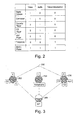
- a context is represented as a table in an array of rows and columns.
- the rows are labelled by objects, and the columns are labelled by attributes.
- a "1" indicates that an object possesses the attribute, whereas a "0" indicates absence of the attribute.
- a digital camera is associated with the attribute "Video”.
- a mobile phone is associated with the attributes "Video”, “Audio”, and "Telecommunication”.
- FIG. 2 The context in Figure 2 is commonly represented by a lattice diagram generated using Formal Concept Analysis (FCA).
- FCA Formal Concept Analysis
- FIG 3 A lattice diagram generated from the context of Figure 2 is illustrated in Figure 3 .
- Each node in the lattice diagram represents a set of zero, one or more of the attributes from the context and the set of zero, one or more of the objects from the context which has that set of attributes.
- the lattice diagram in Figure 3 begins from a common node 200, and a number of first level nodes 202, 204, 206 linked to the common node 200 by branches. Each of the first level nodes is connected to its corresponding second level node 208.
- each of the first and second level nodes is associated with a product (or set of products) (for example: digital camera (DC), telephone, or mp3 player (mp3)), and each product (or set of products) associated with a node has all of the attributes associated with the same node (e.g. node 202 is associated with the sole attribute Video (V) and the products Digital Camera (DC) and Camcorder (C)).
- each node is shaded to represent an associated object (or set of objects).
- the upper half of a node is "cross hatched" to represent the highest node corresponding to an attribute.
- the second level node 208 in this example is associated with all three attributes (Video (V), Telecommunication (T), and Audio (A)) and with the (single) device with all the three attributes (the Mobile Phone MP).
- categorisation of data items may be based on subjective criteria, rather than objective definitions. For example, in categorising data relating to films, there is no clear definition as to whether a film falls in a specific category, such as comedy or drama. Fuzzy set theory that applies graded membership to objects in a context is generally used to categorise this type of data. The graded membership simply assigns "0" and "1" to correspond to non-membership and full membership respectively, and any number in the range of 0 to 1 to represent an ordered scale of intermediate membership.
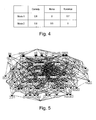
- FIG. 4 An example of the fuzzy set theory applied to data relating to films is illustrated in Figure 4 .
- a graded membership is used to indicate the scale in which an object possesses an attribute, and a "0" indicates absence of the attribute.
- a romantic comedy (Movie 1) may be graded as "0.8" under comedy, and "0.7” under romance.
- the context in Figure 4 can be represented by a lattice diagram generated using fuzzy FCA.
- a lattice diagram generated from a context determined based on fuzzy set theory is illustrated in Figure 5 .
- a fuzzy formal concept lattice can be very complex, due to a large number of concepts which differ slightly in membership. The complex appearance of the lattice diagram is unlikely to provide useful information to a user.
- a complex and large lattice requires more memory and is computationally less efficient.
- it is desirable to reduce the size of a lattice diagram such that it is represented in a useful and manageable form. It is also desirable to retrieve data from a data source in an efficient manner.
- the invention provides a method for processing data items in a data source, and an equivalent apparatus. More specifically, the method reduces a lattice representation of data items in a data source.
- the method comprises the steps of retrieving data items from the data source and determining a context defining relationships between data items and one or more properties associated with the data items.
- An initial lattice data structure is generated based on the determined context.
- the size of the lattice is reduced by dividing the initial lattice data structure into a plurality of subgroup lattice, reducing the size of each of the subgroups of lattice, and combining them to form a reduced lattice data structure.
- the invention provides a data structure that is less complex and represents more relevant, useful information.
- the data also occupy less memory space and subsequent operations on or using the data are computationally more efficient. For example, in an online shopping recommendation system, "outlier" purchases would tend to be ignored by the recommendation system, thereby providing the shopper with more relevant recommendations.
- the reduced data can also be stored on a handheld device without occupying significant memory space.
- a method for processing data items in a data source wherein each of the data items comprises one or more properties associated therewith, the method comprising determining a context defining relationships between the data items and the associated one or more properties, generating an initial lattice data structure based on said context, wherein said initial lattice comprises a plurality of nodes, a node representing one of said one or more properties, and one or more data items are associated with nodes of said plurality of nodes such that data items that are associated with the same node are associated with the same property, and reducing the initial lattice by removing nodes within the initial lattice such that the number of nodes in the reduced lattice is less than the number of nodes in the initial lattice.
- the step of reducing the initial lattice may further comprise the step of dividing said initial lattice into a plurality of subgroups of lattice such that a subgroup of lattice comprises a subset of said plurality of nodes, and applying lattice reduction to reduce one or more of said subgroup of lattice.
- the nodes in said subgroup of lattice are within a predetermined threshold distance of one another, the predetermined threshold distance representing a limit in which data items associated with nodes in a same subgroup lattice differs.
- each node in a subgroup of lattice is closely related to the objects represented by the remaining nodes in the same subgroup. Effectively, this allows objects that are closely related to be grouped together. This provides an advantage that when a search is carried out on the lattice, the search can be focused on a portion of the lattice rather than the global lattice to allow the search to be conducted more efficiently.
- Said subgroup of lattice may be reduced by extracting a minimal node of said subgroup, the minimal node having one or more data items that associate with properties represented by nodes in said subgroup.
- the minimal node of a subgroup represents the objects that have all the attributes in that subgroup, the remaining nodes in the subgroup can be removed. This results in the data occupying less memory space.
- the method may further comprise the step of combining said extracted minimal node of said subgroups of lattice to form the reduced lattice.
- the data items and the associated properties in each node may be, respectively, objects and attributes of a fuzzy set.
- the context may be represented as a table in an array of rows and columns, the rows being labelled by objects and the columns labelled by attributes.
- the method of the above aspect may further comprise receiving user input including a search query term, searching through said reduced lattice to select at least one node from the reduced lattice based on said search query term and providing an output representing at least one data item that is associated with said selected at least one node.
- a method for retrieving at least one data item rotating to a search query term comprising receiving user input including a search query term, retrieving data items from a data source, wherein each data item comprises one or more properties associated therewith, determining a context defining relationships between the data items and the associated one or more properties, generating an initial lattice data structure based on said context, wherein said initial lattice comprises a plurality of nodes, a node representing one of said one or more properties, and one or more data items are associated with nodes of said plurality of nodes such that data items that are associated with the same node are associated with the same property, reducing the initial lattice by removing nodes within the initial lattice such that the number of nodes in the reduced lattice is less than the number of nodes in the initial lattice, searching through said reduced lattice to select at least one node from the reduced lattice based on said search query term, and providing an output
- an apparatus for processing data items in a data source wherein each of the data items comprises one or more properties associated therewith, the apparatus comprising a processor operable to:
- the apparatus may further comprise a user input for receiving user input including a search query term, a searching module for searching through said reduced lattice to select at least one node from the reduced lattice based on said search query term, and a data output operable to output at least one data item that is associated with said selected at least one node.
- a system for retrieving at least one data item relating to a search query term comprising a data source for storing data items represented by a reduced lattice data structure generated by removing nodes within an initial lattice data structure such that the number of nodes in the reduced lattice is less than the number of nodes in the initial lattice, a user input device for receiving user input including a search query term, a searching module for searching through said reduced lattice to select at least one node from the reduced lattice based on said search query term, and a data output operable to output at least one data item that is associated with said selected at least one node.
- the reduced lattice data structure may comprise a plurality of nodes, a node representing one or more properties associated with one or more said data items, wherein the reduced lattice is reduced from said initial lattice by dividing said initial lattice into a plurality of subgroups of lattice such that a subgroup of lattice comprises a subset of said plurality of nodes, extracting a minimal node of said subgroup, the minimal node having one or more data items that are associated with properties represented by nodes in said subgroup, combining said extracted minimal node of each of said subgroups of lattice to form the reduced lattice.
- One embodiment provides a computer program product comprising computer executable instructions which, when executed by a computer, cause the computer to perform a method as set out above.
- the computer program product may be embodied in a carrier medium, which may be a storage medium or a signal medium.
- a storage medium may include optical storage means, or magnetic storage means, or electronic storage means.
- the described embodiments can be incorporated into a specific hardware device, a general purpose device configure by suitable software, or a combination of both.
- Aspects can be embodied in a software product, either as a complete software implementation, or as an add-on component for modification or enhancement of existing software (such as a plug in).
- Such a software product could be embodied in a carrier medium, such as a storage medium (e.g. an optical disk or a mass storage memory such as a FLASH memory) or a signal medium (such as a download).
- Specific hardware devices suitable for the embodiment could include an application specific device such as an ASIC, an FPGA or a DSP, or other dedicated functional hardware means.
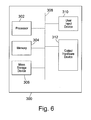
- FIG. 6 is a block diagram showing an apparatus according to an embodiment of the invention.
- the apparatus 300 comprises a processor 302 operable to execute machine code instructions stored in a working memory 304 and/or retrievable from a mass storage device 306.
- the mass storage device 306 stores data to be accessed.
- the mass storage device 306 is not part of the apparatus and in this case the apparatus includes an interface for accessing data stored in an external data source.
- the interface can comprise a port or connector to allow the apparatus to be connected to access the data source, or the interface may comprise a network interface.
- a user operable input device 310 is capable of communication with the processor 302.
- the user operable input device 310 comprises, in this example, a keyboard or a mouse though it will be appreciated that any other input devices could also or alternatively be provided, such as another type of pointing device, a touch-sensitive tablet, speech recognition means, or any other means by which a user input action can be interpreted and converted into data signals.
- Audio/video output hardware devices 312 are further connected to the general purpose bus 308, for output of information to a user.
- Audio/video output hardware devices 312 can include a visual display unit, speaker or any other device capable of presenting information to a user.
- Step S1-1 The processor 302 retrieves data items from a data source such as a mass storage device 306.
- Step S1-2 The processor 302 transforms the retrieved data items into a format that defines conceptual relationships among the data items, such as the table formats described above with reference to Figures 2 and 4 . It is noted that the method of the embodiments of the invention can be applied to objects with graded membership and objects with non-graded membership, although it is noted that greater benefit can be obtained when the method is applied to objects with graded membership, i.e. objects with fuzzy membership of a class.
- Step S1-3 The processor 302 generates an initial lattice diagram from the context of the data using FCA. It will be appreciated by the person skilled in the art that any suitable method of generating the initial lattice diagram may be employed, and therefore details of generating the initial lattice diagram by the processor 302 will not be described.
- the term "initial lattice diagram” as used herein preferably connotes a lattice diagram that is generated using data items in the data source.
- Step S1-4 The processor 302 applies lattice reduction to the initial lattice diagram generated in step S1-3. The specific method of the lattice reduction will be described in due course.
- Step S1-5 The processor 302 passes the reduced lattice back to the data source. As the number of data items represented by the reduced lattice diagram is considerable smaller than the initial lattice diagram, the data items are now stored in a relatively small area of memory.
- reduced lattice diagram as used herein preferably connotes a lattice diagram that has been reduced from the initial lattice diagram.
- the lattice reduction process performed by the processor 302, according to the process described above will now be described with reference to the flow chart of Figure 8 .
- the process begins at step S2-0.
- Step S2-1 The processor 302 divides the initial lattice diagram into subgroups of lattices. As will be described in the forthcoming paragraphs, the initial lattice diagram can be divided by clustering nodes of the initial lattice diagram.
- Step S2-2 The processor 302 applies lattice reduction to each of the subgroups to reduce the size of each subgroup.
- Figure 9 shows a subgroup lattice as an example. It will be appreciated by a person skilled in the art of FCA that each node in Figure 9 represents a combination of a set of attributes and an associated set of objects (each of which is associated with those attributes). It will be understood that each node can be uniquely identified by specifying either the associated set of objects or the associated set of attributes. In Figure 9 , each node is specified only by reference to the set of objects associated with each node. Furthermore, since Figure 9 illustrates a subgroup of a fuzzy FCA lattice each object additionally specifies a membership value to the combination of attributes associated with the respective node.
- the upper most node 400 represents the set of attributes that all objects in that subgroup have (together with all the objects in the subgroup), while the lowest node represents the set of all of the attributes associated with the subgroup (and the set of objects in the subgroup that have all the attributes).
- Two first level nodes 402, 404 are connected to the top level node 400 by branches.
- the fuzzy set in the first level node 402 is expressed as ⁇ a/0.3, d/0.1, h/0.1, i/0.9 ⁇
- the fuzzy set in the first level node 404 is expressed as ⁇ a/0.3, f/0.2, h/0.1, i/0.9 ⁇
- a second level node 406 has a fuzzy set of ⁇ a/0.3, d/0.1, i/0.9 ⁇ , and it is connected to the first level node 402.
- Another second level node 408 has a fuzzy set of ⁇ a/0.3, h/0.1, i/0/9 ⁇ , and it is connected to first level nodes 402 and 404. Finally, a third level node 410 is connected to second level nodes 406 and 408.
- the elements in the fuzzy set of the lowest node 410 are extracted and expressed as a fundamental set.
- the extracted elements, a/0.3 and i/0.9, are also common elements in all the fuzzy sets in the subgroup lattice.
- the extracted fundamental set is used as the reduced lattice to replace the subgroup of lattices.
- Step S2-3 The processor 302 replaces each of the subgroups of lattices with a corresponding reduced lattice.
- step S3-0 The process of dividing the initial lattice diagram into subgroups of lattices will now be described with reference to the flow chart of Figure 11 .
- the process begins at step S3-0.
- Step S3-1 The processor 302 generates a distance table.
- the distance table represents the distance of each node with every other node in the lattice.
- a distance between two nodes represents a value in terms of insertion, deletion or substitution that is required to take place in order to transform one node (or concept) to another node. In other words, the distance represents the difference between the objects in each node and the objects in each of the remaining nodes in the initial lattice diagram.
- Step S3-2 The processor 302 sets a predetermined common distance threshold.
- the distance threshold basically sets the limit in which the objects of a group of nodes that form a subgroup lattice should differ.
- Step S3-3 The processor 302 clusters sets of nodes that have a distance that is equal to or below the predetermined distance threshold.
- the invention provides users with a data structure that is less complex in appearance and represents more relevant, useful information.
- the method of the above described embodiment reduces the size of the initial lattice by removing redundant nodes such that reduced lattice contains only data items that represents relevant information.
- the data occupy less memory space and subsequent operations on or using the data are computationally more efficient.
- the above described methods and apparatus can be applied in a data retrieval system.
- the user input devices 310 can be configured to receive user input, such as a search query term that is related to data items in a data source.
- a search process is carried out on the reduced lattice to retrieve data items that are related to the search query. This process is illustrated in Figure 12 .
- step S4-0 commences at step S4-0.
- Step S4-1 The user input device 310 receives a user input including a search query term.
- Step S4-2 The processor 302 upon receiving the search query carries out a search in the reduced lattice.
- Step S4-3 The processor 302 selects data items that are relevant to the search query.
- Step S4-4 The processor 302 outputs the selected data items as search results.
- step S4-5 The process terminates in step S4-5.
- lattice reduction can be carried out after a search query is received. Referring to Figure 13 , the process commences at step S5-0.
- Step S5-1 The user input device 310 receives a user input defining a search query term.
- Step S5-2 The processor 302 retrieves data items from a data source.
- Step S5-3 The processor 302 transforms the retrieved data items into a context that defines conceptual relationships among the data items.
- Step S5-4 The processor 302 generates an initial lattice diagram from the context using FCA.
- Step S5-5 The processor 302 applies lattice reduction to the initial lattice diagram generated in step S5-4.
- the specific method of the lattice reduction is similar to that described in the preceding paragraphs.
- Step S5-6 The processor 302 stores the reduced lattice in the data source. As the data items represented by the reduced lattice diagram is considerably smaller than the initial lattice diagram, the search can be conducted more efficiently.
- Step S5-7 The processor 302 carries out the search in the reduced lattice.
- Step S5-8 The processor 302 selects the data items that are relevant to the search query.
- Step S5-9 The processor 302 provides an output including the selected data items to the output hardware device 312.
- the embodiments of the invention can therefore be applied to reduce the online shopping database and represent it in a reduced lattice data structure wherein each node of the reduced lattice represents a set of data objects (e.g. products) and a set of attributes.
- the recommendation mechanism Upon receiving an input indicating that a product has been purchased by a user, the recommendation mechanism carries out a search through the reduced lattice to identify any other products that share the same attribute as the purchased product. As the lattice diagram has already been reduced, the search can therefore be performed more efficiently.
- the search is carried out in a region of the reduced lattice that contains nodes that have attributes that are relevant to the attribute of the purchased product.
- the search is focused on a subset of nodes in the reduced lattice, i.e. "outlier" purchases would be ignored by the recommendation mechanism. Consequently, the selectivity of the search result is improved and the search is carried out in a shorter time.
Landscapes
- Engineering & Computer Science (AREA)
- Theoretical Computer Science (AREA)
- Data Mining & Analysis (AREA)
- Databases & Information Systems (AREA)
- Physics & Mathematics (AREA)
- General Engineering & Computer Science (AREA)
- General Physics & Mathematics (AREA)
- Software Systems (AREA)
- Computational Linguistics (AREA)
- Automation & Control Theory (AREA)
- Artificial Intelligence (AREA)
- Fuzzy Systems (AREA)
- Evolutionary Computation (AREA)
- Computing Systems (AREA)
- Mathematical Physics (AREA)
- Information Retrieval, Db Structures And Fs Structures Therefor (AREA)
Priority Applications (4)
| Application Number | Priority Date | Filing Date | Title |
|---|---|---|---|
| EP12250077.0A EP2645274A1 (fr) | 2012-03-29 | 2012-03-29 | Appareil et procédé de traitement de données pour réduire des diagrammes de treillis |
| PCT/GB2013/000144 WO2013144552A1 (fr) | 2012-03-29 | 2013-03-28 | Traitement de données, appareil et procédés |
| EP13713943.2A EP2831771A1 (fr) | 2012-03-29 | 2013-03-28 | Traitement de données, appareil et procédés |
| US14/389,299 US10289609B2 (en) | 2012-03-29 | 2013-03-28 | Data processing, apparatus and methods |
Applications Claiming Priority (1)
| Application Number | Priority Date | Filing Date | Title |
|---|---|---|---|
| EP12250077.0A EP2645274A1 (fr) | 2012-03-29 | 2012-03-29 | Appareil et procédé de traitement de données pour réduire des diagrammes de treillis |
Publications (1)
| Publication Number | Publication Date |
|---|---|
| EP2645274A1 true EP2645274A1 (fr) | 2013-10-02 |
Family
ID=48045578
Family Applications (2)
| Application Number | Title | Priority Date | Filing Date |
|---|---|---|---|
| EP12250077.0A Ceased EP2645274A1 (fr) | 2012-03-29 | 2012-03-29 | Appareil et procédé de traitement de données pour réduire des diagrammes de treillis |
| EP13713943.2A Withdrawn EP2831771A1 (fr) | 2012-03-29 | 2013-03-28 | Traitement de données, appareil et procédés |
Family Applications After (1)
| Application Number | Title | Priority Date | Filing Date |
|---|---|---|---|
| EP13713943.2A Withdrawn EP2831771A1 (fr) | 2012-03-29 | 2013-03-28 | Traitement de données, appareil et procédés |
Country Status (3)
| Country | Link |
|---|---|
| US (1) | US10289609B2 (fr) |
| EP (2) | EP2645274A1 (fr) |
| WO (1) | WO2013144552A1 (fr) |
Cited By (1)
| Publication number | Priority date | Publication date | Assignee | Title |
|---|---|---|---|---|
| CN112966236A (zh) * | 2021-03-03 | 2021-06-15 | 广东粤安科技股份有限公司 | 智慧消防管理系统及方法 |
Families Citing this family (9)
| Publication number | Priority date | Publication date | Assignee | Title |
|---|---|---|---|---|
| US9256833B2 (en) * | 2014-01-23 | 2016-02-09 | Healthtrust Purchasing Group, Lp | Fuzzy inference deduction using rules and hierarchy-based item assignments |
| US10671917B1 (en) | 2014-07-23 | 2020-06-02 | Hrl Laboratories, Llc | System for mapping extracted Neural activity into Neuroceptual graphs |
| US10360506B2 (en) | 2014-07-23 | 2019-07-23 | Hrl Laboratories, Llc | General formal concept analysis (FCA) framework for classification |
| US10546233B1 (en) | 2014-07-23 | 2020-01-28 | Hrl Laboratories, Llc | Method and system to predict and interpret conceptual knowledge in the brain |
| EP3172701A4 (fr) * | 2014-07-23 | 2018-03-28 | HRL Laboratories LLC | Cadre d'analyse générale de concepts formels (fca) pour la classification |
| WO2016207308A1 (fr) | 2015-06-26 | 2016-12-29 | British Telecommunications Public Limited Company | Fourniture de contenu numérique |
| US11403328B2 (en) * | 2019-03-08 | 2022-08-02 | International Business Machines Corporation | Linking and processing different knowledge graphs |
| US11029806B1 (en) * | 2019-10-31 | 2021-06-08 | Nationwide Mutual Insurance Company | Digital product navigation tool |
| US20220327566A1 (en) * | 2021-04-08 | 2022-10-13 | Bank Of America Corporation | System for intelligent and adaptive real time valuation engine using lstm neural networks and multi variant regression analysis |
-
2012
- 2012-03-29 EP EP12250077.0A patent/EP2645274A1/fr not_active Ceased
-
2013
- 2013-03-28 US US14/389,299 patent/US10289609B2/en active Active
- 2013-03-28 WO PCT/GB2013/000144 patent/WO2013144552A1/fr not_active Ceased
- 2013-03-28 EP EP13713943.2A patent/EP2831771A1/fr not_active Withdrawn
Non-Patent Citations (2)
| Title |
|---|
| ANNA FORMICA: "Semantic Web search based on rough sets and Fuzzy Formal Concept Analysis", KNOWLEDGE-BASED SYSTEMS, ELSEVIER, AMSTERDAM, NL, vol. 26, 24 June 2011 (2011-06-24), pages 40 - 47, XP028394410, ISSN: 0950-7051, DOI: 10.1016/J.KNOSYS.2011.06.018 * |
| WEN ZHOU ET AL: "Fuzzy Concept Lattice Based Classifier", FOURTH INTERNATIONAL CONFERENCE ON FUZZY SYSTEMS AND KNOWLEDGE DISCOVERY, FSKD 2007, 1 August 2007 (2007-08-01), IEEE, PISCATAWAY, NJ, US, pages 598 - 602, XP031192478, ISBN: 978-0-7695-2874-8 * |
Cited By (1)
| Publication number | Priority date | Publication date | Assignee | Title |
|---|---|---|---|---|
| CN112966236A (zh) * | 2021-03-03 | 2021-06-15 | 广东粤安科技股份有限公司 | 智慧消防管理系统及方法 |
Also Published As
| Publication number | Publication date |
|---|---|
| WO2013144552A1 (fr) | 2013-10-03 |
| US10289609B2 (en) | 2019-05-14 |
| US20150066944A1 (en) | 2015-03-05 |
| EP2831771A1 (fr) | 2015-02-04 |
Similar Documents
| Publication | Publication Date | Title |
|---|---|---|
| EP2645274A1 (fr) | Appareil et procédé de traitement de données pour réduire des diagrammes de treillis | |
| Jafarkarimi et al. | A naive recommendation model for large databases | |
| US20200226133A1 (en) | Knowledge map building system and method | |
| US20140365498A1 (en) | Finding A Data Item Of A Plurality Of Data Items Stored In A Digital Data Storage | |
| Vijayarani et al. | Multimedia mining research-an overview | |
| Stewart et al. | Cross-tagging for personalized open social networking | |
| US20160364426A1 (en) | Maintenance of tags assigned to artifacts | |
| Işık | A hybrid movie recommendation system using graph-based approach | |
| US8666898B2 (en) | Visual information retrieval system for applying self organizing maps/SOM using five distinct modules that merge the best maps | |
| KR100340036B1 (ko) | 사용자 프로파일을 이용한 상품정보 필터링 장치 및 방법 | |
| Baby et al. | End to end product recommendation system with improvements in Apriori algorithm | |
| TWI582624B (zh) | 用於感知情境並推薦資訊之電子計算裝置、其方法及其電腦程式產品 | |
| CN110879853B (zh) | 信息向量化方法与计算机可读存储介质 | |
| Bodra | Processing queries over partitioned graph databases: an approach and it's evaluation | |
| KR20180018263A (ko) | 시그니처 트리를 이용한 시퀀셜 데이터 클러스터링 방법 및 시스템 | |
| KR20110055144A (ko) | 소셜 메타데이터 관리 시스템 및 방법 | |
| Hameed et al. | Business intelligence: Self adapting and prioritizing database algorithm for providing big data insight in domain knowledge and processing of volume based instructions based on scheduled and contextual shifting of data | |
| Wang et al. | The Research of Sequence Recommendation Method Based on Heterogeneous Enhanced Transformer with Multi-behavior Data | |
| Khare et al. | Perspective Analysis Recommendation System in Machine Learning | |
| CA2704396A1 (fr) | Navigation adaptative de jeux de donnees basee sur des preferences | |
| Durao et al. | A Linked Data browser with recommendations | |
| Aqle et al. | Mobile app conceptual browser: Online marketplaces information extraction | |
| Nguyen et al. | Personalized facets for faceted search using wikipedia disambiguation and social network | |
| Awan et al. | A Recommendation Engine for Predicting Movie Ratings Using a Big Data Approach. Electronics 2021, 10, 1215 | |
| Yang et al. | Integrated Recommendation for Public Cultural Service |
Legal Events
| Date | Code | Title | Description |
|---|---|---|---|
| PUAI | Public reference made under article 153(3) epc to a published international application that has entered the european phase |
Free format text: ORIGINAL CODE: 0009012 |
|
| AK | Designated contracting states |
Kind code of ref document: A1 Designated state(s): AL AT BE BG CH CY CZ DE DK EE ES FI FR GB GR HR HU IE IS IT LI LT LU LV MC MK MT NL NO PL PT RO RS SE SI SK SM TR |
|
| AX | Request for extension of the european patent |
Extension state: BA ME |
|
| STAA | Information on the status of an ep patent application or granted ep patent |
Free format text: STATUS: THE APPLICATION HAS BEEN REFUSED |
|
| 18R | Application refused |
Effective date: 20131020 |