EP2645652A1 - Empfängerarchitektur für die Blockübertragung mit bekannter Symbolablesung - Google Patents
Empfängerarchitektur für die Blockübertragung mit bekannter Symbolablesung Download PDFInfo
- Publication number
- EP2645652A1 EP2645652A1 EP12162389.6A EP12162389A EP2645652A1 EP 2645652 A1 EP2645652 A1 EP 2645652A1 EP 12162389 A EP12162389 A EP 12162389A EP 2645652 A1 EP2645652 A1 EP 2645652A1
- Authority
- EP
- European Patent Office
- Prior art keywords
- symbols
- header
- equalized
- circuit
- frequency domain
- Prior art date
- Legal status (The legal status is an assumption and is not a legal conclusion. Google has not performed a legal analysis and makes no representation as to the accuracy of the status listed.)
- Withdrawn
Links
- 230000005540 biological transmission Effects 0.000 title description 13
- 238000001914 filtration Methods 0.000 claims abstract description 3
- 238000006243 chemical reaction Methods 0.000 claims description 6
- 125000004122 cyclic group Chemical group 0.000 description 19
- 238000013459 approach Methods 0.000 description 16
- 230000003044 adaptive effect Effects 0.000 description 15
- 239000011159 matrix material Substances 0.000 description 12
- 238000012545 processing Methods 0.000 description 12
- 239000013598 vector Substances 0.000 description 10
- 238000003775 Density Functional Theory Methods 0.000 description 9
- 230000008901 benefit Effects 0.000 description 9
- 238000000034 method Methods 0.000 description 8
- 238000007476 Maximum Likelihood Methods 0.000 description 5
- 238000013461 design Methods 0.000 description 5
- 230000006978 adaptation Effects 0.000 description 4
- 238000004891 communication Methods 0.000 description 3
- 230000002596 correlated effect Effects 0.000 description 3
- RPICHNHPPUQIHI-UHFFFAOYSA-N 4,6-dichloro-7-(2,4,5-trichlorophenoxy)-2-(trifluoromethyl)-1h-benzimidazole Chemical compound C=12NC(C(F)(F)F)=NC2=C(Cl)C=C(Cl)C=1OC1=CC(Cl)=C(Cl)C=C1Cl RPICHNHPPUQIHI-UHFFFAOYSA-N 0.000 description 2
- 238000010276 construction Methods 0.000 description 2
- 230000000875 corresponding effect Effects 0.000 description 2
- 230000000694 effects Effects 0.000 description 2
- 238000007493 shaping process Methods 0.000 description 2
- 238000012935 Averaging Methods 0.000 description 1
- 239000000654 additive Substances 0.000 description 1
- 230000000996 additive effect Effects 0.000 description 1
- 230000009286 beneficial effect Effects 0.000 description 1
- 239000000969 carrier Substances 0.000 description 1
- 230000015556 catabolic process Effects 0.000 description 1
- 238000004590 computer program Methods 0.000 description 1
- 238000006731 degradation reaction Methods 0.000 description 1
- 230000001419 dependent effect Effects 0.000 description 1
- 239000000796 flavoring agent Substances 0.000 description 1
- 235000019634 flavors Nutrition 0.000 description 1
- 238000013507 mapping Methods 0.000 description 1
- 230000003287 optical effect Effects 0.000 description 1
- 238000005070 sampling Methods 0.000 description 1
- 238000004088 simulation Methods 0.000 description 1
- 238000001228 spectrum Methods 0.000 description 1
- 230000003068 static effect Effects 0.000 description 1
- 230000001360 synchronised effect Effects 0.000 description 1
Images



Classifications
-
- H—ELECTRICITY
- H04—ELECTRIC COMMUNICATION TECHNIQUE
- H04L—TRANSMISSION OF DIGITAL INFORMATION, e.g. TELEGRAPHIC COMMUNICATION
- H04L25/00—Baseband systems
- H04L25/02—Details ; arrangements for supplying electrical power along data transmission lines
- H04L25/03—Shaping networks in transmitter or receiver, e.g. adaptive shaping networks
- H04L25/03006—Arrangements for removing intersymbol interference
- H04L25/03159—Arrangements for removing intersymbol interference operating in the frequency domain
-
- H—ELECTRICITY
- H04—ELECTRIC COMMUNICATION TECHNIQUE
- H04L—TRANSMISSION OF DIGITAL INFORMATION, e.g. TELEGRAPHIC COMMUNICATION
- H04L25/00—Baseband systems
- H04L25/02—Details ; arrangements for supplying electrical power along data transmission lines
- H04L25/03—Shaping networks in transmitter or receiver, e.g. adaptive shaping networks
- H04L25/03006—Arrangements for removing intersymbol interference
- H04L2025/0335—Arrangements for removing intersymbol interference characterised by the type of transmission
- H04L2025/03375—Passband transmission
- H04L2025/03414—Multicarrier
-
- H—ELECTRICITY
- H04—ELECTRIC COMMUNICATION TECHNIQUE
- H04L—TRANSMISSION OF DIGITAL INFORMATION, e.g. TELEGRAPHIC COMMUNICATION
- H04L25/00—Baseband systems
- H04L25/02—Details ; arrangements for supplying electrical power along data transmission lines
- H04L25/03—Shaping networks in transmitter or receiver, e.g. adaptive shaping networks
- H04L25/03006—Arrangements for removing intersymbol interference
- H04L2025/03592—Adaptation methods
- H04L2025/03598—Algorithms
- H04L2025/03611—Iterative algorithms
- H04L2025/03649—Algorithms using recursive least square [RLS]
-
- H—ELECTRICITY
- H04—ELECTRIC COMMUNICATION TECHNIQUE
- H04L—TRANSMISSION OF DIGITAL INFORMATION, e.g. TELEGRAPHIC COMMUNICATION
- H04L25/00—Baseband systems
- H04L25/02—Details ; arrangements for supplying electrical power along data transmission lines
- H04L25/0202—Channel estimation
- H04L25/0224—Channel estimation using sounding signals
- H04L25/0228—Channel estimation using sounding signals with direct estimation from sounding signals
Definitions
- the present invention is related to the field of receiver structures for digital communication systems wherein block transmission is applied as well as known signal padding.
- DTTB Digital Terrestrial Broadcasting System
- DTMB Digital Terrestrial Multimedia Broadcast
- block transmission schemes such as orthogonal frequency-division multiplexing (OFDM) and single carrier (SC)
- PN sequences three different known symbol padding cyclic extensions (PN sequences), some of which may have phase rotation between blocks (thus breaking the cyclicity), three FEC coding rates, five constellation mappings, two interleaver depths.
- PN sequences symbol padding cyclic extensions
- the block sizes with or without cyclic extension are cumbersome 'non-power of two' numbers. This results in hundreds of operational modes to support standard and high definition TV terrestrial broadcasting services, with rates up to 32.486 Mbps in a channel bandwidth of 7.56 MHz.
- DTMB adopts known symbol padding (KSP) as the cyclic extension for both SC block transmission and OFDM.
- KSP symbol padding
- this scheme is referred to in the DTMB literature as Time Domain Synchronous OFDM (TDS-OFDM), as opposed to the more conventional cyclic-prefix OFDM (CP-OFDM).
- a high performance receiver for DTMB is of importance for two reasons. From a more industrial point of view, TV and TV chipset manufacturers nowadays want to build multi-standard products that can be sold all over the world, thus supporting all digital broadcasting standards, including the Chinese one. Further, it is a challenging task to design a receiver signal processing architecture, because the frame structure does not contain any preamble and the channel estimation can only be based on the embedded cyclic extensions that are corrupted by the preceding data part in long multipath environment. Hence, excellent performance and low complexity are not easily achieved.
- the present invention deals with channel estimation and equalization for all modes of DTMB.
- DTMB is an important application field of the present invention, a brief description of that system is now provided. Only the modulation, block transmission, cyclic extension and the pulse shaping are detailed.
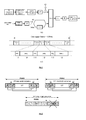
- the DTMB frame generation is illustrated in Fig. 1(a) .
- bits are mapped onto QAM constellations and inserted in frames.
- Each frame contains a frame header (FH) and a frame body (FB).
- the FB is obtained from the inverse discrete Fourier transform (IDFT) of size 3780 of the data block. All sub-carriers are then loaded and their spacing is 2 kHz.
- the frame is upsampled and filtered with a square root raised cosine (SRRC) filter with a roll-off factor of 5%. This shapes the transmitted spectrum and limits the bandwidth of the transmitted signal to 8 MHz.
- SRRC square root raised cosine
- the FH contains one out of three possible PN sequences of length 420, 595 or 945 (in short PN420, PN595 and PN945), respectively.
- the design of the PN sequences is illustrated in Fig. 2 .
- the PN595 sequence is constructed differently. It is obtained by truncation of a length 1023 m-sequence to a length 595. Hence, this sequence has bad auto-correlation properties.
- the PN595 sequence is never rotated nor is it boosted by 3dB.
- the FH is modulated by Quadrature BPSK, which simply means that the same value is mapped on the I and Q axes.
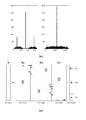
- the PN420 and PN945 sequences have similar correlation properties because they are designed in the same way. If one of those sequences is correlated against its mother m-sequence, it exhibits a zone of low correlation sidelobes (-1) around the main peak (corresponding to the prefix and postfix) but it will also exhibit some unwanted "noise like” correlation sidelobes beyond that zone and two unwanted smaller peaks. Fig. 3 (left) illustrates this. As for the PN595, because it is a truncated m-sequence, it has everywhere unwanted "noise like” correlation sidelobes as is visible in Fig.3 (right).
- a main application of the proposed solution relates to the Chinese standard for digital terrestrial television.
- this invention relates to a circuit for frequency domain equalization of a received block of symbols, said received block comprising a header with known symbols and a body.
- the circuit comprises
- the proposed equalizer circuit is highly beneficial for processing a received block of symbols that comprises a header with known symbols and a body. Irrespective of the modulation scheme (e.g. single carrier or OFDM) transmitted blocks of symbols are processed which have a header containing known symbols. This is one of the design options, which allow for a data-aided and decision-directed approach. According to the invention both the header (i.e. the cyclic extension of the body) and the body are still available after equalization. Both are exploited when determining an updated estimation of the frequency channel response. Due to the fact that also the equalized header is available for adaptive processing, a good performance can be achieved.
- the modulation scheme e.g. single carrier or OFDM
- the circuit comprises conversion means for converting the time-domain converted equalized body to the frequency domain, thereby obtaining the block of symbols at the input of the slicer and for converting the body error.
- the conversion means are provided in one of two parallel possible signal paths, whereby the path with the conversion means is for the OFDM processing and the other, parallel path is a simple through-connection, which is used in case single carrier modulation is applied.
- the updating section is preferably arranged for performing the equalization according to a recursive least-squares (RLS) algorithm.
- RLS least-squares
- the least mean squares adaptation rule can be used.
- any other adaptation rule can be used.
- the header with known symbols is a Pseudo-Noise, PN, sequence.
- a correlation-based approach is preferably adopted.
- the PN sequence received in the header is thereby correlated with the known PN sequence which was transmitted.
- maximum likelihood estimation can be applied, although that involves more complexity than a correlation. It is an asset of the proposed solution that even with such a simple initial correlation-based channel estimation, which may yield a poor result, it is still possible to obtain a good performance due to the adaptive equalization.
- the received block of symbols comprises an Orthogonal Frequency Division Multiplexing signal or wherein the received block of symbols is a single-carrier modulated block.
- the invention in another aspect relates to a receiver structure comprising a circuit for frequency domain equalization as previously described.
- the receiver structure further comprises a circuit for cancelling a rotation applied to a PN sequence in the header at the transmitter side.
- the circuit for cancelling the rotation is advantageously arranged for taking into account said channel estimation.
- the receiver structure further comprises a tracking circuit adapted for compensating unwanted signal rotation due to carrier frequency offset, whereby the tracking circuit is arranged for being fed with said equalized header.
- the receiver structure is adapted for operating according to the digital television terrestrial broadcasting system standard GB20600-2006 .
- One of the most important benefits of the proposed solution is that it can deal with all possible operational modes of said standard.
- Fig.1 represents the DTMB frame generation (a) and super-frame construction (b).
- Fig.2 represents the construction of PN sequences.
- Fig.3 represents the autocorrelation of the PN420 (left) and PN595 (right) sequences, respectively.
- Fig.4 illustrates the vectors and matrices of the applied matrix model.
- Fig.5 represents the global signal processing architecture according to the present invention.
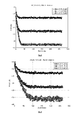
- Fig.6 illustrates EVM in SC mode with PN595 in the Brazil A channel.
- Fig.7 illustrates EVM in OFDM mode with PN420 in the Brazil A channel.
- Fig.8 illustrates the channel estimation MSE in SC mode with PN595 in the Brazil A channel.
- Fig.9 illustrates EVM in SC mode with PN595 in the ATSC R22 Ensemble 3 channel.
- Fig.10 illustrates channel estimation in SC mode with PN595 in the ATSC R22 Ensemble 3 channel.
- Fig.11 illustrates channel estimation in OFDM mode with PN420 in the ATSC R22 Ensemble 3 channel.
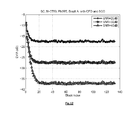
- Fig.12 illustrates EVM in SC mode with PN595 in the Brazil A channel, with CFO and SCO equal to 0.1ppm.
- ⁇ ( n ) are the complex white Gaussian noise samples of variance ⁇ 2 n .
- the symbols are organized in data blocks of size N.
- H FH is an M ⁇ G lower triangular Toeplitz matrix with [0 .... 0, h ( L -1) ... h (0)] on the last row
- H IBI is an M xG upper triangular Toeplitz matrix with [0 ... 0, h ( L -1) ... h (1)] on the first row.
- Those channel matrices and the vectors from (3) are illustrated in Fig.4 .
- the channel matrix For simple equalization in the frequency domain, the channel matrix must be made circulant, as circulant matrices have the property to be diagonalized by Fourier matrices. In that case, equalization in the FD is simply a complex multiplication per sub-carrier. Given the received signal (3) and assuming that the channel is known (or estimated), there are two possible approaches to make the channel matrix circulant, namely the ZP receiver or the KSP receiver.
- both the effect of p k and p k -1 must be removed from x k , since the signal was not transmitted as a ZP block transmission. This is achieved by computing x ZP k as: In the ZP receiver approach, since the signal was not transmitted as a ZP block transmission, both the effect of p k and p k -1 must be removed from x k .
- x KSP k x ⁇ k + H ⁇ ⁇ IBI ⁇ p ⁇ k - p ⁇ k - 1
- x ZP k has length M and the circulant matrix has dimension M ⁇ M.
- a DFT of size M is used to transform to the FD for equalization.
- the cyclic extension is also equalized, which is of great value for adaptive equalization and tracking.
- the OFDM FD symbols are not directly available after equalization in the KSP approach because the DFT does not have the size N. It is to be noted that the conversions to KSP (6) (just as those to ZP (4)) are expressed in matrix form but they actually require convolutions of sequences of length G at most.
- the global signal processing architecture of the invention is illustrated in Fig. 5.
- the algorithm is described by equations (7) to (9) for the initialization and (10) to (22) for the adaptive equalization in SC mode.
- Equations (23) to (26) describe the equations that are specific to the OFDM mode.
- the tracking and PN rotation cancellation are described separately. Note that it is assumed that an acquisition block has performed timing acquisition and compensated for carrier frequency offset (CFO) and sampling clock offset (SCO) with an accuracy of 1 ppm.
- CFO carrier frequency offset
- SCO sampling clock offset
- the equalizer is initialized with the inverse of the size M DFT of the estimated channel response; in (7), ⁇ is appended with 0s to have length M, if needed.
- f ⁇ ⁇ 0 f ⁇ 0 m ... f ⁇ 0 ⁇ M - 1
- the k th received block is transformed by a size M DFT to the FD (10), equalized (11) and transformed back to time domain (TD) by a size M IDFT (12).
- This provides both the equalized FB (13) and equalized FH (14).
- the error on the data (or FB) is computed by computing the difference (16) between the equalized FB and its sliced value (15); ⁇ ⁇ ⁇ denotes the slicing or hard decision operation in (15).
- the error on the FH can be directly computed as the difference (17) between the known FH and the equalized FH.
- the total TD error vector is the vertical concatenation of the FB error and FH error (18).
- the TD error vector is converted to the FD by a size M DFT (19).
- the equalizer update is achieved by (20) if a least mean square (LMS) algorithm is used or by (21) and (22) if a recursive least squares (RLS) algorithm is used.
- LMS least mean square
- RLS recursive least squares
- Other adaptive algorithms can of course be used.
- the algorithms described here are hybrid data-aided (DA) (17) and decision-directed (DD) (16). It is also possible to have the adaptive equalizer working only in data-aided mode.
- the switching between DA and hybrid DA-DD operation can be based on a signal-to-noise ratio (SNR) estimation e.g. on the equalized FH.
- SNR signal-to-noise ratio
- the equalized TD signal y k from (12) cannot be used directly because the data must be extracted in the FD. Hence, equations (13), (15), (16) and (18) must be replaced by equations (23) to (26).
- the TD signal y k must be transformed to the FD by a length N DFT (23). Then the slicing can be applied (24) and the FB error can be calculated (25) and converted back to TD (26).
- the PN rotation cancellation is needed if the PN rotation of PN420 or PN945, as previously described, is applied. This is presumably only applied in OFDM mode but this is not a mandatory for the algorithm.
- the algorithm implements the compensation described in (6).
- the convolution in (6) represented by H IBI ⁇ ( p k - p k -1 ) is computed in the FD.
- the equalized FH (14) can be used to estimate and compensate the unwanted rotation of the signal due to residual CFO and phase noise.
- Many tracking algorithms available in the literature can be used here. Due to the nature of the available reference signal (the FH) a TD tracking loop with a phase/frequency accumulator and a numerically controlled oscillator (NCO) is preferable.
- results are shown of both the SC and OFDM system in the Brazil-A channel (Table II).
- the error vector magnitude (EVM) at the output of the equalizer is shown in Fig. 6 for SC with PN595 and Fig. 7 for OFDM with PN420.
- the EVM is measured on the equalized FH. SNR values of 20, 30 and 40 dB were simulated.
- the mean squared error (MSE) of the estimated channel is also shown in Fig. 8 for the SC case.
- the impressive performance of the adaptive equalizer is clearly visible: at the start of the adaptation, the MSE is limited to about -15dB by the poor auto-correlation properties of the PN595 sequence.
- Fig. 9 the EVM performance is shown of SC with PN595 under the ATSC R22 Ensemble 3 channel (Table III). This is one of the harshest channels discussed in the Digital TV literature because it has a strong echo after 40 ⁇ s.
- Fig. 10 shows the ideal channel response together with the initial channel estimation and the channel estimation after adaptation for an SNR of 20dB.
- the adaptive equalizer brings the initial MSE from -2dB to -28dB.
- the same plot is provided in Fig. 11 for the OFDM case with PN420.
- the initial MSE is better because of the better autocorrelation properties of the PN420 but the late echo is not at all estimated initially.
- the adaptive equalizer is able to correctly estimate this late echo.
- Fig. 12 shows the EVM performance of SC with PN595 in presence of CFO and SCO of 0.1 ppm. Compared to Fig. 6 , there is hardly any visible EVM degradation, which shows the ability of the loop to track CFO and SCO.
- a computer program may be stored/distributed on a suitable medium, such as an optical storage medium or a solid-state medium supplied together with or as part of other hardware, but may also be distributed in other forms, such as via the Internet or other wired or wireless telecommunication systems. Any reference signs in the claims should not be construed as limiting the scope.
Landscapes
- Engineering & Computer Science (AREA)
- Power Engineering (AREA)
- Computer Networks & Wireless Communication (AREA)
- Signal Processing (AREA)
- Cable Transmission Systems, Equalization Of Radio And Reduction Of Echo (AREA)
Priority Applications (2)
| Application Number | Priority Date | Filing Date | Title |
|---|---|---|---|
| EP12162389.6A EP2645652A1 (de) | 2012-03-30 | 2012-03-30 | Empfängerarchitektur für die Blockübertragung mit bekannter Symbolablesung |
| CN 201210599378 CN103368592A (zh) | 2012-03-30 | 2012-12-31 | 用于具有已知码元填充的块传输的接收机结构 |
Applications Claiming Priority (1)
| Application Number | Priority Date | Filing Date | Title |
|---|---|---|---|
| EP12162389.6A EP2645652A1 (de) | 2012-03-30 | 2012-03-30 | Empfängerarchitektur für die Blockübertragung mit bekannter Symbolablesung |
Publications (1)
| Publication Number | Publication Date |
|---|---|
| EP2645652A1 true EP2645652A1 (de) | 2013-10-02 |
Family
ID=45952942
Family Applications (1)
| Application Number | Title | Priority Date | Filing Date |
|---|---|---|---|
| EP12162389.6A Withdrawn EP2645652A1 (de) | 2012-03-30 | 2012-03-30 | Empfängerarchitektur für die Blockübertragung mit bekannter Symbolablesung |
Country Status (2)
| Country | Link |
|---|---|
| EP (1) | EP2645652A1 (de) |
| CN (1) | CN103368592A (de) |
Cited By (2)
| Publication number | Priority date | Publication date | Assignee | Title |
|---|---|---|---|---|
| US10419248B2 (en) | 2016-12-14 | 2019-09-17 | Samsung Electronics Co., Ltd | Method and apparatus for frequency domain inter-carrier interference compensation |
| CN110830409A (zh) * | 2019-11-15 | 2020-02-21 | 同方电子科技有限公司 | 外源辐射雷达参考信道估计和信道估计模型训练方法 |
Families Citing this family (1)
| Publication number | Priority date | Publication date | Assignee | Title |
|---|---|---|---|---|
| JP6490370B2 (ja) * | 2014-09-11 | 2019-03-27 | 株式会社東芝 | 歪み補償装置及び送信装置 |
Citations (4)
| Publication number | Priority date | Publication date | Assignee | Title |
|---|---|---|---|---|
| US20020037058A1 (en) * | 2000-07-07 | 2002-03-28 | Koninklijke Philips Electronics N.V. | Frequency-domain equalizer for terrestrial digital TV reception |
| US20050058193A1 (en) * | 2003-09-12 | 2005-03-17 | Icefyre Semiconductor Corporation | Frequency domain equalizer for wireless communications system |
| US20060205437A1 (en) * | 2005-03-08 | 2006-09-14 | Samsung Electronics Co., Ltd. | Apparatus and method for channel estimation in an SDMA-OFDM system |
| US20100074320A1 (en) * | 2005-10-27 | 2010-03-25 | Sung-Ik Park | Apparatus for equalizing decision feedback based on channel properties change and method therefor |
-
2012
- 2012-03-30 EP EP12162389.6A patent/EP2645652A1/de not_active Withdrawn
- 2012-12-31 CN CN 201210599378 patent/CN103368592A/zh active Pending
Patent Citations (4)
| Publication number | Priority date | Publication date | Assignee | Title |
|---|---|---|---|---|
| US20020037058A1 (en) * | 2000-07-07 | 2002-03-28 | Koninklijke Philips Electronics N.V. | Frequency-domain equalizer for terrestrial digital TV reception |
| US20050058193A1 (en) * | 2003-09-12 | 2005-03-17 | Icefyre Semiconductor Corporation | Frequency domain equalizer for wireless communications system |
| US20060205437A1 (en) * | 2005-03-08 | 2006-09-14 | Samsung Electronics Co., Ltd. | Apparatus and method for channel estimation in an SDMA-OFDM system |
| US20100074320A1 (en) * | 2005-10-27 | 2010-03-25 | Sung-Ik Park | Apparatus for equalizing decision feedback based on channel properties change and method therefor |
Non-Patent Citations (1)
| Title |
|---|
| L. GUI ET AL., IEEE TRANS. CONS. ELECTR., vol. 55, no. 3, August 2009 (2009-08-01), pages 1135 - 1140 |
Cited By (3)
| Publication number | Priority date | Publication date | Assignee | Title |
|---|---|---|---|---|
| US10419248B2 (en) | 2016-12-14 | 2019-09-17 | Samsung Electronics Co., Ltd | Method and apparatus for frequency domain inter-carrier interference compensation |
| CN110830409A (zh) * | 2019-11-15 | 2020-02-21 | 同方电子科技有限公司 | 外源辐射雷达参考信道估计和信道估计模型训练方法 |
| CN110830409B (zh) * | 2019-11-15 | 2022-02-22 | 同方电子科技有限公司 | 外源辐射雷达参考信道估计和信道估计模型训练方法 |
Also Published As
| Publication number | Publication date |
|---|---|
| CN103368592A (zh) | 2013-10-23 |
Similar Documents
| Publication | Publication Date | Title |
|---|---|---|
| Doré et al. | FBMC receiver for multi-user asynchronous transmission on fragmented spectrum | |
| CN1939017B (zh) | 用于在ofdm系统中缓解过剩延迟的时间滤波 | |
| EP1861972B1 (de) | Kanalschätzungsoptimierung | |
| Muck et al. | A pseudorandom postfix OFDM modulator-semi-blind channel estimation and equalization | |
| KR100808949B1 (ko) | Lcic-dfe를 이용한 채널 추정 방법 및 그 장치 | |
| JP2004221702A (ja) | Ofdm(直交周波数分割多重)適応等化受信方式及び受信機 | |
| Ghauri et al. | Implementation of OFDM and channel estimation using LS and MMSE estimators | |
| EP1774735A1 (de) | Pilotsignalübertragung und kanalschätzung für mehrere sender | |
| CA2644365A1 (en) | Receiver for differentially modulated multicarrier signals | |
| CN103179062B (zh) | Sc-fde系统低复杂度信道估计下的相位噪声抑制方法 | |
| US20070160159A1 (en) | Device and method of performing channel estimation for ofdm-based wireless communication system | |
| KR100764012B1 (ko) | 이동통신 시스템에서 채널의 지연확산에 따른 채널 추정장치 및 그 방법 | |
| KR101599074B1 (ko) | 직교주파수분할다중화 방식을 지원하는 수신기에서 위상 잡음 보상장치 및 방법 | |
| US20110310999A1 (en) | Dynamic Optimization of Overlap-and-Add Length | |
| Zhou et al. | Channel Estimation Based on Linear Filtering Least Square in OFDM Systems. | |
| EP2645652A1 (de) | Empfängerarchitektur für die Blockübertragung mit bekannter Symbolablesung | |
| Manhas et al. | Optimized OFDM model using CMA channel equalization for BER evaluation | |
| CN108605028B (zh) | 用于在无线通信系统中估计和校正相位误差的方法和装置 | |
| Hao et al. | MIMO TDS-OFDM for underwater acoustic communication with turbo equalization | |
| Amini et al. | Filterbank multicarrier for underwater communications | |
| Gulomjon et al. | A performance analysis of optimized semi-blind channel estimation method in OFDM systems | |
| Bourdoux et al. | A unified receiver signal processing architecture for all modes of the DTMB broadcasting system | |
| Chen et al. | Frequency domain turbo equalization with iterative channel estimation for single carrier MIMO underwater acoustic communications | |
| Saadat et al. | Matched filter based timing synchronization for orthogonal frequency division multiplexing systems | |
| Farouk et al. | Joint channel estimation for TDS-OFDM based on Superimposed Training |
Legal Events
| Date | Code | Title | Description |
|---|---|---|---|
| PUAI | Public reference made under article 153(3) epc to a published international application that has entered the european phase |
Free format text: ORIGINAL CODE: 0009012 |
|
| 17P | Request for examination filed |
Effective date: 20130329 |
|
| AK | Designated contracting states |
Kind code of ref document: A1 Designated state(s): AL AT BE BG CH CY CZ DE DK EE ES FI FR GB GR HR HU IE IS IT LI LT LU LV MC MK MT NL NO PL PT RO RS SE SI SK SM TR |
|
| AX | Request for extension of the european patent |
Extension state: BA ME |
|
| STAA | Information on the status of an ep patent application or granted ep patent |
Free format text: STATUS: THE APPLICATION IS DEEMED TO BE WITHDRAWN |
|
| 18D | Application deemed to be withdrawn |
Effective date: 20130906 |